
Coker A.K. Fortran Programs for Chemical Process Design, Analysis, and Simulation
Подождите немного. Документ загружается.

Fluid Flow 197
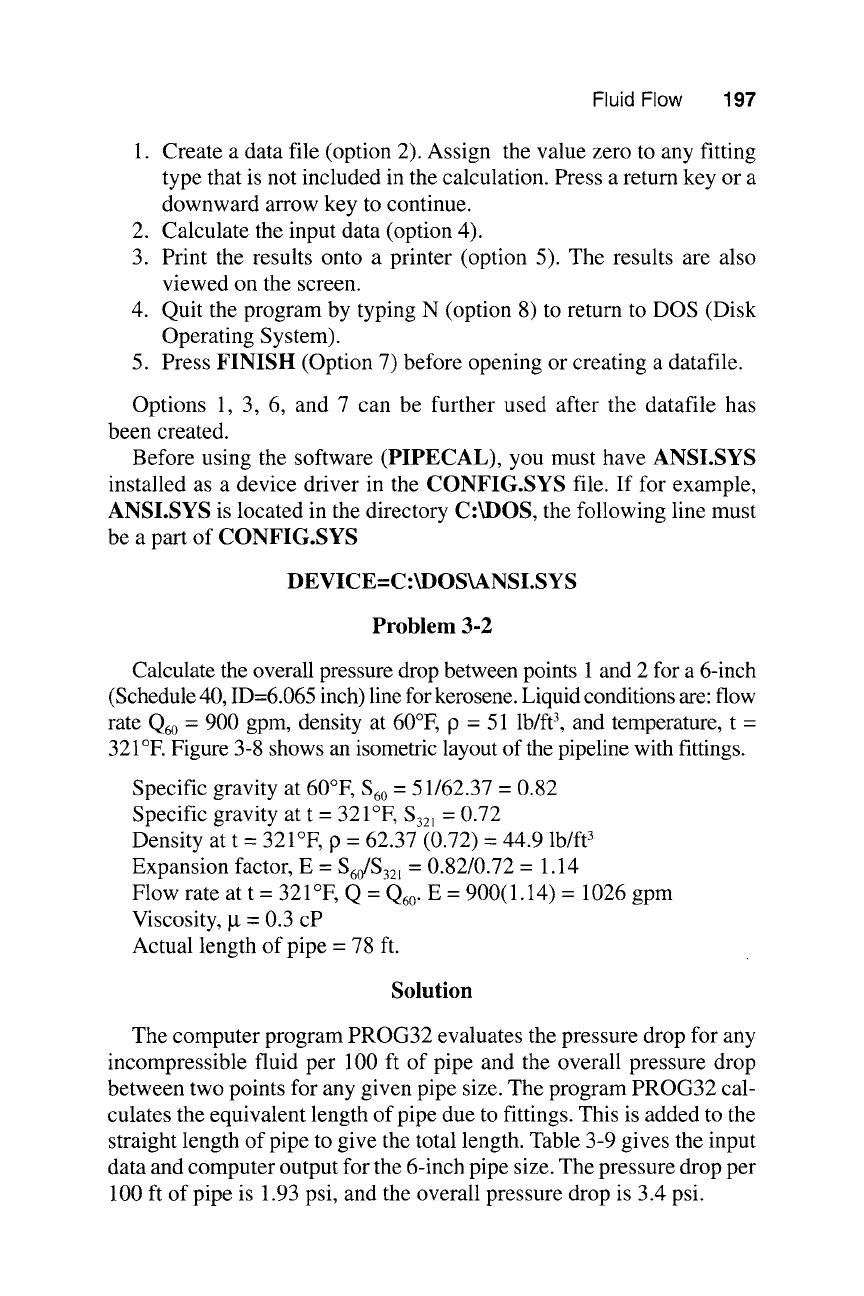
1. Create a data file (option 2). Assign the value zero to any fitting
type that is not included in the calculation. Press a return key or a
downward arrow key to continue.
2. Calculate the input data (option 4).
3. Print the results onto a printer (option 5). The results are also
viewed on the screen.
4. Quit the program by typing N (option 8) to return to DOS (Disk
Operating System).
5. Press FINISH (Option 7) before opening or creating a datafile.
Options 1, 3, 6, and 7 can be further used after the datafile has
been created.
Before using the software (PIPECAL), you must have ANSI.SYS
installed as a device driver in the CONFIG.SYS file. If for example,
ANSI.SYS is located in the directory C:kDOS, the following line must
be a part of CONFIG.SYS
DEVI CE=C: kD O SL~ N SI.SY S
Problem 3-2
Calculate the overall pressure drop between points 1 and 2 for a 6-inch
(Schedule 40, ID=6.065 inch) line for kerosene. Liquid conditions are: flow
rate Q60 =
900 gpm, density at 60~ P = 51 lb/ft 3, and temperature, t =
321 ~ Figure 3-8 shows an isometric layout of the pipeline with fittings.
Specific gravity at 60~
860 =
51/62.37 = 0.82
Specific gravity at t = 321 ~
8321 =
0.72
Density at t = 321 ~ P = 62.37 (0.72) - 44.9 lb/ft 3
Expansion factor, E = $60/$321 = 0.82/0.72 = 1.14
Flow rate at t = 321 ~ Q
= Q60. E = 900(1.14) =
1026 gpm
Viscosity, g = 0.3 cP
Actual length of pipe = 78 ft.
Solution
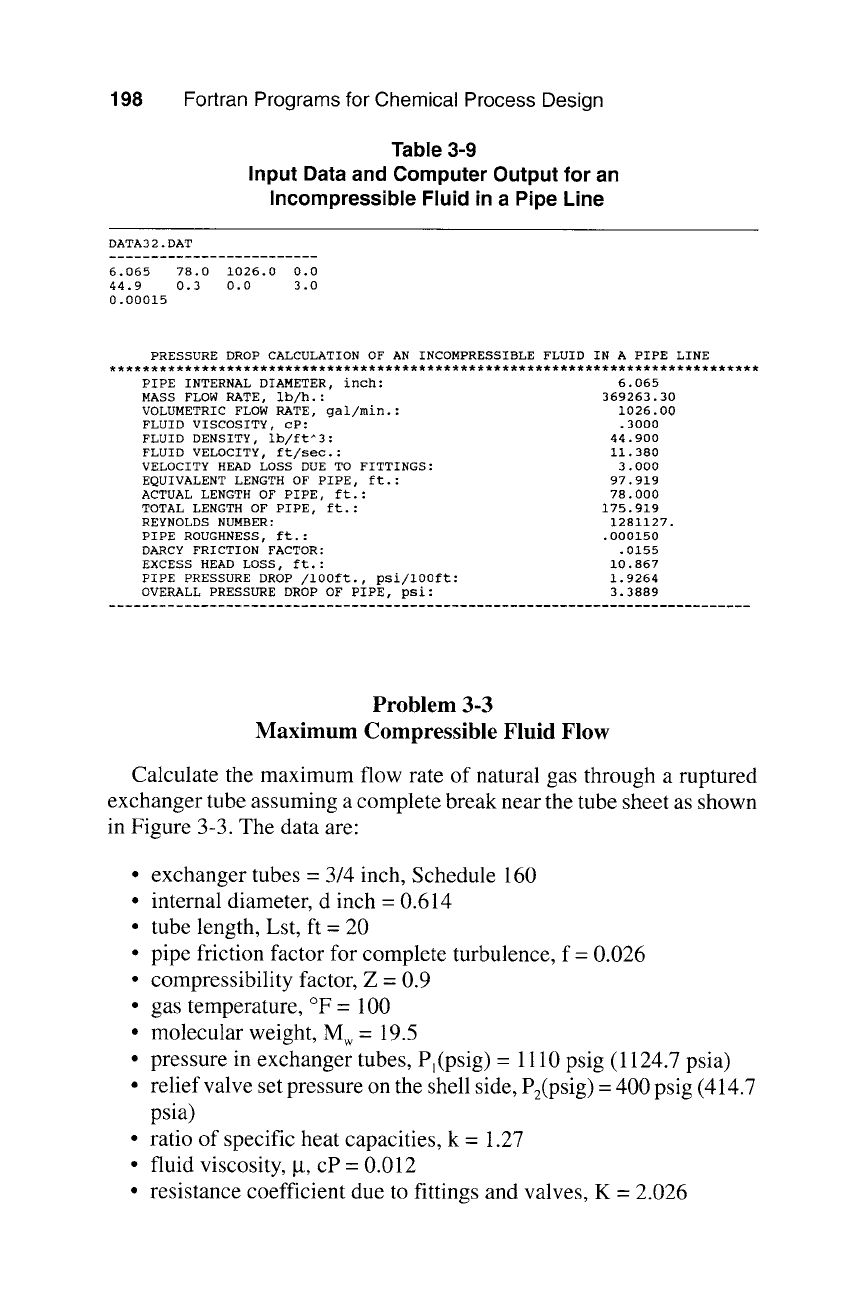
The computer program PROG32 evaluates the pressure drop for any
incompressible fluid per 100 ft of pipe and the overall pressure drop
between two points for any given pipe size. The program PROG32 cal-
culates the equivalent length of pipe due to fittings. This is added to the
straight length of pipe to give the total length. Table 3-9 gives the input
data and computer output for the 6-inch pipe size. The pressure drop per
100 ft of pipe is 1.93 psi, and the overall pressure drop is 3.4 psi.
198
Fortran Programs for Chemical Process Design
Table 3-9
Input Data and Computer Output for an
Incompressible Fluid in a Pipe Line
DATA32.DAT
6.065 78.0 1026.0 0.0
44.9 0.3 0.0 3.0
0.00015
PRESSURE DROP CALCULATION OF AN INCOMPRESSIBLE FLUID IN A PIPE LINE
PIPE INTERNAL DIAMETER,
inch:
MASS FLOW RATE, ib/h.:
VOLUMETRIC FLOW RATE,
gal/min.:
FLUID VISCOSITY,
cP:
FLUID DENSITY, ib/ft^3:
FLUID VELOCITY,
ft/sec.:
VELOCITY HEAD LOSS DUE TO FITTINGS:
EQUIVALENT LENGTH OF PIPE, ft.:
ACTUAL LENGTH OF PIPE, ft.:
TOTAL LENGTH OF PIPE, ft.:
REYNOLDS NUMBER:
PIPE ROUGHNESS, ft.:
DARCY FRICTION FACTOR:
EXCESS HEAD LOSS, ft.:
PIPE PRESSURE DROP /100ft., psi/100ft:
OVERALL PRESSURE DROP OF PIPE,
psi:
6.065
369263.30
1026.00
.3000
44.900
11.380
3.000
97.919
78.000
175.919
1281127.
.000150
.0155
10.867
1.9264
3.3889
Problem 3-3
Maximum Compressible Fluid Flow
Calculate the maximum flow rate of natural gas through a ruptured
exchanger tube assuming a complete break near the tube sheet as shown
in Figure 3-3. The data are:
9 exchanger tubes = 3/4 inch, Schedule 160
9 internal diameter, d inch = 0.614
9 tube length, Lst, ft = 20
9 pipe friction factor for complete turbulence, f = 0.026
9 compressibility factor, Z = 0.9
9 gas temperature, ~ = 100
9 molecular weight, M w = 19.5
9 pressure in exchanger tubes, Pl(psig) = 1110 psig (1124.7 psia)
9 relief valve set pressure on the shell side, P2(psig) = 400 psig (414.7
psia)
9 ratio of specific heat capacities, k = 1.27
9 fluid viscosity, ~t, cP = 0.012
9 resistance coefficient due to fittings and valves, K = 2.026
Fluid Flow 199
Solution
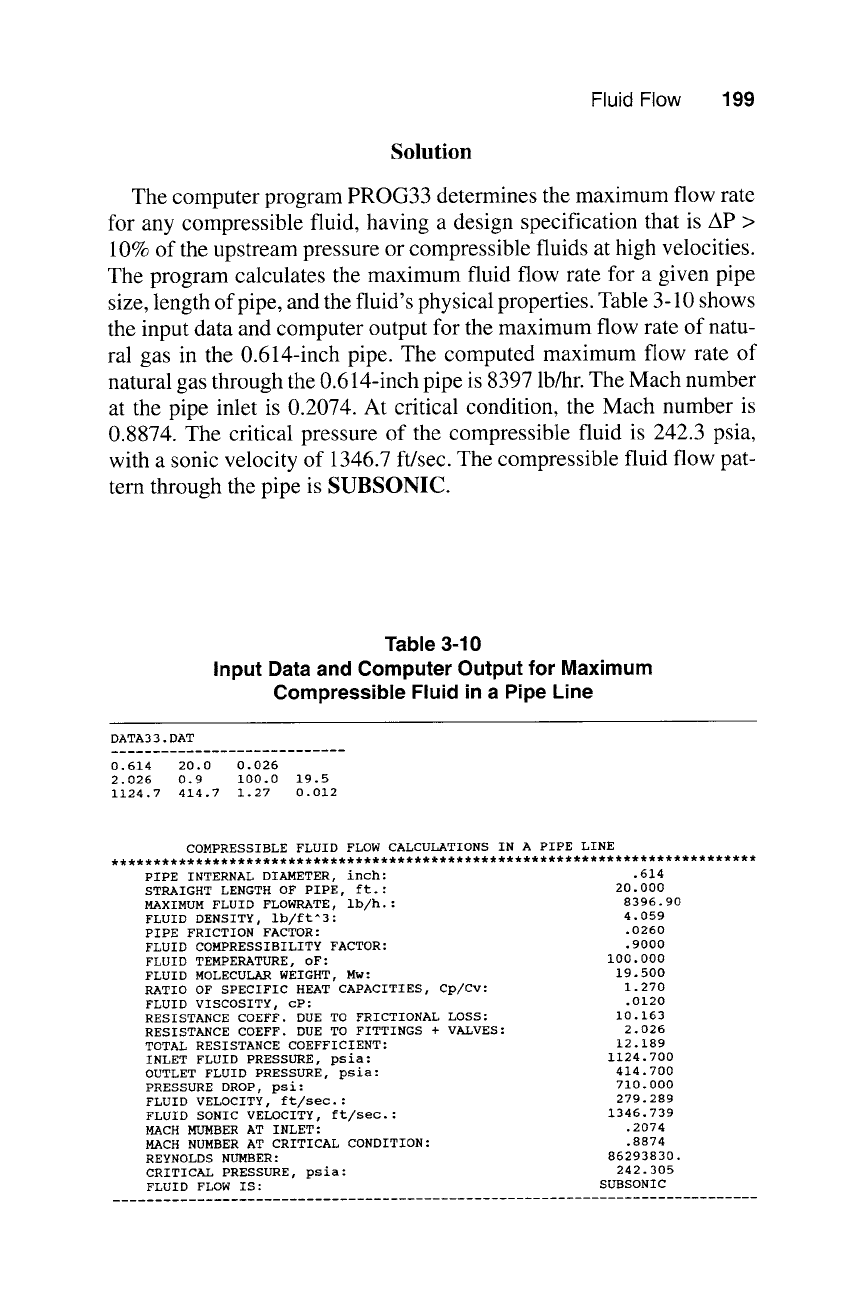
The computer program PROG33 determines the maximum flow rate
for any compressible fluid, having a design specification that is AP >
10% of the upstream pressure or compressible fluids at high velocities.
The program calculates the maximum fluid flow rate for a given pipe
size, length of pipe, and the fluid's physical properties. Table 3-10 shows
the input data and computer output for the maximum flow rate of natu-
ral gas in the 0.614-inch pipe. The computed maximum flow rate of
natural gas through the 0.614-inch pipe is 8397 lb/hr. The Mach number
at the pipe inlet is 0.2074. At critical condition, the Mach number is
0.8874. The critical pressure of the compressible fluid is 242.3 psia,
with a sonic velocity of 1346.7 ft/sec. The compressible fluid flow pat-
tern through the pipe is SUBSONIC.
Table 3-10
Input Data and Computer Output for Maximum
Compressible Fluid in a Pipe Line
DATA33.DAT
0.614 20.0 0.026
2.026 0.9 I00.0 19.5
1124.7 414.7 1.27 0.012
COMPRESSIBLE FLUID FLOW CALCULATIONS IN A PIPE LINE
PIPE INTERNAL DIAMETER,
inch:
STRAIGHT LENGTH OF PIPE, ft.:
MAXIMUM FLUID FLOWRATE, ib/h.:
FLUID DENSITY, ib/ft^3:
PIPE FRICTION FACTOR:
FLUID COMPRESSIBILITY FACTOR:
FLUID TEMPERATURE,
oF:
FLUID MOLECULAR WEIGHT,
Mw:
RATIO OF SPECIFIC HEAT CAPACITIES,
Cp/Cv:
FLUID VISCOSITY,
cP:
RESISTANCE COEFF. DUE TO FRICTIONAL LOSS:
RESISTANCE COEFF. DUE TO FITTINGS + VALVES:
TOTAL RESISTANCE COEFFICIENT:
INLET FLUID PRESSURE,
psia:
OUTLET FLUID PRESSURE,
psia:
PRESSURE DROP,
psi:
FLUID VELOCITY,
ft/sec.:
FLUID SONIC VELOCITY,
ft/sec.:
MACH MUMBER AT INLET:
MACH NUMBER AT CRITICAL CONDITION:
REYNOLDS NUMBER:
CRITICAL PRESSURE,
psia:
FLUID FLOW IS:
.614
20.000
8396.90
4.059
.0260
.9000
i00.000
19.500
1.270
.0120
10.163
2.026
12.189
1124.700
414.700
710.000
279.289
1346.739
.2074
.8874
86293830.
242.305
SUBSONIC
200
Fortran Programs for Chemical Process Design
Problem 3-4
Compressible Fluid Pressure Drop
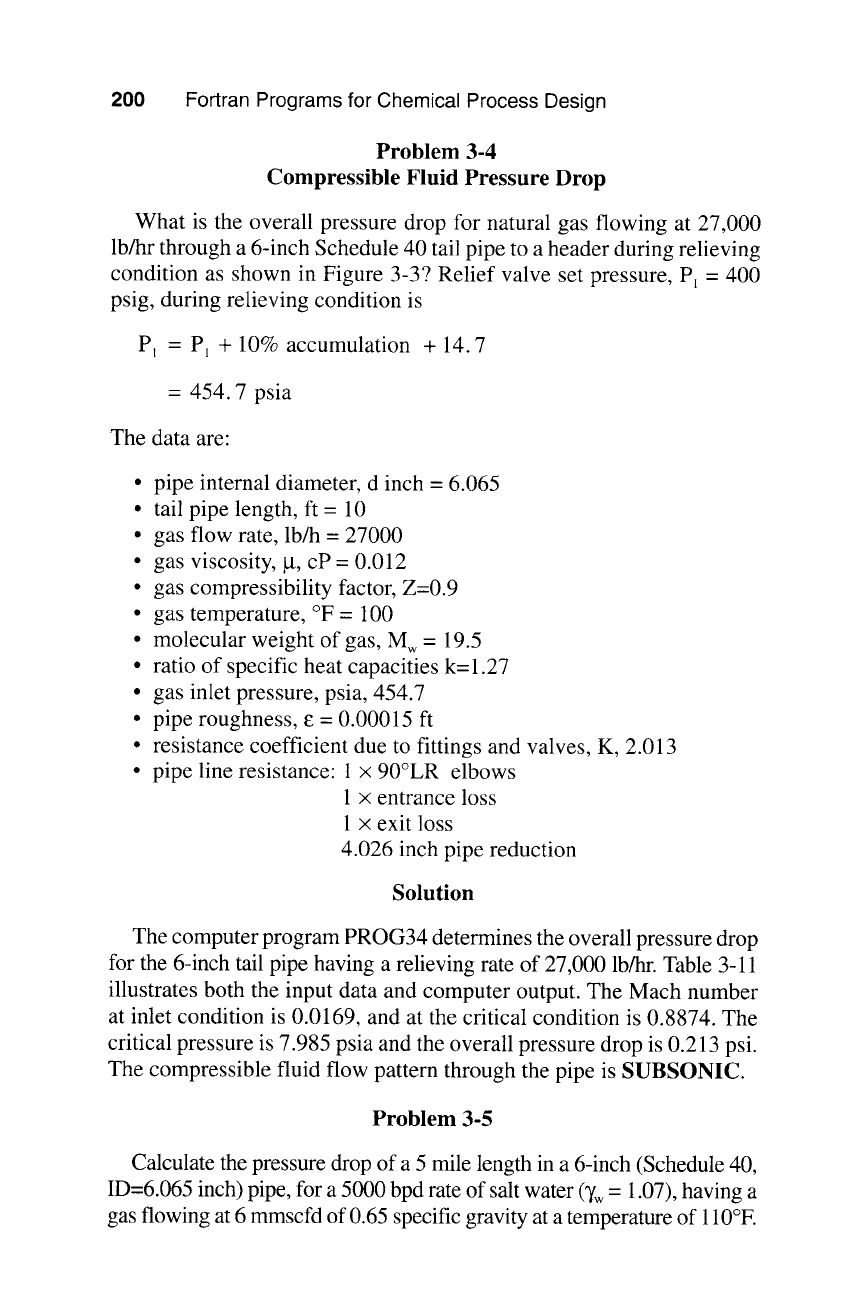
What is the overall pressure drop for natural gas flowing at 27,000
lb/hr through a 6-inch Schedule 40 tail pipe to a header during relieving
condition as shown in Figure 3-3? Relief valve set pressure, P~ = 400
psig, during relieving condition is
P~ - P1 + 10% accumulation + 14.7
= 454.7 psia
The data are:
9 pipe internal diameter, d inch = 6.065
9 tail pipe length, ft = 10
9 gas flow rate, lb/h = 27000
9 gas viscosity, g, cP = 0.012
9 gas compressibility factor, Z=0.9
9 gas temperature, ~ = 100
9 molecular weight of gas, M w = 19.5
9 ratio of specific heat capacities k= 1.27
9 gas inlet pressure, psia, 454.7
9 pipe roughness, e = 0.00015 ft
9 resistance coefficient due to fittings and valves, K, 2.013
9 pipe line resistance: 1 x 90~ elbows
1 x entrance loss
1 x exit loss
4.026 inch pipe reduction
Solution
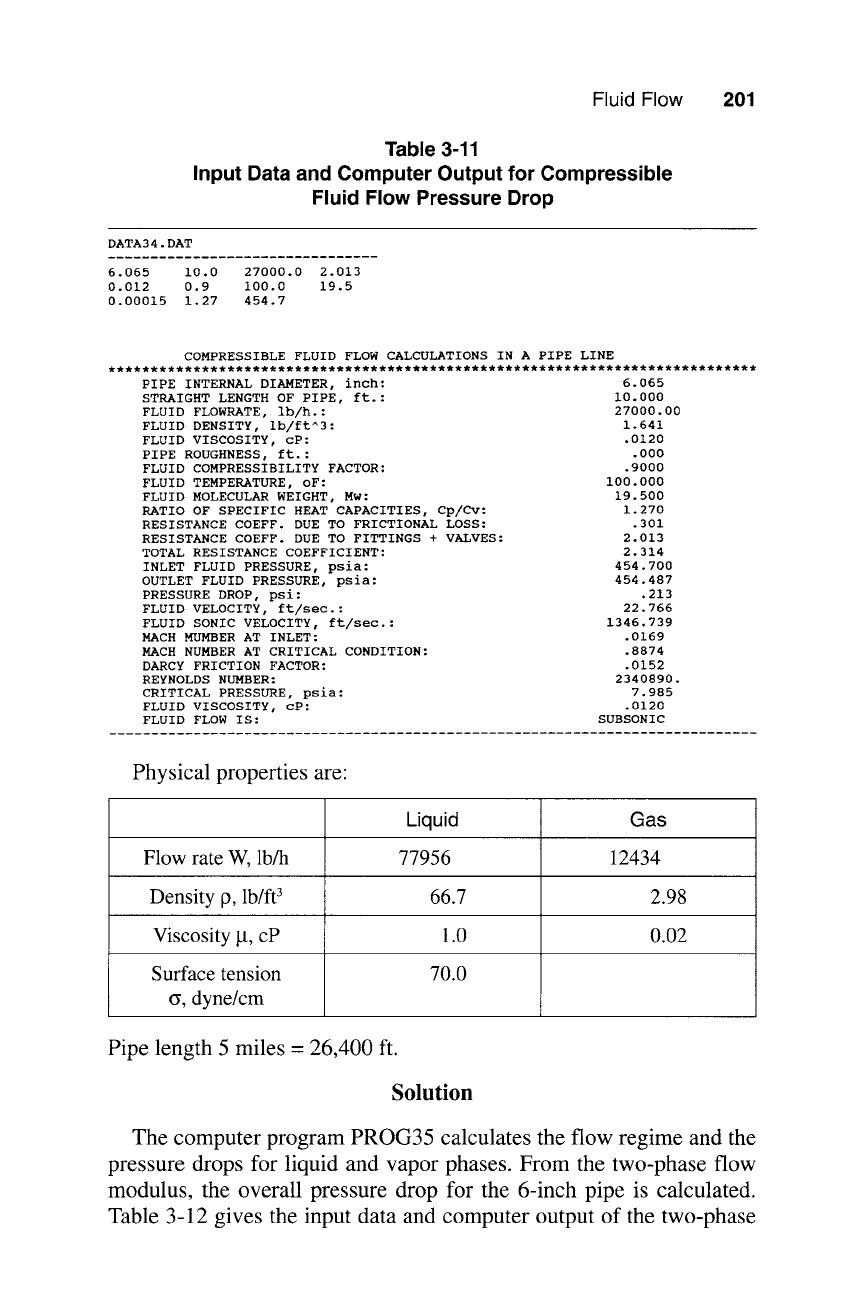
The computer program PROG34 determines the overall pressure drop
for the 6-inch tail pipe having a relieving rate of 27,000 lb/hr. Table 3-11
illustrates both the input data and computer output. The Mach number
at inlet condition is 0.0169, and at the critical condition is 0.8874. The
critical pressure is 7.985 psia and the overall pressure drop is 0.213 psi.
The compressible fluid flow pattern through the pipe is SUBSONIC.
Problem 3-5
Calculate the pressure drop of a 5 mile length in a 6-inch (Schedule 40,
ID=6.065 inch) pipe, for a 5000 bpd rate of salt water (Yw - 1.07), having a
gas flowing at 6 mmscfd of 0.65 specific gravity at a temperature of 110~
Fluid Flow 201
Table 3-11
Input Data and Computer Output for Compressible
Fluid Flow Pressure Drop
DATA34.DAT
6.065 I0.0 27000.0 2.013
0.012 0.9 i00.0 19.5
0.00015 1.27 454.7
COMPRESSIBLE FLUID FLOW CALCULATIONS IN A PIPE LINE
PIPE INTERNAL DIAMETER,
inch:
STRAIGHT LENGTH OF PIPE, ft.:
FLUID FLOWRATE, ib/h.:
FLUID DENSITY, ib/ft^3:
FLUID VISCOSITY, cP:
PIPE ROUGHNESS, ft.:
FLUID COMPRESSIBILITY FACTOR:
FLUID TEMPERATURE,
oF:
FLUID MOLECULAR WEIGHT,
Mw:
RATIO OF SPECIFIC HEAT CAPACITIES, Cp/Cv:
RESISTANCE COEFF. DUE TO FRICTIONAL LOSS:
RESISTANCE COEFF. DUE TO FITTINGS + VALVES:
TOTAL RESISTANCE COEFFICIENT:
INLET FLUID PRESSURE,
psia:
OUTLET FLUID PRESSURE,
psia:
PRESSURE DROP,
psi:
FLUID VELOCITY, ft/sec.:
FLUID SONIC VELOCITY, ft/sec.:
MACH MUMBER AT INLET:
MACH NUMBER AT CRITICAL CONDITION:
DARCY FRICTION FACTOR:
REYNOLDS NUMBER:
CRITICAL PRESSURE,
psia:
FLUID VISCOSITY, cP:
FLUID FLOW IS:
6.065
i0.000
27000.00
1.641
.0120
.000
.9000
I00.000
19.500
1.270
.301
2.013
2.314
454.700
454.487
.213
22.766
1346.739
.0169
.8874
.0152
2340890.
7.985
.0120
SUBSONIC
Physical properties are:
Flow rate W, lb/h
Density p, lb/ft 3
Viscosity g, cP
Surface tension
c~, dyne/cm
Liquid
77956
66.7
1.0
70.0
Gas
12434
2.98
0.02
Pipe length 5 miles - 26,400 ft.
Solution
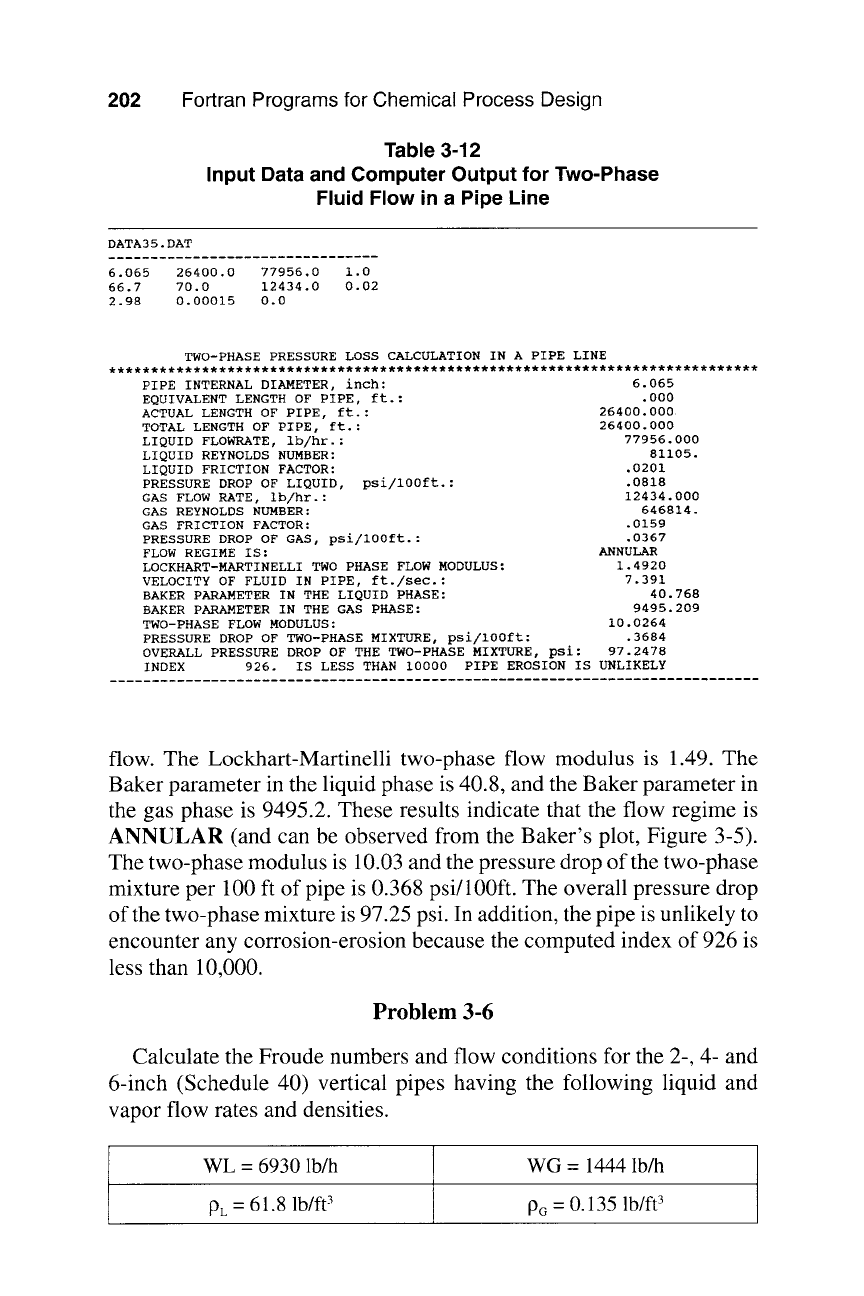
The computer program PROG35 calculates the flow regime and the
pressure drops for liquid and vapor phases. From the two-phase flow
modulus, the overall pressure drop for the 6-inch pipe is calculated.
Table 3-12 gives the input data and computer output of the two-phase
202
Fortran Programs for Chemical Process Design
Table 3-12
Input Data and Computer Output for Two-Phase
Fluid Flow in a Pipe Line
DATA35.DAT
6.065 26400.0 77956.0 1.0
66.7 70.0 12434.0 0.02
2.98 0.00015 0.0
TWO-PHASE PRESSURE LOSS CALCULATION
IN A PIPE LINE
*****************************************************************************
PIPE
INTERNAL DIAMETER, inch: 6.065
EQUIVALENT LENGTH OF
PIPE, ft.:
.000
ACTUAL LENGTH OF PIPE, ft.: 26400.000
TOTAL LENGTH OF
PIPE, ft.:
26400.000
LIQUID FLOWRATE, ib/hr.: 77956.000
LIQUID REYNOLDS NUMBER: 81105.
LIQUID FRICTION FACTOR: .0201
PRESSURE DROP OF LIQUID, psi/100ft.: .0818
GAS
FLOW RATE, ib/hr.: 12434.000
GAS REYNOLDS NUMBER: 646814.
GAS FRICTION FACTOR: .0159
PRESSURE DROP OF GAS, psi/100ft.: .0367
FLOW REGIME IS: ANNULAR
LOCKHART-MARTINELLI TWO PHASE FLOW MODULUS: 1.4920
VELOCITY OF FLUID IN
PIPE, ft./sec.:
7.391
BAKER PARAMETER
IN THE LIQUID PHASE:
40.768
BAKER PARAMETER
IN THE GAS PHASE:
9495.209
TWO-PHASE FLOW MODULUS: 10.0264
PRESSURE DROP OF TWO-PHASE MIXTURE, psi/100ft: .3684
OVERALL PRESSURE DROP OF THE TWO-PHASE MIXTURE, psi: 97.2478
INDEX
926. IS LESS THAN i0000 PIPE EROSION IS UNLIKELY
flow. The Lockhart-Martinelli two-phase flow modulus is 1.49. The
Baker parameter in the liquid phase is 40.8, and the Baker parameter in
the gas phase is 9495.2. These results indicate that the flow regime is
ANNULAR (and can be observed from the Baker's plot, Figure 3-5).
The two-phase modulus is 10.03 and the pressure drop of the two-phase
mixture per 100 ft of pipe is 0.368 psi/100ft. The overall pressure drop
of the two-phase mixture is 97.25 psi. In addition, the pipe is unlikely to
encounter any corrosion-erosion because the computed index of 926 is
less than 10,000.
Problem 3-6
Calculate the Froude numbers and flow conditions for the 2-, 4- and
6-inch (Schedule 40) vertical pipes having the following liquid and
vapor flow rates and densities.
WL - 6930 lb/h
PL -- 61.8
lb/ft 3
WG - 1444 lb/h
PG - 0.135 lb/ft 3
Fluid Flow
203
Solution
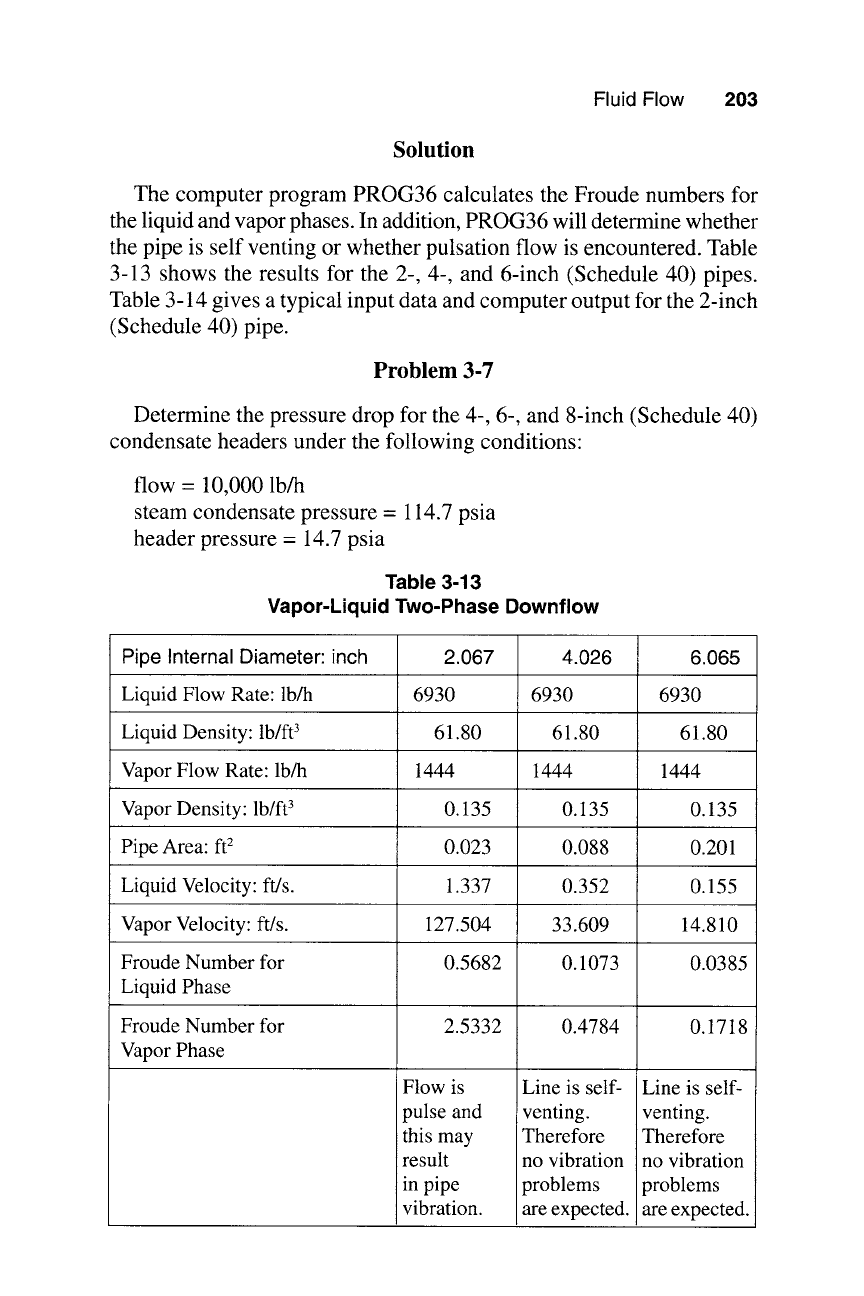
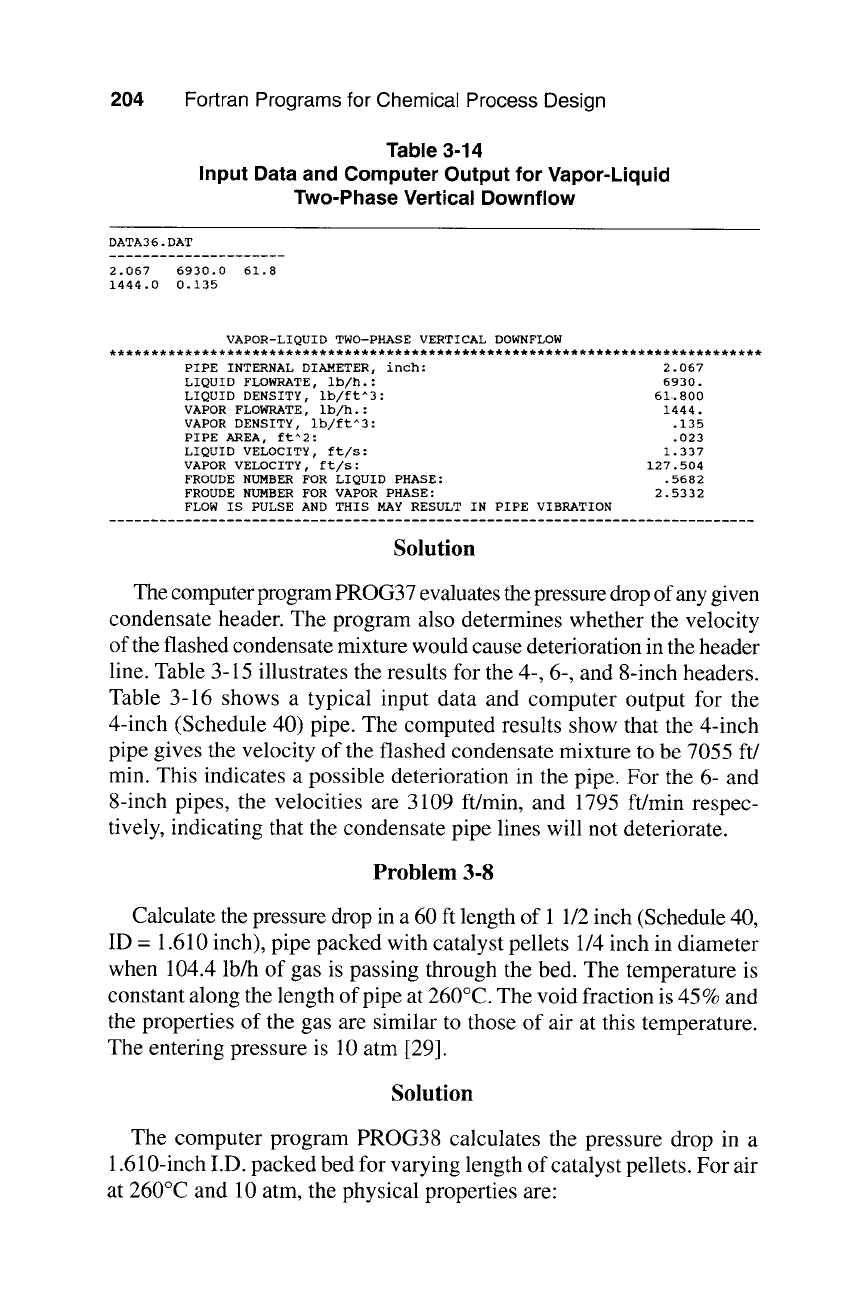
The computer program PROG36 calculates the Froude numbers for
the liquid and vapor phases. In addition, PROG36 will determine whether
the pipe is self venting or whether pulsation flow is encountered. Table
3-13 shows the results for the 2-, 4-, and 6-inch (Schedule 40) pipes.
Table 3-14 gives a typical input data and computer output for the 2-inch
(Schedule 40) pipe.
Problem 3-7
Determine the pressure drop for the 4-, 6-, and 8-inch (Schedule 40)
condensate headers under the following conditions:
flow = 10,000 lb/h
steam condensate pressure- 114.7 psia
header pressure - 14.7 psia
Table 3-13
Vapor-Liquid Two-Phase Downflow
Pipe Internal Diameter: inch
Liquid Flow Rate: lb/h
Liquid Density:
lb/ft 3
Vapor Flow Rate: lb/h
Vapor Density:
lb/ft 3
Pipe Area: ft 2
Liquid Velocity: ft/s.
Vapor Velocity: ft/s.
Froude Number for
Liquid Phase
Froude Number for
Vapor Phase
2.067
6930
61.80
1444
0.135
0.023
1.337
127.504
0.5682
2.5332
Flow is
pulse and
this may
result
in pipe
vibration.
4.026
6930
61.80
1444
0.135
0.088
0.352
33.609
0.1073
0.4784
Line is self-
venting.
Therefore
no vibration
problems
are expected.
6.065
6930
61.80
1444
0.135
0.201
0.155
14.810
0.0385
0.1718
Line is self-
venting.
Therefore
no vibration
problems
are expected.
204
Fortran Programs for Chemical Process Design
Table 3-14
Input Data and Computer Output for Vapor-Liquid
Two-Phase Vertical Downflow
DATA36.DAT
2.067 6930.0 61.8
1444.0 0.135
VAPOR-LIQUID TWO-PHASE VERTICAL DOWNFLOW
PIPE INTERNAL DIAMETER, inch:
LIQUID FLOWRATE, ib/h.:
LIQUID DENSITY, Ib/ft^3:
VAPOR FLOWRATE, Ib/h.:
VAPOR DENSITY, ib/ft^3:
PIPE AREA, ft^2:
LIQUID VELOCITY, ft/s:
VAPOR VELOCITY, ft/s:
FROUDE NUMBER FOR LIQUID PHASE:
FROUDE NUMBER FOR VAPOR PHASE:
FLOW IS PULSE AND THIS MAY RESULT IN PIPE VIBRATION
2.067
6930.
61..800
1444.
.135
.023
1.337
127.504
.5682
2.5332
Solution
The computer program PROG37 evaluates the pressure drop of any given
condensate header. The program also determines whether the velocity
of the flashed condensate mixture would cause deterioration in the header
line. Table 3-15 illustrates the results for the 4-, 6-, and 8-inch headers.
Table 3-16 shows a typical input data and computer output for the
4-inch (Schedule 40) pipe. The computed results show that the 4-inch
pipe gives the velocity of the flashed condensate mixture to be 7055 ft/
min. This indicates a possible deterioration in the pipe. For the 6- and
8-inch pipes, the velocities are 3109 ft/min, and 1795 ft/min respec-
tively, indicating that the condensate pipe lines will not deteriorate.
Problem 3-8
Calculate the pressure drop in a 60 ft length of 1 1/2 inch (Schedule 40,
ID = 1.610 inch), pipe packed with catalyst pellets 1/4 inch in diameter
when 104.4 lb/h of gas is passing through the bed. The temperature is
constant along the length of pipe at 260~ The void fraction is 45 % and
the properties of the gas are similar to those of air at this temperature.
The entering pressure is 10 atm [29].
Solution
The computer program PROG38 calculates the pressure drop in a
1.610-inch I.D. packed bed for varying length of catalyst pellets. For air
at 260~ and 10 atm, the physical properties are:
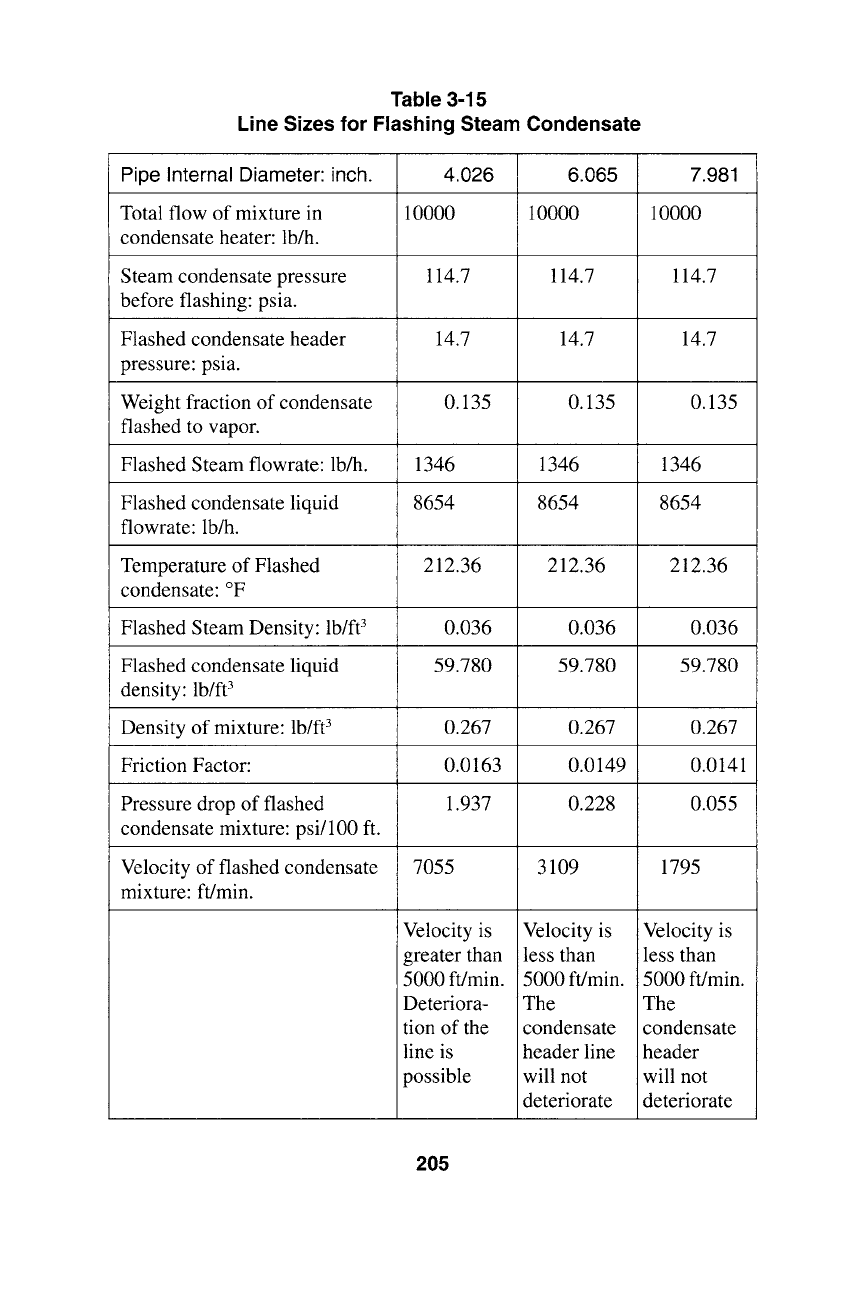
Table 3-15
Line Sizes for Flashing Steam Condensate
Pipe Internal Diameter: inch.
Total flow of mixture in
condensate heater: lb/h.
Steam condensate pressure
before flashing: psia.
Flashed condensate header
pressure: psia.
Weight fraction of condensate
flashed to vapor.
Flashed Steam flowrate: lb/h.
Flashed condensate liquid
flowrate: lb/h.
Temperature of Flashed
condensate" ~
Flashed Steam Density:
lb/ft 3
Flashed condensate liquid
density" lb/ft 3
Density of mixture" lb/ft 3
Friction Factor:
Pressure drop of flashed
condensate mixture: psi/100 ft.
Velocity of flashed condensate
mixture: ft/min.
4.026
10000
114.7
14.7
0.135
1346
8654
212.36
0.036
59.780
0.267
0.0163
1.937
7055
Velocity is
greater than
5000 ft/min.
Deteriora-
tion of the
line is
possible
6.065
10000
114.7
14.7
0.135
1346
8654
212.36
0.036
59.780
0.267
0.0149
0.228
3109
Velocity is
less than
5000 ft/min.
The
condensate
header line
will not
deteriorate
7.981
10000
114.7
14.7
0.135
1346
8654
212.36
0.036
59.780
0.267
0.0141
0.055
1795
Velocity is
less than
5000 ft/min.
The
condensate
header
will not
deteriorate
205
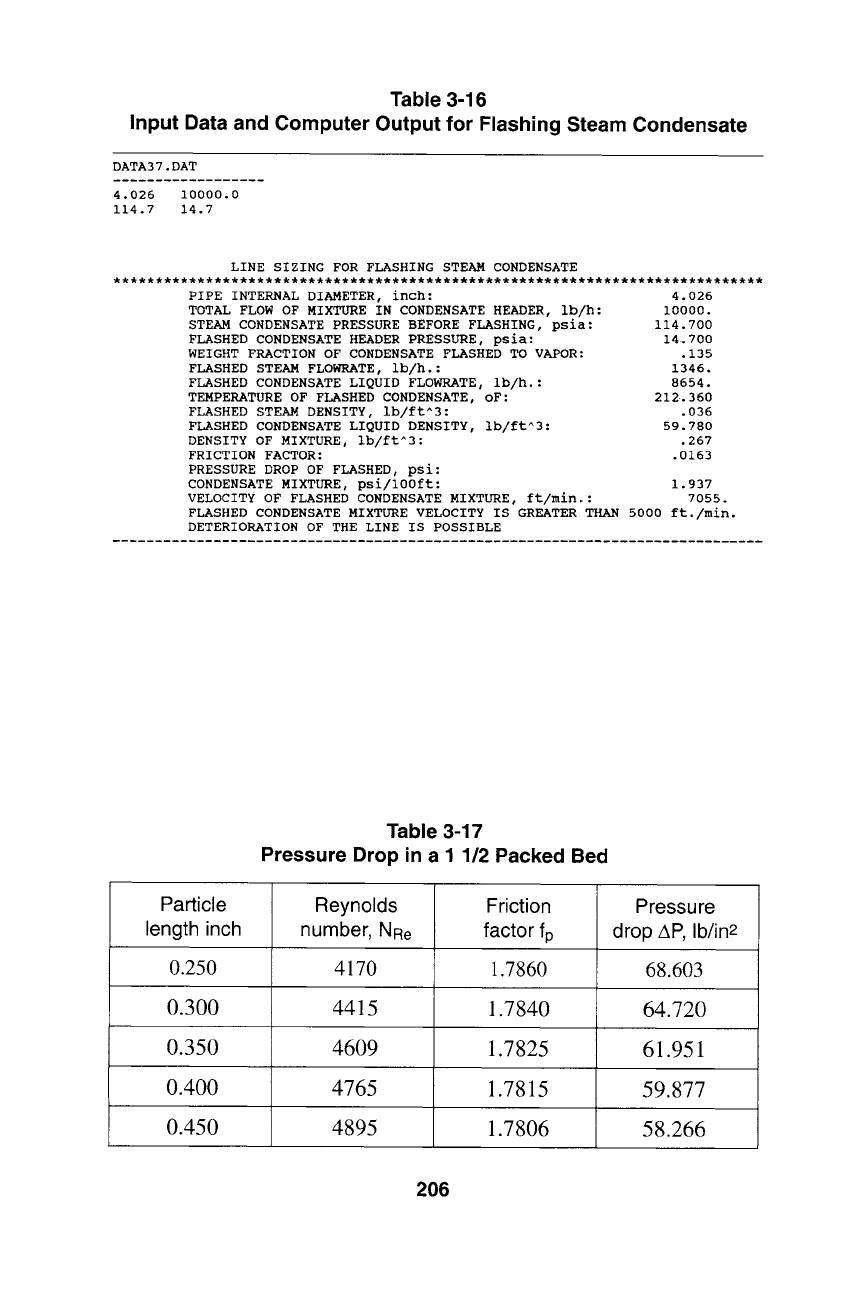
Table 3-16
Input Data and Computer Output for Flashing Steam Condensate
DATA37.DAT
4.026
i0000.0
114.7 14.7
LINE SIZING FOR FLASHING STEAM CONDENSATE
PIPE INTERNAL DIAMETER, inch:
4.026
TOTAL FLOW OF MIXTURE IN CONDENSATE HEADER, ib/h: i0000.
STEAM CONDENSATE PRESSURE BEFORE FLASHING, psia: 114.700
FLASHED CONDENSATE HEADER PRESSURE, psia: 14..700
WEIGHT FRACTION OF CONDENSATE FLASHED TO VAPOR: .135
FLASHED STEAM FLOWRATE, ib/h.: 1346.
FLASHED CONDENSATE LIQUID FLOWRATE, ib/h.: 8654.
TEMPERATURE OF FLASHED CONDENSATE, oF: 212..360
FLASHED STEAM DENSITY, ib/ft^3: .036
FLASHED CONDENSATE LIQUID DENSITY, ib/ft^3: 59.780
DENSITY OF MIXTURE, ib/ft^3: .267
FRICTION FACTOR: .0163
PRESSURE DROP OF FLASHED, psi:
CONDENSATE MIXTURE, psi/100ft: 1.937
VELOCITY OF FLASHED CONDENSATE MIXTURE, ft/min.: 7055.
FLASHED CONDENSATE MIXTURE VELOCITY IS GREATER THAN 5000 ft./min.
DETERIORATION OF THE LINE IS POSSIBLE
Table 3-17
Pressure Drop in a 1 112 Packed Bed
Particle
length inch
0.250
0.300
0.350
0.400
0.450
Reynolds
number, NRe
4170
4415
4609
4765
Friction
factor fp
1.7860
1.7840
1.7825
1.7815
4895
1.7806
Pressure
drop AP, Ib/in2
68.603
64.720
61.951
59.877
58.266
206