
Coker A.K. Fortran Programs for Chemical Process Design, Analysis, and Simulation
Подождите немного. Документ загружается.

Instrument Sizing 377
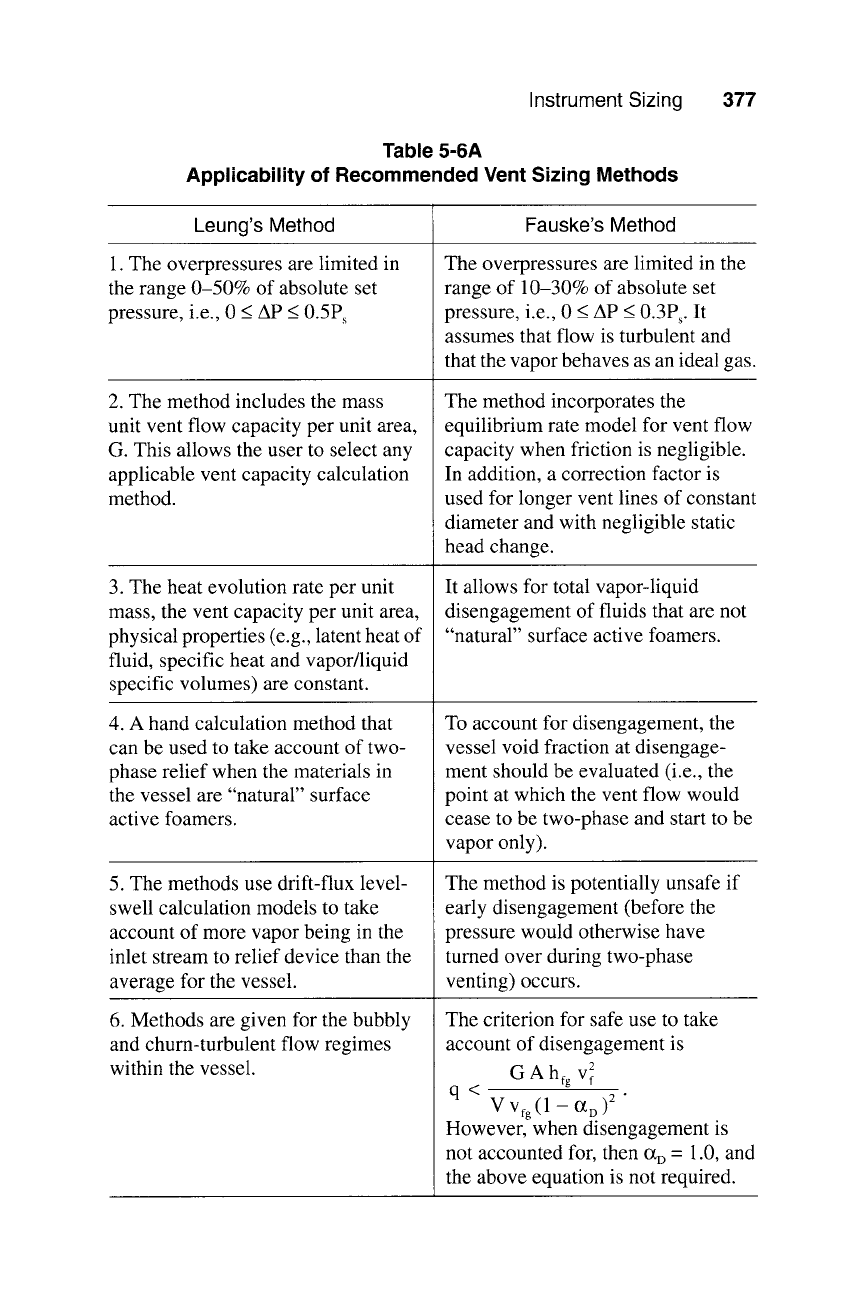
Table 5-6A
Applicability of Recommended Vent Sizing Methods
Leung's Method
1. The overpressures are limited in
the range 0-50% of absolute set
pressure, i.e., 0 < AP _< 0.5Ps
2. The method includes the mass
unit vent flow capacity per unit area,
G. This allows the user to select any
applicable vent capacity calculation
method.
3. The heat evolution rate per unit
mass, the vent capacity per unit area,
physical properties (e.g., latent heat of
fluid, specific heat and vapor/liquid
specific volumes) are constant.
4. A hand calculation method that
can be used to take account of two-
phase relief when the materials in
the vessel are "natural" surface
active foamers.
5. The methods use drift-flux level-
swell calculation models to take
account of more vapor being in the
inlet stream to relief device than the
average for the vessel.
6. Methods are given for the bubbly
and churn-turbulent flow regimes
within the vessel.
Fauske's Method
The overpressures are limited in the
range of 10-30% of absolute set
pressure, i.e., 0 < AP < 0.3P S. It
assumes that flow is turbulent and
that the vapor behaves as an ideal gas.
The method incorporates the
equilibrium rate model for vent flow
capacity when friction is negligible.
In addition, a correction factor is
used for longer vent lines of constant
diameter and with negligible static
head change.
It allows for total vapor-liquid
disengagement of fluids that are not
"natural" surface active foamers.
To account for disengagement, the
vessel void fraction at disengage-
ment should be evaluated (i.e., the
point at which the vent flow would
cease to be two-phase and start to be
vapor only).
The method is potentially unsafe if
early disengagement (before the
pressure would otherwise have
turned over during two-phase
venting) occurs.
The criterion for safe use to take
account of disengagement is
2
GAhfg vf
q<
V Vfg(l _ (XD)2 "
However, when disengagement is
not accounted for, then ot D - 1.0, and
the above equation is not required.
378 Fortran Programs for Chemical Process Design
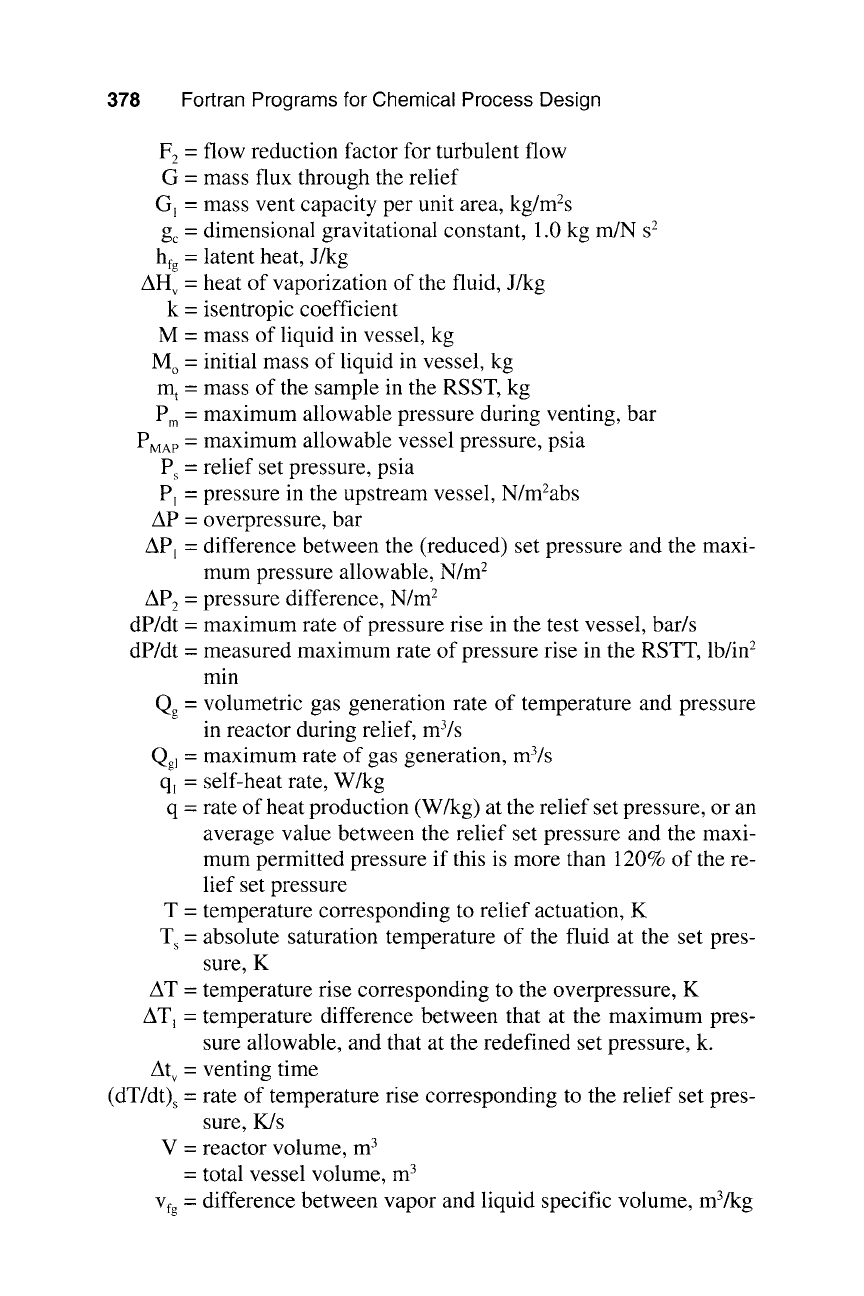
F 2 - flow reduction factor for turbulent flow
G- mass flux through the relief
G~ - mass vent capacity per unit area, kg/mZs
g~ - dimensional gravitational constant, 1.0 kg m/N s 2
hfg - latent heat, J/kg
AH v - heat of vaporization of the fluid, J/kg
k- isentropic coefficient
M - mass of liquid in vessel, kg
M o - initial mass of liquid in vessel, kg
m~- mass of the sample in the RSST, kg
Pm-
maximum allowable pressure during venting, bar
PMAP-
maximum allowable vessel pressure, psia
P~ - relief set pressure, psia
P~ - pressure in the upstream vessel, N/m2abs
AP - overpressure, bar
AP~ - difference between the (reduced) set pressure and the maxi-
mum pressure allowable, N/m 2
AP 2 - pressure difference, N/m 2
dP/dt - maximum rate of pressure rise in the test vessel, bar/s
dP/dt - measured maximum rate of pressure rise in the RSTT, lb/in 2
min
Qg- volumetric gas generation rate of temperature and pressure
in reactor during relief, m3/s
Qgl- maximum rate of gas generation, m3/s
q~ - self-heat rate, W/kg
q - rate of heat production (W/kg) at the relief set pressure, or an
average value between the relief set pressure and the maxi-
mum permitted pressure if this is more than 120% of the re-
lief set pressure
T - temperature corresponding to relief actuation, K
T s - absolute saturation temperature of the fluid at the set pres-
sure, K
AT - temperature rise corresponding to the overpressure, K
AT~- temperature difference between that at the maximum pres-
sure allowable, and that at the redefined set pressure, k.
Atv - venting time
(dT/dt)~- rate of temperature rise corresponding to the relief set pres-
sure, K/s
V - reactor volume, m 3
= total vessel volume, m 3
Vfg - difference between vapor and liquid specific volume, m3/kg
Instrument Sizing 379
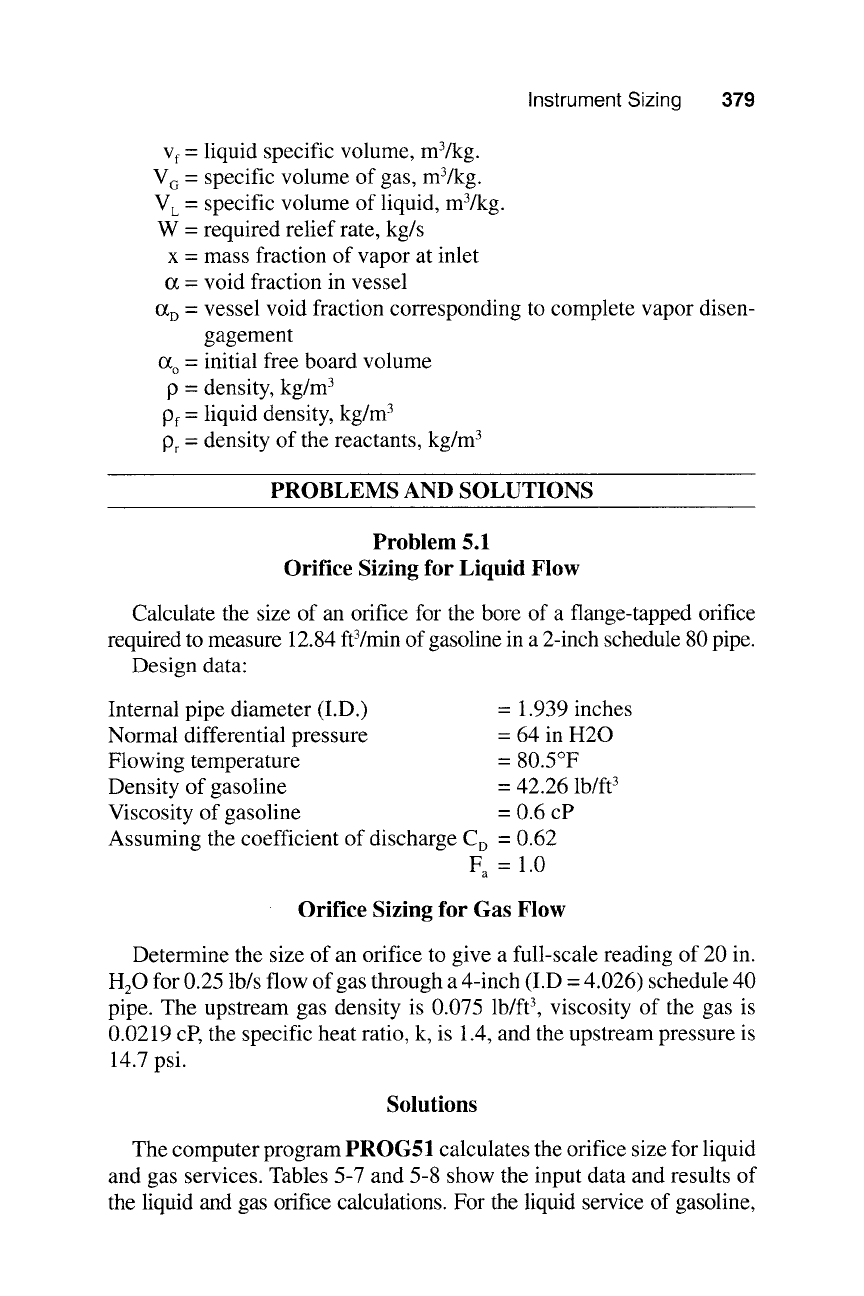
vf = liquid specific volume, m3/kg.
V G = specific volume of gas, m3/kg.
V L - specific volume of liquid, m3/kg.
W = required relief rate, kg/s
x = mass fraction of vapor at inlet
cz = void fraction in vessel
~D - vessel void fraction corresponding to complete vapor disen-
gagement
~o = initial free board volume
9 = density, kg/m 3
9f = liquid density, kg/m 3
Pr =
density of the reactants, kg/m 3
PROBLEMS AND SOLUTIONS
Problem 5.1
Orifice Sizing for Liquid Flow
Calculate the size of an orifice for the bore of a flange-tapped orifice
required to measure 12.84 ft3/min of gasoline in a 2-inch schedule 80 pipe.
Design data:
Internal pipe diameter (I.D.) = 1.939 inches
Normal differential pressure = 64 in H20
Flowing temperature = 80.5~
Density of gasoline = 42.26 lb/ft 3
Viscosity of gasoline = 0.6 cP
Assuming the coefficient of discharge C D - 0.62
F a - 1.0
Orifice Sizing for Gas Flow
Determine the size of an orifice to give a full-scale reading of 20 in.
H20
for 0.25 lb/s flow of gas through a 4-inch (I.D = 4.026) schedule 40
pipe. The upstream gas density is 0.075 lb/ft 3, viscosity of the gas is
0.0219 cP, the specific heat ratio, k, is 1.4, and the upstream pressure is
14.7 psi.
Solutions
The computer program PROG51 calculates the orifice size for liquid
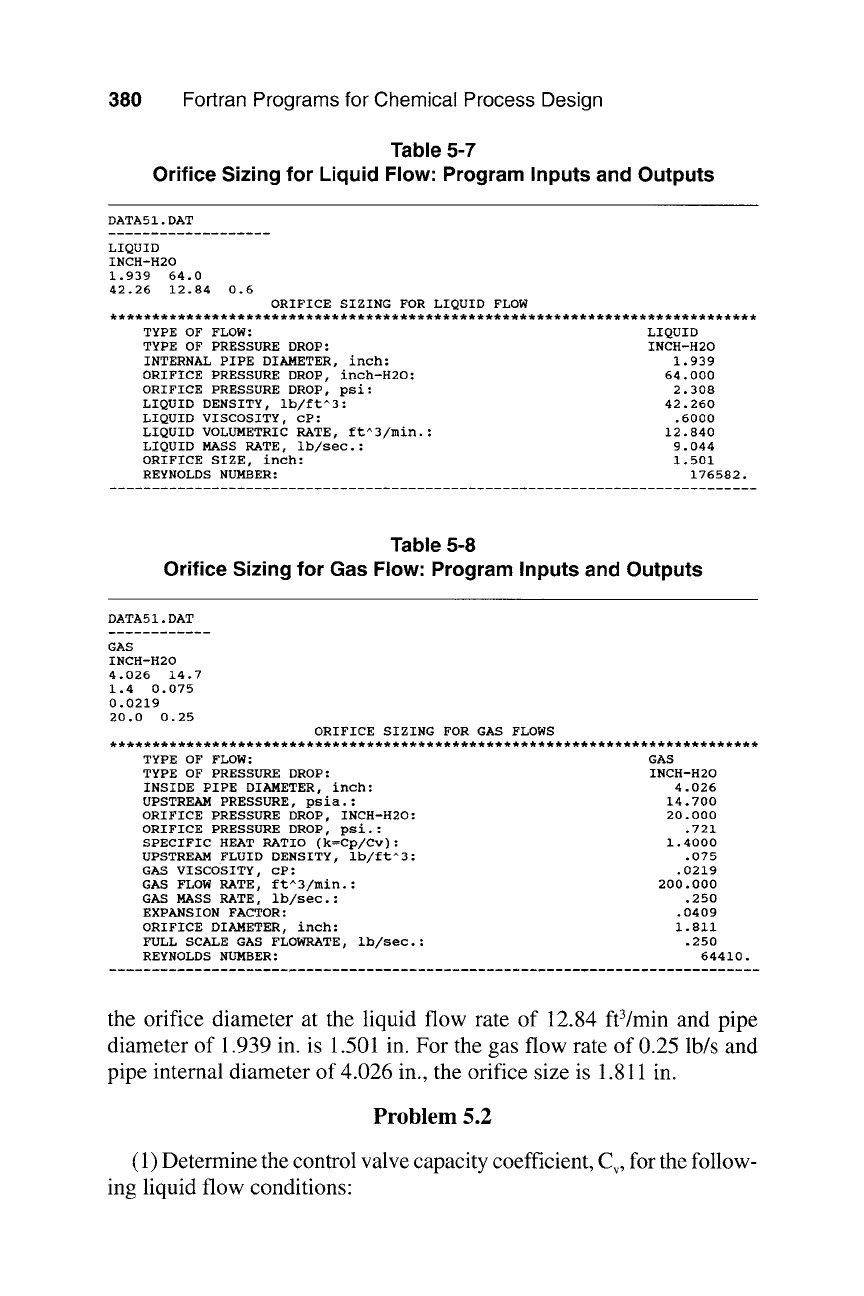
and gas services. Tables 5-7 and 5-8 show the input data and results of
the liquid and gas orifice calculations. For the liquid service of gasoline,
380
Fortran Programs for Chemical Process Design
Table 5-7
Orifice Sizing for Liquid Flow: Program Inputs and Outputs
DATA51.DAT
LIQUID
INCH-H20
1.939 64.0
42.26 12.84 0.6
ORIFICE SIZING FOR LIQUID FLOW
TYPE OF FLOW:
TYPE OF PRESSURE DROP:
INTERNAL PIPE DIAMETER,
inch:
ORIFICE PRESSURE DROP, inch-H20:
ORIFICE PRESSURE DROP,
psi:
LIQUID DENSITY, ib/ft^3:
LIQUID VISCOSITY, cP:
LIQUID VOLUMETRIC RATE, ft^3/min.:
LIQUID MASS RATE, ib/sec.:
ORIFICE SIZE,
inch:
REYNOLDS NUMBER:
LIQUID
INCH-H20
1.939
64.000
2.308
42.260
.6000
12.840
9.044
1.501
176582.
Table 5-8
Orifice Sizing for Gas Flow: Program Inputs and Outputs
DATA51.DAT
GAS
INCH-H20
4.026 14.7
1.4 0.075
0.0219
20.0 0.25
ORIFICE SIZING FOR GAS FLOWS
TYPE OF FLOW:
TYPE OF PRESSURE DROP:
INSIDE PIPE DIAMETER,
inch:
UPSTREAM PRESSURE,
psia.:
ORIFICE PRESSURE DROP, INCH-H20:
ORIFICE PRESSURE DROP,
psi.:
SPECIFIC HEAT RATIO (k=Cp/Cv):
UPSTREAM FLUID DENSITY, ib/ft^3:
GAS VIscOsITY, cP:
GAS FLOW RATE, ft^3/min.:
GAS MASS RATE, ib/sec.:
EXPANSION FACTOR:
ORIFICE DIAMETER,
inch:
FULL SCALE GAS FLOWRATE, ib/sec.:
REYNOLDS NUMBER:
GAS
INCH-H20
4.026
14.700
20.000
.721
1.4000
.075
.0219
200.000
.250
.0409
1.811
.25O
64410.
the orifice diameter at the liquid flow rate of 12.84 ft3/min and pipe
diameter of 1.939 in. is 1.501 in. For the gas flow rate of 0.25 lb/s and
pipe internal diameter of 4.026 in., the orifice size is 1.811 in.
Problem 5.2
( 1 ) Determine the control valve capacity coefficient, C v, for the follow-
ing liquid flow conditions"
Instrument Sizing 381
Flow- 400 gpm P1- 150 psia
P2-
125 psia SpGr~- 1.0
(2) Calculate the control valve coefficient for gas flow under the fol-
lowing conditions"
Flow - 1200 ft3/h P~ - 550 psia P2 - 150 psia SpGrg - 0.6 T - 100~
(3) Calculate the steam flow through a valve with a capacity coefficient,
C v - 75, under the following conditions"
~ superheat - 0 P~ - 70 psia
P2 -
60 psia
Solutions
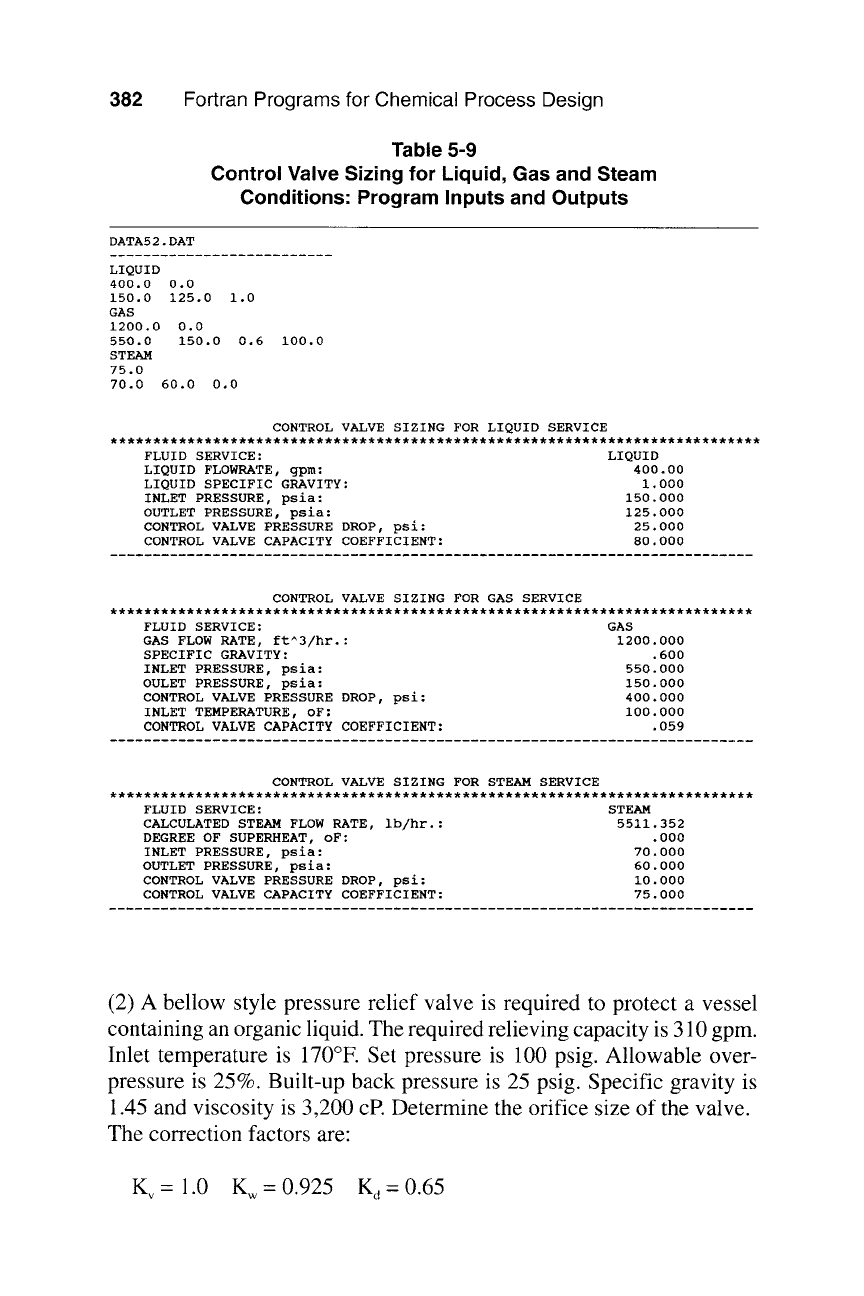
The computer program PROG52 calculates the control valve capac-
ity coefficient (Cv) or the maximum flow rate that will pass through the
valve. Table 5-9 shows the input data and results of the control valve calcu-
lations for liquid, gas, and steam conditions. For the liquid service, at a flow
rate of 400 gpm and the control valve pressure drop of 25 psi, the control
valve capacity coefficient (Cv) is 80. The gas service with a flow rate of
1200 ft3/h, and control valve pressure drop of 400 psi gives the control
valve capacity coefficient (Q) of 0.059. For the steam condition of capac-
ity coefficient (Q) = 75, and the control valve pressure drop of 10 psi, the
maximum steam flow rate through the valve is 5511.4 lb/hr.
Problem 5.3
(1) In a biological plant, ammonia is used to control the pH during
fermentation to obtain maximum yield of the product. For this purpose,
liquid ammonia is vaporized by passing steam through a coil in a vapor-
izer. A relief valve from the vaporizer is set at a pressure of 290 psig. If
the relieving rate of ammonia vapor is 620 lb/hr, determine the size of
the relief valve required to relieve ammonia vapor during an emergency.
Design data are:
Ratio of specific heat capacities
(Cp/Cv) -
1.33
Molecular weight of ammonia
Critical Pressure, Pc
Critical Temperature, T c
Constants in Antoine's equation: A
B
C
= 17.03
= 111.3 atm
= 405.6 K
- 16.9481
= 2132.5
= -32.98
382 Fortran Programs for Chemical Process Design
Table 5-9
Control Valve Sizing for Liquid, Gas and Steam
Conditions- Program Inputs and Outputs
DATA52.DAT
LIQUID
4OO.0 0.0
150.0 125.0 1.0
GAS
1200.0 0.0
550.0 150.0 0.6 i00.0
STEAM
75.0
70.O 6O.O 0.0
CONTROL VALVE SIZING FOR LIQUID SERVICE
****************************************************************************
FLUID SERVICE: LIQUID
LIQUID FLOWRATE, gpm: 400.00
LIQUID SPECIFIC GRAVITY: 1.000
INLET PRESSURE, psia: 150.000
OUTLET PRESSURE, psia: 125.000
CONTROL VALVE PRESSURE DROP, psi: 25.000
CONTROL VALVE CAPACITY COEFFICIENT: 80.000
CONTROL VALVE SIZING FOR GAS SERVICE
***************************************************************************
FLUID SERVICE: GAS
GAS FLOW RATE, ft^3/hr.: 1200.000
SPECIFIC GRAVITY: .600
INLET PRESSURE, psia: 550.000
OULET PRESSURE, psia: 150.000
CONTROL VALVE PRESSURE DROP, psi: 400.000
INLET TEMPERATURE, oF: i00.000
CONTROL VALVE CAPACITY COEFFICIENT: .059
CONTROL VALVE SIZING FOR STEAM SERVICE
***************************************************************************
FLUID SERVICE: STEAM
CALCULATED
STEAM FLOW RATE, ib/hr.: 5511.352
DEGREE OF SUPERHEAT, oF: .000
INLET PRESSURE, psia: 70.000
OUTLET PRESSURE, psia: 60.000
CONTROL VALVE PRESSURE DROP, psi: i0.000
CONTROL VALVE CAPACITY COEFFICIENT: 75.000
(2) A bellow style pressure relief valve is required to protect a vessel
containing an organic liquid. The required relieving capacity is 310 gpm.
Inlet temperature is 170~ Set pressure is 100 psig. Allowable over-
pressure is 25%. Built-up back pressure is 25 psig. Specific gravity is
1.45 and viscosity is 3,200 cE Determine the orifice size of the valve.
The correction factors are:
K v-l.0 K w-0.925 K d-0.65
Instrument Sizing 383
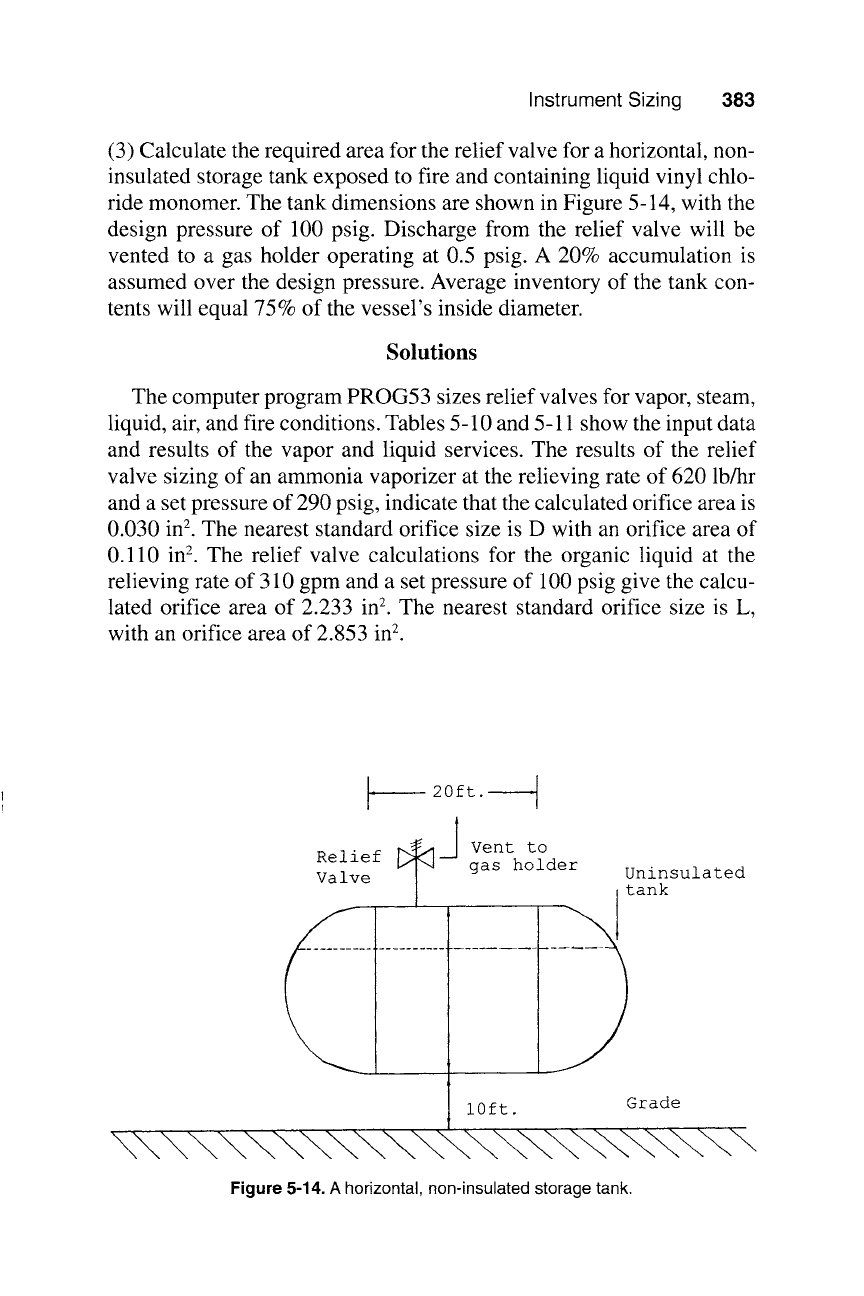
(3) Calculate the required area for the relief valve for a horizontal, non-
insulated storage tank exposed to fire and containing liquid vinyl chlo-
ride monomer. The tank dimensions are shown in Figure 5-14, with the
design pressure of 100 psig. Discharge from the relief valve will be
vented to a gas holder operating at 0.5 psig. A 20% accumulation is
assumed over the design pressure. Average inventory of the tank con-
tents will equal 75% of the vessel's inside diameter.
Solutions
The computer program PROG53 sizes relief valves for vapor, steam,
liquid, air, and fire conditions. Tables 5-10 and 5-11 show the input data
and results of the vapor and liquid services. The results of the relief
valve sizing of an ammonia vaporizer at the relieving rate of 620 lb/hr
and a set pressure of 290 psig, indicate that the calculated orifice area is
0.030 in 2. The nearest standard orifice size is D with an orifice area of
0.110 in 2. The relief valve calculations for the organic liquid at the
relieving rate of 310 gpm and a set pressure of 100 psig give the calcu-
lated orifice area of 2.233 in 2. The nearest standard orifice size is L,
with an orifice area of 2.853 in 2.
[ .... 20ft : :[
[-
I
Valve
Vent to
gas holder
Uninsulated
tank
10ft. Grade
\\
Figure 5-14. A horizontal, non-insulated storage tank.
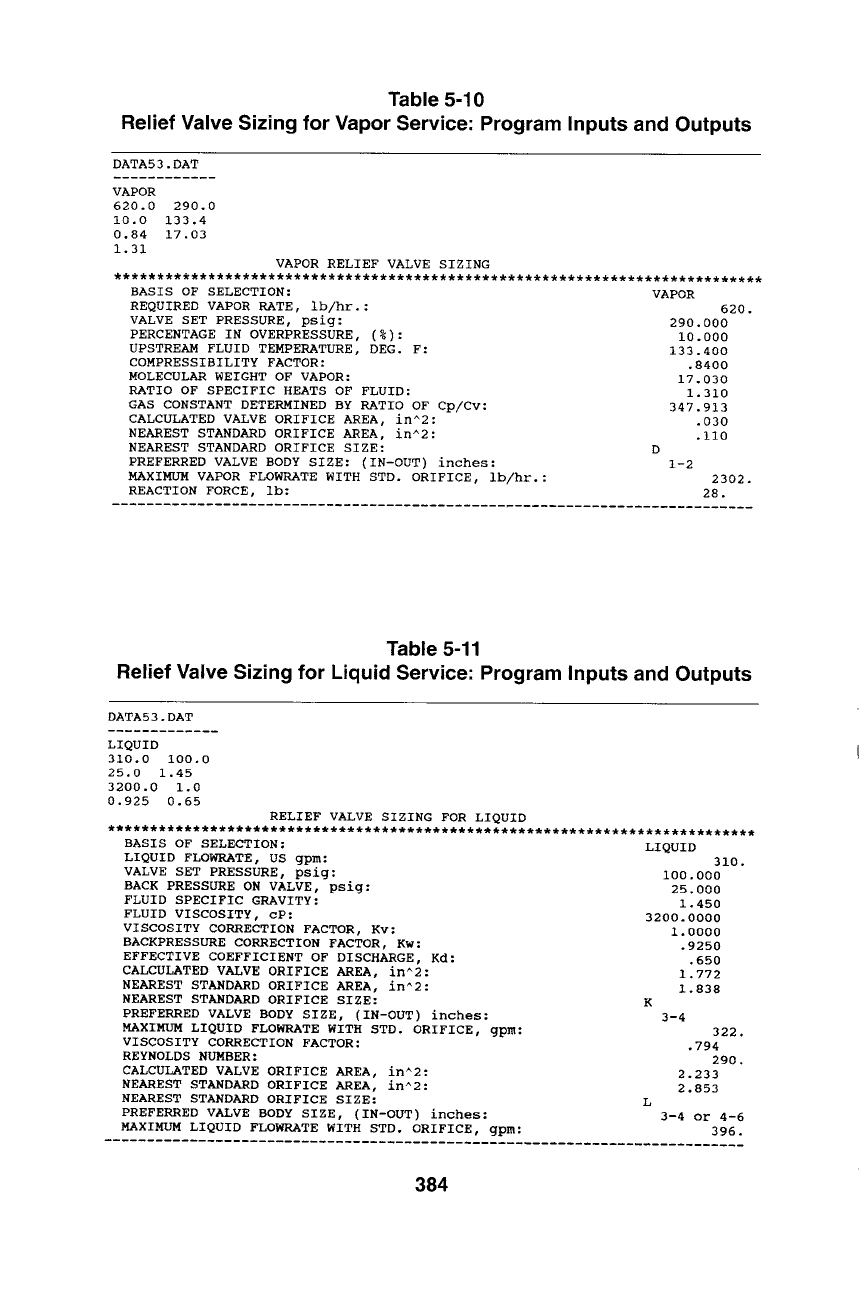
Table 5-10
Relief Valve Sizing for Vapor Service" Program Inputs and Outputs
DATA53.DAT
VAPOR
620.0 290.0
i0.0 133.4
0.84 17.03
1.31
VAPOR RELIEF VALVE SIZING
BASIS OF SELECTION:
REQUIRED VAPOR RATE, ib/hr.:
VALVE SET PRESSURE, psig:
PERCENTAGE IN OVERPRESSURE, (%):
UPSTREAM FLUID TEMPERATURE, DEG. F:
COMPRESSIBILITY FACTOR:
MOLECULAR WEIGHT OF VAPOR:
RATIO OF SPECIFIC HEATS OF FLUID:
GAS CONSTANT DETERMINED BY RATIO OF Cp/Cv:
CALCULATED VALVE ORIFICE AREA, in^2:
NEAREST STANDARD ORIFICE AREA, in^2:
NEAREST STANDARD ORIFICE SIZE:
PREFERRED VALVE BODY SIZE: (IN-OUT) inches:
MAXIMUM VAPOR FLOWRATE WITH STD. ORIFICE, Ib/hr.:
REACTION FORCE, ib:
VAPOR
620.
290.000
i0.000
133.400
.8400
17.030
1.310
347.913
.030
.ii0
1-2
2302.
28.
Table 5-11
Relief Valve Sizing for Liquid Service" Program Inputs and Outputs
DATA53.DAT
LIQUID
310.0 i00.0
25.0 1.45
3200.0 1.0
0.925 0.65
RELIEF VALVE SIZING FOR LIQUID
BASIS OF SELECTION:
LIQUID FLOWRATE, US gpm:
VALVE SET PRESSURE, psig:
BACK PRESSURE ON VALVE, psig:
FLUID SPECIFIC GRAVITY:
FLUID VISCOSITY,
cP:
VISCOSITY CORRECTION FACTOR,
Kv:
BACKPRESSURE CORRECTION FACTOR, Kw:
EFFECTIVE COEFFICIENT OF DISCHARGE, Kd:
CALCULATED VALVE ORIFICE AREA, in^2:
NEAREST STANDARD ORIFICE AREA, in^2:
NEAREST STANDARD ORIFICE SIZE:
PREFERRED VALVE BODY SIZE, (IN-OUT)
inches:
MAXIMUM LIQUID FLOWRATE WITH STD. ORIFICE, gpm:
VISCOSITY CORRECTION FACTOR:
REYNOLDS NUMBER:
CALCULATED VALVE ORIFICE AREA, in^2:
NEAREST STANDARD ORIFICE AREA, in^2:
NEAREST STANDARD ORIFICE SIZE:
PREFERRED VALVE BODY SIZE, (IN-OUT)
inches:
MAXIMUM LIQUID FLOWRATE WITH STD. ORIFICE, gpm:
LIQUID
310.
i00.000
25.O0O
1.450
3200.0000
1.0000
.9250
.650
1.772
1.838
3-4
322.
.794
290.
2.233
2.853
3-4 or 4-6
396.
384
Instrument Sizing 385
Fire Relief Valve Sizing
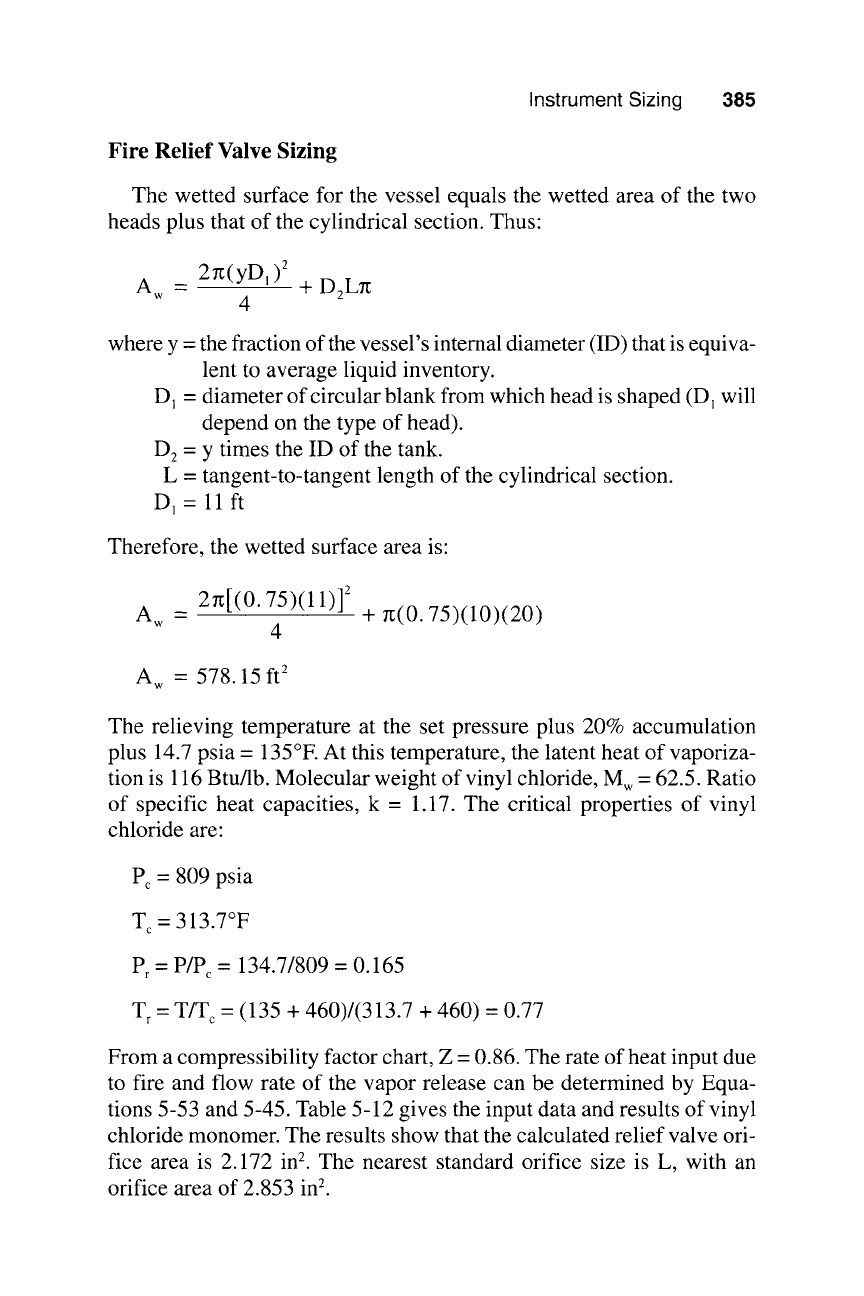
The wetted surface for the vessel equals the wetted area of the two
heads plus that of the cylindrical section. Thus:
2
Aw _- 27t(yD~ + D2L//;
4
where y = the fraction of the vessel's internal diameter (ID) that is equiva-
lent to average liquid inventory.
D~ = diameter of circular blank from which head is shaped (D 1 will
depend on the type of head).
D 2 = y times the ID of the tank.
L = tangent-to-tangent length of the cylindrical section.
Dl= llft
Therefore, the wetted surface area is"
A w -
2rt[(0.75)(11)] 2
+ rt(0.75)(10)(20)
A w - 578.15ft 2
The relieving temperature at the set pressure plus 20% accumulation
plus 14.7 psia = 135~ At this temperature, the latent heat of vaporiza-
tion is 116 Btu/lb. Molecular weight of vinyl chloride, M w = 62.5. Ratio
of specific heat capacities, k = 1.17. The critical properties of vinyl
chloride are:
Pc - 809 psia
T c - 313.7~
Pr -
P/Pc - 134.7/809 - 0.165
T r - T/T c - (135 + 460)/(313.7 + 460) - 0.77
From a compressibility factor chart, Z = 0.86. The rate of heat input due
to fire and flow rate of the vapor release can be determined by Equa-
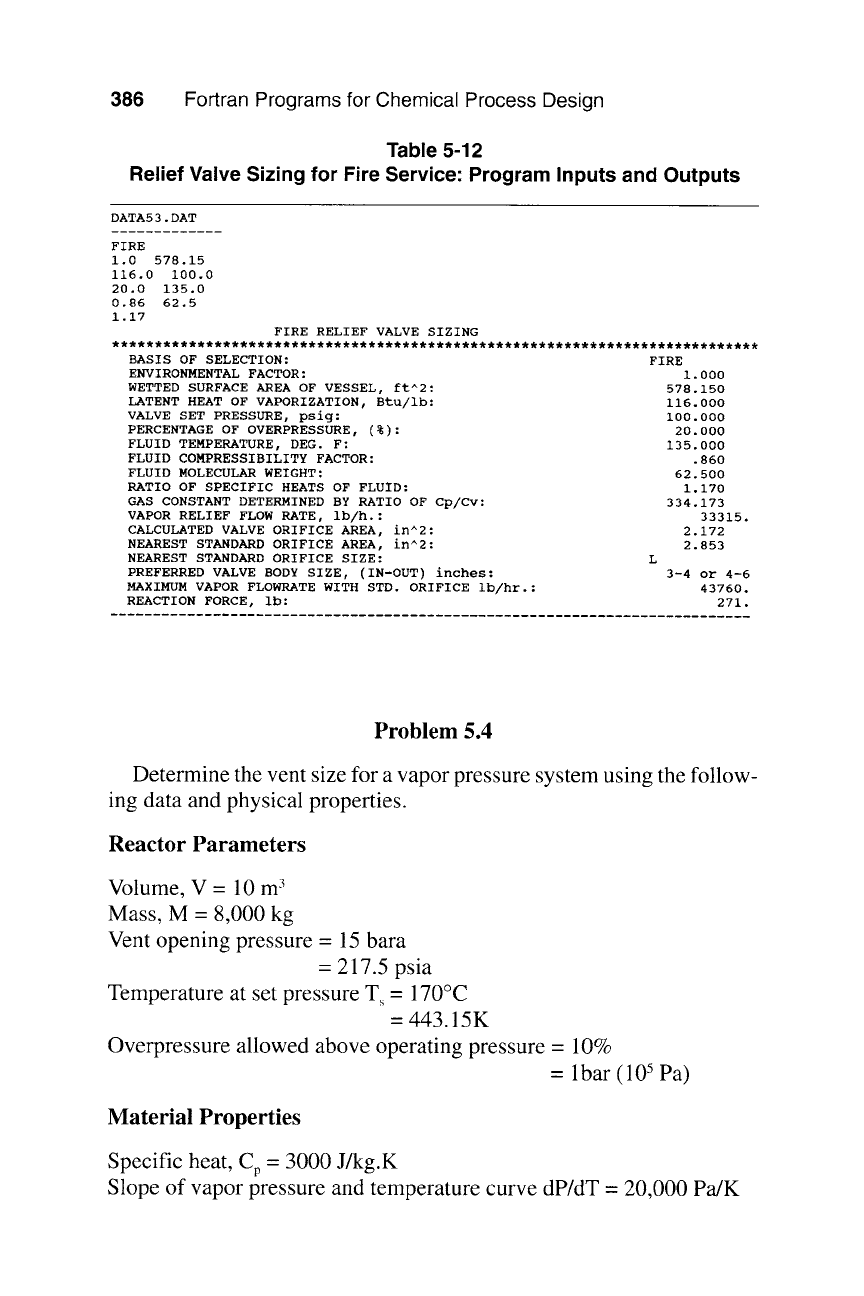
tions 5-53 and 5-45. Table 5-12 gives the input data and results of vinyl
chloride monomer. The results show that the calculated relief valve ori-
fice area is 2.172 in 2. The nearest standard orifice size is L, with an
orifice area of 2.853 in 2.
386
Fortran Programs for Chemical Process Design
Table 5-12
Relief Valve Sizing for Fire Service- Program Inputs and Outputs
DATA53.DAT
FIRE
1.0 578.15
116.0 100.0
20.0 135.0
0.86 62.5
1.17
FIRE RELIEF VALVE SIZING
BASIS OF SELECTION:
ENVIRONMENTAL FACTOR:
WETTED SURFACE AREA OF VESSEL, ft^2:
LATENT HEAT OF VAPORIZATION, Btu/ib:
VALVE SET PRESSURE,
psig:
PERCENTAGE OF OVERPRESSURE, (%):
FLUID TEMPERATURE, DEG. F:
FLUID COMPRESSIBILITY FACTOR:
FLUID MOLECULAR WEIGHT:
RATIO OF SPECIFIC HEATS OF FLUID:
GAS CONSTANT DETERMINED BY RATIO OF Cp/Cv:
VAPOR RELIEF FLOW RATE, ib/h.:
CALCULATED VALVE ORIFICE AREA, in^2:
NEAREST STANDARD ORIFICE AREA, in^2:
NEAREST STANDARD ORIFICE SIZE:
PREFERRED VALVE BODY SIZE, (IN-OUT)
inches:
MAXIMUM VAPOR FLOWRATE WITH STD. ORIFICE
ib/hr.:
REACTION FORCE,
ib:
FIRE
1.000
578.150
116.000
I00.000
20.000
135.000
.860
62.500
1.170
334.173
33315.
2.172
2.853
3-4 or 4-6
43760.
271.
Problem 5.4
Determine the vent size for a vapor pressure system using the follow-
ing data and physical properties.
Reactor Parameters
Volume, V - 10 m 3
Mass, M - 8,000 kg
Vent opening pressure- 15 bara
= 217.5 psia
Temperature at set pressure T~- 170~
= 443.15K
Overpressure allowed above operating pressure- 10%
= 1 bar (105 Pa)
Material Properties
Specific heat, Cp- 3000 J/kg.K
Slope of vapor pressure and temperature curve dP/dT - 20,000 Pa/K