
Cossey L. Introduction to Mathematical Physics
Подождите немного. Документ загружается.

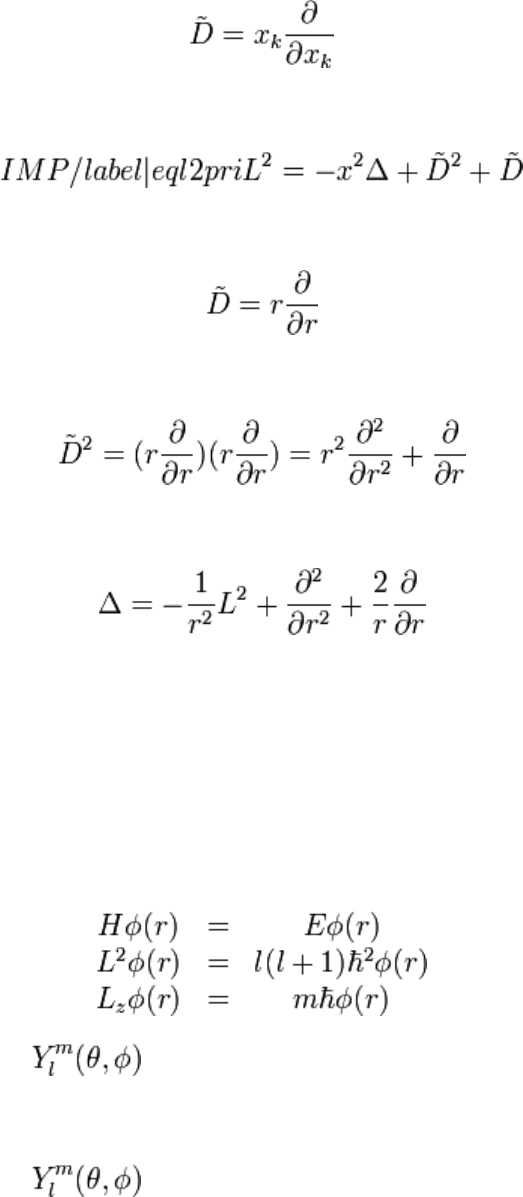
we get the relation:
Using spherical coordinates, we get:
and
So, equation eql2pri becomes:
Let us use the problem's symmetries:
• Since:
• L
z
commutes with operators acting on r
• L
z
commutes with L
2
operator L
z
commutes with H
• L
2
commutes with H
we look for a function φ that diagonalizes simultaneously H,L ,L
2
z
that is such that:
Spherical harmonics
can be introduced now:
Definition:
Spherical harmonics are eigenfunctions common to operators L
2
and L
z
. It can
be shown that:
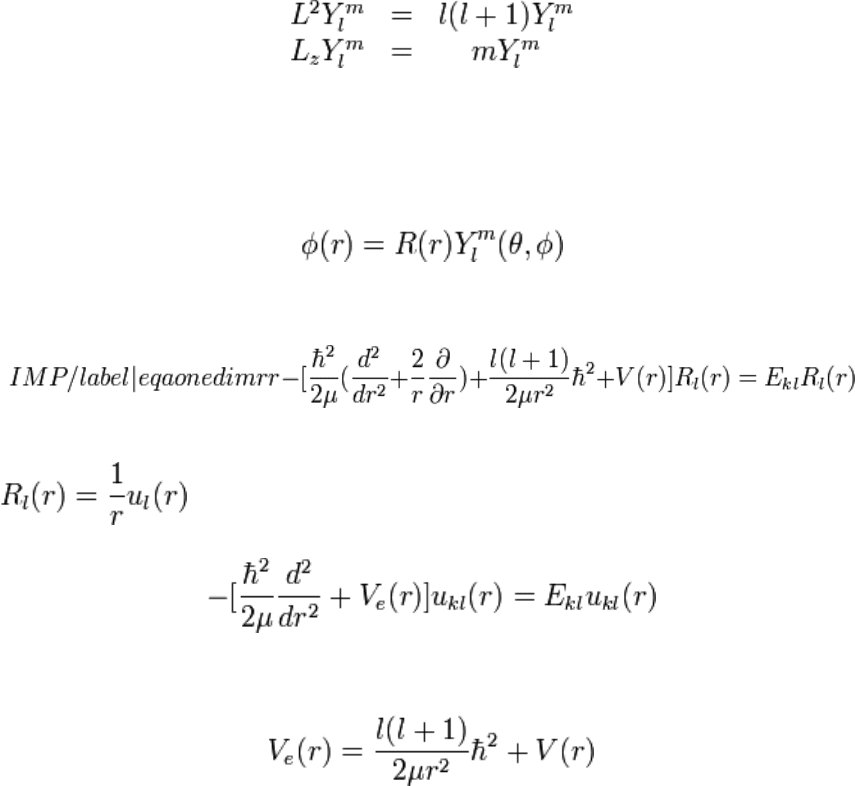
Looking for a solution φ(r) that can\footnote{Group theory argument should be used to
prove that solution actually are of this form.}
be written (variable separation):
problem becomes one dimensional:
where R(r) is indexed by l only. Using the following change of variable:
, one gets the following spectral equation:
where
The problem is then reduced to the study of the movement of a particle in an effective
potential V (r)
e
. To go forward in the solving of this problem, the expression of potential
V(r) is needed. Particular case of hydrogen introduced at section
sechydrog corresponds to a potential V(r) proportional to
1 / r and leads to an accidental degeneracy.
One nucleus, N electrons
This case corresponds to the study of atoms different from hydrogenoids atoms. The
Hamiltonian describing the problem is:
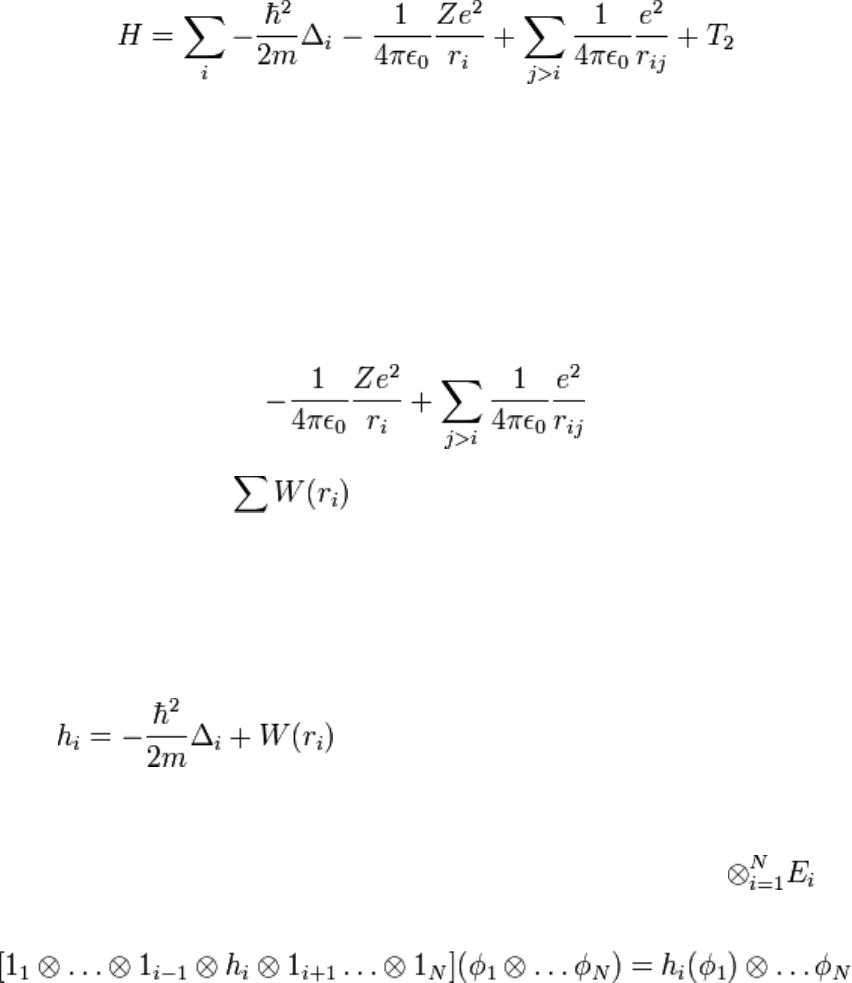
where T
2
represents a spin-orbit interaction term that will be treated later. Here are some
possible approximations:
N independent electrons
This approximation consists in considering each electron as moving in a mean central
potential and in neglecting spin--orbit interaction. It is a ``mean field approximation. The
electrostatic interaction term
is modelized by the sum , where W(r
i
) is the mean potential acting on particle
i. The hamiltonian can thus be written:
H
0
=
∑
h
i
i
where .
Remark:
More precisely, h
i
is the linear operator acting in the tensorial product space and
defined by its action on function that are tensorial products:
It is then sufficient to solve the spectral problem in a space E
i
for operator h
i
. Physical
kets are then constructed by anti symmetrisation example exmppauli of chapter chapmq)
in order to satisfy Pauli principle.{Pauli} The problem is a central potential problem
section
secpotcent). However, potential W(r )
i
is not like 1 / r as in the
hydrogen atom case and thus the accidental degeneracy is not observed here. The energy
depends on two quantum numbers l (relative to kinetic moment) and n (rising from the
radial equation eqaonedimrr). Eigenstates in this approximation are called electronic
configurations.
Example:
For the helium atom, the fundamental level corresponds to an electronic configuration
noted 1s
2
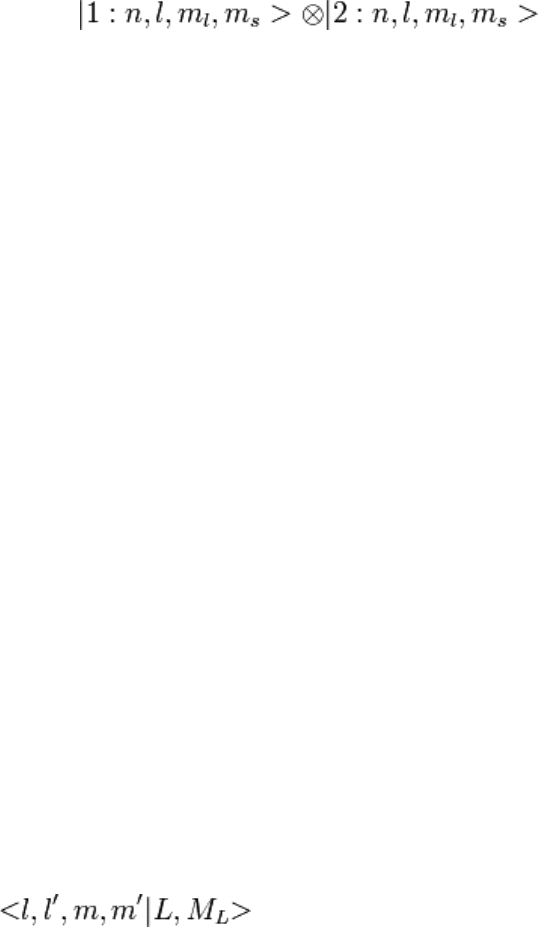
. A physical ket is obtained by anti symetrisation of vector:
Spectral terms
Let us write exact hamiltonian H as:
H = H + T + T
0 1 2
where T
1
represents a correction to H
0
due to the interactions between electrons. Solving
of spectral problem associated to H = H + T
1 0 1
using perturbative method is now
presented.
Remark:
It is here assumed that T < < T
2 1
. This assumption is called L--S coupling approximation.
To diagonalize T
1
in the space spanned by the eigenvectors of H
0
, it is worth to consider
problem's symmetries in order to simplify the spectral problem. It can be shown that
operators L
2
, L
z
, S
2
and S
z
form a complete set of observables that commute.
Example:
Consider again the helium atom
Theorem:
For an atom with two electrons, states such that L + S is odd are excluded.
Proof:
We will proof this result using symmetries. We have:
Coefficients are called Glebsh-Gordan{Glesh-Gordan
coefficients} coefficients. If l = l', it can be shown
Fine structure levels
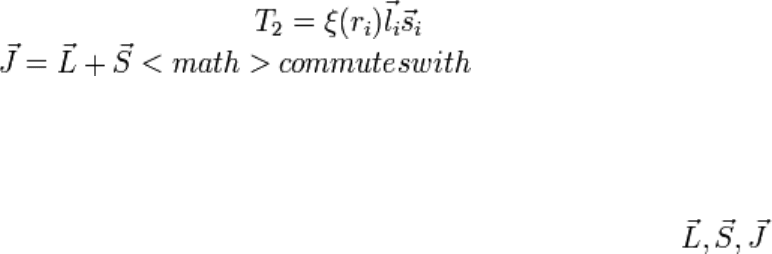
Finally spectral problem associated to
H = H + T + T
0 1 2
can be solved considering T
2
as a perturbation of H = H + T
1 0 1
. It can be shown that
operator T
2
can be written . It can also be shown that operator
T_2.OperatorT_2</math> will have
thus to be diagonilized using eigenvectors | J,m >
J
common to operators J
z
and J
2
. each
state is labelled by:
2S + 1
L
J
where L,S,J are azimuthal quantum numbers associated with operators .
Molecules
Vibrations of a spring model
We treat here a simple molecule model {molecule} to underline the importance of
symmetry using {symmetry} in the study of molecules. Water molecule H
2
0 belongs to
point groups called C
2v
. This group is compound by four symmetry operations: identity E,
rotation C
2
of angle π, and two plane symmetries σ
v
and σ'
v
with respect to two planes
passing by the rotation axis of the C
2
operation figure figmoleceau).
The occurence of
symmetry operations is successively tested, starting from the top of
the
tree. The tree is travelled through depending on the answers of
questions,
"o" for yes, and "n" for no. C
n
labels a rotations of angle
2π / n, σ
h
denotes symmetry operation with respect to a horizontal plane (perpendicular
the C
n
axis), σ
h
denotes a symmetry operation with respect to the vertical plane (going by
the C
n
axis) and i the inversion. Names of groups are framed.}
each of these groups can be characterized by tables of "characters" that define possible
irreducible representations {irreducible representation} for this group. Character table for
group C
2v
is: \begin{table}[hbt]
| center | frame |Character group for group C
2v
.}
\begin{center} \begin{tabular}{|l|r|r|r|r|} C
2v
& E & C
2
& σ
v
& σ'
v
\\ \hline
A
1
&1&1&1&1\\ A
2
&1&1&-1&-1\\ B
1
&1&-1&1&-1\\ B
2
&1&-1&-1&1\\ \end{tabular}
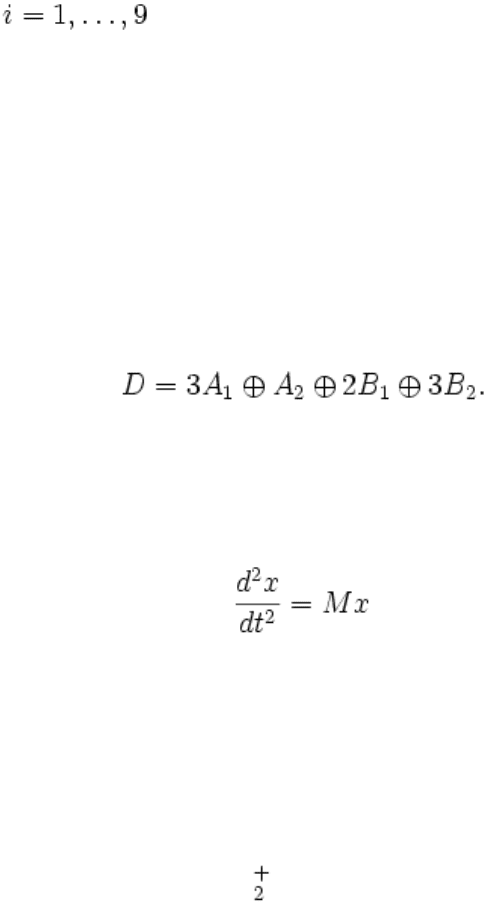
\end{center} \end{table} All the representations of group C
2v
are one dimensional. There
are four representations labelled A
1
, A
2
, B
1
and B
2
. In water molecule case, space in nine
dimension e
i
. Indeed, each atom is represented by three coordinates. A
representation corresponds here to the choice of a linear combination u of vectors e
i
such
that for each element of the symmetry group g, one has:
g(u) = M u.
g
Character table provides the trace, for each operation g of the representation matrix M
g
.
As all representations considered here are one dimensional, character is simply the
(unique) eigenvalue of M
g
. Figure figmodesmol sketches the nine representations of C
2v
group for water molecule. It can be seen that space spanned by the vectors e
i
can be
shared into nine subspaces invariant by the operations g. Introducing representation sum ,
considered representation D can be written as a sum of irreducible representations:
It appears that among the nine modes, there are {mode} three translation modes, and
three rotation modes. Those mode leave the distance between the atoms of the molecule
unchanged. Three actual vibration modes are framed in figure figmodesmol. Dynamics is
in general defined by:
where x is the vector defining the state of the system in the e
i
basis. Dynamics is then
diagonalized in the coordinate system corresponding to the three vibration modes. Here,
symmetry consideration are sufficient to obtain the eigenvectors. Eigenvalues can then be
quickly evaluated once numerical value of coefficients of M are known.
Two nuclei, one electron
This case corresponds to the study of H molecule
.
The Born-Oppenheimer approximation we use here consists in assuming that protons are
fixed (movement of protons is slow with respect to movement of electrons).
Remark:
This problem can be solved exactly. However, we present here the
variational approximation that can be used for more complicated cases.
The LCAO (Linear Combination of Atomic Orbitals) method we introduce here is a
particular case of the variational method. It consists in approximating the electron wave
function by a linear combination of the one electron wave functions of the
atom\footnote{That is: the space of solution is approximated by the subspace spanned by
the atom wave functions.}.
ψ = aψ + bψ
1 2
More precisely, let us choose as basis functions the functions φ
s,1
and
φ
s,2
that are s orbitals centred on atoms 1 and 2 respectively. This
approximation becomes more valid as R is large figure figH2plusS).
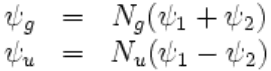
Problem's symmetries yield to write eigenvectors as:
Notation using indices g and u is adopted, recalling the parity of the functions: g for {\it
gerade}, that means even in German and u for {\it ungerade} that means odd in German.
Figure
figH2plusLCAO represents those two functions.
Taking into account the hamiltonian allows to rise the degeneracy of the energies as
shown in diagram of figure figH2plusLCAOener.
==N nuclei, n electrons==
In this case, consideration of symmetries allow to find eigensubspaces that simplify the
spectral problem. Those considerations are related to point groups representation theory.
When atoms of a same molecule are located in a plane, this plane is a symmetry element.
In the case of a linear molecule, any plane going along this line is also symmetry plane.
Two types of orbitals are distinguished:
Definition:
Orbitals σ are conserved by reflexion with respect to the symmetry plane.
Definition:
Orbitals π change their sign in the reflexion with respect to this plane.
Let us consider a linear molecule. For other example, please refer to
.
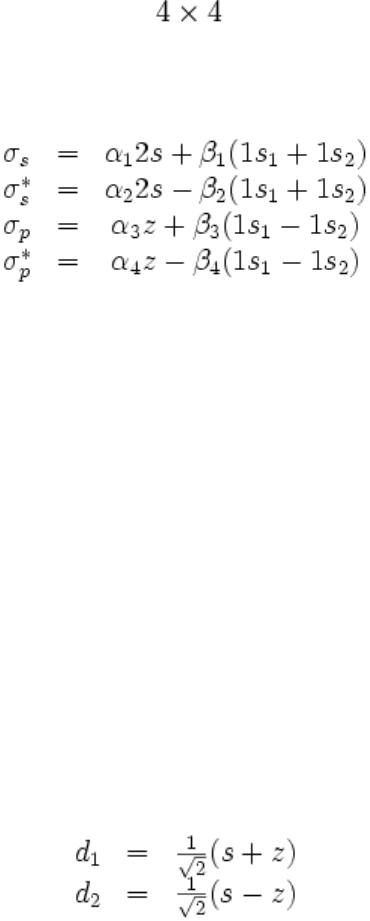
Example:
Molecule BeH
2
. We look for a wave function in the space spanned by orbitals 2s and z of
the beryllium atom Be and by the two orbitals 1s of the two hydrogen atoms. Space is
thus four dimension (orbitals x and y are not used) and the hamiltonian to diagonalize in
this basis is written in general as a matrix
. Taking into account symmetries of the
molecule considered allows to put this matrix as {\it block diagonal matrix}. Let us
choose the following basis as approximation of the state space: \{2s,z,1s + 1s ,1s −
1s
1 2 1
2
\}. Then symmetry considerations imply that orbitals have to be:
Those bindings are delocalized over three atoms and are sketched at figure
figBeH2orb.
We have two binding orbitals and two anti--binding orbitals. Energy diagram is
represented in figure figBeH2ene.In the fundamental state, the four electrons occupy the
two binding orbitals.
Experimental study of molecules show that characteritics of bondings depend only
slightly on on nature of other atoms. The problem is thus simplified in considering σ
molecular orbital as being dicentric, that means located between two atoms. Those
orbitals are called hybrids.
Example:
let us take again the example of the BeH
2
molecule. This molecule is linear. This
geometry is well described by the s − p hybridation. Following hybrid orbitals are
defined:
Instead of considering the basis \{2s,z,1s ,1s
1 2
\}, basis \{d ,d ,1s ,1s
1 2 1 2
\} is directly
considered. Spectral problem is thus from the beginning well advanced.
Crystals
Bloch's theorem
Consider following spectral problem:
Problem:
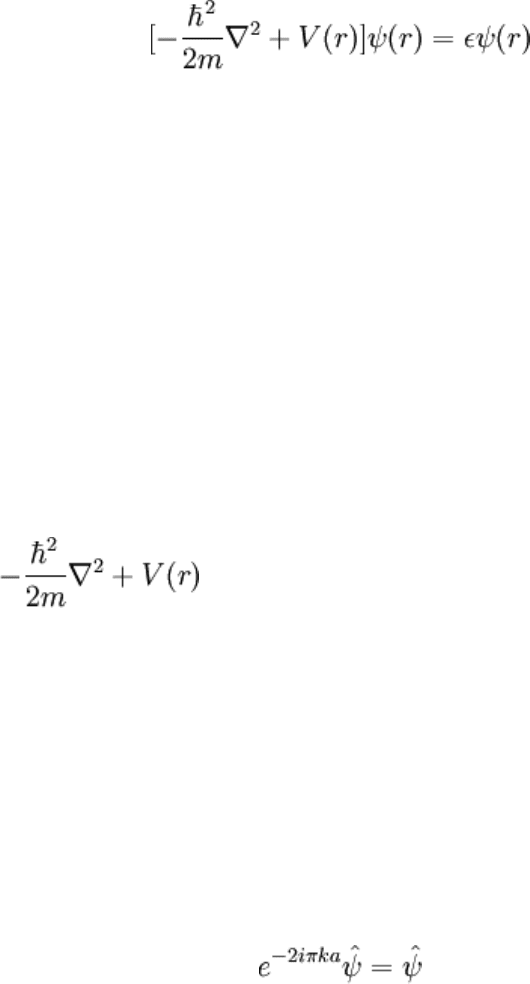
Find ψ(r) and ε such that
where V(r) is a periodical function.
Bloch's theorem allows{Bloch theorem} to look for eigenfunctions under a form that
takes into account symmetries of considered problem.
Theorem:
Bloch's theorem. If V(r) is periodic then
wave function ψ solution of the spectral problem can bne written:
ψ(r) = ψ (r) = e u (r)
k
ikr
k
with u (r) = U (r + R)
k k
(function u
k
has the lattice's periodicity).
Proof:
Operator commutes with translations τ
j
defined by τ ψ(r) = ψ(r + a)
a
.
Eigenfunctions of τ
a
are such that:
τ ψ = ψIMP / label | tra
a
Properties of Fourier transform{Fourier transform} allow to evaluate the eigenvalues of
τ
j
. Indeed, equation tra can be written:
δ(x − a) * ψ(r) = ψ(r)
where * is the space convolution. Applying a Fourier transform to previous equation
yields to:
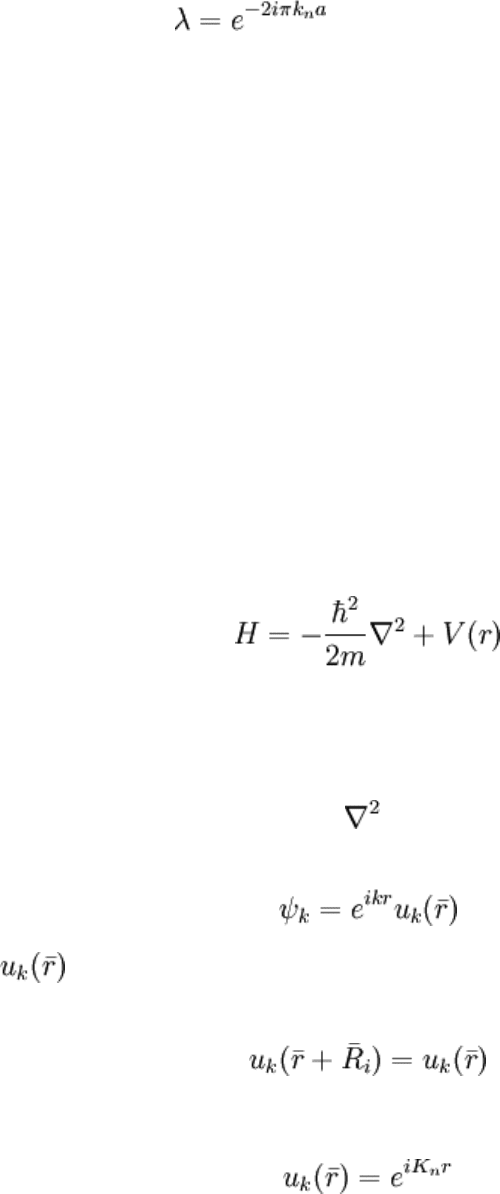
That is the eigenvalue is with k = n / a
n
\footnote{ So, each irreducible
representation{irreducible representation} of the translation group is characterized by a
vector k. This representation is labelled Γ
k
.}. On another hand, eigenfunction can always
be written:
ψ (r) = e u (r).
k
ikr
k
Since u
k
is periodical\footnote{ Indeed, let us write in two ways the action of τ
a
on φ
k
:
τ ψ = e ψ
a k
ika
k
and
τ ψ = e u (r + a)
a k
ik(r + a)
k
} theorem is proved.
Free electron model
Hamiltonian can be written here:
where V(r) is the potential of a periodical box of period a figure figpotperioboit)
figeneeleclib.
Eigenfunctions of H are eigenfunctions of (translation invariance) that verify
boundary conditions. Bloch's theorem implies that φ can be written:
where is a function that has crystal's symmetry{crystal}, that means it is t
invariant:
ranslation
Here ), any function u
k
that can be written
is valid. Injecting this last equation into Schr\"odinger equation yields to following
energy expression: