
Cossey L. Introduction to Mathematical Physics
Подождите немного. Документ загружается.


N body problems
At chapter chapproncorps, N body problem was treated in the quantum mechanics
framework. In this chapter, the same problem is tackled using statistical physics. The
number N of body in interaction is assumed here to be large, of the order of Avogadro
number. Such types of N body problems can be classified as follows:
• Particles are undiscernable. System is then typically a gas. In a classical approach,
partition function has to be described using a corrective factor section
secdistclassi). Partition function can be factorized in two cases: particles are
independent (one speaks about perfect gases){perfect gas} Interactions are taken
into account, but in the frame of a {\bf mean field approximation}{mean field}.
This allows to considerer particles as if they were independent van der Waals
model at section secvanderwaals) In a quantum mechanics approach, Pauli
principle can be included in the most natural way. The suitable description is the
grand-canonical description: number of particles is supposed to fluctuate around a
mean value. The Lagrange multiplier associated to the particles number variable
is the chemical potential µ. Several physical systems can be described by quantum
perfect gases (that is a gas where interactions between particles are neglected): a
fermions gas can modelize a semi--conductor. A boson gas can modelize helium
and described its properties at low temperature. If bosons are photons (their
chemical potential is zero), the black body radiation can be described.
• Particles are discernable. This is typically the case of particles on a lattice. Such
systems are used to describe for instance magnetic properties of solids. Taking
into account the interactions between particles, phase transitions like
paramagnetic--ferromagnetic transition can be described\footnote{ A mean field
approximation allows to factorize the partition function. Paramagnetic--
ferromagnetic transition is a second order transition: the two phases can coexist,
on the contrary to liquid vapour transition that is called first order transition.}.
Adsorption phenomenom can be modelized by a set of independent particles in
equilibrium with a particles reservoir (grand-canonical description).
Those models are described in detail in. In this chapter, we recall the most important
properties of some of them.
Thermodynamical perfect gas
In this section, a perfect gas model is presented: all the particles are independent, without
any interaction.
Remark:
A perfect gas corresponds to the case where the kinetic energy of the particles is large
with respect to the typical interaction energy. Nevertheless, collisions between particles
that can be neglected are necessary for the thermodynamical equilibrium to establish.
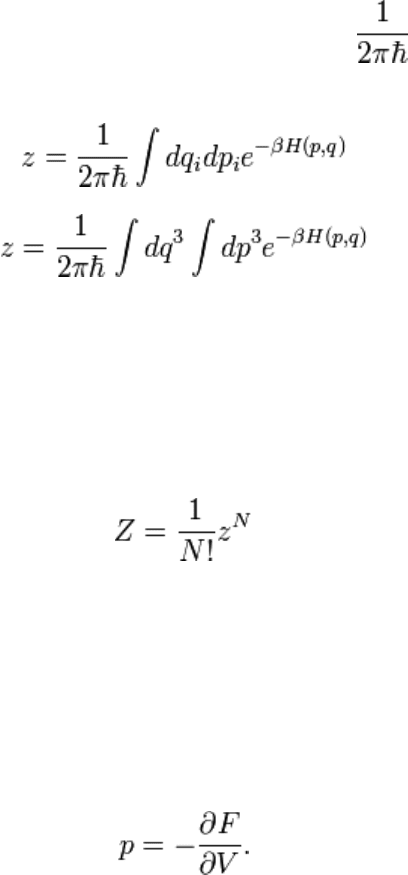
Classical approximation section secdistclassi) allows to replace the sum over the
quantum states by an integral of the exponential of the classical hamiltonian H(q ,p )
i i
. The
price to pay is just to take into account a proportionality factor
. Partition function z
associated to one particle is:
Partition function z is thus proportional to V :
z = A(β)V
Because particles are independent, partition function Z for the whole system can be
written as:
It is known that pressure (proportional to the Lagrange multiplier associated to the
internal variable "volume") is related to the natural logarithm of Z; more precisely if one
sets:
F = − k TlogZ
B
then
This last equation and the expression of Z leads to the famous perfect gas state equation:
pV = Nk T
B
Van der Waals gas
Van der Waals\footnote{Johannes Diderik van der Waals received the physics Nobel
price in 1910.} gas model{Van der Walls gas} is a model that also relies on classical
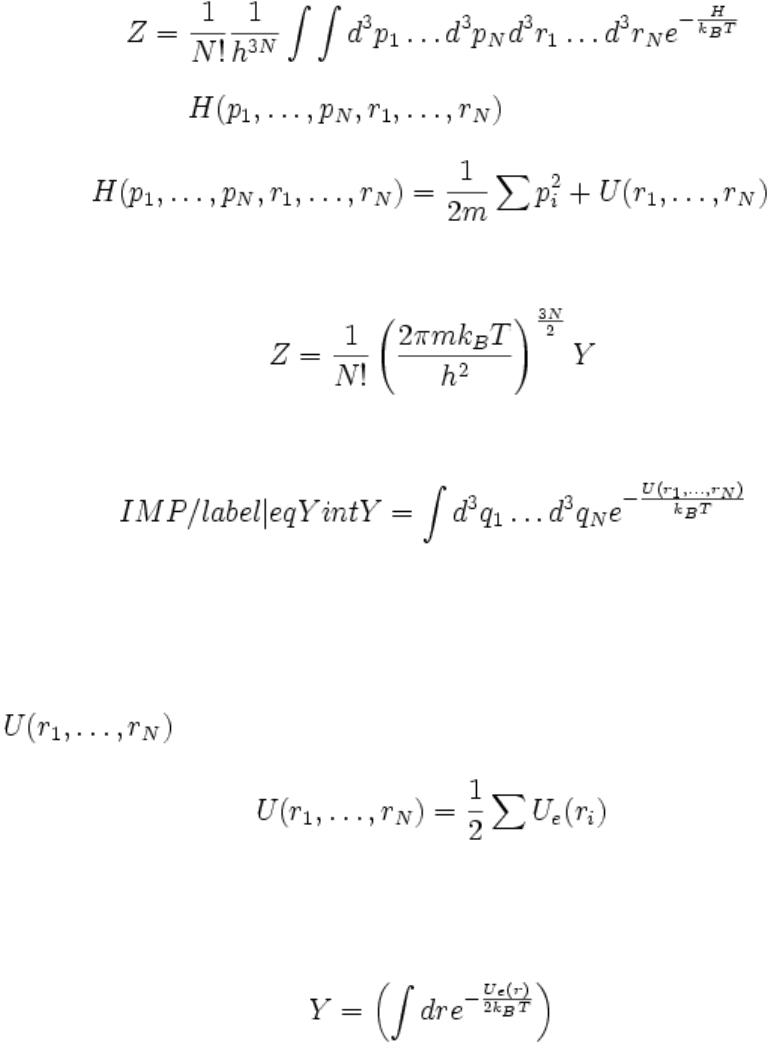
approximation, that is on the repartition function that can be written:
where the function is the hamiltonian of the system.
As for the perfect gas, integration over the p
i
's is immediate:
with
We can simplify the evaluation of previuos integral in neglecting correlations between
particles. A particle number i doesn't feel each particle but rather the average influence of
the particles cloud surrounding the considered particle; this approximation is called mean
field approximation {mean field}. It leads, as if the particles were actually independant to
a factorization of the repartition function. Interaction potential
becomes:
where U (r )
e i
is the "effective potential" that describes the mean interaction between
particle i and all the other particles. It depends only on position of particle i. Function Y
introduced at equation ---eqYint--- can be factorized:
In a mean field approximation framework, it is considered that particle distribution is
uniform in the volume. Effective potential has thus to traduce an mean attraction. Indeed,
it can be shown that at large distances two molecules are attracted, potential varying like
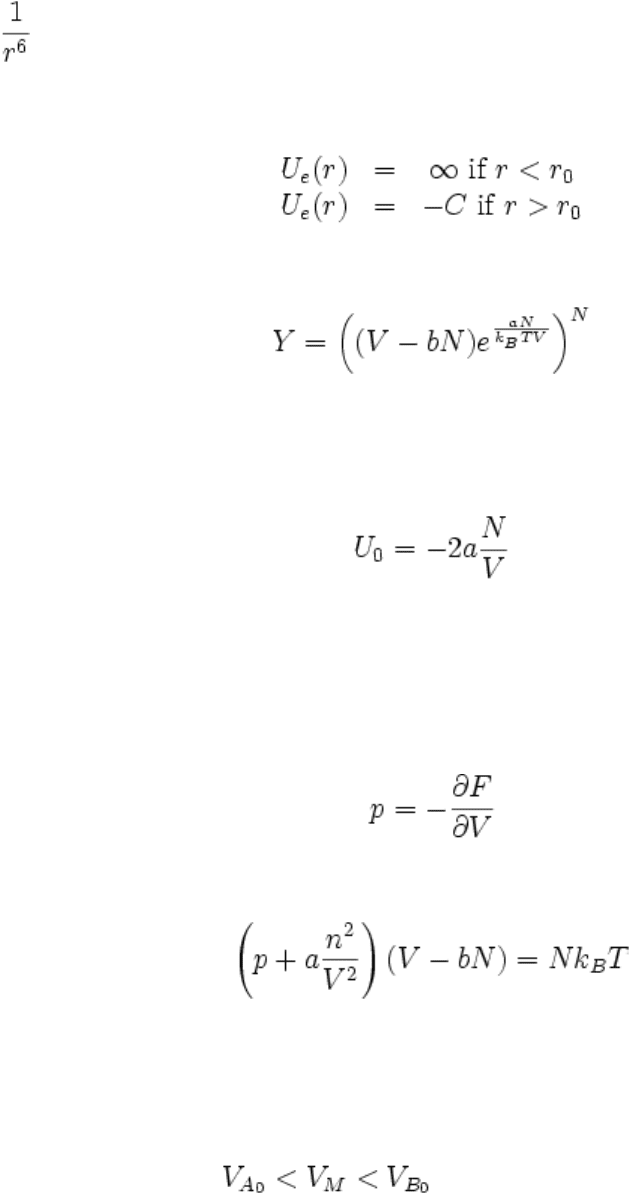
. This can be proofed using quantum mechanics but this is out of the frame of this
book. At small distances however, molecules repel themselves strongly. Effective
potential undergone by a particle at position r = 0 can thus be modelled by function:
Quantity Y is
Quantity bN represents the excluded volume of the particle. It is proportional to N
because N particles occupying each a volume b occupy a Nb. On another hand mean
potential U
0
felt by the test particle depends on ratio N / V. Usually, one sets:
Introducing
F = − k TlogZ
B
and using
one finally obtains Van der Waals state equation:
Van der Waals model allows to describe liquid--vapour phase transition. [[ Image:
When temperature is lower than critical temperature T
c
, the energy of the system for a
given volume V
M
with is not F (V )
v M
. Indeed, system evolves to a
state of lower energy figure
figvanapres) with energy:

The apparition of a local minimum of F corresponds to the apparition of two
phases.{phase transition}
Ising Model
In this section, an example of the calculation of a partition function is presented. The
Ising model
{Ising} is a model describing ferromagnetism{ferromagnetic}. A ferromagnetic material
is constituted by small microscopic domains having a small magnetic moment. The
orientation of those moments being random, the total magnetic moment is zero. However,
below a certain critical temperature T
c
, magnetic moments orient themselves along a
certain direction, and a non zero total magnetic moment is observed\footnote{ Ones says
that a phase transition occurs.{phase transition} Historically, two sorts of phase
transitions are distinguished
phase transition of first order (like liquid--vapor transition) whose
characteristics are:
1. Coexistence of the various phases.
2. Transition corresponds to a variation of entropy.
3. existence of metastable states.
second order phase transition (for instance the
ferromagnetic--paramagnetic transition) whose characteristics are:
1. symmetry breaking
2. the entropy S is a continuous function of temperature and of the order
parameter.
} . Ising model has been proposed to describe this phenomenom. It consists in describing
each microscopic domain by a moment S
i
(that can be considered as a spin){spin}, the
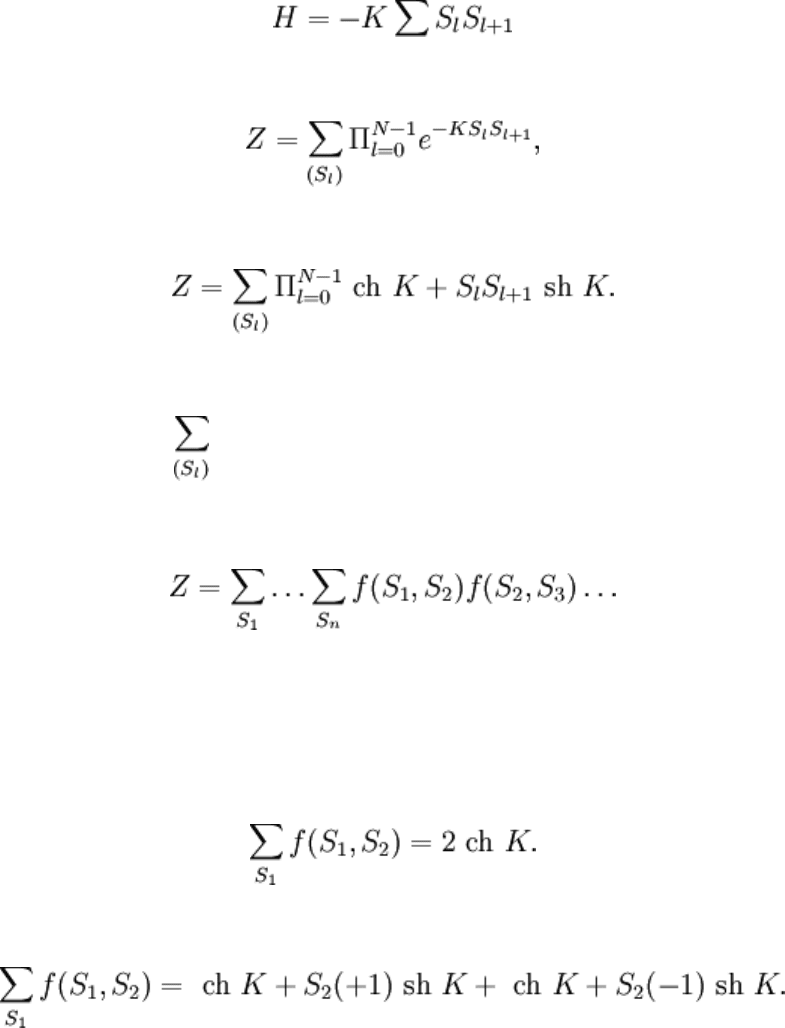
interaction between spins being described by the following hamiltonian (in the one
dimensional case):
partition function of the system is:
which can be written as:
It is assumed that S
l
can take only two values. Even if the one dimensional Ising model
does not exhibit a phase transition, we present here the calculation of the partition
function in two ways. represents the sum over all possible values of S
l
, it is thus, in
the same way an integral over a volume is the successive integral over each variable, the
successive sum over the S
l
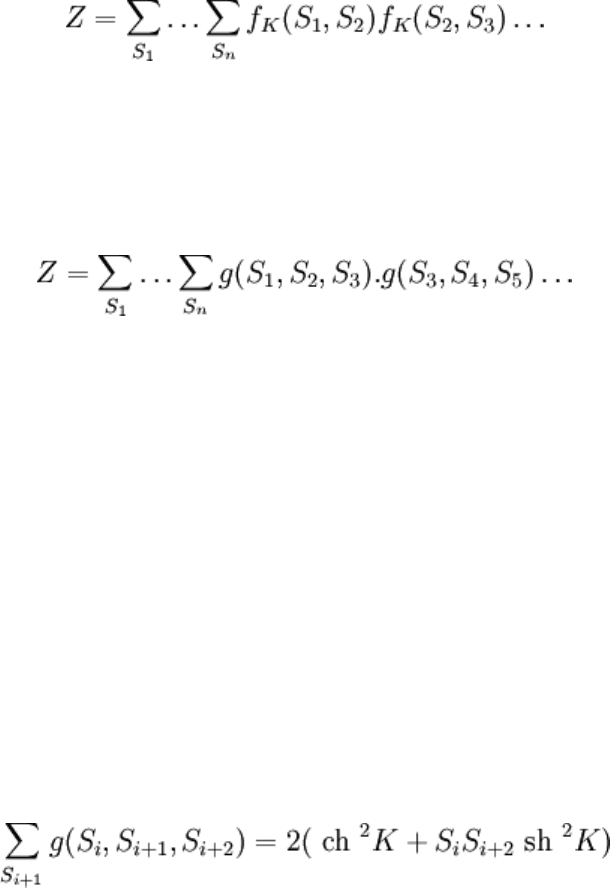
's. Partition function Z can be written as:
with
f (S ,S ) = ch K + SS sh K
K i i + 1 i i + 1
We have:
Indeed:
Thus, integrating successively over each variable, one obtains:
IMP / label | eqZisiZ = 2 ( ch K)
n − 1 n − 1
This result can be obtained a powerful calculation method: the {\bf
renormalization group
method}
{renormalisation group} proposed by K. Wilson\footnote{Kenneth
Geddes Wilson received the physics Nobel price in 1982 for the
method of analysis introduced here.}.
Consider again the partition function:
where
f (S ,S ) = ch K + SS sh K
K i i + 1 i i + 1
Grouping terms by two yields to:
where
g(S ,S ,S ) = ( ch K + SS sh K)( ch K + S S sh K)
i i + 1 i + 2 i i + 1 i + 1 i + 2
This grouping is illustrated in figure figrenorm. [[ Image:
renorm
| center | frame |Sum over all possible spin values S ,S ,S
i i + 1 i + 2
. The
product
f (S ,S )f (S ,S )
K i i + 1 K i + 1 i + 2
is the sum over all possible values of spins S
i
and S
i + 2
of a
function f (S ,S )
K' i i + 2
deduced from f
K
by a simple change of the value of the parameter K
associated to function f
K
.}
]] Calculation of sum over all possible values of S
i + 1
yields to:
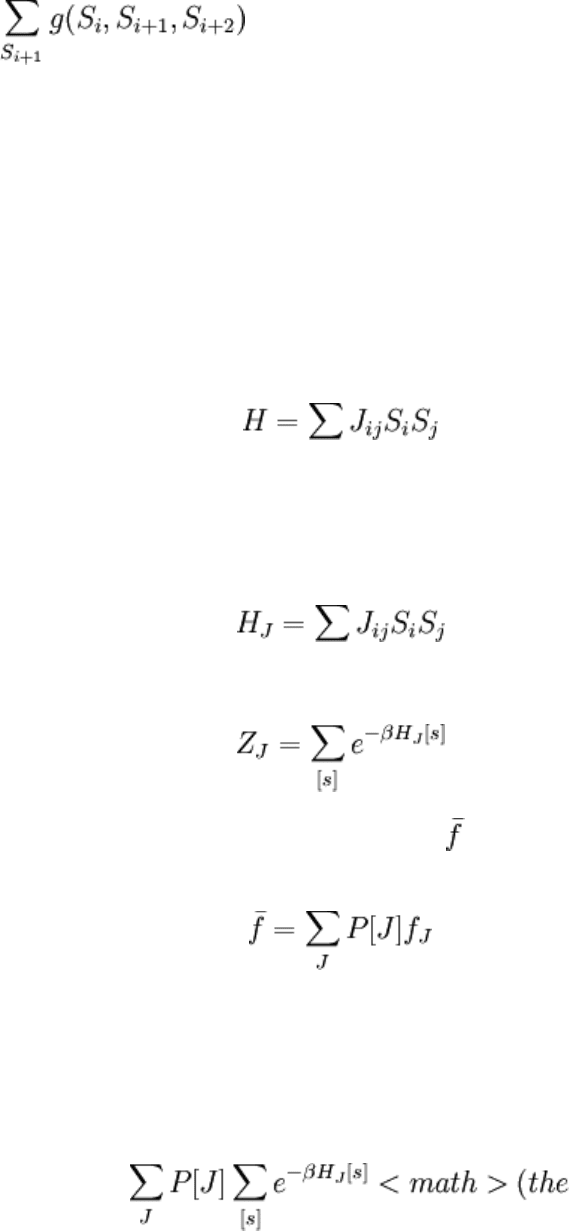
Function can thus be written as a second function f (S ,S )
K' i i + 2
with
K' = Arcth ( th K).
2
Iterating the process, one obtains a sequence converging towards the partition function Z
defined by equation eqZisi.
Spin glasses
Assume that a spin glass system {spin glass} section{secglassyspin}) has the energy:
Values of variable S
i
are + 1 if the spin is up or - 1 if the spin is down. Coefficient J
ij
is +
1 if spins i and j tend to be oriented in the same direction or - 1 if spins i and j tend to be
oriented in opposite directions (according to the random position of the atoms carrying
the spins). Energy is noted:
where J in H
J
denotes the J
ij
distribution. Partitions function is:
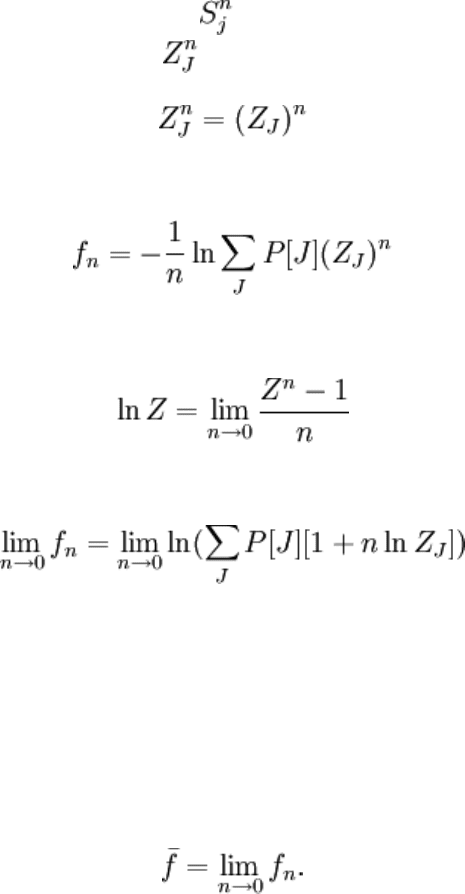
where [s] is a spin configuration. We look for the mean over J
ij
distributions of the
energy:
where P[j] is the probability density function of configurations [J], and where f
J
is:
f = − lnZ .
J J
This way to calculate means is not usual in statistical physics. Mean is done on the
"chilled" J variables, that is that they vary slowly with respect to the S
i
's. A more classical
mean would consist to
J</math>'s are then
"annealed" variables). Consider a system compound by n replicas{replica} of the
same system S
J
. Its partition function is simply:
Let f
n
be the mean over J defined by:
As:
we have:
Using
∑
P[J] = 1
J
and ln(1 + x) = x + O(x) one has:
By using this trick we have replaced a mean over lnZ by a mean over Z
n
; price to pay is
an analytic prolongation in zero. Calculations are then greatly simplified .
Calculation of the equilibrium state of a frustrated system can be made by simulated
annealing method .{simulated annealing} An numerical implementation can be done
using the Metropolis algorithm{Metropolis}. This method can be applied to the travelling
salesman problem
{travelling salesman problem}).
Quantum perfect gases
Introduction
Consider a quantum perfect gas, {\it i. e.}, a system of independent particle that have to
be described using quantum mechanics, {quantum perfect gas} in equilibrium with a
particle reservoir and with a thermostat. The description adopted is called "grand--
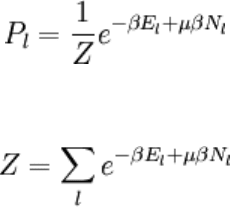
canonical". It can be shown that the solution of the entropy maximalization problem
(using Lagrange multipliers method) provides the occupation probability P
l
of a state l
characterized by an energy E
l
an a number of particle N
l
:
with
Assume that the independent particles that constitute the system are in
addition identical undiscernible. State l can then be defined by the
datum of the states λ of individual particles.
Let ε
λ
be the energy of a particle in the state λ. The energy of the system in state l is then:
E
l
=
∑
N
λ
ε
λ
λ
where N
λ
is the number of particles that are in a state of energy E
λ
. This number is called
occupation number of state of energy{occupation number} E
λ
figure ---figoccup---).
Thus:
N
l
=
∑
N
λ
λ
Partition function becomes:
Z = Π ξ
λ λ
with