
Cossey L. Introduction to Mathematical Physics
Подождите немного. Документ загружается.

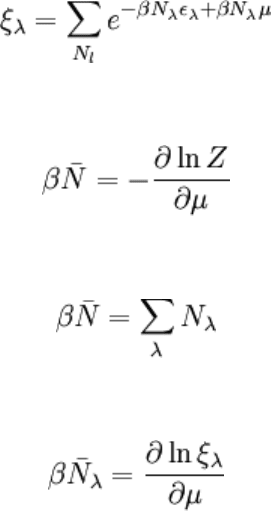
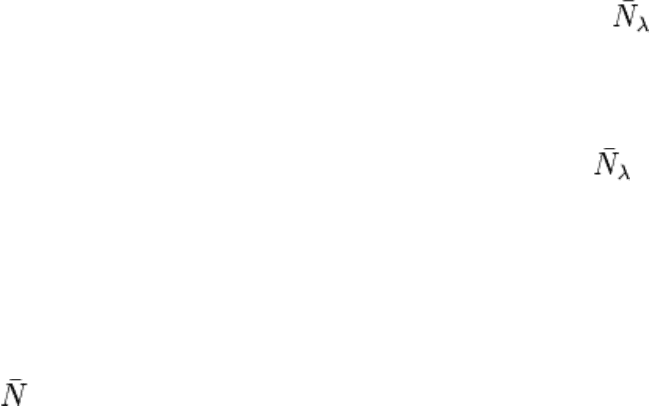
The average particles number in the system is given by:
that can be written:
where N
λ
represents the average occupation number and is defined by following equality:
Fermion gases
If particles are fermions{fermions}, from Pauli principle{Pauli principle}, occupation
number N
λ
value can only be either zero (there is no particle in state with energy ε
λ
) or
one (a unique particle has an energy ε
λ
). The expression of partition function then allows
to evaluate the various thermodynamical properties of the considered system. An
application example of this formalism is the study of electrical properties of {\bf
semiconductors}
{metal}{semi-conductor}. Fermion gases can also be used to model white dwarfs {white
dwarf}. A white dwarf is a star very dense: its mass is of the order of an ordinary star's
mass {star} (as sun), but its radius is 50 to 100 times smaller. Gravitational pressure
implies star contraction. This pressure in an ordinary star is compensated by
thermonuclear reaction that occur in the centre of the star. But is a white wharf, such
reactions do not occur no more. Moreover, one can show that speed of electrons of the
star is very small. As all electrons can not be is the same state from Pauli
principle\footnote{ Indeed, the state of an electron in a box is determined by its energy,
its position is not defined in quantum mechanics.} , they thus exert a pressure. This
pressure called "quantum pressure" compensates gravitational pressure and avoid the star
to collapse completely.
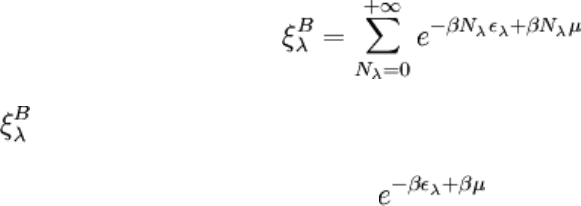
Boson gases
If particles are bosons, from Pauli principle, occupation number N
λ
can have any positive
or zero value:
is sum of geometrical series of reason:
where ε
λ
is fixed. Series converges if
ε − µ > 0
λ
It can be shown that at low temperatures, bosons gather in the state of lowest energy.
This phenomena is called Bose condensation.{Bose condensation}
Remark:
Photons are bosons whose number is not conserved. This confers them a very peculiar
behaviour: their chemical potential is zero.
N body problems and kinetic description
Introduction
In this section we go back to the classical description of systems of particles already
tackled at section ---secdistclassi---. Henceforth, we are interested in the presence
probability of a particle in an elementary volume of space phase. A short excursion out of
the thermodynamical equilibrium is also proposed with the introduction of the kinetic
evolution equations. Those equations can be used to prove conservations laws of
continuous media mechanics (mass conservation, momentum conservation, energy
conservation,\dots) as it will be shown at next chapter.
Gas kinetic theory
Perfect gas problem can be tackled{perfect gas} in the frame of a kinetic theory{kinetic
description}. This point of view is much closer to classical mechanics that statistical
physics and has the advantage to provide more "intuitive" interpretation of results.
Consider a system of N particles with the internal energy:
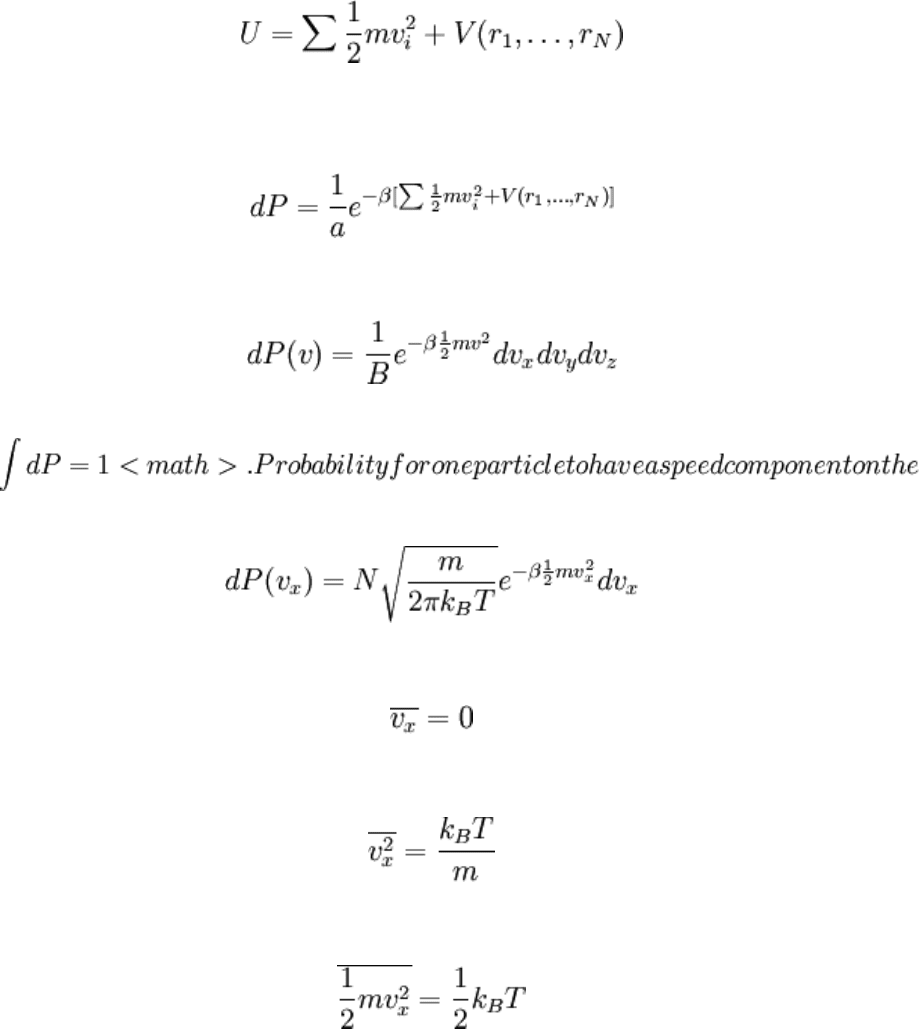
A state of the system is defined by the set of the r,p
i i
's. Probability for the system to be in
the volume of phase space comprised between hyperplanes r,p
i i
and r + dr ,p + dp
i i i i
is:
Probability for one particle to have a speed between v and v + dv is
B is a constant which is determined by the normalization condition
x</math>-axis between v
x
and v + dv
x x
is
The distribution is Gausssian. It is known that:
and that
Thus:
This results is in agreement with equipartition energy theorem . Each particle that crosses
a surface Σ increases of mv
z
the momentum. In the whole box, the number of molecule
that have their speed comprised between v
z
and v + dv
z z
is figure figboite)
dN = NP(v )dv
z z
In the volume ∆V it is:
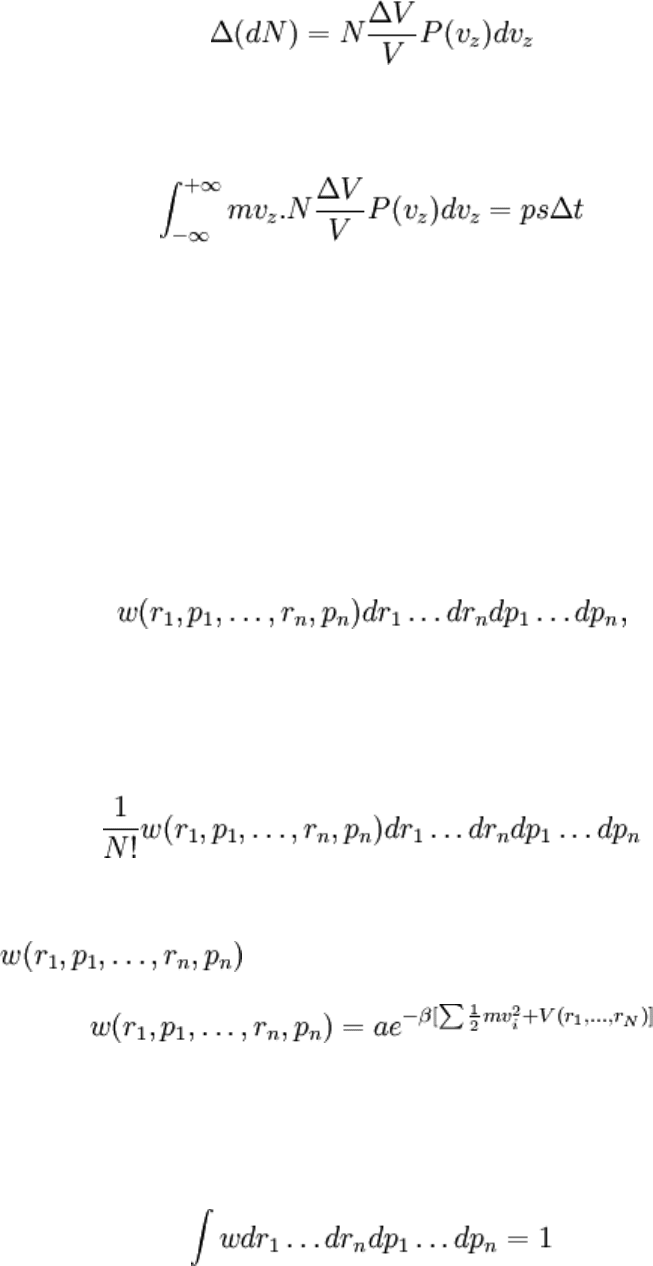
One chooses ∆V = sv ∆t
z
. The increasing of momentum is equal to the pressure forces
power:
so
pV = Nk T
B
We have recovered the perfect gas state equation presented at section
secgasparfthe.
==Kinetic description==
Let us introduce
the probability that particle 1 is the the phase space volume between hyperplanes r ,p
1 1
and r + dr ,p + dp
1 1 1 1
, particle 2 inthe volume between hyperplanes r ,p
2 2
et r + dr ,p +
dp
2 2 2
2
,\dots, particle n in the volume between hyperplanes r ,p
n n
and r + dr ,p + dp
n n n n
. Since
partciles are undiscernable:
is the probability\footnote{At thermodynamical equilibrium, we have seen
that csan be written:
} that a particle is inthe volume between hyperplanes r ,p
1 1
and r + dr ,p + dp < math >
,anotherparticleisinvolumebetweenhyperplanes
1 1 1 1
r_2,p_2</math> et r + dr ,p + dp
2 2 2 2
,\dots,
and one last particle in volume between hyperplanes r ,p
n n
and r + dr ,p + dp
n n n n
. We have
the normalization condition:
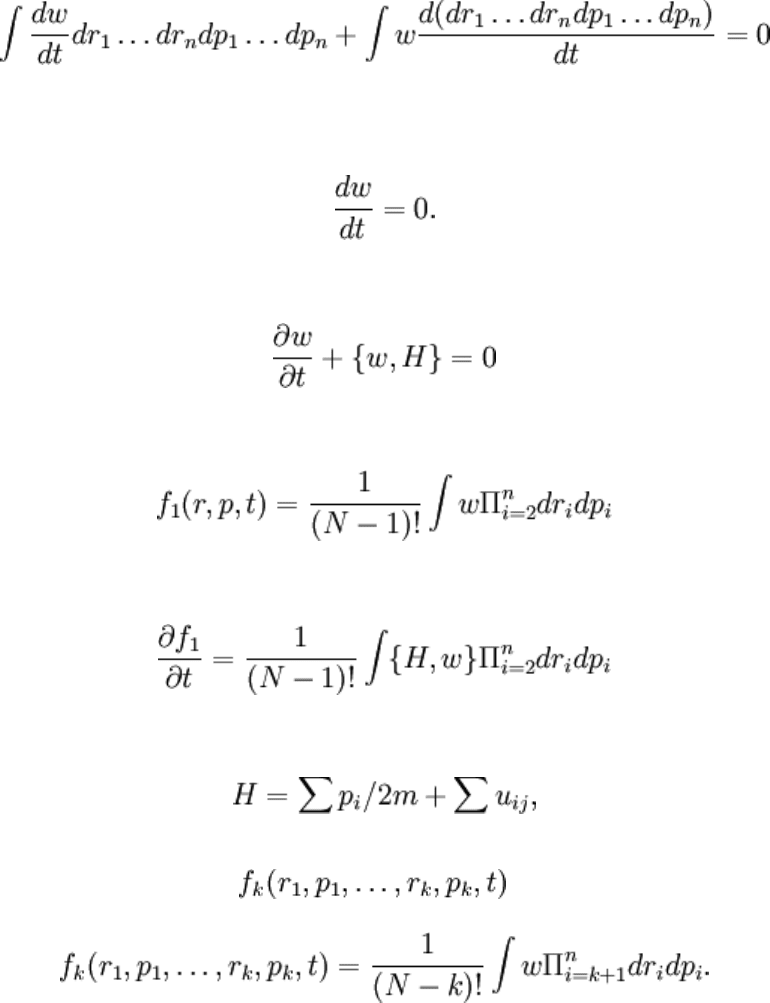
By differentiation:
If the system is hamiltonian{hamiltonian system}, volume element is preserved during
the dynamics, and w verify the Liouville equation :
Using r and p definitions, this equation becomes:
where H is the hamilitonian of the system. One states the following repartition function:
Intergating Liouville equation yields to:
and assuming that
one obtains a hierarchy of equations called BBGKY hierarchy {BBGKY hierachy}
binding the various functions
defined by:
To close the infinite hirarchy, various closure conditions can be considered. The Vlasov
closure condition states that f
2
can be written:
f (r ,p ,r ,p ) = f (r ,p )f (r ,p ).
2 1 1 2 2 1 1 1 2 2 2
One then obtains the Vlasov equation {Vlasov equation} :
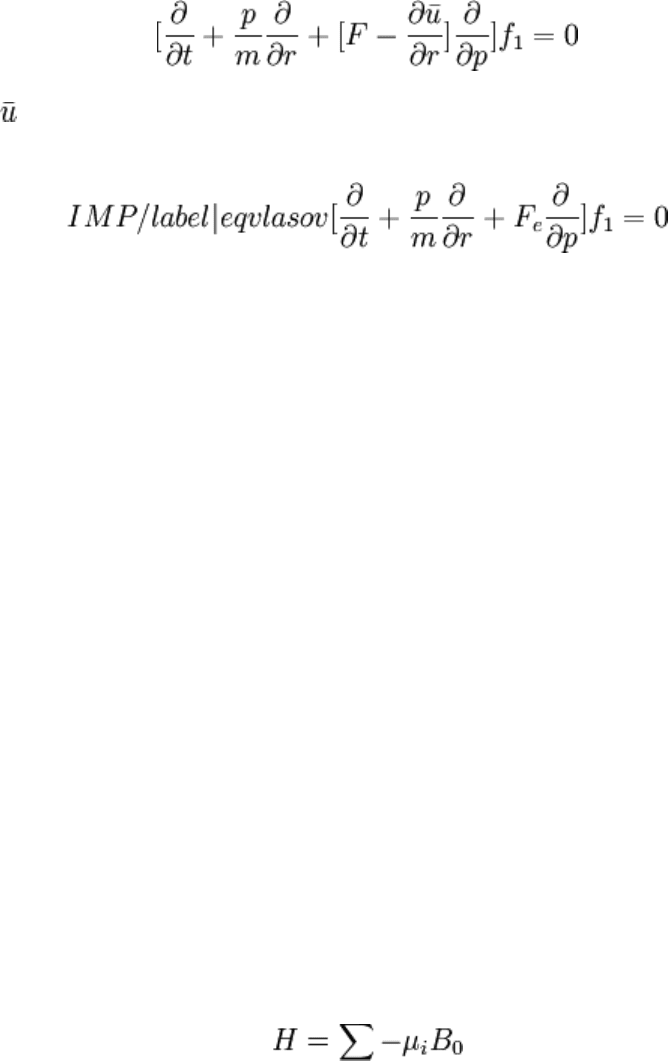
where
is the mean potential. Vlasov equation can be rewritten by introducing a effective
force F
e
describing the forces acting on partciles in a mean filed approximation:
The various momets of Vlasov equation allow to prove the conservation equations of
mechanics of continuous media chapter chapapproxconti).
Remark:
Another dynamical equation close to Vlasov equation is the {\bf Boltzman
equation}
{Boltzman}
Exercises
Exercice:
Paramagnetism. Consider a system constituted by N atoms located at nodes of a lattice.
Let J
i
be the total kinetic moment of atom number i in its fundamental state. It is known
that to such a kinetic moment is associated a magnetic moment given by:
µ = − gµ J
i B i
where µ
B
is the Bohr magneton and g is the Land\'e factor. J
i
can have only semi integer
values.
Assume that the hamiltonian describing the system of N atoms is:
where B
0
is the external magnetic field. What sort of particles are the atoms in this
systme, discernables or undiscernables? Find the partition function of the system.
Exercice:
Study the Ising model at two dimension. Is it possible to envisage a direct method to
calculate Z ? Write a programm allowing to visualize the evolution of the spins with time,
temperature being a parameter.
Exercice:
Consider a gas of independent fermions. Calculate the mean occupation number of a
state λ. The law you'll obtained is called Fermi distribution.
Exercice:
Consider a gas of independent bosons. Calculate the mean occupation number of a
state λ. The law you'll obtained is called Bose distribution.
Exercice:
Consider a semi--conductor metal. Free electrons of the metal are modelized by a gas of
independent fermions. The states are assumed to be described by a sate density ρ(ε), ε
being the nergy of a state. Give the expression of ρ(epsilon). Find the expression binding
electron number to chemical potential. Give the expression of the potential when
temperature is zero.
Introduction
There exist several ways to introduce the matter continuous
approximation. They are different approaches of the averaging over
particles problem. The first approach consists in starting from
classical mechanics and to consider means over elementary volumes
called "fluid elements".
Let us consider an elementary volume dτ centred at r, at time t. Figure figvolele
illustrates this averaging method. Quantities associated to continuous approximation are
obtained from passage to the limit when box-size tends to zero.
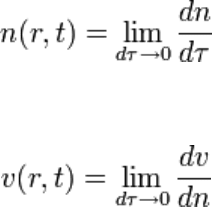
So the particle density is the extrapolation of the limit when box volume tends to zero of
the ratio of dn (the number of particles in the box) over dτ (the volume of the box):
In the same way, mean speed of the medium is defined by:
where dv is the sum of the speeds of the dn particles being in the box.
Remark:
Such a limit passage is difficult to formalize on mathematical point of view. It is a sort of
"physicist limit"!
Remark:
Note that the relation between particles characteristics and mean characteristics are not
always obvious. It can happen that the speed of the particles are non zero but that their
mean is zero. It is the case if particles undergo thermic agitation (if no convection). But it
can also happen that the temporal averages of individual particle speed are zero, and that
in the same time the speed of the fluid element is non zero! Figure
figvitnonul illustrates this remark in the case of the drift
phenomenom
Another method consists in considering the repartition function for one particle f(r,p,t)
introduced at section
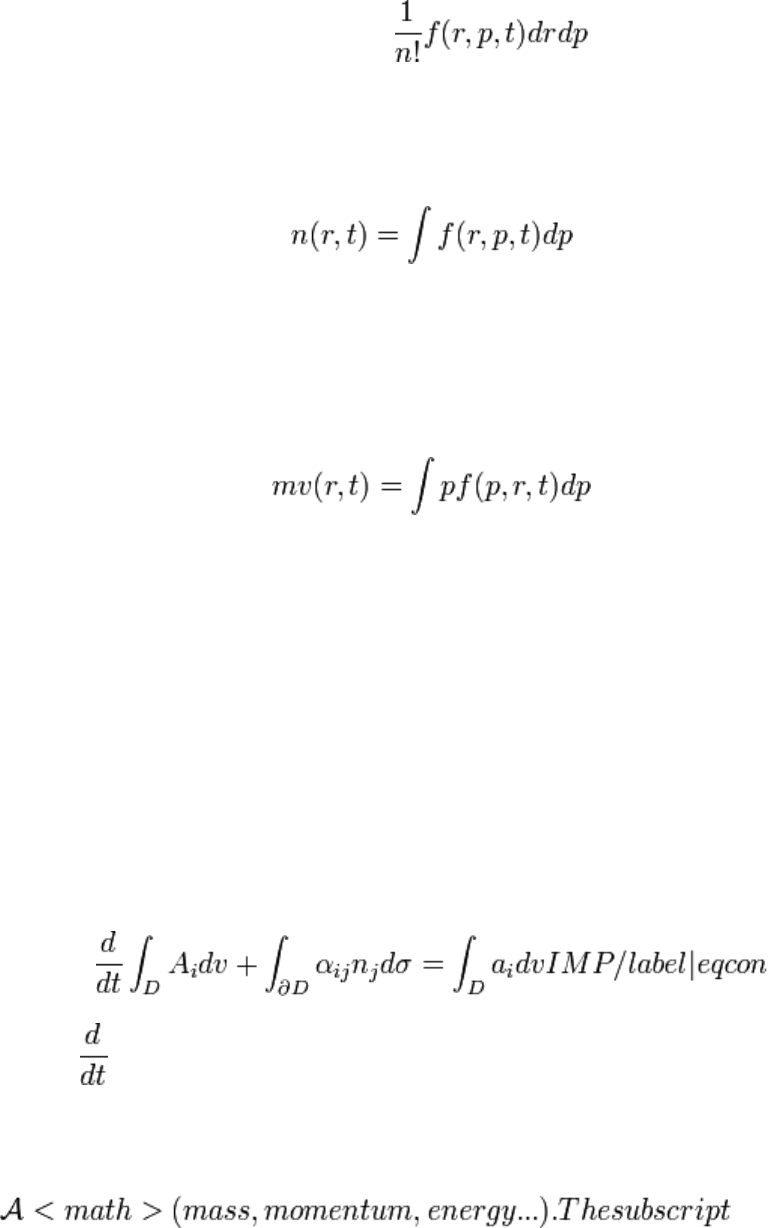
secdesccinet. Let us recall that represents
the probability to find at time t a particle in volume of space phase between r,p and r +
dr,p + dp. The various fluid quantities are then introduced as the moments of f with
respect to speed. For instance, particle density is the zeroth order moment of f :
that is, the average number of particles in volume a volume dτ is
dn = n(r,t)dτ.
Fluid speed is binded to first moment of f :
The object of this chapter is to present laws governing the dynamics of a continuous
system. In general, those laws can be written as {\bf conservation
laws}.
Conservation laws
Integral form of conservation laws
A conservation law {conservation law} is a balance that can be applied to every connex
domain strictly interior to the considered system and that is followed in its movement.
such a law can be written:
Symbol represents the particular derivative appendix
chapretour).
A
i
is a scalar or tensorial\footnote{ A
i
is the volumic density of quantity
i</math>
symbolically designs all the subscripts of the considered tensor. }
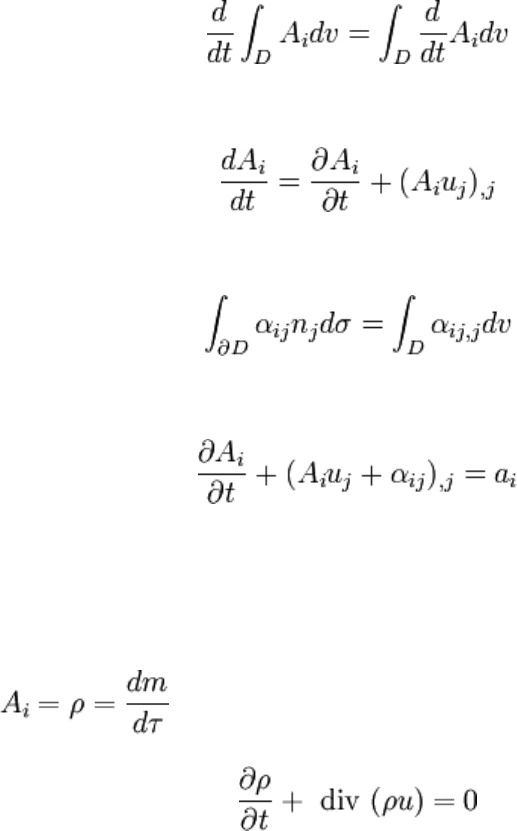
function of eulerian variables x and t. a
i
is volumic density rate
provided by the exterior to the system. α
ij
is the surfacic density
rate of what is lost by the system through surface bording D.
Local form of conservation laws
Equation eqcon represents the integral form of a conservation law. To this integral form
is associated a local form that is presented now. As recalled in appendix chapretour, we
have the following relation:
It is also known that:
Green formula allows to go from the surface integral to the volume integral:
Final equation is thus:
Let us now introduce various conservation laws.
Matter conservation
Setting in equation eqcon one obtains the matter conservation equation:
ρ is called the volumic mass. This law can be proved by calculations using elementary
fluid volumes. So, variation of mass M in volume dτ per time unit is opposed to the
outgoing mass flow: