
Cossey L. Introduction to Mathematical Physics
Подождите немного. Документ загружается.

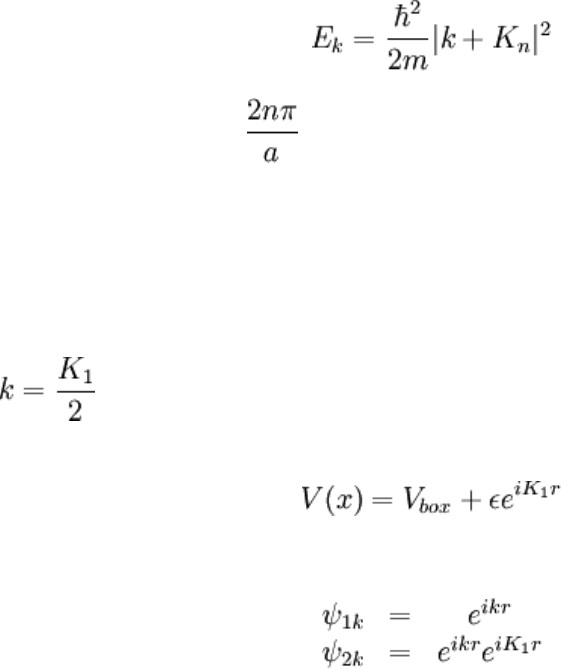
where K
n
can take values , where a is lattice's period and n is an integer. Plot of E as
a function of k is represented in figure
figeneeleclib.
Quasi-free electron model
Let us show that if the potential is no more the potential of a periodic box, degeneracy at
is erased. Consider for instance a potential V(x) defined by the sum of the box
periodic potential plus a periodic perturbation:
In the free electron model functions
are degenerated. Diagonalization of Hamiltonian in this basis (perturbation method for
solving spectral problems, see section chapresospec) shows that degeneracy is erased by
the perturbation.
Thigh binding model
Tight binding approximation consists in approximating the state space by the space
spanned by atomic orbitals centred at each node of the lattice. That is, each eigenfunction
is assumed to be of the form:
ψ(r) =
∑
c
j
φ
at
(r − R
j
)
j
Application of Bloch's theorem yields to look for ψ
k
such that it can be written:
ψ (r) = e u (r)
k
ikr
k
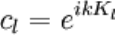
Identifying u (r)
k
and u (r + R )
k i
, it can be shown that . Once more, symmetry
considerations fully determine the eigenvectors. Energies are evaluated from the
expression of the Hamiltonian.
.
Exercises
Exercice:
Give the name of the symmetry group molecule NH
3
belongs to.
Exercice:
Parametrize the vibrations of molecule NH
3
and expand it in a sum of irreducible
representations.
Exercice:
Propose a basis for the study of molecule BeH
2
different from those presented at section
secnnne.
Exercice:
Find the eigenstates as well as their energies of a system constituted by an electron in a
square box of side a (potential zero for − a / 2 < x < a / 2 and − a / 2 < y < + a / 2,
potential infinite elsewhere). What happens if to this potential is added a perturbation of
value ε on a quarter of the box (0 < y < a / 2 and 0 < y < a / 2)? Calculate by perturbation
the new energies and eigenvectors. Would symmetry considerations have permitted to
know in advance the eigenvectors?
Introduction
Statistical physics goal is to describe matter's properties at macroscopic scale from a
microscopic description (atoms, molecules, etc\dots). The great number of particles
constituting a macroscopic system justifies a probabilistic description of the system.
Quantum mechanics (see chapter ---chapmq---) allows to describe part of systems made
by a large number of particles: Schr\"odinger equation provides the various accessible
states as well as their associated energy. Statistical physics allows to evaluate occupation
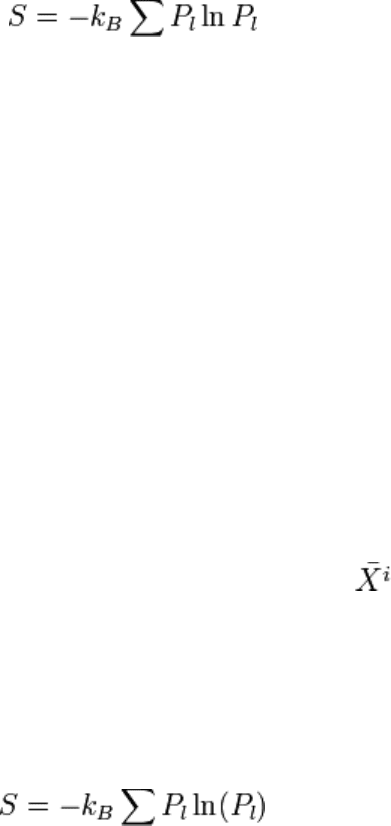
probabilities P
l
of a quantum state l. It introduces fundamental concepts as temperature,
heat\dots
Obtaining of probability P
l
is done using the statistical physics principle that states that
physical systems tend to go to a state of ``maximum disorder. A disorder measure is
given by the statistical entropy\footnote{ This formula is analog to the information
entropy chosen by Shannon in his information theory .}{entropy}
The statistical physics principle can be enounced as:
Postulate:
At macroscopic equilibrium, statistical distribution of microscopic states is, among all
distributions that verify external constraints imposed to the system, the distribution that
makes statistical entropy maximum.
{{IMP/rem| This problem corresponds to the classical minimization (or maximization)
problem presented at section chapmetvar) which can be treated by Lagrange multiplier
method.
Entropy maximalization
The mathematical problem associated to the calculation of occupation probability P
l
is
here presented:{maximalization} In general, a system is described by two types of
variables. External variables y
i
whose values are fixed at y
j
by the exterior and internal
variables X
i
taht are free to fluctuate, only their mean being fixed to . Problem to
solve is thus the following:
Problem:
Find distribution probability P
l
over the states (l) of the considered system that
maximizes the entropy
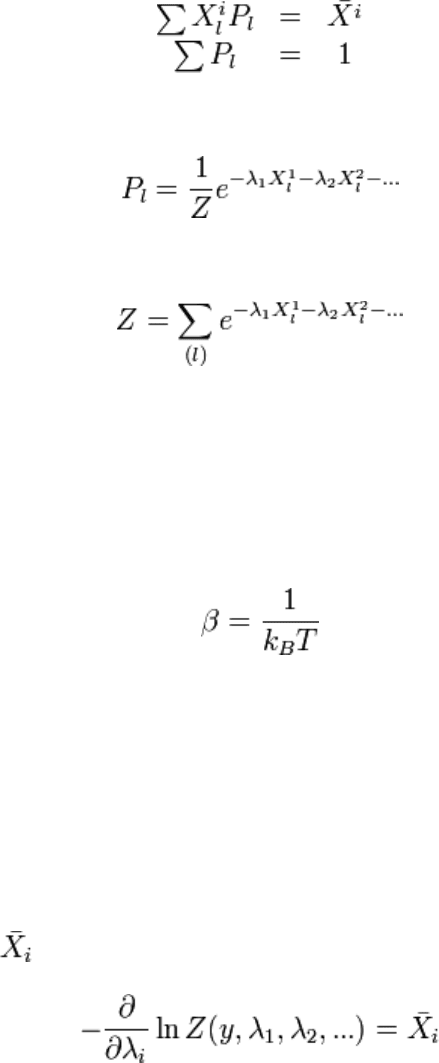
and that verifies following constraints:
Entropy functional maximization is done using Lagrange multipliers technique. Result is:
where function Z, called partition function, {partition function} is defined by:
Numbers λ
i
are the Lagrange multipliers of the maximization problem considered.
Example:
In the case where energy is free to fluctuate around a fixed average, Lagrange multiplier
is:
where T is temperature.{temperature} We thus have a mathematical definition of
temperature.
Example:
In the case where the number of particles is free to fluctuate around a fixed average,
associated Lagrange multiplier is noted βµ where µ is called the chemical potential.
Relations on means\footnote{They are used to determine Lagrange multipliers λ
i
from
associated means
} can be written as:
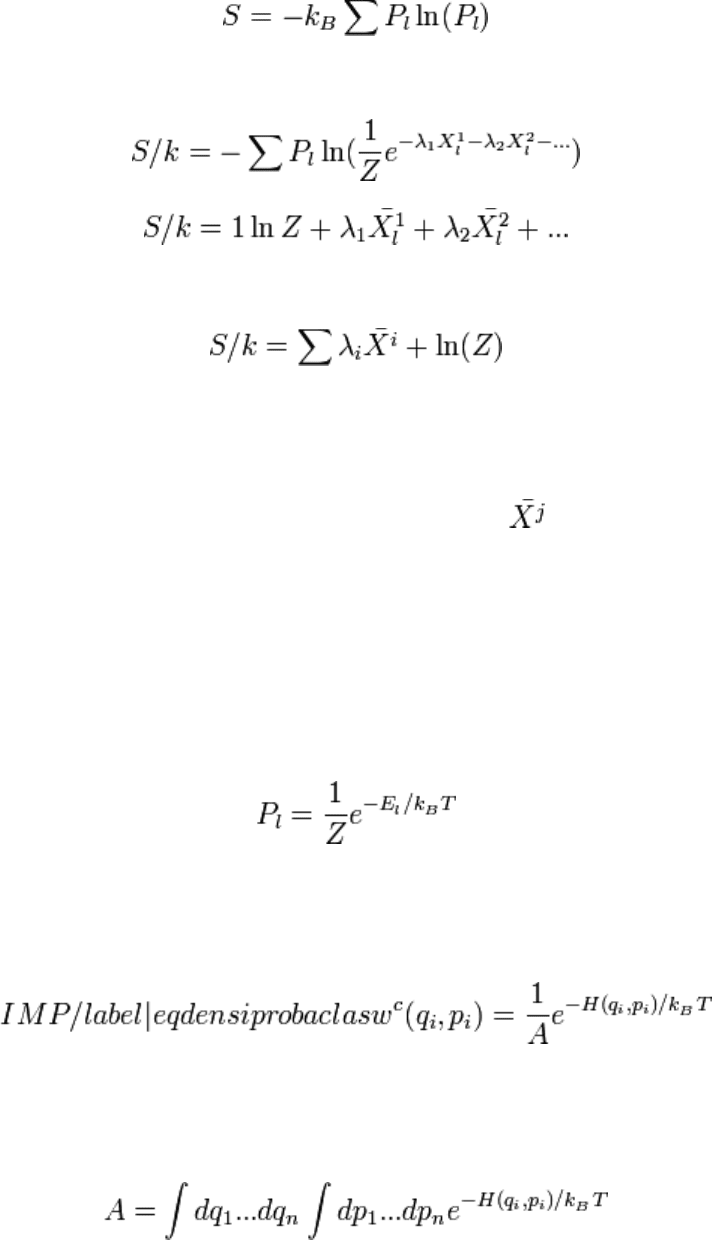
It is useful to define a function L by:
L = lnZ(y,λ ,λ ,...)
1 2
It can be shown\footnote{ By definition
thus
} that:
This relation that binds L to S is called a {\bf Legendre
transform}.{Legendre transformation}
L is function of the y
i
's and λ
j
's, S is a function of the y
i
's and 's.
Canonical distribution in classical
mechanics
Consider a system for which only the energy is fixed. Probability for this system to be in
a quantum state (l) of energy E
l
is given (see previous section) by:
Consider a classical description of this same system. For instance, consider a system
constituted by N particles whose position and momentum are noted q
i
and p
i
, described
by the classical hamiltonian H(q ,p )
i i
. A classical probability density w
c
is defined by:
Quantity w (q,p )dq dr
c
i i i i
represents the probability for the system to be in the phase space
volume between hyperplanes q,p
i i
and q + dq ,p + dp
i i i i
. Normalization coefficients Z and
A are proportional.
One can show that
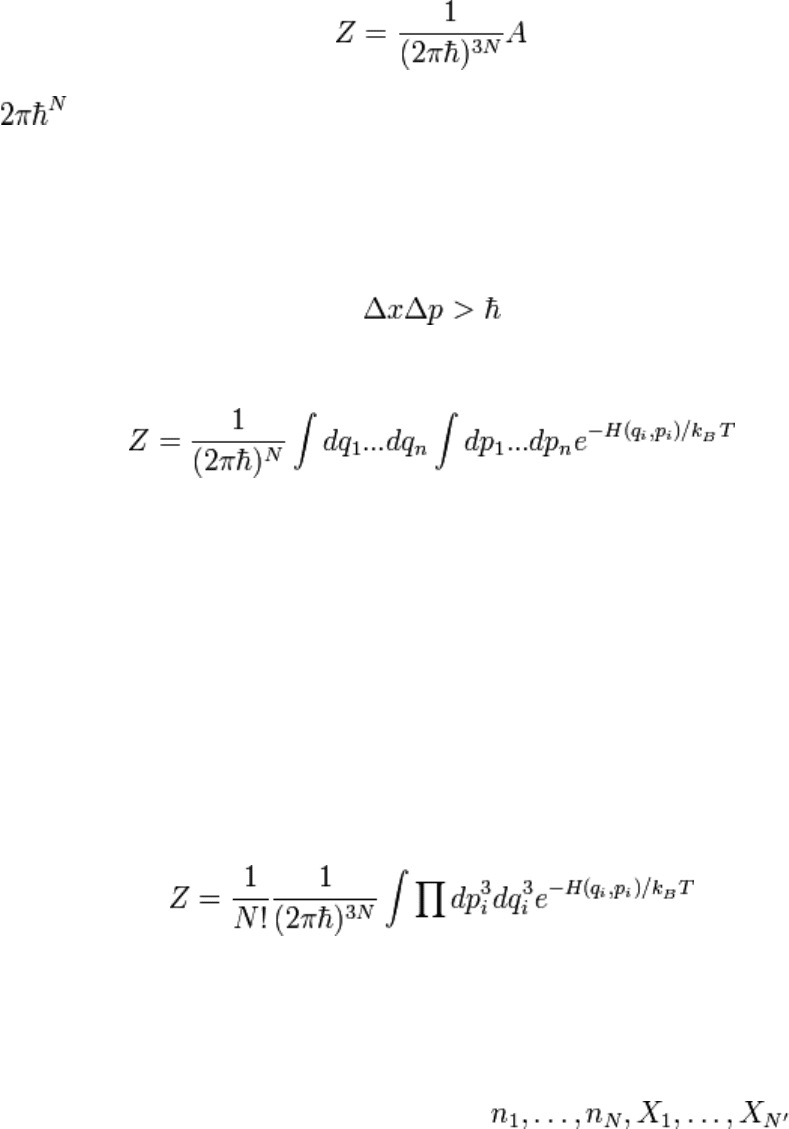
being a sort of quantum state volume.
Remark:
This quantum state volume corresponds to the minimal precision allowed in the phase
space from the Heisenberg uncertainty principle: {Heisenberg uncertainty principle}
Partition function provided by a classical approach becomes thus:
But this passage technique from quantum description to classical description creates
some compatibility problems. For instance, in quantum mechanics, there exist a postulate
allowing to treat the case of a set of identical particles. Direct application of formula of
equation eqdensiprobaclas leads to wrong results (Gibbs paradox). In a classical
treatment of set of identical particles, a postulate has to be artificially added to the other
statistical mechanics postulates:
Postulate:
Two states that does not differ by permutations are not considered as different.
This leads to the classical partition function for a system of N identical particles:
Constraint relaxing
We have defined at section secmaxient external variables, fixed by the exterior, and
internal variables free to fluctuate around a fixed mean. Consider a system L being
described by N + N' internal variables {constraint} . This
system has a partition function Z
L
. Consider now a system F, such that variables n
i
are this
time considered as external variables having value N
i
. This system F has (another)
partition function we call Z
F
. System L is obtained from system F by constraint relaxing.
Here is theorem that binds internal variables n
i
of system L to partition function Z
F
of
system F :
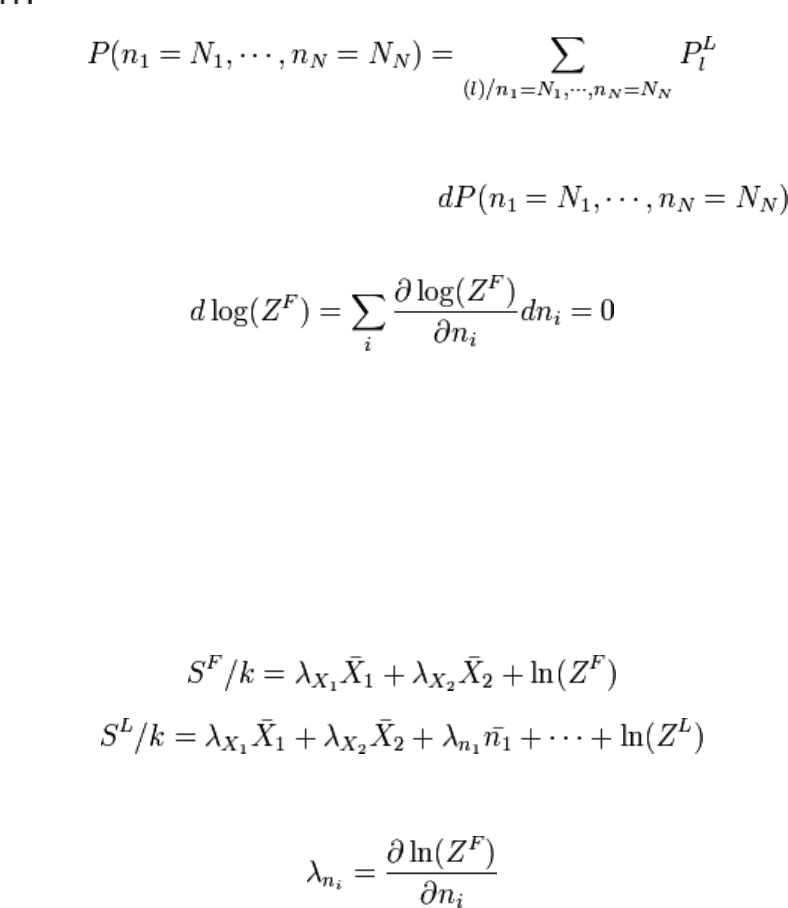
Theorem:
Values n
i
the most probable in system L where n
i
are free to fluctuate are the values that
make zero the differential of partition function Z
F
where the n
i
's are fixed.
Proof:
Consider the description where the n
i
's are free to fluctuate. Probability for event n =
N
1
1
, ,n = N
N N
occurs is:
So
Values the most probable make zero differential
(this
corresponds to the maximum of a (differentiable) function P.). So
Remark:
This relation is used in chemistry: it is the fundamental relation of chemical reaction. In
this case, the N variables n
i
represent the numbers of particles of the N species i and N' =
2 with X = E
1
(the energy of the system) and X = V
2
(the volume of the system). Chemical
reaction equation gives a binding on variables n
i
that involves stoechiometric
coefficients.
Let us write a Gibbs-Duheim type relation {Gibbs-Duheim relation}:
At thermodynamical equilibrium S = S
F L
, so:
Example:
This last equality provides a way to calculate the chemical potential of the
system.{chemical potential}
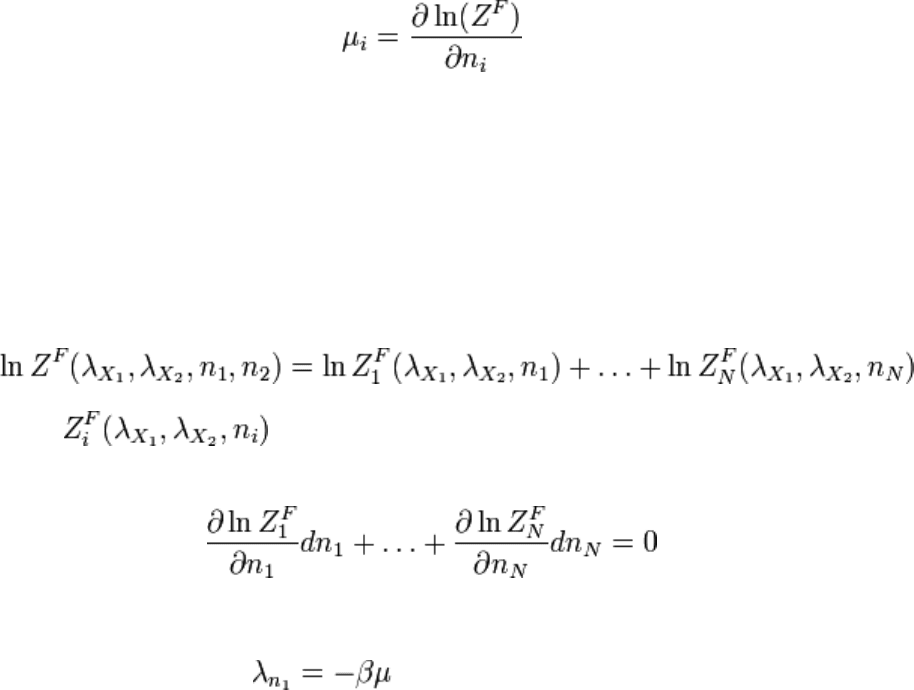
In general one notes − ln(Z ) = G
F
.
Example:
Consider the case where variables n
i
are the numbers of particles of species i. If the
particles are independent, energy associated to a state describing the N particles (the set
of particles of type i being in state l
i
) is the sum of the N energies associated to states l
i
.
Thus:
where represents the partition function of the system constituted
only by particles of type i, for which the value of variable n
i
is fixed. So:
Remark:
Setting λ = β
1
,λ = βp
2
and with G = − k TlnZ
B
nf
, we have G(T,p,n) = E + pV
− TS and G'(T,p,µ) = E + pV − TS − µ − n
1
. This is a Gibbs-Duheim relation.
Example:
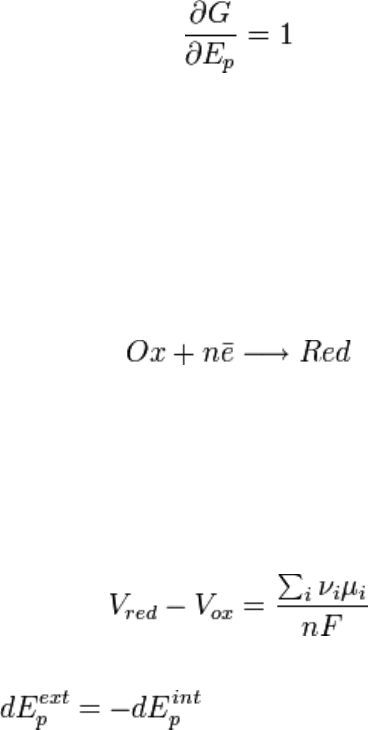
We propose here to prove the Nernst formula{Nernst formula} describing an oxydo-
reduction reaction.{oxydo-reduction} This type of chemical reaction can be tackled using
previous formalism. Let us precise notations in a particular case. Nernst formula
demonstration that we present here is different form those classically presented in
chemistry books. Electrons undergo a potential energy variation going from solution
potential to metal potential. This energy variation can be seen as the work got by the
system or as the internal energy variation of the system, depending on the considered
system is the set of the electrons or the set of the electrons as well as the solution and the
metal. The chosen system is here the second. Consider the free enthalpy function
G(T,p,n ,E )
i p
. Variables n
i
and E
p
are free to fluctuate. They have values such that G is
minimum. let us calculate the differential of G:
Using definition\footnote{ the internal energy U is the sum of the kinetic energy and the
potential energy, so as G can be written itself as a sum:
G = U + pV − TS
}
of G:
one gets:
0 =
∑
µ
i
dn
i
+ dE
p
i
If we consider reaction equation:
0 =
∑
µ
i
ν
i
dξ + nq(V
red
− V
ox
)
i
So:
dG can only decrease. Spontaneous movement of electrons is done in the sense that
implies dE < 0
p
. As we chose as definition of electrical potential:
V = − V
ext int
Nernst formula deals with the electrical potential seen by the exterior.
Some numerical computation in statistical
physics
In statistical physics, mean quantities evaluation can be done using by Monte--Carlo
methods. in this section, a simple example is presented.
Example:
Let us consider a Ising model. In this spin system, energy can be written:

The following Metropolis algorithm
Exercise
Exercice:
Consider a chain of N nonlinear coupled oscillators. Assuming known the (deterministic)
equation governing the dynamics of the particles, is that possible to define a system's
temperature? Can one be sure that a system of coupled nonlinear oscillators will evolve to
a state well described by statistical physics? Do a bibliographic research on this subject,
in particular on Fermi--Ulam--Pasta model.