
Cossey L. Introduction to Mathematical Physics
Подождите немного. Документ загружается.

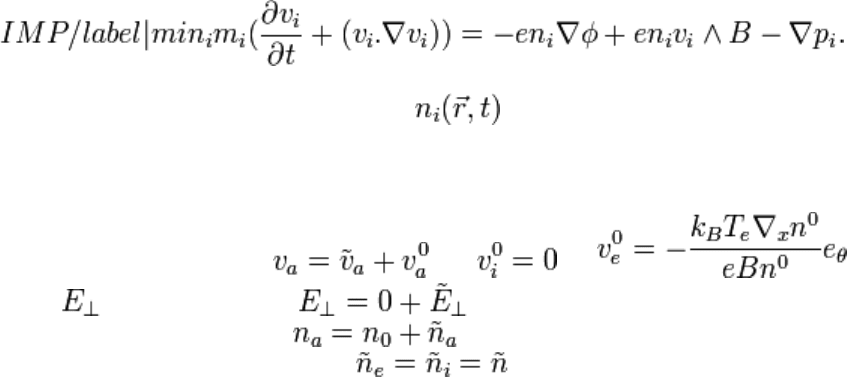
Solve this non linear problem (find solution ) assuming:
• B field is directed along direction z and so defines parallel direction and a
perpendicular direction (the plane perpendicular to the B field).
• speeds can be written with and .
• field can be written: .
• densities can be written . Plasma satisfies the quasi--neutrality
condition{quasi-neutrality} : .
• gases are considered perfect: p = n k T
a a B a
.
• T
e
, T
i
have the values they have at equilibrium.
Introduction
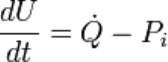
The first principle of thermodynamics section secpremierprinci) allows to bind the
internal energy variation to the internal strains power {strains}:
if the heat flow is assumed to be zero, the internal energy variation is:
dU = − P dt
i
This relation allows to bind mechanical strains (P
i
term) to system's thermodynamical
properties (dU term). When modelizing a system some "thermodynamical" variables X
are chosen. They can be scalars x, vectors x
i
, tensors x
ij
, \dots Differential dU can be
naturally expressed using those thermodynamical variables X by using a relation that can
be symbolically written:
dU = FdX
where F is the conjugated\footnote{ This is the same duality relation noticed between
strains and speeds and their gradients when dealing with powers.}
thermodynamical variable of variable
X. In general it is looked for expressing F as a function of X .
Remark:
If X is a scalar x, the energy differential is:
dU = f.dx
If X is a vector x
i
, the energy differential is:
dU = f dx
i i
Si X is a tensor x
ij
, the energy differential is:
dU = f dx
ij ij
Remark:
If a displacement x, is considered as thermodynamical variable, then the conjugated
variable f has the dimension of a force.
Remark:
One can go from a description using variable X as thermodynamical variable to a
description using the conjugated variable F of X as thermodynamical variables by using a
Legendre transformation section secmaxient and
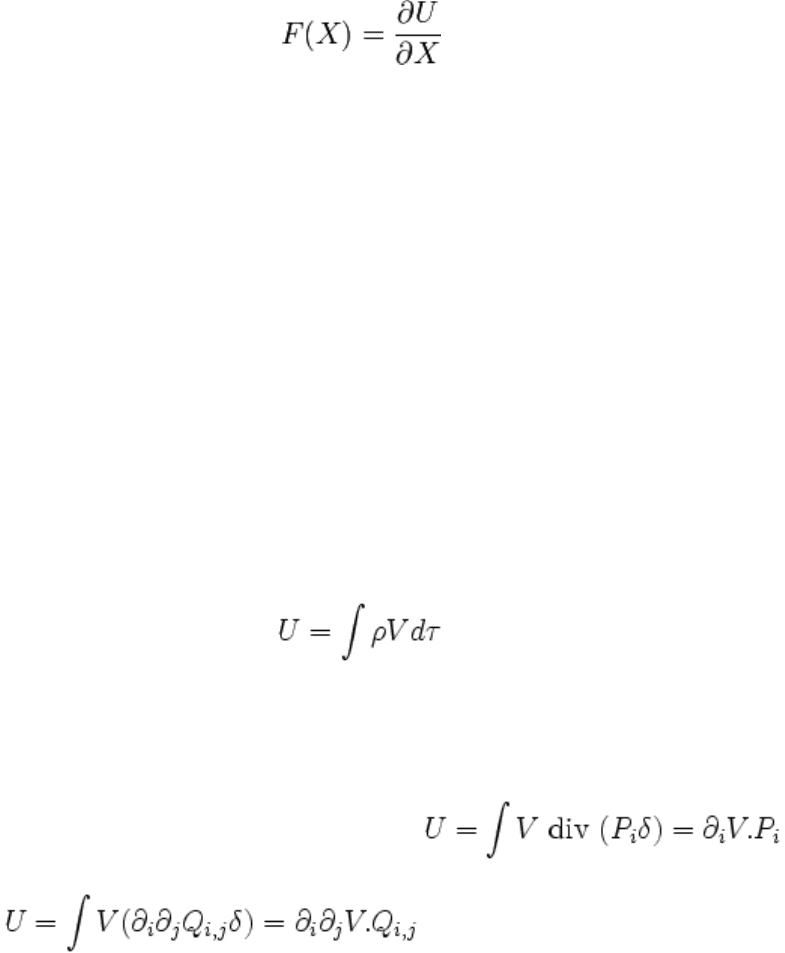
The next step is, using physical arguments, to find an {\bf expression of the internal
energy U(X)} {internal energy} as a function of thermodynamical variables X. Relation
F(X) is obtained by differentiating U with respect to X, symbolically:
In this chapter several examples of this modelization approach are presented.
Electromagnetic energy
Introduction
At chapter chapelectromag, it has been postulated that the electromagnetic power given
to a volume is the outgoing flow of the Poynting vector. {Poynting vector} If currents are
zero, the energy density given to the system is:
dU = HdB + EdD
Multipolar distribution
It has been seen at section secenergemag that energy for a volumic charge distribution ρ
is {multipole}
where V is the electrical potential. Here are the energy expression for common charge
distributions:
• for a point charge q, potential energy is: U = qV(0).
• for a dipole {dipole} P
i
potential energy is: .
• for a quadripole Q
i,j
potential energy is:
.
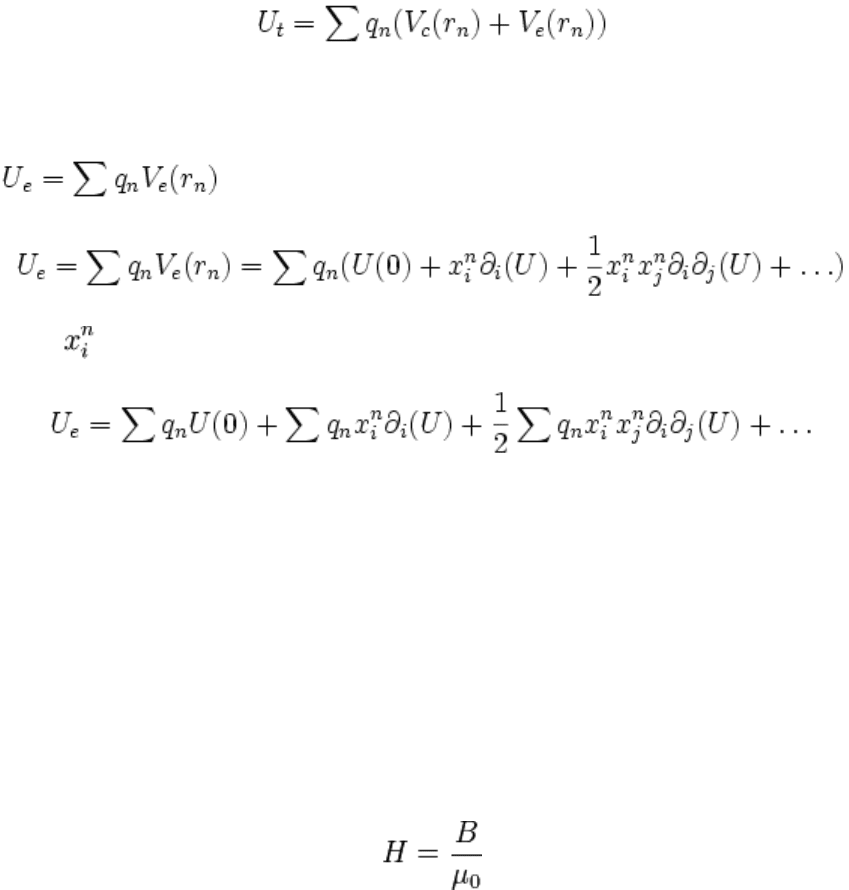
Consider a physical system constituted by a set of point charges q
n
located at r
n
. Those
charges can be for instance the electrons of an atom or a molecule. let us place this
system in an external static electric field associated to an electrical potential U
e
. Using
linearity of Maxwell equations, potential U (r)
t
felt at position r is the sum of external
potential U (r)
e
and potential U (r)
c
created by the point charges. The expression of total
potential energy of the system is:
In an atom,{atom} term associated to V
c
is supposed to be dominant because of the low
small value of r − r
n m
. This term is used to compute atomic states. Second term is then
considered as a perturbation. Let us look for the expression of the second term
. For that, let us expand potential around r = 0 position:
where labels position vector of charge number n. This sum can be written as:
the reader recognizes energies associated to multipoles.
Remark: In quantum mechanics, passage laws from classical to quantum mechanics
allow to define tensorial operators chapter chapgroupes) associated to multipolar
momenta.
Field in matter
In vacuum electromagnetism, the following constitutive relation is exact:
D = ε E
0
Those relations are included in Maxwell equations. Internal electrical energy variation is:
dU = EdD
or, by using a Legendre transform and choosing the thermodynamical variable E:
dF = DdE
We propose to treat here the problem of the model
ization of the function D(E). In other
words, we look for the medium constitutive relation. This problem can be treated in two
different ways. The first way is to propose {\it a priori} a relation D(E) depending on the
physical phenomena to describe. For instance, experimental measurements show that D is
proportional to E. So the constitutive relation adopted is:
D = χE
Another point of view consist in starting from a m
icroscopic level, that is to modelize the
material as a charge distribution is vacuum. Maxwell equations in vacuum eqmaxwvideE
and eqmaxwvideB can then be used to get a macroscopic model. Let us illustrate the first
point of view by some examples:
Example:
If one impose a relation of the following type:
D = ε E
i ij j
then medium is called dielectric .{dielectric} The expression of the energy is:
F = F + ε E E
0 ij i j
Example:
In the linear response theory {linear response}, D
i
at time t is supposed to depend not
only on the values of E at the same time t, but also on values of E at times anteriors. This
dependence is assumed to be linear:
D (t) = ε *
E
i ij j
where * means time convolution.
Example:
To treat the optical
activity
The second point of view is now illustrated by the following two examples:
Example:
A simple model for the susceptibility: {susceptibility} An elementary ele
ctric dipole
located at r
0
can be modelized section secmodelcha) by a charge distribution div (pδ(r )
0
).
Consider a uniform distribution of N such dipoles in a volume V, dipoles being at position
r
i
. Function ρ that modelizes this charge distribution is:
ρ =
∑
div (p
i
δ(r
i
))
V
As the divergence operator is linear, it can also be written:
ρ = div
∑
(p
i
δ(r
i
))
V
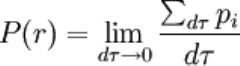
Consider the vector:
This vector P is called polarization vector{polarisation}. The evaluation of this vector P
is illustrated by figure figpolar.
Polar
Polarization vector at point r is the limit of the ratio of the sum of elementary dipolar
moments contained in the box dτ over the volume d\tau</math> as it tends towards zero.}
Maxwell--gauss equation in vacuum
div ε E = ρ
0
can be written as:
div (ε E − P) = 0
0
We thus have related the microscopic properties of the material (the p's) to the
macroscopic description of the material (by vector D = ε E − P
0
). We have now to provide
a microscopic model for p. Several models can be proposed. A material can be
constituted by small dipoles all oriented in the same direction. Other materials, like oil,
are constituted by molecules carrying a small dipole, their orientation being random when
there is no E field. But when there exist an non zero E field, those molecules tend to
orient their moment along the electric field lines. The mean P of the p
i
's given by
equation eqmoyP that is zero when E is zero (due to the random orientation of the
moments) becomes non zero in presence of a non zero E. A simple model can be
proposed without entering into the details of a quantum description. It consist in saying
that P is proportional to E:
P = χE
where χ is the polarisability of the medium. In this case relation:
D = ε E − P
0
becomes:
D = (ε + χ)E
0
Example: A second model of susceptibility: Consider the Vlasov equation equation
eqvlasov and reference
Generalized elasticity
Introduction
In this section, the concept of elastic energy is presented. {elasticity} The notion of
elastic energy allows to deduce easily "strains--deformations" relations.{strain--
deformation relation} So, in modelization of matter by virtual powers method {virtual
powers} a power P that is a functional of displacement is introduced. Consider in
particular case of a mass m attached to a spring of constant k.Deformation of the system
is referenced by the elongation x of the spring with respect to equilibrium. The virtual
work {virtual work} associated to a displacement dx is
δW = f.dx
Quantity f represents the constraint , here a force, and x is the deformation. If force f is
conservative, then it is known that the elementary work (provided by the exterior) is the
total differential of a potential energy function or internal energy U :
δW = − dU
In general, force f depends on the deformation. Relation f = f(x) is thus a constraint--
deformation relation .
The most natural way to find the strain-deformation relation is the following. One looks
for the expression of U as a function of the deformations using the physics of the the
problem and symmetries. In the particular case of an oscillator, the internal energy has to
depend only on the distance x to equilibrium position. If U admits an expansion at x = 0,
in the neighbourhood of the equilibrium position U can be approximated by:
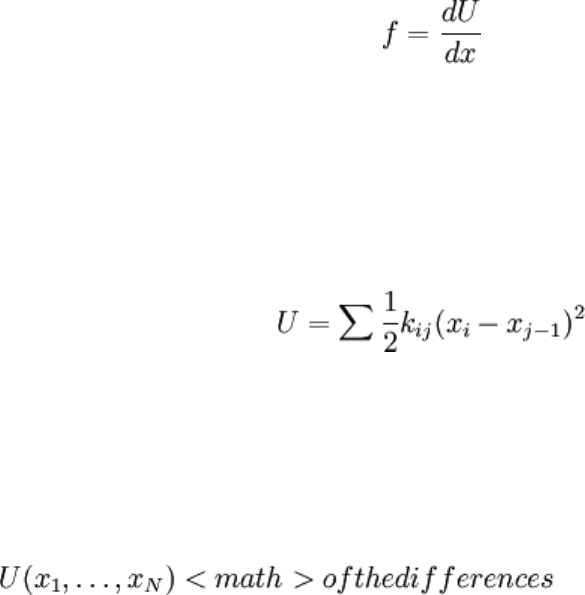
U(x) = a + a x + a x + O(x )
0 1
1
2
2 2
As x = 0 is an equilibrium position, we have dU = 0 at x = 0. That implies that a
1
is zero.
Curve U(x) at the neighbourhood of equilibrium has thus a parabolic shape figure
figparabe
Parabe
In the neighbourhood of a stable equilibrium position x
0
, the intern energy function U, as
a function of the difference to equilibrium presents a parabolic profile.
As
dU = − fdx
the strain--deformation relation becomes:
Oscillators chains
Consider a unidimensional chain of N oscillators coupled by springs of constant k
ij
. this
system is represented at figure figchaineosc. Each oscillator is referenced by its
difference position x
i
with respect to equilibrium position. A calculation using the
Newton's law of motion implies:
Chaineosc
A coupled oscillator chain is a toy example for studying elasticity.
A calculation using virtual powers principle would have consisted in affirming: The total
elastic potential energy is in general a function
x_i</math> to the equilibrium
positions. This differential is total since force is conservative\footnote{ This assumption
is the most difficult to prove in the theories on elasticity as it will be shown at next
section} . So, at equilibrium: {equilibrium} :
dU = 0
If U admits a Taylor expansion:
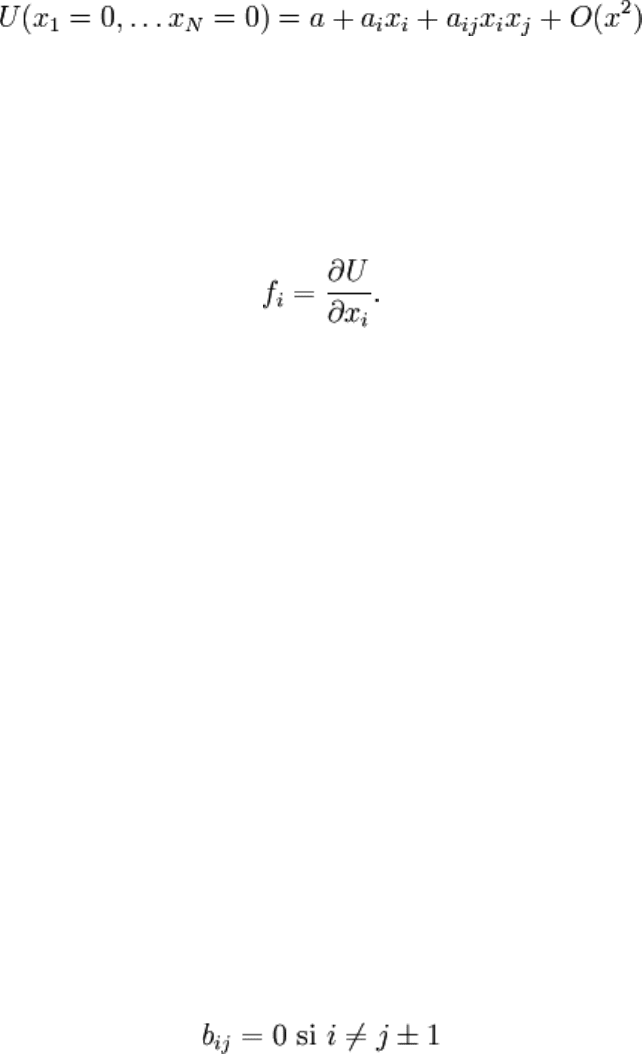
In this last equation, repeated index summing convention as been used. Defining the
differential of the intern energy as:
dU = f dx
i i
one obtains
Using expression of U provided by equation eqdevliUch yields to:
f = a x .
i ij j
But here, as the interaction occurs only between nearest neighbours, variables x
i
are not
the right thermodynamical variables. let us choose as thermodynamical variables the
variables ε
i
defined by:
ε = x − x .
i i i − 1
Differential of U becomes:
dU = F dε
i i
Assuming that U admits a Taylor expansion around the equilibrium position:
U = b + b ε + b ε ε + O(ε )
i i ij i j
2
and that dU = 0 at equilibrium, yields to:
F = b ε
i ij j
As the interaction occurs only between nearest neighbours:
so:
F = b ε + b ε
i ii i ii + 1 i + 1
This does correspond to the expression of the force applied to mass i :
F = − k(x − x ) − k(x − x )
i i i − 1 i + 1 i
if one sets k = − b = − b
ii ii + 1
.
Tridimensional elastic material
Consider a system S in a state S
X
which is a deformation from the state S
0
. Each particle
position is referenced by a vector a in the state S
0
and by the vector x in the state S
X
:
x = a + X
Vector X represents the deformation.
Remark:
Such a model allows to describe for instance fluids and solids.
Consider the case where X is always "small". Such an hypothesis is called small
perturbations hypothesis (SPH). The intern energy is looked as a function U(X).
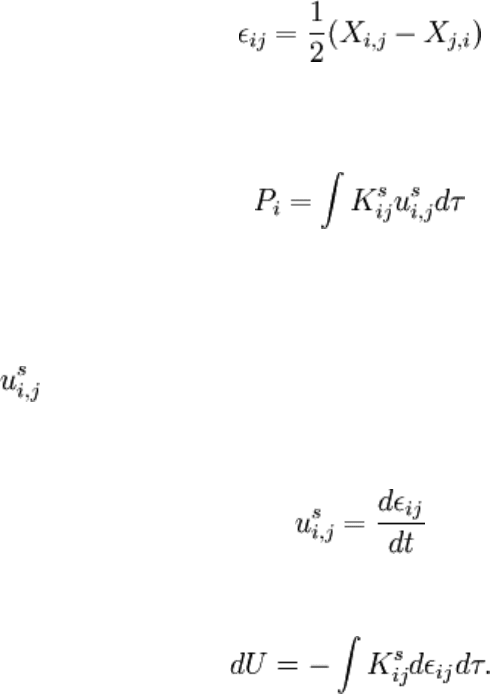
Definition: The deformation tensor SPH is the symmetric part of the tensor gradient of X.
At section secpuisvirtu it has been seen that the power of the admissible intern strains for
the problem considered here is:
with
dU = − P dt
i
Tensor is called rate of deformation tensor. It is the symmetric part of tensor u
i,j
. It
can be shown that in the frame of SPH hypothesis, the rate of deformation tensor is
simply the time derivative of SPH deformation tensor:
Thus: