
Cossey L. Introduction to Mathematical Physics
Подождите немного. Документ загружается.

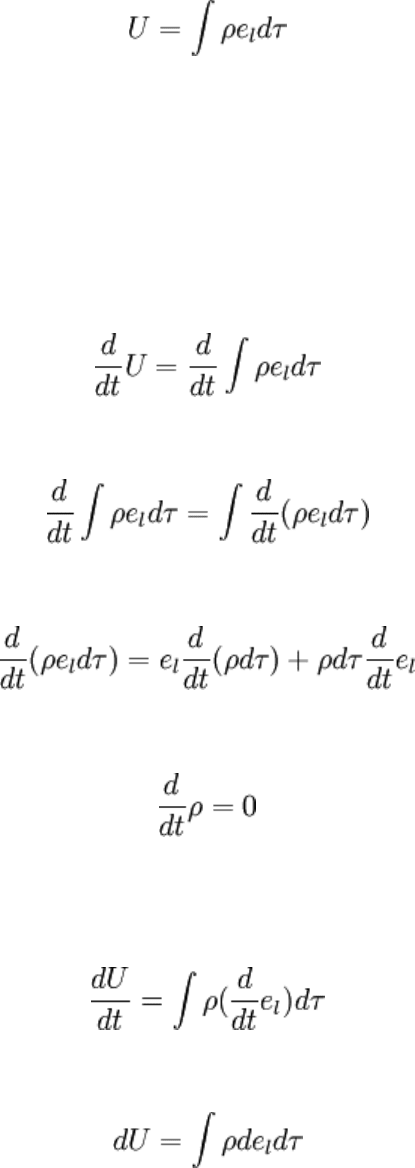
Function U can thus be considered as a function U(ε )
ij
. More precisely, one looks for U
that can be written:
where e
l
is an internal energy density with\footnote{ Function U depends only on ε
ij
.}
whose Taylor expansion around the equilibrium position is:
ρe = a + a ε + a ε ε
l ij ij ijkl ij kl
We have\footnote{
Indeed:
and from the properties of the particulaire derivative:
Now,
From the mass conservation law:
}
Thus
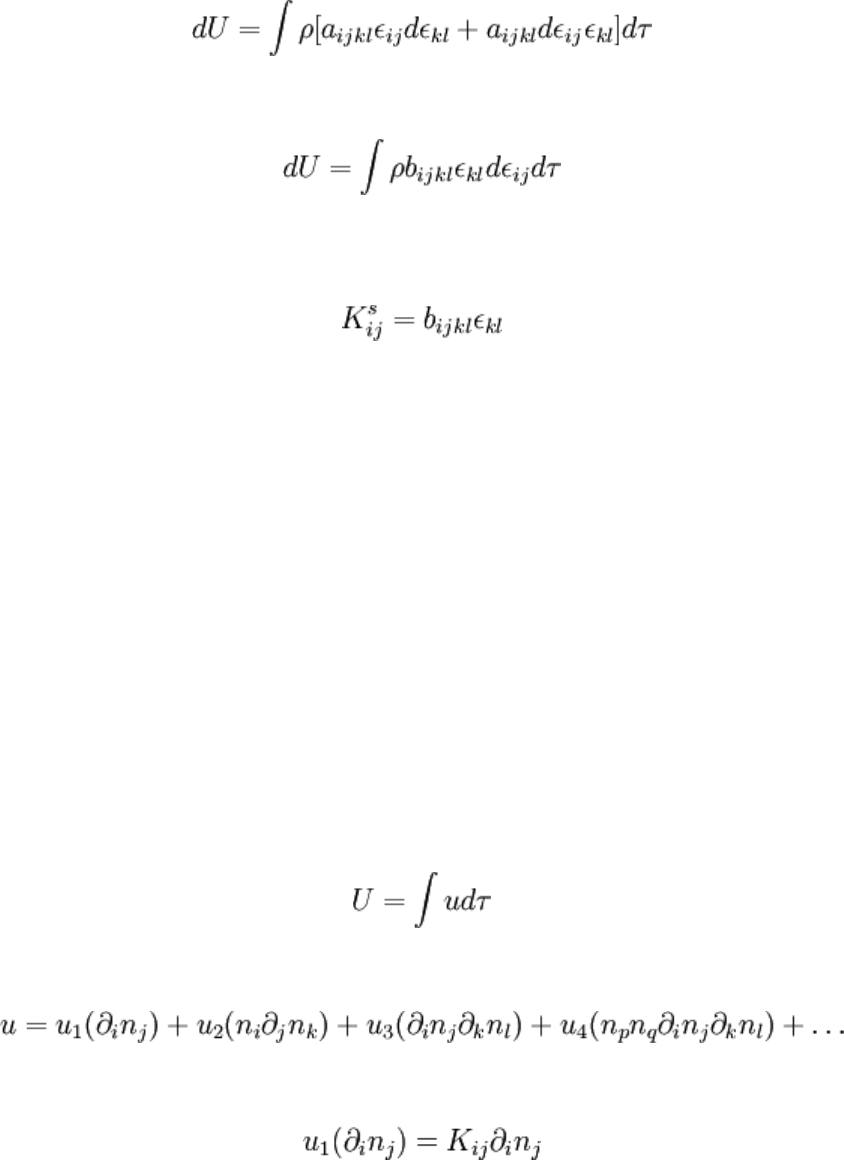
Using expression eqrhoel of e
l
and assuming that dU is zero at equilibrium, we have:
thus:
with b = a + a
ijkl ijkl klij
. Identification with equation dukij, yields to the following strain--
deformation relation:
it is a generalized Hooke law{Hooke law}. The b
ijkl
's are the elasticity coefficients.
Remark: Calculation of the footnote footdensi show that calculations done at previous
section secchampdslamat should deal with volumic energy densities.
Nematic material
A nematic material{nematic} is a material whose state can be defined by vector
field\footnote{ State of smectic materials can be defined by a function u(x,y). } n. This
field is related to the orientation of the molecules in the material.
Champnema
Each molecule orientation in the nematic material can be described by a vector n. In a
continuous model, this yields to a vector field n. Internal energy of the nematic is a
function of the vector field n and its partial derivatives.
Let us look for an internal energy U that depends on the gradients of the n field:
with
The most general form of u
1
for a linear dependence on the derivatives is:
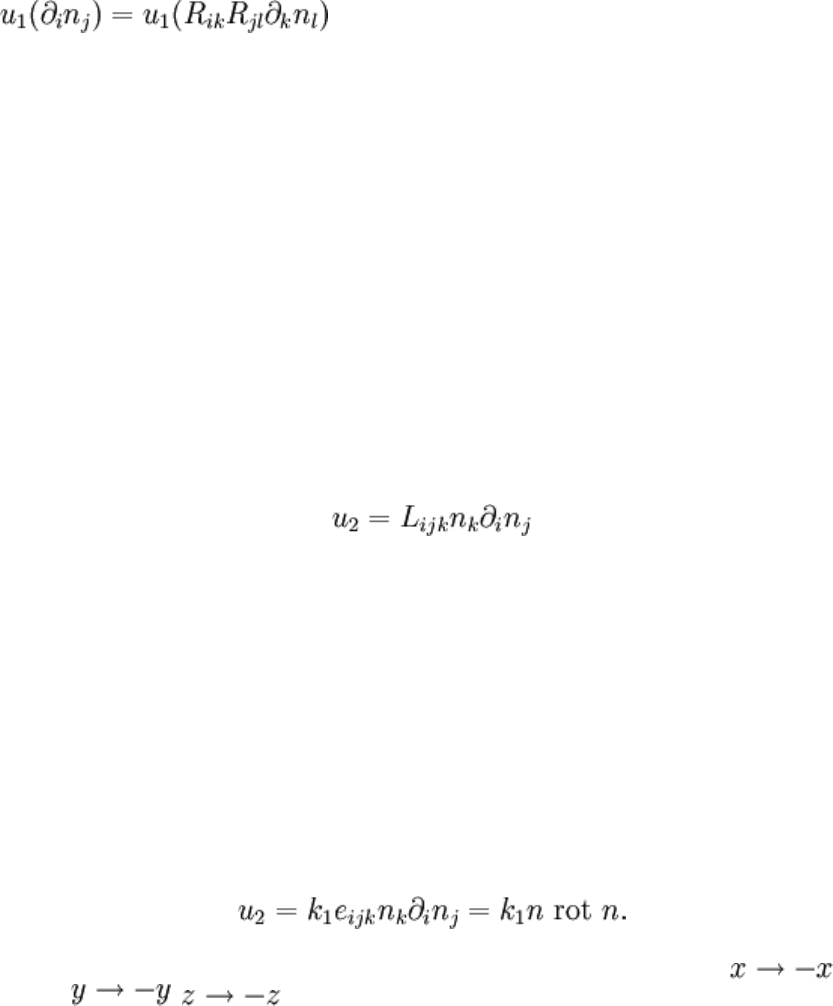
where K
ij
is a second order tensor depending on r. Let us consider how symmetries can
simplify this last form.
• Rotation invariance. Functional u
1
should be rotation invariant.
where R
mn
are orthogonal transformations (rotations). We thus have the condition:
K = R R K ,
ij ik jl kl
that is, tensor K
ij
has to be isotrope. It is know that the only second order isotrope tensor
in a three dimensional space is δ
ij
, that is the identity. So u
1
could always be written like:
u = k div n
1 0
• Invariance under the transformation n maps to − n . The energy of distortion is
independent on the sense of n, that is u (n) = u ( − n)
1 1
. This implies that the
constant k
0
in the previous equation is zero.
Thus, there is no possible energy that has the form given by equation eqsansder. This
yields to consider next possible term u
2
. general form for u
2
is:
Let us consider how symmetries can simplify this last form.
• Invariance under the transformation n maps to − n . This invariance condition is
well fulfilled by u
2
.
• Rotation invariance. The rotation invariance condition implies that:
L = R R R L
ijk il jm kn lmn
It is known that there does not exist any third order isotrope tensor in R
3
, but there exist a
third order isotrope pseudo tensor: the signature pseudo tensor e
jkl
appendix
secformultens). This yields to the expression:
• {\bf Invariance of the energy with respect to the axis transformation ,
, .} The energy of nematic crystals has this invariance
property\footnote{ Cholesteric crystal doesn't verify this condition.} . Since e
ijk
is
a pseudo-tensor it changes its signs for such transformation.
There are thus no term u
2
in the expression of the internal energy for a nematic crystal.
Using similar argumentation, it can be shown that u
3
can always be written:
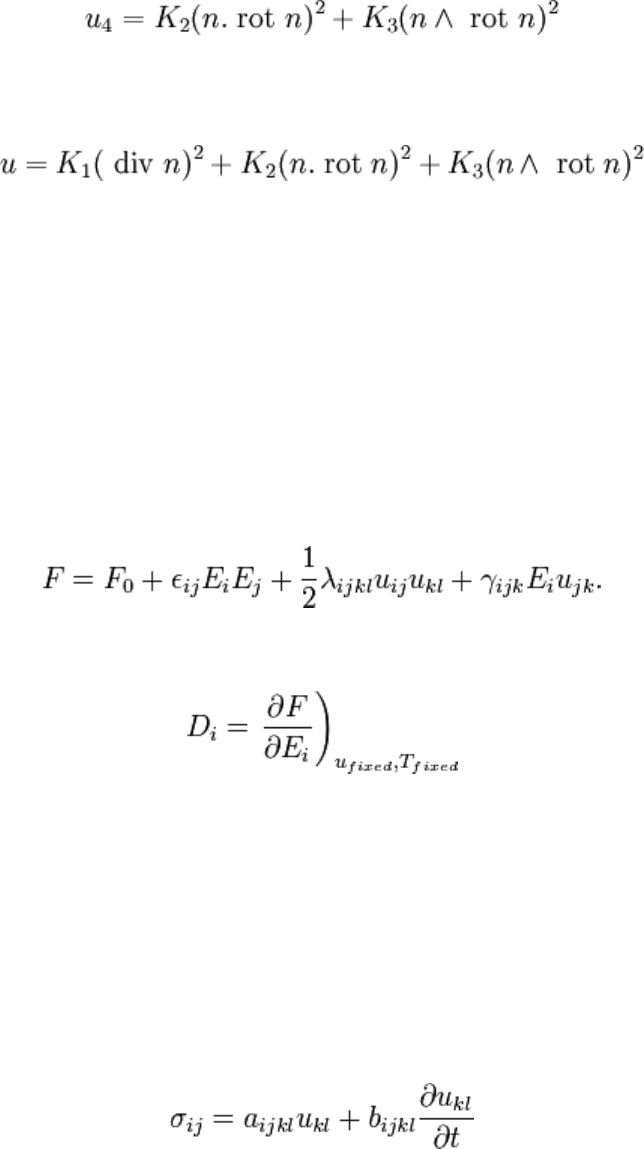
u = K ( div n)
3 1
2
and u
4
:
Limiting the development of the density energy u to second order partial derivatives of n
yields thus to the expression:
Other phenomena
Piezoelectricity
In the study of piezoelectricity , on{piezo electricity} the form chosen for σ
ij
is:
σ = λ u + γ E
ij ijkl kl ijk k
The tensor γ
ijk
traduces a coupling between electrical field variables E
i
and the
deformation variables present in the expression of F:
The expression of D
i
becomes:
so:
D = ε E + γ u
i ij j ijk jk
Viscosity
A material is called viscous {viscosity} each time the strains depend on the deformation
speed. In the linear viscoelasticity theory , the following strain-deformation relation is
adopted:

Material that obey such a law are called {\bf short memory materials} {memory} since
the state of the constraints at time t depends only on the deformation at this time and at
times infinitely close to t (as suggested by a Taylor development of the time derivative).
Tensors a and b play respectively the role of elasticity and viscosity coefficients. If the
strain-deformation relation is chosen to be:
then the material is called long memory material since the state of the constraints at time t
depends on the deformation at time t but also on deformations at times previous to t. The
first term represents an instantaneous elastic effect. The second term renders an account
of the memory effects.
Remark: Those materials belong
Remark: In the frame of distribution theory, time derivatives can be considered as
convolutions by derivatives of Dirac distribution. For instance, time derivation can be
expressed by the convolution by δ'(t). This allows to treat this case as a particular case of
formula given by equation eqmatmem.
Exercises
Exercice: Find the equation evolution for a rope clamped between two walls.
Exercice: {{{1}}}
Exercice: Give the expression of the deformation energy of a smectic section
secristliquides for the description of smectic) whose i
t
h layer's state is described by
surface u (x,y)
i
,
Exercice: Consider a linear, homogeneous, isotrope material. Electric susceptibility ε
introduced at section secchampdslamat allows for such materials to provide D from E by
simple convolution:
D = ε * E.
where * represents a temporal convolution. To obey to the causality principle distribution
ε has to have a positive support. Indeed, D can not depend on the future values of E.
Knowing that the Fourier transform of function "sign of t" is C.V (1 / x)
p
where C is a
normalization constant and V (1 / X)
p
is the principal value of 1 / x distribution, give the
relations between the real part and imaginary part of the Fourier transform of ε. These
relations are know in optics as Krammers--Kr\"onig relations{Krammers--Kr\"onig
relations}.
Measure and integration
Lebesgue integral
The theory of the Lebesgue integral is difficult and can not be presented here. However,
we propose here to give to the reader an idea of the Lebesgue integral based on its
properties. The integration in the Lebesgue sense is a fonctional that at each element F of
a certain functional space (the space of the summable functions) associates a number note
of .
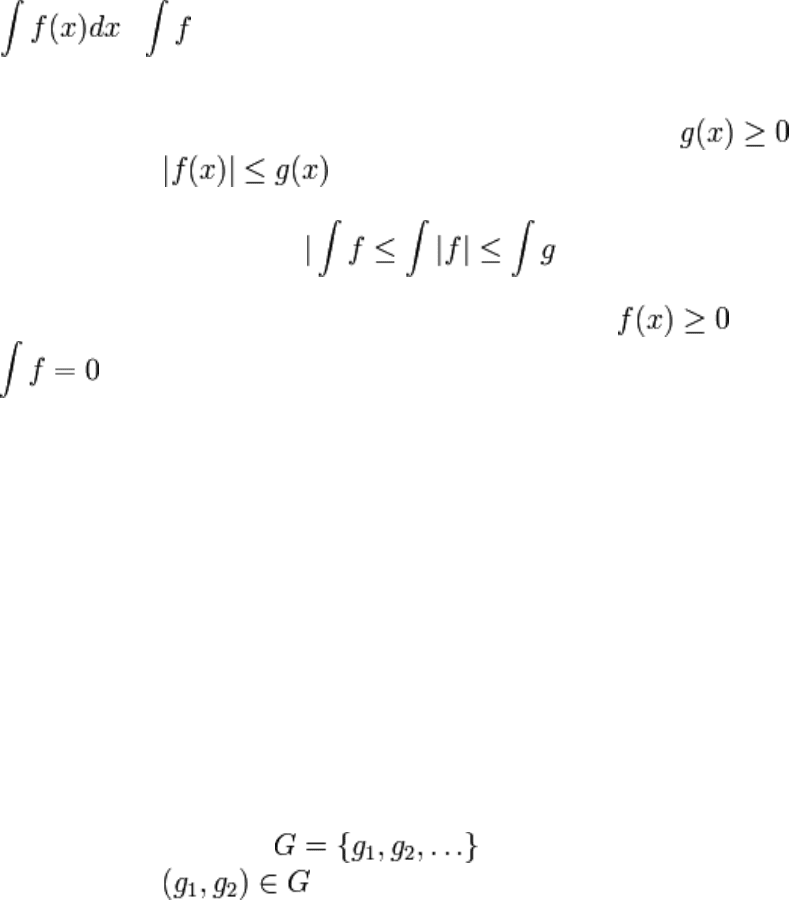
for a function f to be summable, it is sufficient that | f | is summable. if is
summable and if then f(x) is summable and
If f and g are almost everywhere equal, the their sum is egual. if and if
then f is almost everywhere zero. A bounded function, zero out of a finite
interval (a,b) is summable. If f is integrable in the Riemann sense on (a,b) then the sums
in the Lebesgue and Rieman sense are egual.
Groups
Definition
In classical mechanics,{group} translation and rotation invariances correspond to
momentum and kinetic moment conservation. Noether theorem allows to bind
symmetries of Lagrangian and conservation laws. The underlying mathematical theory to
the intuitive notion of symmetry is presented in this appendix.
Definition:
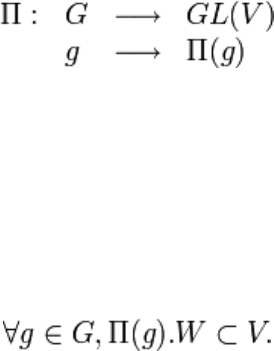
A group is a set of elements and a composition law . that assigns to
any ordered pair an element g .g
1 2
of G. The composition law . is
• associative
g .(g .g ) = (g .g ).g
1 2 3 1 2 3
• has a unit element e :
g.e = e.g = e
• for each g of G, there exists an element g
− 1
of G such that:
g.g = g .g = e
− 1 − 1
Definition:
The order of a group is the number of elements of G.
Representation
For a deeper study of group representation theory, the reader is invited to refer to the
abundant litterature for instance.
Definition:
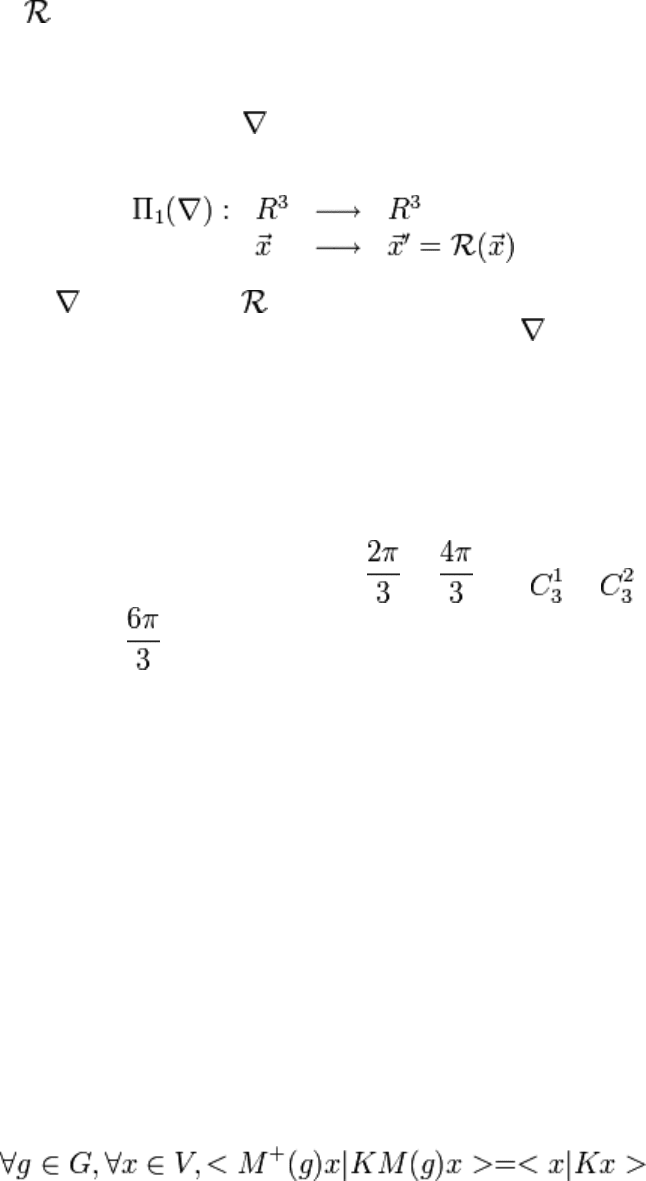
A representation of a group G in a vectorial space V on K = R or K = C is an
endomorphism Π from G into the group GL(V)\footnote{GL(V) is the space of the linear
applications from V into V. It is a group with respect to the function composition law.}
{\it i.e }a mapping
with
Π(g .g ) = Π(g ).Π(g )
1 2 1 2
Definition:
Let (V,Π) be a representation of G. A vectorial subspace W of V is called stable by Π if:
One then obtains a representation of G in W called subrepresentation of Π.
Definition:
A representation (V,Π) of a group G is called irreducible if it admits no subrepresentation
other than 0 and itself.
Consider a symmetry group G. let us consider some classical examples of vectorial
spaces V. Let be an element of G.
Example:
Let G be a group of transformations of space R
3
. A representation Π
1
of G in V = R
3
is
simply defined by:
To each element of G, a mapping of R
3
is associated. This mapping can be defined
by a matrix M called representation matrix of symmetry operator .
Example:
Let us consider molecule NH
3
as a solid of symmetry C
3
. The various symmetry
operations that characterizes this group are:
• three reflexions σ
1
,σ
2
, and σ
3
.
• two rotations around the C
3
axis, of angle and noted and .
• rotation of angle is the identity and is noted E.
In a any basis of R
3
, representation matrices of group symmetry operators are in general
not block diagonal.
The tridimensional space can be shared into two invariant subspaces: a one-dimensional
space E
1
spanned by vector of the C
3
axis, and a plane E
3
perpendicular to this vector. In
chemistry books, representation on E
1
is called A and representation on E
2
is called E.
They are both irreducible.
Remark:
For the study of the vibrations of a molecule, instead of considering the Euclidian space
R
3
as state space, the space of the q
i
's where the q
i
's are the degree of freedom of the
system has to be considered. The diagonalization of the coupling matrix problem can be
tackled using symmetry considerations. Indeed, a vibratory system is invariant by
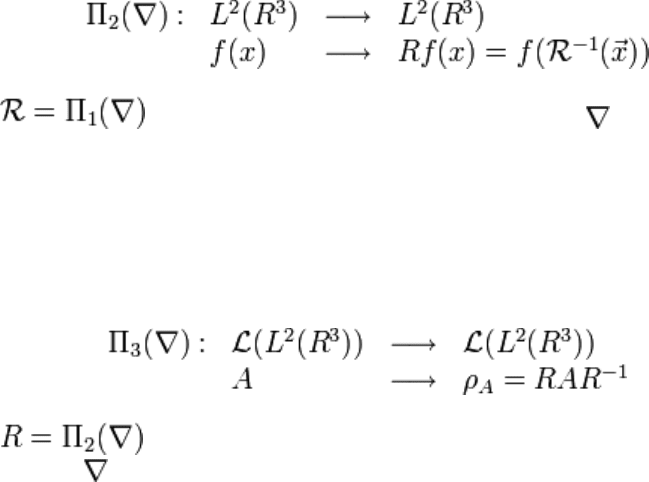
symmetry G, implies that its energy is invariant by G:
Matrices M(g) being orthonormal, kinetic energy is also invariant.
Consider the following theorem:
Theorem:
If operator A is invariant by R, that is ρ A = A
R
or RAR = A
− 1
, the if φ is eigenvector of A,
Rφ is also eigenvector of A.
Proof:
It is sufficient to evaluate the action of A on Rφ to prove this theorem.
This previous theorem allows to predict the eigenvectors and their degeneracy.
Example:
Consider the group G introduced at example exampgroupR. A representation Π
2
of G in
the space L
2
of summable squared can be defined by:
where is the matrix representation of transformation , element of G. If φ
i
is a basis of L (R )
2 3
, then we have Rφ = D φ
i ki i
.
Example:
Consider the group G introduced at example exampgroupR. A representation Π
3
of G in
the space of linear operators of L
2
can be defined by:
where is the matrix representation, defined at prevoius example, of
transformation , element of G and A is the matrix defining the operator
Relatively to the R
3
rotation group, scalar, vectorial and tensorial operators can be
defined.
Definition:
A scalar operator S is invariant by rotation:
RSR = S
− 1
An example of scalar operator is the hamiltonian operator in quantum mechanics.
Definition:
A vectorial operator V is a set of three operators V
m
, m = − 1,0,1, (the components of V in
spherical coordinates) that verify the commutation relations:
[X,V ] = ε V
i m imk k
More generally, tensorial operators can be defined:
Definition:
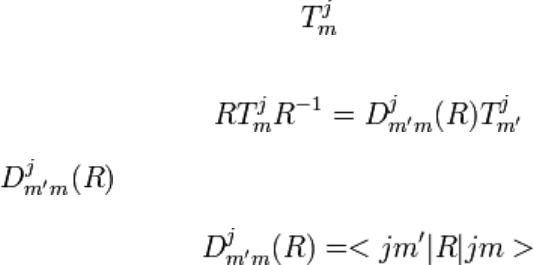
A tensorial operator T of components is an operator whose transformation by rotation
is given by:
where is the restriction of rotation R to space spanned by vectors | jm > .
Another equivalent definition is presented in. It can be shown that a
vectorial operator is a tensorial operator with j = 1. This interest of
the group theory for the physicist is that it provides irreducible
representations of symmetry group encountered in Nature. Their number
is limited. It can be shown for instance that there are only 32
symmetry point groups allowed in crystallography. There exists also
methods to expand into irreducible representations a reducible
representation.
Tensors and symmetries
Let a
ijk
be a third order tensor. Consider the tensor:
X = x x x
ijk i j k
let us form the density:
φ = a X
ijk ijk
φ is conserved by change of basis\footnote{ A unitary operator preserves the scalar
product.} If by symmetry:
Ra = a
ijk ijk
then