
Cossey L. Introduction to Mathematical Physics
Подождите немного. Документ загружается.

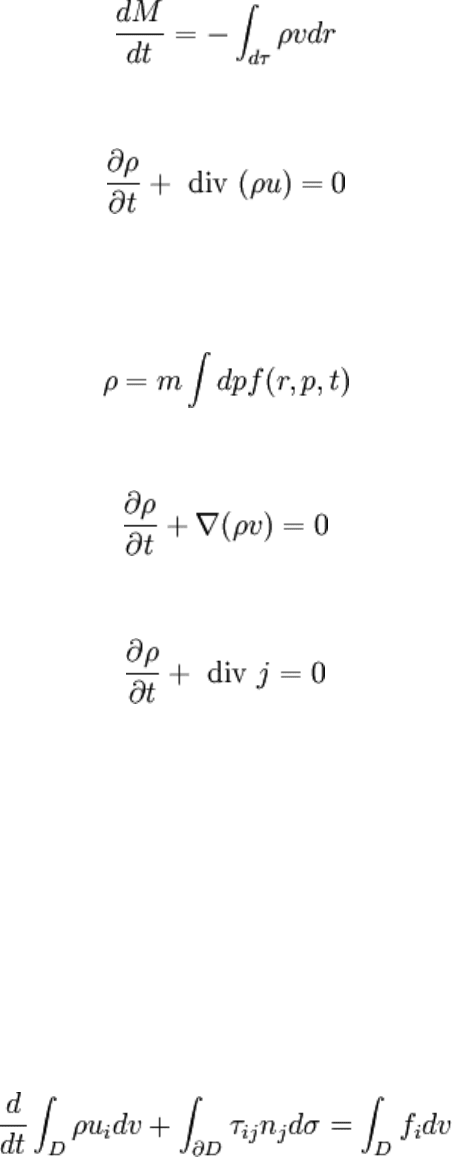
Local form of this equation is thus:
But this law can also be proved in calculating the first moment of the Vlasov equation
equation eqvlasov). Volumic mass is then defined as the zeroth order moment of the
repartition function times mass m of one particle:
Taking the first moment of Vlasov equation, it yields:
Charge conservation equation is completely similar to mass conservation equation:
where here ρ is the volumic charge and j the electrical current density:
j = ρv
Flow of j trough an open surface S is usually called electrical current going through
surface S.
Momentum conservation
We assume here that external forces are described by f and that internal strains are
described by tensor τ
ij
.
This integral equation corresponds to the applying of Newton's law of
motion{momentum} over the elementary fluid volume as shown by figure
figconsp.
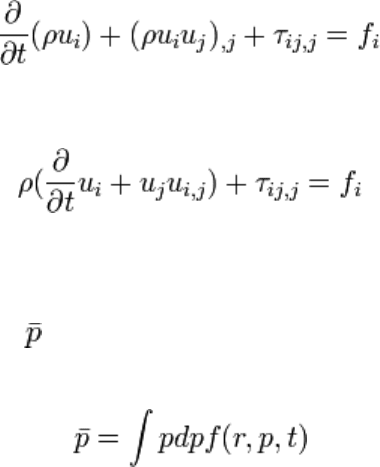
Partial differential equation associated to this integral equation is:
Using continuity equation yields to:
Remark:
Momentum conservation equation can be proved taking the first moment of Vlasov
equation. Fluid momentum is then related to repartition function by the following
equality:
Later on, fluid momentum is simply designated by p.
Virtual powers principle
Principle statement
Momentum conservation has been introduced by using averages over particles of
quantities associated to those particles. Distant forces have been modelized by force
densities f
i
, internal strains by a second order tensor τ
ij
,\dots This point of view is directly
related to the Newton's law of motion. The dual point of view is presented here: strains
are described by the means of movement they permit ). This way corresponds to our day
to day experience
• to know if a wallet is heavy, one lifts it up.
• to appreciate the tension of a string, one moves it aside from its equilibrium
position.
• pushing a car can tell us if the brake is on.
Strains are now evaluated by their effects coming from a displacement or deformation.
This point of view is interesting because it allows to defines strains when they are bad
defined in the first point of view, like for frictions or binding strains. Freedom in
modelization is kept very large because the modelizer can always choose the size of the
virtual movements to be allowed. let us precise those ideas in stating the principle.
\begin{prin} Virtual power of acceleration quantities is equal to the sum of the virtual
powers of all strains applied to the system, external strains, as well as internal strains:
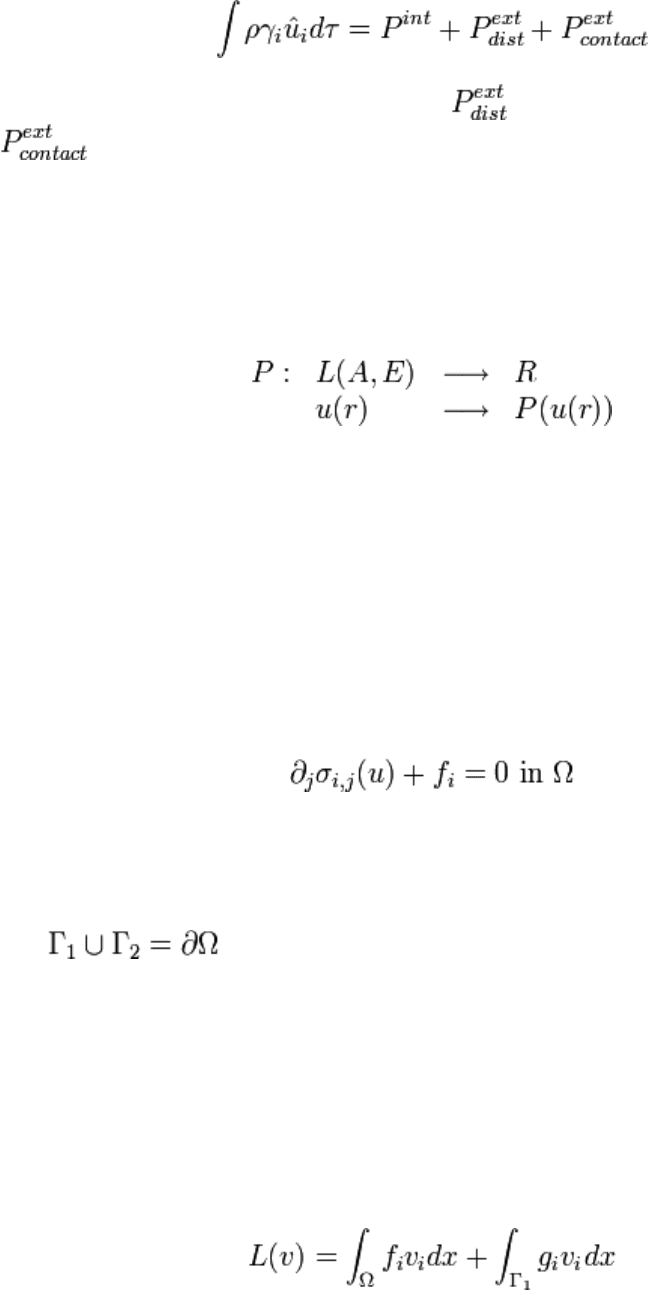
where P
int
represents power of internal strains, , distant external strains,
contact external strains. \end{prin} At section sepripuiva it is shown how a
partial differential equation system can be reduced to a variational system: this can be
used to show that Newton's law of motion and virtual powers principle are dual forms of
a same physical law.
Powers are defined by giving spaces A and E where A is the affine space attached to E:
At section seccasflu we will consider an example that shows the power of the virtual
powers point of view. ==Virtual powers and local equation==
A connection between local formulation (partial derivative equation or PDE) and virtual
powers principle (variational form of the PDE problem considered) is presented on an
example. Consider the problem:
Problem:
Find u such that:
u = 0 on Γ
i 1
σ (u)n = 0 on Γ
i,j j 2
with .
Let us introduce the bilinear form:
a(u,v) =
∫
σ
i,j
(u)ε
i,j
(v)dx
Ω
and the linear form:
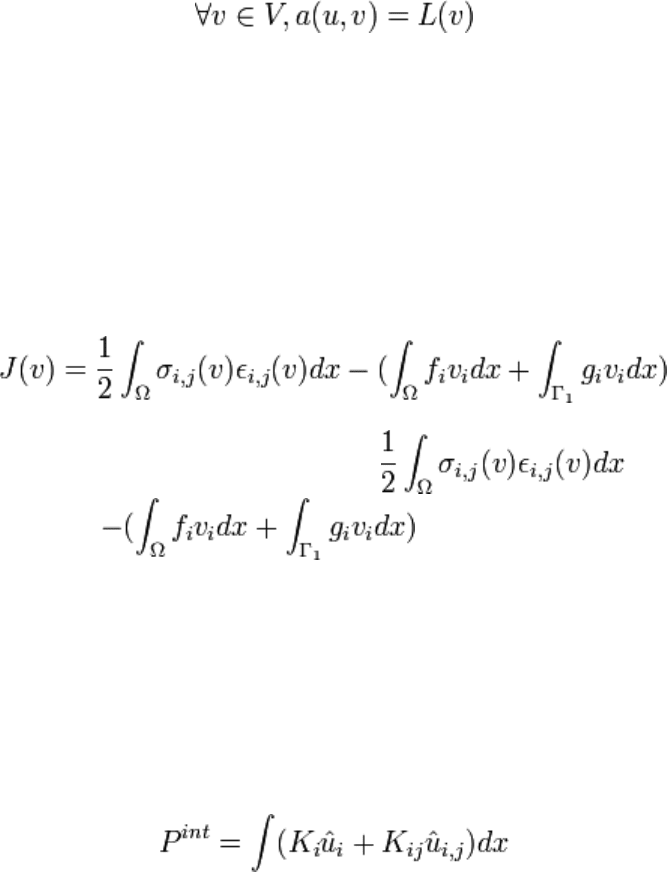
it can be shown that there exist a space V such that there exist a unique solution u of
a(u,v) represents the deformation's work of the elastic solid {virtual power} {elasticity}
corresponding to virtual displacement v from position u. L(v) represents the work of the
external forces for the virtual displacement v. The virtual powers principle can thus be
considered as a consequence of the great conservation laws: \begin{prin}Virtual powers
principle (static case): Actual displacement u is the displacement cinematically
admissible such that the deformation's work of the elastic solid corresponding to the
virtual displacement v is equal to the work of the external forces, for any virtual
displacement v cinematically admissible. \end{prin} Moreover, as a(.,.) is symmetrical,
solution u is also the minimum of
J(v) is the potential energy of the deformed solid, is the
deformation energy. is the potential energy of the
external forces. This result can be stated as follows: \begin{prin} The actual
displacement u is the displacement among all the admissible displacement v that
minimizes the potential energy J(v). \end{prin}
==Case of fluids==
Consider for instance a fluid . Assume that the power of the internal strains can be
described by integral:
where u
i,j
designs the derivative of u
i
with respect to coordinate j. The proposed theory is
called a first gradient theory.
Remark:
The step of the expression of the power as a function of the speed field u is the key step
for modelization. A large freedom is left to the modelizator. Powers being scalars, they
can be obtained by contraction of tensors appendix chaptens) using the speed vector field
u
i
as well as its derivatives. method to obtain intern energies in generalized elasticity is
similar section secelastigene).
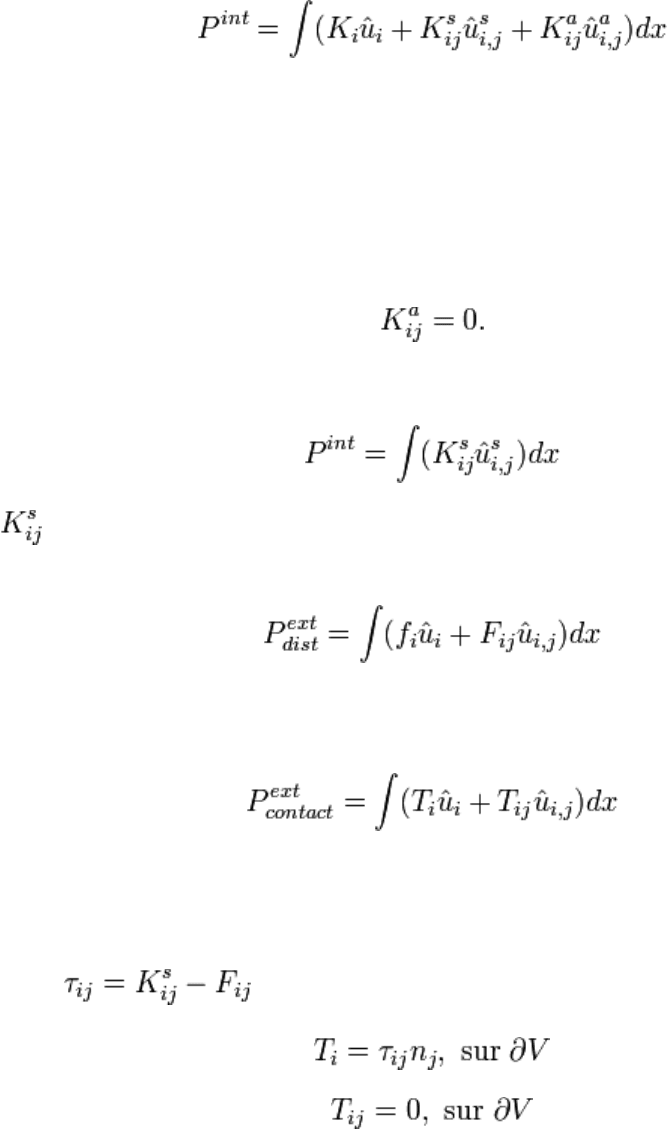
Denoting a and s the antisymmetric and symmetric [art of the considered tensors yields
to:{tensor} :
where it has been noted that cross products of symmetric and antisymmetric tensors are
zero\footnote{ That is: (a + a )(b − b ) = 0
ij ji ij ji
. } . Choosing the uniformly translating
reference frame, it can be shown that term K
i
has to be zero:
K = 0
i
Antisymmetric tensor is zero because movement is rigidifying:
Finally, the expression of the internal strains is:{strains}
is called strain tensor since it describes the internal deformation strains. The external
strains power is modelized by:
Symmetric part of F
ij
can be interpreted as the volumic double--force density and its
antisymmetrical part as volumic couple density. Contact strains are modelized by:
Finally the PDE problem to solve is:
f + τ = ργ in V
i ij,j i
where
Stress-deformation tensor
The next step is to modelize the internal strains. that is to explicit the dependence of
tensors K
ij
as functions of u
i
. This problem is treated at chapter parenergint. Let us give
here two examples of approach of this problem.
Example:
For a perfect gas, pressure force work on a system of volume V is:
δW = − pdV.
The state equation (deduced from a microscopic theory)
pV = nk T
B
is used to bind the strain p to the deformation dV.
Example:
The elasticity theory chapter parenergint) allows to bind the strain tensor τ
ij
to the
deformation tensor ε
ij
Energy conservation and first principle of
thermodynamics
Statement of first principle
Energy conservation law corresponds to the first principle of thermodynamics
.
{first principle of thermodynamics}
Definition:
Let S be a macroscopic system relaxing in R
0
. Internal energy U is the sum of kinetic
energy of all the particle E
cm
and their total interaction potential energy E
p
:
U = E + E
cm p
Definition:
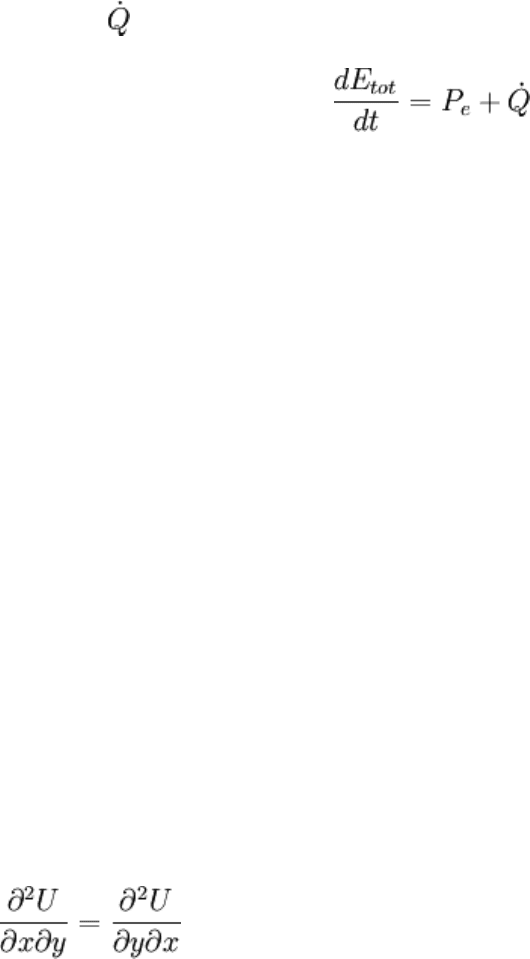
Let a macroscopic system moving with respect to R. It has a macroscopic kinetic energy
E
c
. The total energy E
tot
is the sum of the kinetic energy E
c
and the internal energy U.
{internal energy}
E = E + U
tot c
\begin{prin} Internal energy U is a state function\footnote{ That means that an
elementary variation dU is a total differential. } . Total energy E
tot
can vary only by
exchanges with the exterior. \end{prin} \begin{prin} At each time, particulaire derivative
example exmppartder) of the total energy E
tot
is the sum of external strains power P
e
and
of the heat {heat} received by the system. \end{prin}
This implies:
Theorem:
For a closed system, dE = δW + δQ
tot e
Theorem:
If macroscopic kinetic energy is zero then:
dU = δW + δQ
Remark:
Energy conservation can also be obtained taking the third moment of Vlasov equation
equation eqvlasov).
Consequences of first principle
The fact that U is a state function implies that:
• Variation of U does not depend on the followed path, that is variation of U
depends only on the initial and final states.
• dU is a total differential that that Schwarz theorem can be applied. If U is a
function of two variables x and y then:
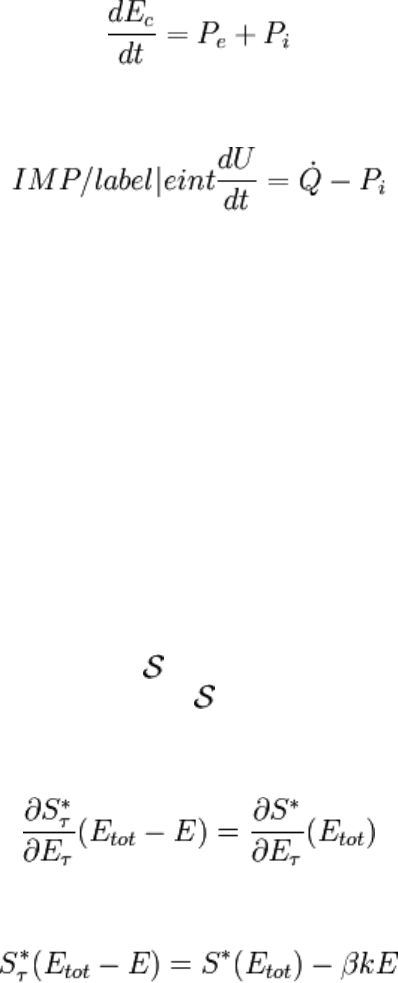
Let us precise the relation between dynamics and first principle of thermodynamics.
From the kinetic energy theorem:
so that energy conservation can also be written:
System modelization consists in evaluating E
c
, P
e
and P
i
. Power P
i
by relation
eint is associated to the U modelization.
Second principle of thermodynamics
Second principle statement
Second principle of thermodynamics\ index{second principle of thermodynamics} is the
macroscopic version of maximum entropy fundamental principle of statistical physics.
Before stating second principle, let us introduce the thermostat notion:
Definition:
S system τ is a thermostat for a system if its microcanonical temperature is practically
independent on the total energy E of system .
We thus have:
so
Postulate:
Second principle. For any system, there exists a state
function called entropy and noted S. Its is an extensive quantity
whose
variation can have two causes:

• heat or matter exchanges with the exterior.
• internal modifications of the system.
Moreover, if for an infinitesimal transformation, one has:
dS = δ S + δ S
e i
then
and
Remark:
Second principle does correspond to the maximum entropy criteria
of statistical physics. Indeed, an internal transformation is always
due to
a constraint relaxing\footnote{
here are two examples of internal transformation:
• Diffusion process.
• Adiabatic compression. Consider a box whose volume is adiabatically decreased.
This transformation can be seen as an adiabatic relaxing of a spring that was
compressed at initial time. }
Remark:
In general, δ S
i
can not be reached directly. Following equalities are used to calculate it:
Applications
Here are two examples of application of second principle:
Example: {{{1}}}
Example:
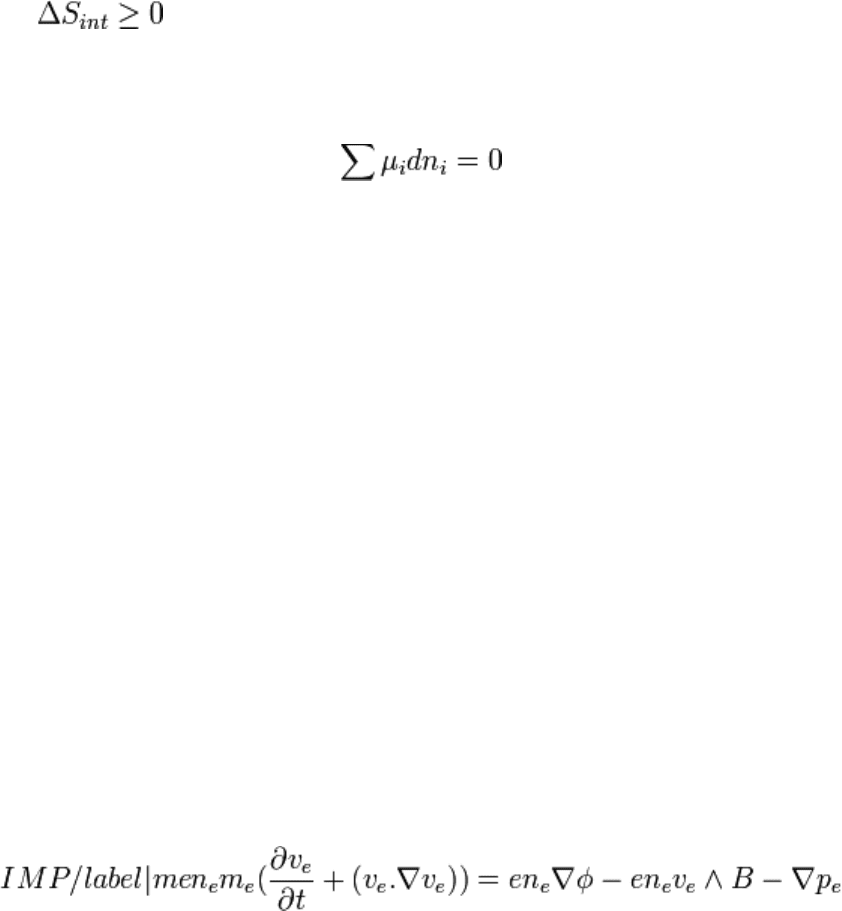
At section secrelacont, we have proved relations providing the most probable quantities
encountered when a constraint "fixed quantity" is relaxed to a constraint "quantity free to
fluctuate around a fixed mean". This result can be recovered using the second principle.
During a transformation at p and T constant (even an irreversible transformation):
∆G(p,T,n ,n ) = ∆Q − T ∆S
1 2 e
Using second principle:
∆G = − T ∆S
e int
with . At equilibrium\footnote{ We are recovering the equivalence between
the physical statistics general postulate "Entropy is maximum at equilibrium" and the
second principle of thermodynamics. In thermodynamics, one says that G(T,p,n )
i
is
minimal for T and p fixed} system's state is defined by ∆G = 0, so
where µ
i
is the chemical potential of species i.
Exercises
Exercice:
Give the equations governing the dynamics of a plate (negligible thickness) from powers
taking into account the gradient of the speeds (first gradient theory). Compare with a
approach starting form conservation laws.
Exercice:
Same question as previous problem, but with a rope clamped between two walls.
Exercice:
A plasma{plasma} is a set of charged particles, electrons and ions. A classical model of
plasma is the "two fluid model": the system is described by two sets of functions density,
speed, and pressure, one for each type of particles, electrons and ions: set n ,v ,p
e e e
characterizes the electrons and set n,v,p
i i i
characterizes the ions. The momentum
conservation equation for the electrons is:
The momentum conservation equation for the ions is: