
Devore J.L., Berk K.N. Modern Mathematical Statistics with Applications
Подождите немного. Документ загружается.

There are two general methods for obtaining information about a statistic’s
sampling distribution. One method involves calculations based on probability rules,
and the other involves carrying out a simulation experiment.
Deriving the Sampling Distribution of a Statistic
Probability rules can be used to obtain the distribution of a statistic provided that it
is a “fairly simple” function of the X
i
’s and either there are relatively few different
X values in the population or else the population distribution has a “nice” form. Our
next two examples illustrate such situations.
Example 6.2 A certain brand of MP3 player comes in three configurations: with 2 GB of
memory, costing $80, a 4 GB model priced at $100, and an 8 GB version with a
price tag of $120. If 20% of all purchasers choose the 2 GB model, 30% choose the
4 GB, and 50% choose the 8 GB model, then the probability distribution of the cost
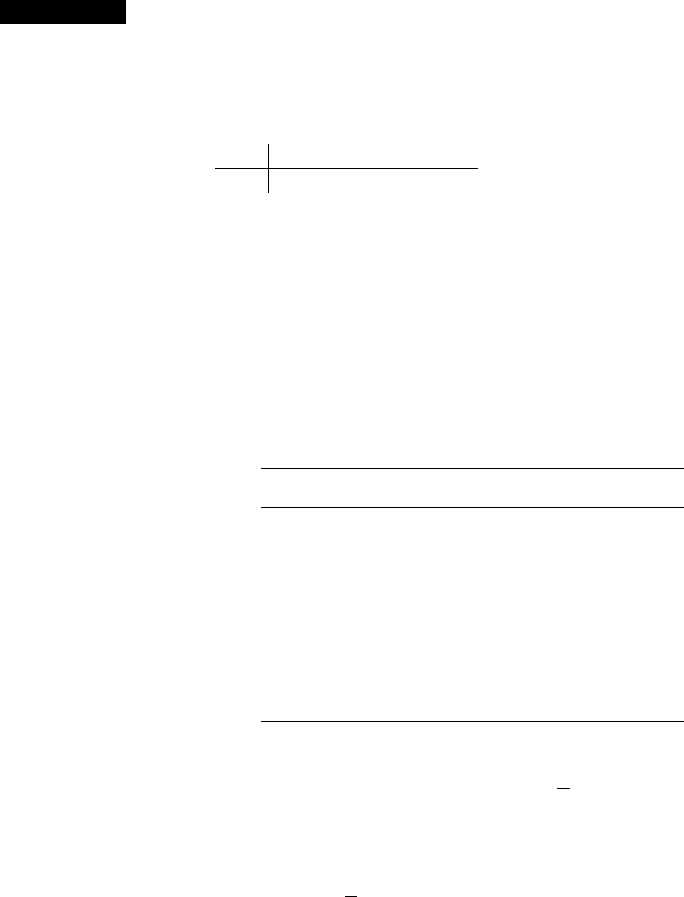
of a single randomly selected MP3 player purchase is given by
x 80 100 120
p(x).2 .3 .5
with m = 106, s
2
= 244 (6.1)
Suppose only two MP3 players are sold today. Let X
1
¼ the cost of the first player
and X
2
¼ the cost of the second. Suppose that X
1
and X
2
are independent, each with
the probability distribution shown in (6.1), so that X
1
and X
2
constitute a random
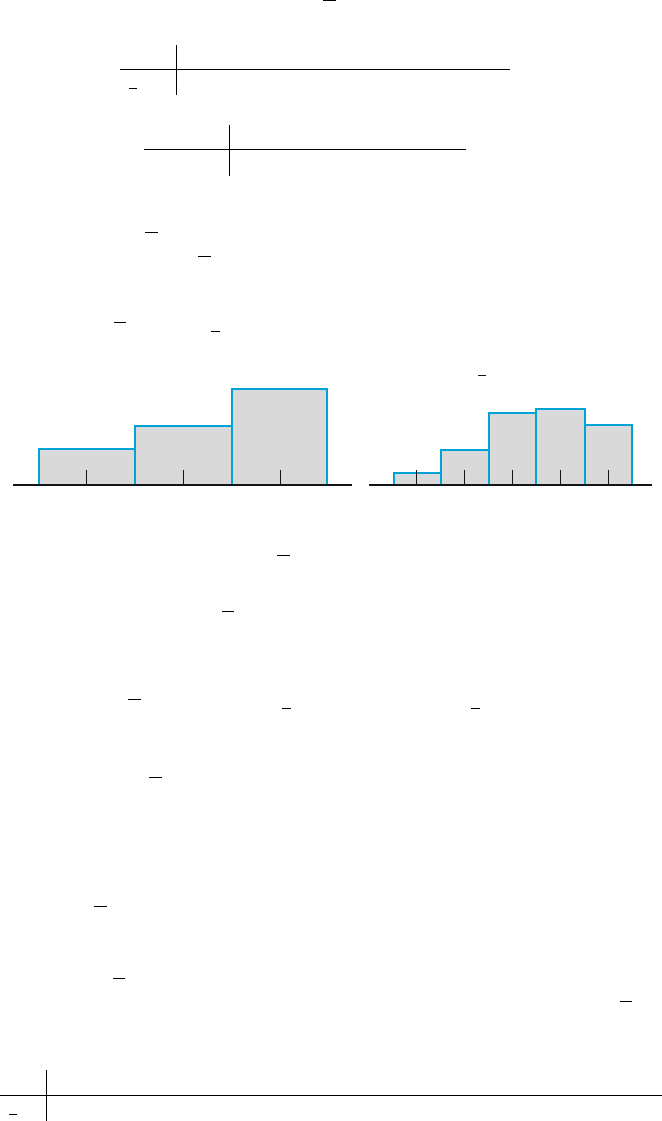
sample from the distribution (6.1). Table 6.2 lists possible (x
1
, x
2
) pairs, the
probability of each computed using (6.1) and the assumption of independence,
and the resulting
x and s
2
values. (When n ¼ 2, s
2
¼ðx
1
xÞ
2
þðx
2
xÞ
2
.)
Now to obtain the probability distribution of
X, the sample average cost per
MP3 player, we must consider each possible value
x and compute its probability.
For example,
x ¼ 100 occurs three times in the table with probabilities .10, .09,
and .10, so
Pð
X ¼ 100Þ¼:10 þ :09 þ :10 ¼ :29
Table 6.2 Outcomes, probabilities, and values
of
x and s
2
for Example 6.2
x
1
x
2
p(x
1
, x
2
)
xs
2
80 80 (.2)(.2) ¼ .04 80 0
80 100 (.2)(.3) ¼ .06 90 200
80 120 (.2)(.5) ¼ .10 100 800
100 80 (.3)(.2) ¼ .06 90 200
100 100 (.3)(.3) ¼ .09 100 0
100 120 (.3)(.5) ¼ .15 110 200
120 80 (.5)(.2) ¼ .10 100 800
120 100 (.5)(.3) ¼ .15 110 200
120 120 (.5)(.5) ¼ .25 120 0
288
CHAPTER 6 Statistics and Sampling Distributions
Similarly, s
2
¼ 800 appears twice in the table with probability .10 each time, so
PðS
2
¼ 800Þ¼PðX
1
¼ 80; X
2
¼ 120ÞþPðX
1
¼ 120; X
2
¼ 80Þ
¼ :10 þ :10 ¼ :20
The complete sampling distributions of
X and S
2
appear in (6.2) and (6.3).
x 80 90 100 110 120
p
X
ð
xÞ .2 .12 .29 .30 .5
(6.2)
s
2
0 200 800
p
S
2
ðs
2
Þ
.38 .42 .20
(6.3)
Figure 6.2 pictures a probability histogram for both the original distribution of
X (6.1) and the
X distribution (6.2). The figure suggests first that the mean
(i.e. expected value) of
X is equal to the mean $106 of the original distribution,
since both histograms appear to be centered at the same place. Indeed, from (6.2),
Eð
XÞ¼
X
xp
X
ð
xÞ¼80ð:04Þþþ120ð:25Þ¼106 ¼ m
Second, it appears that the
X distribution has smaller spread (variability) than the
original distribution, since the values of
x are more concentrated toward the mean.
Again from (6.2),
Vð
XÞ¼
X
ð
x mÞ
2
p
X
ð
xÞ¼
X
ð
x 106Þ
2
p
X
ð
xÞ
¼ð80 106Þ
2
ð:04Þþþð120 106Þ
2
ð:25Þ¼122
Notice that the Vð
XÞ¼122 ¼ 244=2 ¼ s
2
=2, is exactly half the population vari-
ance; the division by 2 here is a consequence of the fact that n ¼ 2.
Finally, the mean value of S
2
is
EðS
2
Þ¼
X
s
2
p
S
2
ðs
2
Þ¼0ð:38Þþ200ð:42Þþ800ð:20Þ¼244 ¼ s
2
That is, the X sampling distribution is centered at the population mean m, and the S
2
sampling distribution (histogram not shown) is centered at the population variance s
2
.
If four MP3 players had been purch ased on the day of interest, the sample
average cost
X would be based on a random sample of four X
i
s, each having
the distribution (6.1). More calculation eventually y ields the distribution of
X for
n ¼ 4as
x 80 85 90 95 100 105 110 115 120
p
X
ð
xÞ .0016 .0096 .0376 .0936 .1761 .2340 .2350 .1500 .0625
.3
.2
.5
.04
.12
.29
.30
.25
10080
x
120 80 90 100 110 120
x
ab
Figure 6.2 Probability histograms for (a) the underlying population distribution
and (b) the sampling distribution of
X
in Example 6.2
6.1 Statistics and Their Distributions 289
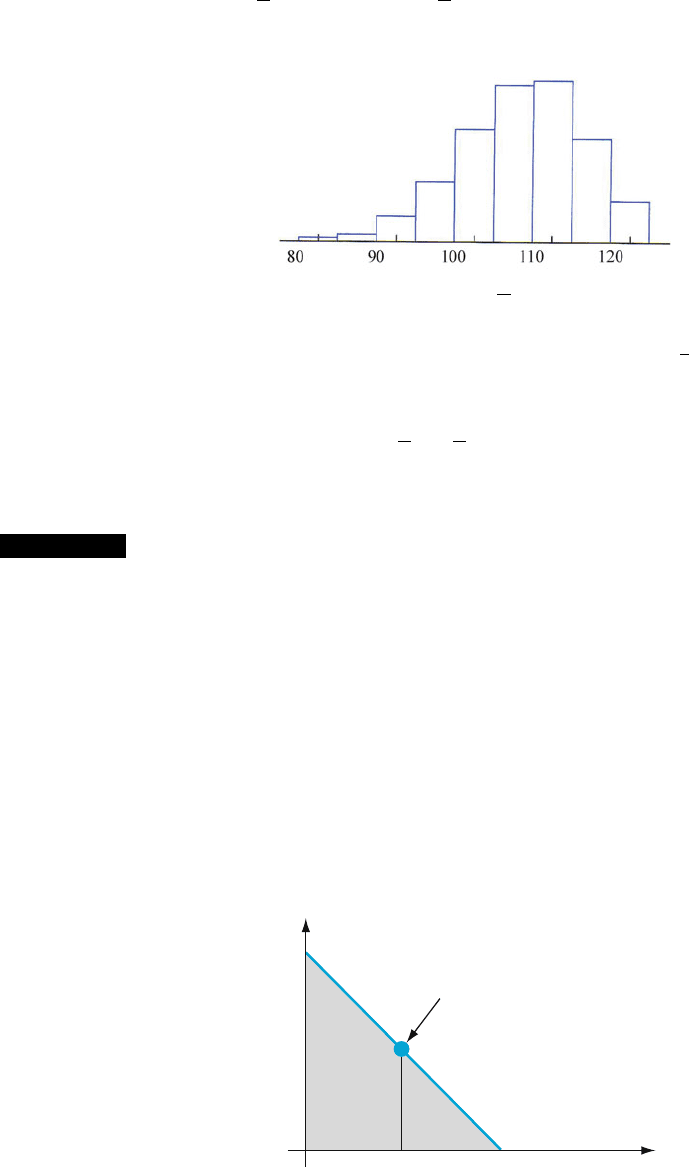
From this, EðXÞ¼106 ¼ m and VðXÞ¼61 ¼ s
2
=4. Figure 6.3 is a probability
histogram of this distribution.
Example 6.2 should suggest first of all that the computation of p
X
ð
xÞand p
S
2
ðs
2
Þ
can be tedious. If the original distribution (6.1) had allowed for more than three
possible values 80, 100, and 120, then even for n ¼ 2 the computations would have
been more involved. The example should also suggest, however, that there are some
general relationships between Eð
XÞ; VðXÞ; EðS
2
Þ,andthemeanm and variance s
2
of
the original distribution. These are stated in the next section. Now consider an
example in which the random sample is drawn from a continuous distribution.
Example 6.3 Th e time that it takes to serve a customer at the cash register in a minimarket is a
random variable having an exponential distribution wi th parameter l. Suppose X
1
and X
2
are service times for two different customers, assumed independent of each
other. Consider the total service time T
o
¼ X
1
þ X
2
for the two customers, also a
statistic. The cdf of T
o
is, for t 0,
F
T
0
ðtÞ¼PðX
1
þ X
2
tÞ¼
ðð
fðx
1
;x
2
Þ:x
1
þx
2
tg
f ð x
1
; x
2
Þ dx
1
dx
2
¼
ð
t
0
ð
tx
1
0
le
lx
1
le
lx
2
dx
2
dx
1
¼
ð
t
0
ðle
lx
1
le
lt
Þ dx
1
¼ 1 e
lt
lte
lt
The region of integration is pictured in Figure 6.4.
Figure 6.3 Probability histogram for
X
based on
n
¼ 4 in Example 6.2 ■
x
1
x
2
x
1
(x
1
,
t − x
1
)
x
1
+ x
2
= t
Figure 6.4 Region of integration to obtain cdf of
T
o
in Example 6.3
290
CHAPTER 6 Statistics and Sampling Distributions

The pdf of T
o
is obtained by differentiating F
T
0
ðtÞ:
f
T
0
ðtÞ¼
l
2
te
lt
t 0
0 t < 0
ð6:4Þ
This is a gamma pdf (a ¼ 2 and b ¼ 1/l). Th is distribution for T
o
can also be
derived by a moment generating function argument.
The pdf of
X ¼ T
0
=2 can be obtained by the method of Section 4.7 as
f
X
ð
xÞ¼
4l
2
xe
2l
x
x 0
0
x < 0
ð6:5Þ
The mean and variance of the underlying exponential distribution are m ¼ 1/l and
s
2
¼ 1/l
2
. Using Expressions (6.4) and (6.5), it can be verified that EðXÞ¼
1=l; Vð
XÞ¼1=ð2l
2
Þ; EðT
0
Þ¼2=l, and VðT
0
Þ¼2=l
2
. These results again sug-
gest some general relationships between means and variances of
X, T
0
, and the
underlying distribution. ■
Simulation Experiments
The second method of obtaining information about a statistic’s sampling distribu-
tion is to perform a simulation experiment. This method is usually used when a
derivation via probability rules is too difficult or complicated to be carried out.
Such an experiment is virtually always done with the aid of a computer.
The following characteristics of an experiment must be specified:
1. Th e statistic of interest (
X, S, a particular trimmed mean, etc.)
2. Th e population distribution (normal with m ¼ 100 and s ¼ 15, uniform with
lower limit A ¼ 5 and upper limit B ¼ 10, etc.)
3. Th e sample size n (e.g., n ¼ 10 or n ¼ 50)
4. Th e number of replications k (e.g., k ¼ 1000)
Then use a computer to obtain k different random samples, each of size n, from the
designated population distribution. For each such sample, calculate the value of the
statistic and construct a histogram of the k calculated values. This histogram gives
the approximate sampling distribution of the statistic. The larger the value of k,
the better the approximation will tend to be (the actual sampling distributio n
emerges as k !1). In practice, k ¼ 1000 may be enough for a “fairly simple”
statistic and population distribution, but modern computers allow a much larger
number of replications.
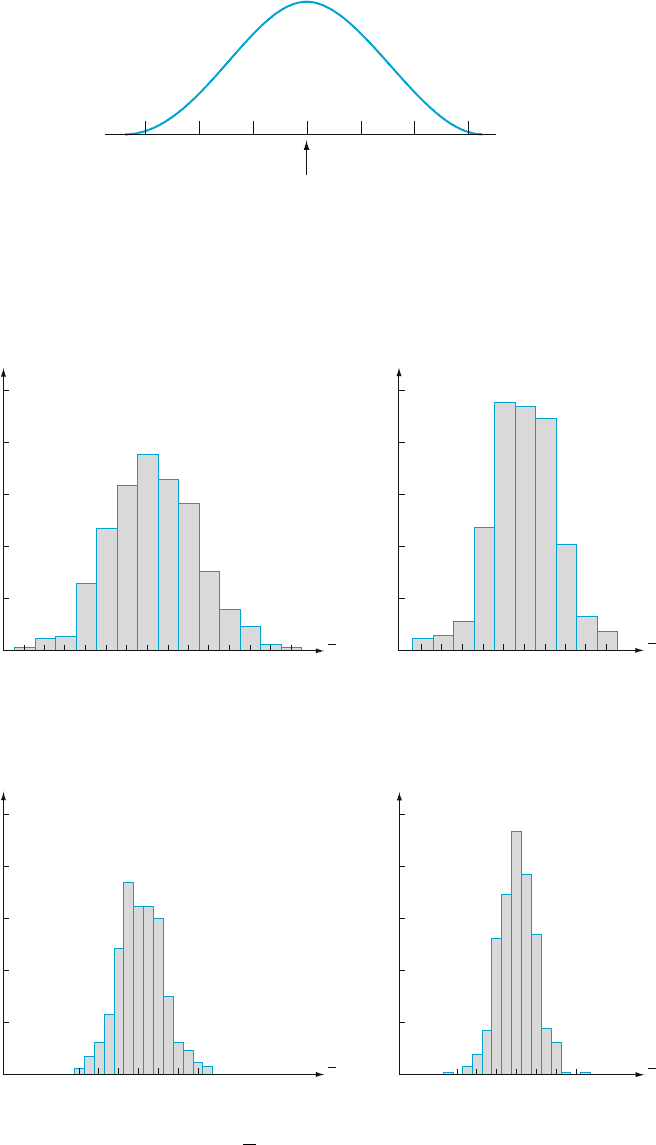
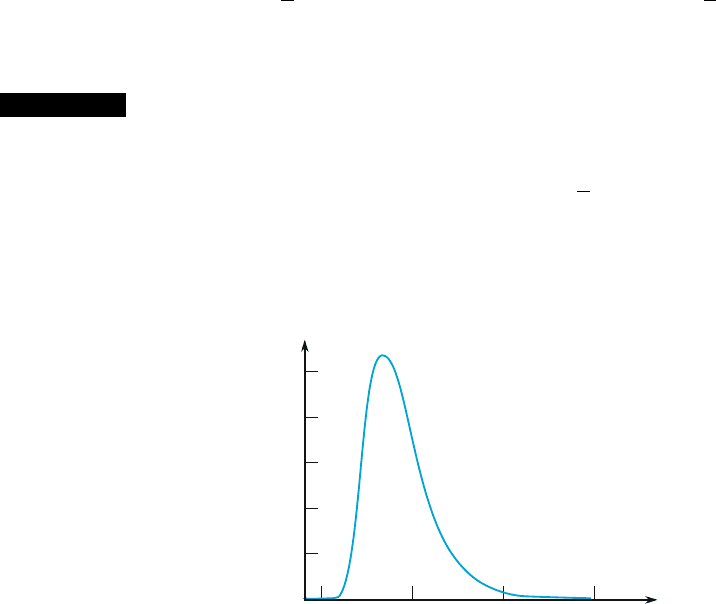
Example 6.4 Th e population distribution for our first simul ation study is normal with m ¼ 8.25
and s ¼ .75, as pictured in Figure 6.5. [The article “Platelet Size in Myocardial
Infarction” (British Med. J., 1983: 449–451) sugges ts this distribution for platelet
volume in individuals wi th no history of serious heart problems.]
We actually performed four different experiments, with 500 replic ations for
each one. In the first experiment, 500 samples of n ¼ 5 observations each were
generated using MINITAB, and the sample sizes for the other three were n ¼ 10,
n ¼ 20, and n ¼ 30, respectively. The sample mean was calculated for each
sample, and the resulting histograms of
x values appear in Figure 6.6.
6.1 Statistics and Their Distributions 291
m = 8.25
s = .75
⎧
⎨
⎩
6.00 6.75 7.50 9.00 9.75 10.50
Figure 6.5 Normal distribution, with m ¼ 8.25 and s ¼ .75
7.35 7.65 7.95 8.25 8.55 8.85 9.15
7.50 7.80 8.10 8.40 8.70 9.00 9.30
.05
.10
.15
.20
.25
.05
.10
.15
.20
.25
.05
.10
.15
.20
.25
.05
.10
.15
.20
.25
Relative
frequency
Relative
frequency
x
7.65 7.95 8.25 8.55 8.85
7.50 7.80 8.10 8.40 8.70
x
x
7.80 8.10 8.40 8.70
7.95 8.25 8.55
7.80 8.10 8.40 8.70
7.95 8.25 8.55
x
ab
Relative
frequency
Relative
frequency
cd
Figure 6.6 Sample histograms for
X
based on 500 samples, each consisting of
n
observations: (a)
n
¼ 5; (b)
n
¼ 10; (c)
n
¼ 20; (d)
n
¼ 30
292
CHAPTER 6 Statistics and Sampling Distributions
The first thing to notice about the histograms is their shape. To a reasonable
approximation, each of the four looks like a normal curve. The resemblance would
be even more striking if each histogram had been based on many more than 500
x
values. Second, each histogram is centered approximately at 8.25, the mean of the
population being sampled. Had the histograms been based on an unending sequence
of
x values, their centers would have been exactly the population mean, 8.25.
The final aspect of the histograms to note is their spread relative to each
other. The smaller the value of n, the greater the exte nt to which the sampling
distribution spreads out about the mean value. This is why the histograms for
n ¼ 20 and n ¼ 30 are based on narrow er class intervals than those for the two
smaller sample sizes. For the larger sample sizes, most of the
x values are quite
close to 8.25. This is the effect of aver aging. When n is small, a single unusual x
value can result in an
x valu e far from the center. With a larger sample size, any
unusual x values, when averaged in with the other sample values, still tend to yield
an
x value close to m. Combining these insights yields a result that should appeal
to your intuition:
X based on a large n tends to be closer to m than does X based on a
small n.
■
Example 6.5 Con sider a simulation experiment in which the population distribution is quite
skewed. Figure 6.7 shows the density curve for lifetimes of a certain type of
electronic control (This is actually a lognormal distribution with E[ln(X)] ¼ 3
and V[ln(X)] ¼ .16; that is, ln(X) is normal with mean 3 and variance .16.).
Again the statistic of interest is the sample mean
X. The experiment utilized
500 replications and considered the same four sample sizes as in Example 6.4.
The resulting histograms along with a normal probability plot from MINITAB for
the 500
x values based on n ¼ 30 are shown in Figure 6.8.
Unlike the normal case, these histograms all differ in shape. In particular,
they become progressively less skewed as the sample size n increases. The averages
of the 500
x values for the four different sample sizes are all quite close to the mean
value of the population distribution. If each histogram had been based on an
0 25 50 75
.01
.02
.03
.04
.05
x
f (x)
Figure 6.7 Density curve for the simulation experiment of Example 6.5 [
E
(
X
) ¼
m ¼ 21.7584,
V
(
X
) ¼ s
2
¼ 82.1449]
6.1 Statistics and Their Distributions 293
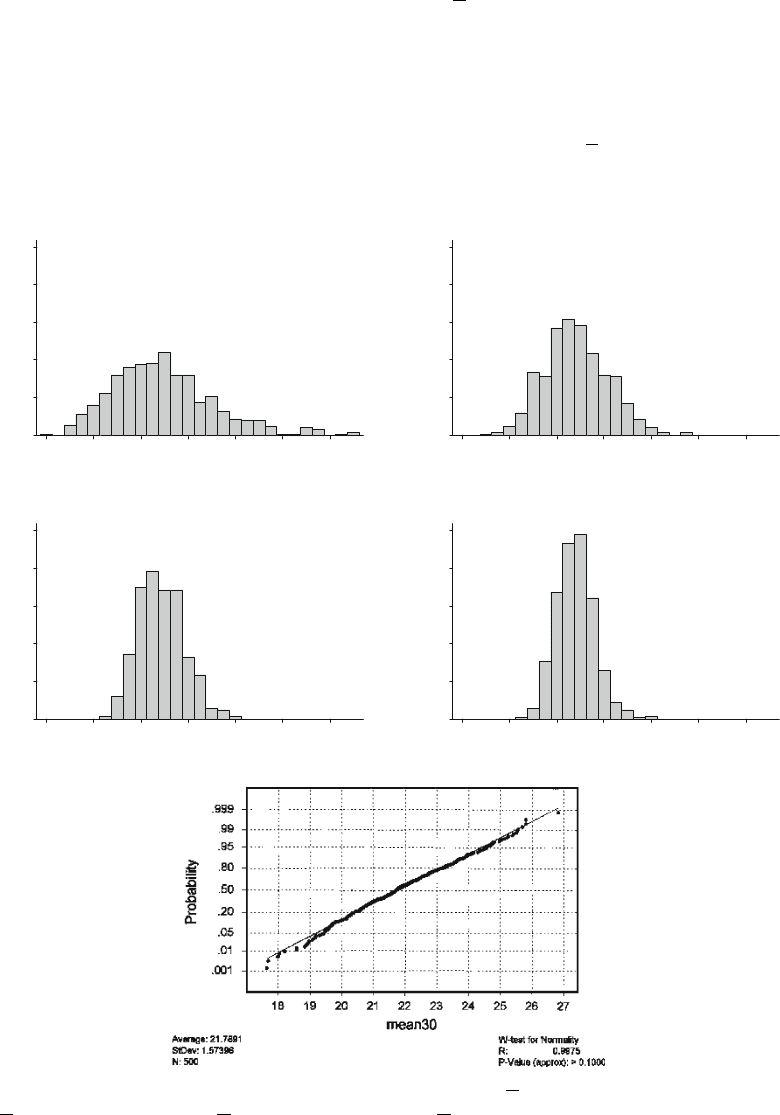
unending sequence of
x values rather than just 500, all four would have been
centered at exactly 21.7584. Thus different values of n change the shape but not
the center of the sampling distribution of
X. Comparison of the four histograms in
Figure 6.8 also shows that as n increases, the spread of the histograms decreases.
Increasing n results in a greater degree of concentration about the population mean
value and makes the histogram look more like a normal curve. The histogram of
Figure 6.8(d) and the normal probability plot in Figure 6.8(e) provide convincing
evidence that a sample size of n ¼ 30 is sufficient to overcome the skewness of the
population distribut ion and give an approximately normal
X sampling distribution.
12
0.00
0.05
0.10
0.15
0.20
0.25
16 20 24 28 32 36
n=5
12 16 20 24 28 32 36
n=20
12 16 20 24 28 32 36
n=10
12 16 20 24 28 32 36
n=30
a
Density
0.00
0.05
0.10
0.15
0.20
0.25
c
Density
0.00
0.05
0.10
0.15
0.20
0.25
b
Density
0.00
0.05
0.10
0.15
0.20
0.25
d
e
Density
Figure 6.8 Results of the simulation experiment of Example 6.5: (a)
X
histogram for
n
¼ 5;
(b)
X
histogram for
n
¼ 10; (c)
X
histogram for
n
¼ 20; (d)
X
histogram for
n
¼ 30; (e) normal
probability plot for
n
¼ 30 (from MINITAB) ■
294
CHAPTER 6 Statistics and Sampling Distributions
Exercises Section 6.1 (1–10)
1. A particular brand of dishwasher soap is sold in
three sizes: 25 oz, 40 oz, and 65 oz. Twenty
percent of all purchasers select a 25-oz box, 50%
select a 40-oz box, and the remaining 30% choose
a 65-oz box. Let X
1
and X
2
denote the package
sizes selected by two independently selected pur-
chasers.
a. Determine the sampling distribution of
X, cal-
culate E(
X), and compare to m.
b. Determine the sampling distribution of the
sample variance S
2
, calculate E(S
2
), and com-
pare to s
2
.
2. There are two traffic lights on the way to work.
Let X
1
be the number of lights that are red, requir-
ing a stop, and suppose that the distribution of X
1
is as follows:
x
1
012
p(x
1
).2 .5 .3
m ¼ 1.1, s
2
¼ .49
Let X
2
be the number of lights that are red on
the way home; X
2
is independent of X
1
. Assume
that X
2
has the same distribution as X
1
, so that X
1
,
X
2
is a random sample of size n ¼ 2.
a. Let T
o
¼ X
1
þ X
2
, and determine the probabil-
ity distribution of T
o
.
b. Calculate m
T
0
. How does it relate to m, the
population mean?
c. Calculate s
2
T
0
. How does it relate to s
2
, the
population variance?
3. It is known that 80% of all brand A DVD players
work in a satisfactory manner throughout the
warranty period (are “successes”). Suppose that
n ¼ 10 players are randomly selected. Let X ¼
the number of successes in the sample. The statis-
tic X/ n is the sample proportion (fraction) of suc-
cesses. Obtain the sampling distribution of this
statistic. [Hint: One possible value of X/n is .3,
corresponding to X ¼ 3. What is the probability of
this value (what kind of random variable is X)?]
4. A box contains ten sealed envelopes numbered 1,
..., 10. The first five contain no money, the next
three each contain $5, and there is a $10 bill in
each of the last two. A sample of size 3 is selected
with replacement (so we have a random sample),
and you get the largest amount in any of the
envelopes selected. If X
1
, X
2
, and X
3
denote the
amounts in the selected envelopes, the statistic of
interest is M ¼ the maximum of X
1
, X
2
, and X
3
.
a. Obtain the probability distribution of this
statistic.
b. Describe how you would carry out a simulation
experiment to compare the distributions of M
for various sample sizes. How would you guess
the distribution would change as n increases?
5. Let X be the number of packages being mailed by
a randomly selected customer at a shipping facil-
ity. Suppose the distribution of X is as follows:
x 1234
p(x).4 .3 .2 .1
a. Consider a random sample of size n ¼ 2 (two
customers), and let
X be the sample mean num-
ber of packages shipped. Obtain the probability
distribution of
X.
b. Refer to part (a) and calculate Pð
X 2:5Þ.
c. Again consider a random sample of size n ¼ 2,
but now focus on the statistic R ¼ the sample
range (difference between the largest and smal-
lest values in the sample). Obtain the distribu-
tion of R.[Hint: Calculate the value of R for
each outcome and use the probabilities from
part (a).]
d. If a random sample of size n ¼ 4 is selected,
what is Pð
X 1:5Þ?[Hint: You should not
have to list all possible outcomes, only those
for which
x 1:5.]
6. A company maintains three offices in a region,
each staffed by two employees. Information con-
cerning yearly salaries (1000’s of dollars) is as
follows:
Office 112233
Employee 123456
Salary 29.7 33.6 30.2 33.6 25.8 29.7
a. Suppose two of these employees are randomly
selected from among the six (without replace-
ment). Determine the sampling distribution of
the sample mean salary
X.
b. Suppose one of the three offices is randomly
selected. Let X
1
and X
2
denote the salaries of
the two employees. Determine the sampling
distribution of
X.
c. How does Eð
XÞ from parts (a) and (b) compare
to the population mean salary m?
6.1 Statistics and Their Distributions 295
7. The number of dirt specks on a randomly selected
square yard of polyethylene film of a certain type
has a Poisson distribution with a mean value of 2
specks per square yard. Consider a random sample
of n ¼ 5 film specimens, each having area 1
square yard, and let
X be the resulting sample
mean number of dirt specks. Obtain the first 21
probabilities in the
X sampling distribution. [Hint:
What does a moment generating function argument
say about the distribution of X
1
þ ···þ X
5
?]
8. Suppose the amount of liquid dispensed by a
machine is uniformly distributed with lower limit
A ¼ 8 oz and upper limit B ¼ 10 oz. Describe
how you would carry out simulation experiments
to compare the sampling distribution of the
(sample) fourth spread for sample sizes n ¼ 5,
10, 20, and 30.
9. Carry out a simulation experiment using a statistical
computer package or other software to study the
sampling distribution of
X when the population dis-
tribution is Weibull with a ¼ 2andb ¼ 5, as in
Example 6.1. Consider the four sample sizes n ¼ 5,
10, 20, and 30, and in each case use 500 replications.
For which of these sample sizes does the
X sampling
distribution appear to be approximately normal?
10. Carry out a simulation experiment using a statisti-
cal computer package or other software to study
the sampling distribution of
X when the popula-
tion distribution is lognormal with E[ln(X)] ¼ 3
and V[ln(X)] ¼ 1. Consider the four sample sizes
n ¼ 10, 20, 30, and 50, and in each case use 500
replications. For which of these sample sizes does
the
X sampling distribution appear to be approxi-
mately normal?
6.2
The Distribution of the Sample Mean
The importance of the sam ple mean X springs from its use in drawing concl usions
about the population mean m. Some of the mos t frequently used inferential proce-
dures are based on properties of the sampling distribution of
X. A preview of these
properties appeared in the calculations and simulation experiments of the previous
section, where we noted relationships between Eð
XÞ and m and also among VðXÞ,
s
2
, and n .
PROPOSITION
Let X
1
, X
2
, ..., X
n
be a random sample from a distribution with mean value m
and standard deviation s.Then
1. Eð
XÞ¼m
X
¼ m
2. Vð
XÞ¼s
2
X
¼ s
2
=n and s
X
¼ s=
ffiffiffi
n
p
In addition, with T
o
¼ X
1
þ ···þ X
n
(the sample total), E(T
o
) ¼ nm,
V(T
o
) ¼ ns
2
, and s
T
0
¼
ffiffiffi
n
p
s.
Proofs of these results are deferred to the next section. According to Result 1, the
sampling (i.e., probability) distribution of
X is centered precisely at the mean of
the population from which the sample has been selected. Result 2 shows that the
X
distribution becomes more concentrated about m as the sample size n increases. In
marked contrast, the distribution of T
o
becomes more spread out as n increases.
Averaging moves probability in toward the middle, whereas totaling spreads
probability out over a wider and wider range of values.
296 CHAPTER 6 Statistics and Sampling Distributions
Example 6.6 Th e amount of time that a patient spends in a certain outpatient surgery center
is a random variable with a mean value of 4.5 h. and a standard deviation of 2 h.
Let X
1
, ..., X
25
be the times for a random sample of 25 patients. Then the expected
value of the sample mean amount of time is Eð
XÞ¼m ¼ 4:5, and the expected total
time for the 25 patients is E(T
0
) ¼ nm ¼ 25(4.5) ¼ 112.5. The standard deviations
of
X and T
0
are
s
X
¼ s=
ffiffiffi
n
p
¼
2
ffiffiffiffiffi
25
p
¼ :4
s
T
0
¼
ffiffiffi
n
p
s ¼
ffiffiffiffiffi
25
p
ð2Þ¼10
If the sample size increases to n ¼ 100, Eð
XÞ is unchanged, but s
X
¼ :2, half of its
previous value (the sample size must be quadrupled to halve the standard deviation
of
X) . ■
The Case of a Normal Population Distribution
Looking back to the simulation experiment of Example 6.4, we see that when
the population distribution is normal, each histogram of
x values is well approxi-
mated by a normal curve. The precise result follows (see the next section for a
derivation).
PROPOSITION
Let X
1
, X
2
, ..., X
n
be a random sample from a normal distribution with mean
m and standard deviation s. Then for any n,
X is normally distributed (with
mean m and standard deviation s=
ffiffiffi
n
p
), as is T
o
(with mean nm and standard
deviation
ffiffiffi
n
p
s).
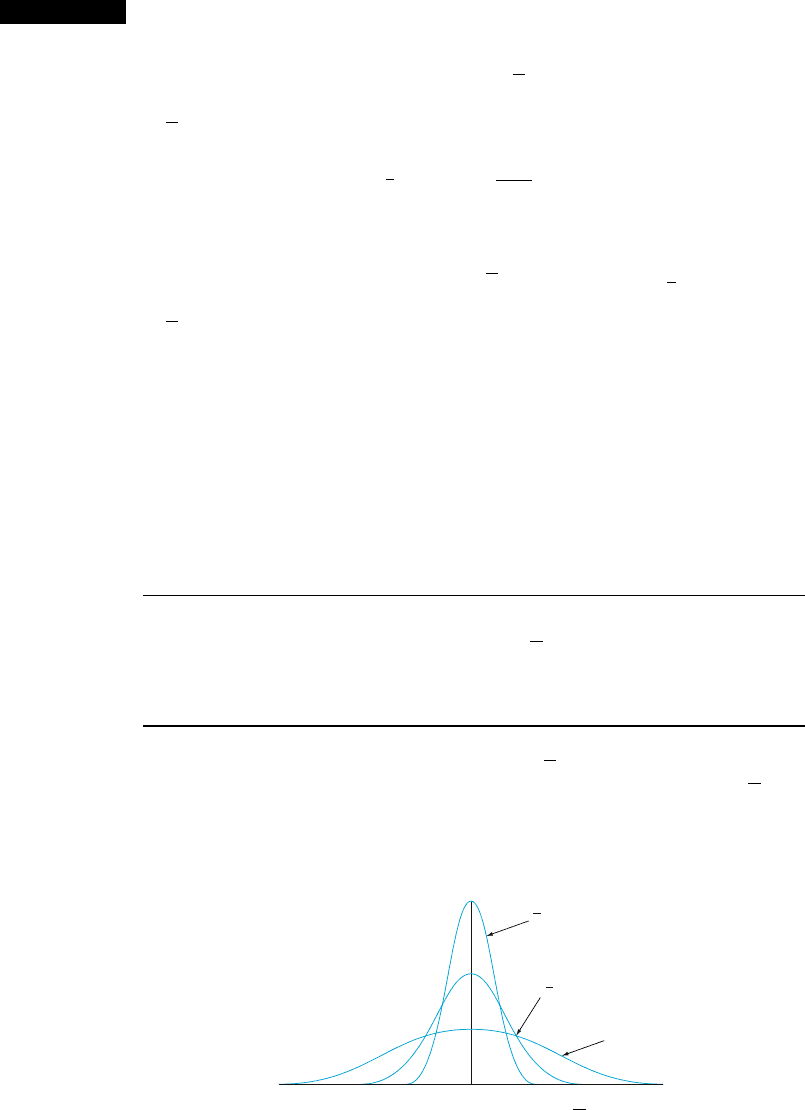
We know everything there is to know about the
X and T
o
distributions when the
population distribution is normal. In particular, probabilities such as Pð a
X bÞ
and Pc T
o
dðÞcan be obtained simply by standardizing. Figure 6.9 illustrates
the proposition.
X distribution
when n = 10
X distribution
when n = 4
Population
distribution
Figure 6.9 A normal population distribution and
X
sampling distributions
6.2 The Distribution of the Sample Mean 297