
Devore J.L., Berk K.N. Modern Mathematical Statistics with Applications
Подождите немного. Документ загружается.

distribution of
^
p is centered at .25 (centered in the sense of mean value), when
p ¼ .9 the sampling distribution is centered at .9, and so on. It is not necessary to
know the value of p to know that
^
p is unbiased.
PROPOSITION
When X is a binomial rv with parameters n and p, the sample proportion
^
p ¼ X=n is an unbiased estimator of p.
Example 7.5 Sup pose that X, the reaction time to a stimulus, has a uniform distribution on
the interval from 0 to an unknown upper limit y (so the density function of X
is rectangular in shape with height 1/y for 0 x y). An investigator wants to
estimate y on the basis of a random sample X
1
,X
2
,...,X
n
of reaction times. Since y
is the largest possible time in the entire population of reaction times, consider as a
first estimator the largest sample reaction time:
^
y
b
¼ maxðX
1
; ...; X
n
Þ.Ifn ¼ 5
and x
1
¼ 4.2, x
2
¼ 1.7, x
3
¼ 2.4, x
4
¼ 3.9, x
5
¼ 1.3, the point estimate of y is
^
y
b
¼ maxð4:2; 1:7; 2: 4 ; 3:9; 1:3Þ¼4:2:
Unbiasedness implies that some samples will yield estimates that exceed y and
other samples will yield estimates smaller than y —otherwisey could not possibly
be the center (balance point) of
^
y
b
’s distribution. However, our proposed estimator
will never overestimate y (the largest sample value cannot exceed the largest
population value) and will underestimate y unless the largest sample value equals
y. This intuitive argument shows that
^
y
b
is a biased estimator. More precisely, using
our earlier results on order statistics, it can be shown (see Exercise 50) that
Eð
^
y
b
Þ¼
n
n þ 1
y < y since
n
n þ 1
<1
The bias of
^
y
b
is given by ny/(n+1) – y ¼y/(n+1), which approaches 0 as n
gets large.
It is easy to modify
^
y
b
to obtain an unbiased estimator of y. Consider the
estimator
^
y
u
¼
n þ 1
n
^
y
b
¼
n þ 1
n
maxðX
1
; ...; X
n
Þ
Using this estimator on the data give s the estimate (6/5)( 4.2) ¼ 5.04. The fact that
(n + 1)/n > 1 implies that
^
y
u
will overestimate y for some samples and underesti-
mate it for others. The mean value of this estimator is
Eð
^
y
u
Þ¼E
n þ 1
n
maxðX
1
; ...; X
n
Þ
¼
n þ 1
n
E½maxðX
1
; ...; X
n
Þ
¼
n þ 1
n
n
n þ 1
y ¼ y
If
^
y
u
is used repeatedly on different samples to estimate y, some estimates
will be too large and others will be too small, but in the long run there will be no
systematic tendency to underestimate or overestimate y.
■
338 CHAPTER 7 Point Estimation
Statistical practitioners who buy into the Principle of Unbiased Estimation
would employ an un biased estimator in preference to a biased estimator. On this
basis, the sample proportion of successes should be preferred to the alternative
estimator of p, and the unbiased estimator
^
y
u
should be preferred to the biased
estimator
^
y
b
in the uniform distribution scenario of the previous example.
Example 7.6 Let’s turn now to the problem of estimating s
2
based on a random sample X
1
, ...,
X
n
. First consider the estimator S
2
¼
P
ðX
i
X
2
Þ=ðn 1Þ, the sample variance as
we have defined it. Applying the result E(Y
2
) ¼ V(Y)+[E(Y)]
2
to
S
2
¼
1
n 1
X
X
2
i
P
X
i
ðÞ
2
n
"#
from Section 1.4 gives
EðS
2
Þ¼
1
n 1
X
EðX
2
i
Þ
1
n
E
X
X
i
2
¼
1
n 1
X
ðs
2
þ m
2
Þ
1
n
V
X
X
i
þ E
X
X
i
hi
2
¼
1
n 1
ns
2
þ nm
2
1
n
ns
2
1
n
nmðÞ
2
¼
1
n 1
ns
2
s
2
¼ s
2
Thus we have shown that the sample variance S
2
is an unbiased estimator of s
2
.
The estimator that uses divisor n can be expressed as (n –1)S
2
/n,so
E
ðn 1ÞS
2
n
¼
n 1
n
ES
2
¼
n 1
n
s
2
This estimator is therefore biased. The bias is (n –1)s
2
/n – s
2
¼s
2
/n. Because
the bias is negative, the estimator with divisor n tends to underestimate s
2
, and this
is why the divisor n – 1 is preferred by many statisticians (although when n is large,
the bias is small and there is little difference between the two).
This is not quite the whole story, however. Suppose the random sample
has come from a normal distribution. Then from Section 6.4 , we know that the
rv (n –1)S
2
/s
2
has a chi-squared distribution with n – 1 degree of freedom. The
mean and variance of a chi-squared variable are df and 2 df, respectively. Let’s now
consider est imators of the form
^
s
2
¼ c
X
ðX
i
XÞ
2
The expected value of the estimator is
Ec
X
ðX
i
XÞ
2
hi
¼ cðn 1ÞEðS
2
Þ¼cðn 1Þs
2
so the bias is cðn 1Þs
2
s
2
. The only unbiased estimator of this type is the
sample variance, with c ¼ 1/(n – 1).
7.1 General Concepts and Criteria 339
Similarly, the variance of the estimator is
Vc
X
ðX
i
XÞ
2
hi
¼ Vcs
2
ðn 1ÞS
2
s
2
¼ c
2
s
4
½2ðn 1Þ
Substituting these expressions into the relationship MSE ¼ variance + (bias)
2
,the
value of c for which MSE is minimized can be found by taking the derivative with
respect to c, equating the resulting expression to zero, and solving for c. The result
is c ¼ 1/(n + 1). So in this situation, the principle of unbiasedness and the principle
of minimum MSE are at loggerheads.
As a final blow, even though S
2
is unbiased for estimating s
2
, it is not true
that the sample standard deviation S is unbiased for estimating s. This is because
the square root function is not linear, so the expected value of the square root is
not the square root of the expected value. Well, if S is biased, why not find an
unbiased estimator for s and use it rather than S? Unfortu nately there is no
estimator of s that is unbiased irrespective of the nature of the population distribu-
tion (although in special cases, e.g., a normal distri bution, an unbiased estimator
does exist). Fortunately the bias of S is not serious unless n is quite small. So we
shall generally employ it as an estimator.
■
In Example 7.2, we proposed several different estimators for the mean m of a
normal distribution. If there were a unique unbiased estimator for m, the estimation
dilemma could be resolved by using that estimator. Unfortunately, this is not
the case.
PROPOSITION
If X
1
, X
2
,...,X
n
is a random sample from a distribution with mean m, then X
is an unbiased estimat or of m. If in addition the distribution is continuous and
symmetric, then
e
X and any trimmed mean are also unbiased estimators of m.
The fact that
X is unbiased is just a restatement of one of our rules of expected
value: Eð
XÞ¼m for every possible value of m (for discrete as well as continuous
distributions). The unbiasedness of the other estimators is more difficult to verify;
the argument requires invoking results on distributions of order statistics from
Section 5.5.
According to this proposition, the principle of unbiasedness by itself does not
always allow us to select a single estimator. When the underlying population is
normal, even the third estimator in Example 7.2 is unbiased, and there are many
other unbiased estimators. What we now need is a way of selecting among unbiased
estimators.
Estimators with Minimum Variance
Suppose
^
y
1
and
^
y
2
are two estimators of y that are both unbiased. Then, although
the distribution of each estim ator is centered at the true value of y, the spreads of the
distributions about the true value may be different.
340 CHAPTER 7 Point Estimation
PRINCIPLE
OF MINIMUM
VARIANCE
UNBIASED
ESTIMATION
Among all estimators of y that are unbiased, choose the one that has
minimum variance. The resulting
^
y Is called the minimum variance unbi-
ased estimator (MVUE) of y. Since MSE ¼ variance + (bias)
2
, seeking
an unbiased estimator with minimum variance is the same as seeking an
unbiased estimator that has minimum mean squared error.
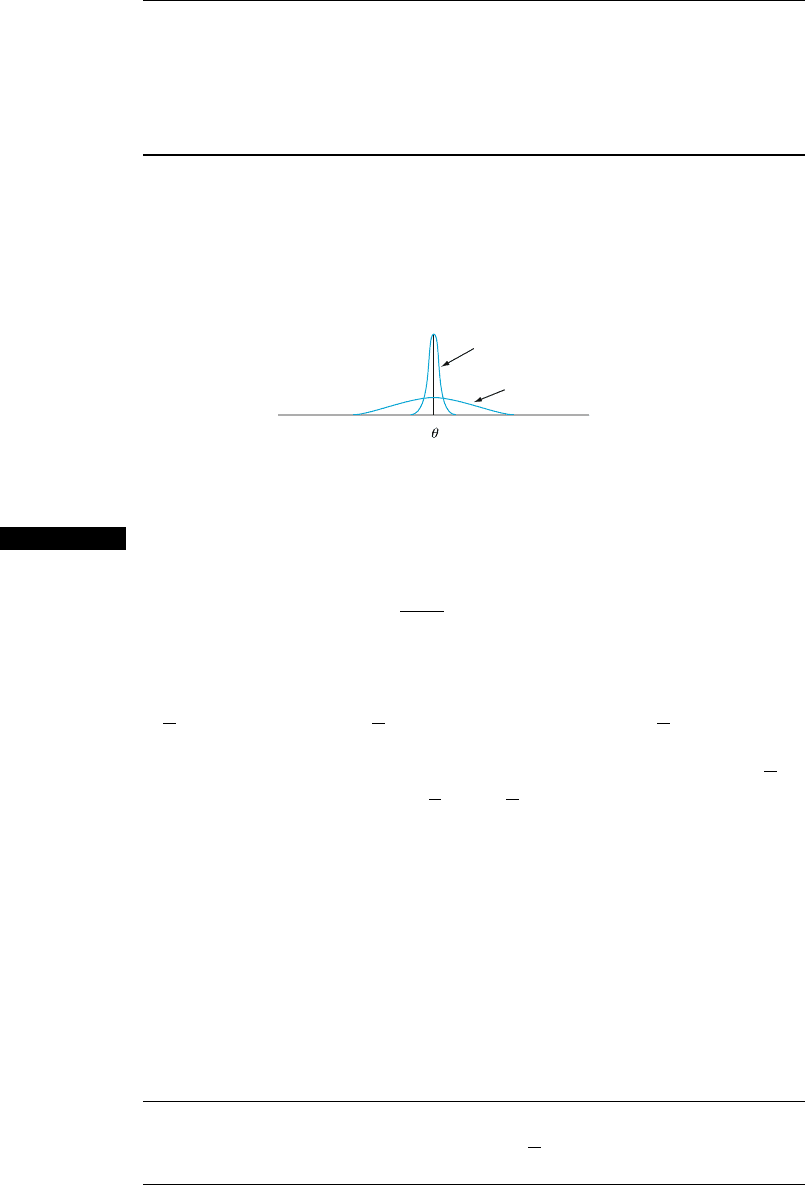
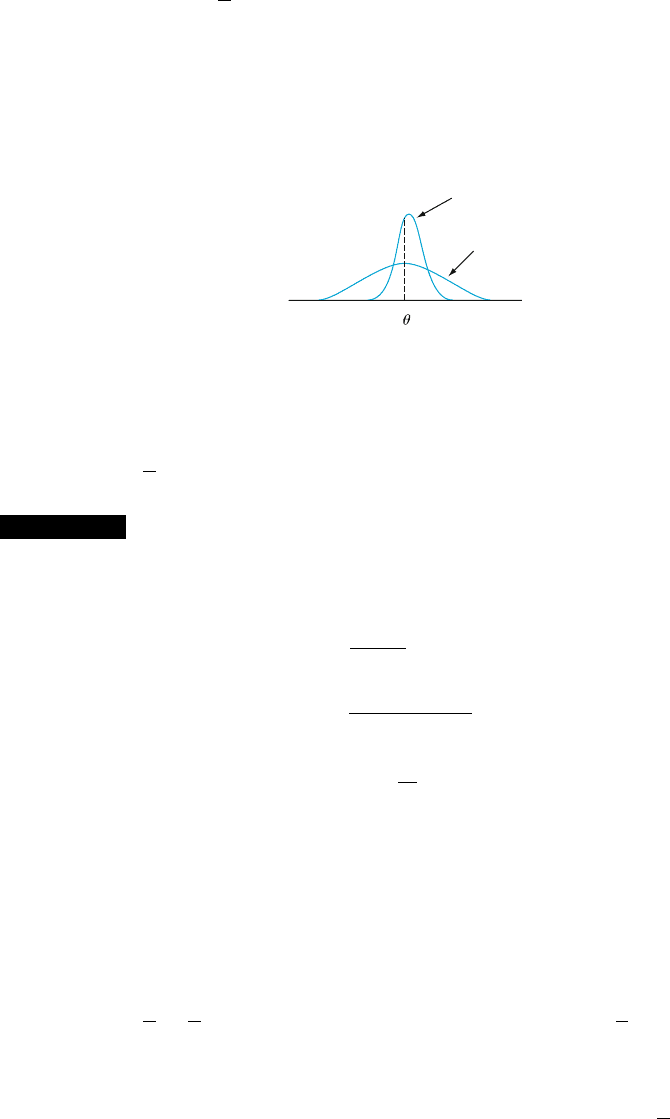
Figure 7.3 pictures the pdf’s of two unbiased estimators, with the first
^
y
having smaller variance than the second estimator. Then the first
^
y is more likely
than the second one to produce an estimate close to the true y. The MVUE is, in a
certain sense, the most likely among all unbiased estimators to produce an estimate
close to the true y.
Example 7.7 We argued in Example 7.5 that when X
1
,...,X
n
is a random sample from a uniform
distribution on [0, y], the estimator
^
y
1
¼
n þ 1
n
maxðX
1
; ...; X
n
Þ
is unbiased for y (we previously denoted this estimator by
^
y
u
). This is not the only
unbiased estimator of y. The expected value of a uniformly distributed rv is just the
midpoint of the interval of positive density, so E(X
i
) ¼ y /2. This implies that
Eð
XÞ¼y=2, from which Eð2XÞ¼y. That is, the estimator
^
y
2
¼ 2X is unbiased for y.
If X is uniformly distributed on the interval [A, B], then V(X) ¼ s
2
¼ (B – A)
2
/12
(Exercise 23 in Chapter 4). Thus, in our situation, V(X
i
) ¼ y
2
/12, VðXÞ¼
s
2
=n ¼ y
2
=ð12nÞ,andVð
^
y
2
Þ¼Vð2XÞ¼4VðXÞ¼y
2
=ð3nÞ. The results of Exercise
50 can be used to show that Vð
^
y
1
Þ¼y
2
=½nðn þ 2Þ. The estimator
^
y
1
has smaller
variance than does
^
y
2
if 3n < n(n + 2)—that is, if 0 < n
2
– n ¼ n(n –1).Aslongas
n > 1, V(
^
y
1
) < V(
^
y
2
), so
^
y
1
is a better estimator than
^
y
2
. More advanced methods
canbeusedtoshowthat
^
y
1
is the MVUE of y—every other unbiased estimator of y
has variance that exceeds y
2
/[n(n + 2)]. ■
One of the triumphs of mathemat ical statistics has been the development of
methodology for identifying the MVUE in a wide variety of situations. The most
important result of this type for our purposes concerns estimating the mean m of a
normal distribution. For a proof in the special case that s is known, see Exercise 45.
THEOREM
Let X
1
,...,X
n
be a random sample from a normal distribution with
parameters m and s. Then the estimator
^
m ¼
X is the MVUE for m.
pdf of second estimator
pdf of first estimator
Figure 7.3 Graphs of the pdf’s of two different unbiased estimators
7.1 General Concepts and Criteria 341
Whenever we are convinced that the population being sampled is normal, the result
says that
X should be used to estimate m. In Example 7.2, then, our estimate would
be
x ¼ 27:793.
Once again, in some situations such as the one in Example 7.6, it is possible
to obtain an estimator with small bias that would be preferred to the best unbiased
estimator. This is illustrated in Figure 7.4. However, MVUEs are often easier to
obtain than the type of biased estimator whose distribution is pictured.
More Complications
The last theorem does not say that in estimating a population mean m, the estimator
X should be used irrespective of the distribution being sampled.
Example 7.8 Sup pose we wish to estimate the number of calories y in a certain food. Using
standard measurement techniques, we will obtain a random sample X
1
,...,X
n
of n
calorie measurements. Let’s assume that the population distribution is a member of
one of the following three families:
f ðxÞ¼
1
ffiffiffiffiffiffiffiffiffiffi
2ps
2
p
e
ðxyÞ
2
=ð2s
2Þ
1< x < 1ð7:1Þ
f ð xÞ¼
1
p½1 þðx y Þ
2
1< x < 1ð7:2Þ
f ð xÞ¼
1
2c
c x y c
0 otherwise
8
<
:
ð7:3Þ
The pdf (7.1) is the normal distribution, (7.2) is called the Cauchy distribution, and
(7.3) is a uniform distribution. All three distributions are symmetric about y,whichis
therefore the median of each distribution. The value y is also the mean for the normal
and uniform distributions, but the mean of the Cauchy distribution fails to exist. This
happens because, even though the Cauchy distribution is bell-shaped like the normal
distribution, it has much heavier tails (more probability far out) than the normal curve.
The uniform distribution has no tails. The four estimators for m considered earlier are
X,
e
X, X
e
(the average of the two extreme observations), and X
trð10Þ
,atrimmedmean.
The very important moral here is that the best estimator for m depends
crucially on which distribution is being sampled. In particular,
1. If the random sample comes from a normal distribution, then
X is the best of the
four estimators, since it has minimum variance among all unbiased estimators.
pdf of q
1
, a biased estimator
ô
ô
pdf of q
2
, the MVUE
Figure 7.4 A biased estimator that is preferable to the MVUE
342
CHAPTER 7 Point Estimation

2. If the random sample comes from a Cauchy distribution, then X and X
e
are
terrible estimators for m, whereas
e
X is quite good (the MVUE is not known);
X is
bad because it is very sensitive to outlying observations, and the h eavy tails of
the Cauchy distribution mak e a few such obser vations likely to appear in any
sample.
3. If the underlying distribution is the particular uniform distribution in (7.3), then
the best estimator is
X
e
; in gener al, this est imator is greatly influenced by
outlying observat ions, but here the lack of tails makes such observations
impossible.
4. The trimmed mean is best in none of these three situations but wor ks
reasonably well in all three. That is,
X
trð10Þ
does not suffer too much in
comparison with the best procedure in any of the three situations.
■
More generally, recent research in statistics has established that when esti-
mating a point of symmetry m of a continuous probability distribution, a trim med
mean with trimming proportion 10% or 20% (from each end of the sample)
produces reasonably behaved estimates over a very wide range of possibl e models.
For this reason, a trimmed mean with small trimming percentage is said to be a
robust estimator.
Until now, we have focused on comparing several estimators based on the
same data, such as
X and
e
X for estimating m when a sample of size n is selected from
a normal population distribution. Sometimes an investigator is faced with a choice
between alternative ways of gathering data; the form of an appropriate estimator
then may well depend on how the experiment was carried out.
Example 7.9 Sup pose a type of component has a lifetime distribution that is exponential with
parameter l so that expected lifetime is m ¼ 1/l. A sample of n such components is
selected, and each is put into operation. If the experiment is continued until all n
lifetimes, X
1
,...,X
n
, have been observed, then X is an unbiased estimator of m.
In some experiments, though, the components are left in operation only until
the time of the rth failure, where r < n. This procedure is referred to as censoring.
Let Y
1
denote the time of the first failure (the minimum lifetime among the n
components), Y
2
denote the time at which the second failure occurs (the second
smallest lifetime), and so on. Since the experiment terminates at time Y
r
, the total
accumulated lifetime at termination is
T
r
¼
X
r
i¼1
Y
i
þðn rÞY
r
We now demonstrate that
^
m ¼ T
r
=r is an unbiased estimator for m. To do so,
we need two properties of exponential variables:
1. The memoryless property (see Section 4.4) says that at any time point,
remaining lifeti me has the same exponential distribut ion as original lifetime.
2. If X
1
,...,X
k
are independent, each exponentially distributed with parameter
l, then min (X
1
,...,X
k
) is exponential with parameter kl and has expected
value 1/(kl). See Example 5.28.
7.1 General Concepts and Criteria 343
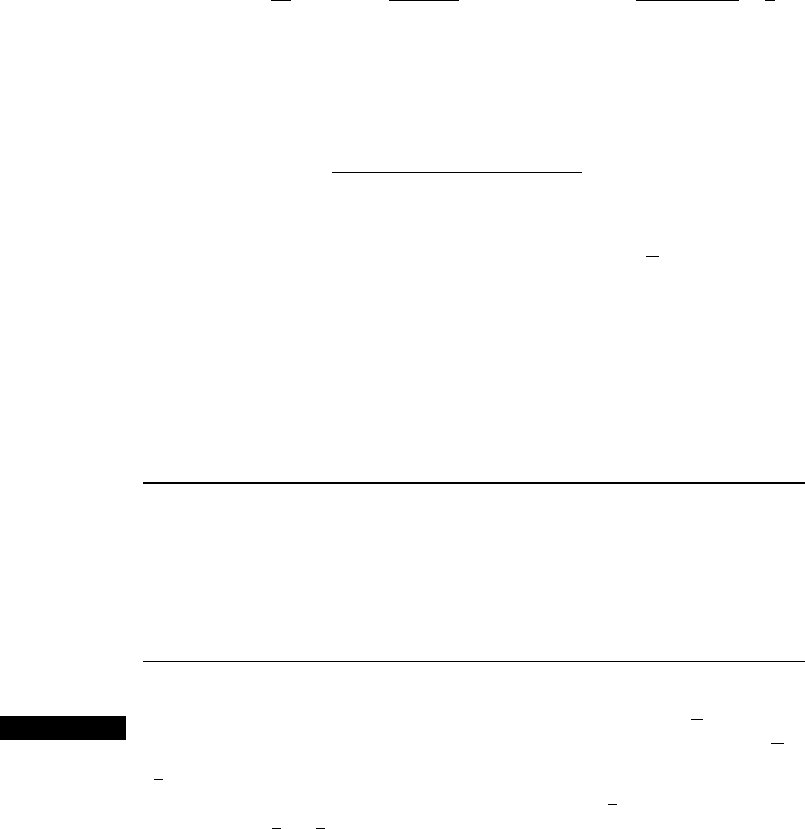
Since all n components last until Y
1
, n – 1 last an additional Y
2
– Y
1
, n –2an
additional Y
3
– Y
2
amount of time, and so on, another expression for T
r
is
T
r
¼nY
1
þðn 1ÞðY
2
Y
1
Þþðn 2Þð Y
3
Y
2
Þþþðn r þ1ÞðY
r
Y
r1
Þ
But Y
1
is the minimum of n exponential variables, so E(Y
1
) ¼ 1/(nl). Simi-
larly, Y
2
– Y
1
is the smallest of the n – 1 remaining lifetimes, each exponential with
parameter l (by the memoryless property), so E(Y
2
– Y
1
) ¼ 1/[(n –1)l].
Continuing, E( Y
i+1
– Y
i
) ¼ 1/[(n – i)l], so
EðT
r
Þ¼nEðY
1
Þþðn 1ÞEðY
2
Y
1
Þþþðn r þ 1ÞEðY
r
Y
r1
Þ
¼ n
1
nl
þðn 1Þ
1
ðn 1Þl
þþðn r þ 1Þ
1
ðn r þ 1Þl
¼
r
l
Therefore, E(T
r
/r) ¼ (1/r)E(T
r
) ¼ (1/r)·(r/ l ) ¼ 1/l ¼ m as claimed.
As an example, suppose 20 components are put on test and r ¼ 10. Then if
the first ten failure times are 11, 15, 29, 33, 35, 40, 47, 55, 58, and 72, the estimate
of m is
^
m ¼
11 þ 15 þþ72 þð10Þð72Þ
10
¼ 111:5
The advantage of the experiment with censo ring is that it terminates
more quickly than the uncensored experiment. However, it can be shown that
V(T
r
/r) ¼ 1/(l
2
r), which is larger than 1/(l
2
n), the variance of X in the uncensored
experiment.
■
Reporting a Point Estimate: The Standard Error
Besides reporting the value of a point estimate, some indication of its precision
should be given. The usual measure of precision is the standard error of the
estimator used.
DEFINITION
The standard error of an estimator
^
y is its standard deviation s
^
y
¼
ffiffiffiffiffiffiffiffiffiffi
Vð
^
yÞ
q
.
If the standard error itself involves unknown parameters whose values can be
estimated, substitution of these estim ates into s
^
y
yields the estimated stan-
dard error (estimated standard deviation) of the estimator. The estimated
standard error can be denoted either by
^
s
^
y
(the ˆ over s emphasizes that s
^
y
is
being estimat ed) or by s
^
y
.
Example 7.10
(Example 7.2
continued)
Assuming that breakdown voltage is normal ly distributed,
^
m ¼ X is the best
estimator of m. If the value of s is known to be 1.5, the standard error of
X is
s
X
¼ s=
ffiffiffi
n
p
¼ 1:5=
ffiffiffiffiffi
20
p
¼ :335. If, as is usually the case, the value of s is
unknown, the estimate
^
s ¼ s ¼ 1:462 is substituted into s
X
to obtain the est imated
standard error
^
s
X
¼ s
X
¼ s=
ffiffiffi
n
p
¼ 1:462=
ffiffiffiffiffi
20
p
¼ :327 ■
344 CHAPTER 7 Point Estimation

Example 7.11
(Example 7.1
continued)
The standard error of
^
p ¼ X=n is
s
^
p
¼
ffiffiffiffiffiffiffiffiffiffiffiffiffiffiffi
VX=nðÞ
p
¼
ffiffiffiffiffiffiffiffiffiffi
VðXÞ
n
2
r
¼
ffiffiffiffiffiffiffiffi
npq
n
2
r
¼
ffiffiffiffiffi
pq
n
r
Since p and q ¼ 1–p are unknown (else why estimate?), we substitute
^
p ¼ x=n and
^
q ¼ 1 x=n into s
^
p
, yielding the estimated standard error
^
s
^
p
¼
ffiffiffiffiffiffiffiffiffiffi
^
p
^
q=n
p
¼
ffiffiffiffiffiffiffiffiffiffiffiffiffiffiffiffiffiffiffiffiffiffiffi
ð:6Þð:4Þ=25
p
¼ :098. Alternatively, since the largest value of pq
is attained when p ¼ q ¼ .5, an upper bound on the standard error is
ffiffiffiffiffiffiffiffiffiffiffiffiffiffi
1=ð4nÞ
p
¼ :10.
■
When the point estimator
^
y has approximately a normal distribution, which will
often be the case when n is large, then we can be reasonably confident that the true
value of y lies within approximately 2 standard errors (standard deviations) of
^
y.Thus
if measurement of prothrombin (a blood-clotting protein) in 36 individuals gives
^
m ¼
x ¼ 20:5ands ¼ 3.6 mg/100 ml, then s=
ffiffiffi
n
p
¼ :60, so “within 2 estimated
standard errors of
^
m” translates to the interval 20.50 (2)(.60) ¼ (19.30, 21.70).
If
^
y is not necessarily approximately normal but is unbiased, then it can be
shown (using Chebyshev’s inequality, introduced in Exercises 43, 77, and 135 of
Chapter 3) that the estimate will deviate from y by as much as 4 standard errors at
most 6% of the time. We would then expect the true value to lie within 4 standard
errors of
^
y (and this is a very conservative statement, since it applies to any
unbiased
^
y). Summarizing, the standard error tells us roughly within what distance
of
^
y we can expect the true value of y to lie.
The Bootstrap
The form of the estimator
^
y may be sufficiently complicated so that standard
statistical theory cannot be applied to obtain an expression for s
^
y
.Thisistrue,for
example, in the case y ¼ s,
^
y ¼ S; the standard deviation of the statistic S, s
S
,cannot
in general be determined. In recent years, a new computer-intensive method called
the bootstrap has been introduced to address this problem. Suppose that the popula-
tion pdf is f (x; y), a member of a particular parametric family, and that data x
1
, x
2
,...,
x
n
gives
^
y ¼ 21:7. We now use the computer to obtain “bootstrap samples” from the
pdf f (x; 21.7), and for each sample we calculate a “bootstrap estimate”
^
y
:
First bootstrap sample: x
1
; x
2
; ...; x
n
; estimate ¼
^
y
1
Second bootstrap sample: x
1
; x
2
; ...; x
n
; estimate ¼
^
y
2
...
Bth bootstrap sample: x
1
; x
2
; ...; x
n
; estimate ¼
^
y
B
B ¼ 100 or 200 is often used. Now let
y
¼
P
^
y
i
=B, the sample mean of the
bootstrap estimates. The bootstrap estimate of
^
y’s standard error is now just the
sample standard deviation of the
^
y
i
’s:
S
^
y
¼
ffiffiffiffiffiffiffiffiffiffiffiffiffiffiffiffiffiffiffiffiffiffiffiffiffiffiffiffiffiffiffiffiffiffiffiffiffiffiffiffiffiffiffi
1
B 1
X
^
y
i
y
2
r
(In the bootstrap literature, B is often used in place of B – 1; for typical values of B,
there is usually little difference between the resulting estimates.)
7.1 General Concepts and Criteria 345
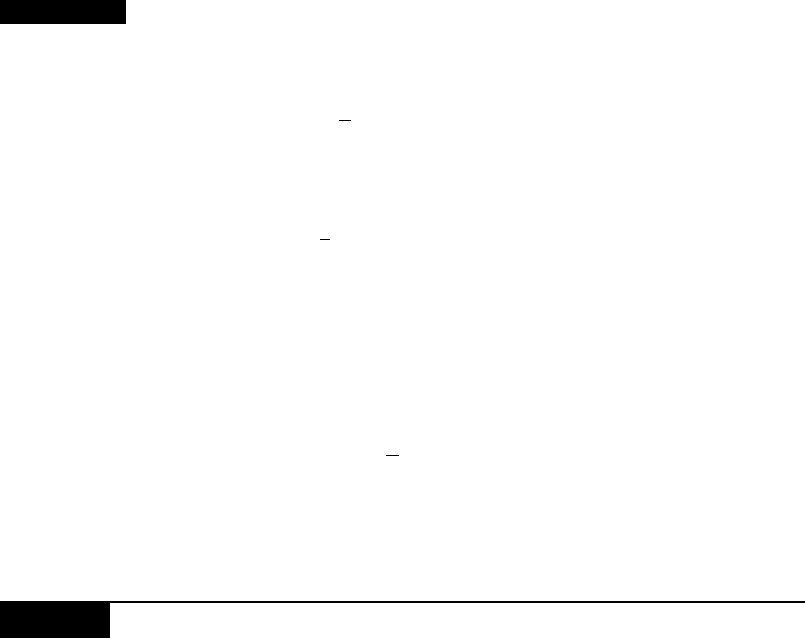
Example 7.12 A theoretical model suggests that X, the time to breakdown of an insulating fluid
between electrodes at a particular voltage, has f(x; l) ¼ le
–lx
, an exponential distri-
bution. A random sample of n ¼ 10 breakdown times (min) gives the following data:
41.53 18.73 2.99 30.34 12.33 117.52 73.02 223.63 4.00 26.78
Since E(X) ¼ 1/l, EðXÞ¼1=l, so a reasonable estimate of l is
^
l ¼
1=
x ¼ 1=55:087 ¼ :018153. We then used a statistical computer package to obtain
B ¼ 100 bootstrap samples, each of size 10, from f(x; .018153). The first such
sample was 41.00, 109.70, 16.78, 6.31, 6.76, 5.62, 60.96, 78.81, 192.25, 27.61,
from which
P
x
i
¼ 545:8 and
^
l
1
¼ 1=54:58 ¼ :01832. The average of the 100
bootstrap estimates is l
¼ .02153, and the sample standard deviation of these 100
estimates is s
^
l
¼ :0091, the bootstrap estimate of
^
l’s standard error. A histogram of
the 100
^
l
i
’s was somewhat positively skewed, suggesting that the sampling
distribution of
^
l also has this property.
■
Sometimes an investigator wishes to estimate a population characteristic
without assuming that the population distribution belongs to a particular parametric
family. An instance of this occurred in Example 7.8, where a 10% trimmed mean
was proposed for estimat ing a symmetric population distribution’s center y. The
data of Example 7.2 gave
^
y ¼
X
trð10Þ
¼ 27:838, but now there is no assumed f(x; y),
so how can we obtain a bootstrap sample? The answer is to regard the sample itself
as constituting the population (the n ¼ 20 observations in Example 7.2) and take B
different samples, each of size n, with replacement from this population. We
expand on this idea in Section 8.5.
Exercises Section 7.1 (1–20)
1. The accompanying data on IQ for first-graders at a
university lab school was introduced in Example 1.2.
82 96 99 102 103 103 106 107 108 108 108
108 109 110 110 111 113 113 113 113 115 115
118 118 119 121 122 122 127 132 136 140 146
a. Calculate a point estimate of the mean value of
IQ for the conceptual population of all first
graders in this school, and state which estima-
tor you used. [Hint: Sx
i
¼ 3753]
b. Calculate a point estimate of the IQ value that
separates the lowest 50% of all such students
from the highest 50%, and state which estima-
tor you used.
c. Calculate and interpret a point estimate of the
population standard deviation s. Which esti-
mator did you use? [ Hint: Sx
2
i
¼ 432; 015]
d. Calculate a point estimate of the proportion of
all such students whose IQ exceeds 100. [Hint:
Think of an observation as a “success” if it
exceeds 100.]
e. Calculate a point estimate of the population
coefficient of variation s/m, and state which
estimator you used.
2. A sample of 20 students who had recently taken
elementary statistics yielded the following infor-
mation on brand of calculator owned (T ¼ Texas
Instruments, H ¼ Hewlett-Packard, C ¼ Casio,
S ¼ Sharp):
TTHTCTTSCH
SST HCTTTHT
a. Estimate the true proportion of all such stu-
dents who own a Texas Instruments calculator.
b. Of the ten students who owned a TI calculator,
4 had graphing calculators. Estimate the pro-
portion of students who do not own a TI graph-
ing calculator.
3. Consider the following sample of observations on
coating thickness for low-viscosity paint (“Achiev-
ing a Target Value for a Manufacturing Process:
A Case Study,” J. Qual. Technol., 1992: 22–26):
.83 .88 .88 1.04 1.09 1.12 1.29 1.31
1.48 1.49 1.59 1.62 1.65 1.71 1.76 1.83
Assume that the distribution of coating thickness
is normal (a normal probability plot strongly sup-
ports this assumption).
346
CHAPTER 7 Point Estimation

a. Calculate a point estimate of the mean value of
coating thickness, and state which estimator
you used.
b. Calculate a point estimate of the median of the
coating thickness distribution, and state which
estimator you used.
c. Calculate a point estimate of the value that
separates the largest 10% of all values in the
thickness distribution from the remaining 90%,
and state which estimator you used. [Hint:
Express what you are trying to estimate in
terms of m and s]
d. Estimate P(X < 1.5), i.e., the proportion of all
thickness values less than 1.5. [Hint: If you
knew the values of m and s, you could calculate
this probability. These values are not available,
but they can be estimated.]
e. What is the estimated standard error of the
estimator that you used in part (b)?
4. The data set mentioned in Exercise 1 also includes
these third grade verbal IQ observations for males:
117 103 121 112 120 132 113 117 132
149 125 131 136 107 108 113 136 114
and females
114 102 113 131 124 117 120 90
114 109 102 114 127 127 103
Prior to obtaining data, denote the male values by
X
1
,...,X
m
and the female values by Y
1
,...,Y
n
.
Suppose that the X
i
’s constitute a random sample
from a distribution with mean m
1
and standard
deviation s
1
and that the Y
i
’s form a random sample
(independent of the X
i
’s) from another distribution
with mean m
2
and standard deviation s
2
.
a. Use rules of expected value to show that
X Y
is an unbiased estimator of m
1
– m
2
. Calculate
the estimate for the given data.
b. Use rules of variance from Chapter 6 to obtain
an expression for the variance and standard
deviation (standard error) of the estimator in
part (a), and then compute the estimated stan-
dard error.
c. Calculate a point estimate of the ratio s
1
/s
2
of
the two standard deviations.
d. Suppose one male third-grader and one female
third-grader are randomly selected. Calculate a
point estimate of the variance of the difference
X–Ybetween male and female IQ.
5. As an example of a situation in which several
different statistics could reasonably be used to
calculate a point estimate, consider a population
of N invoices. Associated with each invoice is its
“book value,” the recorded amount of that invoice.
Let T denote the total book value, a known
amount. Some of these book values are erroneous.
An audit will be carried out by randomly selecting
n invoices and determining the audited (correct)
value for each one. Suppose that the sample gives
the following results (in dollars).
Invoice
1234 5
Book value 300 720 526 200 127
Audited value 300 520 526 200 157
Error 0 200 0 0 30
Let
X ¼ the sample mean audited value, Y¼ the
sample mean book value, and
D¼ the sample
mean error. Propose three different statistics for
estimating the total audited (i.e. correct) value y
— one involving just N and
X, another involving
N, T, and
D, and the last involving T and X=Y.
Then calculate the resulting estimates when
N ¼ 5,000 and T ¼ 1,761,300 (The article “Sta-
tistical Models and Analysis in Auditing,”, Statis-
tical Science, 1989: 2 – 33 discusses properties of
these estimators).
6. Consider the accompanying observations on
stream flow (1000’s of acre-feet) recorded at a
station in Colorado for the period April 1–August
31 over a 31-year span (from an article in the 1974
volume of Water Resources Res.).
127.96 210.07 203.24 108.91 178.21
285.37 100.85 89.59 185.36 126.94
200.19 66.24 247.11 299.87 109.64
125.86 114.79 109.11 330.33 85.54
117.64 302.74 280.55 145.11 95.36
204.91 311.13 150.58 262.09 477.08
94.33
An appropriate probability plot supports the use of
the lognormal distribution (see Section 4.5)asa
reasonable model for stream flow.
a. Estimate the parameters of the distribution.
[Hint:RememberthatX has a lognormal
distribution with parameters m and s
2
if ln(X)
is normally distributed with mean m and vari-
ance s
2
.]
b. Use the estimates of part (a) to calculate an
estimate of the expected value of stream flow.
[Hint: What is E(X)?]
7. a. A random sample of 10 houses in a particular
area, each of which is heated with natural gas,
7.1 General Concepts and Criteria 347