
Devore J.L., Berk K.N. Modern Mathematical Statistics with Applications
Подождите немного. Документ загружается.

By symmetry, all N of the X
i
’s have the same mean and variance, and all of their
covariances are the same. Because each X
i
is a Bernoulli random variable with
success probability p ¼ M/N,
EðX
i
Þ¼p ¼
M
N
VðX
i
Þ¼pð1 pÞ¼
M
N
1
M
N
Therefore,
EðX Þ¼E
X
n
i¼1
X
i
!
¼ np:
Here is a trick for finding the covariances Cov(X
i
, X
j
) for i 6¼ j, all of which
equal Cov(X
1
, X
2
). The sum of all N of the X
i
’s is M, which is a constant, so its
variance is 0. We can use Statement 3 of the proposition to express the variance in
terms of N identical variances and N(N – 1) identical covariances:
0 ¼ VðMÞ¼V
X
N
i¼1
X
i
!
¼ NVðX
1
ÞþNðN 1ÞCovð X
1
; X
2
Þ
¼ Npð1 pÞþNðN 1ÞCovðX
1
; X
2
Þ:
Solving this equation for the covariance,
CovðX
1
; X
2
Þ¼
pð1 pÞ
N 1
:
Thus, using Statement 3 of the proposition with n identical variances and n(n –1)
identical covariances,
VðXÞ¼V
X
n
i¼1
X
i
!
¼ nVðX
1
Þþnðn 1ÞCovðX
1
; X
2
Þ
¼ npð1 pÞþnðn 1Þ
pð1 pÞ
N 1
¼ npð1 pÞ 1
n 1
N 1
¼ npð1 pÞ
N n
N 1
■
The Difference Between Two Random Variables
An important special case of a linear combination results from taking n ¼ 2,
a
1
¼ 1, and a
2
¼1:
Y ¼ a
1
X
1
þ a
2
X
2
¼ X
1
X
2
We then have the following corollary to the proposition.
COROLLARY
E(X
1
X
2
) ¼ E(X
1
) E(X
2
)and,ifX
1
and X
2
are independent, V(X
1
X
2
) ¼
V(X
1
) þ V(X
2
).
308 CHAPTER 6 Statistics and Sampling Distributions
The expected value of a difference is the difference of the two expected
values, but the variance of a difference between two independent variables is
the sum, not the difference, of the two variances. There is just as much variability
in X
1
X
2
as in X
1
þ X
2
[writing X
1
X
2
¼ X
1
þ (1)X
2
,(1)X
2
has the same
amount of variability as X
2
itself].
Example 6.14 An automobile manufacturer equips a particular model with either a six-cylinder
engine or a four-cylinder engine. Let X
1
and X
2
be fuel efficiencies for indepen-
dently and randomly selected six-cylinder and four-cylinder cars, respectively.
With m
1
¼ 22, m
2
¼ 26, s
1
¼ 1.2, and s
2
¼ 1.5,
EðX
1
X
2
Þ¼m
1
m
2
¼ 22 26 ¼4
VðX
1
X
2
Þ¼s
2
1
þ s
2
2
¼ 1:2
2
þ 1:5
2
¼ 3:69
s
X
1
X
2
¼
ffiffiffiffiffiffiffiffiffi
3:69
p
¼ 1:92
If we relabel so that X
1
refers to the four-cylin der car, then E(X
1
– X
2
) ¼ 4, but the
variance of the difference is still 3.69.
■
The Case of Normal Random Variables
When the X
i
’s form a random sample from a normal distribution, X and T
o
are both
normally distributed. Here is a more general result conce rning linear combinations.
The proof will be given toward the end of the section.
PROPOSITION
If X
1
, X
2
, ..., X
n
are independent, normally distributed rv’s (with possibly
different means and/ or variances), then any linear combination of the X
i
’s
also has a normal distribution. In particular, the difference X
1
– X
2
between
two independent, normally distributed variables is itself normally distributed.
Example 6.15
(Example 6.12
continued)
The total revenue from the sale of the three grades of gasoline on a particular day
was Y ¼ 3.5X
1
þ 3.65X
2
þ 3.8X
3
, and we calculated m
Y
¼ 6465 and (assuming
independence) s
Y
¼ 493.83. If the X
i
’s are normally distributed, the probability
that revenue exceeds 5000 is
PðY>5000Þ¼PZ>
5000 6465
493:83
¼ PZ> 2:967ðÞ
¼ 1 Fð2:967Þ¼:9985
■
The CLT can also be generalized so it applies to certain linear combinations.
Roughly speaking, if n is large and no individual term is likely to contribute too
much to the overall value, then Y has approximately a normal distribution.
6.3 The Mean, Variance, and MGF for Several Variables 309
Proofs for the Case n ¼ 2 For the result concerning expected values,
suppose that X
1
and X
2
are continuous with joint pdf f(x
1
, x
2
). Then
Eða
1
X
1
þ a
2
X
2
Þ¼
ð
1
1
ð
1
1
ða
1
x
1
þ a
2
x
2
Þf ðx
1
; x
2
Þ dx
1
dx
2
¼ a
1
ð
1
1
ð
1
1
x
1
f ðx
1
; x
2
Þ dx
2
dx
1
þ a
2
ð
1
1
ð
1
1
x
2
f ðx
1
; x
2
Þ dx
1
dx
2
¼ a
1
ð
1
1
x
1
f
X
1
ðx
1
Þ dx
1
þ a
2
ð
1
1
x
2
f
X
2
ðx
2
Þ dx
2
¼ a
1
EðX
1
Þþa
2
EðX
2
Þ
Summation replaces integration in the discrete case. The argument for the variance
result does not require specifying whether either variable is disc rete or continuous.
Recalling that V(Y) ¼ E[(Y – m
Y
)
2
],
Vða
1
X
1
þ a
2
X
2
Þ¼Ef½a
1
X
1
þ a
2
X
2
ða
1
m
1
þ a
2
m
2
Þ
2
g
¼ Efa
2
1
ðX
1
m
1
Þ
2
þ a
2
2
ðX
2
m
2
Þ
2
þ 2a
1
a
2
ðX
1
m
1
ÞðX
2
m
2
Þg
The expression inside the braces is a linear combination of the variables Y
1
¼
(X
1
– m
1
)
2
, Y
2
¼ (X
2
– m
2
)
2
, and Y
3
¼ (X
1
– m
1
)(X
2
– m
2
), so carrying the E operation
through to the three terms gives a
2
1
VðX
1
Þþa
2
2
VðX
2
Þþ2a
1
a
2
CovðX
1
; X
2
Þ as
required. ■
The previous proposition has a generalization to the case of two linear
combinations:
PROPOSITION
Let U and V be linear combinations of the independent normal rv’s X
1
, X
2
,
..., X
n
. Then the joint distribution of U and V is bivariate normal. The
converse is also true: if U and V have a bivariate normal distribution then
they can be expressed as linear combinations of independent normal rv’s.
The proof uses the methods of Section 5.4 together with a little matrix theory.
Example 6.16 How can we create two bivariate normal rv’s X and Y with a specified correlation
r? Let Z
1
and Z
2
be independent standard normal rv’s and let
X ¼ Z
1
Y ¼ r Z
1
þ
ffiffiffiffiffiffiffiffiffiffiffiffiffi
1 r
2
p
Z
2
Then X and Y are linear combinations of independent normal random variables,
so their joint distribution is bivariate normal. Furthermore, they each have standard
deviation 1 (verify this for Y) and their covariance is r, so their correlation is r.
■
Moment Generating Functions for Linear Combinations
We shall use moment generating functions to prove the proposition on linear
combinations of normal random variables, but we first need a general proposition
on the distribution of linear combinations. This will be useful for normal random
variables and others.
310 CHAPTER 6 Statistics and Sampling Distributions

Recall that the second proposition in Section 5.2 shows how to simplify the
expected value of a product of functions of independent random variables. We now
use this to simplify the moment generating function of a linear combination of
independent random variables.
PROPOSITION
Let X
1
,X
2
, ...,X
n
be independent random variables with moment generating
functions M
X
1
ðtÞ; M
X
2
ðtÞ; ...; M
X
n
ðtÞ, respectively. Define Y ¼ a
1
X
1
þ
a
2
X
2
þ ···þ a
n
X
n
, where a
1
,a
2
, ...,a
n
are constants. Then
M
Y
ðtÞ¼M
X
1
ða
1
tÞM
X
2
ða
2
tÞ M
X
n
ða
n
tÞ
In the special case that a
1
¼ a
2
¼ ···¼ a
n
¼ 1,
M
Y
ðtÞ¼M
X
1
ðtÞM
X
2
ðtÞ M
X
n
ðtÞ
That is, the mgf of a sum of independent rv’s is the product of the individual
mgf’s.
Proof First, we write the moment generating function of Y as the expected value
of a product.
M
Y
ðtÞ¼Eðe
tY
Þ¼Eðe
tða
1
X
1
þa
2
X
2
þþa
n
X
n
Þ
Þ
¼ Eðe
ta
1
X
1
þta
2
X
2
þþta
n
X
n
Þ¼Eðe
ta
1
X
1
e
ta
2
X
2
e
ta
n
X
n
Þ
Next, we use the second Proposition in Section 5.2, which says that the expected
value of a product of functions of independent random variables is the product of
the expected values:
Eðe
ta
1
X
1
e
ta
2
X
2
e
ta
n
X
n
Þ¼Eðe
ta
1
X
1
ÞEðe
ta
2
X
2
ÞEðe
ta
n
X
n
Þ
¼ M
X
1
ða
1
tÞM
X
2
ða
2
tÞM
X
n
ða
n
tÞ
■
Now let’s apply this to prove the previous proposition about normality for a linear
combination of independe nt normal random v ariables. If Y ¼ a
1
X
1
þ a
2
X
2
þ
þ a
n
X
n
, where X
i
is normally distributed with mean m
i
and standard devi ation s
i
,
and a
i
is a constant, i ¼ 1, 2, ..., n, then M
X
i
ðtÞ¼e
m
i
tþs
2
i
t
2
2
=
. Therefore,
M
Y
ðtÞ¼M
X
1
ða
1
tÞM
X
2
ða
2
tÞM
X
n
ða
n
tÞ
¼ e
m
1
a
1
tþs
2
1
a
2
1
t
2
=2
e
m
2
a
2
tþs
2
2
a
2
2
t
2
=2
e
m
n
a
n
tþs
2
n
a
2
n
t
2
=2
¼ e
ðm
1
a
1
þm
2
a
2
þþm
n
a
n
Þtþðs
2
1
a
2
1
þs
2
2
a
2
2
þþs
2
n
a
2
n
Þt
2
=2
Because the moment generat ing function of Y is the moment generating function
of a normal random variable, it follows that Y is normally distributed by the
uniqueness principle for moment generating functions. In agreement with the first
proposition in this section, the mean is the coefficient of t,
EðYÞ¼a
1
m
1
þ a
2
m
2
þþa
n
m
n
and the variance is the coefficient of t
2
/2,
VðYÞ¼a
2
1
s
2
1
þ a
2
2
s
2
2
þþa
2
n
s
2
n
6.3 The Mean, Variance, and MGF for Several Variables 311

Example 6.17 Suppose X and Y are independent Poisson random variables, where X has mean l
and Y has mean n. We can show that X þ Y also has the Poisson distribut ion and its
mean is l þ n, with the help of the proposition on the moment generating function
of a linear combination. According to the proposition,
M
XþY
ðtÞ¼M
X
ðtÞM
Y
ðtÞ¼e
lðe
t
1Þ
e
nðe
t
1Þ
¼ e
ðlþnÞðe
t
1Þ
Here we have used for both X and Y the moment generating function of the Poisson
distribution from Section 3.7. The resulting moment generating function for X þ Y
is the moment generating function of a Poisson random variable with mean l þ n.
By the uniqueness property of moment generating functions, X þ Y is Poisson
distributed with mean l þ n.
■
Exercises Section 6.3 (27–45)
27. A shipping company handles containers in three
different sizes: (1) 27 ft
3
(3 3 3), (2) 125 ft
3
,
and (3) 512 ft
3
. Let X
i
(i ¼ 1, 2, 3) denote the
number of type i containers shipped during a
given week. With m
i
¼ E(X
i
) and s
2
i
¼ VðX
i
Þ,
suppose that the mean values and standard devia-
tions are as follows:
m
1
¼ 200 m
2
¼ 250 m
3
¼ 100
s
1
¼ 10 s
2
¼ 12 s
3
¼ 8
a. Assuming that X
1
, X
2
, X
3
are independent, cal-
culate the expected value and variance of the
total volume shipped. [Hint: Volume ¼
27X
1
þ 125X
2
þ 512X
3
.]
b. Would your calculations necessarily be correct
if the X
i
’s were not independent? Explain.
c. Suppose that the X
i
’s are independent with
each one having a normal distribution. What
is the probability that the total volume shipped
is at most 100,000 ft
3
?
28. Let X
1
, X
2
, and X
3
represent the times necessary to
perform three successive repair tasks at a service
facility. Suppose they are independent, normal
rv’s with expected values m
1
, m
2
, and m
3
and var-
iances s
2
1
; s
2
2
; and s
2
3
, respectively.
a. If m
1
¼ m
2
¼ m
3
¼ 60 and s
2
1
¼ s
2
2
¼
s
2
3
¼ 15, calculate P(X
1
þ X
2
þ X
3
200).
What is P(150 X
1
þ X
2
þ X
3
200)?
b. Using the m
i
’s and s
i
’s given in part (a), calcu-
late Pð55
XÞ and Pð58 X 62Þ.
c. Using the m
i
’s and s
i
’s given in part (a), calcu-
late P(–10 X
1
– .5X
2
– .5X
3
5).
d. If m
1
¼ 40, m
2
¼ 50, m
3
¼ 60, s
2
1
¼ 10;
s
2
2
¼ 12; and s
2
3
¼ 14 , calculate P(X
1
þ
X
2
þ X
3
160) and P(X
1
þ X
2
2X
3
).
29. Five automobiles of the same type are to be
driven on a 300-mile trip. The first two will use
an economy brand of gasoline, and the other
three will use a name brand. Let X
1
, X
2
, X
3
, X
4
,
and X
5
be the observed fuel efficiencies (mpg)
for the five cars. Suppose these variables are
independent and normally distributed with m
1
¼
m
2
¼ 20, m
3
¼ m
4
¼ m
5
¼ 21, and s
2
¼ 4 for the
economy brand and 3.5 for the name brand.
Define an rv Y by
Y ¼
X
1
þ X
2
2
X
3
þ X
4
þ X
5
3
so that Y is a measure of the difference in effi-
ciency between economy gas and name-brand
gas. Compute P(0 Y) and P(–1 Y 1).
[Hint: Y ¼ a
1
X
1
þ þ a
5
X
5
, with a
1
¼
1
2
; ...;
a
5
¼
1
3
.]
30. Exercise 22 in Chapter 5 introduced random vari-
ables X and Y, the number of cars and buses,
respectively, carried by a ferry on a single trip.
The joint pmf of X and Y is given in the table in
Exercise 7 of Chapter 5. It is readily verified that
X and Y are independent.
a. Compute the expected value, variance, and
standard deviation of the total number of vehi-
cles on a single trip.
b. If each car is charged $3 and each bus $10,
compute the expected value, variance, and
standard deviation of the revenue resulting
from a single trip.
31. A concert has three pieces of music to be played
before intermission. The time taken to play each
312
CHAPTER 6 Statistics and Sampling Distributions

piece has a normal distribution. Assume that the
three times are independent of each other. The mean
times are 15, 30, and 20 min, respectively, and the
standard deviations are 1, 2, and 1.5 min, respec-
tively. What is the probability that this part of the
concert takes at most 1 h? Are there reasons to
question the independence assumption? Explain.
32. Refer to Exercise 3 in Chapter 5.
a. Calculate the covariance between X
1
¼ the
number of customers in the express checkout
and X
2
¼ the number of customers in the
superexpress checkout.
b. Calculate V(X
1
+X
2
). How does this com-
pare to V(X
1
) +V(X
2
)?
33. Suppose your waiting time for a bus in the morn-
ing is uniformly distributed on [0, 8], whereas
waiting time in the evening is uniformly
distributed on [0, 10] independent of morning
waiting time.
a. If you take the bus each morning and evening
for a week, what is your total expected wait-
ing time? [Hint: Define rv’s X
1
, ..., X
10
and
use a rule of expected value.]
b. What is the variance of your total waiting
time?
c. What are the expected value and variance of
the difference between morning and evening
waiting times on a given day?
d. What are the expected value and variance of
the difference between total morning waiting
time and total evening waiting time for a
particular week?
34. An insurance office buys paper by the ream,
500 sheets, for use in the copier, fax, and printer.
Each ream lasts an average of 4 days, with
standard deviation 1 day. The distribution is
normal, independent of previous reams.
a. Find the probability that the next ream out-
lasts the present one by more than 2 days.
b. How many reams must be purchased if they
are to last at least 60 days with probability at
least 80%?
35. If two loads are applied to a cantilever beam as
shown in the accompanying drawing, the bend-
ing moment at 0 due to the loads is a
1
X
1
+a
2
X
2
.
X
1
X
2
a
1
a
2
0
a. Suppose that X
1
and X
2
are independent rv’s
with means 2 and 4 kips, respectively, and
standard deviations .5 and 1.0 kip, respec-
tively. If a
1
¼ 5ftanda
2
¼ 10 ft, what is
the expected bending moment and what is the
standard deviation of the bending moment?
b. If X
1
and X
2
are normally distributed, what is
the probability that the bending moment will
exceed 75 kip-ft?
c. Suppose the positions of the two loads are
random variables. Denoting them by A
1
and
A
2
, assume that these variables have means of
5 and 10 ft, respectively, that each has a
standard deviation of .5, and that all A
i
’s and
X
i
’s are independent of each other. What is the
expected moment now?
d. For the situation of part (c), what is the vari-
ance of the bending moment?
e. If the situation is as described in part (a)
except that Corr(X
1
, X
2
) ¼ .5 (so that the
two loads are not independent), what is the
variance of the bending moment?
36. One piece of PVC pipe is to be inserted inside
another piece. The length of the first piece is
normally distributed with mean value 20 in. and
standard deviation .5 in. The length of the second
piece is a normal rv with mean and standard devi-
ation 15 and .4 in., respectively. The amount of
overlap is normally distributed with mean value
1 in. and standard deviation .1 in. Assuming that
the lengths and amount of overlap are indepen-
dent of each other, what is the probability that the
total length after insertion is between 34.5 and
35 in.?
37. Two airplanes are flying in the same direction
in adjacent parallel corridors. At time t ¼ 0, the
first airplane is 10 km ahead of the second one.
Suppose the speed of the first plane (km/h) is
normally distributed with mean 520 and standard
deviation 10 and the second plane’s speed, inde-
pendent of the first, is also normally distributed
with mean and standard deviation 500 and 10,
respectively.
a. What is the probability that after 2 h of flying,
the second plane has not caught up to the first
plane?
b. Determine the probability that the planes are
separated by at most 10 km after 2 h.
38. Three different roads feed into a particular free-
way entrance. Suppose that during a fixed time
period, the number of cars coming from each road
onto the freeway is a random variable, with
6.3 The Mean, Variance, and MGF for Several Variables 313
expected value and standard deviation as given in
the table.
Road 1 Road 2 Road 3
Expected value 800 1000 600
Standard deviation 16 25 18
a. What is the expected total number of cars
entering the freeway at this point during the
period? [Hint: Let X
i
¼ the number from
road i.]
b. What is the variance of the total number of
entering cars? Have you made any assumptions
about the relationship between the numbers of
cars on the different roads?
c. With X
i
denoting the number of cars entering
from road i during the period, suppose that
Cov(X
1
, X
2
) ¼ 80, Cov(X
1
, X
3
) ¼ 90, and
Cov(X
2
, X
3
) ¼ 100 (so that the three streams
of traffic are not independent). Compute the
expected total number of entering cars and the
standard deviation of the total.
39. Suppose we take a random sample of size n from a
continuous distribution having median 0 so that
the probability of any one observation being posi-
tive is .5. We now disregard the signs of the
observations, rank them from smallest to largest
in absolute value, and then let W ¼ the sum of the
ranks of the observations having positive signs.
For example, if the observations are –.3, +.7,
+2.1, and –2.5, then the ranks of positive observa-
tions are 2 and 3, so W ¼ 5. In Chapter 14, W will
be called Wilcoxon’s signed-rank statistic. W can
be represented as follows:
W ¼ 1 Y
1
þ 2 Y
2
þ 3 Y
3
þþn Y
n
¼
X
n
i¼1
i Y
i
where the Y
i
’s are independent Bernoulli
rv’s, each with p ¼ .5 (Y
i
¼ 1 corresponds
to the observation with rank i being positive).
Compute the following:
a. E(Y
i
) and then E(W) using the equation for W
[Hint: The first n positive integers sum to
n(n+1)/2.]
b. V(Y
i
) and then V(W)[Hint: The sum of the
squares of the first n positive integers is
n(n + 1)(2n+1)/6.]
40. In Exercise 35, the weight of the beam itself
contributes to the bending moment. Assume that
the beam is of uniform thickness and density so
that the resulting load is uniformly distributed
on the beam. If the weight of the beam is random,
the resulting load from the weight is also random;
denote this load by W (kip-ft).
a. If the beam is 12 ft long, W has mean 1.5 and
standard deviation .25, and the fixed loads are
as described in part (a) of Exercise 35, what are
the expected value and variance of the bending
moment? [Hint: If the load due to the beam
were w kip-ft, the contribution to the bending
moment would be w
Ð
12
0
xdx.]
b. If all three variables (X
1
, X
2
, and W) are nor-
mally distributed, what is the probability that
the bending moment will be at most 200 kip-ft?
41. A professor has three errands to take care of in the
Administration Building. Let X
i
¼ the time that
it takes for the ith errand (i ¼ 1, 2, 3), and let
X
4
¼ the total time in minutes that she spends
walking to and from the building and between
each errand. Suppose the X
i
’s are independent,
normally distributed, with the following means
and standard deviations: m
1
¼ 15, s
1
¼ 4,
m
2
¼ 5, s
2
¼ 1, m
3
¼ 8, s
3
¼ 2, m
4
¼ 12,
s
4
¼ 3. She plans to leave her office at precisely
10:00 a.m. and wishes to post a note on her door
that reads, “I will return by t a.m.” What time
t should she write down if she wants the probabil-
ity of her arriving after t to be .01?
42. For males the expected pulse rate is 70/m and
the standard deviation is 10/m. For women the
expected pulse rate is 77/m and the standard devi-
ation is 12/m. Let
X ¼ the sample average pulse
rate for a random sample of 40 men and let
Y ¼
the sample average pulse rate for a random sample
of 36 women
a. What is the approximate distribution of
X?
Of
Y?
b. What is the approximate distribution of
X– Y?
Justify your answer.
c. Calculate (approximately) the probability
Pð2
X Y 1Þ.
d. Calculate (approximately) Pð
X Y 15Þ.
If you actually observed
X Y 15, would
you doubt that m
1
– m
2
¼ –7? Explain.
43. In an area having sandy soil, 50 small trees of a
certain type were planted, and another 50 trees
were planted in an area having clay soil. Let X ¼
the number of trees planted in sandy soil that
survive 1 year and Y ¼ the number of trees planted
in clay soil that survive 1 year. If the probability
that a tree planted in sandy soil will survive 1 year
is .7 and the probability of 1-year survival in clay
314
CHAPTER 6 Statistics and Sampling Distributions

soil is .6, compute P(–5 X–Y 5) (use
an approximation, but do not bother with the
continuity correction).
44. Let X and Y be independent gamma random
variables, both with the same scale parameter b.
The value of the other parameter is a
1
for X and a
2
for Y. Use moment generating functions to show
that X + Y is also gamma distributed with scale
parameter b, and with the other parameter equal to
a
1
+ a
2
.IsX + Y gamma distributed if the scale
parameters are different? Explain.
45. The proof of the Central Limit Theorem requires
calculating the moment generating function for
the standardized mean from a random sample of
any distribution, and showing that it approaches
the moment generating function of the standard
normal distribution. Here we look at a particular
case of the Laplace distribution, for which the
calculation is simpler.
a. Letting X have pdf f ðxÞ¼
1
2
e
jxj
, –1 < x < 1,
show that M
X
(t) ¼ 1/(1 –t
2
), –1 < t < 1.
b. Find the moment generating function M
Y
(t) for
the standardized mean Y of a random sample
from this distribution.
c. Show that the limit of M
Y
(t)ise
t
2
=2
, the
moment generating function of a standard
normal random variable. [Hint: Notice that
the denominator of M
Y
(t) is of the form
(1 +a/n)
n
and recall that the limit of this is e
a
.]
6.4
Distributions Based on a Normal
Random Sample
This section is about three distributions that are related to the sample variance S
2
.
The chi-squared, t, and F distributions all play important roles in statistics. For
normal data we need to be able to work with the distribution of the sample variance,
which is built from squares, and this will require finding the distribution for sums of
squares of normal variables. The chi-squared distribution, defined in Section 4.4 as
a special case of the gamma distribution, turns out to be just what is needed. Also,
in order to use the sample standard deviation in a measure of precision for the mean
X, we will need a distribution that combines the square root of a chi-squared variable
with a normal variable, and this is the t distribution. Finally, we will need a distribution
to compare two independent sample variances, and for this we will define the F
distribution in terms of the ratio of two independent chi-squared variables.
The Chi-Squared Distribution
Recall from Sect ion 4.4 that the chi-squared distribution is a special case of the
gamma distribution. It has one parameter, n, called the number of degrees of freedom
of the distribution. Possible values of n are 1, 2, 3, .... The chi-squared pdf is
f ð xÞ¼
1
2
1=2
Gðn=2Þ
x
ðn=2Þ1
e
x=2
x > 0
0 x 0
8
<
:
We use the notation w
2
v
to indicate a chi-squared variable with n df (degrees of freedom).
The mean, variance, and moment generating function of a chi-squared rv
follow from the fact that the chi-squared distribution is a special case of the gamma
distribution with a ¼ n/2 and b ¼ 2:
m ¼ ab ¼ ns
2
¼ ab
2
¼ 2n M
X
ðtÞ¼ð1 2tÞ
n 2
=
6.4 Distributions Based on a Normal Random Sample 315
Here is a result that is not at all obvious, a proposition showing that the square
of a standard normal variable has the chi–squared distribution .
PROPOSITION
If Z has a standard normal distribution and X ¼ Z
2
, then the pdf of X is
f ð xÞ¼
1
2
1=2
Gð1=2Þ
x
ð1=2Þ1
e
x=2
x > 0
0 x 0
8
<
:
That is, X is chi–squared with 1 df, X w
2
1
.
Proof The proof involves determining the cdf of X and differentiating to get the
pdf. If x > 0,
PðX xÞ¼Pð Z
2
xÞ¼Pð
ffiffiffi
x
p
Z
ffiffiffi
x
p
Þ¼2Pð0 Z
ffiffiffi
x
p
Þ
¼ 2Fð
ffiffiffi
x
p
Þ2Fð0Þ
where F is the cdf of the standard normal distribution. Differentiating, and using f
for the pdf of the standard normal distribution, we obtain the pdf
f ð xÞ¼2fð
ffiffiffi
x
p
Þð:5x
:5
Þ¼2
1
ffiffiffiffiffiffi
2p
p
e
:5x
ð:5x
:5
Þ¼
1
2
1=2
Gð1=2Þ
x
ð1=2Þ1
e
x=2
The last equality makes use of the relationship G 1=2ðÞ¼
ffiffiffi
p
p
.
See Example 4.44 for an alternative proof. ■
The next proposition tells us what happens when two independent chi-
squared rvs are added together.
PROPOSITION
If X
1
w
2
v
1
, X
2
w
2
v
2
, and they are independent, then X
1
þ X
2
w
2
v
1
þv
2
.
Proof The proof uses moment generating functions. Recall from Section 6.3
that, if random variables are independent, then the moment generating function of
their sum is the product of their moment generating functions. Therefore,
M
X
1
þX
2
ðtÞ¼M
X
1
ðtÞM
X
2
ðtÞ¼ð1 2tÞ
n
1
=2
ð1 2tÞ
n
2
=2
¼ð1 2 tÞ
ðn
1
þn
2
Þ=2
Because the sum has the moment generating function of a chi-squared variable with
n
1
+ n
2
degrees of freedom, the uniqueness principle implies that the sum has the
chi-squared distribution with n
1
+ n
2
degrees of freedom. ■
By combining the previous two propositions we can see that the sum of two
independent standard normal squares is chi-squared with two degrees of freedom,
the sum of three independent standard normal squares is chi-squared with three
degrees of freedom, and so on.
316 CHAPTER 6 Statistics and Sampling Distributions
PROPOSITION
If Z
1
, Z
2
, ..., Z
n
are independent and each has the standard normal distribu-
tion, then Z
2
1
þ Z
2
2
þþZ
2
n
w
2
n
Now the meaning of the degrees of freedom parameter is clear. It is the number
of independent standard normal squares that are added to build a chi-squared
variable.
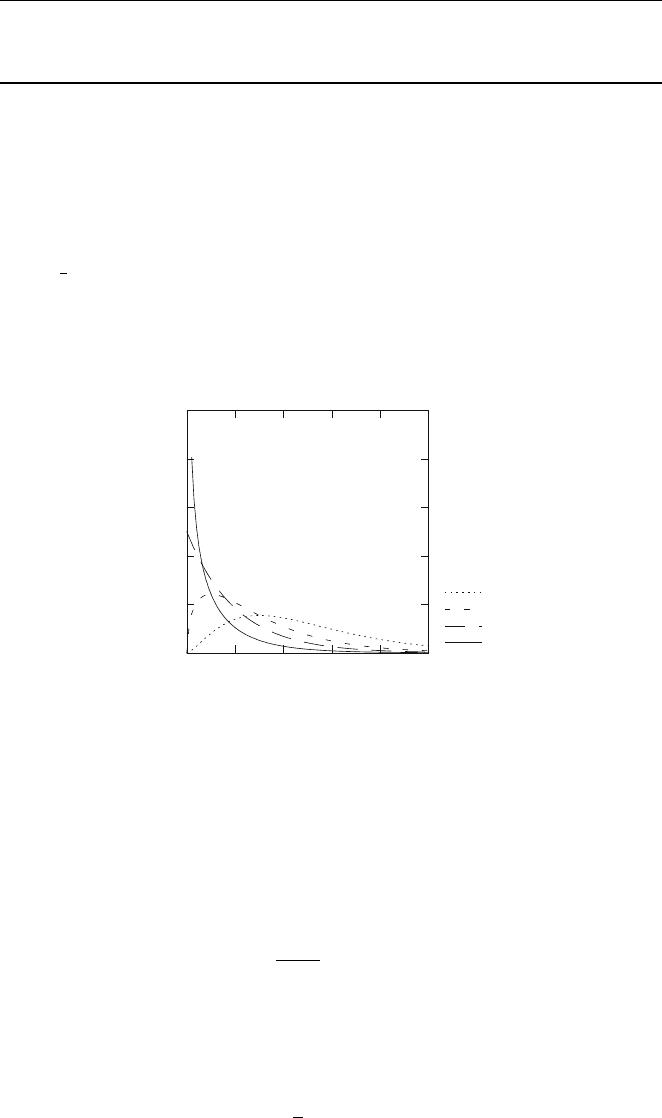
Figure 6.15 shows graphs of the chi-squared pdf for 1, 2, 3, and 5 degrees of
freedom. Notice that the pdf is unbounded for 1 df and the pdf is exponentially
decreasing for 2 df. Indeed, the chi-squared for 2 df is exponential with mean 2,
f ð xÞ¼
1
2
e
x=2
for x > 0. If n > 2 the pdf is unimodal with a peak at x ¼ n –2,as
shown in Exercise 49. The distribution is skewed, but it becomes more symmetric
as the degrees of freedom increase, and for large df values the distribution is
approximately normal (see Exercise 47).
Except for a few special cases, it is difficult to integrate a chi-squared pdf,
so Table A.6 in the appendix has critical values for chi-squared distributions.
For example, the second row of the table is for 2 df, and under the heading .01
the value 9.210 indicates that Pðw
2
2
> 9:210Þ¼:01. We use the notation
w
2
:01;2
¼ 9:210 , where in general w
2
a;v
¼ c means that Pðw
2
v
> cÞ¼a.
In Section 1.4 we defined the sample variance in terms of
x,
s
2
¼
1
n 1
X
n
i¼1
ðx
i
xÞ
2
which gives an estimate of s
2
when the population mean m is unknown. If we
happen to know the value of m, then the appropriate estimate is
^
s
2
¼
1
n
X
n
i¼1
ðx
i
mÞ
2
0246810
X
0.0
0.2
0.4
0.6
0.8
1.0
Density
1 DF
2 DF
3 DF
5 DF
Figure 6.15 The Chi-Squared pdf for 1, 2, 3, and 5 DF
6.4 Distributions Based on a Normal Random Sample 317