
Devore J.L., Berk K.N. Modern Mathematical Statistics with Applications
Подождите немного. Документ загружается.


is selected and the amount of gas (therms) used
during the month of January is determined for
each house. The resulting observations are 103,
156, 118, 89, 125, 147, 122, 109, 138, 99. Let m
denote the average gas usage during January by
all houses in this area. Compute a point esti-
mate of m.
b. Suppose there are 10,000 houses in this area
that use natural gas for heating. Let t denote
the total amount of gas used by all of these
houses during January. Estimate t using the
data of part (a). What estimator did you use
in computing your estimate?
c. Use the data in part (a) to estimate p, the pro-
portion of all houses that used at least 100
therms.
d. Give a point estimate of the population median
usage (the middle value in the population of all
houses) based on the sample of part (a). What
estimator did you use?
8. In a random sample of 80 components of a certain
type, 12 are found to be defective.
a. Give a point estimate of the proportion of all
such components that are not defective.
b. A system is to be constructed by randomly
selecting two of these components and con-
necting them in series, as shown here.
The series connection implies that the system
will function if and only if neither component is
defective (i.e., both components work properly).
Estimate the proportion of all such systems that
work properly. [Hint:Ifp denotes the probabil-
ity that a component works properly, how can
P(system works) be expressed in terms of p?]
c. Let
^
p be the sample proportion of successes.
Is
^
p
2
an unbiased estimator for p
2
?[Hint:
For any rv Y, E( Y
2
) ¼ V(Y) + [E(Y)]
2
.]
9. Each of 150 newly manufactured items is exam-
ined and the number of scratches per item is
recorded (the items are supposed to be free of
scratches), yielding the following data:
Number of
scratches per item
01234567
Observed
frequency
18 37 42 30 13 7 2 1
Let X ¼ the number of scratches on a randomly
chosen item, and assume that X has a Poisson
distribution with parameter l.
a. Find an unbiased estimator of l and compute
the estimate for the data. [Hint: E(X) ¼ l for X
Poisson, so E(
X ¼ ?)]
b. What is the standard deviation (standard error)
of your estimator? Compute the estimated stan-
dard error. [Hint: s
2
X
¼ l for X Poisson.]
10. Using a long rod that has length m, you are going
to lay out a square plot in which the length of each
side is m. Thus the area of the plot will be m
2
.
However, you do not know the value of m,so
you decide to make n independent measurements
X
1
, X
2
,...X
n
of the length. Assume that each X
i
has mean m (unbiased measurements) and vari-
ance s
2
.
a. Show that
X
2
is not an unbiased estimator
for m
2
.[Hint: For any rv Y, E(Y
2
) ¼
V(Y) + [E(Y)]
2
. Apply this with Y ¼ X.]
b. For what value of k is the estimator
X
2
kS
2
unbiased for m
2
?[Hint: Compute E(X
2
kS
2
).]
11. Of n
1
randomly selected male smokers, X
1
smoked
filter cigarettes, whereas of n
2
randomly selected
female smokers, X
2
smoked filter cigarettes. Let
p
1
and p
2
denote the probabilities that a randomly
selected male and female, respectively, smoke
filter cigarettes.
a. Show that (X
1
/n
1
) – (X
2
/n
2
) is an unbiased
estimator for p
1
–p
2
.[Hint: E(X
i
) ¼ n
i
p
i
for
i ¼ 1, 2.]
b. What is the standard error of the estimator in
part (a)?
c. How would you use the observed values x
1
and x
2
to estimate the standard error of your estimator?
d. If n
1
¼ n
2
¼ 200, x
1
¼ 127, and x
2
¼ 176,
use the estimator of part (a) to obtain an esti-
mate of p
1
–p
2
.
e. Use the result of part (c) and the data of part (d)
to estimate the standard error of the estimator.
12. Suppose a certain type of fertilizer has an expected
yield per acre of m
1
with variance s
2
, whereas the
expected yield for a second type of fertilizer is
m
2
with the same variance s
2
. Let S
2
1
and S
2
2
denote
the sample variances of yields based on sample
sizes n
1
and n
2
, respectively, of the two fertilizers.
Show that the pooled (combined) estimator
^
s
2
¼
ðn
1
1ÞS
2
1
þðn
2
1ÞS
2
2
n
1
þ n
2
2
is an unbiased estimator of s
2
.
13. Consider a random sample X
1
,...,X
n
from the pdf
f ðx; yÞ¼:5ð1 þ yxÞ1 x 1
348
CHAPTER 7 Point Estimation

where 1 y 1 (this distribution arises in
particle physics). Show that
^
y ¼ 3
X is an unbiased
estimator of y.[Hint: First determine
m ¼ EðXÞ¼Eð
XÞ.]
14. A sample of n captured Pandemonium jet fighters
results in serial numbers x
1
, x
2
, x
3
,...,x
n
. The CIA
knows that the aircraft were numbered consecu-
tively at the factory starting with a and ending
with b, so that the total number of planes manu-
factured is b – a + 1 (e.g., if a ¼ 17 and b ¼ 29,
then 2917 + 1 ¼ 13 planes having serial num-
bers 17, 18, 19, . . ., 28, 29 were manufactured).
However, the CIA does not know the values of
a or b. A CIA statistician suggests using the esti-
mator max(X
i
) – min(X
i
) + 1 to estimate the total
number of planes manufactured.
a. If n ¼ 5, x
1
¼ 237, x
2
¼ 375, x
3
¼ 202,
x
4
¼ 525, and x
5
¼ 418, what is the
corresponding estimate?
b. Under what conditions on the sample will the
value of the estimate be exactly equal to the
true total number of planes? Will the estimate
ever be larger than the true total? Do you think
the estimator is unbiased for estimating b –
a + 1? Explain in one or two sentences.
(A similar method was used to estimate German
tank production in World War II.)
15. Let X
1
, X
2
,...,X
n
represent a random sample from
a Rayleigh distribution with pdf
f ðx; yÞ¼
x
y
e
x
2
=ð2yÞ
x>0
a. It can be shown that E(X
2
) ¼ 2y. Use this fact
to construct an unbiased estimator of y based
on
P
X
2
i
(and use rules of expected value to
show that it is unbiased).
b. Estimate y from the following measurements
of blood plasma beta concentration (in pmol/L)
for n ¼ 10 men.
16.88 10.23 4.59 6.66 13.68
14.23 19.87 9.40 6.51 10.95
16. Suppose the true average growth m of one type
of plant during a 1-year period is identical to that
of a second type, but the variance of growth for
the first type is s
2
, whereas for the second type,
the variance is 4s
2
. Let X
1
,...,X
m
be m indepen-
dent growth observations on the first type [so
E(X
i
) ¼ m, V(X
i
) ¼ s
2
], and let Y
1
,...,Y
n
be
n independent growth observations on the
second type [E(Y
i
) ¼ m, V( Y
i
) ¼ 4s
2
]. Let c be a
numerical constant and consider the estimator
^
m ¼ c
X þð1 cÞY. For any c between 0 and 1
this is a weighted average of the two sample
means, e.g., :7
X þ :3Y
a. Show that for any c the estimator is unbiased.
b. For fixed m and n, what value c minimizes
Vð
^
mÞ?[Hint: The estimator is a linear combi-
nation of the two sample means and these
means are independent. Once you have an
expression for the variance, differentiate with
respect to c.]
17. In Chapter 3, we defined a negative binomial rv as
the number of failures that occur before the rth
success in a sequence of independent and identical
success/failure trials. The probability mass func-
tion (pmf) of X is
nbðx; r; pÞ
¼
x þ r 1
x
0
@
1
A
p
r
ð1 pÞ
x
x ¼ 0; 1; 2; ...
0 otherwise
8
>
>
>
<
>
>
>
:
a. Suppose that r 2. Show that
^
p ¼ðr 1Þ=ðX þ r 1Þ
is an unbiased estimator for p.[Hint: Write out
Eð
^
pÞ and cancel x+r–1 inside the sum.]
b. A reporter wishing to interview five indivi-
duals who support a certain candidate begins
asking people whether (S) or not (F) they sup-
port the candidate. If the sequence of responses
is SFFSFFFSSS, estimate p ¼ the true propor-
tion who support the candidate.
18. Let X
1
, X
2
,...,X
n
be a random sample from a pdf
f(x) that is symmetric about m, so that
e
X is an
unbiased estimator of m.Ifn is large, it can be
shown that Vð
e
XÞ1=f4n½f ðmÞ
2
g. When the
underlying pdf is Cauchy (see Example 7.8),
Vð
XÞ¼1,soX is a terrible estimator. What is
Vð
e
XÞ in this case when n is large?
19. An investigator wishes to estimate the proportion
of students at a certain university who have vio-
lated the honor code. Having obtained a random
sample of n students, she realizes that asking each,
“Have you violated the honor code?” will proba-
bly result in some untruthful responses. Consider
the following scheme, called a randomized
response technique. The investigator makes up a
deck of 100 cards, of which 50 are of type I and 50
are of type II.
7.1 General Concepts and Criteria 349

Type I: Have you violated the honor code (yes or
no)?
Type II: Is the last digit of your telephone number
a 0, 1, or 2 (yes or no)?
Each student in the random sample is asked to mix
the deck, draw a card, and answer the resulting
question truthfully. Because of the irrelevant ques-
tion on type II cards, a yes response no longer
stigmatizes the respondent, so we assume that
responses are truthful. Let p denote the proportion
of honor-code violators (i.e., the probability of a
randomly selected student being a violator), and
let l ¼ P(yes response). Then l and p are related
by l ¼ .5p+(.5)(.3).
a. Let Y denote the number of yes responses, so
Y~Bin(n, l). Thus Y/n is an unbiased estimator
of l. Derive an estimator for p based on Y.If
n ¼ 80 and y ¼ 20, what is your estimate?
[Hint:Solvel ¼ .5p+.15 for p and then sub-
stitute Y/n for l.]
b. Use the fact that E(Y/n) ¼ l to show that your
estimator
^
p is unbiased.
c. If there were 70 type I and 30 type II cards,
what would be your estimator for p?
20. Return to the problem of estimating the population
proportion p and consider another adjusted esti-
mator, namely
^
p ¼
X þ
ffiffiffiffiffiffiffiffi
n=4
p
n þ
ffiffiffi
n
p
The justification for this estimator comes from the
Bayesian approach to point estimation to be intro-
duced in Section 14.4.
a. Determine the mean squared error of this esti-
mator. What do you find interesting about this
MSE?
b. Compare the MSE of this estimator to the
MSE of the usual estimator (the sample
proportion).
7.2
Methods of Point Estimation
So far the point estimators we have introduced were obtained via intuition and/or
educated guesswork. We now discuss two “constructive” methods for obtaining
point estimators: the method of moments and the method of maximum likelihood.
By constructive we mean that the general definition of each type of estimator
suggests explicitly how to obtain the estimator in any specific problem. Although
maximum likelihood estimators are generally preferable to moment estimators
because of certain efficiency properties, they often require significantly more
computation than do moment estimators. It is sometimes the case that these
methods yield unbiased estimators.
The Method of Moments
The basic idea of this method is to equate certain sample characteristics, such as the
mean, to the corresponding population expected values. Then solving these equa-
tions for unknown parame ter values yields the estimators.
DEFINITION
Let X
1
,...,X
n
be a random sample from a pmf or pdf f(x). For k ¼ 1, 2, 3, . . . ,
the kth population moment,orkth moment of the distribution f(x), is E(X
k
).
The kth sample moment is ð1= nÞ
P
n
i¼1
X
k
i
:
Thus the first population moment is E(X) ¼ m and the first sample moment is
P
X
i
=n ¼ X: The second population and sample moments are E(X
2
) and
P
X
2
i
=n, respectively. The population moments will be functions of any unknown
parameters y
1
, y
2
,....
350 CHAPTER 7 Point Estimation
DEFINITION
Let X
1
, X
2
,...,X
n
be a random sample from a distribution with pmf or pdf
f(x; y
1
,...,y
m
), where y
1
,...,y
m
are parameters whose values are unknown.
Then the moment estimators
^
y
1
; ...;
^
y
m
are obtained by equating the first m
sample moments to the corresponding first m population moments and
solving for y
1
,...,y
m
.
If, for example, m ¼ 2, E(X) and E(X
2
) will be functions of y
1
and y
2
. Setting
EðX Þ¼ð1=nÞ
P
X
i
ð¼ XÞ and EX
2
ðÞ¼ð1=nÞ
P
X
2
i
gives two equations in y
1
and
y
2
. The solution then defines the estimators. For estimating a population mean m,
the method gives m ¼
X, so the estimator is the sample mean.
Example 7.13 Let X
1
,...,X
n
represent a random sample of service times of n customers at a
certain facility, where the underlying distribution is assumed exponential with
parameter l. Since there is only one parameter to be estimated, the estimator is
obtained by equating E(X)to
X. Since E(X) ¼ 1/l for an exponential distribution,
this gives 1=l ¼
X or l ¼ 1=X. The moment estimator of l is then
^
l ¼ 1=X. ■
Example 7.14 Let X
1
,...,X
n
be a random sample from a gamma distribution with parameters a
and b. From Section 4.4 , E(X) ¼ ab and E(X
2
) ¼ b
2
G(a + 2)/G(a) ¼ b
2
(a +1)a.
The moment estimators of a and b are obtained by solving
X ¼ ab
1
n
X
X
2
i
¼ aða þ 1Þb
2
Since aða þ 1Þb
2
¼ a
2
b
2
þ ab
2
and the first equation implies a
2
b
2
¼ XðÞ
2
, the
second equatio n becomes
1
n
X
X
2
i
¼ XðÞ
2
þ ab
2
Now dividing each side of this second equation by the corresponding side of the
first equation and substituting back gives the estimators
^
a ¼
XðÞ
2
1
n
P
X
2
i
XðÞ
2
^
b ¼
1
n
P
X
2
i
XðÞ
2
X
To illustrate, the survival time data mentioned in Example 4.28 is
152 115 109 94 88 137 152 77 160 165
125 40 128 123 136 101 62 153 83 69
with
x ¼ 113:5 and ð1=20Þ
P
x
2
i
¼ 14; 087:8. The estimates are
^
a ¼
113:5ðÞ
2
14; 087:8 113:5ðÞ
2
¼ 10:7
^
b ¼
14; 087:8 113: 5ðÞ
2
113:5
¼ 10:6
These estimates of a and b differ from the values suggested by Gross and Clark
because they used a different estimation technique.
■
7.2 Methods of Point Estimation 351
Example 7.15 Let X
1
,...,X
n
be a random sample from a generalized negative binomial
distribution with parameters r and p (Section 3.6). Since E(X) ¼ r(1 – p)/p and
V(X) ¼ r(1 – p)/p
2
, E(X
2
) ¼ V(X)+[E(X)]
2
¼ r(1 – p)(r – rp + 1)/p
2
. Equating
E(X)to
X and E(X
2
)toð1=nÞ
P
X
2
i
eventually gives
^
p ¼
X
1
n
P
X
2
i
XðÞ
2
^
r ¼
XðÞ
2
1
n
P
X
2
i
XðÞ
2
X
As an illustration, Reep, Pollard, and Benjamin (“Skill and Chance in Ball
Games,” J. Roy. Statist. Soc. Ser. A, 1971: 623–629) consider the negative bino-
mial distribution as a model for the number of goals per game scor ed by National
Hockey League teams. The data for 1966–1967 follows (420 games):
Goals 0 12345678910
Frequency 29 71 82 89 65 45 24 7 4 1 3
Then,
x ¼
X
x
i
=420 ¼½ð0Þð29Þþð1Þð71Þþþð10Þð3Þ=420 ¼ 2:98
and
X
x
2
i
=420 ¼½ð0Þ
2
ð29Þþð1Þ
2
ð71Þþþð10Þ
2
ð3Þ=420 ¼ 12:40
Thus,
^
p ¼
2:98
12:40 2:98ðÞ
2
¼ :85
^
r ¼
2:98ðÞ
2
12:40 2:98ðÞ
2
2:98
¼ 16:5
Although r by definition must be positive, the denominator of
^
r could be negative,
indicating that the negative binomial distribution is not appropriate (or that the
moment estimator is flawed).
■
Maximum Likelihood Estimation
The method of maximum likelihood was first introduced by R. A. Fisher, a
geneticist and statistician, in the 1920s. Most statisticians recommend this method,
at least when the sample size is large, since the resulting estimators have certain
desirable efficiency properties (see the proposition on large sample behavior
toward the end of this section).
Example 7.16 A sample of ten new bike helmets manufactured by a company is obtained . Upon
testing, it is found that the first, third, and tenth helmets are flawed, whereas the
others are not. Let p ¼ P(flawed helmet) and define X
1
,...,X
10
by X
i
¼ 1 if the i th
helmet is flawed and zero otherwise. Then the observed x
i
’s are 1, 0, 1, 0, 0, 0, 0, 0,
0, 1, so the joint pmf of the sample is
f ð x
1
; x
2
; ...; x
10
; pÞ¼pð1 pÞp p ¼ p
3
ð1 pÞ
7
ð7:4Þ
352 CHAPTER 7 Point Estimation
We now ask, “For what value of p is the obser ved sample most likely to have
occurred?” That is, we wish to find the value of p that maximizes the pmf (7.4) or,
equivalently, maximizes the natural log of (7.4).
2
Since
ln½f ðx
1
; x
2
; ...; x
10
; pÞ ¼ 3lnðpÞþ7lnð1 pÞð7:5Þ
and this is a differentiable function of p, equating the derivative of (7.5) to zero
gives the maximizing value
3
:
d
dp
ln½f ðx
1
; x
2
; ...; x
10
; pÞ ¼
3
p
7
1 p
¼ 0 ) p ¼
3
10
¼
x
n
where x is the observed number of successe s (flawed helmets). The estimate
of p is now
^
p ¼
3
10
. It is called the maximum likelihood estimate because
for fixed x
1
,...,x
10
, it is the parameter value that maximizes the likelihood
(joint pmf) of the observed sample. The likelihood and log likelihoo d are
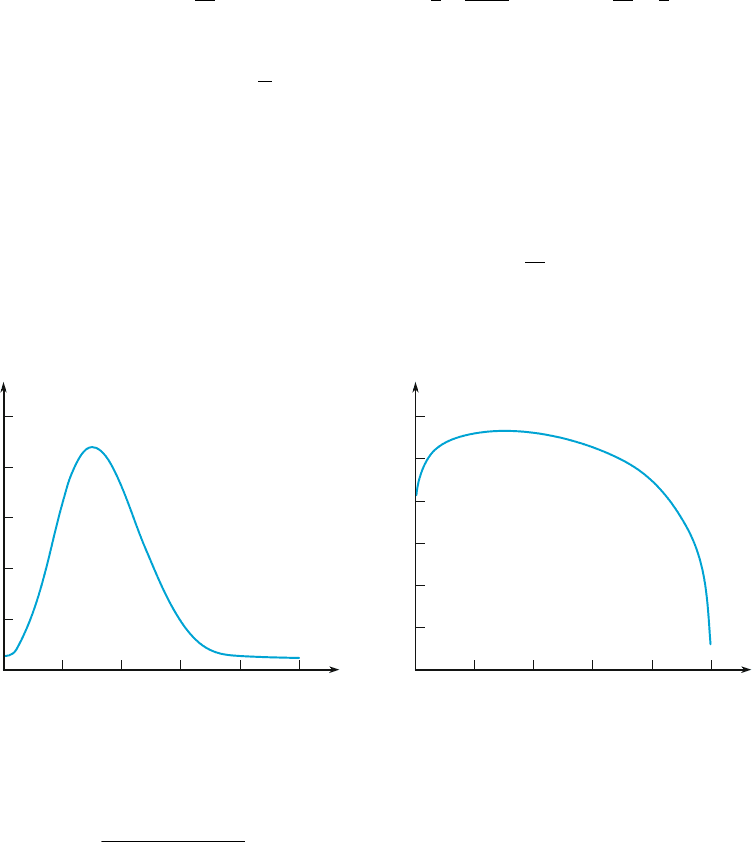
graphed in Figure 7.5. Of course, the maximum on both graphs occurs at the
same value, p ¼ .3.
Note that if we had been told only that among the ten helmets there were
three that were flawed, Equation (7.4) would be replaced by the binomial pmf
10
3
p
3
ð1 pÞ
7
, which is also maximized for
^
p ¼
3
10
.
2
Since ln[g(x)] is a monotonic function of g(x), finding x to maximize ln[g(x)] is equivalent to
maximizing g(x) itself. In statistics, taking the logarithm frequently changes a product to a sum, which
is easier to work with.
3
This conclusion requires checking the second derivative, but the details are omitted.
.0010
.0005
0
.0020
.0015
.0025
0 .2.4.6.81.0 0 .2.4.6.81.0
Likelihood
ab
p
−5
−10
−15
−20
−25
−30
−35
ln(likelihood)
p
Figure 7.5 Likelihood and log likelihood plotted against
p
■
7.2 Methods of Point Estimation 353

DEFINITION
Let X
1
,...,X
n
have joint pmf or pdf
f ð x
1
; x
2
; :::; x
n
; y
1
; :::; y
m
Þð7:6Þ
where the parameters y
1
,...,y
m
have unknown values. When x
1
,...,x
n
are the
observed sample values and (7.6) is regarded as a function of y
1
,...,y
m
,itis
called the likelihood function. The maximum likelihood estimates
^
y
1
; ...;
^
y
m
are those values of the y
i
’s that maximize the likelihood function, so that
f(x
1
, x
2
,. . ., x
n
;
^
y
1
; ...;
^
y
m
) f(x
1
, x
2
,. . ., x
n
; y
1
,...,y
m
) for all y
1
,...,y
m
When the X
i
’s are substituted in place of the x
i
’s, the maximum likelihood
estimators (m le’s) result.
The likelihood function tells us how likely the observed sample is as a function
of the possible parameter values. Maximizing the likelihood gives the parameter
values for which the observed sample is most likely to have been generated, that is,
the parameter values that “agree most closely” with the observed data.
Example 7.17 Suppose X
1
,...,X
n
is a random sample from an exponential distribution with
parameter l. Because of independence, the likelihood function is a product of the
individual pdf’s:
f ð x
1
; ...; x
n
; lÞ¼ðle
lx
1
Þðle
lx
n
Þ¼l
n
e
lSx
i
The ln(likeliho od) is
ln f ðx
1
; ...; x
n
; lÞ½¼n lnðlÞl
X
x
i
Equating (d/dl)[ln(likelihood)] to zero results in n/l – Sx
i
¼ 0, or l ¼
n=Sx
i
¼ 1=
x. Thus the mle is
^
l ¼ 1=X; it is identical to the method of moments
estimator but it is not an unbiased estimator, since Eð1=
XÞ 6¼ 1=EðXÞ. ■
Example 7.18 Let X
1
,...,X
n
be a random sample from a normal distribution. The likelihood
function is
f ð x
1
; ...; x
n
; m; s
2
Þ¼
1
ffiffiffiffiffiffiffiffiffiffi
2ps
2
p
e
ðx
1
mÞ
2
=ð2s
2
Þ
1
ffiffiffiffiffiffiffiffiffiffi
2ps
2
p
e
ðx
n
mÞ
2
=ð2s
2
Þ
¼
1
2ps
2
n=2
e
P
ðx
i
mÞ
2
=ð2s
2
Þ
so
ln½f ðx
1
; ...; x
n
; m; s
2
Þ ¼
n
2
lnð2ps
2
Þ
1
2s
2
X
ðx
i
mÞ
2
To find the maximizing values of m and s
2
, we must take the partial derivatives of
ln( f ) with respect to m and s
2
, equate them to zero, and solve the resulting two
equations. Omitting the details, the resulting mle’s are
354 CHAPTER 7 Point Estimation

^
m ¼
X
^
s
2
¼
P
ðX
i
XÞ
2
n
The mle of s
2
is not the unbiased estimator, so two different principles of estimation
(unbiasedness and maximum likelihood) yield two different estimators. ■
Example 7.19 In Chapter 3, we discussed the use o f the Poisson distribution for modeling the
number of “events” that occur in a two-dimensional region. Assume that when the
region R being sampled has area a(R), the number X of events occurring in R has a
Poisson distribution with parameter la(R) (where l is the expected number of
events per unit area) and that nonoverlapping regions yield independent X’s.
Suppose an ecol ogist selects n nonoverlapping regions R
1
,...,R
n
and counts
the number of plants of a certain species found in each region. The joint pmf
(likelihood) is then
pðx
1
; ...; x
n
; lÞ¼
l aðR
1
Þ½
x
1
e
laðR
1
Þ
x
1
!
l aðR
n
Þ½
x
n
e
laðR
n
Þ
x
n
!
¼
aðR
1
Þ½
x
1
aðR
n
Þ½
x
n
l
Sx
i
e
lSaðR
i
Þ
x
1
! x
n
!
The ln(likelihood) is
ln½pðx
1
; ...; x
n
; lÞ ¼
X
x
i
ln½aðR
i
Þ þ lnðlÞ
X
x
i
l
X
aðR
i
Þ
X
lnðx
i
!Þ
Taking d/dl ln( p) and equating it to zero yields
X
x
i
l
X
aðR
i
Þ¼0
so
l ¼
P
x
i
P
aðR
i
Þ
The mle is then
^
l ¼
P
X
i
=
P
aðR
i
Þ. This is intuitively reasonable because l is the
true density (plants per unit area), whereas
^
l is the sample density since
P
aðR
i
Þ is
just the total area sampled. Because E(X
i
) ¼ l · a(R
i
), the estimator is unbiased.
Sometimes an alternative sampling procedure is used. Instead of fixing
regions to be sampled, the ecologist will select n points in the entire region of
interest and let y
i
¼ the distance from the ith point to the nearest plant. The
cumulative distribution function (cdf) of Y ¼ distance to the nearest plant is
F
Y
ðyÞ¼PðY yÞ¼1 PðY > yÞ¼1 P
no plants in a
circle of radius y
¼ 1
e
lpy
2
lpy
2
ðÞ
0
0!
¼ 1 e
lpy
2
Taking the derivative of F
Y
(y) with respect to y yields
f
Y
ðy; lÞ¼
2plye
lpy
2
y 0
0 otherwise
(
If we now form the likelihood f
Y
(y
1
; l)·····f
Y
(y
n
; l), differentiate ln(likelihood),
and so on, the resu lting mle is
7.2 Methods of Point Estimation 355
^
l ¼
n
p
P
Y
2
i
¼
number of plants observed
total area sampled
which is also a sample density. It can be shown that in a sparse environment (small l),
the distance method is in a certain sense better, whereas in a dense environment, the
first sampling method is better.
■
Example 7.20 Let X
1
,...,X
n
be a random sample from a Weibull pdf
f ð x; a; bÞ¼
a
b
a
x
a1
e
ðx=bÞ
a
x 0
0 otherwise
(
Writing the likelihood and ln(likelihood), then setting both ð@=@aÞ½lnðf Þ ¼ 0 and
ð@=@bÞ½lnðf Þ ¼ 0 yields the equations
a ¼
P
½x
a
i
lnðx
i
Þ
P
x
a
i
P
lnðx
i
Þ
n
1
b ¼
P
x
a
i
n
1=a
These two equations cannot be solved explicitly to give general formulas for the
mle’s
^
a and
^
b. Instead, for each sample x
1
,...,x
n
, the equations must be solved
using an iterative numerical procedure. Even moment estimators of a and b are
somewhat complicated (see Exercise 22).
The iterative mle computations can be done on a computer, and they are available
in some statistical packages. MINITAB gives maximum likelihood estimates for both
the Weibull and the gamma distributions (under “Quality Tools”). Stata has a general
procedure that can be used for these and other distributions. For the data of Example
7.14 the maximum likelihood estimates for the Weibull distribution are
^
a ¼ 3:799
and
^
b ¼ 125:88. (The mle’s for the gamma distribution are
^
a ¼ 8:799 and
^
b ¼ 12:893,
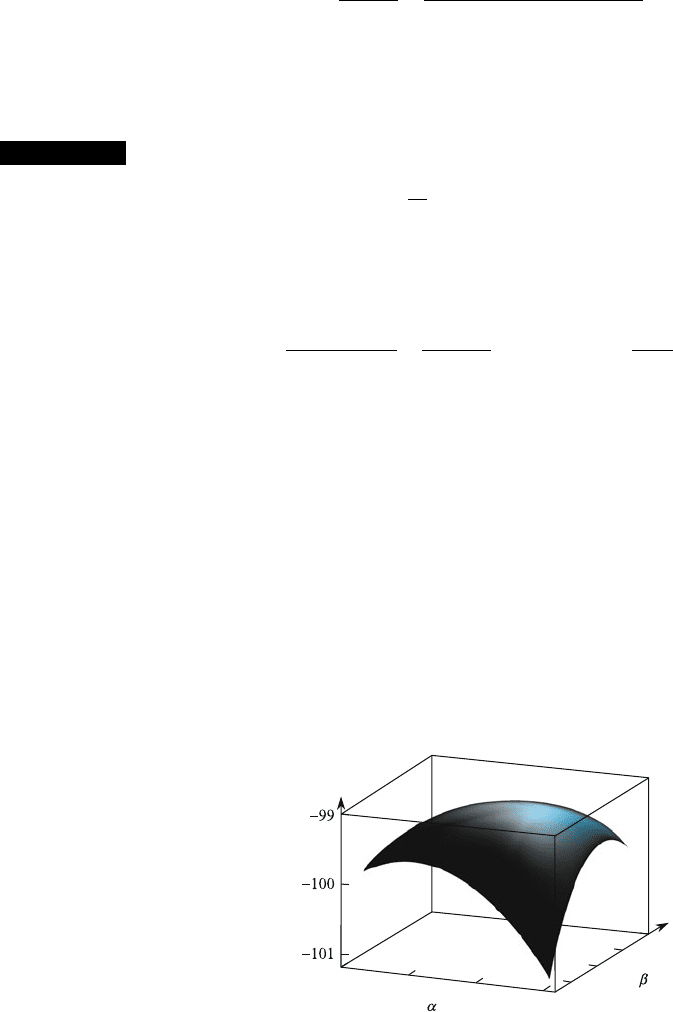
a little different from the moment estimates in Example 7.14). Figure 7.6 shows the
Weibull log likelihood as a function of a and b. The surface near the top has a rounded
shape, allowing the maximum to be found easily, but for some distributions the surface
can be much more irregular, and the maximum may be hard to find.
Log likelihood
3.0
3.5
4.0
4.5
120
125
130
135
Figure 7.6 Weibull log likelihood for Example 7.20 ■
356
CHAPTER 7 Point Estimation
Some Properties of MLEs
In Exam ple 7.18, we obtained the mle of s
2
when the underlying distribution is
normal. The mle of s ¼
ffiffiffiffiffi
s
2
p
, as well as many other mle’s, can be easily derived
using the following proposition.
PROPOSITION
The Invariance Principle
Let
^
y
1
;
^
y
2
; ...;
^
y
m
be the mle’s of the parameters y
1
, y
2
,...,y
m
. Then the mle
of any function h (y
1
, y
2
,...,y
m
) of these parameters is the function
hð
^
y
1
;
^
y
2
; ...;
^
y
m
Þ, of the mle’s.
Proof For an intuitive idea of the proof, consider the special case m ¼ 1, with
y
1
¼ y, and assume that h(·) is a one-to-one function. On the graph of the likelihood
as a function of the parameter y, the highest point occurs where y ¼
^
y. Now consider
the graph of the likelihood as a function of h(y). In the new graph the same heights
occur, but the height that was previously plotted at y ¼ a is now plotted at
hðyÞ¼hðaÞ, and the highest point is now plotted at hðyÞ¼hð
^
yÞ. Thus, the maxi-
mum remains the same, but it now occurs at hð
^
yÞ. ■
Example 7.21
(Example 7.18
continued)
In the normal case, the mle’s of m and s
2
are
^
m ¼ X and
^
s
2
¼
P
ðX
i
XÞ
2
=n.To
obtain the mle of the function hðm; s
2
Þ¼
ffiffiffiffiffi
s
2
p
¼ s, substitute the mle’s into the
function:
^
s ¼
ffiffiffiffiffi
^
s
2
p
¼
1
n
X
ðX
i
XÞ
2
1=2
The mle of s is not the sample standard deviation S, although they are close unless n
is quite small. Similar ly, the mle of the population coefficient of variation 100m/ s
is 100
^
m=
^
s.
■
Example 7.22
(Example 7.20
continued)
The mean value of an rv X that has a Weibull distribution is
m ¼ b Gð 1 þ 1=aÞ
The mle of m is therefore
^
m ¼
^
b Gð1 þ 1=
^
aÞ, where
^
a and
^
b are the mle’s of a and
b. In particular,
X is not the mle of m, although it is an unbiased estimator. At least
for large n,
^
m is a better estimator than X. ■
Large-Sample Behavior of the MLE
Although the principle of maximum likelihood estimation has considerabl e intui-
tive appeal, the following proposition provides additional rationale for the use
of mle’s. (See Section 7.4 for more details.)
PROPOSITION
Under very general conditions on the joint distribution of the sample, when
the sample size is large, the maximum likelihood estimator of any parameter
y is close to y (consistency), is approximately unbiased [Eð
^
yÞy], and has
7.2 Methods of Point Estimation 357