
Devore J.L., Berk K.N. Modern Mathematical Statistics with Applications
Подождите немного. Документ загружается.

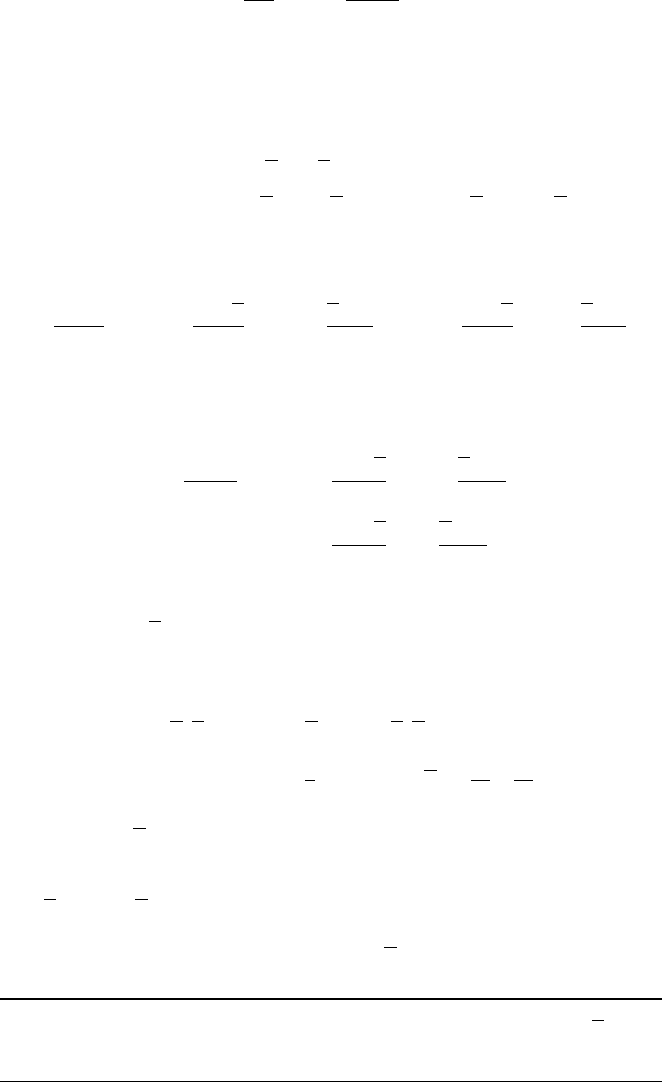
Replacing x
i
’s by X
i
’s results in S
2
and
^
s
2
becoming statistics (and therefore
random variables). A simple function of
^
s
2
is a chi-squared rv. First recall that
if X is normally distributed, then (X m)/s is a standard normal rv. Thus
n
^
s
2
s
2
¼
X
n
i¼1
X
i
m
s
2
is the sum of n independent standard normal squares, so it is w
2
n
.
A similar relationship connects the sample varianc e S
2
to the chi-squared
distribution. First, compute
X
ðX
i
mÞ
2
¼
X
½ðX
i
XÞþðX mÞ
2
¼
X
ðX
i
XÞ
2
þ 2ðX mÞ
X
ðX
i
XÞþ
X
ðX mÞ
2
The middle term on the second line vanishes (why?). Dividing through by s
2
,
X
X
i
m
s
2
¼
X
X
i
X
s
2
þ
X
X m
s
2
¼
X
X
i
X
s
2
þ n
X m
s
2
:
The last term can be written as the square of a standard normal rv, and therefore as a
w
2
1
rv.
X
X
i
m
s
2
¼
X
X
i
X
s
2
þ n
X m
s
2
¼
X
X
i
X
s
2
þ
X m
s=
ffiffiffi
n
p
2
ð6:11Þ
It is crucial here that the two terms on the right be independent. This is equivalent to
saying that S
2
and X are independent. Although it is a bit much to show rigorously,
one approach is based on the covariances between the sample mean and the
deviations from the sample mean. Using the linearity of the covariance operator,
CovðX
i
X; X Þ¼CovðX
i
; XÞCovðX; XÞ
¼ CovðX
i
;
1
n
X
X
i
ÞVðXÞ¼
s
2
n
s
2
n
¼ 0:
This shows that
X is uncorrelated with all the deviations of the observations from
their mean. In general, this does not imply independence, but in the special case of
the bivariate normal distribution, being uncorrelated is equivalent to independence.
Both
X and X
i
X are linear combinations of the independent normal observations,
so they are bivariate normal, as discussed in Section 5.3. Because the sample
variance S
2
is composed of the deviations X
i
X, we have this result.
PROPOSITION
If X
1
, X
2
, ..., X
n
are a random sample from a normal distribution, then X and
S
2
are independent.
318 CHAPTER 6 Statistics and Sampling Distributions
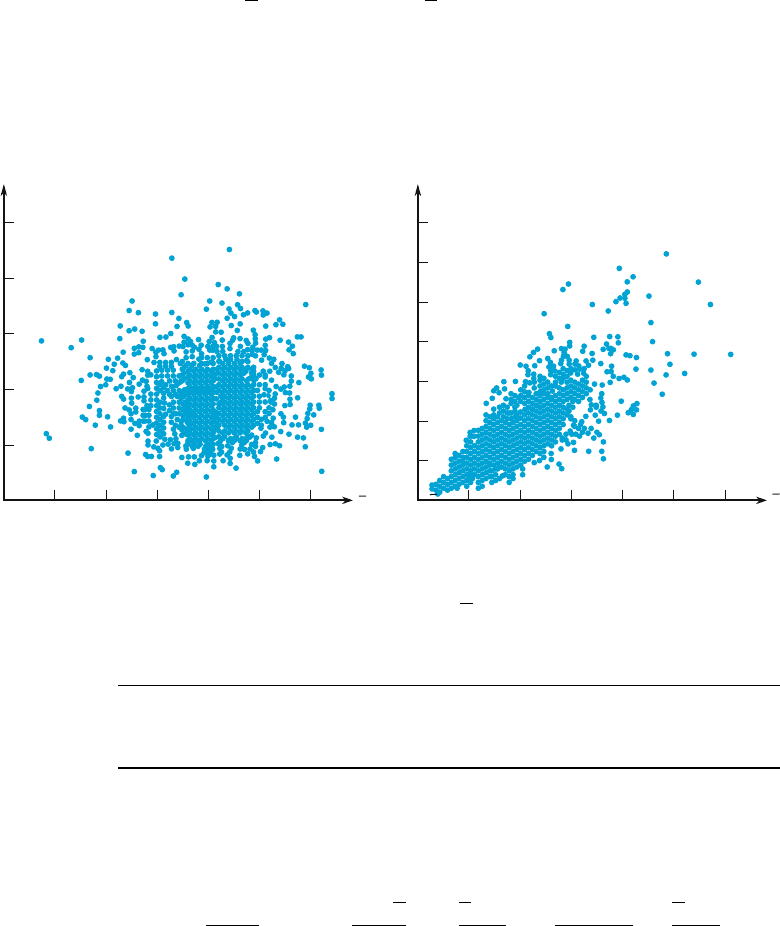
To understand this proposition better we can look at the relationship between
the sample standard deviation and mea n for a large number of samples. In particu-
lar, suppose we select sample after sample of size n from a particular population
distribution, calculate
x and s for each one, and then plot the resulting (
x, s) pairs.
Figure 6.16(a) shows the result for 1000 samples of size n ¼ 5 from a standard
normal population distribution. The elliptical pattern, with axes parallel to the
coordinate axes, suggests no relationship between
x and s, that is, independence
of the statistics
X and S (equivalently X and S
2
). However, this independence fails
for data from a nonnormal distribution, and Figure 6.16(b) illustrates what happens
for samples of size 5 from an exponential distribution with mean 1. This plot shows
a strong relationship between the two statistics, which is what might be expected
for data from a highly skewed distribution.
We will use the independence of
X and S
2
together with the following
proposition to show that S
2
is proportional to a chi-squared random variable.
PROPOSITION
If X
3
¼ X
1
þ X
2
, and X
1
w
2
v
1
, X
3
w
2
v
3
, n
3
> n
1
, and X
1
and X
2
are inde-
pendent, then X
2
w
2
v
3
v
1
.
The proof is similar to that of the proposition involving the sum of indepen-
dent chi-squared variables, and it is left as an exercise (Exercise 51).
From Equation 6.11
X
X
i
m
s
2
¼
X
X
i
X
s
2
þ
X m
s=
ffiffiffi
n
p
2
¼
ðn 1ÞS
2
s
2
þ
X m
s=
ffiffiffi
n
p
2
Assuming a random sample from the normal distribution, the term on the left
is w
2
n
, and the last term is the square of a standard normal variable, so it is w
2
1
.
1.0
.5
0
2.0
1.5
2.5
ab
1.5
.5
0
3.0
2.5
1.0
2.0
3.5
−2.0 −1.5 −1.0 −.5 0 .5 1.0
0
.5 2.0 2.5 3.01.0 1.5
s
x
s
x
x
Figure 6.16 Plot of (
x
, s) pairs
6.4 Distributions Based on a Normal Random Sample 319

Putting the last two propositions together gives the following:
PROPOSITION
If X
1
, X
2
, ..., X
n
are a random sample from a normal distribution, then
ðn 1ÞS
2
s
2
w
2
n1
:
Intuitively, the degrees of fre edom make sense because s
2
is built from the devia-
tions ðx
1
xÞ; ðx
2
xÞ; :::; ðx
n
xÞ, which sum to zero:
X
ðx
i
xÞ¼
X
x
i
X
x ¼ n
x n
x ¼ 0:
The last deviation is determined by the first (n–1) deviations, so it is reasonable
that s
2
has only (n–1) degrees of freedom.
The degrees of freedom help to explain why the definition of s
2
has (n–1)
and not n in the denominator.
Knowing that ðn 1ÞS
2
s
2
w
2
n1
, it can be shown (see Exercise 50) that
the expected value of S
2
is s
2
, and also that the variance of S
2
approaches 0 as n
becomes large.
The t Distribution
Let Z be a standard normal rv and let X be a w
2
v
rv independent of Z. Then the
t distribution with degrees of freedom n is defined to be the distribution of the ratio
T ¼
Z
ffiffiffiffiffiffiffiffi
X=n
p
Sometimes we will include a subscript to indicate the df, t ¼ t
n
. From the definition
it is not obvious how the t distribution can be applied to data, but the next result puts
the distribution in more directly usable form.
THEOREM
If X
1
,X
2
, ...,X
n
is a random sample from a normal distribution N(m,s
2
), then
T ¼
X m
S=
ffiffiffi
n
p
has the t distribution with (n – 1) degrees of freedom, t
n–1
.
Proof First we express T in a slightly different way,
T ¼
X m
S=
ffiffiffi
n
p
¼
ðX mÞ=ðs=
ffiffiffi
n
p
Þ
ffiffiffiffiffiffiffiffiffiffiffiffiffiffiffiffiffiffiffiffiffiffiffiffiffiffiffiffiffi
ðn1ÞS
2
s
2
ðn 1Þ
=
q
The numerator on the right is standard normal because the mean of a random
sample from N(m, s
2
) is normal with population mean m and variance s
2
/n.
320 CHAPTER 6 Statistics and Sampling Distributions
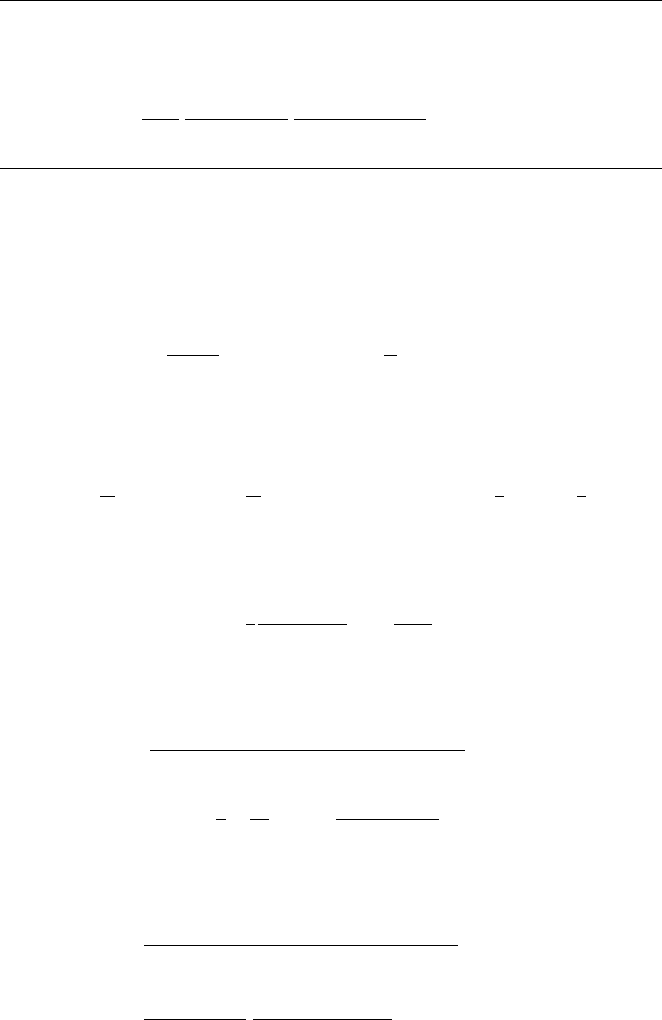
The denominator is the square root of a chi-squared variable with (n –1)degreesof
freedom, divided by its degrees of freedom. This chi-squared variable is independent
of the numerator, so the ratio has the t distribution with (n1) degrees of freedom. ■
It is not hard to obtain the pdf for T.
PROPOSITION
The pdf of a random variable T having a t distribution with n degrees of
freedom is
f ð tÞ¼
1
ffiffiffi
p
p
n
G½ðn þ 1Þ=2
Gðn=2Þ
1
ð1 þ t
2
=nÞ
ðnþ1Þ=2
; 1 < t < 1
Proof We first find the cdf of T and then differentiate to obtain the pdf.
A t variable is defined in terms of a standard normal Z and a chi-squared variable
X with n degrees of freedom. They are independent, so their joint pdf f(x, z) is the
product of their individual pdfs.
PðT tÞ¼P
Z
ffiffiffiffiffiffiffiffi
X=n
p
t
!
¼ PZ t
ffiffiffiffi
X
n
r
!
¼
ð
1
0
ð
t
ffiffiffiffiffi
x=n
p
1
f ð x; zÞ dz dx
Differentiating with respect to t using the Fundamental Theorem of Calculus,
f ð tÞ¼
d
dt
PðT tÞ¼
ð
1
0
d
dt
ð
t
ffiffiffiffiffi
x=n
p
1
f ðx; zÞ dz dx ¼
ð
1
0
ffiffiffi
x
n
r
fx; t
ffiffiffi
x
n
r
dx
Now substitute the joint pdf and integrate
f ðtÞ¼
ð
1
0
ffiffiffi
x
n
r
x
n=21
2
n=2
Gðn=2Þ
e
x=2
1
ffiffiffiffiffiffi
2p
p
e
t
2
x=ð2nÞ
dx
The integral can be evaluated by writing the integrand in terms of a gamma pdf.
f ð tÞ¼
G½ðn þ 1Þ=2
ffiffiffiffiffiffiffiffi
2pn
p
Gðn=2Þ½1=2 þ t
2
=ð2nÞ
½ðnþ1Þ=2
2
n=2
ð
1
0
1
2
þ
t
2
2n
ðnþ1Þ=2
x
ðnþ1Þ=21
G½ðn þ 1Þ=2
e
½1=2þt
2
=ð2nÞx
dx
The integral of the gamma pdf is 1, so
f ð tÞ¼
G½ðn þ 1Þ=2
ffiffiffiffiffiffiffiffi
2pn
p
Gðn=2Þ½1=2 þ t
2
=ð2nÞ
½ðnþ1Þ=2
2
n=2
¼
G½ðn þ 1Þ=2
ffiffiffiffiffi
pn
p
Gðn=2Þ
1
ð1 þ t
2
=nÞ
½ðnþ1Þ=2
; 1 < t < 1
■
6.4 Distributions Based on a Normal Random Sample 321
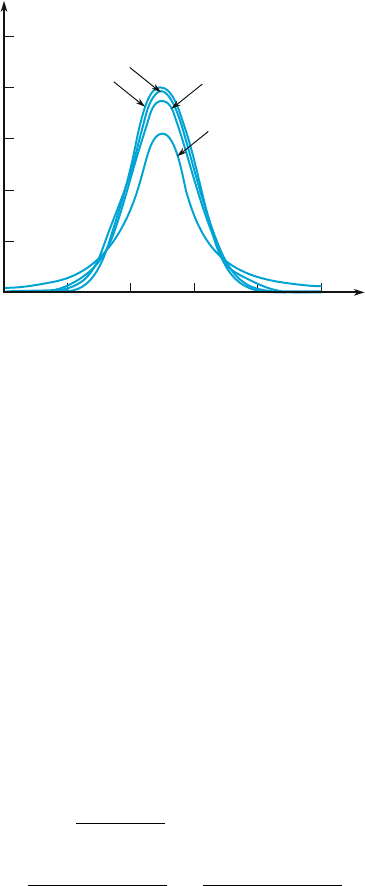
The pdf has a maximum at 0 and decreases symmetrically as | t| increases. As
n becomes large the t pdf approaches the standard normal pdf, as shown in Exercise
54. It makes sense that the t distribution would be close to the standard normal for
large n, because T ¼ Z
ffiffiffiffiffiffiffiffiffi
w
2
v
v
=
p
, and w
2
v
v
=
converges to 1 by the law of large
numbers, as shown in Exercise 48.
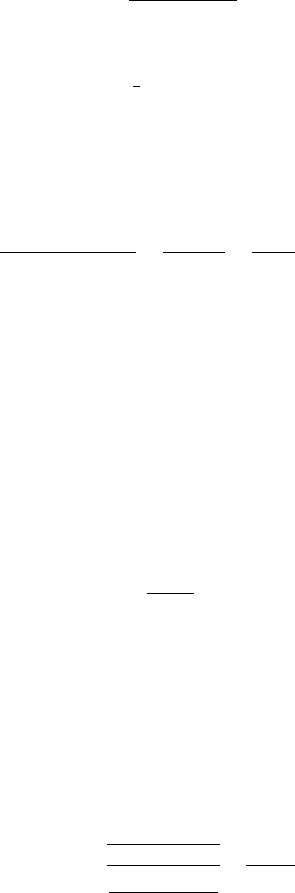
Figure 6.17 shows t density curves for n ¼ 1, 5, and 20 along with the
standard normal curve. Notice how fat the tails are for 1 df, as compared to the
standard normal. Howeve r, as the degrees of freedom increase, the t pdf becomes
more like the standard normal. Fo r 20 df there is not much difference.
Integration of the t pdf is difficult except for low degrees of freedom, so
values of upper tail areas are given in Table A.7. For example, the value in the
column labeled 2 and the row labeled 3.0 is .048, meaning that for two degrees of
freedom P(T > 3.0) ¼ .048. We write this as t
.048,2
¼ 3.0, and in general we write
t
a,n
¼ c if P(T
n
> c) ¼ a. A tabulation of these t critical values (i.e. t
a,n
) for
frequently used tail areas a appears in Table A.5.
Using n ¼ 1 and Gð12
=
Þ¼
ffiffiffi
p
p
in the chi-squared pdf, we obtain the pdf for
the t distribution with one degree of freedom as 1/[p(1 + t
2
)]. It has another name,
the Cauchy distribution. This distribution has such fat tails that the mean does not
exist (Exercise 55).
The mean and variance of a t variable can be obtained directly from the pdf,
but there is another route, through the definition in terms of independen t standard
normal and chi-squared variables, T ¼ Z=
ffiffiffiffiffiffiffiffi
X=v
p
. Recall from Section 5.2 that
E(UV) ¼ E(U)E(V)ifU and V are independent. Thus, Eð TÞ¼EðZÞEð1
ffiffiffiffiffiffiffiffi
Xv=
p
Þ.
Of course, E(Z) ¼ 0, so E(T) ¼ 0 if the second expected value on the right exists.
Let’s compute it from a more general expectation, E(X
k
) for any k if X is chi-squared:
EðX
k
Þ¼
ð
1
0
x
k
x
ðn=2Þ1
2
n=2
Gðn=2Þ
e
x=2
dx
¼
2
kþn=2
Gðk þ n=2Þ
2
n=2
Gðn=2Þ
ð
1
0
x
ðkþn=2Þ1
2
kþn=2
Gðk þ n=2Þ
e
x=2
dx
.2
.1
0
.4
.3
.5
−5 −3 −11 3 5
t
5 df
1 df
z
20 df
f (t)
Figure 6.17 Comparison of
t
curves to the
z
curve
322
CHAPTER 6 Statistics and Sampling Distributions
The secon d integrand is a gamma pdf so its integral is 1 if k + n/2 > 0, and
otherwise the integral does not exist. Therefore,
EðX
k
Þ¼
2
k
Gðk þ n=2Þ
Gðn=2Þ
ð6:12Þ
if k + n/2 > 0, and otherw ise the expectation does not exist. The requirement
k + n/2 > 0 translates when k ¼
1
2
[recall that we need the existence of
Eð1
ffiffiffiffiffiffiffiffi
Xv
=
p
Þ] into n > 1. The mean of a t variable fails to exist if n ¼ 1 and the
mean is indeed 0 otherwise.
For the variance of T we need E(T
2
) ¼ E(Z
2
) E[1/(X/n)] ¼ 1·n/E(1/X). Using
k ¼ –1 in Equation (6.12), we obtain, with the help of G(a +1)¼ aG(a),
EðX
1
Þ¼
2
1
Gð1 þ n=2Þ
Gðn=2Þ
¼
2
1
n=2 1
¼
1
n 2
if n > 2
and therefore V(T) ¼ n/(n – 2). For 1 or 2 degrees of freedom the variance does n ot
exist. The variance always exceeds 1, and for large df the variance is close to 1.
This is appropriate because any t curve spreads out more than the z curve, but for
large df the t curve approaches the z curve.
The F Distribution
Let X
1
and X
2
be independent chi-squared random variables with n
1
and n
2
degrees
of freedom, respect ively. The F distribution with n
1
numerator degrees of freedom
and n
2
denominator degrees of freedom is defined to be the distribution of the ratio
F ¼
X
1
v
1
=
X
2
v
2
=
; ð6:13Þ
Sometimes the degrees of freedom will be indicated with subscripts F
v
1
;v
2
.
Suppose that we have a random sample of m observations from the normal
population Nðm
1
; s
2
1
Þ and an independent random sample of n observations from a
second normal population N m
2
; s
2
2
. Then for the sample variance from the first
group we know ðm 1ÞS
2
1
s
2
1
is w
2
m1
, and similarly for the second group
n 1ðÞS
2
2
s
2
2
is w
2
n1
. Thus, according to Equation (6.13),
F
m1;n1
¼
ðm 1ÞS
2
1
s
2
1
m 1
ðn 1ÞS
2
1
s
2
2
n 1
¼
S
2
1
s
2
1
S
2
2
s
2
2
: ð6:14Þ
The F distribution, via Equation (6.14), will be used in Chapter 10 to compare the
variances from two independent groups. Also, for several independent groups, in
Chapter 11 we will use the F distribution to see if the differences among sample
means are bigger than would be expected by chance.
What happens to F if the degrees of freedom are large? Suppose that n
2
is
large. Then, using the law of large numbers we can see (Exer cise 48) that the
6.4 Distributions Based on a Normal Random Sample 323
denominator of Equation (6.13) will be close to 1, and approximately the F will be
just the numerator chi-squared over its degrees of freedom. Similarly, if both n
1
and
n
2
are large, then both the numerator and denominator will be close to 1, and the
F ratio therefore will be close to 1.
The pdf of a random variable having an F distribution is
gðxÞ¼
G½ðn
1
þ n
2
Þ=2
Gðn
1
=2ÞGðn
2
=2Þ
n
1
n
2
n
1
=2
x
n
1
=21
ð1 þ n
1
x=n
2
Þ
ðn
1
þn
2
Þ=2
x > 0
0 x 0
8
<
:
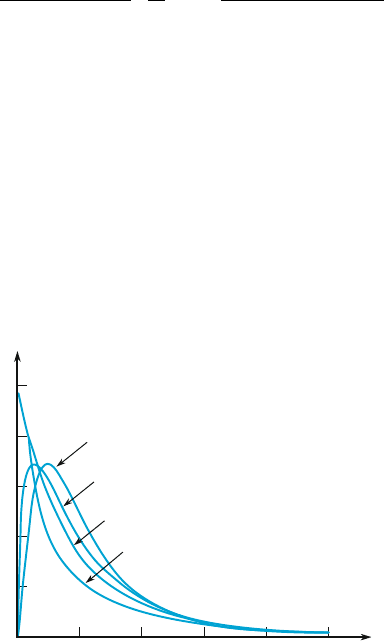
Its derivation (Exercise 60) is similar to the derivation of the t pdf. Figur e 6.18
shows the F density curves for several choices of n
1
and n
2
¼ 10. It should be clear
by comparison with Figure 6.15 that the numerator degrees of freedom determine a
lot about the shapes in Figure 6.18. For example, with n
1
¼ 1, the pdf is unbounded
at x ¼ 0, just as in Figure 6.15 with n ¼ 1. For n
1
¼ 2, the pdf is positive at x ¼ 0,
just as in Figure 6.15 with n ¼ 2. For n
1
> 2, the pdf is 0 at x ¼ 0, just as in
Figure 6.15 with n > 2. However, the F pdf has a fatter tail, especially for low
values of n
2
. This should be evident because the F pdf does not decrease to
0 exponentially as the chi-squared pdf does.
Except for a few special choices of degre es of freedom, integration of the F
pdf is difficult, so F critical values (values that capture specified F distribution tail
areas) are given in Table A.8. For example, the value in the column labeled 1 and
the row labeled 2 and .100 is 8.53, meaning that for one numerator degree of
freedom and two denom inator degre es of freedom P(F > 8.53) ¼ .100. We can
express this as F
.1,1,2
¼ 8.53, where F
a;v
1
;v
2
¼ c means that PðF
v
1
;v
2
> cÞ¼a.
What about lower tail areas? Since 1/F ¼ (X
2
/n
2
)/(X
1
/n
1
), the reciprocal
of an F variable also has an F distribution, but with the degrees of freedom
reversed, and this can be used to obtain lower tail critical values. For example,
.100 ¼ P(F
1,2
> 8.53) ¼ P(1/F
1,2
< 1/8.53) ¼ P(F
2,1
< .117). This can be writ-
ten as F
.9,2,1
¼ .117 because .9 ¼ P(F
2,1
> .117). In general we have
.4
.2
0
.8
.6
1.0
012345
x
3, 10 df
1, 10 df
5, 10 df
2, 10 df
f
(x)
Figure 6.18
F
density curves
324
CHAPTER 6 Statistics and Sampling Distributions

F
p;n
1
;n
2
¼
1
F
1p;n
2
;n
1
: ð6:15Þ
Recalling that T ¼ Z
ffiffiffiffiffiffiffiffi
Xv
=
p
, it follows that the square of this t random
variable is an F random variable with 1 numerator degree of freedom and n
denominator degrees of freedom, t
2
v
¼ F
1;v
. We can use this to obtain tail areas.
For example,
:100 ¼ PðF
1;2
> 8:53Þ¼PðT
2
2
> 8:53Þ¼Pð T
2
jj>
ffiffiffiffiffiffiffiffiffi
8:53
p
Þ¼2PðT
2
> 2:92Þ;
and therefore .05 ¼ P(T
2
> 2.92). We previously determined that .048 ¼
P(T
2
> 3.0), which is very nearly the same statement. In terms of our notation,
t
:05;2
¼
ffiffiffiffiffiffiffiffiffiffiffiffiffi
F
:10;1;2
p
, and we can similarly show that in general t
a;v
¼
ffiffiffiffiffiffiffiffiffiffiffiffi
F
2a;1;v
p
if 0 <
a < .5.
ThemeanoftheF distribution can be obtained with the help of Equation (6.12):
E(F) ¼ n
2
/(n
2
–2)ifn
2
> 2, and it does not exist if n
2
2 (Exercise 57).
Summary of Relationships
Is it clear how the standard normal, chi-squared, t, and F distributions are related?
Starting with a sequence of n independent standard normal random variables (let’s
use five, Z
1
, Z
2
, ..., Z
5
, to be specific) can we construct random variables having the
other distributions? For example, the chi-squared distribution with n degrees of
freedom is the sum of n independent standard normal squares, so Z
2
1
þ Z
2
2
þ Z
2
3
has
the chi-squared distribution with 3 degrees of freedom.
Recall that the rat io of a standard normal rv to the square root of an
independent chi-squared rv, divided by its df n, has the t distribution with n df.
This implies that Z
4
ffiffiffiffiffiffiffiffiffiffiffiffiffiffiffiffiffiffiffiffiffiffiffiffiffiffiffiffiffiffiffiffiffiffiffi
Z
2
1
þ Z
2
2
þ Z
2
3
3
=
q
.
has the t distribution with 3 degrees of
freedom. Why would it be wrong to use Z
1
in place of Z
4
?
Building a random variable with the F distribution requires two independent
chi-squared rvs. We already have Z
2
1
þ Z
2
2
þ Z
2
3
with 3 df, and similarly we obtain
Z
2
4
þ Z
2
5
, chi-squared with 2 df. Dividing each chi-square rv by its df and taking the
ratio gives an F
2,3
random variable, Z
2
4
þ Z
2
5
2
=
Z
2
1
þ Z
2
2
þ Z
2
3
3
=
.
Exercises Section 6.4 (46–66)
46. a. Use Table A.6 to find w
2
:05;2
.
b. Verify the answer to (a) by integrating the pdf.
c. Verify the answer to (a) by using software
(e.g., TI 89 calculator or MINITAB)
47. Why should w
2
v
be approximately normal for large
n? What theorem applies here, and why?
48. Apply the Law of Large Numbers to show that
w
2
v
v= approaches 1 as n becomes large.
49. Show that the w
2
v
pdf has a maximum at n –2if
n > 2.
50. Knowing that ðn 1ÞS
2
s
2
w
2
n1
for a normal
random sample,
a. Show that E(S
2
) ¼ s
2
b. Show that V(S
2
) ¼ 2s
4
/(n–1). What happens
to this variance as n gets large?
c. Apply Equation (6.12) to show that
EðSÞ¼s
ffiffiffi
2
p
Gðn=2Þ
ffiffiffiffiffiffiffiffiffiffiffi
n 1
p
G½ðn 1Þ=2
:
Then show that EðSÞ¼s
ffiffiffiffiffiffiffiffi
2 p
=
p
if n ¼ 2. Is it true
that E(S) ¼ s for normal data?
6.4 Distributions Based on a Normal Random Sample 325

51. Use moment generating functions to show that if
X
3
¼ X
1
þ X
2
, with X
1
w
2
v
1
, X
3
w
2
v
3
, n
3
> n
1
,
and X
1
and X
2
are independent, then X
2
w
2
v
3
v
1
.
52. a. Use Table A.7 to find t
:102;1
.
b. Verify the answer to part (a) by integrating
the pdf.
c. Verify the answer to part (a) using software
(e.g., TI 89 calculator or MINITAB)
53. a. Use Table A.7 to find t
:005;10
.
b. Use Table A.8 to find F
:01;1;10
and relate this to
the value you obtained in part (a).
c. Verify the answer to part (b) using software
(e.g., TI 89 calculator or MINITAB).
54. Show that the t pdf approaches the standard
normal pdf for large df values. [Hint: Use
(1 + a/x)
x
! e
a
and Gðx þ 1=2Þ=½
ffiffiffi
x
p
GðxÞ ! 1
as x !1.]
55. Show directly from the pdf that the mean of a t
1
(Cauchy) random variable does not exist.
56. Show that the ratio of two independent standard
normal random variables has the t
1
distribution.
Apply the method used to derive the t pdf in this
section. [Hint: Split the domain of the denomina-
tor into positive and negative parts.]
57. Let X have an F distribution with n
1
numerator df
and n
2
denominator df.
a. Determine the mean value of X.
b. Determine the variance of X.
58. Is it true that EðF
v
1
;v
2
Þ¼Eðw
2
v
1
v
1
=
Þ Eðw
2
v
2
v
2
=
Þ
.
?
Explain.
59. Show that F
p;v
1
;v
2
¼ 1 F
1p;v
2
;v
1
.
60. Derive the F pdf by applying the method used to
derive the t pdf.
61. a. Use Table A.8 to find F
:1;2;4
.
b. Verify the answer to part (a) using the pdf.
c. Verify the answer to part (a) using software
(e.g., TI 89 calculator or MINITAB).
62. a. Use Table A.7 to find t
:25;10
.
b. Use (a) to find the median of F
1;10
.
c. Verify the answer to part (b) using software
(e.g., TI 89 calculator or MINITAB).
63. Show that if X has a gamma distribution and c
(> 0) is a constant, then cX has a gamma distribu-
tion. In particular, if X is chi-squared distributed,
then cX has a gamma distribution.
64. Let Z
1
, Z
2
, ..., Z
10
be independent standard nor-
mal. Use these to construct
a. A w
2
4
random variable.
b. A t
4
random variable.
c. An F
4,6
random variable.
d. A Cauchy random variable.
e. An exponential random variable with mean 2.
f. An exponential random variable with mean 1.
g. A gamma random variable with mean 1 and
variance
1
2
.[Hint: Use part (a) and Exercise
63.]
65. a. Use Exercise 47 to approximate Pðw
2
50
> 70Þ,
and compare the result with the answer given
by software, .03237.
b. Use the formula given at the bottom of Table
A.6, w
2
v
v 1 29vðÞþZ
ffiffiffiffiffiffiffiffiffiffiffiffiffiffi
29vðÞ
=
p
3
,to
approximate Pðw
2
50
> 70Þ, and compare with
part (a).
66. The difference of two independent normal variables
itself has a normal distribution. Is it true that the
difference between two independent chi-squared
variables has a chi-squared distribution? Explain.
Supplementary Exercises (67–81)
67. In cost estimation, the total cost of a project is the
sum of component task costs. Each of these costs
is a random variable with a probability distribu-
tion. It is customary to obtain information about
the total cost distribution by adding together
characteristics of the individual component cost
distributions—this is called the “roll-up” proce-
dure. For example, E(X
1
+ +X
n
) ¼
E(X
1
) + +E(X
n
), so the roll-up procedure is
valid for mean cost. Suppose that there are two
component tasks and that X
1
and X
2
are indepen-
dent, normally distributed random variables. Is
the roll-up procedure valid for the 75th percen-
tile? That is, is the 75th percentile of the distribu-
tion of X
1
+X
2
the same as the sum of the 75th
percentiles of the two individual distributions?
If not, what is the relationship between the per-
centile of the sum and the sum of percentiles? For
what percentiles is the roll-up procedure valid in
this case?
326
CHAPTER 6 Statistics and Sampling Distributions
68. Suppose that for a certain individual, calorie intake
at breakfast is a random variable with expected
value 500 and standard deviation 50, calorie intake
at lunch is random with expected value 900 and
standard deviation 100, and calorie intake at din-
ner is a random variable with expected value 2000
and standard deviation 180. Assuming that intakes
at different meals are independent of each other,
what is the probability that average calorie intake
per day over the next (365-day) year is at most
3500? [Hint: Let X
i
, Y
i
, and Z
i
denote the three
calorie intakes on day i. Then total intake is
given by S(X
i
þ Y
i
+ Z
i
).]
69. The mean weight of luggage checked by a ran-
domly selected tourist-class passenger flying
between two cities on a certain airline is 40 lb,
and the standard deviation is 10 lb. The mean and
standard deviation for a business-class passenger
are 30 lb and 6 lb, respectively.
a. If there are 12 business-class passengers and
50 tourist-class passengers on a particular
flight, what are the expected value of total
luggage weight and the standard deviation of
total luggage weight?
b. If individual luggage weights are indepen-
dent, normally distributed rv’s, what is the
probability that total luggage weight is at
most 2500 lb?
70. If X
1
, X
2
, ... , X
n
are independent rvs, each with
the same mean value m and variance s
2
, then we
have seen that E(X
1
+ X
2
+ + X
n
) ¼ nm and
V(X
1
+ X
2
+ + X
n
) ¼ ns
2
. In some applica-
tions, the number of X
i
’s under consideration is
not a fixed number n but instead a rv N. For
example, let N be the number of components of
a certain type brought into a repair shop on a
particular day and let X
i
represent the repair time
for the ith component. Then the total repair time is
S
N
¼ X
1
+ X
2
+ + X
N
, the sum of a random
number of rvs.
a. Suppose that N is independent of the X
i
’s.
Obtain an expression for E(S
N
) in terms of m
and E(N). Hint: [Refer back to the theorem
involving the conditional mean and variance
in Section 5.3, and let Y ¼ S
N
and X ¼ N.]
b. Obtain an expression for V(S
N
) in terms of m,
s
2
, E(N), and V(N) (again use the hint of (a))
c. Customers submit orders for stock purchases at
a certain online site according to a Poisson
process with a rate of 3/h. The amount pur-
chased by any particular customer (in 1000 s
of dollars) has an exponential distribution with
mean 30. What is the expected total amount ($)
purchased during a particular 4-h period, and
what is the standard deviation of this total
amount?
71. Suppose the proportion of rural voters in a certain
state who favor a particular gubernatorial candi-
date is .45 and the proportion of suburban and
urban voters favoring the candidate is .60. If a
sample of 200 rural voters and 300 urban and
suburban voters is obtained, what is the approxi-
mate probability that at least 250 of these voters
favor this candidate?
72. Let m denote the true pH of a chemical compound.
A sequence of n independent sample pH determi-
nations will be made. Suppose each sample pH is
a random variable with expected value m and
standard deviation .1. How many determinations
are required if we wish the probability that the
sample average is within .02 of the true pH to be at
least .95? What theorem justifies your probability
calculation?
73. The amount of soft drink that Ann consumes on
any given day is independent of consumption on
any other day and is normally distributed with
m ¼ 13 oz and s ¼ 2. If she currently has two
six-packs of 16-oz bottles, what is the probability
that she still has some soft drink left at the end of
2 weeks (14 days)? Why should we worry about
the validity of the independence assumption here?
74. A large university has 500 single employees who
are covered by its dental plan. Suppose the num-
ber of claims filed during the next year by such an
employee is a Poisson rv with mean value 2.3.
Assuming that the number of claims filed by any
such employee is independent of the number filed
by any other employee, what is the approximate
probability that the total number of claims filed is
at least 1200?
75. A student has a class that is supposed to end at
9:00 a.m. and another that is supposed to begin
at 9:10 a.m. Suppose the actual ending time of
the 9 a.m. class is a normally distributed rv X
1
with mean 9:02 and standard deviation 1.5 min
and that the starting time of the next class is also a
normally distributed rv X
2
with mean 9:10
and standard deviation 1 min. Suppose also that
the time necessary to get from one classroom
to the other is a normally distributed rv X
3
with
mean 6 min and standard deviation 1 min.
What is the probability that the student makes it
to the second class before the lecture starts?
Supplementary Exercises 327