
Devore J.L., Berk K.N. Modern Mathematical Statistics with Applications
Подождите немного. Документ загружается.

43. In an experiment designed to study the effects of
illumination level on task performance (“Perfor-
mance of Complex Tasks Under Different Levels
of Illumination,” J. Illumin. Engrg., 1976:
235–242), subjects were required to insert a fine-
tipped probe into the eyeholes of 10 needles in
rapid succession both for a low light level with a
black background and a higher level with a white
background. Each data value is the time (sec)
required to complete the task.
Subject 12345
Black 25.85 28.84 32.05 25.74 20.89
White 18.23 20.84 22.96 19.68 19.50
Subject 6789
Black 41.05 25.01 24.96 27.47
White 24.98 16.61 16.07 24.59
Does the data indicate that the higher level of
illumination yields a decrease of more than 5 s in
true average task completion time? Test the appro-
priate hypotheses using the P-value approach.
44. It has been estimated that between 1945 and 1971,
as many as 2 million children were born to
mothers treated with diethylstilbestrol (DES),
a nonsteroidal estrogen recommended for preg-
nancy maintenance. The FDA banned this drug
in 1971 because research indicated a link with
the incidence of cervical cancer. The article
“Effects of Prenatal Exposure to Diethylstilbestrol
(DES) on Hemispheric Laterality and Spatial
Ability in Human Males” (Hormones Behav.,
1992: 62–75) discussed a study in which 10
males exposed to DES and their unexposed
brothers underwent various tests. This is the sum-
mary data on the results of a spatial ability test:
x ¼ 12:6 (exposed), y ¼ 13:7, and standard error
of mean difference ¼ .5. Test at level .05 to see
whether exposure is associated with reduced
spatial ability by obtaining the P-value.
45. Cushing’s disease is characterized by muscular
weakness due to adrenal or pituitary dysfunction.
To provide effective treatment, it is important to
detect childhood Cushing’s disease as early as
possible. Age at onset of symptoms and age at
diagnosis for 15 children suffering from the
disease were given in the article “Treatment of
Cushing’s Disease in Childhood and Adolescence
by Transphenoidal Microadenomectomy” (New
Engl. J. Med., 1984: 889). Here are the values of
the differences between age at onset of symptoms
and age at diagnosis:
24 12 55 15 30 60 14 21
48 12 25 53 61 69 80
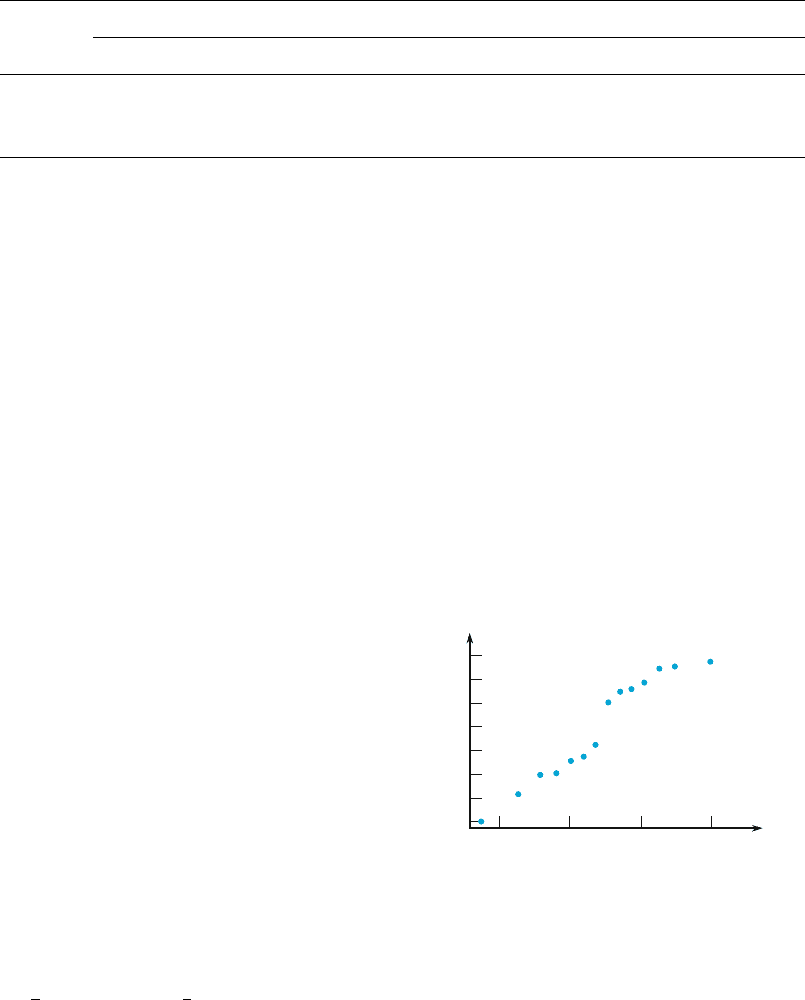
a. Does the accompanying normal probability
plot cast strong doubt on the approximate nor-
mality of the population distribution of differ-
ences?
b. Calculate a lower 95% confidence bound for
the population mean difference, and interpret
the resulting bound.
c. Suppose the (age at diagnosis) (age at onset)
differences had been calculated. What would
be a 95% upper confidence bound for the
corresponding population mean difference?
46. Example 1.2 describes a study of children’s pri-
vate speech (talking to themselves). The 33 chil-
dren were each observed in about 100 ten-second
intervals in the first grade, and again in the second
and third grades. Because private speech occurs
more in challenging circumstances, the children
were observed while doing their mathematics.
Infant
Method 1 2 3 4 5 6 7 8 9 10 11 12 13 14
Isotopic 1509 1418 1561 1556 2169 1760 1098 1198 1479 1281 1414 1954 2174 2058
Test 1498 1254 1336 1565 2000 1318 1410 1129 1342 1124 1468 1604 1722 1518
Difference 11 164 225 9 169 442 312 69 137 157 54 350 452 540
−1.5 −.5 .5 1.5
−10
−20
−30
−40
−50
−60
−70
−80
z percentile
Difference
518 CHAPTER 10 Inferences Based on Two Samples

The speech was classified as on task (about the
math lesson), off task, or mumbling (the observer
could not tell what was said). Here are the 33 first-
grade mumble scores:
20.8 24.4 19.4 33.3 26.0 56.6 39.5 24.7
21.6 32.1 48.1 19.5 19.2 43.0 26.3 22.7
49.4 35.4 56.8 45.4 28.7 42.2 20.3 20.0
34.0 26.9 48.4 27.6 52.6 5.9 38.5 22.1
22.2
and here are the third-grade mum ble scores:
28.8 57.0 23.9 46.9 50.0 64.6 54.2 55.3
21.4 38.3 78.5 38.1 44.3 11.7 58.6 76.1
76.4 48.6 37.2 69.8 29.1 60.4 57.8 38.7
46.5 50.0 69.6 69.8 59.4 22.7 84.9 42.0
67.2
The numbers are in the same order for each grade;
for example, the third student mumbled in 19.4%
of the intervals in the first grade and 23.9% of the
intervals in the third grade.
a. Verify graphically that normality is plausible
for the population distribution of differences.
b. Find a 95% confidence interval for the differ-
ence of population means, and interpret the
result.
47. Construct a paired data set for which t ¼1,so
that the data is highly significant when the correct
analysis is used, yet t for the two-sample t test is
quite near zero, so the incorrect analysis yields an
insignificant result.
10.4
Inferences About Two Population
Proportions
Having presented methods for com paring the means of two different populations,
we now turn to the comparison of two population proportions. The nota tion for this
problem is an extension of the notation used in the corresponding one-population
problem. We let
p
1
and
p
2
denote the proportions of individuals in populations 1
and 2, respectively, who possess a particular characteristic. Alternatively, if we use
the label S for an individual who possesses the characteristic of interest (does favor
a particular proposition, has read at least one book within the last month, etc.), then
p
1
and
p
2
represent the probabilities of seeing the label S on a randomly chosen
individual from populations 1 and 2, respectively.
We will assume the availability of a sample of m individuals from the first
population and n from the second. The variables X and Y will represent the number
of individuals in each sample possessing the char acteristic that defines
p
1
and
p
2
.
Provided the population sizes are much larger than the sample sizes, the distribution
of X can be taken to be binomial with parameters m and
p
1
, and similarly, Y is taken
to be a binomial variable with parameters n and
p
2
. Furthermore, the samples are
assumed to be independent of each other, so that X and Y are independent rv’s.
The obvious estimator for
p
1
p
2
, the difference in population proportions, is
the corresponding difference in sample proportions X /m Y/n. With
^
p
1
¼ X=m and
^
p
2
¼ Y=n, the estimator of
p
1
p
2
can be expressed as
^
p
1
^
p
2
.
PROPOSITION
Let X ~ Bin(m,
p
1
)andY ~ Bin(n,
p
2
)withX and Y independent variables. Then
Eð
^
p
1
^
p
2
Þ¼p
1
p
2
so
^
p
1
^
p
2
is an unbiased estimator of
p
1
p
2
, and
Vð
^
p
1
^
p
2
Þ¼
p
1
q
1
m
þ
p
2
q
2
n
ðwhere q
i
¼ 1 p
i
Þð10:3Þ
10.4 Inferences About Two Population Proportions 519

Proof Since E(X) ¼ mp
1
and E(Y) ¼ np
2
,
E
X
m
Y
n
¼
1
m
EðXÞ
1
n
EðYÞ¼
1
m
mp
1
1
n
np
2
¼ p
1
p
2
Since V(X) ¼ mp
1
q
1
, V(Y) ¼ np
2
q
2
, and X and Y are independent,
V
X
m
Y
n
¼ V
X
m
þ V
Y
n
¼
1
m
2
VðXÞþ
1
n
2
VðYÞ¼
p
1
q
1
m
þ
p
2
q
2
n
■
We will focus first on situations in which both m and n are large. Then
because
^
p
1
and
^
p
2
individually have approximately normal distributions, the esti-
mator
^
p
1
^
p
2
also has approximately a normal distribution. Standardizing
^
p
1
^
p
2
yields a variable Z whose distribution is approximately standard normal:
Z ¼
^
p
1
^
p
2
ðp
1
p
2
Þ
ffiffiffiffiffiffiffiffiffiffiffiffiffiffiffiffiffiffiffiffiffiffiffiffi
p
1
q
1
m
þ
p
2
q
2
n
r
A Large-Sample Test Procedure
Analogously to the hypotheses for m
1
m
2
, the most general null hypothesis an
investigator might consider would be of the form
H
0
:
p
1
p
2
¼ D
0
, where D
0
is
again a specified number. Although for population means the case D
0
6¼ 0 pre-
sented no difficulties, for population proportions the cases D
0
¼ 0 and D
0
6¼ 0 must
be considered separately. Since the vast majority of actual problems of this sort
involve D
0
¼ 0 (i.e., the null hypothesis
p
1
¼
p
2
), we will concentrate on this case.
When
H
0
:
p
1
p
2
¼ 0 is true, let
p
denote the common value of
p
1
and
p
2
(and
similarly for q). Then the standardized variable
Z ¼
^
p
1
^
p
2
0
ffiffiffiffiffiffiffiffiffiffiffiffiffiffiffiffiffiffiffiffiffiffiffiffi
pq
1
m
þ
1
n
s
ð10:4Þ
has approximat ely a standar d normal distribution when
H
0
is true. However, this Z
cannot serve as a test statistic because the value of
p
is unknown—
H
0
asserts only
that there is a common value of
p
, but does not say what that value is. To obtain a
test statistic having approximately a standard normal distribution when
H
0
is true
(so that use of an appropriate z critical value specifies a level a test),
p
must be
estimated from the sample data.
Assuming then that
p
1
¼
p
2
¼
p
, instead of separate samples of size m and n
from two different populations (two different binomial distributions), we really
have a single sample of size m + n from one population with proportion
p
. Since the
total number of individuals in this combined sample having the characteristic of
interest is X + Y, the estimator of
p
is
^
p ¼
X þ Y
m þ n
¼
m
m þ n
^
p
1
þ
n
m þ n
^
p
2
ð10:5Þ
520 CHAPTER 10 Inferences Based on Two Samples

The second expression for
^
p shows that it is actually a weighted average of
estimators
^
p
1
and
^
p
2
obtained from the two samples. If we take (10.5) (with
^
q ¼ 1
^
p) and substitute back into ( 10.4), the resulting statistic has approximately
a standard normal distribution when
H
0
is true.
Null hypothesis:
H
0
:
p
1
p
2
¼ 0
Test statistic value (large samples): z ¼
^
p
1
^
p
2
ffiffiffiffiffiffiffiffiffiffiffiffiffiffiffiffiffiffiffiffiffiffiffiffi
^
p
^
q
1
m
þ
1
n
s
Alternative Hypothesis Rejection Region for Approximate
Level a Test
H
a
:
p
1
p
2
> 0 z z
a
H
a
:
p
1
p
2
< 0 z z
a
H
a
:
p
1
p
2
6¼ 0 either z z
a/2
or z z
a/2
A P-value is calculated in the same way as for previous z tests.
Example 10.11 Some defendants in criminal proceedings plead guilty and are sentenced without a
trial, whereas others who plead innocent are subsequently found guilty and then are
sentenced. In recent years, legal scholars have speculated as to whether sentences
of those who plead guilty differ in severity from sentences for those who plead
innocent and are subsequently judged guilty. Consider the accompanying data on
defendants from San Francisco County accused of robbery, all of whom had
previous prison records (“Does It Pay to Plead Guilty? Differential Senten cing
and the Functioning of Criminal Courts,” Law Soc. Rev., 1981–198 2: 45–69). Does
this data suggest that the proportion of all defendants in these circumstances who
plead guilty and are sent to prison differs from the proportion who are sent to prison
after pleading innocent and being found guilty?
Plea
Guilty Not guilty
Number judged guilty m ¼ 191 n ¼ 64
Number sentenced to prison x ¼ 101 y ¼ 56
Sample proportion
^
p
1
¼ .529
^
p
2
¼ .875
Let
p
1
and
p
2
denote the two population proportions. The hypotheses of
interest are
H
0
:
p
1
p
2
¼ 0 versus
H
a
:
p
1
p
2
6¼ 0. At level .01,
H
0
should be
rejected if either z z
.005
¼ 2.58 or if z 2.58. The com bined estimate of the
common success proportion is
^
p ¼ 101 þ 56ðÞ= 191 þ 64ðÞ¼:616. The value of
the test statistic is then
z ¼
:529 :875
ffiffiffiffiffiffiffiffiffiffiffiffiffiffiffiffiffiffiffiffiffiffiffiffiffiffiffiffiffiffiffiffiffiffiffiffiffiffiffiffiffiffiffiffiffiffiffiffiffiffi
ð:616Þð:384Þ
1
191
þ
1
64
s
¼
:346
:070
¼4:94
10.4 Inferences About Two Population Proportions 521

Since 4.94 2.58,
H
0
must be rejected.
The P-value for a two-tailed z test is
P-value ¼ 2[1 F(|z|)] ¼ 2[1 F(4.94)] < 2[1 F(3.49)] ¼ .0004
A more extensive standard normal table yields P-value ¼ .0000006. This P-value
is so minuscule that at any reasonable level a,
H
0
should be rejected. The data very
strongly suggests that
p
1
6¼ p
2
and, in particular, that initially pleading guilty may
be a good strategy as far as avoiding prison is concerned.
The cited article also reported data on defendants in several other counties.
The auth ors broke down the data by type of crime (burglary or robbery) and by
nature of prior record (none, some but no prison, and prison). In every case, the
conclusion was the same: Among defendants judged guilty, those who pleaded that
way were less likely to receive prison sentences.
■
Type II Error Probabilities and Sample Sizes
Here the determination of b is a bit more cumbersome than it was for other
large-sample tests. The reason is that the denominator of Z is an estimate of the
standard deviation of
^
p
1
^
p
2
, assuming that
p
1
¼
p
2
¼
p
. When
H
0
is false,
^
p
1
^
p
2
must be restandardized using
s
^
p
1
^
p
2
¼
ffiffiffiffiffiffiffiffiffiffiffiffiffiffiffiffiffiffiffiffiffiffiffiffi
p
1
q
1
m
þ
p
2
q
2
n
r
ð10:6Þ
The form of s implies that b is not a function of just
p
1
p
2
, so we denote it by
b(
p
1
,
p
2
)
Alternative Hypothesis b(
p
1
,
p
2
)
H
a
:
p
1
p
2
> 0
F
z
a
ffiffiffiffiffiffiffiffiffiffiffiffiffiffiffiffiffiffiffiffiffiffiffiffiffi
p q
1
m
þ
1
n
s
ðp
1
p
2
Þ
s
2
6
4
3
7
5
H
a
:
p
1
p
2
< 0
1 F
z
a
ffiffiffiffiffiffiffiffiffiffiffiffiffiffiffiffiffiffiffiffiffiffiffiffiffi
p q
1
m
þ
1
n
s
ðp
1
p
2
Þ
s
2
6
4
3
7
5
H
a
:
p
1
p
2
6¼ 0
F
z
a=2
ffiffiffiffiffiffiffiffiffiffiffiffiffiffiffiffiffiffiffiffiffiffiffiffiffi
p q
1
m
þ
1
n
s
ðp
1
p
2
Þ
s
2
6
4
3
7
5
F
z
a=2
ffiffiffiffiffiffiffiffiffiffiffiffiffiffiffiffiffiffiffiffiffiffiffiffiffi
p q
1
m
þ
1
n
s
ðp
1
p
2
Þ
s
2
6
4
3
7
5
where p ¼ðmp
1
þ np
2
Þ=ðm þ nÞ, q ¼ðmq
1
þ nq
2
Þ=ðm þ nÞ, and s is given
by (10.6).
522 CHAPTER 10 Inferences Based on Two Samples

Proof For the upper-tailed test (
H
a
:
p
1
p
2
> 0),
bðp
1
; p
2
Þ¼P
^
p
1
^
p
2
< z
a
ffiffiffiffiffiffiffiffiffiffiffiffiffiffiffiffiffiffiffiffiffiffiffiffi
^
p
^
q
1
m
þ
1
n
s
"#
¼ P
^
p
1
^
p
2
ðp
1
p
2
Þ
s
<
z
a
ffiffiffiffiffiffiffiffiffiffiffiffiffiffiffiffiffiffiffiffiffiffiffiffi
^
p
^
q
1
m
þ
1
n
s
ðp
1
p
2
Þ
s
2
6
6
6
6
4
3
7
7
7
7
5
When m and n are both large,
^
p ¼
m
^
p
1
þ n
^
p
2
m þ n
mp
1
þ np
2
m þ n
¼
p
and
^
q
q, which yields the previous (approximate) expressio n for b(
p
1
,
p
2
). ■
Alternatively, for specified
p
1
,
p
2
with
p
1
p
2
¼ d, the sample sizes neces-
sary to achieve b(
p
1
,
p
2
) ¼ b can be determined. For example, for the upper-tailed
test, we equate z
b
to the argument of F(·) (i.e., what’s inside the parentheses) in
the foregoing box. If m ¼ n, there is a simple expression for the com mon value.
For the case m ¼ n, the level a test has type II error probability b at the
alternative values
p
1
,
p
2
with
p
1
p
2
¼ d when
n ¼
z
a
ffiffiffiffiffiffiffiffiffiffiffiffiffiffiffiffiffiffiffiffiffiffiffiffiffiffiffiffiffiffiffiffiffiffiffiffiffiffiffiffiffiffi
ðp
1
þ p
2
Þðq
1
þ q
2
Þ=2
p
þ z
b
ffiffiffiffiffiffiffiffiffiffiffiffiffiffiffiffiffiffiffiffiffiffiffiffi
p
1
q
1
þ p
2
q
2
p
2
d
2
ð10:7Þ
for an upper- or lower-tailed test, with a/2 replacing a for a two-tailed test.
Example 10.12 One of the truly impressive applications of statistics occurred in connection with
the design of the 1954 Salk polio vaccine experiment and analysis of the resulting
data. Part of the experiment focused on the efficacy of the vaccine in combating
paralytic polio. Because it was thought that without a control group of children,
there would be no sound basis for assessment of the vaccine, it was decided to
administer the vaccine to one group and a placebo injection (visually indistinguish-
able from the vaccine but known to have no effect) to a control group. For ethical
reasons and also because it was thought that the knowledge of vaccine administra-
tion might have an effect on treatment and diagnosis, the experiment was con-
ducted in a double-blind manner. That is, neither the individuals receiving
injections nor those administering them actually knew who was receiving vaccine
and who was receiving the placebo (samples were numerically coded)—remember,
at that point it was not at all clear whether the vaccine was benefic ial.
Let
p
1
and
p
2
be the probabilities of a child getting paralytic polio for the
control and treatment conditions, respectively. The objective was to test the
hypotheses
H
0
:
p
1
p
2
¼ 0 versus
H
a
:
p
1
p
2
> 0 (the alternative hypothesis
10.4 Inferences About Two Population Proportions 523
states that a vaccinated child is less likely to contract polio than an unvaccinated
child). Supposing the true value of
p
1
is .0003 (an incidence rate of 30 per 100,000),
the vaccine would be a significant improvement if the incidence rate was halved—
that is,
p
2
¼ .00015. Using a level a ¼ .05 test, it would then be reasonabl e to ask
for sample sizes for which b ¼ .1 when
p
1
¼ .0003 and
p
2
¼ .00015. Assuming
equal sample sizes, the required n is obtained from (10.7)as
n ¼
1:645
ffiffiffiffiffiffiffiffiffiffiffiffiffiffiffiffiffiffiffiffiffiffiffiffiffiffiffiffiffiffiffiffiffiffiffiffiffiffiffiffiffiffiffiffi
ð:5Þð:00045Þð:199955Þ
p
þ 1:28
ffiffiffiffiffiffiffiffiffiffiffiffiffiffiffiffiffiffiffiffiffiffiffiffiffiffiffiffiffiffiffiffiffiffiffiffiffiffiffiffiffiffiffiffiffiffiffiffiffiffiffiffiffiffiffiffiffiffiffiffiffiffiffiffiffiffiffiffiffiffi
ð:00015Þð:99985Þþð:0003Þð:9997Þ
p
2
ð:0003 :00015Þ
2
¼½ð:0349 þ :0271Þ=:00015
2
171; 000
The actual data for this experiment follows. Sample sizes of approximately
200,000 were used. The reader can easily verify that z ¼ 6.43, a highly significant
value. The vaccine was judged a resounding success!
Placebo: m ¼ 201,229 x ¼ number of cases of paralytic polio ¼ 110
Vaccine: n ¼ 200,745 y ¼ 33
■
A Large-Sample Confidence Interval for
p
1
p
2
As with means, many two-sample problems involve the objective of comparison
through hypothesis testing, but sometimes an interval estimate for
p
1
p
2
is
appropriate. Both
^
p
1
¼ X=m and
^
p
2
¼ Y=n have approximate normal distributions
when m and n are both large. If we identify y with
p
1
p
2
, then
^
y ¼
^
p
1
^
p
2
satisfies the conditions necessary for obtaining a large-sample CI. In particular, the
estimated standard deviation of
^
y is
ffiffiffiffiffiffiffiffiffiffiffiffiffiffiffiffiffiffiffiffiffiffiffiffiffiffiffiffiffiffiffiffiffiffiffiffiffiffiffiffiffiffi
ð
^
p
1
^
q
1
=mÞþð
^
p
2
^
q
2
=nÞ
p
. The 100(1 a)%
interval
^
y z
a=2
^
s
^
y
then becomes
^
p
1
^
p
2
z
a=2
ffiffiffiffiffiffiffiffiffiffiffiffiffiffiffiffiffiffiffiffiffiffiffiffi
^
p
1
^
q
1
m
þ
^
p
2
^
q
2
n
r
Notice that the estimated standard deviation of
^
p
1
^
p
2
(the square-root expression)
is different here from what it was for hypothesis tes ting when D
0
¼ 0.
Recent research has shown that the actual confidence level for the traditional
CI just given can sometimes deviate substantia lly from the nominal level (the level
you think you are getting when you use a particular z critical value—e.g., 95%
when z
a/2
¼ 1.96). The suggested improvement is to add one success and one
failure to each of the two samples and then replace the
^
p’s and
^
q’s in the foregoing
formula by
~
p’s and
~
q’s where
~
p
1
¼ðx þ 1Þ=ðm þ 2Þ, etc. This interval can also be
used when sample sizes are quite small.
Example 10.13 The authors of the article “Adjuvant Radiotherapy and Chemotherapy in Node-
Positive Premenopausal Women with Breast Cancer” (New Engl. J. Med., 1997:
956–962) reported on the results of an experiment designed to compare treating
cancer patients with only chemotherapy to treatment with a combination of chemo-
therapy and radiation. Of the 154 individuals who received the chemotherapy-only
treatment, 76 survived at least 15 years, whereas 98 of the 164 patients who
received the hybrid treatment survived at least that long. With
p
1
denoting the
proportion of all such women who, when treated with just chemotherapy, survive at
524 CHAPTER 10 Inferences Based on Two Samples

least 15 years and
p
2
denoting the analogous proportion for the hybrid treatment,
^
p
1
¼ 76=154 ¼ :494 and
^
p
2
¼ 98=164 ¼ :598. A confidence interval for the dif-
ference between proportions based on the traditional formula with a confidence
level of approximately 99% is
:494 :598 2:58
ffiffiffiffiffiffiffiffiffiffiffiffiffiffiffiffiffiffiffiffiffiffiffiffiffiffiffiffiffiffiffiffiffiffiffiffiffiffiffiffiffiffiffiffiffiffiffiffiffiffiffiffiffiffiffi
ð:494Þð:506Þ
154
þ
ð:598Þð:402Þ
164
r
¼:104 :143 ¼ð:247;:039Þ
At the 99% confidence level, it is plausible that .247 <
p
1
p
2
< .039. This
interval is reasonably wide, a reflec tion of the fact that the sample sizes are not
terribly large for this type of interval. Notice that 0 is one of the plausible values of
p
1
p
2
suggesting that neither treatment can be judged superior to the other. Using
~
p
1
¼ 77=156 ¼ :494,
~
q
1
¼ 79=156 ¼ :506,
~
p
2
¼ :596,
~
q
2
¼ :404 based on sample
sizes of 156 and 166, respectively, the “improved” interval here is essentially
identical to the earlier interval.
■
Small-Sample Inferences
On occasion an inference concerning
p
1
p
2
may have to be based on samples for
which at least one sample size is small. Appropriate methods for such situatio ns are
not as straightforward as those for large samples, and there is more controversy
among statisticians as to reco mmended procedures. One frequently used test, called
the Fisher–Irwin test, is based on the hypergeometric distribution.
Exercises Section 10.4 (48–59)
48. Is someone who switches brands because of a
financial inducement less likely to remain loyal
than someone who switches without induce-
ment? Let
p
1
and
p
2
denote the true proportions
of switchers to a certain brand with and without
inducement, respectively, who subsequently
make a repeat purchase. Test
H
0
:
p
1
p
2
¼ 0
versus
H
a
:
p
1
p
2
< 0 using a ¼ .01 and the
following data:
m ¼200 number of successes ¼ 30
n ¼600 number of successes ¼ 180
(Similar data is given in “Impact of Deals and
Deal Retraction on Brand Switching,” J. Market-
ing, 1980: 62–70.)
49. A sample of 300 urban adult residents of a par-
ticular state revealed 63 who favored increasing
the highway speed limit from 55 to 65 mph,
whereas a sample of 180 rural residents yielded
75 who favored the increase. Does this data indi-
cate that the sentiment for increasing the speed
limit is different for the two groups of residents?
a. Test
H
0
:
p
1
¼
p
2
versus
H
a
:
p
1
6¼
p
2
using
a ¼ .05, where
p
1
refers to the urban population.
b. If the true proportions favoring the increase
are actually
p
1
¼ .20 (urban) and
p
2
¼ .40
(rural), what is the probability that
H
0
will
be rejected using a level .05 test with
m ¼ 300, n ¼ 180?
50. It is thought that the front cover and the nature of
the first question on mail surveys influence the
response rate. The article “The Impact of Cover
Design and First Questions on Response Rates
for a Mail Survey of Skydivers” (Leisure Sci.,
1991: 67–76) tested this theory by experimenting
with different cover designs. One cover was
plain; the other used a picture of a skydiver.
The researchers speculated that the return rate
would be lower for the plain cover.
Cover
Number
Sent
Number
Returned
Plain 207 104
Skydiver 213 109
Does this data support the researchers’ hypothesis?
Test the relevant hypotheses using a ¼ .10byfirst
calculating a P-value.
10.4 Inferences About Two Population Proportions 525
51. Do teachers find their work rewarding and satisfy-
ing? The article “Work-Related Attitudes” (Psych.
Rep., 1991: 443–450) reports the results of a survey
of 395 elementary school teachers and 266 high
school teachers. Of the elementary school teachers,
224 said they were very satisfied with their jobs,
whereas 126 of the high school teachers were very
satisfied with their work. Estimate the difference
between the proportion of all elementary school
teachers who are satisfied and all high school tea-
chers who are satisfied by calculating a CI.
52. A random sample of 5726 telephone numbers
from a certain region taken in March 2002
yielded 1105 that were unlisted, and 1 year later
a sample of 5384 yielded 980 unlisted numbers.
a. Test at level .10 to see whether there is a
difference in true proportions of unlisted
numbers between the 2 years.
b. If
p
1
¼ .20 and
p
2
¼ .18, what sample sizes
(m ¼ n) would be necessary to detect such a
difference with probability .90?
53. Ionizing radiation is being given increasing
attention as a method for preserving horticultural
products. The article “The Influence of Gamma-
Irradiation on the Storage Life of Red Variety
Garlic” (J. Food Process. Preserv., 1983:
179–183) reports that 153 of 180 irradiated garlic
bulbs were marketable (no external sprouting,
rotting, or softening) 240 days after treatment,
whereas only 119 of 180 untreated bulbs were
marketable after this length of time. Does this
data suggest that ionizing radiation is beneficial
as far as marketability is concerned?
54. In medical investigations, the ratio y ¼
p
1
/
p
2
is
often of more interest than the difference
p
1
p
2
(e.g., individuals given treatment 1 are how
many times as likely to recover as those given
treatment 2?). Let
^
y ¼
^
p
1
=
^
p
2
. When m and n are
both large, the statistic lnð
^
yÞ has approximately a
normal distribution with approximate mean
value ln(y) and approximate standard deviation
[(m x)/(mx)+(n y)/(ny)]
1/2
.
a. Use these facts to obtain a large-sample 95%
CI formula for estimating ln(y), and then a CI
for y itself.
b. Return to the heart attack data of Example 1.3,
and calculate an interval of plausible values for
y at the 95% confidence level. What does this
interval suggest about the efficacy of the aspi-
rin treatment?
55. Sometimes experiments involving success or
failure responses are run in a paired or before/
after manner. Suppose that before a major policy
speech by a political candidate, n individuals are
selected and asked whether (S) or not (F) they
favor the candidate. Then after the speech the
same n people are asked the same question. The
responses can be entered in a table as follows:
SF
After
X
2
X
1
X
4
X
3
S
F
Before
where X
1
+ X
2
+ X
3
+ X
4
¼ n. Let
p
1
,
p
2
,
p
3
,
and
p
4
denote the four cell probabilities, so that
p
1
¼ P(S before and S after), and so on. We wish
to test the hypothesis that the true proportion of
supporters (S) after the speech has not increased
against the alternative that it has increased.
a. State the two hypotheses of interest in terms
of
p
1
,
p
2
,
p
3
, and
p
4
.
b. Construct an estimator for the after/before
difference in success probabilities.
c. When n is large, it can be shown that the rv
(X
i
X
j
)/n has approximately a normal distri-
bution with variance [
p
i
+p
j
(
p
i
p
j
)
2
]/n.
Use this to construct a test statistic with
approximately a standard normal distribution
when
H
0
is true (the result is called
McNemar’s test).
d. If x
1
¼ 350, x
2
¼ 150, x
3
¼ 200, and
x
4
¼ 300, what do you conclude?
56. The Chicago Cubs won 73 games and lost 71 in
1995. This was described as a much more suc-
cessful season for them than 1994, when they
won only 49 and lost 64.
a. Based on a binomial model with
p
1
for 1994
and
p
2
for 1995, carry out a two-tailed test for
the difference. Based on your result, could the
difference in sample proportions be attributed
to luck (bad in 1994, good in 1995)?
b. Criticize the binomial model. Do baseball
games satisfy the assumptions?
57. Using the traditional formula, a 95% CI for
p
1
p
2
is to be constructed based on equal sample sizes
from the two populations. For what value of n (¼m)
526
CHAPTER 10 Inferences Based on Two Samples
will the resulting interval have width at most .1
irrespective of the results of the sampling?
58. Statin drugs are used to decrease cholesterol levels,
and therefore hopefully to decrease the chances of
a heart attack. In a British study (“MRC/BHF
Heart Protection Study of Cholesterol Lowering
with Simvastin in 20,536 High-Risk Individuals:
A Randomized Placebo-Controlled Trial,” Lancet,
2002: 7–22) 20,536 at-risk adults were assigned
randomly to take either a 40-mg statin pill or
placebo. The subjects had coronary disease, artery
blockage, or diabetes. After 5 years there were
1328 deaths (587 from heart attack) among the
10,269 in the statin group and 1507 deaths (707
from heart attack) among the 10,267 in the placebo
group.
a. Give a 95% confidence interval for the
difference in population death proportions.
b. Give a 95% confidence interval for the differ-
ence in population heart attack death propor-
tions.
c. Is it reasonable to say that most of the difference
in death proportions is due to heart attacks, as
would be expected?
59. A study of male navy enlisted personnel was
reported in the Bloomington, Illinois, Daily Pan-
tagraph, Aug. 23, 1993. It was found that 90 of
231 left-handers had been hospitalized for inju-
ries, whereas 623 of 2148 right-handers had been
hospitalized for injuries. Test for equal population
proportions at the .01 level, find the P-value for
the test, and interpret your results. Can it be con-
cluded that there is a causal relationship between
handedness and proneness to injury? Explain.
10.5
Inferences About Two Population Variances
Methods for comparing two population variances (or standard deviations) are
occasionally needed, though such problems arise much less frequently than those
involving means or proportions. For the case in which the populations under
investigation are normal, the procedures are based on the F distribution, as dis-
cussed in Section 6.4.
Testing Hypotheses
A test procedure for hypotheses concerning the ratio s
2
1
=s
2
2
, as well as a CI for this
ratio are based on the following result from Section 6.4 .
THEOREM
Let X
1
, ...,X
m
be a random sample from a normal distribution with variance
s
2
1
, let Y
1
, ...,Y
n
be another random sample (independent of the X
i
’s) from a
normal distribution with variance s
2
2
, and let S
2
1
and S
2
2
denote the two sample
variances. Then the rv
F ¼
S
2
1
=s
2
1
S
2
2
=s
2
2
ð10:8Þ
has an F distribution with n
1
¼ m 1 and v
2
¼ n 1.
Under the null hypothesis of equal population variances, (10.8) reduces to the
ratio of sample variances. For a test statistic we use this ratio of sample variances;
and the claim that s
2
1
¼ s
2
2
is rejected if the ratio differs by too much from 1.
10.5 Inferences About Two Population Variances 527