
Devore J.L., Berk K.N. Modern Mathematical Statistics with Applications
Подождите немного. Документ загружается.

THE F TEST
FOR EQUA-
LITY OF
VARIANCES
Null hypothesis:
H
0
: s
2
1
¼ s
2
2
Test statistic value: f ¼ s
2
1
=s
2
2
Alternative Hypothesis Rejection Region for a Level a Test
H
a
: s
2
1
> s
2
2
f F
a,m1,n1
H
a
: s
2
1
< s
2
2
f F
a,m1,n1
H
a
: s
2
1
6¼ s
2
2
either f F
a/2,m1,n1
or f F
1a/2,m1,n1
Since critical values are tabled only for a ¼ .10, .05, .01, and .001, the two -
tailed test can be performed only at levels .20, .10, .02, and .002. More
extensive tabulations of F critical values are available elsewhere, including
calculators and computer software.
Example 10.14 Is there less variation in weights of some baked goods than others? Here are the
weights (in grams) for a sample of Bruegger’s bagels (their Iowa City shop) and
another sample of Wolferman’s muffins (made in Kansas City):
B: 99.8 105.4 94.7 107.8 114.3 106.3
W: 99.0 98.2 98.1 102.1 102.9 104.1 98.8 99.5
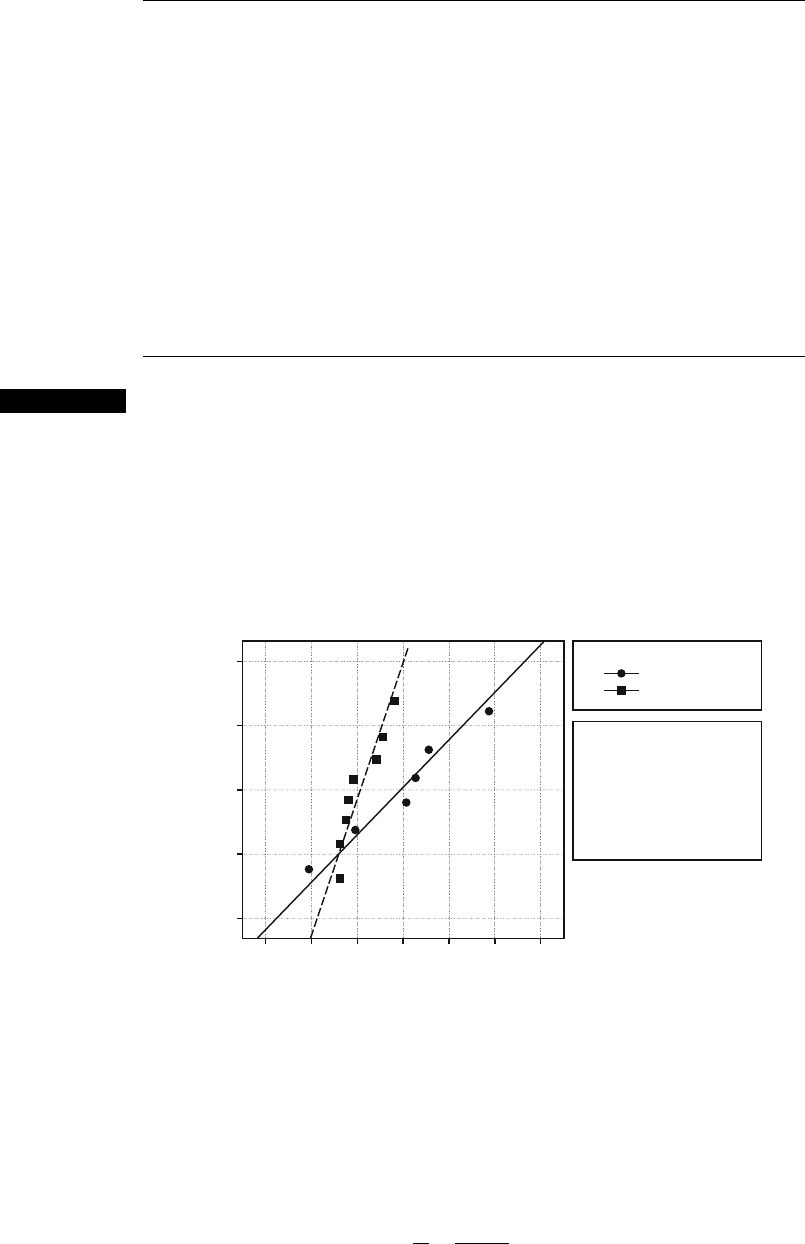
The normality assumption is very important for the use of Expression (10.8)sowe
check the normal plot from MINITAB, shown in Figure 10.9. There is no apparent
reason to doubt normality here.
Notice the difference in slopes for the two sources. This suggests different
variabilities because the vertical axis is the z-score and is related to the horizontal
axis (grams) by z ¼ (grams mean)/(std dev). Th us, when score is plotted against
grams the slope is the reciprocal of the standard deviation. Now let’s test
H
0
:
s
2
1
¼ s
2
2
against a two-tailed alternative with a ¼ .02. We need the critical values
F
.01,5,7
¼ 7.46 and F
.99,5,7
¼ 1/F
.01,7,5
¼ 1/10.46 ¼ .0956. We have
f ¼
s
2
1
s
2
2
¼
6:765
2
2:338
2
¼ 8:37
90 95 100 105 110 115 120
grams
2
1
0
−1
−2
Score
brand
bruegger's
wolferman's
Mean
104.7
100.3
StDev
6.765
2.338
N
6
8
AD
0.206
0.548
P
0.762
0.107
Figure 10.9 Normal plot for baked goods
528
CHAPTER 10 Inferences Based on Two Samples
which exceeds 7.46, so the hypothesis of equal variances is rejected. We conclude that
there is a difference in weight variation, and the English muffins are less variable.
Notice that it is not really necessary to use the lower-tailed critical value here if
the groups are chosen so the first group has the larger variance, and therefore the
value of f ¼ s
2
1
s
2
2
exceeds 1. Because f > 1, the only comparison is between the
computed f and the upper critical value 7.46. It does not change the result of the test to
fix things so f > 1, so it is not cheating to simplify the test in this way.
■
P-Values for F Tests
Recall that the P -value for an upper-tailed t test is the area under the relevant t curve
(the one with appropriate df) to the right of the calculated t. In the sam e way, the
P-value for an upper-tailed F test is the area under the F curve with appropriate
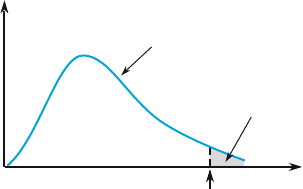
numerator and denominator df to the right of the calculated f. Figure 10.10 illus-
trates this for a test based on n
1
¼ 4 and n
2
¼ 6.
Unfortunately, tabulation of F curve upper-tail areas is much more cumber-
some than for t curves because two df’s are involved. For each combination of n
1
and n
2
, our F table gives only the four critical values that capture areas .10, .05, .01,
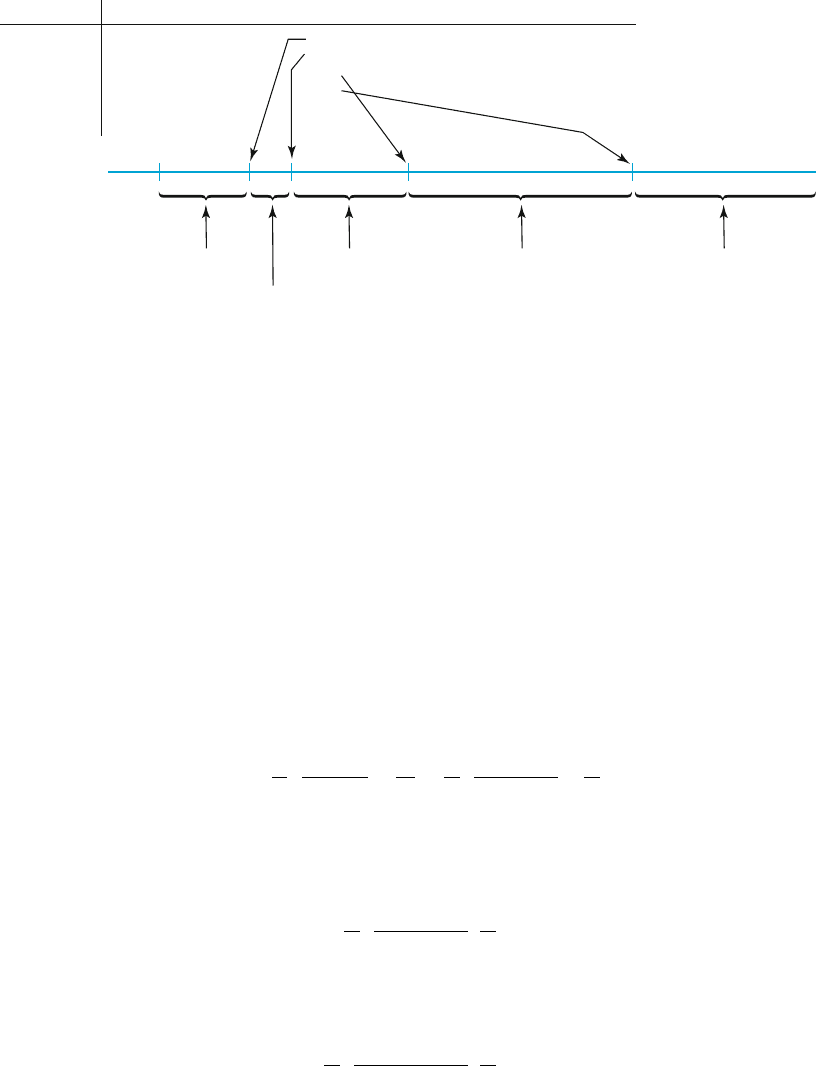
and .001. Figure 10.11 (next page) shows what can be said about the P-value
depending on where f falls relative to the four critical values.
For example, for a test with n
1
¼ 4 and n
2
¼ 6,
f ¼ 5.70 ) .01 < P-value < .05
f ¼ 2.16 ) P-value > .10
f ¼ 25.03 ) P-value < .001
Only if f equals a tabulated value do we obtain an exact P-value (e.g., if f ¼ 4.53,
then P-value ¼ .05). Once we know that .01 < P-value < .05,
H
0
would be
rejected at a significance level of .05 but not at a level of .01. When P-value
< .001,
H
0
should be rejected at any reasonable significance level.
The F tests discussed in succeeding chapters will all be upper-tailed.
If, however, a lower-tailed F test is appropriate, then (6.15) should be used to
obtain lower-tailed critical values so that a bound or bounds on the P-value can
be established. In the case of a two-tailed test, the bound or bounds from a one-
tailed test should be multiplied by 2. For example, if f ¼ 5.82 when n
1
¼ 4 and
n
2
¼ 6, then since 5.82 falls between the .05 and .01 critical values, 2(.01) < P-
value < 2(.05), giving .02 < P-value < .10.
H
0
would then be rejected if a ¼ .10
f = 6.23
F curve for
v
1
= 4, v
2
= 6
Shaded area = P-value
= .025
Figure 10.10 A P-value for an upper-tailed F test
10.5 Inferences About Two Population Variances 529
but not if a ¼ .01. In this case, we cannot say from our table what conclusion is
appropriate when a ¼ .05 (since we don’t know whether the P-value is smaller or
larger than this). However, statistical software shows that the area to the right of
5.82 under this F curve is .029, so the P-value is .058 and the null hypothesis should
therefore not be rejected at level .05 (.058 is the smallest a for which
H
0
can be
rejected and our chosen a is smaller than this).
A Confidence Interval for s
1
=s
2
The CI for s
2
1
=s
2
2
is based on replacing F in the probability statement
PðF
1a=2;n
1
;n
2
< F < F
a=2;n
1
;n
2
Þ¼1 a
by the F variable (10.8) and manipulating the inequalities to isolate s
2
1
=s
2
2
:
s
2
1
s
2
2
1
F
a=2;n
1
;n
2
<
s
2
1
s
2
2
<
s
2
1
s
2
2
1
F
1a=2;n
1
;n
2
¼
s
2
1
s
2
2
F
a=2;n
2
;n
1
Equation (6.15 ) has been used here to simplify the upper bound and enable use of
Table A.8. Thus the confidence interval for s
2
1
=s
2
2
is
s
2
1
s
2
2
1
F
a=2;m1;n1
;
s
2
1
s
2
2
F
a=2;n1;m1
An interval for s
1
=s
2
results from taking the square root of each limit:
s
1
s
2
1
ffiffiffiffiffiffiffiffiffiffiffiffiffiffiffiffiffiffiffiffiffiffiffi
F
a=2;m1;n1
p
;
s
1
s
2
ffiffiffiffiffiffiffiffiffiffiffiffiffiffiffiffiffiffiffiffiffiffiffi
F
a=2;n1;m1
p
!
In the interval for the ratio of population variances, notice that the limits of the
interval are proportional to the ratio of sample variances. Of course, the lower limit
is less than the ratio of sample variances, and the upper limit is greater.
v
2
v
1
a
1 . . .
4 . . .
6 .10
.05
.01
.001
3.18
4.53
9.15
21.92
P-value
> .10 P-value < .001.01 <P-value < .05 .001 < P-value < .01
.05
< P-value < .10
Figure 10.11 Obtaining P-value information from the F table for an upper-tailed F test
530
CHAPTER 10 Inferences Based on Two Samples

Example 10.15 Let’s find a confidence interval using the data of Example 10.14. The sample
standard deviations are s
1
¼ 6.765 for 6 Bruegger’s bagels, and s
2
¼ 2.338 for
8 Wolferman English muffins. Then a 98% confidence interval for the ratio s
1
=s
2
is
6:765
2:338
1
ffiffiffiffiffiffiffiffiffiffiffiffiffi
F
:01;5;7
p
;
6:765
2:338
ffiffiffiffiffiffiffiffiffiffiffiffiffi
F
:01;7;5
p
¼ 2:89
1
ffiffiffiffiffiffiffiffiffi
7:46
p
; 2:89
ffiffiffiffiffiffiffiffiffiffiffi
10:46
p
¼ð1:06; 9:35Þ
Because 1 is not included in the interval, it sugges ts that the two standard deviations
differ. By comparing the CI calculation with the hypothesis test calculation, it
should be clear that a two-tailed test would reject equality at the 2% level, and this
is consistent with the results of Example 10.14.
■
It is important to emphasize that the methods of thi s section are strongly
dependent on the normality assumption. Expression 10.8 is valid only in the case of
normal data or nearly normal data. Otherwise, the F distribution in (10.8) does not
apply. The t procedures of this chapter are robust to the normality assumption,
meaning that the procedure s still work in the case of moderate departures from
normality, but this is not true for comparison of variances based on (10.8).
Exercises Section 10.5 (60–68)
60. Obtain or compute the following quantities:
a. F
.05,5,8
b. F
.05,8,5
c. F
.95,5,8
d. F
.95,8,5
e. The 99th percentile of the F distribution with
n
1
¼ 10, n
2
¼ 12
f. The 1st percentile of the F distribution with
n
1
¼ 10, n
2
¼ 12
g. P(F 6.16) for n
1
¼ 6, n
2
¼ 4
h. P(.177 F 4.74) for n
1
¼ 10, n
2
¼ 5
61. Give as much information as you can about the
P-value of the F test in each of the following
situations:
a. n
1
¼ 5, n
2
¼ 10, upper-tailed test, f ¼ 4.75
b. n
1
¼ 5, n
2
¼ 10, upper-tailed test, f ¼ 2.00
c. n
1
¼ 5, n
2
¼ 10, two-tailed test, f ¼ 5.64
d. n
1
¼ 5, n
2
¼ 10, lower-tailed test, f ¼ .200
e. n
1
¼ 35, n
2
¼ 20, upper-tailed test, f ¼ 3.24
62. Return to the data on maximum lean angle given
in Exercise 27 of this chapter. Carry out a test at
significance level .10 to see whether the popula-
tion standard deviations for the two age groups are
different (normal probability plots support the
necessary normality assumption).
63. Refer to Example 10.7. Does the data suggest that
the standard deviation of the strength distribution for
fused specimens is smaller than that for not-fused
specimens? Carry out a test at significance level .01
by obtaining as much information as you can about
the P-value.
64. Toxaphene is an insecticide that has been identi-
fied as a pollutant in the Great Lakes ecosystem.
To investigate the effect of toxaphene exposure
on animals, groups of rats were given toxaphene in
their diet. The article “Reproduction Study of
Toxaphene in the Rat” (J. Envir. Sci. Health,
1988: 101–126) reports weight gains (in grams)
for rats given a low dose (4 ppm) and for control
rats whose diet did not include the insecticide. The
sample standard deviation for 23 female control
rats was 32 g and for 20 female low-dose rats was
54 g. Does this data suggest that there is more
variability in low-dose weight gains than in con-
trol weight gains? Assuming normality, carry out
a test of hypotheses at significance level .05.
65. In a study of copper deficiency in cattle, the copper
values (mg/100 mL blood) were determined both
for cattle grazing in an area known to have well-
defined molybdenum anomalies (metal values in
excess of the normal range of regional variation)
and for cattle grazing in a nonanomalous area (“An
Investigation into Copper Deficiency in Cattle in
the Southern Pennines,” J. Agric. Soc. Cambridge,
1972: 157–163), resulting in s
1
¼ 21.5 (m ¼ 48)
10.5 Inferences About Two Population Variances 531

for the anomalous condition and s
2
¼ 19.45
(n ¼ 45) for the nonanomalous condition. Test
for the equality versus inequality of population
variances at significance level .10 by using the
P-value approach.
66. The article “Enhancement of Compressive Proper-
ties of Failed Concrete Cylinders with Polymer Im-
pregnation” (J. Test. Eval., 1977: 333–337) reports
the following data on impregnated compressive
modulus (psi 10
6
)whentwodifferentpolymers
were used to repair cracks in failed concrete.
Epoxy 1.75 2.12 2.05 1.97
MMA prepolymer 1.77 1.59 1.70 1.69
Obtain a 90% confidence interval for the ratio of
variances.
67. Reconsider the data of Example 10.6, and calculate
a 95% upper confidence bound for the ratio of the
standard deviation of the triacetate porosity distri-
bution to that of the cotton porosity distribution.
68. For the data of Exercise 27 find a 90% confidence
interval for the ratio of population standard devia-
tions, and relate your CI to the test of Exercise 62.
10.6
Comparisons Using the Bootstrap
and Permutation Methods
In this chapter we have discussed how to make comparisons based on normal data.
We have also considered comparisons of means whe n the sample sizes are large
enough for the means to be approximately normal. What about all other cases,
especially small skewed data sets?
We now consider the bootstrap technique for forming confidence intervals
and permutat ion tests for testing hypotheses. As described in Section 8.5, boot-
strapping involves a lot of computation. The same will be true here for bootstrap
confidence intervals and for permutation tests.
The Bootstrap for Two Samples
The bootstrap for two samples is similar to the one-sample bootstrap of Section 8.5,
except that samples with replacement are taken from the two groups separately.
That is, a sample is taken from the first group, a separate sample is taken from the
second group, and then the difference of means or some other comparison statistic
is computed. Th is process is repeated until there are 999 (or another large number)
values of the comparison statistic, and this constitutes the bootstrap sample. The
distribution of the bootstrap sample is called the bootstrap distribution.
If the bootstrap distribution appears normal, then a confidence interval can be
computed by using the standard deviation of the bootstrap distribution in place of
the square root expression in the theorem of Section 10.2. That is, instead of
estimating the standard error for the difference of means from the two sample
standard deviations, we use the standard deviation of the bootstrap distribution. The
idea is that the bootstrap distribution should represent the actual sampling distribu-
tion for the difference of means.
However, if the bootstrap distribution does not look normal, then the percen-
tile interval should be calculated, just as was done in Section 8.5. Assuming a
bootstrap sample of size 999, this involves sorting the 999 boots trap values, finding
the 25th from the bottom and the 25th from the top, and using these values as
confidence limits for a 95% CI. The bias corrected and adjusted interval is a further
refinement available in some software, including R, Stata, and Systat.
532 CHAPTER 10 Inferences Based on Two Samples

Example 10.16 As an example of the bootstrap for two samples, consider data from a study of
children talking to themselves (private speech), introduced in Example 1.2. The
children were each observed in many 10-s intervals (about 100) and the researchers
computed the percentage of intervals in which private speech occurred. Because
private speech tends to occur when there is a challenging task, the students were
observed when they were doing arithmetic. The private speech is classified as on
task if it is about arithmetic, off task if it is about something else, and mumbling if
the subject is not clear.
Each child was observed in the first, second, and third grades, but we will
consider here just the first grade off-task private speech. For the 18 boys and
15 girls here are the percentages:
B: 4.9, 5.5, 6.5, 0.0, 0.0, 3.0, 2.8, 6.4, 1.0, 0.9, 0.0, 28.1, 8.7, 1.6, 5.1, 17.0, 4.7, 28.1
G: 0.0, 1.3, 2.2, 0.0, 1.3, 0.0, 0.0, 0.0, 0.0, 3.9, 0.0, 10.1, 5.2, 3.2, 0.0.
With the large number of zeroes, a majority for the girls, the normality assumption
of Section 10.2 does not apply here. Also, the sample sizes for the two groups are
not very large, so the two-sample z methods of Section 10.1 might not work for this
data set. Nevertheless, it is useful to give the t CI for comparison purposes. The
95% interval is
x y t
:025;n
ffiffiffiffiffiffiffiffiffiffiffiffiffiffiffiffi
s
2
1
18
þ
s
2
2
15
r
¼ 6:906 1:813 2:080
ffiffiffiffiffiffiffiffiffiffiffiffiffiffiffiffiffiffiffiffiffiffiffiffiffiffiffiffiffiffiffiffi
8:719
2
18
þ
2:846
2
15
s
¼ 5:093 2:080ð2:1825Þ¼5:093 4:540 ¼ð:55; 9:63Þ
The degrees of freedom n ¼ 21 come from the messy formula in the theorem of
Section 10.2. The confidence interval does not include 0, which implies that we would
reject the hypothesis m
1
¼ m
2
against a two-tailed alternative at the .05 level. This is in
agreement with what we get in testing this hypothesis directly: t ¼ 2.33, P-value .030.
The t method is of questionable validity, because of sample sizes that might not
be enough to compensate for the nonnormality. The bootstrap method involves
drawing a random sample of size 18 with replacement from the 18 boys, drawing a
random sample of size 15 with replacement from the 15 girls, and calculating the
difference of means. Then this process is repeated to give a total of 999 differences of
means. The distribution of these 999 differences of means is the bootstrap distribution.
To help clarify the procedure, here are random samples from the boys and girls:
B: 0.0, 3.0, 2.8, 0.9, 3.0, 0.0, 0.0, 6.5, 6.4, 8.7, 6.4, 1.0, 0.9, 5.5, 17.0, 17.0, 0.0, 3.0
G: 1.3, 0.0, 0.0, 0.0, 0.0, 1.3, 1.3, 0.0, 3.2, 0.0, 1.3, 5.2, 0.0, 0.0, 0.0.
Of course, in sampling with replacement some values will occur more than once
and some will not occur at all. For these two samples, the difference of means is
4.56 .91 ¼ 3.65. Doing this 999 times (using the R package boot) gives the
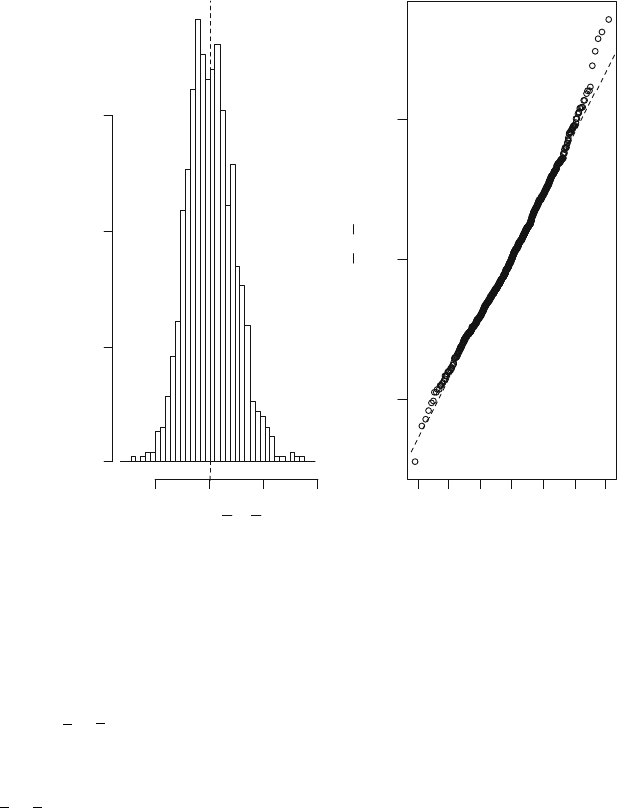
bootstrap distribution displayed in Figure 10.12.
The distribution looks almost normal, but with some positive skewness. The
idea of the bootstrap, with its samples taken from the original samples of boys and
girls, is for this histogram to resemble the true distribution of the difference of means.
If the original samples of boys and girls are representative of their populations, then
our histogram should be a reasonable imitation of the population distribution for the
difference of means.
10.6 Comparisons Using the Bootstrap and Permutation Methods 533
In spite of the nonnormality of the bootstrap distribution, we will use its
standard deviation to compute a confidence interval to see how much it differs from
the perc entile interval. The standard deviation of the bootstrap distribution (i.e., of
the 999
x y values) is s
boot
¼ 2.1874, very close to the 2.1825 that was computed
for the square root in the t interval above. Using 2.1874 instead of 2.1825 gives the
95% confidence interval
x y z
:025
s
boot
¼ 6:906 1:813 1:96ð2:1874Þ¼5:093 4:287 ¼ð:81; 9:38Þ
This is very similar to the t interval, (.55, 9.63), except that using z
.025
(common bootstrap practice) instead of t
.025,n
shortens the interval. Note that the
R package boot produces a slightly different interval because it replaces the
difference 5.093 with the average of the 999 bootstrap mean differences.
In the presence of a nonnormal bootstrap distribution, we now use the
percentile interval, which for a 95% confidence interval finds the middle 95% of
the bootstrap distribution. The confidence limits for a 95% confidence interval are
the 2.5 percentile and the 97.5 percentile. When the 999 boots trap differences of
means are sorted, the 25th value from the bottom is 1.029 and the 25th value from
the top is 9.760. This gives a 95% CI (1.029, 9.760). The skewness of the bootstrap
distribution pushes the endpoints a little to the right of the endpoints computed from
s
boot
. In addition, one can compute the bias corrected and accelerated refinement,
as discussed in Section 8.5. The improved interval (1.625, 10.446), obtained from
R, is moved even farther to the right compared to the previous intervals.
■
Density
0 5 10 15
0.00
0.05
0.10
0.15
−3 −2 −10123
10
5
0
Quantiles of Standard Normal
x *–y *
x *–y *
Figure 10.12 Histogram and normal plot of the bootstrapped difference in means
from R
534
CHAPTER 10 Inferences Based on Two Samples

Permutation Tests
How should we test hypotheses when the validi ty of the t test is in doubt?
Permutation tests do not require any specific distribution for the data. The idea
is that under the null hypothesis, every observation has the same distribution and
thus the same expected value, so we can rearrange the group labels without
changing the group population means. We look at all possible arrangements,
compute the difference of means for each of these, and compute a P-value by
seeing how extreme is our original difference of means. That is, the P-value is the
fraction of arrangements that are at least as extreme as the value computed for the
original data.
Example 10.17 Consider a small-scale version of the off-task private speech data. The first three
values for the boys are 4.9, 5.5, 6.5 and the first two values for the girls are 0.0, 1.3.
To demonstrate the permutation test, we will act as if this is the whole data set.
First, we compute the difference of means of the boys versus the girls, 5.63
.65 ¼ 4.98. Under the null hypothesi s of equal population means, it should not
matter if we reassign boys and girls. Therefore, we consider all ways of selecting
three from among the five observations to be in the boys sample, lea ving the other
two for the girls sample. Unde r the null hypothesis, the following ten choices are
equally likely.
Boys x Girls y x y
4.9 5.5 6.5 5.63 0.0 1.3 .65 4.98
4.9 5.5 0.0 3.47 6.5 1.3 3.90 .43
4.9 5.5 1.3 3.90 0.0 6.5 3.25 .65
4.9 6.5 0.0 3.80 5.5 1.3 3.40 .40
4.9 6.5 1.3 4.23 5.5 0.0 2.75 1.48
4.9 0.0 1.3 2.07 5.5 6.5 6.00 3.93
5.5 6.5 0.0 4.00 4.9 1.3 3.10 .90
5.5 6.5 1.3 4.43 4.9 0.0 2.45 1.98
5.5 0.0 1.3 2.27 6.5 4.9 5.70 3.43
6.5 0.0 1.3 2.60 5.5 4.9 5.20 2.60
How extreme is our original difference of means (4.98) in this set of ten differ-
ences? Because it is the largest of ten, our P-value for an upper-tailed alternative
hypothesis is
1
10
¼ :10. That is, for an upper-tailed test the P-value is the fraction
of arrangements that give a difference at least as large as our original difference.
For a two-tailed test we simply double the one-tailed P-value, giving P ¼ .20 for
this example.
■
When m ¼ 3 and n ¼ 2, it is simple enough to deal with all
5
3
¼ 10
arrangements. What happens when we try to use the whole set of 18 boys and 15
girls in the private speech data set?
Example 10.18 Consider a permutation test for the full private speech data. Here we are dealing
with
33
18
¼ 1;037;158;320 arrangements of the 18 boys and 15 girls, mor e than a
billion arrangements. Even on a reasonably fast computer it might take a while to
generate this many differences and see how many are at least as big as the value
10.6 Comparisons Using the Bootstrap and Permutation Methods 535

x y ¼ 6 :906 1:813 ¼ 5:093 computed for the original data. It took around
an hour on an 800 mhz Dell using the free program BLOSSOM, which can be
downloaded from the Internet. The two-tailed P-value is .0203, a little less than the
P-value .030 from the t test. There is fairly strong evidence, at least at the 5% level,
that the boys engage in more off-task private speech than the girls.
We might have expected that the hypothesis test woul d reject the null
hypothesis (of zero difference in means) at the 5% level with a two-tailed test.
Recall that all three of our 95% confidence intervals in Example 10.16 consisted of
only positive values, so none of the intervals included zero.
The number of arrangements goes up very quickly as the group sizes
increase. If there are 20 boys and 20 girls, then the numb er of arrangements is
more than 100 times as big as when there are 18 boys and 15 girls. Doing the test
exactly, using all of the arrangements, becomes entirely impractical, but there is an
approximate alternative. We can take a rando m sample of a few thousand arrange-
ments and get quite close to the exact answer. For example, with our 18 boys and
15 girls, BLOSSOM gives (almost instantaneously) a P-value of .0204, which is
certainly close enough to the exact answer of .0203. An approximate computation
is also available in R (in the boot package) and Stata and can easily be programmed
in other software such as MINITAB.
■
PERMUTA-
TION TESTS
Let y
1
and y
2
be the same parameters (means, medians, standard deviations,
etc.) for two different populations, and consider testing
H
0
: y
1
¼ y
2
based on
independent samples of sizes m and n, respectively. Suppose that when
H
0
is
true, the two population distributions are identical in all respects, so all m+n
observations have actually been selected from the same population distribu-
tion. In this case, the labels 1 and 2 are arbitrary, as any m of the m+n
observations have the same chance of ending up in the first sample (leaving
the remaining n for the second sample). An exact permutation test computes
a suitable comparison statistic for all possible rearrangements, and sets the
P-value equal to the fraction of these that are at lea st as extreme as the
statistic computed on the original samples. This is the P-value for a one-tailed
test, and it needs to be doubled for a two-tailed test. For an approximate
permutation test, instead of all possible arrangements, we take a random
sample with replacement from the set of all possible arrangements.
Permutation tests are nonparametric, meaning that they do not assume a
specific underlying distribution such as the normal distribution. However, this
does not mean that there are no assumptions whatsoever. The null hypothesis in a
permutation test is that the two distributions are the same, and any deviation can
increase the probability of rejecting the null hypothesis. Thus, strictly speaking,
we are doing a test for equal means only if the distributions are alike in all other
respects, and this means that the two distributions have the sam e shape. In particu-
lar, it requires the distributions to have the same spread. See Exercise 84 for an
example in which the permutation test underestimates the true P-value.
536 CHAPTER 10 Inferences Based on Two Samples
Inferences About Variability
Section 10.5 discussed the use of the F distribution for comparing two variances,
but this inferential method is strongly dependent on normality. For highly skewed
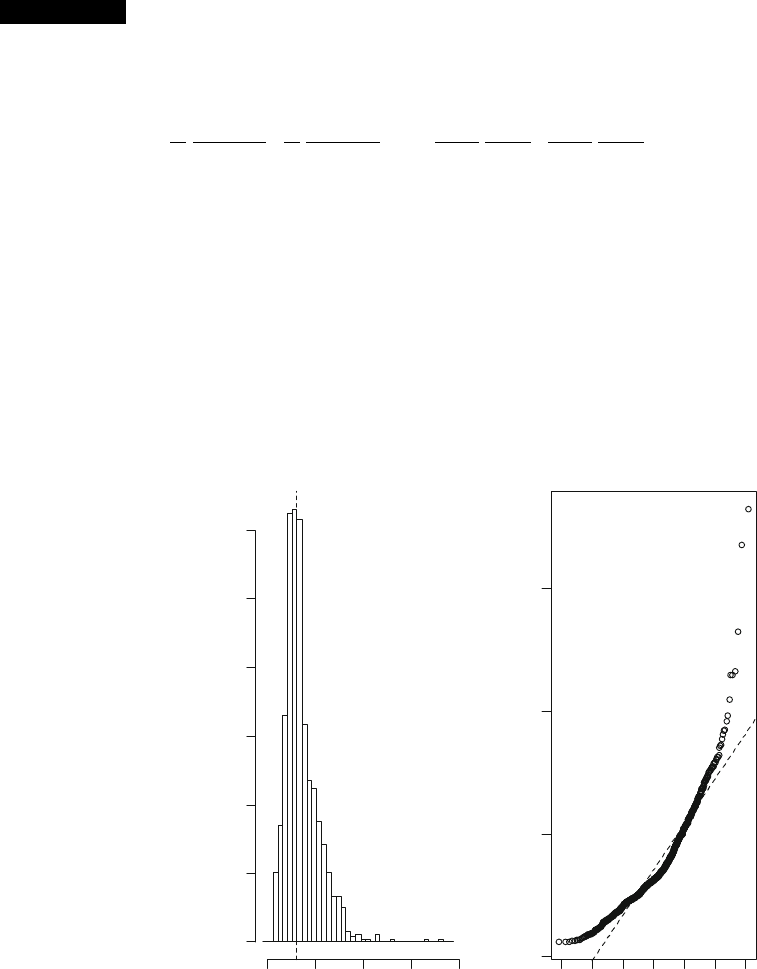
data the F test for equal varianc es will tend to reject the null hypot hesis too often.
Example 10.19 Consider the off-task private speech data from Example 10.16. The sample stan-
dard deviations for boys and girls are 8.72 and 2.85, respectively. Then the method
of Section 10.5 gives for the ratio of male to femal e variances the 95% confidence
interval
s
2
1
s
2
2
1
F
:025;17;14
;
s
2
1
s
2
2
1
F
:975;17;14
¼
8:72
2
2:85
2
1
2:900
;
8:72
2
2:85
2
1
:3633
¼ð3 :23; 25:77Þ
Taking the square root gives (1.80, 5.08) as the 95% confidence interval for
the ratio of standard deviations. However, the legitimacy of this interval is seriously
in question because of the skewed distributions.
What about a hypothesis test of equal population variances? The ratio of male
variance to female variance is s
2
1
=s
2
2
¼ 8:72
2
=2:85
2
¼ 9:385. Comparing this to the
F distribution with 17 numerator degrees of freedom and 14 denominator degrees
of freedom, we find that the one-tailed P-value is .000061, and therefore the two-
tailed P-value is .00012. This is consistent with the 95% confidence interval not
including 1. It would be strong evidence for the male variance being greater than
the female variance, except that the validity of the test is in doubt because of
nonnormality.
SD ratio
Density
0 5 10 15 20
−3 −2 −1
01
23
Quantiles of Standard Normal
SD ratio
0.30
0.25
0.20
0.15
0.10
0.05
0.00
15
10
5
0
Figure 10.13 Histogram and normal plot of bootstrap standard deviation ratios from R
10.6 Comparisons Using the Bootstrap and Permutation Methods 537