
Dinc Ibrahim. Refrigeration systems and applications 2th edition
Подождите немного. Документ загружается.

Advanced Refrigeration Cycles and Systems 241
5.4.4 Multistage Cascade Refrigeration Cycle Used
for Natural Gas Liquefaction
Importance. Natural gas is a mixture of components consisting mainly of methane (60−98%)
with small amounts of other hydrocarbon fuel components. It also contains various amounts of
nitrogen, carbon dioxide, helium, and traces of other gases. It is stored as compressed natural
gas (CNG) at pressures of 16−25 MPa and around room temperature or as a liquefied natural
gas (LNG) at pressures of 70−500 kPa and around −150
◦
C or lower. When transportation of
natural gas in pipelines is not feasible for economic and other reasons, it is first liquefied using
nonconventional refrigeration cycles and then it is usually transported by marine ships in specially
made insulated tanks. It is regasified in receiving stations before being given off the pipeline for
end-use. In fact, different refrigeration cycles with different refrigerants can be used for natural
gas liquefaction. The first cycle used (and still commonly used) for natural gas liquefaction was
the multistage cascade refrigeration cycle that uses three different refrigerants, namely propane,
ethane (or ethylene), and methane in their individual refrigeration cycles. A great amount of
work is consumed to obtain LNG at about −150
◦
C that enters the cycle at about atmospheric
temperature in the gas phase. Minimizing the work consumed in the cycle is the most effective
measure to reduce the cost of LNG. In this regard, exergy appears to be a potential tool for the
design, optimization, and performance evaluation of such systems. Note that identifying the main
sites of exergy destruction shows the direction for potential improvements. An important object
of exergy analysis for systems that consume work such as liquefaction of gases and distillation
of water is finding the minimum work required for a certain desired result.
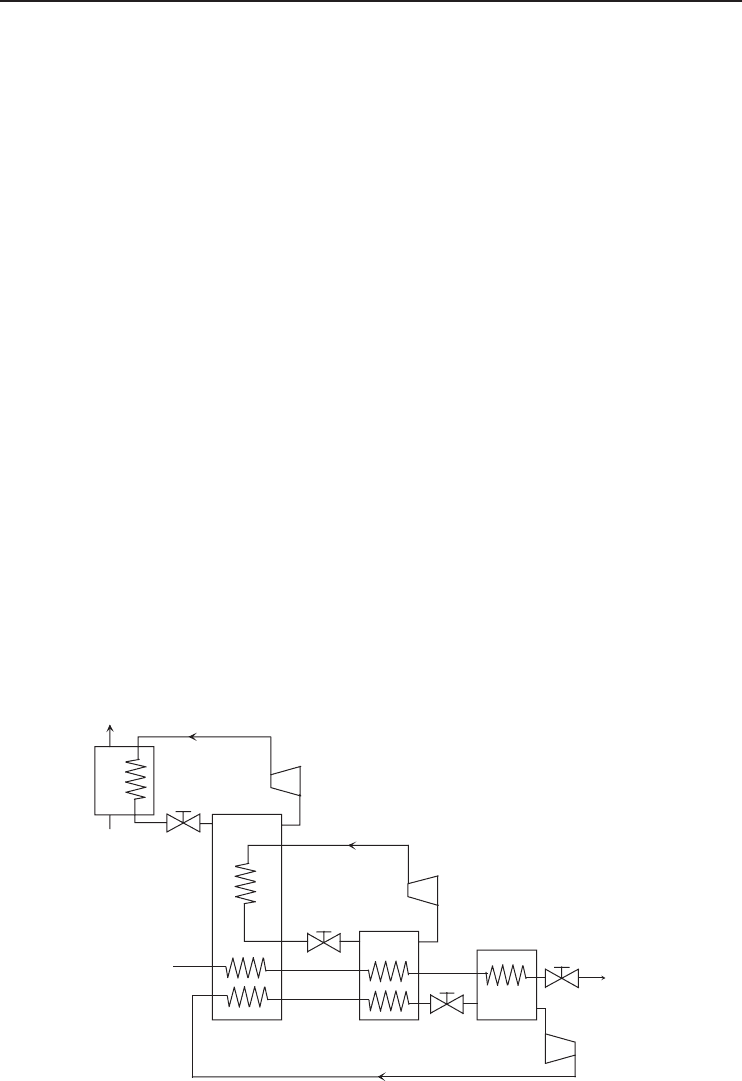
Description of the cycle. Figure 5.21 shows a schematic of the cascade refrigeration cycle and
its components. The cycle consists of three subcycles and each one uses a different refrigerant.
In the first cycle, propane leaves the compressor at a high temperature and pressure and enters
the condenser where the cooling water or air is used as the coolant. The condensed propane
then enters the expansion valve where its pressure is decreased to the evaporator pressure. As
the propane evaporates, the heat of evaporation comes from the condensing ethane, cooling
methane, and cooling natural gas. Propane leaves the evaporator and enters the compressor, thus
Condenser
Propane
compressor
Cooling
water
Expansion
valve
Expansion
valve
Ethane
compressor
Expansion
valve
Methane
compressor
Natural
gas
Evaporator
Expansion
valve
Evaporator-
condenser II
Evaporator-
condenser I
LNG
Figure 5.21 Schematic of the cascade refrigeration cycle (showing only one stage for each refrigerant cycle
for simplicity) (Adapted from Kanoglu, 2002).

242 Refrigeration Systems and Applications
completing the cycle. The condensed ethane expands in the expansion valve and evaporates as
methane condenses and natural gas is further cooled and liquefied. Finally, methane expands
and then evaporates as natural gas is liquefied and subcooled. As methane enters the compressor
to complete the cycle, the pressure of LNG is dropped in an expansion valve to the storage
pressure. The three refrigerant cycles have multistage compression and expansion with usually
three stages and consequently three evaporation temperature levels for each refrigerant. The mass
flows in each stage are usually different. Natural gas from the pipeline goes through a process
during which the acid gases are removed and its pressure is increased to an average value of
40 bar before entering the cycle.
Exergy analysis. The flow exergy of any fluid in a control volume can be written as follows (with
negligible changes in kinetic and potential energies):
˙
Ex =˙mex =˙m
[
(h − h
0
) − T
0
(s − s
0
)
]
(5.29)
where T
0
is the dead state temperature, h and s are the enthalpy and entropy of the fluid at the
specified state, and h
0
and s
0
are the corresponding properties at the dead (reference) state.
The specific exergy change between two states (e.g., inlet and outlet) is
ex = ex
1
− ex
2
= (h
1
− h
2
) − T
0
(s
1
− s
2
) (5.30)
As mentioned earlier, some part of the specific exergy change is lost during the process due
to entropy generation; referring to T
0
s for the above equation, i = T
0
s = T
0
s
gen
known
as specific irreversibility.Heres
gen
is the entropy generation. Two main causes for entropy
generation are friction and heat transfer across a finite temperature difference. Heat transfer is
always accompanied by exergy transfer, which is given by
ex
q
=
δq
1 −
T
0
T
(5.31)
where δq is differential heat transfer and T is the source temperature where heat transfer takes
place. Heat transfer is assumed to occur with the surroundings at T
0
. If this heat transfer shows
an undesired heat loss, Equation 5.31 also expresses the exergy lost by heat.
The following sections give the exergy destruction and exergetic efficiency relations for various
cycle components as shown in Figure 5.21.
5.4.4.1 Evaporators and Condensers
The evaporators and condensers in the system are treated as heat exchangers. There are a total of
four evaporator–condenser systems in the cycle. The first system, named evaporator–condenser-I,
is the evaporator of propane cycle and the condenser of ethane and methane cycles. Similarly,
the system named evaporator–condenser-II is the evaporator of ethane cycle and the condenser of
methane cycle. The third system is the evaporator of methane cycle and the fourth system is the
condenser of propane cycle where the cooling water is used as coolant. An exergy balance written
on the evaporator–condenser-I should express the exergy loss in the system as the difference of
exergies of incoming and outgoing streams. That is,
˙
I =
˙
Ex
in
−
˙
Ex
out
=
( ˙m
p
ex
p
) +
( ˙m
e
ex
e
) +
( ˙m
m
ex
m
) + ( ˙m
d
ex
d
)
in
(5.32)
−
( ˙m
p
ex
p
) +
( ˙m
e
ex
e
) +
( ˙m
m
ex
m
) + ( ˙m
n
ex
n
)
out

Advanced Refrigeration Cycles and Systems 243
where the subscripts in, out, p, e, m, and n stand for inlet, outlet, propane, ethane, methane, and
natural gas, respectively. The summation signs are due to the fact that there are three stages in each
refrigerant cycle with different pressures, evaporation temperatures, and mass flow rates.
The exergetic efficiency of a heat exchanger can be defined as the ratio of total outgoing stream
exergies to total incoming stream exergies as follows:
ε =
( ˙m
p
ex
p
)
out
+
( ˙m
e
ex
e
)
out
+
( ˙m
m
ex
m
)
out
+ ( ˙m
n
ex
n
)
out
( ˙m
p
ex
p
)
in
+
( ˙m
e
ex
e
)
in
+
( ˙m
m
ex
m
)
in
+ ( ˙m
n
ex
n
)
in
(5.33)
The second definition for the exergy efficiency of heat exchangers can be the ratio of the increase
in the exergy of the cold fluid to the decrease in the exergy of the hot. In the system, the only fluid
with an exergy increase is propane while the exergies of ethane, methane, and natural gas decrease.
Therefore, the equation becomes
ε =
( ˙m
p
ex
p
)
out
−
( ˙m
p
ex
p
)
in
( ˙m
e
ex
e
)
in
−
( ˙m
e
ex
e
)
out
+
( ˙m
m
ex
m
)
in
−
( ˙m
m
ex
m
)
out
+ ( ˙m
n
ex
n
)
in
− ( ˙m
n
ex
n
)
out
(5.34)
The above two methods used to determine the exergetic efficiency of a heat exchanger are some-
times called the scientific approach and the engineering approach, respectively. The efficiencies
calculated using these two approaches are usually very close to each other. Here in this example, the
engineering approach will be used in the following relations. The relations for exergy destruction
and exergetic efficiency for evaporator–condenser-II are determined as
˙
I =
˙
Ex
in
−
˙
Ex
out
=
( ˙m
e
ex
e
) +
( ˙m
m
ex
m
) + ( ˙m
n
ex
n
)
in
−
( ˙m
e
ex
e
) +
( ˙m
m
ex
m
) + ( ˙m
n
ex
n
)
out
(5.35)
ε =
( ˙m
e
ex
e
)
out
−
( ˙m
e
ex
e
)
in
( ˙m
m
ex
m
)
in
−
( ˙m
m
ex
m
)
out
+ ( ˙m
n
ex
n
)
in
− ( ˙m
n
x
n
)
out
(5.36)
From the exergy balance on the evaporator of the methane cycle, the following exergy destruction
and exergetic efficiency expressions can be written:
˙
I =
˙
Ex
in
−
˙
Ex
out
=
( ˙m
m
ex
m
) + ( ˙m
n
ex
n
)
in
−
( ˙m
m
ex
m
) + ( ˙m
n
ex
n
)
out
(5.37)
ε =
( ˙m
m
ex
m
)
out
−
( ˙m
m
ex
m
)
in
( ˙m
n
ex
n
)
in
− ( ˙m
n
ex
n
)
out
(5.38)
Finally, for the condenser of the propane cycle the following can be obtained:
˙
I =
˙
Ex
in
−
˙
Ex
out
=
( ˙m
p
ex
p
) + ( ˙m
w
ex
w
)
in
−
( ˙m
p
ex
p
) + ( ˙m
w
ex
w
)
out
(5.39)
ε =
( ˙m
w
ex
w
)
out
− ( ˙m
w
ex
w
)
in
( ˙m
p
ex
p
)
in
−
( ˙m
p
ex
p
)
out
(5.40)
where the subscript w stands for water.
5.4.4.2 Compressors
There is one multistage compressor in the cycle for each refrigerant. The total work consumed in the
cycle is the sum of work inputs to the compressors. There is no exergy destruction in a compressor if

244 Refrigeration Systems and Applications
irreversibilities can be totally eliminated. This results in a minimum work input for the compressor.
In reality, there are irreversibilities due to friction, heat loss, and other dissipative effects. The
exergy destruction in propane, ethane, and methane compressors can be expressed, respectively, as
˙
I
p
=
˙
Ex
in
−
˙
Ex
out
=
( ˙m
p
ex
p
)
in
+
˙
W
p,in
−
( ˙m
p
ex
p
)
out
(5.41)
˙
I
e
=
˙
Ex
in
−
˙
Ex
out
=
( ˙m
e
ex
e
)
in
+
˙
W
e,in
−
( ˙m
e
ex
e
)
out
(5.42)
˙
I
m
=
˙
Ex
in
−
˙
Ex
out
=
( ˙m
m
ex
m
)
in
+
˙
W
m,in
−
( ˙m
m
ex
m
)
out
(5.43)
where
˙
W
p,in
,
˙
W
e,in
, and
˙
W
m,in
are the actual power inputs to the propane, ethane, and methane
compressors, respectively. They are part of the exergy inputs to the compressors. The exergetic
efficiency of the compressor can be defined as the ratio of the minimum work input to the actual
work input. The minimum work is simply the exergy difference between the actual inlet and exit
states. Applying this definition to propane, ethane, and methane compressors, respectively, the
exergy efficiency equations become
ε
p
=
( ˙m
p
ex
p
)
out
−
( ˙m
p
ex
p
)
in
˙
W
p,in
(5.44)
ε
e
=
( ˙m
e
ex
e
)
out
−
( ˙m
e
ex
e
)
in
˙
W
e,in
(5.45)
ε
m
=
( ˙m
m
ex
m
)
out
−
( ˙m
m
ex
m
)
in
˙
W
m,in
(5.46)
5.4.4.3 Expansion Valves
Beside the expansion valves in the refrigeration cycles, one is used to dropping the pressure of LNG
to the storage pressure. Expansion valves are considered essentially isenthalpic devices with no work
interaction and negligible heat transfer with the surroundings. From an exergy balance, the exergy
destruction equations for propane, ethane, methane, and LNG expansion valves can be written as
˙
I
p
=
˙
Ex
in
−
˙
Ex
out
=
( ˙m
p
ex
p
)
in
−
( ˙m
p
ex
p
)
out
(5.47)
˙
I
e
=
˙
Ex
in
−
˙
Ex
out
=
( ˙m
e
ex
e
)
in
−
( ˙m
e
ex
e
)
out
(5.48)
˙
I
m
=
˙
Ex
in
−
˙
Ex
out
=
( ˙m
m
ex
m
)
in
−
( ˙m
m
ex
m
)
out
(5.49)
˙
I
n
=
˙
Ex
in
−
˙
Ex
out
=
( ˙m
n
ex
n
)
in
−
( ˙m
n
ex
n
)
out
(5.50)
The exergetic efficiency of expansion valves can be defined as the ratio of the total exergy output
to the total exergy input. Therefore, the exergy efficiencies for all expansion valves become
ε
p
=
( ˙m
p
ex
p
)
out
( ˙m
p
ex
p
)
in
; ε
e
=
( ˙m
e
ex
e
)
out
( ˙m
e
ex
e
)
in
; ε
m
=
( ˙m
m
ex
m
)
out
( ˙m
m
ex
m
)
in
; ε
n
=
( ˙m
n
ex
n
)
out
( ˙m
n
ex
n
)
in
(5.51–5.54)
5.4.4.4 Cycle
The total exergy destruction in the cycle is simply the sum of exergy destructions in condensers,
evaporators, compressors, and expansion valves. This total can be obtained by adding the exergy
Advanced Refrigeration Cycles and Systems 245
destruction terms in the above equations. Then, the overall exergy efficiency of the cycle can be
defined as
ε =
˙
Ex
out
−
˙
Ex
in
˙
W
actual
=
˙
W
actual
−
˙
I
total
˙
W
actual
(5.55)
where given in the numerator is the exergy difference or the actual work input to the cycle
˙
W
actual
minus the total exergy destruction
˙
I . The actual work input to the cycle is the sum of the work
inputs to the propane, ethane, and methane compressors, which are as follows:
˙
W
actual
=
˙
W
p,in
+
˙
W
e,in
+
˙
W
m,in
(5.56)
In this regard, the exergetic efficiency of the cycle can also be expressed as
ε =
˙
W
min
˙
W
actual
(5.57)
where
˙
W
min
is the minimum work input to the cycle. Here, a process is proposed to determine the
minimum work input to the cycle, or in other words, the minimum work for liquefaction process.
The exergetic efficiency of the natural gas liquefaction process can be defined as the ratio of the
minimum work required to produce a certain amount of LNG to the actual work input. An exergy
analysis needs to be performed on the cycle to determine the minimum work input. The liquefaction
process is essentially the removal of heat from the natural gas. Therefore, the minimum work can
be determined by utilizing a reversible or Carnot refrigerator. The minimum work input for the
liquefaction process is simply the work input required for the operation of Carnot refrigerator for
a given heat removal. It can be expressed as
w
min
=
δq
1 −
T
0
T
(5.58)
where δq is the differential heat transfer and T is the instantaneous temperature at the boundary
where the heat transfer takes place. Note that T is smaller than T
0
for liquefaction process and to
get a positive work input we have to take the sign of heat transfer to be negative since it is a heat
output. The evaluation of Equation 5.52 requires knowledge of the functional relationship between
the heat-transfer δq and the boundary temperature T , which is usually not available.
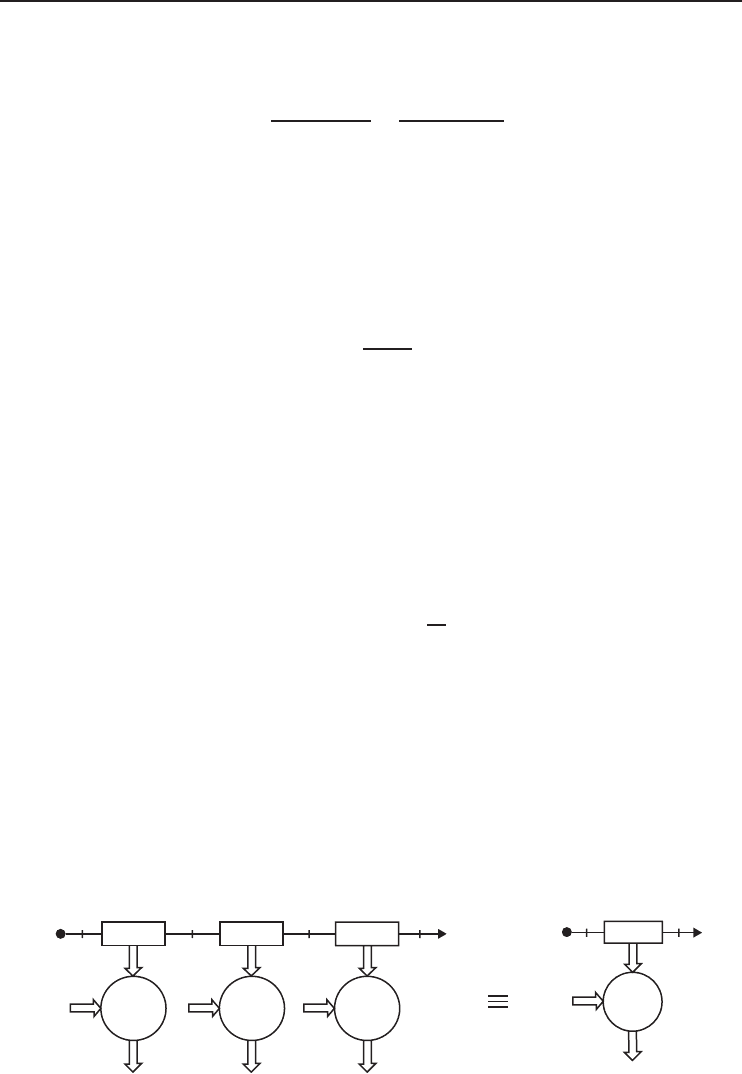
As seen in Figure 5.21, natural gas flows through three evaporator–condenser systems in the
multistage refrigeration cycle before it is fully liquefied. Thermodynamically, this three-stage heat
removal from natural gas can be accomplished using three Carnot refrigerator as seen in Figure 5.22.
The first Carnot refrigerator receives heat from the natural gas and supplies it to the heat sink at T
0
Natural
gas
Carnot
refrigerator
Carnot
refrigerator
Carnot
refrigerator
Carnot
refrigerator
Natural
gas
LNG LNG
T
1
T
0
T
0
T
0
T
0
W
1
W
2
W
3
W
min
T
2
T
3
T
4
T
1
T
4
·
·
··
Figure 5.22 Determination of minimum work for the cycle (Kanoglu, 2002).

246 Refrigeration Systems and Applications
as the natural gas is cooled from T
1
to T
2
. Similarly, the second Carnot refrigerator receives heat
from the natural gas and supplies it to the heat sink at T
0
as the natural gas is cooled from T
2
to T
3
.
Finally, the third Carnot refrigerator receives heat from the natural gas and supplies it to the heat
sink at T
0
as the natural gas is further cooled from T
3
to T
4
, where it exists as LNG. The amount
of power that needs to be supplied to each of the Carnot refrigerator can be determined from
˙
W
min
=
˙
W
1
+
˙
W
2
+
˙
W
3
=˙m
n
(ex
1
− ex
4
) =˙m
n
[
h
1
− h
4
− T
0
(s
1
− s
4
)
]
(5.59)
where
˙
W
1
,
˙
W
2
,and
˙
W
3
are the power inputs to the first, second, and third Carnot refrigerators,
respectively.
˙
W
1
=˙m
n
(ex
1
− ex
2
) =˙m
n
[
h
1
− h
2
− T
0
(s
1
− s
2
)
]
(5.60)
˙
W
2
=˙m
n
(ex
2
− ex
3
) =˙m
n
[
h
2
− h
3
− T
0
(s
2
− s
3
)
]
(5.61)
˙
W
3
=˙m
n
(ex
3
− ex
4
) =˙m
n
[
h
3
− h
4
− T
0
(s
3
− s
4
)
]
(5.62)
This is the expression for the minimum power input for the liquefaction process. This minimum
power can be obtained by using a single Carnot refrigerator that receives heat from the natural
gas and supplies it to the heat sink at T
0
as the natural gas is cooled from T
1
to T
4
.Thatis,
this Carnot refrigerator is equivalent to the combination of three Carnot refrigerators as shown in
Figure 5.22. The minimum work required for liquefaction process depends only on the properties
of the incoming and outgoing natural gas and the ambient temperature T
0
.
Example 5.4
In this illustrative example, we use numerical values to study multistage cascade refrigeration cycle
used for natural gas liquefaction. A numerical value of the minimum work can be calculated using
typical values of incoming and outgoing natural gas properties. The pressure of natural gas is
around 40 bar when entering the cycle. The temperature of natural gas at the cycle inlet can be
taken to be the same as the ambient temperature T
1
= T
0
= 25
◦
C. Natural gas leaves the cycle
liquefied at about 4 bar pressure and at −150
◦
C. Since the natural gas in the cycle usually consists
of more than 95% methane, thermodynamic properties of methane can be used for natural gas.
Using these inlet and exit states, the minimum work input to produce a unit mass of LNG can be
determined from Equation 5.30 to be 456.8 kJ/kg. The heat removed from the natural gas during
the liquefaction process is determined from
˙
Q =˙m
n
(h
1
− h
4
) (5.63)
For the inlet and exit states of natural gas described above, the heat removed from the natural gas
can be determined from Equation 5.63 to be 823.0 kJ/kg. That is, for the removal of 823.0 kJ/kg
heat from the natural gas, a minimum of 456.8 kJ/kg work is required. Since the ratio of heat
removed to the work input is defined as the COP of a refrigerator, this corresponds to a COP of
1.8. That is, the COP of the Carnot refrigerator used for natural gas liquefaction is only 1.8. This
is expected because of the high difference between the temperature T and T
0
in Equation 5.58 An
average value of T can be obtained from the definition of the COP for a Carnot refrigerator, which
is expressed as
COP
rev
=
1
T
0
/T − 1
(5.64)
Using this equation, for COP = 1.8andT
0
= 25
◦
C we determine T =−81.3
◦
C. This is the
temperature a heat reservoir would have if a Carnot refrigerator with a COP of 1.8 operated
Advanced Refrigeration Cycles and Systems 247
between this reservoir and another reservoir at 25
◦
C. Note that the same result could be obtained
by writing Equation 5.52 in the form
w
min
= q
1 −
T
0
T
(5.65)
where q = 823.0 kJ/kg, w
min
= 456.8 kJ/kg, and T
0
= 25
◦
C.
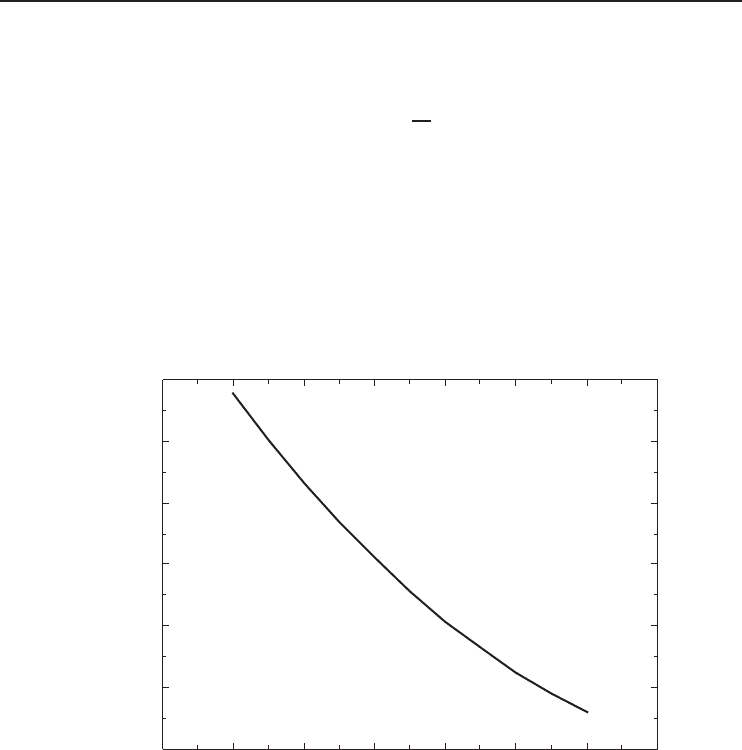
As part of the analysis we now investigate how the minimum work changes with the natural gas
liquefaction temperature. We take the inlet pressure of natural gas to be 40 bar, inlet temperature
to be T
1
= T
0
= 25
◦
C, and exit state to be the saturated liquid at the specified temperature. The
properties of methane are obtained from thermodynamic tables. Using the minimum work relation
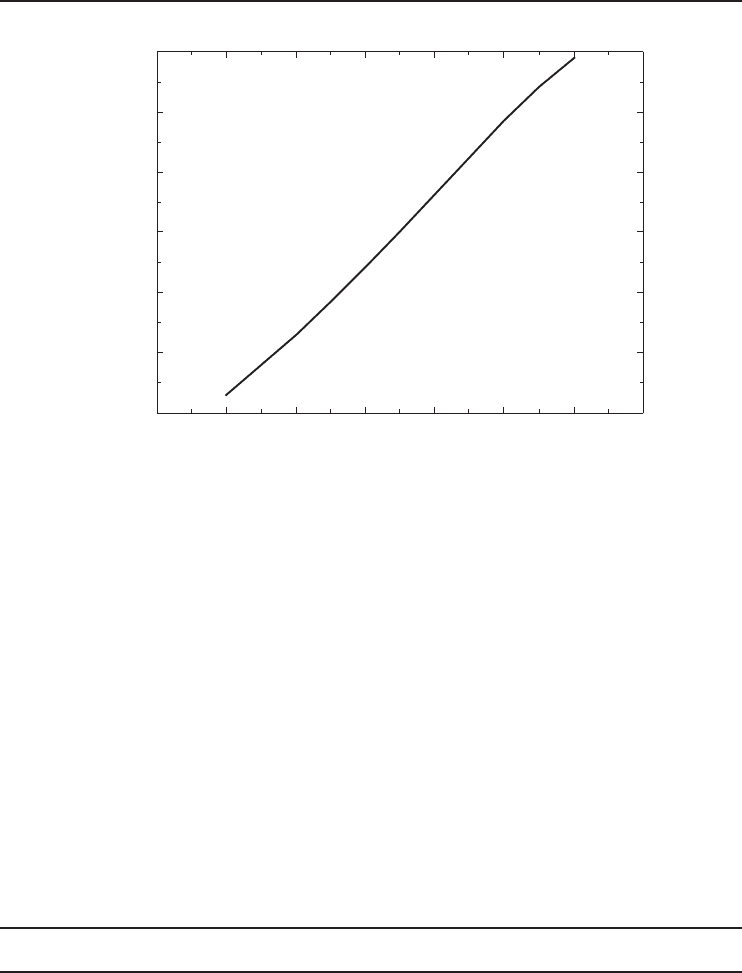
in Equation 5.65, the plot shown in Figure 5.23 is obtained. Using Equation 5.64, the variation of
COP of the Carnot refrigerator with the natural gas liquefaction temperature is also obtained and
shown in Figure 5.24.
−220 −200 −180 −160 −140 −120 −100 −80
200
300
400
500
600
700
800
T (C)
w
min
(kJ/kg)
Figure 5.23 Minimum work (w
min
) versus natural gas liquefaction temperature (Kanoglu, 2002).
As shown in the figure, the minimum work required to liquefy a unit mass of natural gas
increases almost linearly with the decreasing liquefaction temperature. Obtaining LNG at −200
◦
C
requires exactly three times the minimum work required to obtain LNG at −100
◦
C. Similarly,
obtaining LNG at −150
◦
C requires exactly 1.76 times the minimum work required to obtain LNG
at −100
◦
C. The COP of the Carnot refrigerator decreases almost linearly with the decreasing
liquefaction temperature as shown in Figure 5.24. The COP decreases almost by half when the
liquefaction temperature decreases from −100 to −200
◦
C. These figures show that the maximum
possible liquefaction temperature should be used to minimize the work input. In other words, the
LNG should not be liquefied to lower temperatures than needed.
For a typical natural gas inlet and exit states specified in the previous section, the minimum
work is determined to be 456.8 kJ/kg of LNG. A typical actual value of work input for a cascade
cycle used for natural gas liquefaction may be 1188 kJ/kg of LNG. Then the exergetic efficiency of
248 Refrigeration Systems and Applications
−220 −200 −180 −160 −140 −120 −100 −8
0
1.2
1.4
1.6
1.8
2.0
2.2
2.4
T (C)
COP
Figure 5.24 COP versus natural gas liquefaction temperature (Kanoglu, 2002).
a typical cascade cycle can be determined from Equation 3.47 to be 38.5%. The actual work input
required depends mainly on the feed and ambient conditions and on the compressor efficiency.
It has been possible to replace the Joule–Thomson (JT) valve of the cycle with a cryogenic
hydraulic turbine (Kanoglu, 2001). The same pressure drop as in JT valve is achieved with the
turbine while producing power. Using the same typical values as before, the cryogenic turbine
inlet state is 40 bar and −150
◦
C. Assuming isentropic expansion to a pressure of 4 bar, the work
output is calculated to be 8.88 kJ/kg of LNG. This corresponds to a decrease of 2% in the minimum
work input.
Note that the main site of exergy destruction in the cycle is the compressors. Any improve-
ment in the exergetic efficiency of the compressors will automatically yield lower work input for
the liquefaction process. Having three-stage evaporation for each refrigerant in the cascade cycle
results in a total of nine evaporation temperatures. Also, having multiple stages makes the average
temperature difference between the natural gas and the refrigerants small. This results in smaller
exergy destruction in the evaporators since the greater the temperature difference the greater the
exergy destruction. As the number of evaporation stages increases the exergy destruction decreases.
However, adding more stages means additional equipment cost, and more than three stages for each
refrigerant are not justified.
Example 5.5
Natural gas at 77
◦
F and 1 atm (14.7 psia) at a rate of 2500 lbm/h is to be liquefied in a natural
gas liquefaction plant. Natural gas leaves the plant at 1 atm as a saturated liquid. Using methane
properties for natural gas, determine (a) the temperature of natural gas after the liquefaction
process and the rate of heat rejection from the natural gas during this process, (b) the minimum
power input, and (c) the reversible COP. (d) If the liquefaction is done by a Carnot refrigerator
between temperature limits of T
H
= 77
◦
FandT
L
with the same reversible COP, determine the
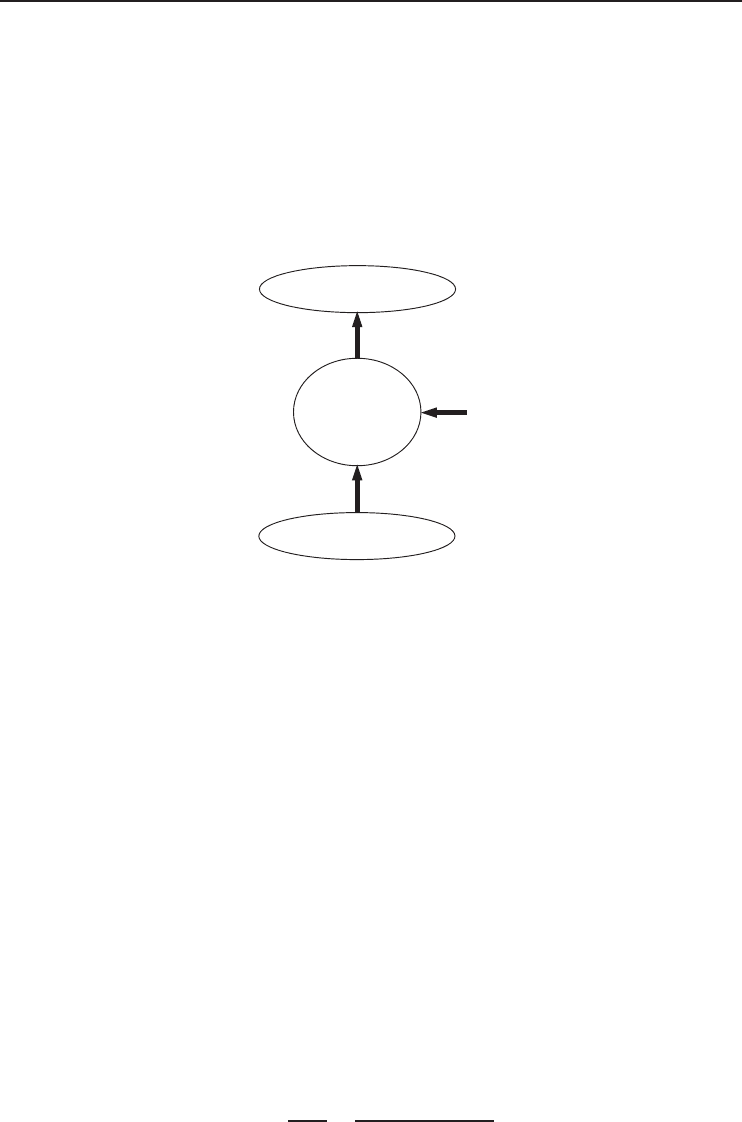
Advanced Refrigeration Cycles and Systems 249
temperature T
L
(see Figure 5.25). Various properties of methane before and after liquefaction
process are given as follows:
h
1
=−0.4254 Btu/lbm
h
2
=−391.62 Btu/lbm
s
1
=−0.0006128 Btu/lbm · R
s
2
=−1.5946 Btu/lbm · R
Carnot
refrigerator
T
H
= 77 °F
T
L
= ?
Q
L
W
min
·
·
Figure 5.25 A Carnot refrigerator operating between T
L
and T
H
as considered in Example 5.4.
Solution
(a) The state of natural gas after the liquefaction is 14.7 psia and is a saturated liquid. The tem-
perature at this state is determined from methane tables to be
T
2
=−259
◦
F
The rate of heat rejection from the natural gas during the liquefaction process is
˙
Q
L
=˙m(h
1
− h
2
) = (2500 lbm/h)
[
(−0.4254) − (−391.62)
]
Btu/lbm = 978,000 Btu/h
(b) Taking the dead state temperature to be T
0
= T
1
= 77
◦
C = 536 R, the minimum work input
is determined from
˙
W
min
=˙m
[
h
2
− h
1
− T
0
(s
2
− s
1
)
]
= (2500 lbm/h)
[
(−391.62) − (−0.4254)
]
Btu/lbm − (537 R)
[
(−1.5941 − (−0.0006128) Btu/lbm · R
]
= 1.162 × 10
6
Btu/h = 340.5kW
(c) The reversible COP is
COP
rev
=
˙
Q
L
˙
W
min
=
9.78 × 10
5
Btu/h
1.162 × 10
6
Btu/h
= 0.842
250 Refrigeration Systems and Applications
(d) The temperature T
L
is determined from
COP
rev
=
1
T
H
/T
L
− 1
−→ 0.842 =
1
(537 R)/T
L
− 1
−→ T
L
= 245 R
It may also be determined from
˙
W
min
=−
˙
Q
L
1 −
T
0
T
L
−→ 1.162 × 10
6
Btu/h
=−(978,000 Btu/h)
1 −
537 R
T
L
−→ T
L
= 245 R
5.5 Steam Jet Refrigeration Systems
In steam jet refrigeration systems, water can be used as the refrigerant. Like air, it is perfectly
safe. These systems were applied successfully to refrigeration in the early years of this century. At
low temperatures the saturation pressures are low (0.008129 bar at 4
◦
C) and the specific volumes
are high (157.3 m
3
/kg at 4
◦
C). The temperatures that can be attained using water as a refrigerant
are not low enough for most refrigeration applications but are in the range which may satisfy
air-conditioning, cooling, or chilling requirements. Also, these systems are used in some chemical
industries for several processes, for example, the removal of paraffin wax from lubricating oils.
Note that steam jet refrigeration systems are not used when temperatures below 5
◦
C are required.
The main advantages of this system are the utilization of mostly low-grade energy and relatively
small amounts of shaft work.
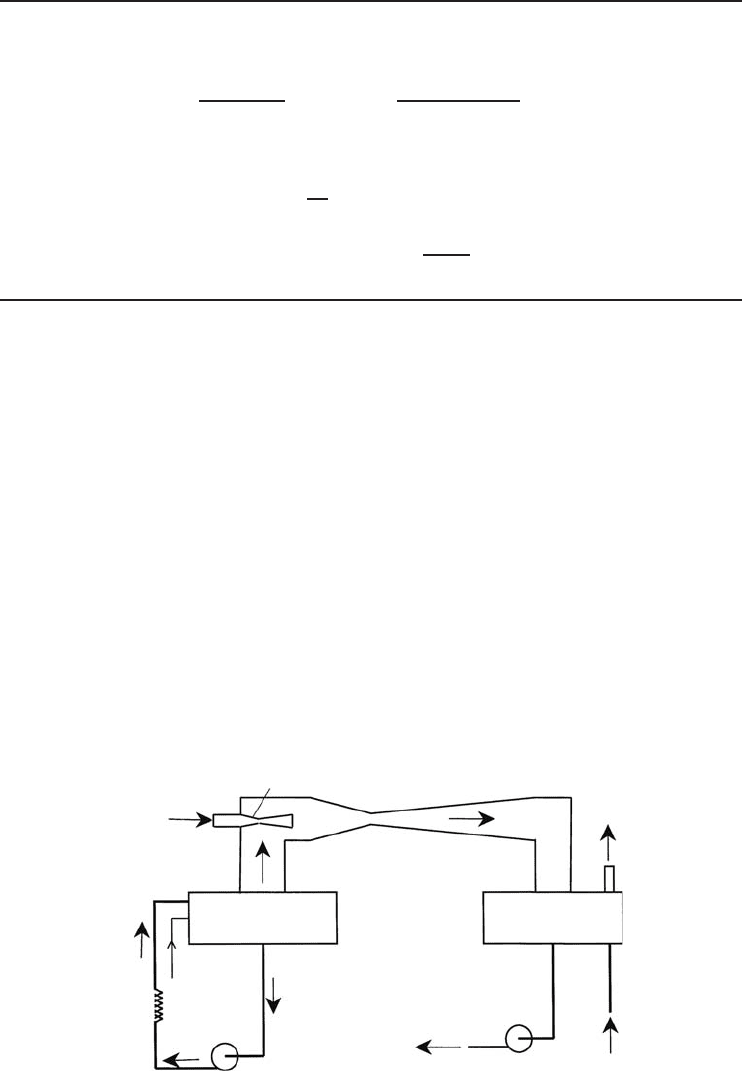
Steam jet refrigeration systems use steam ejectors to reduce the pressure in a tank containing the
return water from a chilled water system. The steam jet ejector utilizes the energy of a fast-moving
jet of steam to capture the flash tank vapor and to compress it. Flashing a portion of the water in
the tank reduces the liquid temperature. Figure 5.26 presents a schematic arrangement of a steam
jet refrigeration system for water cooling. In the system shown, high-pressure steam expands while
Steam nozzle
Makeup
water
High-pressure
steam
3
1
Diffuser
2
Flash tank
Condenser
4
Cooling
load
Chiller water
Circulating
pump
Condensate
to boiler
Condensate
pump
5
Cooling
water
To waste
or cooling
tower
Figure 5.26 A steam jet refrigeration system.