
Dixon R.M.W., Aikhenvald Alexandra Y. The Amazonian Languages (Cambridge Language Surveys)
Подождите немного. Документ загружается.

\
I
234
E.
Loos
I
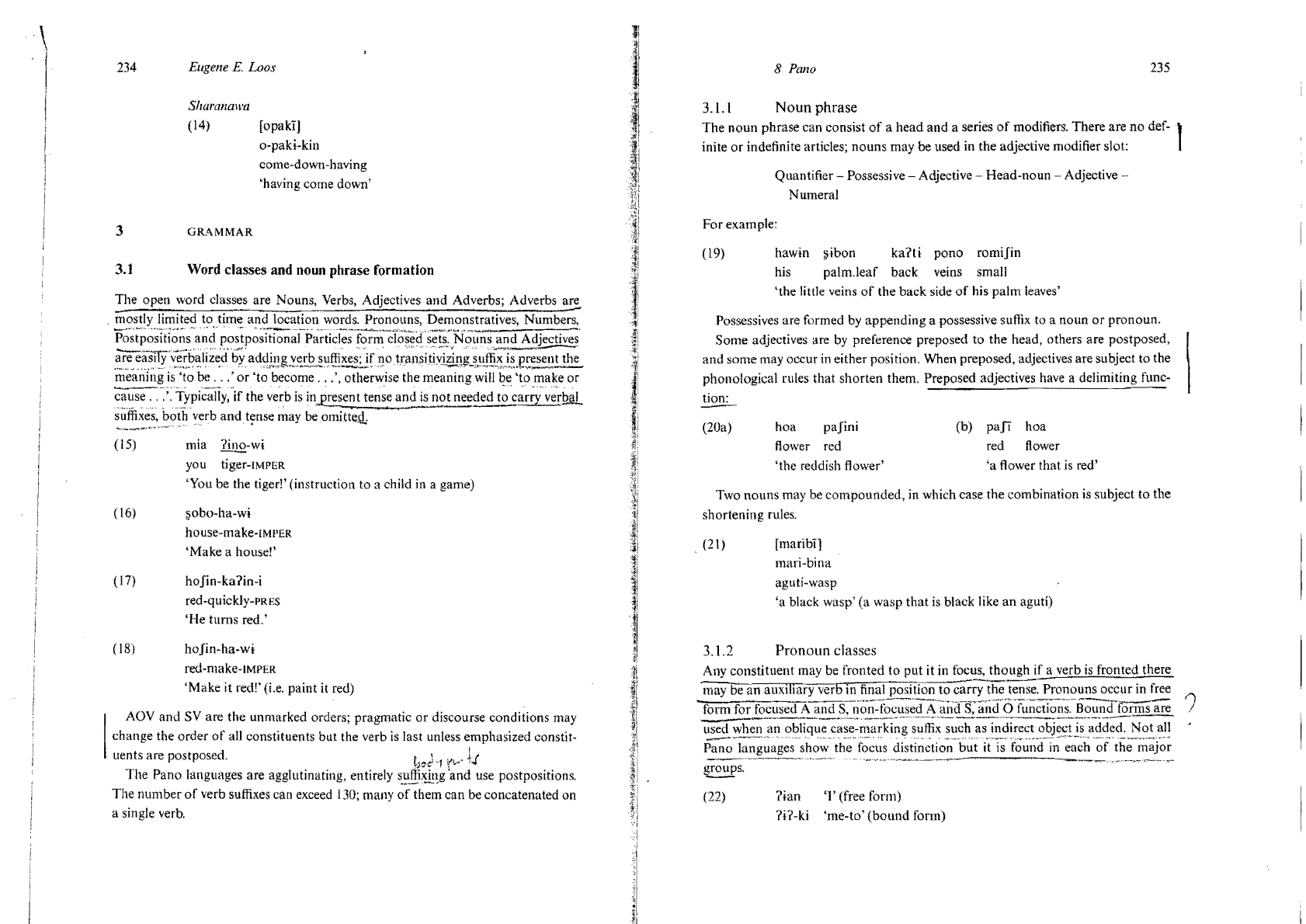
SlUlranawa
(14) [opaki]
o-paki-kin
come-down-having
'having come down'
3
GRAMMAR
3.1
Word
classes
and
no
un
phrase formation
The
open word classes are Nouns, Verbs, Adjectives
and
Adverbs; Adverbs
a;!
. mostly lirnited to time and location words. Pronouns, Demonstratives, Numbers,
P(;"~tp~~it¡~~s-'a~cÍ-
postP~;~;IParti¿I~~f~~cTo~(fs~~:'Noüñsand
Adjectív;;
areeasrryvé¡:b~li~~dbY·ad~il!~:Y.<:.t:,~_~l~~xes~!r!lo.tra~~it¡;i~~Úl!!!l~
..
~~.E~;~
meal:¡i'l~g
is
'to
be
...
'
or
'to
become
...
', otherwise the meaning will
'to
make
or
~.-.;:Tvpica¡iy,-if
the
ve~b
is
ín.eresent tense
an~~~rr~
ver9d
and
t~nse
may
be
omitte.Q
(15)
mía
l.i!.12.-wi
you
tiger-IMPER
'You be the tiger!' (ínstruction to a child in a game)
(16)
~obo-ha-wi
house-make-IMPER
'Make
a house!'
hoJin-ka?in-i
red-quickIY-PRES
'He
tums
red.'
(18)
hoJin-ha-wi
red-make-IMPER
'Make
it red!' paint it
AOV
and
SV are
the
unmarked orders; pragmatic
or
discourse conditions may
change the
order
of
all constítuents but the verb
is
last unless emphasized constit-
I
uents are postposed.
~"c\.1
"e--
~.{
Tite Pano languages
are
agglutinating, entirely suffixing land use postpositions.
The
number
of
verb suffixes can exceed
130;
many
of
them
can
be
concatenated
011
a single
verbo
8 Pallo
235
3.1.1
Noun phrase
The
noun
phrase can consist
of
a
head
and
a series
of
modifiers. There are
no
der- 1
inite
or
indefinite articles;
nouns
may be used in the adjective modifier slot:
Quantifier - Possessive - Adjective
Head-noun
Adjective -
Numeral
For
exarnple:
hawin ¡jibon
ka?ti
pon
o romUin
his palm.leaf
back
veins small
'the
little veíns
of
the back side
of
his
palm
¡eaves'
Possessives are formed by
appending
a possessive
suflix
to a noun
or
pronoull.
Some adjectives are by preference preposed to
the
head, others are postposed,
and sorne may occur in either position. When preposed, adjectives are subject to the
phonological rules
that
shorten
them. Preposed adjectives have a delirniting func-
tíon:
-
(20a)
hoa paJini
(b)
paJi
hoa
flower red
red flower
'the
reddish flower'
'a
flower that
is
red'
Two nOllns may
be
compounded,
in
which case
the
combination
is
subject to the
shortening
rules.
. (21)
[maribí}
mari-bina
agutí-wasp
'a
black W!1SP'
(a
wasp
that
is
black like
an
3.1.2
Pronoun dasses
Any constituent may be fronted
to
put
it
in
facus,
though
if
a verb
is
fronted there
~n
allxlliary verb ill final position to ca;;:yt¡:;eten;;:-Pronouns occur in free
__
.
___
._.
____
.
__
.-----.-_.~_.
,--
..
->,.---~.--
..
----_.
_
t")
form for focused A
and
S,
non-focllsed A
aríaS;and
O functions. Bound-!Orms are /
üSedwh;-;~
obliq~;;;;;=~;-~~~ki~~-suffi;-;uch
as indirect
objectiS·;dd;d.
Not
alI
p;;~-----"
.
"-sh~~'the
focus
di~tinction
iTis-f~~~1(r¡;-;a~h
of
ihe~;:;;'-;;f;;~
groups.
--..........._"._~-~--
..
,-
(22)
?tan
T (free form)
?i?-ki
'me-to'
(bound
I
)
236 El/gene
E.
Loas
3.1.3
Relative
clauses
The head noun is shifted
out
of
a relative clause
or
omitted altogether.
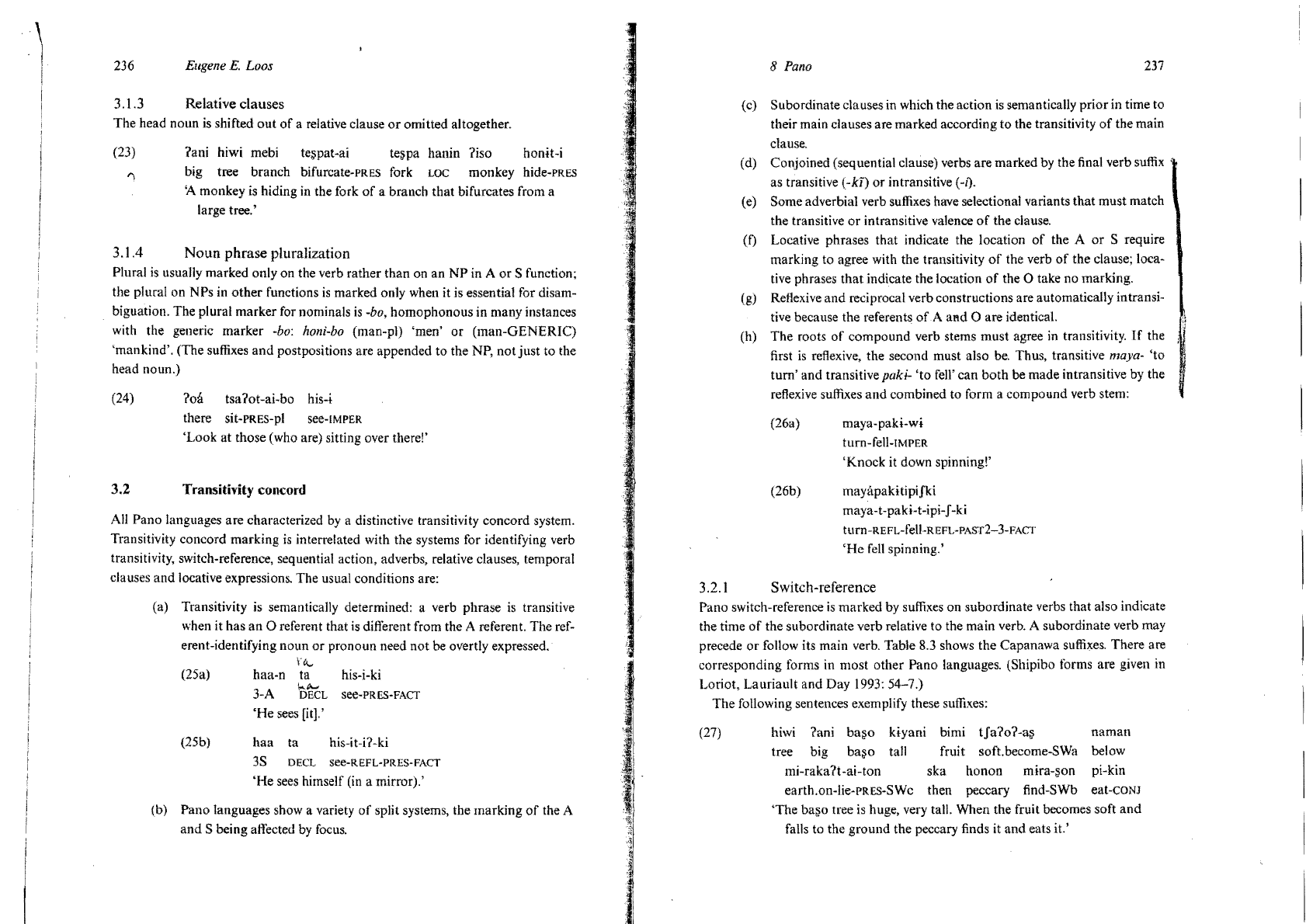
(23) ?aní híwi mebi te;,;pat-ai te¡¡pa hanín ?iso hontt-i
'1 big tree braneh bifureate-PRES fork
LOC
monkey
hide-PRES
'A monkey
is
hiding
in
the fork
of
a braneh that bifurcates from a
large tree.'
3.1.4 Noun phrase pluralization
Plural
is
usually marked only on the verb rather than on an
NP
in A or S funetion;
the plural on NPs
in
other
functions
is
marked only when it
is
essential for disam-
biguation. The plural marker for nominals
is
-ba, homophonous in many instanees
with the generie marker
-ba:
honi-bo (man-pl) 'men'
or
(man-GENERIC)
'mankind'. (The suffixes
and
postpositions are appended to the NP,
notjust
to the
head noun.)
(24)
?oá tsa?ot-ai-bo
his-i:
there
sit-PRES-pl
see-IMPER
'Look
at
those (who are) sitting over there!'
3.2
Transitivity
concord
AII Pano languages are characterized by a distinctive transitivity eoneord system.
Transitivity eoncord marking
is
interrelated with the systems for identifying verb
switeh-reference, sequential action, adverbs, relative c1auses, temporal
c1auses and locative expressions. The usual eonditions are:
(a) Transitivity is semantieally determined: a verb phrase
is
transitive
when it
has
an O referent that
i5
different from the A referent. The ref-
erent-identifying noun
or
pronoun need
not
be overtly expressed.
\"i;..
(25a) haa-n ta his-i-ki
3-A
'D~:éL
see-PRES-PACT
'He
sees
[it].'
(25b)
haa
ta his-ít-i?-ki
3S
DECL
see-REFL-PRES-FACT
'He
sees himself (in a mirror).'
(b)
Pano Janguages show a variety
of
split systems, the marking
of
the A
and
S being affeeted by focus.
8
Pano
237
(e) Subordinate c1auses
in
which the action
is
semantically prior in time to
their main clauses are marked aeeording
to
the transitiyity
of
the main
clause.
(d) Conjoined (sequential cJause) yerbs are marked
by the final verb suffix
as transítive
(-kí)
or intransitive (-i).
(e) Sorne adverbial verb suffixes have selectional variants that must match
the transitive
or
intransitive valenee
of
the clause.
(f) Loeatiye phrases that indicate the loeation
of
the A
or
S require
marking
to
agree with the transitivity
of
the verb
of
the clause; loea-
tive phrases
that
indieate the locatíon
of
the O take no marking.
Retlexive and reciprocal verb eonstructions are automatieally intransi-
tiye beeause the referents
of
A al'ld O are identical.
(h) The roots
01'
eompound verb stems must agree
in
transitivity.
If
the
tirst
is reflexiye, the seeond must al so
be.
Thus, transitive maya-
'to
turn' and transitive paki-
'to
fell' can both
be
made intransitive by the
reflexive suffixes
and
eombined to form a eompound verb stem:
(26a) maya-paki-wi:
turn-fell-IMPER
'Knock
it down spinning!'
mayápakitipifki
maya-t-paki-t-ipi-f-ki
turn-REFL-
fell-R
EFL-PAST2-
3-
FAeT
'He
fell
spinning.'
3.2.1
Switch-reference
Pano switch-reference
is
marked by suffixes on subordinate yerbs that also indicate
the time
of
the subordinate verb relative to the main verb. A subordinate verb may
precede
Of
follow its main
verbo
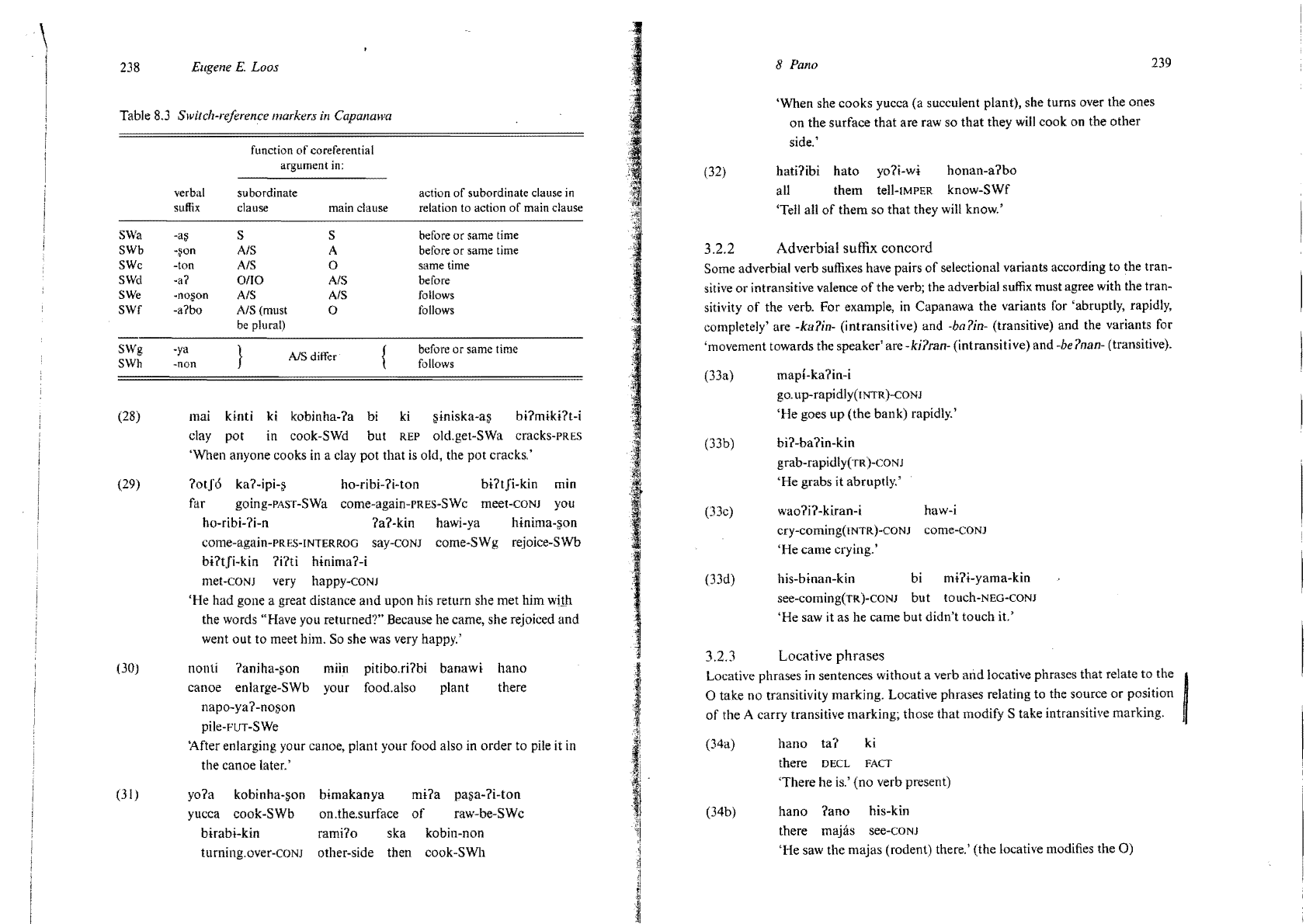
Table 8.3 shows the Capanawa suffixes. There are
corresponding forms in most other Pano languages. (Shipibo forms are given in
Lonot,
Lauriault and Day 1993: 54-7.)
The
following sentences exemplify these suffixes:
(27)
hiwi ?ani
ba!?o
kiyani bimi
tJa?o?-a~
naman
tree big ba¡¡o tall ffuit soft.become-SWa below
mi-raka?t-ai-ton ska honon
m¡ra-~on
pi·kin
earth.on-lie-PRES-SWC then peccary find-SWb
eat-CONJ
'The ba¡¡o tree
is
huge, very tall. When the fruit becomes soft
and
falls to the ground the peccary finds it
and
eats it.'
0.1
238 El/gene
E.
Loas
I
I
Table
8.3
Switch-reference markers in Capanawa
function
of
coreferential
argument
in:
verbal
su
bordinate action
of
subordinate clause
in
suffix
c1ause main clause
relation to action
of
main clause
SWa
-a~
S S
before
oc
same time
SWb
-~on
A/S A
before or same time
SWc -ton
A/S
O
same
lime
SWd
-a1
OflO A/S before
SWe
-no§on
AfS
A/S follows
SWf
-a1bo
A/S{must
O
follows
be
plural)
SWg
-ya
befare
or
same time
AfS differ
SWh
-non
}
{
follows
(28)
mai kinti ki kobinha-?a bi
ki
~iniska-a~
bi?miki?t-i
pO!
in
cook-SWd
but
REP
old.get-SWa
crackS-PRES
'When anyone cooks
in
a clay
pot
that
is
old, the
pot
cracks.'
(29)
?otJó
ka?-ipi-:¡
ho-ribi-?¡-ton bi?tJi-kin
mm
far going-PAsT-SWa come-again-PREs-SWC
meet-CONJ
you
hu-ribi-'lí-n ?a?-kin hawi-ya
come-again-PRF.S-INTERROG
say-cONJ
come-SWg
bi?tJí-kin
?¡'lti
hinima?-i
met-cONJ very
'He
had gone a great distance
and
upon his return she met
h1m
wilh
the words "Have you returned?" Because he carne, she rejoiced and
went
out
to meet him. So she was very happy.'
nonti 'laniha-:,;on miin pitibo.ri?bi banawi
hano
canoe enlarge-SWb your food.also plant there
napo-ya?-no:.;on
pile-l'uT-SWe
I
?\fter
enlarging your canoe, plant your food also in order to pile it
in
the canoe later.'
I
... i -
(31)
yo?a kobinha-I}on
mi?a
pa1}a-?i-ton
': ;
yucca cook-SWb on.the.surface
of
raw-be-SWc
~
birabi-kin rami10 ska kobin-non
~I
;1
other-side then cook-SWh
¡j
11
.~
8 Pano
239
'When she cooks yucca (a succulent plant), she turns over the ones
on
the surface that are raw so
that
they
will
cook on the other
side.'
(32)
hati?ibi
hato
yo?i-wi
honan-a?bo
all them
tell-IMPER
know-SWf
'Tell alt
of
them
so
that
they
wiU
know.'
3.2.2
Adverbial
suffix
concord
Sorne adverbial verb suffixes have paír:;
of
selectional variants according to the tran-
sitive
01'
intransitive valence
of
tlle verb; the adverbial suffix must agree with the tran-
or
the
verbo
For example, in Capanawa the variants for 'abrllptly, rapidly,
completely' are
-ka7in- (intransitive) and
-ba
7in-
(transitive) and the variants for
'movement towards the speaker' are
-kilran- (intransitive) and
-be
luan- (transitive).
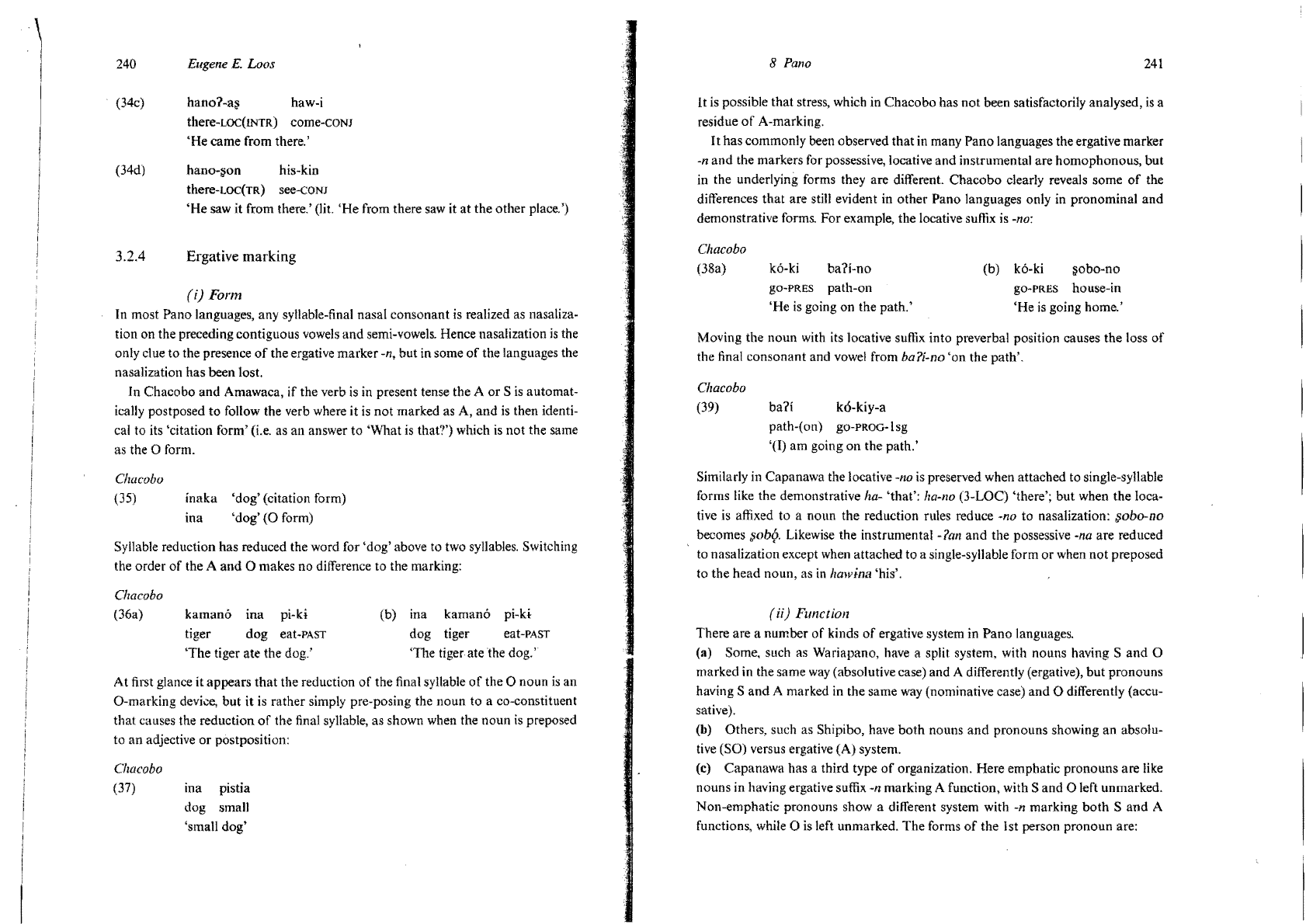
(33a)
mapí-ka?in-i
go.up-rapidlY(INTR)-CONJ
'He
goes up (the bank) rapídly.'
(33b)
bi?-ba?in-kin
wao?i?-kiran-i haw-i
cry-coming(
INTR)-CONJ
come-CONJ
'He
came crying.'
(33d)
his-binan-kin
bi
mi?i-yama-kin
see-coming(TR)-CONJ
but
tOllch-NEG-CONJ
'He
saw it as he carne but didn't tOllch it.'
3.2.3
Locative
phrases
Locutive phrases in sentences without a verb und locative phrases that relate to the I
O take
no
transitivitv
markin~.
Locative phrases relating to the souree
or
position
those that modifv S take intransítive marking.
hano
ta?
ki
there
DECL
FACT
'There he is.' (no verb present)
(34b) hano
?ano
his-kin
there majás
see-CONJ
'He
saw the majas (rodent) there.' (the locative modifies the O)
1
240
Eugene
E.
Loos
(34c)
hano?-a~
haw-i
there-LOC(lNTR)
come-CONJ
'He
carne from there.'
(34d)
hano-¡jon his-kin
there-Loc(TR)
See-CONJ
'He
saw it from there.'
'He
rrom there saw it
at
the other
piare')
3.2.4 Ergative marking
(i)
Form
In most Pano languages, any syllable-final nasal consonant
is
realízed as nasaliza-
tion on the preceding contiguous vowels and semi-vowels. Hence nasa.lization
is
the
only ctue to the presence
of
the ergative marker
-n,
but in sorne
of
the languages the
nasalizatíon has been lost.
In Chacobo
and
Amawaca, if the verb
is
in present tense the A or S
is
automat-
ically postposed to follow the verb where it
is
not marked as A, and
is
then identi-
cal to its 'citation form'
(Le.
as an answer to 'What
is
that?') which
is
not the same
as the O
formo
Chacobo
(35)
ínaka 'dog' (citation form)
ina
Syllable reduction has reduced the word for 'dog' aboye to two syllables. Switching
the order
of
the A
and
O makes no dilference to the marking:
Chacobo
(36a) kamanó ina pi-ki ina kamanó pi-ki
tiger dog
eat-PAST
dog tiger
eat-PAST
'The tiger ate the dog.'
'The tigerate
lhe
dog.'
At first glance it appears that the reduction
of
the final syllable
of
the O noun
is
an
O-marking
devi.::e,
but
it
is
rather
pre-posing the noun to a co-conslÍtuent
that causes the reduction
of
the final
as shown when the noun
is
preposed
lo
an
adjective or P05tposition:
Chacobo
(37)
ina pistia
dog srnall
'small dog'
8 Pano
241
lt
is
possible that stress, which in Chacobo has not been satisfactorily analysed,
is
a
resídue
of
A-marking.
1t has commonly been observed that in many Pano languages the ergative marker
-n
and
the rnarkers for possessive, locative and instrumental are homophonous, but
in the underlying forms they are different. Chacobo c1early reveals sorne
of
the
dilferences that are still evident in other Pano languages in pronominal
and
demonstrative forms. For example, the locative suffix
is
-no:
Chacobo
(38a) kó-ki ba1í-no (b) kó-ki
:¡obo-no
gO-PRES
path-on
gO-PRES
house-in
'He
is
going on the path.'
'He
is
going home.'
Moving the noun with lts locative suffix into preverbal posltion causes the
1055
01'
the final consonant and vowel from ba7í-no
'on
the path'.
Chacobo
(39) ba1í kó-kiy-a
path-( on)
gO-PROG-l
sg
'(1)
am going
on
the path.'
Sirnilarly in Capanawa the locative
-no
is
preserved when attached to single-syllable
forms like the demonstrative
ha- 'tha!': ha-no (3-LOC) 'there'; but when the loca-
tive
is
affixed
lo
a noun the reduction rules reduce -no to nasalization: {jobo-no
becomes
§ob{1.
Likewise the instrumental -7an and the possessive
-na
are reduced
to nasalizatiol1 except when attached to a single-syllable form
or
when not preposed
to Ihe head
nOUl1,
as
in
halVina 'his'.
(ii)
FUllctiol!
There are a number
of
kinds
of
ergative system in Pano languages.
(a) Sorne, such as Wariapano, have a split systern, with nouns having S
and
O
marked in the same
way
(absolutive and A dilferently (ergative),
but
pronouns
having S
and
A marked
in
the same
way
(nominative and O dilferently (acclJ-
sative).
(b) Others, such as Shipibo, have both nouns
and
pronouns showing an absolu-
tive (SO) versus ergative (A) system.
(e) Capanawa has a third type
of
organization. Here emphatic pronouns are like
nouns in having ergative suffix
-n marking A function, with S and O
len
unrnarked.
Non-emphatic pronouns show a dilferent system with
-n marking both S
and
A
functions, while O
is
left unrnarked. The forms
of
the 1st person prono
un
are:
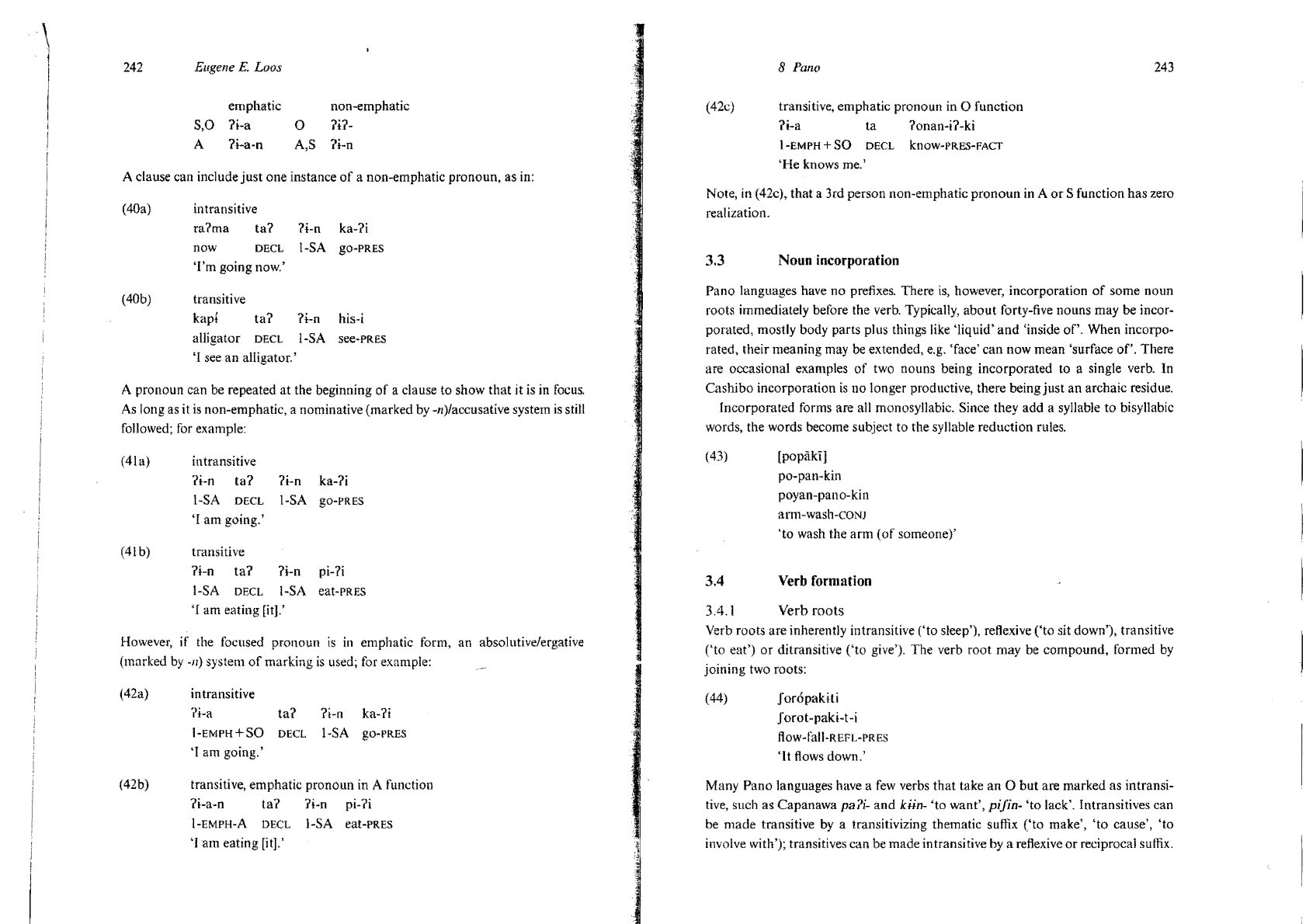
242
Ellgene
E.
Loos
emphatic
non-emphatic
.1
S,O
?t-a
O fi?-
A ?t-a-o A,S
fi-o
A dallse can
ind
ude
just
one instance
of
a non-emphatic pronoun, as
in:
(40a)
intransítive
ra?ma
ta?
?t-n ka-?i
now
DECL
loSA
gO-PRES
'{'m goíng now.'
transitive
kapt
tal
?i-n
his-i
alligator
DECL
I-SA
see-PRES
'1
see
an
alligator.'
A pronoun can be repeated at the beginning
of
a
c1allse
to show
that
it
is
in focus.
As long as it
is
non-emphatíc, a nominative (marked by -n)/accllsative system
is
still
followed; for example:
(4Ia) intransítive
'(t-n
ta?
?ton
ka-?i
I-SA
DECL
loSA
gO-PRES
'1
am goil1g.'
b)
transitive
?Í:-11
ta?
?Í:-n
pí-?i
I-SA
DECL
I-SA
eat-PRES
'[
am eating [it].'
However, ir lhe focused pronoun
is
in
emphatic lorm, an absolutive/ergative
(marked
by
-11)
system
of
marking
is
llsed; for example:
(42a)
intransitive
?i-a
ta?
?i-n
ka-?i
I-EMPH+SO
DECL
loSA
gO-PRES
'1
am going.'
(42b)
pronoun in A
fUl1ction
?i-a-n
ta?
?i-n
l-EMPH-A
DECL
loSA
eat-PRES
'1
am eating [it}.'
;J
j
'¡
'".,,"
8
Pano
243
(42c)
transitive, emphatic pronOlln in O fllnction
n-a
ta
?onan-i?-ki
I-EMPH
+SO
DECL
know-PRES-FACT
'He
kl10ws
me.'
Note, in (42c), that a 3rd person non-emphatic pronoun
in
A
or
S function has zero
realization.
3.3
Nouo
incorporation
Pano languages have
no
prefixes. There
is,
however, incorporation
of
sorne noun
roots immediately before the verb. Typieally, about forty-five nouns may be incor-
porated, mostly body parts plus things Iike 'Iiquid'
and
'inside
of'.
When ineorpo-
rated, their meaning may be extended, e.g. 'face' can now mean 'surface
0[',
There
are occasional examples
of
two nouns being incorporated to a single
verbo
In
Cashibo incorporation
is
no longer productive, there
beingjust
al1
arehaie residue.
lncorporated forms are all monosyllabic. Sinee they add a syllable
to
bisyllabic
words, the words become subiect to the svllable reduction rules.
(43)
[popakí]
po-pan-kin
poyan-pano-kin
arm-wash-coNJ
'to
wash the arm
(of
someone)'
3.4
Verb
formation
3.4.1
Verb
roots
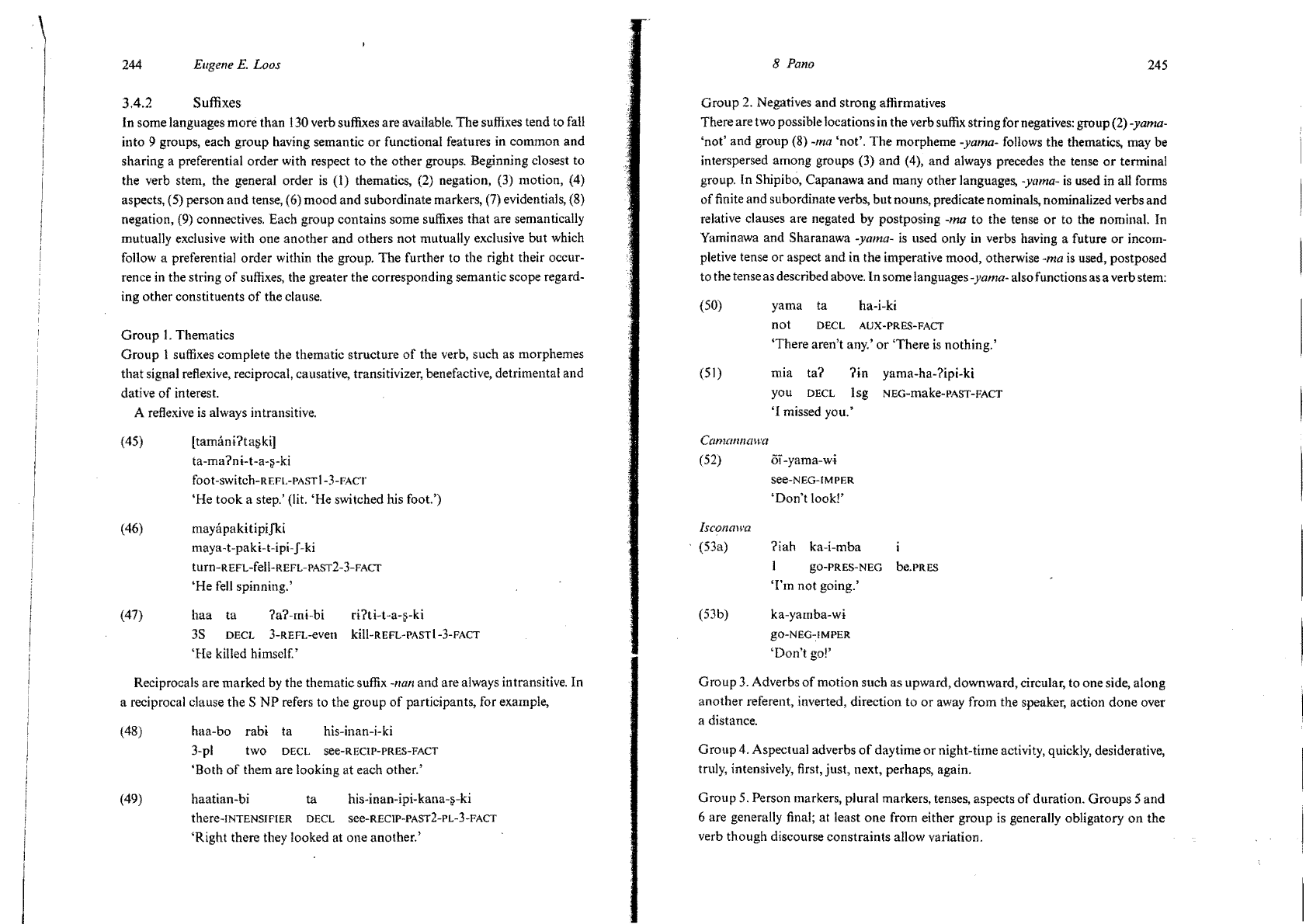
Verb roots are inherently intransitive ('to sleep'), reflexive ('to sit down'), transitive
('to
eat')
or
ditransitive
('to
The verb rool may be compound, formed
by
joining two roots:
(44)
forópakiti
forot-paki-t-i
ftow-fall-REFL-PR
ES
'It
flows down.'
Many Pano languages have a
few
verbs that take an O
but
are marked as intransi-
live, such as Capanawa
pali-
and
kiin-
'to
want', piJin-
'to
laek'. Intransitives can
be
made
transitive by a transitivizing thematíc suffix
('to
make',
'to
cause',
'to
involve transitives ean be made intransitive by a reflexive
or
reciprocal sllffix.
\
El/gene
E.
Loas
244
3.4.2 Suffixes
In
sorne languages
more
than
130 verb suffixes
are
available.
The
suffixes
tend
to
faH
into
9 groups,
each
group
having
semantie
or
functional features in
common
and
sharing
a preferential
order
with respect
to
the
other
groups. Beginning c10sest
to
the verb stem,
the
general
order
is (1) thematies, (2) negation, (3)
motion,
(4)
aspects, (5)
person
and
tense,
mood
and
subordinate
markers, (7) evidentials, (8)
negation,
(9) conneetives.
Eaeh
group
contains
some
suffixes
that
are semantically
mutually
exclusive with
one
another
and
others
not
mutually exclusive
but
whieh
follow a preferential
order
within the group.
The
further
to
the right their oceur-
renee in the string
of
suffixes, the greater the
corresponding
semantie
seope regard-
ing
other
eonstituents
of
the c1ause.
Group
l.
Thematics
Group
I suffixes
complete
the
thematie
structure
of
the verb,
such
as
morphemes
that
signal retlexive, reciprocal, causative, transitivizer, benefactive, detrimental
and
dative
of
interest.
A reflexive is always íntransitive.
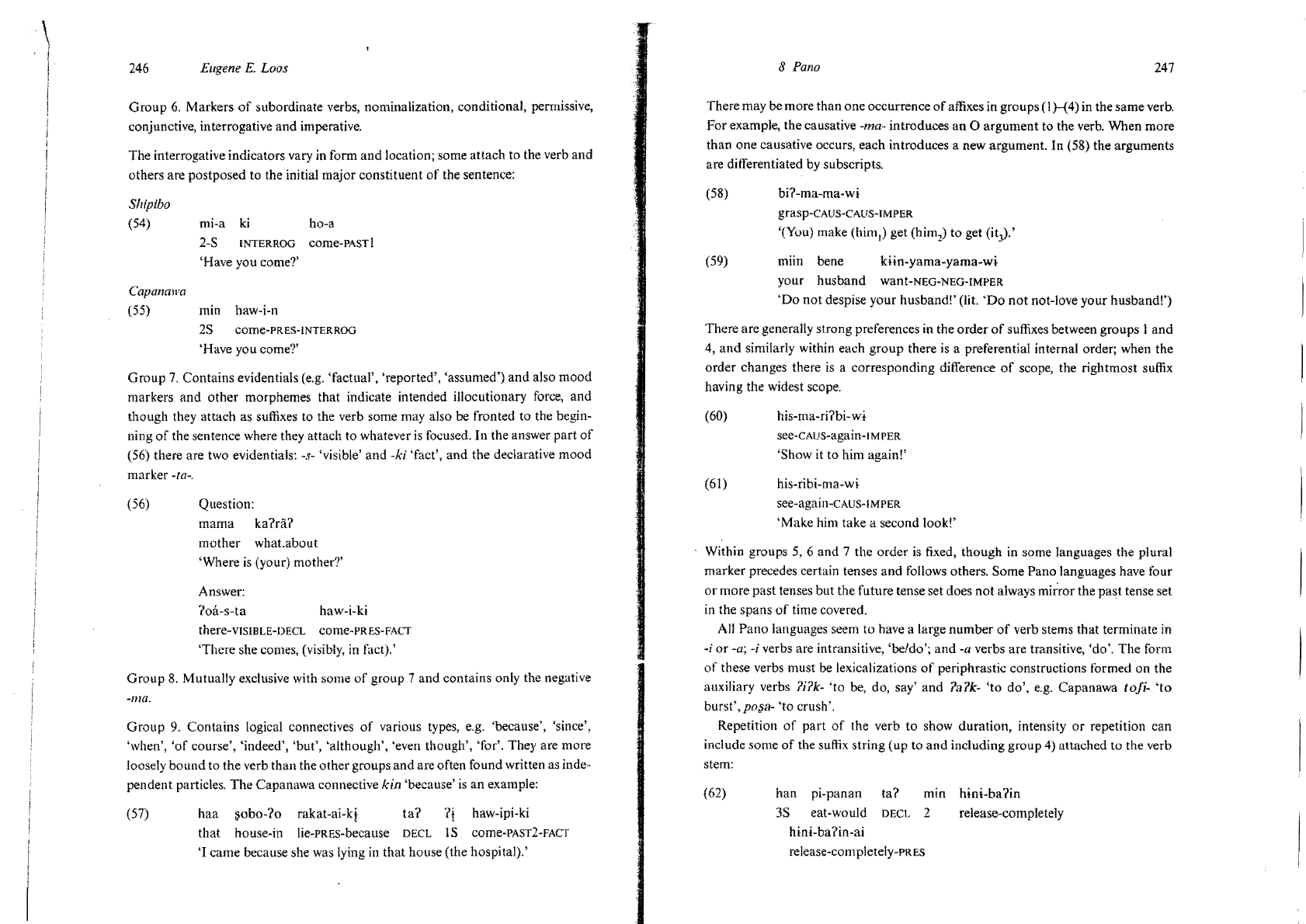
(45)
[tamánt?ta~ki]
ta-ma
?ni-t-a-1?-ki
foot-switch-REFI.-PASTI-3-FACT
'He
took
a step.' (lit.
'He
switched his foot.')
(46)
mayápakitipiJki
maya-t-paki-t-ipí-J-ki
turn-REFL-fell-REFL-PAST2-3-FACf
'He
fel!
spinning.
haa
ta
í'aí'-mi-bi
ri?ti-t-a-~-ki
3S
OECL
3-REFL-eVen
kill-REFL-PASTI-3-FAcT
'He
killed himself.'
Reciprocals
are
marked
by the
thematic
suffix
-nan
and
are
always intransitive.
In
a reciprocal c1ause
the
S
NP
refers to
the
group
of
participants, for example,
(48)
haa-bo
rabi
la
his-inan-í-ki
3-pl
two
DECL
see-RECIP-PRES-FACf
'Both
of
Ihem
are
at
each
other.'
haatian-bi
ta
his-inan-ipi-kana-~-ki
there-INTENSlf'IER
DECL
see-RECIP-PAST2-PL-3-FACf
'Right
there
they looked
at
one
another.'
8
Pano
245
Group
2. Negatives
and
strong
affirmatives
There
are
two possible locations in
the
verb suffix string for negatives:
group
(2)
-yama-
'not'
and
group (8)
-ma
'not'o
The
morpheme
-yama- follows the thematics, may
be
interspersed
among
groups (3)
and
(4),
and
always precedes the tense
or
terminal
group.
In
Shipibo,
Capanawa
and
many
other
languages,
-yama-
is
used
in
all forms
of
finite
and
subordinate verbs,
but
nouns,
predicate nominals, nominalized verbs
and
relative c1auses
are
negated by
postposing
-ma
to
the tense
or
to
the
nominal.
In
Yaminawa
and
Sharanawa
-yama-
is
used only in verbs having a future
or
incom-
pletive tense
or
aspect
and
in
the
imperative
mood,
otherwise
-ma
is
used,
postposed
to
the tense
as
described
above.In
some
languages -yama- also functions
as
a verb stem:
yama
ta
ha-i-ki
not
DECL
AUX-PRES-FAC.j
'There
aren't
any.'
or
'There
is
nothing.'
(51)
mía
ta?
?in
yama-ha-?ipi-ki
you
DECL
lsg
NEG-make-PAST-FACT
'1
missed
you.'
CamclIlnawa
(52)
See-NEG-IMPER
'Don't
look!'
(53a)
í'¡ah
ka-i-mba
gO-PRES-NEG
Tm
not
going.'
be.PRES
(53b)
ka-yamba-wi
gO-NEG~IMPER
'Don't
gol'
3.
Adverbs
of
motion
such
as
downward,
circular,
to
one
side,
along
another
referent,
direction
to
or
away
from
the
speaker, action
done
over
a distance.
Group
4.
Aspectual
adverbs
of
daytime
or
night-time
activity, quickly, desiderative,
truly, intensively, first,
just,
next, perhaps, again.
Group
5.
Person
markers,
plural
markers, tenses,
aspects
of
duration.
Groups
5
and
6
are
generally final;
at
least
one
from
either
group
is generalIy obligatory
on
the
verb
though
diseourse
constraints
allow variation.
\
¡
El/gene
E.
Loos
246
Group
6.
Markers
of
subordinate verbs, nominalization, conditional, permissive,
conjunctive, illterrogative
and
imperative.
The
interrogative indicators vary
in
form
and
location; sorne
attach
to
the verb
and
others are postposed to the ¡nitia!
major
constituent
of
the sentence:
Sltipibo
(54) mi-a
ki
ho-a
2-S
INTERROG
come-PASTI
'Have you come?'
Capanall'Q
(55) min haw-i-n
2S
come-PRES-INTERROG
'Have
you come?'
Group
7.
COl1tail1s
evidentials (e.g.
'factuar,
'reported',
'assumed')
and
also
mood
markers
and
other
morphemes that indicate
in
tended iIIocutionary force,
and
though they attach
as
suffixes to the verb sorne may also be fronted
to
the begin-
ning
of
the
sentence where they attach
lo
whatever
is
focused.
In
the answer
part
of
there are two evidentials:
-s-
'visible'
and
-ki 'fact',
and
the
declarative
mood
marker
-la-o
(56) Question:
mama
ka?rii?
mother
what.about
'Where is mother?'
Answer:
?oá-s-ta
haw-i-ki
there-VISIBLE-DECL
come-PRES-FACT
'There
she comes,
in
fact).'
Group
8.
Mutually exclusive with so me
of
graup
7
and
contains
only the negative
-n/a.
Group
9.
Contains
logical connectives
of
various types, e.g. 'because', 'since',
'when',
'of
course',
'indeed',
'but',
'although',
'even though', 'for'. They are
more
loosely
bound
to
the
verb than the
other
groups
and
are often found written as inde-
pendent particles.
The
Capanawa
connective kin 'becallse'
is
an
example:
(57)
haa
;?obo-?o rakat-ai-kt
ta?
?i
haw-ipi-ki
that house-in lie-PREs-because
DECL
IS
come-PAST2-FACT
'1
carne beca use she was in that house
hospital).'
8 Pano
247
There may be
more
than
one
occurrence
of
affixes in groups
(l)-{
4) in
the
same
verbo
For
example,
the
causative -ma- introduces
an
O
argument
to
the
verbo
When
more
than
one
causative occurs, each introduces a new argumento In (58) the
arguments
are differentiated by subscripts.
(58) bi?-ma-ma-wi
grasp-CAUS-C
AUS-TMPER
'(You) make (him¡) get
to
get (it
3
).'
miin bene
kHn-yama-yama-w.
your
husband
want-NEG-NEG-IMPER
'Do
not
despise
your
husband!'
(lit.
'Do
not
not-Iove
your
husband!')
There
are generally strong preferences in the
order
of
suffixes between groups 1
and
4,
and
similarly within each
group
there is a preferentíal internal arder; when the
order
changes thefe
is
a
corresponding
difference
01'
seo pe, the rightmost suffix
having the widest scope.
his-ma-ri?bi-wf
see-cAus-again-IMPER
'Show
it
to
him
(61)
his-ribi-ma-wi
see-again-cAuS-IMPER
'Make
him take a second ¡ook!'
Within groups 5, 6
and
7 the
order
is fixed,
though
in sorne languages the plural
marker
precedes certain tenses
and
follows others. Sorne
Pano
languages have
tcur
or
more
past tenses but the future tense set does
not
always mirror the
past
tense sel
in
the
spans
of
time covered.
AII
Pano
languages seem
to
have a large
number
of
verb stems that termínate in
-i
or
-a; -i verbs
are
intransitive,
'beldo';
and
-a verbs are transítive,
'do'.
The
form
of these verbs must be lexicalizations of periphrastic constructions
tormed
on
the
auxiliary verbs
?i?k-
'to
be, do, say'
and
?a7k-
'to
do',
e.g.
Capanawa
tofi-
'to
burst',po~a-
'to
crush'.
Repetition
af
part
of
the
verb
to
show
duratíon,
intensity
or
repetition can
include sorne
of
the suffix string
(up
to
and
including
group
4) attached
to
the
verb
stem:
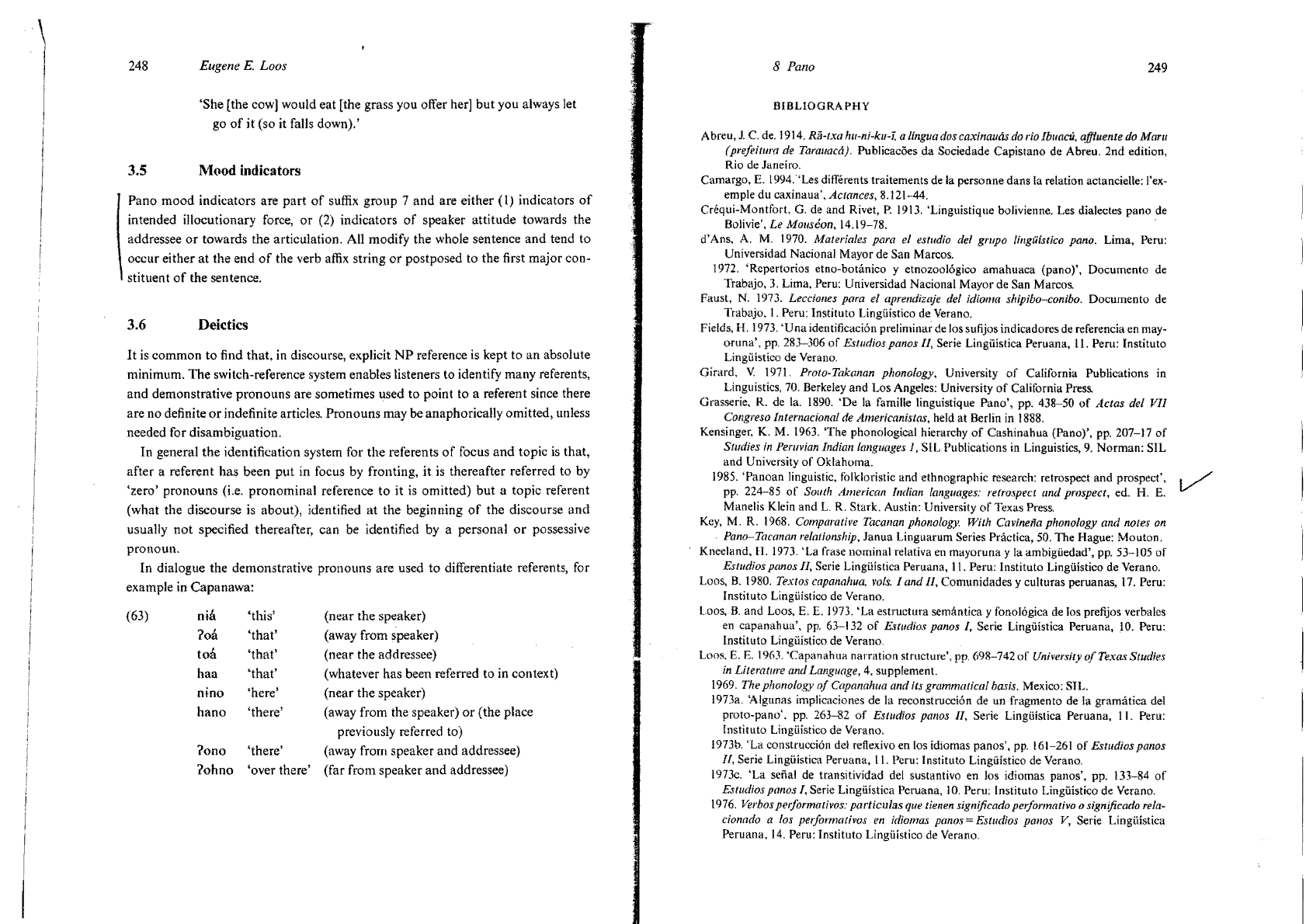
(62)
han
pi-pana n
ta?
min
hini-ba?in
3S eat-would
DECL
2
release-completely
hini-ba?in-ai
release-completelY-PRES
248
Eugelle
E.
Loas
'She [the
cow)
would eat [the grass you olfer her) but you always let
go
of
it
(so it falls down).'
3.5 Mood indicators
Pano mood indicators are part
of
suffix
group 7 and are either (1) indicators
of
intended iIIocutionary force,
or
(2) indicators
of
speaker attitude towards the
addressee
or
towards the articulation. All modify the whole sentence and tend to
oceur either at the end
of
the verb
affix
or
postposed to the first major con-
\
sti tuen t
of
the sen tence.
3.6 Deictics
It
is
eommon
to
find that, in discourse, explicit
NP
reference
is
kept to an absolute
minimum. The switeh-referenee system enables Iisteners to identify many referents,
and demonstrative pronouns are sometimes used to point to a referent since there
are no definite
or
indefinite artides. Pronouns may be anaphorieally omitted, unless
needed for disambiguation.
In general the identifica
tia n system for the referents
of
focus and topic
is
that,
after a referent has been
put
in focus by fronting, ít
is
thereafter referred to by
'zero' pronouns
(Le.
pronominal relerenee to it
is
omitted) but a topie referent
the discourse is about), identified
al
the beginning
of
the discourse and
not specified can
be
identified by a personal
or
possessive
pronoun.
In dialogue the demonstrative pronouns are used to differentiate referents,
for
example
in
Capanawa:
(63)
niá
'this' (near the speaker)
?oá
'that'
(away
from speaker)
toá
'that'
(near the addressee)
haa
'that' (whatever has been referred to
in
context)
nino
'here'
(near the speaker)
hano
'there' (away from the speaker)
or
(the place
previollsly referred to)
10no 'there' (away from speaker and addressee)
?ohno
'over there'
(far from speaker and addressee)
8
Pano
249
BIBLIOGRAPHY
Abreu,
J.
C.
de.
1914.
RiI-lxa Iru-ni-ku-Í. a língua dos caxinauás
do
rio Ibl/acú, ajJluente do Maru
(preftitum de Taral/acá).
Publicacoes da Sociedade Capislano de Abreu. 2nd edítion,
Rio de Janeiro.
Camargo, E. 1994."'Les différents traitements de
la
personne dans
la
relatíon actancielle: I'ex-
emple du caxinaua',
Actallces, 8.121·-44.
Créqui-Montfort,
G.
de and Rivet,
P.
1913.
'Linguistique bolivienne. Les dialectes pano de
Bolivie',
Le
Mouséon, 14.19-78. .
d'Ans,
A.
M.
1970.
Materiales para el estudio del grupo lingUistica pano. Lima, Peru:
Universidad Nacional Mayor de San Marcos.
1972.
'Repertorios etno-botánico y etnozoológico amahuaca (pano)', Documento de
Trabajo,
3.
Lima, Peru: Universidad Nacional Mayor de San Marcos.
Faust,
N.
1973. Lecciones para el aprendizaje del idioma shipibo-conibo. Documento de
Trabajo,
l.
Peru: Instituto Lingüístico de Verano.
Fields, H.
1973.
'Una
identificación preliminar de los sufijos indicadores de referencia en may-
oruna', pp. 283-306
of
Estudios panas Il, Serie Lingüística Peruana,
11.
Peru: Instituto
Lingüístico de Verano.
Glrard,
V.
1971.
Proto-Takanan phollology, University
of
California Publications in
Linguistics,
70.
Berkeley and Los Angeles: University
of
California
Press.
Grasserie, R. de
la.
1890.
'De
la
famille linguistique P.ano', pp. 438-50
of
Actas del
VII
Congreso Internacional de Americanistas, held al Berlin
in
1888.
Kensinger, K. M.
1963.
'The phonological hierarchy
of
Cashinahua (Pano)', pp. 207-17
of
Studies
in
Peruvian Indian langu(lges 1, SIL Publications in Linguistics, 9. Norman: SIL
and University
of
Oklahorna.
1985.
'Panoan linguistic, lolkloristíc and ethnographic research: retrospect and prospect',
pp. 224-85
of
SOl/tI!
American
[nclian
languages: retrospect (md pmspect, ed. H.
E.
v
Manelis Klein and L. R. Stark. Austin: University
01'
Texas
Press.
Key,
M.
R.
1968.
Comparative T(lcanan phonology. With Cav;nen(l phonology am/llOles
on
Pallo--Tacanan relationslrip, Janua Linguarurn Series Práctica,
50.
The Hague: Mouton.
Kneeland.
1I.
1973.
'La frase nominal relativa
en
mayoruna y la ambigüedad', pp. 53-105 of
Estudios pailas 1I, Serie Lingüística Peruana,
11.
Peru: Instituto Lingüístico de Verano.
Loas,
B.
1980.
Textos capanahua,
vols.
[and
1I, Comunidades y culturas peruanas,
17.
Peru:
Instituto Lingüístico de Verano.
Loos,
B.
and Loas,
E. E.
1973.
'La estructura semántica y fonológica de los prefijos verbales
en
capanahua',
pp.
63-132
of
Estudios panos
1,
Serie Lingüística Peruana,
.10.
Peru:
Instituto Lingüístico de Verano.
Loos.
E.
E.
1963.
'Capanahna Ilarration structure',
pp.
698-742
of
University
ofTexas
Studies
in
Litera/l/re ami Language, 4, supplement.
1969. Tlle phonology
of
Capanallua and ils grammaticlll
ba~is.
Mexico: SIL.
1973a. 'Algunas implicaciones de la reconstrucción de un fragmento de la gramática del
proto-pano'. pp. 263-82
of
ESlUdios panas [l, Serie Lingüística Peruana, I L Peru:
Instituto Lingüístico de Verano.
1973b.
'La construcción del reflexivo en los idiomas panas',
pp.
161-261
of
Estudios palios
JI, Serie Lingtiística Peruana, 1 L Peru: 1 nstituto Lingüístico de Verano.
I 973c.
'La
señal de transitividad del sustantivo en los idiomas panas', pp. 133-84
of
ES/lidios panas l, Serie Lingüística Peruana.
10.
Peru: Instituto Língüístico de Verano.
1976. Verbos pe/formativos: particulas que tienen significado performativo o significado rela-
cionado a los pe/formativos
en
idiomas panos = Estudios pailas
V,
Serie Lingüística
Peruana,
14.
Peru: Instituto Lingüístico de Verano.
\
¡
250
El/gene
E.
Loos
1986.
'Capanahua
syllable restructuring in relation to comparative studies', pp. 291··301
of
Langllage
in
global perspective: papers
in
hono/'
al
the 50th anniversary
ol
the
SIL
1935-1985, ed.
B.
Elson. Texas: SIL.
Loriot,
1.,
Lauriau[t, E.
and
Day, D. [993. Diccionario Shipibo-Castellano, Shipibo, Serie
Lingüística
Peruana,
31.
Pene
Instituto Lingüístico de Verano.
Montag, R. 1973.
'La
estructura
semántica
de
las relaciones entre frases verbales en
cashinahua',
pp. 107-57
of
Estudios panos
ll,
Serie Lingüístíca Peruana,
11.
Peru:
Instituto Lingüístico
de
Verano.
Montag,
S.
1981.
Diccionario
cas/¡inahua,
vol.
1,
Serie Lingüística
Peruana,
9. Peru: Instituto
Lingüístico
de
Verano.
Navarro, R.
P.
F.
M.
1903.
Vocabulario
castellano-quechua-pano.
con
sus
respectivas gramá/i-
cas
quechua
y
pana.
Lima: Imprenta del Estado. (Reprinted
in
d'
Ans
1970.)
Parkcr,
S.
G.
1992.
Datos
del
idioma
hllariapano.
Documento
de trabajo,
24.
Peru: Instituto
Lingüístico de Verano.
1994.
'Coda
epenthesis in
Huariapano',
!JAL.
60.95-119.
Prost. G
and
Prost, M. 1962. 'Signalling of transitive
and
intransitive in
Chacobo
(Pano)',
IJAL,28.108-18.
Russell. R. 1975.
Una
gramática tmllslormac/ol1al del
amahuaca""J:,"studios
panas IV, Serie
Lingüística Peruana,
13.
Peru: Instituto Lingüístico de Verano.
Scott.
E.
and
Frantz, D. G. 1973.
'La
pregunta en
sharanahua
y constreñimientos propuestos
sobre la permutación
de
la pregunta', pp. 185-209
of
Estudios panos
1,
Serie Lingüística
Peruana,
10.
Peru: Instituto Lingüístico de Verano.
Shell.
O.
A.
1957.
'Cashibo
II: grammemic analysis
of
transitive
and
intransitive verb
pat-
terns',
!JAL,
28.179--218.
1965.
'Pano
reconstruction', Ph.D. díssertation, Univcrsity
of
Pennsylvania. Published in
1975 as
Las lenguas
palio
y
su
/"ecolIsll'llcción
=
ESllIdios
pailas
fl!,
Serie Lingüística
Pemana.
12. Peru: Instituto Lingüístico
de
Verano.
1973.
'Los
modos
del cashibo y el análisis del performativo·, pp. 23-62
of
Estudios panas
1,
Serie Lingüística
Peruana,
10. Pem: Instituto Lingüístico de Verano.
1987.
Vocabulario
cashibo-cacataibo, Serie Lingüística Peruana, 23. Peru: Instituto
Lingüístíco de Verano.
Young de Hyde,
S.
1973. 'El verbo reflexivo del
amahuaca',
pp. 9-51
of
ESllldios pailas
/l.
Serie
LingUística Peruana,
11.
Peru: Instituto Lingüístico de Verano.
1980.
Diccionario amllhullca. Serie Lingüística Peruana,
7.
Peru: Instituto Lingüístico de
Verano.
9
Makú
SI LVANA
AND
VALTEIR
MARTINS
1
The
Makú
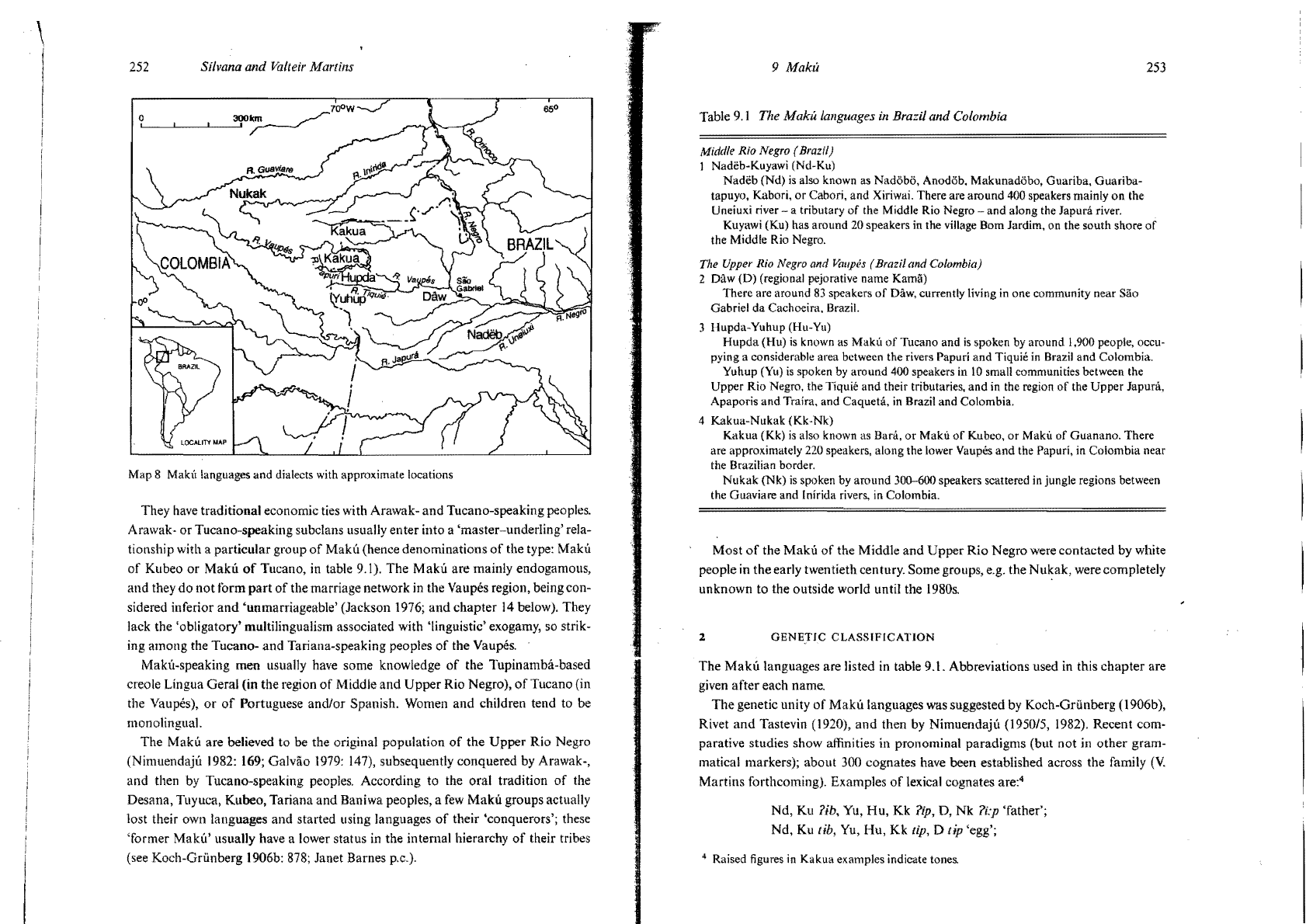
family eonsists
of
four languages belonging to seven
tTibes
- see table
9.1.
One
is
spoken around the Middle Rio Negro in
Sranl,
with the others ranging
from the U pper Rio Negro to the region
of
the Vaupés and Japurá spanning Brazil
and
Colombia (see map
8).
2
The two groups belong to different linguistie areas and
ditTer
in
their grammatieal strueture.
The
Makú
J
are nomadic hunters and gatherers. They have a
10w
soeio-eeonomic
status among other indigenous peoples
of
the speakers
of
Arawak and
Tueano languages, who specialize in slash-and-burn agriculture. The
Makú
live in
sma1l
groups along little streams, avoíding rivers, and províding their
bOllrs
wilh fish-poison (timbó) and game, receíving manioc in exchange. Asjungle
dwellers, they are believed to possess supranatural magical power. Like the Pygmies
in Africa, they are des
pi
sed and fea red at the same time.
We
are
grateful
to
Elias Coelho ror
Puínave-spoken
in the regíon
of
the Inirida river in
Colombia
(see
chapter
13
below) has
sometimes
beenlinked
to
Makú,
as
a Makú·Puinave famíly. In fact, no genetic relationship
between
Makú
languages
and
Puinave has as yel becn proven.
3
The
lerm
'Makú'
is
used as a pejorative term lor
Indians
in the regional varieties
of
Portuguese spoken
in
lhe
Upper
Rio Negro. This
term
may
be
01'
Arawak
ing
10 Koch-Grünberg (190Gb: 877) the ter m was tirst uscd by Arawak peoplcs with refcr-
cncc
to
lhe
original nomadic population.
cf.
Baniwa-Kurripako ma-aku (negation-speak)
'those
who
cannot
spcak'
(also see Weír 1984: 15).
Makú
languages considered here should
nol
be confused with the following
other
groups
to
which this
na
me
is
sorne times applicd:
(i)
Makú,
or
Máku,
ao cnd,\ngered language spoken by a
few
old people
on
the
river Auari, tributary
of
the Uraricoera which Ilows into the Río Branco,
Roraima, Brazil (see Migliazza 1985) this is bríelly discussed in
§1.6of
chapter
3 below;
(ii) Mako, also known as
Cofán-Makú,
spoken
around
the lake
of
Cuyabeno, in
Colombia
and
Ecuador
(Ihis
fa
lis oulside Amazonia);
(iií)
Makú,
also known as Sáliba-Maco,
or
Maco-Piaroa, which
is
a
group
of
the
Sáliba-Piaroa family (see
§3
of
chapler
13
below), spokcn in the savannas
between the lower Ventuari and Orinoco in Venezuela.
I
\
252 Si/l'ana
and
Valteir Martins
o
I
3!1O~700W
65
0
Map
8
Makú
languages
and
díalects with approximate locations
They have traditional economic ties with Arawak-
and
Tucano-speaking peoples.
Arawak- or Tucano-speaking subclans usually enter ¡nto a 'master-underling
'
rela-
tionshi p with a particular group
of
Makú (hence denominations
of
the type: Makú
of
Kubeo or Makú
of
Tucano,
in
table 9.1). The Makú are maínly endogamous,
and they do not form
part
of
the marriage network
in
lhe Vaupés regíon, being con-
sidered inferior
and
'unrnarriageable' (Jackson 1976;
and
chapter
14
below). They
lack the 'obligatory' rnultilingualísrn associated wíth 'linguistic' exogarny,
so
strik-
ing among the Tucano- and Tariana-speaking peoples
of
the Vaupés.
Makú-speaking men usually have sorne knowledge
of
the Tupinambá-based
creole Língua Geral (in the region
of
Middle and Upper Rio Negro),
of
Tucano
the Vaupés),
or
of
Portuguese and/or Soanish. Women
and
children tend to be
The Makú are believed
to
be the original population
of
the Upper Río Negro
(Nirnuendajú
1982:
169;
Galvao
1979:
147),
subsequently conquered by Arawak-,
and then by Tucano-speaking peoples. According to the oral tradition
of
the
Desana, Tuyuca, Kubeo, Tariana
and
Baniwa peoples, a
few
Makú groups actually
lost theír
OWt1 languages and started lIsing languages
of
their 'conquerors'; these
'forrner Makú' llsually have a lower status
in
the internal hierarchy
of
their tribes
(see Koch-Grünberg 1906b:
878;
Janet Barnes
9 Makú
253
Table
9.1
The Makú languages
in
Brazil and Colombia
Middle Río
Negro
(Brazil)
1 Nadeb-Kuyawi (Nd-Ku)
Nadeb
(Nd)
is
also known as NadobO, Anodiíb.
Makunadiíbo,
Guariba.
Guariba-
tapuyo, Kabori,
or
Cabori.
and
Xiriwai. There
are
around
400 speakers mainly
on
the
Uneiuxi ríver - a tributary
of
the Middle Rio Negro
and
along the
Japurá
river.
Kuyawi (Ku)
has
around
20 speakers in
lhe
village
Bom
Jardim, on the
south
shore
of
the Middle Río Negro.
The
Upper
Río Negro and
Vaupés
(Brazil and Colombia)
2
Dáw
(D)
(regional pejorative
name
Kama)
Therc
are
around
83 speakers
of
Daw, currently living
in
one
community near
Sao
Gabriel
da
Cachoeira, Brazil.
3 I1upda-Yuhup (Hu-Yu)
Hupda
(Hu)
is
known as
Makú
of
Tucano
and
is spoken by
around
1,900
people. oceu-
pying a considerable area bctwecn the rivers
Papud
and
Tiquié in Brazil
and
Colombia.
Yuhup
(Yu)
is
spoken by
around
400 speakers in
10
small communities between the
Upper
Rio
Negro, ¡he Tiquié
and
their tributaries,
and
in ¡he region
of
the
Upper
Japurá,
Apaporis
and
Traíra.
and
Caquetá.
in Brazil
and
Colombia.
4
Kakua-Nukak
(Kk-Nk)
Kakua
(Kk)
is
also known as Bará,
or
Makú
or
Kubeo,
or
Makú
of
Guanano.
There
are
approxirnately
220
speakers, along the lower Vaupés
and
the Papurí. in
Colombia
near
the Brazilian bordcr.
Nukak
(Nk)
is
spoken by
around
300--600
speakers scattered in jungle regions between
the Guaviare
and
Inírida rivers, in Colombia.
Most
of
Ihe Makú
of
the Middle and Upper Río Negro were contacted by white
people in the early twentieth century. Sorne groups, e.g. the Nllkak, were completely
lInknown to the outside world until the
19805.
2
GENETIC
CLASSIFICATlON
The
Makú
languages are listed
in
table 9.1. Abbreviations used
in
this chapler are
after each name.
The
genetic unity
of
Makú
langllages
was
suggested by Koch-Grünberg (1906b),
Rivet
and
Tastevin (1920),
and
then by Nirnuendajú (1950/5,
1982).
Recent corn-
parative studies show affinities in pronominal paradígms (but not in
other
gram-
rnatical markers); about 300 cognales have been established across the farnily
Martins forthcoming). Examples
of
lexical cognates are:
4
Nd,
Ku
7ib,
YlI,
Hu, Kk
7ip,
D, Nk
7i:p
'father';
Nd,
Ku
lib,
Yu,
Hu, Kk tip, D tip 'egg';
4 Raised figures in
Kakua
examples indicate tones.