
Dixon R.M.W., Aikhenvald Alexandra Y. The Amazonian Languages (Cambridge Language Surveys)
Подождите немного. Документ загружается.

254
Si/vana and Va/leír Marlins
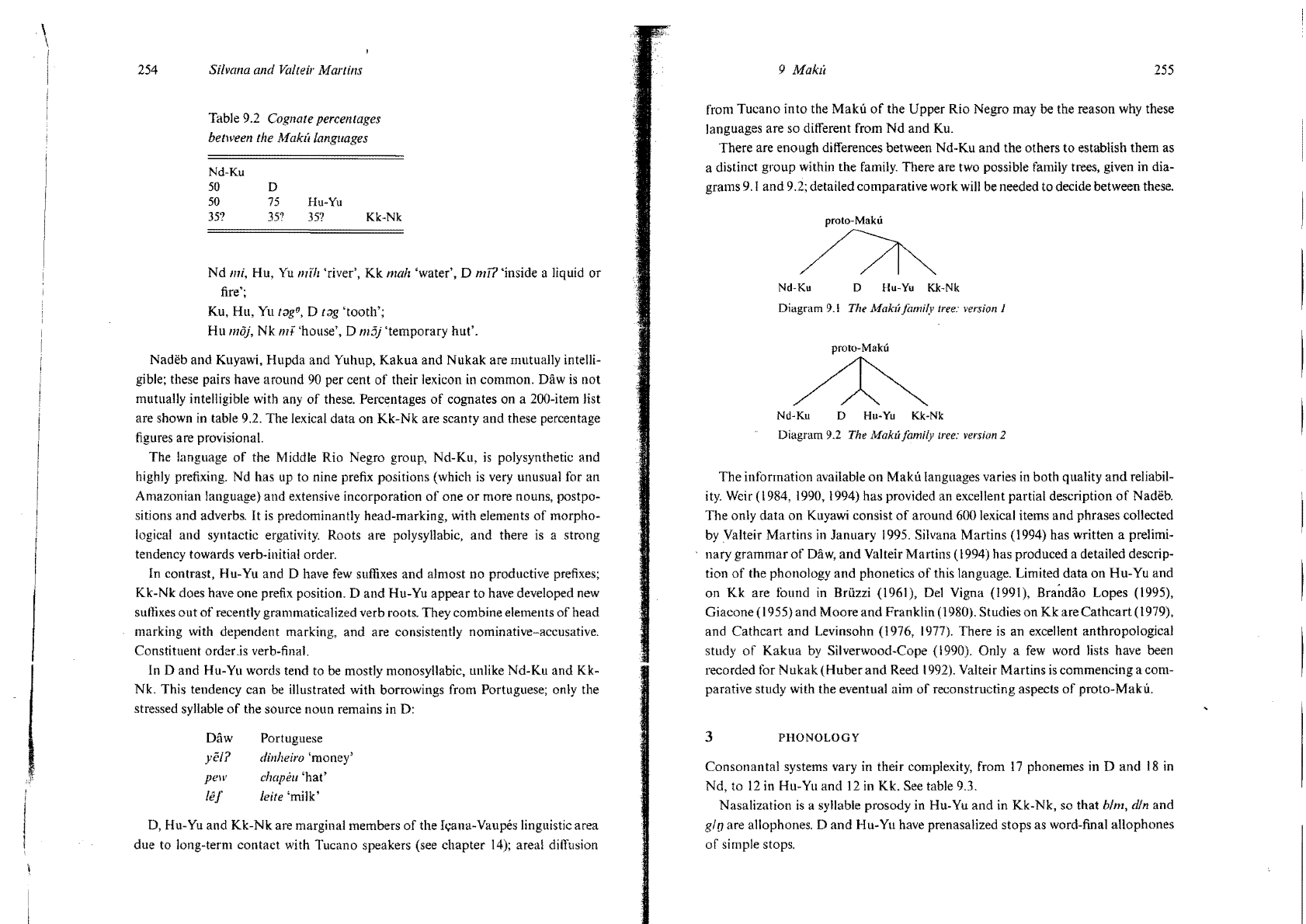
Table 9.2 Cognate percelltages
between the
Makú
languages
Nd-Ku
50
D
50
75
Hu-Yu
351
35?
351
Kk-Nk
Nd
mi,
Hu,
Yu
mIli
'river"
Kk
mah 'water', D
mil
'inside a
or
fire';
Ku,
Hu,
Yll t;JgO, D
tdg
'tooth';
Hu
moj,
Nk
mi
'house', D m5j
'temporary
hut'.
Nadeb
and
Kllyawi,
Hupda
and
Yllhllp,
Kakua
and
Nukak
are Illutually intelli-
gible; these pairs have arollnd 90 per cent
01'
their Jexicon
in
common.
Daw
is
not
mlltllally intelJigible with any
of
these. Percentages
of
cognates on a 2oo-item list
are shown in table 9.2.
The
lexical
data
on
Kk-Nk
are scanty
and
these percentage
figures are provisional.
The
language
of
the Middle
Rio
Negro grollp,
Nd-Ku,
is
polysynthetic
and
prefixing.
Nd
has
up
to
nine prefix positions (which is very unusllal for an
Amazonian
language)
and
extensive incorporation
of
one
or
more
nouns, postpo-
sitions
and
adverbs.
It
is predominantly head-marking, with elements
01'
morpho-
and
syntactic Roots
are
polysyllabic,
and
thefe is a strong
tendency towards verb-initial order.
In contrast,
Hu-Yu
and
D have few suffixes
and
almost
no
productive
Kk-Nk
does have
one
prefix position. D
and
Hll-Yu
appear
to
have develooed new
suftixes
out
01'
recently grammaticalized verb roots. combine elements
01'
head
marking with dependent marking,
and
are consistently nominative-accusative.
Constituent order,is verb-final.
In
D and Hu-Yu words tend to be mostly monosyllabic, unlike
Nd-Ku
and
Kk-
Nk.
This tendency can be ilIustrated with borrowings from Portuguese; only the
stressed syllable
of
the source
noun
remains in D:
Dáw
Portuguese
yí!:l?
dinheiro
'money'
peIV
clwpéu
'ha!'
[eile 'milk'
D, Hu-
Yu
and
Kk-Nk
are marginal members
of
the
I¡;ana-Vallpés linguistic area
due
lo
lone:-Ierm
contact
with Tucano speakers (see
chapter
areal dilfusion
9
Makú
255
from
Tucano
ínto
the
Makú
of
the
Upper
Rio
may be the reason
these
languages
are
so
different from
Nd
and
Ku.
There
are enough differences between Nd-Ku
and
the others
to
establish them as
a distinct
group
within
the
family.
There
are two possible family trees, given in día-
grams
9.1
and
9.2; detailed comparative work
wilJ
be needed to decide between these.
proto-Makú
~
Nd-Ku D
Hu-Yu
Kk-Nk
Diagram
9.1
The MaklÍjámi(v
free:
version J
proto-Makú
~
Nd-Ku
D
Hu-Yu
Kk-Nk
Diagram 9.2 The
Makúfamily
free:
version 2
The
infonnation
available
011
Makú
varíes
in
both
quality
and
relíabil-
ity.
Wcir (1984, 1990, 1994)
has
provided an excellent partíal description
of
Nadeb.
The
only
data
on
Kuyawi consist
of
around
600
lexical items
and
phrases collected
by Valteir
Martins
in
January
1995. Silvana
Martins
(1994) has written a prelimi-
nary
grammar
of
Dáw,
and
Valteir
Martins
(1994) has prodllced a detailed descrip-
tion
of
the phonology
and
phonetics
of
this language. Limited
data
on
Hu-
Yu
and
on
Kk
are
found in Brüzzi (1961), Del Vigna (1991), Brandao Lopes (1995),
Giacone
(1955)
and
Moore
and
Franklin
(1980). Studies
on
Kk
are
Cathcart
(1979),
and
Cathcart
and
Levinsohn (1976, 1977).
There
is an excellent anthropological
of
Kakua
by Silverwood-Cope (1990). Only a
few
word lists have been
recorded for
Nukak
(Huber
and
Reed 1992). Valteir
Martins
is
commencing
a com-
parative
study
with the eventual aim
of
reconstructing aspects
of
proto-Makú.
3
PHONOLOGY
Consonan
tal systems vary in
their
complexity, from
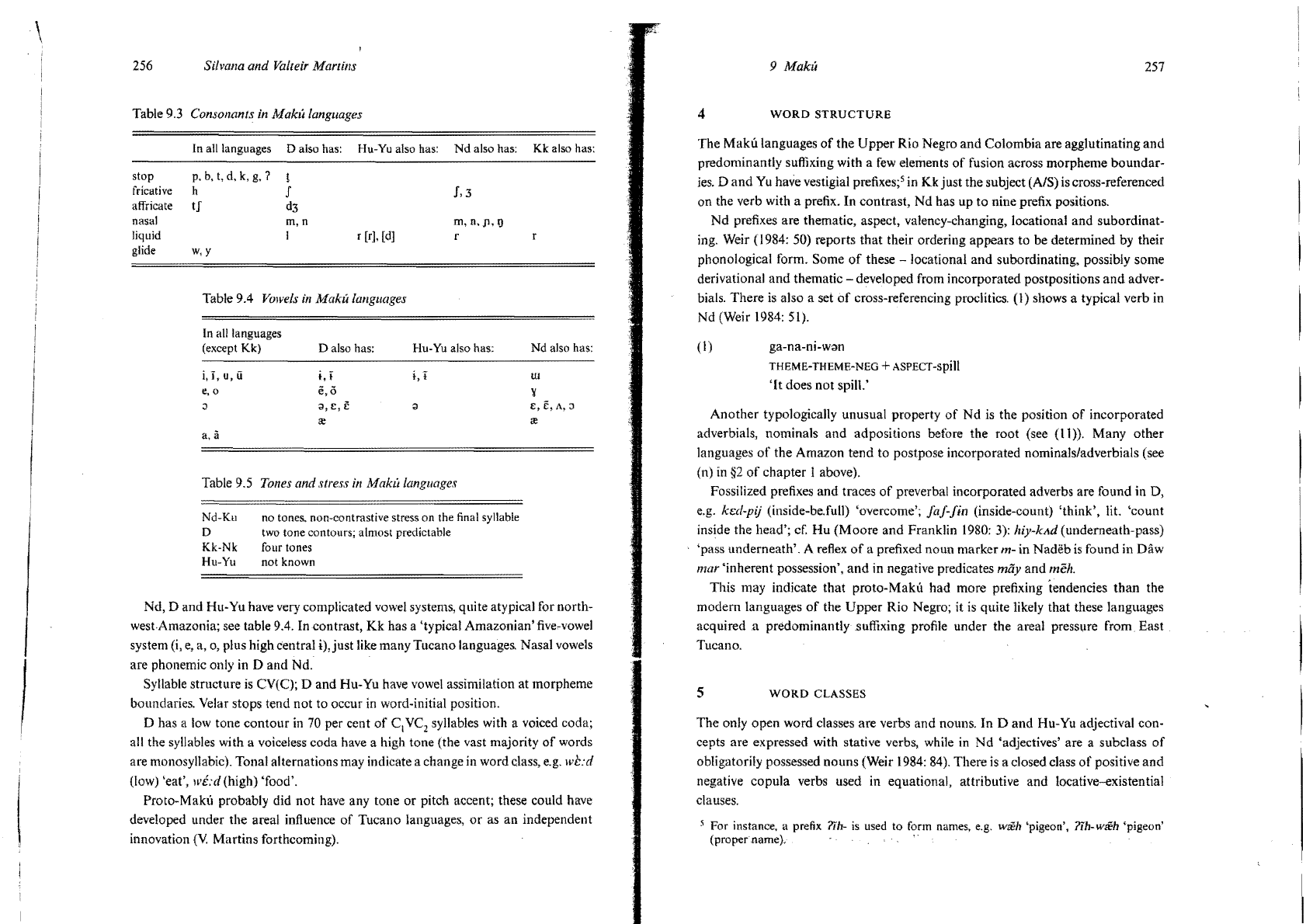
17
phonemes in D
and
18
in
Nd,
to
12
in Hu-Yu
and
12 in
Kk.
See table 9.3.
Nasalization
is
a syllable prosody in Hu-Yu
and
in
Kk-Nk,
so
that
bln!, dln
and
g/O
are
allophones. D
and
Hu-
Yu have prenasalized stops as word-final
allophones
of
simple stops.
\
256
Si/vana and Valteir Martíns
Table 9.3 Consollants in
Makú
languages
In aHlanguages D also has: Hu-Yu also has:
Nd
also has:
Kk
algo has:
stop
fricative
affricate
nasal
liquid
glide
p,
b,
t, d, k, g. ?
h
tI
w,y
!
f
d3
m,n
l
r [r].
[d]
[,3
m,n,J1,Q
Table
9.4
VOlVels
in
Makú
languages
In
aH
languages
(except Kk)
Dalso
has:
Hu-Yu
also has:
Nd
also has:
it
lt
u,
Ü
i,
¡
i,
i
UI
e.
o
e,o
11
;:)
a,e,c
::l
e~e,A,:J
re
re
a,a
Table
9.5
Tones
and
stress in Makú langllages
Nd-Ku
no tones. nOI1-contrastive stress
on
the final syllable
D
two tone contours; almost predictable
Kk-Nk
four tones
Hu-Yu
not known
Nd, D
and
Hu-
Yu
have very complicated vowel systems, quite atypical fol' north-
west.Amazonia; see table
9.4.
In contrast,
Kk
has a 'typical
Amazonian'
five.vowel
system (i,
e,
a, o, plus high central i),
just
Iike many Tucano languages. Nasal vowels
are phonemic only in D and Nd.
Syllable
stmcture
is CV(C); D
and
Hu-
Yu have vowel assimilatíon at morpheme
bOllndaries. Velar stops tend
not
to occur in word-initial position.
D has a low tone
contour
in
70
per cent
of
C
1
VC
2
syllables with a voiced coda;
a1l
the syllables with a voiceless
coda
have a high
tone
(the vast majority
of
words
are monosyllabic). Tonal alternations may indicate a change in word class, e.g.
wc:d
(low) 'eat',
wt:d
(hígh) 'food'.
Proto-Makú probably díd
not
have any tone
or
pitch accent; these could have
developed under the areal influence
of
Tucano languages,
or
as
an
independent
innovation
(Y.
Martins
forthcoming).
9
Makú
257
4
WORD
STRUCTURE
The
Makú
languages
of
the
Upper
Río Negro
and
Colombia
are agglutinating
and
predominantly suffixing with a
few
elements
of
fusion across morpheme
boundar-
¡es. D
and
Yu have vestigial prefixes;s in
Kk
just
the subject (A/S)
is
cross-referenced
on
the verb with a prefix. In
contrast,
Nd
has up
to
nine prefix positions.
Nd
prefixes are thematíc, aspect, valency-changing, locational
and
subordinat-
iug. Weir (1984: 50) reports
that
their ordering
appears
to be determined by their
phonological
formo
Sorne
of
these - locational
and
subordinating, possibly sorne
derivational
and
thematíe - developed from incorporated postpositions
and
adver-
bials.
There
is
also a set
of
cross-referencing proclitics. shows a typical verb in
Nd
(Weir
1984:
51).
ga-na-ni-wan
THEME-THEME-NEG + ASPEcT-spill
'It
does
not
spill.'
Another
typologically unusual property
of
Nd
is the position
of
incorporated
adverbials, nominals
and
adpositions before the root (see
(II».
Many
other
languages
of
the Amazon
tend
to postpose incorporated nominals/adverbials
(see
(n) in
§2
of
chapter
1aboye).
Fossilized prefixes and traces
of
preverbal incorporated adverbs are found in D,
e.g.
Ia:d-pij (inside-be.full) 'overcome';
faf-fin
(inside-count)
'think',
lit.
'count
inside the head'; ct:
Hu
(Moore
and
Franklin
1980:
3):
hiy-kAd (underneath-pass)
'pass underneath'. A reflex
of
a prefixed noun marker
In-
in
Nadeb
is found in
Daw
mar 'inherent possession"
and
in negative predica tes miíy
and
mell.
111i5
may indicate that
proto-Makú
had
more
prefixing tendencies
than
the
modem
languages
of
the
Upper
Rio Negro;
it
is
quite likely that these languages
acquired
.a
predominantly .suffixing profile under
the
areal
press1,lre
from
East
Tucano.
5
WORD
CLASSES
The
only open word c1asses
are
verbs and nouns.
In
D
and
Hu-
Yu
adjectival con-
cepts are expressed with stative verbs, while in
Nd
'adjectives' are a subclass
of
obligatorily possessed
nouns
(Weir
1984:
84).
There is a c10sed
c1ass
ol' positive
and
negative
copula
verbs llsed in equational, attributive and locative-existential
c1auses.
s
For
instance, a
pref1x
?lh-
is
used
to
form names,
e.g.
wreb
'pigeon', ñh-wreh 'pigeon'
(propernarne). . .
258
Si/!'ana and
Valteir
Martins
6
NOMINAL
CATEGORIES:
POSSESSION,
CLASSIFIERS,
NUMBER
Alienable and inalienable possession
is
distinguished
in
Nd, and D
and
Hu-Yu, but
it
is
marked
in
difierent
ways.
Nd has three classes
of
nouns (Weir 1984: 83-7): (a) nouns which can only oeeur
with a preposed possessor,
e.g.
Subih
nloo/¡
'Subih's hand'; (b) those whieh can
optionally occur with a possessor, e.g.
Subíh
t:Jb
'Subih's house'; (e) those which
require a classifier when possessed, stleh as animals, plants, some kinship terms, etc.,
e.g.
Subih
waa
mased
(Subih POSSV.CL:FOOD banana) 'Subih's banana' (one
eannot say
*Subih mased).
In D and H u-
Yu
both alienable and inalienable possession
is
marked by juxtapo-
sition (Possessor-Possessed),
e.g.
D yiím dU/1/ (dog tai/) 'dog's tail'.
D
is
unusual in employing 'possessor classifiers' - suffixes whieh attach to posses-
sors in alienable possession constructions; which
is
used depends on whether the
possessor
is
anímate
or
inanimate: -de:? 'inanimate possessor',
-ej
'anímate pos-
sessor':
see
(2)
and
(3).
(2)
yud d;-¡w-tog-ej
c10thing human-female.child-Cl:ANIM.POSSR
'The clothing
is
a girl's',
or
'girl's clothing'
(3) kaw-w;-¡?-de:?
manioc
garden-up-cL:INAN.POSSR
'manioc from a garden'
D and Hu-Yu also have generic no
un
c1assifiers in noun phrases, e.g. D
d:J1v
lag
(CL:HUMAN
girl)
'a
girl'. These are only rarely found
in
Amazonian languages.
D
and
Hu-Yu (but
not
Nd) have very produetíve nominal compounding; nominal
compollnds are sometimes hard to distinguish from classifier NPs, e.g. D
ked
(person-hand-inside) 'the inside parl
of
a hand'; daw-tim-b:Jk-tjén (person-eye-
skin-hair) 'eyelash'. These examples have just one stress, on the last this
shows Ihat they form oue phonological word (unlike classifier-noun eonstructions).
Kk
IS
the only
Makú
language to have a masculine/feminine gender distinction
in
3rd person singular pronominal prefixes, independent pronouns
and
demonstra-
lives (Cathcart and Levinson
1976:
26);
this could be the result
of
Tucano inftuenee.
D has
five
localive postpositions. Their choice depends on the physical properties
of
the rererent
of
the head:
6
ked'inside a bounded objeet',
mil'inside
liquid, orfire',
bit 'underneath an object with an upper boundary',
}Vd?
'aboye unbounded object',
6 Similar constrllctions, termcd 'locative c1assiflers', are round
in
Carib languages, and
in
Palíkur and Lokono fram lhe North Arawak ramllv: see§4.2
of
chapter 3 aboye.
9 Makú
259
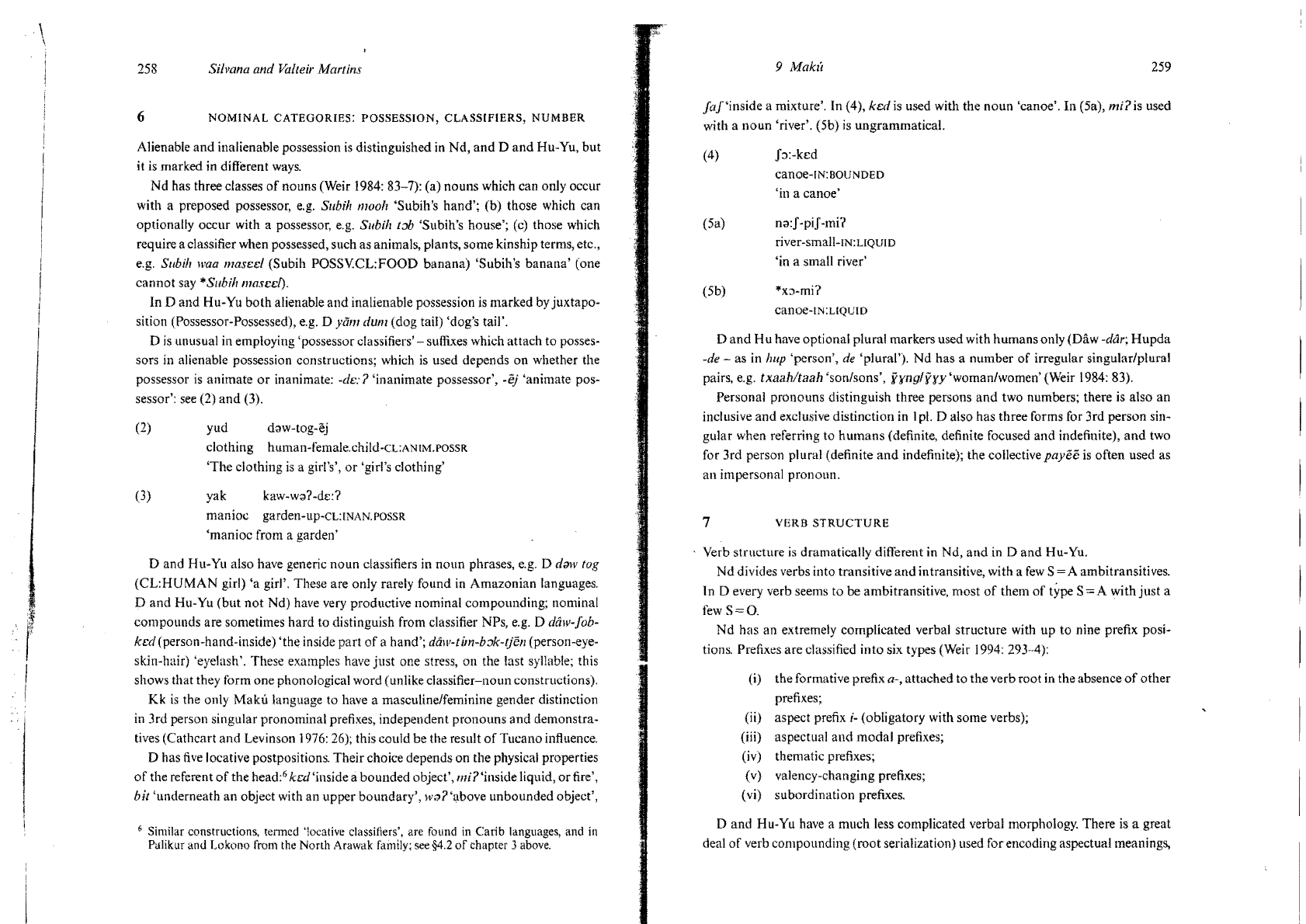
JaJ'inside
a mixture'. In (4),
kE:.d
is
used with the noun 'eanoe'.
In
(5a),
mi?
is
used
with a noun 'river'.
is
ullgrammatical.
(4) Jo:-ked
canoe-IN:BOUNDED
'in a canoe'
(5a) n;-¡:J-píJ-mrl'
river-small-IN:uQUID
'in a small river'
(5b)
*x:l-mi?
calloe-1N:L1QUlD
D
and
Hu have optional
markers used with humans only (Daw
-dar;
Hupda
-de as
in
hup 'person', de 'plural').
Nd
has a number
of
irregular singular/plural
pairs, e.g.
txaahltaah 'son/50ns',
hngl
hY
'woman/women' (Weir
1984:
83).
Personal pronouns distinguish three persons
and
two numbers; there
is
also an
inclusive alld exclusive distinction
in
I
pI.
D also has three forms for 3rd person sin-
gular when referring to
humans
(definite, definite focused and indefillite),
and
two
ror 3rd person plural (definite
and
indefinite); the collective payei5
18
often used as
an impersonal pronoun.
7
VERS
STRUCTURE
Verb strueture
is
dramatically different in Nd,
and
in D and Hu-
Yu.
Nd divides verbs into transitive
and
intransitive, with a
few
S = A ambitransitives.
In D every verb seems to be ambitransitive, most
of
them
of
type S = A with just a
few
S=o.
Nd
has an extremely complicated verbal strueture with up
to
nine prefix posi-
tions. Prefixes are classified into six types (Weir
1994:
293··4):
(i) the formative prefix
a-, attached to the verb root in the absence
of
other
prefixes;
aspect prefix
i- (obligatory with sorne verbs);
(iii) aspectual and modal prefixes;
(iv) thematic prefixes;
(v) valency-changing prefixes;
(vi) subordination prefixes.
D and Hu-Yu
have
a much less complicated verbal morphology. There
is
a great
deal
of
verb compounding (roo! serialization)
lIsed
for encoding aspectual meanillgs,
260
Silvana and Valtel, Martlns
as
in
(6), from
D,
where the verb 'be straight' shows the immediate character of the
action. (Up to
five
verbs can be compounded.)
(6) yo:h b .. :-ham-yow
medicine spill-go-be.straigh
t
'The medicine spilt straight away.'
o and Hu distinguish three tenses: present (unmarked), past
(O
-el)
and future
(O
In Nadeb every verbal root and suffix distinguishes indicative from non-in
di
ca-
tive.
Non-indicative forms are used
in
imperatives, nominalizations and interroga-
tives; they are marked with
vowel
change and/or the voicing
of
a final consonan!
(Weir
1984: 39). Sorne verbs also mark whether the
SI
A argument
is
singular
or
plural. Plural verb forms can
be
suppletive;
or
derived with a prefix
or
vowel
and/or
consonant alternations. There are a number
of
aspectual prefixes (habitual, contin-
uative, directional, etc.). There are only a
few
suffixes (diminutive, ingressive and
completive; Weir
1984: 45).
While
Hu
and
Kk
have only one imperative (Hu
Kk
reduplication
of
the
final vowel),
Nd
distinguishes several imperatives (simple, indirect, permissive). O
distinguishes imperative (5h) and prohibitive
(111).
8
VALENCY-CHANGING
DERIVATlONS
D, Hu-
Yu
and Kk have no valency-reducing derivations. In contrast, Nd has a
prefix
ka- 'reflexive, reciprocal' (Weir 1984:
47).7
It
is
also used as an íntransitívizer,
and to mark non-agentive passive (1984:
Nd
also has a morphological causative, marked with
da-o
The
only example given
by Weir (1984: 47)
is
with an intransitive
verbo
Another technique for marking caus-
atives
is
verb compounding as iIIustrated in (7) (1984:
44).
(7)
t::l:lh
Subih na-boh-yat
pig Subih
THEME-shoot-Iie
down
'Subih killed a pig.'
(lit. 'he shot; it
is
Iying down')
1 n Kakua, morphological causatives (suffix
a
4
-
Cathcart
1979:
can be formed
on intransitive -
and
probably
al
so
011
transitive verbs, while D and
Hu
use
peri-
phrastic constructions, as
in
(8)
and
(9), both from
O:
7
It
was noted
in
chapter 3 that many North Arawak languages use the same marking ror
retlexives, reciprocals and agentless passives; a widespread marker is
(-
)ka(
-),
so one can
110t exclllde the possibility
of
borrowil1g
or
areal diffusion. The callsative prefix
da-
could
also
well
be
of
Arawak
origino
9 Malaí
261
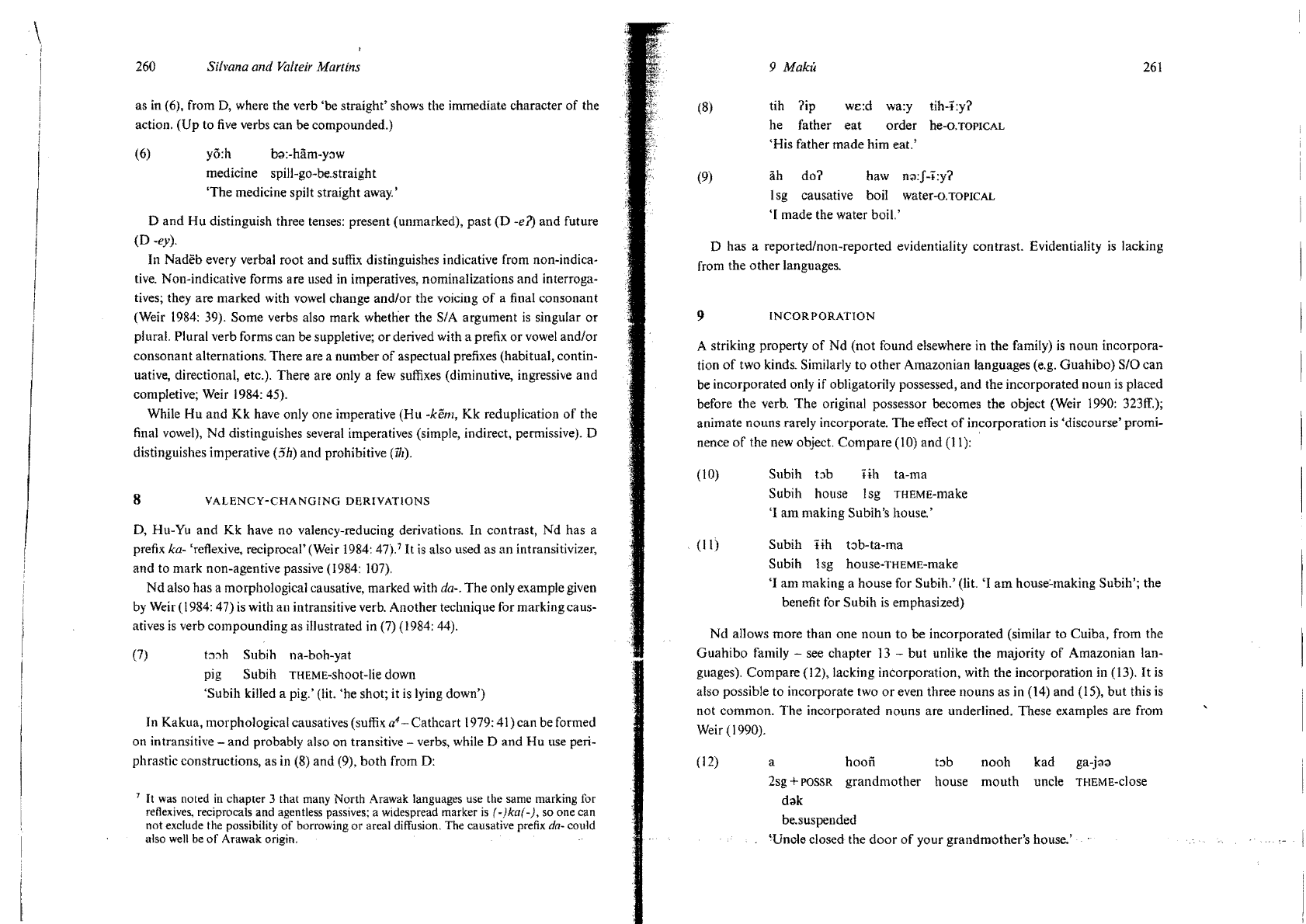
tih ?ip we:d wa:y tih-i:y?
he father eat order
he-O.TOPICAL
'His father made him eat.'
(9) ah do? haw n<l:J-i:y?
Isg causative bon
water-O.TOPICAL
" made the water boil.'
O has a reported/non-reported evidentiality contrast. Evidentiality
is
lacking
from the other languages.
9
INCORPORATION
A striking property
of
Nd
(not
found elsewhere in the family)
is
noun íncorpora-
tion
of
two kinds. Similarly to other Amazonian languages
(e.g.
Guahibo) S/O can
be incorporated only if obligatorily possessed,
and
the incorporated noun
i5
placed
befare the
verbo
The original possessor becomes the object (Weir
1990:
3231f.);
animate nouns rarely incorporate.
The
elfect
of
in~orporation
is
'discourse' promi-
nence
of
the
new
object. Compare (!O)
and
(11):
(10)
Subih tJb
¡ih
ta-ma
Subih house Isg
THEME-make
'1
am
making Subih's house.'
(
11)
Subih
hh
tob-ta-ma
Subih house-THEME-make
'}
am making a house for Subih.' (lit.
'1
am
house~making
Subih'; the
benefit for Subih
is
emphasized)
Nd allows more than one noun to be incorporated (similar to Cuiba, from the
Guahibo family - see chapter
13
~
bu! unlike the majority
of
Amazonian lan-
guages). Compare (12), lacking incorporation, with the incorporatíon in (13).
It
ís
al so possible to incorporate two
or
even three nouns as in (14) and
but
this is
not common. The incorporated nouns are underlined. These examples are from
Weír (1990).
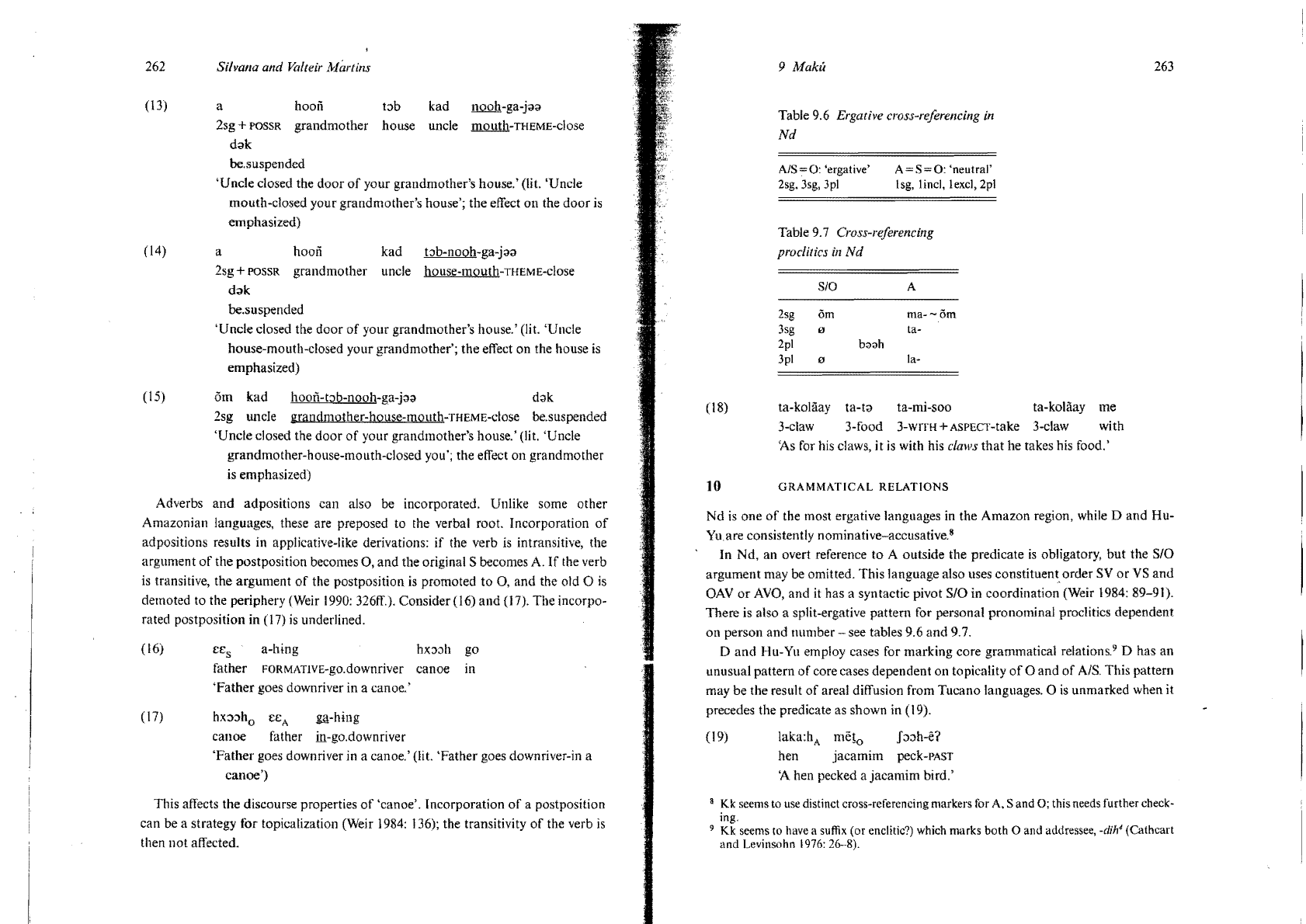
(12)
a
2s
hooñ
g
+
POSSR
grandmother
délk
be.
suspended
tob
house
nooh
mOllth
kad
unele
ga-j<lél
THEME-close
'Vnole closed Ihe
door
of
your gramlmother's house.'
262
Si/vana
and
Valteir Mártins
(13)
a hooil t;,b kad
nooh-ga-j;:¡;:¡
2sg +
POSSR
grandmother
house uncle
1ll.Q!!th-THEME-close
d;:¡k
be.suspended
'Unc1e
c10sed
the door
of
your grandmother's house.' (lit. 'Vncle
mouth-closed your grandmother's house'; the effect
on
the door is
emphasized)
(14)
a hooñ kad
t;,b-nooh-ga-ja;:¡
2sg
+
POSSR
grandmother uncle house-rnouth-
THEME-e1ose
d;:¡k
be.suspended
'Uncle closed the
door
of
your grandmother's house.' (lit. 'Vuele
house-mouth-closed your grandrnother'; the effect on the house
is
ernphasized)
(15)
om
kad
hooñ-tob-nooh-ga-j;:¡;:¡
d;Jk
2sg uncJe ¡¡randmother-house-rnouth-THEME-close be.suspended
'Uncle closed the door
of
your grandmother's house.' (lit. 'Uncle
grandmother-house-mouth-closed you'; the effect on grandmother
is
emphasízed)
Adverbs
and
adpositions can also be incorporated. Unlike sorne other
Amazonian languages, tbese are preposed to tbe verbal root. Incorporation
of
results in applicative-like derivations:
if
tbe verb
is
intransitive, the
argument
of
the postposition becomes
0,
and the original S becomes A.
If
the verb
ís
transitive, the argument
of
the postposition is promoted to
0,
and the old °
is
demoted to the periphery (Weir
1990:
326ff.). Consider (16) and (17). The incorpo-
rated postposition in (17)
is
lInderlined.
cc
s
a-hing hx;,oh go
father
FORMATlvE-go.downriver
canoe in
'Father
goes downriver in a
canoe:
(17)
hx;)oh
o
ce
A g¡!-hing
cauce
father m-go.downriver
'Father goes downriver in a canoe.' (lit. 'Father goes downriver-in a
canoe')
Tbis affects the discourse properties
of
'canoe'. Incorporation
of
a postposition
can be a strategy for topicalization (Weir
1984:
136); the transitivity
of
the verb
is
then not affected.
9
Makú
263
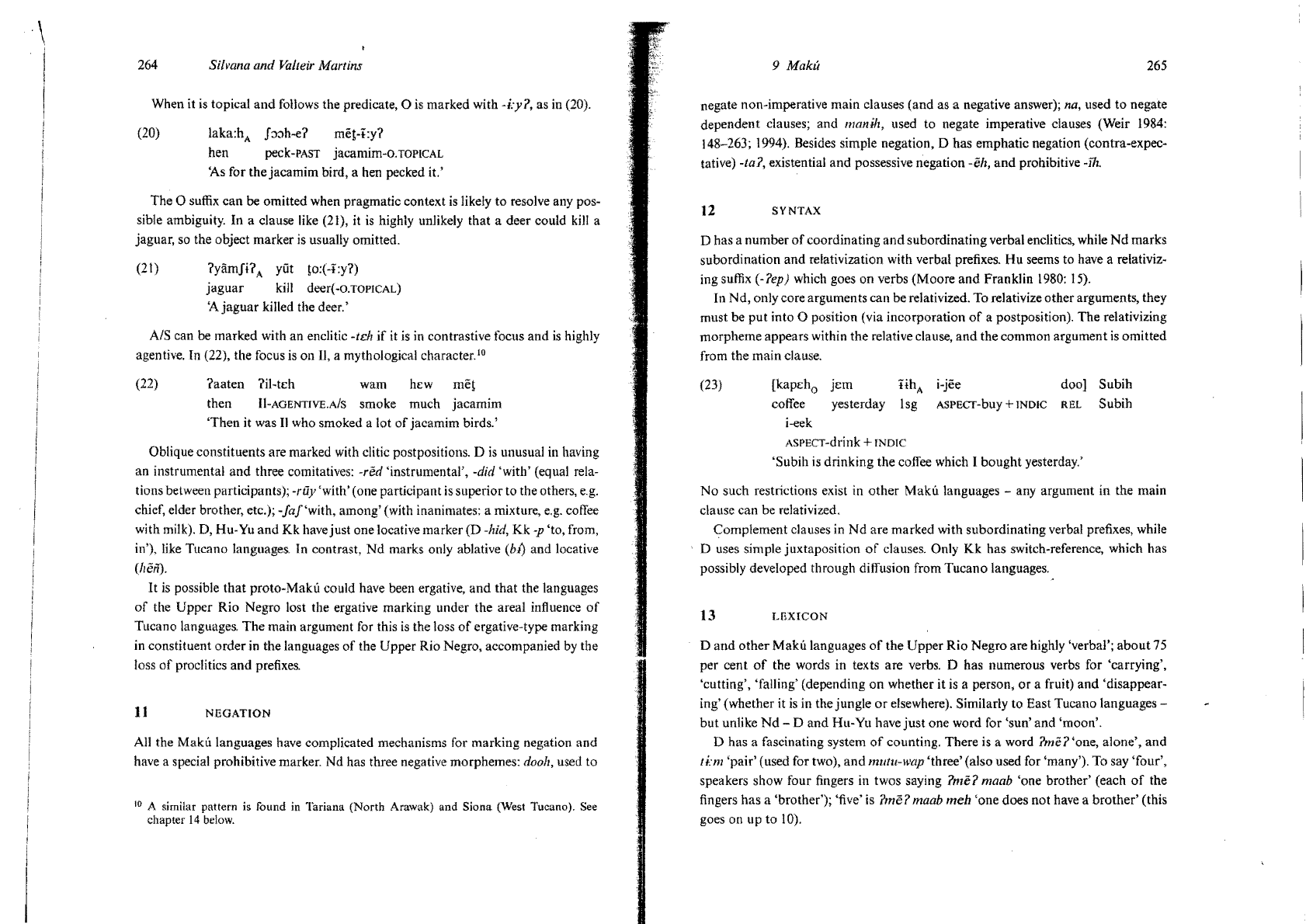
Table 9.6 Ergative cross-referencing in
Nd
A/S
=
o:
'ergative'
A
= S =
O:
'neutral'
25g.
35g,
3pl Isg, lineJ,
lexcJ,
2pl
Table 9.7 Cross-referencing
oroditics
in
Nd
810
A
2sg
om
ma--om
.,
3sg
ta-
2pl
b:l;¡h
3pl
la-
.,
ta-t;;¡
ta-mi-soo ta-kolaay me
3-claw 3-food 3-wrrH
+
ASPECf-take
3-claw with
'As for his claws.
it
is
with his claws that he takes his food.'
10
GRAMMATICAL
RELATlONS
Nd
is
one
of
the mos! ergative languages
in
the Amazon region, while D and Hu-
Yu.are consistently nominative-accusative.
8
In
Nd, an overt reference to A outside the predicate
is
obligatory, but the StO
argument may be omitted. This language also uses constituent arder
SV
or
VS
and
OAV
or
AVO,
and
it
has a syntactic pivot StO in coordination (Weir
1984:
89-91).
There is also a split-ergative pattern for
oll person and number see tables 9.6 and 9.7.
D and HlI-Yu employ cases for marking core grammatical relations.
9
D has an
unuslla1 pattern
of
core cases dependent on topicality
of
°and
of
A/S.
This pattern
may be the reslIlt
of
areal diffusion from Tucano languages. °
is
unmarked when
it
precedes the predicate as shown in (19).
meto
f::J::lh-é?
hen
peCk-PAST
'A hen pecked a
bird.'
3
Kk
seerns to
use
distinct cross-referencing markers
for
A. S and
O;
this needs further check·
ing.
9 Kk seems
to
have a
suffix
(or eneJitic?) which marks both O and addressee,
-dih
4
(Cathcart
and
Levinsohn
1976:
26-8).
I
.\
¡
264
Silvana and
Valteir
Martins
When it
is
topical
and
follows the predicate, O
is
marked with
-1:y7.
as in
laka:h
A
fJoh-eí' mét-i:yí'
hen
peCk-PAST
jacamim-o.ToPICAL
'As
for the jacamim bird, a hen pecked it.'
The O suffix can
be omitted when pragmatic context
is
Iikely to resolve any pos-
sible ambiguity. In a clause like
(21), it
is
highly unlikely that a deer could
kill
a
jaguar,
so
the object marker
is
usuallv omitted.
í'ya.mfií'
A yút to:(-i :yí')
jaguar
kíll
deer(-o.ToPICAL)
'A
jaguar killed the deer.'
A/S can be marked with an enclitic
-tE:h
if
it
is
in
contrastive focus and
is
highly
agentive. In
(22), the focus
is
on
n,
a mythological character.
10
(22)
í'aaten í'il-tch wam hcw
then
II-AGENTlVE.AlS
smoke much jacamim
'Then it was
11
who smoked a lot
of
jacamim birds.'
Oblique constituents are marked with clitic postpositions. D
is
unusual in having
an instrumental
and
three comitatives: -red 'instrumental', -did 'with' (equal rela-
tions between participants);
-ray
'with' (one participant
is
superior to the others,
e.g.
chief, elder brother, etc.); -Jaf'with, among' (with inanimates: a mixture,
e.g.
colfee
with
mil
k).
D,
Hu-
Yu
and Kk havejust one locative marker{D
in'),
Iike
Tucano languages. In contrast,
Nd
marks only ablative and locative
(heñ).
lt
is
possible that proto-Makú could have been ergative,
and
that the languages
of
the Upper Rio Negro lost the ergative under the areal influence
of
Tucano languages. The main argument for this
is
the loss
of
ergative-type marking
in constituent order in the languages
of
the Upper Rio Negro, accompanied by the
1088
of
proclitics and prefixes.
NEOATION
AII the Makú languages have complicated mechanisms for marking negation and
have a special prohibitive marker. Nd has three negative morphemes:
dOG/¡, used to
10 A similar pattern is found in Tariana (North Arawak) and Siona (West Tucano). See
chapter
14
below.
9 Makú
265
negate non-imperative main cIauses (and as a negative answer);
na,
used to negate
dependent cIauses; and
manih, used to negate imperative cIauses (Weir
1984:
148-263; 1994). Besides simple negation, D has emphatic negatíon (contra-expec-
tative)
-tal,
existential and possessive negation -éll,
and
prohibitive oí/¡.
12
SYNTAX
D has a number
of
coordinating
and
subordinating verbal encIitics, while Nd marks
subordination and relativization with verbal prefixes. Hu seems to have a relativiz-
ing suffix
(-7ep) which goes on verbs (Moore
and
Franklin
1980:
15).
In Nd, only core arguments can be relativized. To relativize other arguments, they
must be
put
into O position (via incorporation
of
a postposition). The relativizing
morpheme appears within the relative clause,
and
the common argument
is
omitted
from the main cIause.
[kapch
o
jem
iih
A
colfee yesterday 1
sg
i-eek
i-jée
ASPECT
-buy +
INDlC
doo]
REL
Subih
Subih
ASPECT-drink
+
INDlC
'Subih
is
drinking the coffee which I bought yesterday.'
No such restrictions exist in other Makú languages - any argument in the main
c\ause can be relativized.
Complement cIauses in
Nd
are marked with subordinating verbal prefixes, while
D uses simple juxtaposition
of
c1auses. Only Kk has switch-reference, which has
possibly developed through dilfusion from Tucano languages.
13
LIlXICON
D
and
other Makú languages
of
the Rio Negro are
'verbal';
about
75
per cent
of
the words in texts are verbs. D has numerous verbs for 'carrying',
'cutting', 'falling' (depending
on
whether it
is
a person,
or
a frui!) and 'disappear-
ing' (whether it
is
in the jungle
or
elsewhere). Similarly to East Tucano
languages-
but unlike
Nd
- D and Hu-
Yu
have just one word ror 'sun' and 'moon'.
D has a fascinating system
of
counting. There is a word 7me? 'one, alone', and
ti:m 'pair' (used for two),
and
mlllu-wap 'three' (also used for 'many'). To say 'four',
speakers show
fOUf
fingers in twos saying
7me?
maab 'one brother' (each
of
the
has a 'brother'); 'five'
is
?me? maab
meh
'one does not have a brother' (this
goes on up to
lO).
11
\
266
Silvana
and
Va/teir MartillS
BIBLlOGRAPHY
Brandao Lopes, A. 1995. 'Fonología
da
Iíngua Yuhup: urna abordagem nao-linear',
MA
thesis, Universidade Federal de Santa Catarina, Florianópolis, Brazil.
Brüzzi, A. A.
da
S.
1961.
Discoteca
etno-língiilstico-musical
das
tribos
dos
I'ios
Vaupés,
I,ana e
Cal/aburi.
Sao Paulo: Inspectoria Salesiana.
Cathcart, M. 1979. 'Fonología del cacua',
Sistemas fonológicos
de
idiomas
colombianos,
4.9-45.
Cathcart, M.
and
Levinsohn,
S.
1976.
'Codificación de la progresión cronológica del discurso
narrativo en
el
idioma cacua', pp. 1-31
of
Serie sintáctica 3: Es/udios
en
cacua,
jupda y
saliba.
1977.
'The
encoding
of
chronological progression in Cacua narratives',
pp.
69-·94
of
Discourse
grammm;
studies
in
ind/genous
languages
af
Colombia,
vol.
Il,
ed. R. Longacre
and
F.
Woods. Dalias:
SIL
and University
of
Texas al Arlíngton.
Cathcart, M.
and
Lowers, L. 1976.
'La
pelea entre Aquí y Victoria, texto del cacua', pp. 37-82
of
Serie sintáctica
3:
Esllld/os
en
cacua,
jupda y
sáfiba.
Del Vigna.
D.
1991. 'Segmentos complexos
da
língua Yuhup',
MA
thesis. Universídade
Nacional de Brasília. Brasilia. Brazil.
Galvao,
E.
1979.
'Acllltura~¡¡o
indígena no río Negro',
pp.
135-92
of
his
Encof1tro
de
sod-
edades.
Río de Janeiro: Paz e terra.
Giacone,
A.
1955.
Peq/lena
gramática e
diciollário
portugués ubde-nehern
ou
maclÍ.
Redfe:
Missao indígena salesiana.
Huber. R. Q.
and
Reed. R.
B.
1992.
Compararive
vocabulary:
selected
lI'ords
in
indigenolls
fcm-
guages
of
Colombia.
Santafé de Bogotá: Asociación Instituto Lingüistico de Verano.
Jackson,1. 1976. 'Vaupés marríage: a network system
in
lhe Northwest Amazon', pp. 65-93
of
Regional analysis. vol. II: Social
syslell1S,
ed.
C.
A. Smoth. New York: Academíc Press.
Koch-Grlinberg,T. 1906a. 'Die Indíaner-Stamme am oheren Rio Negro und Yapurá und ihre
sprachliche Zugehorigkeít',
Zeitsclrriftfi1r Et/mologie, 38.167-205.
1906b.
'Die
Sprache del' Makú-Indíancr', Amlrropos.
1.877-906.
1909/10.
Zwei
Jahre
//IlIer
denlndianem. 2
vols.
Stuttgart.
1913. 'Abschluss meiner Reise durch Nordbrasilien zum Orinoeo, mi! besonderer
Berücksichtigung del' von mir besuchten Indianerstamme',
Zeitschrift filr EI/lIl%gie.
45.448-74.
1928.
VOI11
Roroima
zum
OriIlOCO:
Ergebnisse
eiller
Reise
in
Nordbrasiliel1und
Venezuela
in
den
labren 1911-1913. vol.
IV:
Sprachen.
Stultgart.
Martins,
S.
A. 1994. 'Análise da morfosintaxe da Iíngua
Daw
(Makú-Kama)
e suaclassifica"ao
tipológica"
MA
thesis, Universidade Federal de Santa Catarina, Florianópolis, BraziL
Martins. V 1994. 'Fonología da Iíngua
Daw"
MA thesis. Universidade Federal de Santa
Catarina. Florianópolis. Brazi!.
forthcoming.
'Estudo
histórico-comparativo
da
família lingüística
Makú'.
Migliazza. E.
C.
1985. 'Languages
of
the
Orínoco-Amazon
region: current status', pp. 17-139
01'
SOl/tI!
American
Indian
/anguages:
retl'ospect and
prospecto
ed. H. M. Klein and L.
Stark. Austin: University
of
Texas Press.
Moore.
B.
1.
1977. 'Sorne discourse reatures
of
Hupda
Macu·. pp. 35-42
of
Discourse
grammar:
studies in
illdigenous
languages
of
Colombia,
vol.
11,
ed. R. Longacre
and
F.
Woods. Dalias:
SIL
and University
01'
'lexas al Arlington.
Moore,
B.
1.
and
Franklin. G. 1980.
Breves
Ilotlcias
da
língl/a
Makú-Hupda. Brasília: SIL.
Nimuendajú,
C.
1950/5. 'Reconhecimento
dos
Ríos I"ana, Ayari e Vaupés',
101lma/
de
la
Sociélé
des
Américanisles, n.s., 39.125-82; 44.149-78.
1982.
Tf!x/os
indigenistas. Sao Pauto: Edi<;oes Loyola.
9
Makú
267
Rivet.
P.
Kok,
P.
and
Tastevin.
C.
1924-5. 'Nouvelle contribution
¡'¡
I'étude
de
la langue
makú"
/JAL. 3.133-92.
Rivet, P
and
Tastevin. C. 1920. 'Affinltés
du
makú
et
du
puinave', Joumal
de
la
Société
des
Américal1isles. n.s., 12.60-82.
Silverwood-Cope.
P.
1.
1990.
Os
Makú:
pavo
ca¡;adar
do
Noroeste
da
AmazOnia. Brasília:
Editora
da
Universidade Nacional de Brasílía.
Weir.
E.
M.
H.
1984.
'A
nega<;iio e
outros
tópicos
da
gramática
Nadeb',
MA
thesis,
Universidade Estadual
de
Campinas, Brazíl.
1990. 'Incorporation in
Nadeb'.
pp. 321-{i6
of
Amazoniaf1
linguistics:
studies ill Low/and
SOl/th
AmericlllI
Indian
/angullges.
oo.
Doris
1.
Payne. Austin: University
of
Texas
Press.
1994.
'Nadeb'.
pp. 291-323
01'
Typologícal studies
in
negarian,
ed.
P.
Kahrel
and
R. van den
Berg. Amsterdam: John Benjamins.
\
10
Nambiquara
IVAN
LOWE
INTRODUCTlON
1
The
Nambiquara
2
family consists
of
three languages:
Southern
Nambiquara
dialect complex
(2)
MamaindelNakarothe
(3) Sabanes
The
Southern
Nambiquara
dialect complex
comprises
of
the
following twelve
íntelligible dialects (superscript figures indicate tones - see below):
N~3S1l2
(g)
Waik
2
tFte
2
s1l
2
KPtau3Jh u
2
(h)
Ha
J
hai7
J
te
2
su
2
(e)
Ha
3
lot
Z
te
2
s11
2
(i)
A
317yh
In 7e
3
ka
2
ta
J
kPte2su
2
(d) Wa
3
ka
J
IPte
2
su
2
(j)
Ka31u3whiiiJko3te2su2
(e) Wa
3
slIhI
s
711
2
(k)
TuJka31?1I3la3koJte2sul
(f)
AJliin
1
te2su
2
(1)
WaPs1I
2
I The
author
is
grateful lo his SIL colleagues Menno and Barbara Kroeker and Peler
Kingston ror the map
of
the Nambiquara area and ror informalion on Mamainde. And also
to lhe residents
of
lhe víllages
of
Serra Azul, Camararé and Campos Novos for lheir
patience
in
teaching
him
lhe language.
2 The origín
of
lhe name Nambiquara (alternatively spelt Nambicuara or Nambikwara)
is
ínteresling. Lévi-Strauss (1948: 361) states:
The
NambiclIara (Nambikuara. Mambyuara, Malribarez)
have
becn identified ,
only recently.
Nambicllara, meaning 'long eared',
was
originally a Tupf nick-
name used since the 18th century for the little known tribes
of
the western and
norlhern parts
of
the Serra dos ParecÍs. These tribes had large ear and lip plugs,
like
those
of
Ihe Suya and Ha/acudo,
and
were called
Bei¡;os
de Pau, 'Wooden
Mouths',
by
Ihe rubber collectors and gold miners. About
1830,
they began lo
make hostile sorties from the region
of
Ihe upper Sangue River. When,
in
1907,
General Candido Mariano
da
Silva Rondón discovered important tribes
in
Ihe
SerTa
do Norte, he identified them with Ihe NambiclIara
of
the old literature.
Thus,
Nambicuara designates a tribe other than Ihe 'Long Ears', or 'Wooden
Mouths', to whom
ít
was original!y applied.
/¡
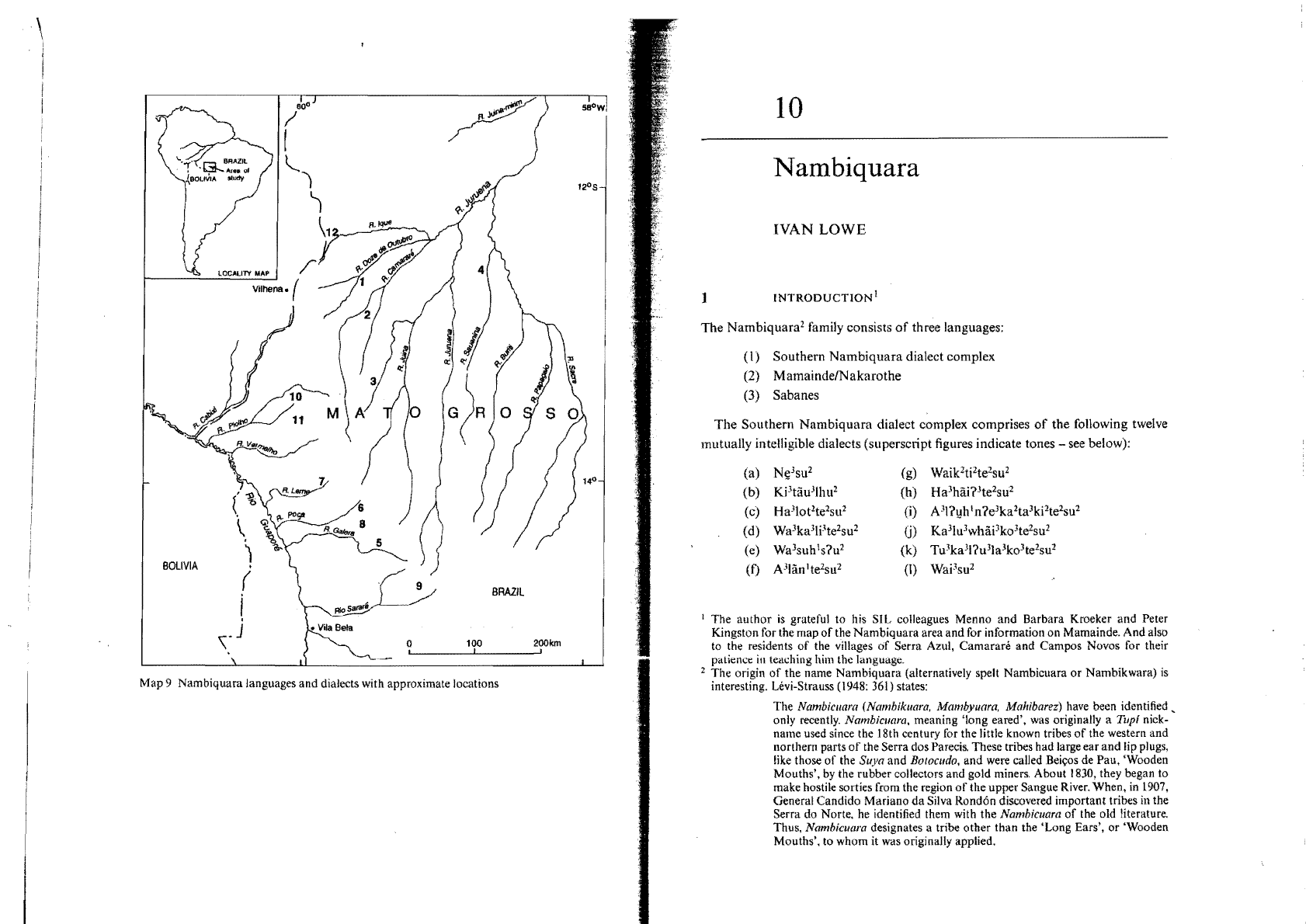
BRAZIL
o 100 200km
I I I
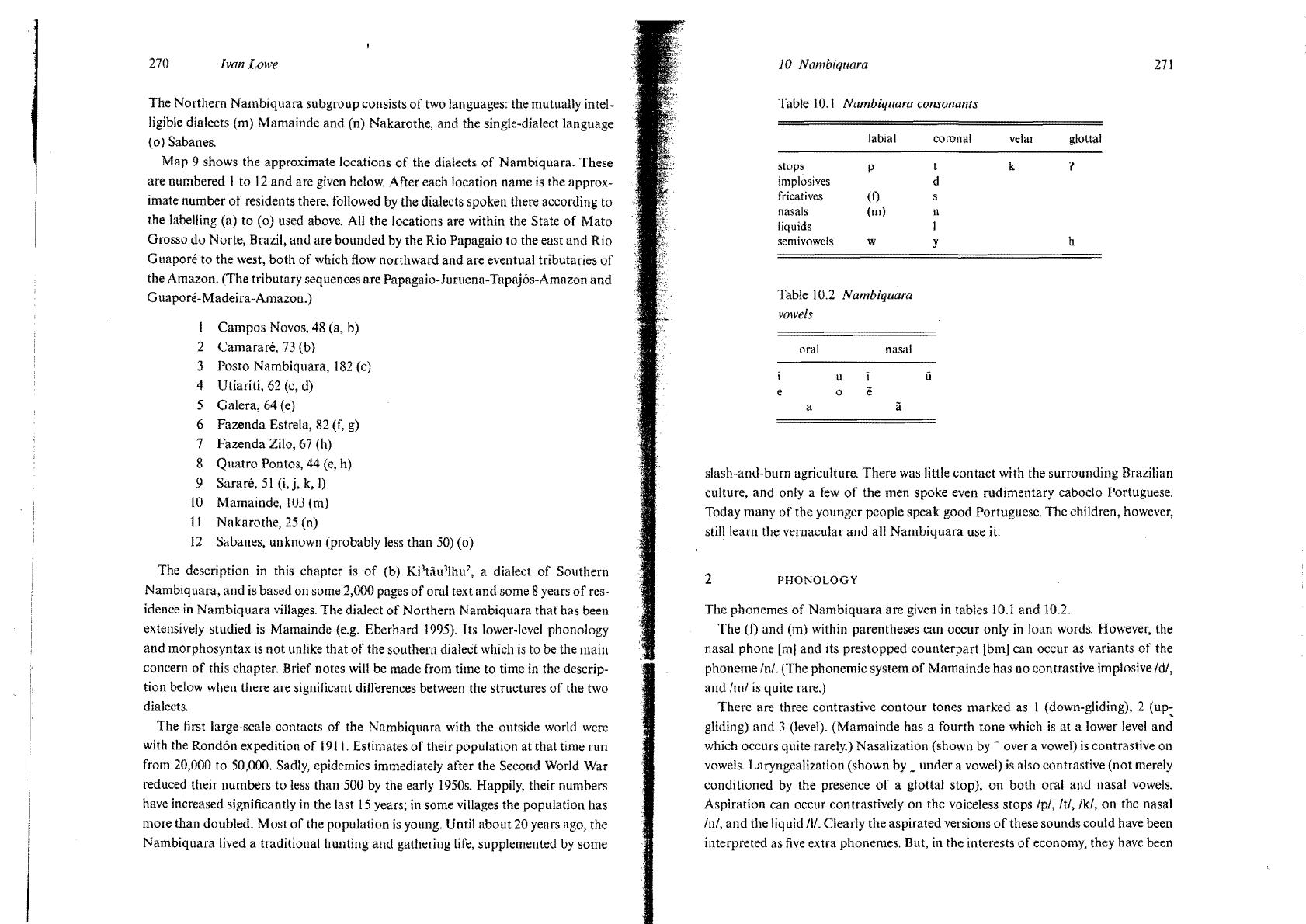
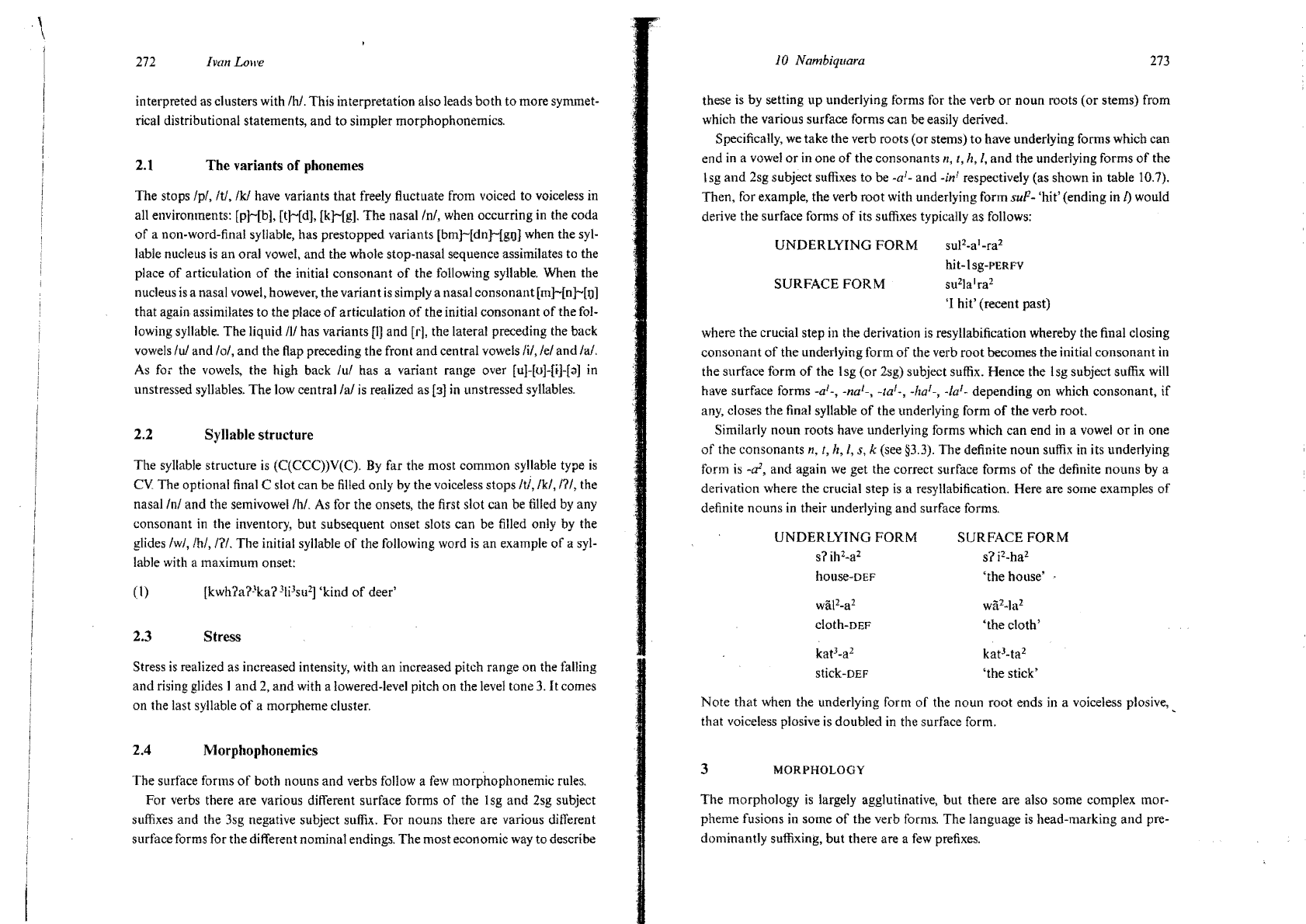
Map 9 Nambiquara languages and dialects with approximate locations
271
270 ¡van
Lowe
The
Northern Nambiquara subgroup consísts
of
two languages: the mutually ¡ntel-
Iigible dialeets (m) Mamainde
and
(n) Nakarothe,
and
the single-dialeet language
(o) Sabanes.
9 shows the approximate locations
of
the dialects
of
Nambiquara. These
are numbered
1 to
12
and
are given below. After each localion name
is
the approx-
imate number
of
residents there, followed by the dialects spoken there according
lo
the labelling (a) to (o) used aboye.
AH
the locations are within the State
of
Mato
Grosso
do
Norte, Brazil,
and
are
bounded
by the Rio Papagaio lo the east
and
Río
Guaporé lo Ihe west,
both
of
which flow northward
and
are eventual tribularies
of
the Amazon. (TIle tributary sequences are Papagaio-Juruena-Tapajós-Amazon
and
Guaporé-Madeira-Amazon.)
1
Campos
Novos,
48
(a, b)
2 Camararé,
73
(b)
3
Posta
Nambiqllara,
182
4 Utiariti,
62
(e, d)
5 Galera,
64
(e)
6 Fazenda Estrela,
82
(f,
g)
7 Fazenda Zilo,
67
(h)
8 Qllatro Pontos,
44
(e, h)
9 Sararé,
51
(i,
j,
k,
1)
10
Mamaindc,
103
11
Nakarolhe,
25
12
Sabanes, unknown (probably less
than
50)
(o)
The description in this chapler is
of
KPtau
J
lhu
2
,
a dialeet
of
Soulhern
Nambiquura,
and
is based on sorne 2,000 pages
of
oral text
and
sorne 8 years
of
res-
idence
in
Nambiqllara villages.
The
dialect
of
Northern Nambiquara that
h<ls
been
eXlensively studied
is
Mamainde (e.g. Eberhard 1995). Its lower-Ievel phonology
and
morphosyntax is
not
unlike that
of
the southern dialect which
is
to be the main
concern
of
Ihis chapler. Brief notes will be made from time to time in the descrip-
lion below when there are significant dilferenees between the structures
of
the Iwo
dialects.
The firsl large-scale contacts
of
the Nambiquara with the outside world were
with the Rondón expedition
of
1911. Estimates
of
their population at that time
mn
from 20,000 to 50,000. Sadly, epidemics immediately after the Second World War
reduced their numbers
to
less than 500
by
the early
1950s.
Happily, their numbers
have increased significantly in the last
15
years; in sorne villages the poplllation has
more than doubled. Most
of
the population
is
young. Until
about
20 years ago, the
Nambiqllara lived a traditional hunling
and
gathering tife, supplemented
by
some
10
Nambiquara
Table
10.1
Nambiquara consonants
labial coronal velar
glottal
stops
p
t
k 1
implosives
d
fricatives
(1)
nasals
(rn)
n
liquíds
l
semívowels
w
y
h
Table 10.2 Nambiquara
vOlVels
oral nasal
u
Ü
e o é
a
¡¡
slash-and-burn agriculture.
There
was little
conlact
with the sllrrounding Brazitian
culture,
and
only a
few
of
the men spoke even rudimentary
cabodo
Portuguese.
Today many
of
the younger people speak good Portuguese.
The
children, however,
stilllearn tlle vernacular
and
all Nambiqllara use il.
2
PHONOLOGY
The
phonemes
of
Nambiquara
are given in tables
10.1
and 10.2.
The
(f) ami (m) within parentheses can occlIr only in loan words. However, the
nasal phone and ¡ls prestopped
counterpart
[bm] can occur as variants
of
the
phoneme
In/.
phonemie systern
01'
Mamainde has no contrastive implosive Idl,
and
Iml
is
rare.)
There
are three contrastive
contour
tones marked as 1 (down-gliding), 2
(up:
and
3 (level).
(Mamainde
has a fourth
tone
which
is
at a tower
leve!
and
which occurs quite rarely.) Nasalization (shown by - over a vowel) is contrastive on
vowels. Laryngealization (shown by _ under a vowel) is also contrastive
(not
conditioned by the presence
of
a glottal stop),
on
both oral and nasal vowels.
Aspiration can occur contrastively
on
the voiceless stops Ipl, Itl, Ik/,
on
the nasal
Inl,
and
lhe liquid
111.
Clearly the uspirated versions
of
these sounds could have been
interpreted as
five
extra phonemes. But, in lhe interests
of
economy, have been
273
\
272
[van LOlI'e
interpreted as c1usters with
Ih/.
Thís interpretation also leads
both
to
more symmet-
rical distributional statements,
and
to simpler morphophonemics.
2.1
The variants of phonemes
The
stops Ipl, ftl,
Ikl
have variants
that
freely ftllctllate from voiced to voiceless in
all environments: [p}-[b], [t]-[d], [k}-[g].
The
nasal/nI,
when occurring in the coda
of
a non-word-final syllable, has prestopped variants [bmJ-[dn}-[gul when the syl-
labJe nucleus
is
an
oral vowel,
and
the whole stop-nasal sequence assimilates to the
place
of
articulation
of
the initial
consonant
of
the following syllable. When the
nuc1eus is a nasal vowel, however, the varíant
is
simply a nasal
consonant
[mJ-[nJ-[IJ]
that again assimilates
to
the place
of
articulation
of
lhe initial
consonant
of
the fol-
lowing syllable.
The
liquid
111
has varíants
[1]
and
[r], the lateral preceding lhe back
vowels
/ul and
10/,
and
the flap precedíng the fronl
and
central vowels li/./el
and
la/o
As fo; the vowcls, the high back fuI has a varíant range over
in
lInstressed sylJables.
The
low
central/al
is
realized as
[3J
in lInstressed
2.2
SyIJable structure
The
syllable structure ís (C(CCC»V(C).
By
far the most
common
syllable tyjJe
is
Cv. The optional final C slot
can
be filled only by the voiceless
stops
/ti, /k/,
ni,
the
nasal/n/
and
the semivowel/h/.
As
for the onsets, the first slot can be filled by any
consonant in the inventory,
but
subsequent onset slot8
can
be filled only by the
glides
¡w/,
Ih/,
/7/.
The
initial syllabJe
of
the following word is
an
example
of
a
Jable with a maximum onset:
[kwh?a7
J
ka7
J
¡Psu2j 'kind
of
deer'
2.3 Stress
Stress
is
realized as increased intensity, with
an
increased pítch range on the falling
and
rising glides 1
and
2,
and
with a lowered-Ievel pitch on the level tone
3.
It
comes
on
the last syllable
af
a morpheme cluster.
2.4 Morphophonemics
The
surface fonns
of
both
nouns
and
verbs follow a
few
morphophonemic rules.
For
verbs tbere
are
varíous ditTerent surface forms
of
the lsg
and
2sg subject
suffixes and tbe 3sg negative subject suffix.
For
nouns there are varíous difl'erent
surface forms ror tbe different nominal endings.
The
most economic way to describe
10 Nambiquara
these is by setting up underlying forms for the verb
or
noun
roots stems) from
which the varíous surface forms
can
be easily deríved.
Specifically, we take the verb roots stems)
to
have underlying forros which can
end in a
voweJ
or
in one
of
the consouants
/l,
1,11,1,
and
the underlying forms
of
the
Isg
and
2sg subject suffixes
to
be -a
l
-
aud -in
l
respectively (as shown in table 10.7).
Then,
for example, the verb
root
with underlying form
suP-
'hit'
(ending in
l)
would
derive
the
surface forros
of
its suffixes typically
as
follows:
UNDERLYING
FORM
suI
2
-a
l
-ra
2
hit-I
sg-PERFV
SURFACE
FORM
su
2
1a
1
ra
2
'1
hit' (recent past)
where
the
crucial step in the derivatíon ís resyllabification whereby Ihe final c10sing
consonant
of
the
underlying form
of
the verb
root
becomes the initial
consonant
in
the surface form
of
the
lsg
(or
2sg) subject suffix.
Hence
the Isg subject suffix will
have surface forros
-a
l
-,
-na/-, -ta
l
-,
_halo,
_la
l
_
depending
on
which
consonant,
ir
any, c10ses the final syllable
of
the underlvine: form
of
the verb root.
Similarly
noun
roots have underlying forms which
can
end
in
a vowel
or
in one
of
the
consonants
n,
t,
11,
1,
s,
k (see §3.3).
The
definite
noun
suffix in its underlying
form is
-al,
and
again we get the correct surface forms
of
the definite
nouns
by a
derívation where
the
crucial step
is
a resyllabification. Here are sorne examples
of
definite
nOUllS
in their underlying
and
surface forms.
UNDERLYING
FORM
SURFACE
FORM
s1
ih
z
-a
2
s7 j2-ha
2
house-DEF
'the
house'
waF-a
2
wa
2
_la
Z
c1oth-DEF
'the
cloth'
kat
J
-a
2
kat
3
-ta
2
stíck-DEF
'the
stick'
Note
that
when the underlying form
of
the
noun
root
ends in a voiceless plosive,
that voiceless plosive
is
doubled
in
the surface
formo
3
MORPHOLOGY
The
morphology
is
largely agglutinative,
but
there are al so some complex mor-
pheme
fusions in some
of
the verb forms.
The
language is head-marking
and
pre-
dominantly suffixing,
but
there are a few prefixes.