
Dixon R.M.W., Aikhenvald Alexandra Y. The Amazonian Languages (Cambridge Language Surveys)
Подождите немного. Документ загружается.

275
274
[van Lowe
There are three open word classes in
Nambiquara,
verbs (§3.l), adjectives (§3.2)
and
nouns (§3.3),
and
four closed word classes, pronouns (§3.4), adverbs (§3.5),
interjections (§3.6)
and
ideophones
3.1
Verbs
3.1.1
Main
verbs
Main verbs are suffixed for mood,
person-number
and
aspect.
Mood
can be either
indicative
or
imperative,
and
indicative verbs are further suffixed for tense-eviden-
[ndicative
verbs
Indicative verbs
can
be either declarative
information without any degree
of
doubt)
or
dubitative (giving information
but
varying degrees ol'
doubt).
Indicative main verbs are inflected for
the
following obligatory categories:
subject person: tirst, second, third
subject number: singular, dual, plural
speaker number: singular, plural
aspect: perl'ective, imperfective
tense: fUlme, present, recent past, mid past, remote past
lVidllUlUIUC
has two futures, one
of
which
is
more definite than ¡he olher.
It
also
clistinguishes recent past, mid past
and
distan! past.)
The
non-future
Nambiauara
forms are fllrther oblümtorilv inflected
foc:
evidentiality: observational, inferential, quotative, internal sllpport
newness: given, new (witll
the
usual meanings)
Evidentiality has to
do
with the kind
01'
evidence that
the
speaker adduces to
support
their statement. Tlle four main subcategories mentioned aboye have thé fol-
meanings:
with observational
support
the
speaker c1aims to have seen the action
they are reporting;
with inferential support, the speaker's c1aím can be based either on
seeing
an
associated simultaneous action
and
making an
tion therefrom,
or
on
seeing a set
of
circumstances which must have
resu)ted [rom a previous actíon
and
making
an
inference: different
sutfixes mark these two
JO
Nambiquara
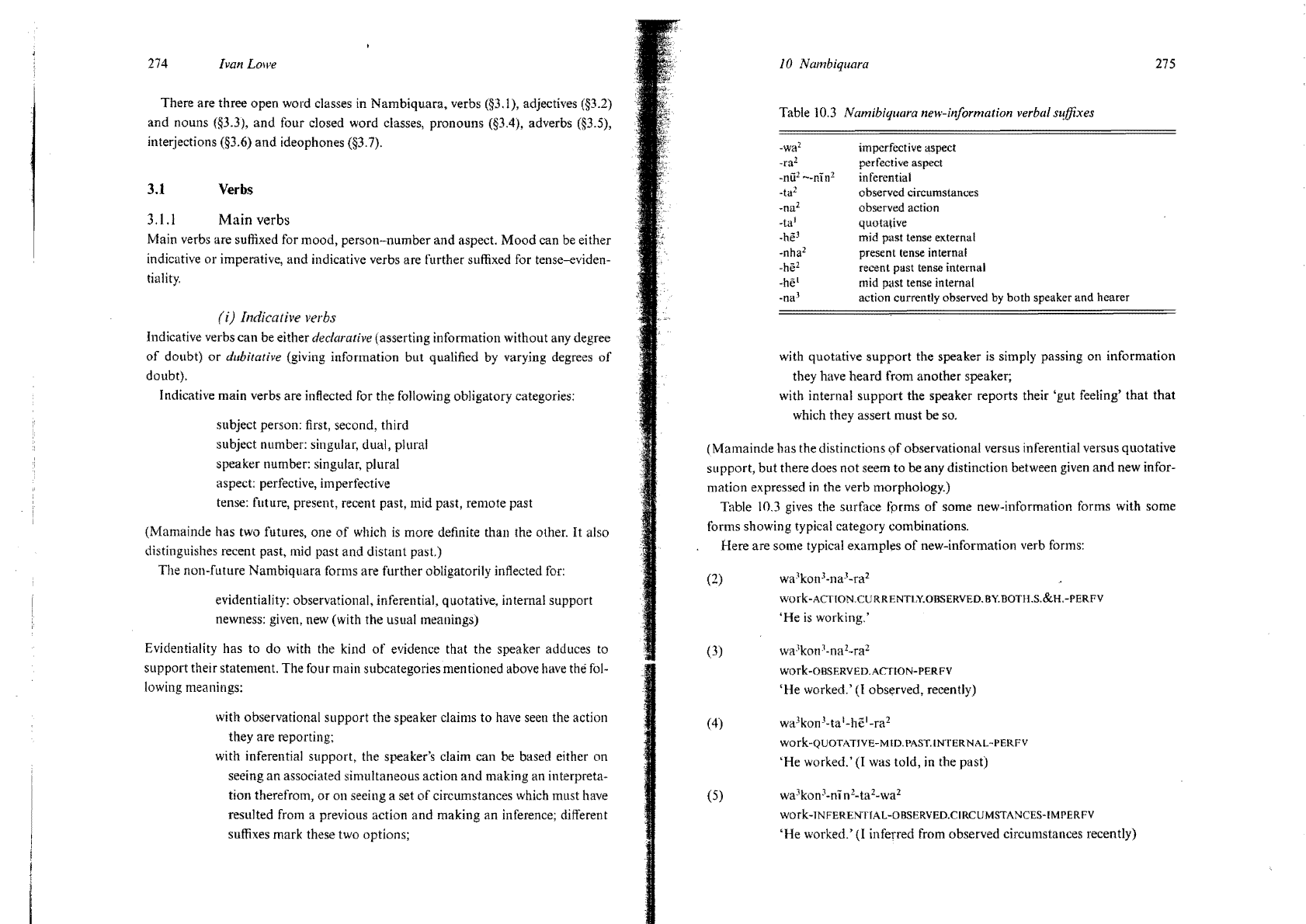
TabIe
10.3
Namibiquura new-information verbal
s"!ffixes
_wa
2
impcrfective aspect
-ra
2
perfective aspect
-1
-?
-nu-
--m
n-
inferential
-ta
2
observed circumstances
_na
2
observed action
_tal
quota¡ive
-he
J
mid P,lst tense external
-nha
2
present tense internal
-he
2
recent pust tense internal
_he!
rnid past tense interna!
-na
J
action currently observed
by
both speaker and hearer
with quotative
support
the speaker
is
simpIy passing on information
they have
heard
from
another
speaker;
with internal
suppart
the speaker reports their
'gut
feeling'
that that
which assert must be so.
(Mamainde
has the distinctions
of
observational versus inferential versus
support,
but
there does
not
seem to be any distinction between
and
new infor-
mation expressed
in
tlle verb morphology.)
Table 10.3 gives the surface fprms
of
sorne new-information forms with sorne
forms showing typical category combinations.
Refe
are some typical examples
of
new-information verb forms:
(2) wa
1
kon
J
_na
J
_ra
Z
work
-ACfION.CU
RR
ENTIY.OBSERVED.
BY.
BOTH.S.&H
.-PERFV
'He
is
(3)
wa.lkonJ-na2-raZ
work-OBSERVED.ACfION-PERFV
'He
worked.'
(1
observed, recently)
(4)
waJkonJ-ta
l-heI_ra
z
work-QuoTATIVE-MlD.PAST.INTERNAL-PERFV
'He
worked.'
(1
was toId, in the past)
(5)
waJkonJ-ni n
2
_ta
2
_wa
2
work-1NFERENTIAL-OBSERVED.CIRCUMSTANCES-IMPERFV
'He
worked.'
(l
inferred from observed circumstances recently)
277
276
¡van
LOlVe
(6) waJkonJ-ntn2-na2-wa2
work-INFERENTIAL-OBSERVED.ACTION-IMPERFV
'He
is
working.'
(1
inferred from observed associated action from a
distance recently)
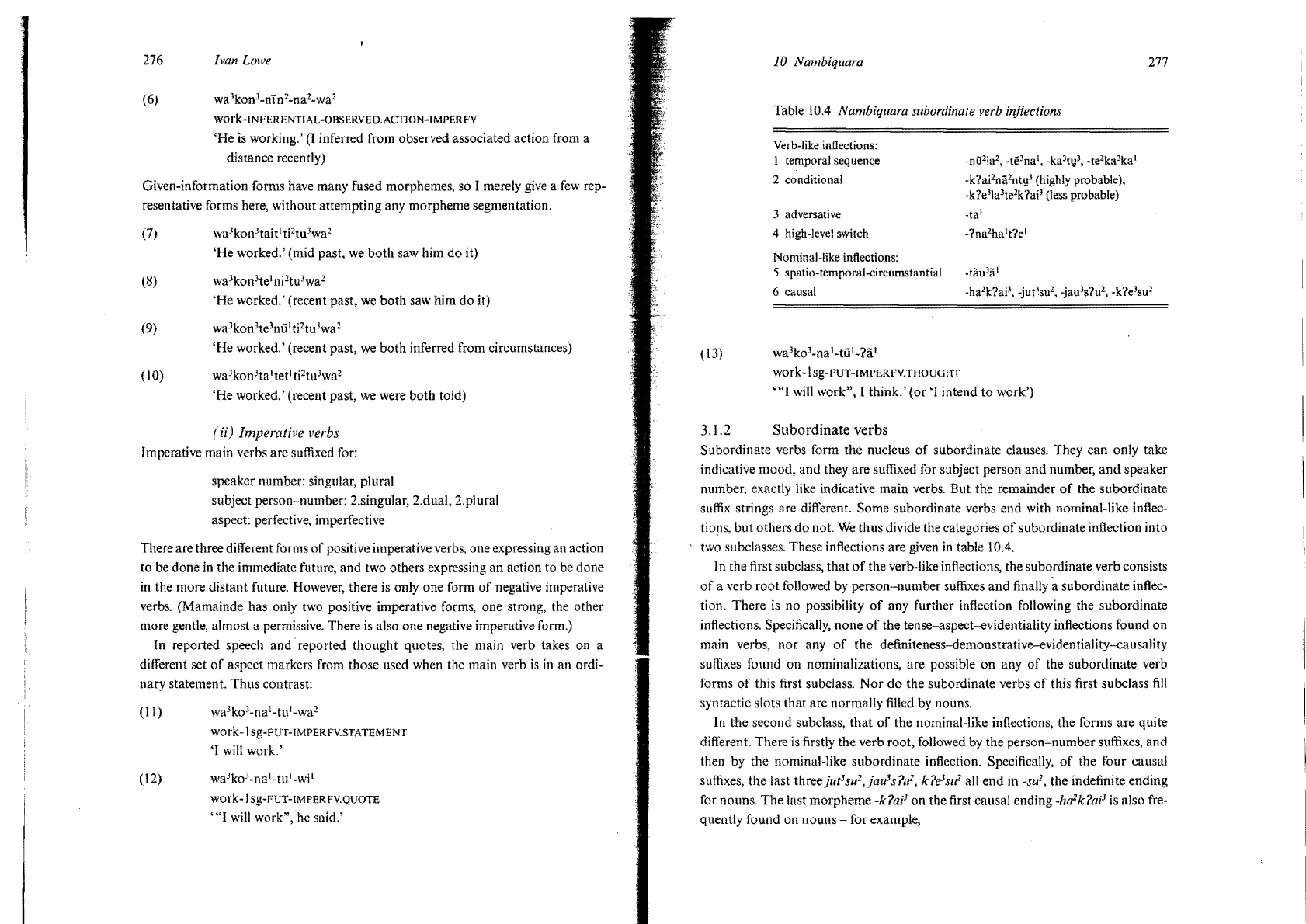
Given-information forms have many fused morphemes, so 1 merely
give
a
few
rep-
resentative forms here, without attempting any morpheme segmentation.
(7)
waJkonJtaitlti2tuJwa2
'He
worked.' (mid past,
we
both
saw him
do
it)
(8)
waJkonJtelni2tuJwa2
'He
worked.' (recent past, we both saw him
do
it)
wa
Jkon
3
telnü1
tFtu
J
wa
2
'He
worked.' (recent past,
\l/e
both
inferred from circumstances)
(10)
wa
J
kon
3
ta
ltet
l
tj2tu
3
wa
2
'He
worked.' (recent past,
we
were both told)
Imperative
verbs
Imperative main verbs are suffixed for:
speaker number: singular, plural
subject person-number: 2.singular, 2.plural
aspect: perfective, imperfective
There are three different forms
of
positive imperative verbs, one expressing an action
to be done in the immediate future,
and
two others expressing an actíon to be done
in the more distant future. However, there is only one form
of
negative imperative
verbs. (Mamainde has only two positive imperative forms, one strong, the other
more gentle, almost a permissive. There
i8
also one negative imperative form.)
In reported speech
and
reported thought quotes, the main verb takes on a
dilferent set
of
aspect markers fmm those used when the
mail1
verb
is
in an ordi-
nary
statement.
Thus
contrast:
(11)
wa3koJ-nal-tul-wa2
work-lsg-FtJT-IMPERFV.STATEMENT
'1
will
work.'
(12)
wa
3
ko
J
-na
I_tu
I_wi
1
work-Isg-FUT-IMPERPV.QUOTE
'''1
will
work", he said.'
10
Nambiqllara
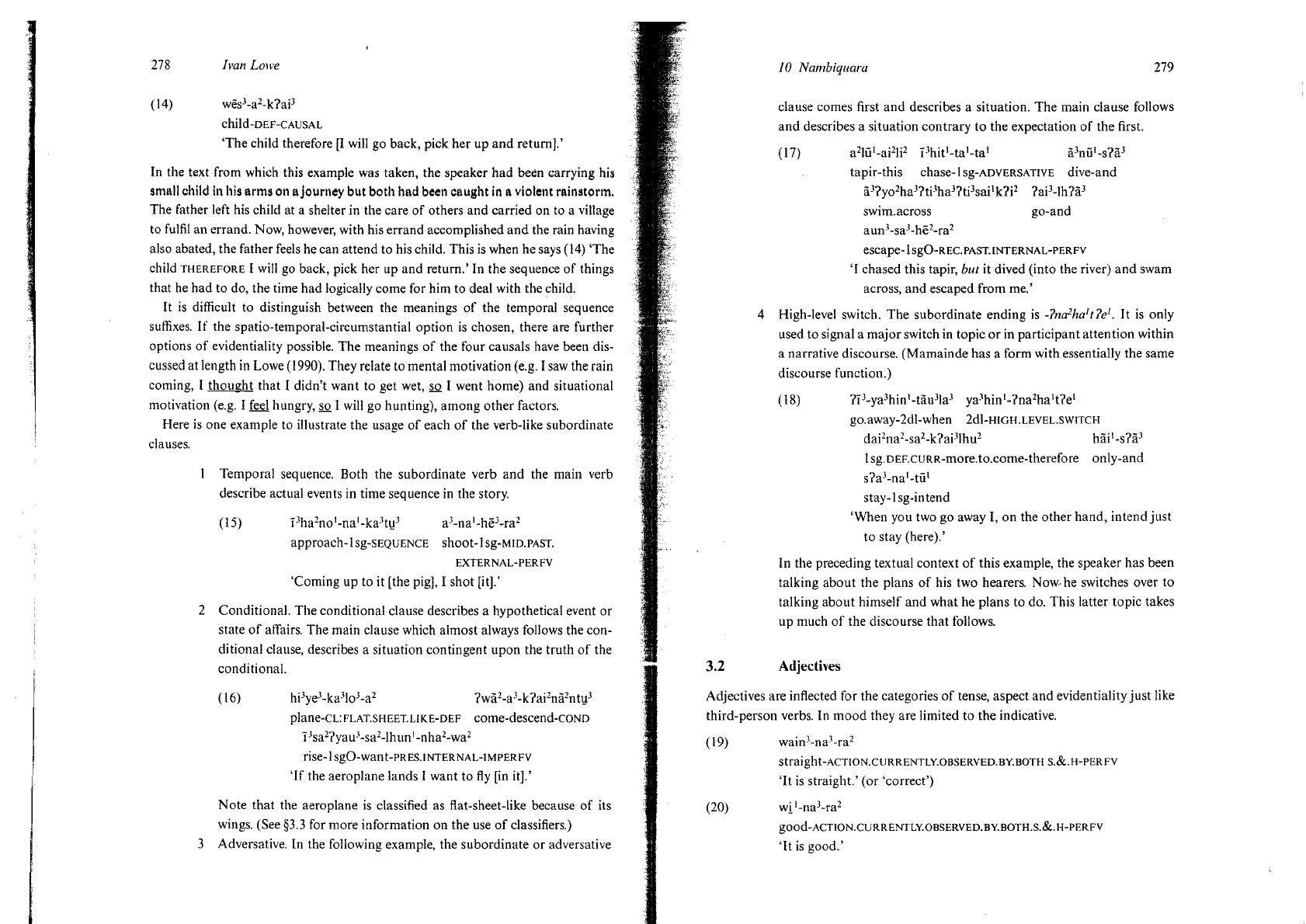
Table 10.4 Nambiquara suhordinate
verb
inflections
Verb-like infiections:
l temporal sequence
_nü
2
Ia
2
,
-télna
l
,
_kaltyl, -te2ka
3
ka
l
2 conditional -k?ai
2
na
2
nt
yJ (highly probable),
-k?e
l
la
3
te
2
1::?aP
(Iess probable)
3 adversative
-tal
4 high-Ievel switch
-?na
2
ha
l
t?e
l
Nominal-like infiections:
5 spatio-temporal-circumstantial
-taula
l
6 causal
-ha
2
k?ai\
-jut'su
2
,
-k?e
l
su
2
(13)
wa
3
ko
3
-l1a
l_tü
1
_
í'ii
I
work-!sg-PUT-IMPERPV.THOUGHT
'''1 will work", 1 think.'
(or
'}
intend
to
work')
3.1.2
Subordínate verbs
Subordinate verbs form the nucleus
of
subordinate clauses. They can only take
indicative mood,
and
they
are
suffixed for subject person
and
number,
and
speaker
number, exactly like indicative main verbs. But the remainder
of
the subordinate
suffix strings are different. Sorne subordinate verbs end with nominal-like inftec-
but
others
do
no1.
We
thus divide the categories
of
subordinate inflection into
two subclasses. These inflections are given in table
lOA.
1 n the first subclass,
that
of
the verb-like inftections, the subordinate verb consists
of
a verb root followed by
person-number
suffixes
and
finally a subordinate
inHec-
tion.
There
is
no possibility
of
any further infiection following the subordinate
inftections. Specifically,
none
of
the tense-aspecHlVidentiality inftections found on
main verbs,
nor
any
of
rhe definiteness-demonstrative-evidentiality-causality
suffixes found on nominalizations, are possible on any
of
the subordinate verb
forms
of
this first subclass.
Nor
do
the subordinate verbs
of
this first subclass
fill
syntactic slots that are normally filled by nouns.
In the second subclass.
that
of
the nominal-like inflections, the forms are
different. There
i3
firstly the verb root, folJowed
by
the persol1-number suffixes,
and
then by the nominal-like subordinate inflectíon. Specifically.
of
the fonr causal
suffixes,
the
last threejut
3
sU!,jau-
l
s7¡1,
k7e3s¡¡2
all
end
in
-sU!,
the indefinite ending
ror nouns.
The
last morpheme -k7ai
J
on
the first causal ending -luik7a¡1 is also fre-
quently found on nouns - for example,
279
278
ban
Lowe
(14)
wes
3
-a
2
-k?aP
child-DEF-cAusAL
'The child therefore
[1
will
go back, pick her up and return].'
In
the text from which this example
was
taken, the speaker had beén carrying
his
smnll
child
in
his
arms
on
aJourney
but
both
hnd
been
caught
in
a
violent
rainstorm.
The father left
his
child at a shelter
in
the care
of
others and carried on to a village
to
fulfil
an errando Now,
however,
with
his
errand accomplished
and
the rain having
also abated, the father
feels
he can attend to
his
child. This
is
when he
says
(14)
'The
child
THEREFORE
I
will
go
back, pick her up and return.' In the sequence
of
things
that
he
had to do, the time had logically come for him to deal with the child.
It
is
difficult to distinguish between the meanings
of
the temporal sequence
suffixes.
If the spatio-temporal-circumstantial option
is
chosen, there are further
options
of
evidentiality possible. The meanings
of
the four causals
have
been dis-
cussed al length
in
Lowe (1990). They relate to mental motivation (e.g. 1
saw
the rain
coming, I thought that I didn't want to get wet, so I went home) and situational
motivation (e.g. 1
feel
hungry, so 1
will
go
hunting), among other faclors.
Here
is
one example to iIlustrate the usage
of
each
of
the verb-like subordinate
clauses.
Temporal sequence. Both the subordinate verb and the main verb
describe actual events
in
time sequence
in
the slory.
(15)
j
3ha
2
no
l-
na
l-ka
3
t!JJ
a
3
-na
l_he
3
_ra
2
approach-l
sg-SEQUENCE
shoot-I
sg-MIO.PAST.
EXTERNAL-PERFV
'Coming up to it [the
pig],
1 shot [it].'
2 Conditional. The conditional clause describes a hypothetical event or
state
of
affairs. The main clause which almost always follows the con-
ditional clause, describes a situation contingent upon the truth
of
the
conditional.
(16)
hPye
3
-ka
3
10
J
-a
2
?wa
2_
a
3
-k ?ai
2na
2
n t
y
3
plane-CL:FLAT.SHEET.LIKE-DEF
come-descend-coND
j J
sa
2?yau
3
-sa
2
-lhun l-nha
2
-wa
2
rise-I
sgO-want-PREs.INTERNAL-IMPERFV
'If
the aeroplane lands 1 want to
fiy
[in
it].'
Note tha! the aeroplane
is
classified
as
fiat-sheet-Iike because
of
its
wings.
(See
§3.3
for more information on the
use
of
c1assifiers.)
3 Adversative.
In
the following example, the subordinale or adversative
10 Nambiqllara
c1ause
comes first and describes a situation. The main
c1ause
follows
and describes a situation contrary to the expectation
of
the first.
(17) a
2
1ú
1
_ai
2
Ji2
j3hit
1
-ta
1
_ta
1
a
3
nú
1
_s?a
3
tapir-this chase-I
sg-ADVERSATIVE
dive-and
a
3?y02ha
3?tPha
3
?tPsaP
k?j2
?aP -Ih?a
3
swim.across go-and
aun
3
-sa
3
-he
2
-ra
2
escape-I
sgO-REC.PAST.INTERNAL-PERFV
'1
chased this tapir, bul it
di
ved (into the river) and swam
across, and escaped from me.'
4 High-Ievel switch. The subordinate ending
is
_?na
2
ha
l
I
lelo
It
is
only
used to signal a major switch
in
topic
or
in
participant attention within
a narrative discourse. (Mamainde has a form with essentially the same
discourse function.)
(18)
T¡3_
ya
3
hin l_tau
J
la
3
ya
3
hin 1-?na
2
ha ltí'e
1
go.away-2dl-when
2dl-HIGH.LEVEL.SWITCH
daj2na
2
-sa
2
-kí'aPlhu
2
hai
1
-s?a
3
I
sg.
DEF.CURR-more.
tO.come-therefore only-and
s?a
J
-na
1
-tú
1
stay-I sg-intend
'When you two go away
1,
on the other hand, intendjust
to stay (here).'
In the preceding textual context
of
this example, the speaker has been
talking about the plans
of
his two hearers. Now· he switches over to
talking about himself and what he plans to do. This latter topic takes
up much
of
the discourse that follows.
3.2
Adjectives
Adjectives are infiected for the categories
of
tense, aspect and evidentiality just like
third-person verbs. In mood they are limited to the indicative.
(19) wain
3
-na
3
-ra
2
straight-AcTION.CURRENTLY.OBSERVED.BY.BOTH
S.&.H-PERFV
'It
is
straight.' (or 'correct')
(20)
wl
1
-na
3
-ra
2
gOOd-ACTlON.CURRENTLY.OBSERVED.BY.BOTH.S.&.H-PERFV
'H
is
good.'
281
280
¡van Lowe
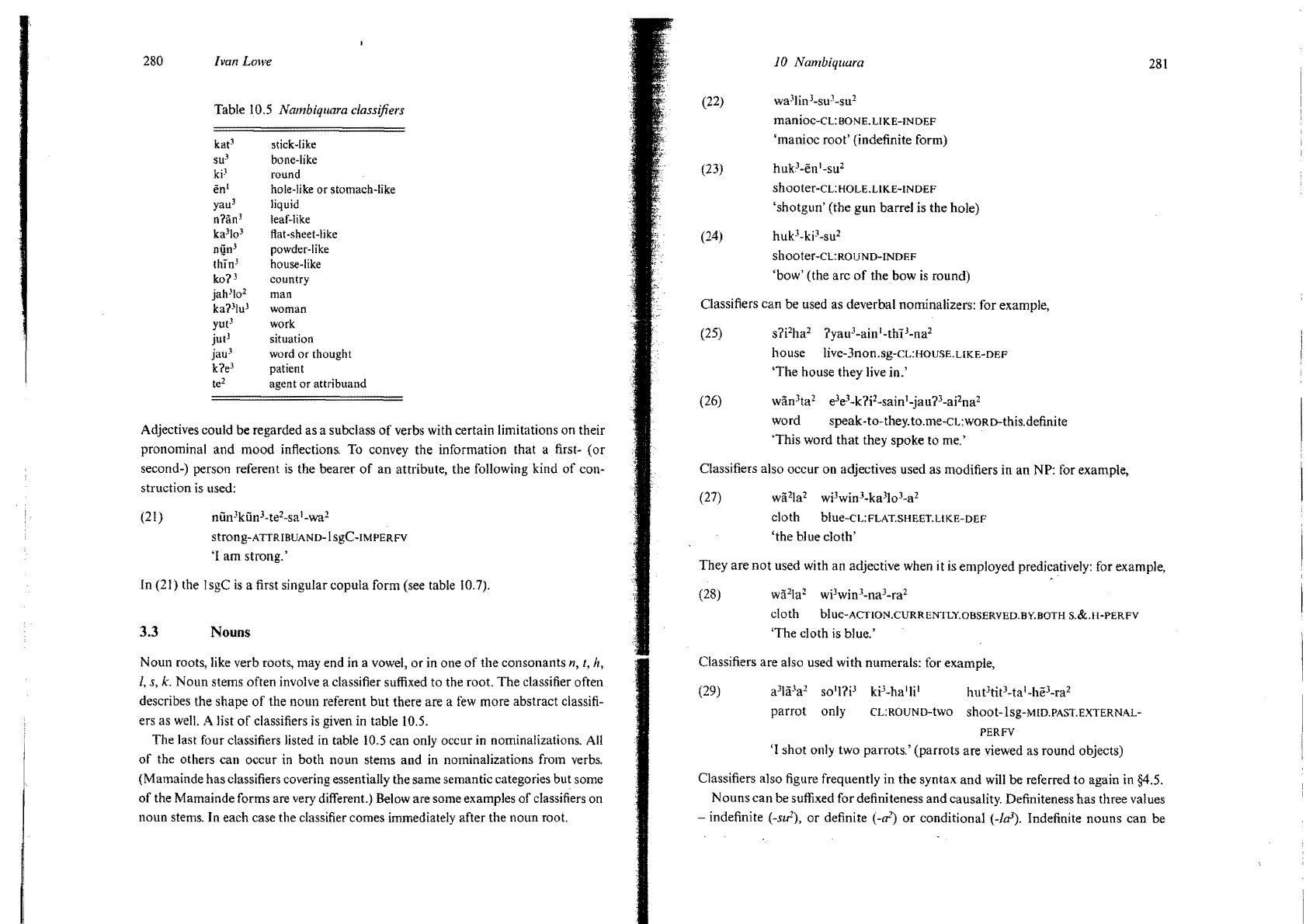
Table 10.5 Nambiquara c/assifiers
kat) stick-like
su"'
bone-like
kP
round
en
l
hole-like
or
stomacn-like
yau
l
liquid
n?iin
l
leaf-like
kallo
l
ftat-sneet-Iíke
o!in)
powder-like
Ihin) house-like
ko? l country
jah)l
o
2 man
ka?)lu) woman
work
situation
word
or
thought
k?e
J
palien!
te
2
agent
or
attribuand
Adjectives could be regarded as a subclass
of
verbs with certain limitations
on
their
pronominal
and
mood
inflections.
To
eonvey
the
information that a first-
second-) person referent
is
the
bearer
of
an
attribute,
the
kind
of
con-
struction
is
lIsed:
(21)
nünJkunJ-te2-sal_wa2
strong-ATTRIBUAND-lsgC-IMPERFV
'1
am
strong.'
In
the IsgC
i8
a first singular
copula
form (see table
10.7).
3.3
Nouos
Noun
roots, Iike verb roots, may end in a vowel,
or
in one
of
the
consonants
n,
t,
h,
1,
s,
k.
Noun
stems often involve a classifier suffixed
to
the root.
The
classifier often
describes the shape
of
the Iloun referent
but
there are a
few
more
abstraet classifi-
ers as
wel!.
A list
of
classifiers is given in table 10.5.
The las! fouf classifiers listed
in
table
10.5
can only occur in nominalizations.
Al!
of
the others can oecur in
both
noun stems
and
in nOJninalizations from verbs.
(Mamainde has classifiers covering essentially the same semantic categories but some
of
the Mamainde forms are very different.) Below are some examples
of
classifiers on
noun
stems.
In
each case the classifier comes irnmediately after the
noun
rooL
10 Nambiquara
(22)
wa
3
Iin
J
-su
J
-S1l
2
manioe-cL:BoNE.L1KE-INDEF
'manioc
root'
(indefinite form)
(23)
huk
J
-en
1
_SU
2
5hooter-cL:HOLE.LIKE-INDEF
(tbe
gun
barrel is
the
hole)
(24)
huk
3
-kP-su
2
shooter-cL:RoUND-INDRF
'bow'
(the
are
of
the bow
is
round)
Classifiers can
be
used as deverbal nominalizers: Ibr example,
(25) s?i2ba
2
?yall
J
-ain
l
-thi
J
-na
2
house Iive-3non.sg-cL:HOUSE.LlKE-DEP
'The
house
tbey
live in.'
(26)
wan
3
ta
2
eJeJ-k?P-sainl_jau?3-ai2na2
word speak-to-they.to.me-CL:woRD-this.definite
'This
word
that
they spoke to me.'
Classifiers also oecur
on
adjectives used as modifiers in an NP: for example,
(27)
wa
2
1a
2
wPwin
3
·ka
J
l
o
J-
a
2
clotb
blue-cL:FLAT.SHEET.L1KE-DEF
'the
bllle c1oth'
are
not
used with
an
adjeetive when it
i5
employed predicatively: for example,
(28)
wa
2
1a
2
wPwin
3
-na
J
-ra
2
cloth
bluc-ACTION.CURRENTLY.OBSERVED.BY.BOTH
S.&.II-PERFV
'The
cloth
i5
blue.'
Classifiers are also used with numerals: tbr example,
(29)
a
l
l1i.
3
a
2
soll?¡J kP-ha1li
l
hutJtitJ-tal_héJ_ra2
parrot
only
CL:ROUND-two
shoot-lsg-MID.PAST.EXTERNAL-
PERFV
'1
shot
only
two
parrots.'
(parrots
are viewed as round objeets)
Classifiers also figure frequently in
the
syntax
and
will be referred to
in
§4.5.
Nouns
ean
be suffixed for definiteness
and
causality. Definiteness
has
three values
índefinite
(-s!?).
or
definite (-al)
or
eonditional (-Jal). Indefinite
nouns
ean
be
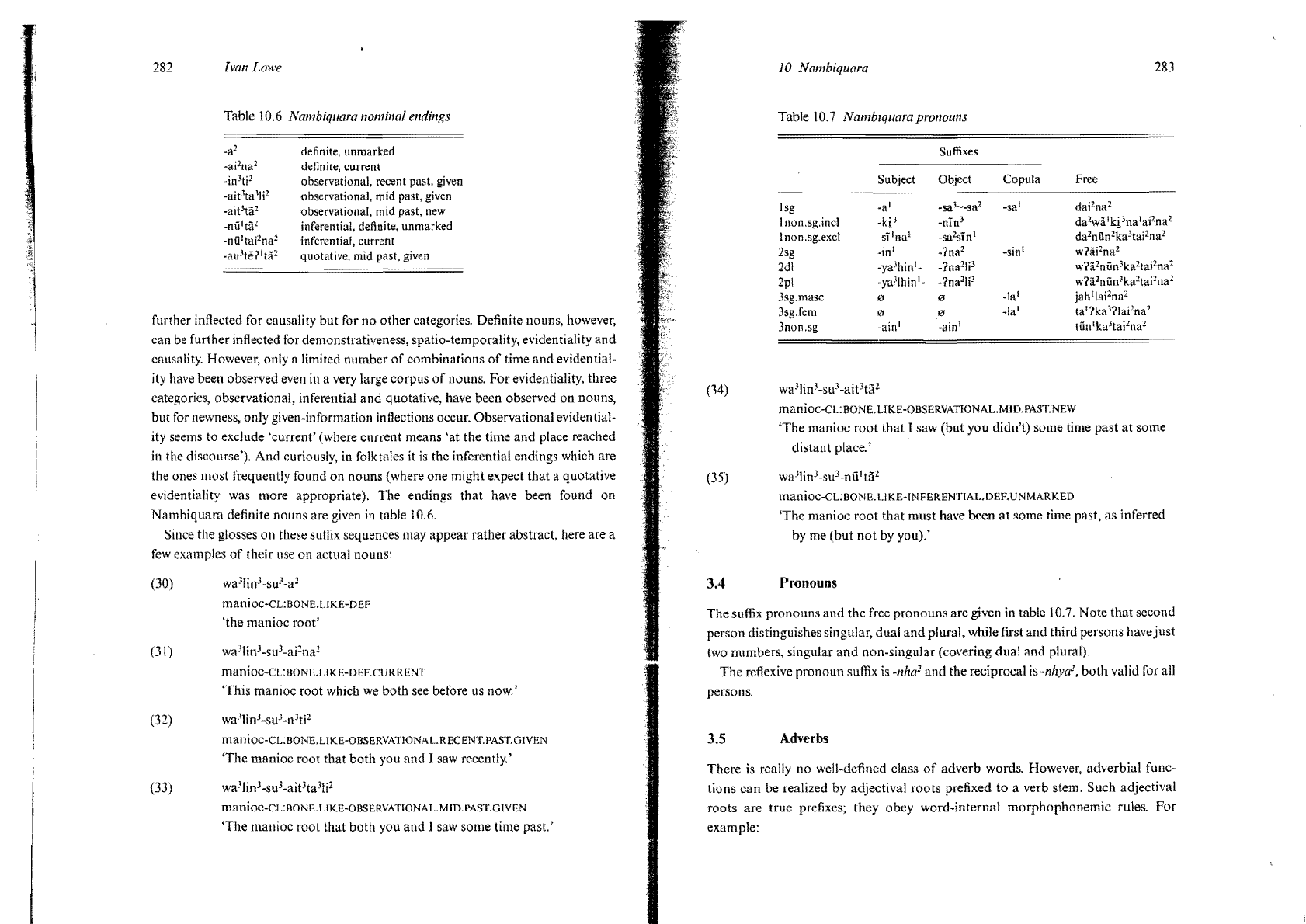
283
282
¡van Lowe
Table 10.6 Nambiquara nominal endings
_al
definite, unmarked
-aFna
1
definite, current
-inJtF
observational, recent
pasto
given
_ait
l
ta
J
Jj2
observational, mid pas!,
gíven
-ait
l
tií
2
observational, mid past,
new
-níi
l
tii
2
inferential, definite, unmarked
-níi1tai1na
1
inferential, current
-auJteí'ltiF
quotative, mid past,
given
further inftected for causality but ror
no
other categories. Definite llouns, however,
can
be
further inftected for demonstrativeness, spatio-temporality, evidentiality
and
callsality. However, only a limited nllmber
of
combinations
of
time and evidential-
have been observed even
in
a very large corpus
of
nouns. For evidentiality, three
categories, observational, inferential and quotative, have been observed on nouns,
bu! for newness, only given-information inflections occur. Observational evidential-
ity seems lo exclude 'eurrent' (where curren! means
'at
the time and place reached
in
the discourse'). And curiollsly, in folktales it
is
the inferential endings which are
the ones most frequently found on nouns (where one might expect that a quotative
was more appropriate). The endings
that
have been found on
definite nouns are given
in
table
lO.6.
Sinee lhe glosses on these suffix sequences may appear rather abstraet, here are a
few
examples
of
their
use
on actual nouns:
waJlinJ-suJ-a
1
manioc-CL:BONE.L1KE-OEF
'the manioc root'
(31
)
wa
3
Iin
J
-su
J
-aPna
1
manioc-Cl:BONE.UKE-DEF.CURRENT
'This manioc root which
we
both see before
us
now.'
(32) wallinJ-suJ-n3til
manioc-cl:BONE.lIKE-OBSERVATIONAL..RECENT.PAST.GIVEN
'The
rnanioc root that both you and 1 saw recently.'
(33)
waJlinJ-suJ-aitJtaJ!¡2
manioc-CL:BONE.lIKE-OBSERVATIONAL..MIO.I'AST.GIVEN
'The manioc root that both you and 1
saw
sorne time past.'
10 Nambíquara
Table
10.7
Nambiquara pronouns
Suffixes
Subject Object
Copula Free
lsg
-al
_sa
l
-·sa
2
-sal
daPna
2
I non.sg.incl
-kP
-nin'
da
l
wii
l
kPna
l
aiZna
2
1
non.sg.exc1
-sjlna
l
-salsínl
dalnún2ka3taj2na2
2sg
·in
l
-í'na
2
-sin
l
wriiFna
2
2dl
-yaJhin
'
-
-í'na
2
lP
w?ii
2
nún
3
ka
2
¡aPna
2
2pl
-yaJlhin
'
- -í'na
2
IP
w7¡¡2nún
3
ka
2
taPna
2
3sg.masc
-la
'
jah1tai
2
na
2
3sg.fem
'"
111
'"
-Ia
l
ta
'
í'ka
3
7IaPna
2
3non.sg
-ain
l
'"
-aín
1
tún
Ika
l
taFna
2
(34)
waJlinJ-su3-aitJta2
manioc-CL:BONE.lIKE-OBSERVATIONAL.MIO.PAST.NEW
'The
manioc root that 1saw (but you didn't) sorne time past at some
distant
(35)
wa
J
lin
J
-su
3
-nú
'
tal
maniOC-CL:BONE.UKE-INFERENTIALDEF.UNMARKED
'The
manioc root
that
mus! have been
at
sorne time past, as inferred
by me (but
not
by you).'
3.4
Pronouns
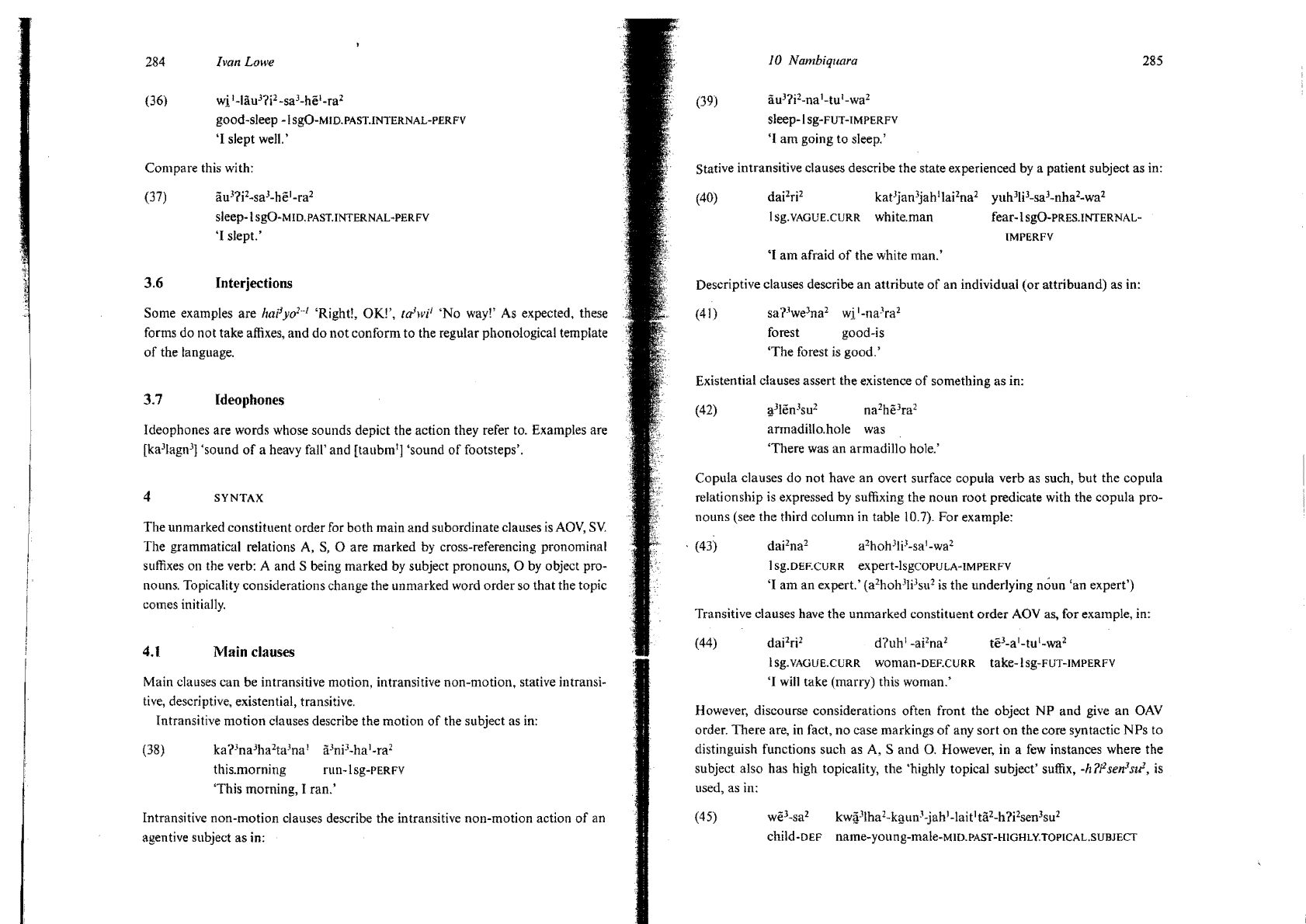
The suffix pronouns and the free pronouns are given
in
table
10.7.
Note that second
person distinguishes singular, dual
and
plural, while first and third persons havejust
two numbers, singular
and
non-singular (covering dual and
The
reflexive pronoun suffix
is
-nha
2
and the reciproca!
is
-nhya
J
,
both
valid for
all
persons.
3.5
ildverbs
There
is
really
no
well·defined
c1ass
of
adverb words. However, adverbial func-
tions
can
be realized
adjectival
roots prefixed
to
a verb stern. Such adjectival
roots
are
true
obey word-internal morphophonemic rules. For
example:
285
284
[van
Lowe
(36)
wi 1-lau
J
?P-sa
3
-hé
l
-ra
2
good-sleep
-lsgO-MID.PAST.INTERNAL-PERFV
'1
slept
wen:
Compare
this with:
(37)
au
3
?i2-sa
J
-he
l
-ra
2
sleep-l
SgO-MID.PAST.INTERNAL-PERFV
'1
slept.'
3.6
Interjections
Some examples
are
hai
J
yo
2 .. ¡ 'Right!,
OK!',
taJwi
l
'No
way!' As expected, these
forms do no! take affixes,
and
do
not
conform
to
the regular phonological template
of
the
language.
3.7
Ideophones
Ideophones
are
words whose
sounds
depict the action they refer to. Examples are
[ka
J
lagn
3
]
'sound
of
a heavy fal!'
and
[taubm
l
]
'sound
of
footsteps'.
4
SYNTAX
The
unmarked
constituent
order for
both
main
and
subordinate clauses
is
AOV,
Sv.
The grammatical relations A,
S,
O are marked by cross-referencing pronominal
suffixes on the verb: A
and
S being
marked
by subject pronouns, O by object pro-
nouns. TopicaHty considerations change lhe unmarked word
arder
so
that
the
comes initially.
4.1
Main
c1auses
Main clauses
can
be
intransitive intransitÍve
non-motíon,
stative intransÍ-
tÍve, descriptive, existential, transitive.
Intransitive
motion
clauses describe
the
moHon
of
the as in:
ka ?3naJha2ta3na
1 a
3
niJ-ha
l
-ra
2
this.morning run-!
sg-PERFV
'This
morning,
1
ran.'
Intransitive
non-motion
clauses describe
the
intransitive
non-motion
action
of
an
agentive subject
as
in:
10
Nambiquara
(39)
au
J
?i
2
-na
1_tu
l_wa
2
sleep-I
sg-FUT-IMPERFV
'(
am
going
to
sleep.'
Stative intransitive c1auses describe
the
state experienced
by
a patient subject as in:
daPri
2
kat
J
jan
J
jah
1
laPna
2
yuh
3
IP-sa
J
_nha
2
_wa
2
1sg.
VAGUE.CURR
white.man fear-I
SgO-PRES.INTERNAL-
IMPERFV
'1
am
afraid
of
the
white
man.'
Descriptive clauses describe
an
attribute
of
an individual
attribuand)
as in:
sa?J
we
3
na
2 wi l-na)ra
2
forest
good-is
'The
forest is
Existential clauses a55ert lhe exi5tence
of
something
as
in:
(42)
ª3Ien)su
2
na
2
he
3
ra
2
armadillo.hole was
'There
was
an
armadillo
hole.'
Copula
c1auses
do
not
have
an
overt surface
copula
verb
as such,
but
the
copula
relationship is expressed by suffixing the
noun
root
predicate with the
copula
pro-
llouns (see
the
third column in table 10.7). For example:
(43)
daPna
2
a
2
hoh
3
JP-sa
l
-wa
2
I
sg.DEF.CURR
expert-lsgcoPuLA-IMPERFV
'1
am
an
expert.'
(a
2
hoh
J
li
J
su
2
is
the underlying
nóun
'an
expert')
Transitive c1auses have the
unmarked
constituent
order
AOVas,
for example, in:
(44)
daPrP
d'luh 1 -ai2na
2
té
3
·a
l
·tu
l
-wa
2
1sg.
VAGUE.CURR
woman-DEF.CURR
take-I
sg-FUT
-IMPERFV
'1
will take (marry) this woman.'
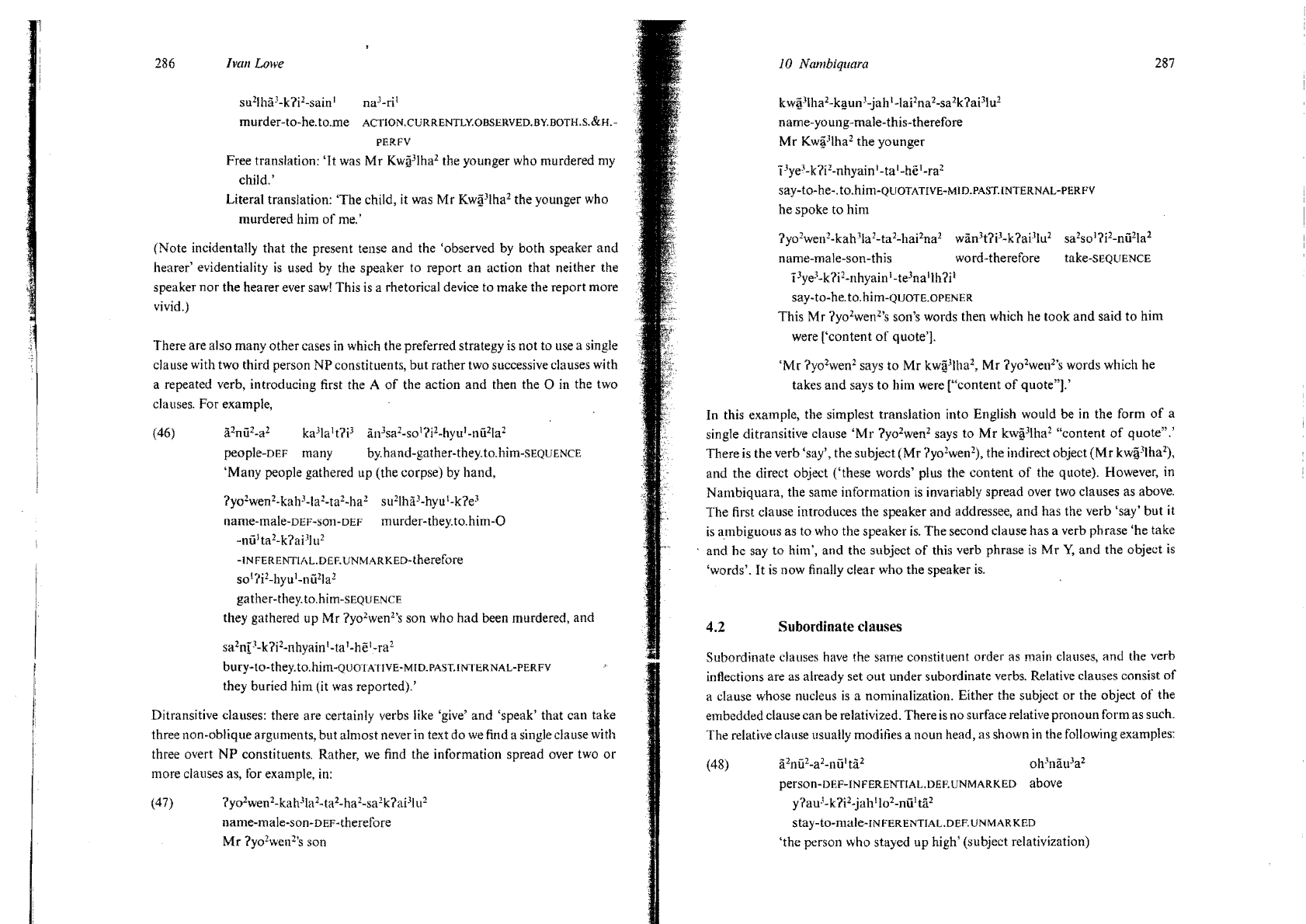
However, discourse considerations often front the object
NP
and
give
an
OAV
order.
There
are, in fact,
no
case markings
of
any
sort
on
the core syntactic
NPs
to
distinguish functions such as A, S
and
O.
However, in a
few
instances where
the
subject
also
has
high topicality,
the
'highly topical subject' suffix,
-h?Pserrsu!,
is
used, as in:
we
3
-sa
2
kwª3lha 2_kªun
J
-jah 1·lait
1
ta
2
-h
?j2sen
J
su
2
child-DEF
name-young-male-MID.PAST-HIGHLY.TOPICAL.SUBJECT
287
286
liJan
Lowe
su
2
Ihii
J
-k?P-sain
l
naJ-ri
l
murder-to-he.to.me
ACT10N.CURRENTLY.OBSERVED.BY.DOTH.S.&H.-
PERfV
Free translation:
'It
was
Mr
Kw¡Plha
2
Ihe younger who murdered my
child.·
Literal translation:
'The
child. it was
Mr
Kw;¡plha
2
the
younger who
murdered him
of
me.'
(Note
incidentaIly
that
the present tense
and
the 'observed by
both
speaker
and
hearer' evidentiality
is
used
the
speaker lo report
an
action Iha! neither the
speaker
nor
the
hearer ever saw! This is a rhetorical device to
make
the
report more
There
are also
many
other
cases
in
which the preferred strategy is
not
to use a
c1ause with two third person
NP
constituents,
but
rather
two successive c1auses with
a repeated verb, introducing first the
A
of
the action
and
then
the
O in
the
Iwo
c1auses. For example,
a
1
nü
2
_a
2
ka
31a
I
t
7P
an
J
sa
2
-so
1
?P-hyu'-n ü
2
1a
2
people-DEF many by.hand-gather-they.
to.him-SEQUENCE
'Many
people gathered
up
(the corpse) by
?y02wen
2
-kah
3
-la
1
-ta
2
_ha
2
su
2
lhii
J
-hyu l-k7e
3
name-male-DEF-son -
DEf
m urder-they.
too
him-O
-nü
1
ta
2
-k?aPlu
2
-IN
FER
ENTIAL.
DEF.
UNMARKED-therefo
re
sol?i2-hyu
1
-n¡í2la
2
gather-they.to.him-sEQUENCE
they gathered up
Mr
?y02wen
2
's
son who
had
been murdered,
and
sa
1
nC-k?i
2
-nhyain
l
-ta 1-he l_ra
2
bury-to-they.to.him-QUOTATIVE-MID.PAST.INTERNAL-PERFV
they buried him
(it
was reported).'
Ditransitive clauses: there are
verbs like 'give'
and
'speak'
that
can take
three non-oblique arguments, but almost never
in
text
do
we find a single clause with
three overt
NP
constituents, Rather,
we
find the information spread over two
or
more clauses as, ror example, in:
?yo2wen2-kah.1la2_ta2_hal_sa2k?aPlu2
name-male-son-DEf-therefore
Mr
?y02wen
2
's
son
10 Nambiquara
kw~plha
2_
kª
un J-jah
'-laPna
2
-sa
2k
?aPlu
2
name-young-male-this-therefore
Mr
Kwí¡Plha
2
the
younger
I J
ye
J-k7i
2
-nhyain l-ta
l
-hc
1
-ra
2
say-to-he-. to,him-QuoTA
TIVE-MIO.PAST.INTERNAL-PER
PV
he
spoke
to
him
?y02wen
2
-kah)la
2
-ta
2
-haj2na
2
wíin
3
t?P-k?aPlu
2
sa
2
so
l
?j2-nü
2
Ia
2
name-male-son-this word-therefore take-sEQuENcE
¡J
ye
J-k?i
2
-nhyain l-te
3
naiIh7P
say-to-he.to.him-QuoTE.OPENER
This
Mr
í'y02wen
2
's
son's words then which he
took
and
said
to
him
were
['content
of
quote'J.
'Mr
?y02wen
2
says
to
Mr
kw¡¡lJha
2
,
Mr
?y02wen
2
's
words which he
takes
and
says
to
him
were ["content
of
quote").'
In this example, the simplest translation into English would be in
the
form
of
a
single dítransitíve clause
'Mr
?yo2wen
2
says
to
Mr
kwij.3lha
2
"content
of
quote".'
There
is
the
verb 'say',
the
subject
(M
r '?y02wen
2
),
the
indirect object
(Mr
kw¡¡3Jha
2),
and
the
direct object
words'
plus the
content
of
the
Nambiquara,
the
same
information
is
invariably
spread
over two clauses as aboye.
The
first c1ause introduces
the
speaker
and
addressee,
and
has the verb 'say'
but
it
is
ambiguolls
as
to
who the speaker
is.
The
second c1ause has a verb
phrase
'he
take
and
he
say
to
him',
and
the
subject
of
this verb
phrase
is
Mr
Y,
and
the
object
is
'words'.
It
is now finally
clear
who
the speaker
is.
4.2
Subordinate
c1auses
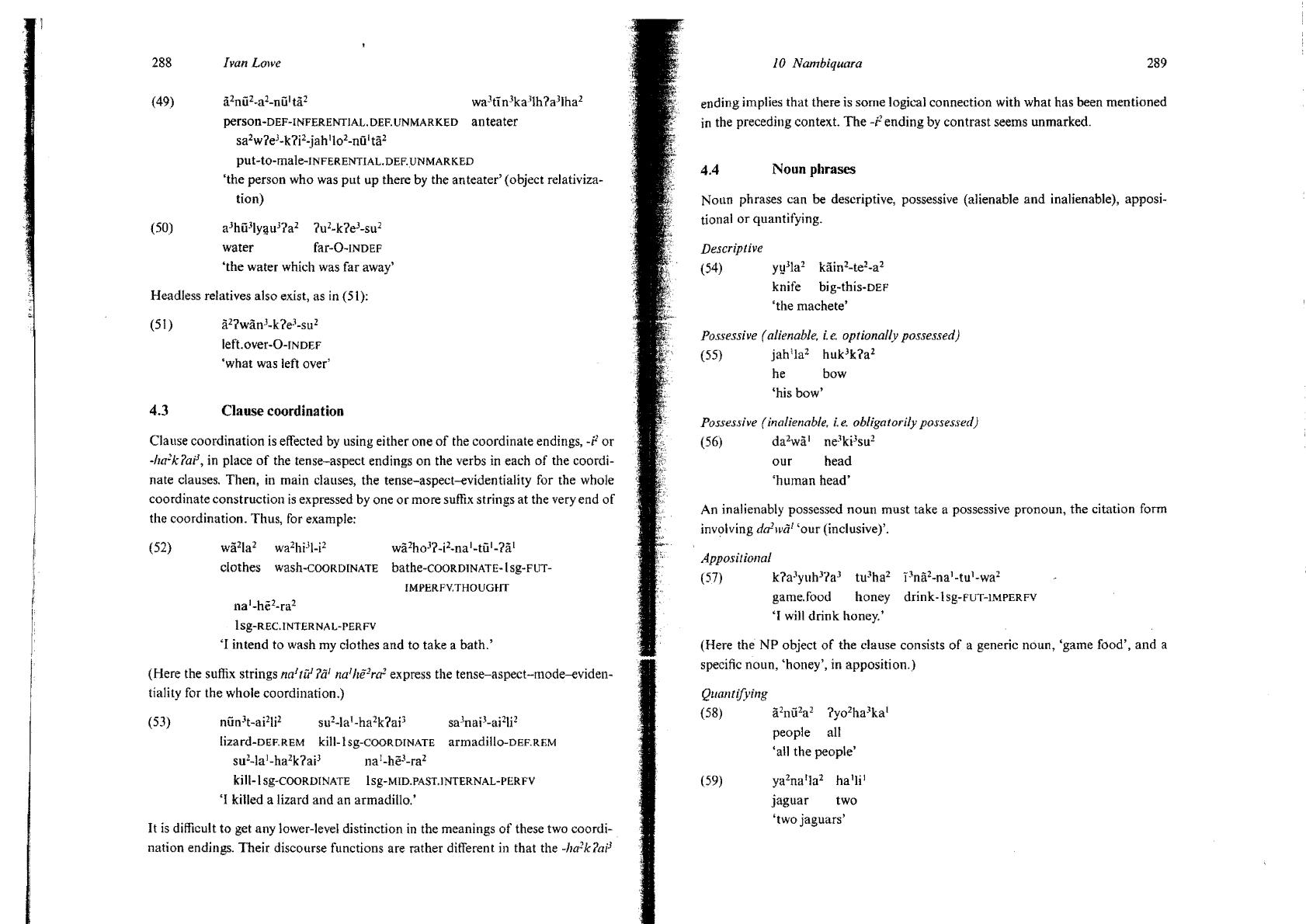
Subordinate c1auses have the same constituent order as main clauses,
and
lhe verb
inflections are as already sel
out
under subordinate verbs. Relative clauses consist
of
a clause whose nucleus
is
a nominalizatioll. Either the subject or the object
01'
the
embedded c1ause can be relativized. There
is
no
surface relative prono un form as such.
The
relative clause llsually modifies a noull head, as shown in the following examples:
(48)
a2nü2-a2-nülta2
oh
J
nau
J
a
2
person-DEf-IN
fERENTIAL.
DEI':
lJNMARKED
aboye
y'lau
J
-k?i
2
-jah Ilo2_nü
l
ta
2
stay-to-male-IN
FER
ENTIAL.
DEF.lIN
MAR
KED
'the
person who stayed
up
high' (subject relativization)
289
288
[van Lowe
a2nú2_a2_núlta2
wa
J
tín
J
ka
3
thí'aliha
1
person-DEF-INFERENTIAL.DEF.UNMARKED
anteater
sa
2
wí'e
J
-k7P-jah It0
2
-nfí I
ta2
put-to-male-INFERENTIAL.DEF.UNMARKED
'the
person who was
put
up there by the anteater' (object relativiza-
tíon)
(50)
a
3
hü
J
lyªu
J
?a
2
7u
1
-k7e
J
-su
2
water
far-O-INDEF
'the
water which was far away'
Headless relatives al so exist,
as
in (51):
(51
) ¡Ví'wan
J
-kí'e
J
-su
2
left.over-O-INDEF
'what
was left over'
4.3 Clause
coordination
Clause coordination
is
effected
by
using either one
of
the coordinate endings,
-P
or
-ha
2
k7a¡3,
in place
of
the tense-aspect endings
on
the verbs in each
of
the coordi-
nate c1auses.
Then,
in main c1auses, the tense-aspect-evidentialíty for the whole
coordinate construction
is
expressed by one
or
more suffix strings
at
the very
end
of
the coordination. Thus, for example:
(52)
wa
2
la
2
wa
2
hi
J
I-F
wa2hoJ7-i2-nal-tfíl-í'al
c\othes wash-cooRDINATE bathe-coORDINATE-lsg-FuT-
IMPERFV.THOUGUT
na
l
-he
2
-ra
2
lsg-REC.INTERNAL-PERFV
'1
illtend to wash my clothes
and
to take a
bath.'
(Here the suffix strings na
l
til7a
J
na
J
/¡€2
r
{¡2
express the tense-aspect-mode--cviden-
tíality
foc
the
whole coordinatíon.)
(53)
nUIl
J
t-ai
2
li
2
su
2
-la
1
-ha
2
k7aP sa
J
naP-ajZ1F
lizard-DEF.REM
kill-l
sg-COORDlNATE
armadillo-DEF.REM
su
2
-la
l
-ha
1
k7aP
na
l_he.l_ra
Z
kill-I
sg-COORDINATE
Isg-MID.PAST.lNTERNAL-PERFV
'1
killed a lízard
and
an
armadillo.'
11
is difficult
to
get any lower-level distillction
in
the meanillgs
of
these two coordi-
natioll endings.
Their
discourse functions are rather different in that the
-ha
2
k7a¡3
10 Nambiquara
ending implies
that
there is
some
logical connection with what has been mentioned
in the preceding cOlltext.
The
-í"
ending by
contrast
seems unmarked.
4.4
Nouo
pbrases
Noun phrases can be descriptive, possessive (alienable
and
inalienable), apposi-
tiona!
or
quantifying.
Descriptive
(54)
yy
J
l
a
2 kain
2
-te
2
-a
2
knife big-tbis-DEF
'the
machete'
Possessive (alienable.
i.e.
optionally possessed)
jahlJa
2
huk
J
kí'a
2
he bow
'his bow'
Possessive (inalienable,
i.
e.
obligatoríly possessed)
da
2
wd
1
ne
J
ki3su
2
our
head
'human
head'
An inalienably possessed
noun
must
take a possessive pronoun, the citation form
illvolving
da2wa
J
'OUT (inclusive)'.
Appositiona/
(57) kí'a
J
yuh
J
'la
3
tu
3
ha
2
rJna2_llal_tul_wa2
gameJood
honey drink-I
sg-FuT-IMPERFV
'1
will
drink honey.'
(Here the
NP
object
of
the
c1ause consists
of
a generic noun,
'game
food', alld a
specific noun, 'honey', in apposition.)
Quantifying
(58)
¡¡2n(¡2a
2
í'
y0
2ha
3
ka
l
people all
'all the people'
(59)
ya
2
1la
1
la
2
ha
1
1i
l
jaguar
two
'two
jaguars'
291
290
¡van Lowe
4.5
Nominalizations
AH
classifiers
may,
as mentioned
in
§3.3,
also fllnctíon as nominalizers:
s7a
J
-ain I-th!
.l-
na
2
stay-3non.sg-CL:HOUSE.L1KE-DEF
'the
hOllse
(or village) where they stay'
As mentioned before, there are
fOllr
classifiers which do no! serve to derive noun
stems fram
nOlln
roots, but whieh fllnction as nominalizers, for example,
(61) a
2
yen
3
_k?a
2
e
3
k?jI-san l-jut
1
_ta
2
¡2_
a
l_tu
l_wa
2
things-DEF
speak-you.to.me-slTUATlON-DEF
see-lsg-FuT-IMPERFY
'The situation
of
the things
yOll
spoke to me about,
1'11
take a look
al.'
Classifiers figure prominently in the syntax. They can funetion like 'ana-
phoric pronouns' lo refer back to an mentioned previously
in
the text, as, for
example, in:
hi
l
na
2
S11
2
wa
J
lín
J
-sll
J
-nti
2
today
manioC-CL:BONE.LlKE-OBSERVATIONAL.REC.GlVEN
¡J-a
l
-ra
2
plant-lsg-PERFv
'Today ( planted the maniee roets that
we
both saw earHer
in
the
?yan Ita 1 suJ-halJ¡t ot.ls?a
J
a
J
-si
1
na
l_ra
2
but
CL:BONE.LlKE-few
extra leave-I
non.sg.excl-PERFY
But
we
left behind a
few
extra roots.
na
l_
su
J-
a
Pna
2sa
2
-k ?aPlhu
2
I
sg.POSSV-CL:BONE.
LlKE-
this-therefore
These
my
roots therefore,
k7alna3ha2tai2na2nla3
teZ-ya
1_7ne
2
tomorrow
this-again-MANNER
¡J-
a
l-túl.7ii
1
na
l
-he
z
-ra
2
plant-l
sg-FUT-IMPERFV.THOUGHT
l
sg.POSSV-REC.INTERNAL-PERFV
1 intend tomorrow to plant
as
before
[Le.
as
I've done today).'
Note,
in
the vernacular
of
this
examDle.
the classifier
stf
'bone.like' oceurs three
times (once on each line
of
the sllrface forms, where its gloss has been eapitalized
to facilitate reader recognition).
It
is
easily seen that the second and third ocellf-
rences
of
su] refer anaphorically to the first occurrence.
10 N ambiquara
However, I do
not
analyse classifiers
as
pronouns as they can never
OCCllr
as pro-
nominal affixes
011 main verbs. Moreover classifiers can be possessed, but unlike
prol1oul1s
they can never be possessofS. Thus, from the aboye example,
we
have:
nal-su3-ai2na2sa2-k7aPlhu2
l
sg.
POSSV-CL:
BONE.LIKIl-this-therefore
where the classifier
SIl
'bone-Jike' refers anaphorically to
wa3/in
3
stfl
nt¡2
'the manioc
roots', first introduced in the first
Hne
of
the text in the example, and the
na}
<Isg.POSSV'
ís
a possessive pronoun. The whole expression
is
therefore a possessed
nominal, and the classifier
-su
3
is
possessed.
BIBLJOGRAPHY
Eberhard, D. 1995. Mamaindé stress:
Ibe
needlor slrala. Dalias: SIL and University
of
Texas
at
Arlington.
Kroeker,
B.
J.
1972.
'Morphophonemics
of
Nambiquara',
AnthropologíC(l1
Linguistics,
14.19-22.
Kroeker, M.
H.
1975. 'Thematic linkage in
Nambiquara
discourse', pp. 361-8
01'
Tlle
thread
01
discolfrse,
ed.
1.
E. Grimes.
The
Hague:
Mouton.
Lévi-Strauss.
C.
1948.
'The
Nambicuara',
pp. 361-9
of
H(lndbook
01
South American lndians,
vol.
lIt
oo.
J.
H. Steward. Bureau
of
American Ethnography, Bullelin
143.
Washington,
D.c.: Smithsonial1 Institlltion.
Lowe.
l.
1972. 'On the relation
of
formal and sememie matrices with illustrations from
Nambiquara',
FOl/nd(llÍolls
01
Language, 8.360-90.
1986a. 'Topicalisation in
Nambiquara"
pp. 131-47
of
Sen/ence
¡nitial
derices, ed.
1.
E.
Grimes. Dalias: SIL
and
University
of
Texas al Arlíngton.
1986b. 'Participants in
Nambiquara
myths
and
folktales', pp. 187-98
of
Senlence initial
devíces,
ed.
J.
E.
Grimes. Dallas:
SIL
and
Univcrsity
of
Texas
at
Arlington.
1990. 'Cause and reason in
Nambiquara',
pp. 543-73 of Amazonían
Unguisties:
studies
in
lowland South American languages, ed.
Doris
L. Payne. Auslin: University
of
Texas Press.
Price.
P.
D. 1976. 'Sollthern
Nambiquara
phonology', lJAL, 42.338-48.
1978.
'The
Nambiqllara lingllistic family', Anllrropologícal Lillguistics, 20.14-37.
~
Rondonia
l
'-"-,
..
-"-'\
\.
12'S
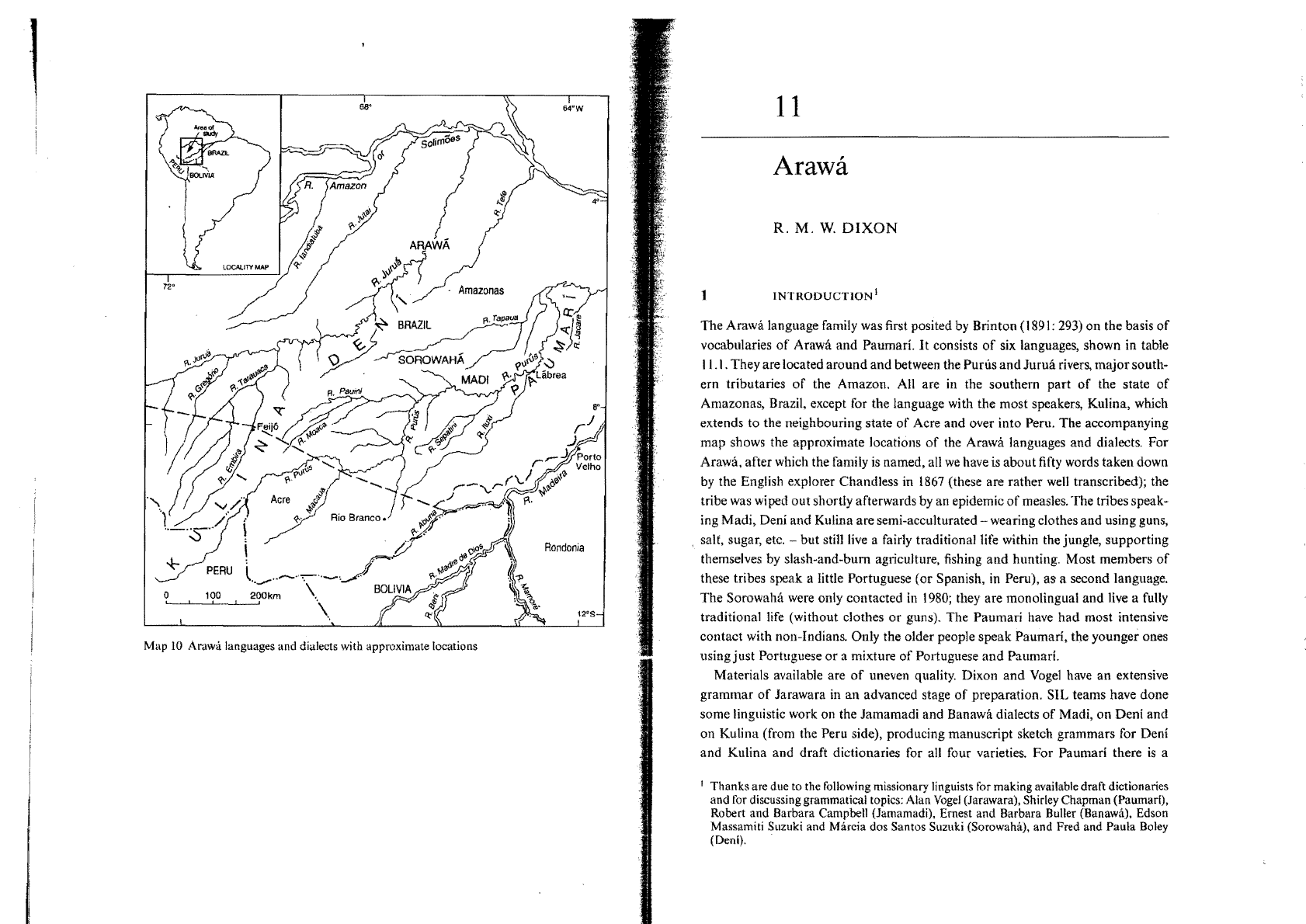
Map
10
Arawá languages and dialects with approximate locations
11
Arawá
R.
M.
W.
DIXON
INTRODUCTlON
I
The Arawá language family was first posited
by
BrÍnton (1891: 293) on the basis
of
vocablllaries
of
Arawá and Paumarí.
lt
consÍsts
of
six languages, shown in table
11.1.
They are located around and between the Purús and Juruá rivers, major south-
em
tributaries
of
the Amazon. All are
in
the southem part
of
the state
of
Amazonas, Brazil, except ror the language with the most speakers, Kulina, which
extends to the neighbouring state
of
Acre and over into Pem. The accompanying
map shows the approximate locations
of
the Arawá languages and dialects. For
Arawá, after which the family is named, all
we
have is about fifty words taken down
by
the English explorer Chandless in
1867
(these are rather
well
transcribed); the
tribe was wiped out shortly afterwards
by
an epidemic
of
measles. The tribes speak-
Madi, Dení and Klllina are semi-acculturated wearing c10thes and using guns,
sal!, sugar, etc. but
stm
líve a fairly traditionallife within the jungle, supporting
themselves
by
slash-and-burn agriculture, fishing
and
hunting. Most members
of
these tribes speak a littIe Portuguese (or Spanish,
in
Peru), as a second language .
The Sorowahá were
contacted
in
1980;
are monolingual and live a fully
traditional
Jife
(without clothes
or
guns). The Paumarí have
had
most intensive
contact with non-Indians.
0nIy
the older people speak Paumarí, the younger ones
usingjust Portuguese
or
a mixture
of
Portuguese and Paumari.
Materials available are
of
uneven quality. Dixon and
Vogel
have an extensive
grammar
of
Jarawara in an advanced stage
of
preparation. SIL teams llave done
sorne linguistic work on the Jamamadi and Banawá dialects
of
Madi, on Dení and
on Kulinlt (from the Peru side), producing manuscript sketch grammars for Dení
and Kulina and draft dictionaries fm all four varieties. For Paumarí there
is
a
I Thanks are due to the following missionary linguists for making available draft dictionaries
and for discussing grammatical tapies: Alan
Vogel
(Jarawara), Shirley Chapman (Paumarí),
Robert and Barbara Campbell (Jamamadi), Emest
and
Barbara Buller (Banawá), Edson
Massamiti Suzuki and Márcia dos Santos Suzuki (Sorowahá), and Fred and Paula Boley
(Den!). .