
Dixon R.M.W., Aikhenvald Alexandra Y. The Amazonian Languages (Cambridge Language Surveys)
Подождите немного. Документ загружается.

\
294
R.
M.
W.
Dixon
1
I
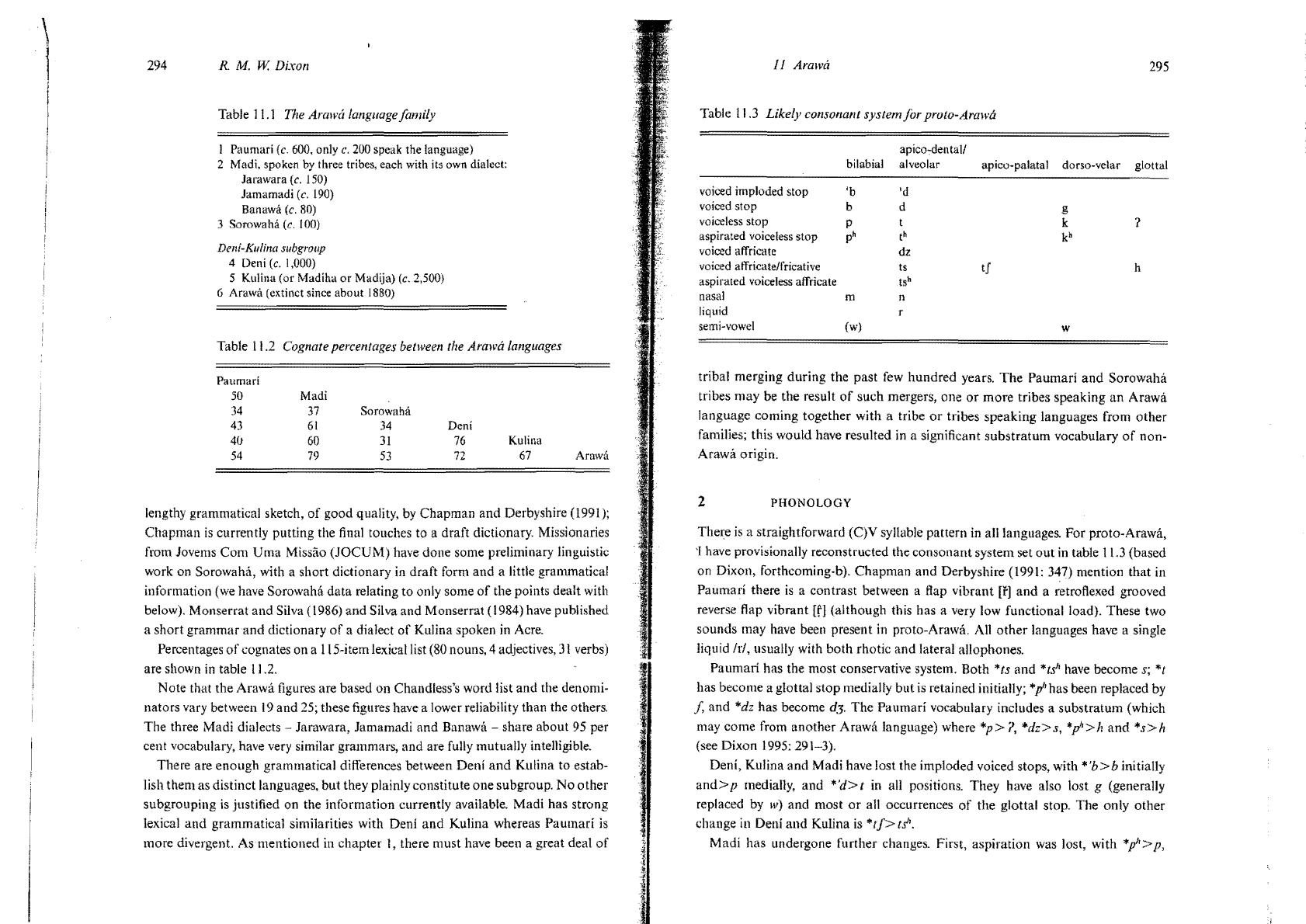
Table I
J.]
The Arawá language
jamily
¡
I Paumari (c. 600, only
c.
200 speak the language)
2 Madi, spoken by three tribes, each with its own dialect:
I
Jal'awara
(c.
150)
Jamamadi
(c.
190)
Banawá (r. 80)
3 Sorowahá
(c.
100)
Dl!llí-Kulilla
slIbgroup
4 Deni (c.
1,000)
5 Kulina (01' Madiha 01' Madija)
(e.
2,500)
(j
Arawá (cKtinct since about 1880)
Table
11.2
Cognate percenlages between
Ihe
Arawá languages
Paumarí
50
Madi
34
37
SOrGwahá
43
61
34
Dení
40
60
31
76
Kulina
54
79
53
72
67 Arawá
lengthy grammatical sketch,
of
good quality, by Chapman
and
Derbyshire (1991);
Chapman
is
currently putting the final touches to a draft dictionary. Missionaries
from Jovems Com Uma Missao (JOCUM) have done some preliminary linguistic
work on Sorowahá, with a short dictionary in draft form and a
HUle
grammatical
informatíon
(we
have Sorowahá data relating to only sorne
of
the points dealt with
below). Monserrat
and
Silva (1986) and Silva and Monserrat (1984) have published
a short grammar and dictionary
of
a dialect
01'
Kulina spoken in Acre.
Percentages
of
cognates on a II5-item lexicallist (80 nouns, 4 adjectives,
31
verbs)
are shown
in
table 11.2.
Note that the Arawá are based on Chand1ess's word list and the denomi-
nators vary between
19
and
25;
these have a lower reliability than the others.
The three Madi dialects - Jarawara, Jamamadi and Banawá share about
95
per
cent vocabulary, have very similar grammars, and are fully mutually intelligible.
There are enough grammatical differences between Dení
and
Kulina to estab-
lish tllem as distinct languages, but they plainly constitute one subgroup.
No
other
subgrouping
is
jllstified on the information clIrrent1y available. Madi has strong
lexical
and
grammatical similarities with Dení
and
Kulina whereas Paumarí
is
more divergent.
Asmentioned
in chapter
1,
there must have been a great deal
of
11
Arawá 295
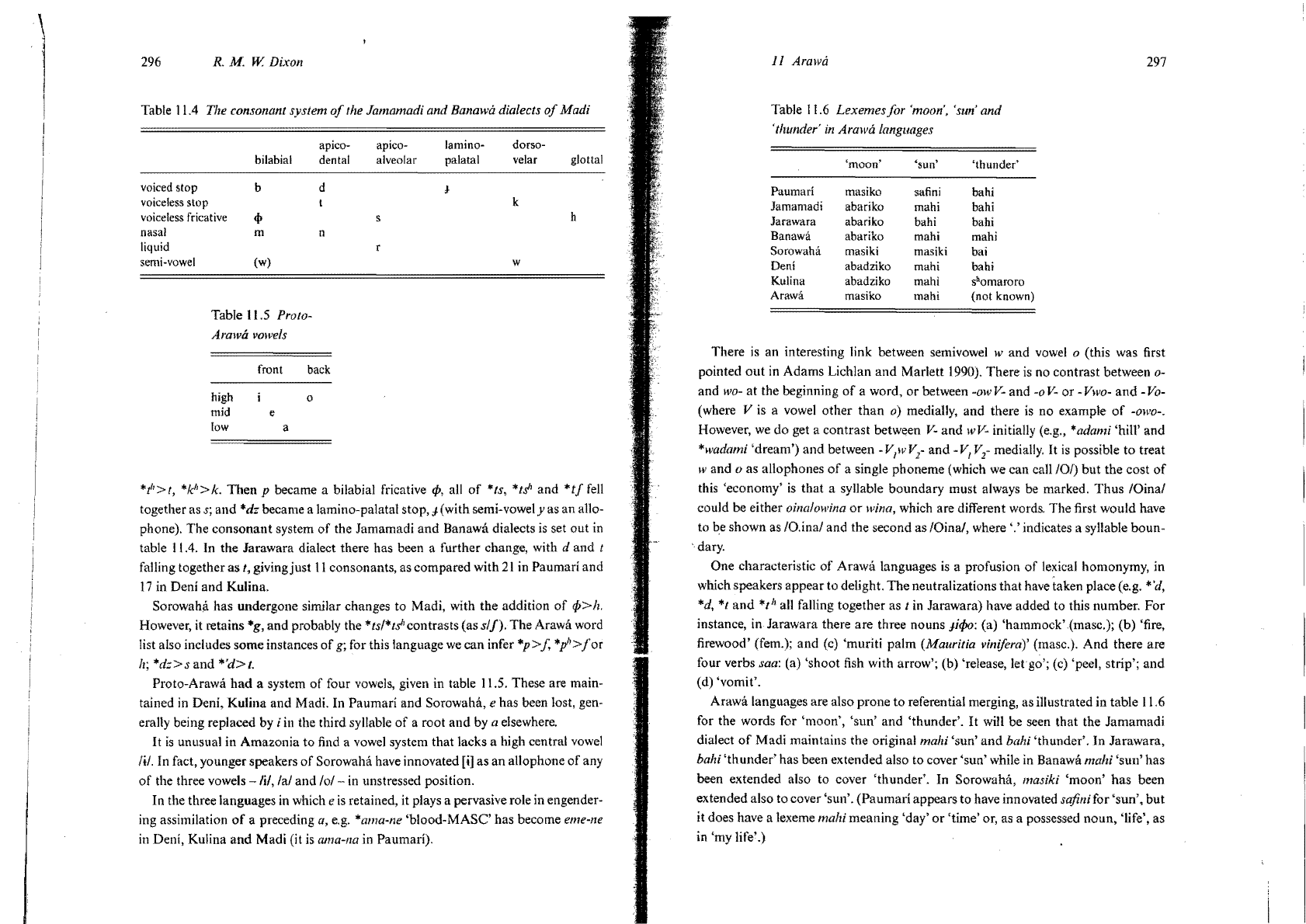
Table
11.3
Likely consonant
systemjor
prolo-Arawá
apicocdentall
bilabial alveolar apico-palatal dorso-velar glottal
voiced imploded stop
'b
'd
voíced
stop
b d
g
voiceless
stop
p
k
?
aspirated voiceless
stop
ph
t
h
k
h
voiced affricate
dz
voiced affricate/fricative
ts
tf
h
aspirated voiceless affrícate
tg
h
nasal
m
n
liquid
semi-vowel
(w)
w
tribal merging
the past
few
hundred years.
The
Paumarí
and
Sorowahá
tri bes may be the result
of
such mergers, one
or
more
tri bes speaking an Arawá
language coming together with a tri be
or
tribes speaking languages from other
families; this would have resulted
in
a significant substratum vocabulary
of
non-
Arawá origino
2
PHONOLOGY
There
is
a straightforward (C)V syllable pattern in alllanguages. For proto-Arawá,
'I
have provisional!y reconstructed the consonant system set out
in
table 11.3 (based
011
DixOIl,
forthcoming-b). Chapman
and
Derbyshire (1991: 347) mentíon that in
Paumarí there
is
a contrast between a flap vibrant [r)
and
a retroflexed grooved
reverse flap vibrant
[f]
(although this has a very low functionalload). These two
sounds may have been present
in
proto-Arawá.
Al!
other
languages have a
liquid Irl, usually with both rhotic and lateral alIophones.
Pallmari has the most conservative system. Both
*ts
and
*ts
h
have beco me
s;
*t
has become a glottal stop medial!y but
is
retained initially; *
p"
has been replaced by
f,
and *dz has become
d3.
The Paumarí vocabulary includes a substratum (which
may
come fram another Arawá language) where *p>
7,
*dz>s, *¡/'>h
and
*s>h
(see Dixon
1995:
291-3).
Dení, Kulina
and
Madi have lost the imploded voiced stops, wíth
*'b>b
and>p
medial1y,
and
*'d>t
in
all posítions. Tlley have al so
10st
g (generally
replaced by
w)
and
most
or
al!
occurrences
of
the glottal stop. The
other
change
in
Dení and Kulina
is
"tf>
ti'.
Madi has undergone further changes.
aspiration
was
lost, with *ph>p,
296
R.
M.
W.
Dixon
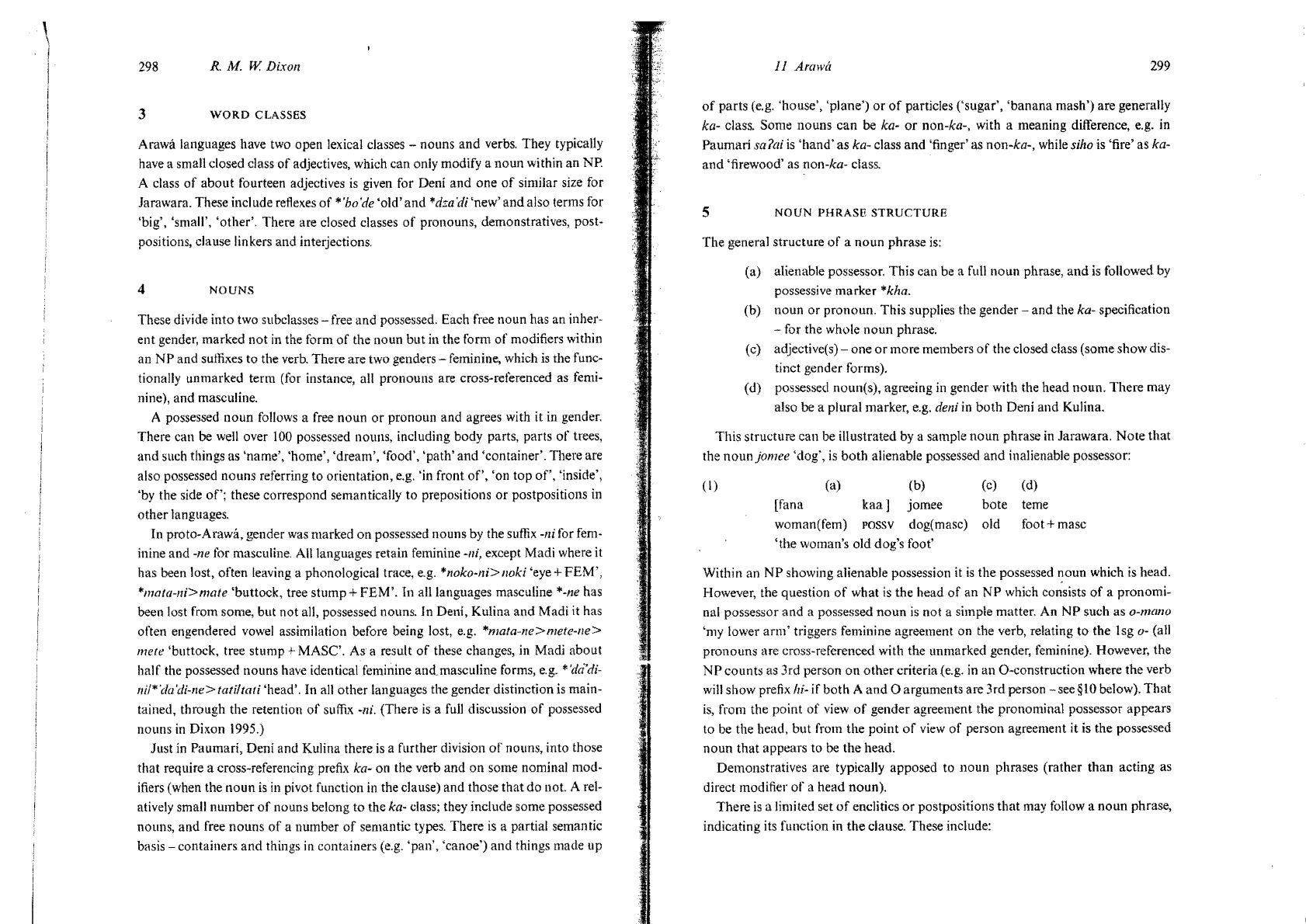
Table 11.4 The consonant system
of
the Jamamadi and Banawá dialects
of
Madi
bilabial
apico-
dental
apíco-
alveolar
lamino-
palatal
dorso-
velar
glottal
voiced
stop
voiceless
stop
voiceless
fricative
nasal
b
$
m
d
n
J
k
h
Iiquid
semi-vowel
(w)
w
Table 11.5
Proto-
Arawá
vowels
front
back
high
o
mid
e
low
a
"'I'>t,
"'¡¿'>k.
TIten p beeame a bilabial frieative
tfJ,
aH
of
"'ts,
"'tI'
and
"'tI
feH
logether as
s;
and
"'dz
beeame a lamino-palatal stop, J (with semi-vowel y as
an
allo-
phone).
The
consonant
system
of
the Jamamadi
and
Banawá dialects is set out in
table
1104.
In the Jarawara dialeet thefe has been a further change, with d
and
t
falling together
as
t, givingjust
II
eonsonants, as eompared with
21
in Paumarí
and
17
in Dení
and
Kulina.
Sorowahá has undergone similar ehanges
lo
with
the
addition
of
tfJ>h.
However, it retains *g,
and
probably the *tsf*tl'eol1trasts (as
slf).
The
Arawá word
list also includes sorne instanees
of
g;
for this language
we
can
¡nfer
"'p>
J,
*¡/'>for
h;
*dz>sand
*'d>t.
Proto-Arawá
had
a system
of
four vowels, given in table 11.5. These are main-
tained in Dení, Kulina
and
Madi. In
Paumarí
and
Sorowahá, e has been losl, gen-
erally being replaced by
i in the third syllable
of
a roo!
and
by a elsewhere.
It
is
ul1usual in Amazonia to find a vowel system that laeks a high central vowel
lil. In faet, younger speakers
of
Sorowahá have innovated [i]
as
an
allophone
of
any
of
!he three vowels lit, fal
and
101
in unstressed position.
In the three Janguages in whieh
e
is
retained, it plays a pervasive role in engender-
ing assimilation
of
a preeeding a, e.g. *ama-ne 'bJood-MASC' has beco me eme-ne
in Dení, KuJina
and
Madi (it is ama-na in Paumarí).
11 Arawá
297
Table
11.6
Lexemes
for
'moon', 'sun'
and
'thunder
in
Arawá
languages
'moon' 'sun'
'thunder'
PaumarÍ masiko
safini
bahi
Jamamadi
abariko
mahi
bahi
Jarawara
abariko
bahi
bahi
Banawá abariko
mahi
mahi
Sorowahá masiki
masiki
baí
Dení
abadziko
mahi
bahi
Kulina
abadzika
mahi
shomaroro
Arawá
masiko
mahi (not known)
There
is an interesting link between semivowel
IV
and
vowel o (this was first
pointed
out
in
Adams Lichlan
and
Maflett
1990).
There
is
no contrast between
0-
and .vo-
at
the beginning
of
a word,
or
between -ow
V-
and
-o
V-
or
-Vwo-
and
-
Vo-
(where V is a vowel
other
than
o) medially,
and
there
is
no example
of
-OIVO-.
However, we
do
get a contras! between
V-
and
wV-
initially *adami 'hill'
and
*wadami
'dream')
and
between -
V¡Hl
V[
and
-
VI
V
2
-
medially.
It
is
possible
to
treat
IV and o
as
allophones
of
a single phoneme (whieh we
can
eall
but
the
eosl
of
this
'eeonomy'
is
that
a syllable
boundary
mus! always be marked.
Thus
IOinal
could
be
either oinalowina
or
wina, which are different words.
The
firsl would have
lo
be
shown
as fO.inaf
and
the second
as
fOinaf, where
'.'
indieates a syllable
boun-
One
eharacteristic
of
Arawá
languages
is
a profusion
of
lexieal homonymy, in
whieh speakers
appear
to
delight.
The
neutralizatioIls tha! have taken place (e.g. *
'd,
*d,
*1
and
"Ih
all falling together as t in Jarawara) have added to this Ilumber. For
instanee,
in
Jarawara there
are
three nouns
JÍtfJo:
Ca)
'harnmoek'.(mase.); (b) 'fire,
firewood' (fem.);
and
(e)
'muríti
palm (Mauritia vinifera)' (mase.).
And
there are
four verbs
saa: (a)
'shoot
fish with arrow'; (b) 'release,
letgo';
(e) 'peel, stríp';
and
(d) ·vomit'.
Arawá languages are also prone
to
referential merging,
as
iIIustrated in table
11.6
for the words for
'moon',
'sun'
and
'thunder'.
It
will be seen that the
Jamamadi
dialeet
of
Madi maintaills
the
original ma/¡i 'sun'
and
bahi
'thunder'.
In Jarawara,
ba/¡¡
'thunder'
has been extended also to eover
'sun'
while in Banawá mahi
'sun'
has
been extended also
to
eover
'thunder'.
In Sorowahá, masiki
'moon'
has
been
extended al
so
to cover
'SUIl'.
(Paumarí
appears to have innovated
sajinifor
'sun',
but
ít does have a lexeme
mahi
meaning 'day'
or
'time'
or, as a possessed
noun,
'life', as
m
298 R M.
W.
Dixon
I
3
WORD
CLASSES
I
I
i
Arawá languages have two open lexical
c1asses
- nouns and verbs. They
have a smal!
dosed
cJass
of
adjectives, which can only modify a
no
un
within an
NP.
A
cJass
of
about fourteen adjectives
is
given for Dení and one
of
similar size for
Jarawara. These incJlIde
reAexes
of
*'bo'de 'old' and *dza
'di
'new' and also terms for
'big', 'small', 'other', There are cJosed cJasses
01'
pronouns, demonstratives, post-
positions, c1ause linkers and interjections,
4
NOUNS
These divide into two subc1asses - free and possessed, Eaeh free
nOlln
has an inher-
ent gender, marked not
in
the form
of
the no
un
but
in
the form
01'
modifiers within
an
NP
and suffixes to the
verbo
There are two feminine, which
is
the fune-
tionally unmarked term (for instanee,
al!
pronouns are cross-referenced as femi-
nine), and masellline.
A possessed
nOlln
follows a free noun
or
pronoun and agrees with it in gender.
There can be
well
over 100 pos
ses
sed
nOUIlS,
incJuding body parts, parts
01'
trees,
and such things as 'na me', 'home', 'dream', 'food', 'path' and 'container'. There are
also possessed nouns referring to orientation,
e.g.
'in front
of',
'on top of', 'inside',
'by the side
or';
these correspond sernantically to prepositions
or
postpositions
in
other langllages.
In proto-Arawá, gender
was
marked on nouns
by
the
suffix
-ni for fem-
inine and
-ne
for masculine, Alllanguages retain feminine -lIí, except Madi where it
has been lost, often leaving a phonologieal trace,
e.g.
*lIoko-ni> I/oki 'eye +
FEM',
*mata-ni>mate 'buttock, tree stump +
FEM'.
In alllangllages maseuline
"'-ne
has
been lost from sorne, but not all, possessed nouns. In Dení, Kulina and Madi
it
has
often engendered
vowel
assimilation before being lost,
e.g.
*mata-ne>mete-lIe>
mete
'buttock, tree stump +MASC'. As a result
of
these changes,
in
Madi about
half the possessed nouns
have
identical feminine and,mascllline forms,
e.g.
*'dd'dí-
ni!"
'da
'dí-ne > tati/fati 'head', In
all
other langllages the gender distinction
is
main-
tailled, through the retention
01'
suffix -ni. (There
is
a
fuI!
diseussion
of
possessed
nouns
in
Dixon 1995.)
Just
in
Paumarí, Dení and Kulina there
is
a fllrther division
of
nouns, ¡nto those
that require a cross-referencing pretix
ka- on lhe verb and
on
sorne nominal mod-
ifiers (when lhe noun is
in
pivot function
in
the c\ause) and those that do not. A rel-
atively small number
of
nouns to the ka- class; they inelude sorne
posse'Ss~:d
nouns, and free nOllns
of
a nllmber
of
semantic types, There
ís
a partíal semantic
basis - containers and things in containers (e.g. 'pan', 'eanoe') and things made up
11
Arawá 299
of
parts (e,g, 'hollse', 'plane')
or
of
particles ('sugar', 'banana mash') are generally
ka- class. Sorne nouns can be ka-
or
non-ka-, with a meaning difference, e.g. in
Paumari
sa?ai
is
'hand'
as ka- class and 'finger' as non-ka-, while siho is 'fire' as ka-
and 'tirewood' as non-ka-
c1ass.
5
NOUN
PHRASE
STRUCTURE
The general structure
of
a noun phrase
is:
(a) alienable possessor. This can be a
full
nOlln
phrase,
and
is
followed
possessive marker
"kha.
(b)
noun
or
pronoun. This supplies the gender - and the ka- specification
- for the whole noun phrase.
(e) adjeetive(s) one
or
more members
of
the c\osed
c1ass
(sorne show dis-
tinct gender rorms).
possessed noun(s),
in
gender with the head noun. There may
also be a marker,
e.g.
deni
in
both Dení and Kulina.
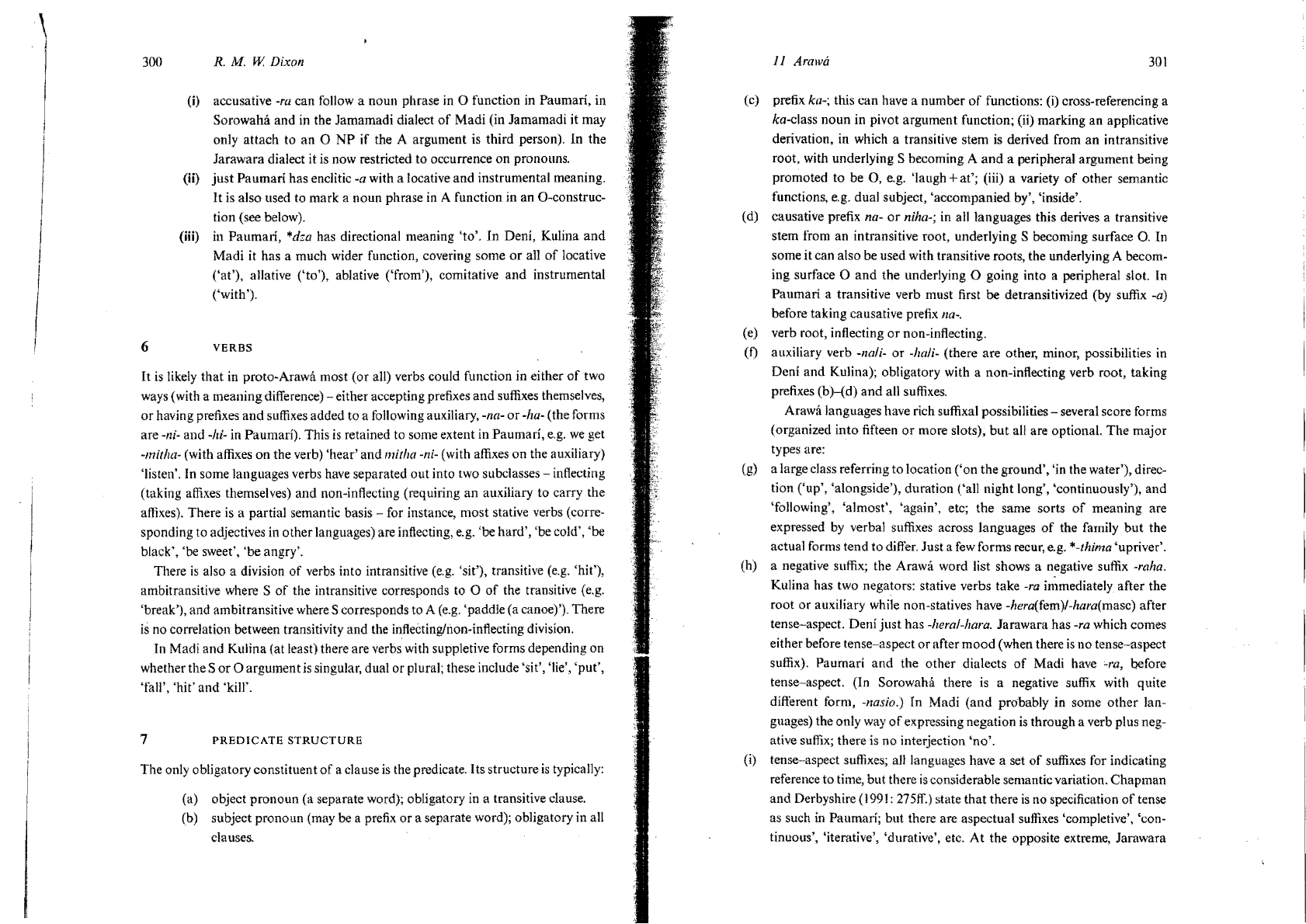
Thís structure can be illustrated
bv
a
noun
in
Jarawara. Note that
the
nounjomee
'dog',
is
both alienable possessed and inalienable possessor:
(1)
(a)
(b)
(e)
(d)
[fana
kaa
1 jomee
bote terne
woman(fem)
possv
dog(masc) old foot+ masc
'the
womall's old dog's foo!'
Wíthin an
NP
showing alienable possession it
is
the possessed noun which
is
head.
However, the questíon
of
what
is
the head
of
an
NP
which consists
of
a pronomi-
nal possessor and a
noun
is
not a simple matter. An
NP
such as o-mano
lower
arm'
feminine agreement on the verb, relating to the
lsg
0-
pronouns are cross-referenced with the unmarked gender, feminine). However, the
NP
eounts as 3rd person
on
other criteria
{e.g.
in an O-construction where the verb
will
show prefix
Irí-
ir
both A and o arguments are 3rd person - see
§\O
below).
That
is,
from the point
of
view
of
gender agreement the pronominal possessor appears
to be the head,
but
from the point
of
view
of
person agreement it is the possessed
noun that appears to be the head.
Demonstratives are typically apposed to noun phrases (rather than aeting as
direct modifier
of
a head noun).
There
is
a limited set
of
enclitícs
or
postpositions that may follow a noun phrase,
its function
in
the dallse. These indude:
300
R. M.
W.
Dixon
(i)
accusative -ra can foIlow a noun phrase in O function in Paumarí, in
Sorowahá and
in
the Jamamadi dialect
of
Madi (in Jamamadi
it
may
attach to
an
O
NP
if
the A argument is third person). In the
Jarawara dialect it
ís
now restricted to occurrence on pronollns.
(ii)
just
Paumarí has enclitic -a with a locative and instrumental meaning.
It
is
also used to mark a noun phrase in A functíon
in
an O-construc-
tion (see below).
(iii)
in Paumari,
*dza
has directional meaning
'to'.
In
Dení, Kulína
and
Madi it has a much wider function, covering sorne
or
all
of
locative
('at'), allative ('to'), ablatíve ('from'), comitative
and
instrumental
('with').
6
VERBS
that
in proto-Arawá most (or
verbs
cOllld
function in either
of
two
a meaning difference) either accepting prefixes
and
suffixes themselves,
or
prefixes
and
suffixes added to a following auxiliary, -na-
or
-ha-
(the forms
are
-ni- and -/¡i-
in
Paumarí). This
is
retained to sorne extent in Paumarí,
e.g.
we
get
-mitha- (with affixes
on
the verb) 'hear'
and
mUlla
-ni- (with affixes on the auxíliary)
'listen'. In sorne languages verbs have separated out into two subc1asses inflecting
(taking affixes themselves) and non-inflecting (requiring an auxiliary
to
carry the
affixes). There
is
a partial sernantic basis for instance, most stative verbs (corre-
sponding to adjectives
in
other languages) are inftectíng, e.g. 'be hard',
'be
eold',
'be
blaek'. 'be sweet',
'be
angry'.
There
is
also a division
of
verbs into intransitive
(e.g.
'sit'), transitiye
ambitransitive where S
of
the intransitive eorresponds to O
of
the transitive
'break'), and ambitransitiye where S to A
(e.g.
'paddle (a canoe)'). There
is
no correlation between transitiYity and lhe inflei;ting/non-ínflecting divisíon.
In Madi and Kulina (at least) there are verbs with suppletiye forms depending
on
whether the S
or
O argument
is
singular, dual or plural; these
indude
'sit', 'líe',
'puf,
'fall', 'hit' and 'kili'.
7
PREDICATE
STRUCTURE
The only obligatory constituent
of
a clause
is
the predicate. Its strueture
is
(a) object pronoun (a separate
oblígatory in a transitive
c1ause.
(b) subject prono
un
(mav be a
or
a separate word): obJigatorv in all
clauses.
J J Arawá
301
(e) prefix ka-; this can have a number
of
functions: (i) cross-referencing a
ka-class noun in pivot argllment function;
(H)
marking an applicative
derivation, in which a transítive stern is derived from an intransitive
root, with underlying S beeomíng A
and
a peripheraJ argument being
promoted
to
be
0,
e.g. 'laugh
+at';
(iii) a variety
of
other semantic
functions, e.g. dual subject, 'aecompanied by', 'inside'.
(d) causative prefix
na-
or
niha-;
in
alllanguages
this derives a transitive
stem from
an
intransitive root, underlying S becoming surface
o.
In
sorne
it
can also be used with transitive root5, the underlying A becom-
surface
°
and
the underlying °going into a perípheral
slOL
In
Paumarí a transítive yerb must first be detransitívized (by suffix
-a)
before taking causative prefix
na-o
(e) verb root, inflecting
or
non-inftecting.
(f) auxiliary verb -nafi-
or
-hali- (there are other, minor, possíbilítíes in
Dení
and
Kulina); obligatory with a non-inflecting verb root, taking
preftxes
(bHd)
and
all su
ffixes.
Arawá languages have rich slIffixal possibilities - several score forms
(organized into fifteen
or
more slots),
but
all
are optional.
The
major
types are:
(g) a referring
to
location
, etc;
the
same sorts
of
meaning are
expressed by verbal suffixes across languages
of
the
fami1y
but
the
actual forms tend
to
differ. Just a
few
forms recur, e.g. *-lhima 'upriver'.
a negative suffix; the Arawá word list shows a negative suffix
-ralla.
Kulina has two negators: stative verbs take
ora
irnmediately after the
root or auxiliary while non-statives haye
-hera(fem)/-hara(masc) after
tense-aspect. Dení
just
has -heral-hara. Jarawara has
-ra
which comes
either before tense-aspect
or
after
mood
(when there
is
no
tense-aspect
suffix). Paumarí
and
the other dialects
of
Madi have
cm,
before
tense-aspecto (In Sorowahá there
is
a negative suffix with quite
di/rerent
fom}
,
-¡¡asio.)
ln Madi
(and
probably in sorne
other
Jan-
guages) the only way
of
expressing negation
is
through a verb plus neg-
ative
there is
no
interiection
'no'.
tense-aspect all languages have a set
of
suffixes for indicating
reference
to
time,
but
there
is
considerable semantic variatíon. Chapman
and Derbyshire (1991' 275ff.) state that there
is
no specification
of
tense
as such
in
Paurnarí; but thefe are aspectual suffixes 'completive', 'con-
tinuous', 'iterative', 'durative', etc.
At
the opposite extreme, Jarawara
302
R.
M.
W.
Dixon
has three past tenses irnmediate past (a
few
seconds
to
a
few
weeks
ago), recent past (a
few
weeks to a
few
years) and far past (many years).
We
also typically find suffixes indicating intentlon, predication and
general irrealis. In Pauman there
is
a post-verbal particle with future ref-
erence,
-bana; Madi has future
suffix
-buna
and
Sorowahá has
-bao
In Jarawara each
of
the three past tenses
is
marked for whether
or
not
the event descnbed was actually seen by the speaker.
It
is
reported
that Dení has verbal suffixes which ¡nclude 'speaker did
not
know this
at the time referred to'
and
'speaker knows this but other people
referred to do not'. This parameter
of
evidentiality has
not
been
studied in the other languages.
(j) mood: there are verb-final suffixes indicating declarative, interrogative
and
imperative. Polar interrogative -ki(fem)/-ko(masc)
is
found
in
Dení, Kulina and Sorowahá. Simple imperative
is
marked
by
-hi(fero)/
-ho(masc)
in
Madi and Kulina, by
-ha
in
Dení, and by zero
in
Pallmarí
and
Sorowahá. There can be more complex roood marking; Jarawara
has distinct suffixes for immediate
('do
now')
and
distant ('do later on')
imperatives, in both
and negative polarity.
Most tense-aspect and mood suffixes have distinct feminine and masculine
forms, in with the pivot argumento Alllanguages except Paumarí
ínclude a final suffix
*-(ha)ro(fem)/*-(ha)ri(masc).
[n
Sorowahá thís
is
added to a
verb just as a marker
of
gender, when
no
other suffix has been chosen. In Dení it
is
glossed as 'neutral aspect' and
in
Kulina as 'completive'. In Madi it has become the
recent past eyewitness form, and
is
al so inclllded at the end
of
various deictics
and
subordinate clause markers.
[ndividllallanguages have other kinds
of
affixes.
In Kulina, for instance, there are
separate suffixes for plural object and ror plural slIbject. Jarawara has a suffix,
-rall'a,
marking that a core argllment (in any function) has a feminine noun as head
and
plural reference.
Arawá languages exploit verbal reduplication throughout their grammars, often
al!
of
initial CV-, initial CVCV-
and
final
-CV.
This can
be
used for semantic
elfect ('do a bit',
'do
with force')
and
to
derive a nominal, e.g. koro
'to
fish', kokoro
'fishing line'
in
Kulina. (Dixol1 and Vogel1996 provides a
full
discussion
of
redupli-
catíon
in
Jarawara.)
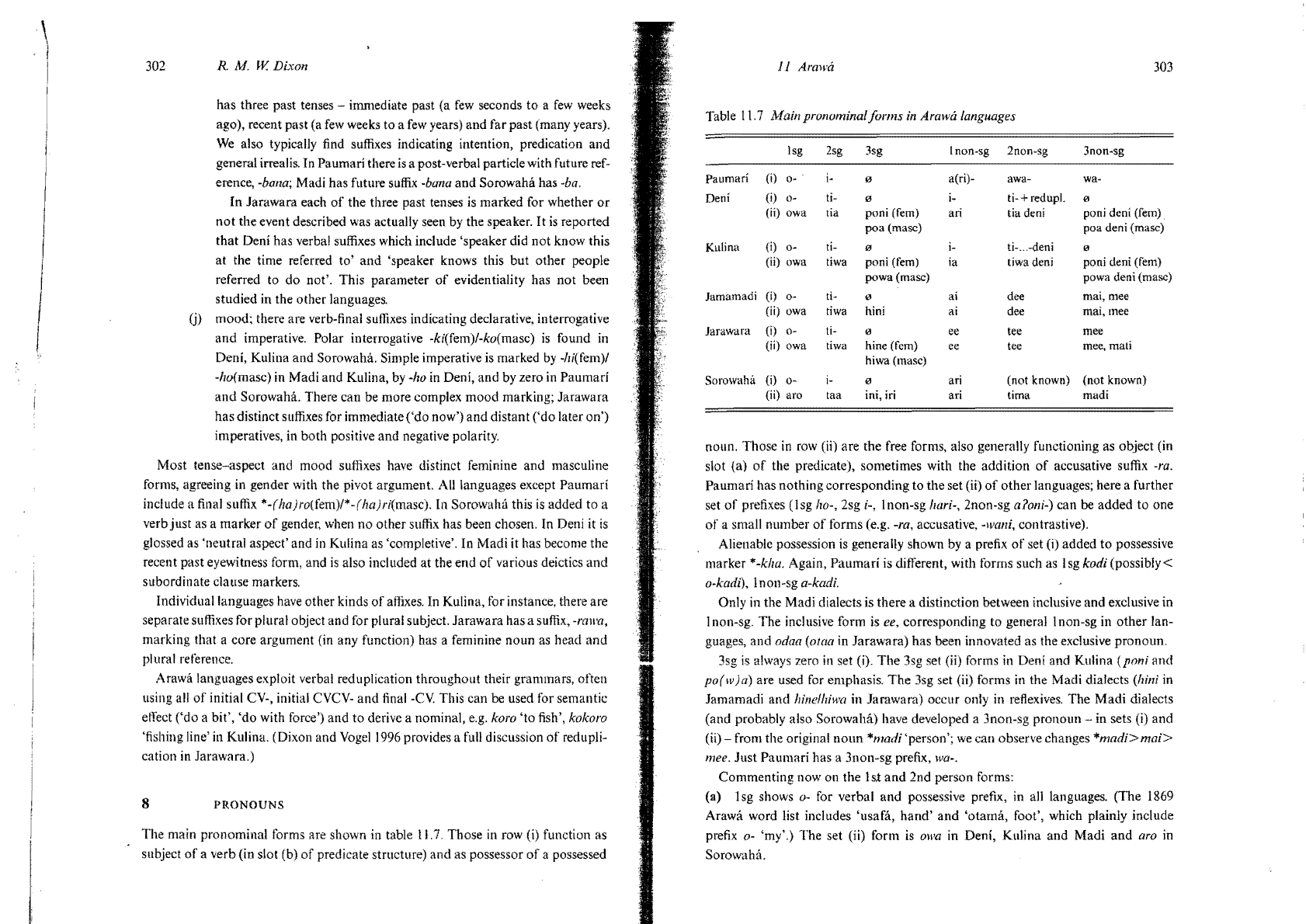
8 PRONOUNS
The main pronominal forms are shown in table 11.7. Those
in
row (i) function as
of
a verb (in slot (b)
of
predicate structure) and as possessor
of
a possessed
11
Arawá
303
Table
11.7
Main pronominalforms
in
Arawá languages
lsg
2sg
3sg
lnon-sg 2non-sg
3non-sg
Paumarí
(i)
0-
i-
0>
a(ri)-
awa-
wa-
Dení
(i)
0-
ti-
\!!
i-
tí-+redupl.
o
(íi) owa
tia poní (fem)
ari
tia de
ni
poni deni (fem)
poa
(mase)
poa
deni (mase)
Kulín!\
(i)
o-
ti- \!!
¡-
ti-o
.-deni
0>
(ii) owa
tiwa
poní (fem)
ia tíwadení poní deni (rem)
powa(mase)
powa deni (mase)
Jamamadí (i) o- ti-
e
ai
dee
mai,mee
(ii) owa
tíwa hini
ai
dee
maí,mee
Jarawara
(i)
0-
ti- e
ee
lee
mee
(ii) owa tiwa hine (fem)
ee
lee
mee, mali
hiwa (mase)
Sorowahá (i)
0-
i-
o
ari
(nol known) (not known)
(ji) aro
taa ini,
id
ari
tima madi
noun. Those
in
row (ii) are the free form5, also generally functioning as object (in
slot (a)
of
the predicate), sometimes with the addition
of
accusative suffix -ra.
Paumarí has nothing corresponding to the set (ii)
of
other languages; here a further
set
of
prefixes
(lsg
ho-, 2sg
t-,
lnon-sg harl-, 2non-sg atoni-) can
be
added to one
of
a small number
of
forros (e.g. -ro, acctlsative, -wani, contrastive).
Alienable possession
is
generally shown by a prefix
of
set (í) added to possessive
marker *-k/w. Again, Paumarí is ditferent, with [orms such as
I
sg
kodi (possibly <
o-kadi), 1non -sg a-kadi.
in the Madi dialects is there a distínction between inclusive and exclusive in
lnon-sg. The inclusive form is
ee, corresponding to general Inon-sg in
other
lan-
guages,
and
odaa (otaa in Jarawara) has been innovated as the exclusive pronoun.
3sg
ís
always zera in set (i).
The
set
(H)
forms in Deni and Kulina
(pon;
and
pO(IV}a) are used for emphasis.
The
set (ii) forms
in
the Madi dialects (hini in
Jamamadi and
hine/hiwa
in Jarawara) occur
in reflexives. The Madi dialects
(and probably al50 Sorowahá) have a 3non-sg pronoun - in sets
O)
and
(ii) - [rom the original
noun
*madi 'person';
we
can observe changes
*madi>mai>
mee. Just Paumari has a 3non-sg prefix,
\Va-.
Commenting now on the 1st
and
2nd person forms:
(a)
lsg
shows
0-
for verbal
and
possessive prefix,
in
al!
languages. (The
1869
Arawá word Iist includes 'usafá,
hand'
and
'otarná, foot', which plainly include
prefix
0-
'my'.) The set (ii) form
is
oIVa
in
Dení, Kulina and Madi
and
aro
in
Sorowahá.
305
304
R.
M.
W.
Dixon
1
(b) 2sg set
(i)
was plainly prefix *ti- in proto-Arawá, with the 1 being lost in
Paumarí
and
Sorowahá.
The
set (ii)
form
is
tiwa
in Madi
and
Kulina, tia in Dení
I
and
laa
in Sorowahá. (Paumarí has a couple
of
traces
of
an
arehaie ti,
e.g.
in the
I
greeting
i!fanirti)
which involves the free
pronoun
iwani plus an
optional-ti.)
In
Sorowahá
15g
0-
and
2sg i- are prefixes
to
possessed
nouns
but
inlixes on a verb
beginning with a consonant, following this consonant. ThllS, from
gania-
'see',
we
get g-o-ania
'1
see',
and
from
sawa-
'wash',
there
is
s-i-awa 'you wash'. In faet the
infix
is
phonetieaIly an off-glide,
Le.
[gWania]
and
[sYawa]
respeetívely.
(e)
For
Inon-sg, ari occurs
as
the set (ii) form in Dení
and
Sorowahá
and
as set (i)
prefix in Paumarí. Just Dení
and
Kulina have a set (i) prefix i-; it is
not
c1ear whether
this should
be
reconstructed
tor
proto-Arawá
Of
whether
it
is
an
innovation
in
Dení-
Kulina (perhaps as the reduced form
of
an
earHer prefix
ario).
In Madi
and
Sorowahá the same free form
is
used in
both
sets.
It
seems likely
that
*ari
reduced
to
ai
in Jamamadi
and
then
to
ee
in Jarawara.
The
Kulina
form
ia
may also relate
to
*ari (or there may be sorne
other
explanation for
(d) 2non-sg shows the greatest variation.
The
Madi
dialeets have free form
dee
(lee
in
both
set (i)
and
set (ii) while Sorowahá has tima in set (ii). Paumarí
awa-.
Kulina has the
same
prefix, ti-, as 2sg
and
adds
a plural suffix
-deni. Dení also uses prefix
ti-
but
here plural is shown by redllplication; roughly,
if
a verb (omitting the final rnood suffix)
ends
in -
v¡e¡
V
#,
then V is repeated before
2 2
VI
V
2
C¡
V
2
#,
e.g. ti-kha-thima-aro ('2-be in
rnotion-UPSTREAM-DECL
+
FEM')
'you (8g) go upstream'
and
ti-kha-thi-ª-ma-aro
'you
(pI) go upstream'.
9 DEMONSTRATlVEiS
AND
INTERROGATlVES
There
i8
typically a rieh set
of
demonstratives,
but
the semantic details
and
forms
vary from language to language.
Most
Arawá languages have a single
root
underlying most
or
all
of
'who',
'what',
'where', etc. This
is
nahina (with variants niha
and
hana)
in Paumarí, neheko
in
Kulina
and
ako in Dení;
in
Dení
and
Kulina feminine
-(
ha)
ro
and
masculine
are
added to the basie rool
to
form
'who'.
In
Jamamadi
'who'
ls ebenike
and
in
Jarawara it
i8
hike (fem)
and
hika (mase) which may be further cognates.
10
CONSTRUCTlON
TYPES
There
are two transitive con8truetion types, the choice between them depending
on
whether the A
or
the O argument
i5
pivot (tooie) within the diseoufse in whieh the
c1ause appears. See examples (2-3) below.
The
main charaeteristics
of
the two cOllstruction types are:
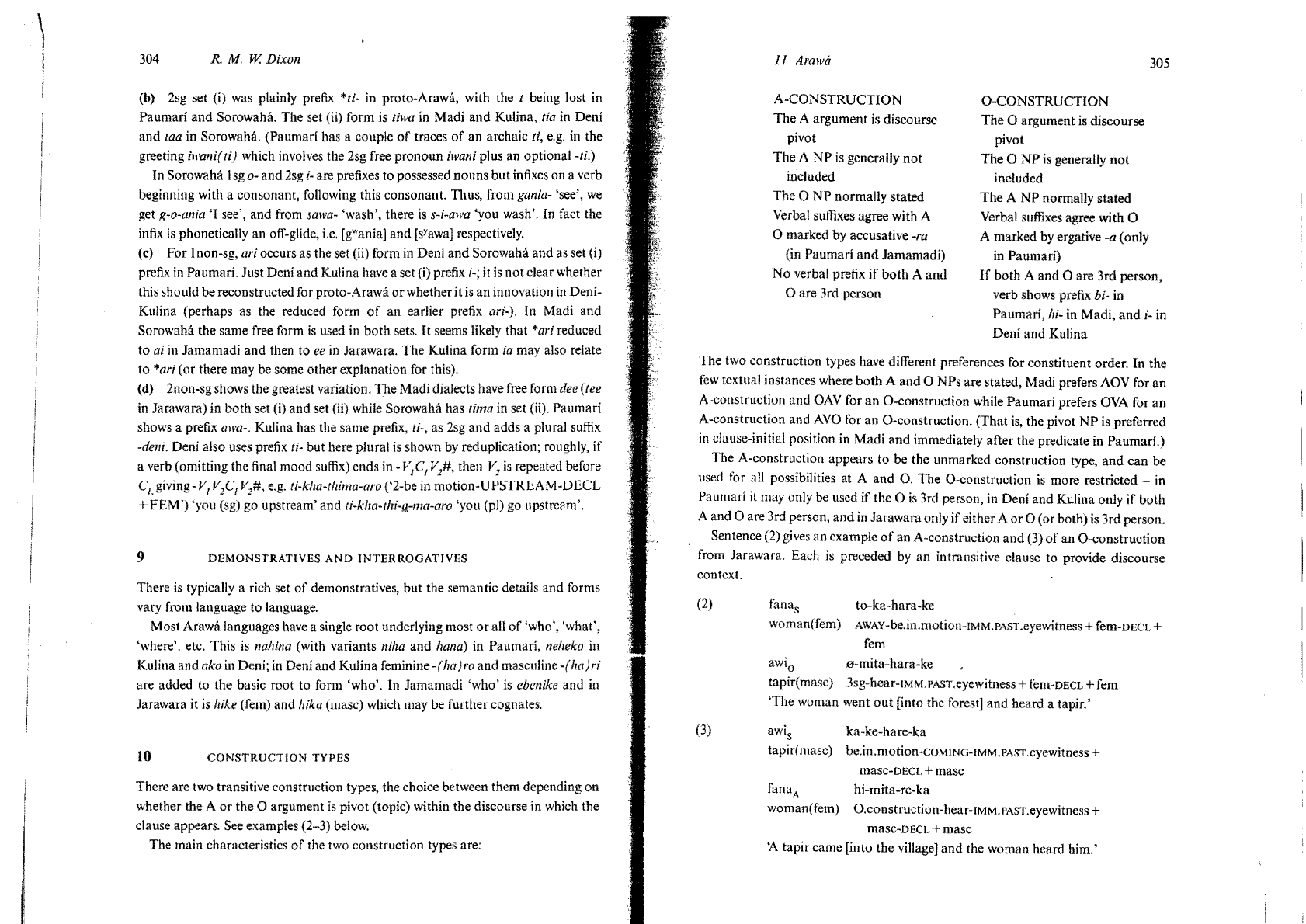
11
ArolVá
A-CONSTRUCTION
O-CONSTRUCTION
The
A
argument
i8
discour8e
The
O argument
is
discourse
pivot
pivot
The
A
NP
is
generally
not
The
O
NP
i5
gellerally
not
incJuded
included
The
O
NP
norrnally stated
TheANP
stated
Verbal suffixes agree with A
Verbal suffixe8 agree with O
O marked by accusative
-ra
A
marked
by ergative -o (only
Paumarí
and
Jamamadi)
in
No
verbal prefix
if
both
A
and
If
both
A
and
O
are
3rd
person,
O
are
3rd person
verb shows pretix bi- in
Paumarí,
hi- in Madi,
and
j-
in
Dení
and
Kulina
The
two eonstruction types have different preferenees for eonstituent order.
In
the
few textual instances where
both
A
and
O
NPs
are
stated, Madi prefers AOV for
an
A-construction
and
OAV for
an
O-construction while
Paumarí
prefers OVA for
an
A-construction
and
AYO
for an O-eonstruction.
(That
is,
the pivot
NP
is preferred
in
clause-initial position in
Madi
and
immediately
after
the predicate in
Paumarí.)
The
A-construction
appears
to
be the unmarked construetion type,
and
can
be
used for all possibilities at A
and
O.
The
O-construction
is
more restrieted - in
Paumari it may only be lIsed
if
the O
is
3rd person, in Dení
and
Kulina only
if
both
A
and
O
are
3rd person,
and
in Jarawara only
if
either A
or
O
(or
both) is
3rd
person.
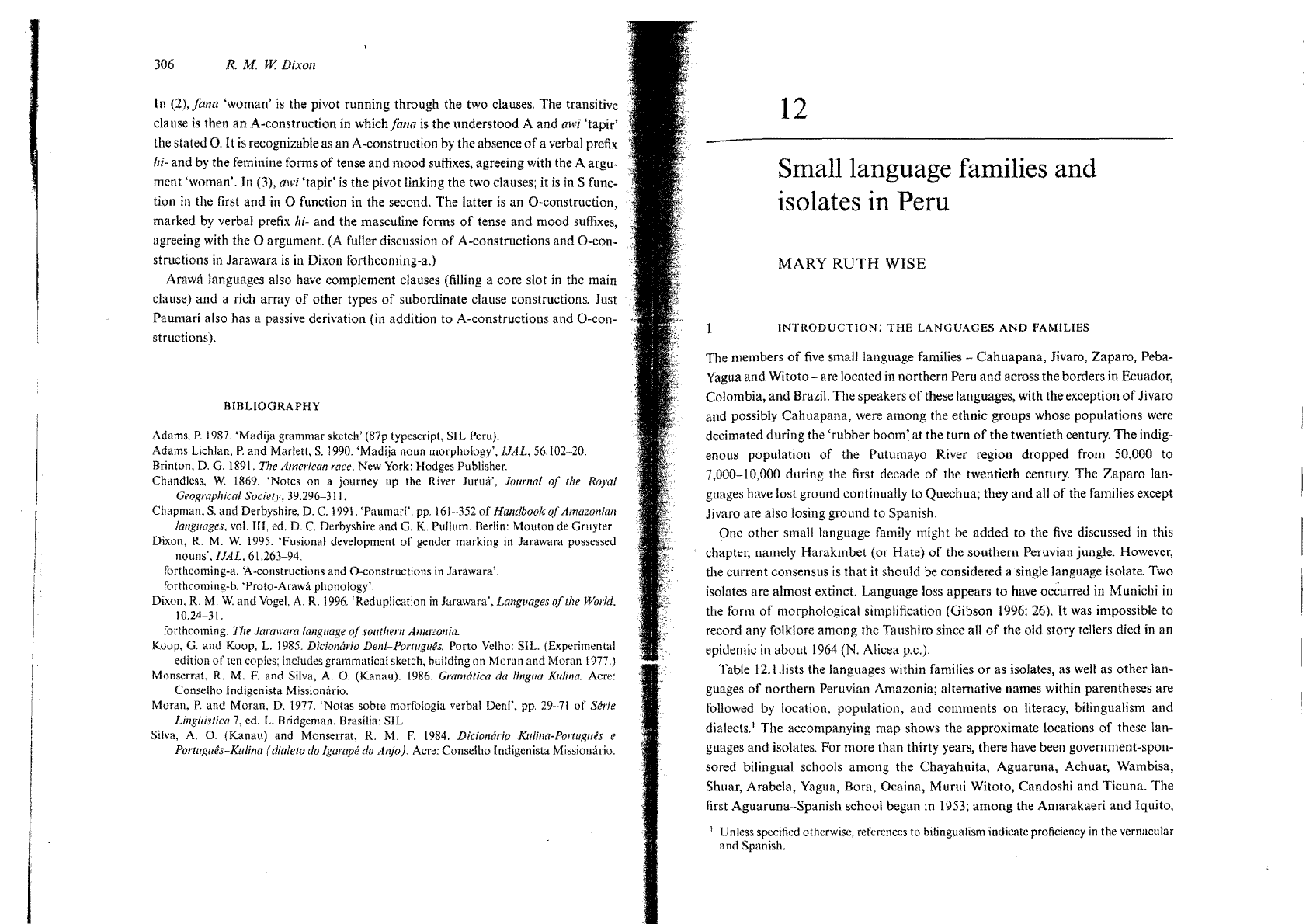
Sentence (2) gives
an
example
of
an
A-construction
and
(3)
of
an
O-construction
from Jarawara. Eaeh is preceded by
an
intransitive clause
to
provide discourse
context.
(2)
fanas
to-ka-hara-ke
fem
liI-mita-hara-ke
3sg-hear-IMM.PAsT.eyewitnes5
+fem-DEcL +fem
'rhe
woman went
out
finto the forest]
and
heard
a
tapir:
awi
g
ka-ke-hare-ka
tapir(masc) be.in.motion-coMING-IMM.PAsT.eyewitness
+
mase-DEO, +mase
fana
A
hi-mita-re-ka
woman(fem) o.construction-hear-IMM.PAsT.eyewitness
+
masc-DECL +
mase
'A
tapir
came
tinto
the
village]
and
the
woman
heard him.'
306
R
M.
W Dixoll
In (2),fana
'woman'
is
the pivot
agreeing with
the
O argumento
structions in Jarawara
is
in
Dixon forthcoming-a.)
Paumarí also has a
structions).
RIBLlOGRAPHY
Adams,
P.
1987.
'Madíja
grammar sketch' (87p typescrípt, SIL Peru).
Brinton,
D.
G.
1891.
Tire
American
race.
New York: Hodges Publisher.
Chandless,
W.
1869.
'Notes
on a
Geogmpltical Sociely,
39.296-311.
nouns"
I.lAL. 61.263-94,
lorthcoming-a. 'A-constructions and O-constructions in Jarawara'.
forthcoming-b. 'Proto-Arawá phonology'.
10.24-31,
forthcoming.
Tlle
.larmram
language
of
sOlllhern
Amazonia.
Conselho Indigenista Míssionárío.
Lingüística
7,
ed.
L.
Bridgeman. Brasilia: SIL.
Silva,
A.
O.
(Kanau)
and
Monserrat, R. M.
F.
1984.
Dicionário Kulillll·Porwgllés e
Por/ugués-Kulina (dia/e/o
do
Igarapé
do
Anjo
J.
Acre: COllselho Indigenista Missionárío.
through
the
two c1auses.
The
transitíve
c1ause
is
then
an
A-construction in whichfana
is
the
understood
A
and
awi
'tapir'
the stated
O.
It
is
recognizable as
an
A-construction by
the
absence
of
a verbal prefix
!Ji-
and
by
the
feminine forms
of
tense
and
mood
suffixes, agreeing with the A argu-
ment
'woman'. In (3), awi
'tapir'
is
the pivot linking
the
two c1auses; ít
is
in S func-
don
in the first
and
in
O function
in
the
second.
The
latter
is
an
O-construction,
marked by verbal prefix
hi-
and
the
masculine forms
of
tense
and
mood
Arawá languages al
50
have complement c1auses (fillíng a core slot in the main
and
a rich array
of
other
types
of
subordinate c1ause constructions. Just
derivation (in addition
to
A-constructions
and
O-con-
Adams Líchlan,
P.
and
Marlett,
S.
1990.
'Madija
noun
morphology'.IJAL,
56.102-20.
journey
up the Ríver
Juruá',
.loi/mal
of
¡he
Royal
Chapman,
S.
and Derbyshire,
D.
C.
1991.
'Paumarí',
pp. 161-352
of
Handbook
of
Amazonillll
langllages.
vol.
111,
ed.
D.
C.
Derbyshire and
G.
K. Pullum. Berlin: Moulon de Gruyter.
Dixon, R.
M.
W.
1995.
'Fusionol development
of
gender marking in Jarawara possessed
Dixon, R. M.
W.
and
Vogel,
A.
R.
1996.
'Reduplication
in
Jarawara"
Languages
of
¡he
World,
Koop.
G.
and
Koop,
L.
1985.
Dicionário Denl-Pol'tugues. Porto Velho: SIL. (Experimental
edition
01'
ten copies; inc!udes grammatical sketch, building on
Moran
and
Moran
1977.)
Monserrat,
R.
M.
F.
and Silva, A.
O.
(Kanau).
1986.
Gramática
da
Ifngua
Kulina,
Acre:
Moran,
P.
and
Moran,
D.
1977.
'Notas
sobre morfologia verbal Dení', pp.
29-71
01'
Série
12
Smalllanguage families and
isolates in Peru
MARY
RUTH
WISE
INTRODUCTION:
THE
LANGUAGES
AND
PAMILlES
The
members
of
five
smalllanguage
familíes
Cahuapana,
Jívaro,
Zaparo,
Peba-
Yagua
and
Witoto
- are located
in
northero
Peru
and
across
the
borders in Ecuador,
Colombia,
and
Brazil.
The
speakers
of
these languages, with
the
exception
of
Jivaro
and possibly
Cahuapana,
were
among
the ethnic groups whose
populations
were
decimated
during
the
'rubber
boom'
al the
turn
of
the
twentieth century.
The
indig-
ellous population
of
the Putumayo River region
dropped
from 50,000
to
7,000-10,000 during the firs! decade
of
the
twentieth century.
The
Zaparo
lan-
guages have los!
continually lo Quechua; they
and
all
of
the famílies except
Jivaro are al so
One
other
smaIl language family might be
added
lo
lhe
five
discussed in this
chapter, namely
Harakmbet
(or
Hate)
of
the
southem
Peruvían jungle. However,
the
current
consensus
is
that
it
should
be considered a single language ¡sola
te.
Two
isolates
are
almos!
e1<tinct.
Language loss
appears
to
have
oc~urred
in Munichi in
the form
of
morphological simplification
(Gibson
1996: 26).
It
was impossible
to
record any folklore
among
!he Taushiro since all
of
the
old story tellers died in an
epidemic in
about
1964
(N. Alicea p.c.).
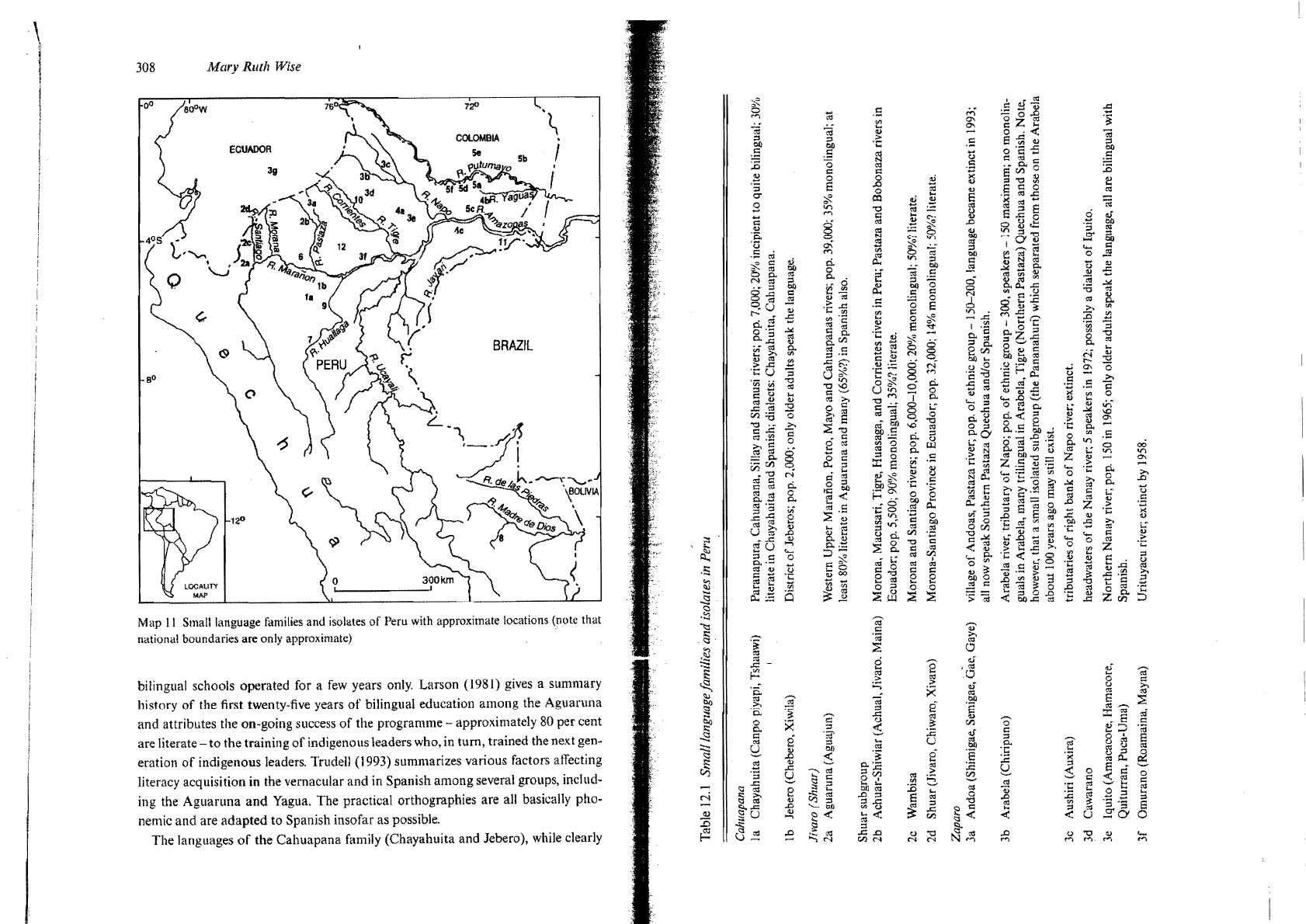
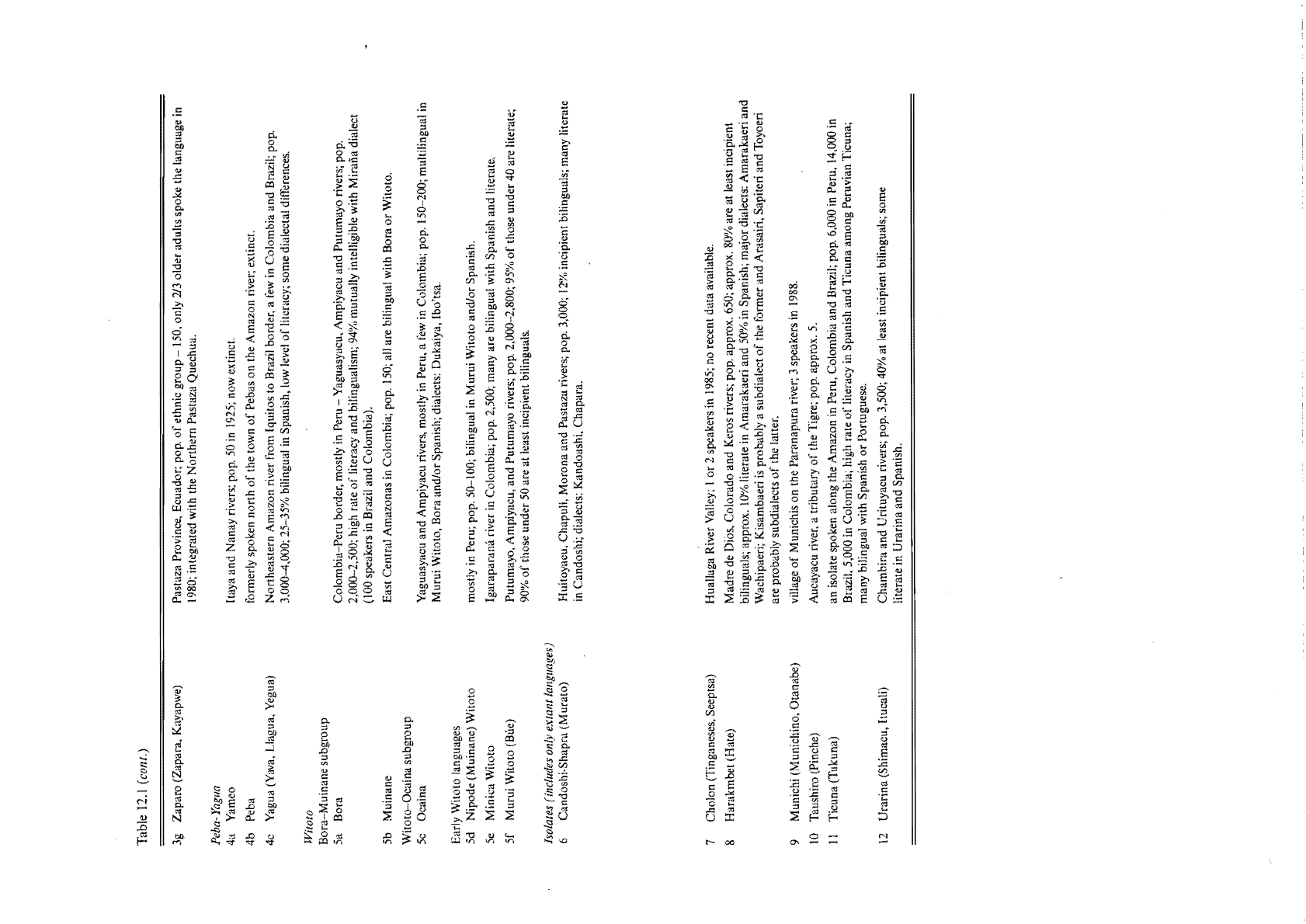
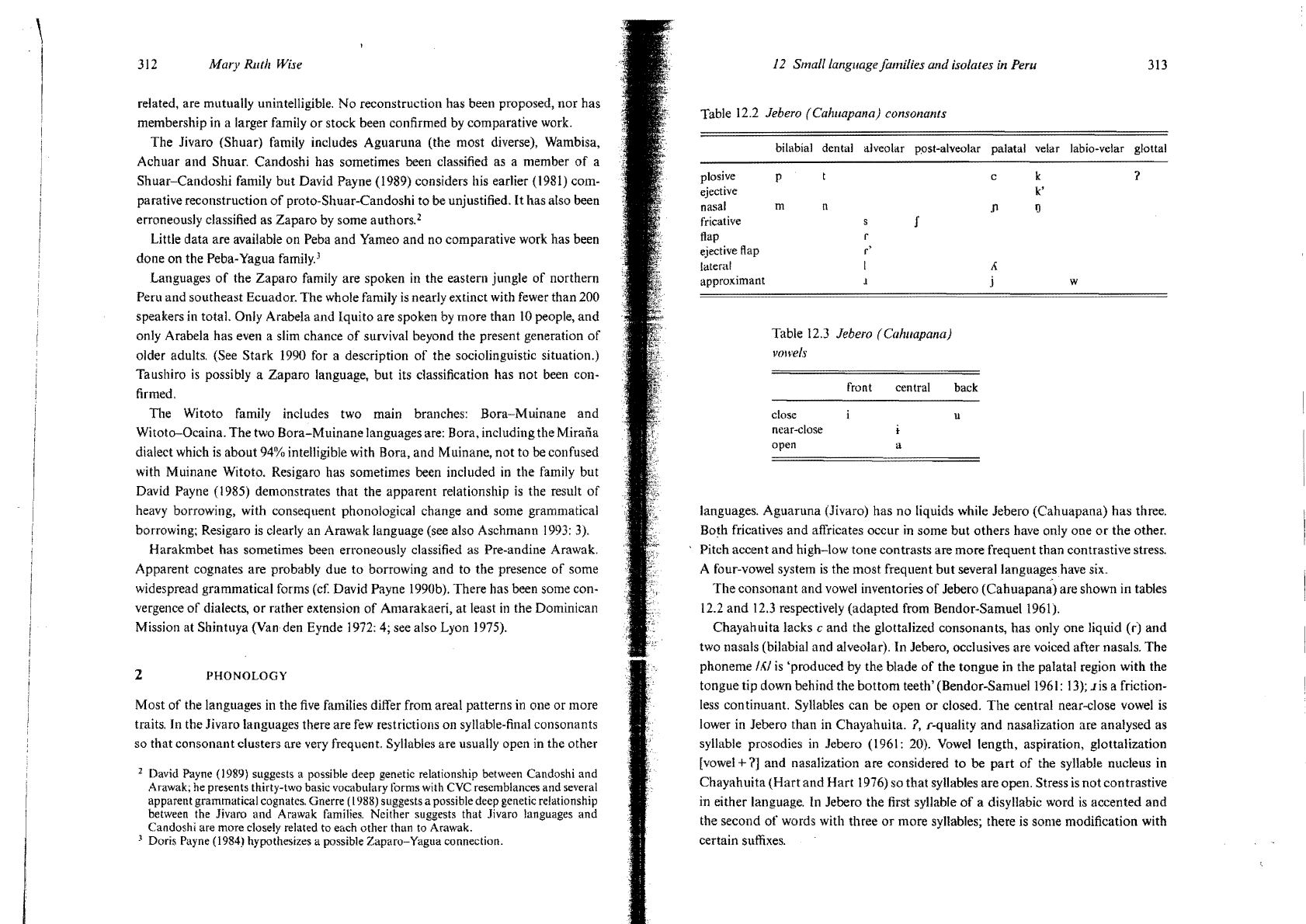
Table 12.1 Jigts the languages within families
or
as
isolates, as
well
as
other
lan-
guages
of
northern
Peruvían Amazonia; alternative names within parentheses are
followed by location,
population,
and
comments
on
literacy, bilingualism
and
dialects.
1
The
accompanying
map
shows
the
approximate locations
of
these Jan-
guages
and
isolates. For
more
than thirty years, there have been government-spon-
sored bilingual schools
among
the
Chayahuita,
Aguaruna,
Achuar, Wambisa,
Shuar,
Arabela,
Yagua, Bora, Ocaina,
Murui
Witoto, Candoshi
and
Ticuna.
The
first Aguaruna-.Spanish sehool began in
1953;
among
the
Amarakaerí
and
Iquito,
Unless specified otherwise,
references
to
bilingualism indicate
proficiency
in
the vernacular
and
Spanish.
w
o
00
Table
12.1
Small
fanguage famUles and isolates in Peru
Cahuapana
la
Chayahuita (Canpo piyapi, Tshaawi)
lb
Jebero (Chebero, Xiwila)
Jivaro (Shuar)
2a Aguaruna (Aguajun)
Shuar
subgroup
2b Achuar-Shiwiar (Achual,livaro. Maina)
2c Wambisa
2d
Shuar (Jivaro. Chiwaro, Xivaro)
Zapara
..
3a
Andoa (Shimigae, Semigae, Gae, Gaye)
3b Arabela (Chiripuno)
3c
Aushiri (Auxira)
3d
Cawarano
3e
lquito (Amacacore, Hamacore,
Quiturran, Puca-Uma)
3f
Omurano (Roamaina, Mayna)
Paranapura, Cahuapana, SiIlay and Shanusi rivers;
popo
7,000;
20%
incipient to quite bilingual; 30%
!iterate in Chayahuita and Spanish; dialects: Chayahuita, Cahuapana.
District
of
Jeberos; pop. 2.000; only older adults speak ¡he language.
Westem Upper Marañon. Potro, Mayo and Cahuapanas rivers; pop.
39,000;
35% mono lingual; al
least 80% !iterate in Aguaruna and many (65%?)
in
Spanish also.
Morona, Macusari, Tigre, Huasaga, and Corrientes rivers in Peru; Pastaza and Bobonaza rivers
in
Ecuador;
popo
5,500; 90% monolingual;
35%7
¡iterate.
Morona and Santiago rivers;
popo
6,000-10,000;
20%
mono lingual;
50%?
literate.
Morona-Santiago Province in Ecuador;
popo
32,000;
14% monolingual;
50%?
literate.
village
of
Andoas, Pastaza river;
popo
of
ethnic group - 150-200, language became extinct in 1993;
al!
now speak Southern Pastaza Quechua andlor Spanish.
Arabela river, tributary
of
Napo;
popo
of
ethnic group - 300, speakers
150
maximum; no monolin-
guals
in
Arabela, many trilíngual in Arabela, Tigre (Northern Pastaza) Quechua
and
Spanish. Note,
however, that a small isolated subgroup (the Pananahuri) which separated from those
on
the Arabela
about
100
years ago may still exist.
tributaries
of
right bank
of
Napo
river; extinct.
headwaters
of
the Nanay river; 5 speakers in
1972;
possibly a dialect
of
Iquito.
Northern Nanay fíver;
popo
150
in
1965;
only older adults speak the language, all are bilingual with
Spanish.
Urituyacu river; extinct
by
1958.
Table
12.1
(cont.)
3g
Zaparo (Zapara. Kayapwe)
Peba-Yagua
4a
Yameo
4b
Peba
4c
Yagua
(Yava,
Llagua,
Yegua)
Wítoto
Bora-Muinane subgroup
5a Bora
Sb
Muínane
Witoto-Ocaina subgroup
Sc
Ocaina
Early Witoto languages
5d Nipode (Muinane) Witoto
Se
Mintca Witoto
sr
Murui Witoto (Búe)
Isolates (íncludes only extant languages)
6 Candoshi-Shapm (Murato)
Pastaza Province, Ecuador;
popo
01'
ethnic group
150,
only
2/3
older adults spoke the language
in
1980;
integrated
with
the
Northern Pastaza Quechua.
!taya and Nanay rivers;
popo
50
in
1'125;
now
extinct.
formerly spoken north of the town
01'
Pebas on the Amazon
river;
extinct.
Northeastern Amazon river
from
(quitos to
Brazil
border, a
few
in
Colombia and Brazil;
popo
3,000-4,000; 25-35% bilingual
in
Spanish,
low
level
01'
literacy; some dialectal differences.
Colombia-Peru border, mostly in
Peru
- Yaguasyacu. Ampiyacu and Putumayo rívers;
popo
2,000-2,500;
hígh
mte
of
literacy and bilingualísm;
94'V,)
mutually intelligible wíth Miraña dialect
(100
speakers in Brazil and Colombia).
East Central Amazonas
in
Colombia;
popo
150;
all
are bilingual with Bora or Witoto.
Yaguasyacu and Ampiyacu
rivers,
mostly
in
Peru, a
few
in
Colombia;
popo
150-200; multilingual
in
Murui Witoto, Bora and/or Spanish; dialects: Dukaiya, Ibo'tsa.
mostly
in
Peru;
popo
50-100; bilingual
in
Murui Witoto andlor Spanish.
Igaraparaná
river
in
Colombia;
pop.
2,500;
many are bilingual with Spanish and litemte.
Putumayo, Ampiyacu, and Putumayo rivers; pop. 2,000-2,800;
95%
of
those under
40
are literate;
90%
01'
those under
50
are at leas! incipient bilínguals.
Huitoyacu, Chapulí, Morona and Pastaza rívers;
popo
3,000;
12'Yo
incipient bilinguals;
many
litcf'dte
in
Candoshi; díaJects: Kandoashi, Chapara.
7 Cholon (Tinganeses. Seeptsa)
Huallaga Ríver
Valley;
1 or 2 speakers in
1985;
no
recent data avaílable.
8 Harakmbet (Hate)
Madre de Dios, Colorado and Keros rivers;
popo
approx.
650;
approx.
80'Yu
are at least incipient
bilinguals; approx.
10%
lilerate in Amarakaeri and
50"/.)
in
Spanish; major dialecrs: Amarakaeri and
Wachipaeri; Kisambaeri
is
probably a subdialect
of
the former and Arasairi, Sapiteri and
Toyoeri
are probably subdialects
of
¡he latter.
9 Munichi (Munichino, Otan abe)
village
of
Munichis on the Par¡lnapum river; 3 speakers
in
1988.
10
Taushiro (Pinche)
Aucayacu
river,
a tributary
of
¡he Tigre;
popo
approx.
5.
11
Ticuna (Tukuna)
an isolate spoken along the Amazon
in
Peru, Colombia and Brazil;
popo
6,000
in
Peru,
14,000
in
Brazil,
5,000
in
Colombia; high rale
01'
literacy
in
Spanish aud Ticuna among Peruvian Ticuna;
many biliugual with Spanísh or Portuguese.
12
Urarína (Shimacu, ltucali)
Chambira and Urituyacu
rivers;
popo
3,500;
40%
at
leas!
incipient bilinguals; some
E¡erate in Urarina and Spanish.
313
\
Mary Ruth Wise
312
related, are mutually unintelligible. No reconstruction has been proposed,
nor
has
membership in a larger family
or
stock been confirmed by comparative work.
The Jivaro (Shuar) family includes Aguaruna (the most diverse), Wambisa,
Achuar and Shuar. Candoshi has sometimes been c\assified as a member
of
a
Shuar-Candoshi family
but
David Payne (1989) considers his earlier (1981) com-
parative reconstruction
of
proto-Shuar-Candoshi to be unjustified.
It
has also been
erroneously e1assified as Zaparo by sorne authors.
2
Little data are available on Peba
and
Yameo and no comparative work has been
done on the Peba-Yagua
family.3
Languages
of
the Zaparo family are
in
the eastem jungle
of
northern
Peru and southeast Ecuador. The whole family
is
nearly extinct with fewer than 200
speakers
in
total. Only Arabela and lquito are spoken more than
10
people, and
only Arabela has even a slim chance
of
survival beyond the present generatíon
of
older adults. (See Stark
1990
for a description
of
the sociolinguistic situation.)
Taushiro
is
possibly a Zaparo language,
but
its classification has not been con-
firmed.
The Witoto family ¡neludes two main branches: Bora-Muinane
and
Witoto-Ocaina. The two Bora-Mu¡nane languages are: Bora, including the Miraña
dialect which
is
about 94% intelligible with Bora, and Muinane, not to be confused
with Muinane Witoto. Resigaro has sometimes been included
in
the family
but
David Payne (1985) demonstrates that the apparent relationship
is
the result
of
heavy borrowing, with consequent phonological change
and
some grammatical
borrowing; Resigaro
is
c1early
an Arawak language (see also Aschmann
1993:
Harakmbet has sometimes been erroneously classified as Pre-andine Arawak.
Apparent cognates are probably due lo borrowing and lo Ihe presence
of
sorne
widespread grammatical forms
(cf.
David Payne There has been some con-
vergence
of
dialects,
or
rather ex.tension
of
Amarakaeri, al leasl
in
the Dominican
Mission al Shinluya (Van den Eynde
1972:
4;
see
also Lyon 1975).
2
PHONOLOGY
Most
of
the languages
in
the
five
families differ from areal patterns in one or more
traits. In the Jivaro languages there are
few
restrictions on syllable-final consonants
so that consonant clusters are very frequent. Syllables are usually open
in
the other
2
David P'''yne (1989) suggcsts a possible deep genetic relationship between Candoshi
and
Arawak; he presents thirty-two basic vocablllary forms with CVC resemblances and several
apparent grammatical cognatcs. Gnerre (1988) sllggests a possible deep genetic relationship
between the Jivaro
and
Arawak ramilies. Neither sllggests thal Jivaro langllages
Candoshi are more
c10sely
related to each other than to Arawak.
J
Dorís Payne (1984) hypothesízes a possible
Zaparo-
Yagua connection.
12 Small /anguagefamilies and iso/ates in Peru
Table
12.2
Jebero (Cahuapana) consonants
bilabial dental alveolar p,ost-alveolar palatal velar labio-velar glottal
plosive p
e
k
'/
ejective
k'
nasal m
n
.n
!l
fricative
f
lIap
f
ejective flap
f'
lateral
Á
approximant
w
Table
12.3
Jebero (Cahuapana)
VOl
veIs
close
near-close
open
front
central
a
back
u
languages. Aguaruna (Ji varo) has no while Jebero (Cahuapana) has three.
Both fricatives and affricates occllr
in
sorne
but
others have one
or
the other.
Pitch accent and high-low tone contrasts are more frequent than contrastive stress.
A four-vowel system
is
the most frequent
but
severallanguageshave six.
The
consonant and vowel inventories
of
Jebero (Cahuapana) are shown in tables
12.2
and
12.3
respectively (adapted from Bendor-Samuel
Chayahuita lacks
e
and the glottalized consonants, has one liquid (r)
and
two nasals (bilabial and alveolar). In Jebero, occlusives are voiced after nasals. The
phoneme
/!../
is
'produced by the blade
of
the tongue in the palatal regio n with the
tongue tip down behind the bottom teeth' (Bendor-SamueI1961:
13);
Jis
a friction-
less
continuant. Syllables can be open
or
closed.
The
central near-close vowel
is
lower
in
Jebero than in Chayahuita.
7,
c-quality
and
nasalization are analysed as
syllable pros odies
in
Jebero (1961: 20).
Vowel
length, aspiratíon, glottalization
[vowel
+
1]
and
nasalization are considered to be
part
of
the syllable nucleus in
Chayahuita
(Hart
and
Hart
1976) so that syllables are open. Stress
is
not contrastive
in
either language.
In
Jebero the first syllable
of
a disyllabic word
is
accented
and
the second
01'
words with three
or
more syllables; there
is
sorne modification with
certain suffixes.