
Dixon R.M.W., Aikhenvald Alexandra Y. The Amazonian Languages (Cambridge Language Surveys)
Подождите немного. Документ загружается.

314
Mary Ruth Wise
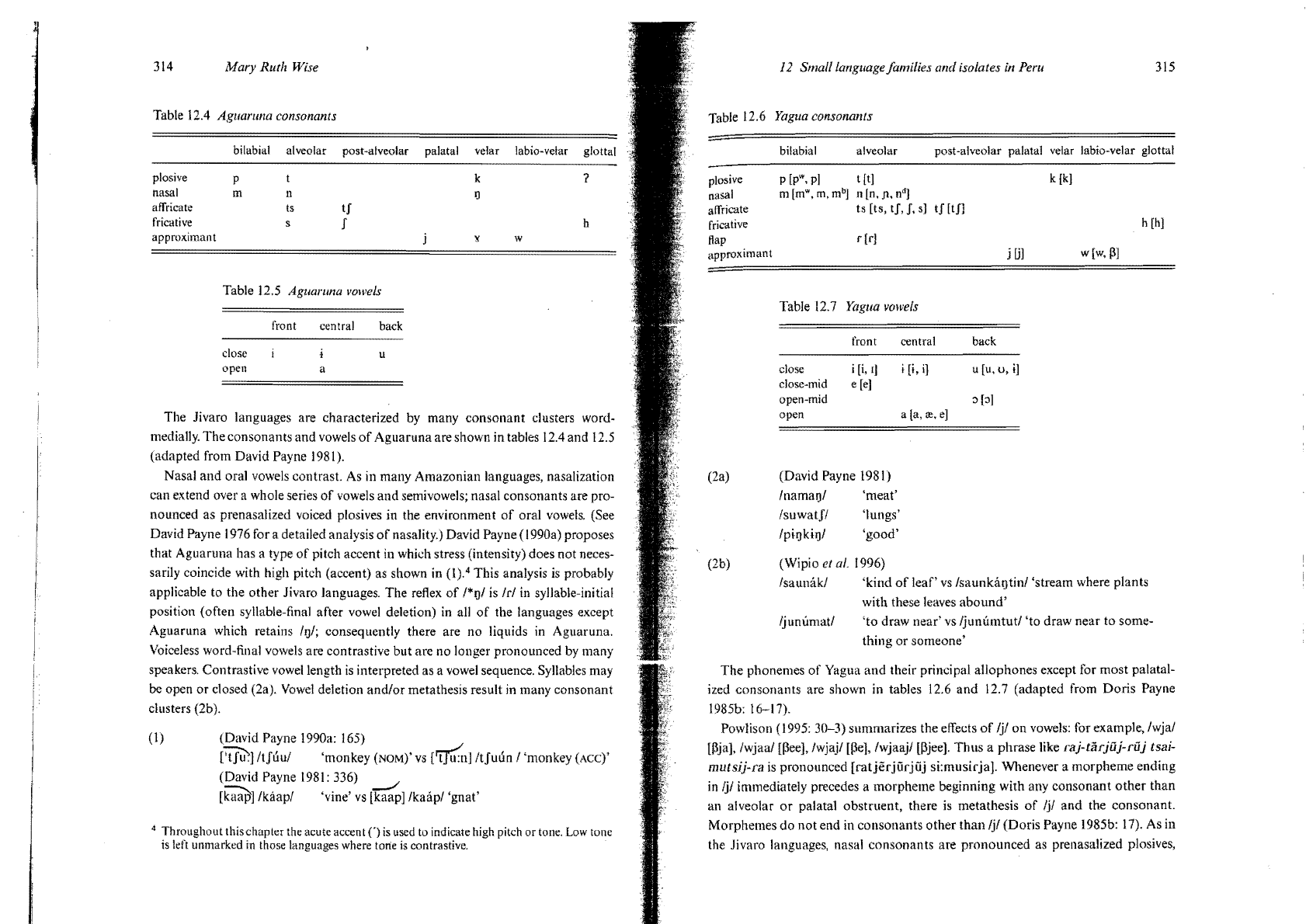
Table 12.4
Aguaruna consonants
bilabial alveolar post-alveolar palatal velar labio-velar glottal
plosive
p
k
?
nasal
m
n
1)
affrícate
ts
tI
fricative
s
J
h
approximant
1(
W
Table 12.5
Aguaruna vowels
front
central back
c10se
u
open
a
The Jivaro languages are characterized by many
consonant
dusters
word-
medially.
The
consonants
and
vowels
of
Aguaruna
are shown in tables 12.4 and 12.5
(adapted
from David Payne 1981).
Nasal
and
oral vowels contrast. As in
many
Amazonian
languages, nasalization
can extend over a whole series
of
vowels
and
semivowels; nasal consonants are pro-
nounced
as
prenasalízed voiced plosives in the environment
of
oral vowels. (See
David Payne 1976 for a detailed analysis
of
nasalíty.) David Payne (1990a) proposes
that
Aguanma
has a type
of
pitch accent in which stress (intensity) does
not
neces-
sarily coincide with high pitch (accent) as shown in (1).4
Tbis
analysis
is
nmh"hlv
applicable to the
other
Jivaro languages.
The
reflex
of
1*01
is
Ir!
in
position (oftell syllable-final after vowel deletion) in
aH
of
the languages except
Aguarulla which retains
IU/;
cOllsequently there are
110
liquids in Aguaruna.
Voiceless word-final vowels are contrastive
but
are
no louger pronolll1ced by many
speakers. Contrastive vowellength
is
interpreted as a vowel seqllence. Syllables may
be open
or
dosed
(2a).
Vowel
deletion
andlor
metathesis result in many
consonant
cllIsters
(1)
(David Payne 1990a: 165)
[~l/tfúul
'monkey
(NOM)'
vs
[~lj
ItJlIún
I
'monkey
(David Payne 1981: 336)
--"
[~/káapl
'vine' vs
[kaap]/kaápl
'gnat'
12
Smalllanguage families and iso/ates in Peru
315
Table 12.6
Yagua
consonan/s
plosive
nasal
affriC'dte
fricative
llap
(2a)
bilabial
alveolar post-alveolar palatal
velar
labio-velar glottal
p[pW,
p]
t[t)
m[m"',m,m
b
]
n[n,j1,n
d
]
Is [ts,
tI.
1,
sI
tI
[tJl
r[r)
Table
12.7
Yagua
vowels
front
close
i[i,l]
c1ose-mid
e
[e)
open-mid
open
(David Payne 1981)
Inama!]1
Isuwatfl
IpllJkiOI
'meat'
'Iungs'
'good'
(Wipio
el al.
1996)
central
i
ti,
i)
a
[a,
<e,
e]
k
[k]
h
[h]
j[j)
w[w,
131
back
u [u,
u,
i)
0[0]
Isaunákl
'kind
of
leaf' vs Isaunkál)tinl
'stream
where plants
with
these leaves
abollnd'
Ijunúmatl
'to
draw
near'
vs
thing
or
someone'
'to
draw
near
to
sorne-
The
phonemes ol' Yagua
and
their principal allophones except for
most
palatal-
ized
consonants
are showl1 in tables 12.6
and
12.7 (adapted l'rom
Doris
Payne
1985b: 16-17).
Powlison (1995:
30-3)
surnrnarizes the elfects
of
Ijl
011
vowels: for example,
/wjal
is
in
Ijl
immediately precedes a rnorpheme
h",,,¡nn¡n
Whenever a
morpheme
ending
with any
consonant
other
than
an alveolar
or
palatal
obstruent,
there is rnetathesis
of
Ijl
and
the
consonant.
Morphemes
do
not
end in cOllsonants
other
than
/jl
(Doris Payne 1985b: 17).
As
in
the Jivaro languages, nasal
consonants
are pronollnced as prenasalized plosives,
lllSCI1t1mer
the
acute accent
n
is
used
to
indicate
high
pitch
or
tone.
Low
tone
languages
where
torie
is
contrastive.
317
\
1
316
Mary
Ruth
Wise
1
I
I
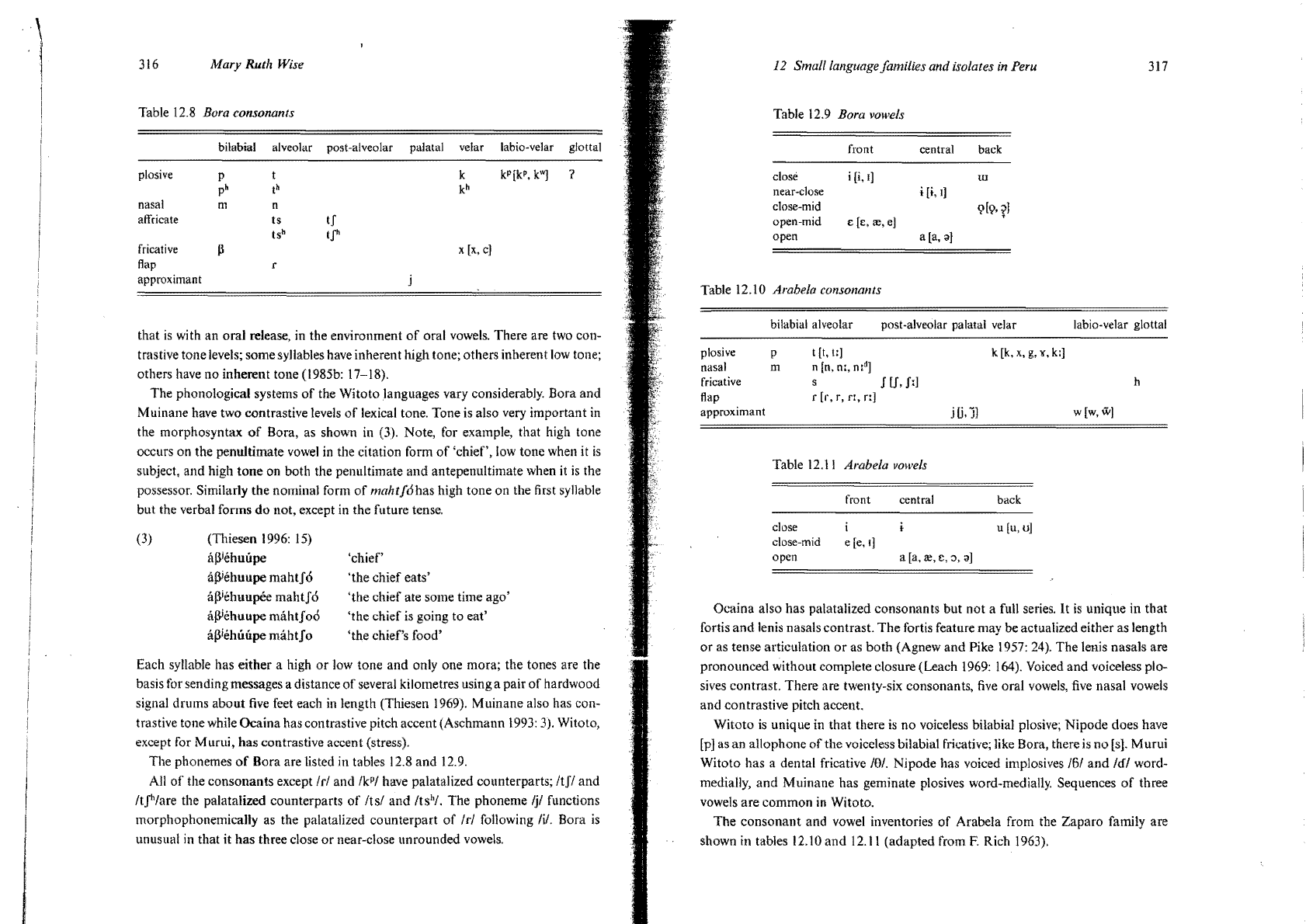
Table 12.8
Dora
consonants
bilabial
alveolar post-alveolar
palatal velar labio-velar glottal
I
I
plosive p k
kP[k
P
,
kW¡
?
ph
t
h
k
h
nasal
m n
affricate
ts
tI
ts
h
tJh
fricative
Ji
x
[x,
e]
flap
r
approximant
that
is with
an
oral
release, in
the
environment
of
oral
vowels.
There
are two
con-
trastive
tone
levels;
sorne
syllables have
inherent
tone;
others
inherent
low tone;
others
have
no
inherent
tone
(I985b: 17-18).
The
phonological
systems
of
the
Witoto
languages
vary considerably.
Bora
and
Muinane
have
two
contrastive
levels
of
lexical tone.
Tone
is
also
very
important
in
the
morphosyntax
of
Bora, as shown in (3). Note, for example,
that
high
tone
occurs
on
the
penultimate
vowel in
the
citatíon form
of
'chief',
low
tone
when it
is
subject,
and
high
tone
on
both
Ihe
penultimate
alld
antepenultimate
when it is
the
possessor. Similarly
the
nominal
form
of
mahtf6has
high
tone
on
the
first syllable
bUI
the
verbal
fonns
do
not,
except in
the
ruture
tense.
(3) (Tlliesen 1996:
15)
áfJíéhuúpe
'chief'
áf.liéhuupe
mahtfó
'the
chief
eats'
áfJíéhuupée
mahtfó
'the
chief
ate some time
ago'
áf.liéhuupe
máhtf
oó
'the
chief
is
going
to
eat'
áfJiéhúúpe
máhtfo
'the
chief's
rood'
Each syllable
has
either
a high
or
low
tone
and
only
one
mora;
the
tones are
the
basis for sending messages a distance
of
several kilometres using a
pair
of
hardwood
signal
drums
abont
five feet
each
in length (Thiesen 1969). M
uinane
also has
con-
trastive tone while
Ocaina
has
contrastive
pitch
accent
(Aschmann
1993: 3). Witoto,
except for M urui,
has
contrastive
accent
The
phonemes
of
Bora
are
listed in tables 12.8
and
12.9.
AIl
of
the
consonants
except
!rl
and
Ik
P
!
have palatalized
counterparts;
Itfl
and
Itr/are
the
palatalized
counterparts
of
Itsl
and
Itsb/.
The
phoneme
Ijl functions
morphophonemically
as
the
palatalized
counterpart
of
Irl
following
lil.
Bora is
un usual in tha!
it
has
three close
or
near-c\ose
unrounded
vowels.
12 Smalllanguage families and iso/ates in Peru
Table 12.9
Dora vowels
[ront
central back
closé
i
(i,
1]
ID
near-c1ose
t
[i,
IJ
c1ose-mid
9[9'l]
open-mid
t::
[E,
<e,
el
open
a
la,
<l)
Table 12.10
Arabe/a
COllsonants
bilabial alveolar
post-alveolar palatal velar
labio-velar glottal
plosive p
t
(1,
t:J
k [k,
x,
g,
Y,
k:]
nasal m
n
In,
0:,
friC'cltive
s
J[J,J:]
h
flap
r Ir, r,
fl,
r:]
approximant
jU,
1)
w
(w,
w]
Table 12.11
Arabela
vowels
front central back
el
ose
i
u[u,u]
close-mid
e
le,
1]
open
a la,
<e,
e,
:>,
<l]
Ocaina
also
has
palatalízed
consonants
bUI
not
a full series.
lt
is
in
tha!
fortis
and
lenis nasals
contrast.
The
fortis feature
may
be
actualized
either
as
length
or
as
tense
articulation
or
as
both
(Agnew
and
Pike 1957: 24).
The
leHis
nasals
are
pronounced
without
complete
closure
(Leach
1969: 164). Voiced
and
voiceless
sives
contrast.
There
are
twenty-six
consonants,
five
oral
vowels, five
nasal
vowels
and
contrastive
pitch accent.
Witoto
is
unique
in
that
there
is
no
voiceless bilabial plosive;
does
have
[p)
as
an
allophone
of
the
voiceless bilabial fricative; like Bora, there is
no
[s).
MUTUi
Witoto
has
a
dental
fricative
lO/.
Nípode
has
voiced implosives
151
and
Idl
word-
medially,
and
Muinane
has
geminate
plosives word-mediaIly. Sequences
of
three
vowels
are
common
in
Witoto.
The
consonant
and
vowel inventories
of
Arabela
from
the
Zaparo
family
are
shown
in tables 12.
\O
and
12.11
(adapted
from
F.
Rich 1963).
319
318
Mary Rllth Wise
Zaparo differs from Arabela
in
having alveolar and postalveolar affricates and a
plosive. Iq uito and Zaparo each has only four vowels: clase front and central,
open central, and one back
vowe1
varying between close
and
mido
In all three Jan-
guages long and short vowels contrasto In Arabela, al least, there
is
palatalization
and
labialization
of
consonants (written as
Ci
and Cu in the examples) in syllables
following
i
and
ti,
respectively. In Arabe1a /hl has a nasal quality and vowels are
nasalized following
Ih/
and nasal consonants
(F.
Rich
1963:
197). With the excep-
tion
of
a phrase-final fortis
Ih/
and
[?J
for emphasis
in
Arabela, syllables are open.
A two-tone system
is
reported for [quito (Eastmall and Eastman
1963:
146).5
The isolates present several phonological features which differ from areal patterns:
Ticuna has a very complex tonal system as
well
as laryngealized vowels (L. Anderson
l 959a,b, and Montes Rodríguez 1995).
6
Candoshi has a voiceless retroflexed post-
alveolar affricate, and the maximum syllable
is
CCCVC. Taushiro
is
the
Peruvian language in which there are
no
bílabial or labio-dental consonants.
3
MORPHOLOGY
Word
c1asses
in most
of
the languages include open classes
of
nouns, verbs
and
adjectives. Closed
c1asses
uSllally include adverbs as
well
as pronouns and conjllnc-
tions. In most
of
the languages, adjectives are more likely
to
occur as predicate
tives than
in
the noun phrase but the adjective
c1ass
as such
ls
not necessarily
c1osed.
AH
of
the languages
of
the
five
familíes are agglutinative, although strings
of
affixes tend to be shorter
in
the Jívaro languages than
in
the others. Sulfixes predom-
inate but there are causative prefixes in Jivaro, Cahuapana and Harakmbet. The
Cahuapana languages
al
so have about two dozen stem-formíng verbal prefixes. In
Zaparo, Bora
and
Yagua, person markers are prefixed to possessed noulls. In
Yagua, (quito and Harakmbet, ¡¡ud sometimes
in
Arabela and Zapa
ro,
subject
person markers are prefixes also. Cahuapana, Jivaro and Harakmbet verbs cross-
reference both subject/agent and object. The cross-referencing morphemes are pre-
fixes
in
Harakmbet; declarative, dubitative
and
imperative sets differ in some
subject/agent-object forms.
The Witoto languages and Yagua have dual, as
well
as singular and plural,
numbers (a dual number
is
unusual
in
Amazonia).
Cahuapana
languages and
Harakmbet have dual number
in
the first person only.
5
Further analysis might show tha! ¡quito has a pitch-accent
6
Anderson (1959a,b) and Soares (1995) describe Ticuna as having
five
tones as well as glides.
In a recent auto-Seb'ltlental analysis, Montes Rodríguez (1995) agrees wilh Anderson's pho-
netic transcription but consíders tha! high and low tones comprise Ihe basic opposition
and
that a third mid tone
is
relatívely weak
and
might best be con
si
de red as
an
underspecified
element.
12 Small /anguage families and iso/ates in Peru
3.1
Nominal
morphology
3.L1
Classifiers
In
Yagua, classifiers are infixed into the number 'one'
and
suffixed to
other
numbers; classifiers occur with nouns, demonstratives, adjectives
and
verbs. They
are especíally important in Bora where more
than
350 have been identified. In
Witoto
and
Peba-Yagua, the
families with gender distinction, masculine
or
feminine gender suffixes function as classifiers in words referring to animate nouns.
In Bora c1assifiers occur in pronouns al so. Examples from Bora with -
?áámi
'Ieaf'
follow:
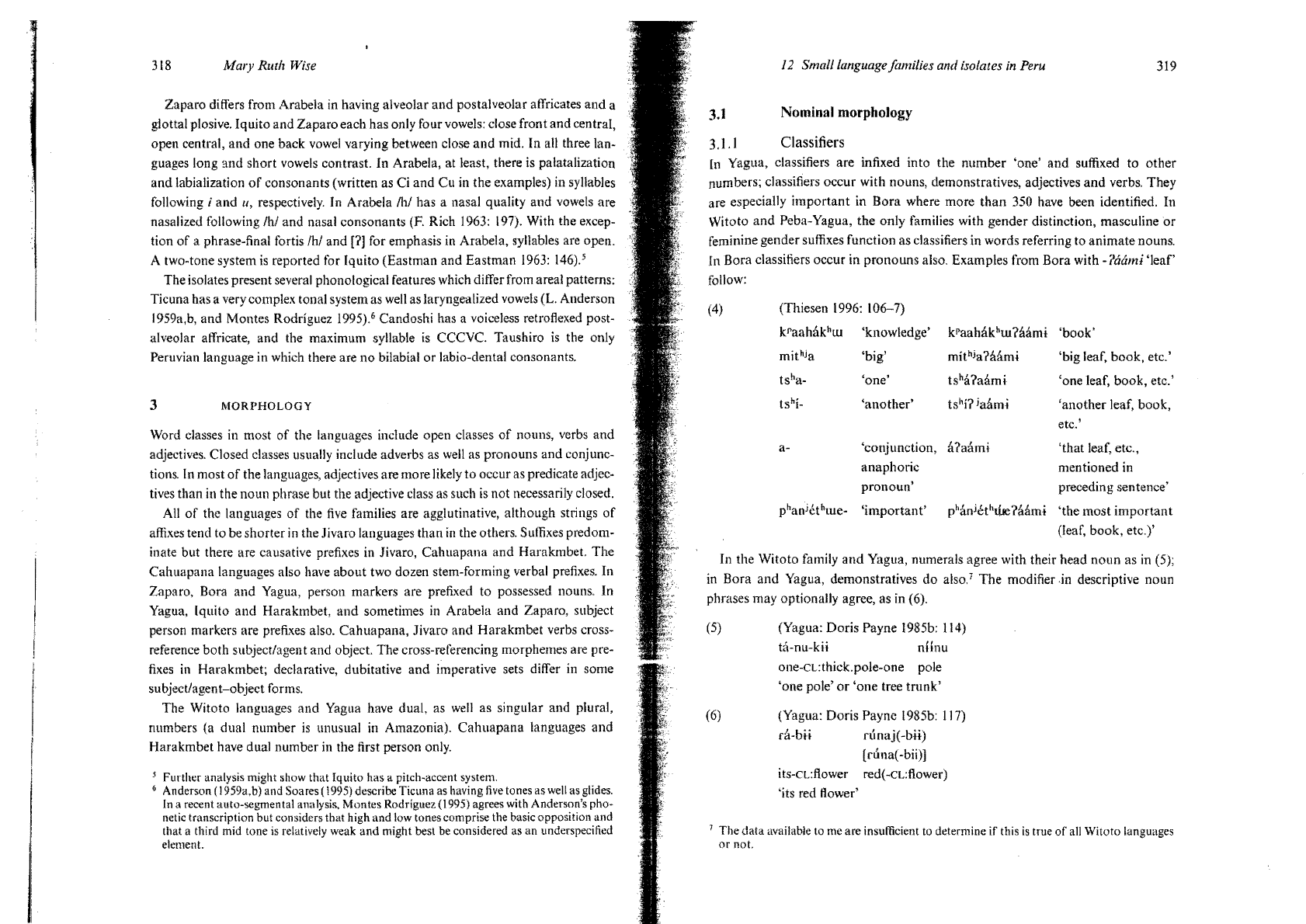
(4)
(Thieseu
1996:
\06-7)
kJ'aahákhw
'knowledge'
kraahákhw?áámi
'book'
mithja
'big'
míthia?áámi
'big leaf, book, etc.'
tsha-
'one'
tshá?aámi
'oue leaf,
boak,
etc.'
tshí-
'another'
tshí?iaámi
'another leaf,
etc.'
a-
'conjullction,
á?aámi
'that
leaf, etc.,
auaphoric mentioned in
pronoun'
preceding sentence'
phaniéthwe-
'important'
pháuiéthÚIe?áámi 'the most impart;>nt
(Ieaf, book, etc.)'
In the Witoto family
and
Yagua, uumerals agree with their head noun as
in
(5);
in
Bora
and
demonstratives
do
also.1
The
modifier .in descríptive uoun
phrases may optionally agree, as
in
(5)
(Yagua: Doris payne 1985b:
114)
tá-nu-kii nHnu
one-CL:thick. pole-one pole
'one Dole'
or
'one
tree trunk'
(6)
Doris Paync 1985b:
117)
rá-bti f'únaj(-bii)
[róna(-bií)]
i ts-cL:flower red( -cL:flower)
'its red flower'
J
The
data
available lo me are insufficienl to determine
ir
this
is
tme
of
all WitQto languages
or
noto
321
320
Mar)'
Ruth
Wise
lo Cahuapaoa aod Zaparo, one
of
the frequent nouo derivational suffixes
is
an
attributive {'owner or'), as in
so?ja-wan
(wife-A TTRlB)
'one
who has a wife',
ma?-
wan
(thiogs-ATTRlB)
'a
rich persoo' (Chayahuita: Hart 1988: 261).
3.1.2
Case
Nominative-accusative type case markers occur
io
alllanguages
of
the Cahuapana,
Jivaro and Witoto families, and
in
Candoshi and Harakmbet. In Bora and the Jivaro
languages, the nominative
is
zero. Witoto itself optiooally marks both oominative
and accusative (the object
is
obligatorily marked when the subject
is
third person).
In
Cahuapana both may be marked or both may be uomarked; the subject
is
usually
marked
to
avoid ambiguity
or
for emphasis and the object only for emphasis.
In Arabela, subje\.:t and object fUllctions are usually marked by constituent order
but
-ri
may mark the subject when it precedes the
verbo
The
-ri
subject marker
occurs io traositive constructions and may be indicative that Zapara lan-
guages are partlally ergative. Another ergative-líke feature in all
of
the Zaparo
is
the fact that there are two sets
of
pronouns, the second
of
which could be consid-
ered absolutive since
it
is
used for the object and for the subject
of
stative clauses.
The
use
of
one set
or
the other, however, depends prímarily on constituent order; the
first set
is
used ror agents/subjects and also for objects when they precede the
verbo
In
Yagua, definite object enclitícs attach
to
any word which follows the verb
and
directly precedes the object;
or
they attach
to
the verb when the object
is
not a fully
specified noun phrase, as
in
Compare the ageot aod object references
in
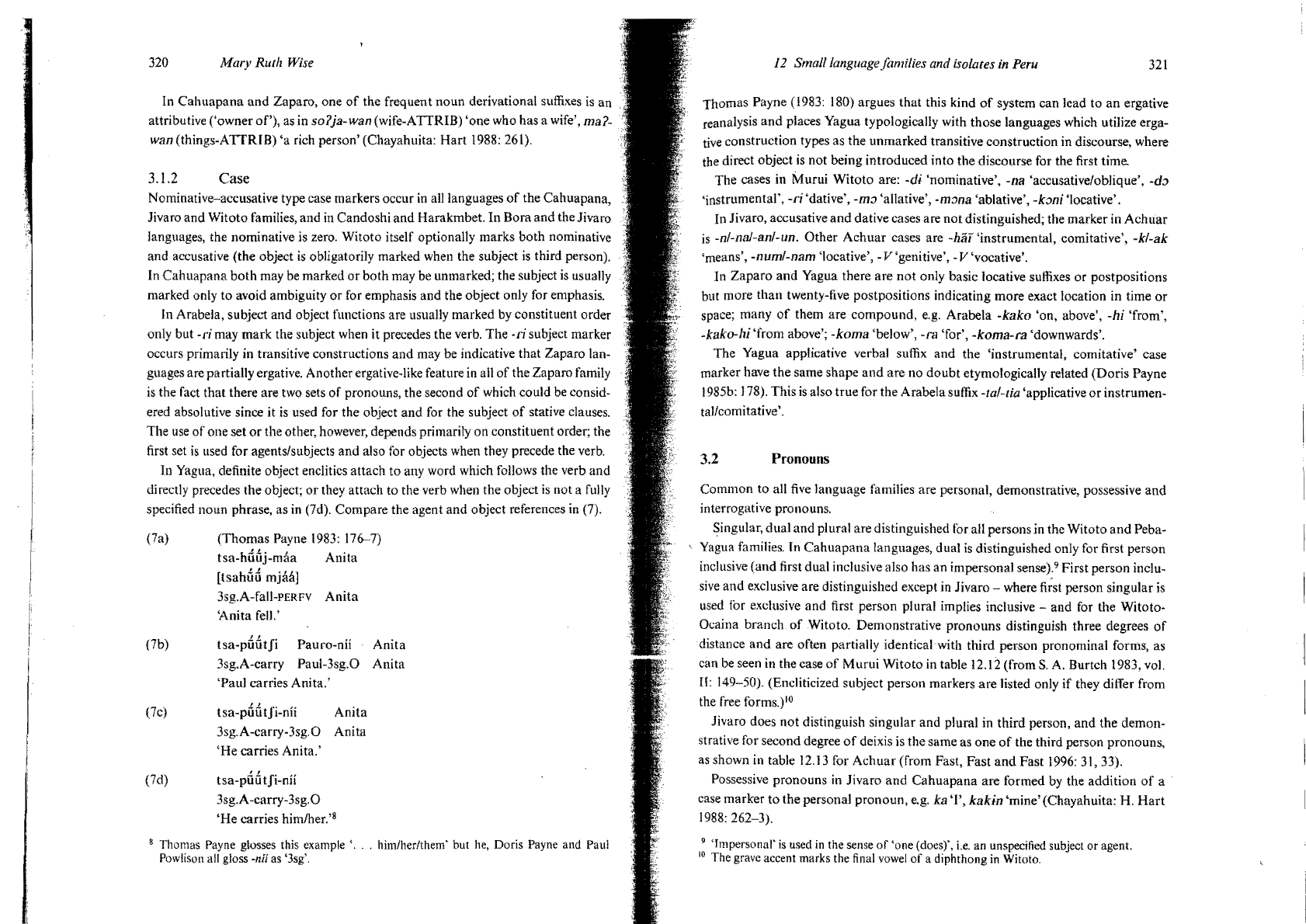
(Thomas
Payne
1983:
tsa-hÚÓj-máa Anita
[tsahÓÓ mjáál
3sg.A-fall-PERFV
Anita
'Anita
fello'
(7b)
tsa-pÓÓtfi Pauro-oíí Anita
3sg.A-carry Paul-3sg.0 Anita
'Paul
canies
Anita.'
(7c)
tsa-pÓíÍtJi-níi Anita
3sg.A-carry-3sg.0 Anita
'He
carries Anita.'
tsa-pÓÓtfi-níí
3sg.A-carry-3sg.0
'He
carries him/her.'8
8
Thomas Payne glosses
Ihi5
example '. . him/herlthem' bul he, Doris Payne and Paul
Powlison all gloss
-nU
as '3sg'.
12 Smalllangllage fami/ies and isolates in Peru
Thomas payne (1983: 180) argues that this kind
of
system can lead to an ergative
reanalysis and places Yagua typologically with those languages which utilize erga-
tive
construction types
as
the unmarked transitive construction in díscourse, where
the direct object
is
not being introduced into the discourse for the first time.
The cases in Murui Witoto are:
-di
'nominative',
-na
'accusative/oblique',
-d:>
'instrumental',
-ri'dative',
-m:>
'allative',
-m:>na
'ablative" -k:>ni'locative'.
In Jivaro, accusative
and
dative cases are
not
distinguished; the marker
in
Achuar
is
-nl-nal-anl-un.
Other Achuar cases are
-har
'instrumental, comitative',
-kl-ak
'means',
-numl-nam
'Iocative', -
V
'genitive', -
V
'vocative'.
In
Zaparo
and
Yagua there are not only basic locative sulfixes or postpositions
bu! more than twenty-five postpositions indicating more exact locatíon in time
or
space; many
of
them are compound, e.g. Arabela
-kako
'on, aboye',
-hí
'from',
-kaka-hí
'from aboye';
-koma
'below',
ora
'for',
-koma-ra
'downwards'.
The Yagua applicative verbal sulfix and the 'instrumental, comitative' case
marker have the same shape
and
are no doubt etymologically related (Doris Payne
1985b:
J
78).
This
is
also true for the A rabel a sulfix
-tal-tia
'applicative
or
instrumen-
tal/comitative'.
3.2
Pronouns
Common to all
five
language families are personal, demonstrative, possessive and
interrogative pronouns.
Singular, dual and plural are distinguished lor all persons in the Witoto
and
Peba-
Yagua families.
In
Cahuapana
languages, dual
is
distinguished only for first person
inclusive (and first dual inclusive also has an impersonal sense).9 First person inclu-
sive
and exclusive are distinguished
eXI..--ept
in Jivaro where fi;5t person singular
is
used lor exclusive and first person plural
inclusive and for tlle Witoto-
Ocaina
branch.of
Witoto. Demonstrative pronouns distinguish three degrees
of
distan
ce
and
are often partially identicalwith third person pronominal
fOfTI1s,
as
can
be
seen
in
t);¡e
case
of
Murui Witoto
in
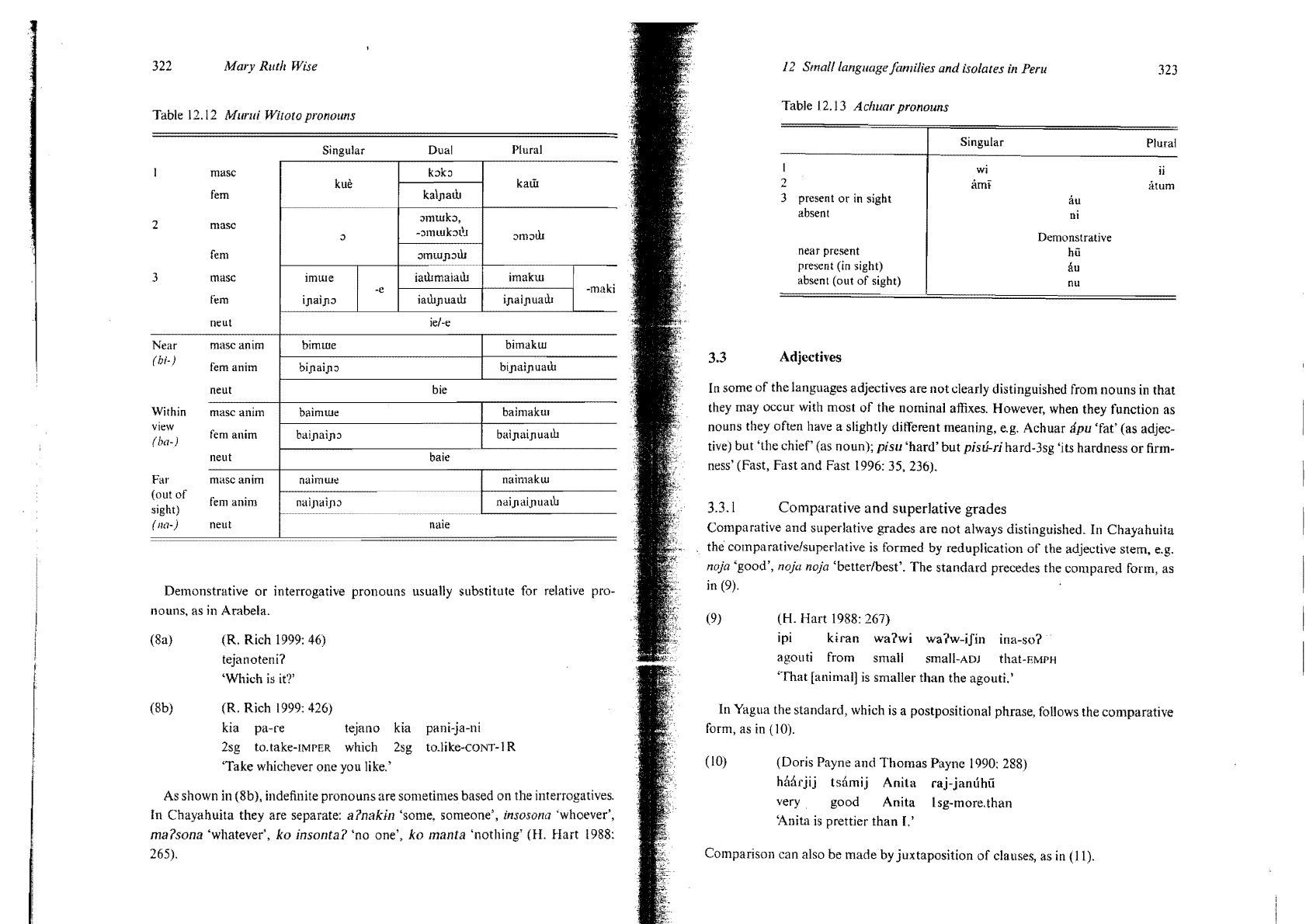
table 12.12 (from
S.
A.
Burtch 1983, vol.
11:
149-50). (Encliticized subject person markers are listed only if they dilfer from
the free
forms.)IO
Jivaro does
not
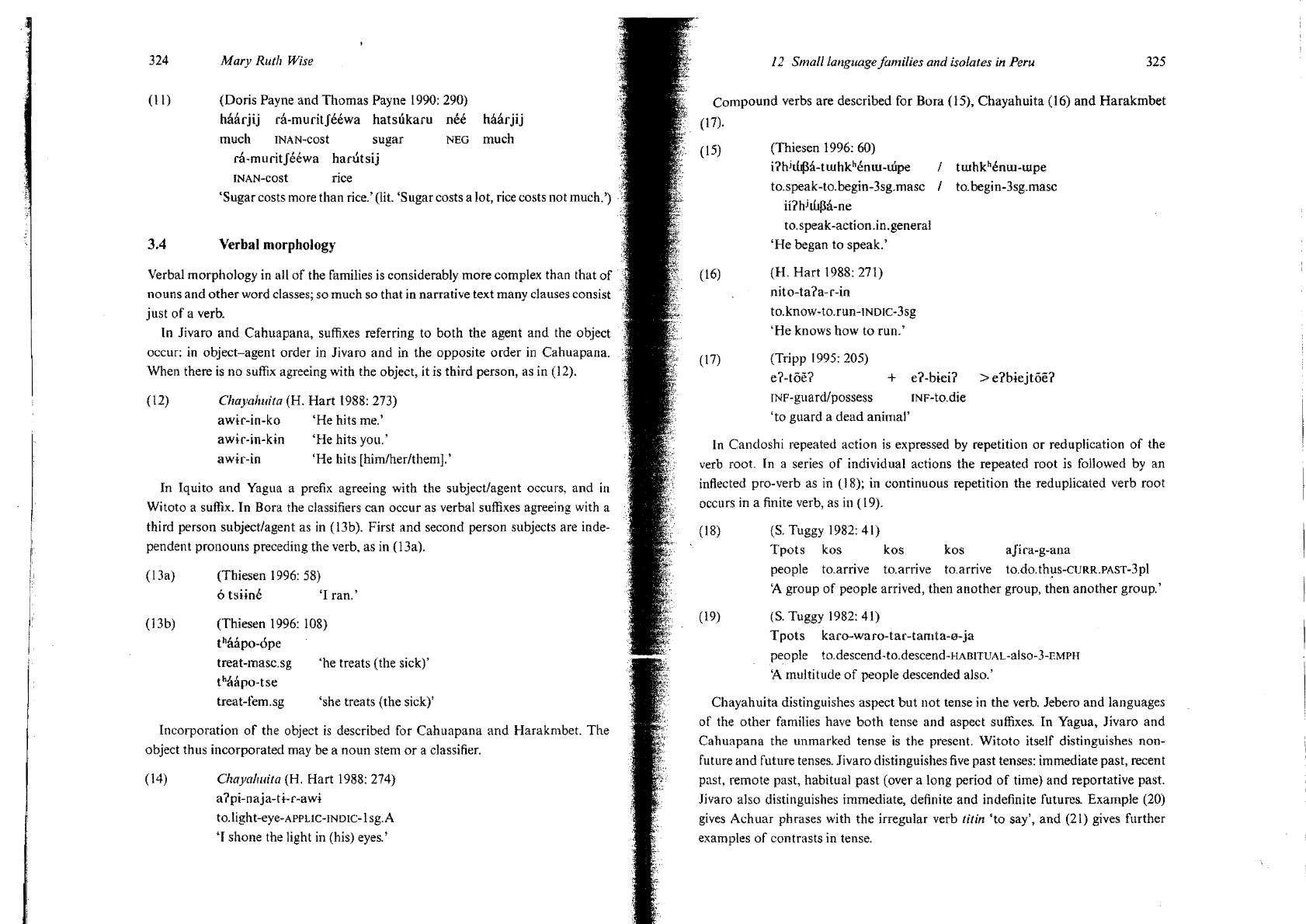
distinguish singular and plural in third person, and the demon-
strative ror second degree
of
deixis
is
the same as one
of
the third person pronouns,
as
shown in table 12.13 ror Achuar (from Fast, Fast
and
Fast
1996:
31, 33).
Possessive pronouns
in
Jivaro
and
Cahuapana
are
formed by the addition
of
a
case marker
to
the personal pronoun, e.g.
ka
'1',
kakin
'mine' (Chayahuita:
H.
Hart
1988:
262-3).
9
'Impersonal'
is
used
in
the sense
of
'one
(does)',
Le.
an unspecitied subjecl
or
agent.
10
The grave accenl marks the final vowel
of
a diphlhong in Witoto.
323
322
Ruth Wise
Table
12.12
MI/rui
Singular
Dual
Plural
I
mase
bb
kue
kaÚI
fem
kalJlaW
2
mase
;¡mwb,
;¡
-:HnwbüI
;¡m;¡W
fem
;¡mwJl:lW
3
mase
imwe
iaWmaiaW
imakw
-e
-maki
fcm
iJlaiJl:l
iaWJluaW iJlaiJluadI
neut ie/-e
Near
maseanim
bimwe
bimakw
(bi-)
fem anim
biJlaiJl:l
biJlaiJluaW
neut
bie
Within
mase anim baimwe
balmakw
view
fem anim
baiJlaiJl:l baiJlaiJluaw
(ba-)
neut bale
Fal' mase anim
naimwe
naimakw
(out
of
fem
anim
naiJ1aiJlJ
naiJlaiJlualU
sight)
(/la-)
neut
nale
Demonstrative
or
interrogative
pronouns
uSllally substitllte for relative pro-
nouns, as in Arabela.
(R.
Rich
1999:
46)
'Which
is
it?'
(R.
Rich
1999:
426)
kia
pa-re
tejano
kia pani-ja-ni
2sg
tO.take-IMPER
which to.like-coNT-l R
'Take
whichever
one
you like.'
indefinÍte pronollns are sometimes based
on
the interrogatives.
are
separate:
a?nakin
'sorne,
someone"
insosona
'whoever',
ma7sona
'whatever"
ka
Ínsontal
'no
one',
ko
manta
'nothing'
(H.
Hart
1988:
265).
J
2
Smalf
and iso/ates
in
Peru
Table
12.13
Achuar pronouns
Singular
Plural
I
2
3
pres
absent
ent
01'
in
sight
wi
ám¡
áu
ni
ii
átum
near
pres
abse
present
ent (in sight)
nt
(out
of
sight)
Demonstrative
hü
áu
nu
3.3
Adjectives
In sorne
of
the languages adjectives
are
not
c1early distinguished from
nouns
in
that
may
occur
with
most
of
the
nominal
affixes. However, when they fllnction as
nouns they often have a slightly different meaning, e.g.
Achuar
ápu
'fat'
(as adjec-
but
'the
chief'
(as
noun);
píSIl
'hard'
but
pisú-ri
hard-3sg 'its
hardness
or
firm-
Fast
and
Fast 1996: 35, 236).
3.3.1
and
superlative grades
In
Chayahllita
is forrned
naja
'good',
noja naja
'betterlbest'.
The
standard
orecedes
as
in (9).
(9)
(H.
Har
ipi
agouti
t
1988:
kiran
from
267)
wa1wi
small
wa1w-iJín
small-ADJ
¡na-so?
that-EMPH
'That
[animal] is srnaller
than
the
agouti.'
In Yagua the
standard,
which is a postpositional phrase, follows the cornparative
form, as
in
(10).
(10)
(Doris
Payne
ami
Thomas
Payne 1990: 288)
háárjij
tsámij
Anita
raj-janúhú
very
good
Anita
I sg-more.
than
'Anita
is
prettier
than
1.'
Comparíson
can
also
be
made
by
juxtaposition
of
c1auses, as in (11).
3.4
325
324
Mary Ruth Wise
(1I)
(Doris Payne and Thomas
háárjij
rá-muritfééwa
much
INAN-cost
rá-muritfééwa
harútsij
INAN-cost
rice
'Sugar costs more than
rice.
Payne
1990:
290)
hatsúkaru
néé
sugar
NEG
'Sugarcostsa
háárjij
much
rice costs not much.')
Verbal
morphology
Verbal morphology in all
of
the families
is
considerably more complex than that
of
nouns and other word c\asses; so much so that in narrative text many
c1auses
consist
just
of
a verb.
In Jivaro
and
Cahuapana, suffixes referring to both the agent and the object
occur:
in
object-agent order in Jivaro and
in
the opposite order
in
Cahuapana.
When there
is
no suffix agreeing with the object, it
is
third person, as in
(12)
Chayalutita
(H.
Hart
1988:
273)
awir-in-ko
'Hehits
me.'
awtr-in-kin
'He
hits you.'
awtr-in
'He hits [him/her/them].'
In Iquito and Yagua a prefix agreeing with the subject/agent occurs, and
in
Witoto a suffix. In Bora the classifiers can occllr as verbal suffixes agreeing with a
third person subjectlagent as
in
(13b). First and second person subjects are inde-
pronOUl1S
preceding the verb, as
in
(l3a)
(Thiesen
1996:
58)
ó
tsiiné
'1
ran.'
(13b)
(Thiesen
1996:
tháápo-ópe
treat-masc.sg 'he treats sick)'
tháápo-tse
treat-fem.sg 'she treats (the sick)'
Incorporation
of
the object
is
described for Cahuapana
and
Harakmbet. The
object thus incorporated may be a noun stem
or
a
c1assifier.
(14)
(H.
Hart
1988:
274)
a1pi-naja-ti-r-awt
to.light-eye-APPLlc-INDIC-1
sg.A
'{
shone the light in (his) eyes.'
12
Smalllanguage families and iso/ates
in
Peru
CompouIld verbs are described for Bora (15), Chayahuita (16)
and
Harakmbet
(15)
(Thiesen
1996:
60)
i?h
í
útf3á-twhk
h
énw-lÚpe
twhkhénru-wpe
to.speak-to.begin-3sg.masc
to.begin-3sg.masc
ií?h.itúl3á-ne
to.speak-action.in.general
'He
began to speak.'
(16)
(H.
Hart
1988:
nito-ta
?a-r-in
to.know-to.run-INDlc-3sg
'He
knows how to
run.'
(17)
1995:205)
e?-tóé? + e?-biei?
>
e?btejtóé?
INF-guardlpossess INF-to.die
'to
guard a dead animal'
In Candoshi repeated action
is
expressed by repetition or reduplication
of
the
verb rooL In a series
of
individual actions the repeated root
is
followed by an
inflected pro-verb as
in
(18);
in continllous repetition the reduplicated verb root
occurs
in
a finite verb, as
in
(19).
(18)
(S.
TlIggy
1982:
kos kos kos afira-g-ana
people tO.arrive tO.arrive tO.arrive
to.do.th!Is-CURR.PAST-3pl
'A
group
of
peop1e arrived, then another grollp, then another group.'
(19)
(S.
Tuggy
1982:
41)
Tpots
karo-waro-tar-tamta-e-ja
people tO.descend-to.descend-HABlTuAL-also-3-EMPH
'A
multitude
of
people descended also.'
Chayahuita distinguishes aspect
but
not tense in the
verbo
Jebero and languages
of
the other famílies have
both
tense and aspect suffixes. In Yagua, Jivaro and
Cahllapana the unmarked tense
is
the present. Witoto itself distinguishes non-
fllture
and
future tenses. Jivaro distinguishes
five
past tenses: immediate past, recent
past, remote past, habitual past (over a long period
of
time) and reportative past.
Jivaro al so distinguishes imrnediate, definite
and
indefinite flltures. Example (20)
gives
Achuar with the verb
tilin
'to
say', and (21) gives further
examples
of
contrasts in tense.
326
327
Mary Ruth Wise
(20)
(Fast, Fast and Fast 1996: 75-7)
táwai
'he says'
turútui
'he says
to
me'
tíji
'he said (immediate)'
'he said (recent
or
remo te)'
'he used to
táu
'he said (repo1'ted)'
títatui
'he
will
say (immediatefdefinite)'
títinuilai
'he
will
say after sorne time'
(21)
(Fast, Fast
and
Fast
1996:
45-6)
jiÍ.afi
takákma-s-ma-mt
yeste1'day to. work
-PER
FV-
REC.
PAST-
2sg
'You worked yesterday (recent).'
amÍ-fa takákma-s-mia-mi
2sg-also
to.work-PERFV-REM.PAST-2sg
'You
wo1'ked
sorne time ago (remote).'
jamáikia takákma-s-ta-hai
110W
to.work-PERFV-IMM.PAST-I
sg
'1
am to work now (immediate).'
wi takákma-s-tat-hai
tomorrow l
sg
to.work-PERFV-FUT.DEF-I
sg
'(
am
going
to
work tomorrow
Aspects
lll~llllglll~Il~U
completive
01'
terminative), du1'ative
Directional suffixes occur
in
all
of
Ihe
families except Jivaro.
a representative set: -
w¡i
'up, upriver',
-kuaa
'down, downriver',
-kuwii
-sllwii
'arriving',
-maa
'indefinite in til11e/direction' (Eastl11an
and
Eastman
1963:
180).
In Yagua, categories having
to
do
with movement are 'boullded'
arrival',
'UpOll
departure', 'en route', 'stationary')
and
'unbounded' (e.g. 'while
wandering around').
In
livaro, Cahuapana and Witoto desiderative afllxes oeeur, especially if the
subject
of
the cornplement
and
'to
want' are identical. The desiderative
Cahuapana
is
a prefix (ja-
in
Chayahuita).
Mu/'ui Witoto
(Burteh
and
Wise
1968:
23)
kW::l-aka-d-e
'He
wants to see.'
in
12 Smalllallguage
and isolates in
Peru
AIl
of
the languages have 1110rphological causatives. In
Cahuapana
and
Jivaro
languages
and
Harakmbet
a causative prefix consisting
of
a single vowel
is
iden-
tified by David Payne (1990b: 78) as a wide-spread grammatical tbrm in South
American languages. These languages, as
well
as the others, also have causative
suffixes.
In most cases the causative affix can occur with both transitive
and
intran-
sitive verb roots.
(23)
Achuar
(Fast, Fast
and
Fast
1996:
38-9)
waká-tin
vs
i-wiák-tin
tO.clirnb-INF CAus-to.c1imb-INF
'to
climb'
'to
lin'
takákma-s-mia-ji
vs
taká-mtik-sa-mia-ji
too
work-PERFV-REc'PAST-3sg
too
work-CAus-PERFV-REC.
PAST-3sg
'he
has worked'
'he
has made him work'
In Witoto itself one
of
the causative suffixes
is
-tao
A valency-changing suffix with
the consonant
t
is
wide-spread in Amazonian
IUlIgUUg<::lS
In Zaparo,
Peba-Yagua and
Cahuapana
(and possibly Jivaro
as
Bueh),
a suffix with
t
functions as
an
applicative" so
tl1at
normally oDllque noun
phrases are treated as direct objects. The applicative may also introduce another
argument although it sometimes remains implicit.
In
Cahuapana the suffix
-lif-la
may
verbalize, transitivize, change impersonal verbs
to
intransitive, detransitivize,
and change transitive
to
ditransitive, as
in
(24)
(-r
'indieative';
-in
'third singular
agent or subject'; third singular object
is
zero).
(24)
Chayahuila
(11.
Hart
1988:
269-70)
ira
'trail' (no un)
ira-ti-r-in
'he/she walks'
ama-e-in 'he/she bathes'
ama-ti-r-in
'he/she bathes him/her'
taJi-tí-r-in
'jt
becomes night
in
the
'h
nÍ!rhts')
place where he/she is'
'jt
nights
on
nati-r-ín 'he/she
nati-ti-r-in
'he/she
obeys'
himfher'
a'~pa-r-in
'hefshe senda il' a í'pa-ti-r-in 'he/she sends
it
to
someone'
In Zaparo languages, the meanings
of
•
tal-tia
include: in a container, with content&,
a group/plllral, affection, perform the action carrying something
(25),
involuntary
11
See Greenbel'g (1987: 317-20)
lar
disc\lssion
of
a system
oC
applicative classifiers
in
Almosan-Keresiouan languages.
328
329
Mary Rutlt Wise
accompaniment (i.e. being carried), to do with a goallreason, the subject
is
sick/old/wounded
(26),
and refiexivizer,
Le.
intransitivizer.
An
additional function,
unique to Zaparo, is that it occurs
in
the maio verb when the subject
of
the infiniti-
val comolement
is
different, as in
(R. Rich
1999:
431)
kua
morehaka
tiurii-tia-ree-nihia
1
sg
manioc stumble-APPLIc-COMPL-lsg
'J
stumbled while carrying
my
load
of
manioc.'
(26) (R. Rich
1999:
56)
hanija-ri
nu-koko-hi
kua
1 sg-S trail-by-of 1 sg hurt-eL
roJi-jo-ko-ho-ta-rikio-wa-oi
Arabela
(R. Rich
1999:
91)
hanija
kia pani-tia-a kia-nu-ni
1
sg
2sg
want-APPLIC-CONT
gO-INF-1
R
'1
want
yOLl
to go.'
Reflexive
and
reciprocal suffixes usually precede aspect
and
person suffixes, as
in
Achuar (28).
(28)
(Fast, Fast
and
Fast 1996: 38)
tfarú-k-hai
vs
'1
cut
it.'
'1
cut
myself.'
In Bora there
is
one
valency-reducíng derivation which can be interpreted as
reflexive
or
passive according to the contexto
(29) (Thiesen 1996: 59)
6
kPá?tá?tnú~-meí
Isg cut-REFL
'1
cut myself
11
was cut. '
A suffix
-j
is
reported for which forms
an
intransitive stem from a transi-
tive root with O becoming
S.12
11
Dorís Payne
(l985b)
uses ¡he term 'anti-causatíve' for this suffix.
12 Smalllanguage fami/ies and isolates
in
Peru
(30a)
(Doris
L.
Payne 1985b: 38)
tsa-n66ta-máá-rá
3sg-knock.down-PERFv-INAN
'She/he has knocked it down.'
(JOb)
tsa-nó6ta-
j-máá
[sanóótarnjáá]
'S
he has fallen down.'
Evidentials occur
in
Bora
and
Zapara. In Arabela there
appear
to be only repor-
tative evidentials:
-na
ís
suffixed to the subject
if
it precedes the verb, as in (31);
if
there
is
no subject preceding,
-kinia
is suffixed to the verb, as in (32).
(31) (R. Rich
1999:
80)
kua ke-ja-na kua nikitio-ja
kuno
pueja-no-ni
¡sg father-pl-REP
1
sg
give-coNT
that
person-sg-I R
'They say
my
parents are giving me
to
that
man.'
(32)
(R. Rich
1999:
80)
kuso-ja-kinia
sick-cONT-REP
say he/she
is
sick.'
In
Bora the reportative -
?ba
indicates that the speaker was
not
a witness
of
that
which he reports; the reporta
ti
ve
-f3a
indicates that
the
speaker
is
reporting what he
heard.
The
two may occur together, as
in
(33).
(33)
(Thiesen
1996:
97)
Hotsée-~á-
?há-ph
e
LUmi~á
khww~é-?ó6-ha-tw
Joseph-REP-unseen-PAST escaped dark-room-house-from
'Joseph escaped from jail a while back
(the
one who told me was not
a witness).'
4
SYNTAX
4.1
Constituent order
The preferred constituent order
is
AOV,
SV
in the Jivaro, Witoto,
Cahuapana
fam-
ílies
and
in Arabela and Harakmbet.
The
preferred
order
in Iquito,
Zaparo
and
Ticuna
is
AVO,
SV;
in Yagua
and
Taushiro it is
VAO,
VS.
Urarina
is
the only
Peruvian language
in
which it
is
OAV,
SV.
Al!
of
the languages have postpositions.
Demonstrative, quantitative
and
descriptive adjectives generally
precedetheir
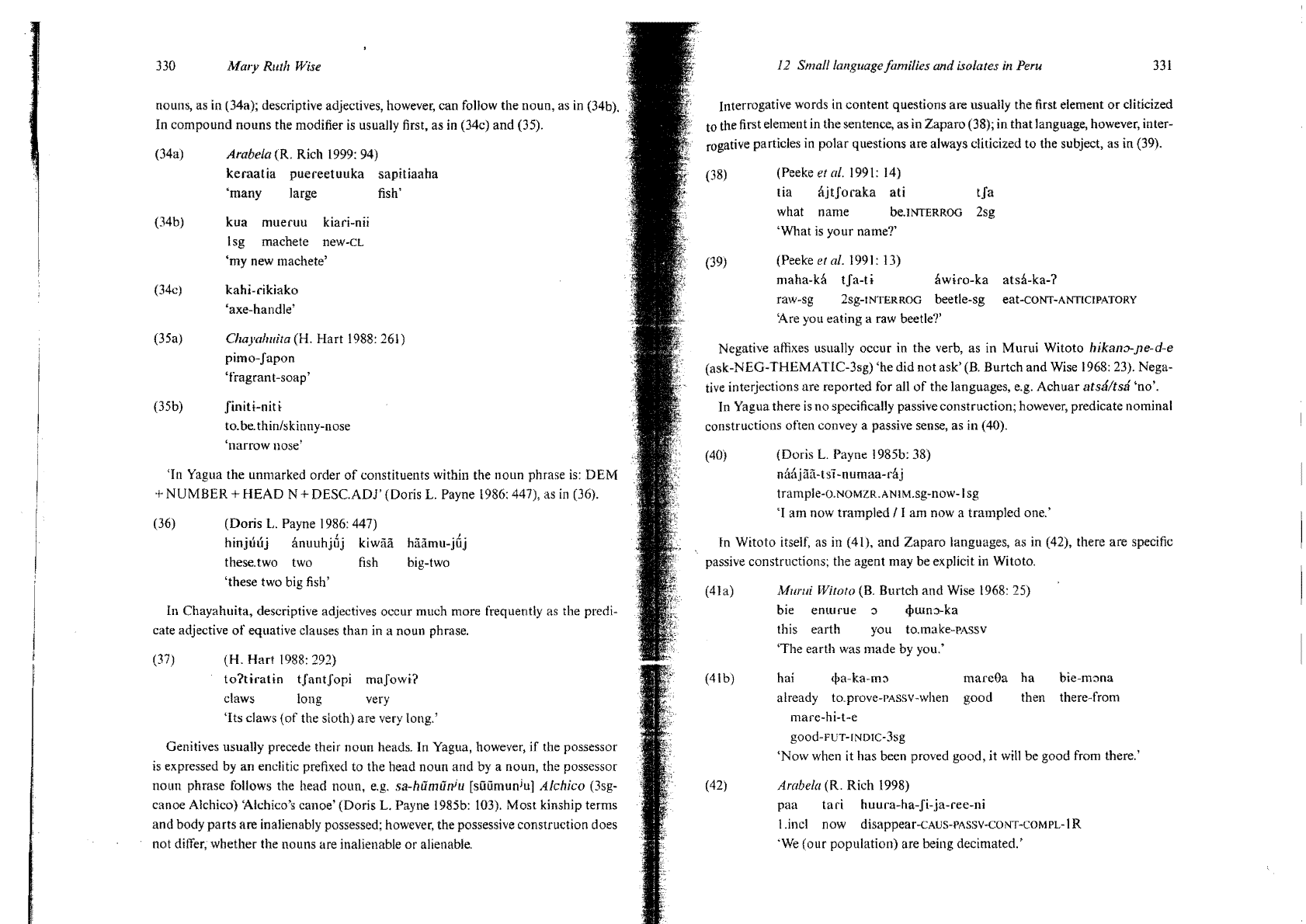
330
Mary
Rlllh Wise
nouns,
as
in (34a); descriptive adjectíves, however,
can
foJlow
the
noun,
as in (34b).
In
comoound
nouns
the
modifier
i5
usually first,
as
in (34c)
and
(35).
Arabela
(R.
Rich 1999: 94)
keraatia
puereetuuka
sapitiaaha
fish'
kua
mueruu
kiari-nii
Isg
machete
neW-CL
'my
new machete'
(34c)
kahi-rikiako
'axe-handle'
(35a)
Clzayallllüa
(H.
Hart
1988: 261)
pimo-Japon
'fragran
t
-soap'
(35b)
finiti-nirt
too
be. thin/skinny-nose
'llarrow
nose'
'In
Yagua the unmarked
order
of
constituents within
the
noun
phrase
is:
DEM
+
NUMBER
+
HEAD
N
+
DESeAD]'
(Dorls
L.
Payne 1986: 447), as
in
(36).
(36)
(Doris
L.
Payne 1986: 447)
hinjúúj
ánuuhjÓj
kiwaa
haamll-jÓj
these.two two fish bíg-two
'these
two big fish'
In
Chayahuita,
descriptive adjectives
occur
much
more
frequently as the predi-
cate adjective
01'
equative c1auses than in a
noun
phrase.
(H.
Hart
1988: 292)
to?tiratin
tJantJopi
maJowi?
c1aws long very
'Its
c1aws
(of
lhe sloth)
are
very long.'
Genitives usually precede their
noun
heads. In however,
ir
the possessor
i8
expressed
by
an
enclitic prefixed
to
the
head
noun
and
by
a
noun,
the possessor
follows the head
noun,
e.g.
sa-húmanJu
[síííímunju]
Alchico
(3sg-
'Alchico's
canoe'
(Dorís
L.
1 985b: 103).
Most
kínship terms
and
body
parts
are
inalienably however, the possessive construction does
not
differ.
whether
the
nouns are inalienable
or
alienable.
12 Small fanguage families and iso/ates
in
Peru
331
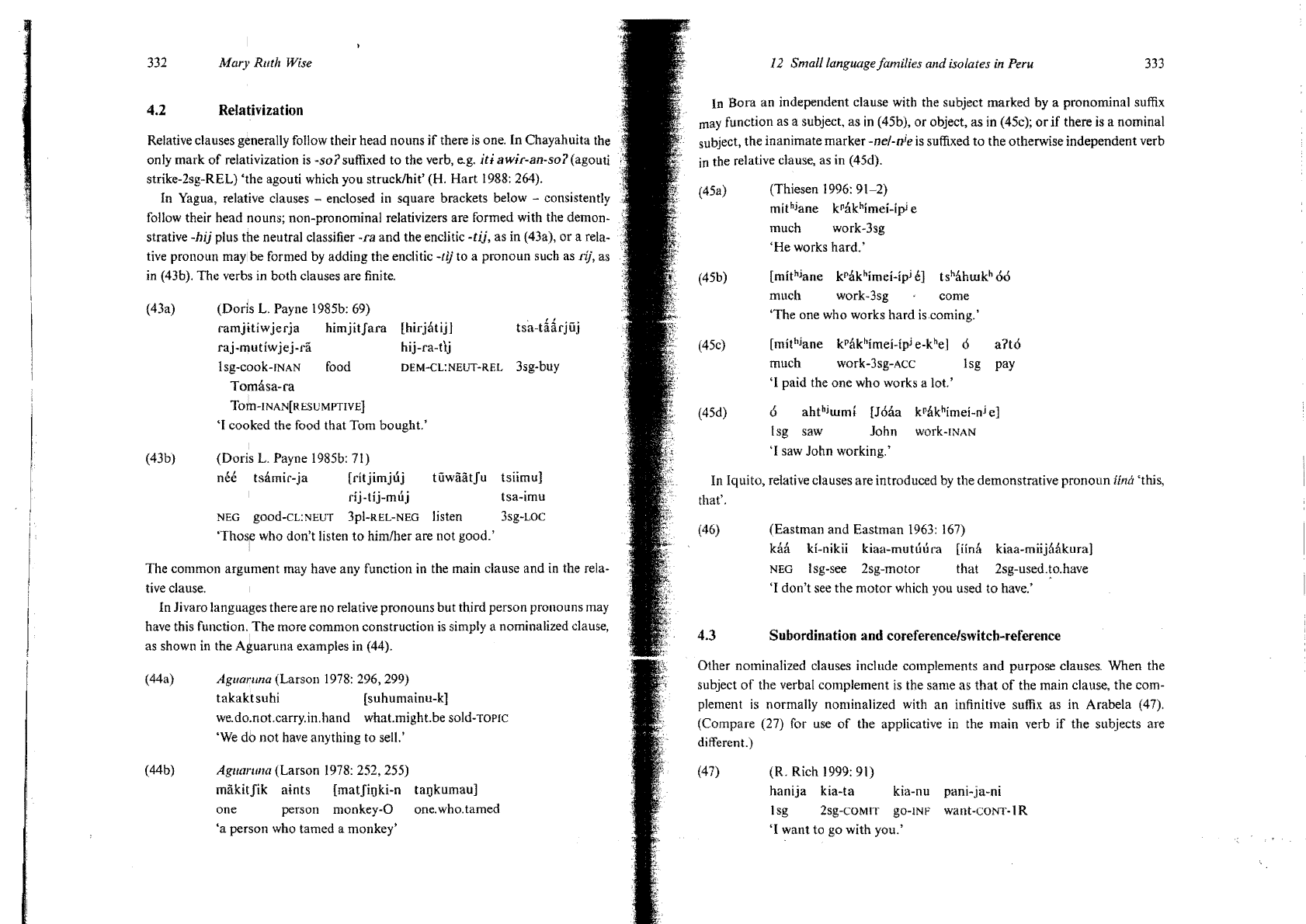
Interrogative words in
content
questions are usually
the
first elernent
or
cliticized
to the first elernent in the sentence, as
in
Zaparo
(38); in
that
language, however, inter-
rogative particJes in
polar
questions
are
always cliticized
to
the
subject, as in
(38)
(Peeke
el
al.
1991:
14)
tia
ájtJoraka
ali
tfa
what
name
be.lNTERROG
2sg
'What
is
your
name?'
(39)
(Peeke
el al.
1991: 13)
maha-ká
tfa-ti:
áwiro-ka
atsá-ka-?
raw-sg
2Sg-INTERROG
beetle-sg
eat-coNT-ANTICIPATORY
'Are
yOll
eating
a raw beetle?'
NCl!atlVe
atnxes uSllally
OCCllr
in the verb,
as
in
Murui
Witoto
IJikall:J-jle-d-e
(ask-NEG-THEMA
TlC-3sg)
'he
did
not
ask'
(B.
Burtch
and
Wise 1968:
23).
Nega-
terjections
are
reported
ror all
of
the languages, e.g.
Achuar
atsá/tsá
'no'.
there is
no
specifically passive
construction;
however, predicate
nominal
constructions
ohen
convey a passive sen
se,
as in
(40).
(Doris
L.
Payne 1985b: 38)
'1
am
now
trarnoled
I
1
am
now a
trarnpled
one.'
tn
Witoto
itself, as in
and
as
in there
are
passive
(4Ia)
MI/mi
Witota
(B.
Burtch
and
Wise 1968:
(4Ib)
(42)
bie
emUflle:J
¡jlwn:l-ka
this eartll you tO.make-PASSv
'The
earth
was
made
bv
you.'
haí ¡jla-ka-m:l
marcOa
ha
bic-m:Jna
already to.prove-PAssv-when
good
then there-from
mare-hi-t-e
gOOd-FUT-INDIC-3sg
'Now
when it
has
been proved
good,
it
will
be
good
from there.'
Arabe/a
(R.
Rich 1998)
paa
tací
huura-ha-Ji-ja-cee-ni
l.incl
now
disappear-cAus-PASSV-CONT-COMPL-I R
'We
(our
population)
are being
decimated.'
333
332
Mary
Ruth
Wise
4.2
Relativization
Relative
c1auses
gene rally follow their head nouns
if
there
is
one.
In
Chayahuita the
only mark
of
relativization
is
-so?
suffixed to the verb,
e.g.
¡ti
awir-an-soí'
(agollti
strike-2sg-REL)
'the
agollti which you strucklhit' (H.
Hart
1988:
264).
In
Yagua, relative
c1auses
- enclosed
in
square brackets below - consistently
follow their head nOllns; non-pronominal relativizers are formed with the demon-
strative
-hij
plus the neutral c1assifier
ora
and the enclitic
-tij,
as in (43a), or a rela-
tive pronoun may
be
formed
by
adding the enc1itic
-tij
to a pronoun such as
ríj,
as
in
(43b). The verbs in both
c1auses
are finite.
(43a)
(Doris
L.
Payne 1985b: 69)
ramjitíwjerja
himjitJara
[hirjátijl
tsa-tHrjuj
raj-mutíwjej-ra
hij-fa-tlj
lsg-cook-INAN rood
DEM-CL:NEUT-REL
3sg-buy
Tomása-ra
Tom-INAN[RESUMPTIVE1
'1
cooked the food that Tom bOllght.'
(43b)
(Dorís
L.
Payne 1985b:
néé tsámir-ja
[rítjimjúj
tuwaatfu
ríj-tíj-múj tsa-imu
NEG
good-CL:NEUT
3pl-REL-NEG
listen
3sg-LOC
'Thos¡::
who don't listen
to
himlher are not good.'
The common argument may have any function
in
the main clause and
in
the rela-
tive
c1ause.
In Jivaro languages there are no relative pronouns but third person pronouns may
have this
fUl1ction.
The more common constructiol1
is
simply a nominalized clause,
as shown
in
the Aguaruna examples in (44).
Aguaruna
1978:
296, 299)
takaktsuhi
[suhumainu-k1
we.do.not.carry.in.hand what.might.be
sold-TOPIC
'We do
not
have anythíng to
seU.'
(44b)
Aguanllla
(Larson
1978:
252, 255)
makitfik
atnts [matfiuki-n taukumau]
one person monkey-O one.who.tamed
'a
person who tamed a monkey'
J2
Smalllanguage ¡amilies and iso/ates
in
Peru
In Bora an independent clause with the subject marked by a pronominal suffix
may
function as a subject, as
in
(45b),
or
object, as in (45c);
or
ir
there
is
a nominal
subject, the inanimate marker
-ne/-nie
is
suffixed to the otherwise independent verb
in
lhe relative
c1ause,
as in (45d).
(45a) (Thiesen
1996:
91-2)
míthiane kPákhímeí-ípi e
much work-3sg
'He
works
hard.'
(45b)
kPákhímeí-ípi él tsháhUlk
h
óó
much work-3sg come
'The one who works hard iscoming.'
(45c)
kPákhímeí-ípJ e-kheJ ó
aí'tó
much work-3sg-Acc
Isg
pay
'1
paid the one who works a lot.'
(45d)
ó
ahthiwml [Jóáa krákhímeí-n
J
e]
Isg saw John
work-INAN
'1
saw
101m
working.'
In
relative c1auses are introduced
by
the demonstrative pronoun
ííná
that'.
(46) (Eastman and Eastman
1963:
167)
káá kí-nikii kiaa-mutúúra [ííná kiaa-miijáákura]
NEG
Isg-see 2sg-motor that
2sg-used.~o.have
'1
don't see the
motor
which you used to have.'
4.3
Subordination
and
coreference/switch~reference
Other nominalized clauses inc\llde complements
and
purpose c\auses. When the
sllbject
of
lhe verbal complement
is
the same as tllat
of
the main c\ause, the com-
plement
is
normally nominalized with an infinitive suffix as in Arabela
(Compare (27) for
use
of
the applicative
in
the main verb
if
the subjects are
different.)
(47)
(R. Rich
1999:
91)
hanija kia-ta kia-nu pani-ja-ni
Isg
2sg-COMIT
gO-INF
want-coNT-1 R
'1
want to go with you.'