
Engelbrecht Andries P. Computational Intelligence: An Introduction
Подождите немного. Документ загружается.


48 3. Supervised Learning Neural Networks
after n
w
iterations if a good solution was not found. The SCG is summarized in
Algorithm 3.4. With reference to the different steps of this algorithm, find detail
below:
• Calculation of second-order information:
σ(t)=
σ
||p(t)||
(3.63)
s(t)=
E
(w(t)+σ(t)p(t)) −E
(w(t))
σ(t)
(3.64)
δ(t)=p(t)
T
s(t) (3.65)
where p(t)
T
is the transpose of vector p(t), and ||p(t)|| is the Euclidean norm.
• Perform scaling:
s(t)+=(λ(t) −
λ(t))p(t) (3.66)
δ(t)+=(λ(t) −
λ(t))||p(t)||
2
(3.67)
• Make the Hessian matrix positive definite:
s(t)=s(t)+
λ(t) − 2
δ(t)
||p(t)||
2
p(t) (3.68)
λ(t)=2
λ(t) − 2
δ(t)
||p(t)||
2
(3.69)
δ(t)=−δ(t)+λ(t)||p(t)||
2
(3.70)
λ(t)=
λ(t) (3.71)
• Calculate the step size:
µ(t)=p(t)
T
r(t) (3.72)
η(t)=
µ(t)
δ(t)
(3.73)
• Calculate the comparison parameter:
∆(t)=
2δ(t)[E(w(t)) −E(w(t)+η(t)p(t))]
µ(t)
2
(3.74)
• Adjust the weights:
w(t +1) = w(t)+η(t)p(t) (3.75)
r(t +1) = −E
(w(t + 1)) (3.76)
• Create a new conjugate direction:
β(t)=
||r(t +1)||
2
− r(t +1)
T
r(t)
µ(t)
(3.77)
p(t +1) = r(t +1)+β(t)p(t) (3.78)

3.3 Functioning of Hidden Units 49
The algorithm restarts each n
w
consecutive epochs for which no reduction in error
could be achieved, at which point the algorithm finds a new direction to search. The
function to calculate the derivative, E
(w)=
∂E
∂w
, computes the derivative of E with
respect to each weight for each of the patterns. The derivatives over all the patterns
are then summed, i.e.
∂E
∂w
i
=
P
T
p=1
∂E
∂w
i,p
(3.79)
where w
i
is a single weight.
3.2.4 LeapFrog Optimization
LeapFrog is an optimization approach based on the physical problem of the motion
of a particle of unit mass in an n-dimensional conservative force field [799, 800]. The
potential energy of the particle in the force field is represented by the function to be
minimized – in the case of NNs, the potential energy is the MSE. The objective is to
conserve the total energy of the particle within the force field, where the total energy
consists of the particle’s potential and kinetic energy. The optimization method sim-
ulates the motion of the particle, and by monitoring the kinetic energy, an interfering
strategy is adapted to appropriately reduce the potential energy. The LeapFrog NN
training algorithm is given in Algorithm 3.5. The reader is referred to [799, 800] for
more information on this approach.
3.2.5 Particle Swarm Optimization
Particle swarm optimization (PSO), which is a stochastic population-based search
method (refer to Chapter 16), can be used to train a NN. In this case, each particle
represents a weight vector, and fitness is evaluated using the MSE function (refer to
Section 16.7 for more detail on NN training using PSO). What should be noted is
that weights and biases are adjusted without using any error signals, or any gradient
information. Weights are also not adjusted per training pattern. The PSO velocity
and position update equations are used to adjust weights and biases, after which the
training set is used to calculate the fitness of a particle (or NN) in P
T
feedforward
passes.
Evolutionary algorithms can also be used in a similar way to train NNs.
3.3 Functioning of Hidden Units
Section 2.3 illustrated the geometry and functioning of a single perceptron. This
section illustrates the tasks of the hidden units in supervised NNs. For this purpose,
consider a standard FFNN consisting of one hidden layer employing SUs. To simplify
visual illustrations, consider the case of two-dimensional input for classification and
one-dimensional input for function approximation.

50 3. Supervised Learning Neural Networks
Algorithm 3.5 LeapFrog Algorithm
Create a random initial solution w(0), and let t = −1;
Let ∆t =0.5,δ =1,m=3,δ
1
=0.001,=10
−5
,i=0,j =2,s=0,p=1;
Compute the initial acceleration a(0) = −∇E(w(0)) and velocity v(0) =
1
2
a(0)∆t;
repeat
t = t +1;
Compute ||∆w(t)|| = ||v(t)||∆t;
if ||∆w(t)|| <δthen
p = p + δ
1
,∆t = p∆t;
end
else
v(t)=δv(t)/(∆t||v(t)||);
end
if s ≥ m then
∆t =∆t/2, s =0;
w(t)=(w(t)+w(t − 1))/2;
v(t)=(v(t)+v (t − 1))/4;
end
w(t +1)=w(t)+v(t)∆t;
repeat
a(t +1)=−∇E(w(t + 1));
v(t +1)=v(t)+a(t +1)∆t;
if a
T
(t +1)a(t) > 0 then
s =0;
end
else
s = s +1,p=1;
end
if ||a(t +1)|| >then
if ||v(t +1)|| > ||v(t)|| then
i =0;
end
else
w(t +2)=(w(t +1)+w(t))/2;
i = i +1;
Perform a restart: if i ≤ j then
v(t +1)=(v(t +1)+v(t))/4;
t = t +1;
end
else
v(t +1)=0,j =1,t= t +1;
end
end
end
until ||v(t +1)|| > ||v(t)||;
until ||a(t +1)|| ≤ ;
Return w(t) as the solution;
3.4 Ensemble Neural Networks 51
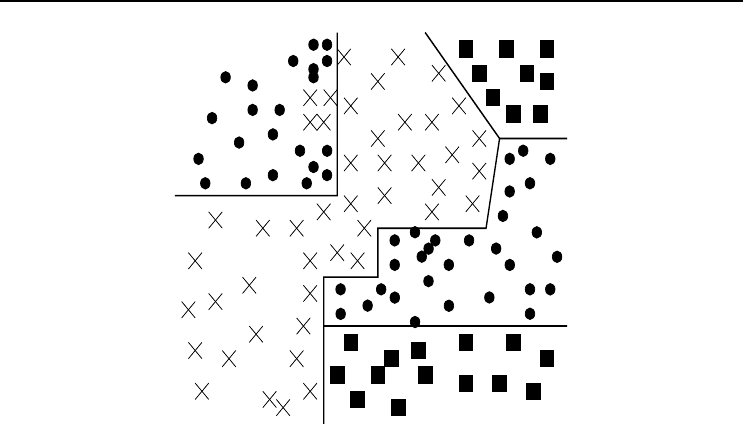
Figure 3.8 Feedforward Neural Network Classification Boundary Illustration
For classification problems, the task of hidden units is to form the decision boundaries
to separate different classes. Figure 3.8 illustrates the boundaries for a three-class
problem. Solid lines represent boundaries. For this artificial problem ten boundaries
exist. Since each hidden unit implements one boundary, ten hidden units are required
to perform the classification as illustrated in the figure. Less hidden units can be used,
but at the cost of an increase in classification error. Also note that in the top left corner
there are misclassifications of class ×, being part of the space for class •. This problem
can be solved by using three additional hidden units to form these boundaries. How
can the number of hidden units be determined without using any prior knowledge
about the input space? This very important issue is dealt with in Chapter 7, where
the relationship between the number of hidden units and performance is investigated.
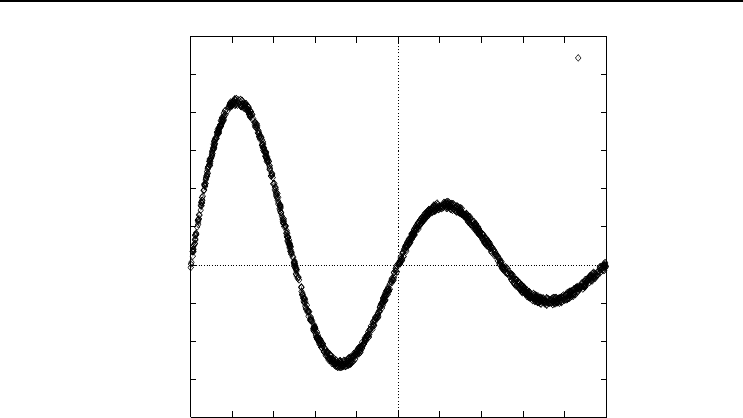
In the case of function approximation, assuming a one-dimensional function as depicted
in Figure 3.9, five hidden units with sigmoid activation functions are required to learn
the function. A sigmoid function is then fitted for each inflection point of the target
function. The number of hidden units is therefore the number of turning points plus
one. In the case of linear activation functions, the hidden units perform the same task.
However, more linear activation functions may be required to learn the function to the
same accuracy as obtained using sigmoid functions.
3.4 Ensemble Neural Networks
Training of NNs starts on randomly selected initial weights. This means that each
time a network is retrained on the same data set, different results can be expected,
since learning starts at different points in the search space; different NNs may disagree,
and make different errors. This problem in NN training prompted the development of
52 3. Supervised Learning Neural Networks
-2
-1.5
-1
-0.5
0
0.5
1
1.5
2
2.5
3
-1 -0.8 -0.6 -0.4 -0.2 0 0.2 0.4 0.6 0.8 1
Output
Input Value
True function
Figure 3.9 Hidden Unit Functioning for Function Approximation
ensemble networks, where the aim is to optimize results through the combination of a
number of individual networks, trained on the same task.
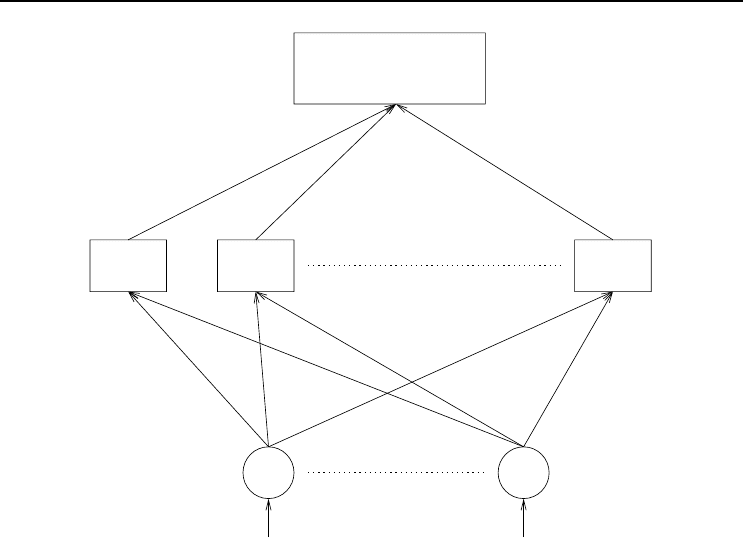
In its most basic form, an ensemble network – as illustrated in Figure 3.10 – consists
of a number of NNs all trained on the same data set, using the same architecture
and learning algorithm. At convergence of the individual NN members, the results of
the different NNs need to be combined to form one, final result. The final result of
an ensemble can be calculated in several ways, of which the following are simple and
efficient approaches:
• Select the NN within the ensemble that provides the best generalization perfor-
mance.
• Take the average over the outputs of all the members of the ensemble.
• Form a linear combination of the outputs of each of the NNs within the ensemble.
In this case a weight, w
n
, is assigned to each network as an indication of the
credibility of that network. The final output of the ensemble is therefore a
weighted sum of the outputs of the individual networks.
The combination of inputs as discussed above is sensible only when there is disagree-
ment among the ensemble members, or if members make their errors on different parts
of the search space.
Several adaptations of the basic ensemble model are of course possible. For example,
instead of having each NN train on the same data set, different data sets can be
used. One such approach is bagging, which is a bootstrap ensemble method that
creates individuals for its ensemble by training each member network on a random
redistribution of the original training set [84]. If the original training set contained
3.4 Ensemble Neural Networks 53
Combination
Output
NN
1
NN
2
NN
N
z
1
z
I
Figure 3.10 Ensemble Neural Network
P
T
patterns, then a data set of P
T
patterns is randomly sampled from the original
training set for each of the ensemble members. This means that patterns may be
duplicated in the member training sets. Also, not all of the patterns in the original
training set will necessarily occur in the member training sets.
Alternatively, the architectures of the different NNs may differ. Even different NN
types can be used. It is also not necessary that each of the members be trained using
the same optimization algorithm.
The above approaches to ensemble networks train individual NNs in parallel, indepen-
dent of one another. Much more can be gained under a cooperative ensemble strategy,
where individual NNs (referred to as agents) exchange their experience and knowledge
during the training process. Research in such cooperative agents is now very active,
and the reader is recommended to read more about these.
One kind of cooperative strategy for ensembles is referred to as boosting [220, 290].
With boosting, members of the ensemble are not trained in parallel. They are trained
sequentially, where already trained members filter patterns into easy and hard pat-
terns. New, untrained members of the ensemble then focus more on the hard patterns
as identified by previously trained networks.
54 3. Supervised Learning Neural Networks
3.5 Assignments
1. Give an expression for o
k,p
for a FFNN with direct connections between the
input and output layer.
2. Why is the term (−1)
v
j,I+1
possible in equation (3.5)?
3. Explain what is meant by the terms overfitting and underfitting. Why is E
V
>
E
V
+ σ
E
V
a valid indication of overfitting?
4. Investigate the following aspects:
(a) Are direct connections between the input and output layers advantageous?
Give experimental results to illustrate.
(b) Compare a FFNN and an Elman RNN trained using GD. Use the following
function as benchmark: z
t
=1+0.3z
t−2
− 1.4z
2
t−1
,withz
1
,z
2
∼ U(−1, 1),
sampled from a uniform distribution in the range (−1, 1).
(c) Compare stochastic learning and batch learning using GD for the function
o
t
= z
t
where z
t
=0.3z
t−6
−0.6z
t−4
+0.5z
t−1
+0.3z
2
t−6
−0.2z
2
t−4
+ ζ
t
,and
z
t
∼ U(−1, 1) for t =1, ···, 10, and ζ
t
∼ N(0, 0.05).
(d) Compare GD and SCG on any classification problem from the
UCI machine learning repository at http://www.ics.uci.edu/
~mlearn/MLRepository.html.
(e) Show if PSO performs better than GD in training a FFNN.
5. Assume that gradient descent is used as the optimization algorithm, and derive
learning equations for the Elman SRNN, the Jordan SRNN, TDNN and FLNN.
6. Explain how a SRNN learns the temporal characteristics of data.
7. Show how a FLNN can be used to fit a polynomial through data points given in
a training set.
8. Explain why bias for only the output units of a PUNN, as discussed in this
chapter, is sufficient. In other words, the PUs do not have a bias. What will be
the effect if a bias is included in the PUs?
9. Explain why the function f(z
1
,z
2
)=z
3
1
z
7
2
−0.5z
6
1
requires only two PUs, if it is
assumed that PUs are only used in the hidden layer, with linear activations in
both the hidden and output layers.
10. Assume that a PUNN with PUs in the hidden layer, SUs in that output layer,
and linear activation functions in all layers, is used to approximate a polynomial.
Explain why the minimal number of hidden units is simply the total number of
non-constant, unique terms in the polynomial.
11. What is the main requirement for activation and error functions if gradient
descent is used to train supervised neural networks?
12. What is the main advantage of using recurrent neural networks instead of feed-
forward neural networks?
13. What is the main advantage in using PUs instead of SUs?
14. Propose a way in which a NN can learn a functional mapping and its derivative.
15. Show that the PUNN as given in Section 3.1.3 implements a polynomial approx-
imation.

Chapter 4
Unsupervised Learning
Neural Networks
An important feature of NNs is their ability to learn from their environment. Chapter 3
covered NN types that learned under the guidance of a supervisor or teacher. The
supervisor presents the NN learner with an input pattern and a desired response.
Supervised learning NNs then try to learn the functional mapping between the input
and desired response vectors. In contrast to supervised learning, the objective of
unsupervised learning is to discover patterns or features in the input data with no
help from a teacher. This chapter deals with the unsupervised learning paradigm.
Section 4.1 presents a short background on unsupervised learning. Hebbian learning
is presented in Section 4.2, while Section 4.3 covers principal component learning,
Section 4.4 covers the learning vector quantizer version I, and Section 4.5 discusses
self-organizing feature maps.
4.1 Background
Aristotle observed that human memory has the ability to connect items (e.g. objects,
feelings and ideas) that are similar, contradictory, that occur in close proximity, or
in succession [473]. The patterns that we associate may be of the same or different
types. For example, a photo of the sea may bring associated thoughts of happiness, or
smelling a specific fragrance may be associated with a certain feeling, memory or visual
image. Also, the ability to reproduce the pitch corresponding to a note, irrespective of
the form of the note, is an example of the pattern association behavior of the human
brain.
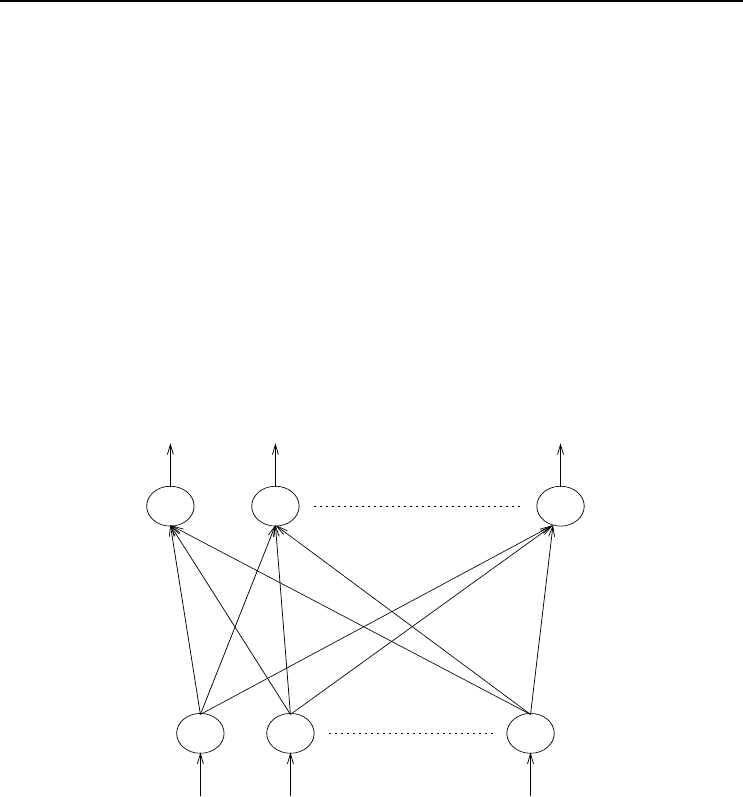
Artificial neural networks have been developed to model the pattern association abil-
ity of the human brain. These networks are referred to as associative memory NNs.
Associative memory NNs are usually two-layer NNs, where the objective is to adjust
the weights such that the network can store a set of pattern associations – without
any external help from a teacher. The development of these associative memory NNs
is mainly inspired from studies of the visual and auditory cortex of mammalian or-
ganisms, such as the bat. These artificial NNs are based on the fact that parts of the
Computational Intelligence: An Introduction, Second Edition A.P. Engelbrecht
c
2007 John Wiley & Sons, Ltd
55
56 4. Unsupervised Learning Neural Networks
brain are organized such that different sensory inputs are represented by topologically
ordered computational maps. The networks form a topographic map of the input
patterns, where the coordinates of the neurons correspond to intrinsic features of the
input patterns.
An additional feature modeled with associative memory NNs is to preserve old infor-
mation as new information becomes available. In contrast, supervised learning NNs
have to retrain on all the information when new data becomes available; if not, super-
vised networks tend to focus on the new information, forgetting what the network has
already learned.
Unsupervised learning NNs are functions that map an input pattern to an associated
target pattern, i.e.
f
NN
: R
I
→ R
K
(4.1)
as illustrated in Figure 4.1. The single weight matrix determines the mapping from
the input vector z to the output vector o.
o
1
o
2
o
K
u
2I
u
K1
u
K2
u
KI
z
1
z
2
z
I
Figure 4.1 Unsupervised Neural Network
4.2 Hebbian Learning Rule
The Hebbian learning rule, named after the neuropsychologist Hebb, is the oldest and
simplest learning rule. With Hebbian learning [203], weight values are adjusted based
on the correlation of neuron activation values. The motivation of this approach is
from Hebb’s hypothesis that the ability of a neuron to fire is based on that neuron’s
ability to cause other neurons connected to it to fire. In such cases the weight between
the two correlated neurons is strengthened (or increased). Using the notation from

4.2 Hebbian Learning Rule 57
Figure 4.1, the change in weight at time step t is given as
∆u
ki
(t)=ηo
k,p
z
i,p
(4.2)
Weights are then updated using
u
ki
(t)=u
ki
(t − 1) + ∆u
ki
(t) (4.3)
where η is the learning rate.
From equation (4.2), the adjustment of weight values is larger for those input-output
pairs for which the input value has a greater effect on the output values.
The Hebbian learning rule is summarized in Algorithm 4.1. The algorithm terminates
when there is no significant change in weight values, or when a specified number of
epochs has been exceeded.
Algorithm 4.1 Hebbian Learning Algorithm
Initialize all weights such that u
ki
=0, ∀i =1, ···,I and ∀k =1, ···,K;
while stopping condition(s) not true do
for each input pattern z
p
do
Compute the corresponding output vector o
p
;
end
Adjust the weights using equation (4.3);
end
A problem with Hebbian learning is that repeated presentation of input patterns leads
to an exponential growth in weight values, driving the weights into saturation. To
prevent saturation, a limit is posed on the increase in weight values. One type of limit
is to introduce a nonlinear forgetting factor:
∆u
ki
(t)=ηo
k,p
z
i,p
− γo
k,p
u
ki
(t − 1) (4.4)
where γ is a positive constant, or equivalently,
∆u
ki
(t)=γo
k,p
[βz
i,p
− u
ki
(t − 1)] (4.5)
with β = η/γ. Equation (4.5) implies that inputs for which z
i,p
<u
ki
(t − 1)/β have
their corresponding weights u
ki
decreased by a value proportional to the output value
o
k,p
.Whenz
i,p
>u
ki
(t − 1)/β, weight u
ki
is increased proportional to o
k,p
.
Sejnowski proposed another way to formulate Hebb’s postulate, using the covariance
correlation of the neuron activation values [773]:
∆u
ki
(t)=η[(z
i,p
− z
i
)(o
k,p
− o
k
)] (4.6)
with
z
i
=
P
T
p=1
z
i,p
/P (4.7)