
Enns R.H. Computer Algebra Recipes for Mathematical Physics
Подождите немного. Документ загружается.

1.1. LINEAR ODES WITH CONSTANT COEFFICIENTS 27
X := 1 +
3
32
√
2sin(2
√
2 t)+
1
8
sin(2 t)+
t
24
Y := 2 −
3
32
√
2sin(2
√
2 t)+
t
24
Z := 3 +
3
32
√
2sin(2
√
2 t) −
1
8
sin(2 t)+
t
24
The positions of the three coaches are now plotted in Figure 1.4 over the interval
t= 0 to 20, the linestyles 1, 2, 3 generating solid, dotted, and dashed curves.
>
plot([X,Y,Z],t=0..20,color=[red,blue,green],linestyle=
[1,2,3],thickness=2,tickmarks=[3,3],labels=["t","X,Y,Z"]);
1
2
3
4
X,Y,Z
01020
t
Figure 1.4: Positions of the three train coaches as a function of time.
The motion of the three coaches (represented by size 20 red boxes) is now
animated and can be observed by executing the following command line.
>
animate({[X,0],[Y,0],[Z,0]},t=0..100,frames=200,style=
point,symbol=box,symbolsize=20,view=[0..8,-0.1..0.1],
tickmarks=[3,2],labels=["x"," "]);
You can explore other possible motions by changing the parameter values and
initial conditions. The time range and view may have to be altered.
1.1.5 “Resonances”, A Recipe by I. M. Curious
Training is everything. The peach was once a bitter almond;
cauliflower is nothing but cabbage with a college education.
Mark Twain, Pudd’nhead Wilson, ch. 5, (1894)
Over the years I have been fortunate to have one or more students in each
mathematical physics class who stood out due to the quality of their work and
their innate curiosity about the subject matter. As a representative of this elite

28 CHAPTER 1. LINEAR ODES OF PHYSICS
group, let me introduce Ms. I. M. Curious who will discuss in her own words the
elegant and thorough computer algebra solution that she generated in solving
the following problem involving a familiar nonhomogeneous LODE.
A mechanical system (of unit mass) experiences a Stokes’s law drag force
F
Stokes
= −2 α ˙x, a Hooke’s law restoring force F
Hooke
= −ω
2
x, and a driving
force F
Drive
= f cos(Ω t + δ). Here α is a positive constant, ω the natural
frequency, f the force amplitude, Ω the driving frequency, and δ a phase angle.
(a) Obtain the solution of the resulting LODE for α<ω (underdamping),
subject to the initial condition x(0) = X ,˙x(0) = V . Discuss the method
used by Maple to solve the LODE and the structure of the solution.
(b) Derive an expression for the absolute value A of the steady-state ampli-
tude as a function of Ω. Determine the resonant frequency Ω
r
at which
A has its maximum value A
max
and evaluate A
max
.
(c) Taking X = −1, V =2, ω =1, α =1/5, Ω = 3, f =5, and δ = 0, determine
x(t)andv(t)= ˙x(t) and plot the results. Approximately how long does
it take for steady-state to prevail? Evaluate Ω
r
and plot the resonance
curves A vs. Ω for some different f values.
And here is I. M. to discuss her solution.
“After loading the plots package, infolevel[dsolve]:=5 is entered so as
to provide maximum information on Maple’s ODE solving method.
>
restart: with(plots): infolevel[dsolve]:=5:
To save on later typing, I introduce the following alias command. When a,
w, W, d, Wr,andAm are subsequently entered, the symbols α, ω,Ω,δ,Ω
r
,and
A
max
will be respectively produced in the output.
>
alias(alpha=a,omega=w,Omega=W,delta=d,Omega[r]=Wr,A[max]=Am);
α, ω, Ω,δ,Ω
r
,A
max
The Stokes, Hooke’s law, and driving forces are entered,
>
F[Stokes]:=-2*a*diff(x(t),t); F[Hooke]:=-wˆ2*x(t);
F[Drive]:=f*cos(W*t+d);
F
Stokes
:= −2 α (
d
dt
x(t)) F
Hooke
:= −ω
2
x(t) F
Drive
:= f cos(Ω t + δ)
which are automatically substituted into Newton’s second law in ode .
>
ode:=diff(x(t),t,t)-F[Stokes]-F[Hooke]=F[Drive];
ode := (
d
2
dt
2
x(t)) + 2 α (
d
dt
x(t)) + ω
2
x(t)=f cos(Ω t + δ)
Assuming that α>0, ω>0, and α<ω, ode is solved for x(t) subject to the
initial conditions and the rhs of the result taken. The list of mathematical
methods tried are given in the output, along with the solution labeled x1 .
>
x1:=rhs(dsolve({ode,x(0)=X,D(x)(0)=V},x(t)))
assuming(a>0,w>0,a<w);
Methods for second order ODEs:

1.1. LINEAR ODES WITH CONSTANT COEFFICIENTS 29
— Trying classification methods —
trying a quadrature
trying high order exact linear fully integrable
trying differential order: 2; linear nonhomogeneous with symmetry [0,1]
trying a double symmetry of the form [xi=0, eta=F(x)]
Try solving first the homogeneous part of the ODE
−> Tackling the linear ODE “as given”:
checking if the LODE has constant coefficients
<− constant coefficients successful
<− successful solving of the linear ODE “as given”
−> Determining now a particular solution to the nonhomogeneous ODE
building a particular solution using variation of parameters
<− solving first the homogeneous part of the ODE successful
x1 := e
(−αt)
sin(
√
ω
2
−α
2
t)(−2 Vω
2
Ω
2
+Ω
4
αX + V Ω
4
− Ω
3
f sin(δ)
+4V Ω
2
α
2
− Ω
2
fαcos(δ) − αω
2
f cos(δ) − 2Ω
2
αω
2
X
+Ωf sin(δ) ω
2
+4Ω
2
α
3
X − 2Ωf sin(δ) α
2
+ αω
4
X + Vω
4
)
/(
√
ω
2
− α
2
(ω
4
− 2 ω
2
Ω
2
+4Ω
2
α
2
+Ω
4
))
+ e
(−αt)
cos(
√
ω
2
−α
2
t)(f cos(δ)Ω
2
− 2 fαΩsin(δ) − f cos(δ) ω
2
+Xω
4
− 2 Xω
2
Ω
2
+4X Ω
2
α
2
+ X Ω
4
)/(ω
4
− 2 ω
2
Ω
2
+4Ω
2
α
2
+Ω
4
)
+
((ω
2
− Ω
2
) cos(Ω t + δ)+2α Ωsin(Ωt + δ)) f
Ω
4
+(−2 ω
2
+4α
2
)Ω
2
+ ω
4
Maple has successfully solved the ODE, a task I would not have wished to do
by hand. It has recognized that ode is a second order nonhomogeneous LODE
with the corresponding homogeneous equation having constant coefficients. It
has solved ode using the method of variation of parameters. The solution x1
is made up of two parts, the transient terms involving the exponentials which
vanish (since α>0) as t →∞, and the remaining steady-state contribution
which survives in this limit. Note that the steady-state part doesn’t depend on
the initial conditions. I will now extract the steady-state solution xss from x1
by removing the terms in x1 which have e
−αt
.
>
xss:=remove(has,x1,exp(-a*t));
xss :=
((ω
2
− Ω
2
) cos(Ω t + δ)+2α Ωsin(Ωt + δ)) f
Ω
4
+(−2 ω
2
+4α
2
)Ω
2
+ ω
4
The amplitude A of the steady-state solution can be obtained as follows. The
amplitude corresponds to maximum displacement of the oscillator at which time
the velocity is zero. I now solve for a time T at which this occurs.
>
T:=solve(diff(xss,t)=0,t);
T :=
−δ + arctan(
2 α Ω
ω
2
− Ω
2
)
Ω
A is then obtained by evaluating xss at t =T and simplifying with the symbolic

30 CHAPTER 1. LINEAR ODES OF PHYSICS
option which picks a particular solution branch of the square root, the sign of
which can be either plus or minus. The magnitude of A then follows on taking
the absolute value of the result. The answer agrees with that found in Fowles
and Cassiday[FC99].
>
A:=simplify(eval(xss,t=T),symbolic): Amag:=abs(A);
Amag :=
f
√
ω
4
− 2 ω
2
Ω
2
+4Ω
2
α
2
+Ω
4
To find the resonance frequency, Amag is differentiated with respect to Ω, set
equal to zero, and the result solved for the frequency.
>
sol:=solve(diff(Amag,W)=0,W);
sol := 0,
√
ω
2
− 2 α
2
, −
√
ω
2
− 2 α
2
The resonance frequency Ω
r
must correspond to the non-zero positive square
root solution. Therefore, the second answer is selected in sol. The maximum
amplitude A
max
is then obtained by evaluating Amag at Ω = Ω
r
and again
simplifying with the symbolic option.
>
Wr:=sol[2]; Am:=simplify(eval(Amag,W=Wr),symbolic);
Ω
r
:=
√
ω
2
− 2 α
2
A
max
:=
1
2
f
α
√
ω
2
− α
2
To answer part (c) of the problem, the given parameter values are entered.
>
X:=-1: V:=2: w:=1: a:=1/5: W:=3: f:=5: d:=0:
The displacement X1 and velocity V1 are calculated, the radical expressions
being simplified with the radsimp command.
>
X1:=radsimp(x1); V1:=radsimp(diff(x1,t));
X1 :=
6737
9816
e
(−
t
5
)
sin(
2
√
6 t
5
)
√
6 −
159
409
e
(−
t
5
)
cos(
2
√
6 t
5
)
−
250
409
cos(3 t)+
75
818
sin(3 t)
V1 :=
179
9816
e
(−
t
5
)
sin(
2
√
6 t
5
)
√
6+
1411
818
e
(−
t
5
)
cos(
2
√
6 t
5
)
+
750
409
sin(3 t)+
225
818
cos(3 t)
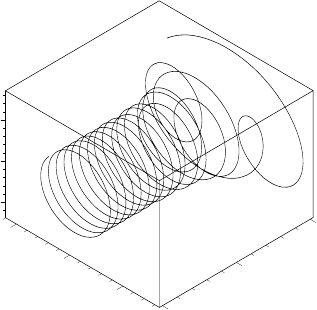
It was not specified how the results are to be plotted, so I will create a 3-
dimensional picture in gr1 of X1 vs. V1 vs. t by using the spacecurve com-
mand. The time range is taken to be t = 0 to 40, 1000 plotting points are
selected, and the plot is enclosed in a viewing box.
>
gr1:=spacecurve({[t,X1,V1]},t=0..40,numpoints=1000,
thickness=2,axes=box,labels=["t","x","v"]):
So that the starting point in the 3-dimensional trajectory can be easily identi-
1.1. LINEAR ODES WITH CONSTANT COEFFICIENTS 31
fied, the textplot3d command is used in gr2 to place the word start (colored
red) in the vicinity of the starting point.
>
gr2:=textplot3d([[0,X-0.15,V,"start"]],color=red):
The graphs are superimposed with the display command. The resulting pic-
ture (Figure 1.5) is enclosed in a viewing box which may be rotated by clicking
on the computer plot and dragging with the mouse. In the upper left-hand cor-
ner of the computer screen, a small window indicates the angular coordinates
of the viewing box. Here the orientation of the box is set to be (45
◦
,45
◦
).
>
display({gr1,gr2},orientation=[45,45],tickmarks=[3,3,3]);
start
0
20
40
t
–1
0
1
x
–2
0
2
v
Figure 1.5: Space curve showing X1 vs. V1 vs. t.
The wild gyrations seen in Figure 1.5 for small t are associated with the tran-
sient, while steady-state corresponds to the uniform, cyclic behavior at larger
t. To obtain an estimate of the time beyond which steady-state prevails, the
orientation of the viewing box can be changed to (-90
◦
,0
◦
)soastoviewX1
vs. t. Steady-state prevails for t greater than about 25 time units.
The resonance frequency is then evaluated in W1 and the value A1 of the
absolute amplitude calculated at this frequency.
>
W1:=evalf(Wr); A1:=evalf(Am);
W1 := 0.9591663048 A1 := 12.75775908
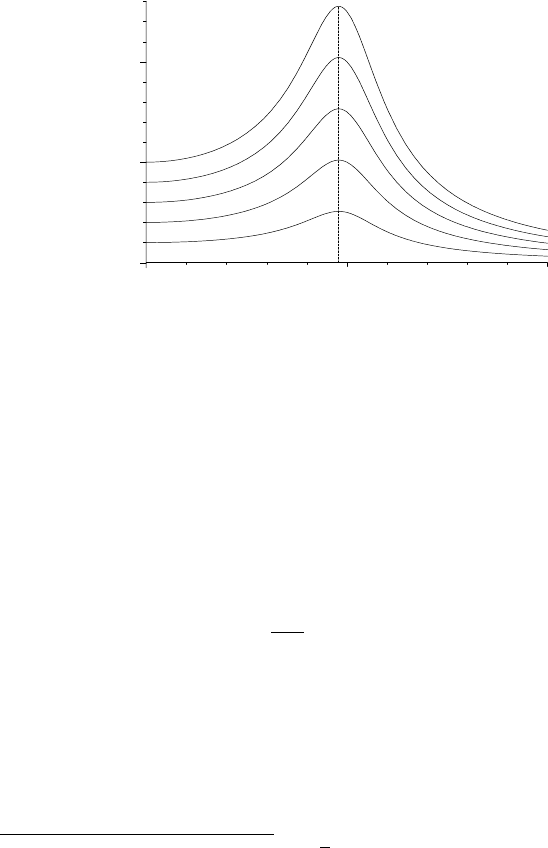
The resonance frequency of about 0.96 is slightly less than the natural frequency
ω = 1. To locate the resonance frequency on the graph of the resonance curves,
I will plot a thick, vertical, dashed, blue line of height A1 at W1 in L.
>
L:=plot([[W1,0],[W1,A1]],color=blue,thickness=2,linestyle=3):
To free the driving frequency and the force amplitude from their previously
assigned values, they are now unassigned.
>
unassign(’W’,’f’):
32 CHAPTER 1. LINEAR ODES OF PHYSICS
A functional operator pl is created for plotting Amag vs. Ω for different f
values over the frequency range Ω = 0 to 2 ω.
>
pl:=i->plot(eval(Amag,f=i),W=0..2*w,thickness=2):
Making use of the sequence command, resonance curves are generated for f =
1, 2, 3, 4, 5 and displayed along with L in Figure 1.6. As I expected, the resonance
curves agree with those drawn in standard texts.”
>
display({L,seq(pl(i),i=1..5)},tickmarks=[2,3],labels=[W,"A"]);
0
5
10
A
12
Omega
Figure 1.6: Resonance curves for f =1 (bottom curve) to f =5 (top).
1.1.6 Mr. Dirac’s Famous Function
The man with a new idea is a crank until the idea succeeds.
Mark Twain, Following the Equator, ch. 32, (1897).
Consider a very long uniform horizontal beam glued to an elastic foundation,
the foundation exerting a Hooke’s law restoring force. Under the influence of
a steady point force of magnitude F exerted at x = 0, the static displacement
ψ(x) of the beam is governed by the nonhomogeneous LODE [Hil57],
YI
d
4
ψ
dx
4
+ Kψ= Fδ(x) (1.3)
where Y is Young’s modulus, I the moment of inertia of the beam’s cross-
section about a horizontal axis, K the spring constant, and δ(x)theDirac delta
function. The delta function (δ function) is defined by
δ(x)=0,x=0; δ(x)=∞,x=0;
β
−α
δ(x) dx =1, (α, β > 0). (1.4)
The δ function should be regarded as the limit of, e.g, a Gaussian function
5
which is made progressively taller and narrower in such a way that the area
5
For the Gaussian, δ(x)= lim
A→∞
(A/
√
π) e
−A
2
x
2
. The choice of functions is not unique.

1.1. LINEAR ODES WITH CONSTANT COEFFICIENTS 33
under the curve remains equal to 1. Changing the argument of the δ-function
from x to x − ζ shifts the location of the δ-function from x=0 to x=ζ.
It should be noted that the δ-function has the dimensions x
−1
. It has a
number of properties, the most important of which is the “selection” property.
If F (x) is a smooth function (not another δ-function), then
ζ+β
ζ−α
F (x) δ(x − ζ) dx = F (ζ), (α, β > 0). (1.5)
The Dirac delta function concept may be generalized to higher dimensions, e.g.,
δ( r ) ≡ δ(x) δ(y) δ(z) is a 3-dimensional δ-function located at x =y = z =0.
A solution of a linear ODE which has a delta function appearing in the
nonhomogeneous term is called a Green function. The goal of the following
recipe is to determine the static displacement of the beam due to the point
force, i.e., the Green function, for Equation (1.3) and plot it.
In the ODE (1.3), the moment of inertia I appears. This is a protected
symbol in Maple, representing
√
−1. Since I is a commonly used symbol in
physics, it is often desirable to unprotect it. The following interface command
is used to let j =
√
−1, thus freeing up I.
>
restart: interface(imaginaryunit=j):
The LODE (1.3) is inputted, the command Dirac(x) being used to enter δ(x).
>
ode:=Y*I*diff(psi(x),x$4)+K*psi(x)=F*Dirac(x);
ode := YI(
d
4
dx
4
ψ(x)) + Kψ(x)=F Dirac(x)
The ODE ode can be simplified by introducing the parameter α =(YI/K)
1/4
and letting ψ(x)=(F/K) G(x), where G(x) is defined to be the Green function.
The transformations are substituted into ode , producing ode2 ,
>
ode2:=subs({Y=alphaˆ4*K/I,psi(x)=F*G(x)/K},ode);
ode2 := α
4
K (
∂
4
∂x
4
(
F G(x)
K
)) + F G(x)=F Dirac(x)
which is then divided by F in ode3 , and the result expanded.
>
ode3:=expand(ode2/F);
ode3 := α
4
(
d
4
dx
4
G(x)) + G(x)=Dirac(x)
For x<0andx>0, the rhs of ode3 is equal to zero. The general solution of
ode3 is obtained, assuming that x<0.
>
sol:=rhs(dsolve(ode3,G(x))) assuming x<0;
sol :=
C1 e
(
(1/2−1/2 j)
√
2 x
α
)
+
C2 e
(
(−1/2−1/2 j)
√
2 x
α
)
+
C3 e
(
(−1/2+1/2 j)
√
2 x
α
)
+
C4 e
(
(1/2+1/2 j)
√
2 x
α
)
Clearly, the general solution for x> 0 will be of a similar structure. Let’s look
at the region to the left of the origin, assigning this portion of G the name GL.
Since the beam is very long, little error is committed by taking the beam to be

34 CHAPTER 1. LINEAR ODES OF PHYSICS
of infinite length. Physically, the displacement of the beam from equilibrium,
and therefore GL,shouldgotozeroasx →−∞. To satisfy this asymptotic
boundary condition, only the two exponentials which have (1/2 − 1/2 j)and
(1/2+1/2 j) in the exponents should be kept. The other two exponentials
involving (−1/2 −1/2 j)and(−1/2+1/2 j) diverge as x →−∞. The following
command selects the two desired exponential terms to keep in GL.
>
GL:=select(has,sol,{1/2-j/2,1/2+j/2});
GL :=
C1 e
(
(1/2−1/2 j)
√
2 x
α
)
+
C4 e
(
(1/2+1/2 j)
√
2 x
α
)
Similarly, applying the condition G→0asx→∞,theselect command is used
to obtain the form GR of the Green function to the right of the origin.
>
GR:=select(has,sol,{-1/2-j/2,-1/2+j/2});
GR :=
C2 e
(
(−1/2−1/2 j)
√
2 x
α
)
+
C3 e
(
(−1/2+1/2 j)
√
2 x
α
)
The four constants must now be evaluated. Since the displacement is physically
continuous at the origin, the condition GR−GL=0 at x=0 is entered in eq
0
.
>
eq[0]:=simplify(eval(GR-GL,x=0))=0;
eq
0
:= C2 + C3 − C1 − C4 =0
An operator f is formed to simplify the nth derivative of the difference GR − GL
evaluated at x= 0. Both n and the difference s must be given.
>
f:=(n,s)->simplify(alphaˆn*(eval(diff(GR-GL,x$n),x=0)=s));
f := (n, s) → simplify(α
n
((
∂
n
∂x
n
(GR −GL))
x =0
= s))
For n =1 and 2, s =0, i.e., the first and second derivatives of G are continuous at
x= 0. The third derivative (n=3) is discontinuous at x=0, however. Mentally
integrating ode3 from the left to the right of the δ function yields s =1/α
4
.
Making use of these results and f, the remaining three conditions are entered.
>
eq[1]:=sqrt(2)*f(1,0); eq[2]:=f(2,0);
eq[3]:=sqrt(2)*f(3,1/alphaˆ 4);
eq
1
:= −
C2 − C2 j + C3 j − C3 +
C1 j − C1 − C4 − C4 j =0
eq
2
:= ( C2 − C3 + C1 − C4 ) j =0
eq
3
:= − C2 j + C2 + C3 + C3 j + C1 + C1 j − C4 j + C4 =
√
2
α
The set of four equations are solved for the four constants,
>
sol2:=solve({seq(eq[n],n=0..3)},{_C1,_C2,_C3,_C4});
sol2 :=
C1 =
(
1
8
−
1
8
j)
√
2
α
,
C2 =
(
1
8
+
1
8
j)
√
2
α
,
C4 =
(
1
8
+
1
8
j)
√
2
α
,
C3 =
(
1
8
−
1
8
j)
√
2
α
1.1. LINEAR ODES WITH CONSTANT COEFFICIENTS 35
and the solution sol2 assigned. The constants are automatically substituted into
GL and GR, which are put into real forms by applying the evalc command.
>
assign(sol2): GL:=evalc(GL); GR:=evalc(GR);
GL :=
1
4
√
2 e
(
√
2 x
2 α
)
cos(
√
2 x
2 α
)
α
−
1
4
√
2 e
(
√
2 x
2 α
)
sin(
√
2 x
2 α
)
α
GR :=
1
4
√
2 e
(−
√
2 x
2 α
)
cos(
√
2 x
2 α
)
α
+
1
4
√
2 e
(−
√
2 x
2 α
)
sin(
√
2 x
2 α
)
α
Noting that there is a symmetry in the two forms (replacing x with −x in
GL yields GR), the Green function can be put into a more compact form by
replacing x by its absolute value, |x|,inGR, then factoring, and relabeling the
result as G. The static displacement of the beam is then ψ(x)=(f/K) G(x).
>
G:=factor(subs(x=abs(x),GR));
G :=
1
4
√
2 e
(−1/2
√
2 |x|
α
)
(cos(
1
2
√
2 |x|
α
)+sin(
1
2
√
2 |x|
α
))
α
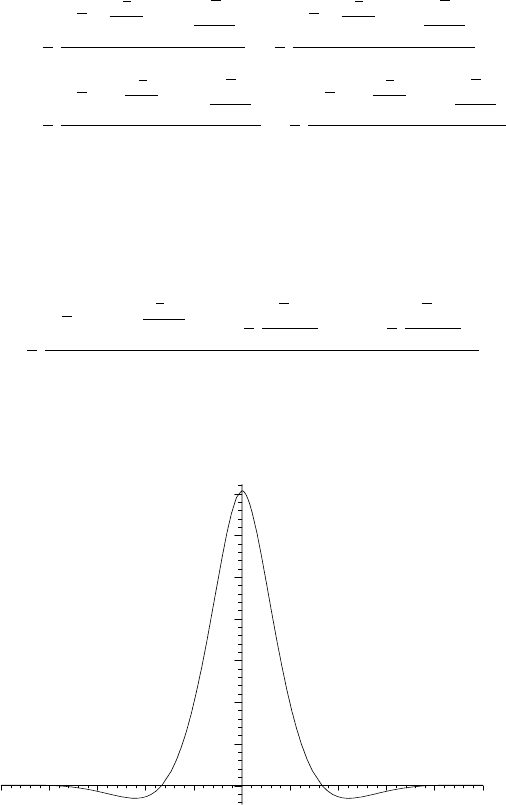
The Green function G is now plotted for the representative value α =1.
>
plot(eval(G,alpha=1),x=-10..10,thickness=2,
labels=["x","G"]);
0
0.35
G
–10
x
10
Figure 1.7: Green function G for the infinite beam.
The result is shown in Figure 1.7. As expected, G and therefore the beam
displacement is localized near the origin where the point force is applied.

36 CHAPTER 1. LINEAR ODES OF PHYSICS
1.2 Linear ODEs with Variable Coefficients
In this section, linear ODEs with variable coefficients are considered. Our at-
tention will be focused on the second-order Sturm–Liouville (S-L) equation,
d
dx
p(x)
dy
dx
− q(x) y + λw(x) y =0, (1.6)
where λ is a real parameter while p(x), q(x), w(x) are real functions and w(x)
is taken to be non-negative over the range x = a to b of interest. The S-L
equation, and its nonhomogeneous counterpart, plays a very important role in
the mathematical analysis of many physical problems, particularly for boundary
valueproblemswherey or its first derivative vanish at a and b. Inthiscasethe
y ’sarereferredtoastheeigenfunctions and the λ ’s as the eigenvalues.For
certain choices of p, q, w,andλ, the general S-L equation reduces to specific
“well-known” LODEs such as Bessel’s equation, Legendre’s equation, Hermite’s
equation, etc. The standard approach to solving these equations is to seek an
infinite power series solution. In some cases (e.g., for Bessel’s equation) the
solution remains as an infinite series, while in other cases the infinite series
have to be truncated (e.g., for Legendre’s and Hermite’s equations) to finite
polynomials to avoid divergence problems for large x. In either case, these
solutions to special forms of the S-L equation are referred to as special functions
(e.g., Bessel functions, Legendre functions (polynomials), etc.). The detailed
series derivation of these special functions will be postponed until Chapter 2. In
this section, we shall be content to see what Maple reveals about some of these
special functions and how physical problems involving these functions can be
easily dealt with. You will encounter many more members of the S-L “family”
of special functions as you progress through the book. For example, in the
Entrees you will see that special functions play an extremely important role in
the solutions of linear PDEs such as the wave and diffusion equations because
these equations can be “separated” into systems of S-L ODEs.
1.2.1 Introducing the Sturm–Liouville Family
My books are water; those of the great geniuses is wine.
Everybody drinks water.
Mark Twain, Mark Twains Notebooks and Journals, Notebook 26, (1887)
Jennifer, a young mathematician at the Metropolis Institute of Technology
(MIT) and a firm believer in using computer algebra to teach applied math-
ematics to engineers and physicists, has kindly consented to provide us with
some of the computer algebra recipes that she has developed. In the following
recipe, she introduces two of the more “famous” members of the S-L family,
namely the Bessel and Legendre ODEs.
Jennifer creates two functional operators, SL for generating a specific ODE
from the S-L equation (1.6) on subsequently specifying the forms of p, q, w