
Enns R.H. Computer Algebra Recipes for Mathematical Physics
Подождите немного. Документ загружается.


1.2. LINEAR ODES WITH VARIABLE COEFFICIENTS 37
and the parameter L (short for λ), and Y for generating the general analytic
solution of a specified ode and taking the right-hand side of the result.
>
restart:
>
SL:=(p,q,w,L)->diff(p*diff(y(x),x),x)-q*y(x)+L*w*y(x)=0;
SL := (p, q, w, L) → (
d
dx
(p (
d
dx
y(x)))) −q y(x)+Lwy(x)=0
>
Y:=ode->rhs(dsolve(ode,y(x))):
According to standard texts (e.g., [MW71], [Boa83]), Bessel’s’ equation should
result on choosing p = x, q = −x, w = −1/x,andL ≡ λ = −n
2
. Entering these
specific forms as arguments in SL produces ode1 .
>
ode1:=SL(x,-x,1/x,-nˆ2);
ode1 := (
d
dx
y(x)) + x (
d
2
dx
2
y(x)) + x y(x) −
n
2
y(x)
x
=0
Loading the DEtools library package, Jennifer enters the following odeadvisor
command line to see if Maple can classify ode1 and offer any information about
this equation. The ODE is identified as Bessel’s equation and inclusion of the
help option causes a help page to be opened with information on this equation.
She adds a comment to close the help page when finished reading it.
>
with(DEtools): odeadvisor(ode1,help); #close Help page
[
Bessel]
Entering the infolevel[dsolve] command so as to gain information about
the methods tried in attempting to solve the ODE, she then uses the arrow
operator Y to solve ode1 .
>
infolevel[dsolve]:=2: y1:=Y(ode1);
Methods for second order ODEs:
— Trying classification methods —
trying a quadrature
checking if the LODE has constant coefficients
checking if the LODE is of Euler type
trying a symmetry of the form [xi=0, eta=F(x)]
checking if the LODE is missing ’y’
−> Trying a Liouvillian solution using Kovacic’s algorithm
<− No Liouvillian solutions exists
−> Trying a solution in terms of special functions:
−> Bessel
<− Bessel successful
<− special function solution successful
y1 :=
C1 BesselJ(n, x)+ C2 BesselY(n, x)
After identifying the ODE as second order, Maple tries various approaches be-
fore seeking and obtaining a general special function solution in terms of Bessel
functions. Highlighting, say, BesselJ in the output with the mouse and clicking
on “Help on BesselJ”, opens a help page on Bessel functions. BesselJ(n, x)is
38 CHAPTER 1. LINEAR ODES OF PHYSICS
identified as a Bessel function of the first kind of order n, while BesselY(n, x)
is a Bessel function of the second kind. In standard mathematical notation,
they are usually written as J
n
(x)andY
n
(x), respectively. Before delving into
some of the properties of Bessel functions, Jennifer notes that on executing the
command ?inifcns, a help page is opened which lists all the functions known
to Maple and has hyperlinks to associated help pages (e.g., for BesselJ).
>
?inifcns;
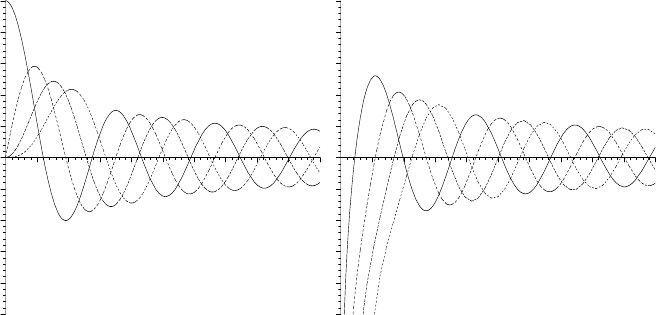
Closing the help page, Jennifer forms an arrow operator f for plotting a se-
quence of four (the number can be easily changed) Bessel functions with integer
subscript. The name N (BesselJ or BesselY) of the Bessel function must be
supplied along with the horizontal range x = x1tox2 over which the function
is to be plotted. The four curves are given different colors and line styles. Line
style 4 produces a DASH-DOT curve. The vertical range is limited with the
view command to −1to+1becausetheY
n
(x) become infinitely large at x=0
if this point is included in the range of interest.
>
f:=(N,x1,x2)->plot([seq(N(n,x),n=0..3)],x=x1..x2,thickness=2,
color=[red,blue,green,cyan],linestyle=[1,2,3,4],
view=[x1..x2,-1..1],tickmarks=[2,2]):
Making use of f,theJ
n
(x)andY
n
(x) are plotted for x=x1=0 to x2=20.
>
f(BesselJ,0,20); f(BesselY,0,20);
–1
0
1
10 20
x
–1
1
10 20
x
Figure 1.8: Left plot: Left to right, J
0
to J
3
.Right:Lefttoright,Y
0
to Y
3
.
The Bessel functions J
0
(x), J
1
(x), J
2
(x), and J
3
(x) are ordered from left to
right in the left plot of Figure 1.8. At x=0, J
0
has the value 1, while all other
positive integer J
n
are equal to zero there. The Bessel functions Y
0
(x), Y
1
(x),
Y
2
(x), and Y
3
(x), with the same ordering, are shown on the right of Figure 1.8.
The Y
n
(x) diverge to −∞ at x = 0, so are rejected in physical problems where
the origin is part of the range of interest.

1.2. LINEAR ODES WITH VARIABLE COEFFICIENTS 39
Of particular importance in solving problems involving Bessel functions is
knowing the locations of the zeros. The first 5 zeros of, e.g., J
1
are now ob-
tained with the following BesselJZeros command. Note that the argument 1
is expressed in floating point form, i.e., 1.0, in order to numerically evaluate the
zeros. The command BesselYZeros will generate the zeros of the Y
n
(x).
>
Zeros_J1:=BesselJZeros(1.0,1..5);
Zeros
J1 := 3.831705970, 7.015586670, 10.17346814, 13.32369194, 16.47063005
For large x, both the J
n
(x)andY
n
(x) have the appearance of slowly decreasing
sine or cosine functions. Jennifer confirms this conjecture by Taylor expanding,
e.g., J
1
(x)aboutx=+∞ and keeping the first term in the expansion.
>
taylor(BesselJ(1,x),x=infinity,1);
−
√
2 cos(x +
π
4
)
1
x
√
π
+O((
1
x
)
(3/2)
)
The “order of” term, O((1/x)
3/2
), is removed with convert(%,polynom),the
“ditto operator”, %, applying the command to the previously executed result.
6
>
J1_asymptotic:=convert(%,polynom);
J1
asymptotic := −
√
2 cos(x +
π
4
)
1
x
√
π
Asymptotically, J
1
(x) behaves like a cosine function whose amplitude decreases
like 1/
√
x. The Bessel functions have many important properties which are too
numerous for Jennifer to explore here. For an exhaustive list of the properties
of all special functions, she refers the reader to the voluminous Handbook of
Mathematical Functions [AS72]. One important property shared by special
functions is that they satisfy recurrence relations, relating functions of different
orders. Here’s an example of a recurrence relation for the J
n
(x). This recurrence
relation relates Bessel functions of orders n−1, n+1, and n for arbitrary x.
>
recurrence:=BesselJ(n-1,x)+BesselJ(n+1,x)
=simplify(BesselJ(n-1,x)+BesselJ(n+1,x));
recurrence := BesselJ(n − 1,x) + BesselJ(n +1,x)=
2 n BesselJ(n, x)
x
Now, Jennifer introduces Legendre’s ODE by entering the Sturm–Liouville
arrow operator SL with p =1−x
2
, q =0, w =1, and L ≡ λ = n (n + 1). The
differential equation ode2 is then solved and identified as Legendre’s equation.
>
ode2:=SL(1-xˆ2,0,1,n*(n+1)); y2:=Y(ode2);
ode2 := −2 x (
d
dx
y(x)) + (1 −x
2
)(
d
2
dx
2
y(x)) + n (n +1)y(x)=0
Methods for second order ODEs:
...................................................................
6
To recall the second previous result, use two percent signs, %%, and so on.

40 CHAPTER 1. LINEAR ODES OF PHYSICS
−> Trying a solution in terms of special functions:
−> Bessel
−> elliptic
−> Legendre
<− Legendre successful
<− special function solution successful
y2 :=
C1 LegendreP(n, x)+ C2 LegendreQ(n, x)
Highlighting LegendreP with the mouse and opening up the associated help page
reveals that LegendreP(n, x)istheLegendre function of the first kind of order n,
while LegendreQ(n, x)istheLegendre function of the second kind. In standard
mathematical notation, they are written as P
n
(x)andQ
n
(x), respectively. If
the odeadvisor command is applied to ode2 , the ODE is identified
>
odeadvisor(ode2);
[
Gegenbauer]
as a Gegenbauer equation, which has the general structure [AS72],
(1 − x
2
) y
− (2 α +1)xy
+ n (n +2α) y =0. (1.7)
Legendre’s ODE is a special case of Equation (1.7) with α=1/2.
The Legendre functions P
n
(x)withn = 0 or a positive integer play an im-
portant role in boundary value problems involving spherical polar coordinates,
in which case x = cos(θ)whereθ is the polar angle measured from the z-axis.
The polar angle runs from 0 to π radians, so x spans the range 1 to −1. For
n =0, 1, 2, ...,theP ’s reduce to the Legendre polynomials which Jennifer now
generates for n = 0 to 5. The simplify command must be applied to produce
the finite polynomial forms.
>
Ps:=seq(simplify(LegendreP(n,x)),n=0..5);
Ps := 1,x,−
1
2
+
3 x
2
2
,
5
2
x
3
−
3
2
x,
3
8
+
35
8
x
4
−
15
4
x
2
,
63
8
x
5
−
35
4
x
3
+
15
8
x
The polynomials may also be generated by loading the orthopoly library package
and using the syntax P(n,x) to enter the nth order Legendre polynomial.
>
with(orthopoly): seq(P(n,x),n=0..5);
1,x,−
1
2
+
3 x
2
2
,
5
2
x
3
−
3
2
x,
3
8
+
35
8
x
4
−
15
4
x
2
,
63
8
x
5
−
35
4
x
3
+
15
8
x
To produce Q
n
(x) over the range x=−1 to 1, Jennifer enters EnvLegendreCut:
=1..infinity: which selects the desired mathematical branch
7
of the function.
The Q ’s are then produced for n=0, 1, 2. They are expressible as combinations
of log functions.
>
_EnvLegendreCut:=1..infinity:
>
Qs:=seq(simplify(LegendreQ(n,x)),n=0..2);
7
To plot Q
n
(x)for|x| > 1, enter EnvLegendreCut:=-1..1: and adjust the view.
1.2. LINEAR ODES WITH VARIABLE COEFFICIENTS 41
Qs :=
1
2
ln(1 + x) −
1
2
ln(1 − x),
1
2
x ln(1 + x) −
1
2
x ln(1 − x) − 1,
−
1
4
ln(1 + x)+
1
4
ln(1 − x)+
3
4
x
2
ln(1 + x) −
3
4
x
2
ln(1 − x) −
3 x
2
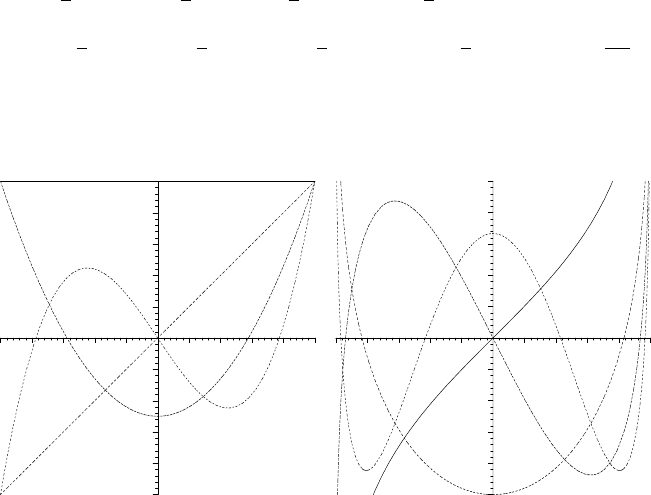
Using the arrow operator f, the Legendre functions of both kinds are now
plotted for n=0 to 3 over the horizontal range x= −1to1.
>
f(LegendreP,-1,1); f(LegendreQ,-1,1);
–1
0
1
–1 1
x
–1
0
1
–1 1
x
Figure 1.9: Left plot: P
0
, P
1
, P
2
, P
3
.Right:Q
0
, Q
1
, Q
2
, Q
3
.
P
0
(x) (horizontal curve), P
1
(x) (diagonal curve), P
2
(x) (parabola), and P
3
(x)
(N-shape) are shown in the left plot of Figure 1.9. Q
0
(x) (solid curve), Q
1
(x)
(parabola), Q
2
(x) (N-shape), and Q
3
(x) (W-shape) are shown in the right plot
of the figure. The P
n
are well behaved at x = ±1, but the Q
n
diverge at these
points and must be rejected in physical problems which include x = ±1inthe
range of interest.
An important general property that all solutions y
n
(x) of the Sturm–Liouville
equation corresponding to a given λ
n
possess is orthogonality. Provided that
y(x), or y
(x), or p(x) vanishes at the end points a and b of the range (referred
to as Sturm–Liouville boundary conditions), then
b
a
w(x) y
m
(x) y
n
(x) dx =0, for m = n. (1.8)
w(x)isreferredtoastheweight function. Noting that w(x) = 1 for Legendre’s
equation and that p =1−x
2
vanishes at x = a = −1andatb = +1, the
orthogonality conditions
1
−1
P
m
(x) P
n
(x) dx = 0 and
1
−1
Q
m
(x) Q
n
(x) dx =0
should prevail for m = n. For specific values of m and n the former condition
is easy to prove, while proving the latter condition is more formidable.
Jennifer tackles the second orthogonality condition, taking m=3 and n=2.
She uses the “inert” form Int on the left of the following command line to

42 CHAPTER 1. LINEAR ODES OF PHYSICS
display the form of the integral and the “active” form on the right to evaluate
the integral. The answer is 0 as expected.
>
orthog:=Int(LegendreQ(2,x)*LegendreQ(3,x),x=-1..1)
=int(simplify(LegendreQ(2,x)*LegendreQ(3,x)),x=-1..1);
orthog :=
1
−1
LegendreQ(2,x) LegendreQ(3,x) dx =0
1.2.2 Onset of Bending in a Vertical Antenna
Truth is stranger than fiction, but it is because Fiction is obliged to
stick to possibilities; Truth isn’t.
Mark Twain, Following the Equator, ch. 15, (1897).
As a follow up to the last recipe, Jennifer has asked her class to examine the
stability of an antenna which consists of a thin vertical wire of length L and
uniform circular cross-section of radius a which is clamped at its lower end and
is free at its upper end. Let θ be the angular deflection of the antenna from
the vertical at a distance y from the top, Y the Young’s modulus, ρ the mass
density, and g the acceleration due to gravity. If the length L is small, the
antenna is “stable” in the vertical position, i.e., θ = 0 for all values of y.As
L increases, there is a critical value beyond which the antenna is unstable and
will bend from the vertical.
By considering the shear and gravitational forces on the wire, it can be
shown that the relevant LODE for small angular displacements θ is
d
2
θ
dy
2
= −c
2
yθ, where c =
2
a
ρg
Y
. (1.9)
(a) Noting that θ =0 at y = L (clamped at bottom end) and dθ/dy =0 at
y = 0 (free at top), determine the solution of the ODE, identifying the
functions which occur. Express the solution in terms of Bessel functions.
(b) Prove that the critical length for bending is given by L
cr
(2.8/c)
2/3
.
(c) Determine L
cr
for a steel (Y =2.1 ×10
11
N/m
2
and ρ= 7800 kg/m
3
)wire
of radius 1 mm. Take g =9.8m/s
2
.
Jennifer has provided us with the following computer algebra solution taken
from her answer key. The governing ODE is entered.
>
restart:
>
ode:=diff(theta(y),y,y)=-cˆ2*y*theta(y);
ode :=
d
2
dy
2
θ(y)=−c
2
yθ(y)
The ODE is solved for θ(y) subject to the boundary condition dθ/dy =0 at
y = 0 and the rhs of the solution taken.
>
theta:=rhs(dsolve({ode,D(theta)(0)=0},theta(y)));

1.2. LINEAR ODES WITH VARIABLE COEFFICIENTS 43
θ :=
C2
√
3 AiryAi(−(c
2
)
(1/3)
y)+ C2 AiryBi(−(c
2
)
(1/3)
y)
Jennifer has not included the other boundary condition in the dsolve command
because then only the trivial solution θ = 0 would be produced. Highlighting
AiryAi in the output with the mouse, clicking on Help, and then on “Help on
AiryAi”, opens a help page which indicates that AiryAi is an Airy wave function.
AiryBi is another Airy function. According to Help, the Airy functions are
related to the Bessel functions J
n/3
where n is a positive or negative integer.
Using this information, θ is converted to Bessel functions of the first kind
and simplified assuming that y>0andc>0. θ is expressed in terms of J
(−1/3)
.
>
theta:=simplify(convert(theta,BesselJ)) assuming y>0,c>0;
θ :=
2
3
C2
√
3 c
(1/3)
√
y BesselJ(
−1
3
,
2 cy
(3/2)
3
)
The other boundary condition, θ(y = L) = 0, is now applied.
>
bc:=eval(theta,y=L)=0;
bc :=
2
3
C2
√
3 c
(1/3)
√
L BesselJ(
−1
3
,
2 cL
(3/2)
3
)=0
For θ to have a non-trivial solution, the coefficient
C2 = 0, so the boundary
condition must reduce to the Bessel function being equal to zero. The select
command is used to extract the Bessel function from the lhs of the bc and the
boundary condition is re-expressed as follows.
>
bc:=select(has,lhs(bc),BesselJ)=0;
bc := BesselJ(
−1
3
,
2 cL
(3/2)
3
)=0
Clearly, the critical length for bending must correspond to finding the first zero
of the above Bessel function. The following op command is used to extract the
second operand from the lhs of bc.
>
X:=op(2,lhs(bc));
X :=
2 cL
(3/2)
3
The first zero of J
(−1/3)
is obtained.
>
s:=BesselJZeros(evalf(-1/3),1);
s := 1.866350859
The critical value L
cr
follows on setting X = s and solving for L. Only one of
the answers is real, the other two being complex.
>
Lcr:=solve(X=s,L);
Lcr :=
1.986352708 (c
2
)
(2/3)
c
2
,
(−
0.7046901283 (c
2
)
(1/3)
c
+
1.220559106 I (c
2
)
(1/3)
c
)
2
,
(−
0.7046901283 (c
2
)
(1/3)
c
−
1.220559106 I (c
2
)
(1/3)
c
)
2

44 CHAPTER 1. LINEAR ODES OF PHYSICS
The first answer (the real one) is selected and simplified with the symbolic
option. This is the expression for the critical length.
>
Lcr:=simplify(Lcr[1],symbolic);
Lcr :=
1.986352708
c
(2/3)
To confirm that the critical length L
cr
(2.8/c)
2/3
, the numerator of Lcr is
extracted and raised to the 3/2 power in p. It is then evaluated to 2 digits
accuracy in p2, yielding 2.8 as desired.
>
p:=(numer(Lcr))ˆ(3/2); p2:=evalf(p,2);
p := 2.799526291 p2 := 2.8
To determine L
cr
for the steel wire, the given parameter values are entered.
>
g:=9.8: a:=0.001: Y:=2.1*10ˆ11: rho:=7800:
The parameter c is evaluated and the critical length for bending of the steel
wire antenna determined.
>
c:=evalf((2/a)*sqrt(rho*g/Y)): Lcr:=Lcr;
Lcr := 1.752545257
The antenna will not bend from the vertical if its length L<1.75 meters.
1.2.3 The Quantum Oscillator
Anybody who is not shocked by this subject has failed to understand it.
Neils Bohr, 1922 Nobel laureate in physics, referring to quantum mechanics
Over the years I have had occasion to teach an introductory quantum mechanics
course which concentrates on how to do quantum mechanics, leaving it to our
departmental “guru” to deal with deeper quasi-philosophical questions of what
it means in a higher-level course. In the doing category, a standard problem
(see Griffiths [Gri95]) is to derive the probability distribution for the quantum
mechanical version of the one-dimensional simple harmonic oscillator. This may
be done either “algebraically” using “ladder operators” or by the more brute
force method of directly solving the time-independent Schr¨odinger equation
for the probability amplitude ψ.Onceψ is determined, the probability density
P (x)=|ψ(x)|
2
may be calculated. The probability that a particle can be found
between, say x= a and x= b,is
b
a
P (x) dx. Of course,
∞
−∞
P (x) dx =1.
This recipe illustrates how P (x) may be painlessly derived, plotted, and
interpreted for the quantum oscillator starting with the Schr¨odinger equation.
The PDEtools package is loaded because it contains the dchange command
which will be used to change both the dependent and independent variables.
>
restart: with(PDEtools):
The Schr¨odinger ODE is entered for a particle of mass m.HereE and V are the
total and potential energy and hbar ≡ ¯h=h/(2π), where h is Planck’s constant.
>
ode:=(hbarˆ2/(2*m))*diff(psi(x),x,x)+(E-V)*psi(x)=0;

1.2. LINEAR ODES WITH VARIABLE COEFFICIENTS 45
ode :=
1
2
hbar
2
(
d
2
dx
2
ψ(x))
m
+(E − V ) ψ(x)=0
For a particle experiencing a Hooke’s law restoring force, V =(1/2) mω
2
x
2
,
where ω is the frequency and x is the displacement of the particle from equi-
librium. On entering V , its form is automatically substituted into ode .
>
V:=(1/2)*m*omegaˆ2*xˆ2: ode:=ode;
ode :=
1
2
hbar
2
(
d
2
dx
2
ψ(x))
m
+(E −
mω
2
x
2
2
) ψ(x)=0
Since ¯hω has the units of energy, let’s express E in these energy units, writing
E =(n +1/2) ¯hω. The form n +1/2 of the “scale factor”, where the parameter
n remains to be determined, has been chosen for later convenience. At the same
time, ode is multiplied by (2/(¯hω) and the result expanded in ode2 .
>
E:=(n+1/2)*hbar*omega: ode2:=expand(2*ode/(hbar*omega));
ode2 :=
hbar (
d
2
dx
2
ψ(x))
ωm
+2ψ(x) n + ψ(x) −
ωψ(x) mx
2
hbar
=0
The constants can be removed from ode2 by introducing a new independent
variable ζ defined by x =
¯h/(mω) ζ and also setting ψ(x)=f(ζ) e
−ζ
2
/2
.
This transformation of variables is now entered.
>
tr:={x=sqrt(hbar/(m*omega))*zeta,psi(x)=f(zeta)*exp(-zetaˆ2/2)}:
Using the dchange command ode2 is expressed in terms of the new variables.
>
ode3:=dchange(tr,ode2,[zeta,f(zeta)]);
ode3 := (
d
2
dζ
2
f (ζ)) e
(−
ζ
2
2
)
− 2(
d
dζ
f (ζ)) ζe
(−
ζ
2
2
)
+2f (ζ) e
(−
ζ
2
2
)
n =0
Dividing ode3 by the common exponential factor, e
−ζ
2
/2
, yields ode4 ,
>
ode4:=expand(ode3/exp(-zetaˆ2/2));
ode4 := (
d
2
dζ
2
f (ζ)) − 2(
d
dζ
f (ζ)) ζ +2f (ζ) n =0
which is the Hermite ODE. Hermite’s equation is another S-L ODE, being
obtained from (1.6) by setting p(ζ)=e
−ζ
2
, q(ζ)=0, w(ζ)=e
−ζ
2
,andλ =2n.
The general solution of ode4 is now sought.
>
f:=rhs(dsolve(ode4,f(zeta)));
f :=
C1 e
(
ζ
2
2
)
WhittakerM(
n
2
+
1
4
,
1
4
,ζ
2
)
√
ζ
+
C2 e
(
ζ
2
2
)
WhittakerW(
n
2
+
1
4
,
1
4
,ζ
2
)
√
ζ
Surprisingly, the answer is not given in terms of Hermite functions, but in-
stead in terms of another special function, the Whittaker functions M
µ,ν
(z)
and W
µ,ν
(z), which satisfy Whittaker’s differential equation,
y
(z)+[−1/4+µ/z +(1/4 −ν
2
)/z
2
] y(z)=0, (1.10)

46 CHAPTER 1. LINEAR ODES OF PHYSICS
with µ= n/2+1/4, ν =1/4, and z =ζ
2
here. However, the WhittakerW function
can be converted to a Hermite function by using convert(f,Hermite).
>
f:=convert(f,Hermite);
f :=
C1 e
(
ζ
2
2
)
WhittakerM(
n
2
+
1
4
,
1
4
,ζ
2
)
√
ζ
+
C2 HermiteH(n,
ζ
2
)(ζ
2
)
(1/4)
√
ζ 2
n
To avoid divergence problems at ζ =±∞, the WhittakerM function is removed
>
f2:=remove(has,f,WhittakerM);
f2 :=
C2 HermiteH(n,
ζ
2
)(ζ
2
)
(1/4)
√
ζ 2
n
from f, and the result simplified with the radsimp command.
>
f2:=radsimp(f2);
f2 :=
C2 HermiteH(n, ζ)
2
n
In terms of ζ, the probability amplitude is given by ψ = f2 e
−ζ
2
/2
.
>
psi:=f2*exp(-zetaˆ2/2);
ψ :=
C2 HermiteH(n, ζ) e
(−
ζ
2
2
)
2
n
To be physically meaningful and to satisfy the normalization condition, ψ must
remain finite over the range ζ = −∞ to +∞. This can only be accomplished
if the WhittakerM function is removed (which has already been done) and n
takes on the values n =0, 1, 2, 3,.... In this case, the Hermite functions reduce
to the Hermite polynomials H
n
(ζ). The Hermite polynomials can be readily
generated. Here are the first six.
>
seq(H[n]=simplify(HermiteH(n,zeta)),n=0..5);
H
0
=1,H
1
=2ζ, H
2
= −2+4ζ
2
,H
3
=8ζ
3
− 12 ζ,
H
4
=12+16ζ
4
− 48 ζ
2
,H
5
=32ζ
5
− 160 ζ
3
+ 120 ζ
The Hermite polynomials can also be generated by loading the orthopoly library
package and using the syntax H(n,x).
To achieve the normalization condition
∞
−∞
P (ζ) dζ = 1, the constant must
be chosen to be
C2=
2
n
/(
√
πn!). This form is substituted into ψ and the
probability density P calculated and simplified with respect to the exponentials.
>
psi:=subs(_C2=sqrt(2ˆn/(sqrt(Pi)*n!)),psi);
>
P:=simplify(psiˆ2,exp);
P :=
e
(−ζ
2
)
HermiteH(n, ζ)
2
2
n
√
πn!
To plot the probability density for a given value of n, P is turned into an
arrow operator with the unapply command.
>
P:=unapply(P,n):