
Enns R.H. Computer Algebra Recipes for Mathematical Physics
Подождите немного. Документ загружается.

128 CHAPTER 4. LINEAR PDES OF PHYSICS
4.1 Three Cheers for the String
When I introduce my physics and engineering students to the PDEs of physics,
I always begin with the transverse vibrations of the humble string. The reason
is quite simple. The vibrating string is familiar and easy to visualize, the basic
underlying equation of motion (the 1-dimensional wave equation) easy to derive,
and a wide variety of important methods and ideas can be introduced. So this
section illustrates a gourmet selection of string recipes. Lest you get ideas of
stringing me up after munching on some of the stringy concoctions, I will show
you that there is life beyond the string in the second part of this chapter.
4.1.1 Jennifer Finds the General Solution
Friends are like fiddle strings, they must not be screwed too tight.
English Proverb. Collected in: H. G. Bohn, A Handbook of Proverbs (1855)
Consider a light, uniform, stretched string of linear density (mass per unit
length) which is horizontal in equilibrium. The goal of this recipe, provided
by Jennifer the MIT mathematician, is to obtain the equation of motion for the
transverse (vertical) oscillations of the string and then the general solution.
The PDEtools package is loaded, because it contains the declare and
dchange commands. Jennifer needs the former to introduce subscript nota-
tion, favored by mathematicians, for the resulting 1-dimensional wave equation
and the latter to transform the variables in arriving at the general solution.
The plots package is included because a typical solution will be animated.
>
restart: with(PDEtools): with(plots):
Let the vertical displacement of a point x on the string from equilibrium at
time t be ψ(x, t). Consider an infinitesimal element of string of arclength ds=
(dx)
2
+(dψ)
2
=
1+(∂ψ/∂x)
2
dx, located between x and x + dx. Since the
string is only to move vertically, the horizontal component T of the tension in
the string is constant along the string. The vertical component of the tension,
which is given by T∂ψ/∂x, will vary along the string. The net vertical force
F on the infinitesimal element is equal to the difference between the vertical
forces at its ends. This force is entered.
>
F:=T*Diff(psi(x+dx,t),x)-T*Diff(psi(x,t),x);
F := T (
∂
∂x
ψ(x + dx,t)) − T (
∂
∂x
ψ(x, t))
Since dx is small, F is taylor expanded in powers of dx to order 2 and the order
of term removed with the convert( ,polynom) command.
>
F:=convert(taylor(F,dx=0,2),polynom);
F := T D
1
(ψ)(x, t) − T (
∂
∂x
ψ(x, t)) + T D
1, 1
(ψ)(x, t) dx
Newton’s second law is applied to the string element in the vertical direction.
The net vertical force F is converted to differential form on the lhs of ode .This

4.1. THREE CHEERS FOR THE S TRING 129
must be equal to the mass of the string element times the acceleration, i.e., to
ds(∂
2
ψ/∂t
2
). Assuming that the vibrations are such that ∂ψ/∂x 1, then
ds ≈ dx.Thislinear approximation is used on the rhs of ode .
>
ode:=convert(F,diff)=epsilon*dx*diff(psi(x,t),t,t);
ode := T (
∂
2
∂x
2
ψ(x, t)) dx = ε dx (
∂
2
∂t
2
ψ(x, t))
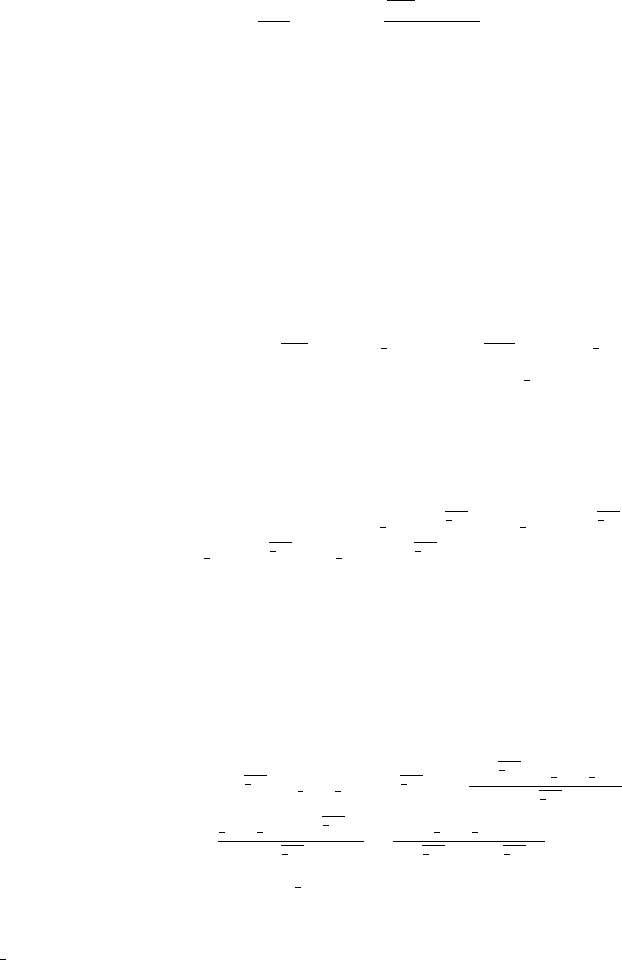
Dividing ode by (dx T ) and substituting =T/c
2
, yields the 1-dimensional wave
equation WE,withc the wave speed. By using the declare command, Jennifer
has introduced subscript notation for the derivatives in the wave equation.
>
declare(psi(x,t)): WE:=subs(epsilon=T/cˆ2,ode/(dx*T));
ψ(x, t) will now be displayed as ψ
WE := ψ
x, x
=
ψ
t, t
c
2
If proceeding by hand, the general solution of WE can be obtained by in-
troducing two new independent variables u and v related to x and t by the
transformation u = x + ct, v = x −ct. Then one would apply the chain rule of
differentiation, e.g., calculating,
∂ψ
∂x
=
∂ψ
∂u
∂u
∂x
+
∂ψ
∂v
∂v
∂x
=
∂ψ
∂u
+
∂ψ
∂v
, and then
∂
2
ψ
∂x
2
=
∂
2
ψ
∂u
2
+2
∂
2
ψ
∂v∂u
+
∂
2
ψ
∂v
2
The second time derivative would be similarly calculated. This hand trans-
formation of the wave equation WE can be easily accomplished with Maple
as follows. Jennifer enters the transformation tr and solves for x and t,thus
obtaining the inverse transformation itr.
>
tr:={u=x+c*t,v=x-c*t}: itr:=solve(tr,{x,t});
itr := {t = −
v −u
2 c
,x=
u
2
+
v
2
}
Then applying the inverse transformation to the wave equation with the dchange
command, and simplifying, yields the transformed wave equation WE2 . Note
that c is indicated as a parameter (params=c) in the command.
>
WE2:=simplify(dchange(itr,WE,[u,v],params=c));
WE2 := ψ
u, u
+2ψ
u, v
+ ψ
v, v
= ψ
u, u
− 2 ψ
u, v
+ ψ
v, v
The cross-derivative term is isolated in WE2 , yielding the greatly simplified
wave equation WE3 .
>
WE3:=isolate(WE2,diff(psi(u,v),u,v));
WE3 := ψ
u, v
=0
Clearly, the solution of WE3 is a linear combination of an arbitrary function
of u and an arbitrary function of v. This general solution can be obtained by
applying the partial differential equation solve command, pdsolve,toWE3 .
>
sol:=pdsolve(WE3);
sol := ψ(u, v)=
F2 (u)+ F1 (v)

130 CHAPTER 4. LINEAR PDES OF PHYSICS
The quantities
F1 and F2 denote arbitrary functions. The general solution
to the original wave equation follows on substituting the transformation tr into
the right-hand side of the solution sol.
>
sol2:=psi(x,t)=subs(tr,rhs(sol));
sol2 := ψ =
F2 (x + ct)+ F1(x − ct)
Of course, since Jennifer is using Maple, it was not really necessary to mimic
the hand calculation. Applying the pdsolve command directly to the original
wave equation WE yields a similar general solution.
>
sol3:=pdsolve(WE);
sol3 := ψ =
F1 (x + ct)+ F2(ct− x)
The solution sol3 is a linear superposition of a general wave form traveling in the
negative-x direction (the first term) with speed c and a wave form (the second
term) traveling in the positive-x direction with the same speed. The wave forms
propagate unchanged in shape since dissipative forces have not been included.
As a representative example, Jennifer considers the following specific wave form
ψ which is a linear combination of two Gaussian profiles.
>
psi:=exp(-(x-t)ˆ2)+exp(-(x+t)ˆ2);
ψ := e
(−(x−t)
2
)
+ e
(−(x+t)
2
)
On animating ψ with the following command, the initial frame shows a single
pulse of amplitude 2. As the animation progresses, this pulse splits into two
pulses of amplitude 1 propagating in opposite directions with speed c=1.
>
animate(psi,x=-10..10,t=0..7,frames=50,numpoints=500);
4.1.2 Daniel Separates Strings: I Separate Variables
There are strings in the human heart that had better not be vibrated.
Charles Dickens, English novelist, Barnaby Rudge (1841)
In contrast to Dickens’s quote, there are strings in my heart which vibrate
with pleasure as I watch my young grandson, Daniel, explore his new world.
However, given a multi-stranded string, he would likely try to separate it into
its constituent strands, rather than carrying out the following scenario. But,
who knows? Perhaps, some day, he will separate variables instead of strings.
Young Daniel is playing with a light horizontal string of length L fixed at
x = 0 and L, i.e., ψ(0,t)=ψ(L, t) = 0. Suppose that he cleverly plucks the
string (which is initially at rest) in such a way that it has an initial profile
ψ(x, 0) =f(x)=hx
3
(L −x)/L
4
. Our task is to use the method of separation of
variables to mathematically determine the subsequent motion of the string and
then animate the string vibrations, taking L =1m,h = 5 m, and c =5m/s.
After loading the plots package, needed for the animation,
>
restart: with(plots):
4.1. THREE CHEERS FOR THE S TRING 131
the 1-dimensional wave equation is entered in pde . Unlike Jennifer, I will not
bother with the subscript notation.
>
pde:=diff(psi(x,t),x,x)=(1/cˆ2)*diff(psi(x,t),t,t);
pde :=
∂
2
∂x
2
ψ(x, t)=
∂
2
∂t
2
ψ(x, t)
c
2
The separation of variables method assumes that the solution can be written
as a product of unknown functions, each function depending on only one of
the independent variables. For the present problem, this assumption takes the
form ψ(x, t)=X(x) T (t). Mentally substituting ψ(x, t)intopde and dividing
by ψ(x, t) would yield (d
2
X(x)/dx
2
)/X(x)=(d
2
T (t)/dt
2
)/(c
2
T (t)). The only
way this equality can hold is if both sides of the equation are equal to a con-
stant, called the separation constant. This then would yield two ODEs, one for
determining X(x) and a second for finding T (t). These steps may be achieved
by applying the pdsolve command to pde , but now including the product as-
sumption as a HINT.
>
pdsolve(pde,psi(x,t),HINT=X(x)*T(t));
(ψ(x, t)=X (x) T (t)) &where [{
d
2
dt
2
T (t)= c
1
T (t) c
2
,
d
2
dx
2
X (x)= c
1
X (x)}]
The resulting ODEs are shown in the above output, with
c
1
the separation
constant. The next step is to solve the ODEs for X and T. If, in addition to
supplying the HINT,theINTEGRATE option is included, the separated ODEs are
readily solved with the pdsolve command.
>
pdsolve(pde,psi(x,t),HINT=X(x)*T(t),INTEGRATE);
(ψ(x, t)=X (x) T (t)) &where[{{T (t)=
C3 e
(
√
c
1
ct)
+ C4 e
(−
√
c
1
ct)
},
{X (x)=
C1 e
(
√
c
1
x)
+ C2 e
(−
√
c
1
x)
}}]
Finally, the product of X and T must be formed to give ψ(x, t). Including the
build option in the pdsolve command accomplishes this step. In the recipes
which follow in this and the following chapter, all three options will be included
whenever we wish to separate variables. You will begin to really appreciate
the power of the pdsolve command when we tackle problems in non-Cartesian
coordinate systems.
>
sol:=pdsolve(pde,psi(x,t),HINT=X(x)*T(t),INTEGRATE,build);
sol := ψ(x, t)=e
(
√
c
1
ct)
C3 C1 e
(
√
c
1
x)
+
e
(
√
c
1
ct)
C3 C2
e
(
√
c
1
x)
+
C4 C1 e
(
√
c
1
x)
e
(
√
c
1
ct)
+
C4 C2
e
(
√
c
1
ct)
e
(
√
c
1
x)
To determine the four constants C1 , etc., the two boundary conditions and
the two initial conditions must be applied. In order to do this, the form of
the solution will be simplified somewhat. First, let’s make the substitution
c
1
=−k
2
on the rhs of sol and assume that k>0.

132 CHAPTER 4. LINEAR PDES OF PHYSICS
>
psi:=simplify(subs(_c[1]=-kˆ2,rhs(sol))) assuming k>0;
ψ :=
C3 C1 e
(k (ct+x) I)
+ C3 C2 e
(k (ct−x) I)
+ C4 C1 e
(−Ik(ct−x))
+ C4 C2 e
(−Ik(ct+x))
Then ψ is converted to trigonometric form and the result expanded.
>
psi2:=expand(convert(psi,trig));
The lengthy output, which has been suppressed here in the text, involves the
terms cos(kx), sin(kx), cos(ckt), and sin(ckt). To satisfy the boundary
condition at x = 0, the cos(kx) terms are removed from ψ2 by substituting
cos(kx)=0. At x= L, the boundary condition yields sin(kL)=0 or k = nπ/L,
with n =1, 2, 3, .... This is also substituted. Since the transverse velocity of
the string is initially zero, we must also set sin(ck,t)=0.
>
psi3:=subs({cos(k*x)=0,sin(c*k*t)=0,k=n*Pi/L},psi2);
On then factoring ψ3, the result shown in ψ4 results.
>
psi4:=factor(psi3);
ψ4:=(−
C2 + C1)( C3 + C4 ) cos(
nπct
L
)sin(
nπx
L
) I
The following select command is used to replace the “ugly” coefficient com-
bination in ψ4withthesymbolA
n
. The resulting term, labeled ψ5 here, is the
nth term in the infinite series which will represent ψ(x, t).
>
psi5:=A[n]*select(has,psi4,{sin,cos});
ψ5:=A
n
cos(
nπct
L
)sin(
nπx
L
)
The initial shape of the string is entered.
>
f:=h*xˆ3*(L-x)/Lˆ4:
Using linear superposition, ψ(x, t)=
∞
n=1
A
n
sin(nπx/L) cos(nπct/L). At
t = 0, one has f =
∞
n=1
A
n
sin(nπx/L). Multiplying this equation by
sin(mπx/L) and integrating from x=0 to L, the only term which will survive
in the series due to orthogonality of the sine functions is the term corresponding
to n= m. This procedure is carried out in the following equation.
>
eq:=int(f*sin(n*Pi*x/L),x=0..L)
=int(subs(t=0,psi5)*sin(n*Pi*x/L),x=0..L):
The equation is then solved for A
n
, assuming that n is an integer.
>
A[n]:=solve(eq,A[n]) assuming n::integer;
A
n
:= −
12 h (4 − 4(−1)
n
+ n
2
π
2
(−1)
n
)
n
5
π
5
The parameter values L =1, h =5, and c = 5 are entered and a formal sum
performed with the first 25 terms in the series being retained.
>
L:=1: h:=5: c:=5:
>
psi6:=Sum(psi5,n=1..25);
4.1. THREE CHEERS FOR THE S TRING 133
ψ6:=
25
n=1
(−
60 (4 − 4(−1)
n
+ n
2
π
2
(−1)
n
) cos(5 nπt)sin(nπx)
n
5
π
5
)
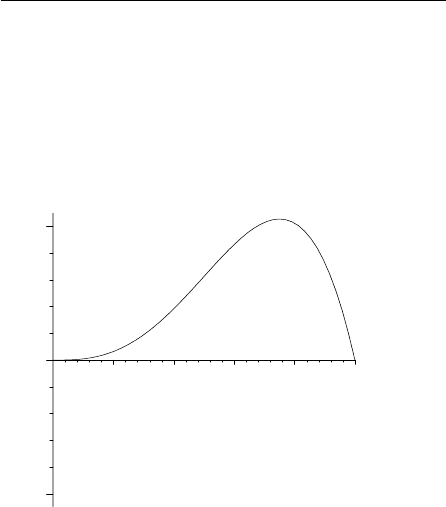
Applying the value command to ψ6, the motion of the string is now animated
over the time range t = 0 to 160 seconds. The opening frame of the animation
is shown in Figure 4.1. By executing the command line, you will be able to
observe the vibrations of the string.
>
animate(value(psi6),x=0..L,t=0..160,frames=100,
thickness=2,scaling=constrained,tickmarks=[4,3]);
–0.5
0
0.5
0.2 0.4
0.6
0.8 1
x
Figure 4.1: The initial shape of the plucked string.
4.1.3 Daniel Strikes Again: Mr. Fourier Reappears
We are all instruments endowed with feeling and memory.
Our senses are so many strings that are struck by surrounding
objects and that also frequently strike themselves.
Denis Diderot, French philosopher, (1713–84)
If Daniel didn’t separate the strands or otherwise destroy the string, another
possible scenario is that he would strike it in some manner. Consider a string
fixed at x = 0 and L to be initially horizontal, but is struck in such a way
that it is given the initial piecewise velocity profile g(x)=4vx/L for x ≤ L/4,
g(x)=4(v/L)(L/2 − x)forL/4 ≤ x ≤ L/2, and g(x)=0 for x ≥ L/2. Using
the Fourier series approach, determine the subsequent motion of the string and
animate it for L=20 cm, v =5 cm/s, and c= 1 cm/s.
The plots package is needed for the animation. To perform the integration
involving the piece-wise velocity profile, it is necessary to assume that both v
and L are positive.
>
restart: with(plots): assume(v>0,L>0):
134 CHAPTER 4. LINEAR PDES OF PHYSICS
A functional operator ψ is introduced to generate the necessary Fourier series.
From the previous recipe, it is clear that the spatial part should be built up
of terms of the form sin(nπx/L), with n =1, 2, 3, ..., in order to satisfy the
boundary conditions at x= 0 and L. The time part is left quite general, so that
the recipe will run even if the initial conditions are changed.
>
psi:=N->Sum(sin(n*Pi*x/L)*(a[n]*cos(n*Pi*c*t/L)
+b[n]*sin(n*Pi*c*t/L)),n=1..N);
ψ := N →
N
n=1
sin(
nπx
L
)(a
n
cos(
nπct
L
)+b
n
sin(
nπct
L
))
The given initial spatial (f(x)) and velocity (g(x)) profiles are entered.
>
f(x):=0:
g(x):=piecewise(x<L/4,4*v*x/L,x<L/2,(4*v/L)*(L/2-x),x<L,0);
g(x):=
⎧
⎪
⎪
⎪
⎪
⎨
⎪
⎪
⎪
⎪
⎩
4 vx
L
x<
L
4
4 v (
L
2
− x)
L
x<
L
2
0 x<L
The coefficients a
n
and b
n
are explicitly evaluated.
>
a[n]:=(2/L)*int(f(x)*sin(n*Pi*x/L),x=0..L);
a
n
:= 0
>
b[n]:=simplify((2/(n*Pi*c))*int(g(x)*sin(n*Pi*x/L),x=0..L));
b
n
:= −
8 vL(sin(
nπ
2
) − 2sin(
nπ
4
))
n
3
π
3
c
The first 25 terms in the Fourier series are calculated, being left as formal sum.
>
sol:=psi(25);
sol :=
25
n=1
⎛
⎜
⎝
−
8sin(
nπx
L
) vL(sin(
nπ
2
) − 2sin(
nπ
4
)) sin(
nπct
L
)
n
3
π
3
c
⎞
⎟
⎠
For animation purposes, the parameter values are substituted into the solution.
The transverse velocity of the string is then calculated so that we can decide if
25 terms is sufficient to fit the initial velocity profile and thus ensure an accurate
animation of the string.
>
sol2:=subs({L=20,v=5,c=1},sol): vel:=diff(sol2,t):
Substituting the parameter values into g(x) and evaluating the velocity at t=0,
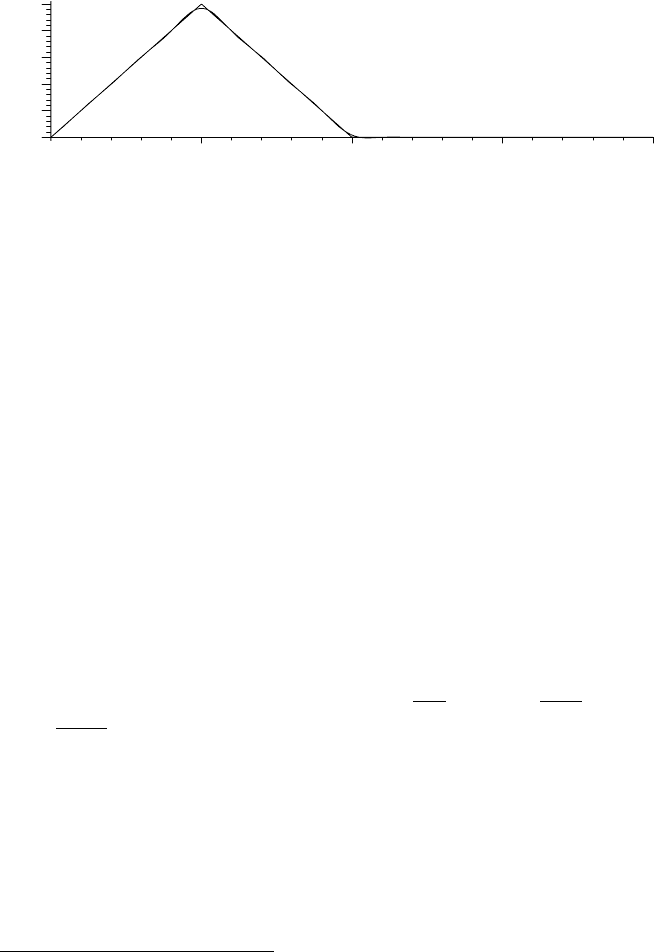
g(x)andvel are now plotted in the same figure, the former curve being colored
blue, the latter colored red. The scaling is constrained. The resulting picture
is reproduced in Figure 4.2.
>
plot([subs({L=20,v=5,c=1},g(x)),eval(vel,t=0)],x=0..20,color
=[blue,red],thickness=2,scaling=constrained,tickmarks=[4,4]);
4.1. THREE CHEERS FOR THE S TRING 135
0
1
2
3
4
5
5
10
15
20
x
Figure 4.2: Fourier series superimposed on initial velocity profile.
Clearly, 25 terms produces a very good fit to the initial velocity profile. The
motion of the string, described by sol2 , is then animated.
>
animate(sol2,x=0..20,t=0..50,frames=100,thickness=2,
scaling=constrained,tickmarks=[4,3]);
What do you think happens? You will have to execute the recipe to find out.
4.1.4 The 3-Piece String
What is called an acute knowledge of human nature is mostly noth-
ing but the observer’s own weaknesses reflected back from others.
G. C. Lichtenberg, German physicist, philosopher, (1742–99)
In this recipe, we will derive the energy reflection and transmission coefficients
for a monochromatic (frequency ω) plane wave traveling from x = −∞ in an
infinitely long string which has a different constant linear density in the region
x=0 to L than in the rest of the string. If the linear density in region 1 (x<0)
is ,inregion2(0<x<L)is
2
, and in region 3 (x>L)is again, the
corresponding wave numbers are k
1
= k = ω
/T , k
2
= ω
2
/T = rk with
r ≡
(
2
/), and k
3
=k, respectively, where T is the tension in the string.
Using complex notation, in region 1 the wave form is ψ1=e
i(kx−ωt)
+
b1 e
−i(kx+ωt)
. (The physical solution is the real part of ψ1.) The spatial part
is now entered, e
−iωt
being omitted since it will cancel.
>
restart:
>
psi||1:=exp(I*k*x)+b1*exp(-I*k*x);
ψ1:=e
(kxI)
+ b1 e
(−Ikx)
The first term is the “incident” wave with unit amplitude
1
traveling in the
1
Since the reflection and transmission coefficients involve ratios, the incident wave ampli-
tude can be chosen to be 1 without any loss of generality.
136 CHAPTER 4. LINEAR PDES OF PHYSICS
positive x-direction, the second the “reflected” wave with amplitude b1 traveling
in the negative x-direction. The energy reflection coefficient, which measures
the fraction of the incident wave energy in region 1 which is reflected, then is
R= |b1 |
2
=(b1) (b1
∗
), where the star denotes complex conjugate.
The spatial part of the solution in region 2, which is a linear combination of
plane waves traveling in the positive and negative x directions, is entered. The
amplitudes are labeled a2 and b2 .
>
psi||2:=a2*exp(I*r*k*x)+b2*exp(-I*r*k*x);
ψ2:=a2 e
(rkxI)
+ b2 e
(−Irkx)
In region 3, there will only be a plane wave traveling in the positive x-direction.
>
psi||3:=a3*exp(I*k*x);
ψ3:=a3 e
(kxI)
The energy transmission coefficient, which measures the fraction of the incident
energy in region 1 which is transmitted into region 3, will be given by T =|a3 |
2
.
Clearly, since energy must be conserved, one must have R+T =1. To determine
R and T , the four unknown coefficients must be determined. The string is
continuous, so ψ1=ψ2atx = 0 and ψ2=ψ3atx = L. These boundary
conditions are entered in eq1 and eq2 .
>
eq||1:=eval(psi||1=psi||2,x=0);
eq1 := 1 + b1 = a2 + b2
>
eq||2:=eval(psi||2=psi||3,x=L);
eq2 := a2 e
(rkLI)
+ b2 e
(−IrkL)
= a3 e
(kLI)
The continuity of the slopes at x= 0 and L is entered in eq3 and eq4 .
>
eq||3:=eval(diff(psi||1=psi||2,x),x=0);
eq3 := kI− b1 kI = a2 rkI− b2 rkI
>
eq||4:=eval(diff(psi||2=psi||3,x),x=L);
eq4 := a2 rke
(rkLI)
I − b2 rke
(−IrkL)
I = a3 ke
(kLI)
I
The sequence of four equations is solved for b1 , a2 , b2 ,anda3 .
>
sol:=solve({seq(eq||i,i=1..4)},{b1,a2,b2,a3}); assign(sol):
On assigning the solution, R is calculated by multiplying b1 by its complex
conjugate, employing the complex evaluation command, and simplifying.
>
R:=simplify(evalc(b||1*conjugate(b||1)));
R :=
(−1 + cos(rkL)
2
)(r
2
− 1)
2
−2 r
2
cos(rkL)
2
− r
4
+ r
4
cos(rkL)
2
− 2 r
2
− 1 + cos(rkL)
2
The energy transmission coefficient T =(a3 )(a3
∗
) is similarly calculated.
>
T:=simplify(evalc(a||3*conjugate(a||3)));
T := −
4 r
2
−1 − 2 r
2
+ cos(rkL)
2
− 2 r
2
cos(rkL)
2
+ r
4
cos(rkL)
2
− r
4
As a check, let’s confirm that the sum S ≡ R + T =1.
4.1. THREE CHEERS FOR THE S TRING 137
>
S:=simplify(R+T);
S := 1
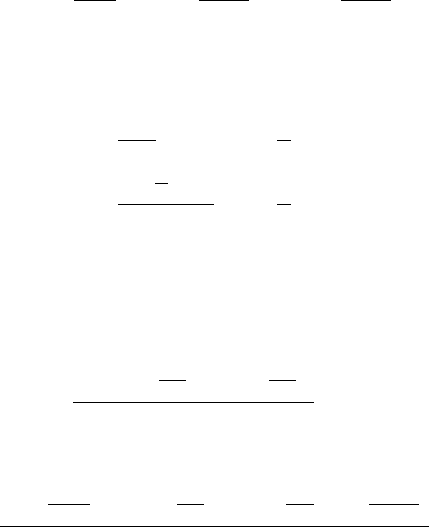
To get a feeling for the behavior of R and T , let’s choose, say, r =2, i.e., region
2 has a density 4 times that of regions 1 and 3. Setting kL=z in R and T ,the
reflection and energy coefficients are given by T1 and R1 ,
>
r:=2: T1:=algsubs(k*L=z,T); R1:=algsubs(k*L=z,R);
T1 := −
16
−25 + 9 cos(2 z)
2
R1 :=
−9 + 9 cos(2 z)
2
−25 + 9 cos(2 z)
2
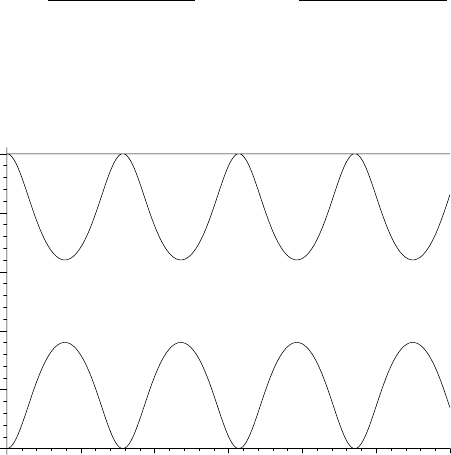
which are then plotted along with S = 1 over the range z = 0 to 6.
>
plot([R1,T1,S],z=0..6,color=[red,blue,green],thickness=2,
labels=["kL","R,T"],numpoints=100);
0
0.2
0.4
0.6
0.8
1
R,T
1234
5
6
kL
Figure 4.3: R and T for the 3-piece string as a function of kL.
The bottom oscillatory curve is R, the top oscillatory curve is T , and the
horizontallineisthesumS of the two. Whenever rz ≡ rkL = nπ,with
n =0, 1, 2, ..., the reflection coefficient R is 0 and the transmission coefficient
T is 1 (100% transmission).
4.1.5 Encore?
Applause is a receipt, not a bill.
Artur Schnabel, American pianist, on why he didn’t give encores, (1882–1951)
Early in my academic career, I was assigned the task of teaching the fresh-
man physics class of several hundred in a huge tiered lecture hall. Being a
theoretician, I approached this task with some trepidation, knowing that in
order to demonstrate some basic ideas of physics, and to keep the class awake,