
Enns R.H. Computer Algebra Recipes for Mathematical Physics
Подождите немного. Документ загружается.

148 CHAPTER 4. LINEAR PDES OF PHYSICS
>
a:=1: V0:=2: V:=sum(sol3,n=1..100):
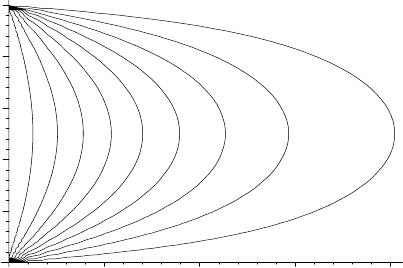
Using the contourplot command, V is plotted over the interval x = 0 to 2
and y =0 to a = 2. Constant potential curves (equipotentials) are plotted for
0.2, 0.4,...,1.6, 1.8 volts. The grid is taken to be 50 × 50 in order to obtain
reasonably smooth curves. The resulting picture is shown in Figure 4.7, the 0.2
volt curve being furthest to the right.
>
contourplot(V,x=0..2,y=0..a,contours=[seq(i*V0/10,i=1..9)],
thickness=2,grid=[50,50]);
0
0.2
0.4
y
0.8
1
0.2 0.4
x
0.8
Figure 4.7: Equipotentials corresponding to 0.2 (far right), 0.4,...,1.8 volts.
The contourplot3d command is used to produce a three-dimensional con-
tour plot, the equipotential curves again being spaced 0.2 volts apart.
>
contourplot3d(V,x=0..1,y=0..a,contours=[seq(i*V0/10,i=1..9)],
grid=[60,60],shading=zhue,filled=true,axes=boxed,
tickmarks=[2,2,2]);
The resulting picture can be viewed by executing the recipe on your computer.
4.2.4 Grandpa’s “Trampoline”
In the first place God made idiots. This was for practice.
Then He made School Boards.
Mark Twain, Following the Equator, (1897)
From his sundeck, my grandson Daniel can peek over the fence and see his
neighbor’s children happily bouncing up and down on their trampoline after
coming home from school. He is too young to join in the fun, so must be con-
tent (not very!) to watch. On the other hand, I am getting too old to engage in
trampoline antics, being more content to substitute the following recipe instead.

4.2. BEYOND THE STRING 149
A trampoline, consisting of a square horizontal elastic membrane fixed on
its four edges (x=0,band y =0,b), has an initial transverse profile ψ(x, y, 0) ≡
f = Ax
2
y (b − x)(b − y)
3
and is released from rest. Determine ψ(x, y, t)for
arbitrary time t>0. Taking A =1/5m
−7
, b = 2 m, and the wave speed c =1
m/s, animate the trampoline motion.
The plots package is loaded, because we shall be animating the motion of the
trampoline. A functional operator F is created to calculate the second derivative
of ψ(x, y, t) with respect to an arbitrary variable v.
>
restart: with(plots): F:=v->diff(psi(x,y,t),v,v):
The transverse vibrations of the trampoline are governed by the two-dimensional
wave equation which is entered using F.
>
pde:=F(x)+F(y)=F(t)/cˆ2;
pde := (
∂
2
∂x
2
ψ(x, y, t)) + (
∂
2
∂y
2
ψ(x, y, t)) =
∂
2
∂t
2
ψ(x, y, t)
c
2
The wave equation is solved by the method of separation of variables, the as-
sumed form ψ(x, y, t)=X(x) Y (y) T (t) being supplied as a hint.
>
sol:=pdsolve(pde,HINT=X(x)*Y(y)*T(t),INTEGRATE,build);
The output (not displayed here) has two separation constants,
c
1
and c
2
.To
simplify the form of the solution, the substitution
c
1
= −α
2
and c
2
= −β
2
is
made on the rhs of sol and the result simplified with the symbolic option.
>
psi1:=simplify(subs({_c[1]=-alphaˆ2,_c[2]=-betaˆ2},
rhs(sol)),symbolic);
ψ1:=
C5 sin(c
α
2
+ β
2
t) C3 C1 e
((βy+αx) I)
+ ···
+
C6 cos(c
α
2
+ β
2
t) C3 C1 e
((βy+αx) I)
+ ···
The initial transverse velocity is zero, so the time-dependent sine terms must
be removed from ψ1.
>
psi2:=remove(has,psi1,sin);
The exponential terms in ψ2areconvertedtoatrigforminψ3 and the result
expanded. The terms cos(βy), sin(βy), cos(αx), and sin(αx)appear.
>
psi3:=expand(convert(psi2,trig));
To satisfy the fixed edge conditions along y = 0 and x = 0, the cosine terms are
removed from the solution by setting them equal to zero, while one must have
α= mπ/b and β =nπ/b ,withm, n=1, 2, 3, ..., to satisfy the conditions along
x= b and y =b. Making these substitutions and factoring yields ψ4.
>
psi4:=factor(subs({cos(beta*y)=0,cos(alpha*x)=0,
alpha=m*Pi/b,beta=n*Pi/b},psi3));
ψ4:= −cos(cπ
m
2
+ n
2
b
2
t)sin(
nπy
b
)sin(
mπx
b
)
C6 ( C1 − C2 )( C3 − C4 )
The following select command is used to replace the cumbersome coefficient

150 CHAPTER 4. LINEAR PDES OF PHYSICS
combination in ψ4withthesymbolB
m,n
.
>
psi5:=B[m,n]*select(has,psi4,{sin,cos});
ψ5:=B
m,n
cos(cπ
m
2
+ n
2
b
2
t)sin(
nπy
b
)sin(
mπx
b
)
The initial transverse profile of the trampoline is entered.
>
f:=A*xˆ2*y*(b-x)*(b-y)ˆ3;
f := Ax
2
y (b −x)(b − y)
3
Using orthogonality of the sine functions, the coefficient B
m,n
is evaluated by
performing the double integration
B
m,n
=(2/b)
2
b
0
b
0
f sin(mπx/b)sin(nπy/b) dx dy,
and assuming that m and n are integers.
>
B[m,n]:=(2/b)ˆ2*int(int(f*sin(m*Pi*x/b)*sin(n*Pi*y/b),
x=0..b),y=0..b) assuming m::integer,n::integer;
B
m, n
:= −48 b
7
A(−4+8(−1)
(1+m)
+ n
2
π
2
+2(−1)
m
π
2
n
2
+4(−1)
n
+8 (−1)
(n+m)
)
(m
3
π
8
n
5
)
The solution then will be of the form
ψ(x, y, t)=
∞
m=1
∞
n=1
B
m,n
sin(mπx/b)sin(nπy/b) cos(cπ
m
2
+ n
2
t/b).
A functional operator G is formed, using ψ5, for explicitly calculating this double
Fourier series out to N terms in each sum,
>
G:=N->sum(sum(psi5,m=1..N),n=1..N):
The given parameters are entered, and the double series calculated for N =10.
You will have to execute the recipe on your own computer to see the 10 × 10
= 100 terms in ψ.
>
A:=1/5: b:=2: c:=1: N:=10: psi:=G(N);
Using the animate command, the answer ψ is animated over the time interval
t= 0 to 5 seconds, 50 frames being used. Execute the recipe and enjoy!
>
animate(plot3d,[psi,x=0..b,y=0..b],t=0..5,frames=50,
axes=boxed,shading=zhue,tickmarks=[3,3,3]);
4.2.5 Irma Insect’s Isotherm
A man thinks he amounts to a great deal but to a flea or a mosquito
a human being is merely something good to eat.
Don Marquis, American humorist, (1878–1937)
In the Erehwon zoo, Irma insect lives inside a rectangular enclosure with walls
at x =0,aand y =0,b,flooratz = 0 and ceiling at z = c. In the winter, the

4.2. BEYOND THE STRING 151
floor and walls have a temperature of zero degrees while the ceiling has a steady
temperature profile T (x, y, c) = 1600 x (a − x) y (b − y) degrees. Determine the
temperature inside Irma’s enclosure. Irma is most comfortable when the tem-
perature is 20
◦
.Ifa = b = c = 1, plot the 3-dimensional isothermal surface
corresponding to this temperature. What is T at the center of the enclosure?
The steady-state temperature inside the enclosure is given by the solution of
Laplace’s equation, ∇
2
T (x, y, z) = 0. For variety, let’s load the VectorCalculus
package and use the Laplacian command in Cartesian coordinates.
>
restart: with(plots): with(VectorCalculus):
>
pde:=Laplacian(T(x,y,z),’cartesian’[x,y,z])=0;
pde := (
∂
2
∂x
2
T (x, y, z)) + (
∂
2
∂y
2
T (x, y, z)) + (
∂
2
∂z
2
T (x, y, z)) = 0
The temperature of the walls at x = 0 and a is held at zero degrees. On
separating variables, the x part of the solution will be a linear combination
of a sine and a cosine. To satisfy T =0 at x = 0 and a, this part of the
solution must involve sin(mπx/a), with m a positive integer. Similarly, the y
part of the solution must be sin(nπy/b), with n a positive integer. So, let’s
apply the pdsolve command with the hint that the solution is of the form
sin(mπx/a)sin(nπy/b) Z(z), with the structure of Z(z) to be determined.
>
sol:=pdsolve(pde,T(x,y,z),HINT=sin(m*Pi*x/a)*
sin(n*Pi*y/b)*Z(z),INTEGRATE,build);
sol := T (x, y, z)=sin(
mπx
a
)sin(
nπy
b
)
C1 sin(
π
√
−m
2
b
2
− n
2
a
2
z
ab
)
+sin(
mπx
a
)sin(
nπy
b
)
C2 cos(
π
√
−m
2
b
2
− n
2
a
2
z
ab
)
Since the floor at z = 0 is held at zero degrees, the cosine term must be removed
from the rhs of the solution sol. The result is the general term T
m, n
in a double
Fourier series, with the coefficient
C1 to be determined.
>
T[m,n]:=remove(has,rhs(sol),cos);
T
m, n
:= sin(
mπx
a
)sin(
nπy
b
)
C1 sin(
π
√
−m
2
b
2
− n
2
a
2
z
ab
)
The temperature profile at z =c is entered in f . To determine the form of
C1 ,
the combination sin(mπx/a)sin(nπy/b)isfirstentereding.
>
f:=1600*x*(a-x)*y*(b-y): g:=sin(m*Pi*x/a)*sin(n*Pi*y/b):
Making use of orthogonality of the sine functions, f is multiplied by g and the
double integral over x and y carried out. This must be equal to T
m, n
, evaluated
at z =c, multiplied by g, with the same double integration performed.
>
eq:=int(int(f*g,x=0..a),y=0..b)
=int(int(eval(T[m,n],z=c)*g,x=0..a),y=0..b):
Then eq is solved for
C1, and simplified assuming that m and n are integers.
>
_C1:=simplify(solve(eq,_C1)) assuming m::integer,n::integer;
152 CHAPTER 4. LINEAR PDES OF PHYSICS
C1 :=
25600 a
2
b
2
(1 − (−1)
m
+(−1)
m
(−1)
n
− (−1)
n
)
sin(
π
√
−m
2
b
2
− n
2
a
2
c
ab
) m
3
π
6
n
3
The dimensions of the enclosure are entered, and the series representation of
the temperature T calculated, keeping 50 ×50 = 2500 terms to ensure accurate
numerical results.
>
a:=1.0: b:=1.0: c:=1.0: T:=sum(sum(T[m,n],m=1..50),n=1..50):
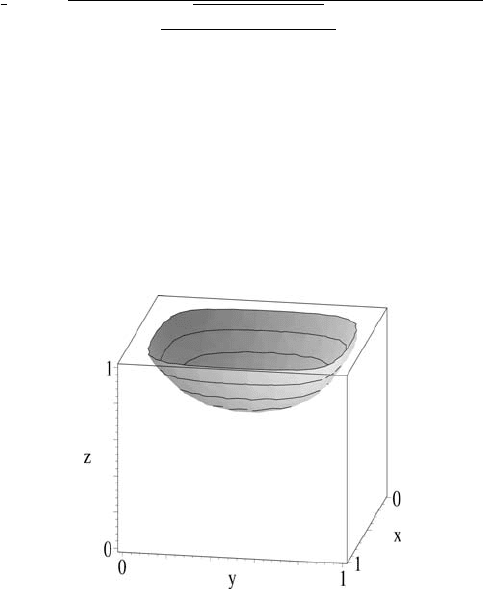
Setting T = 20, the implicitplot3d command is used to plot the 20 degree
isotherm, the result being the bowl-shaped surface shown in Figure 4.8.
>
implicitplot3d(T=20,x=0..a,y=0..b,z=0..c,axes=box,
orientation=[10,70],style=PATCHCONTOUR,tickmarks=[2,2,2]);
Figure 4.8: The 20
◦
C isotherm.
The temp erature is now evaluated at the center of the enclosure,
>
T2:=evalf(eval(T,{x=a/2,y=b/2,z=c/2}));
T2 := 11.36308962
and found to be about 11 degrees.
4.2.6 Daniel Hits Middle C
The notes I handle no better than many pianists. But the pauses
between the notes – ah, that is where the art resides.
Artur Schnab el, American pianist, Chicago Daily News, 11 June 1958
A horizontal bar of nickel-iron (Young’s modulus, Y =2.1 × 10
11
N/m
2
,and
density, ρ=7.8×10
3
kg/m
3
) of length L= 1 m, whose cross-section is rectangu-
lar with width W =0.1 m and height H =0.049 m, is clamped (i.e., ψ =ψ
=0)
at x = 0 and L. Daniel strikes the bar sharply at the midpoint of one of its

4.2. BEYOND THE STRING 153
wider sides in such a way that the initial transverse velocity is (approximately)
v(x, 0) = v
0
δ(x − L/2), with v
0
=1 m
2
/s and δ the Dirac delta function. De-
termine the transverse displacement ψ(x, t) of the bar at arbitrary time t>0.
Show that the fundamental frequency corresponds to approximately middle C
(f=261.63 Hz). Animate the motion of the bar over the interval t = 0 to 10 T ,
where T =1/f is the fundamental period.
After loading the plots library package, needed for the animation,
>
restart: with(plots):
the equation of motion for transverse oscillations of the bar is entered.
>
pde:=aˆ4*diff(psi(x,t),x$4)+diff(psi(x,t),t,t)=0;
pde := a
4
(
∂
4
∂x
4
ψ(x, t)) + (
∂
2
∂t
2
ψ(x, t)) = 0
The parameter a =(Sκ
2
Y/)
1/4
,whereS = WH is the cross-sectional area of
the bar, κ = H/
√
12 is the radius of gyration about the horizontal midplane
through the bar, and =ρS is the linear density.
Using pdsolve, pde is solved with the hint ψ(x, t)=X(x) T (t).
>
sol:=pdsolve(pde,HINT=X(x)*T(t),INTEGRATE,build);
Setting the separation constant
c
1
=k
4
in sol, the frequency is ω =a
2
k
2
.
>
sol:=simplify(subs(_c[1]=kˆ4,sol),symbolic);
sol := ψ(x, t)=e
(−Ikx)
C5 sin(a
2
k
2
t) C1 + ···+ C6 cos(a
2
k
2
t) C4 e
(kx)
Since the bar is initially horizontal, i.e., ψ(x, 0) = 0, the cosine term must be
removed from the rhs of sol. The result is then factored.
>
psi:=factor(remove(has,rhs(sol),cos));
ψ :=
C5 sin(a
2
k
2
t)( C1 e
(−Ikx)
+ e
(−kx)
C2 + C3 e
(kxI)
+ e
(kx)
C4 )
To apply the boundary conditions at the end of the bar, the spatial part is
extracted with the select command. The time part is also selected.
>
X:=select(has,psi,x); T:=select(has,psi,t);
X :=
C1 e
(−Ikx)
+ e
(−kx)
C2 + C3 e
(kxI)
+ e
(kx)
C4
T := sin(a
2
k
2
t)
X is converted to trig form, and the cosine, sine, cosh, and sinh terms collected.
>
X:=collect(convert(X,trig),[cos,sin,cosh,sinh]);
X := (
C3 + C1) cos(kx)+(− C1 I + C3 I)sin(kx)
+(
C4 + C2)cosh(kx)+( C4 − C2 ) sinh(kx)
Using the op command to extract the relevant operands, new coefficients A1 ,
etc, are introduced into X in the following line.
>
X:=add(A||i*op([i,2],X),i=1..4);
X := A1 cos(kx)+A2 sin(kx)+A3 cosh(kx)+A4 sinh(kx)
The clamped-end boundary conditions are applied at x=0 in bc1 and bc2 and
at x= L in bc3 and bc4 .

154 CHAPTER 4. LINEAR PDES OF PHYSICS
>
bc1:=eval(X,x=0)=0; bc2:=eval(diff(X,x),x=0)=0;
bc1 := A1 + A3 =0 bc2 := A2 k + A4 k =0
>
bc3:=eval(X,x=L)=0; bc4:=eval(diff(X,x),x=L)=0;
bc3 := A1 cos(kL)+A2 sin(kL)+A3 cosh(kL)+A4 sinh(kL)=0
bc4 := −A1 sin(kL) k + A2 cos(kL) k + A3 sinh(kL) k + A4 cosh(kL) k =0
On attempting to solve the four boundary conditions for the four unknown
coefficients, one of the coefficients will be undetermined and a transcendental
equation for k will result. Let’s choose the undetermined coefficient to be A4 .
Then, bc1 , bc2 ,andbc3 are solved for A1 , A2 ,andA3 and sol2 assigned.
>
sol2:=solve({bc1,bc2,bc3},{A||1,A||2,A||3}); assign(sol2):
The coefficient A4 is temporarily set equal to 1 and the fourth boundary con-
dition divided by k
3
and simplified with the symbolic option.
>
A||4:=1: bc4:=simplify(bc4/kˆ3,symbolic);
bc4 :=
2(−1 + cos(kL)cosh(kL))
k
2
(cos(kL) − cosh(kL))
=0
We set kL= K in bc4 and isolate the cos(K) term to the left of the equation.
>
eq:=isolate(subs(k*L=K,bc4),cos(K));
eq := cos(K)=
1
cosh(K)
On comparing the transcendental equation eq with the corresponding equation
for the clamped-free end situation in Recipe 01-1-3, we see that they differ by
a minus sign on the right-hand side. As before, eq must be solved numerically
for the allowed K values. For large K,cosh(K) becomes very large and cos K
approaches zero. The allowed K values, therefore, are approximately the zeros
of the cosine function. A functional operator f is introduced to determine the
zeros in the range 3(n − 1) to 3 n,wheren will take on the values 1, 2, etc.
>
f:=n->fsolve(eq,K,3*(n-1)..3*n):
Then forming f(n), dividing by L, and using the sequence command, the first
four zeros of k are given in sol3 which is assigned.
>
sol3:=seq(k||n=f(n)/L,n=1..4); assign(sol3):
sol3 := k1 =0., k2 =
4.730040745
L
, k3 =
7.853204624
L
, k4 =
10.99560784
L
The first zero, k1 , must be rejected, because for k = 0 the lhs of bc4 is finite.
The parameters L, v
0
, W , H, Y ,andρ are entered, and the radius of gyration
κ, cross-sectional area S, linear density , and the parameter a calculated.
>
L:=1: v0:=1: W:=0.1: H:=0.049: Y:=2.1*10ˆ11: rho:=7.8*10ˆ3:
>
kappa:=evalf(H/sqrt(12)); S:=W*H; epsilon:=rho*S;
a:=(S*kappaˆ2*Y/epsilon)ˆ(1/4);
κ := 0.01414508160 S := 0.0049 ε := 38.22000 a := 8.567101289
The coefficient A4 , which had been temporarily set equal to 1, is relabeled
4.2. BEYOND THE STRING 155
B, and will now be calculated. The initial transverse velocity is of the form
v(x, 0) =v
0
δ(x −L/2) =
∞
n=1
a
2
k
2
n
B
n
X
n
,whereX
n
is the nth spatial mode.
Multiplying v(x, 0) by X
n
, integrating x over the range 0 to L, and using the
orthogonality of the spatial modes, yields v
0
X
n
(x=L/2) = B
n
a
2
k
2
n
L
0
X
2
n
dx,
which is easily solved for B
n
. The coefficient B is evaluated in the following
line for a general k value.
>
B:=v0*eval(X,x=L/2)/(aˆ2*kˆ2*int(Xˆ2,x=0..L)):
The product BXT is evaluated at k = kn and the first three terms of the
complete solution ψ added. Only the fundamental (n= 2) contribution is shown
here, the remaining terms having rapidly decreasing amplitudes.
>
psi:=simplify(add(eval(B*X*T,k=k||n),n=2..4));
ψ := −0.0009671479296 sin(1642.092308 t) cos(4.730040745 x)
+0.0009502249823 sin(1642.092308 t)sin(4.730040745 x)
+0.0009671479296 sin(1642.092308 t) cosh(4.730040745 x)
− 0.0009502249823 sin(1642.092308 t) sinh(4.730040745 x)+···
The fundamental frequency ω =a
2
k2
2
is 1642 rads/s or f =ω/(2 π) ≈ 261.3Hz,
which is close to middle C. The fundamental period T =1/f is also calculated.
>
omega:=aˆ2*k||2ˆ2; f:=evalf(omega/(2*Pi)); T:=1/f;
ω := 1642.092308 f := 261.3471078 T := 0.003818536004
Finally, the vibrations of the bar are animated over the interval t= 0 to 10 T .
>
animate(psi,x=0..L,t=0..10*T,frames=100,thickness=2);
Execute the recipe on your computer and click on the plot and on the start
arrow to see the vibrations.
4.2.7 A Poisson Recipe
Life is good for only two things, discovering mathematics
and teaching mathematics
Simon Poisson, French mathematician, (1781–1840)
In this day and age, being overweight and having high blood pressure and/or
high cholesterol cause great concern among an aging population. To address
these issues, all types of diets are proposed and cookbooks written. Amongst
the latter are the HeartSmart [Ste94] cook books, sponsored by the Heart and
Stroke Foundation of Canada. Each book presents “over 200 healthful & deli-
cious recipes”, with a section devoted to fish and seafood. So, in the spirit of
keeping us intellectually healthy, here’s a delicious Poisson (equation) recipe.
The simplest non-trivial Poisson equation problems involve point or line
charges in the vicinity of one or more “grounded” (zero potential) conducting
surfaces. Since the charge densities for these sources may be characterized
by Dirac δ-functions, the solutions of these problems are electrostatic Green’s
functions. As a simple 2-dimensional example, let us consider an infinitely long
156 CHAPTER 4. LINEAR PDES OF PHYSICS
line charge characterized by the charge density ρ=4π
0
δ(x −a) δ(y −b), with
0
the permittivity of free space. The line charge is located between two infinite
grounded conducting plates at y = 0 and at L>b>0. To firmly establish the
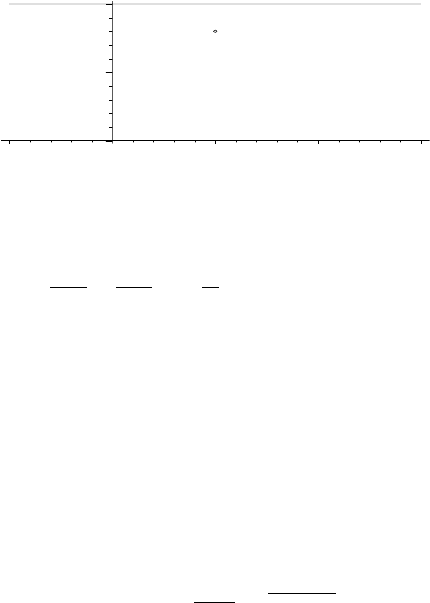
geometry in our minds, a finite portion of the two infinite conducting planes is
plotted in the x-y plane as green lines in gr1,withL=1.
>
restart: with(plots):
>
gr1:=plot([[[-1/2,0],[3/2,0]],[[-1/2,1],[3/2,1]]],color=
green,thickness=2,tickmarks=[4,3],labels=["x","y"]):
Taking a =0.5andb =0.8, a point is plotted in gr2, representing an end-on
view of the line charge. The geometry for the Green’s function problem is then
displayed by superimposing the two graphs in Figure 4.9.
>
gr2:=pointplot([[0.5,0.8]],symbol=circle,symbolsize=12):
>
display({gr1,gr2},scaling=constrained);
0
0.5
1
y
–0.5 0.5
1
1.5
x
Figure 4.9: End-on view of line charge between two grounded conducting plates.
The relevant Poisson equation for the Green’s function potential G is
∇
2
G =
∂
2
G
∂x
2
+
∂
2
G
∂y
2
= −
ρ
0
= −4 πδ(x − a) δ(y − b). (4.7)
For the region outside the line charge, Equation (4.7) becomes homogeneous
and a solution is easily constructed. In the y direction G is zero at y = 0 and
L,soG must include terms of the structure sin(nπy/L), with n =1, 2, 3, ....
As x →±∞,wemusthaveG → 0. For x<a, the Green’s function GL to the
“left” of the line charge will be built up of terms of the structure e
nπ(x−a)/L
.
We have used the fact that our final result should ultimately depend only on
the difference x−a. The factor nπ/Lis included so that the homogeneous form
of Poisson’s equation will be satisfied. The nth term in the infinite series then
takes the following form for GL, the coefficients A
n
still to be determined.
>
GL:=A[n]*sin(n*Pi*y/L)*exp(n*Pi*(x-a)/L);
GL := A
n
sin(
nπy
L
) e
(
nπ(x−a)
L
)
For x>a, the Green’s function GR to the “right”of the line charge is built up
of terms of the structure e
−nπ(x−a)/L
.Thenth term in the infinite series then
takes the following form for GR, the coefficients B
n
still to be determined.
>
GR:=B[n]*sin(n*Pi*y/L)*exp(-n*Pi*(x-a)/L);

4.2. BEYOND THE STRING 157
GR := B
n
sin(
nπy
L
) e
(−
nπ(x−a)
L
)
As a check on, e.g., GL, we confirm that ∂
2
(GL)/∂x
2
+ ∂
2
(GL)/∂y
2
=0.
>
check:=diff(GL,x,x)+diff(GL,y,y);
check := 0
The Green’s function must be continuous, i.e., GL = GR,atx=a for arbitrary
y between 0 and L. The continuity condition is implemented in eq1 .
>
eq1:=expand(eval(GL=GR,x=a)/sin(n*Pi*y/L));
eq1 := A
n
= B
n
To determine the discontinuity in ∂G/∂x at x=a, we appeal to the divergence
(Gauss’s) theorem, viz.,
V
(∇·
A) dv =
S
(ˆn ·
A) ds for a vector field
A.Here
ˆn is the outward unit normal to the closed surface S, enclosing a volume V .
Let’s take V to be a thin (thickness 2, where ultimately → 0) slice between
the plates of unit length in the z direction, with faces at x − and x + ,and
A= ∇G. Then, making use of Poisson’s equation, the divergence theorem yields
∇
2
Gdxdy=
(ˆn ·∇G) d =
∂G
∂n
d= −4π
δ(x−a) δ(y−b) dx dy = −4 π.
Here ∂G/∂n is the normal derivative of G and the line integral (
d) is carried
out along the perimeter of the slice in the x-y plane. As → 0, the “ends” of
thesliceaty = 0 and L will make no contribution to the line integral, so that
lim
→0
[
along x=a+
(∂G/∂x) dy −
along x=a−
(∂G/∂x) dy]=−4π, which implies
(in the limit → 0) that (∂G/∂x)
a+
−(∂G/∂x)
a−
=−4πδ(y −b). Multiplying
this result by sin(nπy/L), integrating from y =0 to L, and using orthogonality,
yields the desired second relation for the coefficients. This calculation is imple-
mented in eq2 , the assumptions that b>0, L>b,andn is an integer being
included to accomplish the integration over the δ-function.
>
eq2:=int(eval(diff(GL-GR,x),x=a)*sin(n*Pi*y/L),y=0..L)
=4*Pi*int(Dirac(y-b)*sin(n*Pi*y/L),y=0..L)
assuming b>0,L>b,n::integer;
eq2 :=
1
2
nπA
n
+
1
2
nπB
n
=4π sin(
nπb
L
)
eq1 and eq2 are solved for A
n
and B
n
, and the solution assigned.
>
sol:=solve({eq1,eq2},{A[n],B[n]}): assign(sol):
Keeping 30 terms in the sum, the complete Green’s function to the left and
right of x=a are given in GL2 and GR2 , respectively.
>
GL2:=Sum(GL,n=1..30); GR2:=Sum(GR,n=1..30);
GL2 :=
30
n=1
⎛
⎜
⎝
4sin(
nπb
L
)sin(
nπy
L
) e
(
nπ(x−a)
L
)
n
⎞
⎟
⎠