
Enns R.H. Computer Algebra Recipes for Mathematical Physics
Подождите немного. Документ загружается.

138 CHAPTER 4. LINEAR PDES OF PHYSICS
I would have to intersperse the lecture material with demonstrations. In one
demo, a heavy iron ball was suspended from a long vertical rope attached to a
hidden catwalk far above the lecture podium. Standing with my back against
a4× 8 plywood sheet, I would pull the heavy ball away from the vertical a
sizeable distance, bring it up to my chin, and release it. I would stand there
bravely, lecturing on the conservation of energy, as the ball completed a few
oscillations without, of course, hitting my chin.
This seemed a bit tame, so I decided to add a humorous twist. A depart-
mental assistant was placed out of sight on the catwalk with instructions to give
the rope a good heave on the third swing. I would step away from the plywood
sheet after the second swing and the iron ball would crash into the plywood.
I would then express my relief at having avoided injury by a clear violation of
energy conservation. Unfortunately, either the assistant couldn’t count or was
paid off by the students. He pushed on the second swing! As the ball hurtled
towards my chin at an alarming speed, I knew that something was wrong, but
I reacted slowly. I got my hands up in time to avoid serious injury, but the
momentum of the ball knocked me against the plywood sheet which toppled
with a crash to the floor. The students loved it, whistling and cheering and
demanding an encore. Somewhat dazed, I declined!
However, I did repeat the demo the next year with a better trained assis-
tant, replacing the plywood with a large plate of old glass painted black so
the students didn’t know it was glass. This time it was a dazzling success as I
stepped away in time and the ball shattered the glass. The down side was that
I had to sweep up all the glass, as the janitorial staff refused to do so.
Although the following recipe is not identical to the situation described
above, it is inspired by that early exciting demo. A small iron ball of mass
M is attached to the lower end of a long vertical rope of length L which has
a uniform linear density . Derive the equation of motion for small transverse
oscillations of the rope. Solve the equation of motion for the normal modes of
oscillation if the initially vertical rope is given a non-zero transverse velocity.
Taking M =10 kg, L =10 m, =0.1 kg/m, and the gravitational acceleration
g =10 m/s
2
, animate the normal mode with the lowest frequency.
The plots library package is needed for the animation and the plottools
package required in order to rotate the animation by 90
◦
.
>
restart: with(plots): with(plottools):
Taking the origin at the top of the rope and measuring the vertical distance y
downwards, the tension T in the rope will be given by T = Mg+ (L − y) g.
At the bottom of the rope (y = L), the upward tension has to only balance the
weight of the ball, but at the top of the rope (y = 0) it has to balance both the
weight of the ball and the weight of the entire rope.
>
T:=M*g+epsilon*(L-y)*g;
T := Mg+ ε (L − y) g
The transverse (horizontal) oscillations of the rope will be described by the 1-
dimensional wave equation ∂(T∂ψ/∂y)/∂y = ∂
2
ψ/∂t
2
. On entering this PDE,

4.1. THREE CHEERS FOR THE S TRING 139
the tension is automatically substituted, yielding the equation of motion pde .
>
pde:=diff(T*diff(psi(y,t),y),y)=epsilon*diff(psi(y,t),t,t);
pde := −εg(
∂
∂y
ψ(y, t)) + (Mg+ ε (L − y) g)(
∂
2
∂y
2
ψ(y, t)) = ε (
∂
2
∂t
2
ψ(y, t))
Since the rope initially has zero displacement, but a non-zero velocity, a normal-
mode solution of the form ψ(y, t)=X(y)sin(ωt) is sought. The pdsolve com-
mand is applied, with the assumptions that ω, , M, L,andg are positive, and
y<L.
>
sol:=pdsolve(pde,psi(y,t),HINT=X(y)*sin(omega*t),INTEGRATE,
build) assuming omega::positive, epsilon::positive,
M::positive,L::positive, g::positive, y<L;
sol := ψ(y, t)=sin(ωt)
C1 BesselJ(0,
2 ω
√
M + εL− εy
√
ε
√
g
)
+sin(ωt)
C2 BesselY(0,
2 ω
√
M + εL− εy
√
ε
√
g
)
The spatial part of the solution is a linear combination of zeroth-order Bessel
functions of the first and second kinds. The spatial part X is now extracted.
>
X:=simplify(rhs(sol)/sin(omega*t),symbolic);
X:=
C1 BesselJ(0,
2 ω
√
M + εL− εy
√
ε
√
g
)+
C2 BesselY(0,
2 ω
√
M + εL− εy
√
ε
√
g
)
Assuming that the free-end boundary condition (dX/dy)|
y=L
= 0 applies, we
solve for
C1 .
>
_C1:=solve(subs(y=L,diff(X,y))=0,_C1);
C1 := −
C2 BesselY(1,
2 ω
√
M
√
ε
√
g
)
BesselJ(1,
2 ω
√
M
√
ε
√
g
)
The parameter values are entered and X divided by the arbitrary constant
C2
and expanded to yield X2 .
>
L:=10: M:=10: g:=10: epsilon:=1/10: X2:=expand(X/_C2);
X2 := −
BesselY(1, 2 ω
√
10) BesselJ(0, 2 ω
−
y
10
+ 11)
BesselJ(1, 2 ω
√
10)
+ BesselY(0, 2 ω
−
y
10
+ 11)
The fixed-end boundary condition at y = 0 is applied to the numerator of X2.
>
bc:=eval(numer(X2),y=0)=0;
140 CHAPTER 4. LINEAR PDES OF PHYSICS
bc := −BesselY(1, 2 ω
√
10) BesselJ(0, 2 ω
√
11)
+ BesselY(0, 2 ω
√
11) BesselJ(1, 2 ω
√
10) = 0
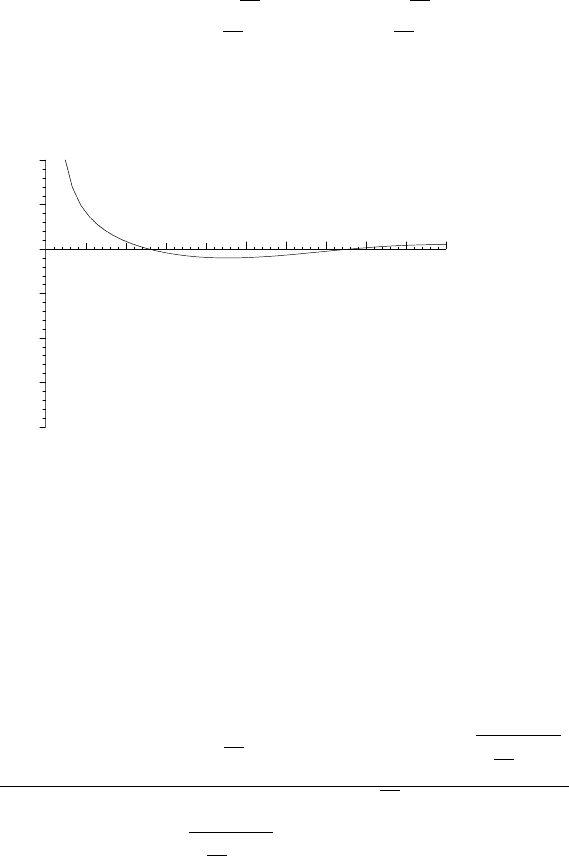
The left-hand side of bc is plotted in Figure 4.4 over the frequency range ω =0.1
to 20 and the vertical view limited so as to be able to clearly see the zeros.
>
plot(lhs(bc),omega=0.1..20,view=[0..20,-0.2..0.1]);
–0.2
–0.1
0
0.1
2468
12 14 16 18 20
omega
Figure 4.4: Plot of lhs of the boundary condition at y =0 versus frequency.
Guided by the plot, the lowest zero is numerically sought between ω = 4 and 6.
>
omega:=fsolve(bc,omega=4..6);
ω := 5.137764180
The lowest possible frequency for a normal mode is ω =5.14 Hz. The mode
with the lowest frequency then is given by ψ. Higher frequency normal modes
can be obtained by selecting other zeros in the fixed-end boundary condition.
>
psi:=X2*sin(omega*t);
ψ :=
−
BesselY(1, 10.27552836
√
10) BesselJ(0, 10.27552836
−
y
10
+ 11)
BesselJ(1, 10.27552836
√
10)
+ BesselY(0, 10.27552836
−
y
10
+ 11)
sin(5.137764180 t)
The solution ψ is animated, the scaling being left unconstrained for better
viewing. Using the rotate command, the figure is rotated by −90
◦
so that the
string is initially vertical and the subsequent time-dependent displacement is
horizontal.
>
rotate(animate(psi,y=0..L,t=0..5,color=red,
thickness=2,frames=50,numpoints=100),-Pi/2);
You will have to execute the worksheet on your computer to see the animation.

4.2. BEYOND THE STRING 141
4.2 Beyond the String
Many more string examples are given in the Supplementary Recipes, but
it’s time to move on to other physical examples and also look at two- and
three-dimensional situations. All the recipes in this section involve Cartesian
coordinates. The next section is devoted entirely to non-Cartesian examples.
4.2.1 Heaviside’s Telegraph Equation
Get your facts first,
and then you can distort them as much as you please.
Mark Twain, American author on propaganda, (1835–1910)
Consider an electrical transmission line carrying a current I(x, t)thathasa
uniform inductance L, capacitance C to ground (zero potential), and resistance
R (all per unit length) and has a leakage (leakage coefficient G per unit length)
proportional to the potential V from the line to ground.
(a) Show that V (x, t) satisfies the telegraph equation,
∂
2
V
∂x
2
= LC
∂
2
V
∂t
2
+(RC + LG)
∂V
∂t
+ RGV. (4.6)
(b) Under what conditions does the telegraph equation reduce to a wave equa-
tion? a diffusion equation? Identify the wave velocity for the former, the
diffusion coefficient for the latter.
(c) Show that a general solution of the form V (x, t)=e
−kt
f(αx+βt), where
f is an arbitrary function, will satisfy (4.6), provided that RC=LG and
k, α,andβ take on certain forms which are to be determined. Briefly
discuss what this solution means.
This problem was first solved by the English electrical engineer Oliver Heaviside
in 1887. Heaviside also reduced Maxwell’s equations into the simpler form
that we now know, invented the differential operator (D) notation for solving
differential equations, predicted the existence of an ionized reflective layer (the
Heaviside layer) in the ionosphere which bounces radio signals back to earth,
and predicted that the mass of an electric charge would increase with velocity.
Now let’s answer the question. In order to use the symbol I for the current,
the imaginary unit
√
−1 is set equal to j with the following interface command.
>
restart: interface(imaginaryunit=j):
The rate of change of the voltage V with distance x is given by eq1 . The first
term −RI on the rhs is the potential drop per unit length due to the resistance,
which is given by Ohm’s law. The second term −L∂I/∂t is the back emf per
unit length due to the inductance.
>
eq1:=diff(V(x,t),x)=-R*I(x,t)-L*diff(I(x,t),t);
eq1 :=
∂
∂x
V (x, t)=−R I (x, t) − L (
∂
∂t
I (x, t))

142 CHAPTER 4. LINEAR PDES OF PHYSICS
The rate of change of the current I with x is given by eq2 . The first term on
the rhs is the leakage of current per unit length from the line to ground, the
second term the capacitive loss per unit length to ground.
>
eq2:=diff(I(x,t),x)=-G*V(x,t)-C*diff(V(x,t),t);
eq2 :=
∂
∂x
I (x, t)=−G V (x, t) −C (
∂
∂t
V (x, t))
eq1 and eq2 are differentiated with respect to x, t, respectively, in eq3 and eq4 .
>
eq3:=diff(eq1,x); eq4:=diff(eq2,t);
eq3 :=
∂
2
∂x
2
V (x, t)=−R (
∂
∂x
I (x, t)) − L (
∂
2
∂x∂t
I (x, t))
eq4 :=
∂
2
∂x∂t
I (x, t)=−G (
∂
∂t
V (x, t)) − C (
∂
2
∂t
2
V (x, t))
A PDE for V (x, t) alone is obtained by substituting eq2 and eq4 into eq3 .
Collecting the ∂V/∂t terms then yields the telegraph equation TE .
>
eq5:=subs({eq2,eq4},eq3);
>
TE:=collect(eq5,diff(V(x,t),t));
TE:=
∂
2
∂x
2
V (x, t)=(RC + LG)(
∂
∂t
V (x, t)) + RGV (x, t)+LC(
∂
2
∂t
2
V (x, t))
The wave equation WE follows on setting R = 0 and G =0 in TE ,thewave
velocity being c=1/
√
LC.
>
WE:=eval(TE,{R=0,G=0});
WE :=
∂
2
∂x
2
V (x, t)=LC(
∂
2
∂t
2
V (x, t))
The diffusion equation DE results on setting L = 0 and G =0 inTE ,the
diffusion coefficient being d=1/(RC).
>
DE:=eval(TE,{L=0,G=0});
DE :=
∂
2
∂x
2
V (x, t)=RC(
∂
∂t
V (x, t))
To answer the last part of the question, the given ansatz is entered.
>
ansatz:=V(x,t)=exp(-k*t)*f(alpha*x+beta*t);
ansatz := V (x, t)=e
(−kt)
f (αx+ βt)
The pdetest command is used to test whether the proposed solution sat-
isfies the telegraph equation TE . If it does, the answer would be zero, but
instead it yields an algebraic equation, appropriately in terms of differential
operators, the notation introduced by Heaviside.
>
eq6:=pdetest(ansatz,TE);
4.2. BEYOND THE STRING 143
eq6 := −e
(−kt)
(−(D
(2)
)(f)(αx+ βt) α
2
− RCkf (αx+ βt)
+ RCD(f)(αx+ βt) β − LGkf (αx+ βt)+LGD(f)(αx+ βt) β
+ RGf (αx+ βt)+LCk
2
f (αx+ βt) −2 LCkD(f)(αx+ βt) β
+ LC(D
(2)
)(f)(αx+ βt) β
2
)
By inspection of the output in eq6 , the second-order differential terms will
cancel if we choose β = α/
√
LC. Assuming that G = RC/L, all remaining
terms will cancel provided that k = R/L. To confirm that this is so, these
relations are entered and the new ansatz, ansatz2 displayed, and entered as the
argument in pdetest.
>
beta:=alpha/sqrt(L*C): G:=R*C/L: k:=R/L: ansatz2:=ansatz;
ansatz2 := V (x, t)=e
(−
Rt
L
)
f (αx+
αt
√
LC
)
>
pdetest(ansatz2,TE);
0
The answer is zero, indicating that a solution to the telegraph equation exists
for G=RC/L of the form V =e
−Rt/L
f(α(x + t/
√
LC)). This solution implies
“distortionless” propagation of the input wave form with velocity 1/
√
LC,the
wave form decreasing in amplitude with time.
4.2.2 Spiegel’s Diffusion Problems
Any solution to a problem changes the problem.
R. W. Johnson, American journalist, Washingtonian, Nov. 1979
Murray Spiegel’s Advanced Mathematics [Spi71] is probably the classic source
book of solved problems relevant to mathematical physics. The following recipe
is based on two diffusion examples (Problems 12.16 and 12.17) taken from that
text. Of course, we shall use computer algebra here, instead of performing a
hand calculation. I shall take each example one step further by animating the
solutions. Simply staring at the series solutions is no substitute for observing
what actually happens as time progresses. So here are the problems.
(a) Using the method of separation of variables, solve the 1-dimensional heat
diffusion equation in a thin bar 3 m in length whose surface is insu-
lated and has a diffusion coefficient of 2 m
2
/s. Its ends are kept at
0
◦
C(T (0,t)=T (3,t) = 0) and it has the initial temperature profile
T (x, 0)= 5 sin(4 πx) −3sin(8πx) + 2 sin(10 πx). Animate the tempera-
ture profile over the time interval t= 0 to 0.025 seconds.
(b) If the bar in part (a) has an initial internal constant temperature of 25
◦
C
with the ends held at 0
◦
C, use the Fourier series method to derive the
temperature distribution for arbitrary time t>0. Animate the solution
overthetimeintervalt=0 to 2 seconds, keeping 20 terms in the series.

144 CHAPTER 4. LINEAR PDES OF PHYSICS
After loading the plot package, needed for the animations, the 1-dimensional
heat diffusion equation for the bar of length L=3 and diffusion coefficient d =2
is entered in pde .
>
restart: with(plots): d:=2: L:=3:
>
pde:=diff(T(x,t),t)=d*diff(T(x,t),x,x);
pde :=
∂
∂t
T (x, t)=2(
∂
2
∂x
2
T (x, t))
The pdsolve command is applied to pde . Since the separation of variables
method is requested, the hint that T (x, t)=X(x) Y (t) is provided. The sepa-
rated ODEs are integrated and the product solution built in sol.
>
sol:=pdsolve(pde,HINT=X(x)*Y(t),INTEGRATE,build);
sol := T (x, t)=
C3 (e
( c
1
t)
)
2
C1 e
(
√
c
1
x)
+
C3 (e
( c
1
t)
)
2
C2
e
(
√
c
1
x)
Without loss of generality the integration constant
C3 can be set equal to 1
on the rhs of sol. For later convenience,
C1and C2 are relabeled as A and
B, respectively, and the separation constant
c
1
=−k
2
.
>
T:=subs({_C3=1,_C1=A,_C2=B,_c[1]=-kˆ2},rhs(sol));
T := (e
(−k
2
t)
)
2
Ae
(
√
−k
2
x)
+
(e
(−k
2
t)
)
2
B
e
(
√
−k
2
x)
T is simplified with the symbolic option in T2 .
>
T2:=simplify(T,symbolic);
T2 := Ae
(−k (2 kt−xI))
+ Be
(−k (2 kt+xI))
To satisfy the boundary condition T (0,t) = 0, we must set B = −A in T2 .
The complex evaluation command is then applied so as to convert the complex
exponential into a sine function.
>
T3:=evalc(subs(B=-A,T2));
T3 := 2 IAe
(−2 k
2
t)
sin(kx)
To satisfy the boundary condition T (3,t) =0, we must have sin(3 k)=0, so k =
mπ/3, with m =1, 2, 3, .... The coefficient is removed from T3 by substituting
A=1/(2 I).
>
k:=m*Pi/L: T4:=subs(A=1/(2*I),T3);
T4 := e
(−
2 m
2
π
2
t
9
)
sin(
mπx
3
)
The general solution is of the form T (x, t)=
∞
m=1
C
m
e
(−
2 m
2
π
2
t
9
)
sin(
mπx
3
).
The initial temperature profile will be satisfied by retaining the three terms
corresponding to m =12, 24, and 30, with C
12
=5, C
24
= −3, and C
30
=2.
Using T4 ,thisisdoneinT5 .
>
T5:=5*eval(T4,m=12)-3*eval(T4,m=24)+2*eval(T4,m=30);
T5 := 5 e
(−32 π
2
t)
sin(4 πx) − 3 e
(−128 π
2
t)
sin(8 πx)+2e
(−200 π
2
t)
sin(10 πx)
4.2. BEYOND THE STRING 145
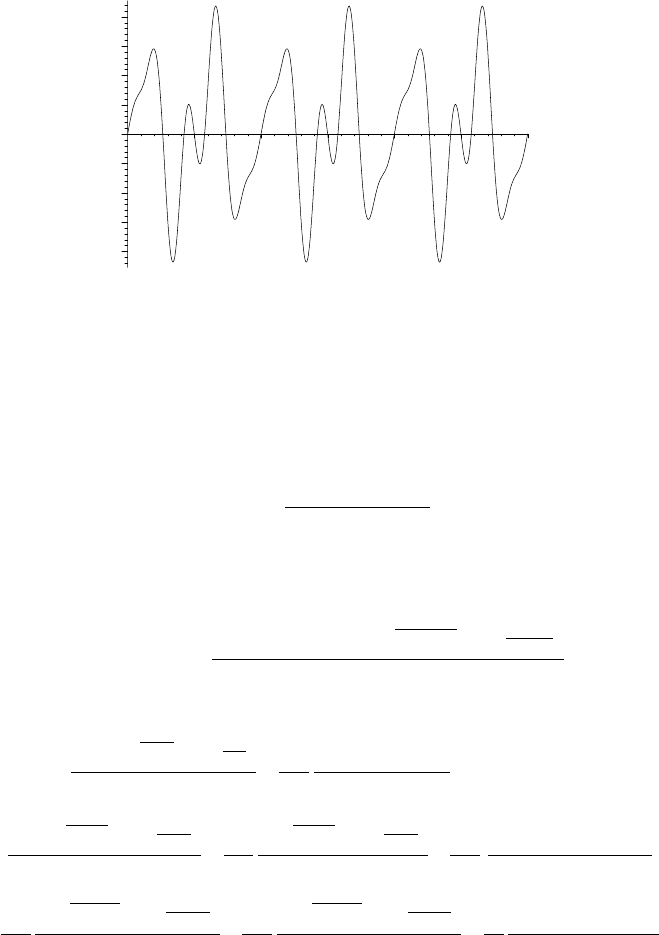
The temperature profile given in T5 is animated over the time interval t=0 to
0.025 s, the opening frame of the animation (initial temperature profile) being
shown in Figure 4.5. As t increases, T (x, t) decays to zero inside the bar.
>
animate(T5,x=0..L,t=0..0.025,frames=100,numpoints=500,
thickness=2,labels=["x","T"]);
–8
0
T
8
123
x
Figure 4.5: The initial temperature profile in the bar for part (a).
Now let’s tackle part (b) of the problem. The initial temperature profile is
a constant 25
◦
C everywhere inside the bar. Using the Fourier series approach,
the general Fourier coefficient is given by C
m
=(2/L)
L
0
25 sin(mπx/L) dx
with L = 3 and m a positive integer. This coefficient is now calculated.
>
C[m]:=(2/L)*int(25*sin(m*Pi*x/L),x=0..L) assuming m::integer;
C
m
:= −
50 (−1+(−1)
m
)
mπ
The formal Fourier series representation (out to m = 20) of the temperature is
displayed in Temp , and then explicitly calculated with the value command.
>
Temp:=Sum(C[m]*T4,m=1..20);
Temp :=
20
m=1
⎛
⎜
⎝
−
50 (−1+(−1)
m
) e
(−
2 m
2
π
2
t
9
)
sin(
mπx
3
)
mπ
⎞
⎟
⎠
>
Temp:=value(Temp);
Temp :=
100 e
(−
2 π
2
t
9
)
sin(
πx
3
)
π
+
100
3
e
(−2 π
2
t)
sin(πx)
π
+
20 e
(−
50 π
2
t
9
)
sin(
5πx
3
)
π
+
100
7
e
(−
98 π
2
t
9
)
sin(
7πx
3
)
π
+
100
9
e
(−18 π
2
t)
sin(3 πx)
π
+
100
11
e
(−
242 π
2
t
9
)
sin(
11πx
3
)
π
+
100
13
e
(−
338 π
2
t
9
)
sin(
13πx
3
)
π
+
20
3
e
(−50 π
2
t)
sin(5πx)
π
146 CHAPTER 4. LINEAR PDES OF PHYSICS
+
100
17
e
(−
578 π
2
t
9
)
sin(
17πx
3
)
π
+
100
19
e
(−
722 π
2
t
9
)
sin(
19πx
3
)
π
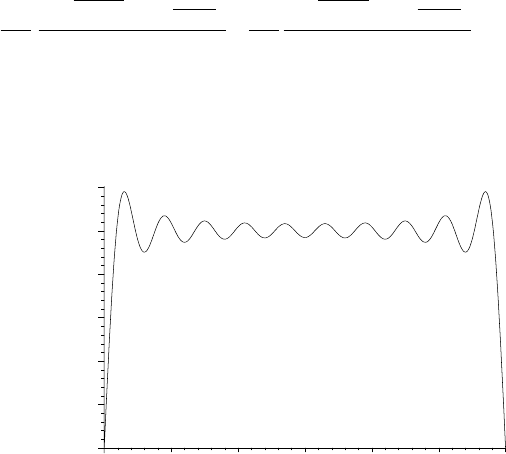
The temperature distribution is now animated over the time interval t=0 to 2
seconds, the initial frame in the animation being shown in Figure 4.6.
>
animate(Temp,x=0..L,t=0..2,frames=50,thickness=2,
numpoints=500,labels=["x","T"]);
0
5
10
15
20
25
30
T
0.5
1
1.5
2
2.5
3
x
Figure 4.6: The initial temperature profile for part (b) with 20 terms.
Because of the step function nature of the initial temperature profile at the
ends of the bar, Gibb’s oscillations appear in the initial series representation,
oscillating around the exact profile. The oscillations quickly disappear as the
animation progresses and once again T (x, t) decreases to zero inside the bar.
4.2.3 Introducing Laplace’s Equation
An editor is someone who separates the wheat from the chaff
and then prints the chaff.
Adlai Stevenson, American politician, referring to news reporting (1900–65)
In electrostatics, the electric field
E is related to the electric potential V by
E = −∇V . In SI units, Maxwell’s equations are ∇×
E = 0 and ∇·
E = ρ/
0
,
where ρ is the electric charge density and
0
the permittivity of free space. Sub-
stituting
E into the first relation yields the vector identity ∇×∇V = 0, while
the second relation produces Poisson’s equation, ∇
2
V = −ρ/
0
. In charge-free
regions of space, ρ = 0 and Poisson’s equation reduces to Laplace’s equation
∇
2
V =0. This recipe involves solving a two-dimensional electrostatic boundary-
value problem, using Laplace’s equation in Cartesian coordinates.
4.2. BEYOND THE STRING 147
Determine the potential V (x, y) in the charge-free region x ≥ 0, 0 ≤ y ≤ a,
given that the boundary at x= 0 is held at the constant potential V
0
, while the
boundaries at y=0 and a are held at zero potential. The asymptotic boundary
condition is V → 0forx →∞. Taking a =1 meter and V
0
= 2 volts, produce
two- and three-dimensional contour plots of V (x, y)forx ≥ 0, 0 ≤ y ≤ a.
After loading the plots library package, needed for the contour plots, the
two-dimensional form of Laplace’s equation is entered for the potential V (x, y).
>
restart: with(plots):
>
pde:=diff(V(x,y),x,x)+diff(V(x,y),y,y)=0;
pde := (
∂
2
∂x
2
V (x, y)) + (
∂
2
∂y
2
V (x, y)) = 0
pde is analytically solved, assuming that V (x, y)=X(x) Y (y).
>
sol:=pdsolve(pde,HINT=X(x)*Y(y),INTEGRATE,build);
sol := V (x, y)=
C3 sin(
√
c
1
y) C1 e
(
√
c
1
x)
+
C3 sin(
√
c
1
y) C2
e
(
√
c
1
x)
+ C4 cos(
√
c
1
y) C1 e
(
√
c
1
x)
+
C4 cos(
√
c
1
y) C2
e
(
√
c
1
x)
The substitution
c
1
=k is made on the rhs of sol and the result simplified.
>
sol:=simplify(subs(sqrt(_c[1])=k,rhs(sol)));
sol := (
C3 sin(ky) C1 e
(2 kx)
+ C3 sin(ky) C2
+
C4 cos(ky) C1 e
(2 kx)
+ C4 cos(ky) C2 ) e
(−kx)
To satisfy the boundary condition V =0 at y = 0, the cos(ky) term is removed
from sol by setting it equal to zero. To satisfy V =0 at y = a for arbitrary
x>0, we must have sin(ka)=0, so k = nπ/a,wheren is a positive integer.
The term e
2 kx
must also be removed so that V → 0asx →∞.
>
sol2:=subs({cos(k*y)=0,exp(2*k*x)=0,k=n*Pi/a},sol);
sol2 :=
C3 sin(
nπy
a
)
C2 e
(−
nπx
a
)
Using the operand command, op, the coefficient combination is replaced with
A. The arguments may have to be changed if the terms are ordered differently.
>
sol3:=A*op(2,sol2)*op(4,sol2);
sol3 := A sin(
nπy
a
) e
(−
nπx
a
)
Making use of orthogonality of the sine functions over the interval y =0 to a,
the coefficient A is calculated, assuming that n is an integer.
>
A:=(2/a)*int(V0*sin(n*Pi*y/a),y=0..a) assuming n::integer;
A := −
2 V0 (−1+(−1)
n
)
nπ
Entering the given values of the parameters, the result in sol3 is summed. A
large number of terms (100) is kept to obtain smooth contour plots.