
Enns R.H. Computer Algebra Recipes for Mathematical Physics
Подождите немного. Документ загружается.

158 CHAPTER 4. LINEAR PDES OF PHYSICS
GR2 :=
30
n=1
⎛
⎜
⎝
4sin(
nπb
L
)sin(
nπy
L
) e
(−
nπ(x−a)
L
)
n
⎞
⎟
⎠
The parameter values a=0.5, b=0.8, and L= 1 are entered, and the piecewise
Green’s function, G=GL2 for x<aand GR2 for x>a,formed.
>
a:=0.5: b:=0.8: L:=1:
>
G:=piecewise(x<a,value(GL2),x>a,value(GR2)):
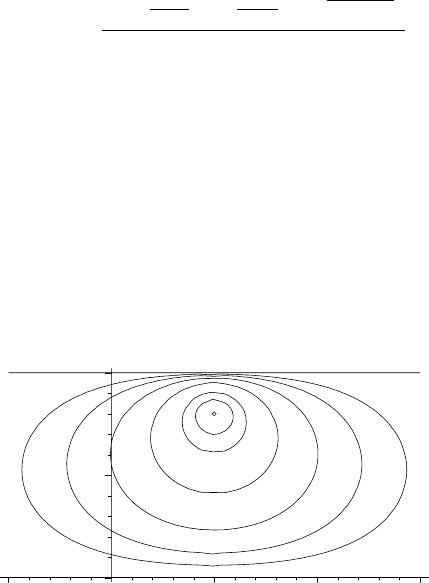
Using contourplot, equipotentials are drawn in cp for G=1/8, 1/4, 1/2, 1, 2, 3
and then superimposed on gr1 and gr2, the result being shown in Fig. 4.10.
The curve closest to the line charge is for G= 3, the furthest for G=1/8.
>
cp:=contourplot(G,x=-2..2,y=0..L,contours=[1/8,1/4,1/2,
1,2,3],grid=[70,70],color=blue,thickness=2):
>
display({gr1,gr2,cp},scaling=constrained);
0
0.5
1
y
–0.5 0.5
1
1.5
x
Figure 4.10: Equipotentials around line charge between grounded plates.
4.3 Beyond Cartesian Coordinates
Some representative non-Cartesian examples are now presented. Many more
are included in the Supplementary Recipes at the end of the chapter.
4.3.1 Is It Separable?
Alliance. In international politics, the union of two thieves who have
their hands so deeply inserted in each other’s pockets that they can-
not separately plunder a third.
Ambrose Bierce, American author, The Devil’s Dictionary (1881–1906)
The method of separation of variables can be applied to other orthogonal curvi-
linear coordinate systems besides the Cartesian system. I have found that, at
first, some students are surprised that the variable separation method works

4.3. BEYOND CARTESIAN COORDINATES 159
at all. After a while, they assume that it always works. It turns out that the
scalar Helmholtz equation, ∇
2
S +k
2
S = 0, which is the spatial part of either the
wave or diffusion equations with k a constant, is separable [MF53] in 11, and
only 11, 3-dimensional orthogonal curvilinear coordinate systems. Fortunately,
these include spherical polar and cylindrical coordinates, which are the two
most commonly used non-Cartesian systems. An example of a 3-dimensional
coordinate system for which the Helmholtz equation is not separable are the
bispherical coordinates u, v, w, which are related to x, y, z by
x =
a sin u cos v
cosh w − cos u
,y=
a sin u sin v
cosh w − cos u
,z=
a sinh w
cosh w − cos u
. (4.8)
Here a is a scale factor and 0 ≤ u<π,0≤ v ≤ 2 π, −∞ <w<∞.
As the following recipe illustrates, Laplace’s equation is not separable in
bispherical coordinates either, but can be separated into three ODEs by a mod-
ified separation assumption. This is useful, e.g., in determining the potential
outside two spheres of equal diameters, held at different potentials, and with
their centers separated by a distance greater than the sphere diameter.
2
Although, the bispherical system is known (with a =1)toMaple,itis
instructive to tackle the following problem from first principles.
(a) Plot the contours in the x-z plane corresponding to holding u and w fixed.
What surfaces are generated if v is constant?
(b) Calculate the scale factors and the Laplacian operator.
(c) Show that Laplace’s equation is not completely separable if one makes
the “standard” ansatz, S(u, v, w)=U(u) V (v) W (w).
(d) Show that Laplace’s equation is completely separable if one assumes that
S(u, v, w)=
(cosh w − cos u) U(u) V (v) W (w). Assuming that cosh w>
cos u, identify any special functions which occur in the separated ODEs.
It is assumed that u ≥ 0, u<π, v ≥ 0, v ≤ 2π, and cosh w>cos u.The
coordinate relations are then entered.
>
restart: with(plots): assume(u>=0,u<Pi,v>=0,v<=2*Pi,
cosh(w)>cos(u)):
>
x:=a*sin(u)*cos(v)/(cosh(w)-cos(u));
>
y:=a*sin(u)*sin(v)/(cosh(w)-cos(u));
>
z:=a*sinh(w)/(cosh(w)-cos(u));
To plot the surfaces corresponding to holding w fixed, let’s form X
2
+ Y
2
+
(Z − a coth w)
2
=x
2
+ y
2
+(z − a coth w)
2
and simplify the right-hand side.
>
eq1:=Xˆ2+Yˆ2+(Z-a*coth(w))ˆ2
=simplify(xˆ2+yˆ2+(z-a*coth(w))ˆ2);
eq1 := X
2
+ Y
2
+(Z −a coth(w))
2
=
a
2
sinh(w)
2
The result is the equation of a sphere of radius a/ sinh w centered at X =0,
2
An excellent source of electrostatic problems in bispherical and other coordinate systems
is Problems in Mathematical Physics by Lebedev, Skal’skaya, and Uflyand (Pergamon, 1966).
160 CHAPTER 4. LINEAR PDES OF PHYSICS
Y =0, and Z = a coth w. Different choices of w will generate different size
spheres with centers located at different Z values.
Similarly, (
√
X
2
+ Y
2
−a cot u)
2
+Z
2
=(
x
2
+ y
2
−a cot u)
2
+z
2
is entered
in eq2 and simplified.
>
eq2:=(sqrt(Xˆ2+Yˆ2)-a*cot(u))ˆ2+Zˆ2
=simplify((sqrt(xˆ2+yˆ2)-a*cot(u))ˆ2+zˆ2,symbolic);
eq2 := (
√
X
2
+ Y
2
− a cot(u))
2
+ Z
2
=
a
2
sin(u)
2
To see what type of surface is generated by holding u fixed, let’s set a = 1 and
Y =0 so as to generate plots in the X-Z plane. The unapply command is used
to free up w and u in eq1 and eq2 for plotting purposes.
>
a:=1: Y:=0: A:=unapply(eq1,w): B:=unapply(eq2,u):
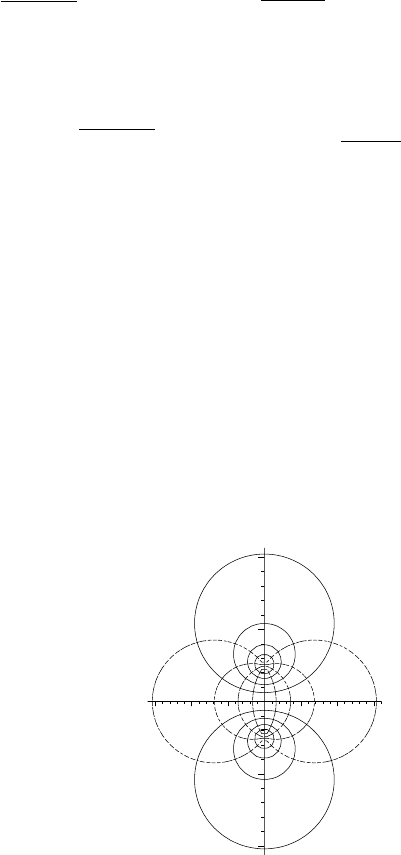
Using A and B and the implicitplot command, representative contours are
drawn for fixed w (solid circles) in gr1 and fixed u (dashed circles) in gr2
>
gr1:=implicitplot({seq(A(n/2),n=-4..-1),seq(A(n/2),n=1..4)},
X=-5*a..5*a,Z=-5*a..5*a,grid=[70,70],color=red,thickness=2):
>
gr2:=implicitplot({seq(B(0.2*Pi*n),n=1..4)},X=-5*a..5*a,
Z=-5*a..5*a,grid=[70,70],color=blue,thickness=2,linestyle=2):
and superimposed to produce Fig. 4.11.
>
display({gr1,gr2},scaling=constrained);
–4
4
Z
–2 2
X
Figure 4.11: Contours for fixed w (solid circles) and fixed u (dashed).
The corresponding 3-dimensional surfaces result on rotating the figure about
the vertical (Z) axis, the circles becoming spheres, hence the name “bispherical”
for the coordinate system. From the defining relations between the bispherical
4.3. BEYOND CARTESIAN COORDINATES 161
and Cartesian systems, one has y/x=sinv/ cos v = tan v, so holding v fixed will
produce half-planes passing through the z-axis.
A functional operator L is created for generating the Laplacian of S(u, v, w)
on specifying the coordinates u, v, w and the scale factors h
u
, h
v
, h
w
.
>
L:=(u,v,w,hu,hv,hw)->(diff(hv*hw*diff(S(u,v,w),u)/hu,u)
+ diff(hu*hw*diff(S(u,v,w),v)/hv,v)
+ diff(hu*hv*diff(S(u,v,w),w)/hw,w))/(hu*hv*hw):
An operator H is formed for producing and simplifying the scale factors.
>
H:=u->simplify(sqrt(diff(x,u)ˆ2+diff(y,u)ˆ2+diff(z,u)ˆ2),
symbolic):
Using H the three scale factors are explicitly calculated.
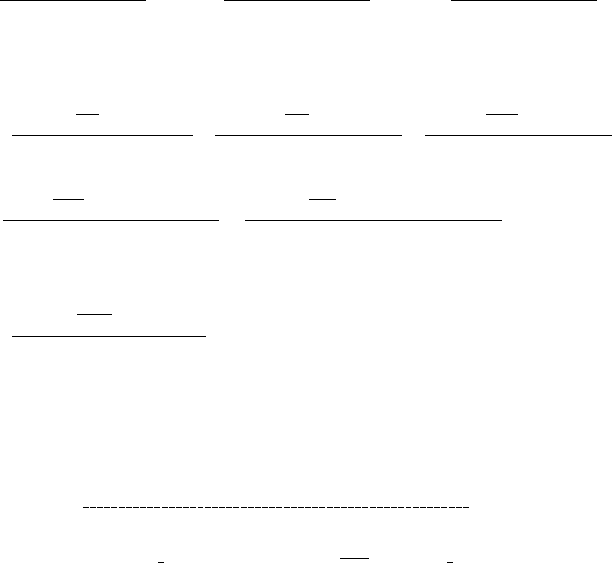
>
h[u]:=H(u); h[v]:=H(v); h[w]:=H(w);
h
u
:=
1
cosh(w) − cos(u)
h
v
:=
sin(u)
cosh(w) − cos(u)
h
w
:=
1
cosh(w) − cos(u)
Then employing L, Laplace’s equation, ∇
2
S(u, v, w) =0, is generated.
>
Lap:=L(u,v,w,h[u],h[v],h[w])=0;
Lap :=
cos(u)(
∂
∂u
S(u, v, w))
cosh(w) − cos(u)
+
sin(u)
2
(
∂
∂u
S(u, v, w))
(cosh(w) − cos(u))
2
+
sin(u)(
∂
2
∂u
2
S(u, v, w))
cosh(w) − cos(u)
+
∂
2
∂v
2
S(u, v, w)
(cosh(w) − cos(u)) sin(u)
+
sin(u)(
∂
∂w
S(u, v, w)) sinh(w)
(cosh(w) − cos(u))
2
+
sin(u)(
∂
2
∂w
2
S(u, v, w))
cosh(w) − cos(u)
(cosh(w) − cos(u))
3
/sin(u)=0
An unsuccessful attempt is made to separate Laplace’s equation by assuming
that S(u, v, w)=U(u) V (v) W (w).
>
pdsolve(Lap,HINT=U(u)*V(v)*W(w));
Warning : Incomplete separation.
(S(u, v, w)=V (v) F1 (u, w)) &where[{
d
2
dv
2
V (v)= c
2
V (v), ······
The separation is incomplete, an ODE resulting for V (v), but the u and w de-
pendence remaining coupled in a PDE, which is not displayed here in the text.
Supplying the modified separation assumption as a hint, Laplace’s equation is
now completely separated.
162 CHAPTER 4. LINEAR PDES OF PHYSICS
>
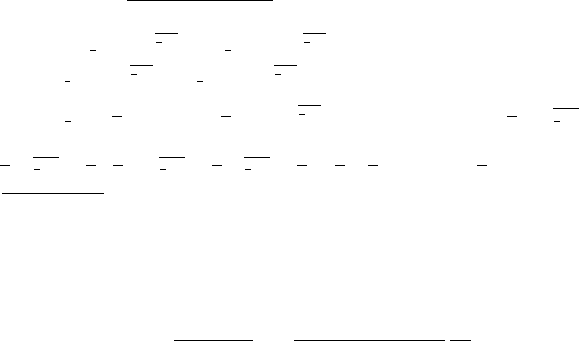
pdsolve(Lap,HINT=sqrt((cosh(w)-cos(u)))*U(u)*V(v)*W(w),
INTEGRATE);
(S(u, v, w)=
cosh(w) − cos(u) U (u) V (v) W (w)) &where
[{{W (w)=
C5 e
(
√
c
3
w)
+ C6 e
(−
√
c
3
w)
},
{V (v)=
C3 e
(
√
c
2
v)
+ C4 e
(−
√
c
2
v)
},
{U (u)=
C1 (
1
2
cos(2 u) −
1
2
)
(1/2 I
√
c
2
)
sin(2 u)hypergeom([
1
2
I
√
c
2
+
1
2
√
c
3
+
3
4
,
1
2
I
√
c
2
−
1
2
√
c
3
+
3
4
], [
3
2
],
1
2
cos(2 u)+
1
2
)
1 − cos(2 u)+···}}]
W (w)andV (v) are both expressed in terms of exponentials, but U is given in
terms of hypergeometric functions. The hypergeometric function F (a, b; c; z)is
given by the following infinite series [AS72], where Γ is the Gamma function,
F (a, b; c; z)=
Γ(c)
Γ(a)Γ(b)
∞
n=0
Γ(a + n)Γ(b + n)
Γ(c + n)
z
n
n!
.
4.3.2 A Shell Problem, Not a Shell Game
Insurance. An ingenious modern game of chance in which the player
is permitted to enjoy the comfortable conviction that he is beating the
man who keeps the table.
Ambrose Bierce, American author, The Devil’s Dictionary (1881–1906)
In creating physics exams at the freshman level, I often play a bit of a shell
game, presenting problems similar to those that the students have solved for
homework, but in new guises and combinations. The hope is that they really
understand the underlying principles and methods and haven’t merely memo-
rized the solutions to the homework problems. At the senior level, I rely less
on “disguise ” and more on having students explore challenging problems, even
“standard” ones, in some depth. A computer algebra approach is encouraged
as an auxiliary tool. The following recipe, submitted by Ms. I. M. Curious, is
based on a standard problem appearing on an exam given to my senior electro-
magnetic theory class.
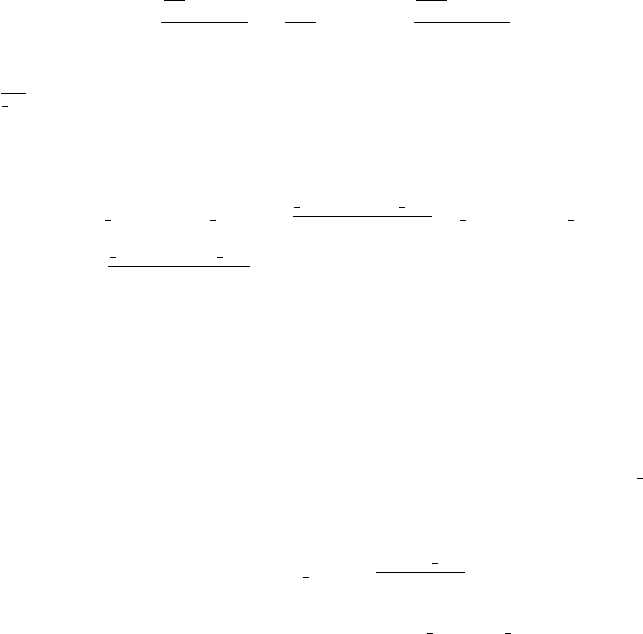
A very long circular cylindrical shell of dielectric constant and inner and
outer radii a and b, respectively, is placed in a previously uniform electric field
E
0
with the cylinder axis perpendicular to the field. The medium inside (r<a)
and outside (r>b) the cylindrical shell has a dielectric constant of unity.
(a) Determine the potential and electric field in the three regions.
(b) Taking =3, a =1, b =2, and E
0
= 1, plot the equipotentials and electric
field vectors in all three regions in a single figure. Discuss the results and
explore the effect of changing the parameter values.
4.3. BEYOND CARTESIAN COORDINATES 163
In addition to the plots library package, I. M. loads the plottools and VectorCal-
culus packages. Plottools contains the circle command which she will use for
drawing the inner and outer radii of the cylindrical shell. The VectorCalculus
package is needed for the Laplacian and Gradient commands.
>
restart: with(plots): with(plottools): with(VectorCalculus):
Neglecting end effects, the cylindrical shell is taken to be infinitely long in
the z direction, thus reducing the problem to 2 dimensions in the x-y plane.
Noting the circular symmetry, I. M. introduces the polar coordinates (r, θ)with
x=r cos θ and y = r sin θ, r being measured from the cylinder axis and θ from
the x-axis. Laplace’s equation is entered in polar coordinates and expanded.
>
pde:=expand(Laplacian(phi(r,theta),’polar’[r,theta]))=0;
pde :=
∂
∂r
φ(r, θ)
r
+(
∂
2
∂r
2
φ(r, θ)) +
∂
2
∂θ
2
φ(r, θ)
r
2
=0
Using the separation of variables method, a general solution is sought of the
form φ(r, θ)=R(r)Θ(θ). For convenience, I. M. replaces the separation constant
√
c
1
that appears on the rhs of sol with the symbol k.
>
sol:=pdsolve(pde,HINT=R(r)*Theta(theta),INTEGRATE,build);
>
sol2:=subs(sqrt(_c[1])=k,rhs(sol));
sol2 :=
C3 sin(kθ) C1 r
k
+
C3 sin(kθ) C2
r
k
+ C4 cos(kθ) C1 r
k
+
C4 cos(kθ)
C2
r
k
Taking the electric field to be in the x direction, I. M. notes that the solution
must have reflection symmetry (is unchanged if θ →−θ) around the x axis. So
she removes the sine terms, which are odd functions of θ,fromsol2 .Asr →∞,
the electric field must remain uniform and is given by
E
0
=E
0
ˆe
x
=−(∂φ/∂x)ˆe
x
,
so the asymptotic potential is φ= −E
0
x=−E
0
r cos θ, the arbitrary constant in
the potential being set equal to zero. This immediately implies that k =1, which
must hold in every region to satisfy the boundary conditions. I. M. substitutes
k = 1 and, without loss of generality, also sets the redundant coefficient
C4
equalto1aswell.
>
sol3:=subs({_C4=1,k=1},remove(has,sol2,sin));
sol3 := cos(θ)
C1 r +
cos(θ) C2
r
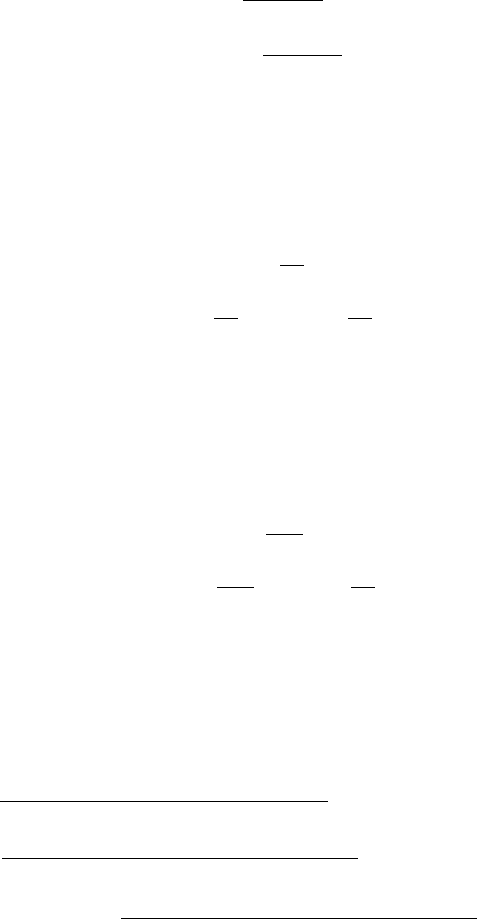
I. M. labels φ in the regions r<a, a<r<b,andr>bas φ1, φ2, and φ3. An
operator P is formed for relabeling the coefficients
C1and C2foreachφ.
>
P:=(u,v)->subs({_C1=u,_C2=v},sol3):
For r<a,the1/r term must be removed from φ1 for it to remain finite at
r =0. SoI.M.formsφ1 by setting v =0 in P and u = A
1
.Forφ2, she chooses
u = A
2
, v = B
2
.Forφ3, she takes u = −E0, in order to match the asymptotic
boundary condition as r →∞,andv = B
3
.
164 CHAPTER 4. LINEAR PDES OF PHYSICS
>
phi1:=P(A[1],0); phi2:=P(A[2],B[2]); phi3:=P(-E0,B[3]);
φ1 := cos(θ) A
1
r
φ2 := cos(θ) A
2
r +
cos(θ) B
2
r
φ3:=−cos(θ) E0 r +
cos(θ) B
3
r
With A
1
, A
2
, B
2
,andA
3
unknown, 4 boundary conditions are required. The
potentials φ1=φ2atr = a and φ2=φ3atb for arbitrary θ. The following
operator F is created to match the potentials u and v at a radius r =R.
>
F:=(u,v,R)-> expand(eval((u=v)/cos(theta),r=R)):
Using F, the above boundary conditions are applied in eq1 and eq2 .
>
eq1:=F(phi1,phi2,a); eq2:=F(phi2,phi3,b);
eq1 := A
1
a = A
2
a +
B
2
a
eq2 := A
2
b +
B
2
b
= −E0 b +
B
3
b
The radial component of the displacement vector
D =
E is continuous at the
boundaries, so ∂φ1/∂r = (∂φ2/∂r)atr = a and (∂φ2/∂r)=∂φ3/∂r at r = b.
An operator G is created for equating the radial derivative of u and v at a radius
R.UsingG, the two boundary conditions are applied in eq3 and eq4 .
>
G:=(u,v,R)->expand(eval(diff(u=v,r),r=R)/cos(theta)):
>
eq3:=G(phi1,epsilon*phi2,a); eq4:=G(epsilon*phi2,phi3,b);
eq3 := A
1
= εA
2
−
εB
2
a
2
eq4 := εA
2
−
εB
2
b
2
= −E0 −
B
3
b
2
The four equations are solved for the four coefficients and sol4 assigned.
>
sol4:=solve({eq1,eq2,eq3,eq4},{A[1],A[2],B[2],B[3]});
assign(sol4):
The potentials φ1, φ2, and φ3 are now determined, the coefficients being auto-
matically substituted.
>
phi1:=phi1; phi2:=simplify(phi2); phi3:=phi3;
φ1:=−
4 cos(θ) ε E0 b
2
r
2 εa
2
− a
2
+2εb
2
+ b
2
− ε
2
a
2
+ b
2
ε
2
φ2:=−
2 cos(θ) E0 b
2
(r
2
ε + r
2
+ εa
2
− a
2
)
(2 εa
2
− a
2
+2εb
2
+ b
2
− ε
2
a
2
+ b
2
ε
2
) r
φ3:=−cos(θ) E0 r +
cos(θ) E0 b
2
(−ε
2
a
2
+ b
2
ε
2
+ a
2
− b
2
)
(2 εa
2
− a
2
+2εb
2
+ b
2
− ε
2
a
2
+ b
2
ε
2
) r
An operator EF is formed for calculating the electric field in polar coordinates,
given some potential f.

4.3. BEYOND CARTESIAN COORDINATES 165
>
EF:=f->-Gradient(f,’polar’[r,theta]):
The electric field is then explicitly calculated in each region, but only the field
EF1 in region 1 is displayed here.
>
EF1:=EF(phi1); EF2:=EF(phi2); EF3:=EF(phi3);
EF1 :=
4 cos(θ) ε E0 b
2
2 εa
2
− a
2
+2εb
2
+ b
2
− ε
2
a
2
+ ε
2
b
2
e
r
−
4sin(θ) ε E0 b
2
2 εa
2
− a
2
+2εb
2
+ b
2
− ε
2
a
2
+ ε
2
b
2
e
θ
The parameter values =3, a=1, b=2, and E
0
=1 are now entered.
>
epsilon:=3: a:=1: b:=2: E0:=1:
For plotting purposes, I. M. changes to Cartesian coordinates by entering r =
x
2
+ y
2
,cosθ = x/r and sin θ = y/r.
>
r:=sqrt(xˆ2+yˆ2): cos(theta):=x/r: sin(theta):=y/r:
The potential V for all three regions is formed with the piecewise command
and the radical expressions simplified with the radsimp command. The electric
field Ef is then calculated from V using the Gradient command and again the
radicals are simplified.
>
V:=radsimp(piecewise(r<a,phi1,r<b,phi2,phi3));
Ef:=-radsimp(Gradient(V,[x,y]));
V :=
⎧
⎪
⎪
⎪
⎪
⎪
⎨
⎪
⎪
⎪
⎪
⎪
⎩
−
4 x
5
x
2
+ y
2
< 1
−
4(2x
2
+2y
2
+1)x
15 (x
2
+ y
2
)
x
2
+ y
2
< 2
−
(5 x
2
+5y
2
− 8) x
5(x
2
+ y
2
)
otherwise
The equipotentials of V are produced in gr1 over the range x=−4..4, y = −4..4
with the contourplot command, 25 contours being requested. I. M. colors the
plot by including filled=true as an option.
>
gr1:=contourplot(V,x=-4..4,y=-4..4,contours=25,filled=true):
An operator C is formed to plot a thick red circle of radius r, centered at the
origin. Then C is used in gr2 and gr3 to produce circles of radius a and b,
representing the inner and outer radii of the cylindrical shell.
>
C:=r->circle([0,0],r,color=red,thickness=3):
gr2:=C(a): gr3:=C(b):
The fieldplot command is used in gr4 to plot the electric field vectors as
medium sized blue arrows. The density of the arrows is controlled.
>
gr4:=fieldplot([Ef[1],Ef[2]],x=-4..4,y=-4..4,color=blue,
arrows=MEDIUM,grid=[20,20]):
The four graphs are superimposed with the display command, the scaling
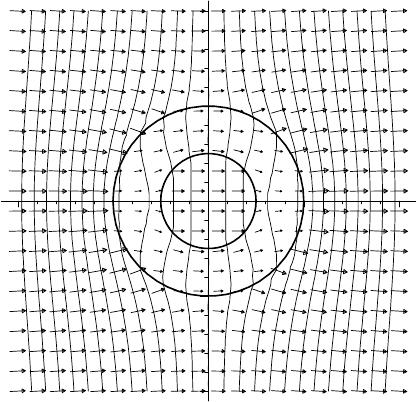
being constrained. The resulting picture is shown in Figure 4.12.
>
display({gr1,gr2,gr3,gr4},scaling=constrained);
166 CHAPTER 4. LINEAR PDES OF PHYSICS
–4
4
y
–4 4
x
Figure 4.12: The electric field arrows and equipotentials for a cylindrical dielec-
tric shell inserted in a previously uniform (horizontal) electric field.
Referring to the figure, I. M. notes that the electric field for r<ais completely
horizontal and therefore parallel to the asymptotic field. The arrows are slightly
shorter however. Quantitatively, the ratio of the electric field for r<ato the
asymptotic field is A
1
/E
0
=4/5. Unlike the situation for a conductor, the
surfaces of the dielectric shell are not equipotentials so the electric field vectors
are not perpendicular to the inner and outer surfaces of the shell.
I. M. leaves it to you, the reader, to explore her recipe. For example, you
might take to be much larger, or alter b with a fixed. She reminds you that
in interpreting any result to remember that the arrows are not field lines.
4.3.3 The Little Drummer Boy
Shall I play for you! pa rum pum pum on my drum.
From the Christmas carol, Little Drummer Boy
Little Daniel loves to bang on large pots and pans with a wooden spoon, creat-
ing his own version of music, which to untrained adult ears such as mine sounds
a lot like noise. Here’s a quieter version of “drum playing”.
A large circular drumhead of radius r = a = 1 m has its perimeter fixed.
If the drumhead has an initial shape U(r, θ, 0) = r (1 − r
2
/a
2
)sin(2θ)/20 and
is released from rest, determine the shape of the drumhead at arbitrary time
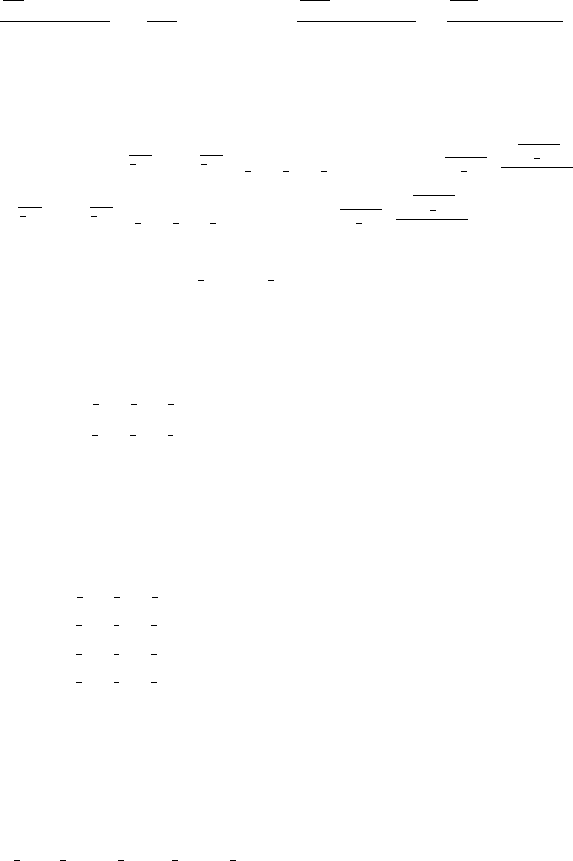
4.3. BEYOND CARTESIAN COORDINATES 167
t>0. Takethewavespeedtobec = 1 m/s. Then, animate the motion of the
drumhead in time steps of 0.1 s over the interval t=0to2s.
After loading the plots and VectorCalculus packages, the wave equation pde
is entered in polar coordinates (r, θ), making use of the Laplacian command.
>
restart: with(plots): with(VectorCalculus):
>
pde:=expand(Laplacian(U(r,theta,t),’polar’[r,theta]))
=(1/cˆ2)*diff(U(r,theta,t),t,t);
pde :=
∂
∂r
U (r, θ, t)
r
+(
∂
2
∂r
2
U (r, θ, t)) +
∂
2
∂θ
2
U (r, θ, t)
r
2
=
∂
2
∂t
2
U (r, θ, t)
c
2
Then pde is analytically solved, assuming that U(r, θ, t)=R(r)Θ(θ) T (t).
>
sol:=pdsolve(pde,HINT=R(r)*Theta(theta)*T(t),INTEGRATE,
build);
sol := U (r, θ, t)=e
(
√
c
3
t)
e
(
√
c
2
θ)
C5 C3 C1 BesselJ(
√
− c
2
,
√
− c
3
r
c
)
+ e
(
√
c
3
t)
e
(
√
c
2
θ)
C5 C3 C2 BesselY(
√
− c
2
,
√
− c
3
r
c
)+···
The answer involves exponentials and Bessel functions of the first and second
kinds. The separation constants
c
2
and c
3
on the rhs of sol are replaced with
−p
2
and −c
2
k
2
, and the result simplified with the symbolic option.
>
U1:=simplify(subs({_c[2]=-pˆ2,_c[3]=-cˆ2*kˆ2},rhs(sol)),
symbolic);
U1 :=
C5 C3 C1 BesselJ(p, k r) e
((ckt+pθ) I)
+ C5 C3 C2 BesselY(p, k r) e
((ckt+pθ) I)
+ ···
The Bessel functions Y
p
(kr) of the second kind diverge at r =0, so are removed
from U1 .ThenU2 is converted to trig form and expanded in U3 .
>
U2:=remove(has,U1,BesselY);
>
U3:=expand(convert(U2,trig));
U3 :=
C5 C3 C1 BesselJ(p, k r) cos(ckt) cos(pθ)
−
C5 C3 C1 BesselJ(p, k r)sin(ckt)sin(pθ)
+
C5 C4 C1 BesselJ(p, k r)sin(ckt) cos(pθ) I
+
C5 C3 C1 BesselJ(p, k r) cos(ckt)sin(pθ) I + ···
The initial transverse velocity of the drumhead is zero, so the sin(ckt)terms
must be removed from U3 . Since the initial shape involves a sine function only,
there can be no cosine terms present in the solution. The cos(pθ) terms are
therefore also removed in U4 and the result then factored.
>
U4:=factor(remove(has,U3,{sin(c*k*t),cos(p*theta)}));
U4 :=
C1 ( C3 − C4 )( C5 + C6 )sin(pθ) cos(ckt) BesselJ(p, k r)I