
Enns R.H. Computer Algebra Recipes for Mathematical Physics
Подождите немного. Документ загружается.


258 CHAPTER 7. CALCULUS OF VARIATIONS
Consider a tiny bug (Betsy Bug) of mass m starting from rest and sliding
under the influence of gravity along a smooth greased wire from some fixed
point A to another fixed point B somewhere (but not directly) below A.What
should the shape y(x) of the wire be between A and B so that Betsy’s time of
descent is a minimum?
Let’s take the point A to be at the origin (i.e., x
0
=0, y
0
= 0) and measure
y downwards. Neglecting friction and air resistance, Betsy’s speed v when she
passes through an arbitrary lower point P (x, y) is obtained by equating her in-
crease in kinetic energy to the decrease in potential energy, i.e.,
1
2
mv
2
= mgy,
or v =
√
2gy,whereg is the acceleration due to gravity. But v = ds/dt where
ds=
(dx)
2
+(dy)
2
=
1+(y
)
2
dx is an element of arc length along the path
at P and dt is the time it takes for Betsy to traverse ds. Combining these
results, the time T of descent from A to B(where x = x
1
,y = y
1
)is
T =
x
1
0
1+(y
)
2
dx
√
2gy
.
The y(x) which minimizes T follows on solving (7.2) with F =
1+(y
)
2
/
√
2gy.
In this recipe, we will derive Betsy’s path in the parametric form
x =
a
2
(θ −sin θ),y=
a
2
(1 − cos θ),
with θ a parameter which is equal to 0 at A. Then, taking θ= θ1 at B, we will
show that the minimum time of descent is T =
a/2gθ1 . Finally, choosing
x
1
=5m,y
1
= 2 m, Betsy’s path will be plotted and T evaluated.
If the form of F is specified, the EulerLagrange command will calculate the
left-hand side of (7.2), and even produce the first integral if possible. To use
this command, the VariationalCalculus package must be first loaded.
>
restart: with(VariationalCalculus):
The relevant F for the brachistochrone problem is entered. The factor 1/
√
2g
is omitted since it will cancel out of the Euler–Lagrange equation, (7.2).
>
F:=sqrt(1+diff(y(x),x)ˆ2)/sqrt(y(x));
F :=
1+(
d
dx
y(x))
2
y(x)
The EulerLagrange command, with F , x,andy(x) given as arguments, is
applied to F and simplified, generating two results.
>
eq:=simplify(EulerLagrange(F,x,y(x)));
eq :=
⎧
⎪
⎨
⎪
⎩
1
1+(
d
dx
y(x))
2
y(x)
= K
1
, −
1
2
1+(
d
dx
y(x))
2
+2(
d
2
dx
2
y(x)) y(x)
y(x)
(3/2)
(1+(
d
dx
y(x))
2
)
(3/2)
⎫
⎪
⎬
⎪
⎭
Since F doesn’t explicitly depend on x here, the first integral is generated in
the first expression in the above output, the integration constant being K
1
.
The second expression is just the left-hand side of the resulting ODE generated
7.1. EULER–LAGRANGE EQUATION 259
by the Euler–Lagrange equation. We will work with the first integral and now
select it in eq2 . The last argument, [1], in the command line removes the curly
(Maple set) brackets which would otherwise enclose the first integral expression.
>
eq2:=select(has,eq,K[1])[1];
eq2 :=
1
1+(
d
dx
y(x))
2
y(x)
= K
1
The dsolve command is used to analytically solve eq2 for y(x). The parametric
option is specified, since a parametric form of the solution is desired.
>
sol:=dsolve(eq2,y(x),parametric);
sol :=
,
y(
T )=
1
K
1
2
(1 + T
2
)
,
x(
T )=
−
T − arctan( T ) − arctan( T ) T
2
+ C1 K
1
2
+ C1 K
1
2
T
2
K
1
2
(1 + T
2
)
-
The mathematical forms of x and y are given in terms of the parameter
T .The
quantity
C1 is a second integration constant. A new parameter θ is introduced
by setting
T = cos(θ/2)/ sin(θ/2). The constant K
1
is set equal to 1/
√
a.
>
_T:=cos(theta/2)/sin(theta/2): K[1]:=1/sqrt(a):
Let’s tackle x first. The right-hand side of the second expression in sol is
symbolically simplified with the trig option, the above assignments having been
automatically substituted.
>
x:=simplify(rhs(sol[2]),trig,symbolic);
x := −cos(
θ
2
) a sin(
θ
2
) − arctan
⎛
⎜
⎝
cos(
θ
2
)
sin(
θ
2
)
⎞
⎟
⎠
a +
C1
Applying the combine command with the trig option reduces the first term in
x to one of the terms desired in the final form of x.
>
x:=combine(x,trig);
x := −
1
2
a sin(θ) − arctan
⎛
⎜
⎝
cos(
θ
2
)
sin(
θ
2
)
⎞
⎟
⎠
a +
C1
We must choose the constant
C1 in such a way that the last two terms in the
above output reduce to aθ/2. To do this, recall that the parameter θ must have
the value 0 when x=0. For θ=0, the first term in the above output is 0, while
the second term yields −a arctan(∞), or −aπ/2. Thus, to make θ =0 at x=0,
we must choose
C1 = aπ/2. This substitution is now made in x. We further
substitute cos(θ/2)= cot(θ/2) sin(θ/2).
>
x:=subs({_C1=a*Pi/2,cos(theta/2)=cot(theta/2)*sin(theta/2)},x );

260 CHAPTER 7. CALCULUS OF VARIATIONS
x := −
1
2
a sin(θ) − arctan(cot(
θ
2
)) a +
aπ
2
Applying the combine command with the trig option, and then making the
substitution arccot(cot(θ/2))= θ/2 produces the desired final form for x.
>
x:=combine(x,trig);
x := −
1
2
a sin(θ)+a arccot(cot(
θ
2
))
>
x:=subs(arccot(cot(theta/2))=theta/2,x);
x := −
1
2
a sin(θ)+
aθ
2
Next, we tackle y by selecting the first expression from the right-hand side of
sol and simplifying with the trig and symbolic options.
>
y:=simplify(rhs(sol[1]),trig,symbolic);
y := a sin(
θ
2
)
2
Applying combine, with the trig option, yields the final desired form of y.
>
y:=combine(y,trig);
y :=
a
2
−
1
2
a cos(θ)
With the parametric forms of x and y determined, the minimum time of descent
can be calculated. First note that the time of descent
T =
x
1
0
1+
dy(x)
dx
2
dx
2 gy(x)
=
θ1
0
1+
dy(θ)/dθ
dx(θ)/dθ
2
dx(θ)
dθ
dθ
2 gy(θ)
,
where θ1 is the value of θ at the end point B. The latter integrand is now
calculated and simplified assuming that θ>0.
>
integrand:=simplify(sqrt(1+(diff(y,theta)/diff(x,theta))ˆ2)
*diff(x,theta)/sqrt(2*g*y)) assuming theta>0;
integrand :=
1
2
√
2 a
√
ga
The minimum time of descent, assigned the name T , follows on integrating the
integrand from θ =0 to θ1 .
>
T:=int(integrand,theta=0..theta1);
T :=
1
2
√
2 aθ1
√
ga
The value of θ1 depends on the coordinates x
1
, y
1
of the point B, and must be
determined numerically. This is now done for the specified values x
1
=5, y
1
=2.
>
x1:=x=5; y1:=y=2;
x1 := −
1
2
a sin(θ)+
aθ
2
=5 y1 :=
a
2
−
1
2
a cos(θ)=2
7.1. EULER–LAGRANGE EQUATION 261
The above pair of equations is solved numerically for the constant a and the
value of θ at B, i.e., θ1 .
>
sol2:=fsolve({x1,y1},{a,theta});
sol2 := {θ =3.819665136,a=2.248728127}
Thevaluesofθ1 and a are now expressed separately.
>
theta1:=eval(theta,sol2); a:=eval(a,sol2);
θ1 := 3.819665136 a := 2.248728127
Betsy’s path then is given by the following expressions for x and y. Taking
g =9.8m/s
2
, her time of descent is also calculated.
>
x:=x; y:=y; g:=9.8: T:=evalf(T);
x := −1.124364064 sin(θ)+1.124364064 θ
y := 1.124364064 −1.124364064 cos(θ)
T := 1.293795782
Along the path given by the above forms of x and y, Betsy takes about 1.29
seconds to travel from the origin (A)toB. This is the minimum time possible
between these points, any other path producing a longer time. If you don’t
believe it, try calculating the time for descent along, e.g., a straight line path
between A and B.
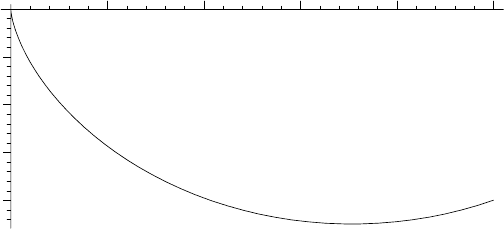
Finally, Betsy’s path is plotted from θ =0 to θ1 with constrained scaling.
The resulting picture is shown in Figure 7.1. Mathematically, the path is a
portionofaninvertedcycloid. Another example of a cycloidal path is the
trajectory traced out by a point on the rim of a wheel rolling without slipping.
>
plot([x,-y,theta=0..theta1],scaling=constrained,
thickness=2,labels=["x","y"]);
–2
y
–1
0
12345
x
Figure 7.1: Betsy’s path which minimizes the time of descent.

262 CHAPTER 7. CALCULUS OF VARIATIONS
7.1.2 Fermat’s Principle
The light that radiates from the great novels time can never dim....
Milan Kundera, Czech author, critic, (1929–)
Fermat’s principle states that a ray of light in a medium with a variable re-
fractive index n will follow the path which requires the shortest traveling time.
Consider a medium which has a refractive index n(x, y)=e
ay
,withx the hori-
zontal and y the vertical coordinate, respectively. Noting that the speed of light
is v = c/n,wherec is the vacuum speed of light, determine the general equation
for the light ray path. Taking a = 1, determine the light ray path between the
points (−1, 1) and (1, 1) and plot it.
Now the light ray speed v = ds/dt = c/n,whereds =
(dx)
2
+(dy)
2
=
1+(y
)
2
dx is an element of arclength and dt is a time interval. So, since
n= e
ay
, the total time to travel between x=−1 and +1 is given by
T =
1
c
1
−1
e
ay
1+(y
)
2
dx.
Omitting the constant factor 1/c which cancels out, the Euler–Lagrange equa-
tion will be solved with F =e
ay
1+(y
)
2
. As in the previous recipe, since F
doesn’t explicitly depend on x, a first integral must exist.
After loading the VariationalCalculus package, the refractive index n is en-
tered and F formed.
>
restart: with(VariationalCalculus):
>
n:=exp(a*y(x)); F:=n*sqrt(1+diff(y(x),x)ˆ2);
n := e
(a y(x))
F := e
(a y(x))
1+(
d
dx
y(x))
2
The EulerLagrange command is applied to F and the result simplified.
>
eq:=simplify(EulerLagrange(F,x,y(x)));
eq :=
⎧
⎪
⎪
⎨
⎪
⎪
⎩
e
(a y(x))
1+(
d
dx
y(x))
2
= K
1
, −
e
(a y(x))
(−a − a (
d
dx
y(x))
2
+(
d
2
dx
2
y(x)))
(1+(
d
dx
y(x))
2
)
(3/2)
⎫
⎪
⎪
⎬
⎪
⎪
⎭
In addition to generating the left-hand side of the Euler–Lagrange equation (sec-
ond term in eq ), the first integral has been generated (first term) as expected.
Once again, we will work with the first integral, selecting the expression from
eq which contains the constant K
1
.
>
eq2:=select(has,eq,K[1])[1];
eq2 :=
e
(a y(x))
1+(
d
dx
y(x))
2
= K
1

7.1. EULER–LAGRANGE EQUATION 263
Then, eq2 is analytically solved for y(x) using the dsolve command and as-
suming that K
1
is real. If this assumption is not made, a much more formidable
form of the solution will occur. Further, even with the assumption included,
there occasionally may appear more possible forms of y(x) in the output of sol.
If this occurs, either select the solution which corresponds to the one chosen
here or re-execute the work sheet to get an identical output.
>
sol:=dsolve(eq2,y(x)) assuming K[1]::real;
sol := y(x)=
1
2
ln(K
1
2
)
a
, y(x)=
ln(
tan(a (x − C1 ))
2
+1K
1
tan(a (x − C1 ))
)
a
,
y(x)=
ln(−
tan(a (x − C1 ))
2
+1K
1
tan(a (x − C1 ))
)
a
Noting that the second and third solutions in sol turn out to be equivalent, the
rhs of the third solution is chosen and converted to sines and cosines.
>
y:=convert(rhs(sol[3]),sincos);
y :=
ln
⎛
⎜
⎜
⎜
⎜
⎝
−
sin(a (x −
C1 ))
2
cos(a (x −
C1 ))
2
+1K
1
cos(a (x − C1 ))
sin(a (x − C1 ))
⎞
⎟
⎟
⎟
⎟
⎠
a
The form of y is considerably simplified in y2 by applying the radical simplifi-
cation command followed by combine with the trig option.
>
y2:=combine(radsimp(y),trig);
y2 :=
ln(−
K
1
sin(ax− a
C1 )
)
a
With an analytic form for the light ray path determined, the given parameter
values are now entered. Here h is the vertical coordinate of the end points of
the light ray path and x=±L will be the end points’ horizontal coordinates.
>
a:=1: h:=1: L:=1:
The light ray must pass through the points (x= L, y = h)and(−L, h). These
boundary conditions are entered in bc1 and bc2 , respectively.
>
bc1:=eval(y2,x=L)=h; bc2:=eval(y2,x=-L)=h;
bc1 := ln(
K
1
sin(−1+
C1 )
)=1 bc2 := ln(
K
1
sin(1 +
C1 )
)=1
Then bc1 and bc2 are numerically solved for K
1
and C1 and the solution
assigned. K
1
and C1 are automatically substituted into y2 which is displayed.
>
sol2:=fsolve({bc1,bc2},{K[1],_C1}); assign(sol2): y2:=y2;
sol2 := {
C1 = −7.853981634,K
1
= −1.468693940}
264 CHAPTER 7. CALCULUS OF VARIATIONS
y2 := ln(
1.468693940
sin(x +7.853981634)
)
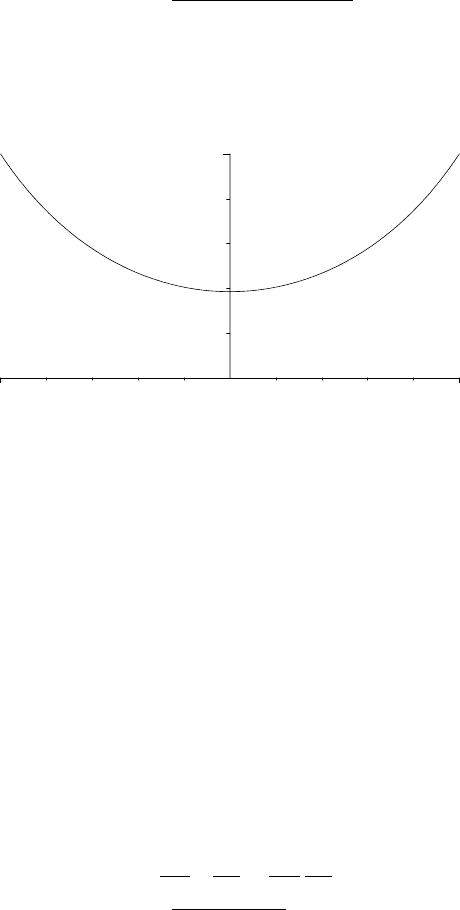
The solution y2 is now plotted with constrained scaling,
>
plot(y2,x=-L..L,thickness=2,tickmarks=[3,2],view=
[-L..L,0..h],scaling=constrained,labels=["x","y"]);
0
1
y
–1 1
x
Figure 7.2: Path traced by light ray between the points (−1, 1) and (1, 1).
the light ray path being shown in Figure 7.2. The path joining the two points
is curved rather than a straight line.
7.1.3 Betsy’s Other Path
Adulthood is the ever-shrinking period between childhood and old age.
It is the apparent aim of modern industrial societies to reduce this
period to a minimum.
Thomas Szasz, American psychiatrist, The Second Sin,“Social Relations” (1973)
Suppose that we want to find the function y(x) which minimizes or maximizes
I[y]=
x
1
x
0
F (x, y, y
) dx,withy fixed at x
0
, but with the other end point x
1
free to lie anywhere along the curve G(x, y) = 0. According to Mathews and
Walker [MW71], y(x) may still be found by solving the Euler–Lagrange equa-
tion, but subject to the subsidiary condition
F −y
∂F
∂y
∂G
∂y
−
∂F
∂y
∂G
∂x
=0. (7.4)
For the brachistochrone, F =
(1 + (y
)
2
)/y and the condition (7.4) reduces
to y
=(∂G/∂y)/(∂G/∂x). I.e., the curve of quickest descent must intersect
G(x, y) =0 at right angles.
As a simple illustration of applying this latter condition, suppose that Betsy
bug now slides down a smooth wire from the origin (starting at rest, and with y
measured downwards) to the parabola y =mx
2
+ c, where the parabola passes

7.1. EULER–LAGRANGE EQUATION 265
through the two points (x=0,y =50) and (30, 0) cm. Determine the path which
minimizes Betsy’s time of descent to the parabola. Taking g =980 cm/s
2
,how
long does it take Betsy to reach the parabola and through what distance does
she drop? Plot Betsy’s path and the parabola, using constrained scaling.
After loading the plots package, the parabolic equation G is entered.
>
restart: with(plots):
>
G:=Y-m*Xˆ2-c=0;
G := Y − mX
2
− c =0
Evaluating G at the two given points and solving yields the values of m and c.
>
sol:=solve({eval(G,{X=0,Y=50}),eval(G,{X=30,Y=0})},{m,c});
sol := {c =50,m=
−1
18
}
Assigning sol, the explicit form of the parabola G then is as follows.
>
assign(sol): G:=G;
G := Y +
X
2
18
− 50 = 0
The quantity (∂G/∂Y )/(∂G/∂X) is calculated and evaluated at the (still un-
known) end point X =x
1
.
>
s:=eval(lhs(diff(G,Y))/lhs(diff(G,X)),X=x1);
s :=
9
x1
Since F isthesameasinRecipe07-1-1, the path of quickest descent must
have the same mathematical form as obtained earlier. In parametric form, the
equations describing the x and y coordinates of the path are as follows:
>
x:=(a/2)*(theta-sin(theta)); y:=(a/2)*(1-cos(theta));
x :=
1
2
a (θ − sin(θ)) y :=
1
2
a (1 − cos(θ))
The slope of the path, dy/dx or (dy/dθ)/(dx/dθ), must be equal to s at some
unknown value θ1 of the parameter θ. This boundary condition is now entered.
>
bc||1:=eval(diff(y,theta)/diff(x,theta),theta=theta1)=s;
bc1 :=
sin(θ1)
1 − cos(θ1)
=
9
x1
As two additional conditions, x and y evaluated at θ = θ1 must be equal to x1
and y1 . Finally, in bc4 we evaluate G at X = x1 and Y = y1 .
>
bc||2:=x1=eval(x,theta=theta1);
bc2 := x1 =
1
2
a (θ1 − sin(θ1))
>
bc||3:=y1=eval(y,theta=theta1);
bc3 := y1 =
1
2
a (1 − cos(θ1))
>
bc||4:=eval(G,{X=x1,Y=y1});
266 CHAPTER 7. CALCULUS OF VARIATIONS
bc4 := y1 +
x1
2
18
− 50 = 0
The 4 boundary conditions are numerically solved for x1 , y1 , a,andθ1.
>
sol2:=fsolve({seq(bc||i,i=1..4)},{x1,y1,a,theta1},x1=0..30);
sol2:={a =26.49236117,x1 =22.15176281,θ1= 2.369761726,y1 =22.73885580}
Assigning sol2 , the parametric equations describing Betsy’s path are as follows:
>
assign(sol2): x:=x; y:=y;
x := 13.24618058 θ −13.24618058 sin(θ)
y := 13.24618058 −13.24618058 cos(θ)
Entering the value of g, the distance h through which Betsy drops and the
(minimum) time T it takes to reach the parabola are calculated. h is given by
the numerical value of y1, while for T we borrow the result T =
a/(2g) θ from
recipe 07-1-1 and evaluate it at θ = θ1.
>
g:=980: h:=evalf(y1); T:=evalf(sqrt(a/(2*g))*theta1);
h := 22.73885580 T := 0.2755097538
Betsy drops through 22.7 cm and takes about 0.28 seconds to reach the parabola.
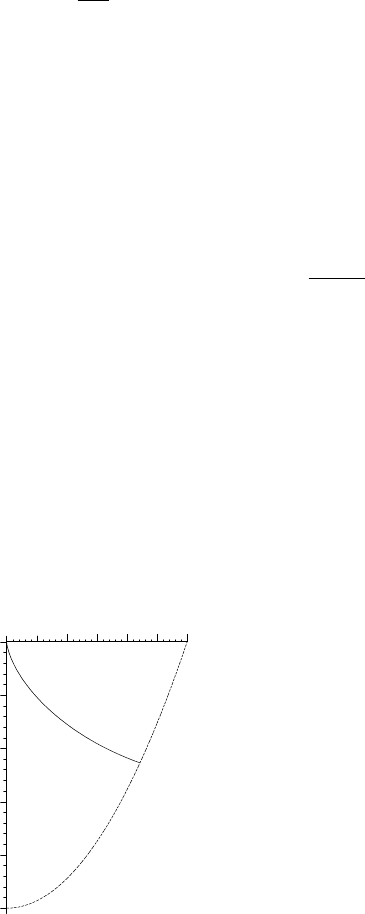
In gr1 and gr2, Betsy’s path and the parabola are plotted, respectively.
>
gr1:=plot([x,-y,theta=0..theta1],color=blue,thickness=2):
>
gr2:=plot(lhs(G)-Y,X=0..30,thickness=2,linestyle=3):
The two graphs are superimposed with the display command, constrained
scaling being used. The resulting picture is shown in Figure 7.3, the solid curve
being Betsy’s path, the dashed curve the parabola.
>
display({gr1,gr2},scaling=constrained,labels=["x","y"]);
–50
0
y
15 30
x
Figure 7.3: Betsy’s path which minimizes the time of descent to the parabola.
Since constrained scaling has been used, it may be seen from the figure that
Betsy’s path does indeed intersect the parabola at right angles.

7.2. SUBSIDIARY CONDITIONS 267
7.2 Subsidiary Conditions
In differential calculus, we may require a function φ(x, y)tobeaconditional
minimum or maximum subject to a subsidiary condition y = y
1
(x)or,equiva-
lently g(x, y)= 0. How is a conditional extremum calculated?
A straightforward way is to replace y in φ(x, y)withy
1
(x) and calculate
dφ(x, y
1
(x))
dx
=0, or using the chain rule,
∂φ
∂x
+
∂φ
∂y
1
∂y
1
∂x
=0. (7.5)
An alternate procedure is the method of Lagrange multipliers. One extrem-
izes φ + λg, subject to g(x, y)=0. λ is called the Lagrange multiplier. More
explicitly, one must solve the simultaneous equations
∂
∂x
(φ + λg)=0,
∂
∂y
(φ + λg)=0,g=0. (7.6)
In variational calculus, we may require an integral I[y]=
x
1
x
0
F (x, y, y
) dx
to be a minimum or maximum subject to an integral subsidiary condition
N =
x
1
x
0
G(x, y, y
)=C,whereC is a known constant. In this case, one sets
F=F + λG and solves the Euler–Lagrange equation
∂F
∂y
−
d
dx
∂F
∂y
=0. (7.7)
Extensions can be made to handle more than one subsidiary condition. In the
following recipes, examples from differential and variational calculus are given.
7.2.1 Ground State Energy
Authority has always attracted the lowest elements in the human
race. All through history mankind has been bullied by scum...Every
government is a parliament of whores. The trouble is, in a democ-
racy the whores are us.
P. J. ORourke, American journalist, (1947–)
The quantum mechanical ground state energy of a particle of mass m in a
box (rectangular parallelepiped) with sides a, b, c, is given ([Wie73]) by
E =
¯h
2
π
2
2 m
1
a
2
+
1
b
2
+
1
c
2
,
where ¯h = h/(2π), h being Planck’s constant.
What shape must the box have to minimize the energy E, subject to the
constraint that the volume V = abc of the box is constant? What is the
minimum energy? Solve this problem by (a) the “direct” method, (b) the
method of Lagrange multipliers. Here is Ms. I. M. Curious’s solution.
(a) I. M. enters the energy expression E, setting A ≡ (¯h
2
π
2
)/(2 m).
>
restart: E:=A*(1/aˆ2+1/bˆ2+1/cˆ2);
E := A (
1
a
2
+
1
b
2
+
1
c
2
)