
Enns R.H. Computer Algebra Recipes for Mathematical Physics
Подождите немного. Документ загружается.

228 CHAPTER 6. INTEGRAL TRANSFORMS
The plots and integral transform packages are loaded and the 1-dimensional
diffusion equation entered in pde for the concentration C(x, t)ofink.
>
restart: with(plots): with(inttrans):
>
pde:=diff(C(x,t),t)=d*diff(C(x,t),x,x);
pde :=
∂
∂t
C(x, t)=d (
∂
2
∂x
2
C(x, t))
Since there can be no flow of ink through the x = 0 end, the concentration
gradient ∂C/∂x must be zero there. This boundary condition implies that we
should use a Fourier cosine transform approach on the diffusion equation. The
Fourier cosine transform (fouriercos) command is applied to pde .
>
eq:=fouriercos(pde,x,k);
eq :=
∂
∂t
fouriercos(C(x, t),x,k)=
−
d (
√
2D
1
(C)(0,t)+k
2
fouriercos(C(x, t),x,k)
√
π)
√
π
The result in eq is expressed in terms of the concentration gradient at x =0,
viz., D
1
(C)(0,t). This term is set equal to zero in eq2 . The notation is also
simplified by replacing fouriercos(C(x, t),x,k)withF(k, t).
>
eq2:=subs({fouriercos(C(x,t),x,k)=F(k,t),D[1](C)(0,t)=0},eq);
eq2 :=
∂
∂t
F(k, t)=−dk
2
F(k, t)
The initial concentration profile f =Aδ(x − x0) of the ink is entered,
>
f:=A*Dirac(x-x0);
f := A Dirac(−x + x0 )
and its Fourier cosine transform taken and simplified assuming that x0 > 0.
>
F1:=simplify(fouriercos(f,x,k)) assuming x0>0;
F1 :=
A
√
2 cos(k x0 )
√
π
The ODE eq2 is analytically solved for F(k, t).
>
eq3:=dsolve(eq2,F(k,t));
eq3 := F(k, t)=
F1(k) e
(−dk
2
t)
At t=0, F(k, 0)= F1(k), so F1(k)=F1 is substituted into eq3 .
>
eq4:=subs(_F1(k)=F1,eq3);
eq4 := F(k, t)=
A
√
2 cos(k x0 ) e
(−dk
2
t)
√
π
The general desired expression for the concentration follows on applying the
Fourier cosine transform to the right-hand side of eq4 , taking us from k-space
back into x-space.
>
C:=fouriercos(rhs(eq4),k,x);
6.1. FOURIER TRANSFORMS 229
C :=
A
π
td
e
(−
x0
2
+x
2
4 td
)
cosh(
x0 x
2 td
)
π
The time T at which the ink concentration is an extremum at x= 0 is obtained
by evaluating C at this point, differentiating with respect to t, setting the result
equal to zero, and solving for the time t. The plot of the concentration at x=0
will confirm that the time T corresponds to the maximum ink concentration at
that end of the tube.
>
T:=solve(diff(eval(C,x=0),t)=0,t);
T :=
x0
2
2 d
The parameter values A =1, d=1, andx0= 10 are entered and the concentration
profile C(x, t)andtimeT then determined.
>
A:=1: d:=1: x0:=10: C:=C; T:=T;
C :=
π
t
e
(−
100+x
2
4 t
)
cosh(
5 x
t
)
π
T := 50
The concentration reaches its maximum value at the x = 0 end 50 time units
after the ink drop is injected.
The concentration profile is animated over the time interval t =1 to 2T , 100
frames being taken. The animation does not start at t = 0 because the initial
profile is a Dirac delta function. The initial frame is shown in Figure 6.3. Run
the animation and see how the profile evolves with time.
>
animate(C,x=0..35,t=1..2*T,frames=100,thickness=2,
numpoints=200,labels=["x","C"]);
0
0.05
0.1
C
0.2
0.25
5
10
15
x
25
30
35
Figure 6.3: Initial frame in the animation of the ink concentration.
230 CHAPTER 6. INTEGRAL TRANSFORMS
The concentration of ink at x = 0 is now plotted in Figure 6.4 over the time
interval t= 0 to 2 T . The maximum concentration occurs at 50 time units.
>
plot(eval(C,x=0),t=0..2*T,thickness=2,
labels=["t","C(0,t)"]);
0
0.01
0.02
C(0,t)
0.04
20 40
t
80 100
Figure 6.4: Time evolution of the ink concentration at x=0.
6.1.4 Diffusive Heat Flow
In my own time there have been inventions of this sort,...tubes for
diffusing warmth equally through all parts of a building...
Seneca, Roman writer, philosopher, and statesman, (5BC–65AD)
In contrast to the radiant heating referred to by Seneca, involving the con-
vective flow of warm water in tubes under the floor, this recipe involves the
diffusive flow of heat in an infinitely long thin solid rod. Suppose that the
initial temperature distribution inside the rod is T (x, 0) = T
0
e
−b
2
x
2
.Whatis
the temperature distribution T (x, t) for times t ≥ 0? Animate the suitably
normalized temperature distribution.
Since the domain is infinite, the full Fourier transform will be used. Because
the inverse will also be calculated, it is not necessary to worry about the fact
that the Maple convention for splitting the factor 1/(2π) in Fourier’s integral
theorem differs from the convention adopted in this chapter. As before, the
integral transform and plots (needed for the animation) packages are loaded.
>
restart: with(plots): with(inttrans):
In order for the transforms to be explicitly calculated, the assumption that
b>0, t>0, and the heat diffusion coefficient a>0, is supplied.
>
assume(a>0,b>0,t>0):
The one-dimensional heat diffusion equation is entered.
6.1. FOURIER TRANSFORMS 231
>
de:=diff(T(x,t),t)=aˆ2*diff(T(x,t),x,x);
de :=
∂
∂t
T(x, t)=a
2
(
∂
2
∂x
2
T(x, t))
The Fourier transform of the PDE de is taken in eq and notationally simplified
in eq2 by substituting F(k, t) for fourier(T(x, t),x,k).
>
eq:=fourier(de,x,k);
eq :=
∂
∂t
fourier(T(x, t),x,k)=−a
2
k
2
fourier(T(x, t),x,k)
>
eq2:=subs(fourier(T(x,t),x,k)=F(k,t),eq);
eq2 :=
∂
∂t
F(k, t)=−a
2
k
2
F(k, t)
Using the dsolve command, the ODE eq2 is analytically solved for F(k, t).
>
sol:=dsolve(eq2,F(k,t));
sol := F(k, t)=
F1(k) e
(−a
2
k
2
t)
The arbitrary function F1(k) is determined by Fourier transforming the initial
temperature profile, T
0
e
−b
2
x
2
. Its functional form is automatically substituted
into sol, the result being labeled sol2 .
>
_F1(k):=fourier(T0*exp(-bˆ2*xˆ2),x,k); sol2:=sol;
F1(k):=T0 e
(−
k
2
4 b
2
)
π
b
2
sol2 := F(k, t)=T0 e
(−
k
2
4 b
2
)
π
b
2
e
(−a
2
k
2
t)
The temperature profile inside the rod for t>0 follows on taking the inverse
Fourier transform (invfourier) of the right-hand side of sol2 .
>
T:=invfourier(rhs(sol2),k,x);
T :=
T0 e
(−
b
2
x
2
4 b
2
a
2
t+1
)
√
4 b
2
a
2
t +1
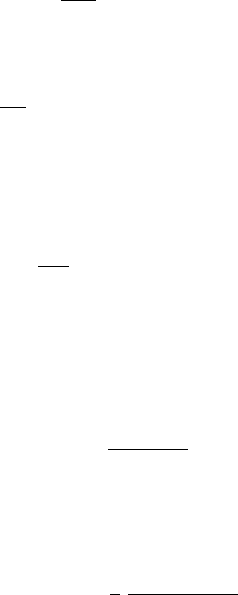
The temperature is normalized (made dimensionless) by dividing T by T0 ,and
normalized spatial (ζ) and time (τ) coordinates are introduced by substituting
x=ζ/b and t= τ/(b
2
a
2
).
>
Tnorm:=subs({x=zeta/b,t=tau/(bˆ2*aˆ2)},T/T0);
Tnorm :=
e
(−
ζ
2
4 τ +1
)
√
4 τ +1
The normalized temperature, Tnorm, is animated over the time interval τ =0
to 10, the spatial range being ζ =−10 to 10.
>
animate(Tnorm,zeta=-10..10,tau=0..10,frames=100,
thickness=2,numpoints=200,labels=["zeta","Tnorm"]);
Run the animation to see the initially Gaussian temperature profile diffuse away.
232 CHAPTER 6. INTEGRAL TRANSFORMS
6.1.5 Deja Vu
The postmodern reply to the modern consists of recognizing that the
past, since it cannot really be destroyed, because its destruction leads
to silence, must be revisited...
Umberto Eco, Italian novelist, Reflections on the Name of the Rose, (1983)
If this example seems familiar, it is. We revisit Recipe 01-1-6: Mr. Dirac’s
Famous Function and, instead of using the Green’s function method, Fourier
transform the relevant differential equation and illustrate how contour integra-
tion can be used to evaluate the inverse transform.
Consider a very long uniform horizontal beam glued to an elastic foundation
which exerts a Hooke’s law restoring force (spring constant K) on the beam.
Subject to a steady point force F exerted at x = 0, the static displacement
ψ(x)=(F/K) G(x) of the beam satisfies the following ODE,
α
4
d
4
G
dx
4
+ G = δ(x), (6.7)
with α =(YI/K)
1/4
, Y being Young’s modulus and I the beam’s moment of
inertia. Determine G(x) for all x.
After loading the integral transform package, the following interface com-
mand is used to set j =
√
−1, to avoid confusion with the moment of inertia.
>
restart: with(inttrans): interface(imaginaryunit=j):
Equation (6.7) is entered in ode and then Fourier transformed in eq .
>
ode:=alphaˆ4*diff(G(x),x$4)+G(x)=Dirac(x);
ode := α
4
(
d
4
dx
4
G(x)) + G(x)=Dirac(x)
>
eq:=fourier(ode,x,k);
eq := fourier(G(x),x,k)(α
4
k
4
+1)=1
eq is solved in eq2 for the Fourier transform of G(x).
>
eq2:=solve(eq,fourier(G(x),x,k));
eq2 :=
1
α
4
k
4
+1
With Maple’s convention for the Fourier transform, the inverse Fourier trans-
form is given by G(x)=
∞
−∞
e
jkx
(eq2 /(2π)) dk. The integrand is now entered.
>
integrand:=exp(j*k*x)*eq2/(2*Pi);
integrand :=
1
2
e
(kxj)
(α
4
k
4
+1)π
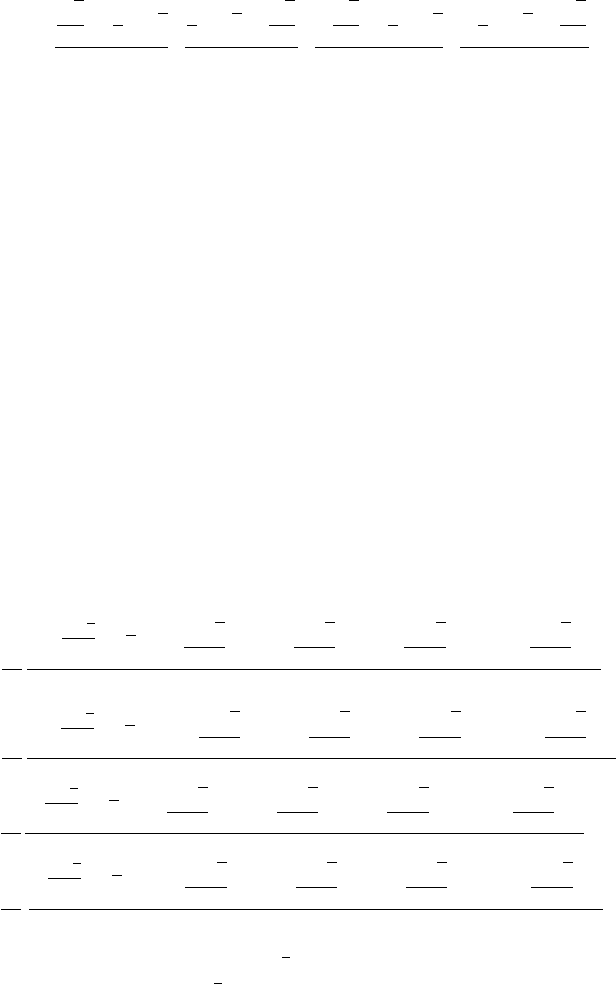
The four complex k zeros of the integrand’s denominator are determined.
>
sol:={solve(denom(integrand)=0,k)};
6.1. FOURIER TRANSFORMS 233
sol :=
⎧
⎪
⎪
⎨
⎪
⎪
⎩
√
2
2
+
1
2
j
√
2
α
,
1
2
j
√
2 −
√
2
2
α
,
−
√
2
2
−
1
2
j
√
2
α
,
−
1
2
j
√
2+
√
2
2
α
⎫
⎪
⎪
⎬
⎪
⎪
⎭
Theintegrandhasfoursimplepoles,thefirsttwoentriesinsol corresponding
to poles in the upper-half of the complex k-plane, the last two entries to poles in
the lower-half k-plane. The integral in G(x) is evaluated by performing a closed
contour integration along the real k-axis from −R to +R and then around a
semi-circle of radius R (where k =Re
jθ
), the limit R →∞being taken. Noting
that on the semi-circle the exponential term in the integrand takes the form
e
jRe
jθ
x
= e
jR cos(θ)x
e
−R sin(θ)x
, the semi-circle must be taken in the upper-half
k-plane (where sin(θ) > 0) for x>0 for the semi-circular contribution to vanish
as R →∞. In this case, the two poles in the upper-half plane will contribute
to the integral.
For x<0, on the other hand, the semi-circle must be taken in the lower-half
plane where sin(θ) < 0. The two poles in the lower-half k-plane then contribute.
A functional operator is formed for evaluating the residue of the integrand
for the ith simple pole.
>
res:=i->simplify(evalc(residue(integrand,k=sol[i]))):
Using the functional operator, the sequence of four residues is explicitly calcu-
lated, the first two residues corresponding to the two poles in the upper-half
plane, the last two residues to the two poles in the lower-half plane.
>
eq3:={seq(res(i),i=1..4)};
eq3 :=
−
1
16
e
(−
x
√
2
2 α
)
√
2 (cos(
x
√
2
2 α
) − sin(
x
√
2
2 α
)+sin(
x
√
2
2 α
) j + cos(
x
√
2
2 α
) j)
απ
,
−
1
16
e
(−
x
√
2
2 α
)
√
2(−cos(
x
√
2
2 α
)+sin(
x
√
2
2 α
)+sin(
x
√
2
2 α
) j + cos(
x
√
2
2 α
) j)
απ
,
1
16
e
(
x
√
2
2 α
)
√
2 (cos(
x
√
2
2 α
)+sin(
x
√
2
2 α
) − sin(
x
√
2
2 α
) j + cos(
x
√
2
2 α
) j)
απ
,
1
16
e
(
x
√
2
2 α
)
√
2(−cos(
x
√
2
2 α
) − sin(
x
√
2
2 α
) − sin(
x
√
2
2 α
) j + cos(
x
√
2
2 α
) j)
απ
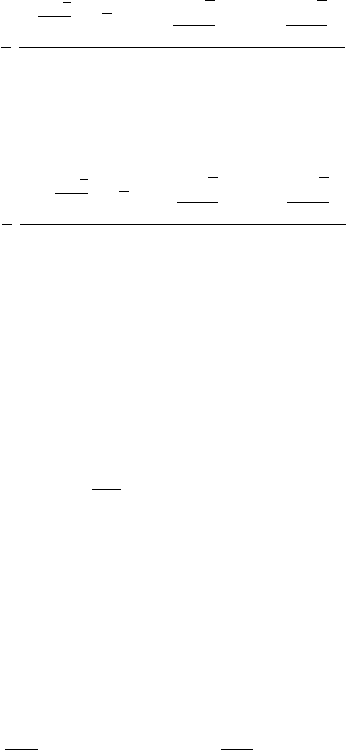
The last two residues, containing e
x
√
2/(2α)
, are selected in eq4 , while the first
two residues, containing e
−x
√
2/(2α)
, are selected in eq5 .
>
eq4:=select(has,eq3,exp(x*sqrt(2)/(2*alpha))):
>
eq5:=select(has,eq3,exp(-x*sqrt(2)/(2*alpha))):
234 CHAPTER 6. INTEGRAL TRANSFORMS
For x<0 (to the left of the applied force at the origin), then G(x) is obtained
by summing the two residues in eq4 , multiplying by 2 jπ, applying the complex
evaluation command, and simplifying. The minus sign is inserted because for
the semi-circle in the lower-half k-plane, the contour is taken clockwise, rather
than counter-clockwise. The result, assigned the name GL,isthesameas
obtained previously in Recipe 01-1-6.
>
GL:=-simplify(evalc(2*j*Pi*(eq4[1]+eq4[2])));
GL :=
1
4
e
(
x
√
2
2 α
)
√
2(−sin(
x
√
2
2 α
) + cos(
x
√
2
2 α
))
α
The solution for x>0 is similarly obtained by using eq5 . The contour is
counter-clockwise in this case, so a minus sign is not inserted. The result GR
is identical with that previously obtained using the Green’s function method.
>
GR:=simplify(evalc(2*j*Pi*(eq5[1]+eq5[2])));
GR :=
1
4
e
(−
x
√
2
2 α
)
√
2 (cos(
x
√
2
2 α
)+sin(
x
√
2
2 α
))
α
6.2 Laplace Transforms
The Laplace transform of a function f(t) is defined to be
L(f(t)) = F (s)=
∞
0
e
−st
f(t) dt, (6.8)
where s = x + iy is a complex variable. The inverse transform is given by the
Bromwich integral formula,
L
−1
(F )=f(t)=
1
2πi
c+i ∞
c−i ∞
e
st
F (s) ds, t > 0 (6.9)
and f(t)=0 for t<0. The integration in (6.9) is to be performed along a line
s= c + iy in the complex plane. The real number c is chosen so that s =c lies to
the right of all poles, branch points, or essential singularities. With Maple, the
laplace command is used to calculate the Laplace transform, and invlaplace
for the inverse transform.
A couple of the more important properties of Laplace transforms are:
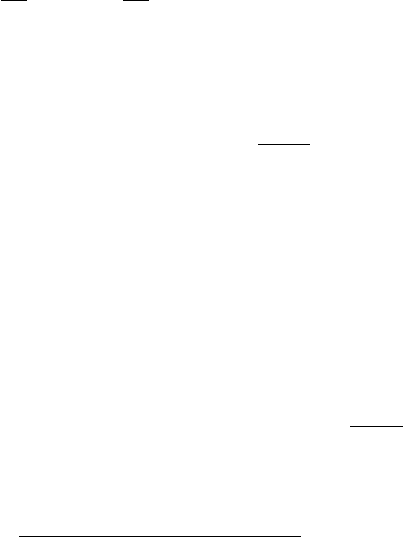
• The Laplace transform of the nth derivative of f(t)isgivenby
L
d
n
f
dt
n
= s
n
F (s) −
n−1
k=0
d
k
f
dt
k
t=0
s
n−k−1
.
• Defining the convolution of the functions f
1
(t)andf
2
(t)tobe
C(t)=
t
0
f
1
(t − y) f
2
(y) dy, then L(C(t)) = F
1
(s) F
2
(s),
where F
1
(s)andF
2
(s) are the Laplace transforms of f
1
(t)andf
2
(t).
6.2. LAPLACE TRANSFORMS 235
6.2.1 Jennifer Consults Mr. Spiegel
Histories are more full of examples of the fidelity of dogs
than of friends.
Alexander Pope, English satirical poet, (1688–1744).
To illustrate the use of Laplace transforms in solving ODEs, Jennifer has cre-
ated a recipe for solving the following problem taken from Murray Spiegel’s
Advanced Mathematics. Solve the fourth order inhomogeneous ODE
y
(t)+2y
(t)+y(t)=sint, y(0) = 1,y
(0) = −2,y
(0) = 3,y
(0) = 0.
After loading the integral transform package, Jennifer lets the Laplace transform
of y(t) be represented by F (s) for notational convenience.
>
restart: with(inttrans): LT:=laplace(y(t),t,s)=F(s):
The ODE is now entered.
>
ode:=diff(y(t),t$4)+2*diff(y(t),t$2)+y(t)=sin(t);
ode := (
d
4
dt
4
y(t)) + 2 (
d
2
dt
2
y(t)) + y(t)=sin(t)
She then takes the Laplace transform of ode and substitutes LT ,
>
eq:=subs(LT,laplace(ode,t,s));
eq := s
4
F (s) − (D
(3)
)(y)(0) − s (D
(2)
)(y)(0) − s
2
D(y)(0) − s
3
y(0)
+2s
2
F (s) − 2D(y)(0) − 2 s y(0) + F (s)=
1
s
2
+1
the result being expressed in terms of y(0) and the first three derivatives at
t = 0. Maple has simply applied the rule for taking the Laplace transform of a
derivative to the fourth and second order derivatives. The last term, 1/(s
2
+1),
in eq is the Laplace transform of sin(t). If proceeding by hand, one would look
up this result in a table of Laplace transforms.
The initial conditions are now entered in ic, using the differential operator,
>
ic:=(y(0)=1,D(y)(0)=-2,D(D(y))(0)=3,D(D(D(y)))(0)=0):
and eq is evaluated in eq2 with the initial conditions.
>
eq2:=eval(eq,{ic});
eq2 := s
4
F (s)+4− 5 s +2s
2
− s
3
+2s
2
F (s)+F (s)=
1
s
2
+1
Jennifer then solves eq2 for F (s).
>
eq3:=solve(eq2,F(s));
eq3 :=
−6 s
2
− 3+6s
3
+5s − 2 s
4
+ s
5
s
6
+3s
4
+3s
2
+1
The solution, Y , of the original ODE then follows on applying the inverse
Laplace transform to eq3 . If proceeding by hand, as in Spiegel, one would
laboriously express eq3 as a sum of partial fractions and then use a table to
look up the inverse transforms of the various terms.
236 CHAPTER 6. INTEGRAL TRANSFORMS
>
Y:=invlaplace(eq3,s,t);
Y := −
1
8
sin(t) (21 + t
2
− 16 t)+
1
8
cos(t)(8+5t)
Exactly the same answer can be obtained more easily by using the dsolve
command with the option method=laplace, as illustrated in Y2 .
>
Y2:=dsolve({ode,ic},y(t),method=laplace);
Y2 := y(t)=−
1
8
sin(t) (21 + t
2
− 16 t)+
1
8
cos(t)(8+5t)
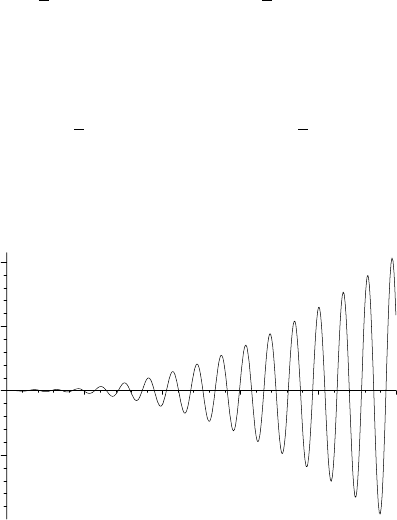
Finally, Jennifer completes the recipe by plotting Y overthetimeintervalt=0
to 100, the solution being shown in Figure 6.5.
>
plot(Y,t=0..100,thickness=2,labels=["t","y"],numpoints=200);
–500
0
500
1000
y
20 40
60
80 100
t
Figure 6.5: Time-dependent solution of the ODE.
As time increases, the oscillations grow indefinitely in amplitude, never settling
down to a steady-state solution.
6.2.2 Jennifer’s Heat Diffusion Problem
Gossip is a sort of smoke that comes from the dirty ...pipes of those
who diffuse it: it proves nothing but the bad taste of the smoker.
George Eliot, English novelist, (1819–80)
The Laplace transform approach can be used to solve the diffusion equation
with specified boundary conditions and an initial profile. Jennifer will illustrate
this by solving the following temperature diffusion problem and animating it
overthetimeintervalt=0 to 0.05 seconds,
T
t
=4T
xx
,T(0,t)=T (3,t)=0,T(x, 0)= 10 sin(2πx) −6sin(4πx)+2sin(6πx).
After loading the integral transform and plots packages,
>
restart: with(inttrans): with(plots):
6.2. LAPLACE TRANSFORMS 237
Jennifer enters the relevant PDE and the initial temperature profile T (x, 0).
>
pde:=diff(T(x,t),t)=4*diff(T(x,t),x,x);
pde :=
∂
∂t
T (x, t)=4(
∂
2
∂x
2
T (x, t))
>
T(x,0):=10*sin(2*Pi*x)-6*sin(4*Pi*x)+2*sin(6*Pi*x);
Then pde is Laplace transformed in eq with respect to the time variable t,the
initial condition being automatically substituted. For notational simplicity the
Laplace transform of T (x, t) is replaced with F (x), the resulting ODE for F(x)
being displayed in eq2 .
>
eq:=laplace(pde,t,s);
>
eq2:=subs(laplace(T(x,t),t,s)=F(x),eq);
eq2 := s F (x) − 10 sin(2 πx)+6sin(4πx) − 2sin(6πx)=4(
d
2
dx
2
F (x))
Since the boundary conditions are T (0,t)=T (3,t) = 0, their Laplace trans-
forms are equal to zero. So eq2 is analytically solved for F (x) subject to
F (0) = 0 and F (3) = 0.
>
sol:=dsolve({eq2,F(0)=0,F(3)=0},F(x));
sol := F (x) = ((160 sπ
2
+2s
2
+2048 π
4
)sin(6πx) − 13824((
s
16
+π
2
)sin(4πx)
−
20
3
sin(2 πx)(
s
64
+π
2
)) (
s
144
+π
2
))
(s
3
+224 s
2
π
2
+12544 sπ
4
+147456 π
6
)
Finally, applying the inverse Laplace transform to the right-hand side of sol
yields the temperature profile T (x, t)fort ≥ 0, which is animated over the time
interval t= 0 to 0.05.
>
T(x,t):=invlaplace(rhs(sol),s,t);
T (x, t):= 10sin(2πx) e
(−16 π
2
t)
− 6sin(4πx) e
(−64 π
2
t)
+2sin(6πx) e
(−144 π
2
t)
>
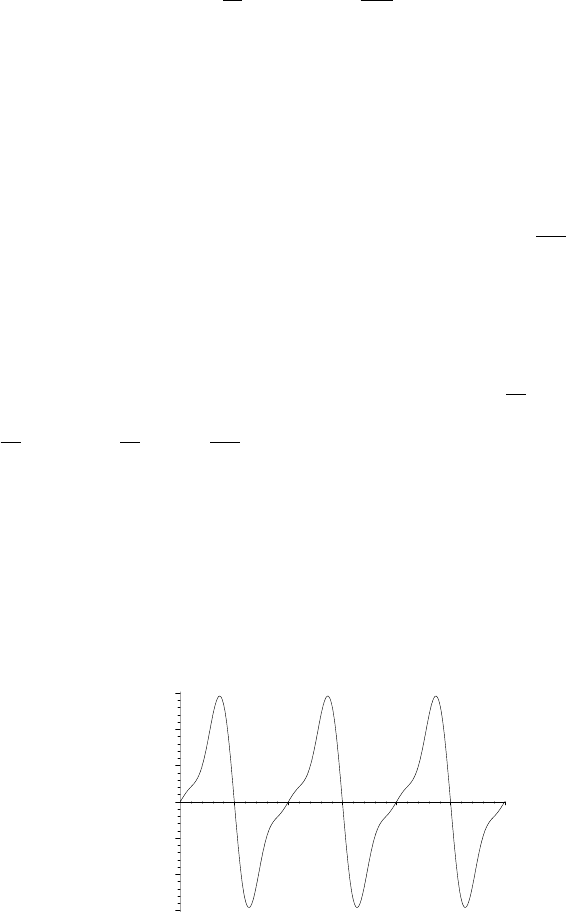
animate(T(x,t),x=0..3,t=0..0.05,frames=100,numpoints=500,
thickness=2,labels=["x","T"]);
–15
0
T
15
123
x
Figure 6.6: Initial frame of the animation.