
Faddeev L.D., Yakubovskii O.A. Lectures on Quantum Mechanics for Mathematics Students
Подождите немного. Документ загружается.

8 L. D. Faddeev and 0. A. Yakubovskii
where cp-1 (E) is the inverse image of E under the mapping ;p-
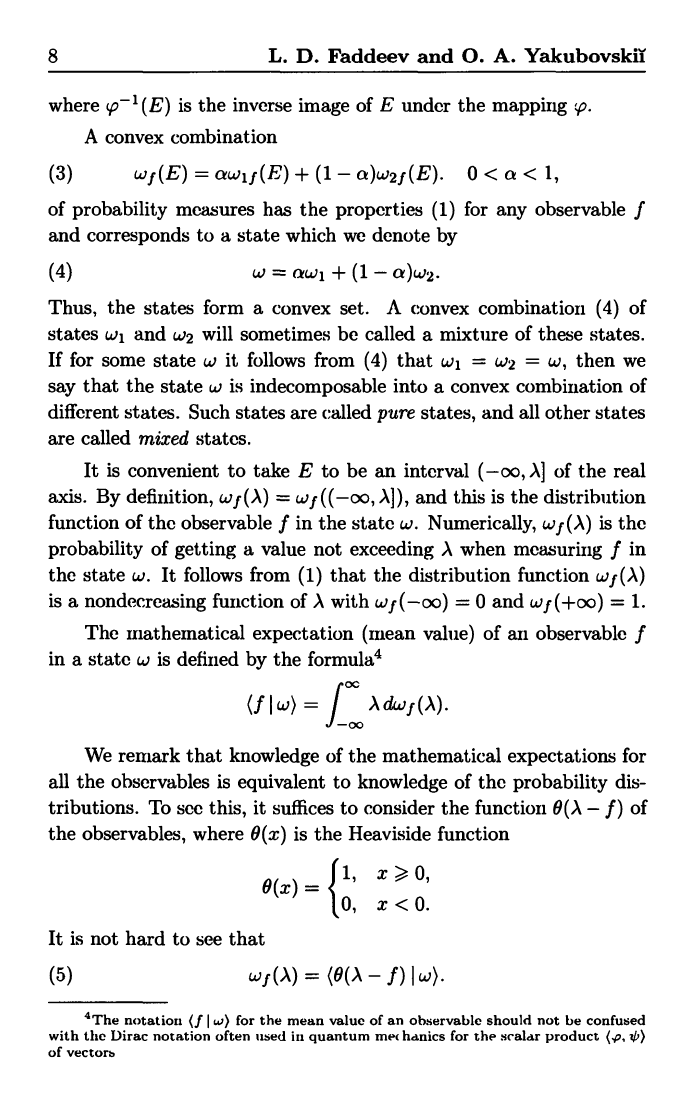
A convex combination
(3)
w1(E) = awl f(E) +0 - a)w2 f(E).
0 < a < 1,
of probability measures has the properties (1) for any observable f
and corresponds to a state which we denote by
(4) w=awl +(1--a)w2.
Thus, the states form a convex set. A convex combination (4) of
states wl and W2 will sometimes be called a mixture of these states.
If for some state w it follows from (4) that w1 = w2 = w, then we
say that the state w is indecomposable into a convex combination of
different states. Such states are called pure states, and all other states
are called mixed states.
It is convenient to take E to be an interval (-oo, A] of the real
axis. By definition, w f (A) = w f ((-oo, A] ), and this is the distribution
function of the observable f in the state w. Numerically, w f (A) is the
probability of getting a value not exceeding A when measuring f in
the state w. It follows from (1) that the distribution function w f (A)
is a nondecreasing function of A with w f (- oo) = 0 and w f (+ oo) = 1.
The mathematical expectation (mean value) of an observable f
in a state w is defined by the formula4
(f I w) = I__00 A dwf (A).
We remaxk that knowledge of the mathematical expectations for
all the observables is equivalent to knowledge of the probability dis-
tributions. To see this, it suffices to consider the function 9(A - f) of
the observables, where O (x) is the Heaviside function
fi, x > 0,
0, x<0.
It is not hard to see that
(5)
wf (A) = (O(A - f) I w).
4The notation (f I w) for the mean value of an observable should not be confused
with the Dirac notation often used in quantum mechanics for the scalar product (p, 0)
of vectors
§ 2. States
9
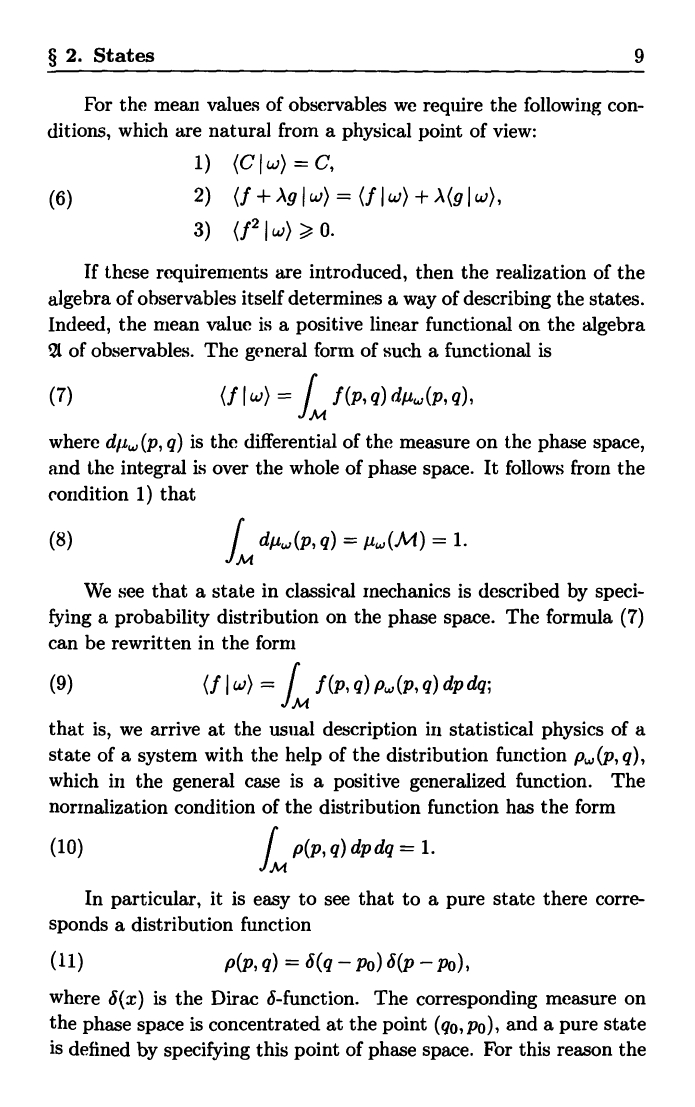
For the mean values of observables we require the following con-
ditions, which are natural from a physical point of view:
1)
(CIw)=C,
(6)
2)
(f + Ag I uj) = (f I w) + A(g I uj),
3)
(f2Jw)>0
.
If these requirements are introduced, then the realization of the
algebra of observables itself determines a way of describing the states.
Indeed, the mean value is a positive linear functional on the algebra
% of observables. The general form of such a functional is
(7)
(11w)= JAM .f(p,q)dluw(p,q),
where dpi, (p, q) is the differential of the measure on the phase space,
and the integral is over the whole of phase space. It follows from the
condition 1) that
(a)
JAM
dp,a (p, q) = pw (M) = 1.
We see that a state in classical mechanics is described by speci-
fying a probability distribution on the phase space. The formula (7)
can be rewritten in the form
(9) (1 I w) = fMA
.f (p, q) pw (p, q) dp dq;
that is, we arrive at the usual description in statistical physics of a
state of a system with the help of the distribution function p, (p, q),
which in the general case is a positive generalized function. The
normalization condition of the distribution function has the form
(10)
IM
P(P, 4) dP d9' = 1.
In particular, it is easy to see that to a pure state there corre-
sponds a distribution function
P(p, 9) = a(q - Po) a(p - Po),
where d(x) is the Dirac 6-function. The corresponding measure on
the phase space is concentrated at the point (qo, po), and a pure state
is defined by specifying this point of phase space. For this reason the
10
L. D. Faddeev and 0. A. Yakubovskil
phase space M is sometimes called the state space. The mean value
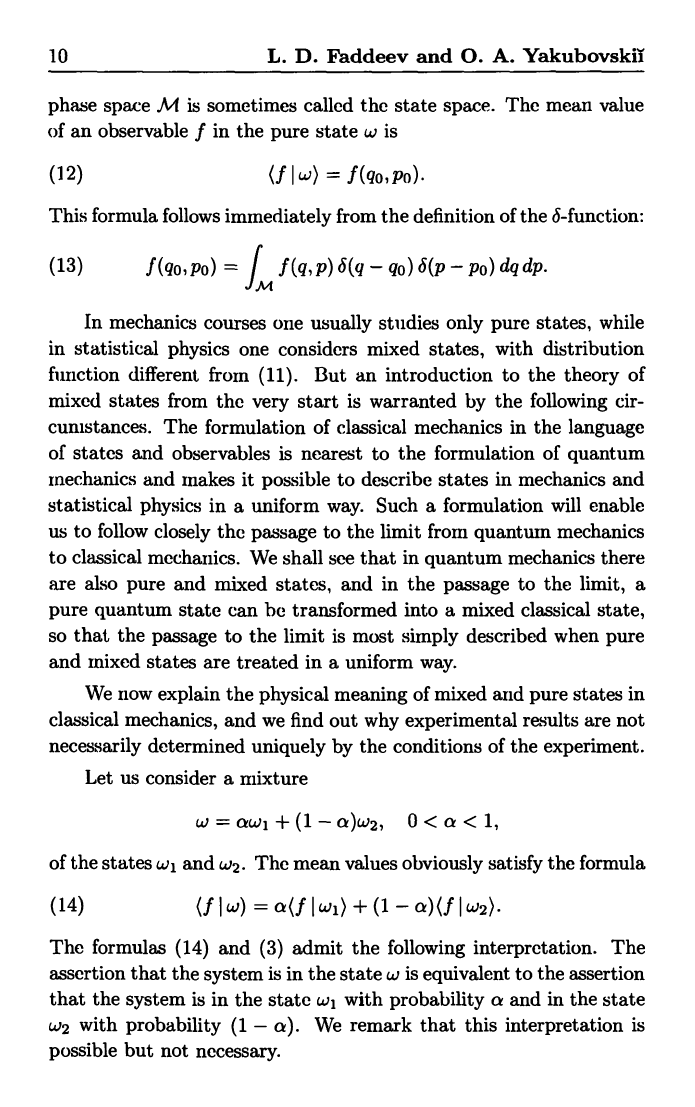
of an observable ,f in the pure state w is
(12)
(f w) = f (go,po)
This formula follows immediately from the definition of the 6-function:
(13)
f (qo, po) = fM f (q, p) 6(q - qo) b(p -- po) dq dp.
In mechanics courses one usually studies only pure states, while
in statistical physics one considers mixed states, with distribution
function different from (11). But an introduction to the theory of
mixed states from the very staxt is warranted by the following cir-
cumstances. The formulation of classical mechanics in the language
of states and observables is nearest to the formulation of quantum
mechanics and makes it possible to describe states in mechanics and
statistical physics in a uniform way. Such a formulation will enable
us to follow closely the passage to the limit from quantum mechanics
to classical mechanics. We shall see that in quantum mechanics there
are also pure and mixed states, and in the passage to the limit, a
pure quantum state can be transformed into a mixed classical state,
so that the passage to the limit is most simply described when pure
and mixed states are treated in a uniform way.
We now explain the physical meaning of mixed and pure states in
classical mechanics, and we find out why experimental results are not
necessarily determined uniquely by the conditions of the experiment.
Let us consider a mixture
w=awl+(1-a)w2i 0<a<1,
of the states wl and w2. The mean values obviously satisfy the formula
(14)
(f I W) = Q(f I W1) + (1 - COU I W2)-
The formulas (14) and (3) admit the following interpretation. The
assertion that the system is in the state w is equivalent to the assertion
that the system is in the state wl with probability a and in the state
W2 with probability (1 - a). We remark that this interpretation is
possible but not necessary.
§ 2. States
11
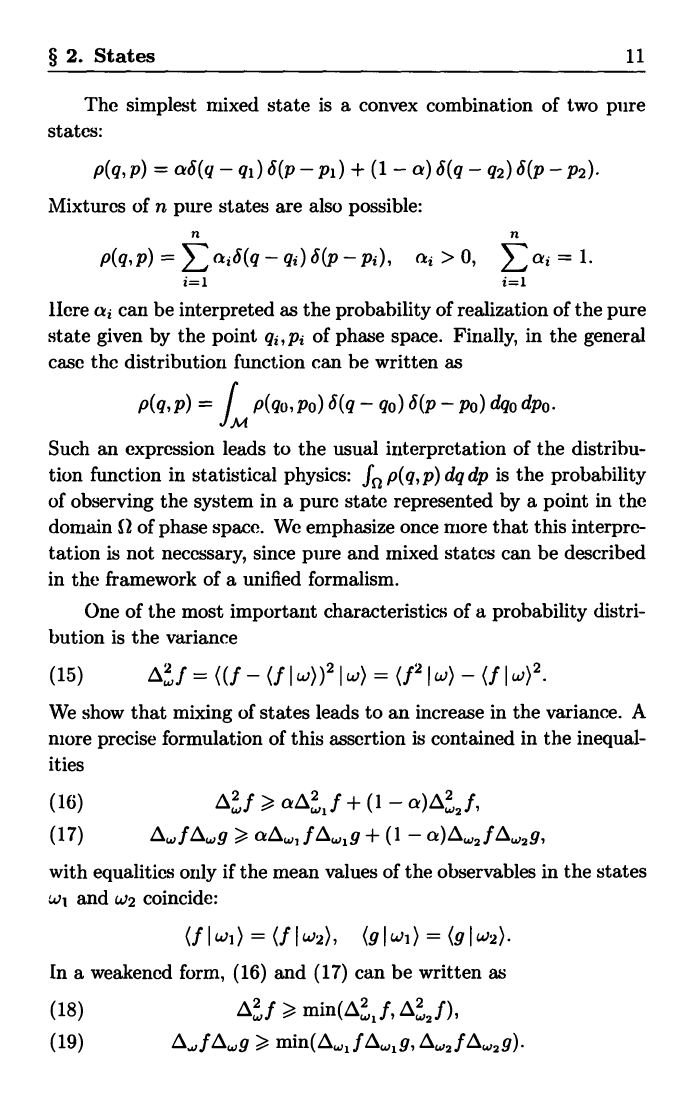
The simplest mixed state is a convex combination of two pure
states:
P(4, p) = aS(9 - 9i) bhp - Pi) + (1- a) 8(9 - 92) b(P - Pi)
Mixtures of n pure states are also possible:
p(q, p) =
n
ai6(q -- qi) 6(p -- pi), ai > 0, > aj = 1.
Here ai can be interpreted as the probability of realization of the pure
state given by the point qi, pi of phase space. Finally, in the general
case the distribution function can be written as
p(q,p) = ZM p(qo, po) o(q _ qo) 6(p -- po) dqo dpo
Such an expression leads to the usual interpretation of the distribu-
tion function in statistical physics: ff p(q, p) dq dp is the probability
of observing the system in a pure state represented by a point in the
domain 11 of phase space. We emphasize once more that this interpre-
tation is not necessary, since pure and mixed states can be described
in the framework of a unified formalism.
One of the most important characteristics of a probability distri-
bution is the variance
(15)
Owf = ((f- (fI.))2I) = (f2w) - (fIw)2.
We show that mixing of states leads to an increase in the variance. A
more precise formulation of this assertion is contained in the inequal-
ities
(16)
(17)
Aw f
f + (1 - a)Aw2f
oWfAW9 > a&, f &1,,9 + (1 - a)L 2fO129,
with equalities only if the mean values of the observables in the states
w2 and W2 coincide:
(f I W1 ) = (f I W2), (9 1 W1) = (9 1 W2)-
In a weakened form, (16) and (17) can be written as
(18)
02 f %In1II(O2
Wlf7 Ow2f)l
(19) O.a.fAm9'
II11n(0,1.fOwi9, Owz.fAw29)
12
L. D. Faddeev and 0. A. Yakubovski
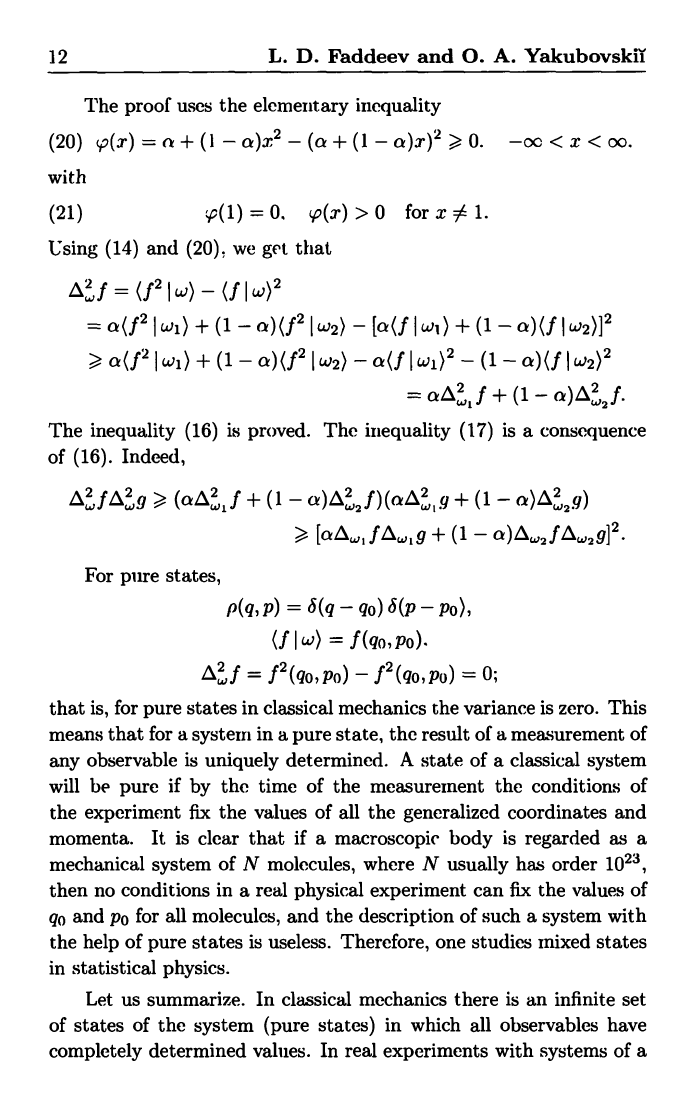
The proof uses the elementary inequality
(20)
a + (1 - a)x2 - (a + (1 - a)X)2
U.
-oc < x < 00.
with
(21)
0(1) = 0.
p(X) > 0
for x 1.
Using (14) and (20); we get that,
olf
= (I2 I W)- (I I w)2
= aq2
I Wi)
+ (1- a)(.f2 I
L02)- [a(f lwi) + (1 - a)(.f
I w2)]2
a(j' I wi) + (1
- a)
(f2
I Wa) - a(f
I wi)2
- (1- a)(.f l W2)2
aA2 f + (1 _ (,k)A2
W1
W2
The inequality (16) is proved. The inequality (17) is a consequence
of (16). Indeed,
i . f I . g>(cil.f +(I -a)022f)(aA2,g+(1-x)022.9)
[azf&1g + (1
- a)A"2fA&2g]2.
For pure states,
p(q, p) = 5(q - q0) a(p - po),
(f I w) = f (qo, po).
A2 f = f2(go,po) - f2(go,po) = 0;
that is, for pure states in classical mechanics the variance is zero. This
means that for a system in a pure state, the result of a measurement of
any observable is uniquely determined. A state of a classical system
will be pure if by the time of the measurement the conditions of
the experiment fix the values of all the generalized coordinates and
momenta.
It is clear that if a macroscopic body is regarded as a
mechanical system of N molecules, where N usually has order 1023,
then no conditions in a real physical experiment can fix the values of
qo and po for all molecules, and the description of such a system with
the help of pure states is useless. Therefore, one studies mixed states
in statistical physics.
Let us summarize. In classical mechanics there is an infinite set
of states of the system (pure states) in which all observables have
completely determined values. In real experiments with systems of a
§ 3. Liouville's theorem, and two pictures of motion 13
huge number of particles. mixed states arise. Of course, such states
are possible also in experiments with simple mechanical systems. In
this case the theory gives only probabilistic predictions.
§ 3. Liouville's theorem, and two pictures of
motion in classical mechanics
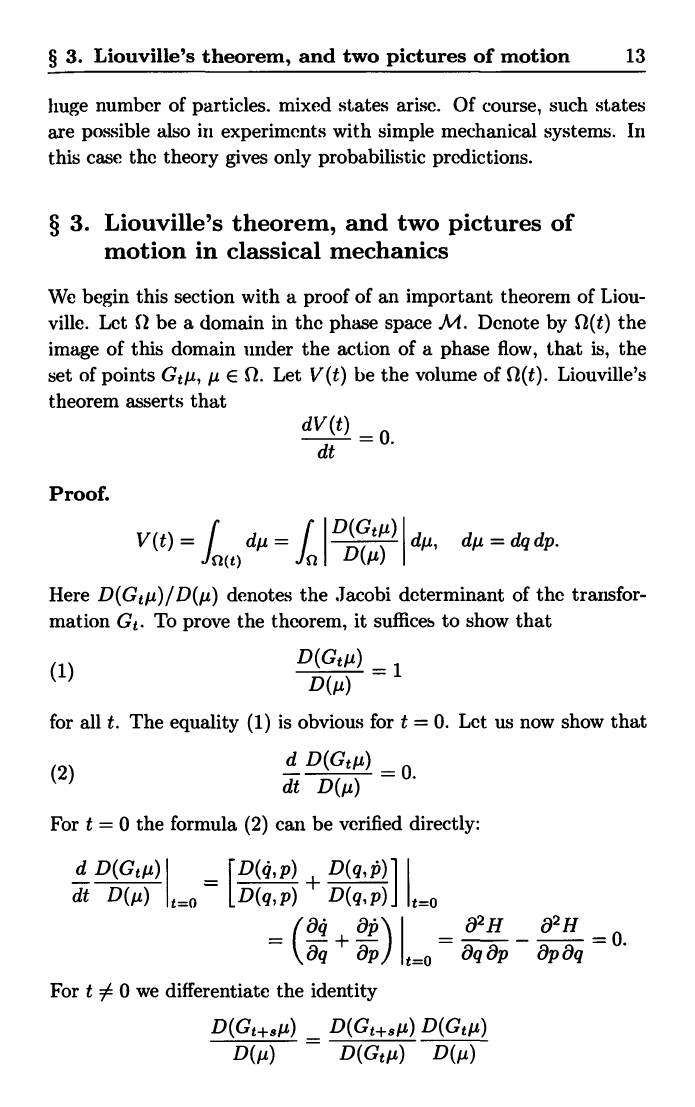
We begin this section with a proof of an important theorem of Liou-
ville. Let 11 be a domain in the phase space M. Denote by f(t) the
image of this domain under the action of a phase flow, that is, the
set of points Gtp, /2 E Q. Let V(t) be the volume of 1(t). Liouville's
theorem asserts that
dV(t)
o
dt
Proof.
v(t) =
d1i _
r D(Geu)
Jst
D(µ)
dy, dit = dq dp.
Here D (Gt tt) / D (u) denotes the Jacobi determinant of the transfor-
mation Gt. To prove the theorem, it suffices to show that
D(Gt p)
(1)
D (IL)
for all t. The equality (1) is obvious for t = 0. Let us now show that
2( )
dt D(µ)
For t = 0 the formula (2) can be verified directly:
d D(Gtµ)
dt D(µ)
do
[D(,p)
+
D(Q, P)
D(9,p)
D(4, P)
t=o
q
a2x
a2x
(8a7Y
aq +
ap) 1t=0
aqap
-
c9paq
- o.
d D(Gcµ)
= 0.
For t # 0 we differentiate the identity
D(Gc+Bµ)
D(Ge+Bµ) D(Geµ)
D(µ)
D(Giµ)
D(µ)
14 L. D. Faddeev and 0. A. Yakubovskii
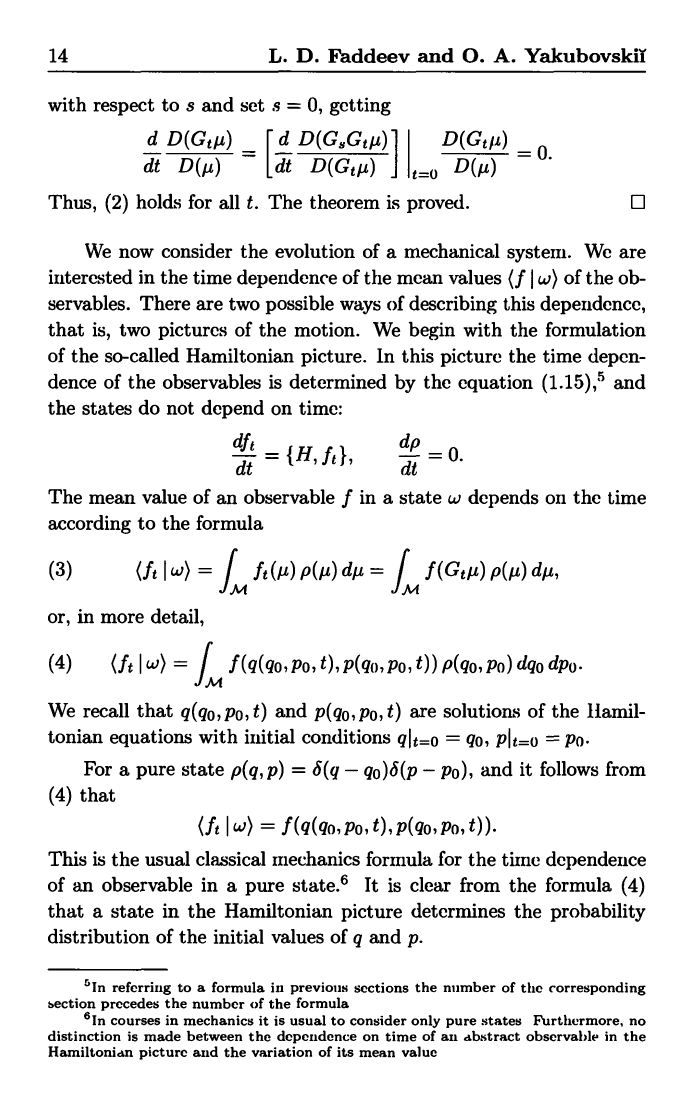
with respect to s and set s = 0, getting
d D(Ctµ)
_
Id D(G.Geµ)
D(GcIj,)
_ 0.
dt D(p)
Ldt D(Gtµ)
c=u D(µ)
Thus, (2) holds for all t. The theorem is proved.
We now consider the evolution of a mechanical system. We are
interested in the time dependence of the mean values (f I w) of the ob-
servables. There are two possible ways of describing this dependence,
that is, two pictures of the motion. We begin with the formulation
of the so-called Hamiltonian picture. In this picture the time depen-
dence of the observables is determined by the equation (1.15),5 and
the states do not depend on time:
4!={Hft}
= 0.
dt
The mean value of an observable f in a state w depends on the time
according to the formula
(3)
(ft 1w) =
ft (i) p(p) dju =
f(Gt u) p(i) d p,
or, in more detail,
(4)
(ft I=
fM
f(4(9o,Post),p(9o,po, t))P(9o,Po)dQodPo
We recall that q(qo, po, t) and p(qo, po, t) are solutions of the liamil-
tonian equations with initial conditions qlt=v = Qo, plt=o = po
For a pure state p(q, p) = S(y - go)8(p - po), and it follows from
(4) that
(ft I w) = f (q(qo, po, t), p(qo, po, t) ).
This is the usual classical mechanics formula for the time dependence
of an observable in a pure state.6
It is clear from the formula (4)
that a state in the Hamiltonian picture determines the probability
distribution of the initial values of q and p.
5In referring to a formula in previous sections the number of the corresponding
section precedes the number of the formula
6In
courses in mechanics it is usual to consider only pure states Furthermore, no
distinction is made between the dependence on time of an abstract observable in the
Hamiltonian picture and the variation of its mean value
§ 4. Physical bases of quantum mechanics
15
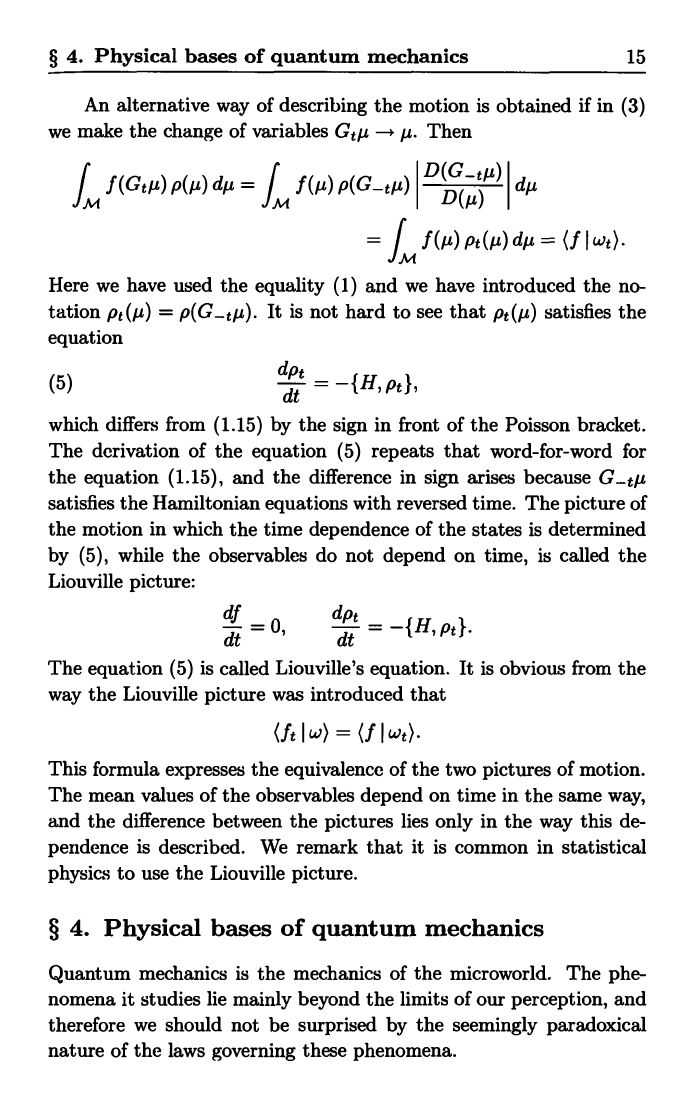
An alternative way of describing the motion is obtained if in (3)
we make the change of variables Gtµ -> µ. Then
fM f (Gtµ) p(p) dp = JM f (µ)
DD(A) (G-tp)
dµ
= f
.f (y) pt (,u) dp = (11 wt)
M
Here we have used the equality (1) and we have introduced the no-
tation pt(p) = p(G_tµ). It is not hard to see that pt (p) satisfies the
equation
(5)
dot
= -{H, pt},
which differs from (1.15) by the sign in front of the Poisson bracket.
The derivation of the equation (5) repeats that word-for-word for
the equation (1.15), and the difference in sign arises because G_tµ
satisfies the Hamiltonian equations with reversed time. The picture of
the motion in which the time dependence of the states is determined
by (5), while the observables do not depend on time, is called the
Liouville picture:
df
=0
dpt
= - H .
dt dt { '
Pt}
The equation (5) is called Liouville's equation. It is obvious from the
way the Liouville picture was introduced that
(ftI) = (1 IWt).
This formula expresses the equivalence of the two pictures of motion.
The mean values of the observables depend on time in the same way,
and the difference between the pictures lies only in the way this de-
pendence is described. We remark that it is common in statistical
physics to use the Liouville picture.
§ 4. Physical bases of quantum mechanics
Quantum mechanics is the mechanics of the microworld. The phe-
nomena it studies lie mainly beyond the limits of our perception, and
therefore we should not be surprised by the seemingly paradoxical
nature of the laws governing these phenomena.
16 L. D. Faddeev and 0. A. Yakubovskii
It has not been possible. to formulate the basic laws of quantum
mechanics as a logical consequence of the results of some collection
of fundammiental physical experiments. In other words, there is so far
no known formulation of quantum mechanics that is based on a sys-
tem of axioms confirmed by experiment. Moreover, sortie of the basic
statements of quantum mechanics are in principle not amenable to
experimental verification. Our confidence in the validity of quantum
mechanics is based on the fact that all the physical results of the
theory agree with experiment. Thus, only consequences of the ba-
sic tenets of quantum mechanics can be verified by experiment, and
not its basic laws. The main difficulties arising upon an initial study
of quantum mechanics are apparently connected with these circum-
stances.
The creators of quantum mechanics were faced with difficulties
of the same nature, though certainly much more formidable. Exper-
iments most definitely pointed to the existence of peculiar quantum
laws in the microworld, but gave no clue about the form of quantum
theory. This can explain the truly dramatic history of the creation
of quantum mechanics and, in particular, the fact that its original
formulations bore a purely prescriptive character. They contained
certain rules making it possible to compute experimentally measur-
able quantities, but a physical interpretation of the theory appeared
only after a mathematical formalism of it had largely been created.
In this course we do not follow the historical path in the con-
struction of quantum mechanics. We very briefly describe certain
physical phenomena for which attempts to explain them on the basis
of classical physics led to insurmountable difficulties. We then try to
clarify what features of the scheme of classical mechanics described
in the preceding sections should be preserved in the mechanics of the
microworld and what can and must be rejected. We shall see that
the rejection of only one assertion of classical mechanics, namely, the
assertion that observables are functions on the phase space, makes it
possible to construct a scheme of mechanics describing systems with
behavior essentially different from the classical. Finally, in the follow-
ing sections we shall see that the theory constructed is more general
than classical mechanics, and contains the latter as a limiting case.
§ 4. Physical bases of quantum mechanics
17
Historically, the first quantum hypothesis was proposed by Planck
in 1900 in connection with the theory of equilibrium radiation. He
succeeded in getting a formula in agreement with experiment for the
spectral distribution of the energy of thermal radiation, conjecturing
that electromagnetic radiation is emitted and absorbed in discrete
portions, or quanta, whose energy is proportional to the frequency of
the radiation:
(1)
E = hw,
where w = 2irv with v the frequency of oscillations in the light wave,
and where h = 1.05 x
10-27
erg sec is Planck's constant.7
Planck's hypothesis about light quanta led Einstein to give an
extraordinarily simple explanation for the photoelectric effect (1905).
The photoelectric phenomenon consists in the fact that electrons are
emitted from the surface of a metal under the action of a beam of
light. The basic problem in the theory of the photoelectric effect
is to find the dependence of the energy of the emitted electrons on
the characteristics of the light beam. Let V be the work required to
remove an electron from the metal (the work function) . Then the law
of conservation of energy leads to the relation
hw=V+T,
where T is the kinetic energy of the emitted electron. We see that
this energy is linearly dependent on the frequency and is independent
of the intensity of the light beam. Moreover, for a frequency w < V/h
(the red limit of the photoelectric effect), the photoelectric phenom-
enon becomes impossible since T > 0. These conclusions, based on
the hypothesis of light quanta, are in complete agreement with ex-
periment. At the same time, according to the classical theory, the
energy of the emitted electrons should depend on the intensity of the
light waves, which contradicts the experimental results.
Einstein supplemented the idea of light quanta by introducing
the momentum of a light quantum by the formula
(2)
p = hk.
Tin the older literature this formula is often written in the form F. = hv, where
the constant h in the latter formula obviously differs from the h in (1) by the factor
2 ir