
Faddeev L.D., Yakubovskii O.A. Lectures on Quantum Mechanics for Mathematics Students
Подождите немного. Документ загружается.

28
L. D. Faddeev and 0. A. Yakubovskii
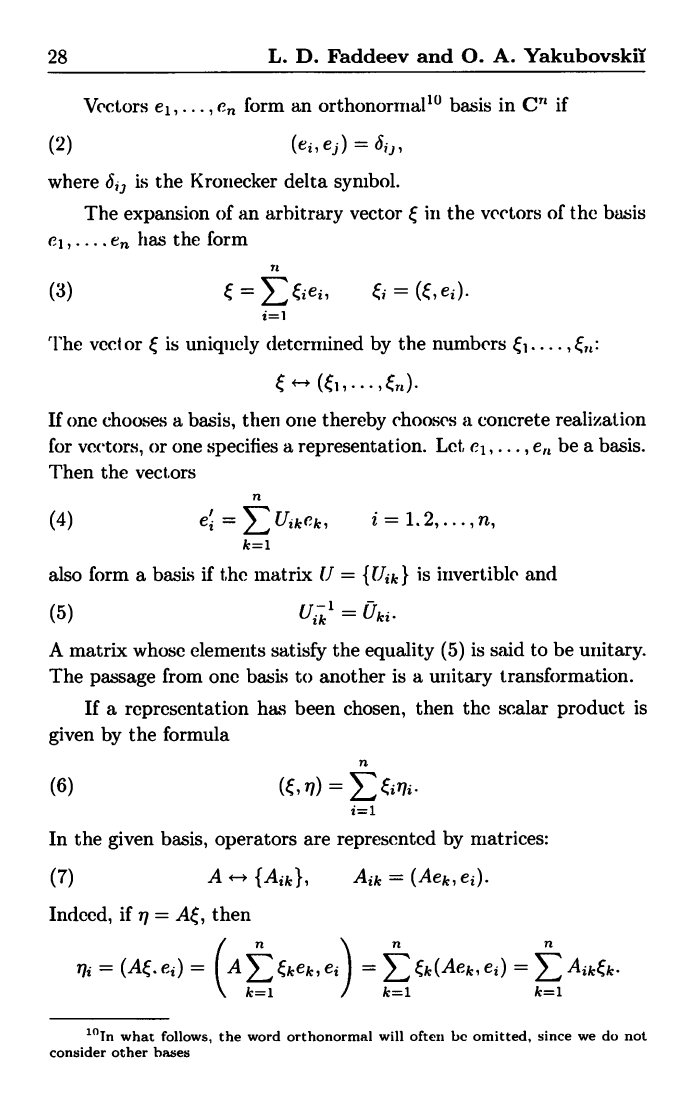
Vectors e1, ... , e, form an orthonormall ° basis in C7t if
(2)
(ei, e j) = bi J,
where b;J is the Kronecker delta symbol.
The expansion of an arbitrary vector
in the vectors of the basis
el, ... , e,z has the form
71
(3) --
i =
rl'he vect or is uniquely determined by the numbers 1it ...
H
1. .. , ').
If one chooses a basis, then one thereby chooses a concrete realization
for vectors, or one specifies a representation. Let e1, ... , e,, be a basis.
Then the vectors
n
-° 1] Uikek,
k=1
i=1.2,...,n,
also form a basis if the matrix U = {Ujk} is invertible and
(5)
Uik1
= Uki.
A matrix whose elements satisfy the equality (5) is said to be unitary.
The passage from one basis to another is a unitary transformation.
If a representation has been chosen, then the scalar product is
given by the formula
(6)
ini
i=1
In the given basis, operators are represented by matrices:
(7)
A H {A2k},
Aik = (Aek, ei).
Indeed, if 17 = then
n n
n
rIi = e) =
(Akekei)
= >
k (Aek, ei) = E AikG-
k=1
k=1
k=1
1oIn what follows, the word orthonormal will often be omitted, since we do not
consider other bases
§ 5. A finite-dimensional model of quantum mechanics
29
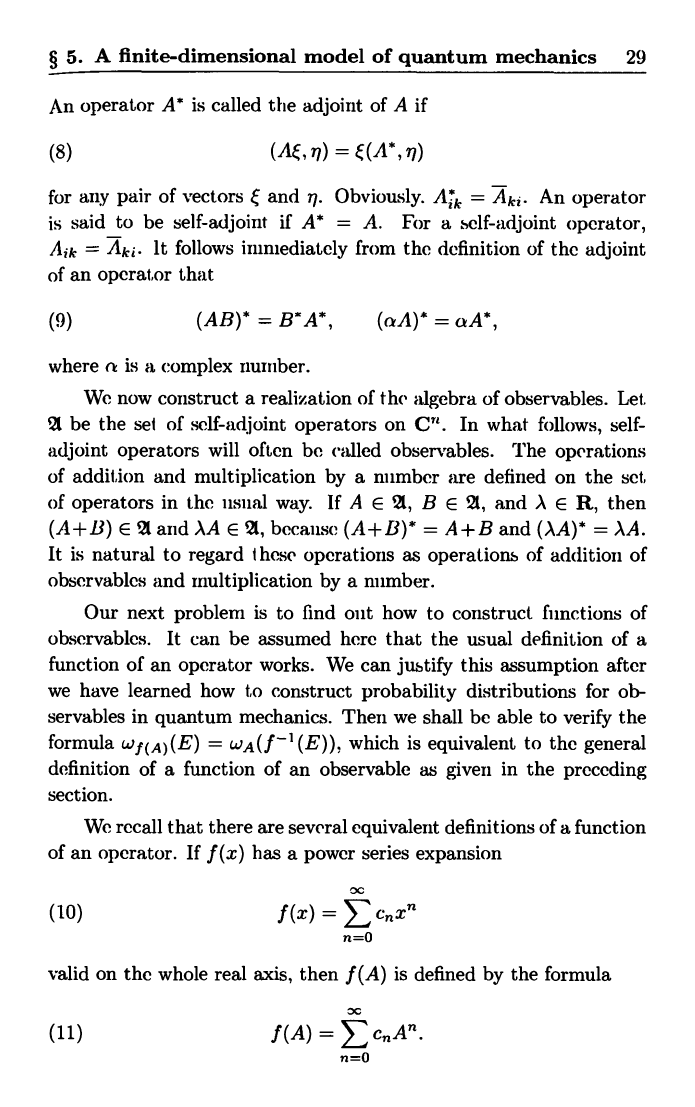
An operator A* is called the adjoint of A if
(8)
17) =
(A*
, n)
for any pair of vectors
and q. Obviously. A i = Aki. An operator
is said to be self-adjoint if A* = A.
For a self-adjoint operator,
Ails = Aki .
It follows immediately from the definition of the adjoint
of an operator that
(AB)* = B*A*,
(cA)*
= aA*,
where rt is a complex number.
We now construct a realization of the algebra of observables. Let,
21 be the set of self-acljoint operators on C7t. In what follows, self-
adjoint operators will often be called observables. The operations
of addition and multiplication by a number are defined on the set,
of operators in the usual way. If A E 2i, B E %, and A E R, then
(A+B) E % and AA E %, because (A+B)* = A+B and (AA)* = AA.
It is natural to regard t hese operations as operations of addition of
observables and multiplication by a number.
Our next problem is to find out how to construct functions of
observables.
It can be assumed here that the usual definition of a
function of an operator works. We can justify this assumption after
we have learned how to construct probability distributions for ob-
servables in quantum mechanics. Then we shall be able to verify the
formula w f(A) (E) = wA(f -1(E)), which is equivalent to the general
definition of a function of an observable as given in the preceding
section.
We recall that there are several equivalent definitions of a function
of an operator. If f (x) has a power series expansion
x
(10)
f (X) _ E
Cnxn
n=0
valid on the whole real axis, then f (A) is defined by the formula
x
f (A)
c,A
n=0
30
L. D. Faddeev and 0. A. Yakubovskii
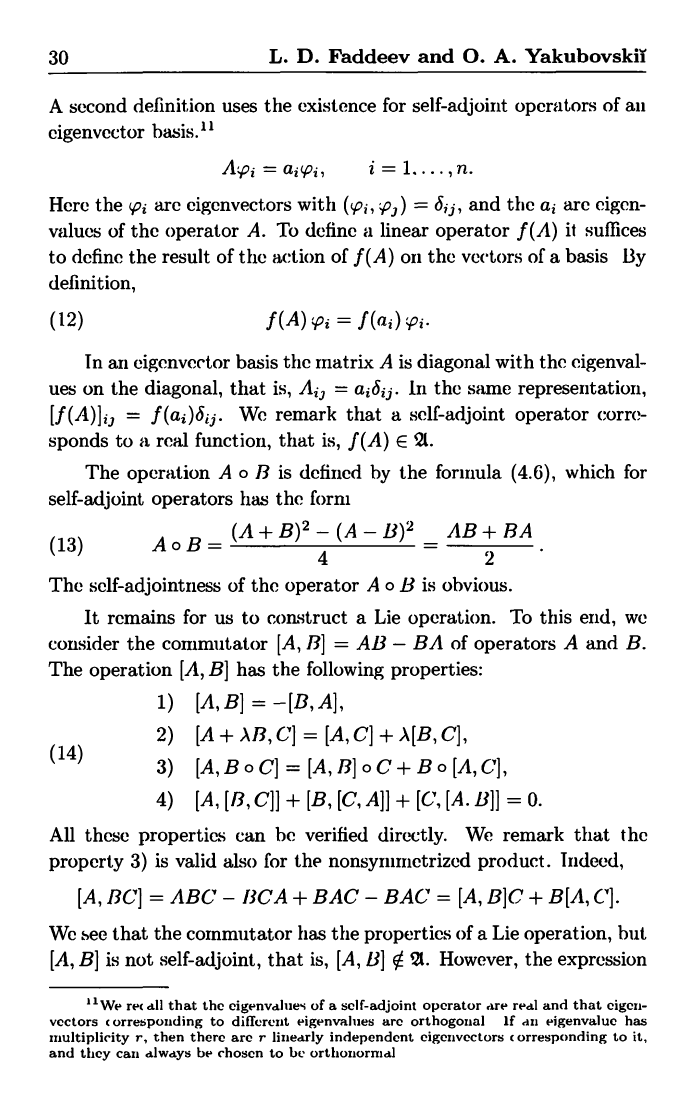
A second definition uses the existence for self-adjoint operators of an
cigenvector basis-ii
Ajpi = aiSpi,
i = 1.... , n.
Here the Spi are cigenvectors with (pj, ;p3) = bi j, and the ai are eigen-
values of the operator A. To define a linear operator f (A) it suffices
to define the result of the action of f (A) on the vectors of a basis By
definition,
(12)
f (A) pj = f (ai) oj-
In an eigenvector basis the matrix A is diagonal with the eigenval-
ues on the diagonal, that is, A13 = aibij.
In the same representation,
[1(A)]13 = f (ai) bid . We remark that a self-ad j oint operator corre-
sponds to a real function, that is, f (A) E %.
The operation A o B is defined by the formula (4.0), which for
self-adjoint operators has the form
(A + B)2 - (A - B)2 _ AB + BA
(13)
A o B =
4 2
The self-adjointness of the operator A o B is obvious.
It remains for us to construct a Lie operation. To this end, we
consider the commutator [A, B] = AB - BA of operators A and B.
The operation [A, B] has the following properties:
(14)
1) [A, B) = - [Bj A],
2)
[A+.AB,C] _ [A, C] + A[B, C'],
3) [A,BoC]=[A,B]oC+Bo[A,CJ,
4) [A, [B, C]] + [B, [C, A]] + [C, [A. B]] = 0.
All these properties can be verified directly. We remark that the
property 3) is valid also for the nonsynarietrized product. Indeed,
[A, BC] = ABC - BCA + BAC - BAC = [A, B]C + B [A, C].
We see that the commutator has the properties of a Lie operation, but
[A, B] is not self-adjoint, that is, [A, B] V Z. However, the expression
"We re( all that the eigenvalues of a self-adjoi nt operator are real and that eigen-
vectors corresponding to different eigenvalues are orthogonal
if an eigenvalue has
multiplicity r, then there are r linearly independent eigenvectors corresponding to it,
and they can always be chosen to be orthonornial
§ 5. A finite-dimensional model of quantum mechanics
31
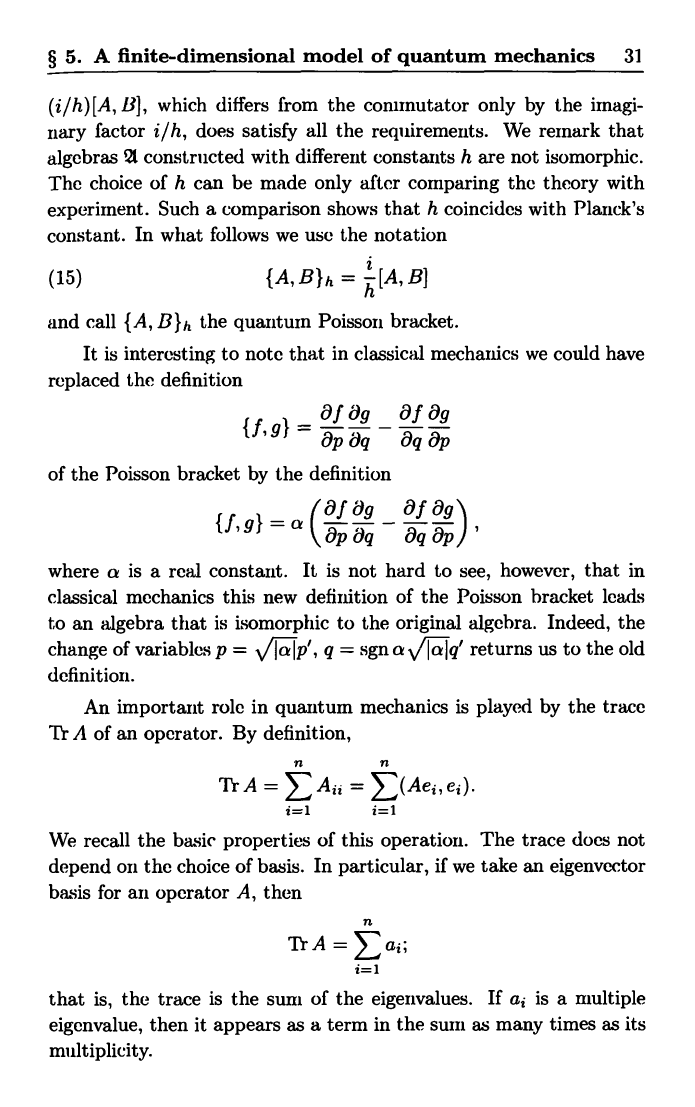
(i/h) [A, B], which differs from the conirnutator only by the imagi-
nary factor i/h, does satisfy all the requirements. We remark that
algebras % constructed with different constants h are not isomorphic.
The choice of h can be made only after comparing the theory with
experiment. Such a comparison shows that h coincides with Planck's
constant. In what follows we use the notation
(15)
JAI B}h
=i-[A,
BI
and call {A, B } h the quantum Poisson bracket.
It is interesting to note that in classical mechanics we could have
replaced the definition
{f,g}-8fdg
afag
ap dq
aq Op
of the Poisson bracket by the definition
{fig} = o
8f dg
-
Ofa
ap dq aq ap
where a is a real constant. It is not hard to see, however, that in
classical mechanics this new definition of the Poisson bracket leads
to an algebra that is isomorphic to the original algebra. Indeed, the
change of variables p = a j p', q = sgn a
f a j q' returns us to the old
definition.
An important role in quantum mechanics is played by the trace
Tr A of an operator. By definition,
TrA = >Ajj -- (Ae,e).
i=1
i=1
We recall the basic properties of this operation. The trace does not
depend on the choice of basis. In particular, if we take an eigenvector
basis for an operator A, then
n
IA'A=Eai;
i=x
that is, the trace is the sum of the eigenvalues.
If aZ is a multiple
eigenvalue, then it appears as a term in the sure as many times as its
multiplicity.
32
L. D. Faddeev and 0. A. YakubovskiT
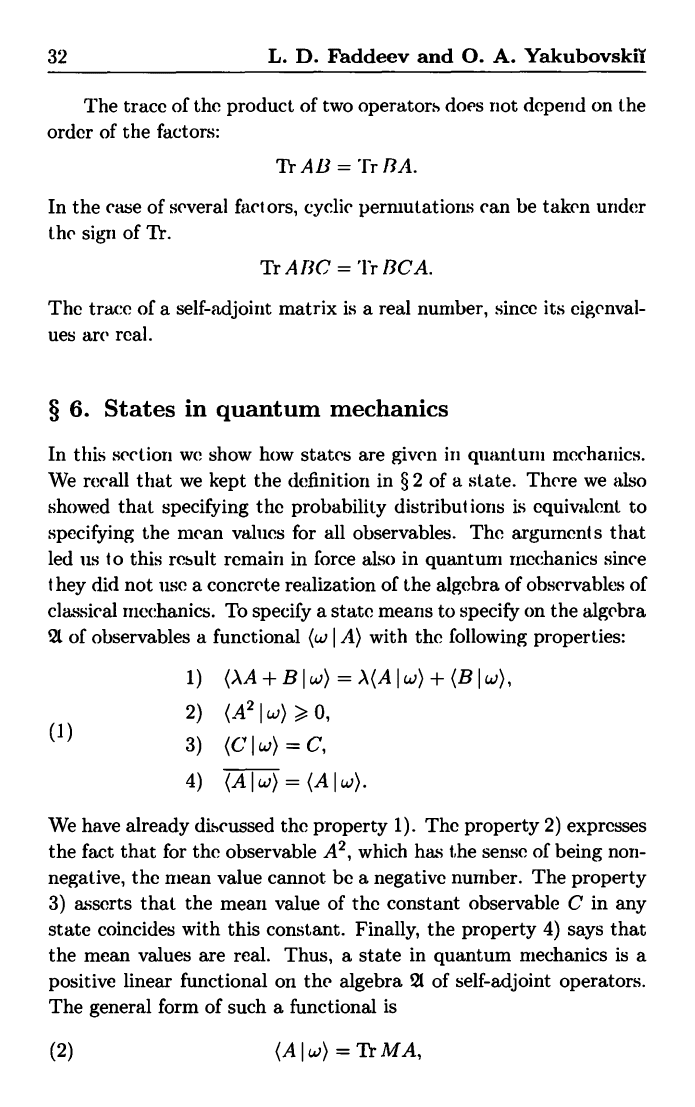
The trace of the product of two operators does not depend on the
order of the factors:
Tr A B = Tr BA.
In the case of several fact ors, cyclic permutations can be taken under
the sign of Tr.
Tr ABC = '1'r BCA.
The trace of a self-adjoins matrix is a real number, since its eigenval-
ues are real.
§ 6. States in quantum mechanics
In this section we show how states are given in quantum mechanics.
We recall that we kept the definition in § 2 of a state. There we also
showed that specifying the probability distributions is equivalent to
specifying the mean values for all observables. The arguments that
led us to this result remain in force also in quantum mechanics since
t hey did not use a concrete realization of the algebra of observables of
classical mechanics. To specify a state means to specify on the algebra
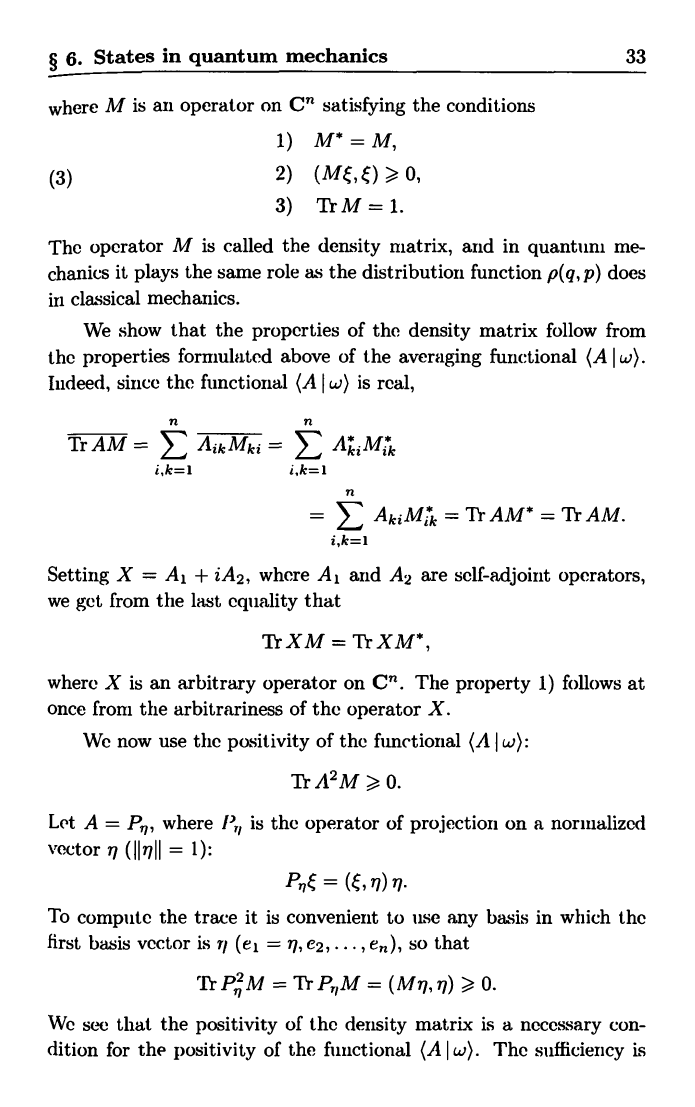
% of observables a functional (w I A) with the following properties:
rii
1) (1\A+Bjw)=1\(Ajw)+(Bjw),
2)
(421w)>O
,
(CIw)=C,
3)
4)
(AIw)=(AIw).
We have already discussed the property 1) . The property 2) expresses
the fact that for the observable A2, which has the sense of being non-
negative, the mean value cannot be a negative number. The property
3) asserts that the mean value of the constant observable C in any
state coincides with this constant. Finally, the property 4) says that
the mean values are real. Thus, a state in quantum mechanics is a
positive linear functional on the algebra 2 of self-adjoint operators.
The general form of such a functional is
(2)
(A I w) = Tr MA,
§ 6. States in quantum mechanics
33
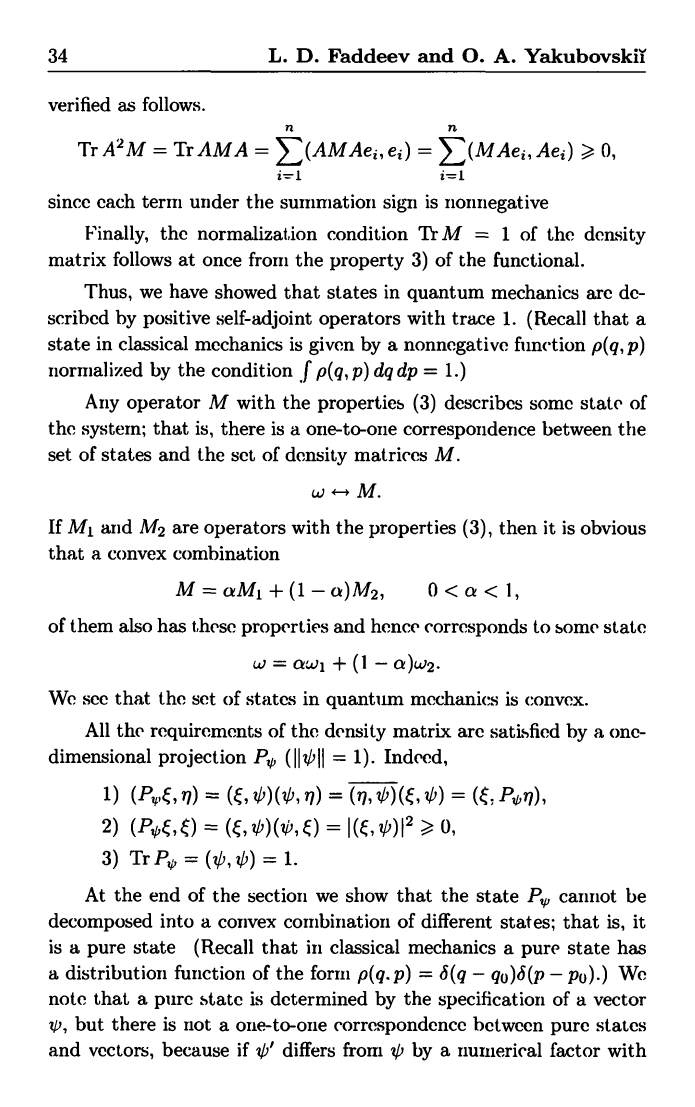
where M is an operator on C' satisfying the conditions
1) M*=M,
(3)
2)
3)
Tr M = 1.
The operator M is called the density matrix, and in quantum me-
chanics it plays the same role as the distribution function p(q, p) does
in classical mechanics.
We show that the properties of the density matrix follow from
the properties formulated above of the averaging functional (A I U)).
Indeed, since the functional (A I w) is real,
n n
Tr
AM =
Ails Mki =
A*i Mik
i,k=1 i,k=1
n
_
1: Aki
*k = Tr AM* = Tr AM.
i,k=1
Setting X = A, + i A2, where A 1 and A2 are self-adj oint operators,
we get from the last equality that
TXM=TrXM*,
where X is an arbitrary operator on Cn. The property 1) follows at
once from the arbitrariness of the operator X.
We now use the positivity of the functional (A I u)):
TrA2M0.
Let A = P,7, where 1-11 is the operator of projection on a normalized
vector r, (I I q I I = 1) :
Pn =(C'9)
To compute the trace it is convenient to use any basis in which the
first basis vector is,-r/ (e l = Ti, e2,
... , (2,L) , so that
Tr Pn M = Tr P,,M = (Mrf, 77) > 0.
We see that the positivity of the density matrix is a necessary con-
dition for the positivity of the functional (A I w). The sufficiency is
34
L. D. Faddeev and 0. A. Yakubovskii
verified as follows,.
n n
Tr A2M = Tr AMA =
E(AMAei,
ei) = E(MAei, Aei) > 0,
i=1
i=1
since each term under the summation sign is nonnegative
Finally, the normalization condition Tr M = 1 of the density
matrix follows at once from the property 3) of the functional.
Thus, we have showed that states in quantum mechanics are de-
scribed by positive self-adjoint operators with trace 1. (Recall that a
state in classical mechanics is given by a nonnegative function p(q, p)
normalized by the condition f p(q, p) dq dp = 1.)
Any operator M with the properties (3) describes some state of
the system; that is, there is a one-to-one correspondence between the
set of states and the set of density matrices M.
wHM.
If Ml and M2 are operators with the properties (3), then it is obvious
that a convex combination
M=aM1+(1-a)M2,
0<a<1,
of them also has these properties and hence corresponds to some state
w=awl+(1--a)w2.
We see that the set of states in quantum mechanics is convex.
All the requirements of the density matrix are satisfied by a one-
dimensional projection P (11011 = 1). Indeed,
1) (P1 ,rl)_(i1,
P7l)
2)
0,
=(b, )=1.3) TrPO
At the end of the section we show that the state P. cannot be
decomposed into a convex combination of different states; that is, it
is a pure state
(Recall that in classical mechanics a pure state has
a distribution function of the form p(q. p) = b(q - go)S(p - pc).) We
note that a pure state is determined by the specification of a vector
', but there is not a one-to-one correspondence between pure states
and vectors, because if 0' differs from 0 by a numerical factor with
§ 6. States in quantum mechanics
35
modulus 1, then P,,' = P
W
Thus. corresponding to a pure state is a
class of vectors with norm 1 that differs from each other by a factor
(-iQwith aER.
The vector i' is usually called a state vector, and the space in
which the self-adjoint operators (observables) act is called the state
space. For the present we take the space C" as the state space.
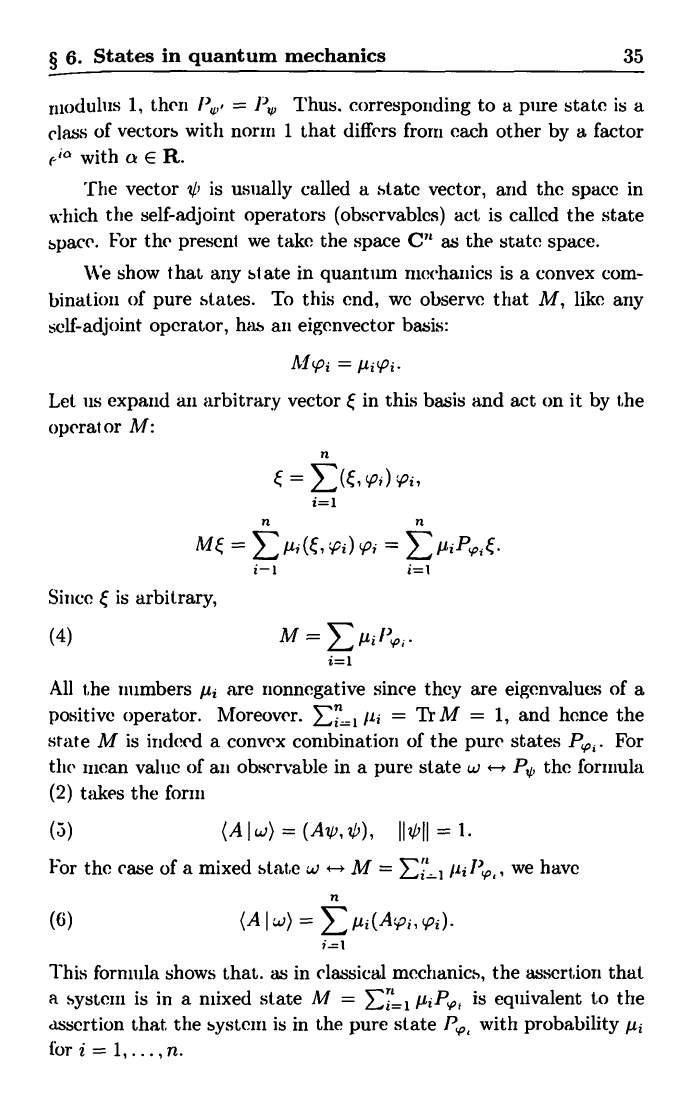
We show that any st ate in quantum mechanics is a convex com-
bination of pure states. To this end, we observe that M, like any
operator, has an eigenvector basis:
self-elf
Mcpi =
Let us expand an arbitrary vector in this basis and act on it by the
operator M:
n
- (
i=1
n
n
--
Pi v, Vii) Oi = > pi Poi .
i-I i=1
Since
is arbitrary,
(4)
M =
EIuij SOi
i=1
All the numbers lui are nonnegative since they are eigenvalues of a
positive operator. Moreover.
En
j=j /,ti = Tr M = 1, and hence the
state M is indeed a convex combination of the pure states P,,i . For
the mean value of an observable in a pure state w
P, , the forrrlula
(2) takes the form
(5)
(AIw) = (A),
I1'1I = 1.
For the case of a mixed state w M
pi Pit , we have
n
r
/
(6)
(A I w) =
1:,ui
i-1
This formula shows that. as in classical mechanics, the assertion that
a system is in a mixed state M = E i
r 1-i PS,, is equivalent to the
assertion that the system is in the pure state P., with probabilityi
fori=1,...,n.
36
L. D. Faddeev and 0. A. YakubovskiT
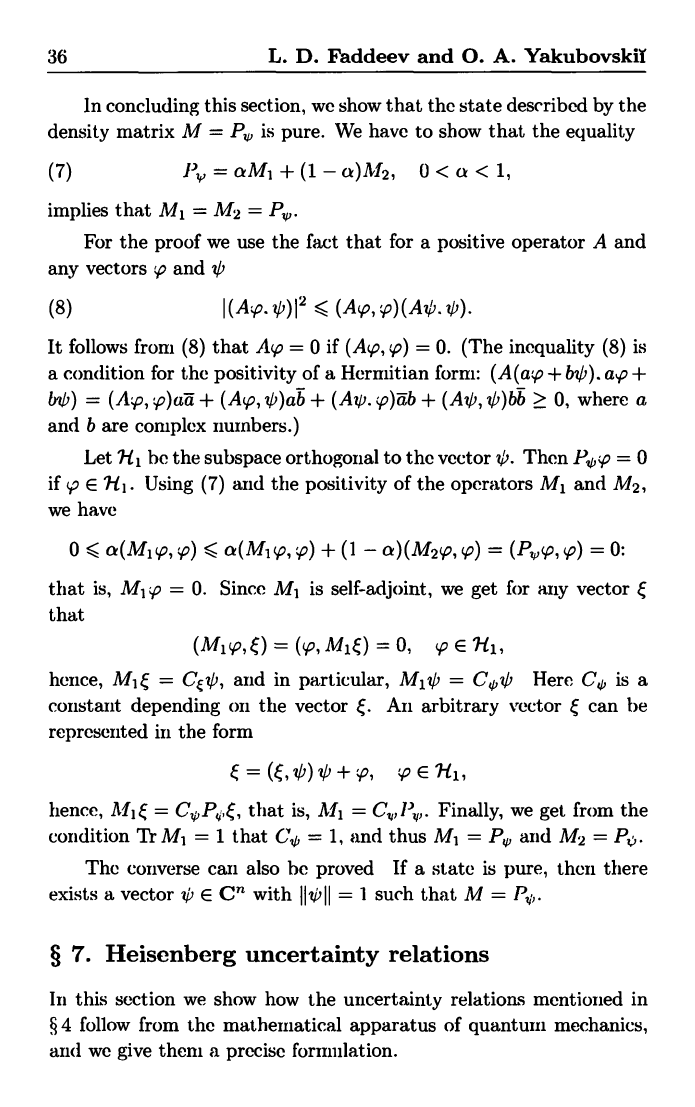
In concluding this section, we show that the state described by the
density matrix M = P is pure. We have to show that the equality
(7)
'V =aM1+(1-o)M2, 0<a <1,
implies that M1 = M2 = Pv.
For the proof we use the fact that for a positive operator A and
any vectors ;p and
(8) I
(A)(Ap).
It follows from (8) that AW = 0 if (Acp, gyp) = 0. (The inequality (8) is
a condition for the positivity of a Hermitian form: (A(ap + 60). app +
bib) = (Ap,p)a+ (Acp, V))ab + (Aip.p)ab+ (AiP,ib)bb > 0,where a
and b are complex numbers.)
Let RI be the subspace orthogonal to the vector ib. Then P.0 = 0
if V E f l .
Using (7) and the positivity of the operators Ml and M2,
we have
0 < a (Ml p, P) < a (Ml 0, p) + (1 -- a) (M2 gyp, Sp) =
0:
that is, M1 p = 0. Since M1 is self-adjoint, we get for any vector
that
OERJJ
hence, M1 = Q V), and in particular, Mxib = C,, Here C#) is a
constant depending on the vector An arbitrary vector
can be
represented in the form
ipExz,
hence, Ml = CJP
that is, All = C,,, Pg,. Finally, we get from the
condition Tr M1 = 1 that C. b = 1, and thus M1 = Pp and M2 = P,.
The converse can also he proved If a state is pure, then there
exists a vector 0 E Cn with I I V 1 I = 1 such that M = Per,
P.
§ 7. Heisenberg uncertainty relations
In this section we show how the uncertainty relations mentioned in
4 follow from the mathematical apparatus of quantum mechanics,
and we give them a precise formulation.
§ 7. Heisenberg uncertainty relations 37
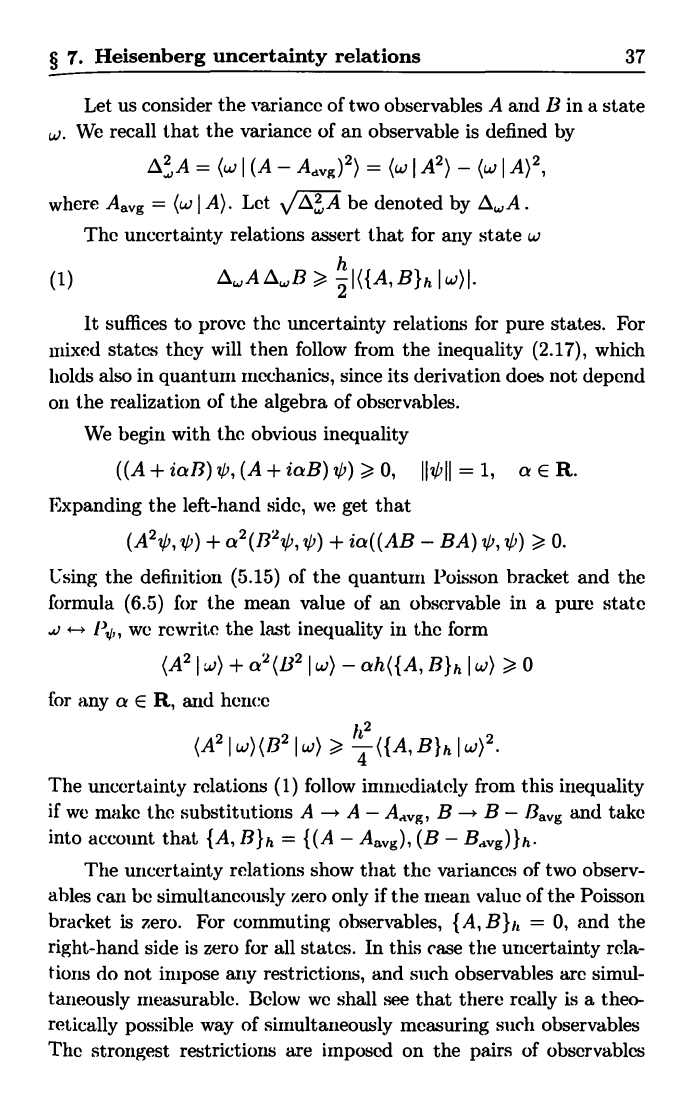
Let us consider the variance of two observables A and B in a state
w. We recall that the variance of an observable is defined by
A2 A
= (w I (A - Aavg) 2) _ (w I A2) - (w I
A)2'
where Aavg = (w I A) . Let Ow A be denoted by Ow A .
The uncertainty relations assert that for any state w
1
A, A B >
w
w IIt
suffices to prove the uncertainty relations for pure states. For
mixed states they will then follow from the inequality (2.17), which
holds also in quantum Ynechanics, since its derivation does not depend
on the realization of the algebra of observables.
We begin with the. obvious inequality
((A + jaB),O, (A+iaB)iP) > 0,
11,011=17
a E R.
Expanding the left-hand side, we get that
(A2b,i') + a2(B2 b, s) + ia((AB --- BA) ,') > 0.
Using the definition (5.15) of the quantum Poisson bracket and the
formula (6.5) for the mean value of an observable in a pure state
we rewrite. the last inequality in the form
(A21w)+a2(B21w)-ah({A,B}hlw) > 0
for any a E R, and hence
(A21w)(B21w)>h ({A,B}hIw)2.
The uncertainty relations (1) follow immediately from this inequality
if we make the substitutions A A - Aavg, B B - and take
into account that {A, B}h = ((A - Aavg), (B - Bg) }h.
The uncertainty relations show that the variances of two observ-
ables can be simultaneously zero only if the mean value of the Poisson
bracket is zero. For commuting observables, { A, B}h = 0, and the
right-hand side is zero for all states. In this case the uncertainty rela-
tions do not impose any restrictions, and such observables are simul-
twieously measurable. Below we shall see that there really is a theo-
retically possible way of simultaneously measuring such observables
The strongest restrictions are imposed on the pairs of observables