
Faddeev L.D., Yakubovskii O.A. Lectures on Quantum Mechanics for Mathematics Students
Подождите немного. Документ загружается.

48
L. D. Faddeev and 0. A. YakubovskiI
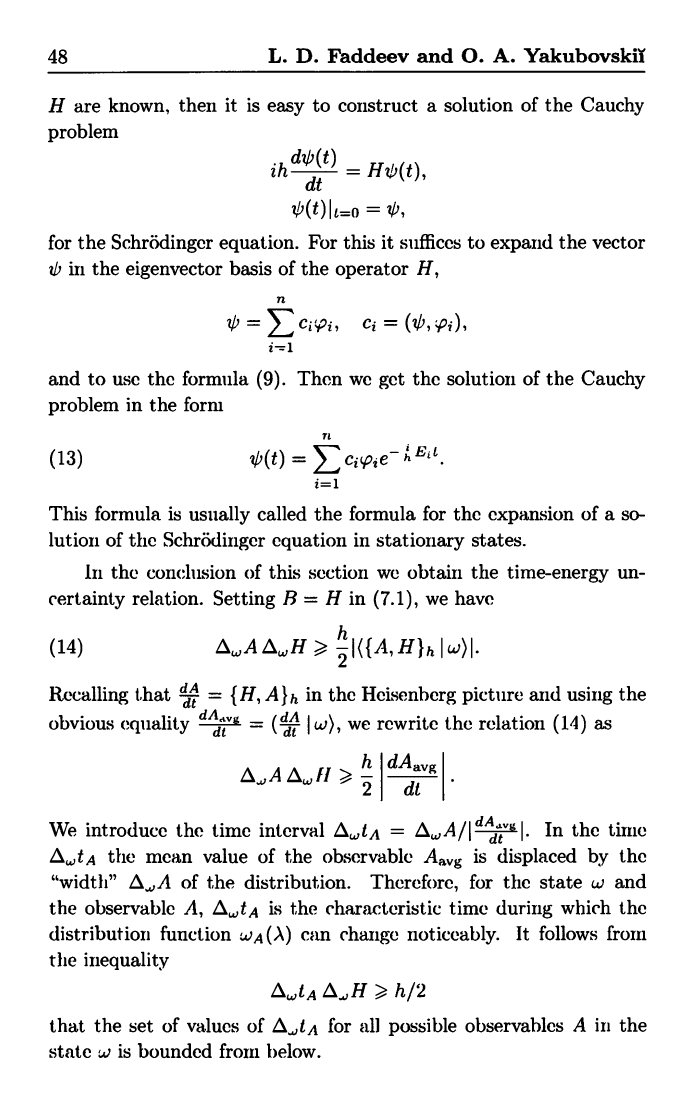
H are known, then it is easy to construct a solution of the Cauchy
problem
ih
do(t)
= H
dt
V(t)}
V/ (t) I t=O = 0,
for the Schrodinger equation. For this it suffices to expand the vector
zG in the eigenvector basis of the operator H,
n
E ciWoi
C2 ... (tb, 7'Z)
i-1
and to use the formula (9). Then we get the solution of the Cauchy
problem in the form
7z
(13)(t} ---
hit
2=1
This formula is usually called the formula for the expansion of a so-
lution of the Schrodinger equation in stationary states.
In the conclusion of this section we obtain the time-energy un-
certainty relation. Setting B = H in (7.1), we have
w .
1({ AH}h(14)
w w
2
Recalling that t = {H, A } h in the Heisenberg picture and using the
obvious equality dt = dc I w), we rewrite the relation (14) as
A, A
H>h
`
W
2
dAavg
dt
We introduce the time interval &, t A = Ow A / I
dALvg
. In the time
&,t A the mean value of the observable Aa,,,g is displaced by the
"width" &,A of the distribution. Therefore, for the state w and
the observable A, OW t A is the characteristic time during which the
distribution function WAN can change noticeably.
It follows from
the inequality
&WtA&H > h/2
that the set of values of A,1 A for all possible observables A in the
state w is bounded from below.
§ 10. Quantum mechanics of real systems 49
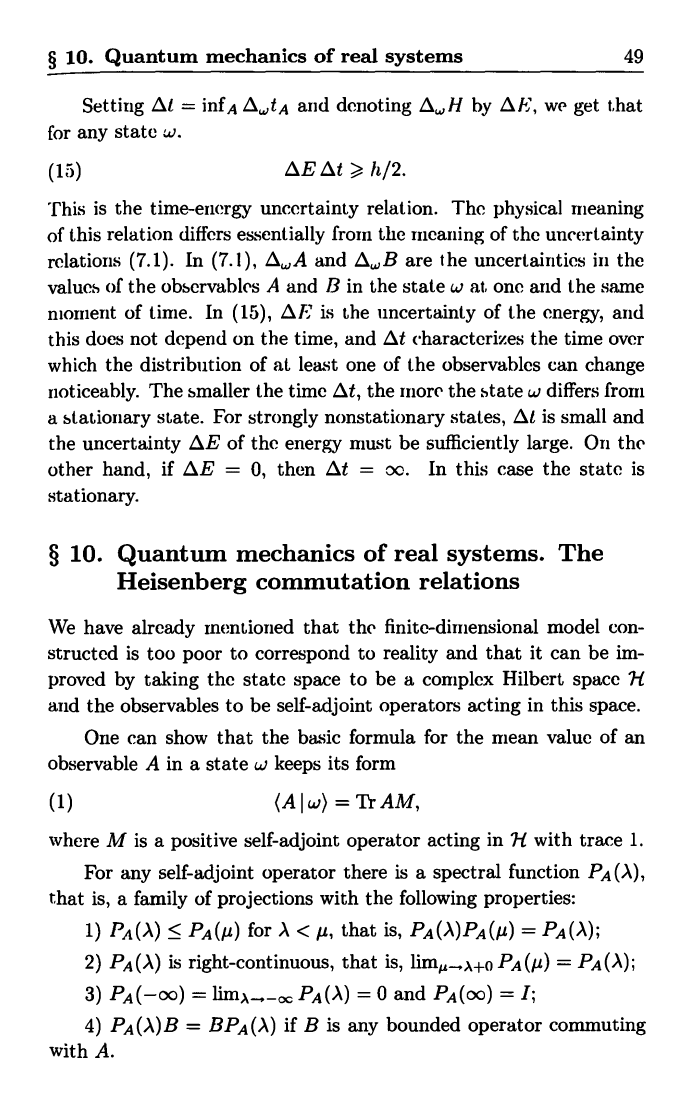
Setting At = infA OWtA arid denoting &,H by A E, we get that
for any
state w.
(15)
AE At > h/2.
This is the time-energy uncertainty relation. The physical meaning
of this relation differs essentially from the meaning of the uncertainty
relations (7.1). In (7.1), &,A and A , B are the uncertainties in the
values of the observables A and B in the state w at, one and the same
niorrient of time. In (15), Al is the uncertainty of the energy, and
this does not depend on the time, and At characterizes the time over
which the distribution of at least one of the observables can change
noticeably. The smaller the time At, the more the state w differs from
a stationary state. For strongly nonstationary states, At is small and
the uncertainty DE of the energy must be sufficiently large. On the
other hand, if of = 0, then At = oo.
In this case the state is
stationary.
§ 10. Quantum mechanics of real systems. The
Heisenberg commutation relations
We have already mentioned that the finite-dimensional model con-
structed is too poor to correspond to reality and that it can be im-
proved by taking the state space to be a complex Hilbert space fl
and the observables to be self-adjoint operators acting in this space.
One can show that the basic formula for the mean value of an
observable A in a state w keeps its form
(1)
(A I w) = Tr AM,
where M is a positive self-adjoins operator acting in fl with trace 1.
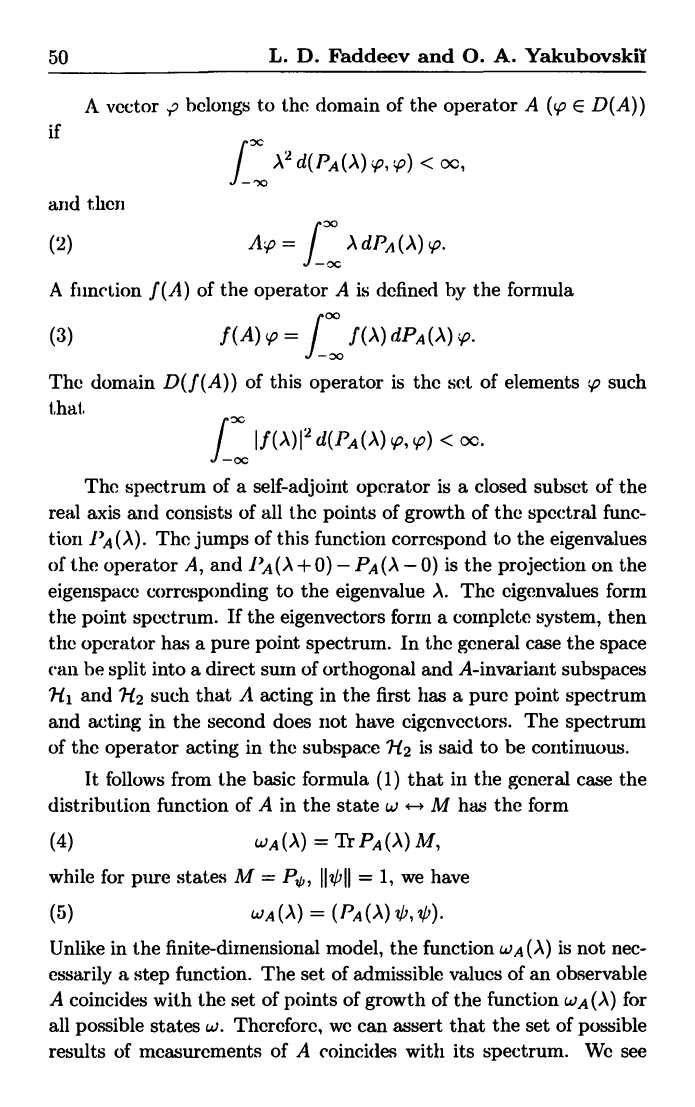
For any self-adjoint operator there is a spectral function PA (A),
that is, a family of projections with the following properties:
1) PA (A) < PA (li) for A < p, that is, PA (A) PA (li) = PA (A) ;
2) PA (A) is right-continuous, that is, lim;,_.., A+c PA (1u) = PA (A) ;
3) PA(-oo) = lima-,_0CPA (A) = 0 and PA (oo) = I;
4) PA (A) B = B PA (A) if B is any bounded operator commuting
with A.
50
L. D. Faddeev and 0. A. Yakubovskii
if
A vector p belongs to the domain of the operator A (cp E D(A))
and then
(2)
jA2d(PA(A),)
< oc,
00
AdPA(A) o.
x
A function f (A) of the operator A is defined by the formula
(3)
f (A) p = f-
00
f (A) dPA(A) p-
The domain D (f (A)) of this operator is the set of elements :p such
that
oc.
The spectrum of a self-adjoint operator is a closed subset of the
real axis and consists of all the points of growth of the spectral func-
tion PA (A) . The jumps of this function correspond to the eigenvalues
of the operator A, and PA (A + 0) - PA (A -- 0) is the projection on the
eigenspace corresponding to the eigenvalue A. The eigenvalues form
the point spectrum. If the eigenvectors form a complete system, then
the operator has a pure point spectrum. In the general case the space
can be split into a direct sum of orthogonal and A-invariant subspaces
7x and H2 such that A acting in the first has a pure point spectrum
and acting in the second does not have eigenvectors. The spectrum
of the operator acting in the subspace f2 is said to be continuous.
It follows from the basic formula (1) that in the general case the
distribution function of A in the state w H M has the form
(4) WA (A) = Tr PA (A) M,
while for pure states M = Pp,
11,011 = 1, we have
(5)
WA(A) = (PA(A),O,
).
Unlike in the finite-dimensional model, the function WA (A) is not nec-
essarily a step function. The set of admissible values of an observable
A coincides with the set of points of growth of the function WA (A) for
all possible states w. Therefore, we can assert that the set of possible
results of measurements of A coincides with its spectrum. We see
§ 10. Quantum mechanics of real systems
51
that the theory makes it possible to describe observables with both a
discrete and a continuous set of values.
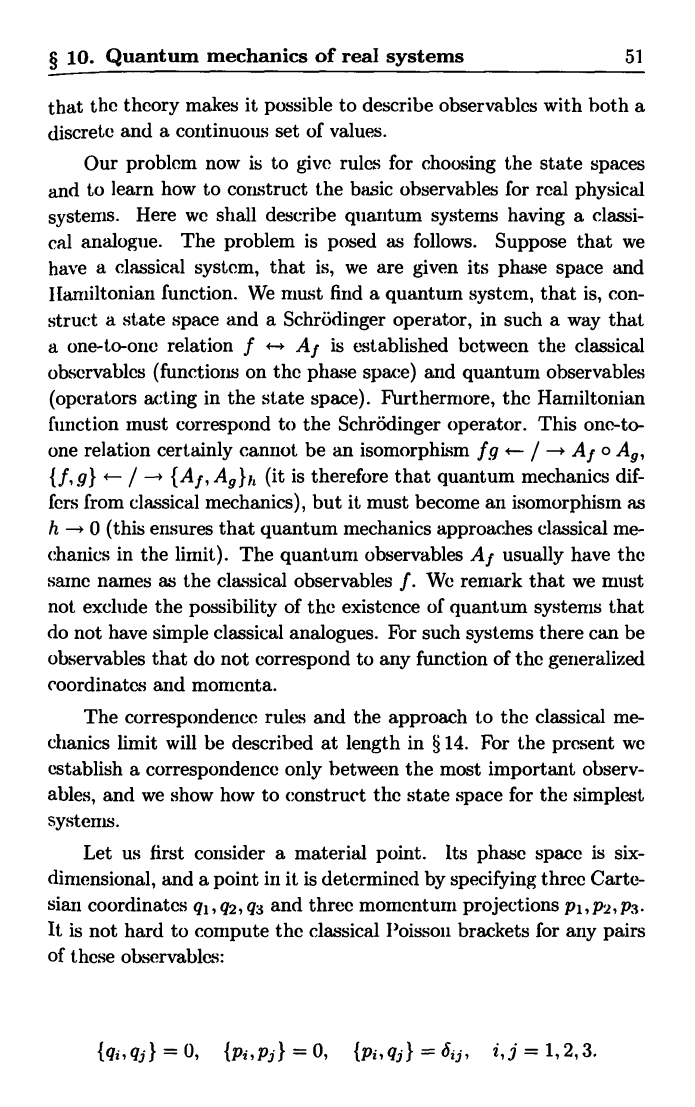
Our problem now is to give rules for choosing the state spaces
and to learn how to construct the basic observables for real physical
systems. Here we shall describe quantum systems having a classi-
cal analogue. The problem is posed as follows.
Suppose that we
have a classical system, that is, we are given its phase space and
llamiltonian function. We must find a quantum system, that is, con-
struct a state space and a Schrodinger operator, in such a way that
a one-to-one relation f A f is established between the classical
observables (functions on the phase space) and quantum observables
(operators acting in the state space). Furthermore, the Hamiltonian
function must correspond to the Schr"finger operator. This one-to-
one relation certainly cannot be an isomorphism fg F-- / -+ A f o A9,
f f, g } +- / -* {A, A9 J h (it is therefore that quantum mechanics dif-
fers from classical mechanics), but it must become an isomorphism as
h -+ 0 (this ensures that quantum mechanics approaches classical me-
chanics in the limit). The quantum observables A f usually have the
same names as the classical observables f. We remark that we must
not exclude the possibility of the existence of quantum systems that
do not have simple classical analogues. For such systems there can be
observables that do not correspond to any function of the generalized
coordinates and momenta.
The correspondence rules and the approach to the classical me-
chanics limit will be described at length in § 14. For the present we
establish a correspondence only between the most important observ-
ables, and we show how to construct the state space for the simplest
systems.
Let us first consider a material point. Its phase space is six-
dimensional, and a point in it is determined by specifying three Caxte-
sian coordinates q1, q2, q3 and three momentum projections p1, p2, p3.
It is not hard to compute the classical Poisson brackets for any pairs
of these observables:
{q,q}=0,
{pi,pj} =0,
{pi,gj}--Sip, i,j=1,2,3.
52
L. D. Faddeev and 0. A. YakubovskiT
For a particle in quantum mechanics we introduce six observables Q,
Q2- Q3- P1, P2. PP.3 for which the quantum Poisson brackets have the
same values:
(6)
{Q1.Qj}h = 0,
{P, P3 }h = o,
{IQj}h =- Ihj3.
where I is the identity operator. These observables will be called the
coordinates and momentum projections.
Below we shall justify this association of operators with coordi-
nates and momenta by the following circumstances. After studying
the observables determined by the relations (6), we shall see that they
have many of the properties of classical coordinates and xrionienta.
For example, for free particles the projections of the momentum are
integrals of motion, and the mean values of the coordinates depend
linearly on the time (uniform rectilinear motion).
Further. the correspondence qi H "L}i, pi E--3 PZ, i = 1, 2, 3, is
fundamental for us for the construction of a general correspondence
f (q, p) H Af . The quantum observables defined in this way, including
the coordinates and momenta, turn into the corresponding classical
observables in the limit.14 Finally, the correspondence rules f ; Al
make. the theory completely concrete, and its results can be verified
in experiments. It is the agreement of theory with experiment that
should be regarded as the definitive justification of the assumption
(6) and of all of quantum mechanics.
The conditions (6) are called the Heisenberg quantization condi-
tions. Together with (7.1) they at once imply the Heisenberg uncer-
tainty relations for the coordinates and momenta. We have already
discussed these relations.
The formulas (6) are often written for the commutators:
(7)
[Q7, QkJ = O, [PjiPk1=O,
[Q3, Pk]= ihSjk.
These relations are called the Heisenberg commutation relations.
14The exact meaning of this assertion is discussed in § 14
§ 10. Quantum mechanics of real systems
53
We now state without proof the remarkable von Neumanii-Stone
theorer1m.15
For the system of relations (7) there exists a unique irreducible
representation by operators actin( in a Hilbert space (unique tip to a
unitary transformation).
We recall what an irreducible representation is. One usually uses
two equivalent definitions:
1) A representation of the relations (7) is said to be irreducible
if there does not, exist an operator other than a multiple C1 of the
identity that commutes with all the operators Qi and Pi.
2) A representation is said to be irreducible if there does not exist
a nontrivial subspace Ho of x that is invariant under all the operators
Q1 and P.
We verify the equivalence of these definitions. If there is a non-
trivial subspace Ho invariant under Qi and I i, then the projection
PI-j0 onto this subspace commutes with Qi and Pi, and obviously
PH() CL
If there is an operator A CI commuting with all the Qi and Pi,
then A* and hence also A + A* commute with Qi and Pi. Therefore,
we can assume from the very beginning that A is self-adjoint. The
self-adjoint operator A has a spectral function PA (A) which for some A
is different from zero and CI. The operator PA (A) commutes with Qi
and Pi, and thus the subspace Ho onto which it projects is invariant
with respect to Qi and Pi.
It follows from the von Neumann-Stone theorem that if we find
some representation of the Heisenberg commutation relations and
prove that it is irreducible, then all other irreducible representations
will differ from it by a unitary transformation.
We know that the physical interpretation of the theory is based
on the formula (A I w) = RAM for the mean value. The right-hand
side of this formula does not change under a unitary transformation
15The formulation given is not precise, since there
are subtleties connected with
the unboundedness of the operators P and Q that we are not going to discuss Sim-
ilar difficulties do not arise if instead of the operators P and Q themselves we con-
sider bounded functions of these operators We present a precise formulation of the
von Neumann-Stone theorem in § 13
54
L. D. Faddeev and 0. A. Yakubovskii
of all the operators. Therefore, the physical results of the theory do
not depend on which of the unitarily equivalent representations we
choose.
§ 11. Coordinate and momentum
representations
We describe the so-called coordinate representation most often used
in quantum mechanics. It is sometimes called the Schrodinger repre-
sentation. As the state space for a material point in this representa-
tion, we choose the space L2 (R3) of square-integrable complex-valued
functions p (x) = Sp(x 1
, X2, X3). The scalar product is defined by
(1)
((P1, 02) =
1(X) So2 (x) dX.
R3
The operators Qj and Pj, = 1, 2, 3, are introduced by the for-
rnulas
Qj c0 (X) = xj fi(x),
(2)
h (9
Pj O(x)
i
O(x)
8xj
These are unbounded operators, and this corresponds to the phys-
ical meaning of the observables, since the numerical values of the
coordinates and momenta are unbounded. The operators Q., and P
themselves and all their positive integer powers are defined on the do-
main D formed by the infinitely differentiable functions that decrease
faster than any power. Obviously, D is dense in W. It can be shown
that the operators Qj and P3 have unique self-adjoint extensions upon
closure. It is easy to verify that these operators are symmetric. For
example, for P1 and any functions b, ;p E D we get by integrating by
parts that
(Pi 5P,
} =
dx
V)(x)
--
0C
11)0
dx2 dx3.
Ax)'P(X)
R.3
i
ox,
«,
f0C
z
00
h 8ip(x) h ft (x)
3
dx so(x)
i
dxi
=
3
dx So(x)
i ax,
- p,
Pi h)
JR
R
§ 11. Coordinate and momentum representations
55
Let us verify the commutation relations (10.7). The first two of
them are obvious, and the third follows from the equalities
ha
h
ha
PkQ3Se(x)
i vex
(xjfi(x))
bjk'P(x) + xj
-
SP(X),
2 i(Xk
f,
SP(X) = x
j
a
Q'
3 i
x
S O
Thus, we have indeed constructed a representation of the relations
(10.7) by linear operators. The irreducibility of this representation
will be proved later
We present one more example of a representation (the momentum
representation). In this representation the state space 7-1 is also the
complex space L`2 (R3) with elements co(p), and the operators Q.7 and
PJ , j = 1, 2, 3, are defined as follows:
a
Qj P(p) = i
5P-j
h
(3)
SP(P),
P(p) _ pj SP(P)-
The commutation relations (10.7) are verified in the same way
as for the coordinate representation, and the proof of irreducibility is
t he same. By the von Neumann Stone theorem, these representations
are unitarily equivalent; that is, there is a unitary transformation 16
Se(x)
- (p)
such that the operators defined by (3) are transformed into the oper-
ators (2). It is not hard to see that the Fourier transformation
3
(4)
x =
SP()
(27rh
cP(P) P
R3
3
2
(5)
SP(p) =
2i h
e- hp"cp(x) dx
j
s
is such a transformation
The unitarity of the Fourier transformation follows from the Par-
seval equality
fR3 Isa(X)I2 ax = 1R3
dp.
16We intentionally use one and the same symbol to denote the different functions
.P(x) and cp(p), since both these functions represent one and the same state p
56
L. D. Faddeev and 0. A. Yakubovskii
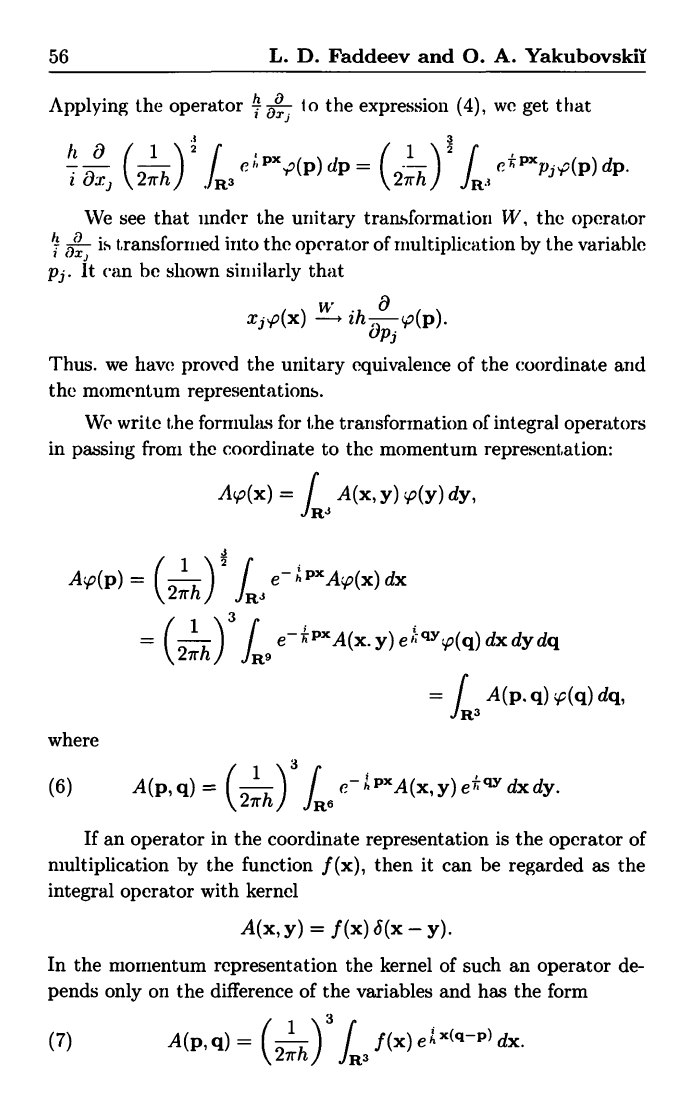
to the expression (4), we get thatApplying the operator h
OX j
J
h a
1
i a:r.j
27rh
2
3
pX
-1
f' h pX
.
3
(P) dP =
27Th
ppp(P) dP
R
JR
We see that tinder the unitary transformation W, the operator
tt
Q
is transformed into the operator of multiplication by the variable
z {`fix J
Pi. It can he shown similarly that
a
xjp(x)
W
----p ih
SA(P)
p3
Thus. we have proved the unitary equivalence of the coordinate and
the momentum representations.
We write the formulas for the transformation of integral operators
in passing from the coordinate to the momentum representation:
A(X,Y) P(Y) dY,
A4p(X) =
fR
AiP(P) =
where
3
1 2
(27rh
iRS e
h P dx
()3fR9
e
e' 1iP(9) dxdYdq
P q) F(9) d4,
fR3 A(
3
,
(6) A(p, q) = 27Th
_ pXA(x, y) ,dx
dy.
fR6
If an operator in the coordinate representation is the operator of
multiplication by the function f (x), then it can be regarded as the
integral operator with kernel
A(x, y) = f (x) J(x - y).
In the momentum representation the kernel of such an operator de-
pends only on the difference of the variables and has the form
(7)
A(P,q)=
()3ff(x)e1_cix.
§ 11. Coordinate and momentum representations
57
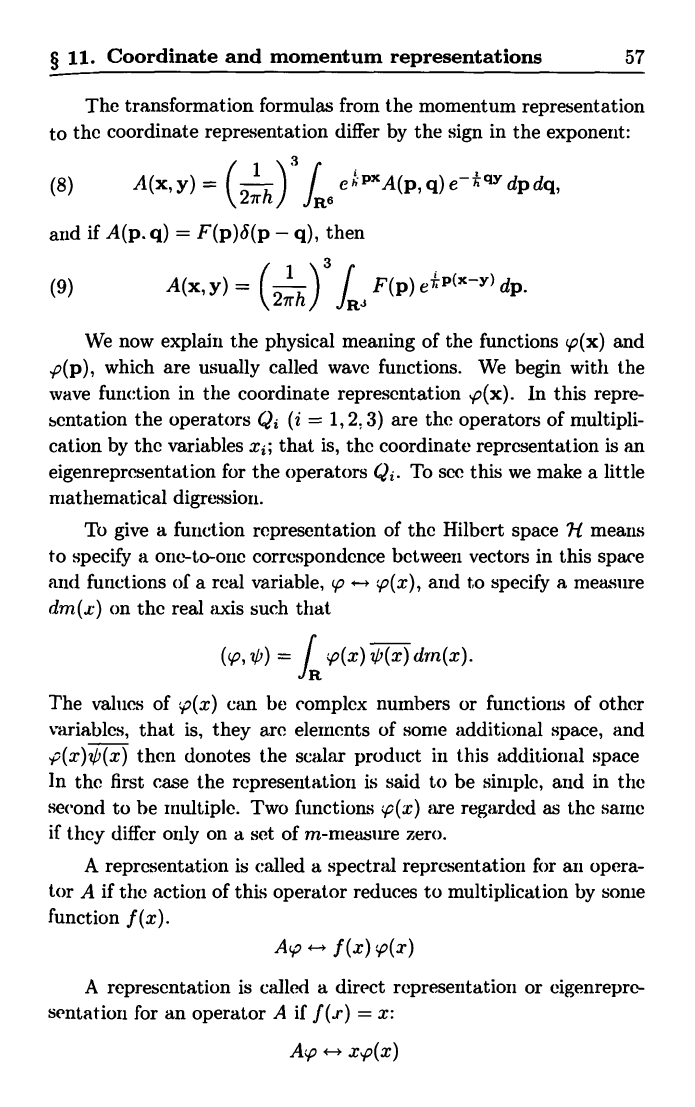
The transformation formulas from the momentum representation
to the coordinate representation differ by the sign in the exponent:
3
1
(8)
A(X,Y)= (27rh)
f1R;6
e
hpA(Aq)e
"`"'dPdq,
and if A(p, q) = F(p)8(p - q), then
1
3
(9)
A(x, y) = (27rh ) fR
3
F(p) eT p(X-r) dp.
We now explain the physical meaning of the functions
(x) and
,o(p), which are usually called wave functions. We begin with the
wave function in the coordinate representation yp(x). In this repre-
sentation the operators Q (i = 1, 2; 3) are the operators of multipli-
cation by the variables x1; that is, the coordinate representation is an
eigenrepresentation for the operators Q j. To see this we make a little
mathematical digression.
To give a function representation of the Hilbert space 7-1 means
to specify a one-to-one correspondence between vectors in this space
and functions of a real variable, p
;p(x), and to specify a measure
dm
on the real axis such that
(Sp, *) =
f(x)Ydrn(x).
The values of ;p(x) can be complex numbers or functions of other
variables, that is, they are elements of some additional space, and
(x)'(x) then donotes the scalar product in this additional space
In the first case the representation is said to be simple, and in the
second to be multiple. Two functions p(x) are regarded as the same
if they differ only on a set of m-measure zero.
A representation is called a spectral representation for an opera-
tor A if the action of this operator reduces to multiplication by some
function f (x).
A
representation is called a direct representation or eigenrepre-
sentation for an operator A if f (x) = x:
H
xo(x)