
Faddeev L.D., Yakubovskii O.A. Lectures on Quantum Mechanics for Mathematics Students
Подождите немного. Документ загружается.

58
L. D. Faddeev and 0. A. Yakubovskii
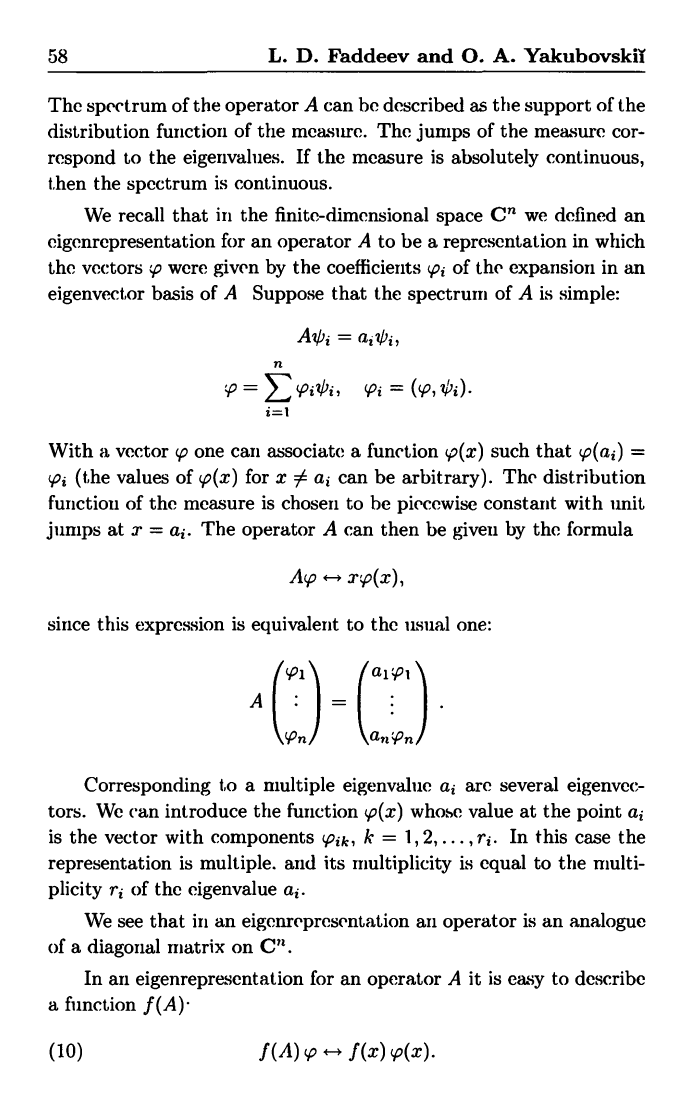
The spectrum of the operator A can be described as the support of the
distribution function of the measure. The jumps of the measure cor-
respond to the eigenvalues. If the measure is absolutely continuous,
then the spectrum is continuous.
We recall that in the finite-dimensional space Cn we defined an
eigenrepresentation for an operator A to be a representation in which
the vectors SP were given by the coefficients Spj of the expansion in an
eigenvector basis of A Suppose that the spectrum of A is simple:
Aii = ai V)i
>P =
Oi lPi ,
SPi = (W,lii).
i=1
With a vector Sp one can associate a function w(x) such that Sp(ai) =
Spi (the values of SP(x) for x
ai can be arbitrary). The distribution
function of the measure is chosen to be piecewise constant with unit
jumps at x = ai. The operator A can then be given by the formula
ASP H xSP(x),
since this expression is equivalent to the usual one:
Oi
ai;Pl
A _
SPn
a'.t 'p
Corresponding to a multiple eigenvalue ai are several eigenvec-
tors. We can introduce the function Sp(x) whose value at the point ai
is the vector with components 0ik, k = 1, 2, ... , ri.
In this case the
representation is multiple. and its iriultiplicity is equal to the multi-
plicity ri of the eigenvalue ai.
We see that in an eigenrepresentation an operator is an analogue
of a diagonal rrmatrix on C".
In an eigenrepresentation for an operator A it is easy to describe
a function f (A)
(10) I (A) p H .f (x) p(x).
§ 11. Coordinate and momentum representations
59
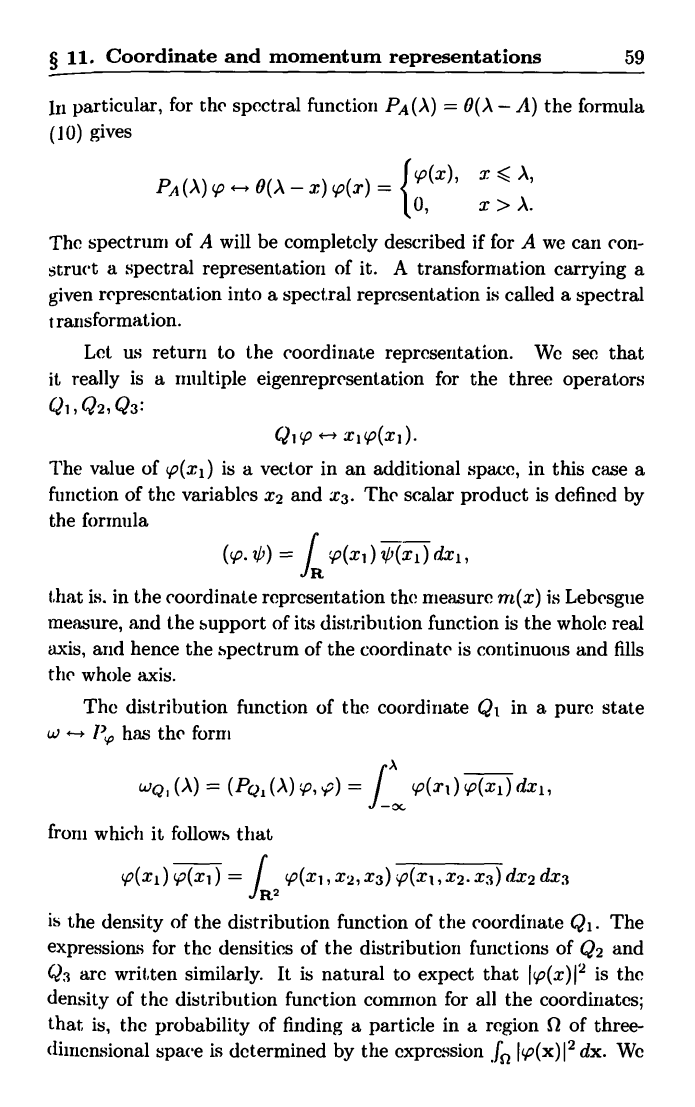
Iri particular, for the spectral function PA (A) = ©(a -- A) the formula
(10) gives
PA (A) O +-+ O(A - X) V(X) =
fcp(x),
x < A,
1.0,
x > A.
The spectrum of A will be completely described if for A we can con-
struct a spectral representation of it. A transformation carrying a
given representation into a spectral representation is called a spectral
t rarisformation.
Let us return to the coordinate representation. We see that
it really is a multiple eigenrepresentation for the three operators
Q1, Q2, Q3:
Ql
-* xi So(xl ).
The value of cp(x1) is a vector in an additional space, in this case a
function of the variables x2 and x3. The scalar product is defined by
the formula
0) =
[(xi)(dx,
R
that is. in the coordinate representation the measure m(x) is Lebesgue
measure, and the support of its distribution function is the whole real
axis, arid hence the spectrum of the coordinate is continuous and fills
the whole axis.
The distribution function of the coordinate Q1 in a pure state
w +-+ 1-11 has the forni
WRY (A) = (PQ1(A)'.p,) = o(xj) o(xj dxl,
A
from which it follows that
P(xl
, x2, x3)
(x1,x2.x3)dx2 dx3
o(x1)
(Xi) =
R2
is the density of the distribution function of the coordinate Q1. The
expressions for the densities of the distribution functions of Q2 and
Q3 are written similarly.
It is natural to expect that I (x)12 is the
density of the distribution function common for all the coordinates;
that is, the probability of finding a particle in a region f
of three-
dimensional space is determined by the expression .f1 dx. We
60
L. D. Faddeev and 0. A. Yakubovskii
prove this assertion in the section devoted to systems of commuting
observables.
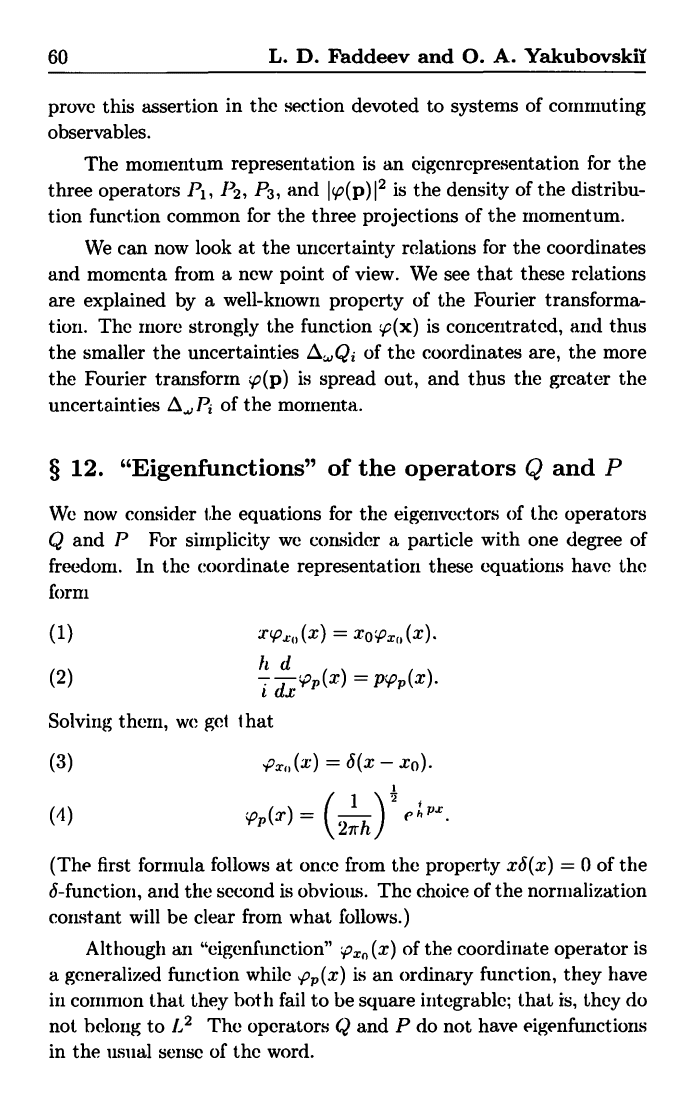
The momentum representation is an eigenrepresentation for the
three operators P1, P2 , P3, and I W (p) 2 is the density of the distribu-
tion function common for the three projections of the momentum.
We can now look at the uncertainty relations for the coordinates
and momenta from a new point of view. We see that these relations
are explained by a well-known property of the Fourier transforma-
tion. The more strongly the function ;p (x) is concentrated, and thus
the smaller the uncertainties A;,, Qi of the coordinates are, the more
the Fourier transform ap(p) is spread out, and thus the greater the
uncertainties 0, Pi of the momenta.
§ 12. "Eigenfunctions" of the operators Q and P
We now consider the equations for the eigenvectors of the operators
Q and P For simplicity we consider a particle with one degree of
freedom. In the coordinate representation these equations have the
form
(1) (X)
= X0 Oxo W -
(2)
It =wnW
Solving them, we gel that
(3)
'OX" (X) = 6(X - XO).
pX
en
(The first formula follows at once from the property x6(x) = 0 of the
6-function, and the second is obvious. The choice of the normalization
constant will be clear from what follows.)
Although an "eigenfunction"
x,,
(x) of the coordinate operator is
a generalized function while app (x) is an ordinary function, they have
in common that they both fail to be square integrable; that is, they do
not belong to L2 The operators Q and P do not have eigenfunctions
in the usual sense of the word.
§ 12. "Eigenfunctions" of the operators Q and P
61
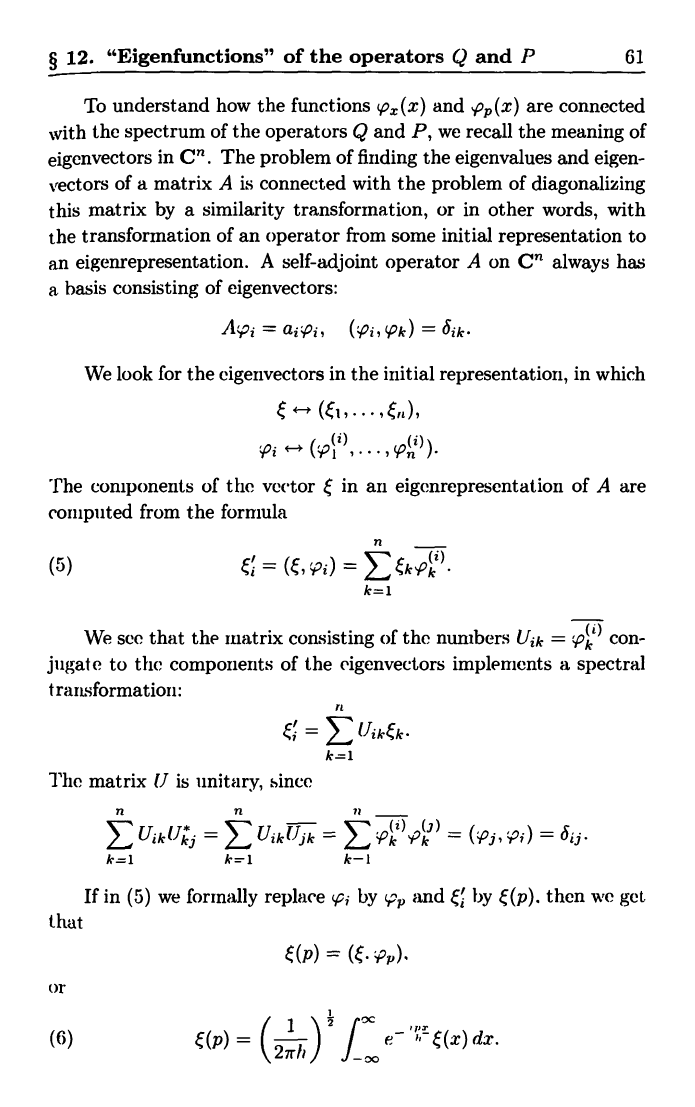
To understand how the functions cpx (x) and ypp (x) are connected
with the spectrum of the operators Q and P, we recall the meaning of
eigenvectors in C'. The problem of finding the eigenvalues and eigen-
vectors of a matrix A is connected with the problem of diagonalizing
this matrix by a similarity transformation, or in other words, with
the transformation of an operator from some initial representation to
an eigenrepresentation. A self-adjoint operator A on C' always has
a basis consisting of eigenvectors:
A i =
(pi,
0k) = Sik
We look for the eigenvectors in the initial representation, in which
I ... I10I
i
Gl oM
rn(i) )
-O
The components of the vector in an eigenrepresentation of A are
computed from the formula
(5)
n
kP(i)
k=1
We see that the matrix consisting of the numbers Uik = ;pit) con-
jugate to the, components of the eigenvectors implements a spectral
transformation:
it
; = E
U
is unitairy, since
n
n
Goi
Uik UUj =
k2)'p .7)
,
Vii) = Saj
k=1
k=-1
k-1
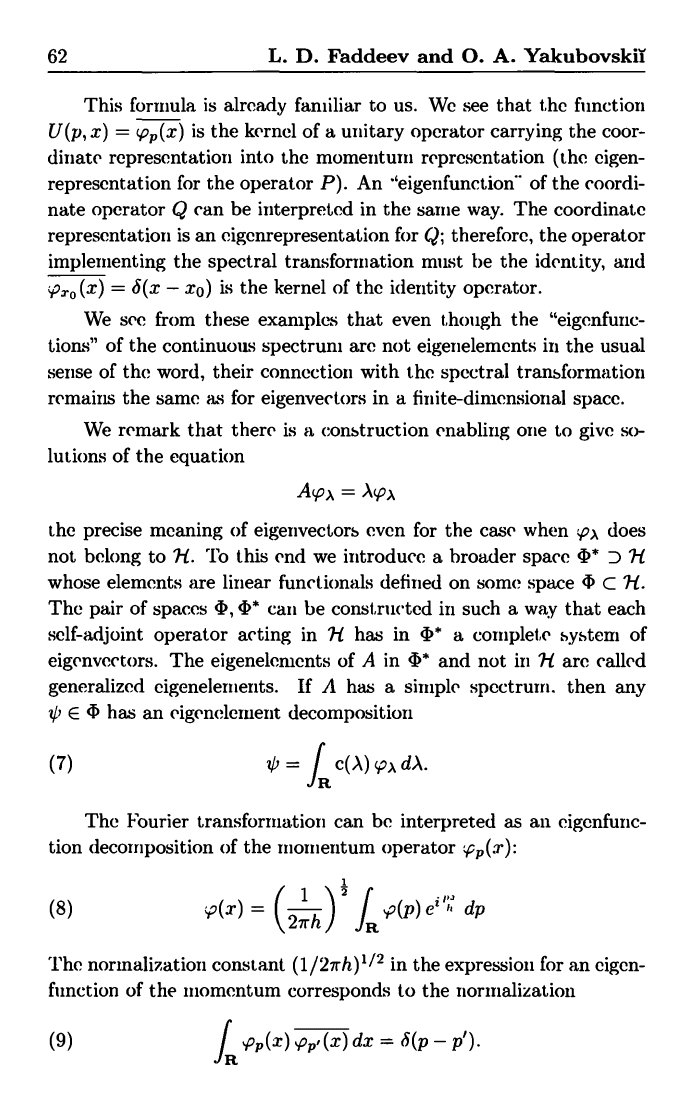
If in (5) we formally replace p by
and by gy(p). then we get
that
_ ( p)P
or
or
z
()fCe(x)dx.
(6)
62
L. D. Faddeev and 0. A. Yakubovskii
This formula is already familiar to us. We see that the function
U(p, x) = cpp(x) is the kernel of a unitary operator carrying the coor-
dinate representation into the momentum representation (the eigen-
representation for the operator P). An "eigenfunction ' of the coordi-
nate operator Q can be interpreted in the same way. The coordinate
representation is an eigenrepresentation for Q; therefore, the operator
implementing the spectral transformation must be the identity, and
,o (x) = 6(x - x0) is the kernel of the identity operator.
We see from these examples that even though the "eigenfunc-
tions" of the continuous- spectrum are not eigenelements in the usual
sense of the word, their connection with the spectral transformation
remains the same as for eigenvectors in a finite-dimensional space.
We remark that there is a construction enabling one to give so-
lutions of the equation
Acpa = A(pa
the precise meaning of eigenvectors even for the case when ;Pa does
not belong to R. To this end we introduce a broader space V D N
whose elements are linear functionals defined on some space dD C fl.
The pair of spaces
V can be constructed in such a way that each
self-adjoint operator acting in f has in V a complete system of
eigenvectors. The eigenelements of A in and not in fl are. called
generalized eigenelements. If A has a simple spectrum. then any
V' E
has an eigenelement decomposition
c(A) p,\ dA.
JR
The Fourier transformation can be interpreted as an eigenfunc-
tion decomposition of the momentum operator :pp (x) :
(8)
1
') _ (27rh)
(p) ez'sI dp
R
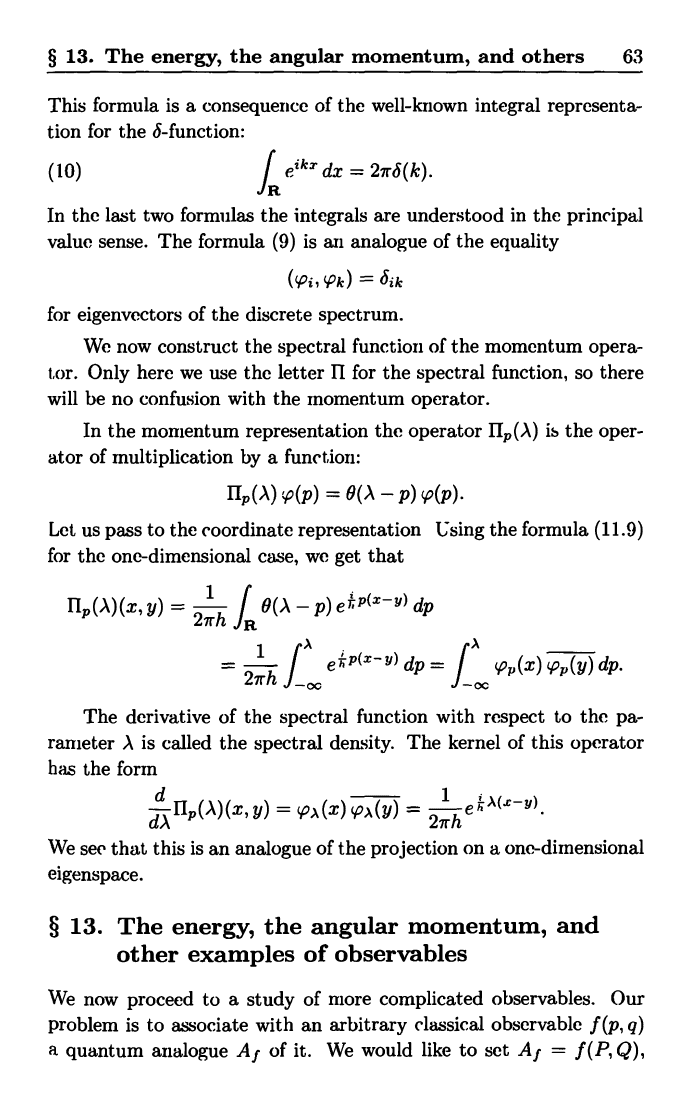
The normalization constant (1/2irh)1/2 in the expression for an eigen-
function of the momentum corresponds to the normalization
JR
§ 13. The energy, the angular momentum, and others
63
This formula is a consequence of the well-known integral representa-
tion for the 6-function:
(10)
At
e
ik-TdX
=
27ro(k).
In the last two formulas the integrals are understood in the principal
value sense. The formula (9) is an analogue of the equality
(Wi,'Pk) = sik
for eigenvectors of the discrete spectrum.
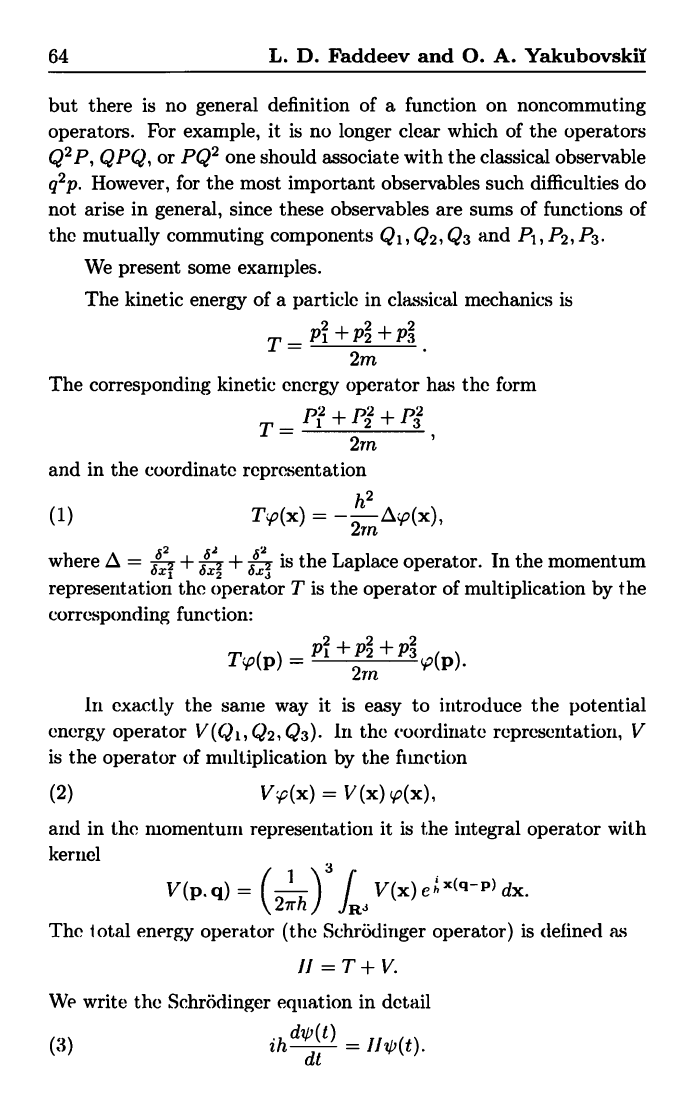
We now construct the spectral function of the momentum opera-
tor. Only here we use the letter II for the spectral function, so there
will be no confusion with the momentum operator.
In the momentum representation the operator IIp (A) is the oper-
ator of multiplication by a function:
Hp(A) P(p) = O(A - p) SP(p)
Let us pass to the coordinate representation Using the formula (11.9)
for the one-dimensional case, we get that
li a x - 1
OA -
eTp(T-y) d
p(
) (
,
y)
27Th
( p)
p
R
-- e h
dp =
V. (x) WP (y) dP.
27r h
_ y)
h _ -
The derivative of the spectral function with respect to the pa
rameter A is called the spectral density. The kernel of this operator
has the form
d
rip
y) = V,\ (x) V.\ (y) -
27Th
eh a(X-y)
da
(
)(x,
We see that this is an analogue of the projection on a one-dimensional
eigenspace.
13. The energy, the angular momentum, and
other examples of observables
We now proceed to a study of more complicated observables. Our
problem is to associate with an arbitrary classical observable f (p, q)
a quantum analogue Af of it. We would like to set Al = f (P, Q),
64
L. D. Faddeev and 0. A. Yakubovski
but there is no general definition of a function on noncommuting
operators. For example, it is no longer clear which of the operators
Q2P, QPQ, or PQ2 one should associate with the classical observable
q2p. However, for the most important observables such difficulties do
not arise in general, since these observables are sums of functions of
the mutually commuting components Q1, Q2, Q3 and P1, P2, P3.
We present some examples.
The kinetic energy of a particle in classical mechanics is
pi + p2 + p3
T=
2m
The corresponding kinetic energy operator has the form
Pl + P2 + P3
2rn
and in the coordinate representation
h
(1)
T,(x)
2m
where I. = 2
62
+
62
+ a is the Laplace operator. In the momentum
I 2
3
representation the operator T is the operator of multiplication by the
corresponding function:
pi+p2+p3
27n
SA(P)
In exactly the same way it is easy to introduce the potential
energy operator V (Q 1, Q2, Q3) .
In the coordinate representation, V
is the operator of multiplication by the function
(2)
V;c(x) = V (X) SP (x),
and in the momentum representation it is the integral operator with
kernel
1
3
e
(9- P)
V(P q) =
27rh
R3
V(x) e h dx.
The total energy operator (the Schrodinger operator) is defined a.5
11 = T + V.
We write the Schrodinger equation in detail
ihdV(t)
= I1 t .
(3)
dt ( }
§ 13. The energy, the angular momentum, and others
65
In the coordinate representation the Schr6dinger equation for a par-
ticle is the. partial differential equation
a(x, t}
h2
ih
at
-
-
Av)(x, t) + V ( X )
and in the momentum representation the integro-differential equation
a0 (P, t) P2
0(p
ih
at
-
2m
t) +
V (p, q) b(q, t) dq.
f
3
Along with (4) we consider the equation for the complex conju-
gate wave function:
azl) (x, t)
_ h
(5)
-ih
at
-
2 _
Oib(x, t) + V(x) P(x, 1).
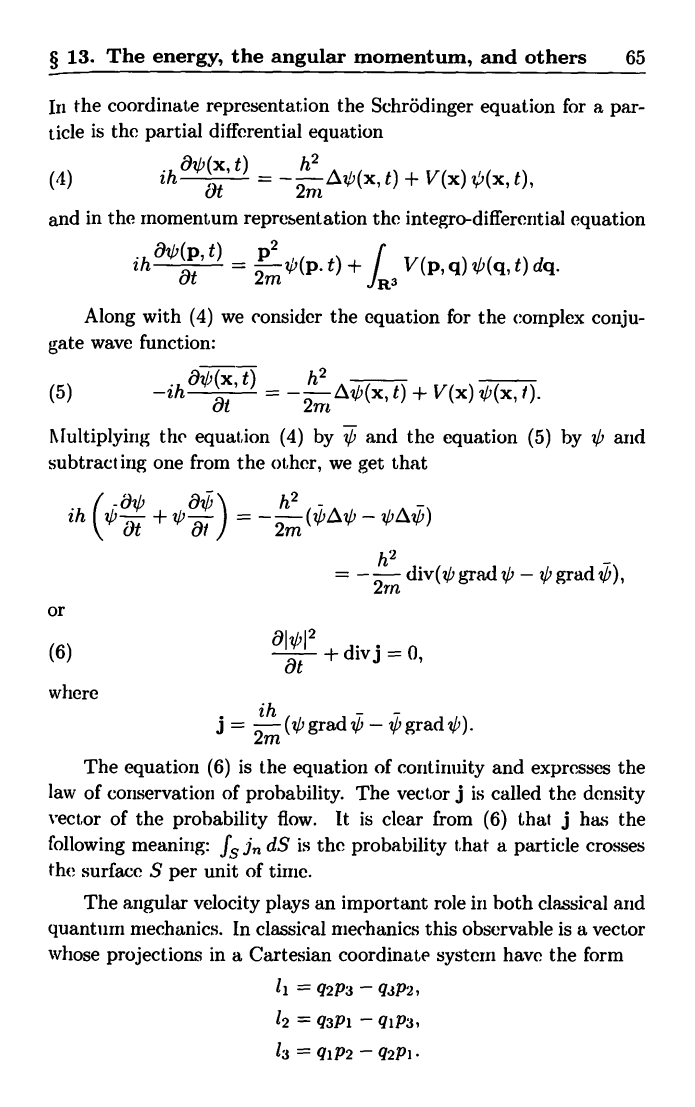
Multiplying the equation (4) by 70 and the equation (5) by 0 and
subtracting one from the other, we get that
2
-00
h
ih *-+V
V))
at 01) 2m
h
2
div( grad 7P - V) grad
or
(6)
where
2
aatl + aivi = n,
- ih
(,0 grad
grad
- 2m
V)).
The equation (6) is the equation of continuity and expresses the
law of conservation of probability. The vector j is called the density
vector of the probability flow. It is clear from (6) that j has the
following meaning: fs j,, dS is the probability that a particle crosses
the surface S per unit of tirrie.
The angular velocity plays an important role in both classical and
quantum mechanics. In classical mechanics this observable is a vector
whose projections in a Cartesian coordinate system have the form
11 g2p3 -43P2
12 = g3pi - g1p3,
13=gIP2--g2pI.
66
L. D. Faddeev and 0. A. Yakubovski"
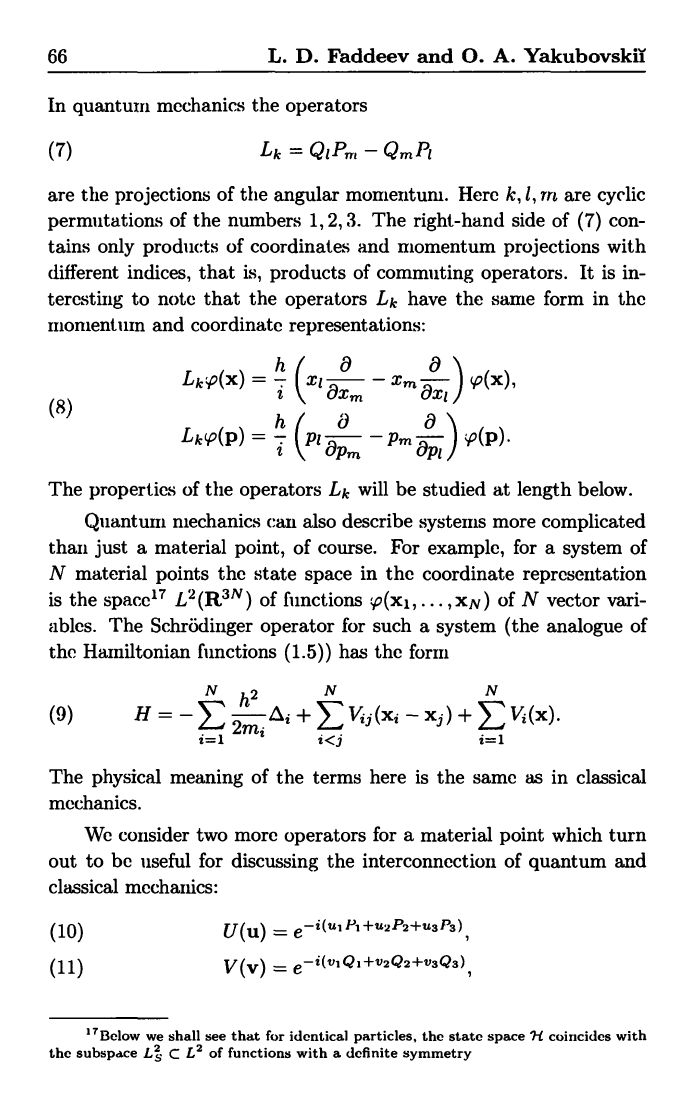
In quantum mechanics the operators
(7)
Lk = QlPm - QmP1
are the projections of the angular momentum. Here k, 1, in are cyclic
permutations of the numbers 1, 2, 3. The right-hand side of (7) con-
tains only products of coordinates and momentum projections with
different indices, that is, products of commuting operators. It is in-
teresting to note that the operators Lk have the same form in the
momentum and coordinate representations:
(A)
h( a al
i `C7xm
- xm
C7x(
(X)'
(i)z-
m -Pm
iP(P)
The properties of the operators Lk will be studied at length below.
Quantum mechanics can also describe systems more complicated
than just a material point, of course. For example, for a system of
N material points the state space in the coordinate representation
is the space17 L2 (R3N) of functions ;p(Xl, ... , XN) of N vector vari-
ables. The Schrodinger operator for such a system (the analogue of
the Hamiltonian functions (1.5)) has the form
N
h2
N N
2mi
i+>1'j(Xi-Xj)+>Vj(X).
(9)
H=-
i=1 i<j
i=1
The physical meaning of the terms here is the same as in classical
mechanics.
We consider two more operators for a material point which turn
out to he useful for discussing the interconnection of quantum and
classical mechanics:
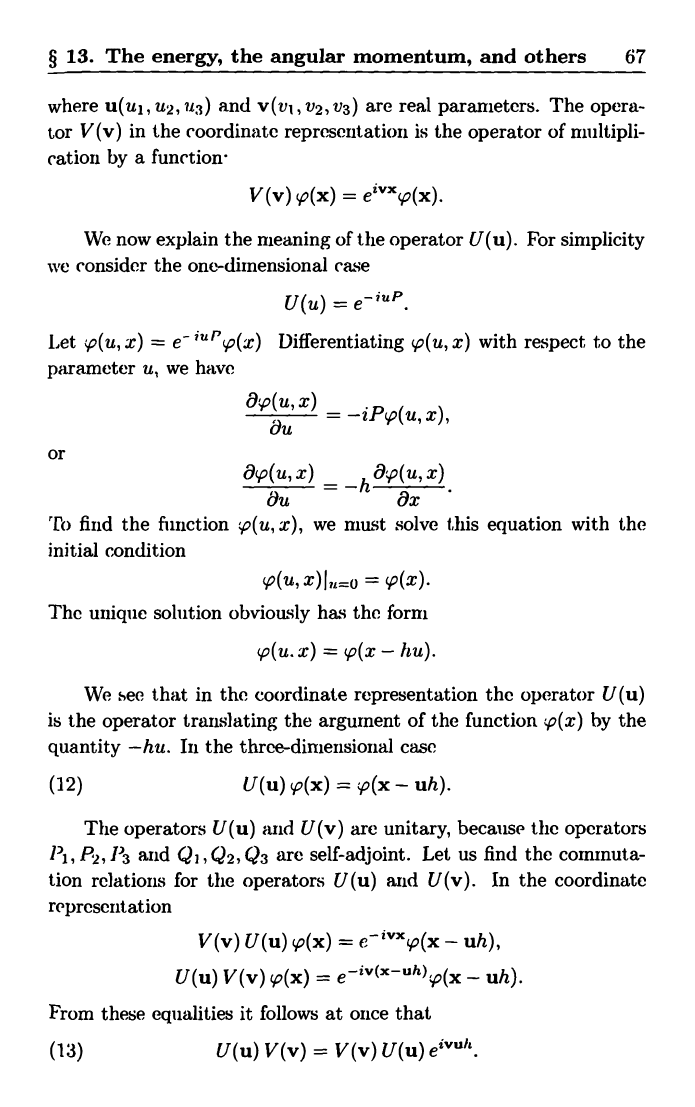
U(u) = e-i(U1
P1+U2 '2+u3P3)
V(V) ` e-2(v1Q1+v2Q2+V3Q3)
17 Below
we shall see that for identical particles, the state space 'H coincides with
the subspace L2 C L2 of functions with a definite symmetry
§ 13. The energy, the angular momentum, and others
67
where u (u x , u2 , u3) and v (vi , V2, v3) are real parameters. The opera-
tor V (v) in the coordinate representation is the operator of niultipli-
cation by a function-
V(v) V(X) = eL°XV(X)
We now explain the meaning of the operator U(u). For simplicity
we consider the one-dimensional case
U(u)
=
e- iuP.
Let
(u, x) = e- iu'Sp(x) Differentiating Sp(u, x) with respect to the
parameter u, we have
a;p(u, x)
On
- X),
or
&(u, x)
_ h
80(u' x)
On
ax
To find the function ;p(u, x), we must solve this equation with the
initial condition
co(u, x) I,L=o = Se(x)
The unique solution obviously has the form
p(u. x) = p(x - hu)-
We see that in the. coordinate representation the operator U (u)
is the operator translating the argument of the function ,,p(x) by the
quantity -hu. In the three-dimensional case.
(12)
U(u) p(x) _ p(x - uh).
The operators U (u) and U (v) are unitary, because the operators
1'j, P2, P3 and Qi , Q2, Q3 are self-adjoint. Let us find the coxninuta-
tion relations for the operators U (u) and U (v) . In the coordinate
representation
V(V) U(U) O(X) = uh),
U(u) V(v) cp(x) = e-`°("-Dh) o(x - uh).
From these equalities it follows at once that
L°°(13)
U(u) V (v) = V (v) U(u)
e`