
Faddeev L.D., Yakubovskii O.A. Lectures on Quantum Mechanics for Mathematics Students
Подождите немного. Документ загружается.

18 L. D. Faddeev and 0. A. Yakubovskii
Here k is the so-called wave vector, which has the direction of prop-
agation of the light waves. The length k of this vector is connected
with the wavelength A, the frequency w, and the velocity c of light by
the relations
21r w
(3)
k
C
For light quanta we have the formula
E = pc,
which is a special case of the relativity theory formula
E = Vp2C2 + m2c4
for a particle with rest mass m
0.
We remark that the historically first quantum hypotheses in-
volved the laws of emission and absorption of light waves, that is,
electrodynamics, and not mechanics. However, it soon became clear
that discreteness of the values of a number of physical quantities was
typical not only for electromagnetic radiation but also for atomic sys-
tems. The experiments of Franck and Hertz (1913) showed that when
electrons collide with atoms, the energy of the electrons changes in
discrete portions. The results of these experiments can be explained
by the assumption that the energy of the atoms can have only defi-
nite discrete values. Later experiments of Stern and Gerlach in 1922
showed that the projection of the angular momentum of atomic sys-
tems on a certain direction has an analogous property.
It is now
well known that the discreteness of the values of a number of ob-
servables, though typical, is not a necessary feature of systems in the
microworld. For example, the energy of an electron in a hydrogen
atom has discrete values, but the energy of a freely moving electron
can take arbitrary positive values. The mathematical apparatus of
quantum mechanics had to be adapted to the description of observ-
ables taking both discrete and continuous values.
In 1911 Rutherford discovered the atomic nucleus and proposed
a planetary model of the atom (his experiments on scattering of a
particles on samples of various elements showed that an atom has a
positively charged nucleus with charge Ze, where Z is the number of
the element in the Mendeleev periodic table and e is the charge of an
§ 4. Physical bases of quantum mechanics
19
electron, and that the size of the nucleus does not exceed 10-12 cm,
while the atom itself has linear size of order 10-8 cm). The plane-
tary model contradicts the basic tenets of classical electrodynamics.
Indeed, when moving around the nucleus in classical orbits, the elec-
trons. like all charged particles that are accelerating, must radiate
electromagnetic waves. Thus, they must be losing their energy and
must eventually fall into the nucleus. Therefore, such an atom cannot
be stable, and this, of course, does not correspond to reality. One of
the main problems of quantum mechanics is to account for the stabil-
ity and to describe the structure of atoms and molecules as systems
consisting of positively charged nuclei and electrons.
The phenomenon of diffraction of microparticles is completely
surprising from the point of view of classical mechanics. This phe-
nomenon was predicted in 1924 by de Broglie, who suggested that
to a freely moving particle with momentum p and energy E there
corresponds (in some sense) a wave with wave vector k and frequency
w. where
p=hk, E=hw;
that is, the relations (1) and (2) are valid not only for light quanta
but also for particles. A physical interpretation of de Broglie waves
was later given by Born, but we shall not discuss it for the present. If
to a moving particle there corresponds a wave, then, regardless of the
precise meaning of these words, it is natural to expect that this implies
the existence of diffraction phenomena for particles.
Diffraction of
electrons was first observed in experiments of Davisson and Germer
in 1927 Diffraction phenomena were subsequently observed also for
other particles.
We show that diffraction phenomena are incompatible with clas-
sical ideas about the motion of particles along trajectories. It is most
convenient to argue using the example of a thought experiment con-
cerning the diffraction of a beam of electrons directed at two slits," the
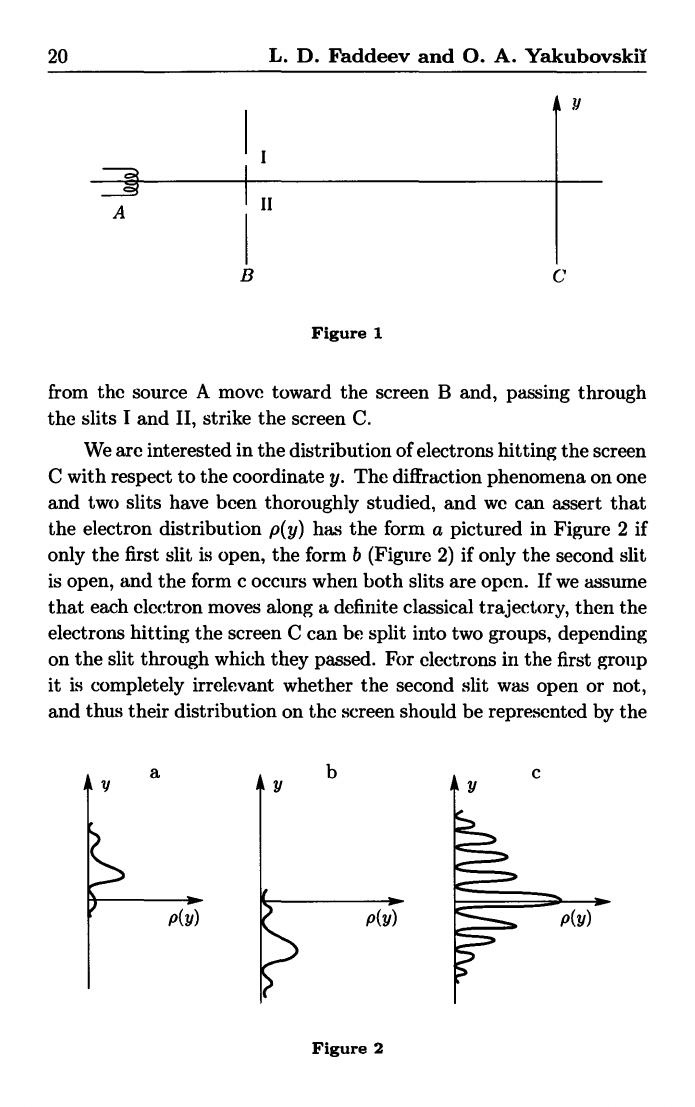
scheme of which is pictured in Figure 1. Suppose that the electrons
8Such an experiment is a thought experiment, so the wavelength of the electrons
at energies convenient for diffraction experiments does not exceed 10-7 cm, and the
distance between the slits must be of the same order In real experiments diffraction
is observed on crystals. which are like natural diffraction lattices
20
L. D. Faddeev and 0. A. YakubovskiT
Ay
A
I
IU
C
Figure 1
from the source A move toward the screen B and, passing through
the slits I and II, strike the screen C.
We are interested in the distribution of electrons hitting the screen
C with respect to the coordinate y. The diffraction phenomena on one
and two slits have been thoroughly studied, and we can assert that
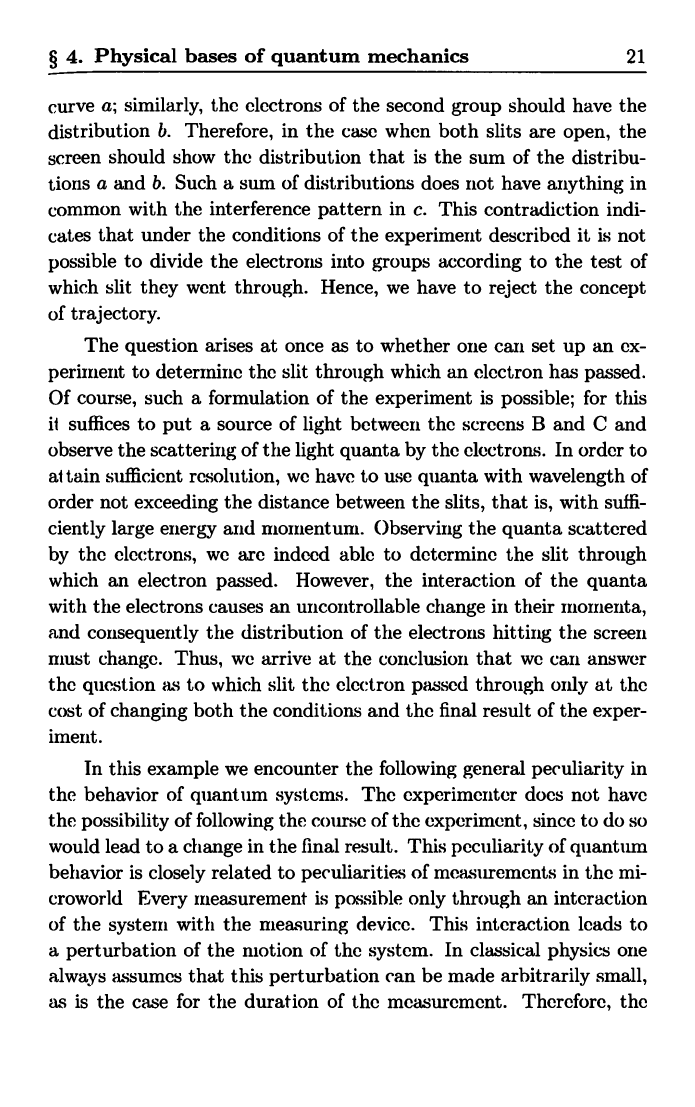
the electron distribution p(y) has the form a pictured in Figure 2 if
only the first slit is open, the form b (Figure 2) if only the second slit
is open, and the form c occurs when both slits are open. If we assume
that each electron moves along a definite classical trajectory, then the
electrons hitting the screen C can be split into two groups, depending
on the slit through which they passed. For electrons in the first group
it is completely irrelevant whether the second slit was open or not,
and thus their distribution on the screen should be represented by the
y
b
y
P(y)
Figure 2
§ 4. Physical bases of quantum mechanics
21
curve a; similarly, the electrons of the second group should have the
distribution b. Therefore, in the case when both slits are open, the
screen should show the distribution that is the sum of the distribu-
tions a and b. Such a sum of distributions does not have anything in
common with the interference pattern in c. This contradiction indi-
cates that under the conditions of the experiment described it is not
possible to divide the electrons into groups according to the test of
which slit they went through. Hence, we have to reject the concept
of trajectory.
The question arises at once as to whether one can set up an ex-
periment to determine the slit through which an electron has passed.
Of course, such a formulation of the experiment is possible; for this
it suffices to put a source of light between the screens B and C and
observe the scattering of the light quanta by the electrons. In order to
at tain sufficient resolution, we have to use quanta with wavelength of
order not exceeding the distance between the slits, that is, with suffi-
ciently large energy and momentum. Observing the quanta scattered
by the electrons, we are indeed able to determine the slit through
which an electron passed.
However, the interaction of the quanta
with the electrons causes an uncontrollable change in their momenta,
and consequently the distribution of the electrons hitting the screen
must change. Thus, we arrive at the conclusion that we can answer
the question as to which slit the electron passed through only at the
cost of changing both the conditions and the final result of the exper-
iment.
In this example we encounter the following general peculiarity in
the behavior of quantum systems. The experimenter does not have
the possibility of following the course of the experiment, since to do so
would lead to a change in the final result. This peculiarity of quantum
behavior is closely related to peculiarities of measurements in the mi-
croworld Every measurement is possible only through an interaction
of the system with the measuring device. This interaction leads to
a perturbation of the motion of the system. In classical physics one
always assumes that this perturbation can be made arbitrarily small,
as is the case for the duration of the measurement. Therefore, the
22
L. D. Faddeev and 0. A. Yakubovskii
simultaneous measurement of any number of observables is always
possible.
A detailed analysis (which can be found in many quantum me-
chanics textbooks) of the process of measuring certain observables
for microsystems shows that an increase in the precision of a niea
surexrient of observables leads to a greater effect on the system, and
the rrieasurenient introduces irncont rollable changes in the numerical
values of some of the other observables. This leads to the fact, that
a simultaneous precise measurement of certain observables becomes
impossible in principle. For example, if one uses the scattering of light
quanta to measure the coordinates of a particle, then the error of the
measurement has the order of the wavelength of the light: Ox ti A. It
is possible to increase the accuracy of the measurement by choosing
quanta with a smaller wavelength, but then with a greater momeri-
turn p = 27rh/A. Here an uncontrollable change Lip of the order of
the momentum of the quantum is introduced in the numerical val-
«es of the momentum of the particle. Therefore, the errors Ax and
Op in the measurements of the coordinate and the momentum are,
connected by the relation
Lax Op ^, 27Th.
A more precise argument shows that this relation connects only a
coordinate and the momentum project ion with the same index. The
relations connecting the theoretically possible accuracy of a simul-
taneous measurement of two observables are called the Heisenberg
uncertainty relations. They will be obtained in a precise formtrlat ion
in the sections to follow. Observables on which the uncertainty rela-
tions do not impose any restrictions are simultaneously measurable.
We shall see that the Cartesian coordinates of a particle are shnulta-
neously measurable. as are the projections of its momentum. but this
is not so for a coordinate and a momentumi projection with the. same
index, nor for two Cartesian projections of the angular momentum.
In the construction of quantum mechanics we must remember the
possibility of the existence of quantities that are not simultaneously
measurable
§ 4. Physical bases of quantum mechanics 23
After our little physical preamble we now try to answer the ques-
tion posed above. what features of classical mechanics should be kept,,
and which ones is it natural to reject in the construction of a mechan-
ics of the microworld? The main concepts of classical mechanics were
the concepts of an observable and a state. The problem of a phys-
ical theory is to predict results of experiments, and an experiment
is always a measurement of some characteristic of the system or an
observable under definite conditions which determine the state of the
system. Therefore, the concepts of an observable and a state must
appear in any physical theory. From the point of view of the ex-
perimenter, to determine an observable means to specify a way of
measuring it. W e denote observables b y the symbols a, b, c, ... , and
for the present we do not make any assumptions about their mathe-
matical nature (we recall that in classical mechanics the observables
are functions on the phase space). As before, we denote the set of
observables by 2t.
It is reasonable to assume that the conditions of the experiment,
determine at least the probability distributions of the results of mea-
surements of all the observables, and therefore it is reasonable to keep
the definition in § 2 of a state. The states will be denoted by w as
before, the probability measure on the real axis corresponding to an
observable a by wa, (E) ; the distribution function of a in the state w
by WQ(A), and finally, the mean value of a in the state w by (w I a).
The theory must contain a definition of a function of an observ-
able. For the experimenter, the assertion that an observable b is
a function of an observable a (b = f (a)) means that to measure b
it suffices to measure a, and if the number a{ is obtained as a re-
sult of measuring a, then the numerical value of the observable b is
bo = f (ao).
For the probability measures corresponding to a and
f (a), we have
(4)
Wf (a) (E) = Wa Y
I (E))
for any states w.
We note that all possible functions of a single observable a are
simultaneously measurable, since to measure these observables it suf-
fices to measure a. Below we shall see that in quantum mechanics this
24 L. D. Faddeev and 0. A. Yakubovski
example exhausts the cases of simultaneous measurement, of observ-
ables; that is, if the observables bl, b2,
... are
simultaneously measur-
able, then there exist an observable a and functions fl, f2.... such
that bz = fi(a).b2 = f2(a)J.. 0
.
The set of functions f (a) of an observable a obviously includes
f (a) = Aa and f (a) = const, where A is a real number. The existence
of the first of these functions shows that observables can be multiplied
by real numbers. The assertion that an observable is a constant means
that its numerical value in any state coincides with this constant.
We now try to make clear what meaning can be assigned to a
sum a+ b and product ab of two observables. These operations would
be defined if we had a definition of a function f (a, b) of two variables.
I iowevetr, there arise fundamental difficulties here connected with the
possibility of observables that are not simultaneously measurable. If
a and b are simultaneously measurable, then the definition of f (a, b)
is completely analogous to the definition of f (a). To measure the ob-
servable f (a, b), it suffices to measure the observables a and b leading
to the numerical value f (ac, bo), where ao and bo are the numerical
values of the observables a and b, respectively. For the case of ob-
servables a and b that are not simultaneously measurable, there is no
reasonable definition of the function f (a, b). This circumstance forces
us to reject the assumption that observables are functions f (q, p) on
the phase space, since we have a physical basis for regarding q and
p as not simultaneously measurable, and we shall have to look for
observables among mathematical objects of a different nature.
We see that it is possible to define a sum a + b and a product
ab using the concept of a function of two observables only in the
case when they are simultaneously measurable.
However, another
approach is possible for introducing a sum in the general case. We
know that all information about states and observables is obtained
by measurements; therefore, it is reasonable to assume that there are
sufficiently many states to distinguish observables, and similarly, that
there are sufficiently many observables to distinguish states.
More precisely, we assume that if
(alw)=(biw)
§ 4. Physical bases of quantum mechanics
25
for all states w, then the observables a and b coincide,9 and if
(aiwi) = (aIw2)
for all observables a. then the states w1 and W2 coincide.
The first of these assumptions rriakes it possible to define the sum
a + b as the observable such that
(a+ bow) _ (alw)+(bjw)
for any state w. We remark at once that this equality is an expression
of a well-known theorem in probability theory about the mean value
of a sum only in the case when the observables a and b have a common
distribution function. Such a common distribution function can exist,
(and in quantum mechanics does exist) only for simultaneously mea-
surable quantities In this case the definition (5) of a sum coincides
with the earlier definition. An analogous definition of a product is
not possible, since the mean of a product is not equal to the product
of the means, not even for simultaneously measurable observables.
The definition (5) of the suns does riot contain any indication
of a way to measure the observable a + b involving known ways of
measuring the observables a and b, arid is in this sense implicit.
To give an idea of how much the concept of a sum of observables
can differ from the usual concept of a sum of random variables, we
present an example of an observable that will be studied in detail in
what follows. Let
P2
w2 Q2
H= 2 + 2
The observable H (the energy of a one-dimensional harmonic oscilla-
tor) is the sum of two observables proportional to the squares of the
momentum and the coordinate. We shall see that these last observ-
ables can take any nonnegative numerical values, while the values of
the observable H must coincide with the numbers E74 = (n + 1/2)w,
where n = 0, 1, 2, ...: that is, the observable H with discrete numer-
ical values is a sum of observables with continuous values.
Thus, two operations are defined on the set Qt of observables:
multiplication by real numbers and addition, and 21 thereby becomes
This assumption allows us to regard an observable as specified if a real number
is associated with each state
26
L. D. Faddeev and 0. A. Yakubovskii
a linear space. Since real functions are defined on 2t, and in particular
the square of an observable, there arises a natural definition of a
product of observables:
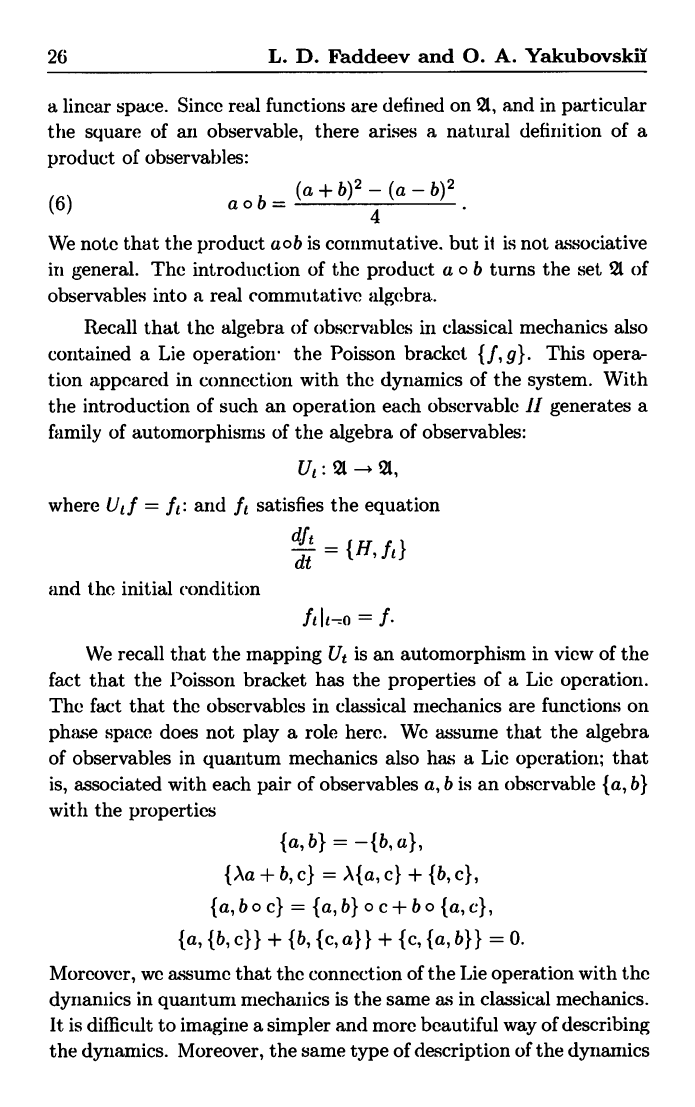
(a + b)2 - (a - b)2
(6)
aob=
4 .
We note that the product aob is commutative. but it is not associative
in general. The introduction of the product a o b turns the set 2t of
observables into a real commutative algebra.
Recall that the algebra of observables in classical mechanics also
contained a Lie operation- the Poisson bracket {f, g}. This opera-
tion appeared in connection with the dynamics of the system. With
the introduction of such an operation each observable 11 generates a
family of autornorphisms of the algebra of observables:
Ut : 2t - 2t,
where Utf = ft: and ft satisfies the equation
dft
= M
dt
AI
and the initial condition
ft It--o = f.
We recall that the mapping Ut is an automorphism in view of the
fact that the Poisson bracket has the properties of a Lie operation.
The fact that the observables in classical mechanics are functions on
phase space does not play a role here. We assume that the algebra
of observables in quantum mechanics also has a Lie operation; that
is, associated with each pair of observables a, b is an observable {a, b}
with the properties
{a,b} = -{b, a},
{)ta+b,c} = A{a,c} + {b,c},
{a,boc}={a,b}oc+bo{a,c},
{a,{b,c}} + {b,{c,a}}+ {c,{a,b}} =0.
Moreover, we assume that the connection of the Lie operation with the
dynamics in quantum mechanics is the same as in classical mechanics.
It is difficult to imagine a simpler and more beautiful way of describing
the dynamics. Moreover, the same type of description of the dynamics
§ 5. A finite-dimensional model of quantum mechanics
27
in classical and quantum mechanics allows us to hope that we can
construct a theory that contains classical mechanics as a limiting
case.
In fact, all our assumptions reduce to saying that in the construc-
tion of quantum mechanics it is reasonable to preserve the structure
of the algebra of observables in classical mechanics, but to reject the
realization of this algebra as functions on the phase space since we
admit the existence of observables that are not simultaneously mea-
surable.
Our immediate problem is to see that, there is a realization of the
algebra of observables that is different from the realization in classi-
cal mechanics. In the next section we present an example of such a
realization, constructing a finite-dimensional model of quantum me-
chanics. In this model the algebra 2l of obscrvables is the algebra
of self-adjoint operators on the n-dimensional complex space C. In
studying this simplified model, we can follow the basic features of
quantum theory At the same. time, after giving a physical interpre-
tation of the model constructed, we shall see that it is too poor to
correspond to reality Therefore, the finite-dimensional model cannot
be regarded as a definitive variant of quantum mechanics. However,
it will seem very natural to improve this model by replacing C'z by a
complex flilbert space.
5. A finite-dimensional model of quantum
mechanics
We show that the algebra 2i of observables can be realized as the
algebra of self-adjoint operators on the finite-dimensional complex
space C".
Vectors in C' will be denoted by the Greek letters
;p,, ... .
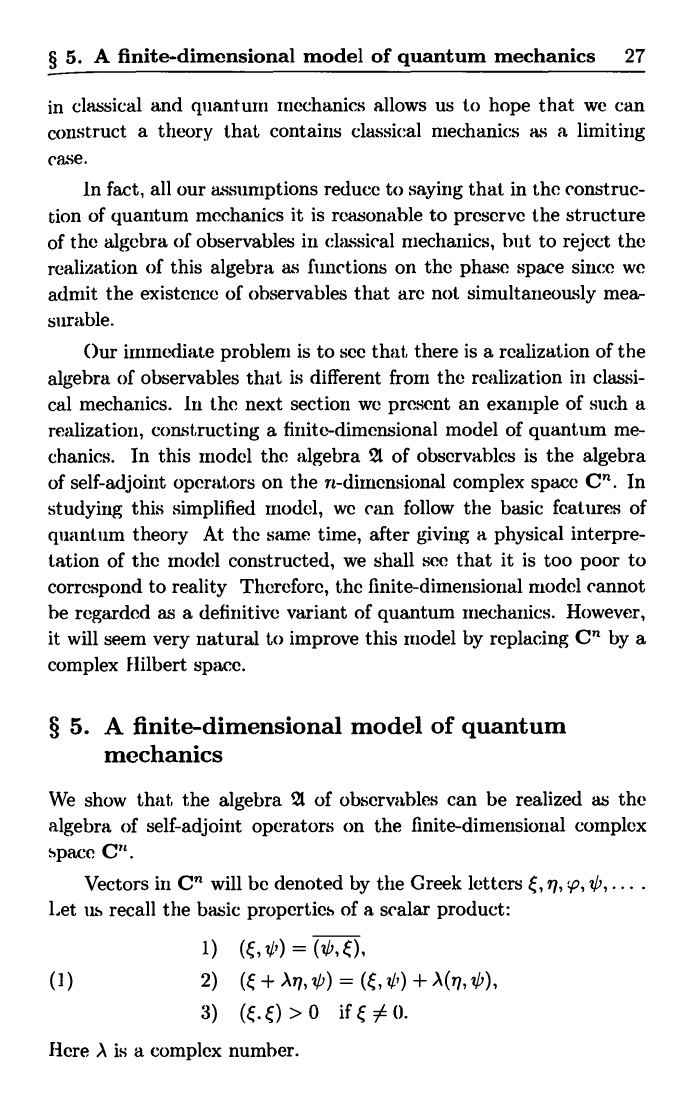
Let us recall the basic properties of a scalar product:
1) 0) = (01 0 1
2) + Aq, *) = (C 7 VY) + A (77
7 0)1
3)
C) > 0 if
=14 0.
Here A is a complex number.