
Faddeev L.D., Yakubovskii O.A. Lectures on Quantum Mechanics for Mathematics Students
Подождите немного. Документ загружается.

38
L. D. Faddeev and 0. A. Yakubovskii
such that ({A, B } h I w)
0 for all w, for example, if {A. B } h = const.
In this case there do not exist any states in which the variances of
both observables are equal to zero. We shall see that for a coordinate
and momentum projection with the same index,
fP-Qlh = Il
where I is the identity operator. The uncertainty relations for these
observables take the form
&WPOWQ > h/2;
that is, in nature there are no states in which a coordinate and mo-
mentum projection with the same index have simultaneously com-
pletely determined values. This assertion is valid for both mixed and
pure states, and therefore the pure states in quantum mechanics, un-
like those in classical mechanics, are not states with zero variance of
all observables.
We can now go back to the question posed at the beginning of § 2:
what can explain the nonuniqueness of the results of experiments? We
have seen t hat in classical mechanics such nonuniqueness is connected
solely with the conditions of the experiment. If in the conditions of the
experiment we include sufficiently many preliminary measurements,
then we can be certain that the system is in a pure state, and the
results of any experiment are completely determined. In quantum
mechanics the answer to this question turns out to be quite different.
The uncertainty relations show that there is not even a theoretical
possibility of setting up the experiment in such a way that the results
of all measurements are uniquely determined by the conditions of the
experiment We are therefore forced to assume that the probabilistic
nature of predictions in the xnicroworld is connected with the physical
properties of quantum systems.
These conclusions seem so unexpected that one might ask about
the possibility of introducing so-called "hidden parameters" into the
theory. One might suppose that the description of a state of the
system with the help of the density matrix M = Pv is not complete;
§ 8. Physical meaning of eigenvalues and eigenvectors
39
that is, in addition to PV, we should specify the values of some param-
eters x ("hidden parameters" ),12 and then the description becomes
sufficient for the unique prediction of the results of any measurement.
The probabilistic character of the predictions in a state w
P can
then be explained by the fact that we do not know the values of the
hidden parameters, and there is some probability distribution with
respect to them. If the state determined by the pair (P,1,, x) is de-
Ynoted by wx, then our assumption reduces to the state w being a
convex combination of the states w, We know that P,, does not de-
compose into a convex combination of operators with the properties
of a density matrix; that is, there are no operators M correspond-
ing to the states wx. The way of describing the states in quantum
mechanics is determined by the choice of the algebra of observables.
The assiunption that there are states that do not correspond to any
density matrices forces us to reject the assertion that the observables
are self-ad j oint operators, that is, to reject the basic assumption of
quantum mechanics. Thus, we see that the introduction of hidden
parameters into quantum mechanics is impossible without a radical
restructuring of its foundations.
§ 8. Physical meaning of the eigenvalues and
eigenvectors of observables
In this section we consider questions involving the physical interpre-
tation of the theory. First of all we must learn how to construct
distribution functions for observables in a given state. We know the
general formula
(L)
WA (A) = (O(A - A) I w)l
where O (x) is the Heaviside function. To construct a function of the
observable O (A - A), we consider the equation
A'i = aicpi.
12Tlic "hidden parameters" x can be regarded as elements of some set X We do
not rriake any assumptions about the physical nature of these parameters, since it is
irrelevant for the arguments to follow
40
L. D. Faddeev and 0. A. YakubovskiT
Just for simplicity of the arguments we assume for the present that, the
eigenvalues are distinct: that is, the spectrum of the operator A is sim-
ple, and we number the eigenvalues in increasing order: al <
< an.
Denote by P,,; the operators of projection on the eigenvectors We
introduce the operator
(2)
PA (A) = 1:
PYi
a,<a
(the subscript i under the summation sign takes the values such that
ai < A) . We show that
(3)
PA(A) = a(a - A).
To prove this equality it, suffices to show that the operators PA (A)
and ©(A - A) act in the same way on the basis vectors cpi. Using the.
definition of a function of an operator, we have.
8(A-A)cps =O(A-aj),oj
0,
A < a..
On the other hand,
PA (A) Pj = 1: PP, oj =
01
> aj.
ai<a
107
< aj.
The last equality was written taking into account that P,0i P3 = bij cpj
and that the operator Pp, appears under the summation sign only if
A > a3 . It is easy to see that PA (A) is a projection, that is, PA (A) =
PA (A) and PA (A) = PA(A). Obviously, PA (A) = 0 for A < a1 and
PA (A) = 1 for A > an. The operator PA (A) is called the spectral
function of the operator A.
Now it is not hard to get an explicit form for the distribution
function WA (A), w
M:
WA(A) = (PA(A)I) = Tr MPA(A) = Tr M 1: Phi = > Tr MP',
,
ai <A
ai <,\
and finally,
(4) WA (A) =
(Ma,').
,
§ 8. Physical meaning of eigenvalues and eigenvectors
41
1
30,
a1 a2
a3
a
1
Figure 3
an-1 an
X
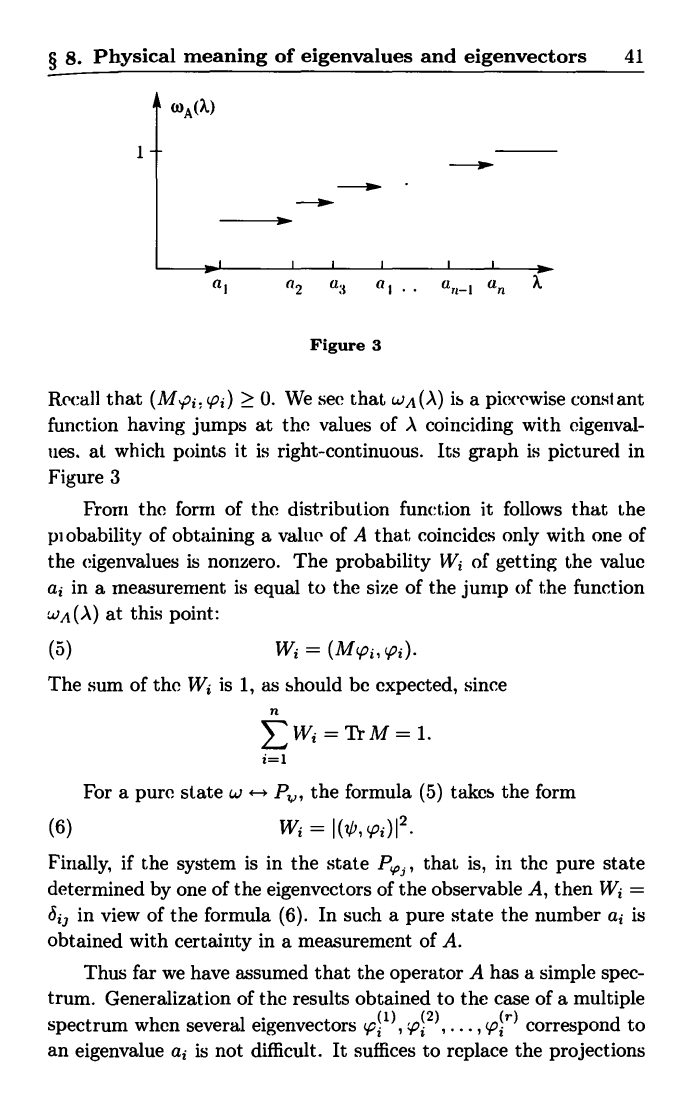
Recall that (Mp, cPi } > 0. We see that WA (A) is a piecewise const ant
function having jumps at the. values of A coinciding with eigenval-
ues. at which points it is right-continuous. Its graph is pictured in
Figure 3
From the, form of the distribution function it follows that the
pi obability of obtaining a value of A that coincides only with one of
the eigenvalues is nonzero. The probability Wi of getting the value
ai in a measurement is equal to the size of the jump of the function
wA (A) at this point:
(5) Wi = (Mp,cp).
The sum of the Wi is 1, as should be expected, since
n
>W3 = Tr M = 1.
(6)
For a pure. state w H P. the formula (5) takes the form
Wi = I
Finally, if the system is in the state P,,,, that is, in the pure state
determined by one of the eigenvectors of the observable A, then Wi =
aiJ in view of the formula (6). In such a pure state the number ai is
obtained with certainty in a measurement of A.
Thus far we have assumed that the operator A has a simple spec-
trum. Generalization of the results obtained to the case of a multiple
r)
correspond tospectrum when several eigenvectors c0i
1)' ;pi 2)
, . . . , (Pi
an eigenvalue ai is not difficult. It suffices to replace the projections
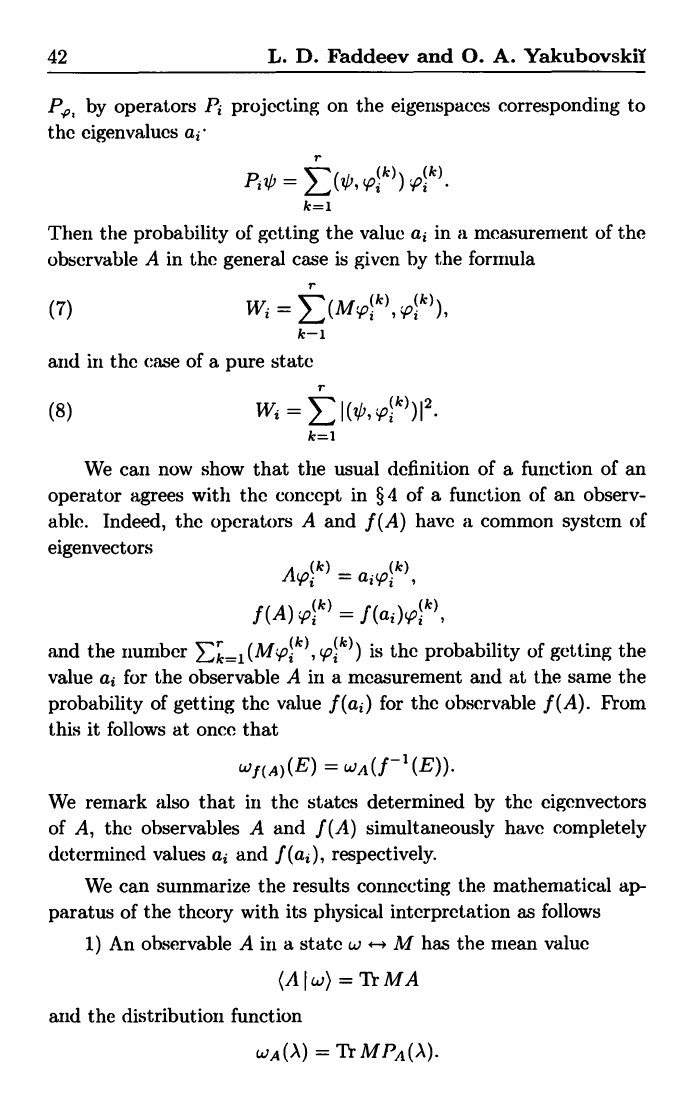
42
L. D. Faddeev and 0. A. YakubovskiY
Pp, by operators Pi projecting on the eigenspaces corresponding to
the eigenvalues a i
r
k=1
Then the probability of getting the value ai in a measurement of the
observable A in the general case is given by the formula
r
(7)i
-
E
k-1
and in the case of a pure state
(8)
r
k=1
We can now show that the usual definition of a function of an
operator agrees with the concept in § 4 of a function of an observ-
able. Indeed, the operators A and f (A) have a common systemn of
eigenvectors
AcOZk) = aicO{k),
f (A)
Oik)
_ f (ai)Soik)I
and the number
cpik)) is the probability of getting the
value ai for the observable A in a measurement and at the same the
probability of getting the value f (ai) for the observable f(A). From
this it follows at once that
Wf(A)(E) = WA (f -'(E)).
We remark also that in the
states determined by the eigenvectors
of A, the observables A and f (A) simultaneously have completely
determined values ai and f (ai ), respectively.
We can summarize the results connecting the mathematical ap-
paratus of the theory with its physical interpretation as follows
1) An observable A in a state w M has the mean value
(A I w) = Tr MA
acid the distribution function
WA (A) = TY MPA (A) -
§ S. Physical meaning of eigenvalues and eigenvectors
43
For a pure state M = P,b,
jI
11 = 1, we have
(A
= (AiPj v),
WA (/\) PA (/\) 01 0) -
2) The set, of eigenvalues of an observable A coincides with the
set of possible results of a measurement of this observable.
3) In measuring an observable A, the probability WW of obtaining
a number coinciding with one of its eigenvalues is computed by the
forrriula (7) in the general case and by the formula (8) for pure states.
4) The eigenvectors of an observable A determine the pure states,
in which the observable with certainty takes a value equal to the
corresponding eigenvalue.
We see that the model constructed satisfies many of the physical
requirements of the mechanics of the microworld that were formulated
in § 4. It admits the existence of observables that are not simultane-
ously measurable, and it explains the uncertainty relations. Observ-
ables having a discrete set of values can be described in a natural way
in the framework of this model. On the other hand, we also see the
limitations of such a model. Any observable cannot have more than n
values, where n is the dimension of the state space C', and hence this
model does not let us describe observables with a continuous set of
values. Therefore, it is hard to believe that such a model can describe
real physical systems. However, these difficulties do not arise if we
pass to n = oo and take the state space to be a complex Hilbert space
and the observables to be self-adjoint operators acting in this space.
We shall discuss the choice of a state space for concrete physical sys-
tems and the rules for constructing observables for them in § 11, but
for the time being we continue to study our finite-dimensional model.
A finite-dimensional model is convenient for us also in that we do not
have to deal with the purely mathematical difficulties encountered
in the spectral theory of unbounded self-adjoint operators acting in
Flilbert space. We remark that the basic aspects of this theory were
worked out by von Neumann in connection with the needs of quantum
mechanics
44
L. D. Faddeev and 0. A. YakubovskiT
§ 9. Two pictures of motion in quantum
mechanics. The Schrodinger equation.
Stationary states
In this section we discuss questions of the dynamics of quantum sys-
tems. In essence, the basic assumption was made already in § 4 when
we considered the necessity of introducing a Lie operation in the al-
gebra of observables in quantum mechanics and the connection of
this with the dynamics. Therefore, we begin directly by postulating
the so-called Heisenberg picture, which is an analogue of the classical
Hamili onian picture. Just as in classical mechanics, the observables
A depend on time while the states w H M do not:
(1)
dt
dM
dt
0,
=
Here H is the total energy operator of the system and is an analogue
of the Ilarniltonian function of classical mechanics. The operator 11 is
sometimes called the Schrodinger operator. In form, the Heisenberg
picture is exactly the same as the Flamiltonian picture, except that
the right-hand side contains the quantum Poisson bracket instead of
the classical one.
As in classical mechanics, the equation
(2)
= H A t
)
dt
{
)}h
together with the initial condition
(3)
A(t)I c=n = A
gives a one-parameter family of aut onmorphisms of the algebra 2t of
observables.
The dependence of the rriean value on the time is determined by
the formula
(A(t) I= TrA(t) M.
The equation (2) with the initial condition (3) has a unique solution,
which can be written in the form
(4) A(t) = e,HtAe- ,z jet.
§ 9. Two pictures of motion in quantum mechanics
45
Indeed,
dA(t)
i
= -
--
[H,A(t)] = {H,A(t)}h.
It is clear that the initial condition is satisfied.
The operator U(t) = e- Ht appearing in the solution (4) is called
the evolution operator. The evolution operator is a unitary operator
in view of the self-adjointness of H:
U*(t) = e h Ht = U-1(t).
The set of operators U(t) forms a one-parameter group*
U(t2) U(t1) = U(tl + t2),
U-1(t) = U(-t)-
If the observables H and A commute, then {H, A } h = 0, and the
mean value of A does not depend on the time. Such observables are
called quantum integrals of motion.
In quantum mechanics there is a second equivalent picture of the
motion which is an analogue of the classical picture of Liouville. To
formulate this picture, we transform the formula for the mean value:
(A(l)
Tr U* (t) AU(t) M
= 'Ir AU(t) MU*(t) = 'ir AM (t) = (A I w(t)),
where
(s)
w(t) H M(t) = U(t) MU'(l)
and MW is the unique solution of the equation
dt
with the initial condition
= -try, tvl kc)jla
(7)
M(t)It=o = M.
We have arrived at the so-called Schr" inger picture. In this picture
it turns out that the states depend on the time:
dM (t)
= -j11tM(0jhi
dt
dA
T
0.
46
L. D. Faddeev and 0. A. Yakubovskii
From the very way it was introduced, the Schrddinger picture is equiv-
alent to the Heisenberg picture, since the dependence of the mean
values of the observables is the same in these pictures.
Let us now consider the dependence on time of the pure states in
the Schrddinger picture. According to the general formula (5).
P (t) = U(t)1 VU* (t).
We choose the dependence of the state vector 1(t) on time in such a
way that
Pi(t) = 1
3(E).
We verify that this condition is satisfied by
(9)
fi(t) = U(t)
For an arbitrary vector ,
11P {t) _ ( p(t)) V) (t)
U(t) /) U(t)
= U(t)(U* (t)
,
)
= U(t)P0U* (t)
=
PO (t)
Thus, in view of the formula (9), the dependence on time of the
vector (t) guarantees the correct dependence on time of the pure
state. We note that (9) does not and cannot necessarily follow from
(5), since a state vector is determined by the state only up to a fac
tor of modulus 1. In spite of this, it is always assumed in quantum
mechanics that the dependence of state vectors on the time is deter-
mined by the formula (9). We remark that the evolution does not
change the normalization of the state vector; that is,
II'(t)II =1IV)1I1
since U (t) is a unitary operator.
The vector p' (t) satisfies the equation
(io)
and the initial condition
ihd
dtt) -11*(t)
IP(t)1t=O _
The equation (10) is called the Schrddinger equation and is the basic
equation in quantum mechanics.
§ 9. Two pictures of motion in quantum mechanics 47
We now consider states that do not depend on the time in the
Schrodinger picture. Such states are called stationary states
Obvi-
ously, the mean value of any observable and the probabilities of its
definite values in stationary states do not depend on the time The
condition of stationarity follows at once from (6) and has the form
(11) {H,M}h=O.
Let us consider pure stationary states. From (11) we have13
HP,(t) = Pi(t)H.
We apply the left- and right-hand sides of this equality to the vector
p(t)
F1 fi(t) = (Hip(t),1Ii(t))?/,'(t).
The number E = (U1V)(t), i(t)) = Tr 1",p(t) H does not depend on the
time, and we see that for any t the vector O (t) is an eigenvector of
11 with eigenvalue E. Therefore, the Schrodinger equation for the
vector b(t) takes the form
ih
do(t)
- E .
d '(t)t
The solution of this equation is
(12)
b(t) = zp(O) e-hEt.
Thus, the pure stationary states are the states with definite en-
ergy, and a vector determining such a state depends on the time
according to the formula (12).
The equation
Thi
is sometimes called the stationary (or time-independent) Schrodinger
equation. The basic problems in quantum mechanics reduce to the
solution of this equation. According to the general physical inter-
pretation, the numbers Ea are the possible values of the energy (the
energy levels) of the system. The state corresponding to the smallest
value El of the energy is called the ground state of the system, and
the other states are called excited states.
If the eigenvectors cpi of
3 We note that the independence of P(t) from the time does not in any way
imply that the vector p(t), which satisfies the Schrodinger equation, does not depend
on the time