
Francoise J.-P., Naber G.L., Tsun T.S. (editors) Encyclopedia of Mathematical Physics
Подождите немного. Документ загружается.


as averages over phase sp ace with respect to the
probability distribution on the rhs of [8].
Furthermore, if T was identified with the average
kinetic energy, U with the average energy, and p
with the average force per unit surface on the walls
of the container with volume V, the relation [3]
held for a variety of families of probability distribu-
tions on phase space, besides [8]. Among these are:
1. The ‘‘microcanonical ensemble,’’ which is the
collection of probability distributions on the rhs
of [8] parametrized by u = U=N, v = V=N (ener gy
and volume per particle),
mc
u;v
ðdP dQÞ
¼
1
Z
mc
ðU; N; VÞ
ðHðP; QÞUÞ
dP d Q
N!h
dN
½9
where h is a constant with the dimensions of an
action which, in the discrete representation of
phase space mentioned in the previous section, can
be taken such that h
dN
equals the volume of the
cells and, therefore, the integrals with respect to [9]
can be interpreted as an (approximate) sum over
the cells conceived as microscopic configurations
of N indistinguishable particles (whence the N!).
2. The ‘‘canonical ensemble,’’ which is the collec-
tion of probability distributions pa rametrized by
, v = V=N,
c
;v
ðdPdQÞ¼
1
Z
c
ð; N; VÞ
e
HðP;QÞ
dPdQ
N!h
dN
½10
to which more ensembles can be added, such as
the grand canonical ensemble (Gibbs).
3. The ‘‘grand canonical ensemble’’ which is the
collection of probability distributions parameter-
ized by , and defined over the space
F
gc
= [
1
N = 0
F(N),
gc
;
ðdPdQÞ
¼
1
Z
gc
ð; ; VÞ
e
NHðP;QÞ
dPdQ
N!h
dN
½11
Hence, there are several different models of thermo-
dynamics. The key tests for accepting them as real
microscopic descriptions of macroscopic thermo-
dynamics are as follows.
1. A correspondence between the macroscopic
states of thermodynamic equilibrium and the
elements of a collection of probability distribu-
tions on phase space can be established by
identifying, on the one hand, macroscopic
thermodynamic states with given values of the
thermodynamic functions and, on the other,
probability distributions attributing the same
average values to the corresponding microscopic
observables (i.e., whose averages have the inter-
pretation of thermodynamic functions).
2. Once the correct correspondence between the
elements of the different ensembles is established,
that is, once the pairs (u, v), (, v), (, ) are so
related to produce the same values for the
averages U, V, k
B
T =
def
1
, pj@j of
HðP; QÞ; V;
2KðPÞ
3N
;
Z
@
ðq
1
Þ2mðv
1
nÞ
2
dq
1
½12
where (
@
(q
1
) is a delta-function pinning q
1
to
the surface @), then the averages of all physi-
cally interesting observables should coincide at
least in the thermodynamic limit, !1. In this
way, the elements of the considered collection
of probability distributions can be ident ified with
the states of macroscopic equilibrium of the
system. The ’s depend on parameters and there-
fore they form an ensemble: each of them
corresponds to a macroscopic equilibrium state
whose thermodynamic functions are appropriate
averages of microscopic observables and therefore
are functions of the parameters identifying .
Remark The word ‘‘ensemble’’ is often used to
indicate the individual probability distributions of
what has been called here an ensemble. The meaning
used here seems closer to the original sense in the
1884 paper of Boltzmann (in other words, often by
‘‘ensemble’’ one means that collection of the phase
space points on which a given probability distribu-
tion is considered, and this does not seem to be the
original sense).
For instance, in the case of the microcanonical
distributions this means interpreting energy, volume,
temperature, and pressure of the equilibrium state
with specific energy u and specific volume v as
proportional, through approp riate universal propor-
tionality constants, to the integrals with respect to
mc
u, v
(dP dQ) of the mechanical quantities in [12].
The averages of other thermodynamic observables in
the state with specific energy u and specific volume
v should be given by their integrals with respect
to
mc
u, v
.
Likewise, one can interpret energy, volume,
temperature, and pressure of the equilibrium state
with specific energy u and specific volume v as the
averages of the mechanical quantities [12] with
respect to the canonical distribution
c
, v
(dP dQ)
which has average specific energy precisely u. The
averages of other thermodynamic observables in the
state with specific energy and volume u and v are
Introductory Article: Equilibrium Statistical Mechanics 55

given by their integral s with respect to
c
, v
.A
similar definition can be given for the description of
thermodynamic equilibria via the grand canonical
distributions.
For more details, see Gibb s (1981) and Gallavotti
(1999).
Equivalence of Ensembles
BOLTZMANN proved that, computing averages via the
microcanonical or canonical distributions, the essen-
tial property [3] was satisfied when changes in their
parameters (i.e., u, v or , v, respectively) induced
changes du and dv on energy and volume, respec-
tively. He also proved that the function s, whose
existence is implied by [3], was the same function
once expressed as a function of u, v (or of any pair
of thermodynamic parameters, e.g., of T, v or p, u).
A close examination of Boltzmann’s proof shows
that the [3] holds exactly in the canonical ensemble
and up to corrections tending to 0 as !1 in the
microcanonical ensemble. Identity of thermo-
dynamic functions evaluated in the two ensembles
holds, as a consequence, up to corrections of this
order. In addition, Gibbs ad ded that the same held
for the grand canonical ensemble.
Of course, not every collection of stationary
probability distributions on phase space would
provide a model for thermodynamics: Boltzmann
called ‘‘orthodic’’ the collections of stationary
distributions which generated models of thermo-
dynamics through the above-mentioned identifica-
tion of its elements with macroscopic equilibrium
states. The microcanonical, canonical, and the later
grand canonical ensembles are the chief examples
of orthodic ensembles. Boltzmann and Gibbs
proved these ensembles to be not only orthodic
but to generate the same thermodynamic functions,
that is to generate the same thermodynamics.
This meant freedom from the analysis of the truth
of the doubtful ergodic hypothesis (still unproved in
any generality) or of the monocyclicity (manifestly
false if understood literally rather than regarding the
phase space as consisting of finitely many small,
discrete cells), and allowed Gibbs to formulate the
problem of statistical mechanics of equilibrium as
follows.
Problem Study the properties of the collection of
probability distributions constituting (any) one of
the above ensembles.
However, by no means the three ensembles just
introduced exhaust the class of orthodic ensembles
producing the same models of thermodynamics in
the limit of infinitely large systems. The wealth of
ensembles with the orthodicity property, hence
leading to equivalent mechanical models of thermo-
dynamics, can be naturally interpreted in connection
with the phenomenon of phase transition (see the
section ‘‘Phase transitions and boundary conditions’’).
Clearly, the quoted results do not ‘‘prove’’
that thermodynamic equilibria ‘‘are’’ de scribed by
the microcanonical, canonical, or grand canonical
ensembles. However, they certainly show that,
for most systems, independently of the number of
degrees of freedom, one can define quite unambigu-
ously a mechanical model of thermodynamics estab-
lishing parameter-free, system-independent, physically
important relations between thermodynamic quanti-
ties (e.g., @
u
(p(u,v)=T(u,v)) @
v
(1=T(u,v)), from [3]).
The ergodic hypothesis which was at the root
of the mechanical theorems on heat and entropy
cannot be taken as a justification of their validity.
Naively one would expect that the time scale
necessary to see an equilibrium attained, called
recurrence time scale, would have to be at least the
time that a phase space point takes to visit all
possible microscopic states of given energy: hence,
an explanation of why the necessarily enormous size
of the recurrence time is not a problem becomes
necessary.
In fact, the recurrence time can be estimated once
the phase space is regarded as discrete: for the
purpose of countering mounting criticism, Boltz-
mann assumed that momentum was discretized in
units of (2mk
B
T)
1=2
(i.e., the average momentum
size) and space was discretized in units of
1=3
(i.e., the average spacing), implying a volume of
cells h
3N
with h =
def
1=3
(2mk
B
T)
1=2
; then he calcu-
lated that, even with such a gross discretization, a
cell representing a microscopic state of 1 cm
3
of
hydrogen at normal condition would require a time
(called ‘‘recurrence time’’) of the order of 10
10
19
times the age of the Universe (!) to visit the entire
energy surface. In fact, the phase space volume is
=(
3
N(2mk
B
T)
3=2
)
N
h
3N
and the number of
cells of volume h
3N
is =(N!h
3N
) ’ e
3N
; and the
time to visit all will be e
3N
0
, with
0
a typical
atomic unit, e.g., 10
12
s – but N = 10
19
. In this
sense, the statement boldly made by young Boltz-
mann that ‘‘aperiodic motions can be regar ded as
periodic with infinite period’’ was even made
quantitative.
The recurrence time is clearly so long to be
irrelevant for all purposes: nevertheless, the correct-
ness of the microscopic theory of thermodynamics
can still rely on the microscopic dynamics once it is
understood (as stressed by Boltzmann) that the
reason why we observe approach to equilibrium,
and equilibrium itself, over ‘‘human’’ timescales
56 Introductory Article: Equilibrium Statistical Mechanics

(which are far shorter than the recurrence times) is
due to the property that on most of the energy surface
the (very few) observables whose averages yield
macroscopic thermodynamic functions (namely pres-
sure, temperature, energy, ...) assume the same value
even if N is only very moderately large (of the order of
10
3
rather than 10
19
). This implies that this value
coincides with the average and therefore satisfies the
heat theorem without any contradiction with the
length of the recurrence time. The latter rather
concerns the time needed to the generic observable to
thermalize, that is, to reach its time average: the
generic observable will indeed take a very long time to
‘ ‘thermalize’’ but no one will ever notice, because the
generic observable (e.g., the position of a pre-identified
particle) is not relevant for thermodynamics.
The word ‘‘proof’’ is not used in the mathematical
sense so far in this article: the relevance of a
mathematically rigorous analysis was widely rea-
lized only around the 1960s at the same time when
the first numerical studies of the thermodynamic
functions became possible and rigorous results were
needed to check the correctne ss of various numerical
simulations.
For more details, the reader is referred to Boltzmann
(1968a, b) and Gallavotti (1999).
Thermodynamic Limit
Adopting Gibbs axiomatic point of view, it is
interesting to see the path to be followed to achieve
an equivalence proof of three ensembles introduced
in the section ‘‘Heat theorem and ergodic
hypothesis.’’
A preliminary step is to consider, given a cubic
box of volume V = L
d
, the normalization factors
Z
gc
(, , V), Z
c
(, N, V), and Z
mc
(U, N, V)in[9],
[10], and [11], respectively, and to check that the
following thermodynamic limits exist:
p
gc
ð; Þ¼
def
lim
V!1
1
V
log Z
gc
ð; ; VÞ
f
c
ð; Þ¼
def
lim
V!1;
N
V
¼
1
N
log Z
c
ð; N; VÞ
k
1
B
s
mc
ðu;Þ
¼
def
lim
V!1;N=V¼; U=N¼u
1
N
log Z
mc
ðU; N; VÞ
½13
where the density =
def
v
1
N=V is used, instead of
v, for later refe rence. The normalization factors play
an important role because they have simple thermo-
dynamic interpretation (see the next section): they
are called grand canonical, canonical, and micro-
canonical partition functions, respectively.
Not surprisingly, assumptions on the interparticle
potential ’(q q
0
) are necessary to achieve an
existence proof of the limits in [13]. The assump-
tions on ’ are not only quite general but also have a
clear physical meaning. They are
1. stability: that is, existence of a constant B 0
such that
P
N
i<j
’(q
i
q
j
) BN for all N 0,
q
1
, ..., q
N
2 R
d
,and
2. temperedness: that is, existence of constants "
0
,
R > 0 such that j’(q q
0
)j < Bjq q
0
j
d"
0
for
jq q
0
j > R.
The assumptions are satisfied by essentially all
microscopic interactions with the notable exceptions
of the gravitational and Coulombic interactions,
which require a separate treatment (and lead to
somewhat different results on the thermodynamic
behavior).
For instance, assumptions (1), (2) are satisfied
if ’(q)isþ1 for jqj < r
0
and smooth for jqj > r
0
,
for some r
0
0, and furthermore ’(q) > B
0
jqj
(dþ"
0
)
if r
0
< jqjR, while for jqj > R it is j’(q)j <
B
1
jqj
(dþ"
0
)
, for some B
0
, B
1
, "
0
> 0, R > r
0
. Briefly,
’ is fast diverging at contact and fast approaching 0
at large distance. This is called a (generalized)
Lennard–Jones potential. If r
0
> 0, ’ is called a
hard-core potential. If B
1
= 0, the potential is said
to have finite range. (See Appendix 1 for physical
implications of violations of the above stability and
temperedness properties.) However, in the following,
it will be necessary, both for simplicity and to contain
the length of the exposition, to restrict consideration
to the case B
1
= 0, i.e., to
’ðqÞ > B
0
jqj
ðdþ"
0
Þ
; r
0
< jqjR;
j’ðqÞj 0; jqj > R
½14
unless explicitly stated.
Assuming stability and temperedness, the exis-
tence of the limits in [13] can be mathematically
proved: in Appendix 2, the proof of the first is
analyzed to provide the simplest example of the
technique. A remarkable property of the functions
p
gc
(, ), f
c
(, ), and s
mc
(u, ) is that they are
convex functions: hence, they are co ntinuous in the
interior of their domains of definition and, at one
variable fixed, are differentiable with respect to the
other with at most countably many exceptions.
In the case of a potential without hard core
(
max
= 1), f
c
(, ) can be checked to tend to 0
slower than as !0, and to 1 faster than as
!1(essentially proportionally to log in both
cases). Likewise, in the same case, s
mc
(u, ) can be
shown to tend to 0 slower than u u
min
as u !u
min
,
and to 1 faster than u as u !1. The latter
Introductory Article: Equilibrium Statistical Mechanics 57

asymptotic properties can be exploited to derive, from
the relations between the partition functions in [13],
Z
gc
ð; ;VÞ¼
X
1
N¼0
e
N
Z
c
ð; N; VÞ
Z
c
ð; N; VÞ¼
Z
1
B
e
U
Z
mc
ðU; N; VÞdU
½15
and, from the above-mentioned convexity, the
consequences
p
mc
ð; Þ¼max
v
ðv
1
v
1
f
c
ð; v
1
ÞÞ
f
c
ð; v
1
Þ¼max
u
ðu þ k
1
B
s
mc
ðu; v
1
ÞÞ
½16
and that the maxima are attained in points, or
intervals, internal to the intervals of definition. Let
v
gc
, u
c
be points where the maxima are, respectively,
attained in [16].
Note that the quantity e
N
Z
c
(,N, V)=Z
gc
(, , V)
has the interpretation of probability of a density
v
1
= N=V evaluated in the grand canonical distribu-
tion. It follows that, if the maximum in the first of
[16] is strict, that is, it is reached at a single point, the
values of v
1
in closed intervals not containing the
maximum point v
1
gc
have a probability behaving as
<e
cV
, c > 0, as V !1, compared to the probability
of v
1
’s in any interval containing v
1
gc
. Hence, v
gc
has
the interpretation of average value of v in the grand
canonical distribution, in the limit V !1.
Likewise, the interpretation of
e
uN
Z
mc
ðuN; N; VÞ=Z
c
ð; N; VÞ
as probability in the canonical distribution of an
energy density u shows that, if the maximum in the
second of [16] is strict, the values of u in closed
intervals not containing the maximum point u
c
have
a probability behaving as <e
cV
, c > 0, as V !1,
compared to the probab ility of u’s in any interval
containing u
c
. Hence, in the limit !1, the
average value of u in the canonical distribution is u
c
.
If the maxima are strict, [16] also establishes a
relation between the grand canonical density, the
canonical free energy and the grand canonical para-
meter , or between the canonical energy, the micro-
canonical entropy, and the canonical parameter :
¼@
v
1
ðv
1
gc
f
c
ð;v
1
gc
ÞÞ; k
B
¼@
u
s
mc
ðu
c
;v
1
Þ½17
where convexity and strictness of the maxima imply
the derivatives existence.
Remark Therefore, in the equivalence between
canonical and microcanonical ensembles, the cano-
nical distribution with parameters (, v) should
correspond with the microcanonical with para-
meters (u
c
, v). The grand canonical distribution
with parameters (, ) should correspond with the
canonical with parameters (, v
gc
).
For more details, the reader is referred to Ruelle
(1969) and Gallavotti (1999).
Physical Interpretation of
Thermodynamic Functions
The existence of the limits [13] implies several
properties of interest. The first is the possibility of
finding the physical meaning of the functions
p
gc
, f
c
, s
mc
and of the parameters ,
Note first that, for all V the grand canonical average
hKi
,
is (d=2)
1
hNi
,
so that
1
is proportional to
the temperature T
gc
= T(, ) in the grand canonical
distribution:
1
= k
B
T(, ). Proceeding heuristically,
the physical meaning of p(, )and can be found
through the following remarks.
Consider the microcanonical distribution
mc
u, v
and
denote by
R
the integral over (P, Q) extended to the
domain of the (P, Q) such that H(P, Q) = U and, at
the same time, q
1
2 dV, wher e dV is an infinitesimal
volume surrounding the region . Then, by the
microscopic definition of the pressure p (see the
introductory section), it is
pdV ¼
N
ZðU; N; VÞ
Z
2
3
p
2
1
2m
dP dQ
N!h
dN
2
3ZðU; N; VÞ
Z
KðPÞ
dP dQ
N!h
dN
½18
where (H(P, Q) U). The RHS of [18] can be
compared with
@
V
ZðU; N; VÞdV
ZðU; N; VÞ
¼
N
ZðU; N; VÞ
Z
dP d Q
N!h
dN
to give
@
V
Z dV
Z
¼ N
p dV
ð2=3ÞhKi
¼ p dV
because hKi
, which denotes the average
R
K=
R
1,
should be essentially the same as the microcanoni cal
average hKi
mc
(i.e., insensitive to the fact that one
particle is constrained to the volume dV)ifN is
large. In the limit V !1, V=N = v , the latter
remark together with the second of [17] yields
k
1
B
@
v
s
mc
ðu; v
1
Þ¼pðu; vÞ;
k
1
B
@
u
s
mc
ðu; vÞ¼ ½19
respectively. Note that p 0 and it is not increasing
in v because s
mc
() is concave as a function of
v =
1
(in fact, by the remark following [14]
s
mc
(u, ) is convex in and, in genera l, if g()is
convex in then g(v
1
) is always concave in v =
1
).
58 Introductory Article: Equilibrium Statistical Mechanics

Hence, ds
mc
(u, v) = (du þ pdv)=T, so that taking
into account the physical meaning of p, T (as
pressure and temperature, see the section ‘‘Pressure,
temperature, and kinetic energy’’), s
mc
is, in thermo-
dynamics, the entropy. Therefore (see the second
of [16]), f
c
(, ) = u
c
þ k
1
B
s
mc
(u
c
, ) becomes
f
c
ð; Þ¼u
c
T
c
s
mc
ðu
c
;Þ;
df
c
¼p dv s
mc
dT ½20
and since u
c
has the interpretation (as ment ioned in
the last section) of average energy in the canonical
distribution
c
, v
it follows that f
c
has the thermo-
dynamic interpretation of free energy (once com-
pared with the definition of free energy, F = U TS,
in thermodynamics).
By [17] and [20],
¼ @
v
1 ðv
1
gc
f
c
ð; v
1
gc
ÞÞ u
c
T
c
s
mc
þ pv
gc
and v
gc
has the meaning of sp ecific volume v. Hence,
after comparison with the definition of chemical
potential, V = U TS þ pV, in thermodynamics, it
follows that the thermodynamic interpretation of
is the chemical potential and (see [16], [17]), the
grand canonical relation
p
gc
ð; Þ¼v
1
gc
v
1
gc
ðu
c
þ k
1
B
s
mc
ðu
c
; v
1
ÞÞ
shows that p
gc
(, ) p, implying that p
gc
(, )is
the pressure expressed, however, as a function of
temperature and chemical potential.
To go beyond the heuristic derivations above, it
should be remarked that convexity and the property
that the maxima in [16], [17] are reached in the
interior of the intervals of variability of v or u are
sufficient to turn the above arguments into rigorous
mathematical deductions: this means that given [19]
as definitions of p(u, v), (u, v), the second of [20]
follows as well as p
gc
(, ) p(u
v
, v
1
gc
). But the
values v
gc
and u
c
in [16] are not necessarily unique:
convex functions can contain horizontal segments
and therefore the general conclusion is that the
maxima may possibly be attained in intervals.
Hence, instead of a single v
gc
, there might be a
whole interval [v
, v
þ
], where the rhs of [16] reaches
the maximum an d, instead of a single u
c
, there
might be a whole interval [u
, u
þ
] where the rhs of
[17] reaches the maximum.
Convexity implies that the values of or
for which the maxima in [16] or [17] are attained
in intervals rather than in single points are rare
(i.e., at most denumerably many): the interpretation
is, in such cases, that the thermodynamic functions
show discontinuities, and the corresponding
phenomena are called phase transitions (see the
next section).
For more details the reader is referred to Ruelle
(1969) and Gallavotti (1999).
Phase Transitions and Boundary
Conditions
The analysis in the last two sections of the relations
between elements of ensembles of distributions
describing macroscopic equilibrium states not only
allows us to obtain mechanical models of thermo-
dynamics but also shows that the models, for a given
system, coincide at least as !1. Furthermore, the
equivalence between the thermodynamic functions
computed via corresponding distributions in differ-
ent ensembles can be extended to a full equivalence
of the distributions.
If the maxima in [16] are attained at single points
v
gc
or u
c
the equivalence should take place in the
sense that a correspondence between
gc
,
,
c
, v
,
mc
u, v
can be established so that, given any local obser-
vable F(P, Q), defined as an observable depending
on (P, Q) only through the p
i
, q
i
with q
i
2 , where
is a finite region, has the same average with
respect to corresponding distributions in the limit
!1.
The correspondence is established by considering
(, ) $(, v
gc
) $(u
mc
, v), where v
gc
is where the
maximum in [16] is attained, u
mc
u
c
is where the
maximum in [17] is attained and v
gc
v, (cf. also
[19], [20]). This means that the limits
lim
V!1
Z
FðP; QÞ
a
ðdP dQÞ¼
def
hFi
a
ða independentÞ; a ¼ gc; c; mc ½21
coincide if the averages are evaluated by the
distributions
gc
,
,
c
, v
c
,
mc
u
mc
, v
mc
Exceptions to [21] are possible: and are certainly
likely to occur at values of u, v where the maxima in
[16] or [17] are attained in intervals rather than in
isolated points; but this does not exhaust, in general,
the cases in which [21] may not hold.
However, no case in which [21] fails has to be
regarded as an exception. It rather signals that an
interesting and important phenomenon occurs. To
understand it properly, it is necessary to realize that
the grand canonical, canonical, and microcanonical
families of probability distributions are by far not
the only ensembles of probability dist ributions
whose elements can be considered to generate
models of thermodynamics, that is, which are
orthodic in the sense of the discussion in the section
‘‘Equivalence of ensembles.’’ More general families
of orthodic statistical ensembles of probability
Introductory Article: Equilibrium Statistical Mechanics 59

distributions can be very easily conceived. In
particular:
Definition Consider the grand canonical, canoni-
cal, and microcanonical distributions associated
with an energy function in which the potential
energy contains, besides the interaction between
particles located inside the container, also the
interaction energy
in, out
between particles inside
the container and external particles, identical to the
ones in the container but not allowed to move and
fixed in positions such that in every unit cube
external to there is a finite number of them
bounded independently of . Such configurations of
external particles will be called ‘‘boundary condi-
tions of fixed external particles.’’
The thermodynamic limit with such boundary
conditions is obtained by considering the grand
canonical, canonical, and microcanonical distribu-
tions constructed with potential energy function
þ
in, out
in containers of increasing size taking
care that, while the size increases, the fixed particles
that would become internal to are eliminated. The
argument used in the section ‘‘Thermodynamic limit’’
to show that the three models of thermodynamics,
considered there, did define the same thermodynamic
functions can be repeated to reach the conclusion that
also the (infinitely many) ‘‘new’’ models of thermo-
dynamics in fact give rise to the same thermodynamic
functions and averages of local observables. Further-
more, the values of the limits corresponding to [13]
can be computed using the new partition functions
and coincide with the ones in [13] (i.e., they are
independent of the boundary conditions).
However, it may happen, and in general it is
the case, for many models and for particular va lues
of the state parameters, that the limits in [21] do
not coincide with the analogous limits computed
in the new ensembles, that is, the averag es of
some local observables are unstable with respect
to changes of boundary conditions with fixed
particles.
There is a very natural interpretation of such
apparent ambiguity of the various models of
thermodynamics: namely, at the values of the
parameters that are selected to describe the macro-
scopic states under consideration, there may corre-
spond different equilibrium states with the same
parameters. When the maximum in [16] is reached
on an interval of densities, one should not think of
any failure of the microscopic model s for thermo-
dynamics: rather one has to think that there are
several states possible with the same , and that
they can be identified with the probability distribu-
tions obtained by forming the grand canonical,
canonical, or microcanonical distributions with
different kinds of boundary conditions.
For instance, a boundary condition with high
density may produce an equilibrium state with
parameters , which also has high density, i.e., the
density v
1
þ
at the right extreme of the interval in
which the maximum in [16] is attained, while using a
low-density boundary condition the limit in [21] may
describe the averages taken in a state with density v
1
at the left extreme of the interval or, perhaps, with a
density intermediate between the two extremes.
Therefore, the following definition emerges.
Definition If the grand canonical distributions
with parameters (, ) and different choices of
fixed external particles boundary conditions gene-
rate for some local observable F average values
which are different by more than a quantity >0
for all large enough volumes then one says that
the system has a phase transition at (, ). This
implies that the limits in [21], when existing, will
depend on the boundary condition and their values
will represent averages of the observables in
‘‘different phases.’’ A corresponding definition is
given in the case of the canonical and microcano-
nical distributions when, given (, v)or(u, v), the
limit in [21] depends on the boundary conditions
for some F.
Remarks
1. The idea is that by fixing one of the thermodynamic
ensembles and by varying the boundary conditions
one can realize all possible states of equilibrium of
the system that can exist with the given values of
the parameters determining the state in the chosen
ensemble (i.e., (, ), (, v), or (u, v) in the grand
canonical, canonical, or microcanonical cases,
respectively).
2. The impression that in order to define a phase
transition the thermodynamic limit is necessary
is incor rect: the definition does not require
considering the limit !1. The phenomenon
that occurs is that by changing boundary condi-
tions the average of a local observable can
change at least by amounts independent of the
system size. Hence, occurrence of a phase
transition is perfectly observable in finite volume:
it suffices to check that by changing boundary
conditions the average of some observable
changes by an amount whose minimal size is
volume independent. It is a manifestation of an
instability of the averages with respect to changes
in boundary conditions: an instability which does
not fade away when the boundary recedes to
infinity, i.e., boundary perturbations produce
60 Introductory Article: Equilibrium Statistical Mechanics

bulk effects and at a phase transition the averages
of the local observable, if existing at all, will
exhibit a nontrivial dependence on the boundary
conditions. This is also called ‘‘long range order.’’
3. It is possible to show that when this happens then
some thermodynamic function whose value is
independent of the boundary condition (e.g., the
free energy in the canonical distributions) has
discontinuous derivatives in terms of the para-
meters of the ensemble. This is in fact one of the
frequently-used alternat ive definitions of phase
transitions: the latter two natural definitions of
first-order phase transition are equivalent. How-
ever, it is very difficult to prove that a given system
shows a phase transition. For instance, existence of
a liquid–gas phase transition is still an open
problem in systems of the type considered until
the section ‘‘Lattice models’’ below.
4. A remarkable unification of the theory of the
equilibrium ensembles emerges: all distributions of
any ensemble describe equilibrium states. If a
boundary condition is fixed once and for all, then
some equilibrium states might fail to be described
by an element of an ensemble. However, if all
boundary conditions are allowed then all equili-
brium states should be realizable in a given
ensemble by varying the boundary conditions.
5. The analysis leads us to consider as completely
equivalent without exceptions grand canonical,
canonical, or microcanonical ensembles enlarged
by adding to them the distributions with poten-
tial energy augmented by the interaction with
fixed external particles.
6. The above picture is really proved only for
special classes of models (typically in models
in which particles are constrained to occupy
points of a lattice and in systems with hard core
interactions, r
0
> 0in[14]) but it is believed to
be correct in general. At least it is consistent
with all that is known so far in classical
statistical mechanics. The difficulty is that,
conceivably, one migh t even need boundary
conditions more complicated than the fixed
particles boundary conditions (e.g., putting
different particles outside, interacting with
the system with an arbitrary potential, rather
than via ’).
The discussion of the equivalence of the ensembles
and the question of the importance of boundary
conditions has already imposed the consideration
of several limits as !1. Occasionally, it will
again come up. For conciseness, it is useful to set up
a formal definition of equilibrium states of an
infinite-volume system: although infinite volume is
an idealization v oid of physical reality, it is never-
theless useful to define such states because certain
notions (e.g., that of pure state) can be sharply
defined, with few words and avoiding wide circu m-
volutions, in terms of them. Therefore, let:
Definition An infinite-volume state with parameters
(, v), (u, v)or(, ) is a collection of average values
F !hFi obtained, respectively, as limits of finite-
volume averages hFi
n
defined from canonical, micro-
canonical, or grand canonical distributions in
n
with
fixed parameters (, v), (u, v)or(, ) and with general
boundary condition of fixed external particles, on
sequences
n
!1for which such limits exist simul-
taneously for all local observables F.
Having set t he definition of infinite-volume
state consider a local observable G(X)andlet
G(X) = G(X þ ), 2 R
d
,withX þ denoting the
configuration X in which all particles are trans-
lated by : then an infinite-volume state is called
a pure state if for any pair of local observables
F, G it is
hF
GihFih
Gi!
!1
0 ½22
which is called a cluster property of the pair F, G.
The result allud ed to in remark (6) is that at least in
the case of hard-core systems (or of the simple lattice
systems discussed in the section ‘‘Lattice models’’) the
infinite-volume equilibrium states in the above sense
exhaust at least the totality of the infinite-volume
pure states. Furthermore, the other states that can be
obtained in the same way are convex combinations of
the pure states, i.e., they are ‘‘statistical mixtures’’ of
pure phases. Note that h
Gi cannot be replaced, in
general, by hGi because not all infinite-volume states
are necessarily translation invariant and in simple
cases (e.g., crystals) it is even possible that no
translation-invariant state is a pure state.
Remarks
1. This means that, in the latter models, general-
izing the boundary conditions, for example
considering external particles to be not identical
to the ones inside the system, using periodic or
partially periodic boundary conditions, or the
widely used alternative of introducing a small
auxiliary potential and first taking the infinite-
volume states in presence of it and then letting
the potential vanish, does not enlarge further the
set of states (but may sometimes be useful: an
example of a study of a phase transition by using
the latter method of small fields will be given in
the section ‘‘Continuous symmetries: ‘no d = 2
crystal’ theorem’’).
Introductory Article: Equilibrium Statistical Mechanics 61

2. If is the indicator function of a local event, it
will make sense to consider the probability of
occurrence of the event in an infinite-volume state
defining it as hi. In particular, the probability
density for finding p particles at x
1
, x
2
, ..., x
p
,
called the p-point correlation function, will thus be
defined in an infinite-volume state. For instance,
if the state is obtained as a limit of canonical
states hi
n
with parameters , , = N
n
=V
n
,ina
sequence of containers
n
,then
ðxÞ¼lim
n
X
N
n
j¼1
ðx q
j
Þ
*+
n
ðx
1
; x
2
; ...; x
p
Þ¼lim
n
X
N
n
i
1
;...;i
p
Y
p
j¼1
ðx
j
q
i
j
Þ
*+
n
where the sum is over the ordered p-ples
(j
1
, ..., j
p
). Thus, the pair correlation (q, q
0
)
and its possible cluster property are
ðq;q
0
Þ
¼
def
lim
n
R
n
expðUðq;q
0
;q
1
;...;q
N
n
2
ÞÞdq
1
dq
N
n
2
ðN
n
2Þ!Z
c
0
ð;;V
n
Þ
ðq;ðq
0
þxÞÞðqÞðq
0
þxÞ!
x!1
0 ½23
where
Z
c
0
¼
def
Z
e
UðQÞ
dQ
is the ‘‘configurational’’ partition function.
The reader is referred to Ruelle (1969), Dobrushin
(1968), Lanford and Ruelle (1969), and Gallavotti
(1999).
Virial Theorem and Atomic Dimensions
For a long time it has been doubted that ‘‘just
changing boundary conditions’’ could produce such
dramatic changes as macroscopically different states
(i.e., phase transitions in the sense of the definition in
the last section). The first evidence that by taking the
thermodynamic limit very regular analytic functions
like N
1
log Z
c
(, N, V)(asafunctionof, v = V=N)
coulddevelop,inthelimit !1, singularities like
discontinuous derivatives (corresponding to the max-
imum in [16] being reached on a plateau and to a
consequent existence of several pure phases) arose in
the van der Waals’ theory of liquid–gas transition.
Consider a real gas with N identical particles with
mass m in a container with volume V. Let the
force acting on the ith particle be f
i
; multiplying
both sides of the equations of motion, m
€
q
i
= f
i
,by
(1=2)q
i
and summing over i, it follows that
1
2
X
N
i¼1
mq
i
€
q
i
¼
1
2
X
N
i¼1
q
i
f
i
¼
def
1
2
CðqÞ
and the quantity C(q) defines the virial of the forces
in the configuration q. Note that C(q) is not
translation invariant because of the presence of the
forces due to the walls.
Writing the force f
i
as a sum of the internal and
the external forces (due to the walls) the virial C can
be expressed naturally as sum of the virial C
int
of the
internal forces (translation invariant) and of the
virial C
ext
of the external forces.
By dividing both sides of the definition of the
virial by and integrating over the time interval
[0, ], one finds in the limit !þ1, that is, up to
quantities relatively infinitesimal as !1, that
hKi¼
1
2
hCi and hC
ext
i¼3pV
where p is the pressure and V the volume. Hence
hKi¼
3
2
pV þ
1
2
hC
int
i
or
1
¼ pv þ
hC
int
i
3N
½24
Equation [24] is Clausius’ virial theorem: in the case
of no internal forces, it yields pv = 1, the ideal-gas
equation.
The internal virial C
int
can be written, if f
j !i
=
@
q
i
’(q
i
q
j
), as
C
int
¼
X
N
i¼1
X
i6¼j
f
j!i
q
i
X
i<j
@
q
i
’ðq
i
q
j
Þðq
i
q
j
Þ
which shows that the contribution to the virial by
the internal repulsive forces is negative while that of
the attractive forces is positive. The average of C
int
can be computed by the canonical distribution,
which is convenient for the purpose. van der Waals
first used the virial theorem to perform an actual
computation of the corrections to the perfect-gas
laws. Simply neglect the third-order term in the
density and use the approximation (q
1
, q
2
) =
2
e
’(q
1
q
2
)
for the pair correlation function, [23],
then
1
2
hC
int
i¼V
3
2
2
IðÞþVOð
3
Þ½25
62 Introductory Article: Equilibrium Statistical Mechanics
where
IðÞ¼
1
2
Z
ðe
’ðqÞ
1Þd
3
q
and the equation of state [24] becomes
pv þ
IðÞ
v
þ Oðv
2
Þ¼
1
For the purpose of illustration, the calculation of I
can be performed app roximately at ‘‘high tempera-
ture’’ ( small) in the case
’ðrÞ¼4"
r
0
r
12
r
0
r
6
(the classical Lennard–Jones potent ial), ", r
0
> 0.
The result is
I ffiðb aÞ
b ¼ 4v
0
; a ¼
32
3
"v
0
; v
0
¼
4
3
r
0
2
3
Hence,
pv þ
a
v
b
v
¼
1
þ O
1
v
2
p þ
a
v
2
v ¼ 1 þ
b
v
1
¼
1
1 b=v
1
þ O
1
v
2
or
p þ
a
v
2
ðv bÞ ¼ 1 þ Oðv
2
Þ½26
which gives the equation of state for " 1. Equation
[26] can be compared with the well-known empirical
van der Waals equation of state:
p þ
a
v
2
ðv bÞ¼1
or
ðp þ An
2
=V
2
ÞðV nBÞ¼nRT ½27
where, if N
A
is Avogadro’s number, A = aN
2
A
,
B = bN
A
, R = k
B
N
A
, n = N=N
A
. It shows the possi-
bility of accessing the microscopic parameters " and
r
0
of the potential ’ via measurements detecting
deviations from the Boyle–Mariotte law, pv = 1,
of the rarefied gases: " = 3a=8b = 3A=8BN
A
r
0
= (3b=2)
1=3
= (3B=2N
A
)
1=3
.
As a final comment, it is worth stressing that the
virial theorem gives in principle the exact correc-
tions to the equation of state, in a rather direct and
simple form, as time averages of the virial of the
internal forces. Since the virial of the internal forces
is easy to calculate from the positions of the
particles as a function of time, the theorem provides
a method for computing the equation of state in
numerical simulations. In fact, this idea has been
exploited in many numerical experiments, in which
[24] plays a key role.
For more details, the reader is referred to Gallavotti
(1999).
van der Waals Theory
Equation [27] is empirically used beyond its validity
region (small density and small )byregardingA, B as
phenomenological parameters to be experimentally
determined by measuring them near generic values of
p, V, T. The measured values of A, B do not ‘‘usually
vary too much’’ as functions of v, T and, apart from
this small variability, the predictions of [27] have
reasonably agreed with experience until, as experi-
mental precision increased over the years, serious
inadequacies eventually emerged.
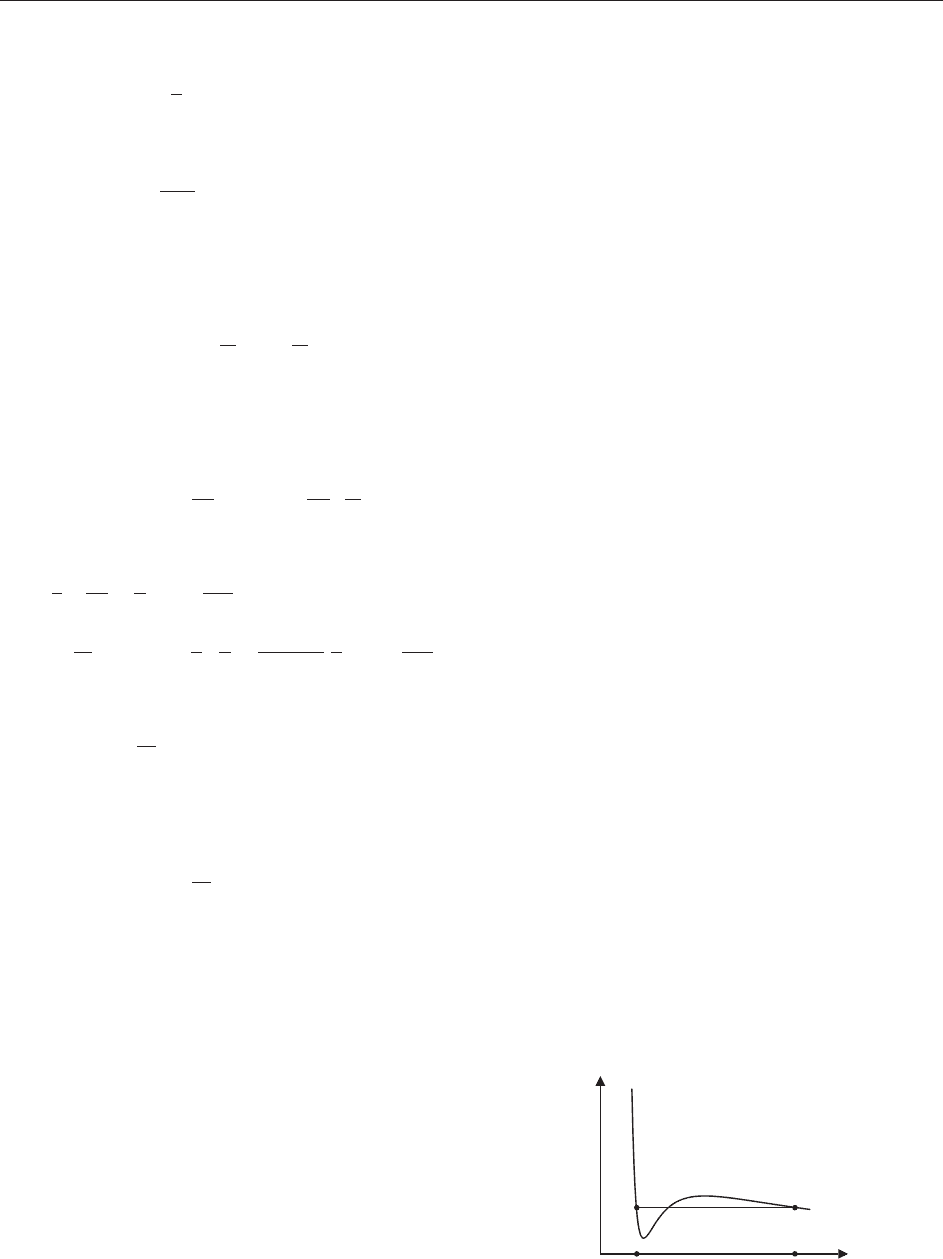
Certain consequences of [27] are appealing: for
example, Figure 1 shows that it does not give a p
monotonic nonincreasing in v if the temperature is
small enough. A critical temperature can be defined
as the largest value, T
c
, of the temperature below
which the graph of p as a function of v is not
monotonic decreasing; the critical volume V
c
is the
value of v at the horizontal inflection point
occurring for T = T
c
.
For T < T
c
the van der Waals interpretation of the
equation of state is that the function p(v)may
describe metastable states while the actual equilibrium
states would follow an equation with a monotonic
dependence on v and p(v) becoming horizontal in the
coexistence region of specific volumes. The precise
value of p where to draw the plateau (see Figure 1)
would then be fixed by experiment or theoretically
predicted via the simple rule that the plateau
associated with the represented isotherm is drawn at
a height such that the area of the two cycles in the
resulting loop are equal.
This is Maxwell’srule: obtained by assuming
that the isotherm curve joining the extreme points of
the plateau and the plateau itself define a cycle
p
v
i
v
g
v
Figure 1 The van der Waals equation of state at a temperature
T < T
c
where the pressure is not monotonic. The horizontal line
illustrates the ‘‘Maxwell rule.’’
Introductory Article: Equilibrium Statistical Mechanics 63

(see Figure 1) representing a sequence of possible
macroscopic equilibrium states (the ones correspond-
ing to the plateau) or states with extremely long time
of stability (‘‘metastable’’) represented by the curved
part. This would be an isothermal Carnot cycle which,
therefore, could not produce work: since the work
produced in the cycle (i.e.,
H
pdv) is the signed area
enclosed by the cycle the rule just means that the area is
zero. The argument is doubtful at least because it is not
clear that the intermediate states with p increasing
with v could be realized experimentally or could even
be theoretically possible.
A striking prediction of [27], taken literally, is
that the gas undergoes a gas–liquid phase transition
with a critical point at a temperature T
c
, volume v
c
,
and pressure p
c
that can be computed via [27] and
are given by RT
c
= 8A=27B, V
c
= 3B (n = 1).
At the same time, the above prediction is interesting
as it shows that there are simple relations between the
critical parameters and the microscopic inter-
action constants, i.e., " ’ k
B
T
c
and r
0
’ (V
c
=N
A
))
1=3
:
or more precisely " = 81k
B
T
c
=64, r
0
= (V
c
=2N
A
)
1=3
if a classical Lennard–Jones potential (i.e., ’ = 4"
((r
0
=jqj)
12
(r
0
=jqj)
6
); see the last section) is used
for the interaction potential ’.
However, [27] cannot be accepted acritically not
only because of the approximations (essentially the
neglecting of O(v
1
) in the equation of state), but
mainly because, as remarked above, for T < T
c
the
function p is no longer monotonic in v as it must be;
see comment following [19].
The van der Waals equation, refined and comple-
mented by Maxwell’s rule, predicts the following
behavior:
ðp p
c
Þ/ðv v
c
Þ
;¼ 3; T ¼ T
c
ðv
g
v
l
Þ/ðT
c
TÞ
;¼ 1=2; for T !T
c
½28
which are in sharp contrast with the experimental
data gathered in the twentieth century. For the
simplest substances, one finds instead ffi 5, ffi 1=3.
Finally, blind faith in the equation of state [27] is
untenable, last but not least, also because nothing in
the analysis would change if the space dimension was
d = 2ord = 1: but for d = 1, it is easily proved that the
system, if the interaction decays rapidly at infinity,
does not undergo phase transitions (see next section).
In fact, it is now understood that van der Waals’
equation represents rigorously only a limiting situa-
tion, in which particles have a hard-core interaction
(or a strongly repulsive one at close distance) and a
further smooth interaction ’ with very long range.
More precisely, suppose that the part of the potential
outside a hard-core radius r
0
> 0isattractive
(i.e., non-negative) and has the form
d
’
1
(
1
jqj) 0
and call P
0
(v)the(-independent) product of times
the pressure of the hard-core system without any
attractive tail (P
0
(v) is not explicitly known except
if d = 1, in which case it is P
0
(v)(v b) = 1, b = r
0
),
and let
a ¼
1
2
Z
jqj>r
0
j’
1
ðqÞjdq
If p(, v; ) is the pressure when >0 then it can be
proved that
pð; vÞ¼
def
lim
!0
pð; v; Þ
¼
a
v
2
þ P
0
ðvÞ
Maxwell
0
srule
½29
where the subscript means that the graph of p(, v)
as a function of v is obtained from the function in
square bracket by applying to it Maxwell’s rule,
described above in the case of the van der Waals
equation. Equation [29] reduces exactly to the
van der Waals equation for d = 1, and for d > 1
it leads to an equation with identical critical
behavior (even though P
0
(v) cannot be explicitly
computed).
The reader is referred to Lebowitz and Penrose
(1979) and Gallavotti (1999) for more details.
Absence of Phase Transitions: d = 1
One of the most quoted no-go theorems in statistical
mechanics is that one-dimensional systems of parti-
cles interacting via sho rt-range forces do not exhibit
phase transitions (cf. the next section) unless the
somewhat unphysical situation of having zero
absolute temperature is considered. This is particu-
larly easy to check in the case of ‘‘nearest-neighbor
hard-core interactions.’’ Let the hard-c ore size be r
0
,
so that the interaction potential ’(r) = þ1 if r r
0
,
and suppose also that ’(r) 0iff 2r
0
. In this
case, the thermodynamic functions can be exactly
computed and checked to be analytic: hence the
equation of state cannot have any phase transition
plateau. This is a special case of van Hove’s theorem
establishing smoothness of the equation of stat e for
interactions extending beyond the nearest neighbor
and rapidly decreasing at infinity.
If the definition of phase transition based on the
sensitivity of the thermodynamic limit to variations
of boundary conditions is adopted then a more
general, conceptually simple, argument can be give n
to show that in one-dimensional systems there
cannot be any phase transit ion if the potential
energy of mutual interaction between a
64 Introductory Article: Equilibrium Statistical Mechanics