
Francoise J.-P., Naber G.L., Tsun T.S. (editors) Encyclopedia of Mathematical Physics
Подождите немного. Документ загружается.


should be much less than 1=
0
. That is, the velocities
involved should be much less than
c ¼
1
ffiffiffiffiffiffiffiffiffi
0
0
p
¼ 3 10
8
ms
1
This, of course, is the velocity of light.
The Limits of Galilean Invariance
Our basic principles EM1–EM3 must now be seen to
be approximations – they describe the interactions of
particles and fields when the particles are moving
relative to each other at speeds much less than that of
light. To emphasize that we cannot expect, in
particular, EM3 to hold for particles moving at
speeds comparable with c, we must replace it by
EM3
0
. A charge moving with velocity v, where v c,
generates a magnetic field
B ¼
0
ev ^ r
4r
3
þ Oðv
2
=c
2
Þ½20
The magnetic field of a system of charges in
general motion satisfies
div B ¼ 0 ½21
In the second part, we have retained [21] as a
differential form of the statement that there are no
free magnetic poles; the magnetic field is generated
only by the motion of the charges. With this change,
the theory is consistent with the principle of
relativity, provided that we ignore terms of order
v
2
=c
2
. The substitution of EM3
0
for EM3 resolves the
conspicuous paradox; the symmetry noted by Ein-
stein between the current generated by the motion of
the conductor in a magnetic field and by the motion
of a magnet past a conductor is explained, provided
that the velocities are much less than that of light.
The central problem remains however; the equa-
tions of electromagnetism are not invariant under
a Galilean transformation with velocity comparable
to c. The paradox is still there, but it is more subtle
than it appeared to be at first. There are three
possible ways out: (1) the noninvariance is real and
has observable effects (necessarily of order v
2
=c
2
or
smaller); (2) Maxwell’s theory is wrong; or (3) the
Galilean transformation is wrong. Disconcertingly,
it is the last path that physics has taken. But that is
to jump ahead in the story. Our task is to compl ete
the derivation of Maxwell’s equations.
Faraday’s Law of Induction
The magnetic field of a slow-moving charge will
always be small in relation to its electric field (even
when we replace B by cB to put it into the same
units as E). The magnetic fields generated by
currents in electrical circuits are not, however,
dominated by large electric fields. This is because
the currents are created by the flow, at slow
velocity, of electrons, while overall the matter in
the wire is roughly electrically neutral, with the
electric fields of the positively charged nuclei and
negatively charged electr ons canceling.
This is the physical context to keep in mind in
the following deduction of Faraday’s law of
induction from Galilean invariance for velocities
much less than c. The law relates the electromotive
force or ‘‘voltage’’ around an electrical circuit
totherateofchangeofthemagneticfieldB over
a s urface spanning the circuit. In its differential
form, the law becomes one of Maxwell’s
equations.
Suppose first that the fields are generated by
charges all moving relative to a g iven inertial
frame of reference R withthesamevelocityv.
Then in a second frame R
0
moving relative to R
with velocity v, there is a stationary distribution of
charge. If the velocity is much less than that of
light, then the electric fi eld E
0
measured in R
0
is
related to the electric and magnetic E and B
measured in R by
E
0
¼ E þ v ^ B
Since the field measured in R
0
is that of a stationary
distribution of charge, we have
curl E
0
¼ 0
In R, the charges are all moving with velocity v,so
their configuration looks exactly the same from the
point r at time t as it does from the point r þ v at
time t þ . Therefore,
Bðr þ v;t þ Þ¼B ðr; tÞ
Eðr þ v; t þ Þ¼Eðr; tÞ
and hence by taking derivatives with respect to
at = 0,
v grad B þ
@B
@t
¼ 0
v grad E þ
@E
@t
¼ 0
½22
So we must have
0 ¼ curl E
0
¼ curl E þ curlðv ^ BÞ
¼ curl E þ v div B v grad B
¼ curl E þ
@B
@t
½23
Introductory Article: Electromagnetism 45

since div B = 0. It follows that
curl E þ
@B
@t
¼ 0 ½24
Equation [24] is linear in B and E; so by adding
the magnetic and electric fields of different streams
of charges moving relative to R with different
velocities, we deduce that it holds generally for the
electric and magnetic fields generated by moving
charges.
Equation [24] encodes Faraday’s law of electro-
magnetic induction, which describes how changing
magnetic fields can generate currents. In the static case
@B
@t
¼ 0
and the equation reduces to curl E = 0 – the
condition that the electrostatic field should be
conservative; that is, it should do no net work
when a charge is moved around a closed loop .
More generally, consider a wire loop in the shape of
aclosedcurve.LetS be a fixed surface spanning .
Then we can deduce from eqn [24] that
I
E ds ¼
Z
S
curl E dS
¼
Z
S
@B
@t
dS
¼
d
dt
Z
S
ðB dSÞ½25
If the magnetic field is varying, so that the integral of B
over S is not constant, then the integral of E around the
loop will not be zero. There will be a nonzero electric
field along the wire, which will exert a force on the
electrons in the wire and cause a current to flow.
The quantity
I
E ds
which is measured in volts, is the work done by the
electric field when a unit charge makes one circuit
of the wire. It is called the electromotive force
around the circuit. The integral is the magne tic flux
linking the circuit. The relationship [25] between
electromotive force and rate of change of magnetic
flux is Faraday’s law.
The Field of Charges in Uniform Motion
We can extract another of Maxwell’s equations
from this argument. By EM3
0
, a single charge e with
velocity v generates an electric field E and a
magnetic field
B ¼
0
ev ^ r
4r
3
þ Oðv
2
=c
2
Þ
where r is the vector from the charge to the point at
which the field is measured. In the frame of reference
R
0
in which the charge is at rest, its electric field is
E
0
¼
er
4
0
r
3
In the frame in which it is moving with velocity
v, E = E
0
þ O(v=c). Therefore,
cB ¼
v ^ E
0
c
¼
v ^ E
c
þ O
v
2
c
2
By taking the curl of both sides, and dropping terms
of order v
2
=c
2
,
curlðcBÞ¼curl
v ^ E
c
¼
1
c
v div E v grad EðÞ
But
div E ¼ =
0
; v grad E ¼
@E
@t
by [22]. Therefore,
curlðcBÞ
1
c
@E
@t
¼
1
c
0
J ¼ c
0
J
where J = v. By summing over the separate particle
velocities, we conclude that
curl B
1
c
2
@E
@t
¼
0
J
holds for an arbitrary distribution of charges, provided
that their velocities are much less than that of light.
Maxwell’s Equations
The basic principles, together with the assumption of
Galilean invariance for velocities much less than that
of light, have allowed us to deduce that the electric and
magnetic fields generated by a continuous distribution
of moving charges in otherwise empty space satisfy
div E ¼
0
½26
div B ¼ 0 ½27
curl B
1
c
2
@E
@t
¼
0
J ½28
curl E þ
@B
@t
¼ 0 ½29
46 Introductory Article: Electromagnetism
where is the charge density, J is the current
density, and c
2
= 1=
0
0
. These are Maxwell’s
equations, the basis of modern electrodynamics.
Together with the Lorentz-force law, they describe
the dynamics of charges and electromagnetic fields.
We have arrived at them by considering how basic
electromagnetic processes appear in moving frames
of reference – an unsatisfactory route because we
have seen on the way that the principles on which
we based the derivation are incompatible with
Galilean invariance for velocities comparable with
that of light. Maxwell derived them by analyzing an
elaborate mechanical model of electric and magnetic
fields – as displacements in the luminiferous ether.
That is also unsatisfactory because the model has
long been abandoned. The reason that they are
accepted today as the basis of theoretical and
practical applications of electromagnetism has little
to do with either argument. It is first that they are
self-consistent, and second that they describe the
behavior of real fields with unreasonable accuracy.
The Continuity Equation
It is not immediately obvious that the equations are
self-consistent. Given and J as functions of the
coordinates and time, Maxwell’s eq uations are two
scalar and two vector equations in the unknown
components of E and B. That is, a total of eight
equations for six unknow ns – more equations than
unknowns. Therefore, it is possible that they are in
fact inconsistent.
If we take the divergence of eqn [29], then we
obtain
@
@t
div B
ðÞ
¼ 0
which is consistent with eqn [27]; so no problem
arises here. However, by taking the divergence of
eqn [28] and substituting from eqn [26], we get
0 ¼ div curl B
¼
1
c
2
@
@t
div EðÞþ
0
div J
¼
0
@
@t
þ div J
This gives a contradiction unless
@
@t
þ div J ¼ 0 ½30
So the choice of and J is not unconstrained; they
must be related by the continuity equation [30]. This
holds for physically reasonable distributions of
charge; it is a differential form of the statement
that charges are neither created nor destroyed.
Conservation of Charge
To see the connection between the continuity
equation and charge conservation, let us look at
the total charge within a fixed V bounded by a
surface S. If charge is conserved, then any increase
or decrease in a short period of time must be
exactly balanced by an inflow or outflow of charge
across S.
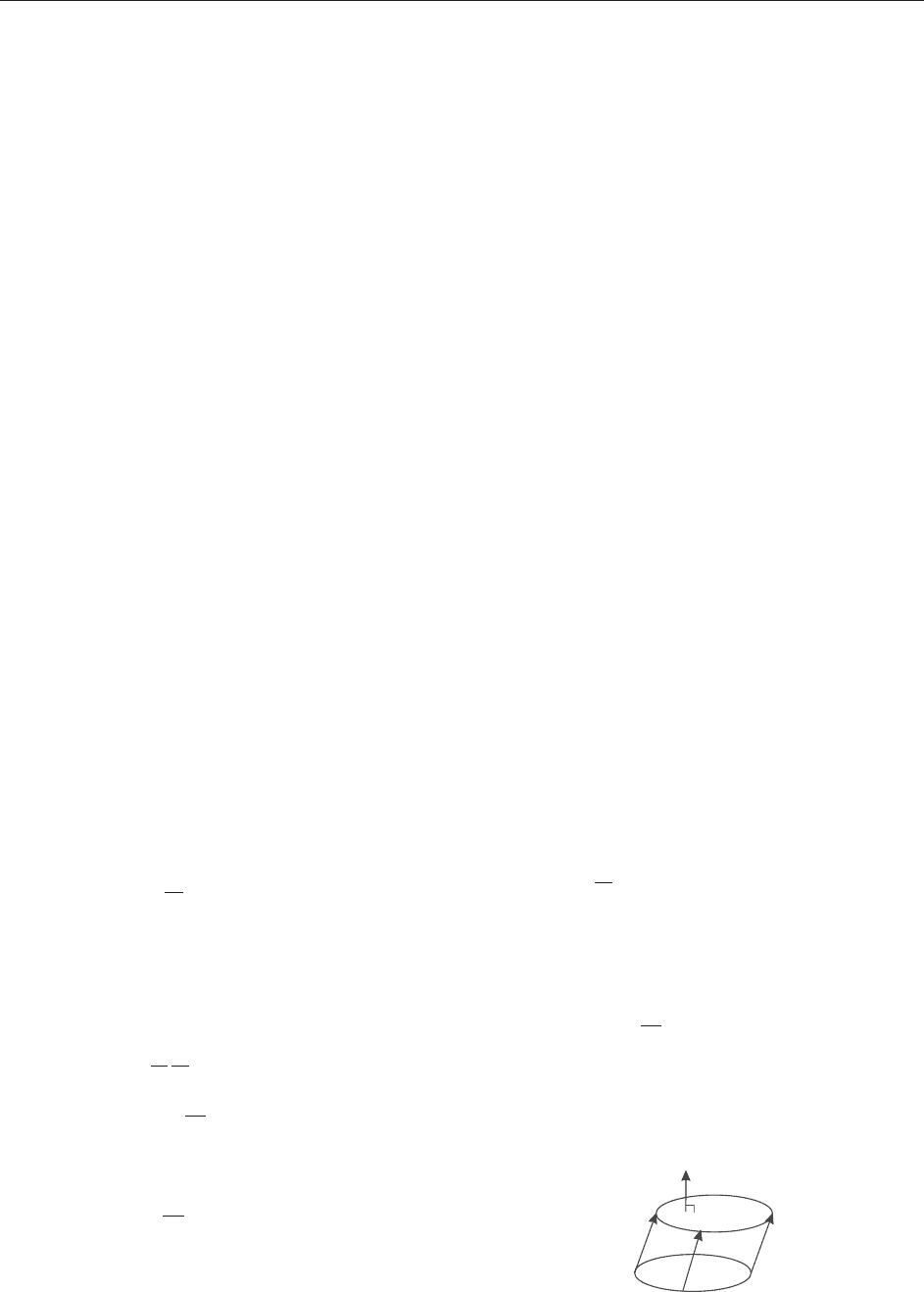
Consider a small element dS of S with outward
unit nor mal and consider all the particles that have a
particular charge e and a particular velocity v at
time t. Suppose that there are of these per unit
volume ( is a function of position). Those that cross
the surface element between t and t þ t are those
that at time t lie in the region of volume
jv n dS tj
shown in Figure 1. They contribute ev dSt to the
outflow of charge through the surface element. But
the value of J at the surface element is the sum of
ev over all pos sible values of v and e. By summing
over v, e, and the elements of the surface, therefore,
and by passing to the limit of a continuous
distribution, the total rate of outflow is
Z
S
J dS
Charge conservation implies that the rate of
outflow should be equal to the rate of decrease in
the total charge within V. That is,
d
dt
Z
V
dV þ
Z
S
J dS ¼ 0 ½31
By differentiating the first term under the integral
sign and by applying the divergence theorem to the
second integral,
Z
V
@
@t
þ div J
dV ¼ 0 ½32
If this is to hold for any choice of V, then and J
must satisfy the continuity equation. Conversely, the
continuity equation implies charge conservation.
dS
n
νdt
ν
dt
Figure 1 The outflow through a surface element.
Introductory Article: Electromagnetism 47

The Displacement Current
The third of Maxwell’s equations can be written as
curl B ¼
0
J þ
0
@E
@t
½33
in which form it can be read as an equation
for an unknown magnetic field B in terms of
a known current distribution J and electric
field E.WhenE and J are independent of t,it
reduces to
curl B ¼
0
J
which determines the magnetic field of a steady
current, in a way that was already familiar
to Maxwell’s contemporaries. But his second
term on the right-hand side of [33]wasnew;it
adds to J the so-called v acuum displacement
current
0
@E
@t
The name comes from an analogy with the
behavior of charges in an insulating material.
Here no s teady curren t can flow, but the distribu-
tion of charges within the material is distorted
by an external electric field. When the field
changes, the distortion also c hanges , and the result
appears as a current – the displacement current –
which flows during the period of change. Max-
well’s central insight was that the same term
should be present even in empty space. The
consequence was profound; it allowed him to
explain the propagation of light as an electromag-
netic phenomenon.
The Source-Free Equations
In a region of empty space, away from the
charges generating the e lectric and magnetic fields,
we have = 0 = J, and Maxwell’s equations
reduce to
div E ¼ 0 ½34
div B ¼ 0 ½35
curl B
1
c
2
@E
@t
¼ 0 ½36
curl E þ
@B
@t
¼ 0 ½37
where c = 1=
ffiffiffiffiffiffiffiffiffi
0
0
p
. By taking the curl of eqn [36]
and by substituting from eqns [35]and[37], we
obtain
0 ¼grad ðdiv BÞr
2
B
1
c
2
curl
@E
@t
¼r
2
B
1
c
2
@
@t
ðcurl EÞ
¼r
2
B þ
1
c
2
@
2
B
@t
2
½38
Therefore, the three components of B in empty space
satisfy the (scalar) wave equation
&u ¼ 0
Here & is the d’Alembertian operator, defined by
& ¼
1
c
2
@
2
@t
2
r
2
¼
1
c
2
@
2
@t
2
@
2
@x
2
@
2
@y
2
@
2
@z
2
By taking the curl of eqn [37], we also obtain
& E = 0.
Monochromatic Plane Waves
The fact that E and B are vector-va lued solutions of
the wave equation in empty space suggests that we
look for ‘‘plane wave’’ solutions of Maxwell’s
equations in which
E ¼ a cos þ b sin ½39
where a, b are constant vectors an d
¼
!
c
ct r eðÞ; e e ¼ 1 ½40
with !>0, , , and e constant; ! is the frequency
and e is a unit vector that gives the direction of
propagation (adding to t and ce to r leaves u
unchanged). This satisfies the wave equation, but for
a general choice of the constants, it will not be
possible to find B such that eqns [34]–[37] also hold.
By taking the divergence of eqn [39], we obtain
div E ¼
!
c
e a sin e b cos ðÞ½41
For eqn [34] to hold, there fore, we must choose a
and b orthogonal to e. For eqn [37] to hold, we
must find B such that
curl E ¼
!
c
e ^ a sin e ^ b cos ðÞ¼
@B
@t
½42
A possible choice is
B ¼
e ^ E
c
¼
1
c
e ^ a cos þ e ^ b sin ðÞ½43
and it is not hard to see that E and B then satisfy
[35]and[36] as well.
48 Introductory Article: Electromagnetism

The solutions obtained in this way are called
‘‘monochromatic electromagnetic plane waves.’’
Note that such waves are transverse in the sense
that E and B are orthogonal to the direction of
propagation. The definition E can be written more
concisely in the form
E ¼ Re ða þ ibÞe
i
½44
It is an exercise in Fourier analysis to show every
solution in empty space is a combination of
monochromatic plane waves. A plane wave has
‘‘plane’’ or ‘‘linear’’ polarization if a and b are
proportional. It has ‘‘circular’’ polarization if
a a = b b, a b = 0.
At the heart of Maxwell’s theory was the idea that
a light wave with definite frequency or color is
represented by a monochromatic plane solution of
his equations.
Potentials
For every solution of Maxwell’s equations in vacuo,
the components of E and B satisfy the three-
dimensional wave equatio n; but the converse is not
true. That is, it is not true in general that if
&B ¼ 0; &E ¼ 0
then E and B satisfy Maxwell’s equations. For this
to happen, the divergence of both fields must vanish,
and they must be related by [36] and [37]. These
additional constraints are somewhat simpler to
handle if we work not with the fields themselves,
but with auxiliary quantities called ‘‘potentials.’’
The definition of the potentials depends on
standard integrability conditions from vector calcu-
lus. Suppose that v is a vector field, which may
depend on time. If curl v = 0, then there exists a
function such that
v ¼ grad ½45
If div v = 0, then there exists a second vector field a
such that
v ¼ curl a ½46
Neither nor a is uniquely determined by v. In the
first case, if [45] holds, then it also holds when is
replaced by
0
= þ f , where f is a function of time
alone; in the second, if [46] holds, then it also holds
when a is replaced by
a
0
¼ a þ grad u
for any scalar function u of position and time. It
should be kept in mind that the existence statements
are local. If v is defined on a region U with
nontrivial topology, then it may not be possible to
find a suitable or a throughout the whole of U.
Suppose now that we are given fields E and B
satisfying Maxwell’s equations [26]–[29] with
sources represented by the charge density and the
current density J. Since div B = 0, there exists a time-
dependent vector field A (t, x, y, z) such that
B ¼ curl A
If we substitute B = curl A into [29] and interchange
curl with the time derivative, then we obtain
curl E þ
@A
@t
¼ 0
It follows that there exists a scalar (t, x, y, z) such
that
E ¼grad
@A
@t
½47
Such a vector field A is called a ‘‘magnetic vector
potential’’; a function such that eqn [47] holds is
called an ‘‘electric scalar potential.’’
Conversely, given scalar and vector functions
and A of t, x, y, z, we can define B and E by
B ¼ curl A; E ¼grad
@A
@t
½48
Then two of Maxwell’s equations hold automati-
cally, since
div B ¼ 0; curl E þ
@B
@t
¼ 0
The remaining pair translate into conditions on A
and . Equation [26] becomes
div E ¼r
2
@
@t
ðdiv AÞ¼
0
and eqn [28] becomes
curl B
1
c
2
@E
@t
¼r
2
A þ grad div A
þ
1
c
2
@
@t
grad þ
@A
@t
¼
0
J
If we put
¼
1
c
2
@
@t
þ div ðAÞ
then we can rewrite the equations for A and more
simply as
&
@
@t
¼
0
&A þ grad ¼
0
J
Introductory Article: Electromagnetism 49

Here we have four equations (one scalar, one vector)
in four unknowns ( and the components of A). Any
set of solutions , A determines a solution of
Maxwell’s equations via [48].
Gauge Transformations
Given solutions E and B of Maxwell’s equations,
what freedom is there in the choice of A and ?
First, A is determined by curl A = B up to the
replacement of A by
A
0
¼ A þ grad u
for some function u of position and time. The scalar
potential
0
corresponding to A
0
must be chosen so
that
grad
0
¼ E þ
@A
0
@t
¼ E þ
@A
@t
þ grad
@u
@t
¼grad
@u
@t
That is,
0
= @u=@t þ f (t), where f is a function
of t alone. We can absorb f into u by subtracting
Z
f dt
(this does not alter A
0
). So the free dom in the choice
of A and is to make the transformation
A 7!A
0
¼ A þ grad u;7!
0
¼
@u
@t
½49
for any u = u(t, x, y, z). The transform ation [49]is
called a ‘‘gauge transformation.’’
Under [49],
7!
0
¼
1
c
2
@
0
@t
þ divðA
0
Þ¼ &u
It is possible to show, under certain very mild
conditions on , that the inhomogeneous wave
equation
&u ¼ ½50
has a solution u = u(t, x, y, z). If we choose u so that
[50] holds, then the transformed potentials A
0
and
0
satisfy
divðA
0
Þþ
1
c
2
@
0
@t
¼ 0
This is the ‘‘Lorenz gauge condition,’’ named after
L Lorenz (not the H A Lorentz of the ‘‘Lorentz
contraction’’).
If we impose the Lorenz condition, then the only
remaining freedom in the choice of A and is to
make gauge transformations [49] in which u is a
solution of the wave equation &u = 0. Under the
Lorenz condition, Maxwell’s equations take the
form
& ¼ =
0
; &A ¼
0
J ½51
Consistency with the Lorenz condition follows from
the continuity equation on and J.
In the absence of sources, therefore, Maxwell’s
equations for the potential in the Lorenz gauge
reduce to
& ¼ 0; &A ¼ 0 ½52
together with the constraint
div A þ
1
c
2
@
@t
¼ 0
We can, for example, choose three arbitrary solu-
tions of the scalar wave equation for the compo-
nents of the vector potential, and then define by
¼ c
2
Z
div Adt
Whatever choice we make, we shall get a solution of
Maxwell’s equations, and every solution of Max-
well’s equations (without sources) will arise from
some such choice.
Historical Note
At the end of the eighteenth century, four types of
electromagnetic phenomena were known, but not
the connections between them.
Magnetism, the word derives from the Greek for
‘‘stone from Magnesia.’’
Static electricity, produced by rubbing amber with
fur; the word ‘‘electricity’’ derives from the Greek
for ‘‘amber.’’
Light.
Galvanism or ‘‘animal electricity’’ – the electricity
produced by batteries, discovered by Luigi
Galvani.
The constr uction of a unified theory was a slow
and painful business. It was hindered by attempts,
which seem bizarre in retrospect, to understand
electromagnetism in terms of underlying mechanical
models involving such inventions as ‘‘electric fluids’’
and ‘‘magnetic vortices.’’ We can see the legacy of
this period, which ended with Einstein’s work in
1905, in the misleading and archaic terms that still
survive in modern terminology: ‘‘magnetic flux,’’
‘‘lines of force,’’ ‘‘electric displacement,’’ and so on.
50 Introductory Article: Electromagnetism

Maxwell’s contribution was decisive, although
much of what we now call ‘‘Maxwell’s theory’’ is
due to his successors (Lorentz, Hertz, Einstein, and
so on); and, as we shall see, a key element in
Maxwell’s own description of electromagnetism –
the ‘‘electromagnetic ether,’’ an all-pervasive
medium which was supposed to transmit electro-
magnetic waves – was thrown out by Einstein.
A rough chronology is as follows.
1800 Volta demonstrated the connection between
galvanism and static electricity.
1820 Oersted showed that the current from a
battery generates a force on a magnet.
1822 Ampe` re suggested that light was a wave
motion in a ‘‘luminiferous ether’’ made up of two
types of electric fluid. In the same year, Galileo’s
‘‘Dialogue concerning the two chief world sys-
tems’’ was removed from the index of prohibited
books.
1831 Faraday showed that moving magnets can
induce currents.
1846 Faraday suggested that light is a vibration
in magnetic lines of force.
1863 Maxwell published the equations that
describe the dynamics of electric and magnetic
fields.
1905 Einstein’s paper ‘‘On the electrodynamics
of moving bodies.’’
Further Reading
Chalmers AF (1975) Maxwell and the displacement current.
Physics Education January 1975: 45–49.
Einstein A (1905) On the Electrodynamics of Moving Bodies. A
translation of the paper can be found in The Principle of
Relativity by Lorentz HA, Einstein A, Minkowski H, and
Weyl H, with notes by Sommerfeld A. New York: Dover,
1952.
Roche J (1998) The present status of Maxwell’s displacement
current. European Journal of Physics 19: 155–166.
Siegel DM (1985) Mechanical image and reality in Maxwell’s
electromagnetic theory. In: Harman PM (ed.) Wranglers and
Physicists. Manchester: Manchester University Press.
Introductory Article: Equilibrium Statistical Mechanics
G Gallavotti, Universita
`
di Roma ‘‘La Sapienza,’’
Rome, Italy
ª 2006 G Gallavotti. Published by Elsevier Ltd.
All rights reserved.
Foundations: Atoms and Molecules
Classical statistical mechanics studies properties of
macroscopic aggregates of particles, atoms, and
molecules, based on the assumption that they are
point masses subject to the laws of classical
mechanics. Distinction between macr oscopic and
microscopic systems is evanescent and in fact the
foundations of statistical mechanics have been laid
on properties, proved or assumed, of few-particle
systems.
Macroscopic systems are often considered in
stationary states, which means that their micro-
scopic configurations follow each other as time
evolves while looking the same macroscopically.
Observing time evolution is the same as sampling
(‘‘not too closely’’ time-wise) independent copies of
the system prepared in the same way.
A basic distinction is necessary: a stationary state
may or may not be in equilibrium. The first case
arises when the particles are enclosed in a container
and are subject only to their mutual conservative
interactions and, possibly, to external conservative
forces: a typical example is a gas in a container
subject to forces due to the walls of and gravity,
besides the internal interactions. This is a very
restricted class of systems and states.
A more general case is when the system is in a
stationary state but it is also subject to nonconservative
forces: a typical example is a gas or fluid in which a
wheel rotates, as in the Joule experiment, with some
device acting to keep the temperature constant. The
device is called a thermostat and in statistical
mechanics it has to be modeled by forces, including
nonconservative ones, which prevent an indefinite
energy transfer from the external forcing to the system:
such a transfer would impede the occurrence of
stationary states. For instance, the thermostat could
simply be a constant friction force (as in stirred
incompressible liquids or as in electric wires in which
current circulates because of an electromotive force).
A more fundam ental approach would be to
imagine that the thermostat device is not a phenom-
enologically introduced nonco nservative force (e.g.,
a friction force) but is due to the interaction with an
external infinite system which is in ‘‘equilibrium at
infinity.’’
In any event nonequilibrium stationary states are
intrinsically more complex than equilibrium states.
Here attention will be confined to equilibrium
Introductory Article: Equilibrium Statistical Mechanics 51

statistical mechanics of systems of N identical point
particles Q = (q
1
, ..., q
N
) enclosed in a cubic box ,
with volume V and side L, normally assumed to
have perfectly reflecting walls.
Particles of mass m located at q, q
0
will be
supposed to interact via a pair potential ’(q q
0
).
The microscopic motion follows the equations
m
€
q
i
¼
X
N
j¼1
@
q
i
’ðq
i
q
j
Þþ
X
i
W
wall
ðq
i
Þ
¼
def
@
q
i
ðQÞ½1
where the potential ’ is assumed to be smooth
except, possibly, for jq q
0
jr
0
where it could be
þ1, that is, the particles cannot come closer than
r
0
, and at r
0
[1] is interpreted by imagining that they
undergo elastic collisions; the potential W
wall
models
the container and it will be replaced, unless
explicitly stated, by an elastic collision rule.
The time evolution (Q,
_
Q) !S
t
(Q,
_
Q) will, there-
fore, be described on the position – velocity space,
b
F(N), of the N particles or, more conveniently, on
the phase space, i.e., by a time evolution S
t
on the
momentum – position (P, Q, with P = m
_
Q) space,
F(N). The motion being conservative, the energy
U ¼
def
X
i
1
2m
p
2
i
þ
X
i<j
’ðq
i
q
j
Þþ
X
i
W
wall
ðq
i
Þ
¼
def
KðPÞþðQÞ
will be a constant of motion; the last term in is
missing if walls are perfect. This makes it convenient to
regard the dynamics as associated with two dynamical
systems (F(N), S
t
) on the 6N-dimensional phase
space, and (F
U
(N), S
t
)onthe(6N 1)-dimensional
surface of energy U. Since the dynamics [1] is
Hamiltonian on phase space, with Hamiltonian
HðP; QÞ¼
def
X
i
1
2m
p
2
i
þ ðQÞ¼
def
K þ
it follows that the volume d
3N
Pd
3N
Q is conserved
(i.e., a region E has the same volume as S
t
E) and
also the area (H(P, Q) U)d
3N
Pd
3N
Q is conserved.
The above dynamical systems are well defined,
i.e., S
t
is a map on phase space globally defined for
all t 2 (1, 1), when the interaction potential is
bounded below: this is implied by the a priori
bounds due to energy conservation. For gravita-
tional or Coulomb interactions, much more has to
be said, assumed, and done in order to even define
the key quantities needed for a statistical theory of
motion.
Although our world is three dimensional (or at
least was so believed to be until recent revolutionary
theories), it will be useful to consider also systems of
particles in dimension d 6¼3: in this case the above
6N and 3N become, respectively, 2dN and dN.
Systems with dimension d = 1, 2 are in fact some-
times very good models for thin filaments or thin
films. For the same reason, it is often useful to
imagine that space is discrete and particles can only
be located on a lattice, for example, on Z
d
(see the
section ‘‘Lattice models’’).
The reader is referred to Gallavotti (1999) for
more details.
Pressure, Temperature, and Kinetic
Energy
The beginning was BERNOULLI’s derivation of
the perfect gas law via the identific ation of
the pressure at numerical density with the
average momentum transferred per unit time to
a surface element of area dS on the walls: that is,
the average of the observable 2mvv dS,withv
the normal component of the velocity of
the particles that undergo collisions with dS.
If f (v)dv is the d istribution of the normal compo-
nent of velocity and f (v)d
3
v
Q
i
f (v
i
)d
3
v, v =
(v
1
, v
2
, v
3
), is the total velocity distribution,
the average of the momentum transferred is pdS
given by
dS
Z
v>0
2mv
2
f ðvÞdv ¼ dS
Z
mv
2
f ðvÞdv
¼
2
3
dS
Z
m
2
v
2
f ðvÞd
3
v ¼
2
3
K
N
dS ½2
Furthermore (2=3)hK=Ni was identified as pro-
portional to the abso lute tempera ture hK=Ni =
def
const (3=2)T which, with present-day notations, is
written a s (2=3)hK=Ni= k
B
T.Theconstantk
B
was
(later) called Boltzmann’s constant and it is the
same for at least all perfect gases. Its independence
on the particular nature of the gas is a conse-
quence of Avogadro’slawstating that equal
volumes of gases at the sam e conditions of
temperature and pressure contain equal number
of molecules.
Proportionality between average kinetic energy
and temperature via the universal constant k
B
became in fact a fundamental assumption extending
to all aggregates of particles gaseous or not, never
challenged in all later works (until quantum
mechanics, where this is no longer true, see the
section ‘‘Quantum statistics’’.
For more details, we refer the reader to Gallavotti
(1999).
52 Introductory Article: Equilibrium Statistical Mechanics

Heat and Entropy
After Clausius’ discovery of entropy, BOLTZMANN,in
order to explain it mechanically, introduced the heat
theorem, which he developed to full generality
between 1866 and 1884. Together with the men-
tioned identification of absolute temperature with
average kinetic energy, the heat theorem can also be
considered a founding element of statistical
mechanics.
The theorem makes precise the notion of time
average and then states in great generality that
given any mechanical system one can associate with
its dynamics four quantities U, V, p, T, defined as
time averages of suitable mechanical observables
(i.e., functions on phase space), so that when the
external conditions are infinitesimally varied and
the quantities U, V change by dU,dV, respectively,
the ratio (dU þ pdV)=T is exact, i.e., there is a
function S(U, V) whose corre sponding variation
equals the ratio. It will be better, for the purpose of
considering very large boxes (V !1) to write this
relation in terms of intensive quantities u =
def
U=N and
v = V=N as
du þ pdv
T
is exact ½3
i.e., the ratio equals the variation ds of
s(U=N, V=N) (1=N)S(U, V).
The proof originally dealt with monocyclic
systems, i.e., systems in which all motions are
periodic. The assumption is clearly much too
restrictive and justification for it developed from
the early ‘‘nonperiodic motions can be regarded
as periodic with infinite period’’ (1866), to the
later ergodic hypothesis and finally to the
realization that, after all, the heat theorem
does not really depend on the ergodic hypothesis
(1884).
Although for a one -dimensional system the proof
of the heat theorem is a simple check, it was a real
breakthrough because it led to an answer to the
general question as to under which conditions one
could define mechanical quantities whose variations
were constrained to satisfy [3] and therefore could
be interpreted as a mechanical model of Clausius’
macroscopic thermodynamics. It is reproduced in
the following.
Consider a one-dimensional system subject to
forces with a confining potential ’(x) such that
j’
0
(x)j> 0 for jxj> 0,’
00
(0) > 0and’(x) !
x!1
þ1.
All motions are periodic, so that the system is
monocyclic. Suppose that the potential ’(x) depends
on a parameter V and define a state to be a motion with
given energy U and given V;let
U ¼ total energy of the system K þ
T ¼ time average of the kinetic energy K ¼hKi
V ¼ the parameter on which ’
is supposed to depend
p ¼time average of @
V’
; h@
V’
i
½4
A state is thus parametrized by U, V.Ifsuch
parameters change by dU,dV, respectively, and
if dL =
def
pdV,dQ =
def
dU þpdV,then[3] holds. In
fact, let x
(U, V) be the extremes of the oscillations of
themotionwithgivenU, V and define S as
S ¼ 2 log
Z
x
þ
ðU;VÞ
x
ðU;VÞ
ffiffiffiffiffiffiffiffiffiffiffiffiffiffiffiffiffiffiffiffiffiffiffi
ðU ’ðxÞÞ
p
dx
) dS ¼
R
ðdU @
V’
ðxÞdVÞðdx=
ffiffiffiffi
K
p
Þ
R
ðdx=
ffiffiffiffi
K
p
ÞK
½5
Noting that dx=
ffiffiffiffi
K
p
=
ffiffiffiffiffiffiffiffiffiffi
2=m
p
dt , [3] follows because
time averages are given by integrating with respect
to dx=
ffiffiffiffi
K
p
and dividing by the integral of 1=
ffiffiffiffi
K
p
.
For more details, the reader is referred to Boltzmann
(1968b) and Gallavotti (1999).
Heat Theorem and Ergodic Hypothesis
Boltzmann tried to extend the result beyond the one-
dimensional systems (e.g., to Keplerian motions,
which are not monocyclic unless only motions with
a fixed eccentricity are considered). However, the
early statement that ‘‘aperiodic motions can be
regarded as periodic with infinite period’’ is really
the heart of the application of the heat theorem
for monocyclic systems to the far more complex gas
in a box.
Imagine that the gas container is closed by a
piston of section A located to the right of the
origin at distance L and acting as a lid, so t hat the
volume is V = AL. The microscopic model for the
piston will be a potential
’(L )ifx = (, , )are
the coordinates of a particle. The function
’(r)
will vanish for r > r
0
,forsomer
0
L,and
diverge to þ1 at r = 0. Thus, r
0
is the width of
the layer near the piston where the force of the
wall is felt by the particles that happen to be
roaming there.
The contribution to the total potential energy
due to the walls is W
wall
=
P
j
’(L
j
)and
@
V
’ = A
1
@
L
’; assuming monocyclicity, it is neces-
sary to evaluate the time average of @
L
(x) =
@
L
W
wall
P
j
’
0
(L
j
). As time evolves, the
particles x
j
with
j
in the layer within r
0
of the
wall will feel the force exercised by the wall and
Introductory Article: Equilibrium Statistical Mechanics 53

bounce back. One particle in the layer will con-
tribute to the average of @
L
(x) the amount
1
total time
2
Z
t
1
t
0
’
0
ðL
j
Þdt ½6
if t
0
is the first instant when the point j enters the
layer and t
1
is the instant when the -component of
the velocity vanishes ‘‘against the wall.’’ Since
’
0
(L
j
) is the -component of the force, the
integral is 2mj
˙
j
j (by Newton’s law), provided, of
course,
˙
j
> 0:
Suppose that no collisions between particles occur
while the particles travel within the range of the
potential of the wall, i.e., the mean free path is much
greater than the range of the potent ial
’ defining the
wall. The contribution of collisions to the average
momentum transfer to the wall per unit time is
therefore given by, see [2],
Z
v>0
2mv f ðvÞ
wall
Av dv
if
wall
, f (v) are the average density near the wall
and, respectively, the average fraction of particles
with a velocity component normal to the wall
between v and v þ dv. Here p, f are supposed to be
independent of the point on the wall: this should be
true up to corrections of size o(A).
Thus, writing the average kinetic energy per particle
and per velocity component,
R
(m=2)v
2
f (v)dv,as
(1=2)
1
(cf. [2])itfollowsthat
p ¼
def
h@
V
i¼
wall
1
½7
has the physical interpre tation of pressure. (1=2)
1
is the average kinetic energy per degree of freedom:
hence, it is proportional to the absolute temperature
T (cf. see the section ‘‘Pressure, temperature, and
kinetic energy’’).
On the other hand, if motion on the energy
surface takes place on a single periodic orbit, the
quantity p in [7] is the right quantity that would
make the heat theorem work; see [4]. Hence,
regarding the trajectory on each energy surface as
periodic (i.e., the system as monocyclic) leads to the
heat theorem with p, U, V, T having the right
physical interpretation corresponding to their a ppel-
lations. This shows that monocyclic systems provide
natural models of thermodynamic behavior.
Assuming that a chaotic system like a gas in a
container of volume V will satisfy, for practical
purposes, the above property, a quantity p can be
defined such that dU þ pdV admits the inverse of
the average kinetic energy hKi as an integrating
factor and, furthermore, p, U, V, hKi have the
physical interpretations of pressure, energy, volume,
and (up to a proportionality factor) absolute
temperature, respectively.
Boltzmann’s conception of space (and time) as
discrete allowed him to conceive the property that
the energy surface is constituted by ‘‘points’’ all of
which belong to a single trajectory: a property that
would be impossi ble if the phase space was really a
continuum. Regarding phase space as consisting of a
finite number of ‘‘cells’’ of finite volume h
dN
, for
some h > 0 (rather than of a continuum of points),
allowed him to think, without logical contradiction,
that the energy surface consisted of a single
trajectory and, hence, that motion was a cyclic
permutation of its points (actually cells).
Furthermore, it implied that the time average of
an observable F(P, Q) had to be identified with its
average on the energy surface computed via the
Liouville distribution
C
1
Z
FðP; QÞðHðP; QÞUÞdP dQ
with
C ¼
Z
ðHðP; QÞUÞdP dQ
(the appropriate normalization factor): a property
that was written symbolically
dt
T
¼
dP dQ
R
dP dQ
or
lim
T!1
1
T
Z
T
0
FðS
t
ðP; QÞÞdt
¼
R
FðP
0
; Q
0
ÞðHðP
0
; Q
0
ÞUÞdP
0
dQ
0
R
ðHðP
0
; Q
0
ÞUÞdP
0
dQ
0
½8
The validity of [8] for all (piecewise smooth)
observables F an d for all points of the energy
surface, with the exception of a set of zero area, is
called the ergodic hypothesis.
For more details, the reader is referred to
Boltzmann (1968) and Gallavotti (1999).
Ensembles
Eventually Boltzmann in 1884 realized that the
validity of the heat theorem for averages computed
via the right-hand side (rhs) of [8] held indepen-
dently of the ergodic hypothesis, that is, [8] was not
necessary because the heat theorem (i.e., [3]) could
also be derived under the only assumption that the
averages involved in its formulation were computed
54 Introductory Article: Equilibrium Statistical Mechanics