
Francoise J.-P., Naber G.L., Tsun T.S. (editors) Encyclopedia of Mathematical Physics
Подождите немного. Документ загружается.


critical point theory which extends to infinite-
dimensional manifolds and, among other conse-
quences, leads to conclusions on extremal s or closed
extremals of variational problems. Rather than
privileging points on a manifold, one can study
instead the geometry of manifolds from the point of
view of spaces of functions, which leads to an
algebraic approach to differential geo metry. The
initial concept there is a commutative ring (which
becomes a possibly noncommutative algebra in the
framework of noncommutative geometry), namely
the ring of smooth functions on the mani fold, while
the manifold itself is defined in terms of the ring as the
space of maximal ideals. In particular, this point of
view proves to be fruitful to understand supermani-
folds, a generalization of manifolds which is impor-
tant for supersymmetric field theories.
One can further consider the sheaf of smooth
functions on an open subset of the manifold; this
point of view leads to sheaf theory which provides a
unified approach to establishing connections between
local and global properties of topological spaces.
Metric Properties
Riemann focused on the metric properties of manifolds
but the first clear formulation of the co ncept of a
manifold equipped with a metric was given by Weyl in
Die Idee der Riemannsche Fla¨che. A Riemannian
metric on a differentiable manifold M is a positive-
definite scalar product g
m
on T
m
M for every point
m 2 M depending smoothly on the point m.Amanifold
equipped with a Riemannian metric is called a
Riemannian manifold. A Weyl transformation, which
is multiplying the metric by a smooth positive function,
yields a new Riemannian metric with the same angle
measurement as the original one, and hence leaves the
‘ ‘conformal’ ’ structure on M unchanged.
Riemann also suggested considering metrics on
the tangent spaces that are not induced from scalar
products; metrics on the manifold built this way
were first systematically investigated by Finsler and
are therefore called Finsler metrics. Geodesics on a
Riemannian mani fold M which correspond to
smooth curves :[a, b] ! M that minimize the
length functional
LðÞ :¼
1
2
Z
b
a
ffiffiffiffiffiffiffiffiffiffiffiffiffiffiffiffiffiffiffiffiffiffiffiffiffiffiffiffiffi
g
ðtÞ
d
dt
;
d
dt
s
dt
then generalize to curves which realize the shortest
distance between two points chosen sufficiently close.
Euclid’s axioms which naturally lead to Rieman-
nian geometry are also satisfied up to the axiom
of parallelism by a geometry developed by
Lobatchevsky in 1829 and Bolyai in 1832. Non-
Euclidean geometries actually played a major role in
the development of differential geometry and Loba-
chevsky’s work inspired Riemann and later Klein.
Dropping the positivity assumption for the
bilinear forms g
m
on T
m
M leads to Lorentzian
manifolds which are (n þ 1)-dimensional smooth
manifolds equipped with bilinear forms on the
tangent spaces with signature (1, n). These occur in
general relativity and tangent vectors with negative,
positive, or vanishing squared length are called
timelike, spacelike, and lightlike, respectively.
Just as complex vector spaces can be equipped with
positive-definite Hermitian products, a complex
manifold M can come equipped with a Hermitian
metric, namely a positive-definite Hermitian product
h
m
on T
m
M for every point m 2 M depending
smoothly on the point m; every Hermitian metric
induces a Riemannian one given by its real part. The
complex projective space CP
n
comes naturally
equipped with the Fubini–Study Hermitian metric.
Transformation Groups
Metric properties can be seen from the point of view
of transformation groups. Poncelet in his Traite´
projectif des figures (1822) had investigated classical
Euclidean geometry from a projective geometric
point of view, but it was not until Cayley (1858)
that metric properties were interpreted as those
stable under any ‘‘projective’’ trans formation which
leaves ‘‘cyclic points’’ (points at infinity on the
imaginary axis of the complex plane) invariant.
Transformation groups were further investigated by
Lie, leading to the modern concept of Lie group, a
smooth manifold endowed with a group structure
such that the group operations are smooth.
A vector field X on a Lie group G is called left-
(resp. right-) invariant if it is invariant under left
translations L
g
: h 7!gh (resp. right translations
R
g
: h 7!hg) for every g 2 G, that is, if (L
g
)
X(h) =
X(gh) 8(g, h) 2 G
2
(resp. (R
g
)
X(h) = X(gh) 8(g, h)
2 G
2
). The set of all left-invariant vector fields
equipped with the sum, scalar multip lication, and
the bracket operation on vector fields form an
algebra called the Lie algebra of G.
The group Gl
n
(R) (resp. Gl
n
(C)) of all real (resp.
complex) invertible n n matrices is a Lie group
with Lie algebra, the algebra gl
n
(R) (resp. gl
n
(C)) of
all real (resp. complex) n n matrices and the
bracket operation reads [A, B] = AB BA.
The orthogonal (resp. unitary) group O
n
(R):=
{A 2 Gl
n
(R), A
t
A = 1}, where A
t
denotes the trans-
posed matrix (resp. U
n
(C):= {A 2 Gl
n
(C), A
A = 1},
where A
=
A
t
), is a compact Lie grou p with Lie
Introductory Article: Differential Geometry 35

algebra o
n
(R):={A 2Gl
n
(R),A
t
= A}(resp.u
n
(C):=
{A 2Gl
n
(C),A
= A}).
A left-invariant vector field X on a finite-dimen-
sional Lie group G (or equivalently an element X of
the Lie algebra of G) generates a global one-
parameter group of transformations
X
(t), t 2 R.
The mapping from the Lie algebra of G into G
defined by exp(X):=
X
(1) is called the exponential
mapping. The exponential mapping on Gl
n
(R) (resp.
Gl
n
(C)) is given by the series exp (A) =
P
1
i = 0
A
i
=i!.
As symmetry groups of physical syst ems, Lie
groups play an important role in physics, in
particular in quantum mechanics and Yang–Mills
theory. Infinite-dimensional Lie groups arise as
symmetry groups, such as the group of diffeomorph-
isms of a manifold in general relativity, the group of
gauge transformations in Yang–Mills theory, and
the group of Weyl transformations of metrics on a
surface in string theory . The princ iple ‘‘the physics
should not depend on how it is described’’ translates
to an invariance under the action of the (possibly
infinite-dimensional group) of symmetries of the
theory. Anomalies arise when such an invariance
holds for the classical action of a physical theory but
‘‘breaks’’ at the quantized level.
In his Erlangen program (1872), Klein puts the
concept of transformation group in the foreground
introducing a novel idea by which one should
consider a space endowed with some properties
as a set of objects invariant under a given group of
transformations. One thereby reaches a classifica-
tion of geometric results accordi ng to which group is
relevent in a particular problem as, for example, the
projective linear group for projective geometry,
the orthogonal group for Riemannian geometry, or
the symplectic group for ‘‘symplectic’’ geometry.
Fiber Bundles
Transformation groups give rise to principal fiber
bundles which play a major role in Yang–Mills
theory. The notion of fiber bundle first arose out of
questions posed in the 1930s on the topology and the
geometry of manifolds, and by 1950 the definition of
fiber bundle had been clearly formulated by Steenrod.
A smooth fiber bundle with typical fiber a
manifold F is a triple (E, , B), where E and B are
smooth manifolds called the total space and the base
space, and : E ! B is a smooth surjective map
called the projection of the bundle such that the
preimage
1
(b) of a point b 2 B called the fiber of
the bundle over b is isomorphic to F and any base
point b has a neighborhood U B with preimage
1
(U) diffeomorphic to U F, where the diffeo-
mophisms commute with the projection on the base
space. Smooth sections of E are maps : B ! E such
that = I
B
.
When F is a vector space and when, given open
subsets U
i
B that cover B with corresponding
coordinate charts (U
i
,
i
)
i2I
, the local diffeomorph-
isms
i
:
1
(U
i
) ’
i
(U
i
) F give rise to transition
maps
i
1
j
:
j
(U
i
\U
j
) F !
i
(U
i
\U
j
) F that
are linear in the fiber, the bundle is called a ‘‘vector
bundle.’’ The tangent bundle TM =
S
m2M
T
m
M to a
differentiable manifold M modeled on a vector space
V is a vector bundle with typical fiber V and
transition maps
ij
= (
i
1
j
,d(
i
1
j
)) expressed
in terms of the differentials of the transition maps on
the manifold M. So are the cotangent bundle, the
dual of the tangent bundle, and tensor products of
the tangent and cotangent vector bundles with
typical fiber the dual V
and tensor products of V
and V
. Vector fields defined previously are sections
of the tangent bundle, 1-forms on M are sections of
the cotangent bundle, and contravariant tensors,
resp. covariant tensors are sections of tensor
products of the tangent, resp. cotangent bundles. A
differentiable mapping : M ! N takes covariant
p-tensor fields on N to their pullbacks by ,
covariant p-tensors on M given by
ð
TÞðX
1
; ...; X
p
Þ := Tð
X
1
; ...;
X
p
Þ
for any vector fields X
1
, ..., X
p
on M.
Differentiating a smooth function f on M gives
rise to a 1-form df on M. More generally, exterior p-
forms are antisymmetric smooth covariant p-tensors
so that !(X
(1)
, ..., X
(p)
) = ()!(X
1
, ..., X
p
) for
any vector fields X
1
, ..., X
p
on M and any permuta-
tion 2
p
with signature ().
Riemannian metrics are covariant 2-tensors and
the space of Riemannian metrics on a manifold M is
an infinite-dimensional manifold which arises as a
configuration space in string theory and general
relativity.
A principal bundle is a fiber bundle (P, , B)with
typical fiber a Lie group G acting freely and properly
on the total space P via a right action (p, g) 2
P G 7!pg = R
g
(p) 2 P and such that the local
diffeomorphisms
1
(U) ’ U G are G-equivariant.
Given a principal fiber bundle (P, , B)withstructure
group a finite-dimensional Lie group G, the action of
G on P induces a homomorphism which to an
element X of the Lie algebra of G assigns a vector
field X
on P called the ‘‘fundamental vector field’’
generated by X.Itisdefinedatp 2 P by
X
ðpÞ:¼
d
dt
j
t¼0
R
expðtXÞ
ðpÞ
where exp is the exponential map on G.
36 Introductory Article: Differential Geometry

Given an action of G on a vector space V, one
builds from a principal bundle with typical fiber G an
associated vector bundle with typical fiber V.
Principal bundles are essential in gauge theory; U(1)-
principal bundles arise in electro-magnetism and
nonabelian structure groups arise in Yang–Mills
theory. There the fields are connections on the
principal bundle, and the action of gauge transforma-
tions on (irreducible) connections gives rise to an
infinite-dimensional principal bundle over the moduli
space with structure group given by gauge transfor-
mations. Infinite-dimensional bundles arise in other
field theories such as string theory where the moduli
space corresponds to inequivalent complex structures
on a Riemann surface and the infinite-dimensional
structure group is built up from Weyl transformations
of the metric and diffeomorphisms of the surface.
Connections
On a manifold there is no canonical method to
identify tangent spaces at different points. Such an
identification, which is needed in order to differenti-
ate vector fields, can be achieved on a Riemannian
manifold via ‘ ‘parallel transport’ ’ of the vector fields.
The basic concepts of the theory of covariant
differentiation on a Riemannian manifold were given
at the end of the nineteenth century by Ricci and, in a
more complete form, in 1901 in collaboration with
Levi-Civita in Me´thodes de calcul diffe´rentiel absolu et
leurs applications; on a Riemannian manifold, it is
possible to define in a canonical manner a parallel
displacement of tangen t vectors and thereby to
differentiate vector field covariantly using the since
then called Levi-Civita connection.
More generally, a (linear) connection (or equiva-
lently a covariant derivation) on a vector bundle E
over a manifol d M provides a way to identify fibers
of the vector bundle at different points; it is a map r
taking sections of E to E-valued 1-forms on M
which satisfies a Leibniz rule, r(f ) = df þ f r,
for any smooth function f on M. When E is the
tangent bundle over M, curves on the manifold
with covariantly constant velocity r
_
(t) = 0 give rise
to geodesics. Given an initial velocity
_
(0) = X 2
T
m
M and provided X has small enough norm,
X
(1)
defines a point on the corresponding geodesic and
the map exp : X 7!
X
(1) a diffeomorphism from a
neighborhood of 0 in T
m
M to a neighborhood of
m 2 M called the ‘‘exponential map’’ of r.
The concept of connect ion extends to principal
bundles where it was developed by Ehresmann
building on the work of Cartan. A connection on a
principal bundle (P, , B) with structure group G,
which is a smooth equivariant (under the action of
the group G) decomposit ion of the tangent space
T
p
P = H
p
P V
p
P at each point p into a horizontal
space H
p
P and the vertical space V
p
P = Ker d
p
,
gives rise to a linear connection on the associated
vector bundle.
A connection on P gives rise to a 1-form ! on P
with values in the Lie algebra of the structure group
G called the connection 1-form and defined as
follows. For each X 2 T
p
P, !(X) is the unique
element U of the Lie algebra of G such that the
corresponding fundamental vector field U
(p)at
point p coincides with the vertical component of X.
In particu lar, !(U
) = U for any element U of the Lie
algebra of G.
The space of connections which is an infinite-
dimensional manifold arises as a configuration space
in Yang–Mills theory and also comes into play in the
Seiberg–Witten theory.
Geometric Differential Operators
From connections one defines a number of diff er-
ential operators on a Riemannian manifold, among
them second-order Laplacians. In particular, the
Laplace–Beltrami operator f 7!tr(r
TM
df )on
smooth functions, where r
T
M
is the connection on
the cotangent bundle induced by the Levi-Civita
connection on M, generalizes the ordinary Laplace
operator on Euclidean space. This in turn generalizes
to second-order operators
E
:= tr(r
T
ME
r
E
)
acting on smooth sections of a vector bundle E over
a Riemannian manifold M,wherer
E
is a connection
on E and r
T
ME
the connection on T
M E
induced by r
E
and the Levi-Civita connection on M.
The Dirac operator on a spin Riemannian
manifold, a first-order differential operator whose
square coincides with the Laplace–Beltrami opera-
tor up to zeroth-order terms, can be best under-
stood going back to the initial idea of Dirac. A
first-order differential operator with constant
matrix coeffic ients
P
n
i = 1
i
(@=@x
i
) has square
given by the Laplace operator
P
n
i = 1
@
2
=@x
2
i
on
R
n
if and only if its coefficients satisfy the the
Clifford relations
2
i
¼1 8 i ¼ 1; ...; n
i
j
þ
j
i
¼ 0 8 i 6¼ j
The resulting Clifford algebra, once complexified, is
isomorphic in even dimensions n = 2k to the space
End(S
n
) (and End(S
n
) End(S
n
) in odd dimensions
n = 2k þ 1) of endomorphisms of the space S
n
= C
2
k
of complex n-spinors. When instead of the canoni-
cal metric on R
n
one starts from the the metric on
the tangent bundle TM induced by the Riemannian
Introductory Article: Differential Geometry 37

metric on M and provided the corresponding spinor
spaces patch up to a ‘‘spinor bundle’’ over M, M is
called a spin manifold. The Dirac operator on a
spin Riemannian manifold M is a first-order
differential operator acting on spinors given by
D
g
=
P
n
i = 1
i
r
e
i
, where r is the connection
on spinors (sections of the spinor bundle S) induced
by the Levi-Civita connection and e
1
, ..., e
n
is
an orthonormal frame of the tangent bundle TM.
This is a particular case of more general twisted
Dirac operators D
W
g
on a twisted spinor bundle
S W equippe d with the connection r
SW
which
combines the connection r with a connection r
W
on an auxilliary vector bundle W. Their square
(D
W
g
)
2
relates to the Laplacian
SW
built from this
twisted connection via the Lichnerowicz formula
which is useful for estimates on the spectrum of the
Dirac operator in terms of the unde rling geometric
data.
When there is no spin structure on M, one can still
hope for a Spin
c
structure and a Dirac D
c
operator
associated with a connection compatible with that
structure. In particular, every compact orientable
4-manifold can be equipped with a Spin
c
structure
and one can build invariants of the differentiable
manifold called Seiberg–Witten invariants from
solutions of a system of two partial differential
equations, one of which is the Dirac equation
D
c
=0 associated with a connection compatible
with the Spin
c
structure and the other a nonlinear
equation involving the curvature.
Curvature
The concept of ‘‘curvature,’’ which is now under-
stood in terms of connections (the curvature of a
connection r is defi ned by =r
2
), historically
arose prior to that of connection. In its modern
form, the concept of curvature dates back to Gauss.
Using a spherical representation of surfaces – the
Gauss map , which sends a point m of an oriented
surface R
3
to the outward pointing unit normal
vector
m
– Gaus s defined what is since then called
the Gaussian curvat ure K
m
at point m 2 U as
the limit when the area of U tends to zero of the
ratio area((U))=area(U). It measures the obstruc-
tion to finding a distance-preserving map from a
piece of the surface around m to a region in the
standard plane. Gauss’ Teorema Egregium says that
the Gaussian curvature of a smooth surface in R
3
is
defined in terms of the metric on the surface so that
it agrees for two isometric surfaces.
From the curvature of a connection on a
Riemannian manifold (M, g), one builds the
Riemannian curvature tensor, a 4-tensor which in
local coordinates reads
R
ijkl
:¼ g
@
@
i
;
@
@
j
@
@
k
;
@
@
l
further taking a partial trace leads to the Ricci
curvature given by the 2-tensor Ric
ij
=
P
k
R
ikjk
,
the trace of which gives in turn the scalar cur-
vature R =
P
i
Ric
ii
. Sectional curvature at a point
m in the direction of a two-dimensional plane
spanned by two vectors U and V corresponds to
K(U, V) = g((U, V)V, U). A manifold has constant
sectional curvature whenever K(U, V)=kU ^ Vk
2
is a
constant K for all linearly independent vectors U,V.
A Riemannian manifold with constant sectional
curvature is said to be spherical, flat, or hyperbolic
type depending on whether K > 0, K = 0, or K < 0,
respectively. One owes to Cartan the discovery of an
important class of Riemannian manifolds, symmetric
spaces, which contains the spheres, the Euclidean
spaces, the hyperbolic spaces, and compact Lie
groups. A connected Riemannian manifold M
equipped at every point m with an isometry
m
such that
m
(m) = m and the tangent map T
m
m
equals Id on the tangent space (it therefore reverses
the geodesics through m)iscalledsymmetric.CP
n
equipped with the Fubini–Study metric is a symmetric
space with the isometry given by the reflection with
respect to a line in C
nþ1
. A compact symmetric space
has non-negative sectional curvature K.
Constraints on the curvature can have topological
consequences. Spheres are the only simply connected
manifolds with constant positive sectional curvature;
if a simply connected complete Riemannian mani-
fold of dimension >1 has non- positive sectional
curvature along every plane, then it is homeo-
morphic to the Euclidean space.
A manifold with Ricci curvature tensor propor-
tional to the metric tensor is called an Einstein
manifold. Since Einstein, curvature is a cornerstone
of general relativity with gravitational force being
interpreted in terms of curvature. For example, the
vacuum Einstein equation reads Ric
g
= (1=2)R
g
g with
Ric
g
the Ricci curvature of a metric g and R
g
its scalar
curvature. In addition, Kaluza–Klein supergravity is a
unified theory modeled on a direct product of the
Mikowski four-dimensional space and an Einstein
manifold with positive scalar curvature.
The Ricci flow dg(t)=dt = 2Ric
g(t)
, which is
related with the Einstein equation in general
relativity, was only fairly recently introduced in the
mathematical literature. Hopes are strong to get a
classification of closed 3-manifolds using the Ricci
flow as an essential ingredient.
38 Introductory Article: Differential Geometry

Cohomology
Differentiation of functions f 7!df on a differenti-
able manifold M generalizes to exterior differentia-
tion 7!d of differential forms. A form is closed
whenever it is in the kernel of d and it is exact
whenever it lies in the range of d. Since d
2
= 0, exact
forms are closed.
Cartan’s structure equations d! = (1=2)[!, !] þ
relate the exterior differential of the connection 1-form
! on a principal bundle to its curvature given by
the exterior covariant derivative D! := d! h,where
h : T
p
P ! H
p
P is the projection onto the horizontal
space.
On a complex manifold, forms split into sums
of (p, q)-forms, those with p-holomorphic and
q-antiholomorphic compo nents, and exterior differ-
entiation splits as d = @ þ
@ into holomorphic and
antiholomorphic derivatives, with @
2
=
@
2
= 0.
Geometric data are often expressed in terms of
closedness conditions on certain differential forms.
For example, a ‘‘symplectic manifold’’ is a manifold
M equipped with a closed nondegenerate differential
2-form called the ‘‘symplectic form.’’ The theory of
J-holomorphic curves on a manifold equipped with
an almost-complex structure J has proved fruitful in
building invariant s on symplectic manifol ds. A
Ka¨ hler manifold is a complex manifold equipped
with a Hermitian metri c h whose imaginary part
Im h yields a closed (1, 1)-fo rm. The complex
projective space CP
n
is Ka¨ hler.
The exterior differentation d gives rise to de Rham
cohomology as Ker d=Im d, and de Rham’s theorem
establishes an isomorphism between de Rham coho-
mology and the real singular cohomology of a
manifold. Chern (or characteristic) classes are topo-
logical invariants associated to fiber bundles and play
a crucial role in index theory. Chern–Weil theory
builds representatives of these de Rham cohomology
classes from a connection r of the form tr(f(r
2
)),
where f is some analytic function.
When the manifold is Riemannian, the Laplace–
Beltrami operator on functions generalizes to differ-
ential forms in two different ways, namely to the
Bochner Laplacian
T
M
on forms (i.e., sections of
T
M), where the contangent bundle T
M is
equipped with a connection induced by the Levi-Civita
connection and to the Laplace–Beltrami operator on
forms (d þ d
)
2
= d
d þ dd
,whered
is the (formal)
adjoint of the exterior differential d. These are related
via Weitzenbo¨ ck’s formula which in the particular case
of 1-forms states that the difference of those two
operators is measured by the Ricci curvature.
When the manifold is compact, Hodge’s theorem
asserts that the de Rham cohomology groups are
isomorphic to the space of harmonic (i.e., annihi-
lated by the Laplace–Beltrami operator) differential
forms. Thus, the dimension of the set of harmonic
k-forms equals the kth Betti numbers from which
one can define the Euler characteristic (M) of the
manifold M taking their alternate sum. Hodge
theory plays an important role in mirror symmetry
which posits a duality between different manifolds
on the geometric side and between different field
theories via their correlation functions on the
physics side. Calabi–Yau manifolds, which are
Ricci-flat Ka¨hler manifolds, are studied extensively
in the context of duality.
Index Theory
While the Gaussian curvature is the solution to a
local problem, it has strong influence on the global
topology of a surface. The Gauss–Bonnet formula
(1850) relates the Euler characteristic on a closed
surface to the Gaussian curvature by
ðMÞ¼
1
2
Z
M
K
m
dA
m
where dA
m
is the volume element on M. This is the
first result relating curvature to global properties
and can be seen as one of the starting points for
index theory. It genera lizes to the Chern–Gauss–
Bonnet theorem (1944) on an even-dimensional
closed manifold and can be interpreted as an
example of the Atiyah–Singer index theorem (1963)
indðD
W
g
Þ¼
Z
M
^
Að
g
Þe
trð
W
Þ
where g denotes a Riemannian metric on a spin
manifold M, D
W
g
a Dirac operator acting on sections
of some twisted bundle S W with S the spinor
bundle on M and W an auxiliary vector bundle over
M, ind(D
W
g
) the ‘‘index’’ of the Dirac operator, and
g
,
W
respectively the curvatures of the Levi-Civita
connection and a connection on W, and
^
A(
g
)a
particular Chern form called the
^
A-genus. Index
theorems are useful to comput e anomalies in gauge
theories arising from functional quantisation of
classical actions.
Given an even-dimensional closed spin manifold
(M, g) and a Hermitian vector bundle W over M, the
index of the associated Dirac operator D
W
g
yields the
so-called Atiyah map K
0
(M) 7!Z defined by
W 7!ind(D
W
g
), where K
0
(M) is the group of formal
differences of stable homotopy classes of smooth
vector bundles over M . This is the starting point for
the noncommutative geometry approach to index
theory, in which the space of smooth functions on a
Introductory Article: Differential Geometry 39

manifold which arises here in a disguised from since
K
0
(M) ’ K
0
(C
1
(M)) (which consists of formal
differences of smooth homotopy classes of idempo-
tents in the inductive limit of spaces of matrices
gl
n
(C
1
(M))) is generalized to any noncommutative
smooth algebra.
Further Reading
Bishop R and Crittenden R (2001) Geometry of Manifolds.
Providence, RI: AMS Chelsea Publishing.
Chern SS, Chen WH, and Lam KS (2000) Lectures on Differential
Geometry, Series on University Mathematics. Singapore: World
Scientific.
Choquet-Bruhat Y, de Witt-Morette C, and Dillard-Bleick M
(1982) Analysis, Manifolds and Physics, 2nd edn. Amsterdam–
New York: North Holland.
Gallot S, Hulin D, and Lafontaine J (1993) Riemannian Geometry,
Universitext. Berlin: Springer.
Helgason S (2001) Differential, Lie Groups and Symmetric Spaces.
Graduate Studies in Mathematics 36. AMS, Providence, RI.
Husemoller D (1994) Fibre Bundles, 3rd edn. Graduate Texts in
Mathematics 20. New York: Springer Verlag.
Jost J (1998) Riemannian Geometry and Geometric Analysis,
Universitext. Berlin: Springer.
Klingenberg W (1995) Riemannian Geometry, 2nd edn. Berlin: de
Gruyter.
Kobayashi S and Nomizou K (1996) Foundations of Differential
Geometry I, II. Wiley Classics Library, a Wiley-Interscience
Publication. New York: Wiley.
Lang S (1995) Differential and Riemannian Manifolds, 3rd edn.
Graduate Texts in Mathematics, 160. New York: Springer
Verlag.
Milnor J (1997) Topology from the Differentiate Viewpoint.
Princeton Landmarks in Mathematics. Princeton, NJ: Princeton
University Press.
Nakahara M (2003) Geometry, Topology and Physics, 2nd edn.
Bristol: Institute of Physics.
Spivak M (1979) A Comprehensive Introduction to Differential
Geometry, vols. 1, 2 and 3. Publish or Perish Inc., Wilmington,
Delaware.
Sternberg S (1983) Lectures on Differential Geometry, 2nd edn.
New York: Chelsea Publishing Co.
Introductory Article: Electromagnetism
N M J Woodhouse, University of Oxford, Oxford, UK
ª 2006 Springer-Verlag. Published by Elsevier Ltd.
All rights reserved.
This article is adapted from Chapters 2 and 3 of Special
Relativity, N M J Woodhouse, Springer-Verlag, 2002, by kind
permission of the publisher.
Introduction
The modern theory of electromagnetism is built on
the foundations of Maxwell’s equations:
div E ¼
0
½1
div B ¼ 0 ½2
curl B
1
c
2
@E
@t
¼
0
J ½3
curl E þ
@B
@t
¼ 0 ½4
On the left-hand side are the electric and magnetic
fields, E and B, which are vector-valued functions
of position and time. On the right are the sources,
the charge density , which is a scalar function of
position and time, and the current density J. The
source terms encode the distribution and velocities
of charges, and the equations, together with
boundary conditions at infinity, determine the fields
that they generate. From these equations, one can
derive the familiar predictions of electrostatics and
magnetostatics, as well as the dynamical behavior
of fields and charges, in particular, the generation
and propagation of electromagnetic waves – light
waves.
Maxwell would not have recognized the equations
in this compact vector notation – still less in the
tensorial form that they take in special relativity. It
is notable that although his contribution is univer-
sally acknowledged in the naming of the equations,
it is rare to see references to ‘‘Maxwell’s theory.’’
This is for a good reason. In his early studies of
electromagnetism, Maxwell worked with elaborate
mechanical models, which he saw as analogies
rather than as literal descriptions of the underlying
physical reality. In his later work, the mechanical
models, in particular the mechanical properties of
the ‘‘lumiferous ether’’ through which light waves
propagate, were put forward more literally as
the foundations of his electromagnetic theory . The
equations survive in the modern theory, but the
mechanical models with which Maxwell, Faraday,
and others wrestled live on only in the survival of
archaic terminology, such as ‘‘lines of force’’ and
‘‘magnetic flux.’’ The luminiferous ether evaporated
with the advent of special relativity.
Maxwell’s lega cy is not his ‘‘theory,’’ but his
equations: a consiste nt system of partial differential
equations that describe the whole range of known
interactions of electric and magnetic fields with
40 Introductory Article: Electromagnetism

moving charges. They unify the treatment of
electricity and magnetism by revealing for the first
time the full duality between the electric and
magnetic fields. They have been verified over an
almost unimaginable variety of physical processes,
from the propagation of light over cosm ological
distances, through the behavior of the magnetic
fields of stars and the everyday applications in
electrical engineering and laboratory experiments,
down – in their quantum version – to the exchange
of photons between individual electrons.
The history of Maxwell’s equations is convoluted,
with many false turns. Maxwell himself wrote down
an inconsistent form of the equations, with a
different sign for in the first equation, in his
1865 work ‘‘A dynamical theory of the electromag-
netic field.’’ The consistent form appeared later in
his Treatise on Electricity and Magnetism (1873);
see Chalmers (1975).
In this article, we shall not follow the historical
route to the equations. Some of the complex story of
the development hinted at in the remarks above can
be found in the articles by Chalmers (1975), Siegel
(1985), and Roche (1998). Neither shall we follow
the traditional pedagogic route of many textbooks in
building up to the full dynamical equations through
the study of basic electrical and magnetic phenom-
ena. Instead, we shall follow a path to Maxwell’s
equations that is informed by knowledge of their
most critical feature, invariance under Lorentz
transformations. Maxwell, of course , knew nothing
of this.
We shall start with a summary of basic facts
about the behavior of charge s in electric and
magnetic fields, and then establish the full dynami-
cal framework by considering this behavior as seen
from moving frames of reference. It is impossible, of
course, to do this consistently within the framework
of classical ideas of space and time since Maxwell’s
equations are inconsistent with Galilean relativity.
But it is at least possible to understand some of the
key features of the equations, in particular the need
for the term invol ving the time derivative of E, the
so-called ‘‘displacement current,’’ in the third of
Maxwell’s equations.
We shall begin with some remarks concerning the
role of relativity in classical dynamics.
Relativity in Newtonian Dynamics
Newton’s laws hold in all inertial frames. The
formalism of classical mechanics is invariant under
Galilean transformations and it is impossible to tell
by observing the dynamical behavior of particles
and other bodies whether a frame of reference is at
rest or in uniform motion. In the world of classical
mechanics, therefore:
Principle of Relativity There is no absolute stan-
dard of rest; only relative motion is observable.
In his ‘‘Dialogue concerning the two chief world
systems,’’ Galileo illustrated the principle by arguing
that the uniform motion of a ship on a calm sea does
not affect the behavior of fish, butterflies, and other
moving objects, as observed in a cabin below deck.
Relativity theory takes the principle as funda-
mental, as a statement about the nature of space and
time as much as about the properties of the
Newtonian equations of motion. But if it is to be
given such universal significance, then it must apply
to all of physics, and not just to Newtonian
dynamics. At first this seems unproblematic – it is
hard to imagine that it holds at such a basic level,
but not for more complex physical interactions.
Nonetheless, deep problems emerge when we try to
extend it to electromagnetism since Galilean invari-
ance conflicts with Maxwell’s equations.
All appears straightforward for systems involving
slow-moving charges and slowly varying electric and
magnetic fields. These are governed by laws that
appear to be invariant under transformations
between uniformly moving frames of reference.
One can imagine a modern version of Galileo’s
ship also carrying some magnets, batteries, semi-
conductors, and other electrical components. Salvia-
ti’s argument for relativity would seem just as
compelling.
The problem arises when we include rapidly
varying fields – in particular, when we consider the
propagation of light. As Einstein (1905) put it,
‘‘Maxwell’s electrodynamics ..., when applied to
moving bodies, leads to asymmetries which do not
appear to be inherent in the phenomena.’’ The
central difficulty is that Maxwell’s equations give
light, along with other electromagnetic waves, a
definite velocity: in empty space, it travels with the
same speed in every direction, independently of the
motion of the source – a fact that is incompatible
with Galilean invariance. Light traveling with speed
c in one frame should have speed c þ u in a frame
moving towards the source of the light with speed u.
Thus, it should be possible for light to travel with
any speed. Light that travels with speed c in a frame
in which its source is at rest should have some other
speed in a moving frame; so Galilean invariance
would imply dependence of the velocity of light on
the motion of the source.
A full resolution of the conflict can only be
achieved within the special theory of relativity: here,
remarkably, Maxwell’s equations retain exactly
Introductory Article: Electromagnetism 41

their classical form, but the transformations between
the space and time coordinates of frames of
reference in relative motion do not. The difference
appears when the velocities involved are not insig-
nificant when compared with the velocity of light.
So long as one can ignore terms of order u
2
=c
2
,
Maxwell’s equations are compatible with the Gali-
lean principle of relativity.
Charges, Fields, and the
Lorentz-Force Law
The basic objects in the modern form of electro-
magnetic theory are
charged particles; and
the electric and magnetic fields E and B, which
are vector quantities that depend on position and
time.
The charge e of a particle, which can be positive
or negative, is an intrinsic quantity analogous
to gravit ational mass. It determines the strength
of the particle’s interaction with the electric
and magnetic fields – as its mass determines
the strength of its interaction with gravitational
fields.
The interaction is in two dire ctions. First, electric
and magnetic fields exert a force on a charged
particle which depends on the value of the charge,
the particle’s velocity, and the values of E and B at
the location of the particle. The force is given by the
Lorentz-force law
f ¼ eðE þ u ^ BÞ½5
in which e is the charge and u is the velocity. It is
analogous to the gravitational force
f ¼ mg ½6
on a particle of mass m in a gravitational field g.Itis
through the force law that an observer can, in
principle, measure the electric and magnetic fields at
a point, by measuring the force on a standard charge
moving with known velocity.
Second, moving charges generate electric and
magnetic fields. We shall not yet consider in detail
the way in which they do this, beyond stating the
following basic principles.
EM1. The fields depend linearly on the charges.
This means that if we superimpose two distributions
of charge, then the resultant E and B fields are the
sums of the respective fields that the two distribu-
tions generate separately.
EM2. A stationary point charge e generates an electric
field, but no magnetic field. The electric field is
given by
E ¼
ker
r
3
½7
where r is the position vector from the charge,
r = jrj, and k is a positive constant, analogous
to the gravitational constant.
By combining [7] and [5], we obtain an inverse-
square law electrostatic force
kee
0
r
2
½8
between two stationar y charges; unlike gravity, it is
repulsive when the charges have the same sign.
EM3. A point charge moving with velocity v gen-
erates a magnetic field
B ¼
k
0
ev ^ r
r
3
½9
where k
0
is a second positive constant.
This is extrapolated from measurements of the
magnetic field generated by currents flowing in
electrical circuits.
The constants k and k
0
in EM2 and EM3
determine the strengths of electric and magnetic
interactions. They are usually denoted by
k ¼
1
4
0
; k
0
¼
0
4
½10
Charge e is measured in coulombs, jBj in teslas, and
jEj in volts per meter. With other quantities in SI units,
0
¼ 8:9 10
12
;
0
¼ 1:3 10
6
½11
The charge of an electron is 1.6 10
19
C; the
current through an electric fire is a flow
of 5–10 C s
1
. The earth’s magnetic field is about
4 10
5
T; a bar magnet’s is about 1 T; there is a
field of about 50 T on the second floor of the
Clarendon Laboratory in Oxford; and the magnetic
field on the surface of a neutron star is about 10
8
T.
Although we are more aware of gravity in every-
day life, it is very much weaker than the electrostatic
force – the electrostatic repulsion between two
protons is a factor of 1.2 10
36
greater than their
gravitational attraction (at any separation, both
forces obey the inverse-square law).
Our aim is to pass from EM1–EM3 to Maxwell’s
equations, by replacing [7] and [9] by partial
differential equations that relate the field strengths
to the charge and current densities and J of a
42 Introductory Article: Electromagnetism
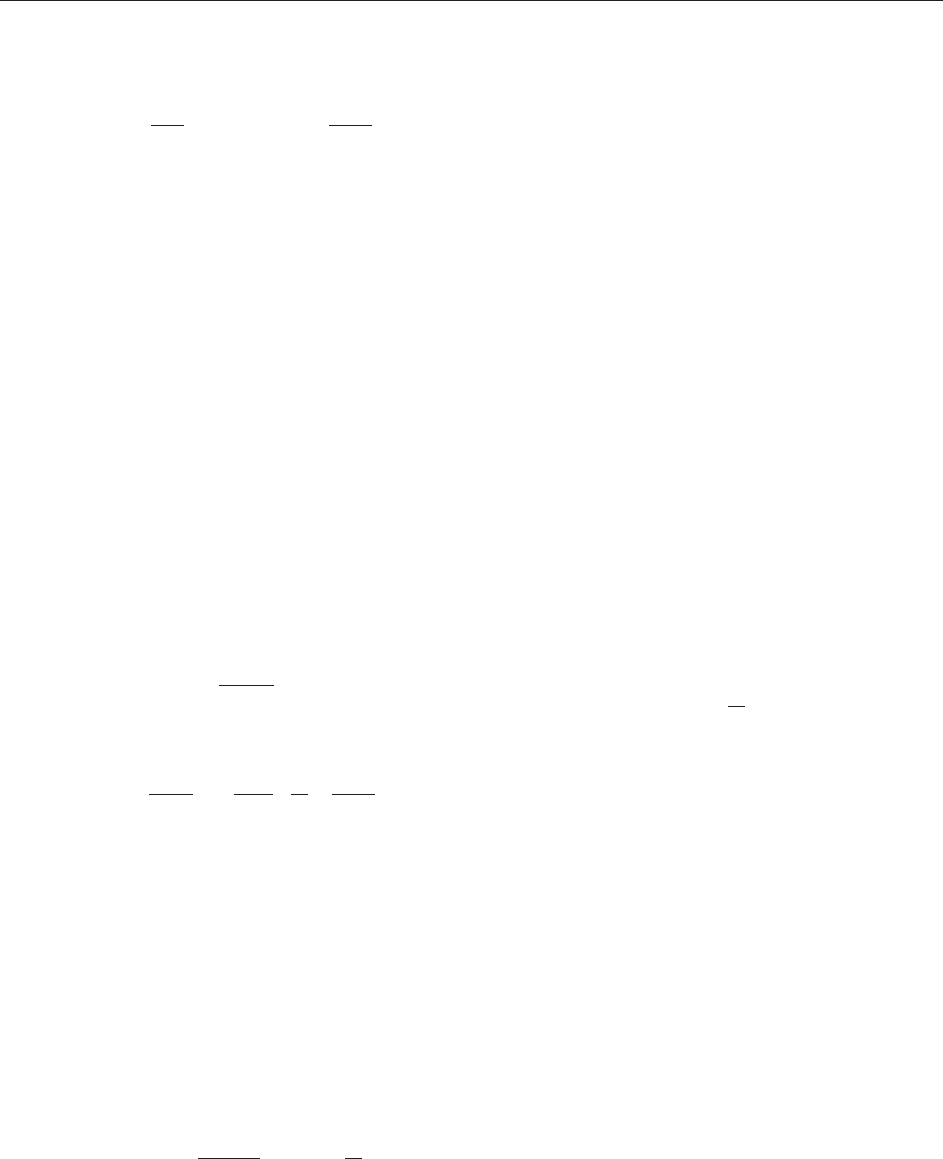
continuous distribution of charge. The densities are
defined as the limits
¼ lim
V!0
P
e
V
; J ¼ lim
V!0
P
ev
V
½12
where V is a small volume containing the point, e is
a charge within the volume, and v is its veloc ity; the
sums are over the charge s in V and the limits are
taken as the volume is shrunk (although we shall not
worry too much about the precise details of the
limiting process).
Stationary Distributions of Charge
We begin the task of converting the basic principles
into partial differential equations by looking at the
electric field of a stationary distribution of charge,
where the passage to the continuous limit is made by
using the Gauss theorem to restate the inverse-
square law.
The Gauss theorem relates the integral of the
electric field over a closed surface to the total charge
contained within it. For a point charge, the electric
field is given by EM2:
E ¼
er
4
0
r
3
Since div r = 3 and grad r = r=r,wehave
divðEÞ¼div
er
0
r
3
¼
e
4
0
3
r
3
3r r
r
5
¼ 0
everywhere except at r = 0. Therefore, by the
divergence theorem,
Z
@V
E dS ¼ 0 ½13
for any closed surface @V bounding a volume V that
does not contain the charge.
What if the volume does contain the charge?
Consider the region bounded by the sphere S
R
of
radius R centered on the charge; S
R
has outward
unit normal r=r. Therefore,
Z
S
R
E dS ¼
e
4R
2
0
Z
S
R
dS ¼
e
0
In particular, the value of the surface integral on the
left-hand side does not depend on R.
Now consider arbitrary finite volume bounded by
a closed surface S. If the charge is not inside
the volume, then the integral of E over S vanishes
by [13]. If it is, then we can apply [13] to the
volume V between S and a small sphere S
R
to
deduce that
Z
S
E dS
Z
S
R
E dS ¼
Z
@V
E dS ¼ 0
and that the integrals of E over S and S
R
are the
same. Therefore,
Z
S
E dS ¼
e=
0
if the charge is in
the volume bounded by S
0 otherwise
(
When we sum over a distribution of charges,
the integral on the left picks out the total charge
within S. Therefore, we have the Gauss theorem.
The Gauss theorem. For any closed surface @V
bounding a volume V,
Z
@V
E dS ¼ Q=
0
where E is the total electric field and Q is the total
charge within V.
Now we can pass to the continuous limit. Suppose
that E is generated by a distribution of charges with
density (charge per unit volume). Then by the
Gauss theorem,
Z
@V
E dS ¼
1
0
Z
V
dV
for any volume V. But then, by the divergence
theorem,
Z
V
ðdiv E =
0
ÞdV ¼ 0
Since this holds for any volume V, it follows that
div E ¼ =
0
½14
By an argument in a similar spirit, we can also
show that the electric field of a stationary distribu-
tion of charge is conservative in the sense that the
total work done by the field when a charge is moved
around a closed loop vanishes; that is,
I
E ds ¼ 0
for any closed path. This is equivalent to
curl E ¼ 0 ½15
since, by Stokes’ theorem,
I
E ds ¼
Z
S
curl E dS
where S is any surface spanning the path. This vanishes
for every path and for every S if and only if [15] holds.
Introductory Article: Electromagnetism 43
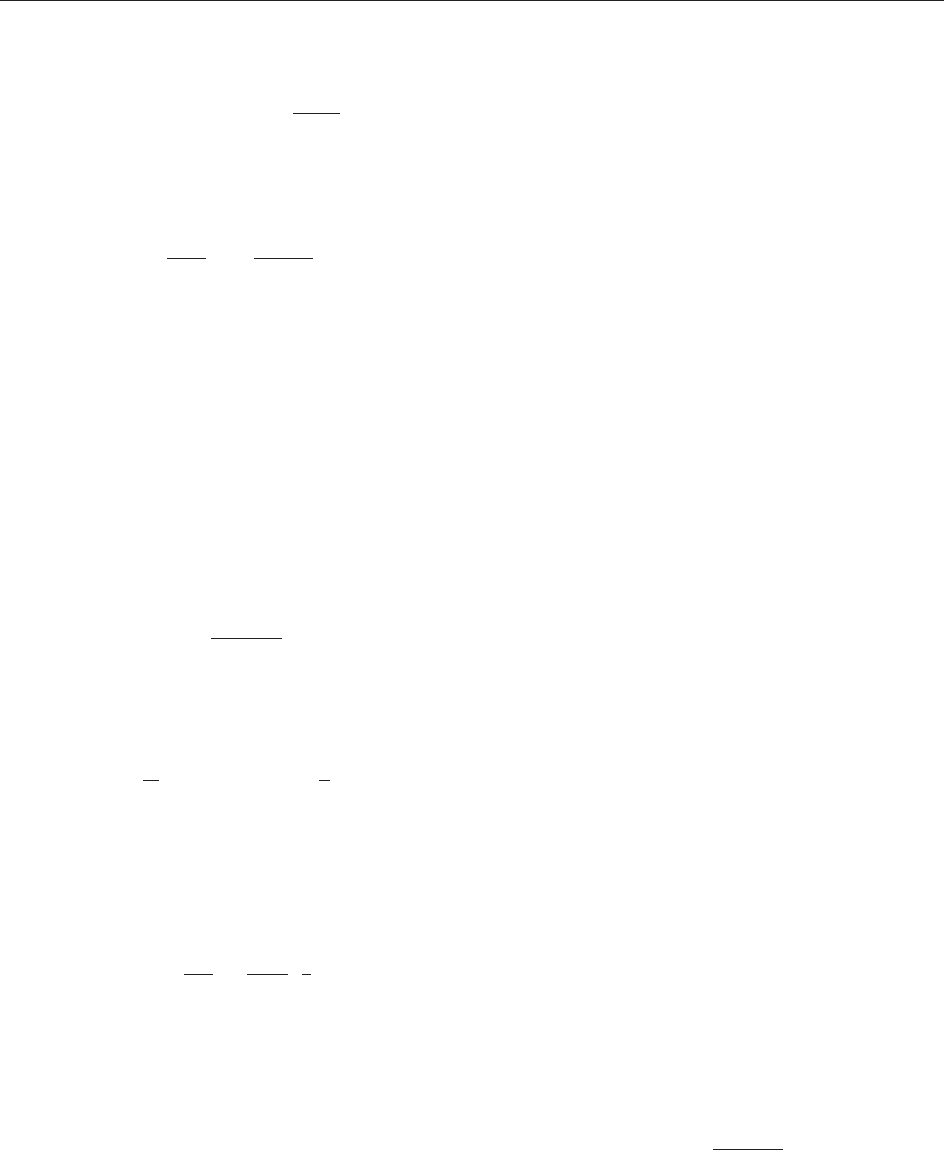
The field of a single stationary charge is con-
servative since
E ¼grad ; ¼
e
4
0
r
and therefore curl E = 0 since the curl of a gradient
vanishes identically. For a continuous distribution,
E = grad , where
ðrÞ¼
1
4
0
Z
r
0
2V
ðr
0
Þ
jr r
0
j
dV
0
½16
In the integral, r (the position of the point at which
is evaluated) is fixed, and the integration is over
the positions r
0
of the individual charges. In spite of
the singularity at r = r
0
, the integral is well defined.
So, [15] also holds for a continuous distribution of
stationary charge.
The Divergence of the Magnetic Field
We can apply the same argument that established
the Gauss theorem to the magne tic field of a slow-
moving charge. Here,
B ¼
0
ev ^ r
4r
3
where r is the vector from the charge to the point at
which the field is measured. Since r=r
3
= grad(1=r),
we have
div v ^
r
r
3
¼ v ^ curl grad
1
r
¼ 0
Therefore, div B = 0 except at r = 0, as in the case of
the electric field. However, in the magnetic case, the
integral of the field over a surface surrounding the
charge also vanishes, since if S
R
is a sphere of radius
R centered on the charge, then
Z
S
R
B dS ¼
0
e
4
Z
S
R
v ^ r
r
3
r
r
dS ¼ 0
By the divergence theorem, the same is true for any
surface surrounding the charge. We deduce that if
magnetic fields are generated only by moving
charges, then
Z
@V
B dS ¼ 0
for any volume V, and hence that
div B ¼ 0 ½17
Of course, if there were free ‘‘magnetic poles’’
generating magnetic fields in the same way that
charges generate electric fields, then this would not
hold; there would be a ‘‘magnetic pole density’’ on
the right-hand side, by analogy with the charge
density in [14].
Inconsistency with Galilean Relativity
Our central concern is the compatibility of the laws
of electromagnetism with the principle of relativity.
As Einstein observed, simple electromagnetic inter-
actions do indeed depend only on relative motion;
the curre nt induced in a conductor moving through
the field of a magnet is the same as that generated in
a stationary conductor when a magnet is moved past
it with the same rel ative velocity (Einstein 1905).
Unfortunately, this symmetry is not reflected in our
basic principles. We very quickly come up against
contradictions if we assume that they hold in every
inertial frame of reference.
One emerges as follows. An observer O can measure
the values of B and E at a point by measuring the force
on a particle of standard charge, which is related to the
velocity v of the charge by the Lorentz-force law,
f ¼ eðE þ v ^ BÞ
A second observer O
0
moving relative to the first with
velocity v will see the same force, but now acting on a
particle at rest. He will therefore measure the electric
field to be E
0
= f =e. We conclude that an observer
moving with velocity v through a magnetic field B and
an electric field E should see an electric field
E
0
¼ E þ v ^ B ½18
By interchanging the roles of the two observers, we
should also have
E ¼ E
0
v ^ B
0
½19
where B
0
is the magnetic field measured by the
second observer. If both are to hold, then B B
0
must be a scalar multiple of v.
But this is incompatible with EM3; if the fields are
those of a point charge at rest relative to the first
observer, then E is given by [7], and
B ¼ 0
On the other hand, the second observer sees the field
of a point charge moving with velocity v.Therefore,
B
0
¼
0
ev ^ r
4r
3
So B B
0
is orthogonal to v, not parallel to it.
This conspicuous paradox is resolved, in part, by
the realization that EM3 is not exact; it holds only
when the velocities are small enough for the
magnetic force between two particles to be negli-
gible in comparison with the electrostatic force. If v
is a typical velocity, then the condition is that v
2
0
44 Introductory Article: Electromagnetism