
Francoise J.-P., Naber G.L., Tsun T.S. (editors) Encyclopedia of Mathematical Physics
Подождите немного. Документ загружается.

(ii) The following observations may clarify the
role of assumptions in the compactness theorem:
(1) a sequence of integral currents (T
j
) with M(T
j
)
uniformly bounded – but not M(@T
j
) – may
converge to any current with finite mass, not
necessarily a rectifiable one.
(2) A sequence of rectifiable currents (T
j
) with
rectifiable boundaries and M(T
j
), M(@T
j
) uniformly
bounded may converge to any normal current,
not necessarily a rectifiable one. Examples of both
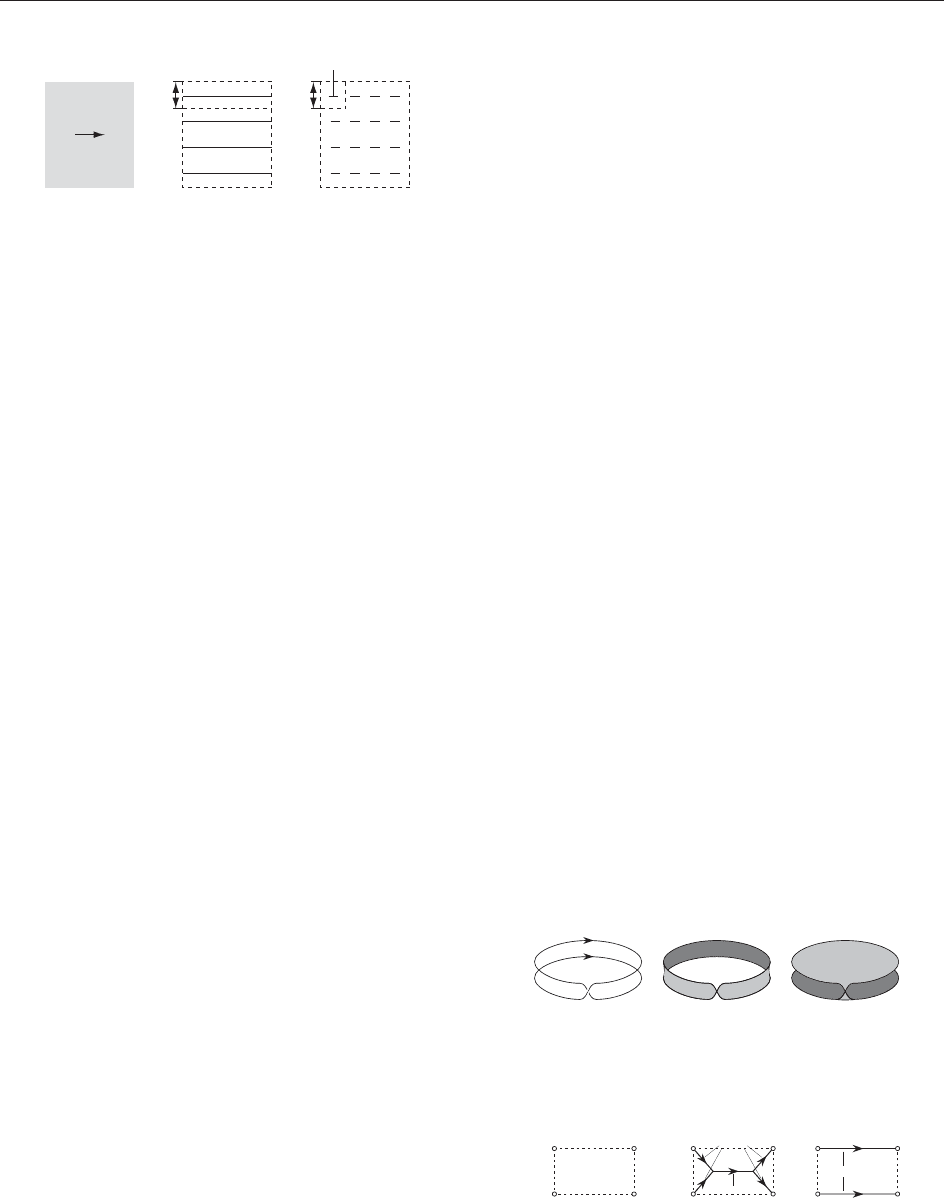
situations are described in Figure 5.
Application to the Plateau Problem
The compactness result for integral currents implies
the existence of currents with minimal mass: if is
the boundary of an integral k-current in R
n
,1 k
n, then there exists a current T of minimal mass
among those that satisfy @T =.
The proof of this existence result is a typical
example of the direct method: let m be the infimum
of M(T) among all integral currents with boundary
, and let (T
j
) be a minimizing sequence (i.e., a
sequence of integral currents with boundary such
that M(T
j
) converges to m). Since M(T
j
) is bounded
and M(@T
j
) = M() is constant, we can apply the
compactness theorem for integral currents and
extract a subsequence of (T
j
) that converges to an
integral current T. By the continuity of the boundary
operator, @T = lim @T
j
=, and by the semiconti-
nuity of the mass M (T) lim M(T
j
) = m (cf. [14]).
Thus, T is the desired minimal current.
Remarks
(i) Every integral (k 1)-current with null
boundary and compact support in R
n
is the boundary
of an integral current, and therefore is an admissible
datum for the previous existence result.
(ii) A mass-minimizing integral current T is more
regular than a general integral current. For k = n 1,
there exists a closed singular set S with dim
H
(S)
k 7suchthatT agrees with a smooth surface in the
complement of S and of the support of the boundary.
In particular, T is smooth away from the boundary
for n 7. For general k, it can only be proved
that dim
H
(S) k 2 Both results are optimal: in
R
4
R
4
, the minimal 7-current with boundary :=
{jxj= jyj= 1} – a product of two 3-spheres – is the
cone T := {jxj= jyj1}, and is singular at the origin.
In R
2
R
2
, the minimal 2-current with boundary
:= {x = 0, jyj= 1} [ {y = 0, jxj= 1} – a union of
two disjoint circles – is the union of the disks
{x = 0, jyj1} [ {y = 0, jxj1}, and is singular at
the origin.
(iii) In certain cases, the mass-minimizing current
T may not agree with the solution of the Plateau
problem suggested by intuiti on. The first reason is
that currents do not include nonorientable surfaces,
which sometimes may be more convenient (Figure 6).
Another reason is that the mass of an integral
current T associated with a k-rectifiable set E does
not agree with the measure H
k
(E) – called size of T
– because multiplicity must be taken into account,
and for certain the mass-minimizing current may
be not size-minimizing (Figure 7). Unfortunately,
proving the existence of size-minimizing currents is
much more complicated, due to lack of suitable
compactness theorems.
(iv) For k = 2, the classical approach to the
Plateau problem consists in parametrizing surfaces
in R
n
by maps f from a given two-dimensional
domain D into R
n
, and looking for minimizers of
the area functional
Z
D
ffiffiffiffiffiffiffiffiffiffiffiffiffiffiffiffiffiffiffiffiffiffiffiffiffi
detðrf
rf Þ
q
e
T
:= e·1
Ω
Ω
T
j
:= [E
j
, e, 1/j]
E
j
1/j
Length
= 1/j
2
1/j
E
j
′
T
j
:= [E
j
, e, 1]
′′
Figure 5 T is the normal 1-current on R
2
associated with the
vectorfield equal to the unit vector e on the unit square , and
equal to 0 outside. T
j
are the rectifiable currents associated with
the sets E
j
(middle) and the constant multiplicity 1=j, and then
M(T
j
) = 1, M(@T
j
) = 2. T
0
j
are the integral currents associated
with the sets E
0
j
(left) and the constant multiplicity 1, and then
M(T
0
j
) = 1, M(@T
0
j
) = 2j
2
. Both (T
j
) and (T
0
j
) converge to T.
–1
–1
+1
+1
Γ T
T
' ′
θ = 2
θ
= 1
θ = 1
′
Figure 7 The boundary is a 0-current associated with four
oriented points. The size (length) of T is smaller than that of T
0
.
However, @T = implies that the multiplicity of T must be 2 on
the central segment and 1 on the others; thus the mass of T is
larger than its size. The size-minimizing current with boundary
is T, while the mass-minimizing one is T
0
:
ΓΣ
Σ′
Figure 6 The surface with minimal area spanning the
(oriented) curve is the Mo
¨
bius strip . However, is not
orientable, and cannot be viewed as a current. The mass-
minimizing current with boundary is
0
:
526 Geometric Measure Theory
(recall the area formula, discussed earlier) under the
constraint f (@D) =. In this framework, the choice
of the domain D prescribes the topological type of
admissible surfaces, and therefore the minimizer
may differ substantially from the mass-minimizing
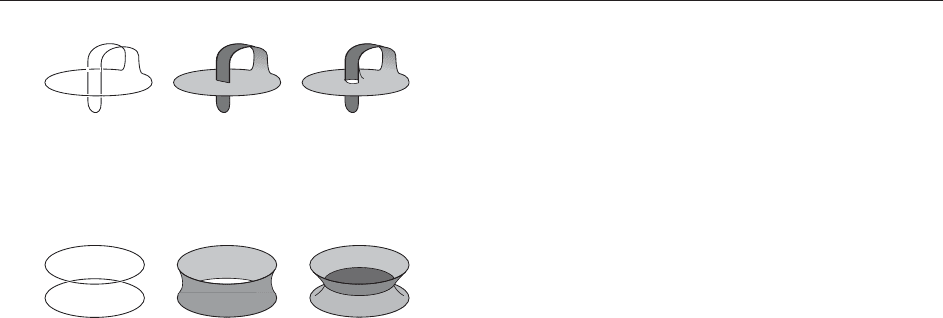
current with boundary (Figure 8).
(v) For some modeling problems, for instance,
those related to soap films and soap bubbles, currents
do not provide the right framework (Figure 9). A
possible alternative are integral varifolds (cf. Almgren
2001). However, it should be pointed out that this
framework does not allow for ‘‘easy’’ application of
the direct method, and the existence of minimal
varifolds is in general quite difficult to prove.
Miscellaneous Results and Useful Tools
(i) An important issue, related to the use of currents
for solving variational problems, concerns the extent
to which integral currents can be approximated by
regular objects. For many reasons, the ‘‘right’’ regular
class to consider are not smooth surfaces, but integral
polyhedral currents, that is, linear combinations with
integral coefficients of oriented simplexes. The follow-
ing approximation theorem holds: for every integral
current T in R
n
there exists a sequence of integral
polyhedral currents (T
j
)suchthat
T
j
! T;@T
j
! @T
MðT
j
Þ!MðTÞ; Mð@T
j
Þ!Mð@TÞ
The proof is based on a quite useful tool, called
polyhedral deformation.
(ii) Many geometric operations for surfaces have an
equivalent for currents. For instance, it is possible to
define the image of a current in R
n
via a smooth proper
map f : R
n
!R
m
. Indeed, with every k-form ! on R
m
is canonically associated a k-form f
#
! on R
n
,called
pullback of ! according to f. The adjoint of the
pullback is an operator, called push-forward, that
takes every k-current T in R
n
into a k-current f
#
T in
R
m
.IfT is the rectifiable current associated with a
rectifiable set E and a multiplicity , the push-forward
f
#
T is the rectifiable current associated with f (E ) – and
a multiplicity
0
(y) which is computed by adding up
with the right sign all (x)withx 2 f
1
(y). As one
might expect, the boundary of the push-forward is the
push-forward of the boundary.
(iii) In genera l, it is not possible to give a meaning
to the intersection of two currents, and not even of
a current and a smooth surface. However, it is
possible to define the intersection of a normal
k-current T and a level surfa ce f
1
(y) of a smooth
map f : R
n
!R
h
(with k h n) for almost every
y, resulting in a current T
y
with the expected
dimension h k. This operation is called slicing.
(iv) When working with currents, a quite useful
notion is that of flat norm:
FðTÞ :¼ inf fMðRÞþMðSÞ: T ¼ R þ @Sg
where T and R are k-currents, and S is a (k þ 1)-
current. The relevance of this notion lies in the fact
that a sequence (T
j
) that converges with respect to
the flat norm converges also in the dual topology,
and the converse holds if the masses M(T
j
) and
M(@T
j
) are unifor mly bounded. Hence, the flat
norm metrizes the dual topology of currents (at
least on sets of currents where the mass and the
mass of the boundary are bounded).
Since F(T) can be explicitly estimated from above, it
can be quite useful in proving that a sequence of
currents converges to a certain limit. Finally, the flat
norm gives a (geometrically significant) measure of how
far apart two currents are: for instance, given the 0-
currents
x
and
y
(the Dirac masses at x and y,
respectively), then F(
x
y
) is exactly the distance
between x and y.
See also: Free Interfaces and Free Discontinuities:
Variational Problems; -Convergence and
Homogenization; Geometric Phases; Image Processing:
Mathematics; Minimal Submanifolds; Mirror Symmetry:
A Geometric Survey; Moduli Spaces: An Introduction.
Further Reading
Almgren FJ Jr. (2001) Plateau’s Problem: An Invitation to
Varifold Geometry, Revised Edition, Student Mathematical
Library, vol. 13. Providence: American Mathematical Society.
Falconer KJ (2003) Fractal Geometry. Mathematical Foundations
and Applications, 2nd edn. Hoboken, NJ: Wiley.
Federer H (1969) Geometric Measure Theory, Grundlehren der
mathematischen Wissenschaften, vol. 153. Berlin: Springer.
(Reprinted in the series Classics in Mathematics. Springer, Berlin,
1996).
ΓΣ
Σ′
Figure 8 The surface minimizes the area among surfaces
parametrized by the disk with boundary . The mass-minimizing
current
0
can only be parametrized by a disk with a handle.
Note that is a singular surface, while
0
is not.
Γ
Σ′
Σ
Figure 9 Two possible soap films spanning the wire : unlike
,
0
cannot be viewed as a current with multiplicity 1 and
boundary .
Geometric Measure Theory 527

Federer H and Fleming WH (1960) Normal and integral currents.
Annals of Mathematics 72: 458–520.
Mattila P (1995) Geometry of Sets and Measures in Euclidean
Spaces, Fractals and Rectifiability, Cambridge Studies in
Advanced Mathematics, vol. 44. Cambridge: Cambridge
University Press.
Morgan F (2000) Geometric Measure Theory. A Beginner’s
Guide, 3rd edn. San Diego: Academic Press.
Simon L (1983) Lectures on Geometric Measure Theory.
Proceedings of the Centre for Mathematical Analysis, 3.
Australian National University, Centre for Mathematical
Analysis, Canberra 1983.
Geometric Phases
PLe´ vay, Budapest University of Technology and
Economics, Budapest, Hungary
ª 2006 Elsevier Ltd. All rights reserved.
Introduction
We invite the reader to perform the following simple
experiment. Put your arm out in front of you keeping
your thumb pointing up perpendicular to your arm.
Move your arm up over your head, then bring it down
to your side, and at last bring the arm back in front of
you again. In this experiment an object (your thumb)
was taken along a closed path traced by another object
(your arm) in a way that a simple local law of transport
was applied. In this case the local law consisted of two
ingredients: (1) preserve the orthogonality of your
thumb with respect to your arm and (2) do not rotate
the thumb about its instantaneous axis (i.e., your arm).
Performing the experiment in this way, you will
manage to avoid rotations of your thumb locally;
however, in the end you will experience a rotation of
90
globally.
The experiment above can be regarded as the
archetypical example of the phenomenon called
anholonomy by physicists and holonomy by math-
ematicians. In this article, we consider the manifes-
tation of this phenomenon in the realm of quantum
theory. The objects to be transported along closed
paths in suitable manifolds will be wave functions
representing quantum systems. After applying local
laws dictated by inputs coming from physics, one
ends up with a new wave function that has picked
up a complex phase factor. Phases of this kind are
called geometric phases, with the famous Berry
phase being a special case.
The Space of Rays
Let us consider a quantum system with physical
states represented by elements j i of some Hilbert
space H with scalar product hji:HH ! C. For
simplicity, we assume that H is finite dimensional,
H’C
nþ1
with n 1. The infinite-dimensional case
can be studied by taking the inductive limit n !1.
Let us denote the complex amplitudes characterizing
the state j i by Z
, = 0, 1, ..., n. For a normalized
state,
k k
2
¼h j i
Z
Z
Z
Z
¼ 1 ½1
where summation over repeated indices is understood,
indices raised and lowered by
and
,respectively,
and the overbar refers to complex conjugation. A
normalized state lies on the unit sphere S’S
2nþ1
in
C
nþ1
. Two nonzero states j i and j’i are equivalent,
j ij’i, iff they are related as j i= j’i for some
nonzero complex number . For equivalent states,
physically meaningful quantities such as
h jAj i
h j i
;
jh j’ij
2
k k
2
k’k
2
½2
(mean value of a physical quantity represented by a
Hermitian operator A, transition probability from a
physical state represented by j i to one represented
by j ’i) are invariant. Hence, the real space of states
representing the physical states of a quantum system
unambiguously is the set of equivalence classes P
H= . P is called the ‘‘space of rays.’’ For H’C
nþ1
,
we have P’CP
n
, where CP
n
is the n-dimensional
complex projective space. For normalized states, j i
and j’i are equivalent iff j i= j’i, where jj= 1,
that is, 2 U(1). Thus, two normalized states are
equivalent iff they differ merely in a complex phase.
It is well known that S can be regarded as the total
space of a principal bundle over P with structure
group U(1). This means that we have the projection
: j i2SH!j ih j2P ½3
where the rank-1 projector j ih j represents the
equivalence class of j i. Since we will use this bundle
frequently in this article, we call it
1
(the meaning of
the subscript 1 will be clarified later). Then, we have
1
: Uð1Þ,!S!
P½4
For Z
0
6¼ 0 the space of rays P can be given local
coordinates
w
j
Z
j
=Z
0
; j ¼ 1; ...; n ½5
528 Geometric Phases

The w
j
are inhomogeneous coordinates for CP
n
on
the coordinate patch U
0
defined by the con dition
Z
0
6¼ 0.
P is a compact complex manifold with a natural
Riemannian metric g. This metric g is induced from
the scalar product on H. Let us consider the
construction of g by using the physical input
provided by the invariance of the transition prob-
ability of [1]. For this we define a distance between
j ih j and j’ih’j in P as follows:
cos
2
ðð ;’Þ=2Þ
jh j’ij
2
k k
2
k’k
2
½6
This definition makes sense since, due to the
Cauchy–Schwartz inequality, the right-hand side of
[6] is non-negative and 1. It is equal to 1 iff j i is
a nonzero complex multiple of j’i, that is, iff they
define the same point in P. Hence in this case,
( , ’) = 0 as expected.
Suppose now that j i and j’i are separa ted by an
infinitesimal distance ds ( , ’). Putting this into
the definition [6], using the local coordinates w
j
of
[5] for j i and w
j
þ dw
j
for j’i after expanding both
sides using Taylor series, one gets
ds
2
¼ 4g
j
k
dw
j
dw
k
; j;
k ¼ 1; 2; ...; n ½7
where
g
j
k
ð1 þ
w
l
w
l
Þ
jk
w
j
w
k
ð1 þ
w
m
w
m
Þ
2
½8
with dw
k
d
w
k
. The line element [7] defines the
Fubini–Study metric for P.
The Pancharatnam Connection
Having defined the basic entity, the space of rays P,
and the principal U(1) bundle
1
, now we define a
connection giving rise to a local law of parallel
transport. This approach gives rise to a very general
definition of the geometric phase. In the math ema-
tical literature, the connection defined below is
called the ‘‘canonical connection’’ on the principal
bundle. However, since the motivation is coming
from physics, we are going to rediscover this
construction using merely physical information
provided by quantum theory alone.
The information needed is an adaptation of Pan-
charatnam’s study of polarized light to quantum
mechanics. Let us consider two normalized states j i
and j’i. When these states belong to the same ray, then
we have j i= e
i
j’i for some phase factor e
i
; hence,
the phase difference between them can be defined to be
just . How to define the phase difference between j i
and j’i (not orthogonal) when these states belong to
different rays? To compare the phases of
nonorthogonal states belonging to different rays,
Pancharatnam employed the following simple rule:
two states are ‘‘in phase’’ iff their interference is
maximal. In order to find the state j’ie
i
j’
0
i from
the ray spanned by the representative j’
0
i which is ‘‘in
phase’’ with j i,wehavetofinda modulo 2 for
which the interference term in
jj þ e
i
’
0
jj
2
¼ 2ð1 þ Reðe
i
h j’
0
iÞÞ ½9
is maximal. Obviously the interference is maxi mal
iff e
i
h j’
0
i is a real positive number, that is,
e
i
¼
h’
0
j i
jh’
0
j ij
; j’i¼j’
0
i
h’
0
j i
jh’
0
j ij
½10
Hence for the state j’i ‘‘in phase’’ with j i, one has
h j’i¼jh j’
0
ij 2 R
þ
½11
When such j i and j’ij þ d i are infinitesi-
mally separated, from [11] it follows that
Imh jd i¼
1
2i
Z
dZ
d
Z
Z
¼ 0 ½12
where
Z
Z
=
Z
0
Z
0
(1 þ
w
j
w
j
) = 1 due to normal-
ization. Writing Z
0
jZ
0
je
i
using [5], one obtains
Imh jd i¼d þ A ¼ 0; A Im
w
j
dw
j
1 þ
w
k
w
k
½13
In order to clarify the meaning of the 1-form A,
notice that the choice
j
0
i
1
ffiffiffiffiffiffiffiffiffiffiffiffiffiffiffiffiffiffiffiffiffi
1 þ
w
k
w
k
p
1
w
j
½14
defines a local section of the bundle
1
. In terms of
this section, the state j i can be expressed as
j i¼
Z
0
Z
j
¼jZ
0
je
i
1
w
j
¼ e
i
j
0
i½15
For a path w
j
(t) lying entirely in U
0
P,
j (t)i= e
i(t)
j
0
(t) i defines a path in S with a
(t) satisfying the equation
˙
þ A = 0. For a closed
path C, the equation above defines a (generically)
open path projecting onto C by the projection .
It must be clear by now that the process described is
the one of parallel transports with respect to a
connection with a connection 1-form !. The pull-
back of ! with respect to the local section in [14] is
the 1-form (U(1) gauge field) A in [13]. The curve
corresponding to j (t)i is the horizontal lift of C in
P. The U(1) phase
e
i½C
e
i
H
C
A
½16
Geometric Phases 529

is the holonomy of the connection. We call this
connection the ‘‘Pancharatnam connection,’’ and its
holonomy for a closed path in the space of rays is
the geometric phase acquired by the wave function.
Now the question of fundamental importance is:
how to realize closed paths in P physically? This
question is addressed in the following sections.
Quantum Jumps
We have seen that physical states of a quantum
system are represented by the space of rays P and
normalized states used as representatives for
such states form the total space S of a principal
U(1) bundle
1
over P. Moreover, in the previous
section we have realized that the physical
notions of transition probability, and quantum
interference naturally lead t o the introduction of a
Riemannian metric g and an abelian U(1) gauge
field A living on P.
An interesting result based on the connection
between g and A concerns a nice geometric descrip-
tion of a special type of quantum evolution consist-
ing of a sequence of ‘‘quantum jumps.’’
Consider two nonorthogonal rays jAihAj and
jBihBj in P. Le t us suppose that the system’s
normalized wave function initially is jAi2S, and
measure by the ‘‘polarizer’’ jBihBj. Then the result of
this filtering measurement is jBihBjAi, or after
projecting back to the set of normalized states we
have the ‘‘quantum jump’’
jAi!jBi
hBjAi
jhBjAij
½17
Now we have the following theorem:
Theorem The [17] jump can be recovered by
parallel transporting the normalized state jAi
according to the Pancharatnam connection along
the shortest geodesic (with respect to the [8] metric),
connecting jAihAj and jBihBj in P.
Let us now consider a cyclic series of filtering
measurements with projectors jA
a
ihA
a
j, a = 1, 2, ...,
N þ 1, where jA
1
ihA
1
j= jA
Nþ1
ihA
Nþ1
j. Prepare the
system in the state jA
1
i2S, and then subject it to
the sequence of filtering measurements. Then
according to the theorem, the phase
e
i
¼
hA
1
jA
N
ihA
N
jA
N1
ihA
2
jA
1
i
jhA
1
jA
N
ihA
N
jA
N1
ihA
2
jA
1
ij
½18
picked up by the state is equal to the one obtained
by parallel transporting jA
1
i along a geodesic
polygon consisting of the shorte r arcs connecting
the projectors jA
a
ihA
a
j and jA
aþ1
ihA
aþ1
j with
a = 1, 2, ..., N. It is important to realize that this
filtering measurement process is not a unitary one;
hence, unitarity is not essential for the geometric
phase to appear.
In this section we have managed to obtain closed
paths in the form of geodesic polygons in P via the
physical process of subjecting the initial stat e jA
1
i to
a sequence of filtering measurements. It is clear that
for any type of evolution, the geodesics of the
Fubini-study metric play a fundamental role since
any smooth closed curve in P can be approximated
by geodesic polygons.
Nonunitary evolution provided by the quantum
measuring process is only half of the story. In the
next section, we start describing closed paths in P
arising also from unitary evolutions generated by
parameter-dependent Hamiltonians, the original
context where geometric phases were discovered.
Unitary Evolutions
Adiabatic Evolution
Suppose that the evolution of our quantum system
with H’C
nþ1
is generated by a Hermitian Hamil-
tonian matrix depending on a set of external
parameters x
, = 1, 2, ..., M. Here we assume
that the x
are local coordinates on some coordinate
patch V of a smooth M-dimensional manifold M.
We lable the eigenvalues of H(x) by the numbers
r = 0, 1, 2, ..., n, and assume that the rth eigenvalue
E
r
(x) is nondegenerate:
HðxÞjr; xi¼E
r
ðxÞjr; xi; r ¼ 0; 1; 2; ...; n ½19
We assume that H(x), E
r
(x), jr, xi are smooth func-
tions of x. The rank-1 spectral projectors
P
r
ðxÞjr; xihr; xj; r ¼ 0; 1; 2; ...; n ½20
for each r define a map f
r
: M!P:
f
r
: x 2VM7!P
r
ðxÞ2P ½21
Recall now that we have the bundle
1
over P,at
our disposal, and we can pull back
1
using the map
f
r
to construct a new bundle
r
1
over the parameter
space M. Moreover, we can define a connection on
r
1
by pulling back the canonical (Pancharatnam)
connection of
1
. The resulting bundle
r
1
is called
the Berry–Simon bundle over the parameter space
M. Explicitly,
r
1
: Uð1Þ,!
r
1
!
M½22
The states jr, xi of [19] define a local section of
r
1
.
Supressing the index r, the relationship between
1
530 Geometric Phases

and
1
can be summarized by t he following
diagram:
1
f
1
#
#
M
!
f
P
½23
Here f
denotes the pullback map, and we have
1
f
(
1
). (We have denoted the total space S as
1
.)
The local section of
1
arising as the pullback of
[14] an
1
is given by
jr; xi¼
1
ffiffiffiffiffiffiffiffiffiffiffiffiffiffiffiffiffiffiffiffiffiffiffiffiffiffiffiffiffiffiffiffiffi
1 þ
w
k
ðxÞw
k
ðxÞ
p
1
w
j
ðxÞ
;
x 2VM ½24
with j = 1, 2, ..., n. The pullback of the Panchar-
atnam connection ! on
1
is f
(!). We can further
pull back f
(!)toVMwith respect to the local
section of [24] to obtain a gauge field living on the
parameter space. This gauge field is called the
‘‘Berry gauge field’’ and the corresponding connec-
tion is the Berry connection. Thus,
A¼f
ðAÞ¼A
ðxÞdx
¼ðA
j
@
w
j
þA
j
@
w
j
Þdx
½25
here @
@=@x
and A is given by [13]. When we
have a closed curve C in M, then f C defines a
closed curve C in P. We already know that the
holonomy for C in P can be written in the [16]
form; hence,
B
¼
I
f C
A ¼
I
C
f
ðAÞ¼
I
C
A½26
This formula stat es that there is a geometric phase
picked up by the eigenstates of a parameter-
dependent Hermitian Hamiltonian when we change
the parameters along a closed curve. Our formula
shows that the geometric phase can be calculated
using either the canonical connection on
1
or the
Berry connection on
1
.
Let us then change the parameters x
adiabati-
cally. The closed path in parameter space then
defines Hamiltonians satisfying H(x(T)) = H(x(0))
for some T 2 R
þ
. Moreover, there is also the
associated closed curve P
r
(x(T)) = P
r
(x(0)) in P.
The quantum adiabatic theorem states that if we
prepare a state j(0)ijr, x(0)i at t = 0, which is an
eigenstate of the instantaneous Hamiltonian
H(x(0)), then after changing the parameters
infinitely slowly, the time evolution generated by
the time-dependent Schro¨ dinger equation
ih
d
dt
jðtÞi ¼ HðtÞjðtÞi ½27
takes the form
jðtÞi ¼ jr; xðtÞie
i
r
ðtÞ
½28
after time t, which belongs to the same eigensub-
space. The point is that the theorem holds only for
cases when the kinetic energy associated with the
slow change in the external parameters is much
smaller than the energy separation between E
r
(x)
and E
r
0
(x) for all x 2M. Under this assumption,
transitions between adjacent levels are prohibited
during evolution. Notice that the adiabatic theorem
clearly breaks down in the vicinity of level crossings
where the gap is comparable with the magnitude of
the kinetic energy of the external pa rameters.
However, if one takes it for granted that the
projector P
r
(t) P
r
(x(t)) for some r satisf ies the
Schro¨ dinger–von Neumann equation
ih
d
dt
P
r
ðtÞ¼½HðtÞ; P
r
ðtÞ ½29
by virtue of [19] , we get zero for the right-hand side.
This means that P
r
(t) is constant; hence, the curve in
P degenerates to a point. The upshot of this is that
exact adiabatic cyclic evolutions do not exist. It can
be shown, however, that under certain conditions
one can find an initial state j(0)i 6¼jr, x(0)i that is
‘‘close enough’’ to P
r
(x(t)) = jr, x(t)ihr, x(t)j. Then,
we can say that the projector analog of [28] only
approximately holds
jðtÞihðtÞj ’ jr; xðtÞihr; xðtÞj ½30
This means that the use of the bundle picture for
the generation of closed curves for P via the
adiabatic evolution can merely be used as an
approximation.
Berry’s Phase
The straightforward calculation after substituting
[28] into [27] shows that
expði
r
ðTÞÞexp
i
h
Z
T
0
E
r
ðtÞdt
exp i
I
C
A
ðrÞ
½31
where C is a closed curve lying entirely in VM.
The first phase factor is the dynamical and the
second is the celebrated Berry phase. Notice that the
index r labeling the eigensubspace in question
Geometric Phases 531

should now be included in the definition of A
(see eqn [25]).
As an explicit example, let us take the Hamiltonian
HðXðtÞÞ ¼ !
0
JXðtÞ;!
0
Bge
2mc
;
X 2 R
3
; jXj¼1 ½32
where e, m, and g are the charge, mass, and Lande´
factor of a particle, c is the speed of light, and B is
the (constant) magnitude of an applied magnetic
field. The three components of J are
(2J þ 1) (2J þ 1)-dimensional spin matrices satis-
fying J J = ihJ. The Hamiltonian (eqn [32])
describes a spin J particle moving in a magnetic
field with slowly varying direction. It is obvious that
the parameter space is a 2-sphere. Introducing polar
coordinates 0 <,0 <2 for the patch V
of S
2
excluding the south pole, we have
x
1
, x
2
.
As an illustration, let us consider the spin 1/2 case.
Then H can be expressed in terms of the 2 2 Pauli
matrices. The eigenvalues are E
0
= !
0
h=2 and
E
1
= !
0
h=2(r = 0, 1). For the ground state, the
mapping f
0
of [21] from VM’S
2
to P’CP
1
is
given by
wð; Þtan
2
e
i
½33
which is stereographic projection of S
2
from the
south pole onto the complex plane corresponding to
the coordinate patch U
0
CP
1
. Using [13] an d [25],
one can calculate the pullback gauge field and its
curvature F
(0)
dA
(0)
, where
A
ð0Þ
¼
1
2
ð1 cos Þd; F
ð0Þ
¼
1
2
sin d ^d ½34
Notice that F
(0)
is the field strength of a magnetic
monopole of strength 1/2 living on M. Using Stokes
theorem, from [26] one can calculate Berry’s phase
ð0Þ
½C ¼
I
C
A
ð0Þ
¼
Z
S
F
ð0Þ
¼
1
2
½C ½35
where S is the surface bounded by the loop C and [C]is
the solid angle subtended by the curve C at X = 0.
The above result can be generalized for arbitrary spin
J. Then, we have the eigenvalues E
r
= !
0
h( J r),
where 0 r 2J. The final result in this case is
ðrÞ
½C ¼ ðJ rÞ½C; 0 r 2J ½36
The Aharonov–Anandan Phase
We have seen that the quantum adiabatic theorem
can only be used approximately for generating
closed curves in P. This section, describes as to
how such curves can be generated exactly.
Let us consider the Schro¨ dinger equation with a
time-dependent Hamiltonian (eqn [27]). Then we
call its solution j(t)i cyclic if the state of the system
returns, after a period T, to its original state. This
means that the projector j(t)ih(t)j trave rses a
closed path C in P. In order to realize this situation,
we have to find solutions of [27] for which
j(T)i= e
i
j(0)i for some
.
Taking for granted the existence of such a solution, let
us first explore its consequences. First, we remove the
dynamical phase from the cyclic solution j(t)i
j ðtÞi exp
i
h
Z
t
0
hðt
0
ÞjHðtÞjðt
0
Þidt
0
jðtÞi ½37
Then, j (t)i satisfies [12], that is, it defines a unique
horizontal lift of the closed curve C in P. Following
the same steps as in section describing the Panchar-
atnam condition, we see that the phase
AA
½C¼
I
C
A
¼
þ
1
h
Z
T
0
hðtÞjHðtÞjðtÞidt ½38
is purely geometric in origin. It is called the
Aharonov–Anandan (AA) pha se.
Let us now turn back to the question of finding
cyclic states satisfying j(T)i= e
i
j(0)i. One
possible solution is as follows. Suppose that H
depends on time through some not necessarily
slowly changing parameters x. Let us find a partner
Hamiltonian h for our H by defining a smooth
mapping : M!M, such that
hðxÞHððxÞÞ; x 2VM ½39
For the special class we study here, the cyclic vectors
are eigenvectors of h(x). Hence, the projectors p
r
and P
r
of h and H are related as p
r
(x) = P
r
((x)); this
means that we have a map g
r
: M!P,
g
r
f
r
: x 2VM!p
r
ðxÞ2P ½40
which associates with every x an eigenstate of h(x).
Moreover, g
r
associates with a closed curve C in M
a closed curve C in P. Notice that generically
[h(x), H(x)] 6¼ 0; hence, cyclic states are not eigen-
states of the instanteneous Ham iltonian.
It should be clear by now that we can repeat the
construction as discussed in the adiabatic case with
g
r
replacing f
r
. In particular, we can construct a new
bundle
1
over the parameter space via the usual
532 Geometric Phases

pullback procedure. More precisely, we have the
corresponding diagram
1
g
1
#
#
M
!
g
P
½41
The AA connection can be obtained by pulling back
the Pancharatnam connection:
a g
ðAÞ¼
f
ðAÞ¼
ðAÞ ½42
where the last equality relates the AA connection
with the Berry connection. Now the AA phase is
AA
¼
I
gC
A ¼
I
C
g
ðAÞ¼
I
C
a ½43
As an example, let us take the Hamiltonian [32]
with the curve C on MS
2
:
XðtÞ¼ðsin cosð þ!tÞ;sin sinð þ!tÞ;cosÞ½44
Here and are the polar coordinates of a fixed point
in S
2
where the motion starts. The curve C is a circle of
fixed latitude and is traversed with an arbitrary speed.
This model can be solved exactly and it can be shown
that the mapping
s
:S
2
! S
2
is given by
: ðu;Þ7!
u s
ffiffiffiffiffiffiffiffiffiffiffiffiffiffiffiffiffiffiffiffiffiffiffiffiffiffi
s
2
2us þ 1
p
;
;
u cos ; s
!
!
0
½45
One can prove that for 0 s < 1,
s
is a diffeo-
morphism. In the s ! 0 (the adiabatic) limit, the
mapping g
r,s
f
r,s
s
is continuously deformed to
f
r
. Moreover, h(x) as defined above commutes with
the time evolution operator; hence, cyclic states are
indeed eigenstates of h(x).
Using [42], [43], and [45], the explicit form of
s
,
we get for the AA phase
ðr;sÞ
AA
½C ¼ 2ðJ rÞ 1
u s
ffiffiffiffiffiffiffiffiffiffiffiffiffiffiffiffiffiffiffiffiffiffiffiffiffiffi
s
2
2us þ 1
p
½46
In the adiabatic limit, the result goes to 2(J r)
(1 u) which is just (J r) times the solid angle of
the path of fixed latitude, as it has to be.
Generalization
In the sequence of examples, we have shown that
geometric phases are related to the geometric struc-
tures on the bundle
1
. The Berry and AA phases are
special cases arising from Pancharatnam’s phase via a
pullback procedure with respect to suitable maps
defined by the physical situation in question. Hence,
the Pancharatnam connection in this sense is universal.
The root of this universality rests in a deep theorem of
mathematics concerning the existence of universal
bundles and their universal connections. In order to
elaborate the insight provided by this theorem into the
geometry of quantum evolution, let us first make a
further generalization.
In our study of time-dependent Hamiltonians we
have assumed that the eigenvalues of [19] were
nondegenerate. Let us now relax this assumption. Fix
an integer N 1, the degeneracy of the eigensubspace
corresponding to the eigenvalue E
r
. One can then form
aU(N) principal bundle
N
over M, furnished with a
connection, that is a natural generalization of the Berry
connection. The pullback of this connection to a patch
of M is a U(N)-valued gauge field and its holonomy
along a loop in M gives rise to a U(N)matrix
generalization of the U(1) Berry phase.
The natural description of this connection and its AA
analog is as follows. Take the complex Grassmannian
Gr(n þ 1, N)ofN planes in C
nþ1
. Obviously, Gr(n þ
1, 1) P. Each point of Gr(n þ 1, N) corresponds to
an N plane through the origin represented by a rank-N
projector. This projector can be written in terms of N
orthonormal basis vectors in an infinite number of
ways. This ambiguity of choosing orthonormal frames
is captured by the U(N) gauge symmetry, the analog of
the U(1) (phase) ambiguity in defining a normalized
state as the representative of the rank-1 projector. This
bundle of frames is the Stiefel bundle V(n þ 1, N)
alternatively denoted by
N
.V(n þ 1, N) is a principal
U(N) bundle over Gr(n þ 1, N)equippedwitha
canonical connection !
N
which is the U(N)analogof
Pancharatnam’s connection.
Now according to the powerful theorem of Nar-
asimhan and Ramanan if we have a U(N) bundle
N
over the M-dimensional parameter space M,then
there exists an integer n
0
(N, M) such that for n n
0
there exists a map f : M!Gr(n þ 1, N)suchthat
N
= f
(V(n þ 1, N)). Moreover, given any two such
maps f and g, the corresponding pullback bundles are
isomorphic if and only if f is homotopic to g.
For the exampl es of the sect ions ‘‘Berry’ s pha se’’
and ‘‘The Ahar onov –Ananda n pha se,’’ we have
N = 1, n = 1, and M = 2. Since the maps f
r
and g
r,s
defined by the ran k-1 spectral projectors of H(x)
and h(x) for 0 s < 1 are homotopic, the corre-
sponding pullback bundles
1
and
1
are isom orphic.
Moreover, the Berry and AA connections are the
pullbacks of the universal connection on V(n þ
1, 1)
1
which is just Pancharatnam’s connection.
For the infinite-dimensional case, one can define
Gr(1, N) by taking the union of the natural
inclusion maps of Gr(n, N) into Gr(n þ 1, N).
Geometric Phases 533

We denote this universal classifying bundle V(1, N)
as . Then, we see that given an N-dimensional
eigensubspace bundle over M and a map f
r
: x 2
M7!P
r
(x) 2 Gr(1, N) defined by the physical
situation, the geometry of evolving eigensubspaces
can be unde rstood in terms of the holonomy of the
pullback of the universal connection on .
Conclusions
In this article, we elucidate the mathematical origin of
geometric phases. We have seen that the key observa-
tion is the fact that the space of rays P represents
unambiguously the physical states of a quantum
system. The particular representatives of a class in P
belonging to the usual Hilbert space H form (local)
sections of a U(1) bundle
1
. Based on the physical
notions of transition probability and interference,
1
can be furnished with extra structures: the metric and
the connection, the latter giving rise to a natural
definition of parallel transport. We have seen that the
geodesics of P with respect to the metric play a
fundamental role in approximating evolutions of any
kind, giving rise to a curve in P.
The geometric structures of
1
induce similar
structures for pullback bundles. These bundles encap-
sulate the geometric details of time evolutions gener-
ated by Hamiltonians that depend on a set of
parameters x belonging to a manifold M.Itwas
shown that the famous examples of Berry and AA
phases arise as an important special case in this
formalism. A generalization of evolving N-dimen-
sional subspaces based on the theory of universal
connections can also be given. This shows that the
basic structure responsible for the occurrence of
anholonomy effects in evolving quantum systems is
the universal bundle which is the bundle of subspaces
of arbitrary dimension N in a Hilbert space.
The important issue of applying the idea of
anholonomy to physical problems has not been
dealt with in this article. There are spectacular
applications such as holonomic quantum computa-
tion, the gauge kinematics of deformable bodies,
quantum Hall-effect, fractional spin and statistics.
The interested reader should consult the vast
literature on the subject or as a first glance, the
book of Shapere and Wilczek (1989).
See also: Fractional Quantum Hall Effect; Geometric
Measure Theory; Holomorphic Dynamics; Moduli
Spaces: An Introduction.
Further Reading
Aharonov Y and Anandan J (1987) Phase change during a cyclic
evolution. Physical Review Letters 58: 1593–1596.
Benedict MG and Fehe´r LGy (1989) Quantum jumps, geodesics,
and the topological phase. Physical Review D 39: 3194–3196.
Berry MV (1984) Quantal phase factors accompanying adiabatic
changes. Proceedings of the Royal Society A 392: 45–57.
Berry MV (1987) The adiabatic phase and Pancharatnam’s phase
for polarized light. Journal of Modern Optics 34: 1401–1407.
Bohm A and Mostafazadeh A (1994) The relation between the
Berry and the Anandan–Aharonov connections for UðNÞ
bundles. Journal of Mathematical Physics 35: 1463–1470.
Kobayashi S and Nomizu K (1969) Foundations of Differential
Geometry, vol. 2. Berlin: Springer.
Le´vay P (1990) Geometrical description of SU(2) geometric
phases. Physical Review A 41: 2837–2840.
Narasimhan MS and Ramanan S (1961) Existence of universal
connections. American Journal of Mathematics 83: 563–572.
Pancharatnam S (1956) Generalized theory of interference, and its
applications. The Proceedings of the Indian Academy of
Sciences XLIV. No 5. Sec. A: 247–262.
Samuel J and Bhandari R (1988) General setting for Berry’s phase.
Physical Review Letters 60: 2339–2342.
Shapere A and Wilczek F (eds.) (1989) Geometric Phases in
Physics. Wiley.
Simon B (1983) Holonomy, the quantum adiabatic theorem, and
Berry’s phase. Physical Review Letters 51: 2167–2170.
Wilczek F and Zee A (1984) Appearance of gauge structure in simple
dynamical systems. Physical Review Letters 52: 2111–2114.
Geophysical Dynamics
M B Ziane, University of Southern California,
Los Angeles, CA, USA
ª 2006 Elsevier Ltd. All rights reserved.
Introduction
The equations of geophysical fluid dynamics are the
equations governing the motion of the atmosphere and
the ocean, and are derived from the conservation
equations from physics, namely conservation of mass,
momentum, energy, and some other components such
as salt for the ocean, humidity (or chemical pollutants)
for the atmosphere.
The first assumption used in any circulation
model is the well-accepted Boussinesq approxima-
tion, that is, the density differences are neglected in
the system except in the buoyancy term and in the
equation of state. The resulting system is the so-
called Boussinesq equations (Pedlosky 1987). Due to
the extremely high accuracy of this approximation,
these equations are considered as the basic equations
534 Geophysical Dynamics
in geophysical dynamics. From the computational
point of view, however, the Boussinesq equations
are still not accessible.
Owing to the difference of sizes of the vertical and
horizontal dimensions, both in the atmosphere and in
the ocean (10–20 km versus several thousands of
kilometers), the second approximation is based on the
smallness of the vertical length scales with respect to
the horizontal length scales, that is, oceans (and the
atmosphere) compose very thin layers. The scale
analysis ensures that the dominant forces in the
vertical-momentum equation come from the pressure
gradient and the gravity. This leads to the so-called
hydrostatic approximation, which amounts to repla-
cing the vertical component of the momentum equa-
tion by the hydrostatic balance equation, and hence
leading to the well-accepted primitive equations (PEs)
(Washington and Parkinson 1986). As far as we
know, the primitive equations were first considered
by L F Richardson (1922); when it appeared that
they were still too complicated they were left out
and, instead, attention was focused on even simpler
models, the geostrophic and quasigeostrophic mod-
els, considered in the late 1940s by J von Neumann
and his collaborators, in particular J G Charney.
With the increase of computing power, interest
eventually returned to the PEs, which are now the
core of many global circulation models (GCMs) or
ocean global circulation models (OGCMs), avail-
able at the National Center for Atmospheric
Research (NCAR) and elsewhere. GCMs and
OGCMs are very complex models which contain
many components, but still, the PEs are the central
component for the dynamics of the air or the water.
Further approximations based on the fast rotation
of the Earth implying the smallness of the Rossby
number lead to the quasigeostrophic and goes-
trophic equations (Pedlosky 1987).
The mathematical study of the PEs was initiated by
Lions, Temam, and Wang in the early 1990s. They
produced a mathematical formulation of the PEs
which resembles that of the Navier–Stokes due to
Leray, and obtained the existence, for all time, of weak
solutions (see Lions et al. 1992a, b, 1993, 1995).
Further works conducted during the 1990s have
improved and supplemented these early results bring-
ing the mathematical theory of the PEs to that of the
three-dimensional incompressible Navier–Stokes
equations (Constantin and Foias 1998, Teman 2001).
In summary, the following results are now available
which will be presented in this article:
1. existence of weak solutions for all time;
2. existence of strong solutions in space dimension
three, local in time;
3. existence and uniqueness of a strong solution in
space dimension two, for all time; and
4. uniqueness of weak solutions in space dimension
two.
The PEs of the Ocean
The ocean is made up of a slightly compressible
fluid subject to a Coriolis force. The full set of
equations of the large-scale ocean are the following:
the conservation of momentum equation, the con-
tinuity equation (conservation of mass), the thermo-
dynamics equation, the equation of state and the
equation of diffusion for the salinity S:
dV
3
dt
þ 2 W V
3
þr
3
p þ g ¼ D ½1
d
dt
þ div
3
V
3
¼ 0 ½2
dT
dt
¼ Q
T
½3
dS
dt
¼ Q
S
½4
¼ f ðT; S; pÞ½5
Here V
3
is the three-dimensional velocity vector,
V
3
= (u, v, w), , p, T are respectively, the density,
pressure, and temperature, and S is the concentra-
tion of salinity; g = (0, 0, g) is the gravity vector, D
the molecular dissipation, Q
T
and Q
S
are the heat
and salinity diffusions, respectively.
Remark 1 The equation of state for the oceans is
derived on a phenomenological basis. Only empirical
forms of the function f (T, S, ) are known (see
Washington and Parkinson (1986)). It is natural,
however, to expect that decreases if T increases and
that increases if S increases. The simplest law is
¼
0
ð1
T
ðT T
r
Þþ
S
ðS S
r
ÞÞ ½6
corresponding to a linearization around reference
values
0
, T
r
, S
r
of respectively, the density, tem-
perature, and the salinity,
T
and
S
are positive
expansion coefficients.
The Mach number for the flow in the ocean is not
large and, therefore, as a starting point, we can
make the so-called Boussinesq approximation in
which the density is assumed constant, =
0
,
except in the buoyancy term and in the equation of
state. This amounts to replacing [1], [2] by
0
dV
3
dt
þ 2
0
V
3
þr
3
p þ g ¼ D ½7
div
3
V
3
¼ 0 ½8
Furthermore, since for large-scale ocean, the horizon-
tal scale is much larger than the vertical one, a scale
analysis (Pedolsky 1987) shows that @p=@z and g are
Geophysical Dynamics 535