
Francoise J.-P., Naber G.L., Tsun T.S. (editors) Encyclopedia of Mathematical Physics
Подождите немного. Документ загружается.

gases, and thermodynamic insights underpin much
of our qualitative understanding.
Few-Body Problems
The Two-Body Problem
For N = 2, the relative motion of the two bodies can
be reduced to the force-free motion of the center of
mass and the problem of the relative motion. If
r = r
1
r
2
, then
€
r ¼Gðm
1
þ m
2
Þ
r
jrj
3
½2
often called the Kepler problem. It represents motion
of a particle of unit mass under a central inverse-square
force of attraction. Energy and angular momentum are
constant, and the motion takes place in a plane passing
through the origin. Using plane polar coordinates (r, )
in this plane, the equations for the energy and angular
momentum reduce to
E ¼
1
2
_
r
2
þ
L
2
r
2
Gðm
1
þ m
2
Þ
r
½3
L ¼ r
2
_
½4
(Note that these are not the energy and angular
momentum of the two-body problem, even in the
barycentric frame of the center of mass; E and L must
be multiplied by the reduced mass m
1
m
2
=(m
1
þ m
2
).)
Using eqns [3] and [4], the problem is reduced to
quadratures. The solution shows that the motion is on
a conic section (ellipse, circle, straight line, parabola,
or hyperbola), with the origin at one focus.
This reduction depends on the existence of integrals
of the equations of motion, and these in turn depend
on symmetries of the underlying Lagrangian or
Hamiltonian. Indeed, eqns [1] yield ten first integrals:
six yield the rectilinear motion of the center of mass,
three the total angular momentum, and one the energy.
Furthermore, eqn [2] may be transformed, via the
Kustaanheimo–Stiefel (KS) transformation, to a four-
dimensional simple harmonic oscillator. This reveals
further symmetries, corresponding to further invar-
iants: the three components of the Lenz vector.
Another manifestation of the abundance of symme-
tries of the Kepler problem is the fact that there exist
action-angle variables in which the Hamiltonian
depends only on one action, that is, H = H(L).
Another application of the KS transformation is one
that has practical importance: it removes the singular-
ity of (i.e., regularizes) the Kepler problem at r = 0,
which is troublesome numerically.
To illustrate the character of the KS transforma-
tion, we consi der briefly the planar case, which can
be handled with a complex variable obeying the
equation of motion
€
z = z=jzj
3
(after scaling
eqn (2)). By introducing the Levi-Civita transforma-
tion z = Z
2
and Sundman’s transformation of the
time, that is, dt=d = jzj, the equation of motion
transforms to Z
00
= hZ=2, where h = j
˙
zj
2
=2 1=jzj is
the constant of energy. The KS transformation is a
very similar exercise using quaternions.
The Restricted Three-Body Problem
The simplest three-body problem is given by the
motion of a test particle in the gravitational field of
two particles, of positive mass m
1
, m
2
, in circular
Keplerian motion. This is called the circular
restricted three-body problem, and the two massive
particles are referred to as primaries. In a rotating
frame of reference, with origin at the center of mass
of these two particles, which are at rest at positions
r
1
, r
2
, the equation of motion is
€
r þ 2
_
r þ ð rÞ
¼ Gr
m
1
jr r
1
j
þ
m
2
jr r
2
j
½5
where r is the position of the massless particle and
is the angular velocity of the frame.
This problem has three degrees of freedom but only
one known integral: it is the Hamiltonian in the
rotating frame, and equivalent to the Jacobi integral, J.
One consequence is that Liouville’s theorem is not
applicable, and more elaborate arguments are required
to decide its integrability. Certainly, no general
analytical solution is known.
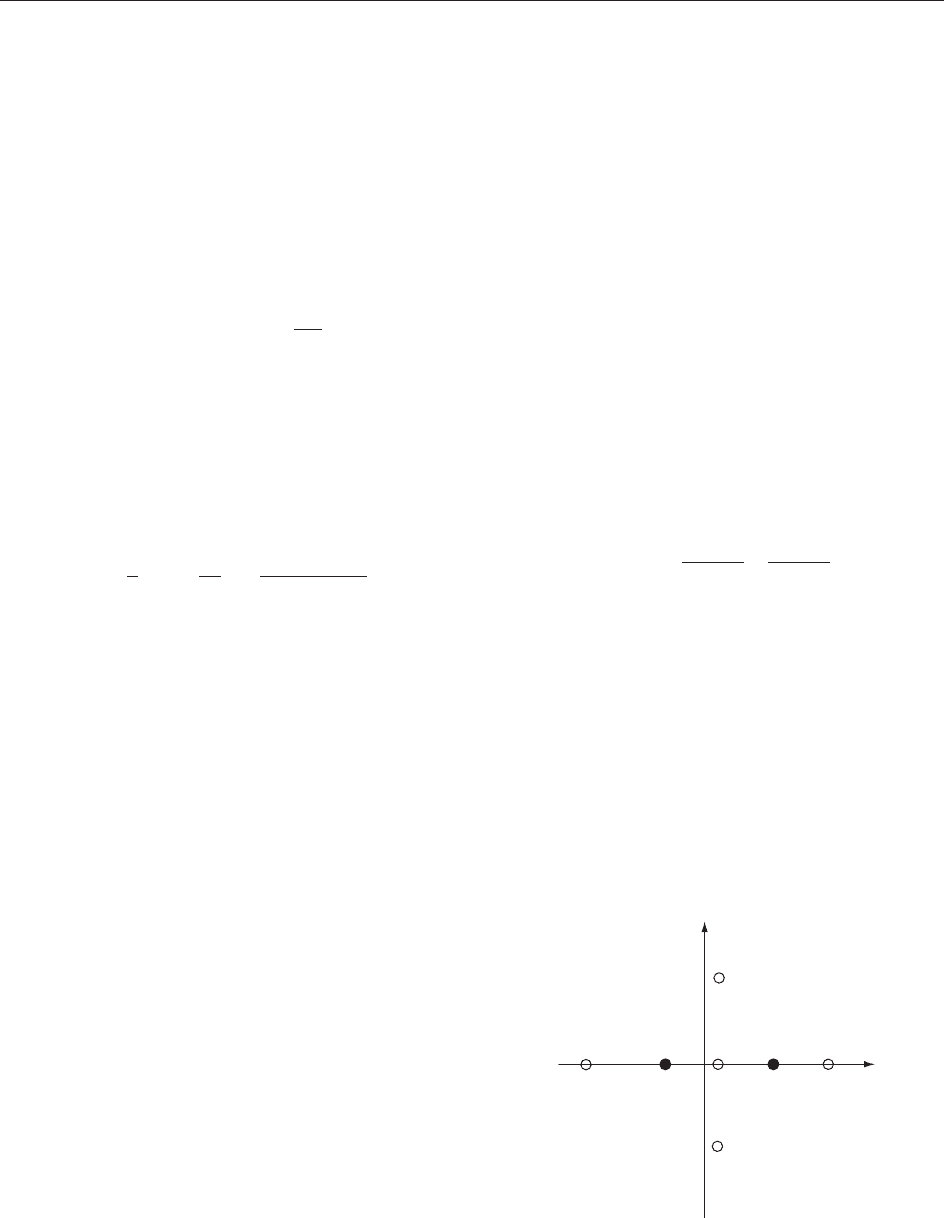
There are five equilibrium solutions, discovered
by Euler and Lagrange (see Figure 1). They lie at
critical points of the effective potential in the
L
1
L
3
L
3
L
4
L
2
Figure 1 The equilibrium solutions of the circular restricted
three-body problem. A rotating frame of reference is chosen in
which two particles are at rest on the x-axis. The massless
particle is at equilibrium at each of the five points shown. Five
similar configurations exist for the general three-body problem;
these are the ‘‘central’’ configurations.
576 Gravitational N-Body Problem (Classical)
rotating frame, and demarcate possible regions of
motion.
Throughout the twentieth century, much numerical
effort was used in finding and classifying periodic
orbits, and in determining their stability and bifurca-
tions. For example, there are families of periodic orbits
close to each primary; these are perturbed Kepler
orbits, and are referred to as satellite motions. Other
important families are the series of Liapounov orbits
starting at the equilibrium points.
Some variants of the restricted three-body pro-
blem include the following:
1. The elliptic restricted three-body problem, in
which the primaries move on an elliptic Kepler-
ian orbit; in suitable coordinates the equation of
motion closely resembles eqn [5], except for a
factor on the right side which depends explicitly
on the independent variable (transformed time);
this system has no first integral.
2. Sitnikov’s pr oblem, which is a special case of the
elliptic problem, in which m
1
= m
2
, and the
motion of the massless particle is confined to
the axis of symmetry of the Keplerian motion;
this is still nonintegrable, but simple enough to
allow extensive analysis of such fundamental
issues as integrability and stochasticity.
3. Hill’s problem, which is a scaled version suitable
for examining motions close to one primary; its
importance in applications began with studies of
the motion of the moon, and it remains vital for
understanding the motion of asteroids.
The General Three-Body Problem
Exact solutions When all three particles have
nonzero masses, the equations of motion become
m
i
€
r
i
¼r
i
W
where the potential energy is
W ¼G
X
1 i < j 3
m
i
m
j
jr
i
r
j
j
Then the exact solutions of Euler and Lagrange
survive in the form of homographic solutions. In
these solutions, the configuration remains geometri-
cally similar, but may rotate and/or pulsate in the
same way as in the two-body problem.
Let us repre sent the position vector r
i
in the
planar three-body problem by the complex number
z
i
. Then, it is easy to see that we have a solution of
the form z
i
(t) = z(t)z
0i
, provided that
€
z ¼C
z
jzj
3
and
m
i
Cz
0i
¼r
i
Wðz
01
; z
02
; z
03
Þ
for some constant C. Thus, z(t) may take the form of
any solution of the Kepler problem, while the
complex numbers z
0i
must correspond to what is
called a central configuration. These are in fact
critical points of the scale-free function W
ffiffi
I
p
, where
I (the ‘‘moment of inertia of the system’’) is given by
I =
P
3
1
m
i
r
2
i
; and C = W=I.
The existence of other important classes of
periodic solutions can be proved analytically, even
though it is not possible to express the solution in
closed form. Examples include hierarchical three-
body systems, in which two masses m
1
, m
2
exhibit
nearly elliptic relative motion, while a third mass
orbits the barycenter of m
1
and m
2
in another nearly
elliptic orbit. In the mathematical literature, this is
referred to as motion of elliptic–elliptic type. More
surprisingly, the existence of a periodic solution in
which the three bodies travel in succession along the
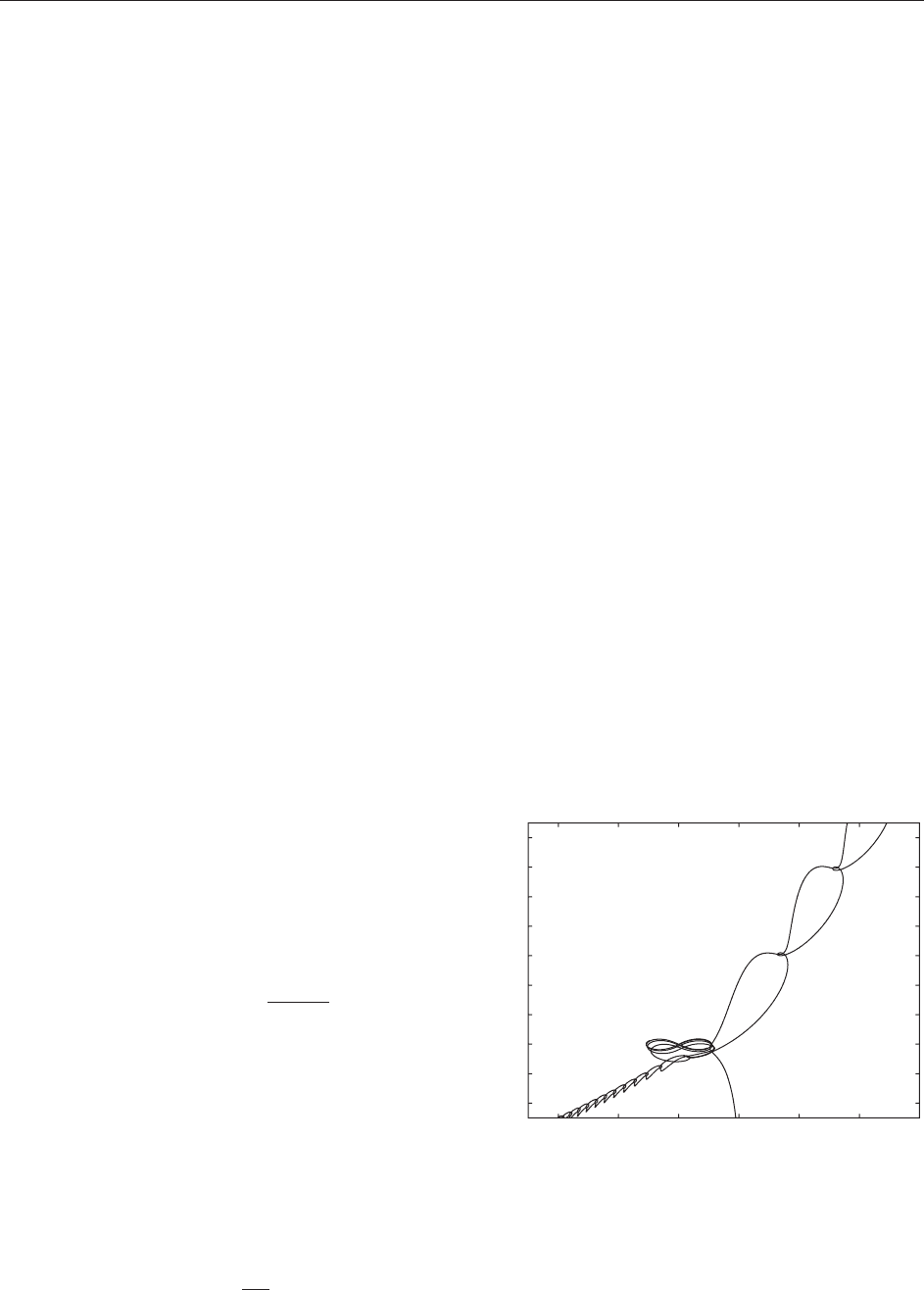
same path, shaped like a figure 8 (cf. Figure 2), was
established by Chenciner and Montgomery (2000),
following its independent discovery by Moore using
numerical methods. Another interesting periodic
motion that was discovered numerically, by
Schubart, is a solution of the collinear three-body
problem, and so collisions are inevitable. In this
motion, the body in the middle alternately encoun-
ters the other two bodies.
14
8
8
4
4
0
0
–2
–2
–4
–4
2
2
6
6
10
12
y
x
Figure 2 A rare example of a scattering encounter between
two binaries (which approach from upper right and lower left)
which leads to a permanently bound triple system describing the
‘‘figure-8’’ periodic orbit. A fourth body escapes at the bottom.
Note the differing scales on the two axes. (Reproduced with
permission from Heggie DC (2000) A new outcome of binary-
binary scattering. Monthly Notices of the Royal Astronomical
Society 318(4): L61–L63; ª Blackwell Publishing Ltd.)
Gravitational N-Body Problem (Classical) 577

Singularities As Schubart’s solution illustrates,
two-body encounters can occur in the three -body
problem. Such singularities can be regularized just as
in the pure two-body problem. Triple collisions
cannot be regularized in general, and this singularity
has been studied by the technique of ‘‘blowup.’’ This
has been worked out most thoroughly in the collinear
three-body problem, which has only two degrees of
freedom. The general idea is to transform to two
variables, of which one (denoted by r, say) deter-
mines the scale of the system, while the other (s)
determines the configuration (e.g., the ratio of
separations of the three masses). By scaling the
corresponding velocities and the time, one obtains a
system of three equations of motion for s and the
two velocities which are perfectly regular in the limit
r ! 0. In this limit, the energy integral restricts the
solutions of the system to a manifold (called the
collision manifold). Exactly the same manifold
results for zero-energy solutions, which permits a
simple visualization. Equilibria on the collision
manifold correspond to the Lagrangian collinear
solutions in which the system either expands to
infinity or contracts to a three-body collision.
Qualitative ideas Reference has already been made
to motion of elliptic –elliptic type. In a motion of
elliptic–hyperbolic type, there is again an ‘‘inner’’
pair of bodies describing nearly Keplerian motion,
while the relative motion of the third body is nearly
hyperbolic. In applications, this is referred to as a
kind of scattering encounter between a binary and a
third body. When the encounter is sufficiently close,
it is possible for one member of the binary to be
exchanged with the third body. One of the major
historical themes of the general three-body problem
is the classification of connections between these
different types of asymptotic motion. It is possible to
show, for instance, that the measure of initial
conditions of hyperbolic–elliptic type leading asymp-
totically to elliptic–elliptic motion (or any other type
of permanently bound motion) is zero. Much of the
study of such problems has been carried out
numerically.
There are many ways in which the stability of
three-body motions may be approached. One exam-
ple is furnished by the central configurations already
referred to. They can be used to establish sufficient
conditions for ensuring that exchange is impossible,
and similar conclusions.
A powerful tool for qualitative study of three-
body motions is Lagrange’s identity, which is now
thought of as the reduction to three bodies of the
virial theorem. Let the size of the system be
characterized by the ‘‘moment of inertia’’ I. Then it
is easy to show that
d
2
I
dt
2
¼ 4T þ 2W
where T, W are, respectively, the kinetic an d
potential energies of the system. Usually, the bary-
centric frame is adopted. Since E = T þ V is con-
stant and T 0, it follows that the system is not
bounded for all t > 0 unless E < 0.
Perturbation theory The question of the integr-
ability of the general three-body problem has
stimulated much research, including the famous
study by Poincare´ which established the nonexis-
tence of integrals beyond the ten classical ones.
Poincare´’s work was an important landmark in the
application to the three-body problem of perturba-
tion methods. If one mass dominates, that is, m
1
m
2
and m
1
m
3
, then the motion of m
2
and m
3
relative to m
1
is a mildly perturbed two-body
motion, unless m
2
and m
3
are close together. Then
it is beneficial to describe the motion of m
2
relative
to m
1
by the parameters of Keplerian motion. These
would be constant in the absence of m
3
, and vary
slowly because of the perturbation by m
3
. This was
the idea be hind Lagrange’s very general method of
variation of parameters for solving systems of
differential equations. Numerous methods were
developed for the iterative solution of the resulting
equations. In this way, the solution of such a three-
body problem could be represented as a type of
trigonometric series in which the arguments are the
angle variab les describing the two approximate
Keplerian motions. These were of immense value in
solving problems of celestial mechanics, that is, the
study of the motions of planets, their satellites,
comets, and asteroids.
A major step forward was the introduction of
Hamiltonian methods. A three-body problem of the
type considered here has a Hamiltonian of the form
H ¼ H
1
ðL
1
ÞþH
2
ðL
2
ÞþR
where H
i
, i = 1, 2, are the Hamiltonians describing
the interaction between m
i
and m
1
,andR is the
‘‘disturbing function.’’ It depends on all the vari-
ables, but is small compared with the H
i
. Now
perturbation theory reduces to the task of perform-
ing canonical transformations which simplify R as
much as possible.
Poincare´’s major contribution in this area was to
show that the series solutions produced by perturba-
tion methods are not, in general, convergent, but
578 Gravitational N-Body Problem (Classical)

asymptotic. Thus, they were of practical rather than
theoretical value. For example, nothing could be
proved about the stability of the solar system using
perturbation methods. It took the further analytic
development of KAM theory to rescue this aspect of
perturbation theory. This theory can be used to
show that, provide d that two of the three masses are
sufficiently small, then for almost all initial condi-
tions the motions remain close to Kepl erian for all
time. Unfortunately, now it is the practical aspect of
the theory which is missing; though we have
introduced this topic in the context of the three-
body problem, it is extensible to any N-body system
with N 1 small masses in nearly Keplerian motion
about m
1
, but to be applicable to the solar system
the masses of the planets would have to be
ridiculously small.
Numerical methods Numerical integrations of the
three-body problem were first carried out near the
beginning of the twentieth century, and are now
commonplace. For typical scattering events, or other
short-lived solutions, there is usually little need to go
beyond common Runge–Kutta methods, provided
that automatic step-size control is adopted. When
close two-body approaches occur, some regulariza-
tion based on the KS transformation is often
exploited. In cases of prolonged elliptic–elliptic
motion, an analytic approximation based on Kepler-
ian motion may be adequate. Otherwise (as in
problems of planetary motion, where the evolution
takes place on an extremely long timescale), meth-
ods of very high ord er are often used. Symplect ic
methods, which have been developed in the context
of Hamiltonian problems, are increasingly adopted
for problems of this kind, as their long-term error
behavior is generally much superior to that of
methods which ignore the geometrical properties of
the equations of motion.
Four- and Five-Body Problems
Many of the foregoing remarks, on central config-
urations, numerical methods, KAM theory, etc.,
apply equally to few-body problems with N > 3.
Of special interest from a theoretical point of view is
the occurr ence of a new kind of singularity, in which
motions become unbounded in finite time. For
N = 4, the known examples also require two-body
collisions, but noncollision orbits exhibiting finite-
time blowup are known for N = 5.
One of the practical (or, at least, astronomical)
applications is again to scattering encounters, this
time involving the approach of two binaries on a
hyperbolic relative orbit. Numerical results show
that a wide variety of outcomes is possible, includ-
ing even the creation of the figure-8 periodic orbit of
the three-body problem, while a fourth body escapes
(Figure 2).
Many-Body Problems
Many of the concepts already introduced, such as
the virial theorem, apply equally well to the many-
body classical gravitational problem. This section
refers mainly to the new features which arise when
N is not small. In particular, statistical descriptions
become central. The applications also have a
different emphasis, moving from problems of plane-
tary dynamics (celestial mechanics) to those of
stellar dynamics. Typically, N lies in the range
10
2
–10
12
.
Evolution of the Distribution Function
The most useful statistical description is obtained if
the correlations we neglect and focus on the one-
particle distribution funct ion f (r, v, t), which can be
interpreted as the number density at time t at the
point in phase space corresponding to position r and
velocity v. Several processes contribute to the
evolution of f.
Collective effects When the effects of near neigh-
bors are neglected, the dynamics is described by the
Vlasov–Poisson system
@f
@t
þ v
@f
@r
@ðr; tÞ
@r
@f
@v
¼ 0 ½ 6
r
2
¼ 4Gm
Z
f ðr; v; tÞd
3
v ½7
where is the gravitational potential and m is the
mass of each body. Obvious ex tensions are neces-
sary if not all bodies have the same mass.
Solutions of eqn [6] may be found by the method
of characteristics, which is most useful in cases
where the equation of motion
€
r = r is integr-
able, for exa mple, in stationary, spherical potentials.
An example is the solution
f ¼jEj
7=2
½8
where E is the specific energy of a body, that is,
E = v
2
=2 þ . This satisfies eqn [6] provided that
is static. Equation [7] is satisfied provided that
satisfies a case of the Lane–Emden equation, which
is easy to solve in this case.
The solution just referred to is an example of an
equilibrium solution. In an equilibrium solution, the
virial theorem takes the form 4T þ 2W = 0, where
Gravitational N-Body Problem (Classical) 579
T, W are appropriate mean-field approximations for
the kinetic and potential energy, respectively. It
follows that E = T, where E = T þ V is the total
energy. An increase in E causes a decrease in T,
which implies that a self-gravitating N-body system
exhibits a negative specific heat.
There is little to choose between one equilibrium
solution and another, except for their stability. In
such an equilibrium, the bodies orbit within the
potential on a timescale of the crossing time, which
is conventionally defined to be
t
cr
¼
GM
5=2
ð2jEjÞ
3=2
The most important evolutionary phenomenon of
collisionless dynamics is violent relaxation. If f is not
time indepe ndent then is time dependent in
general. Also, from the equation of motion of one
body, E varies according to dE=dt = @=@t, and so
energy is exchanged between bodies, which leads to
an evolution of the distribution of energies. This
process is known as violent relaxati on.
Two other relaxation processes are of importance:
1. Relaxation is possible on each energy hypersur-
face, even in a static potential, if the potential is
nonintegrable.
2. The range of collective phenomena becomes
remarkably rich if the system exhibits ordered
motions, as in rotating systems. Then an impor-
tant role is played by resonant motions, espe-
cially resonances of low order. The
corresponding theory lies at the basis of the
theory of spiral structure in galaxies, for instance.
Collisional effects The approximations of colli-
sionless stellar dynamics suppress two important
processes:
1. The exponential divergence of stellar orbits,
which takes place on a timescale of order t
cr
.
Even in an integrable potential, therefore, f
evolves on each energy hypersur face.
2. Two-body relaxation. It operates on a timescale of
order (N= ln N)t
cr
, where N is the number of
particles. Although this two-body relaxation time-
scale, t
r
, is much longer than any other timescale
we have considered, this process leads to evolution
of f (E), and it dominates the long-term evolution
of large N-body systems . It is usually modeled by
adding a collision term of Fokker–Planck type on
the right-hand side of eqn [6].
In this case, the only equilibrium solutions
in a steady potential are those in which f (E) /
exp (E), where is a constant. Then eqn [7]
becomes Liouville’s equation, and for the case of
spherical symmetry the relevant solutions are those
corresponding to the isothermal sphere.
Collisional Equilibrium
We consider the collisional evolution of an N-body
system further in a later subsection and here develop
fundamental ideas about the isothermal model . The
isothermal model has infinite mass, and much has
been learned by considering a model confined within
an adiabatic boundary or enclosure. There is a series
of such models, characterized by a single dimension-
less parameter, which can be taken to be the ratio
between the central density and the density at the
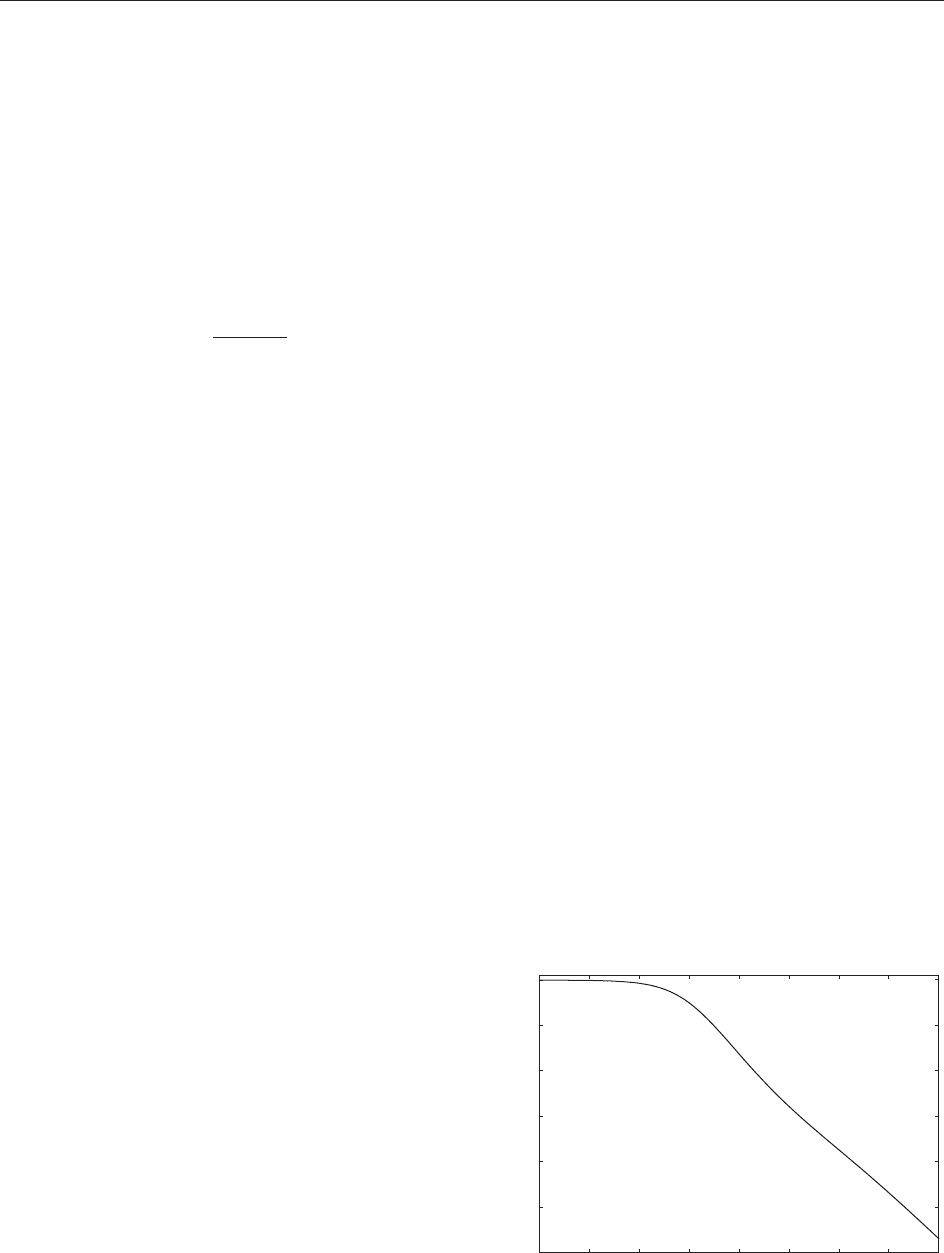
boundary,
0
=
e
(Figure 3).
These models are extrema of the Boltzmann
entropy S = k
R
f ln f d
6
,wherek is the Boltzmann
constant, and the integration is taken over all
available phase space. Their stability may be
determined by evaluating the second variation of S.
It is found that it is negative definite, so that S is a
local maximum and the configuration is stable, only
if
0
=
e
< 709 approximately. A physical explana-
tion for this is the following. In the limit when
0
=
e
’ 1, the self-gravity (which causes the spatial
inhomogeneity) is weak, and the system behaves like
an ordinary perfect gas. When
0
=
e
1, however,
the system is highly inhomogeneous, consisting of a
core of low mass and high density surrounded by an
extensive halo of high mass and low density.
Consider a transfer of energy from the deep interior
to the envelope. In the envelope, which is restrained
by the enclosure, the additional energy causes a rise
in temperature, but this is small, because of the very
large mass of the halo. Extraction of energy from
around the core, however, causes the bodies there to
sink and accelerate, and, because of the negative
–6
–5
–4
–3
–2
–1
0
–1 –0.5 0 1 2 30.5 1.5 2.5
Log density
Lo
g
radius
Figure 3 The density profile of the nonsingular isothermal
model, with conventional scalings.
580 Gravitational N-Body Problem (Classical)
specific heat of a self-gravitating system, they gain
more kinetic energy than they lost in the original
transfer. Now the system is hotter in the core than in
the halo, and the transfer of energy from the interior
to the exterior is self-sustaining, in a gravothermal
runaway. The isothermal model with large density
contrast is therefore unstable.
The negative specific heat, and the lack of an
equilibrium which maximizes the entropy, are two
examples of the anomalous thermo dynamic beha-
vior of the self-gravitating N-body problem. They
are related to the long-range nature of the gravita-
tional interaction, the importance of boundary
terms, and the nonextensivity of the energy. Another
consequence is the inequivalence of canonical and
microcanonical ensembles.
Numerical Methods
The foregoing considerations are difficult to extend
to systems without a boundary, although they are a
vital guide to the behavior even in this case. Our
knowledge of such systems is due largely to
numerical experiments, which fall into several
classes:
1. Direct N-body calculations. These minimize the
number of simplifying assumptions, but are
expensive. Special-purpose hardware is readily
available, which greatly accelerates the necessary
calculations. Great care has to be taken in the
treatment of few-body configurations, which
otherwise consume almost all resour ces.
2. Hierarchical methods, including tree methods,
which shorten the calculation of forces by
grouping distant masses. They are most ly used
for collisionless problems.
3. Grid-based methods, which are used for colli-
sionless problems.
4. Fokker–Planck methods, which usually require a
theoretical knowledge of the statistical effects of
two-, three- and four-body interactions. Other-
wise they can be very flexible, especially in the
form of Monte Carlo codes.
5. Gas codes. The behavior of a self-gravitating
system is simulated surprisingly well by modeling
it as a self-gravitating perfect gas, rather like a
star.
Collisional Evolution
Consider an isolate d N-body system, which is
supposed initially to be given by a spherically
symmetric equilibrium solution of eqns [6] and [7],
such as eqn [8]. The temperature decreases with
increasing radius, and a gravothermal runaway
causes the ‘‘collapse’’ of the core, which reaches
extremely high density in finite time. (This collapse
takes place on the long two-body relaxation time-
scale, and so it is not the rapid collapse, on a free-
fall timescale, which the name rather suggests.)
At sufficiently high densities, the timescale of
three-body reactions becomes competitive. These
create bound pairs, the excess energy being removed
by a third body. From the point of view of the one-
particle distribution function, f, these reactions are
exothermic, causing an expansion and cooling of the
high-density central regions. This temperat ure inver-
sion drives the gravothermal runaway in reverse,
and the core expands, until contact with the cool
envelope of the system restores a normal tempera-
ture profile. Core collapse resumes once more, and
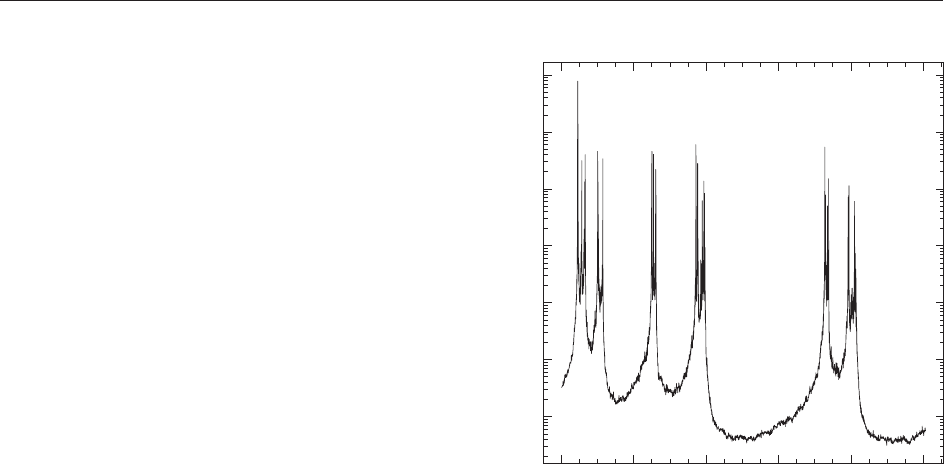
leads to a chaotic sequ ence of expansi ons and
contractions, called gravothermal oscillations
(Figure 4).
The monotonic addition of energy during the
collapsed phases causes a secular expansion of the
system, and a general increase in all timescales. In
each relaxation time, a small fraction of the masses
escape, and eventually (it is thought) the system
consists of a dispersing collection of mutually
unbound single masses, binaries, and (presumably)
stable higher-order systems.
It is very remarkable that the long-term fate of
the largest self-gravitating N-body system appears
to be intimately linked with the three-body
problem.
N = 64 K stars
10
8
10
7
10
6
10
5
10
4
10
4
100
1000
Central density, ρ
0 4000 800060002000
T [N-body ]
Figure 4 Gravothermal oscillations in an N-body system with
N = 65 536. The central density is plotted as a function of time in
units such that t
cr
= 2
ffiffiffi
2
p
. (Source: Baumgardt H, Hut P,
and Makino J, with permission.)
Gravitational N-Body Problem (Classical) 581

See also: Boltzmann Equation (Classical and Quantum);
Chaos and Attractors; Dynamical Systems and
Thermodynamics; KAM Theory and Celestial Mechanics;
Lyapunov Exponents and Strange Attractors;
Nonequilibrium Statistical Mechanics: Interaction
between Theory and Numerical Simulations; Quantum
N-Body Problem; Stability Problems in Celestial
Mechanics; Stability Theory and KAM.
Further Reading
Arnol’d VI, Kozlov VV, and Neishtadt AI (1993) Mathematical
Aspects of Classical and Celestial Mechanics, 2nd edn. Berlin:
Springer.
Barrow-Green J (1997) Poincare´ and the Three Body Problem.
Providence: American Mathematical Society.
Binney J and Tremaine S (1988) Galactic Dynamics. Princeton:
Princeton University Press.
Chenciner A and Montgomery R (2000) A remarkable periodic
solution of a three-body problem in the case of equal masses.
Annals of Mathematics 152: 881–901.
Dauxois T et al. (eds.) (2003) Dynamics and Thermodynamics of
Systems with Long Range Interactions. Berlin: Springer.
Diacu F (2000) A century-long loop. Mathematical Intelligencer
22(2): 19–25.
Heggie DC and Hut P (2003) The Gravitational Million-Body
Problem. Cambridge: Cambridge University Press.
Marchal C (1990) The Three-Body Problem. Amsterdam: Elsevier.
Murray CD and Dermott SF (2000) Solar System Dynamics.
Cambridge: Cambridge University Press.
Padmanabhan T (1990) Statistical mechanics of gravitating
systems. Physics Reports 188: 285–362.
Siegel CL, Moser JK, and Kalme CI (1995) Lectures on Celestial
Mechanics. Berlin: Springer.
Steves BJ and Maciejewski AJ (eds.) (2001) The Restless Universe.
Applications of Gravitational N-Body Dynamics to Planetary,
Stellar and Galactic Systems. Bristol: IoP and SUSSP.
Szebehely V (1967) Theory of Orbits: The Restricted Problem of
Three Bodies. New York: Academic Press.
Gravitational Waves
G Gonza´ lez and J Pullin, Louisiana State University,
Baton Rouge, LA, USA
ª 2006 Elsevier Ltd. All rights reserved.
In elementary physics presentations, one learns about
electricity and magnetism, and also about gravity.
There appear striking similarities between Newton’s
law of gravitational attraction and Coulomb’s law of
attraction between charges. There are also obvious
differences, the most immediate one being that in
gravitation all masses are positive and always attract
each other, whereas in electromagnetism charges may
attract or repel, depending on their signs. We also
know today that Newton’s theory of gravity is not
considered an entirely correct description of the
gravitational field, particularly when fields are time
dependent and intense. The currently accepted theory
of gravity is Einstein’s theory of general relativity.
The similarity between electromagnetism and
gravitation also holds to a certain extent when the
fields depend on time. This is usually not discussed
in elementary treatments since a full description of
time-dependent gravitational fields requi res the use
of general relativity. It is true, however, that if the
fields are weak, there exist several similarities
between gravitation and electromagnetism. In parti-
cular, one can have waves in the gravitational field
that are able to carry energy from a source to a
receptor.
If one assumes that the metric of spacetime is
close to the flat Minkow ski metric
, that is,
g
=
þ h
with jh
j << 1 in Cartesian coordi-
nates, the Einstein equations of general relativity,
expanding to linear order in h
, become
0 ¼R
1
2
R
¼
1
2
@
@
h
þ @
@
h
@
@
h
&h
@
@
h
þ
&h
½1
These do not look like wave equations. However,
if one chooses ‘‘harmonic coordinates,’’
&
x
= 0,
where
&
is the d’Alembertian constructed with the
full metric and then linearized, the vacuum Einstein
equations become
&h
¼ 0 ½2
where
&
is the d’Alembertian computed in the flat
Minkowski metric.
Just as in electromagnetism the motion of charges
produces waves, the motion of masses produces
waves in the gravitational field. In the above wave
equations, one would have nonzero right-hand sides
if masses were present. In electromagnetism, the
conservation of charge implies that the lowest order
of ‘‘structure’’ a source must have to produce
electromagnetic waves is that of a time-dependent
dipole. In the gravitational field, the conservation of
momentum implies that the lowest multipolar order
of a source of gravitational waves must be a
quadrupole. Moreover, gravity is a weaker force
than electromagnetism when one considers usually
available situations. One can exert forces of the
orders of fractions of Newton with electromagnetic
582 Gravitational Waves

charges easily collected in tabletop experiments. To
produce similar amou nts of gravitational force, one
needs large quantities of mass. This last fact,
coupled with the quadrupolar nature of the sources
of gravi tational waves, makes their production quite
challenging in experimental terms. The luminosity of
a gravitational wave source is given by the cele-
brated Einstein quadrupole formula,
L ¼
G
5c
5
X
3
j¼1;k¼1
I
...
jk
2
½3
where G is Newton’s gravitational constant, c is the
speed of light, and I
...
ij
is the third-order time
derivative of the traceless part of the qua drupole
mass moment of the source.
Gravity is, however, a domina nt force if one
considers the universe at large (say, at least
planetary) scales. There one would expect gravita-
tional waves to play some role in the dynamics of
the systems. In such systems, the pr esence of
gravitational waves has indeed been experimentally
confirmed. We know of a system of two pulsars in
mutual orbit, PSR1913 þ16, whose orbit has been
tracked with enough accuracy via radioastronomy
to make the influence of gravitational waves
observable. The motion of the pulsars makes the
system an emitter of gravitational waves. Since the
waves carry away energy, the orbit of the system
decreases in radius and the period of oscillation
increases. The system has now been tracked for over
20 years, and the predi ction of the emitted amount
of energy in gravitational waves due to general
relativity has been confirmed with a very significant
degree of accuracy. Penrose was the first to notice
that if one considers how accurately Newton’s
theory plus the corrections due to general relativity
predict the positions of the pulsars in their orbit, this
is in fact the most accurately verified physical
prediction ever.
Technically, even the existence of gravitational
waves at a conceptual mathematical level, was an
open problem for many years. Since the correct
description of the waves is through the general
theory of relativity, a ‘‘gravitational wave’’ should
really be viewed as a ‘‘ripple in spacetime.’’ Disen-
tangling if such ripples are a true physical effect or a
time-dependent coordinate transformation that pro-
pagates – to use the words of Eddington – ‘‘with the
speed of thought’’ took quite a bit of technical
development within the general theory of relativity.
It was only in the 1960s that a clear enou gh
conceptual picture was developed to determine that
gravitational waves were indeed a true physical
phenomenon akin to electromagnetic waves. And in
particular that one can unambiguously characterize
them as transporting energy, momentum, and
angular momentum from a source to an observer.
Gravitational waves are as difficult to detect as
they are to produce. Since all masses fall in the same
way in a gravitational field, one needs to couple to
the gradients of the field to detect gravitational
waves, which diminishes the efficiency. Attempting
to produce gravitational waves via mechanical
means in the lab (e.g., by rotating a bar of metal)
produces too little luminosity, and in addition, the
relatively low frequency implies that the wave zone
is far away, which further decreases the chances for
detection. Up to date, no one has succeeded in
producing a Hertz-like experiment for gravitational
waves and the jury is still out on the issue if future
technologies (e.g., the use of superconductors to
produce waves of gigahertz frequency) will ever
allow such an experiment.
Efforts to attempt to detect gravitational waves
produced by astrophysical phenomena started in the
1960s with pioneering work by Weber. The initially
proposed technology for detection was the construc-
tion of large (1 ton) resonant bars. The idea was
to use sensitive technology to measure the resonance
of the bar as gravitational waves of astrophysical
origin impact on it. Gravitational waves manifest
themselves as a stretching and contraction of
lengths. The contraction or stretchi ng is propor-
tional to the length of the object considered and is
therefore characterized by a dimensionless number,
the ‘‘strain’’ L=L usually called ‘‘h.’’ Conservative
current estimates of possible astrophysical sources
state that on Earth one should not expect strains
larger than 10
22
for events that repeat more
frequently than a few times every year. Detectors
with bar technology are approaching their funda-
mental quantum limits with strains that appear to be
too large for detection to be ensured. This led to the
proposal of a new technology, the use of Michelson-
type interferometers to detect the waves. Currently,
several interferometric detectors are being built in
the US, Europe, Japan, and Australia that expect to
achieve enough sensitivity for detection within a few
years. Contrary to the bars, which are quintessen-
tially narrow-band detectors (most bars operate
900 Hz with a bandwidth of 10 Hz), interfero-
metric detectors are broadband. Current detectors
have a sensitivity curve limited by various sources of
noise that make them suitable for detection within
the 10 Hz–1 kHz band. The broadband nature of the
detectors opens several oppor tunities for the use of
data analysis techniques that can allow the detection
of gravitational waves that have strains even lower
than the noise of the detectors. Moreover, several of
Gravitational Waves 583

the candidate events ‘‘evolve’’ in frequency as they
emit gravitational waves (in the case of the binary
pulsar, for instance, the frequency ‘‘sweeps up’’ as the
system loses energy), and such evolution could be
monitored with interferometric detectors. This
would allow several insights into the physics of the
observed systems.
An important limitation of any type of detector
based on Earth is that the seismic noise increases
quite significantly below 10 Hz. Even if seismic
isolation allo wed sensitivities below 10 Hz, gravity
gradients due to Earth’s seismic motion and due to
clouds would limit gro und-based detectors to 1 Hz
and above. The frequency at which a system emits
gravitational waves is inversely proportional to the
system’s mass (a simple way to see this is to realize
that larger systems move proportionally slower to
their size). However, larger systems generically have
more mass and therefore consequently emit larger
amounts of energy in gravitational waves. This
suggests that setting up detectors in space, free of
the constraints of seismic noise, would offer sig-
nificant promise in detec ting gravitational waves.
Currently, there is a proposal for a space-borne
gravitational wave detector consisting of three
satellites in a solar orbit that trails that of Earth.
Lasers would be sent between the satellites to track
their relative pos itions, which will be separated by
5 mi llion kilometers. Such a detector would be
sensitive in frequencies of 10
4
–10
2
Hz. In such a
frequency band, one expects that compact objects
plunging into supermassive black holes and other
sources will be readily available. Detection of
gravitational waves on Earth is considered marginal,
in the sense that conservative current estimates
cannot guarantee that there will be enough events
to make the detection successful at significant event
rates. Conversely, for the detectors in space, detec-
tion should be guaranteed at high event rates.
Possible sources of gravitational waves to be
detected by the Earth-based interferometric detec-
tors are:
1. Binary systems of compact objects. As the system
orbits, it emits gravitational waves, which makes
the orbit shrink in size and the orbiting period
shorter with the objects eventually merging
together. Potential systems include black hole
binaries, neutron star binaries and mixed black
hole/neutron star binaries. As the system sweeps
up in orbital speed towards the merger, so does
the frequency of the gravitational waves emitted.
For binaries of neutron stars, which usually have
masses slightly larger than the mass of the Sun,
the last few minutes of the binary inspiral will be
detectable by the current generation of gravita-
tional wave detectors, up to a distance of several
mega-parsecs for the initial detectors, increasing
to a few hundreds of mega-parsecs for improve-
ments planned for the next few years. For black
hole binaries, since the masses can be larger, one
expects larger signal-to-noise ratio for the same
distance or to be able to detect at larger
distances.
2. Spinning neutron stars that develop ‘‘mountains’’
or other irregularities in the surface would
produce gravitational wave s of small amplitude
but of a very regular periodic nature. This makes
them prime candidates for data analysis techni-
ques that could exhibit the presence of the wave
even though it is weaker than the background
noise of the interferometers. Integration periods
of several months may be needed for detection,
depending on the size of the asymmetries in the
neutron stars.
3. Supernovas or other violent events are obviously
possible sources of gravitational waves. How-
ever, the quadrupole nature of the waves requires
the events to be asymmetric in order to produce
gravitational waves. Current numerical models of
supernovas are not accurate enough to predict in
a clear way the level of asymmetry to make
reliable predictions of how frequently and at
what intensity could these types of sources be
detected.
4. The primordial background of gravitational
waves produced in the big bang is not expected
to be detectable by the Earth-based detectors.
The precise amplitude of the background is
unknown, depending on details of cosmological
models. The detectors are likely to be able to
constrain some of the models that predict large
amplitudes for the gravitational wave
background.
For the space-based detectors, the situation is
more favorable, since there exist sources of gravita-
tional waves that are guaranteed to be detected.
Potential sources of gravitational waves are:
1. Merger of the supermassive black holes at the
centers of two galaxies. Given the large amounts
of mass involved, they would be easily detected
and very precise measurements of the system’s
parameters and of various general relativistic
behaviors could be possible. Such systems should
be detectabl e all across the universe, although it
is not expected that such systems form for
redshifts larger than 30.
2. Inspiral of compact objects into the supermassive
black holes at the centers of galaxies (neutron
584 Gravitational Waves

stars, white dwarfs, solar-sized black holes).
These processes will allow the usage of gravita-
tional waves to map precisely the gravitational
field of the supermassive object.
3. White-dwarf binaries and low-mass X-ray bin-
aries. There exist about a dozen such systems
optically observable with gravitational wave
frequencies above 0.1 mHz that the space-based
detectors should be able to detect. There is likely
to be a large population of other systems that are
also detectable and are not optically visible. In
fact, there may be so many of these sources that
time resolution would be impossible, and they
would form a random background.
4. Collapse of supermassive stars. The formation
mechanism for the supermassive black holes in
the centers of galaxies is still uncertain. One
possibility is that they stem from the collapse of
supermassive stars, and in that case a potentially
significant emission of gravitational waves could
take place.
5. Primordial background of gravitat ional waves.
Unfortunately, the abundance of white-dwarf
binaries as a source is expected to cloud the ability
of the space detectors to observe primordial
gravitational waves in an important portion of the
spectrum of the instrument, although it appears
possible at low frequencies, where it could compete
with the bounds set by pulsar timing.
The current Earth-based g ravitational wave pro-
jects include the LIGO project in the US, funded by
the National Science Foundation and jointly oper-
ated by Caltech and MIT and a consortium of
institutions known as the LIGO Science Collabora-
tion. LIGO consists of two 4 km long Fabry–Perot
recycled Michelson interferometers, one in Hanford,
WA, and one in Livingston, LA. In Europe, the
GEO600 project is a 600 m dual-recycled inter-
ferometer near Hanover in Germany and the Virgo
project is a 3 km interferometer near Pisa in Italy
operated by a French–Italian consortium with a
similar optical configuration as LIGO. TAMA300 is
a 300 m interferometer in Japan also with the same
configuration as LIGO. When all these detectors are
in operation, sources seen in coincidence could be
localized by triangulation. TAMA is now operating
close to design sensitivity, GEO600 and LIGO are
likely to operate at design sensitivity in 2006, with
VIRGO following close behind. The space-based
interferometer project is called the LISA project and
is planned as a joint NASA/ESA project. ESA has
approved a launching date for 2015, but it is
plausible that the mission could be launched at an
earlier date.
A direct detection of gravitational waves would be a
breakthrough in experimental science, as well as a
confirmation of the dynamic nature of gravity in
general relativity. Once the detection of gravitational
waves becomes a routine matter, one can imagine a
revolution in astronomy as one uses gravitational
waves to ‘‘see’’ the universe. Since they are so hard to
produce and interfere with, gravitational waves
become an excellent type of ‘‘light’’ to look at the
universe with. Gravitational waves will be produced by
important concentrations of mass, correlating well
with ‘‘interesting’’ astronomical processes, and is not
expected to be affected by the presence of dust or other
interfering objects that could easily obscure electro-
magnetic waves. In addition to this, one has several
‘‘standard candles’’ for gravitational waves (e.g., most
neutron stars have masses that differ by a few percent
from 1.4 solar masses). This could allow, for instance,
to determine with a high degree of accuracy the Hubble
constant. Gravitational waves will also provide insight
into the nuclear equation of state that holds in the
interior of compact objects like neutron stars. Contrary
to ordinary electromagnetic radiation, which
‘‘decoupled’’ from matter only when the universe
became cool enough after the big bang, gravitational
waves could be used to probe the universe further into
the past. The detection could also prove that gravita-
tional waves travel at the speed of light, a prediction of
general relativity and other theories.
An interesting observation is that most astrophysical
objects that are quite visible in the electromagnetic
spectrum are unlikely to be visible in terms of
gravitational waves, and vice versa. This makes the
information we will gather from gravitational wave
astronomy complementary to what we learn from
optical (electromagnetic) astronomy. Moreover, it
should be noted that wavelengths of electromagnetic
waves are typically very small compared to the size of
the astronomical objects they depict. This is due to the
fact that the waves are really not produced by the
objects themselves but by atoms on the surface of the
objects or in regions nearby, usually very hot and in
gaseous form. In contrast, gravitational waves are
produced by the bulk matter of astronomical objects
and their wavelengths are expected to be long as
compared to the objects that produce them. They are
more akin to a sound than to light in this respect,
another reason to suspect that the information we will
get from them is unlike any information obtained
electromagnetically.
Gravitational waves are likely to bring great
surprises. Every time a new window has been
opened on the universe – for instance, the use of
radio waves – our view of the universe has been
revolutionized. Given how differently they operate
Gravitational Waves 585