
Francoise J.-P., Naber G.L., Tsun T.S. (editors) Encyclopedia of Mathematical Physics
Подождите немного. Документ загружается.


Many efforts have been devoted to the compre-
hension of the scaling laws in aging (Bouchaud
et al.). Among the theories and models of aging that
have been proposed, one can cite the phenomeno-
logical model known as ‘‘trap model,’’ devel oped by
Bouchaud and collaborators that assimilates aging
to a random walk between ‘‘traps’’ characterized by
a broad distribution of trapping times. Suitable
choices of the trapping-time dist ribution allow to
derive scaling laws similar to the ones characteristic
of aging systems . A different theory, the ‘‘droplet
model’’ for spin glasses assimilates aging phenomena
to the competition between slowly growing domains
of equilibrium phases, in analogy with the dynamics
of phase separation in first-order phase transitions.
The approach that has led to the most detailed and
spectacular predictions has been the study of
microscopic mean-field models.
Mean-Field Models of Disordered
Systems
Mean-field theory starts from the analysis of the
relaxation dynamics of disordered systems with
weak long-range forces (Bouchaud et al.). The
reference model of spin glass mean-field theory is
the so called p-spin model, which considers N spins
S
i
with random p-body interactions with each other
and is described by the Hamiltonian
H
p
ðSÞ¼
X
1;N
i
1
<<i
p
J
i
1
;...;i
p
S
i
1
S
i
p
½6
where the quenched coupling constants J
i
1
,..., i
p
are
assumed to be i.i.d. Gaussian variables with zero
average and N dependent variance E(J
2
i
1
,..., i
p
) =
p!=2N
p1
. The case p = 2 coincides with the SK
model defined in the introduction. The reason for
considering the p-spin generalization is that the
order of the transition passes from the second one
for p = 2 to the first one for p 3 and that this last
case has been suggested to provide a mean-field limit
for the structural glass transition. It is also useful to
define Hamiltonians
H½S¼
X
p1
a
p
H
p
½S½7
that mix p-spin Hamiltonians for different p. These
are random Gaussian functions of the spin variables,
with covariance induced by the coupling distribution
E½HðSÞHðS
0
Þ ¼ Nf ðqðS; S
0
ÞÞ
¼
N
2
X
p1
a
2
p
qðS; S
0
Þ
p
½8
where the function
qðS; S
0
Þ¼
1
N
X
N
i¼1
S
i
S
0
i
is the overlap between configurations. A crucial
hypothesis in the study of relaxation in spin systems
is that any local spin update rule verifying the detailed
balance condition with respect to the Boltzmann–
Gibbs measure gives rise to the same long-time
properties. In this perspective, in Monte Carlo simula-
tions, it is convenient to use Ising spins with
Metropolis or Glauber dynamics. Much theoretical
progress has been achieved considering spherical
models where the spin variables are real numbers
subject to a global spherical constraint
P
i
S
2
i
= N and
evolve according to the following Langevin dynamics:
dS
i
ðtÞ
dt
¼
@HðSðtÞÞ
@S
i
ðtÞS
i
ðtÞþ
i
ðtÞ½9
where (t) is a time-dependent multiplier that at
each instant of time insures that the spherical
constraint is respected, and
i
(t) is a thermal white
noise with variance
Eð
i
ðtÞ
j
ðsÞÞ ¼ 2 T
ij
ðt sÞ½10
In order to model the quench from high temperature
performed in experiments, the initial conditions are
randomly chosen with uniform probability. To
describe long but finite-time dynamics, it is neces-
sary to consi der the limit of large volume N !1for
finite time, which is the only case where one can
have infinite relaxation times. Application of func-
tional Martin–Siggia–Rose techniques has allowed
the derivation of closed integro-differential equa-
tions for the spin autocorrelatio n function
Cðt; t
0
Þ¼ lim
N!1
1
N
X
N
i¼1
hS
i
ðtÞS
i
ðt
0
Þi
and the response to an impulsive external field
h
i
ðtÞ; Rðt; t
0
Þ¼ lim
N!1
1
N
X
N
i¼1
S
i
ðtÞ
h
i
ðt
0
Þ
where the average has to be intended on quenched
disordered couplings, initial conditions, and realiza-
tion of thermal noise. Unfortunately, in the case
p = 2 relevant for spin glass phenomenology, the
spherical constraints reduce the model to a linear
system where different eigenmodes of the interaction
matrix J
ij
evolve independently. This oversimplifica-
tion renders the model similar to systems apt to
describe phase separa tion rather then freezing
phenomena. Many of the glassy features of the SK
model however are captured by a mixture of p = 2
556 Glassy Disordered Systems: Dynamical Evolution

with p = 4 Hamiltonians and f (q) = (1=2)(q
2
þ aq
4
).
For the general Hamiltonian [7] one gets the
coupled equations
@Cðt; t
0
Þ
@t
¼ðtÞCðt; t
0
Þ
þ
Z
t
0
dt
00
f
00
ðCðt; t
00
ÞÞRðt; t
00
ÞCðt
0
; t
00
Þ
þ
Z
t
t
0
dt
00
f
0
ðCðt; t
00
ÞÞRðt
00
; t
0
Þ
@Rðt; t
0
Þ
@t
¼ðtÞRðt; t
0
Þ
þ
Z
t
t
0
dt
00
f
00
ðCðt; t
00
ÞÞRðt; t
00
ÞRðt
00
; t
0
Þ½11
(t) is a multiplier that at each instant of time
insures the spherical constraint C(t, t) = 1, and is
determined by
ðtÞ¼
Z
t
0
dt
00
Cðt; t
00
ÞRðt; t
00
ÞþT ½12
In the next sections, we will discuss how these
equations describe dynamical freezing at low tem-
perature. The gross features are determined by the
form of the function f (q). Two main behaviors can
be identified:
1. Systems of type I. This behavior is found if
f
000
(q)=(f
00
(q))
3=2
is a monotonically decreasing
function of q. To this family belongs the pure
spherical p-spin model for p 3, and one finds a
dynamical transition not corresponding to a
point of singularity in the free energy where the
Edwards–Anderson parameter jumps discontinu-
ously to a nonzero value. Models of this family
have been proposed as appropriate mean-field
limits for structural glass behavior.
2. Systems of type II. This behavior is found if
f
000
(q)=(f
00
(q))
3=2
is a monotonically increasing
function of q . This family mimics the behavior
of the SK model. An example of function f
verifying the condition for type II behavior is
f (q) = 1=2(q
2
þ aq
4
) for sufficiently small but
positive values of a. I n t his case, the dynamical
transition is found at a point of second-order
singularity of the free energy and the Edwards–
Anderson parameter is continuous at the transi-
tion. Models of this family provide a mean-field
limit for spin glass type behavior.
Equilibrium Dynamics at High Temperature
At high temperature, after a finite transient, eqn [11]
describes equilibrium behavior. In these conditions,
time-translation invariance holds C( t, t
0
) = C(t t
0
),
R(t, t
0
) = R(t t
0
) while the Lagrange multiplier
becomes time independent. In addition, correlation
and response are related by the fluctuation–
dissipation theorem (FDT) relation
RðtÞ¼
1
T
dCðtÞ
dt
½13
Ergodic behavior is manifest in the fact that the
dynamics decorrelate completely; lim
t !1
C(t) = 0.
Then from [11] one gets the equilibrium equation:
dCðtÞ
dt
¼TCðtÞ
1
T
Z
t
0
dsf
0
ðCðt sÞÞ
dCðsÞ
ds
½14
It is worth noticing that this equation, apart from an
irrelevant inertial term, coincides for type I systems
with the schematic mode-coupling theory (MCT)
equation which has been succe ssfully used to
describe moderate supercooled liquids (Goetze
1989). In the context of liquid theory, mode-
coupling equations stem from an approximate
treatment for the dynamical evolution of the
density–density space and time-dependent correla-
tion function. The schematic MCT equations con-
sider an equation for a single mode, neglectin g any
space dependence of the correlator.
Both in type I and in type II systems, eqn [14]
displays a dynamical transition at a finite tempera-
ture T
c
where the relaxati on time diverges as a
power law jT T
c
j
c
and the asymptotic value of
the correlation acquires a nonz ero value.
This behavior in type I systems represents a failure
of MCT to describe the temperature dependence of
the relaxation time in supercooled liquids, which, as
previously observed, empirically follows the Vogel–
Fulcher law. The MCT temperature is interpreted as
a singularity which is avoided in supercooled
liquids, thanks to relaxation mechanisms specific of
short-range systems. It has been noticed that this
singularity at T
c
can be associated to the growth of
spatial heterogeneities and dynamical correlations,
as exemplified in the behavior of the four-point
function
4
ðtÞ¼
1
N
X
i;j
hS
i
ðtÞS
j
ðtÞS
i
ð0ÞS
j
ð0Þi
and its associate correlation length (Franz and Parisi
2000, Biroli and Bouchaud 2004).
Off-Equilibrium Dynamics Below T
c
: Aging
and Slow Dynamics
Type I systems Below the transition temperature
T
c
slow dynamics and aging set in. In 1993,
Cugliandolo and Kurchan found a long-time
Glassy Disordered Systems: Dynamical Evolution 557

solution to the equations of motion [11] for type I
systems describing an asymptotic off-equilibrium
state that follows from high-temperature quench.
Soon after, type II systems were also analyzed
(Bouchaud et al.).
The equations can be analyzed in the limit in
which both times tend to infinity t, t
0
!1. In this
regime all ‘‘one-time quantities,’’ that is, state
functions like energy, magnetization, etc., reach
asymptotic time-independent limit. Though the
decay to the asymptotic value cannot read directly
from the analysis of the equations in that limit,
numerical and theoretical evidence sugges ts that the
final values are approached as power laws in time.
The study of correlation and response functions
displays an asymptotic scaling behavior similar to
the one observed in glassy systems in laboratory and
numerical experiments.
Two different interesting regimes are found , first of
all there is a stationary regime: the limit t, t
w
!1is
performed keeping the difference t t
w
= s finite. In
this regime, equilibrium behavior is observed, with
correlation and response related by the FDT relation
R
st
(s) = @C
st
(s)=@s. The stationary regime is fol-
lowed by an aging regime, where correlations decay
below the value q
EA
= lim
s !1
C
st
(s) down to zero.
One of the most striking features of aging evolution is
that the system – though at a decreasing speed –
constantly move far apart from any visited region of
configuration space. The decay of correlations is
nonstationary and takes place on a timescale (t
w
)
diverging for large t
w
. While the theory can infer the
existence of the timescale (t
w
), its precise form
remains undetermined. This is a consequence of an
asymptotic invariance under monotonous time repar-
ametrizations t !g(t) appearing for large times.
Coherently with nonstationary behavior, other equi-
librium propertie s break down in the aging regime.
Correlation and response which do not verify the
FDT are rather asymptotically related by a genera l-
ized form of the fluctuation–dissipation relation
R
ag
ðt; t
w
Þ¼
X
T
@C
ag
ððt t
w
Þ=ðt
w
ÞÞ
@t
w
½15
This relation, despite predicting the vanishing of
the instantaneous response, implies a finite contribu-
tion of the aging dynamics to the value of the
integrated ZFC and TRM responses. The constant
X, called fluctuation–dissipation ratio (FDR), is a
temperature-dependent factor monotonically vary-
ing between the values 1 and 0 as the temperature is
decreased from T
c
down to zero. Violations of the
FDT have to be expected in any off-equilibrium
regime; however, a constant ratio between response
and derivative of the correlation is very nongeneric.
It is of great theoretical importance that the same
constant that governs the FDR among spin auto-
correlation and magnetic response, also appears in
the relation of any other conceivable couple of
correlation and conjugated response in the system.
Slow dynamics can be interpreted as motion
between finite-life metastable states with well-
defined free energy f and exponential multiplicity
exp(N(f )). The FDR verifies the generalized
thermodynamic relation
@
@f
¼
X
T
½16
This relation is in turn intimately related to the
possibility of considering the ratio T
eff
= T=X as
an effective temperature, that governs the
heat exchanges among slow degrees of f reedom
(Cugliandolo et al. 1997). Slow degrees of freedom
do not exchange heat with the fast ones, but they
are in equilibrium between themselves at the
temperature T
eff
. The validity of relation [16 ] has
been put at the basis of a detailed statistical
description of the glassy state (Franz and Virasoro
2000, Biroli and Kurchan 2001, Nieuwenhuizen
2000) which assumes that metastable states with
equal free energy are encountered with equal
probability during the descent to equilibrium.
Modified thermodynamic relations follow, that
condensate all the dependence on the thermal
history in the value of the effective temperature.
Given the interest of a thermodynamic description
of the glassy state, many numerical studies have
addressed the problem of the identification and
determination of effective temperatures from the
fluctuation–dissipation relations, and its relation
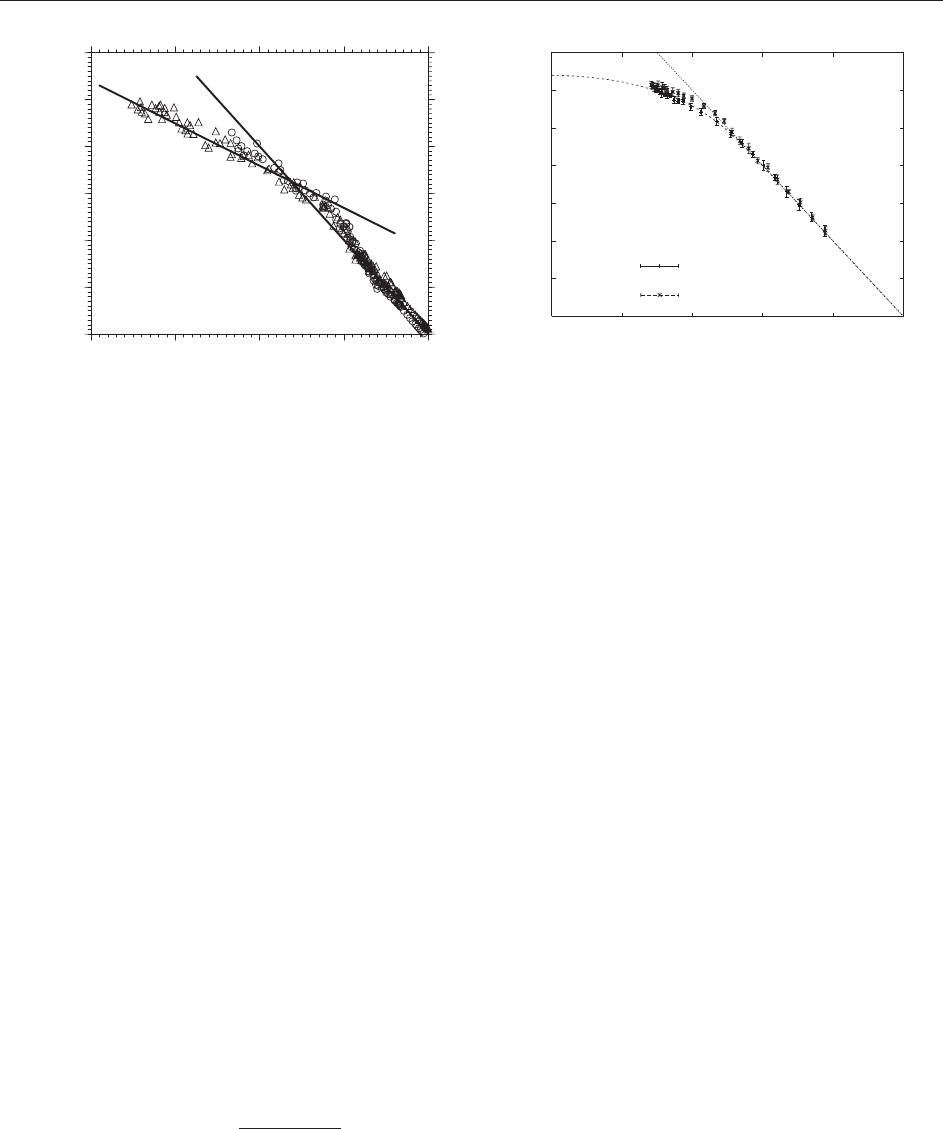
with configurational entropy. In Figure 3 the result
of a numerical study on a realistic system is
presented, verifying relation [15]. Experimental
verifications are at the moment starting and new
results are waite d in the future.
Type II syst ems In these systems the dynamic
transition occurs at the point of thermodynamic
singularity, where the Edwards–Anderson parameter
becomes nonzero in a second-order fashion. The
magnetic susceptibility exhibits a cusp singularity
similar to the one found in spin glass materials.
Differently from type I systems, one-time quantities
tend to their equilibrium values for long times. The
off-equilibrium nature of the relaxation shows up in
the behavior of correlations and responses, which
display aging behavior.
Their behavior generalizes the one found in type I
systems, with a more complex pattern of violation
558 Glassy Disordered Systems: Dynamical Evolution
of time-translation invariance and FDT. Also in this
case a short-time equilibrium behavior can be
identified where the correlation decreases from 1 to
q
EA
and a long-time inhomogeneous aging behavior
where correlations decrease to zero. Differently from
type I system it is impossible to characterize aging
through a unique timescale (t
w
). One finds instead
a continuum of timescales hierarchically organized.
The analysis of the equations at the
reparametrization-invariant level reveals the existence
of a continuum of separate timescales (t
w
, q)asso-
ciated to each value of C(t, t
w
) = q < q
EA
and that
lim
t
w
!1
(t
w
, q)=(t
w
, q
0
) = 0forq > q
0
,meaningthat
for finite t
w
thetimetodecaytoq
0
is much larger than
thetimetodecaytoq. For large times, 1 << t
1
<<
t
2
<< t
3
, the correlations verify the ultrametric prop-
erty C(t
3
, t
1
) = min[C(t
3
, t
2
), C(t
2
, t
1
)]. To each time-
scale corresponds in this case a different effective
temperature, and correlation and response are related
by the equation
XðqÞ¼ lim
t;t
w
!1
Cðt;t
0
Þ¼q
Rðt; t
0
Þ
@Cðt; t
0
Þ=@t
0
½17
where the function X(q) is an increasing function of
q with the properties of a cumulative probability
distribution. In fact it can be seen (Franz et al. 1999)
that this is related to the Parisi overlap probability
function describing the correlations among ergodic
components at equilibrium, in a generalization of
relation [14]. Figure 4 shows the result of a
numerical experiment in a three-dimensional spin
glass, where X(q) is not piecewise constant.
The ideas presented in this article, fruits of mean-field
theory of disordered systems, are objects of intense
debate in their application to the physics of short-range
systems. Many of the relations derived have stimulated
a lot of numerical, experimental, and theoretical work.
Some of the predictions of the theory are very well
verified in many short-range glassy systems, at least on
the accessible timescales. Notably, the violations of
FDR, and the possibility to associate the values of the
FDR to effective temperatures is very well verified both
in structural glass models, and in finite-range spin
glasses. Since finite aging times imply finite length scales
over which the dynamic variables can exhibit correlated
behavior, this indicates that the mean-field theory is at
least good at describing glassy phenomena on a local
scale. The question if the mean-field theory also gives a
good description on the infinite time limit and the
anomalous response persists forever is at present an
open theoretical problem. It relates to the possibility of
having mean-field type of equilibrium ergodicity break-
ing, which is an open question, object of active research.
See also: Interacting Stochastic Particle Systems;
Short-Range Spin Glasses: The Metastate Approach;
Spin Glasses.
Further Reading
Barrat J-L and Kob W (1999) Europhysics Letters 46: 637.
Barrat J-L and Kob W Fluctuation–dissipation ratio in an aging
Lennard–Jones glass.
0.2 0.4 0.6 0.8 1.0
C(τ
+ t
w
,t
w
)
0.00
0.10
0.20
0.30
0.40
0.50
0.60
Tχ(τ + t
w
,t
w
)
T
f
= 0.3
Figure 3 Fluctuation–dissipation plot;
ZFC
(t, t
w
) vs. C(t, t
w
)in
a model of Lennard-Jones glass for different values of the
waiting time t
w
. The slope of the curves is equal to the finite-time
FDR divided by the temperature. One observes the characteristic
shape of type-I systems with an FDR equal to 1 in the stationary
regime for high correlations and equal to a constant smaller then
1 in the low-correlations aging regime. Reproduced from Kob W
and Barrat J-L (1999) Europhysics Letters 46: 637, with
permission from EDP Sciences.
0
0.1
0.2
0.3
0.4
0.5
0.6
0.7
0 0.2 0.4 0.6 0.8 1
t
w
=
2
17
t
w
=
2
14
Figure 4 Fluctuation–dissipation plot in a three-dimensional
spin glass at low temperature. As predicted for type-II systems,
the FDR is an increasing function of the correlation, constant
only in the stationary part of the relaxation. Reproduced from
Marinari E et al. (1998) Violation of the fluctuation dissipation
theorem in finite dimensional spin glasses. Journal of Physics A:
Mathematical and General 31: 2611, with permission from
Institute of Physics Publishing Ltd.
Glassy Disordered Systems: Dynamical Evolution 559

Biroli G and Bouchaud J-P (2004) Diverging length scale and
upper critical dimension in the mode-coupling theory of the
glass transition. Europhysics Letters 67: 21.
Biroli G and Kurchan J (2001) Metastable states in glassy systems.
Physical Review E 64: 16101.
Bouchaud J-P, Cugliandolo L, Kurchan J, and Mezard M Out of
equilibrium dynamics of spin-glasses and other glassy systems.
In: Young AP (ed.) Spin Glasses and Random Fields.
Singapore: World Scientific.
Cugliandolo LF, Kurchan J, and Peliti L (1997) Energy flow,
partial equilibration and effective temperatures in systems
with slow dynamics. Physical Review E 55: 3898.
Debenedetti P (1996) Metastable Liquids, Concepts and Princi-
ples. New Jersey: Princeton University Press.
Fischer KH and Hertz JA (1991) Spin Glasses. Cambridge:
Cambridge University Press.
Franz S, Mezard M, Parisi G, and Peliti L (1999) The response of
glassy systems to random perturbations: a bridge between
equilibrium and off-equilibrium. Journal of Statistical Physics
97: 459.
Franz S and Parisi G (2000) On nonlinear susceptibility in
supercooled liquids. In: Franz S, Glotzer SC, and Sastry S
(eds.) Proceedings of the Conference ‘‘Unifying Concepts in
Glass Physics’’, Trieste, 5–18 September, 1999. Journal of
Physics: Condensed Matter 12: 6335.
Franz S and Virasoro M (2000) Quasi-equilibrium interpretation
of aging dynamics. Journal of Physics A 33: 891.
Goetze W (1991) Aspects of structural glass transitions. In:
Hansen JP, Levesque D, and Zinn-Justin J (eds.) Liquid,
Freezing and the Glass Transition. Amsterdam: Les Houches,
North-Holland.
Marinari E et al. (1998) Violation of the fluctuation dissipation
theorem in finite dimensional spin glasses. Journal of Physics
A: Mathematical and General 31: 2611.
Nieuwenhuizen ThM (2000) In: Franz S, Glotzer SC, and Sastry S
(eds.) Thermodynamic Picture of the Glassy State, Trieste,
5–18 September, 1999. Journal of Physics: Condensed Matter
12: 6335.
Norblad P and Svendlidh P (1997) Experiments in spin glasses. In:
Young AP (ed.) Spin Glasses and Random Fields. Singapore:
World Scientific.
Young AP (ed.) (1997) Spin Glasses and Random Fields.
Singapore: World Scientific.
Graded Poisson Algebras
A S Cattaneo, Universita
¨
tZu
¨
rich, Zu
¨
rich, Switzerland
D Fiorenza and R Longoni, Universita
`
di Roma ‘‘La
Sapienza,’’ Rome, Italy
ª 2006 Elsevier Ltd. All rights reserved.
Definitions
Graded Vector Spaces
By a Z-graded vector space (or simply, graded
vector space) we mean a direct sum A =
i 2Z
A
i
of
vector spaces over a field k of characteristic zero.
The A
i
are called the components of A of degree i
and the degree of a homogeneous element a 2A is
denoted by j a j. We also denote by A[n] the graded
vector space with degree shifted by n, namely
A[n] =
i 2Z
(A[n])
i
with (A[n])
i
= A
iþn
. The tensor
product of two graded vector spaces A and B is
again a graded vector space whose degree r
component is given by (A B)
r
=
pþq = r
A
p
B
q
.
The symmetric and exterior algebras of a graded
vector space A are defined, respectively, as S(A) =
T(A)=I
S
and
V
(A) = T(A)=I
^
,whereT(A) =
n0
A
n
is the tensor algebra of A and I
S
(resp. I
^
)isthe
two-sided ideal generated by elements of the form
a b (1)
jajjbj
b a (resp. a b þ (1)
jajjbj
b a),
with a and b homogeneous elements of A.Theimages
of A
n
in S(A)and
V
(A) are denoted by S
n
(A)and
V
n
(A), respectively. Notice that there is a canonical
decalage isomorphism S
n
(A[1]) ’
V
n
(A)[n].
Graded Algebras and Graded Lie Algebras
We say that A is a graded algebra (of degree zero) if
A is a graded vector space endowed with a degree
zero bilinear associative product: A A !A.A
graded algebra is graded commutative if the product
satisfies the condition
a b ¼ð1Þ
jajjbj
b a
for any two homogeneous elements a, b 2A of
degree jaj and jbj, respectivel y.
A graded Lie algebra of degree n is a graded
vector space A endowed with a graded Lie bracket
on A[n]. Such a bracket can be seen as a degree n
Lie bracket on A, that is, as a bilinear operation
{ , }:A A !A[n] satisfying graded antisym me-
try and graded Jacobi relations:
fa; bg ¼ ð1Þ
ðjajþnÞðjbjþnÞ
fb; ag
fa; fb; cgg ¼ ffa; bg; cgþð1Þ
ðjajþnÞðjbjþnÞ
fafb; cgg
Graded Poisson Algebras
We can now define the main objec t of interest of
this note:
Definition 1 A graded Poisson algebra of degree n,
or n-Poisson algebra, is a triple (A, , { , }) consisting
of a graded vector space A =
i 2Z
A
i
endowed with
a degree zero graded commutative product an d with
560 Graded Poisson Algebras

a degree n Lie bracket. The bracket is required to
be a biderivation of the product, namely:
fa; b c g¼fa; bgc þð1Þ
jbjðjajþnÞ
b fa; cg
Notation. Graded Poisson algebras of degree zero
are called Poisson algebras, while for n = 1 one
speaks of Gerstenhaber (1963) algebras or of
Schouten algebras.
Sometimes a Z
2
-grading is used instead of a
Z-grading. In this case, one just speaks of even and
odd Poisson algebras.
Example 1 Any graded commutative algebra can
be seen as a Poisson algebra with the trivial Lie
structure, and any graded Lie algebra can be seen as
a Poisson algebra with the trivial product.
Example 2 The most classical example of a
Poisson algebra (already considered by Poisson
himself) is the algebra of smoot h functions on R
2n
endowed with usual multiplication and with the
Poisson bracket {f , g} = @
q
i f @
p
i
g @
q
i g@
p
i
f , where the
p
i
’s and the q
i
’s, for i = 1, ..., n, are coordinates on
R
2n
. The bivector field @
q
i ^@
p
i
is induced by the
symplectic form ! = dp
i
^dq
i
. An immediate gener-
alization of this example is the algebra of smooth
functions on a symplectic manifold (R
2n
, !) with the
Poisson bracket {f , g} = !
ij
@
i
f @
j
g, where !
ij
@
i
^@
j
is
the bivector field defined by the inverse of the
symplectic form ! = !
ij
dx
i
^dx
j
; viz. !
ij
!
jk
=
k
i
.
A further generalization is when the bracket on
C
1
(R
m
) is defined by {f , g} =
ij
@
i
f @
j
g, with the
matrix function not necessarily nondegenerate.
The bracket is Poisson if and only if is skewsym-
metric and satisfies
ij
@
i
kl
þ
il
@
i
jk
þ
ik
@
i
lj
¼0
An example of this, already considered by Lie
(1894), is
ij
(x) = f
ij
k
x
k
, where the f
ij
k
’s are the
structure constants of some Lie algebra.
Example 3 Example 2 can be generalized to any
symplectic manifold (M, !). To every function
h 2C
1
(M) one associates the Hamiltonian vector
field X
h
which is the unique vector field satisfying
i
X
h
! = dh. The Poisson bracket of two functions
f and g is then defined by
ff ; gg¼i
X
f
i
X
g
!
In local coordinates, the correspond ing Poisso n
bivector field is related to the symplectic form as in
Example 2.
A generalization is the algebra of smooth
functions on a manifold M with bracket
{f , g} = hjdf ^dgi, where is a bivector field
(i.e., a section of
V
2
TM) such that {, }
SN
= 0,
where { , }
SN
is the Schouten–Nije nhuis bracket
(see the first subsection in the next section for
details, and Example 2 for the local coordinate
expression). Such a bivector field is called a Poisson
bivector field and the manifold M is called a Poisson
manifold. Observe that a Poisson algebra structure
on the algebra of smoot h functions on a smooth
manifold is necessarily defined this way. In the
symplectic case, the bivector field corresponding to
the Poisson bracket is the inverse of the symplectic
form (regarded as a bundle map TM !T
M).
The linear case described at the end of Example 2
corresponds to M = g
where g is a (finite-
dimensional) Lie algebra. The Lie bracket
V
2
g !g
is regarded as an element of g
V
2
g
(
V
2
Tg
)
and reinterpreted as a Poisson bivector field on g.
The Poisson algebra structure restricted to polyno-
mial functions is described at the beginning of the
next section.
Batalin–Vilkovisky Algebras
When n is odd, a generator for the bracket of an
n-Poisson algebra A is a degree n linear map from
A to itself,
:A!A½n
such that
ða bÞ¼ðaÞb þð1Þ
jaj
a ðbÞþð1Þ
jaj
fa; bg
A generator is called exact if and only if it satisfies
the condition
2
= 0, and in this case becom es a
derivation of the bracket:
ðfa; bgÞ ¼ fðaÞ; bgþð1Þ
jajþ1
fa; ðbÞg
Remark 1 Notice that not every odd Poisson
algebra A admits a genera tor. For inst ance, a
nontrivial odd Lie algebra seen as an odd Poisson
algebra with trivial multiplication admits no gen-
erator. Moreover, even if a generator for an odd
Poisson algebra exists, it is far from being unique. In
fact, all different generators are obtained by adding
to a derivation of A of degree n.
Definition 2 An n-Poisson algebra A is called an
n-Batalin–Vilkovisky algebra, if it is endowed with
an exact generator.
Notation.Whenn = 1 it is customary to speak
of Batalin–Vilkovisky algebras, or simply BV alge-
bras (see Batalin–Vilkovi sky Quantization; see also
Batalin and Vilkovisky (1963), Getzler (1994), and
Koszul (1985)).
Graded Poisson Algebras 561

There exists a characterization of n-Batalin–
Vilkovisky algebras in terms of only the product and
the generator (Getzler 1994, Koszul (1985). Suppose
in fact that a graded vector space A is endowed with a
degree zero graded commutative product and a linear
map : A !A[n]suchthat
2
= 0, satisfying the
following ‘‘seven-term’’ relation:
ða b cÞþðaÞb c þð1Þ
jaj
a ðbÞc
þð1Þ
jajþjbj
a b ðcÞ
¼ ða bÞc þð1Þ
jaj
a ðb cÞ
þð1Þ
ðjajþ1Þjbj
b ða cÞ
In other words, is a derivation of order 2.
Then, if we define the bilinear operation
{,}:A A !A[n]by
fa; bg¼ð1Þ
jaj
ða bÞðaÞb
ð1Þ
jaj
a ðbÞ
we have that the quadruple (A, ,{,},)isan
n-Batalin–Vilkovisky algebra. Conversely, one easily
checks that the product and the genera tor of an
n-Batalin–Vilkovisky algebra satisfy the above
‘‘seven-term’’ relation.
Examples
Schouten–Nijenhuis Bracket
Suppose g is a graded Lie algebra of degree zero.
Then A = S(g[n]) is a (n)-Poisson algebra with its
natural multiplication (the one induced from the
tensor algebra T(A)) and a degree n bracket
defined as follows (Koszul 1985 , Krasil’shchik
1988): the bracket on S
1
(g[n]) = g[n] is defined as
the suspension of the bracket on g, while on
S
k
(g[n]), for k > 1, the bracket, often called the
Schouten–Nijenhuis bracket, is defined inductively
by forcing the Leibniz rule
fa; b c g¼fa; bgc þð1Þ
jbjðjajþnÞ
b fa; cg
Moreover, when n is odd, there exists a generator
defined as
ða
1
a
2
a
k
Þ
¼
X
i<j
ð1Þ
fa
i
; a
j
ga
1
b
a
i
b
a
j
a
k
where a
1
, ..., a
k
2g and =ja
i
jþ(ja
i
jþ1)(ja
1
jþþ
ja
i1
jþi1) þ(ja
j
jþ1)(ja
1
jþþ
c
ja
i
jþþ ja
j1
jþ
j2). An easy check shows that
2
=0, thus
S(g[n]) is an n-Batalin–Vilkovisky algebra for
every odd n2N. For n= 1 the -cohomology
on
V
g is the usual Cartan–Chevalley–Eilenber g
cohomology.
In particular, one can consider the Lie algebra
g = Der(B) =
j 2Z
Der
j
(B) of derivations of a graded
commutative algebra B. More explicitly, Der
j
(B)con-
sists of linear maps : B !B of degree j such
that (ab) = (a)b þ (1)
j jaj
a(b) and the bracket
is {, } = (1)
jjj j
.Thespaceofmulti-
derivations S(Der(B)[1]), endowed with the Schouten–
Nijenhuis bracket, is a Gerstenhaber algebra.
We can further specialize to the case when B is the
algebra C
1
(M) of smooth functions on a smooth
manifold M; then X(M) = Der(C
1
(M)) is the space of
vector fields on M and V(M) = S (X(M)[1]) is the
space of multivector fields on M. It is a classical
result by Koszul (1985) that there is a bijective
correspondence between generators for V(M) and
connections on the highest exter ior power
V
dimM
TM of the tangent bundle of M. Moreover,
flat connections correspond to generators which
square to zero.
Lie Algebroids
A Lie algebroid E over a smooth manifold M is a
vector bundle E over M together with a Lie algebra
structure (over R) on the space (E) of smooth
sections of E, and a bundle map : E !TM, called
the ancho r, extended to a map between sections of
these bundles, such that
fX; fYg¼ffX; YgþððXÞf ÞY
for any smooth sections X and Y of E and any
smooth function f on M. In particular, the anchor
map induces a morphism of Lie algebras
: (E) !X(M), namely
({X, Y}) = {
(X),
(Y)}.
The link between Lie algebroids and Gerstenhaber
algebras is given by the following Proposition
(Kosmann-Schwarzbach and Monterde 2002, Xu
1999):
Proposition 1 Given a vector bundle E over M,
there exists a one -to-one correspondence between
Gerstenhaber algebra structures on A =(
V
(E))
and Lie algebroid structures on E.
The key of the proposition is that one can extend
the Lie algebroid bracket to a unique graded
antisymmetric bracket on (
V
(E)) such that
{X, f } = (X)f for X 2(
V
1
(E)) and f 2(
V
0
(E)),
and that for Q 2(
V
qþ1
(E)), {Q, } is a derivation
of (
V
(E)) of degree q.
Example 4 A finite-dimensional Lie algebra g can
be seen as a Lie algebroid over a trivial base
manifold. The corresponding Gerstenhaber algebra
is the one of last subsection.
562 Graded Poisson Algebras

Example 5 The tangent bundle TM of a smooth
manifold M is a Lie algebroid with ancho r map
given by the identity and algebroid Lie bracket given
by the usual Lie bracket on vector fields. In this
case, we recover the Gerstenhaber algebra of multi-
vector fields on M described in the last subsection.
Example 6 If M is a Poisson manifold with Poisson
bivector field , then the cotangent bundle T
M
inherits a natural Lie algebroid structure where the
anchor map
#
: T
p
M !T
p
M at the point p 2M is
given by
#
()() = (, ), with , 2T
p
M, and the
Lie bracket of the 1-forms !
1
and !
2
is given by
f!
1
;!
2
g¼L
#
ð!
1
Þ
!
2
L
#
ð!
2
Þ
!
1
dð!
1
;!
2
Þ
The associated Gerstenhaber algebra is the de Rham
algebra of differential forms endowed with the
bracket defined by Koszul (1985) . As shown in
Kosmann-Schwarzbach (1995), (
V
(T
M)) is indeed
a BV algebra with an exact generator =[d, i
] given
by the commutator of the contraction i
with the
Poisson bivector and the de Rham differential d.
Similar results hold if M is a Jacobi manifold.
It is natural to ask what additional structure on a
Lie algebroid E makes the Gerstenhaber algebra
(
V
(E)) into a BV algebra. The answer is given by
the following result, which is proved in Xu (1999).
Proposition 2 Given a Lie algebroid E, there is a
one-to-one correspondence between generators for the
Gerstenhaber algebra (
V
(E)) and E-connections on
V
rk E
E (where rk E denotes the rank of the vector
bundle E). Exact generators correspond to flat E-
connections , and in particular, since flat E-connections
always exist, (
V
(E)) is always a BV algebra.
Lie Algebroid Cohomology
A Lie algebroid structure on E !M defines a
differential on (
V
E
)by
f :¼
df ; f 2C
1
ðMÞ¼ð
0
E
Þ
and
h;X ^Yi:¼hh; Xi; Yihh; Yi; Xi
h; fX; YgiX; Y 2ðEÞ;2ðE
Þ
where
:
1
(M) !(E
) is the transpose of
: (E) !X(M) and h, i is the canonical pairing of
sections of E
and E.On(
V
n
E
), with n 2, the
differential is defined by forcing the Leibniz rule.
In Example 4 we get the Cartan–Chevalley–
Eilenberg differential on
V
g
;inExample 5 we
recover the de Rham differential on
(M) =
(
V
T
M), while in Example 6 the differential on
V(M) =(
V
TM)is{,}
SN
.
Lie–Rinehart Algebras
The algebraic generalization of a Lie algebroid is a
Lie–Rinehart algebra. Recall that given a commu-
tative associative algebra B (over some ring R) and a
B-module g, then a Lie–Rinehart algebra structure
on (B, g) is a Lie algebra structure (over R)ong and
an action of g on the left on B by derivations,
satisfying the following compatibility conditions:
f; ag¼ðaÞ þ af; g
ðaÞðbÞ¼aððbÞÞ
for every a, b 2B and , 2g.
The Lie–Rinehart structures on the pair (B, g)
bijectively correspond to the Gerstenhaber algebra
structures on the exterior algebra
V
B
(g)ofg in
the category of B-modules. When g is of finite rank
over B, generators for these structures are in turn
in bijective correspondence with (B, g)-connections on
V
rk
B
B
g
g, and flat connections correspond to exact
generators. For additional discussions, see Gerstenhaber
and Schack (1992) and Huebschmann (1998).
Lie algebroids are Lie–Ri nehart algebras in the
smooth setting. Namely, if E !M is a Lie algebroid,
then the pair (C
1
(M), (E)) is a Lie–Rinehart
algebra (with action induced by the anchor and the
given Lie bracket).
Lie–Rinehart Cohomology
Lie algebroid cohomology may be generalized to
every Lie–Rinehart algebra (B, g). Namely, on the
complex Alt
B
(g, B) of alternating multilinear func-
tions on g with values in B, one can define a
differential by the rules
ha;i¼ðaÞ; a 2B ¼ Alt
0
B
ðg; BÞ;2g
ha;^i¼hha;i;ihha;i;iha; f; gi
; 2g; a 2Alt
1
B
ðg; BÞ
and forcing the Leibniz rule on elements of
Alt
n
B
(g, B), n 2.
Hochschild Cohomology
Let A be an associative algebra with product , and
consider the Hochschild cochain complex
Hoch(A) =
Q
n0
Hom(A
n
, A)[n þ 1]. There are
two basic operations between two elements
f 2Hom(A
k
, A)[k þ 1] and g 2Hom (A
l
, A)[l þ
1], namely a degree zero product
f [ gða
1
a
kþl
Þ
¼ð1Þ
kl
f ða
1
a
l
Þgða
lþ1
a
kþl
Þ
Graded Poisson Algebras 563
and a degree 1 bracket {f , g} = f g (1)
(k1)(l1)
g f , where
f g ða
1
a
kþl1
Þ
¼
X
k1
i¼1
ð1Þ
iðl1Þ
f ða
1
a
i
gða
iþ1
a
i
l
Þa
kþl1
Þ
It is well known from Gerstenhaber (1963) that the
cohomology HHoch(A) of the Hochschild complex
with respect to the differential d
Hoch
= {, } has the
structure of a Gerstenhaber algebra. More generally,
there is a Gerstenhaber algebra structure on Hochs-
child cohomology of differential graded associative
algebras (Loday 1998).
Graded Symplectic Manifolds
The construction of Example 3 can be extended
to graded symplectic manifolds (see Supermanifolds;
see also Alexandrov et al. (1997), Getzler (1994),
and Schwarz (1993)). Recall that a symplectic
structure of degree n on a graded manifold N is a
closed nondegenerate 2-form ! such that L
E
! = n!
where L
E
is the Lie derivative with respect to the
Euler field of N (see Roytenberg (2002) for details).
Let us denote by X
h
the vector field associated to the
function h 2C
1
(N) by the formula i
X
h
! = dh. Then
the bracket
ff ; gg¼i
X
f
i
X
g
!
gives C
1
(N) the structure of a graded Poisson
algebra of degree n.
If the symplectic form has odd degree and the
graded manifold has a volume form, then it is
possible to construct an exact generator defined by
ðf Þ¼
1
2
divðX
f
Þ
where div is the divergence operator associated to
the given volume form (Getzler 1994, Kosmann-
Schwazbach and Monterde 2002).
An explicit characterization of graded symplectic
manifolds has been given in Roytenberg (2002).In
particular, it is proved there that every symplectic
form of degree n with n 1 is necessarily exact.
More precisely, one has ! = d(i
E
!=n).
Shifted Cotangent Bundles
The main examples of graded symplectic manifolds
are given by shifted cotangent bundles. If N is a
graded manifold then the shifted cotangent bundle
T
[n]N is the graded manifold obtained by shifting
by n the degrees of the fibers of the cotangent
bundle of N. This graded mani fold possesses a
nondegenerate closed 2-form of degree n, which can
be expressed in local coordinates as
! ¼
X
i
dx
i
^dx
y
i
where {x
i
} are local coordinates on N and {x
y
i
} are
coordinate functions on the fibers of T
[n]N.In
local coordinates, the bracket between two homo-
geneous functions f and g is given by
ff ; gg¼ð1Þ
jx
y
i
jjf j
@f
@x
y
i
@g
@x
i
ð1Þ
ðjf jþnÞðjgjþnÞþjx
y
i
jjgj
@g
@x
y
i
@f
@x
i
If in addition the graded manifold N is orientable,
then T
[n]N has a volume form too; when n is odd,
the exact generator (f ) = (1=2)divX
f
is written in
local coordinates as
¼
@
@x
y
i
@
@x
i
In the case n = 1, we have a natural identification
between functions on T
[1]N and multivector fields
V ( N )on N , and we recover again the Gerste nhaber
algeb ra of the subsec tion ‘‘Schou ten–Nijenhu is
bracket .’’ Moreove r, it is easy to see that, under
the above identification, applied to a vector field
of N is the usual divergence operator.
Examples from Algebraic Topology
For any n > 1, the homology of the n-fold loop
space
n
(M) of a topological space M has the
structure of an (n 1)-Poisson algebra (May 1972).
In particular, the homology of the double loop space
2
(M) is a Gerstenha ber algebra, and has an exact
generator defined using the natural circle action on
this space (Getzler 1994). The homology of the free
loop space L(M) of a closed oriented manifold M is
also a BV algebra when endowed with the ‘‘Chas–
Sullivan intersection product’’ and with a generator
defined again using the natural circle action on the
free loop space (Cohen and Jones 2002).
Applications
BRST Quantization in the Hamiltonian Formalism
The BRST procedure is a method for quantizing
classical mechanical systems or classical field the-
ories in the prese nce of symmetries (see BRST
Quantization). The starting point is a symplectic
manifold M (the ‘‘phase space’’), a function H (the
‘‘Hamiltonian’’ of the system) governing the evolu-
tion of the system, and the ‘‘constraints’’ given by
564 Graded Poisson Algebras

several functions g
i
which commute with H and
among each other up to a C
1
(M)-linear combina-
tion of the g
i
’s.
Then the dynamics is constrained on the locus V of
common zeros of the g
i
’s. When V is a submanifold,
the g
i
’s are a set of generators for the ideal I of
functions vanishing on V. Observe that I is closed
under the Poisson bracket. Functions in I are called
‘‘first class constraints.’’ The Hamiltonian vector fields
of first-class constraints, which by construction tan-
gential to V, are the ‘‘symmetries’’ of the system.
When V is smooth, then it is a coisotropic
submanifold of M and the Hamiltonian vector fields
determined by the constraints give a foliation F of
V. In the nicest case V is a principal bundle with F
its vertical foliation and the algebra of functions
C
1
(V=F) on the ‘‘reduced phase space’’ (see Poisson
Reduction, and Symmetry and Symplectic Reduction)
V=F is identified with the I-invariant subalgebra of
C
1
(M)=I.
From a physical point of view, the points of V=F are
the interesting states at a classical level, and a
quantization of this system means a quantization of
C
1
(V=F). The BRST procedure gives a method of
quantizing C
1
(V=F) starting from the (known) quan-
tization of C
1
(M). Notice that these notions immedi-
ately generalize to graded symplectic manifolds.
From an algebraic point of view, one starts with a
graded Poisson algebra P and a multiplicative ideal I
which is closed unde r the Poisson bracket. The
algebra of functions on the ‘‘reduced phase space’’ is
replaced by (P=I)
I
, the I-invariant subalgebra of P=I.
This subalgebra inherits a Poisson bracket even if
P=I does not. Moreover, the pair (B, g) = (P=I , I=I
2
)
inherits a graded Lie–Rinehart structure . The ‘‘Rine-
hart complex’’ Alt
P=I
(I=I
2
, P=I) of alternating multi-
linear functions on I=I
2
with values in P=I, endowed
with the differential described in the subsection
‘‘Lie-R inehart cohomol ogy,’’ plays the role of the de
Rham complex of vertical forms on V with respect
to the foliation F determined by the constraints.
In case V is a smooth submanifold, we also have
the following geometric interpretation: let N
V
denote the conorm al bundle of V (i.e., the annihi-
lator of TV in T
V
P). This is a Lie subalgebroid of
T
P if and only if V is coisotropic. Since we may
identify I=I
2
with sections of N
C (by the de Rham
differential), (P=I, I=I
2
) is the corresponding Lie–
Rinehart pair. The Rinehart complex is then the
corre sponding Lie a lgebroid complex (
V
( N
V )
)
with differenti al descr ibed in the subsecti on ‘‘Lie
algeb roid coh omolog y.’’ The image of the anchor
map N
V !TV is the distribution determining F,
so by duality we get an injective chain map from the
vertical de Rham complex to the Rinehart complex.
The main point of the BRST procedure is to define
a chain complex C
=
V
(
) P , where is a
graded vector space, with a cobou ndary operator D
(the ‘‘BRST operator’’), and a quasi-isomorphism
(i.e., a chain map that induces an isomorphism in
cohomology)
: ðC
; DÞ! Alt
P=I
ðI
2
=I; P=IÞ; d
This means in particular that the zeroth cohomology
H
0
D
(C) gives the algebra (P=I)
I
of functions on the
‘‘reduced phase space.’’ Observe that there is a
natural symmetric inner product on
given by
the evaluation of
on . This inner product, as an
element of S
2
(
) ’S
2
() (
) S
2
(
),
is concentrated in the component
, and so
it defines an element in
V
2
([1]
[1]) ’
S
2
()[2] (
) S
2
(
)[2], that is, a degree
zero bivector field on [1]
[1]. It is easy to see
that this bivector field induces a degree zero Poisson
structure on S(
[1] [1]). From another view-
point this is the Poisson structure corresponding to
the canonical symplectic structure on T
[1].
Finally, we have that S(
[1] [1]) P is a
degree zero Poisson algebra. Note that the super-
algebra underlying the graded algebra S(
[1]
[1]) P is canonically isomorphic to the complex
C
=
V
(
) P. When P = C
1
(M), we can
think of S(
[1] [1]) C
1
(M) as the algebra
of functions on the graded symplectic manifold
N = ([1]
[1]) M (the ‘‘extended phase
space’’). In physical language, coordinate functions
on [1] are called ‘‘ghost fields’’ while coordinate
functions on
[1] are called ‘‘ghost momenta’’ or,
by some authors, ‘‘antighost fields’’ (not to be
confused with the antighosts of the Lagrangian
functional-integral approach to quantization).
Suppose now that there exists an element
2S(
[1] [1]) P such that {, } = D, that
one can extend the ‘‘known’’ quantization of P to a
quantization of S(
[1] [1]) P as operators
on some (graded) Hilbert space T and that the
operator Q which quantizes has square zero.
Then one can consider the ‘‘true space of physical
states’’ H
0
Q
(T ) on which the ad
Q
-cohomology of
operators will act. This provides one with a
quantization of (P=I)
I
.
For further details on this procedure, and in
particular for the construction of D,wereferto
Henneaux and Teitelboim (1992), Kostant and
Sternberg (1987),andStasheff (1997), and references
therein. Observe that some authors refer to this
method as BVF (Batalin–Vilkovisky–Fradkin) and
reserve the name BRST for the case when the g
i
’s are
the components of an equivariant moment map.
Graded Poisson Algebras 565