
Francoise J.-P., Naber G.L., Tsun T.S. (editors) Encyclopedia of Mathematical Physics
Подождите немного. Документ загружается.


For a generalization to graded manifolds different
from ([1]
[1]) M we refer to Roytenberg
(2002). There it is proved that the element exists if the
graded symplectic form has degree different from 1.
BV Quantization in the Lagrangian Formalism
The BV formalism (see Batalin–Vilkovisky Quantiza-
tion; see also Batalin and Vilkovisky (1983) and
Henneaux and Teitelboim (1992))isaprocedurefor
the quantization of physical systems with symmetries
in the Lagrangian formalism. As a first step, the
‘ ‘configuration space’’ M of the system is augmented
by the introduction of ‘‘ghosts.’’ If G is the group of
symmetries, this means that one has to consider the
graded manifold W = g[1] M . The second step is to
double this space by introducing ‘‘antifields for fields
and ghosts,’’ namely one has to consider the ‘‘extended
c o n f ig ur at io n s pa ce ’’ T
[ 1]W , whose space of func-
tions is a BV algebra (see the subsection ‘‘Shifted
cotangent bundle.’’ The algebra of ‘‘observables’’ is by
definition the cohomology H
(C
1
(T
[1]W)) with
respect to the exact generator .
Related Topics
AKSZ
The graded manifold T
[1]W considered above is a
particular example of a QP-manifold, that is, of a
graded manifold M endowed with an integrable (i.e.,
self-commuting) vector field Q of degree 1 and a graded
Q-invariant symplectic structure P. In quantization of
classical mechanical theories, the graded symplectic
manifold of interest is the space of fields and antifields
with symplectic form of degree 1, while Q is the
Hamiltonian vector field defined by the action func-
tional S; the integrability of Q is equivalent to the
classical master equation {S, S} = 0fortheaction
functional. Quantization of the theory is then reduced
to the computation of the functional integral
R
L
exp(iS=h), where L is a Lagrangian submanifold
of M. This functional integral actually depends only on
the homology class of the Lagrangian. Locally, a QP
manifold is a shifted cotangent bundle T
[1]N and
aLagrangiansubmanifoldisthegraphofanexact
1-form. I n the notations of the subsection ‘‘Shifted
cotang ent bundle,’’ a Lagrangian submanifold L is
therefore locally defined by equations x
y
i
= @=@x
i
,and
the function is called a gauge-fixing fermion. The
action functional of interest is then the gauge-fixed
action Sj
L
= S(x
i
, @=@x
i
).
The language of QP manifolds has powerful
applications to sigma models (see Topological Sigma
Models): if is a finite-dimensional graded manifold
equipped with a volume element, and M is a QP
manifold, then the graded manifold C
1
(, M)of
smooth maps from to M has a natural structure of
QP manifold which descr ibes some field theory if one
arranges for the symplectic structure to be of degree
1. As an illustrative example, if =T[1]X, for a
compact oriented three-dimensional smooth mani-
fold X, and M = g[1], where g is the Lie algebra of a
compact Lie group, the QP manifold C
1
(, M)is
relevant to Chern–Simons theory on X. Simil arly, if
=T[1]X, for a compact oriented two-dimensional
smooth manifold X and M = T[1]N is the shifted
tangent bundle of a symplectic manifold, then the QP
structure on C
1
(, M) is related to the A-model with
target N; if the symplectic manifold N is of the form
N = T
K for a complex manifold K, then one can
endow C
1
(, M) with a complex QP manifold
structure, which is related to the B-model with target
K; this shows that, in some sense, the B-model can be
obtained from the A-model by ‘‘analytic continua-
tion’’ (Alexandrov et al. 1997). If =T[1]X, for a
compact oriented two-dimensional smooth manifold
X and M = T
[1]N with canonical symplectic struc-
ture, then the QP structure on C
1
(, M) is related to
the Poisson sigma model (QP structures on T
[1]N
with canonical symplectic structure are in one-to-one
correspondence with Poisson structures on N). The
study of QP manifolds is sometimes referred to as
‘‘the AKSZ formalism’’. In Roytenberg (2002) QP
manifolds with symplectic struc ture of degree 2 are
studied and shown to be in one-to-one correspon-
dence with Courant algebroids.
Graded Poisson Algebras from Cohomology of P
1
The Poisson bracket on a Poisson manifold can be
derived from the Poisson bivector field using the
Schouten–Nienhuis bracket as follows:
ff ; gg¼ff; f g
SN
; gg
SN
This may be generalized to the case of a graded
manifold M endowed with a multivector field of
total degree 2 (i.e., =
P
1
i = 0
i
, where
i
is an
i-vector field of degree 2 i) satisfying the equation
{, }
SN
= 0. One then has the derived multibrackets
i
: A
i
!A
i
ða
1
; ...; a
i
Þ
:¼ff...ff
i
; a
1
g
SN
; a
2
g
SN
...g
SN
; a
i
g
SN
with A = C
1
(M). Observe that
i
is a multiderivation
of degree 2 i. The operations
i
define the structure
of an L
1
-algebra on A. Such a structure is called a
P
1
-algebra (P for Poisson) since the
i
’s are multi-
derivations. If
0
=
0
vanishes, then
1
is a differ-
ential, and the
1
-cohomology inherits a graded
Poisson algebra structure. This structure can be used
566 Graded Poisson Algebras

to describe the deformation quantization of coisotropic
submanifolds and to describe their deformation theory.
Acknowledgments
The authors thank Johannes Huebschmann, Yvette
Koszmann-Schwarzbach, Dmitry Roytenberg, and
Marco Zambon for very useful comments and
suggestions.
A S C acknowledges partial support of SNF Grant
No. 200020-107444/1.
See also: Batalin–Vilkovisky Quantization; BRST
Quantization; Poisson Reduction; Supermanifolds;
Symmetry and Symplectic Reduction; Topological Sigma
Models.
Further Reading
Alexandrov M, Schwarz A, Zaboronsky O, and Kontsevich M
(1997) The geometry of the master equation and topological
quantum field theory. International Journal of Modern
Physics A 12(7): 1405–1429.
Batalin IA and Vilkovisky GA (1981) Gauge algebra and
quantization. Physics Letters B 102(1): 27–31.
Batalin IA and Vilkovisky GA (1983) Quantization of gauge
theories with linearly dependent generators. Physical Review
D (3) 28(10): 2567–2582.
Cohen RL and Jones JDS (2002) A homotopy theoretic realization
of string topology. Mathematische Annalen 324(4): 773–798.
Gerstenhaber M (1963) The cohomology structure of an
associative ring. Annals of Mathematics 78: 267–288.
Gerstenhaber M and Schack SD (1992) Algebras, bialgebras,
quantum groups, and algebraic deformations. In: Deformation
Theory and Quantum Groups with Applications to Mathema-
tical Physics (Amherst, MA, 1990), Contemp. Math., vol. 134,
pp. 51–92. Providence, RI: American Mathematical Society.
Getzler E (1994) Batalin–Vilkovisky algebras and two-dimensional
topological field theories. Communications in Mathematical
Physics 159(2): 265–285.
Henneaux M and Teitelboim C (1992) Quantization of Gauge
Systems. Princeton, NJ: Princeton University Press.
Huebschmann J (1998) Lie–Rinehart algebras, Gerstenhaber
algebras and Batalin–Vilkovisky algebras. Annales de l’Institut
Fourier (Grenoble) 48(2): 425–440.
Kosmann-Schwarzbach Y (1995) Exact Gerstenhaber algebras and
Lie bialgebroids. Acta Applicandae Mathematicae 41(1–3):
153–165.
Kosmann-Schwarzbach Y and Monterde J (2002) Divergence
operators and odd Poisson brackets. Annales de l’Institut
Fourier (Grenoble) 52(2): 419–456.
Kostant B and Sternberg S (1987) Symplectic reduction, BRS
cohomology, and infinite-dimensional Clifford algebras.
Annals of Physics 176(1): 49–113.
Koszul J-L (1985) Crochet de Schouten-Nijenhuis et cohomologie.
Aste´risque (Numero Hors Serie) 257–271.
Krasil’shchik IS (1988) Schouten bracket and canonical algebras.
In: Global Analysis – Studies and Applications, III, Lecture
Notes in Math., vol. 1334, pp. 79–110. Berlin: Springer.
Lie S (1890) Theorie der Transformationsgruppen. Leipzig:
Teubner.
Loday J-L (1998) Cyclic Homology. Grundlehren der Mathema-
tischen Wissenschaften [Fundamental Principles of Mathema-
tical Sciences] vol. 301. Berlin: Springer.
May JP (1972) The Geometry of Iterated Loop Spaces. Berlin:
Springer.
Roytenberg D (2002) On the structure of graded symplectic
supermanifolds and Courant algebroids. In: Quantization,
Poisson Brackets and Beyond (Manchester, 2001), Contemp.
Math., vol. 315, pp. 169–185. Providence, RI: American
Mathematical Society.
Schwarz A (1993) Geometry of Batalin–Vilkovisky quantization.
Communications in Mathematical Physics 155(2): 249–260.
Stasheff J (1997) Homological reduction of constrained Poisson
algebras. Journal of Differential Geometry 45(1): 221–240.
Xu P (1999) Gerstenhaber algebras and BV-algebras in Poisson
geometry. Communications in Mathematical Physics 200(3):
545–560.
Gravitational Lensing
J Wambsganss, Universita
¨
t Heidelberg, Heidelberg,
Germany
ª 2006 Elsevier Ltd. All rights reserved.
Introduction
Einstein’s theory of general relativity states that
gravity attracts light. The deflection angle of a light
ray by an object with mass m was predicted to be
~
¼
4Gm
c
2
r
½1
where c and G are the velocity of light and the
gravitational constant, respectively, and r is the
impact parameter. The quantitative measurement of
this light deflection at the solar limb during the solar
eclipse in 1919 with
~
¼
4GM
c
2
R
1:74 arcsec ½2
(here m is replaced by the so lar mass M
and the
impact parameter is the solar radius R
) confirmed
Einstein’s theory.
In the decades following this measurement,
various aspects of the gravitational lens effect were
explored theoretically, which include (1) the possi-
bility of multiple or ring-like images of background
sources, (2) the use of lensing as a gravitational
telescope on very faint and distant objects, and
(3) the possibility of determining Hubble’s constant
with lensing. Only relatively recently – after the
Gravitational Lensing 567
discovery of the first doubly imaged quasar in 1979 –
gravitational lensing became an observational
science. Today gravitational lensing is a booming
part of astrophysics.
Lensing has established itself as a very useful
astrophysical tool with some remarkable successes:
with the discovery of multiply-imaged quasars, giant
luminou s arcs, Einstein rings , quasar an d galac tic
microl ensing significant new resul ts in areas as
different as cosmology, physics of quasars, and
galaxy structure could be reached. In this article,
only the aspects of ‘‘strong lensing’’ can be treated.
More detailed studi es on strong and weak lensing
can be found in the ‘‘Furth er reading ’’ section.
Basics of Gravitational Lensing
The path, the size, and the cross section of a light
bundle propagating through spacetime in principle
are affected by all the matter between the light
source and the observer. For most practical pur-
poses, we can assume that the lensing action is
dominated by a single matter inhomogeneity at
some location between source and observer. This is
usually called the ‘‘thin-lens approximation’’: all the
action of deflection is thought to take place at a
single distance. This approach is valid only if the
relative velocities of lens, source, and observer are
small compared to the velocity of ligh t (v c) and
if the Newtonian potential is small (jjc
2
). These
two assumptions are justified in all astronomical
cases of interest. The size of a galaxy, for example,
is of order 50 kpc, even a cluster of galaxies is not
much larger than 1 Mpc. This ‘‘lens thickness’’ is
small compared to the typical distances of the order
of few Gpc between observer and lens or lens and
background quasar/galaxy, respectively. We assume
that the underlying spacetim e is well described by a
perturbed Friedmann–Robertson–Walker metric:
ds
2
¼ 1 þ
2
c
2
c
2
dt
2
a
2
ðtÞ 1
2
c
2
d
2
½3
A detailed description of optics in curved spacetimes
and a derivation of the lens equation from Einstein’s
field equations can be found in Schneider et al.
(1992, chapters 3 and 4).
Lens Equation
The basic setup for such a simplified gravitational
lens scenario involving a point source and a point
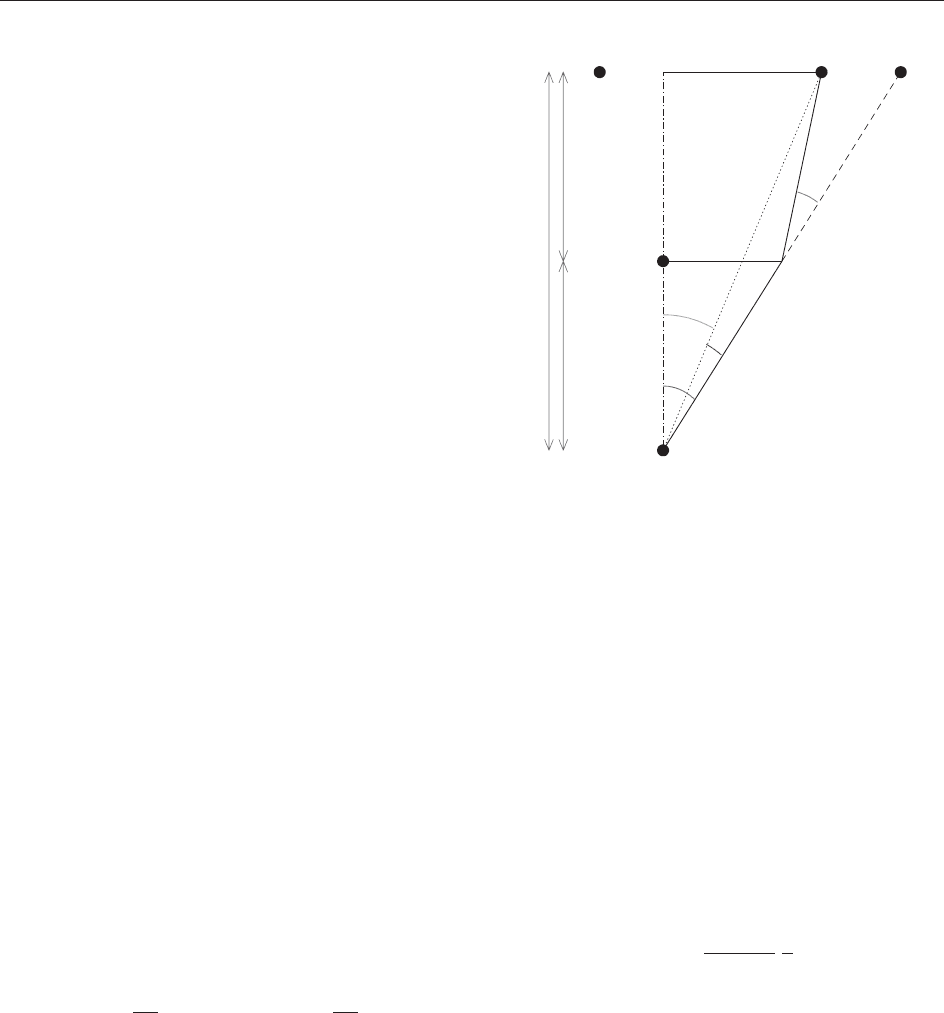
lens is displayed in Figure 1. The three ingredients in
such a lensing situation are the source S, the lens L,
and the observer O. Light rays emitted from the
source are defl ected by the lens. For a point-like
lens, there will always be (at least) two images S
1
and S
2
of the source. With external shear – due to
the tidal field of objects outside but near the light
bundles – there can be more images. The observer
sees the images in directions corresponding to the
tangents to the real incoming light paths.
In Figure 1, the corresponding angles and angular
diameter distances D
L
, D
S
, D
LS
are indicated. (In
cosmology, the various methods to define distance
diverge. The relevant distances for gravitational
lensing are the angular diameter distances.) In the
thin-lens approximation, the hyperbolic paths are
approximated by their asymptotes. In the circular-
symmetric case, the deflection angle is given as
~
ðÞ¼
4GMðÞ
c
2
1
½4
where M() is the mass inside a radius . In this
depiction, the origin is chosen at the observer. From
the diagram, it can be seen that the following
relation holds:
D
S
¼ D
S
þ
~
D
LS
½5
(for , ,
˜
1; this condition is fulfilled in practi-
cally all astrophysically relevant situations). With
the definition of the reduced deflection angle as
() = (D
LS
=D
S
)
˜
(), this can be expressed as
¼ ðÞ½6
This relation between the positions of images and
source can easily be derived for a nonsymmetric
mass distribution as well. In that case, all angles are
S
2
S
1
S
D
LS
D
S
D
L
L
η
α
β
ξ
α
~
θ
0
Figure 1 The relation between the various angles and
distances involved in the lensing setup can be derived for the
case
˜
1 and formulated in the lens equation [6].
568 Gravitational Lensing

vector valued. The two-dimensional lens equation
then reads
b ¼ q aðqÞ½7
Einstein Radius
For a point lens of mass M, the deflection angle is
given by eqn [4]. Plugging this deflection angle into
eqn [6] and using the relation = D
L
(cf. Figure 1),
one obtains
ðÞ¼
D
LS
D
L
D
S
4GM
c
2
½8
For the special case in which the source lies exactly
behind the lens ( = 0), due to the symmetry, a ring-
like image occurs whose angular radius is called
Einstein radius
E
:
E
¼
ffiffiffiffiffiffiffiffiffiffiffiffiffiffiffiffiffiffiffiffiffiffiffiffiffi
4GM
c
2
D
LS
D
L
D
S
s
½9
The Einstein radius defines the angular scale for a
lens situation. For a massive galaxy with a mass of
M = 10
12
M
at a redshift of z
L
= 0.5 and a source at
redshift z
S
= 2.0 (we us ed here H = 50 km s
1
Mpc
1
as the value of the Hubble constant and an Einstein–
de Sitter universe), the Einstein radius is
E
1:8
ffiffiffiffiffiffiffiffiffiffiffiffiffiffiffiffiffi
M
10
12
M
s
arcsec ½10
(note that for cosmological distances, in general,
D
LS
6¼ D
S
D
L
!). For a galactic microlensing sce-
nario in which star s in the disk of the Milky Way act
as lenses for stars close to its center, the scale
defined by the Einstein radius is
E
0:5
ffiffiffiffiffiffiffiffi
M
M
s
marcsec ½11
An application and some illustrations of the point
lens case can be found in the section on galac tic
microl ensing.
Critical Surface Mass Density
In the more general case of a three-dimensional mass
distribution of an extended lens, the density (r) can
be projected along the line of sight onto the lens
plane to obtain the two-dimensional surface mass
density distribution (x)as
ðxÞ¼
Z
D
S
0
ðrÞdz ½12
Here r is a three-dimensional vector in space, and x
is a two-dimensional vector in the lens plane. The
two-dimensional deflection angle
˜
a is then given as
the sum over all mass elements in the lens plane:
˜
aðxÞ¼
4G
c
2
Z
ðx x
0
Þðx
0
Þ
jx x
0
j
2
d
2
0
½13
For a finite circle with constant surface mass density
, the deflection angle can be written as
ðÞ¼
D
LS
D
S
4G
c
2
2
½14
With = D
L
this simplifies to
ðÞ¼
4G
c
2
D
L
D
LS
D
S
½ 15
With the definition of the critical surface mass
density
crit
as
crit
¼
c
2
4G
D
S
D
L
D
LS
½16
the deflection angle for a such a mass distribution
can be expressed as
~
ðÞ¼
crit
½17
The critical surface mass density can be visualized as
the lens mass M ‘‘smeared out’’ over the area of the
Einstein ring:
crit
= M=(R
2
E
), where R
E
=
E
D
L
.
The value of the critical surface mass density is
roughly
crit
0.8 g cm
2
for lens and source red-
shifts of z
L
= 0.5 and z
S
= 2.0, respectively. For an
arbitrary mass distribution, the condition >
crit
at any point is sufficient to produce multiple images.
Image Positions and Magnifications
The lens equation [6] can be re-formulated in the
case of a single-point lens:
¼
2
E
½18
Solving this for the image positions , one finds that
an isolated point source always produces two
images of a background source. The positions of
the images are given by the two solutions:
1; 2
¼
1
2
ffiffiffiffiffiffiffiffiffiffiffiffiffiffiffiffiffiffi
2
þ 4
2
E
q
½19
The magnification of an image is defined by the
ratio between the solid angles of the image and the
source, since the surface brightness is conserved.
Hence, the magnification is given as
¼
d
d
½20
Gravitational Lensing 569

In the symmetric case above, the image magnifica-
tion can be written as (by using the lens equation)
1; 2
¼ 1
E
1;2
4
!
1
¼
u
2
þ 2
2u
ffiffiffiffiffiffiffiffiffiffiffiffiffiffi
u
2
þ 4
p
1
2
½21
Here we defined u as the ‘‘impact parameter,’’ the
angular separation between lens and source in units
of the Einstein radius: u = =
E
. The magnification
of one image (the one inside the Einstein radius) is
negative. This means it has negative pa rity: it is
mirror-inverted. For ! 0 the magnification
diverges. In the limit of geometrical optics, the
Einstein ring of a point source has infinite magnifi-
cation! (Due to the fact that physical objects have a
finite size, and also because at some limit wave
optics has to be applied, in reality the magnification
stays finite.) The sum of the absolute values of the
two image magnifications is the measurable total
magnification :
¼j
1
jþj
2
j¼
u
2
þ 2
u
ffiffiffiffiffiffiffiffiffiffiffiffiffiffi
u
2
þ 4
p
½22
Note that this value is (always) larger than 1! (This
does not violate energy conservation, since this is the
magnification relative to an ‘‘empty’’ universe and
not relative to a ‘‘smoothed out’’ universe. This issue
is treated in detail in Schneider et al. (1992, chapter
4.5).) The ‘‘sum’’ of the two image magnifications is
unity:
1
þ
2
¼ 1 ½ 23
(Non)Singular Isothermal Sphere
A popular model for galaxy lenses is the singular
isothermal sphere with a three-dimensional density
distribution of
ðrÞ¼
2
v
2G
1
r
2
½24
where
v
is the one-dimensional velocity dispersion.
Projecting the matter on a plane, one obtains the
circularly symmetric surface mass distribution
ðÞ¼
2
v
2G
1
½25
With M() =
R
0
(
0
)2
0
d
0
plugged into eqn [4],
one obtains the deflection angle for an isothermal
sphere, which is a constant (i.e., independent of the
impact parameter ):
~
ðÞ¼4
2
v
c
2
½26
In practical units for the velocity dispersion of a
galaxy, this can be expressed as
~
ðÞ¼1:15
v
200 km s
1
2
arcsec ½27
Two generalizations of this isothermal model are
commonly used: models with finite cores are more
realistic for (spiral) galaxies. In this case, the
deflection angle is modified to (core radius
c
):
~
ðÞ¼4
2
v
c
2
ð
2
c
þ
2
Þ
1=2
½28
Furthermore, a realistic galaxy lens usually is not
perfectly symmetric but is slightly elliptical. Depend-
ing on whether one wants an elliptical mass
distribution or an elliptical potential, various form-
alisms are in use.
Lens Mapping
In the vicinity of an arbitrary point, the lens
mapping as shown in eqn [7] can be described by
its Jacobian matrix A:
A¼
@b
@q
¼
ij
@
i
ðqÞ
@
j
¼
ij
@
2
ðqÞ
@
i
@
j
½29
Here we made use of the fact that the deflection
angle can be expressed as the gradient of an effective
two-dimensional scalar potential :
= a, where
ðqÞ¼
D
LS
D
L
D
S
2
c
2
Z
ðrÞdz ½30
and (r) is the Newtonian potential of the lens. The
determinant of the Jacobian A is the inverse of the
magnification:
¼
1
det A
½31
Defining
ij
¼
@
2
@
i
@
j
½32
the Laplacian of the effective potential is twice the
convergence:
11
þ
22
¼ 2 ¼ tr
ij
½33
With the definitions of the components of the
external shear ,
1
ðqÞ¼
1
2
ð
11
22
Þ¼ðqÞcos½2’ðqÞ ½34
and
2
ðqÞ¼
12
¼
21
¼ ðqÞsin½2’ðq Þ ½35
570 Gravitational Lensing

(where the angle ’ reflects the direction of the shear-
inducing tidal force relative to the coordinate
system), the Jacobian matrix can be written as
A¼
1
1
2
2
1 þ
1
¼ð1 Þ
10
01
cos 2’ sin 2’
sin 2’ cos 2’
½36
The magnification can now be expressed as a
function of the local convergence and the local
shear :
¼ðdet AÞ
1
¼
1
ð1 Þ
2
2
½37
Locations at which det A = 0 have formally infinite
magnification. They are called ‘‘critical curves’’ in
the lens plane. The corresponding locations in the
source plane are the ‘‘caustics.’’ For spherically
symmetric mass distributions, the critical curves are
circles. For a point lens , the caustic degenerates into
a point. For elliptical lenses or spherically symmetric
lenses plus external shear, the caustics consist of
cusps and folds.
Time Delay and Fermat’s Theorem
The deflection angle is the gradient of an effective
lensing potential . Hence, the lens equation can be
rewritten as
ðq bÞ
¼ 0 ½38
or
1
2
ðq bÞ
2
¼ 0 ½39
The term in brackets appears as well in the physical
time delay function for gravitationally lensed
images:
ðq; bÞ¼
geom
þ
grav
¼
1 þ z
L
c
D
L
D
S
D
LS
1
2
ðq bÞ
2
ðÞ
½40
This time delay surface is a function of the image
geometry (q, b), the gravitational potential , and
the distances D
L
, D
S
, and D
LS
. The first part – the
geometrical time delay
geom
– reflec ts the extra path
length compared to the direct line between observer
and source. The second part – the gravi tational time
delay
grav
– is the retardation due to gravitational
potential of the lensing mass (known and confirmed
as Shapiro delay in the solar system). From eqns [39]
and [40], it follows that the gravitationally lensed
images appear at locations that correspond to
extrema in the light travel time, which reflects
Fermat’s principle in gravitational-lensing optics.
The (angular-diameter) distances that appear in
eqn [40] depend on the value of the Hubble
constant. Therefore, it is possible to determine the
latter by measuring the time delay between different
images and using a good model for the effective
gravitational potential of the lens.
Lensing Phenomena
Strong lensing phenomena involve multiple images,
caustics, critical lines, usually a significant magnifi-
cation, and large distortions if extended sources are
involved. Below we discuss the most frequent strong
lensing phenomena.
Galactic Microlensing
The conceptually simplest strong lensing scenario is
a foreground star acting as a lens on a background
star. Since stars in the Milky Way move relative to
each other, this can be observed as a time-variable
situation: due to the relative motion between
observer, lensing star, and source star, the projected
impact parameter between lens and source changes
with time and produces a time-dependent magnifi-
cation. If the impact parameter is smaller than an
Einstein radius (u < 1), then the magnification is
min
> 1.34 (cf. eqn [22]).
For an extended source, a sequence image
configurations with decreasing impact parameter
is illustrated in Figure 2 for five instants of time.
The separation of the two images is of order-2
Einstein radii when they are of comparable
magnification, which corresponds to only about
1 marcsec in a realistic situation in the Milky
Way. Hence, the two images cannot be resolved
individually; we can only observe the c ombined
brightness of the image pair. This is illustrated in
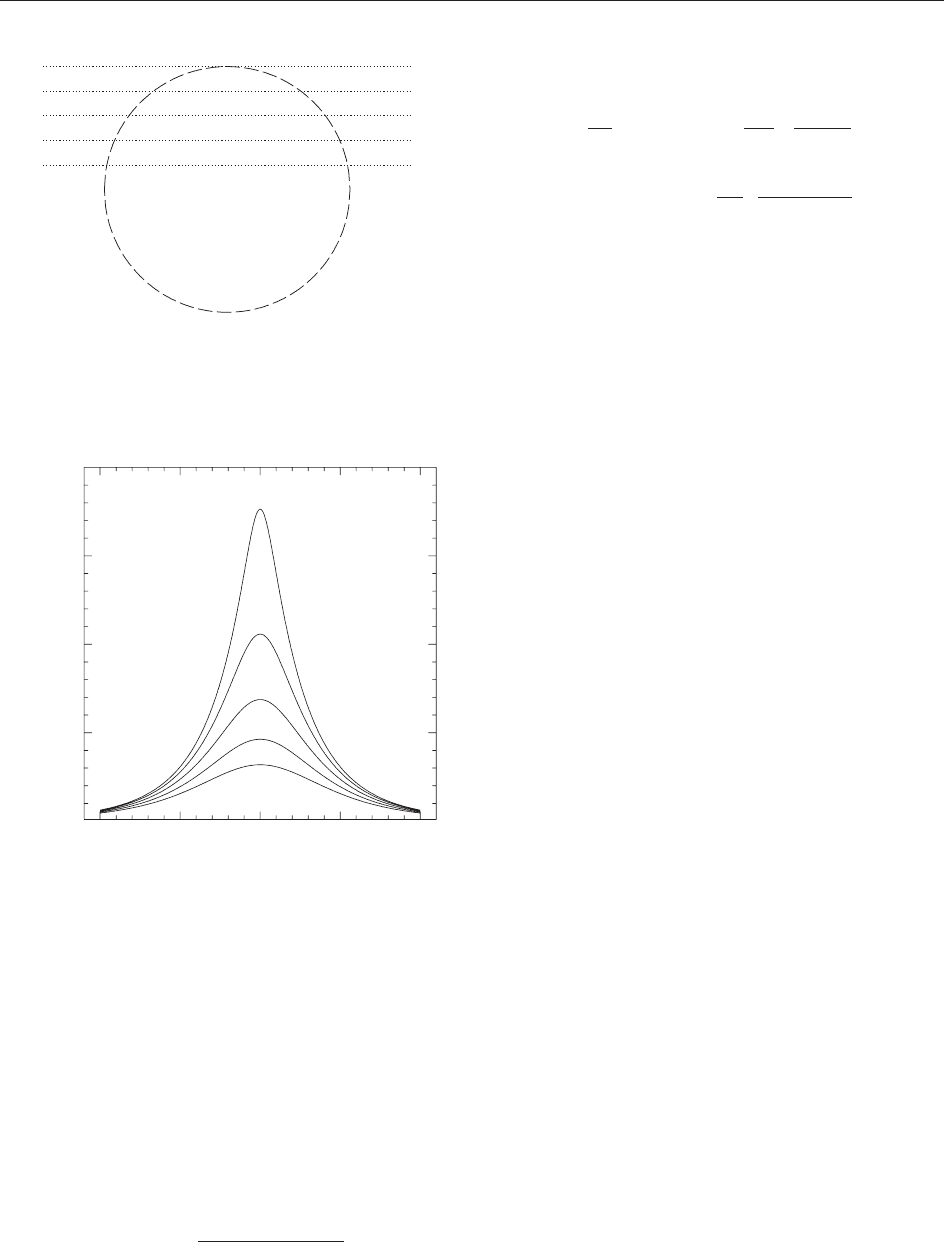
Figures 3 and 4, which show the rel ative tr acks
and the respective light curves for five values of
the minim um impact parameter u
min
.
Figure 2 Five snapshots of a gravitational lens situation with a
point lens and an extended source: from left to right the
alignment between lens and source gets better and better, until
it is perfect in the rightmost panel. This results in the image of an
‘‘Einstein ring.’’
Gravitational Lensing 571
Quantitatively, the total magnification = j
1
jþ
j
2
j of the two images (cf. eqn [22]) entirely depends
on the impact parameter u(t) = r(t)=R
E
between the
lensed star and the lensing object, measured in the
lens plane (here R
E
is the Einstein radius of the lens,
i.e., the radius at which a circular image appears for
perfect alignment between source, lens, and obser-
ver, cf. Figure 2, rightmost panel):
ðuðtÞÞ ¼
uðtÞ
2
þ 2
uðtÞ
ffiffiffiffiffiffiffiffiffiffiffiffiffiffiffiffiffiffiffiffiffiffiffi
ðuðtÞ
2
þ 4Þ
q
½41
The timescale of such a ‘‘microlensing event’’ is
defined as the time it takes for the source to cross
the Einstein radius. With realistic values for dis-
tances and relative velocity, this can be expressed as
t
0
¼
R
E
v
?
0:214 yrðÞ
ffiffiffiffiffiffiffiffi
M
M
s
ffiffiffiffiffiffiffiffiffiffiffiffiffiffi
D
L
10 kpc
s
ffiffiffiffiffiffiffiffiffiffiffiffiffiffiffi
1
D
L
D
S
s
v
?
200 km s
1
1
½42
(here v
?
is the (relative) transverse velocity of the
lens; we ap plied the simple relation D
LS
= D
S
D
L
,
which is valid here).
Note that from eqn [42] it is obvious that it is not
possible to determine the mass of the lens from one
individual microlensing event. The duration of an
event is determined by three unknown parameters:
the mass of the lens m, the transverse velocity v
?
,
and the distance of the lens D
L
(assuming we know
the distance to the source). It is impossible to
disentangle these for individual events. Only with a
model for the spatial and velocity distribution of the
lensing stars in the Milky Way, one can obtain
approximate information about the masses of the
lensing objects.
In 1986, Bohdan Paczyn
´
ski suggested to use this
microlensing method as an observational test for
potential dark matter candidates in the halo of the
Milky Way. If the dark matter is in the form of
astrophysical objects (such as brown dwarfs, neu-
tron stars, black holes, sometimes called ‘‘MACHO’’
for MAssive Compact Halo Object), then they
should occasionally act as lenses on stars in the
neighboring galaxy Large Magellanic Cloud. It
turned out that too few of such microlensing events
were observed, in order to explain the dark matter
this way.
However, this method produced more than 2000
microlensing events by ordinary stars in the direc-
tion to the center of the Milky Way. Two of these
events provide convincing evidence for a planet
accompanying the lensing star. It is likely that
gravitational microlensing will provide a statistically
very valuable sample of extrasolar planets, because
in contrast to most other methods these planets are
pre-selected by their host stars. Furthermore, micro-
lensing is sensitive to masses as low as a few Earth
masses.
Multiply-Imaged Quasars
The first gravitationally lensed double quasar was
discovered in 1979: two images of the same quasar,
separated by about 6 arcsec. This led to the field of
gravitational lensing as an observational science. By
now, more than 120 multiply imaged quasars are
known, mostly double and quadruple images. They
u
min
= 1.0
u
min
= 0.8
u
min
= 0.6
u
min
= 0.4
u
min
= 0.2
*
Figure 3 Five relative tracks between background star and
foreground lens (indicated as the central star) parametrized by
the impact parameter u
min
. The dashed line indicates the
Einstein ring for the lens.
012–1–2
–2
–1.5
–1
–0.5
–2 –1 0 1 2
Time (in t
E
=
R
E
/V
⊥
)
u
min
= 1.0
u
min
= 0.2
Δm (in magnitudes)
Figure 4 Five microlensing light curves for the tracks indicated
in Figure 3, parametrized by the impact parameter u
min
. The
vertical axis is the magnification in astronomical magnitudes
relative to the unlensed case, the horizontal axis displays the
time in ‘‘normalized’’ units.
572 Gravitational Lensing
span image separations from 0.3 arcsec to almost 30
arcsec.
Gravitationally lensed quasar systems are studied
individually in great detail to get a better under-
standing of both lens and source. The lens systems
are analyzed statistically as well, in order to get
information about the population of lenses (and
quasars) in the universe, their distribution in
distance (i.e., cosmic time) and mass, and hence
about the cosmological model.
Time delay and Hubble constant As stated above,
the signals from a gravitational lens system reach us
with a certain ‘‘time delay’’ t , so that the measured
fluxes as functions of time, I
A
(t)andI
B
(t), can be
described as: I
B
(t) = const. I
A
(t þ t). Any intrin-
sic fluctuation of the quasar shows up in both
images, in general with an overall offset in apparent
magnitude and an offset in time.
Q0957 þ 561 is the first lens system in which the
time delay was firmly established:
t
Q0957þ561
¼ð417 3Þdays ½43
With a model of the lens system, the time delay
can be used to determine the Hubble constant. (This
can be seen very simply: imagine a certain lens
situation like the one displayed in Figure 1. If now
all length scales are reduced by a factor of 2 and at
the same time all masses are reduced by a factor of
2, then for an observer, the angular configuration in
the sky would appear exactly identical. But the total
length of the light path is reduced by a factor of 2.
Now, since the time delay between the two paths is
the same fraction of the total lengths in either
scenario, a measurement of this fractional length
allows us to determine the total length, and hence
the Hubble constant, the co nstant of proportionality
between dist ance and redshift.) The resulting value
of H
0
is
H
0
¼ð67 13Þkm s
1
Mpc
1
½44
where the uncertainty comprises the 95% confi-
dence level. To date, abou t a dozen quasar lens
systems have measured time delays. The derived
values of the Hubble constant are ‘‘lowish,’’ if we
assume the best astrophysical motivated lens
models.
Quasar Microlensing
Light bundles from ‘‘lensed’’ quasars are split by
intervening galaxies. Usually the quasar light bundle
passes through the galaxy and/or the galaxy halo.
Galaxies consist at least partly of star s, and galaxy
halos consist possibly of compact objects as well.
Each of these stars (or other compact objects like
black holes, brown dwarfs, or planets) acts as a
‘‘compact lens’’ or ‘‘microlens’’ and produces at least
one additional microimage of the source. This
means the ‘‘macroimage’’ consists of many ‘‘micro-
images’’ (Figure 5). But because the image splitting is
proportional to the square root of the lens mass,
these microimages are only of order a microarcse-
cond apart and cannot be resolved. Various aspects
of microlensing have been addressed after the first
double quasar had been discovered.
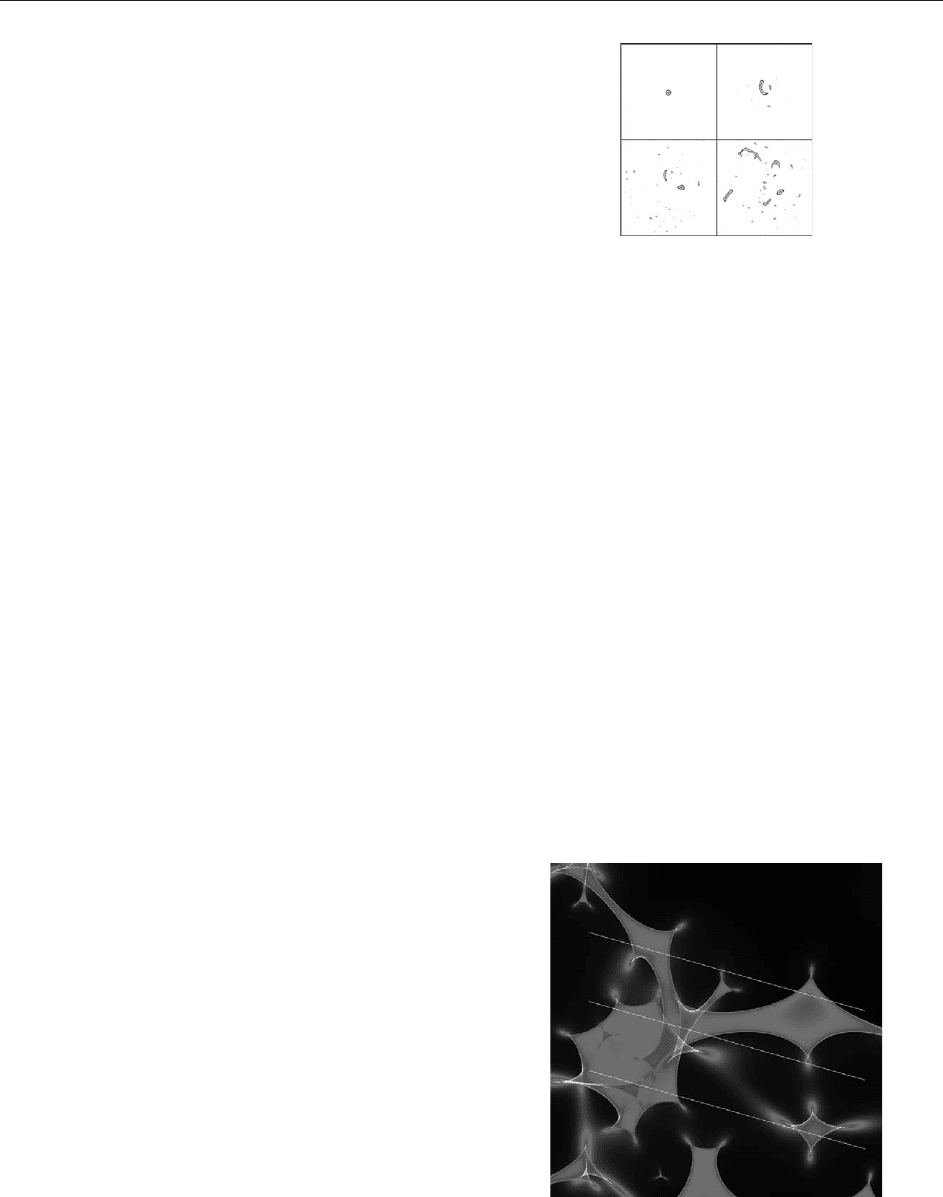
The microlenses produce a complicated two-
dimensional magnification distribution in the source
plane. It consists of many caustics, locations that
correspond to formally infinitely high magnification.
An example for such a magnification pattern is shown
in Figure 6. It is determined with the parameters of
image A of the quadruple quasar Q2237 þ 0305
Figure 5 ‘‘Microimages’’: the top left panel shows an assumed
‘‘unlensed’’ source profile of a quasar. The other three panels
illustrate the microimage configuration as it would be produced
by stellar objects in the foreground. The surface mass density of
the lenses is 20% (top right), 50% (bottom left), and 80%
(bottom right) of the critical density (cf. eqn [16]).
Figure 6 Magnification pattern in the source plane, produced
by a dense field of stars in the lensing galaxy. The gray scale
reflects the magnification as a function of the quasar position.
Light curves taken along the straight tracks are shown in
Figure 7. The microlensing parameters were chosen according
to a model for image A of the quadruple quasar Q2237 þ
0305: = 0.36, = 0.44.
Gravitational Lensing 573
(surface mass density = 0.36; external shear
= 0.44). Gray scale indicates the magnification.
Due to the relative motion between observer, lens,
and source, the quasar changes its position relative
to this arrangement of caustics, that is, the apparent
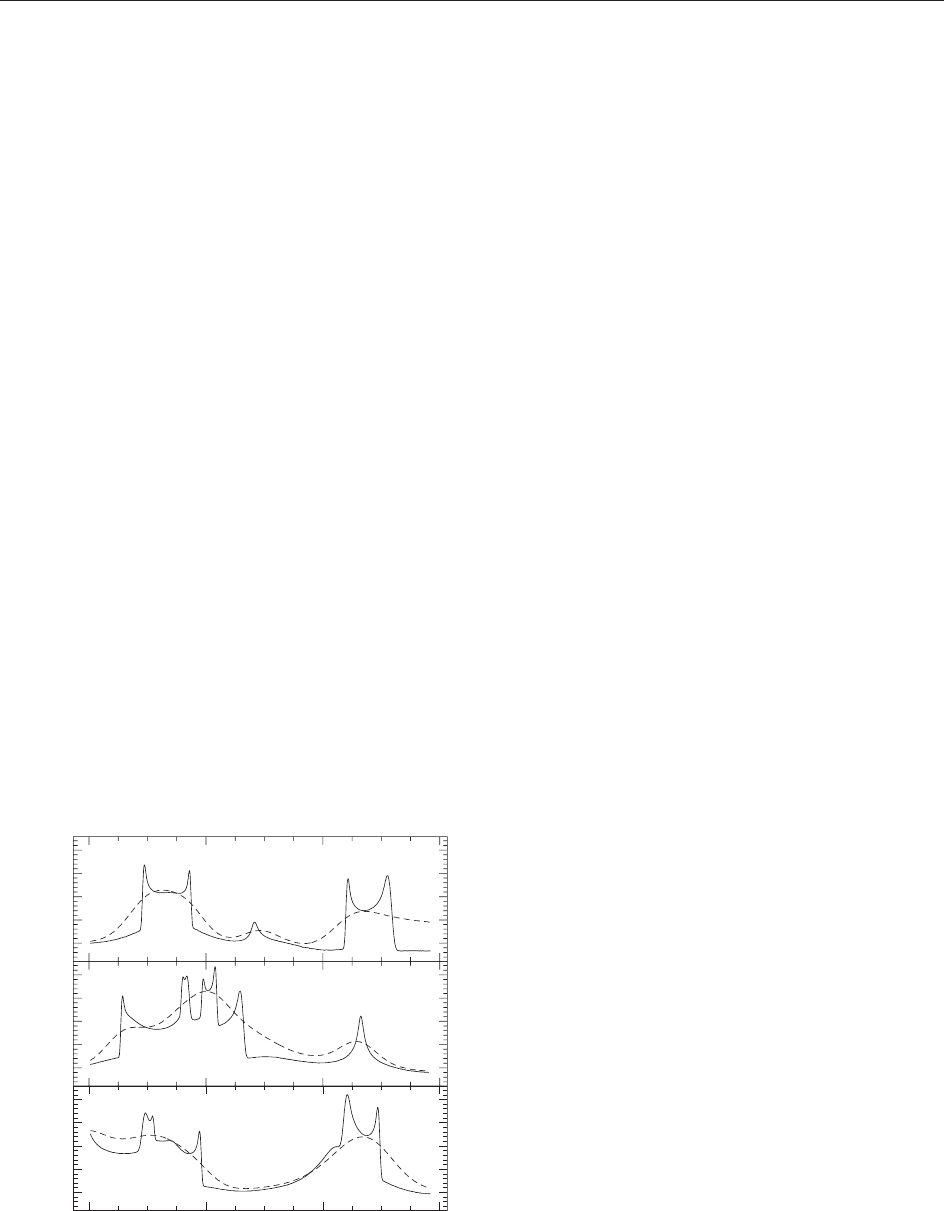
brightness of the quasar changes with time. A one-
dimensional cut through such a magnification
pattern, convolved with a source profile of the
quasar, results in a microlensed light curve. Exam-
ples for microlensed light curves taken along the
straight lines in Figure 6 can be seen in Figure 7 for
two different quasar sizes.
In pa rticular when the quasar track crosses a
caustic (the sharp lines in Figure 6 for which the
magnification formally is infinite, because the deter-
minant of the Jacobian disappears, cf. eqn [31]), a
pair of highly magnified microimages appears
newly or merges and disappears. Such a microlen-
sing event can easily be detected as a strong peak in
the light curve of the quasar image.
Microlens-induced fluctuations in the observed
brightness of quasars contain information both
about the light-emitting source (size of continuum
region or broad line region of the quasar, brightness
profile of quasar) and abou t the lensing objects
(masses, density, transvers e velocity). Hence, from a
comparison between observed and simulated quasar
microlensing, one can draw conclusions about the
density and mass scale of the microlenses. So far the
‘‘best’’ example of a microlensed quasar is the
quadruple quasar Q2237 þ 0305.
Einstein Rings
If a point source lies exactly behind a point lens, a ring-
like image occurs. Theorists had recognized early on
that such a symmetric lensing arrangement would result
in a ring image, the so-called ‘ ‘Einstein ring.’ ’ There are
two necessary requirements for the observability of
Einstein rings: the mass distribution of the lens needs to
be approximately axially symmetric, as seen from the
observer, and the source must lie exactly on top of the
resulting degenerate pointlike caustic. Such a geometric
arrangement is highly unlikely for pointlike sources. But
astrophysical sources in the real universe have a finite
extent, and it is enough if a part of the source covers the
point caustic (or the complete astroid caustic in the case
of a not quite axially symmetric mass distribution) in
order to produce such an annular image.
In 1988, the first example of an ‘‘Einstein ring’’
was discovered. With high-resolution radio observa-
tions, the extended radio source MG1131 þ 0456
turned out to be a ring with a diameter of about
1.75 arcsec. The source was identified as a radio
lobe at a redshift of z
S
= 1.13, whereas the lens is a
galaxy at z
L
= 0.85. By now more than a dozen cases
have been fou nd that qualify as Einstein rings. Their
diameters vary between 0.33 and about 2 arcsec.
Giant Luminous Arcs and Arclets
Fritz Zwicky had pointed out the potential use of
galaxies and galaxy clusters as gravitational lenses in
the 1930s. With background galaxies as sources, the
apparent lensing consequences for them would be
far more dramatic than for quasars: galaxies should
be heavily deformed once they are strongly lensed.
Rich clusters of galaxies at redshifts beyond z 0.2
with masses of order 10
14
M
are very effective
lenses if they are centrally concentrated. Their
Einstein radii are of the order of 20 arcsec.
In 1986, the following gravitational lensing phe-
nomenon was discovered: magnified, distorted, and
strongly elongated images of background galaxies
which happen to lie behind foreground clusters of
galaxies, the so-called giant luminous arcs. The giant
arcs can be exploited in two ways, as is typical for
many lens phenomena. Firstly, they provide us with
strongly magnified galaxies at (very) high redshifts.
These galaxies would be too faint to be detected or
analyzed in their unlensed state. Hence, with the
lensing boost, we can study these galaxies in their early
evolutionary stages, possibly as infant or protoga-
laxies, relatively shortly after the big bang. The other
practical application of the arcs is to take them as tools
to study the potential and mass distribution of the
lensing galaxy cluster. In the simplest model of a
spherically symmetric mass distribution for the cluster,
2046
0246
–1.5
–1.5
–1
–1
–0.5
–0.5
–1.5
–1
–0.5
0
0
0.5
0.5
0
0.5
Normalized time t
E
Δm (magnitudes)
Figure 7 Microlensing light curve for the straight lines in
Figure 6. The solid and dashed lines indicate relatively small and
large quasar sizes. The time axis is in units of Einstein radii
divided by unit velocity.
574 Gravitational Lensing

giant arcs form very close to the critical curve, which
marks the Einstein ring. So with the redshifts of the
cluster and the arc, it is easy to determine a rough
estimate of the lensing mass by just determining the
radius of curvature and interpreting it as the Einstein
radius of the lens system.
Weak Lensing/Statistical Lensing/Cosmic Shear
In contrast to the phenomena that were mentioned
here, ‘‘weak lensing’’ deals with effects of light
deflection that cannot be measured individually, but
rather in a statistical way only. No caustics, critical
lines, or multiple images are involved. As was
discussed above, ‘‘strong lensing’’ – usually defined as
the regime that involves multiple images, high magni-
fications, and caustics in the source plane – is a rare
phenomenon. Weak lensing on the other hand is much
more common. In principle, weak lensing acts along
each line of sight in the universe, since each light
bundle’s path is affected by matter inhomogeneities
along or near its path. It is just a matter of how
accurately we can measure. In recent years, many
teams started impressive and ambitious observational
programs to determine the slight distortion of tens of
thousands of background galaxies by foreground
galaxy clusters and/or by the large-scale structure in
the universe, the so-called cosmic shear. It is beyond
the scope of this article to discuss these applications of
weak gravitational lensing. The interested reader is
referred to the ‘‘Further reading’’ section, in particular
to Bartelmann and Schneider (2001).
See also: Cosmology: Mathematical Aspects; General
Relativity: Experimental Tests; General Relativity:
Overview; Newtonian Limit of General Relativity;
Singularity and Bifurcation Theory.
Further Reading
Bartelmann M and Schneider P (2001) Weak gravitational
lensing. Physics Reports 340: 291.
Bliokh PV and Minakov AA (1989) Gravitational Lensing, (in
Russian). Kiev: Izdatel’stvo Naukova Dumka.
Kochanek CS, Schneider P, and Wambsganss J (2005) In: Meylan G,
Jetzer P, and North P (eds.) Gravitational Lensing: Strong,
Weak & Micro, Proceedings of the 33rd Saas-Fee Advanced
Course. Berlin: Springer.
Mollerach S and Roulet E (2002) Gravitational Lensing and
Microlensing. World Scientific.
Narayan R and Bartelmann M (1997) Lectures on gravitational
lensing. In: Dekel A and Ostriker JP (eds.) Proceedings of the
1995 Jerusalem Winter School.
Paczyn
´
ski B (1996) Gravitational microlensing in the local group.
Annual Review of Astronomy and Astrophysics 34: 419.
Perlick V (2000) Ray Optics, Fermat’s Principle, and Applications to
General Relativity, Lecture Notes in Physics, vol. 61. Springer.
Perlick V (2004) Gravitational Lensing from a Spacetime
Perspective, Living Reviews in Relativity, 9/2004 http://
relativity.livingreviews.org
Petters AO, Levine H, and Wambsganss J (2001) Singularity
Theory and Gravitational Lensing (Birkhauser 2001), Progress
in Mathematical Physics, vol. 21.
Schneider P, Ehlers J, and Falco EE (1992) Gravitational Lenses.
Berlin: Springer.
Wambsganss J (1998) Gravitational Lensing in Astronomy,Living
Reviews in Relativity, 12/1998 http://relativity.livingreviews.org
Gravitational N-Body Problem (Classical)
D C Heggie, The University of Edinburgh,
Edinburgh, UK
ª 2006 Elsevier Ltd. All rights reserved.
Introduction
Let a number, N, of particles interact classically
through Newton’s laws of motion and Newton’s
inverse-square law of gravi tation. Then the equa-
tions of motion are
€
r
i
¼G
X
j¼N
j¼1; j6¼i
m
j
r
i
r
j
jr
i
r
j
j
3
½1
where r
i
is the position vector of the ith particle
relative to some inertial frame, G is the universal
constant of gravitation, and m
i
is the mass of the ith
particle. These equations provide an approximate
mathematical model with numerous applications in
astrophysics, including the motion of the Moon and
other bodies in the solar system (planets, asteroids,
comets, and meteor particles); stars in stellar systems
ranging from binary and other multiple stars to star
clusters and galaxies; and the motion of dark-matter
particles in cosmology. For N = 1andN = 2, the
equations can be solved analytically. The case N = 3
provides one of the richest of all unsolved dynamical
problems – the general three-body problem. For
problems dominated by one massive body, as in
many planetary proble ms, approximate methods
based on perturbation expansions ha ve been devel-
oped. In stellar dynamics, astrophysicists have
developed numerous numerical and theoretical
approaches to the problem for larger values of N,
including treatments based on the Boltzmann equa-
tion and the Fokker–P lanck equation; such N-body
systems can also be modeled as self-gravitating
Gravitational N-Body Problem (Classical) 575