
Francoise J.-P., Naber G.L., Tsun T.S. (editors) Encyclopedia of Mathematical Physics
Подождите немного. Документ загружается.


C
f
K(f )). In the quadratic case, the Basic Dicho t-
omy holds: the Julia set (and the filled Ju lia set) is
either connected or a Cantor set .
Bo¨ ttcher Coordinate
Let f = z
d
þ a
1
z
d1
þþa
d
be a monic polyno-
mial of degree d 2. Then 1 is a superattracting
fixed point, and hence there is a univalent function
B(z) = B
f
(z) near 1 satisfying the Bo¨ ttcher equation
B(fz) = B(z)
d
(the Bo¨ ttcher coordinate near 1).
Moreover, B(z) z as z !1since f is monic.
If J(f ) is connected, B(z) can be analytically
extended to the whole basin of 1, and provides us
with the Riemann map CnK(f ) !Cn
D. Otherwise,
B(z) extends to a conformal map from some
invariant domain
f
whose boundary contains a
critical point onto Cn
D
R
, where R = R
f
> 1.
The B-preimage of a straight ray {re
2i
:0< r < 1}
is called the external ray R
of angle .TheB-preimage
of a round circle {re
2i
:0 <1} is called the
equipotential E
t
of level t = log r. External rays and
equipotentials form two orthogonal f-invariant folia-
tions. We let R
(t) = R
\E
t
.
Combinatorial Equivalence
Assume now that J(f) is connected. One says that an
external ray R
lands at some point z 2 J(f )if
R
(t) !z as t !0. Any external ray of rational
angle = q=p with odd p lands at some repelling or
parabolic periodic point of period dividing p
(Douady and Hubbard 1982). Vice versa, any
repelling or parabolic point is a landing point of at
least one rational ray as above (Douady 1990s).
Let us consider the following equivalence relation
on the set of rational numbers with odd denomi-
nators: two such numbers and
0
are equivalent if
the corresponding rays R
and R
0
land at the same
point z 2 J(f ). Two polynomials f and
~
f with
connected Julia set are called combinatorially
equivalent if the corresponding equivalence relations
coincide. Notice that topologically equivalent poly-
nomials are combinatorially equivalent.
Parameter Phenomena
Spaces of Rational Functions
Let Rat
d
stand for the space of rational functions
of degree d. As an open subset of the complex
projective space CP
2dþ1
, it is endowed with the
natural topology and complex structure.
Hyperbolic Maps and Fatou’s Conjecture
Hyperbolic maps form an important and best-
understood class of rational maps (compare with
Hyperbolic Dynamical Systems). A rational map f is
called hyperbolic if one of the following equiva lent
conditions holds:
All critical points of f converge to attracting
cycles;
The map is expanding on the Julia set:
jDf
n
ðzÞj C
n
; z 2 Jðf Þ
where C > 0, >1.
For instance, the maps z 7!z
2
þ " for small
", z 7!z
2
1, and z 7!z
2
þ c for c 2 Rn[2, 1=4]
are hyperbolic. It is easy to see from the first
definition that hyperbolicity is a stable property,
that is, the set of hyperbo lic maps is open in the
space Rat
d
of rational maps of degree d. One of the
central open problems in holomorphic dynamics is
to prove that this set is also dense. This problem is
known as Fatou’s conjecture.
Postcritically Finite Maps and Thurston’s Theory
A rational map is called postcritically finite if the
orbits of all criti cal points are finite. In this case, any
critical point c is either a superattracting periodic
point, or a repelling preperiodic point (i.e., f
n
c is a
repelling periodic point for some n). If all critical
points of f are preperiodic, then J(f ) =
^
C.
Important examples of postcritically finite maps with
J(f ) =
^
C come from the theory of elliptic functions.
Namely, let P
: C=
!
^
C be the Weierstrass
P-function , where
is the lattice in C generated by
1and,Im>0. It satisfies the functional equation
P
(nz) = f
, n
(P( z)), where f
, n
is a rational function.
These f unctions called Latte´s examples possess the
desired properties. (For some special lattices, n can be
selected complex: the corresponding maps are also
called Latte´s.)
More generally, one can consider postcritically
finite topological branched coverings f : S
2
!S
2
.Two
such maps, f and g, are called Thurston combina-
torially equivalent if there exist homeomorphisms
h, h
0
:(S
2
, O
f
) !(S
2
, O
g
) homotopic rel O
f
(and
hence coinciding on O
f
)suchthath
0
f = h g.
A combinatorial class is called realizable if it
contains a rational function. Thurston (1982) gave a
combinatorial criterion for a combinatorial class to
be realizable. If it is realizable, then the realization is
unique, except for Latte´s examples (Thurston’s
Rigidity Theorem).
656 Holomorphic Dynamics
Structural Stability and Holomorphic Motions
A map f 2 Rat
d
is called J-stable if for any maps
g 2 Rat
d
sufficiently close to f, the maps f jJ(f ) and
g jJ(g) are topologically conjugate, and moreover,
the conjugacy h
g
: J(f ) !J(g) is close to id. Thus, the
Julia set J(f ) moves continuously over the set of
J-stable maps. The following result proves a weak
version of Fatou’s conjecture:
Theorem 4 (Lyubich and Man
˜
e´-Sad-Sullivan
1983). The set of J-stable maps is open and dense
in Rat
d
. Moreov er, the set of unstable maps is the
closure of maps that have a pa rabolic periodic point.
A map f 2 Rat
d
is called structurally stable if for
any maps g 2 Rat
d
sufficiently close to f, the maps f
and g are topologically conjugate on the whole
sphere, and moreover, the conjugacy h
g
:
^
C !
^
C is
close to id. The set of structurally stable maps is also
open and dense in Rat
d
(Man
˜
e´-Sad-Sullivan).
The proofs make use of the theory of holomorphic
motions developed for this purpose but having much
broader range of applications in dynamics and
analysis. Let X be a subset of
^
C, and let h
: X !
^
C
be a family of injections depending on parameter
2 in some complex manifold with a marked
point
. Assume that h
= id and that the functions
7!h
(z) are holomorphic in for any z 2 X. Such
a family of injections is called a holomorphic
motion.
A holomorphic motion of any set X over
extends to a holomorphic motion of the whole
sphere
^
C over some smaller manifol d
0
(Bers–
Royden, Sullivan–Thurston 1986). If h
is a holo-
morphic motion of an open subset of the sphere,
then the maps h
are quasiconformal (Man
˜
e
`
-Sad-
Sullivan). These statements are usually referred to as
the -lemma.
If =D, then the holomorphic motion of a set
X
^
C extends to a holomorphic motion of
^
C over
the whole disk D (Slodkowsky 1991).
Fundamental Conjectures
The above rigidity and stability results led to the
following profound conjectures:
QC Rigidity Conjecture If two rational maps are
topologically conjugate, then they are quasiconfor-
mally conjugate.
Let us consider the real projective tangent bundle
PT over
^
C, with a natural action of the map f.
A measurabl e invariant line field on the Julia set is
an invariant measurab le section X !PT over an
invariant set X J(f ) of positive Lebesgue measure.
In other words, it is a family of tangent lines L
z
T
z
, z 2 X, such that Df (L
z
) = L
fz
. Note that such a
field can exist only if J(f ) has positive Lebesgue
measure.
No Invariant Line Fields Conjecture Let us con-
sider two rational maps, f and
~
f , that are not Latte´s
examples. If they are quasiconformally conjugate
and the conjugacy is conformal on the Fatou set,
then they are conjugate by a Mo¨ bius transformation.
Equivalently, if f is not Latte´s, then there are no
measurable invariant line fields on J(f ).
This conjecture would imply Fatou’s conjecture.
Mandelbrot Set
Let us consider the quadratic family f
c
: z 7!z
2
þ c.
(Note that any quadratic polynomial is affinely
conjugate to a unique map f
c
.) The Mandelbrot set
classifies parameters c according to the Basic
Dichotom y of the subsec tion ‘‘Mor e pro perties of
the Julia set’’:
M ¼fc : Jðf
c
Þ is connectedg¼fc : f
n
c
ð0Þ7!1g
Note that
n
(c) f
n
c
(0) is a polynomial in c of
degree 2
n1
, and these polynomials satisfy a
recursive relation
nþ1
=
2
n
þ c. Moreover, M =
{c : j
n
(c)j2, n 2 Z
þ
}, which gives an easy way to
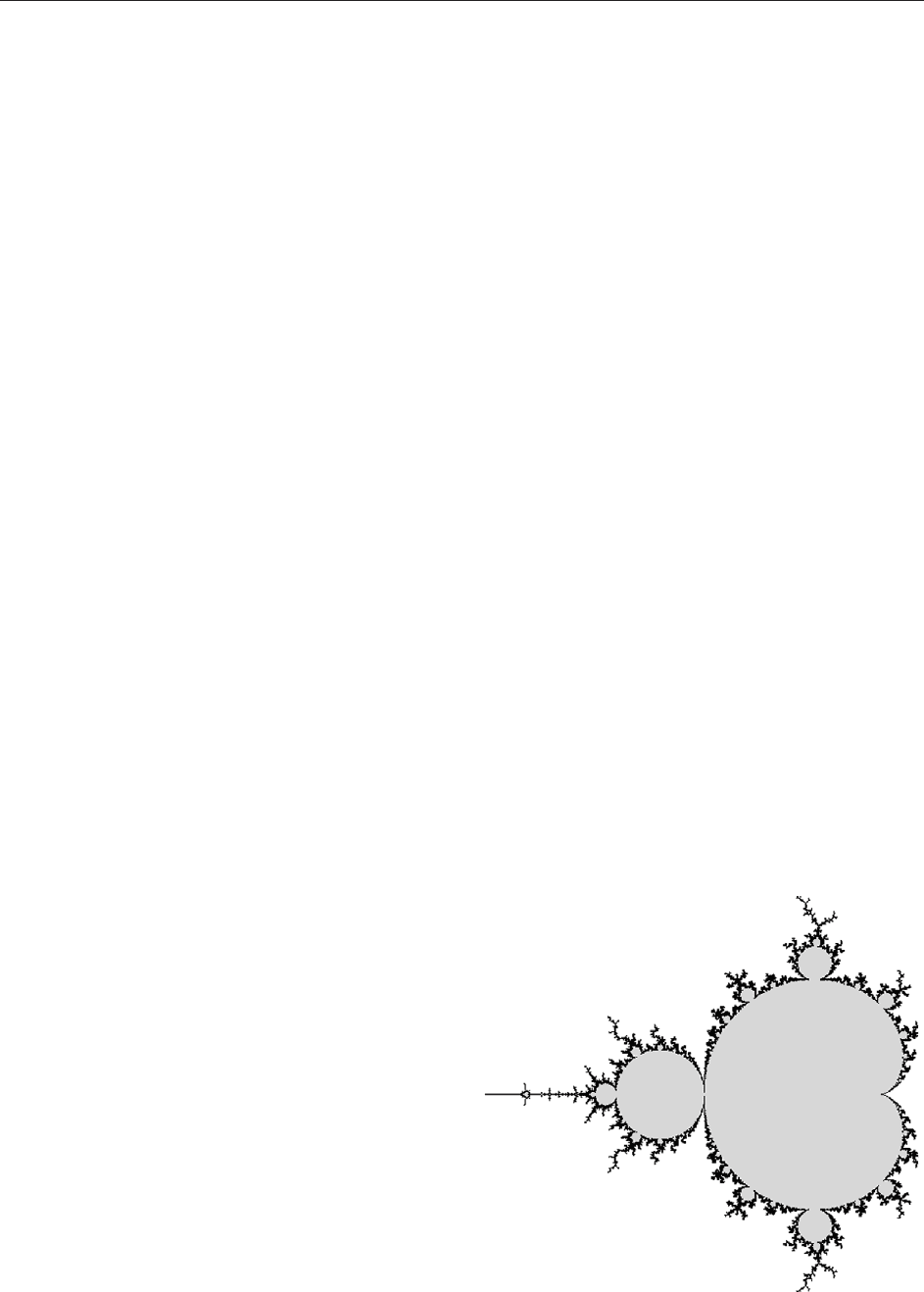
make a computer image of M (see Figure 5 ).
A distinguished curve seen at the picture of M is
the main cardioid C= {c = e
2i
e
4i
=4}, 2 R=Z.
For such a c = c( ) 2C, the map f
c
has a neutral
fixed point
c
with rotation number . For c inside
the domain H
0
bounded by C, f
c
has an attracting
fixed point
c
, and the Julia set J(f
c
) is a Jordan
curve (see Figure 1).
Figure 5 The Mandelbrot set.
Holomorphic Dynamics 657

At the cusp c = 1=4 = c(0) of the main cardioid,
the map f
c
has a parabolic point with multiplier 1.
This point is also called the root of C. Other
parabolic points c = c(q=p)onC are bifurcation
points: if one crosses C transversally at c, then the
fixed point
c
‘‘gives birth’’ to an attracting cycle of
period p. This cycle preserves its ‘‘attractiveness’’
within some component H
q=p
of int M attached to C.
On the boundary of H
q=p
, the above attracting
cycle becomes neutral, and similar bifurcations
happen as one crosses this boundary transversally,
etc. In this way we obtain cascades of bifurcations
and associated necklaces of components of int M.
The most famous one is the cascade of doubling
bifurcations that occur along the real slice of M.
Components of int M that occur in these bifurcation
cascades give examples of hyperbolic components of
int M. More generally, a component H of int M is
called hyperbolic of period p if the maps f
c
, c 2 H,
have an attracting cycle of peri od p. Many other
hyperbolic components becom e visible if one begins
to zoom-in into the Mandelbrot set. Some of them
are satellite, that is, they are born as above by
bifurcation from other hyperbolic components.
Others are primitive. They can be easily distin-
guished geometrically: primitive components have a
cusp at their root, while satellite compon ents are
bounded by smooth curves.
Given a hyperbolic component H, let us consider the
multiplier (c), c 2 H, of the corresponding attracting
cycle, as a function of c 2 H. The function univalently
maps H onto the unit disk D (Douady and Hubbard
1982). Thus, there is a single parameter c
0
2 H for
which (c
0
) = 0, so that f
c
0
has a superattracting cycle.
This parameter is called the center of H.
Nonhyperbolic components of int M are called
queer. Conjecturally, there are no queer compo-
nents. This conjecture is equivalent to Fatou’s
conjecture for the quadratic family.
The boundary of M coincides with the set of
J-unstable quadratic maps (see the subsection
‘‘Struct ural stabili ty and holom orphic motions’’).
Connectivity and Local Connectivity
Theorem 5 (Douady and Hubbard 1982). The
Mandelbrot set is connected.
The proof provides an explicit uniformization
R
M
: CnM !Cn
D. Namely, let B
c
:
c
!CnD
R
c
, c 2
CnM, be the Bo¨ ttcher coordinate near 1. The n
R
M
(c) = B
c
(c). This remarkable formula explains the
phase-parameter similarity between the Mandelbrot
set near a parameter c 2 M and the corresponding
Julia set J (f
c
) near the critical value c.
The following is the most prominent open
problem in holomorphic dynamics:
MLC Conjecture The Mandelbrot set is locally
connected.
If this is the case, then the inverse map R
1
M
extends to the unit circle T, and the Mandelbrot
set can be represented as the quotient of T modulo
certain equiva lence relation that can be explicitly
described. Thus, we would have an explicit topolo-
gical model for the Mandelbrot set (Douady and
Hubbard, Thurston).
The MLC conjecture is equivalent to the follow-
ing conjecture:
Combinatorial Rigidity Conjecture If two quadratic
maps f
c
and f
c
0
with all periodic points repelling are
combinatorially equivalent, then c = c
0
.
In turn, this conjecture would imply, in the
quadratic case, the above fundamental conjectures.
For a progress towards the MLC conjecture (see
Universality in Mathematical Physics).
Parabolic Implosion
Parabolic maps f
c
0
: z 7!z
2
þ c
0
are unstable in a
dramatic way. In particular, the Julia set J(f
c
) does
not depend continuously on c near c
0
. Instead, J (f
c
)
tends to fill in a good part of int J(f
c
0
). This
phenomenon called parabolic implosion has been
explored by Douady, Lavaurs, Shishikura, and many
others.
Geometric Aspects
Area
One of the basic problems in holomorphic dynamics
is whether a Julia set that does not coincide with
^
C
can have positive area. It would give an example of
‘‘observable chaos’’ that occurs on a topologically
small set. It is also related to the No Invariant Line
Fields Conjecture.
Maps with strong hyperbolic properties have zero
area Julia set. A rational map f is called Collet–
Eckmann if there exist constants C > 0and>1
such that:
jDf
n
ðfcÞj C
n
; n 2 N
for all critical points c. If f is a Collet–Eckmann map
with J( f ) 6¼
^
C, then area J(f ) = 0 (Przytycki and
Rohde 1998) (see Universality and Renormalization
for more examples). On the other hand, A Douady
has set up a compelling program of constructing a
Cremer quadratic polynomial f : z 7!e
2i
z þ z
2
whose Julia set would have positive area. Buff and
658 Holomorphic Dynamics

Cheritat have recently announced that they have
completed the program, thus constructing the first
example of a Julia set of positive area. (It makes use
of a renormalization theorem for parabolic implo-
sion recently announced by Shishikura.)
In the parameter plane, it would be interesting to
know whether the boundary of the Mandelbrot set
has zero area.
Hausdorff Dimension
Hausdorff dimension (HD) gives us a furt her
refinement of fractal sets of zero area. Any Julia
set has positive HD. If f is a polynomial with
connected Julia set, then HD( J(f )) > 1 unless f is
affinely conjugate to z 7!z
d
or a Chebyshev poly-
nomial (Zdunik 1990). If f is a Collet–Eckmann map
with J(f ) 6¼
^
C, then HD J(f ) < 2 (Przytycki–Rohde
1998). On the other hand, in the quadratic case
f
c
: z 7!z
2
þ c,HD(J(f
c
)) = 2 for a generic parameter
c 2 @M. The corresponding parameter result is that
HD(@M) = 2 (Shishikura 1998). It is based on the
parabolic implosion phenomenon.
Conformal Measure
Let 0. A Borel measure on
^
C is called
-conformal if
ðfXÞ¼
Z
X
jDf j
d
for any measurable set X such that f jX is inj ective.
Theorem 6 (Sullivan 1983). Any rational map f
has a -conformal measure with 2 (0, 2] supported
on J(f ).
This is a dynamical measure that captures well
geometric properties of J(f ). For instance, for Collet–
Eckmann maps, = HD(J(f )), and is equivalent to
the Hausdorff measure on J(f ) in dimension .
The hyperbolic dimension,HD
hyp
of J(f ) is the
supremum of HD(X) over all compact invariant
hyperbolic subsets of J(f ). Denker and Urbanski
(1991) proved that HD
hyp
(J(f )) is equal to the
smallest exponent of all -conformal measures
supported on J(f )(see Universality and
Renormalization).
Measure of Maximal Entropy
An f-invariant measure is called balanced if
(fX) = d(X) for any measurable set X such that
f jX is injective (where d = deg f ).
Theorem 7 (Brolin 1965, Lyubich 1982). Any
rational map f has a unique balanc ed measure .
Moreover, preimages of any point z except at most
two are equidistributed with respect to (meaning
that the probability measures
n, z
that assign mass 1
to every f
n
-preimage of z converge weakly to as
n !1).
For polynomials, the balanced measure coincides
with the harmonic meas ure on J(f ) (Brolin). (The
latter is the charge distribution on the conductor J(f )
generated by the unit charge placed at 1 .) In
general, the balanced measure is the unique measure
of maximal entropy of f, and moreover, periodic
points are equidistributed with respect to
(Lyubich).
Measure of maximal entropy is supported on a
relatively small measurable set: its HD is strictly less
than HD(J(f )), unless f is conformally equivalent to
z 7!z
d
, a Chebyshev polynomial, or a Latte´s example
(Zdunik 1990). In the polynomial case, it is
supported on a set of HD at most 1 (Manning 1984).
In complex analysis, there has been an extensive
study of fractal properties of harmonic meas ures,
providing insights at the balanced measure and the
other way around (Carleson, Makarov, Jones,
Binder, Smirnov, ...)
See also: Fractal Dimensions in Dynamics; Geometric
Analysis and General Relativity; Geometric Flows and
the Penrose Inequality; Geometric Phases; Polygonal
Billiards; Renormalization: General Theory;
Renormalization: Statistical Mechanics and Condensed
Matter; Universality and Renormalization.
Further Reading
Space limitations prohibit the inclusion of references to all the
results quoted in this article. Where an author is quoted in the
text, the reader can find the corresponding reference in one of the
books listed in this section and in the MatSciNet.
Buff X and Hubbard J Dynamics in One Complex Variable.
Ithaca, NY: Matrix Editions (to appear).
Carleson L and Gamelin W (1993) Complex Dynamics. Berlin:
Springer.
Eremenko A and Lyubich M (1990) The dynamics of an alytical
transformations. Leningrad Mathematic al Journal 1:
563–633.
Milnor J (1999) Dynamics in One Complex Variable: Introduc-
tory Lectures. Braunschweig: Vieweg and Sohn.
Pilgrim KM (2003) Combinatorics of Complex Dynamical
Systems, Lecture Notes in Mathematics no 1827. Berlin–
Heidelberg–New York: Springer-Verlag.
Przytycki F and Urbanski M, Fractals in the Plane – the Ergodic
Theory Methods. (www.math.unt.edu/uranski/book1.html)
Cambridge: Cambridge University Press (to appear).
Tan Lei (ed.) (2000) The Mandelbrot Set, Theme and Variations,
London Math. Soc. Lecture Note Ser., vol. 274. Cambridge:
Cambridge University Press.
Holomorphic Dynamics 659

Holonomic Quantum Fields
J Palmer, University of Arizona, Tucson, AZ, USA
ª 2006 Elsevier Ltd. All rights reserved.
Introduction
The term, holonomic field, was coined by Sato,
Miwa, and Jimbo (SMJ) in 1978 and the subject was
investigated by them in a series of five long papers
and many shorter notes in the period from 1978–81
(Sato et al. 1979a, 1979b, 1979c, 1980, Tracy
and Widom 1994). The term refers to a special class of
two-dimensional interacting quantum field theories
whose n point correlations can be expressed in terms
of the solution to a holonomic system of differential
equations. A holonomic system is an overdetermined
system of differential equations with only a finite-
dimensional family of solutions. There is a sense in
which these interacting systems with infinitely many
degrees of freedom have a finite-dimensional substrate
(at the level of n point functions for fixed n). After
developing their theory, SMJ realized that such
quantum fields made an earlier appearance in work
of Thirring and Federbush. The models considered by
Thirring and Federbush are self-interacting fermionic
systems whose nonlinear classical field equations have
solutions that are an explicit nonlinear transformation
of solutions to the free field equations. This inspired
the idea of trying to study these models by ‘‘quantiz-
ing’’ the nonlinear transformation. Expressions were
obtained for the correlations and S-matrix but the
connection with deformation theory was not under-
stood until the SMJ work.
In what follows we will sketch the SMJ theory and
discuss some of its offshoots. There is one circum-
stance that it might help the reader to be aware of
even though it will be mostly glossed over. Quantum
fields in one space and one time dimension have
correlations which transform under the symmetries of
spacetime with metric signature (1,1). Since the work
of Osterwalder and Schrader, it is customary to pass
back and forth between this Minkowski regime and
the Schwinger functions obtained by analytically
continuing the n point functions to pure imaginary
values for the time variable where they possess the
rotational symmetries associated with a positive-
definite metric. The Ising model, which we take up
next, is naturally considered in the Euclidean domain
where the correlations have an interpretation in
statistical mechanics as the expected value of a
product of random variables. Ultimately, the SMJ
deformation analysis is done in the Euclidean
domain.
The Two-Dimensional Ising Model
The SMJ theory was inspired by, and provides an
attractive sett ing for, an earlier result of Wu,
McCoy, Tracy, and Baruch (WMTB), concerning
the spin–spin scaling functions of the two-dimen-
sional Ising model (Wu et al. 1976). Since the Ising
model is the example with the most direct signifi-
cance for physics, we will take some time to explain
the WMTB result and to sketch the way in which it
fits into the SMJ theory.
The Ising mod el is a statistical model of magnest-
ism on a lattice that incorporates ferromagnetic
interactions of nearest-neighbor spins. In the 1920s,
Ising solved the model for the one-dimensional
lattice and showed that there was no phase transition
in the infinite volume limit. Interest in the two-
dimensional model intensified dramatically following
Onsager’s calculation of the specific heat in the
infinite volume limit (see Palmer and Tracy (1981)
and references within). His formula for the specific
heat was the first instance of a thermodynamic
quantity in a nearest-neighbor model which exhibits
the sort of discontinuity in temperature dependence
expected at a phase transition. For many years, the
Ising model served as a testbed for the now accepted
notion that the infinite volume limit of Gibbsian
statistical mechanics provides a suitable setting for
the study of phase transitions.
A configuration for the Ising model on a finite
subset, , of the integer lattice, Z
2
,isamapC:
!{þ1, 1}, which assigns to each site on the
lattice either an up spin (þ1) or a down spin (1).
The energy function of the Ising model, E
(), is
defined by
E
ðÞ¼J
X
hi;ji2
ðiÞðjÞ
for J > 0 and a spin configuration is a sum over
pairs of nearest-neighbor sites i, j in (boundary
terms require special consideration). This energy
function tends to favor spin configurations, ,in
which the nearest-neighbor spins are aligned in the
sense that the Boltzmann weight, e
E
()=kT
, is larger
for such configurations. In the Gibb s ensemble,
which is expected to describe systems in equilibrium
at temperature T, the configuration occurs with a
probability proportional to the Boltzmann weight.
The factor k which appears is a conversion factor
between thermal and kinetic energy called the
Boltzmann constant. It is clear from the formula
for the Boltzmann weight that small temperatures
(near 0) tend to accentuate the difference in
660 Holonomic Quantum Fields

statistical weights assigned to configurations with
different energies, and large temperatures tend to
wash out the difference in statistical weights
associated to configurations with different energies.
Remarkably, there is a sharp critical temperature
0 < T
c
< 1 so that for T < T
c
the propensity for
order built into the energy triumphs in the infinite
volume limit "Z
2
, and for T > T
c
the randomness
or disorder associated with high temperatures
governs the infinite volume behavior. More specifi-
cally, if T < T
c
and the infinite volume limit is taken
with plus spins assigned to the boundary of , the
system exhibits a residual magnetism (there is a
positive expected value, hi, for the spin per site).
This infinite volume plus state is the quintessential
example of symmetry breaking – the spin flip
symmetry possessed by the bulk energy is broken
below T
c
in the thermodynamic limit. For T > T
c
,
the spin per site is 0 no matter what boundary
conditions are imposed on the infinite volume limit.
Pure equilibrium states both above and below T
c
exhibit clustering in the thermodynamic limit
(uniqueness for the ground state in field theory).
This is the tendency of spin variables (a) and (b)
at sites a, b 2 Z
2
to become statistically independent
as the distance ja bj tends to 1. In such a pure
state the two-point function, which is the expected
value of the product of spin variables, h(a)(b)i,
will tend to the square hi
2
both below (hi 6¼ 0)
and above (hi= 0) the critical temperature T
c
as
ja bj!1. To leading order, this clustering takes
place at an exponential rate, e
jabj=(T)
, for a
function (T) called the correlation length. The
correlation length (T) !1 as T !T
c
. The scaling
limit (from below T
c
) of the spin–spin correlation is
the leading-order correction to the clustering beha-
vior of the correlations when these correlations are
examined at the scale of the correlation length. It is
the limit
hðaÞðbÞi ¼ lim
T"T
c
hððTÞaÞððTÞbÞi
T
hi
2
T
where the correlations on the right-hand side are
thermodynamic correlations on the lattice at tem-
perature T. Since hi
T
tends to 0 as T !T
c
, the
normalization by hi
1
T
on the right produces an
‘‘infinite wave function renormalization’’ in the limit.
Equivalently, one may think of this continuum
limit being achieved by letting the lattice spacing
shrink to 0 as T approaches T
c
so that the
correlation length stays fixed on the new scale. The
scaling limit from above T
c
turns out to be different
from the scaling limit from below T
c
and since
hi
T
= 0 for T > T
c
, it is defined by a different wave
function renormalization. The resulting asymptotics
are expected to capture quite a lot about what is
interesting in the behavior of the correlations near
the phase transition. In the late 1970s, the scaling
behavior in this model was also a pro totype for the
emerging connection between renormalization group
ideas in quantum field theory and statistical
mechanics.
Wu et al. (1976) showed that the two-point
scaling function, h(0)(x)i, is a function of r = jxj
and can be written as
hð0ÞðxÞi¼
coshð =2Þ
exp
1
4
Z
1
r
sinh
2
d
dt
2
!
sds
ðT "T
c
Þ
sinhð =2Þ
exp
1
4
Z
1
r
sinh
2
d
dt
2
!
sds
ðT #T
c
Þ
8
>
>
>
>
>
>
>
>
>
>
>
>
>
>
>
<
>
>
>
>
>
>
>
>
>
>
>
>
>
>
>
:
½1
where = (r) satisfies the differential equation,
d
dr
r
d
dr
¼
r
2
sinhð2 Þ
The substitution = e
transforms this differential
equation into a Painleve´ equation of the third kind.
This was used by McCoy, Tracy, and Wu (see
Palmer and Tracy (1981) and references within) to
study the short-distance behavior, r !0, of the
scaling functions – behavior which is far from
manifest in the infinite series expansions obtained
for the scaling functions.
Deformation Theory
Sato, Miwa, and Jimbo showed that there was a
class of quantum field theories that included the
scaling limits of the Ising model which have the
property that the n-point correlations are ‘‘tau
functions’’ for monodromy-preserving deformations
of the Dirac equation in two dimensions. The two-
dimensional (Euclidean) Dirac operator is
D¼
m 2@
2
@ m
with
@ ¼
1
2
@
@x
i
@
@y
;
@ ¼
1
2
@
@x
þ i
@
@y
Holonomic Quantum Fields 661

the usual complex derivatives acting on smooth
functions on R
2
. The monodromy-preserving defor-
mations mentioned above are families of (multivalued)
solutions w(x)to
Dw ¼ 0 ½2
which are branched at points a
j
2 R
2
(j = 1, 2, ..., n)
and change by a factor e
2i‘
j
as x makes a small
circuit about a
j
. SMJ (1979b) show that the L
2
(R
2
)
(square-integrable) solutions w(x) of the Dirac
equation with this prescribed branching behavior
comprise an n-dimensional subspace of L
2
(R
2
). The
constants e
2i‘
j
are called the monodromy of the
solutions and the term ‘‘deformation’’ in the descrip-
tion refers to the fact that the monodromy constants
do not change as the branch points a
j
are varied.
SMJ show that it is possible to choose a basis
w
j
(x, a) = w
j
(x, a
1
, ..., a
n
)(j = 1, ..., n) so t hat the
vector
Wðx; aÞ :¼½w
1
ðx; aÞ; w
2
ðx; aÞ; ...; w
n
ðx; aÞ
becomes a section for a flat (Dirac compatible)
connection in the (x, a) variables. That is,
d
x;a
W ¼ ðx; aÞW
where d
x, a
is the exterior derivative in the x and a
variables and is a matrix-valued 1-form that
satisfies the zero curvature condition,
d
x;a
¼ ^
They also introduced the notion of a tau function,
(a), for such deformations. The logarithmic deri-
vative d
a
log (a) = !,where! is a 1-form on
R
2
n{a
1
, a
2
, ..., a
n
} expressed in t erms of the m atrix
elements of . The 1-form ! introduced by SMJ is
showntobeclosedwhen satisfies the zero
curvature condition above. The scaling limit of
the Ising model is related to the situation for
monodromy multipliers 1 and when the scaling
limits of correlations are identified as suitable
-functions in this case, the WMTB result emerges
when the nonlinear zero curvature condition is
identified with a Painlev e´ equation.
The connection between the deformation theory
and quantum field theory is developed in the
computationally intensive paper SMJ (1980).Exten-
sive use is made of local operator product expan-
sions, analytic continuation, and formal series
expansions that are infinite-dimensional analogs of
Wick-type theorems for finite-dimensional spin repre-
sentations (developed by SMJ (1978)). One can get
a feeling for the source of the connection by recalling
that in one of the ‘‘exact solutions’’ of the two-
dimensional Ising model the spin operators, (a),
are identified as elements of an infinite spin
representation of the orthogonal group and are
characterized by their linear action on Fermionic
variables (Palmer and Tracy 1981). In the physics
literature, the (a) are referred to as Bogoliubov
transformations. In the scaling limit the associated
representation space is the home to a free Fermi field
(x), an operator-valued solution to the Dirac
equation. Of course, (x) has components
j
(x)but
for simplicity we will suppress such details in the
mostly schematic discussion that follows. For coin-
cident second coordinates x
2
= a
2
the Fermi field (x)
and (a) satisfy the commutation relation
ðaÞ ðxÞ¼sgnðx
1
a
1
Þ ðxÞðaÞ½3
which is a surviving remnant of the linear action of
(a) on lattice fermi ons. In the transfer matrix
formalism, which is natural for statistical mechanics,
translation in the ‘‘space’’ variable x
1
is unitary, but
translation in the ‘‘time’’ variable, x
2
, is governed by
the transfer matrix, the generator of a contractive
semigroup. Because of this, the quantities that are
well behaved in this formalism are ‘‘time-ordered
vacuum expectations’’; these involve only ‘‘positive’’
powers of the transfer matrix. Let T denote the
‘‘time’’-ordering operator; a sequence of operators
depending on coordinates in R
2
is reordered follow-
ing T so that the second coordinates appear in
increasing order from left to right. Sign changes are
incorporated whenever it is necessary to exchange
Fermi type operators like
(x) and (y) to put them
in the correct order. In the Euclidean setting (pure
imaginary time) it is well known that
Gðx; yÞ¼hT
ðxÞ ðyÞi
is a Green function for the Dirac operat or D (the
distribution kernel for D
1
).
This observation and [3] suggests that the hybrid
vacuum expectation
Gðx; y; aÞ¼
hT
ðxÞ ðyÞða
1
Þða
n
Þi
hT ða
1
Þða
n
Þi
should be the Green function for a Dirac operator
with a domain containing ‘‘functions’’ branched at
the points a
j
having ‘‘monodromy’’ 1there.Itis
possible to recast the SMJ analysis so that a Dirac
operator, D(a), on a suitable vector bundle with base
R
2
n{a
1
, ..., a
n
} becomes the central player (see
Palmer et al. (1994) and references therein). The
data for the vector bundle includes the factors e
2i‘
j
incorporated in transition functions for the bundle.
The -function becomes an infinite determinant (or
Pfaffian in the Ising case)
ðaÞ¼det DðaÞ½4
662 Holonomic Quantum Fields

in the Segal–Wilson sense (see Palmer et al. (1994)
and references therein). The Green function
G(x, y; a) has a finite-rank derivative,
d
a
Gðx; y; aÞ¼
X
j
r
j
ðx; aÞs
j
ðy; aÞda
j
þ u
j
ðx; aÞv
j
ðy; aÞd
a
j
½5
which is the key result in this version of the SMJ
analysis (this observation appears in SMJ (1980) but
does not have a central role there). The ‘‘wave
functions’’ r, s, u,andv are closely related to the
L
2
wave functions w
j
described above. Equation [5]
is both the source of the deformation equations for
r, s, u, and v which arise from d
2
a
G = 0 coupled with
the rotational and translational symmetries of the
Green function, and also of the expression for
d
a
log (a) in terms of data associated with the
deformation theory. A ‘‘transfer matrix’’ calculation
of the determinant allows one to make the connection
with the scaling limits of lattice fields including the
Ising model (see Palmer et al. (1994) and references
therein).
The short-distance behavior of the two-point
function for the Ising model scaling functions has
been rigorously calculated by Tracy and later by
Tracy and Widom (see Harnad and Its (2002) and
references therein). A less detailed analysis of the
short-distance behavior of the n point functions that
uses the deformation analysis of the correlations in a
crucial way can be found in Palmer (2000).
The Riemann–Hilbert Problem
In SMJ (1979b), a ‘‘massless’’ version of holonomic
fields is developed. This concerns monodromy-
preserving deform ations of the Cauchy–Riemann
operator
@. The techniques used to study this lead
back to the Riemann–Hilbert problem – the problem
of determining a linear differential equation in the
complex plane with rational coefficients and pre-
scribed monodromy at the poles of the coefficients.
More specifically, suppose one is given n distinct
points {a
1
, ..., a
n
}inP
1
, the Riemann sphere, and
a base point a
0
distinct from the a
j
, j 6¼ 0. Let
j
denote a simple closed curve based at a
0
which
winds counterclockwise once around a
j
but has
winding number 0 for the other points a
k
, k 6¼ j.
Choose n invertible p p matrices M
j
which satisfy
the single condition M
1
M
2
M
n
= I. Then, the
homotopy classes of the curves
j
are the generators
for the fundamental group of the punctured
sphere P
1
n{a
1
, ..., a
n
} with base point a
0
and the
map which sends
j
! M
j
determines a representa-
tion of the fundamental group. One version of the
Riemann–Hilbert problem is to find p p complex
matrices A
j
for j = 1, ..., n so that the linear
differential equation
dY
dz
¼
X
j
A
j
z a
j
Y ½6
has monodromy representation given by
j
!M
j
.
This means that the fundamental solution Y(z)
defined in a neighborhood of z = a
0
and normalized
so the Y(a
0
) = I (the identity) will become the
fundamental solution Y(z)M
1
j
after analytic con-
tinuation around the curve
j
. This form of the
problem does not always have a solution but when
it does, it is interesting t o consider deformations
a !A
j
(a) that preserve the monodromy multipliers
M
j
. Such monodromy-preserving deformations
were first considered by Schlesinger in 1912 (see
Palmer and Tracy (1981) and references therein)
and he discovered that the coefficients A
j
must
satisfy nonlinear differential equations that, for
a
0
= 1,canbewrittenas
d
a
A
j
¼
X
k6¼j
A
k
A
j
a
k
a
j
dða
k
a
j
Þ
SMJ introduced -functions associated with these
deformations and they gave these -func tions a
quantum field theory interpretation as n point
functions. Eventually this theory was extended to
include the Birkhoff generalization of the Riemann–
Hilbert problem, a generalization which incorpo-
rates the additional information needed to fix local
holomorphic equivalence at higher-order poles (formal
asymptotics and Stokes’ multipliers) (Jimbo and
Miwa 1981, Sato et al. 1978). Roughly speaking, the
problem is to reconstruct a global connection with
specified singularities from its local holomorphic
equivalence data and its global monodromy represen-
tation. Thinking of the differential equation [6] as a
holomorphic connection proved very helpful in a
geometric reworking of the SMJ analysis given
by Malgrange (1983a, 1983b) who showed that the
zeros of the -function occurred at points where a
suitably defined Riemann–Hilbert problem fails to
have a solution (see also Palmer (1999) references
within). The mathematical significance of massless
holonomic quantum fields as (quantized) singular
elements of a gauge group is apparent from the SMJ
work and later work of Miwa but the possibility of
interesting physics in these models does not seem to
have been much investigated at this time. These
quantum fields are also conformal fields; however, a
comprehensive integration into the highly developed
formalism of conformal field theory on compact
Riemann surfaces has not currently been developed
Holonomic Quantum Fields 663

(an analog of [5] should survive on compact Riemann
surfaces but the deformation analysis of the correla-
tions is likely limited to symmetric spaces).
Further Developments
This work on massless holonomic fields and the
connection with the Riemann–Hilbert problem is
doubtless the aspect of holonomic fields with the
most ‘‘spin offs’’ in the mathematics and physics
literature. These include an analysis of the delta-
function gas done by Jimbo, Miwa, Mori, and Sato
in 1981, random matrix models first looked at by
Jimbo, Miwa, Mori, and Sato and later system-
atically investigated by Tracy and Widom (1994),
the deformations of line bundles on Riemann
surfaces that led to KdV in the work of Segal and
Wilson (1985), which emerged from work of Sato,
Miwa, Jimbo and collaborators, the analysis of
Painleve´ equations starting with work of McCoy,
Tracy and Wu (see Palmer and Tracy (1981) and
references within) and more systematically devel-
oped by Its and Novokshenov (1986), and the
revival of interest in monodromy-preserving defor-
mations (Harnad and Its 2002).
Holonomic fields are related to free fields in a
well-understood way and it is natural to study them
in situations where free fields make sense. In
particular, they are an interesting testbed for the
nonperturbative investigation of the influence of
geometry (or curvature) on quantum fields. In Palmer
et al. (1994),thedeformationanalysisof-functions
for holonomic fields is carried out for the Poincare´
disk. The two-point functions are shown to be
expressible in terms of solutions to the family of
Painleve´ VI equations. A quantum field t heory
interpretation of these -functions is given by
Doyon and there are natural analogs of the scaling
limit of the Ising model on the Poincare´diskas
well. The role of ‘‘spacetime’’ sym metries in the
deformation theory suggests that such analysis will
be limited to symmetric spac es. In addition to the
plane a nd the Poincare´ disk, the cylinder, the
sphere, and the torus round out the possibilities i n
two dimensions. Lisovyy has recently worked out
the analysis for the cylinder, which is important for
the study of thermodynamic correlations. It should
be possible to recast t he analysis of the continuum
Ising model on the torus (Zuber a nd Itzykson 1977)
in deformation theoretic terms. It does not appear
that the holonomic fields associated with the Dirac
operator for the constant curvature metric on the
2-sphere have been studied yet.
See also: Deformation Theory; Integrable Systems:
Overview; Isomonodromic Deformations;
Riemann–Hilbert Problem; Two-Dimensional Ising
Model.
Further Reading
Harnad J and Its A (2002) CRM Workshop: Isomonodromic
Deformations and Applications in Physics, vol. 31 American
Mathematical Society.
Its AR and Novokshenov VYu (1986) The Isomonodromic
Deformation Method in the Theory of Painleve´ Equations,
Lecture Notes in Mathematics, vol. 1191. Berlin: Springer.
Jimbo M and Miwa T (1981) Monodromy preserving deforma-
tions of linear ordinary differential equations with rational
coefficients II. Physica D 2: 407–448.
Jimbo M, Miwa T, and Ueno K (1981) Monodromy preserving
deformations of linear ordinary differential equations with
rational coefficients I. Physica D 2: 306–352.
Malgrange B (1983a) Sur les de´formations isomonodromiques I,
Singularite´s re´gulie`res, Progress in Mathematics vol. 37,
pp. 401–426. Bost on: Birkha¨user.
Malgrange B (1983b) Sur les de´formations isomonodromiques II,
Singularite´s irre´gulie`res, Progress in Mathematics vol. 37,
pp. 427–438. Boston: Birkha¨user.
Palmer J (1999) Zeros of the Jimbo, Miwa, Ueno tau function.
Journal of Mathematical Physics 40: 6638–6681.
Palmer J (2000) Short distance asymptotics of Ising correlations.
Journal of Mathematical Physics 7: 1–50.
Palmer J, Beatty M, and Tracy C (1994) Tau functions for the
Dirac operator on the Poincare´ disk. Communications in
Mathematical Physics 165: 97–173.
Palmer J and Tracy CA (1981) Two dimensional Ising correla-
tions: Convergence of the scaling limit. Advances in Applied
Mathematics 2: 329–388.
Sato M, Miwa T, and Jimbo M (1978) Holonomic quantum fields I.
Publications of the Research Institute for Mathematical Sciences,
Kyoto University 14: 223–267.
Sato M, Miwa T, and Jimbo M (1979a) Holonomic quantum
fields II. Publications of the Research Institute for Mathema-
tical Sciences, Kyoto University 15: 201–278.
Sato M, Miwa T, and Jimbo M (1979b) Holonomic quantum
fields III. Publications of the Research Institute for Mathema-
tical Sciences, Kyoto University 15: 577–629.
Sato M, Miwa T, and Jimbo M (1979c) Holonomic quantum
fields IV. Publications of the Research Institute for Mathema-
tical Sciences, Kyoto University 15: 871–972.
Sato M, Miwa T, and Jimbo M (1980) Holonomic quantum fields
V. Publications of the Research Institute for Mathematical
Sciences, Kyoto University 16: 531–584.
Tracy CA and Widom H (1994) Fredholm determinants,
differential equations and matrix models. Communications in
Mathematical Physics 163: 33–72.
Wu TT, McCoy B, Tracy CA, and Barouch E (1976) Spin–spin
correlation functions for the two dimensional Ising model:
exact theory in the scaling region. Physical Review B 13:
316–374.
Wilson G and Segal G (1985) Loop groups and equations of KdV
type. Publications of Mathe´matiques IHES 61: 5–65.
Zuber JB and Itzykson C (1977) Quantum field theory and the
two dimensional Ising model. Physical Review D
15:
2875–2884.
664 Holonomic Quantum Fields

Homeomorphisms and Diffeomorphisms of the Circle
A Zumpano and A Sarmiento, Universidade Federal
de Minas Gerais, Belo Horizonte, Brazil
ª 2006 Elsevier Ltd. All rights reserved.
Introduction
In this article we consider the following question:
which homeomorphisms of the circle transport one
given class of continuous functions into another?
The allowed classes of functions are Banach spaces
contained in C(T), the space of continuous functions
on the unit circle T, and will be defined by the
properties of the Fourier series of the functions.
Next, we will develop the theory of Poincare´–
Denjoy which describes some basic geome tric
properties about diffeomorphisms of the circle such
as existence and properties of the rotation number,
classifications of possible orbits of diffeomorphisms,
and Denjoy counterexample.
A homeomorphism of the circle is regarded here as
a change of variables for periodic functions. So, it will
be our major concern to describe the changes of
variables that do not affect ‘‘too much’’ the behavior
of the Fourier series of the functions in the given class.
We say that a function h : R !R is a homeomorph-
ism of the circle T = {(x, y) 2 R
2
: x
2
þ y
2
= 1},
if h itself is a homeomorphism such that h(t þ 2) =
h(t) 2 for all t 2 R. It is clear that such function h
induces a unique homeomorphism
e
h : T !T that
makes the following diagram commutative:
e
h
T ! T
e
it
##e
it
R ! R
h
; i:e:;
e
hðe
it
Þ¼e
ihðtÞ
In the same way, we identify functions
e
: T 7!C
with 2-periodic functions : R 7!C.
Let U(T) be the space of all continuous functions
on T that have uniformly convergent Fourier series,
and let A(T) be the space of all continuous functions
on T with absolute convergent Fourier series.
In 1953, Beurling and Helson proved an important
result about the homeomorphisms that preserve the
space A(T): they are rotations and symmetries, that
is, if f h 2A(T) for all f 2A(T), then the homeo-
morphism h must have the form h(t) = t þ or
h(t) = t þ . It is quite obvious that rotations and
symmetries preserve A( T ), since the Fourier coeffi-
cients of f h and f have the same modulus, but to
prove the converse is very hard. So, homeomorphisms
that preserve A(T)areaveryrestrictclass.
A wider class is obtained when we trans port A(T)
into U(T), that is, f
h 2U(T) for all f 2A(T). The
major object of this article is to study such changes
of variables.
We say that a homeomorphism of the circle h is of
finite type, if there is an integer , satisfying 3 <1,
such that h is of class C
and
jh
00
ðtÞjþ jh
ð3Þ
ðtÞjþþjh
ðÞ
ðtÞj 6¼ 0; for all t 2 R
In the realm of Fourier analysis, the most
important and general result about homeomorph-
isms of the circle is due to R Kaufman, who showed
in 1974 that a finite-type homeomorphism h
transports A(T) into U(T). We shall analyze in
detail such seminal result.
Homeomorphism of the Circle
of Finite Type
In this section we prove the theorem of R Kaufman
mentioned before, which means that it is sufficient
for a homeomorphism of the circle h to have a
certain amount of curvature in order to transport
A(T) into U(T). We present a simple proof of this
fact, based on a result due to Stein and Wainger.
If f : T !C is a continuous function and if
^
f
n
¼
1
2
Z
f ðtÞe
int
dt; n 2 Z
denote the Fourier coefficients of f, then f 2A(T)if
and only if
X
n2Z
j
^
f
n
j¼ lim
N!1
X
N
N
j
^
f
n
j < 1
Of course, A(T) is a Banach space with the norm
kf k
AðTÞ
¼
X
n2N
j
^
f
n
j
The space U(T) is defined as the space of all
continuous functions f : T !C such that
X
N
N
^
f
n
e
int
! f ðtÞ; when N !1; for all t 2½;
uniformly on T, that is, U( T ) is the space of
continuous functions from T to C that are the
uniform limit of their Fourier partial sums
S
N
ðf ; tÞ¼
X
N
N
^
f
n
e
int
Homeomorphisms and Diffeomorphisms of the Circle 665