
Francoise J.-P., Naber G.L., Tsun T.S. (editors) Encyclopedia of Mathematical Physics
Подождите немного. Документ загружается.

where L is the characteristic size of the system, r
c
and F
c
are, respectively, the radius and the energy of
the disclination core, a region in which the distor-
tions are too strong to be described by a pheno-
menological theory.
The restriction of planar director distortions does
not allow the model to grasp the crucial difference
between half-integer and integer k’s. The lines of
integer k, as already discussed, are fundamentally
unstable, as the director can be reoriented along the
axis. This ‘‘escape in the third dimension,’’ is usually
energetically favorable, since the singular core is
eliminated. When opposite directions of the
‘‘escape’’ meet, a point defect hedgehog is formed,
as illustrated in Figure 5c.
Unlike point defects s uch as vacancies in
solids, topological point defects in nematics
cause disturbances over the whole volume.
The curvature energy of the point defect is
proportional to the size R of the system. For
example, for the radial hedgehog with
n = (x, y, z)=
ffiffiffiffiffiffiffiffiffiffiffiffiffiffiffiffiffiffiffiffiffiffiffiffiffiffi
x
2
þ y
2
þ z
2
p
, and the hyperbolic
hedgehog with n = (x, y, z)=
ffiffiffiffiffiffiffiffiffiffiffiffiffiffiffiffiffiffiffiffiffiffiffiffiffiffi
x
2
þ y
2
þ z
2
p
,
one finds, respectively,
F
rh
¼8 Rð K
11
K
24
ÞþF
cr
and
F
hh
¼8R
K
11
5
þ
2K
33
15
þ
K
24
3
þ F
ch
½14
Defects in Smectics
Layered structure of smec tics leads to line ar
defects of positional order, dislocations, in addi-
tion to disclinations. There is also a special class
of distortions known as focal conic domains
(FCDs) that are associate d with large-scale cur-
vatures of layers. Imagine that because of the
boundary conditions, flow, or the external fields,
the smectic layers are curved over the scale much
larger than the thickne ss of the layers. It is easy
to see from e qn [9] that the curved laye rs will
prefer to maintain their equidistance, as the
curvature en ergy is much smaller than the layers
dilation energy at t he large scal es of deforma-
tions. Generally, the family of equidistant curved
surfaces is ass ociated with the focal surfaces at
which the principal curvatures diverge. These
focal surfaces are thus e nergetically very costly.
A r adical way to reduce the elastic energy would
be to decrease the dimensionality of t he focal
surfaces,say,bytransformingthemintolinesand
points. The latter case corresponds simply to a
system of concentric spherical layer s. The former
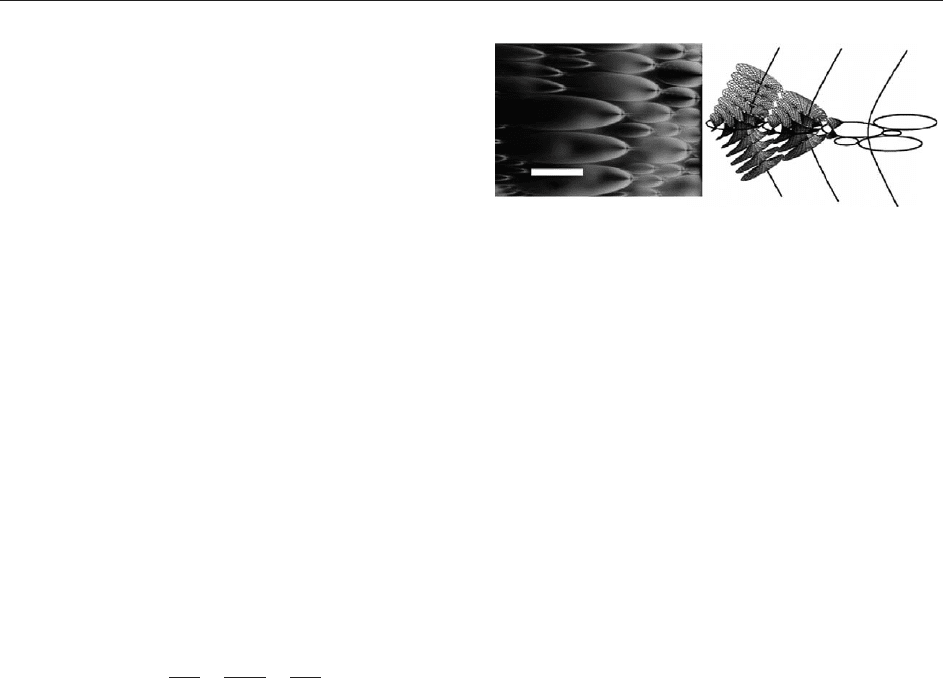
is more complicated and corresponds to FCDs in
which the focal surfaces are represented by pairs
of confocal l ines: ellipse and hyperbola (limiting
case: circle and straight line), and the pair of
confocal parabolae. Experiments c onfirm that the
FCDs are the most frequent type of structural
deformations in smectic materials see Figure 8.
Conclusion
To summarize, over the last few decades, liquid
crystals transformed from a mysterious and
curious form of condensed matter into a key
technological material, thanks to the progress in
the understanding of their elastic, optical, and
viscous properties. However, the intrinsic com-
plexity of these materials s till leaves plenty of
room for further studies, not only of an applied
nature, but also fundamental. In the f ield of
thermotropic liquid crystals, re searchers continue
to discover new types of structural organization,
such as the phases formed by ‘‘banana-shaped’’
molecules that are dramatically different from the
phases formed by ‘‘regular’’ rod-like and disk-like
molecules. There is a continuous work to sharpen
our understanding of even the ‘‘old’’ problems, such
as mechanisms of surface alignment, nature and
quantitative values of the elastic constants K
13
, K
24
,
and
K. Even in the case of the electric Frederiks
effect that is at the heart of modern applications, the
search continues as the corresponding process of
director reorientation is generally very complex. In
addition to the dielectric torque, it is controlled by
various factors, for example, a nonlocal character of
the electric field in the anisotropic medium, finite
electric conductivity, flexoelectric effect (i.e., electric
polarization brought about by the director deforma-
tions), surface electric polarization at the bounding
plates, dependence of the dielectric and other
material properties on the frequency of the applied
field which might be comparable with the
60 µm
Figure 8 SmA phase with FCDs based on the confocal pairs
of ellipses and hyperbolas; the scheme on the right shows
the arrangement of the elliptic bases and smectic layers
wrapped around the confocal pairs of defects. Reproduced
from Lavrentovich OD (2003) In: Arodz et al. (eds.) Patterns of
Symmetry Breaking. Dordrecht: Kluwer Academic Publishers,
with kind permission of Springer Science and Business Media.
Liquid Crystals 327

characteristic frequency of dielectric relaxation, cou-
pling of the director reorientation and the material’s
flows, appearance of topological defects, etc. Many
research efforts nowadays are focused on composite
systems, such as liquid crystal colloids and polymer–
liquid crystal composites. Over the next decade or so,
one would expect that the emphasis in fundamental
studies will gradually shift from the thermotropic
liquid crystals to their lyotropic counterparts, as the
lyotropic type of orientational order is featured by
many systems of biological significance, such as
solutions of DNA, f-actin, etc.
See also: Non-Newtonian Fluids; Topological Defects
and Their Homotopy Classification.
Further Reading
Barbero G and Evangelista LR (2001) In: Ong HC (ed.) An
Elementary Course on the Continuum Theory for Nematic
Liquid Crystals, Series on Liquid Crystals. Singapore: World
Scientific.
Blinov LM and Chigrinov VG (1996) Electrooptic Effects in
Liquid Crystal Materials. New York: Springer.
Chaikin PM and Lubensky TC (1995) Principles of Condensed
Matter Physics. Cambridge University Press.
Chandrasekhar S (1992) Liquid Crystals, 460 pp. Cambridge:
Cambridge University Press.
Frank FC (1958) On the theory of liquid crystals. Transactions of
the Faraday Society 25: 19–28.
de Gennes PG and Prost J (1993) The Physics of Liquid Crystals.
Oxford: Oxford Science Publications.
Hartshorne NH and Stuart A (1970) Crystals and the Polarizing
Microscope. New York: American Elsevier.
Kitzerow HS and Bahr C (eds.) (2001) Chirality in Liquid
Crystals, 502 pp. New York: Springer.
Kleman M and Lavrentovich OD (2003) Soft Matter Physics: An
Introduction. New York, NY: Springer.
Larsen RG (1999) The Structure and Rheology of Complex
Fluids, 664 pp. New York: Oxford University Press.
Lavrentovich OD, Pasini P, Zannoni C, and Zumer S (eds.)
(2001) Defects in Liquid Crystals: Computer Simulations,
Theory and Experiments, 344 pp. Dordrecht: Kluwer Academic
Publishers.
Sonin AA (1995) The Surface Physics of Liquid Crystals, 180
pp. Australia: Gordon and Breach.
Wu ST and Yang DK (2001) Reflective Liquid Crystal Displays,
336 pp. Chichester: Wiley.
Ljusternik–Schnirelman Theory
J Mawhin, Universite
´
de Louvain, Louvain-la-Neuve,
Belgium
ª 2006 Elsevier Ltd. All rights reserved.
Introduction
Using Lagrange multipliers, the smallest and
the largest eigenvalue of a symmetric quadratic form
QðuÞ¼
X
n
j;k¼1
a
jk
u
j
u
k
ða
jk
¼ a
kj
Þ
can be obtained by minimizing and maximizing Q
on the unit sphere S
n1
= {u 2 R
n
: kuk= 1}. If the
corresponding extremum is reached at u
, then u
is
an associated eigenvector.
In the setting of integral or partial differential
equations, a ‘‘recursive variational method’’ has
been proposed to determine all the eigenvalues
1
2
n
and corresponding eigenvectors
u
1
, u
2
, ..., u
n
of Q or, in modern terms, of the
associated symmetric matrix A = (a
ij
):
1
¼ min
kuk¼1
QðuÞð¼Qðu
1
ÞÞ
j
¼ min
kuk¼1;uu
1
¼0;...;uu
j1
¼0
QðuÞ
ð¼ Qðu
j
ÞÞ ðj ¼ 2; ...; nÞ
Further considerations have led to a nonrecursive
minimum–maximum principle:
j
¼ min
fX
j
R
n
: dim X
j
¼jg
max
fu2X
j
: kuk¼1g
QðuÞð1 j nÞ
and to a dual maximum–minimum principle
(Weyl):
j
¼ max
fp
1
;...;p
j1
2R
n
g
min
fkuk¼1;up
i
¼0;1ij1g
QðuÞ
ð1 j nÞ
These principles have been widely used in various
existence and approximation questions of math ema-
tical physics, and extensions have been made to the
abstract setting of symmetric bilinear forms in
Hilbert spaces.
Around 1930, Ljusternik and Schnirelman have
extended this theory beyond the frame of quadratic
forms, replacing Q by a differentiable real-valued
function f and the unit sphere by a finite-
dimensional compact differentiable manifold M.
Their aim was the obtention of the ‘‘critical points’’
of f on M, that is, the points u 2 M where the
differential f
0
(u)off at u (as a linear functional on
the tangent space T
u
M to M) is equal to zero, and of
the corresponding critical values, that is, the values
of f at critical points. When M is a sphere, the
328 Ljusternik–Schnirelman Theory

critical points are nontrivial solutions of the
equation
f
0
ðuÞ¼u ½1
for some 2 R (nonlinear eigenvalue problem).
Ljusternik and Schnirelman have replaced the
dimension of the vector spaces occurring in
the minimum–maximum principle for eigenvalues
by the concept of ‘‘category’’ of a closed set A in a
topological space X. An early success of their
approach was the existence of three geometrically
distinct closed geodesics without self-intersections
on any compact surface of genus zero. In 1960,
their theory has been extended to infinite-
dimensional manifolds and to other measures of
the ‘‘size’’ of a set than the category, allowing many
theoretical developments as well as various
applications to nonlinear differential equations.
Ljusternik–Schnirelman Category
Let X be a topological space (e.g., a normed vector
space, or a differentiable manifold, or a metric
space), and A a closed subset of X. The category of
A in X, cat
X
(A), is the least integer k such that A
can be written as
S
k
j = 1
A
j
, with A
j
closed and
contractible in X, that is, continuously deformable
in X into a single point. If no such k exists, one sets
cat
X
(A) = þ1. We write cat(X) for cat
X
(X). For
example, if X is contractible (in itself), cat(X) = 1.
This is the case for any normed space X. For the
hypersphere, cat
R
n
(S
n1
) = 1, but cat(S
n1
) = 2.
The Ljusternik–Schnirelman category satisfies the
following properties, which are not too difficult to
prove. If A, B X are closed,
1. cat
X
(A) = 0 if and only if A = ;;
2. if A B, cat
X
(A) cat
X
(B);
3. cat
X
(A [ B) cat
X
(A) þ cat
X
(B);
4. if : [0, 1] X ! X is a continuous deformation
of X((0, A) = A), cat
X
(A) cat
X
((1, A)); and
5. if X is a finite-dimensional manifold and A X
is compact, there is a neighborhood B of A such
that cat
X
(B) = cat
X
(A).
Computing or even estimating the category of a
given set is in general difficult, requiring techniques
of algebraic topology. In particular, one can show
that, for the n-torus T
n
= S
1
S
1
S
1
(n times),
cat(T
n
) = n þ 1, and for the n-dimensional projective
space P
n
= S
n
=Z
2
, obtained by identifying the anti-
podal points of S
n
,cat(P
n
) = n þ 1. It is clear that a
setofcategoryp must contain at least p points. If X
is connected, any compact subset of category p þ 1
has (topological) dimension larger or equal to p.
Ljusternik–Schnirelman Minimax Method
The Ljusternik–Schnirelman category of M provides a
lower bound for the number of critical points of a
smooth function f on suitable finite-dimensional
manifolds M. Namely, if M is a compact Riemannian
C
2
-manifold without boundary, any f 2 C
2
(M, R)
has at least cat(M) distinct critical points, with
critical values
c
k
¼ inf
A2A
k
sup
u2A
f ðuÞð1 k catðMÞÞ ½2
where
A
k
¼fA M: A closed; cat
M
ðAÞkg
ð1 k catðMÞÞ ½3
A fundamental technique in the proof is a deformation
lemma along the trajectories of the gradient system
associated to f (method of steepest descent). If r f
denotes the gradient of f in the Riemannian structure
of M, the Cauchy problem for the gradient system
d
dt
¼rf ðÞ;ð0Þ¼u ½4
has a unique globally defined continuous solution
(t, u), which is such that
f ð ð1; uÞÞ f ðuÞ¼
Z
1
0
d
dt
f ððt; uÞÞdt
¼
Z
1
0
krf ððt; uÞÞk
2
dt ½5
Notice that, by property (4) of the category, each
deformation by of a set in A
j
remains in A
j
. For
c 2 R, define
f
c
:¼fu 2 M : f ðuÞcg
K
c
:¼fu 2 M : rf ðuÞ¼0; f ðuÞ¼cg
½6
From [5] it follows that given c 2 R andanopen
neighborhood U
c
of K
c
, one has (1, f
cþ"
n U
c
) f
c"
for all sufficiently small ">0. This implies that if
c := c
j
= c
jþ1
= = c
jþq
for some q 0, then
cat
M
(K
c
) q þ 1. Assume, by contradiction, that
cat
M
(K
c
) q,letU
c
be an open neighborhood of K
c
such that cat
M
(U
c
) = cat
M
(K
c
)(U
c
= ; if q = 0), ">0
such that (1, f
cþ"
n U
c
) f
c"
,andA 2A
jþq
such
that sup
A
f c þ " ,thatis,A f
cþ"
.Then
cat
M
ðð1; A n U
c
ÞÞ cat
M
ðA n U
c
Þ
cat
M
ðAÞcat
M
ðUÞj
giving the contradiction c sup
(1, A)
f c " .
Notice that, for each j, c
j
= inf {c 2 R :cat
M
(f
c
) j},
which shows that the c
j
are precisely those levels of f
where cat
M
(f
c
) changes. The presence of critical
values is detected by changes in the topology of the
Ljusternik–Schnirelman Theory 329

sublevel sets f
c
when c varies, a common feature of
many techniques for finding critical points of
functions.
A direct consequence is that for each even
f 2 C
2
(R
n
, R), system [1] has at least n pairs of
solutions (u, u)withkuk= 1. Indeed, the solu-
tions of [1] are the critical points of f on S
n1
.Asf
takes the same values at antipodal points, it is well
defined on the projective space P
n1
,and
cat(P
n1
) = n.
The Ljusternik–Schnirelman theorem can be extended
to the C
1
-situation. The category of M gives a lower
bound for the number of critical points of f on the closed
manifold M.IfCrit(M) denotes the minimum of
the number of critical points of all C
1
-functions on M,
so that Crit(M) cat(M), an interesting question is
to estimate the gap Crit(M) cat(M). For M closed
connected, Crit(M) dim(M) þ 1 (Takens). If
Crit(M) = 2, M is homeomorphic to a sphere, so that
the equality Crit(S) = cat(S) for homotopy spheres is
equivalent to Poincare´’s conjecture! Manifolds with
Crit(M) = cat(M) þ 1 are known, but not with
Crit(M) > cat(M) þ 1.
Ljusternik–Schnirelman Theory
in Infinite-Dimensional Manifolds
The main difficulty in extending the results of the
previous section to functions defined on infinite-
dimensional manifolds lies in the lack of compact-
ness. J T Schwartz and Palais have shown that such
an extension is possible for functions f satisfying on
M a compactness property (allowing an infinite-
dimensional deformation lemma), now referred to as
the Palais–Smale condition: each sequence (u
k
)with
(f (u
k
)) bounded and lim
k !1
rf (u
k
) = 0hasacon-
vergent subsequence. Such a condition can be
localized at level c by replacing the boundedness of
(f (u
k
)) by lim
k !1
f (u
k
) = c. The infinite-dimensional
extension of Ljusternik–Schnirelman’s theorem goes
as follows: Let M be an infinite-dimensional Rieman-
nian (or even Finsler) connected complete manifold
of class C
1
without boundary. Any f 2 C
1
(M, R)
bounded from below and satisfying Palais–Smale
condition has at least cat(M) distinct critical points.
A simple application can be given to the periodic
solutions of period T (T-periodic solutions) of
Lagrangian systems
u
00
þrVðuÞ¼hðtÞ½7
where V 2 C
1
(R
n
, R), 2-periodic in each compo-
nent u
j
(1 j n), h is continuous, T-periodic and
has mean value
h equal to zero. By the least action
principle, the T-periodic solutions of [7] are the
critical points of the action functional
f ðuÞ¼
Z
T
0
ku
0
ðtÞk
2
2
VðuðtÞÞ þ hðtÞuðtÞ
"#
dt
on the Hilbert space H
1
T
obtained by completion of
the space of T-periodic C
1
functions for the norm
associated with the inner product
hu; vi :¼
Z
T
0
uðtÞvðtÞdt þ
Z
T
0
u
0
ðtÞv
0
ðtÞdt
It follows easily from condition
h = 0thatf is bounded
from below and that f (u þ 2e
j
) = f (u)forallu 2 H
1
T
,
with e
j
the jth unit vector in R
n
(1 j n). Conse-
quently, we can see f as defined on the Riemannian
manifold T
n
f
H
1
T
,where
f
H
1
T
= {u 2 H
1
T
:
u = 0}. It is
easy to show that cat(T
n
f
H
1
T
) = cat(T
n
) = n þ 1and
that f satisfies Palais–Smale condition on T
n
f
H
1
T
.
Consequently, system [7] has at least n þ 1 geometri-
cally distinct T-periodic solutions. The same result
holds for the more general systems
Mu
00
þ Au þrFðuÞ¼hðtÞ
occurring in the theory of multipoint Josephson
junctions or in space discretizations of the
sine-Gordon equation. In particular, the classical
forced pendulum equation
u
00
þ a sin u ¼ hðtÞ
has at least two geometrically distinct T-periodic
solutions when h is T-periodic and
h = 0, a result
first proved, in a different way, by Mawhin and
Willem.
Another way to study nonlinear eigenvalue pro-
blems of the form
f
0
ðuÞ¼g
0
ðuÞ
in a Hilbert or a suitable reflexive Banach space X
is based upon a Rayleigh–Ritz approximation
through a sequence of finite-dimensional problems,
where the classical theory is applied. Conditions
upon f , g 2 C
1
(X, R) are given, generalizing
Ljusternik–Schnirelman’s ones, which ensure the
existence of infinitely many solutions. Again, some
compactness is needed to justify the limit process,
and expressed by some assumptions upon f and g
too lengthy to be reproduced here. The following
application is exemplary. Let R
N
be a bounded
domain and X = W
1, p
0
(), p > 1, be the Sobolev
space of functions u : ! R obtained as the comple-
tion of the smooth functions with compact support
330 Ljusternik–Schnirelman Theory

in for the norm kuk
1, p
= (
R
kru (x)k
p
dx)
1=p
.
Define the functionals f and g on W
1, p
0
()by
f ðuÞ¼
Z
kruðxÞk
p
dx; gðuÞ¼
Z
juðxÞj
p
dx
The critical points of f on {u 2 X : g(u) = 1} corre-
spond to the nontrivial solutions of the Dirichlet
eigenvalue problem
p
u ¼ juj
p2
u in ; u ¼ 0on@ ½8
for the p-Laplacian operator
p
defined by
p
uðxÞ:¼r kruðxÞk
p2
ruðxÞ
which occurs in the modelization of various
problems in a porous medium. An eigenvalue is
any 2 R such that problem [8] has a nontrivial
solution. The Ljusternik–Schnirelman technique
implies the existence of a sequence of eigenvalues
going to infinity, with the usual minimax character-
ization. When N = 1, direct computations show that
this sequence gives all eigenvalues, but the problem
remains open for N 2. The corresponding forced
problem
p
u juj
p2
u ¼ hðxÞ in ; u ¼ 0on@
is always solvable (although not uniquely) when is
not an eigenvalue, but solvability conditions at the
higher eigenvalues (Fredholm alternative) remain
almost terra incognita.
Index Theories and Critical Points
of Symmetric Functionals on
a Banach Space
Closely related to the Ljusternik–Schnirelman category
is the concept of index associated to the action of a
compact topological group G on a normed space X,
that is, to a continuous map G X ! X,[g, u] 7!gu
such that 1 u = u,(gh)u = g(hu), u 7!gu is linear.
The action is isometric if kguk= kuk, A X
is invariant if gA = A for all g 2 G, f : X ! R is
invariant if f g = f for all g 2 G,andh : X ! X
is equivariant if g h = h g for each g 2 G.Let
Fix G = {u 2 X :
gu = u for all g 2 G}. The aim of an
index is to measure the size of invariant sets.
Explicitly, an index theory associates to each closed
invariant subset A of X a non-negative (possibly
infinite) integer G-ind(A), its G-index, such that
1. G-ind(A) = 0 if and only if A = ;;
2. if R : A ! B is equivariant and continuous,
G-ind(A) G-ind(B);
3. G-ind(A [ B) G-ind(A) þ G-ind(B); and
4. if A is compact, there is a closed invariant
neighborhood U of A such that G-ind(U) =
G-ind(A).
A first example of index is Krasnosel’skii’s genus
or Z
2
-index which corresponds to the action
0 u = u,1 u = u of G = Z
2
. The invariant sets
are the ones symmetric with respect to the origin
and Z
2
-ind(A) is defined by Z
2
-ind(;) = 0 and, for
A 6¼;, as the smallest integer k such that there
exists an odd h 2 C(A, R
k
n {0}). A consequence of
the Borsuk–Ulam theorem in algebraic topology is
that any symmetric bounded neighborhood of the
origin in R
n
has Z
2
-index equal to n. Furthermore,
for a compact A R
n
n {0} symmetric with respect
to the origin, and
e
A = A=Z
2
(A with antipodal
points identified), one has Z
2
-ind(A) = cat
R
n
n{0}
(
e
A).
A second example, the S
1
-index, is important in
the study of periodic solutions of autonomous
Hamiltonian systems. S
1
-ind(;) = 0 and for a non-
empty closed invariant A X, S
1
-ind(A) is defined
as the smallest integer k such that there exists a
positive integer n and h 2 C(A, C
k
n {0})
with h g = g
n
h for all g 2 S
1
. A Borsuk–
Ulam-type theorem for S
1
-equivariant mappings
implies that if Z is a finite-dimensional invariant
subspace of X such that Fix S
1
\ Z = {0} and D is
an open bounded invariant neighborhood of 0 in Z,
then S
1
-ind(@D) = (1=2)dim Z.
As the category of a Banach space X = 1, the
classical Ljusternik–Schnirelman approach does not
provide any information about the multiplicity of
the unconstrained critical points of f 2 C
1
(X, R). If f
is invariant under the action on X of a compact
group G and satisfies Palais–Smale condition, a
Ljusternik–Schnirelman minimax method associated
to a G-index provides multiplicity results for
unconstrained critical points. Letting
A
j
¼fA X : A is compact, invariant,
and G-indðAÞjg
c
j
¼ inf
A2A
j
sup
A
f ðj ¼ 1; 2; ...Þ
one shows as in classical Ljusternik–Schnirelman
theory that if c := c
j
= c
jþ1
= = c
jþq
for some j
and some q 0, then G-ind(K
c
) q þ 1. The proof
uses an equivariant deformation lemma.
Z
2
- and S
1
-Invariant Functionals
InthecaseoftheZ
2
-action, the following multiplicity
result holds for possibly unbounded even f 2 C
1
(X, R)
satisfying the Palais–Smale condition and having the
mountain pass geometry: if Y \ {u 2 X : f (u) 0} is
bounded for each finite-dimensional subspace Y of X,
Ljusternik–Schnirelman Theory 331

f (0) = 0, and f (u) a > 0on@B(r), then f has
infinitely many couples of critical points. As an
application, the semilinear Dirichlet problem
u þ u þjuj
p1
u ¼ 0in
u ¼ 0on@
½9
has infinitely many solutions when R
N
is
bounded, 1 < p < (N þ 2)=(N 2), and <
1
, the
smallest eigenvalue of with Dirichlet boundary
conditions. The corresponding energy functional,
defined on W
1, 2
0
()by
f ðuÞ¼
Z
kruðxÞk
2
2
juðxÞj
2
2
juðxÞj
pþ1
p þ 1
"#
dx
satisfies the Palais–Smale condition. This condition
fails in the critical case where p = (N þ 2)=(N 2), at
least at some levels c, and this lack of compactness
creates both difficulties and interesting phenomena.
This situation, which occurs in many important
problems of geometry and physics (harmonic maps,
Yang–Mills connections, Yamabe problem, equations
of constant mean curvature, closed geodesics pro-
blems, etc.), reveals indeed, in physical terms, ‘‘phase
transitions’’ or ‘‘particle creations’’ at the levels where
the Palais–Smale condition fails. In the special case of
eqn [9] with p = (N þ 2)=(N 2), if N 4, a positive
solution exists when 2 [0,
1
], and, if N = 3, the
same is true for 2 [
,
1
]andsome
2 [0,
1
],
with the optimal value
=
1
=4when is a ball. For
N 4, [9] has at least cat() nontrivial solutions
when 2 [0,
]forsome
<
1
.Suchalackof
compactness, which can also occur for eqn [9] in R
N
(nonlinear Schro¨ dinger equation), is associated to the
invariance of f with respect to the action of some
noncompact group, coming, for example, from scale or
gauge invariance. P L Lions’ concentration–compact-
ness method is useful to analyze those problems.
The following multiplicity theorem holds for an
S
1
-invariant f 2 C
1
(X, R) satisfying Palais–Smale
condition. Let Fix(S
1
) = {0} and Z be a closed
invariant vector subspace of X of positive finite
dimension. If f is bounded from below, f (u) c < 0
whenever u 2 Z and kuk= r, and f (0) 0 for u 2
Fix(S
1
) \ (f
0
)
1
(0), then f has at least dim Z=2
distinct S
1
-orbits of critical points of f with critical
values less or equal to c. This abstract theorem
provides multiplicity results for the periodic solu-
tions (closed orbits) of autonomous Hamiltonian
systems in R
2n
Ju
0
þrHðuÞ¼0 ½10
where J is the symplectic matrix, H 2 C
1
(R
2n
, R),
and c 2 R is such rH(u) 6¼ 0 for u 2 H
1
(c). If
H
1
(c) bounds a strictly convex compact set C such
that B[r] C B[R] for some 0 < r < R <
ffiffiffi
2
p
r,
then [10] has at least n closed orbits on H
1
(c). The
problem is reduced to finding the critical points of a
suitable dual action functional acting on some space
X of 2-periodic functions having mean value zero.
The S
1
-action on X is defined by time translations
[, u] 7!u
= u( þ) for all = e
i
2 S
1
. One takes,
in the abstract result above, Z = {(cos t)e þ
(sin t) Je : e 2 R
2n
}, so that dim Z = 2n. The complete
proof is quite involved, and, although some
improvements of Ekeland–Lasry conditions have
been obtained, the problem remains open to know
if some pinching condition of the energy surface
between spheres or ellipsoids is necessary.
Some Extensions
When dealing with unbounded functionals, it may
be convenient to replace the Ljusternik–Schnirelman
category cat
X
(A) by a relative category cat
X, Y
(A)
with respect to a closed subset Y where, in the
covering of A occurring in the classical definition, a
set A
0
Y is added, which is continuously deform-
able in X into a subset of Y in such a way that
points of Y remain in Y during the deformation.
Clearly cat
X, ;
(A) = cat
X
(A). This allows us to prove,
under some restrictions on the coefficients and the
period, the existence of at least four periodic
solutions for the double pendulum with periodic
forcing of mean value zero. The classical Ljusternik–
Schnirelman category gives at least three periodic
solutions without restrictions, and the question of
their necessity to obtain four solutions is open.
The relative category also gives a simpler proof of
Conley–Zehnder’s version of the Arnol’d conjecture
(the existence of at least 2n þ 1 geometrically distinct
1-periodic solutions for the Hamiltonian system
Ju
0
þrHðt; uÞ¼0
with H 1-periodic in each variable), under minimal
regularity assumptions upon H. The general con-
jecture, namely that the minimum number of fixed
points of all Hamiltonian symplectomorphisms of a
closed symplectic manifold M is larger than the
minimum number of critical points of smooth
functions f on M, remains open.
In another direction, a Ljusternik–Schnirelman
theory for functionals defined on closed convex sets
of a Banach space has been developed, which is
specially well suited for the study of the Plateau
problem for minimal surfaces, for surfaces of
constant mean curvature, as well as for variational
inequalities.
332 Ljusternik–Schnirelman Theory

See also: Bifurcations of Periodic Orbits; Compact
Groups and Their Representations; Floer Homology;
Ginzburg–Landau Equation; Inequalities in Sobolev Spaces;
Minimal Submanifolds; Minimax Principle in the Calculus
of Variations; Saddle Point Problems; Sine-Gordon
Equation; Spectral Theory for Linear Operators.
Further Reading
Ambrosetti A (1992) Critical Point and Nonlinear Variational
Problems, Cours de la Chaire Lagrange. Paris: Socie´te´
Mathe´matique de France.
Cornea O, Lupton G, Oprea J, and Tanre´ D (2003) Ljusternik–
Schnirelman Category. Providence: American Mathematical
Society.
Courant R and Hilbert D (1953–62) Methods of Mathematical
Physics, vol. 2. New York: Wiley-Interscience.
Ekeland I (1990) Convexity Methods in Hamiltonian Mechanics.
Berlin: Springer.
Ekeland I and Ghoussoub N (2002) Selected new aspects of the
calculus of variations in the large. Bulletin of the American
Mathematical Society (NS) 39: 207–265.
Fuc
ˇ
ik S, Nec
ˇ
as J, Souc
ˇ
ek J, and Souc
ˇ
ek V (1973) Spectral Analysis
of Nonlinear Operators. Berlin: Springer.
Ghoussoub N (1993) Duality and Pertubation Methods in Critical
Point Theory. Cambridge: Cambridge University Press.
Gould SH (1966) Variational Methods for Eigenvalue Problems,
2nd edn. Toronto: Toronto University Press.
Hofer H and Zehnder E (1994) Symplectic Invariants and
Hamiltonian Dynamics. Basel: Birkha¨user.
Krasnosel’skii MA (1963) Topological Methods in the Theory of
Nonlinear Integral Equations. Oxford: Pergamon.
Ljusternik LA (1966) The Topology of the Calculus of Variations
in the Large. Providence: American Mathematical Society.
Ljusternik LA and Schnirelman LG (1930) Me´thodes topologi-
ques dans les proble` mes variationnels (Russian). Moscow:
Trudy Scient. Invest. Inst. Math. Mech. (French translation
(1934) Actualite´s scientifiques et industrielles no. 188. Paris:
Hermann).
Mawhin J and Willem M (1989) Critical Point Theory and
Hamiltonian Systems. New York: Springer.
Palais RS (1970) Critical point theory and the minimax principle.
In: Proceedings of Symposia in Pure Mathematics, vol. 15,
pp. 115–132. Providence: American Mathematical Society.
Rabinowitz P (1986) Minimax Methods in Critical Point Theory
with Applications to Differential Equations. Providence:
American Mathematical Society.
Schwartz JT (1969) Nonlinear Functional Analysis. New York:
Gordon and Breach.
Struwe M (1996) Variational Methods, 2nd edn. Berlin: Springer.
Willem M (1996) Minimax Theorems. Basel: Birkha¨user.
Zeidler E (1985) Nonlinear Functional Analysis III. New York:
Springer.
Localization for Quasiperiodic Potentials
S Jitomirskaya, University of California at Irvine,
Irvine, CA, USA
ª 2006 Elsevier Ltd. All rights reserved.
Introduction
Discrete Schro¨dinger operators with quasiperiodic
potentials are operators acting on ‘
2
(Z
d
)anddefined
by
H
¼ þ V ½1
where is the lattice tight-binding Laplacian
ðn; mÞ¼
1; dist ðn; mÞ¼1
0; otherwise
and V(n, m) = V
n
(n, m) is a potential given by
V
n
= f (T
n
1
1
T
n
d
d
), 2 T
b
, where T
i
= þ !
i
, and
! is an incommensurate vector. In certain cases
may also be replaced by a long-range Laplacian
L(n, m) = L(n m) with L(n) !0 sufficiently fast.
The questions of interest in the study of quasiper-
iodic and other ergodic operators are the nature and
structure of the spectrum, behavior of the eigenfunc-
tions, and the quantum dynamics: properties of the
time evolution
t
= e
itH
0
of an initially localized
wave packet
0
.
Of particular importance is the phenomenon of
Anderson localization which is usually referred to
the property of having pure point spectrum with
exponentially decaying eigenfunctions. A stronger
property of dynamical localization (see the section
‘‘Dynamical localization’’) indicates the insulator
behavior, while ballistic transport, which for d = 1
follows from the absolutely continuous spectrum,
indicates the metallic behavior.
Operators with ergodic potentials always have
spectra (and pure point spectra, understood as closures
of the set of eigenvalues) constant for a.c. realization of
the potential. The individual eigenvalues however
depend very sensitively on the phase. Moreover, the
pure point spectrum of operators with ergodic
potentials never contains isolated eigenvalues, so pure
point spectrum in such models is dense in a certain
closed set. An easy example of an operator with dense
pure point spectrum is H
1
which is operator [1] with
1
= 0, or pure diagonal. It has a complete set of
eigenfunctions, characteristic functions of lattice
points, with eigenvalues V
j
. H
may be viewed as a
perturbation of H
1
for small
1
.However,sinceV
j
are dense, small denominators (V
i
V
j
)
1
make any
Localization for Quasiperiodic Potentials 333

perturbation theory difficult, for example, requiring
intricate KAM-type schemes.
Various methods developed for the Anderson
model (where V
n
are i.i.d.r.v.’s) such as Fro¨ hlich–
Spencer multiscale analysis and its enhancements, or
Aizenman–Molchanov method, do not work for
quasiperiodic potentials as, among other reasons,
quasiperiodicity does not allow for nice perturba-
tions. The situation here is more difficult and the
theory is far less developed than for the random
case. With a few exceptions, the results are confined
to the one-dimensional setting, and also the case of
one frequency (b = 1) has been much better under-
stood than that of higher frequencies.
One might expect that H
with small can be
treated as a perturbation of H
0
=, and therefore
have absolutely continuous spectrum. It is not the
case though for random potentials in d = 1, where
Anderson localization holds for all . The same is
expected for random potentials in d = 2 (but not
higher). Moreover, in one-dimensional case, there
is strong evidence (numerical, analytical, as well as
rigorous) that even models with very mild stochas-
ticity in the underlying dynamics (and sufficiently
nice sampling functions) have point spectrum for
all values of , like in the random case (e.g.,
V
n
= f (n
þ ), for any >1). At the same time,
for quasiperiodic potentials, one can in many cases
show absolutely continuous spectrum for small
as well as pure point spectrum for large (see
below), and therefore there is a metal–insulator
transition in the coupling constant. It is an
interesting question whether quasiperiodic poten-
tials are the only ones with metal–insulator
transition in 1D.
Perturbative and Nonperturbative
Approaches
It is probably fair to say that much of the theory of
qusiperiodic operators has been first developed
around the almost-Mathieu operator, which is
H
;!;
¼ þ f ð þ n!Þ½2
acting on ‘
2
(Z), with f : T !T; f () = cos (2).
Several KAM-type approaches, starting with the
pioneering work of Dinaburg–Sinai in 1975, were
developed, in 1980s and 1990s, for this or similar
models in both large and small coupling regimes. Of
those, the most robust and detailed is the reduci-
bility result of Eliasson (1998) that settled the case
of small couplings for sufficiently regular potentials.
The common feature of those perturbative
approaches is that, besides all of them being rather
intricate multistep procedures, they rely extensively
on eigenvalue and eigenfunction parametrization
and perturbation arguments.
The common feature of the perturbative results in
the quasiperiodic setting is that they typically provide
no explicit estimates on how large (or small) the
parameter should be, and, more importantly,
clearly depends on ! at least through the constants in
the Diophantine characterization of !.
In contrast, the nonperturbative results allow
effective (in many cases even optimal) and, most
importantly, independent of !,estimateson.The
latter property (uniform in ! estimates on ) has been
often taken as a definition of a nonperturbative result.
Recently developed nonperturbative methods are
also quite different from the perturbative ones in that
they do not employ multiscale schemes: usually only
a few (from one to three) sufficiently large scales are
involved, do not use the eigenvalue parametrization,
and rely instead on direct estimates of the Green’s
function. They are also significantly less involved,
technically. One may think that in these latter
respects they resemble the Aizenman–Molchanov
method for random localization. It is, however, a
superficial similarity, as, on the technical side, they
are still closer to and do borrow certain ideas from
the multiscale analysis proofs of localization.
Lyapunov Exponents
Here for simplicity we consider the quasiperiodic
case, although the definition of the Lyapunov
exponents and some of the mentioned facts apply
more generally to the one-dimensional ergodic case.
Let d = 1. For an energy E 2 R the Lyapunov
exponent (E) is defined as
ðEÞ¼lim
n!1
R
1
0
ln kM
k
ð; EÞkd
k
½3
where
M
k
ð; EÞ¼
Y
0
n¼k1
E f ð!n þ Þ1
10
is the k-step transfer matrix for the eigenvalue
equation H=E.
In physics literature, positivity of the Lyapunov
exponent is often taken as an implicit definition of
localization, as Lyapunov exponent is often called
the inverse localization length. Thus, we will be
interested in the regime when Lyapunov exponents
are positive for all energies in a certain interval
intersecting the spectrum. If this condition holds for
all E 2 R, there is no absolutely continuous
334 Localization for Quasiperiodic Potentials

component in the spectrum for all . Positivity of
Lyapunov exponents, however, does not imply
localization or exponential decay of eigenfunctions
(in particular, neither for the Liouville ! nor for the
resonant 2 T
b
).
Nonperturbative methods, at least in their original
form, stem to a large extent from estimates invol-
ving the Lyapunov exponents and exploiting their
positivity.
The general theme of the results on positivity of
(E), as suggested by perturbation arguments, is that
the Lyapunov exponents are positive for large .
This subject has had a rich history. The strongest
result in this general context up to date is the
following theorem (Bourgain 2003):
Theorem 1 Let f be a nonconstant real-analytic
function on T
b
, and H given by [1]. then, for
>(f ), we have (E) > (1=2) ln for all E and all
incommensurate vectors !.
Corollaries of Positive Lyapunov Exponents
The almost-Mathieu operator On one hand the
almost-Mathieu operator, while simple looking,
seems to represent most of the nontrivial properties
expected to be encountered in the more general case.
On the other hand it has a very special feature: the
duality (essentially a Fourier) transform maps H
to
H
4=
; hence = 2 is the self-dual point. Aubry and
Andre in 1980, conjectured that for this model, for
irrational ! a sharp metal–insulator transition in the
coupling constant occurs at the critical value of
coupling = 2: the spectrum is pure point for >2
and purely absolutely continuous for <2. This
conjecture was modified based on later discoveries
of singular-continuous spectrum in this context for
frequencies or phases with certain arithmetic proper-
ties. The modified conjecture stated pure point
spectrum for Diophantine ! and a.e. for >2
and pure absolutely continuous spectrum for <2
for all !,. The spectrum at = 2 is singular
continuous for all ! and a.e. (this follows from a
combination of works by Gordon, Jitomirskaya,
Last, Simon Avila, and Krikoryan).
As with the KAM methods, the almost-Mathieu
operator was the first model where the positivity of
Lyapunov exponents was effectively exploited
(Jitomirskaya 1999):
Theorem 2 Suppose ! is Diophantine and (E, !) > 0
for all E 2 [E
1
, E
2
]. Then the almost-Mathieu operator
has Anderson localization in [E
1
, E
2
] for a.e. .
The condition on can be made explicit (arithmetic)
and close to optimal. This, combined with the
mentioned results on the Lyapunov exponents,
critical value = 2, and duality, gives the following
description in the Diophantine case:
Corollary 3 The almost-Mathieu operator H
!, ,
has
1
for >2, Diophantine ! 2 R and almost every
2 R, only pure point spectrum with exponen-
tially decaying eigenfunctions.
2
for = 2, all ! 62 Q, and a.e. 2 R purely
singular-continuous spectrum.
3
for <2, Diophantine ! 2 R and a.e. 2 R,
purely absolutely continuous spectrum.
Precise arithmetic descriptions of ! , are available.
Thus, the Aubry–Andre conjecture is settled at
least for almost all !, . One should mention,
however, that while 1
can be made optimal by
existing methods, both 2
and 3
are expected to
hold for all and all ! 62 Q, and such extension
remains a challenging problem (see Simon (2000)).
The method in the above work, while so far the
only nonperturbative method available allowing
precise arithmetic conditions, uses some specific
properties of the cosine. It extends to certain other
situations, for example, quasiperiodic operators
arising from Bloch electrons in a perpendicular
magnetic field, where the lattice is triangular or
has next-nearest-neighbor interactions. However, it
does not extend easily to the multifrequency or even
general analytic potentials. A much more robust
method was developed by Bourgain–Goldstein
(2000), which allowed them to extend (a measure-
theoretic version of) the above localization result to
the general real analytic as well as the multi-
frequency case. Note that essentially no results
were previously available for the multifrequency
case, even perturbative.
Theorem 4 Let f be nonconstant real analytic on
T
b
and H given by [2]. Suppose (E, !) > 0 for
all E 2 [E
1
, E
2
] and a.e. ! 2 T
b
. Then for any ,
H has Anderson localization in [E
1
, E
2
] for a.e. !.
Combining this with Theorem 1, Bourgain (2003)
obtained that for >(f ), H as above satisfies
Anderson localization for a.e. !. Those results were
recently extended by S Klein to potentials belonging
to certain Gevrey classes. One very important
ingredient of this method is the theory of semialge-
braic sets that allows one to obtain polynomial
algebraic complexity bounds for certain ‘‘excep-
tional’’ sets. Combined with measure estimates
coming from the large deviation analysis of
(1=n)lnkM
n
()k (using subharmonic function theory
and involving approximate Lyapunov exponents),
Localization for Quasiperiodic Potentials 335

this theory provides necessary information on the
geometric structure of those exceptional sets. Such
algebraic complexity bounds also exist for the
almost-Mathieu operator and are actually sharp
albeit trivial in this case due to the specific nature
of the cosine.
Further corollaries of positive Lyapunov expo-
nents for analytic sampling functions f and b = 1
include Ho¨ lder regularity of the integrated density
of states, zero-dimensionality of spectral measures
for all !, , almost Lipshitz continuity of spectral
gaps, continuity of measure of the spectrum (in
frequency), and vanishing of lower transport
exponents for all !, . Some weaker statements are
available for b > 1orf belonging to certain Gevrey
classes.
Without Lyapunov Exponents
While having led to significant advances, Lyapunov
exponents have obvious limitations, as any method
based on them is restricted to one-dimensional
nearest-neighbor Laplacians. It turns out that the
above methods can be extended to obtain nonper-
turbative results in certain quasi-one-dimensional
situations where Lyapunov exponents do not exist.
For example, nonperturbative localization results
extend to the strip (of arbitrary dimension).
The following nonperturbative theorem deals with
the case of small coupling:
Theorem 5 Let H be an operator [2], where f is
real analytic on T and ! is Diophantine. then, for
<(f ), H has purely absolut ely continuous spec-
trum for a.e. .
We note that an analog of this theorem does not
hold in the multifrequency case (see next section).
The results of this type are obtained by a method
(developed by Bourgain and Jitomirskaya in
2000–02) that studies large deviations for the
quantities of the form (1=n)lnjdet (H E)
j and
path-determinant expansion for the matrix elements
of the resolvent. Those techniques apply also to
certain other situations with long-range Laplacians,
for example, the kicked-rotor model. Theorem 5 is a
result on nonperturbative localization in disguise as
it was obtained using duality from a localization
theorem for a dual model which has in general a
long-range Laplacian and a cosine potential, and
was in turn obtained by an extension of the method
of Jitomirskaya (1999). A certain measure-theoretic
version of it allowing nonlocal Laplacians but
leading only to continuous spectrum is also available
(see Bourgain (2004)).
Multidimensional Case: d > 1
As mentioned above, there are very few results in
the multidimensional lattice case (d > 1). Essentially,
the only result that existed before the recent
developments was a perturbative theorem – an
extension by Chulaevsky–Dinaburg of Sinai’s
method to the case of operator [1] on ‘
2
(Z
d
) with
V
n
= f (n !), ! 2 R
d
, where f is a cos-type function
on T. This also holds nonperturbatively for any real-
analytic f (see Bourgain (2004)). Note that since
b = 1, this avoids most serious difficulties and is
therefore significantly simpler than the general
multidimensional case. We therefore have:
Theorem 6 For any >0 there is (f , ), and, for
>(f ,), (, f ) T
d
with mes() <, so that for
!=2, operator [1] with V
n
as above has Anderson
localization.
This should be confronted with the following
theorem of Bourgain:
Theorem 7 Let d = 2 and f () = cos 2 in H = H
!
defined as above. Then for any measure of ! s.t.
H
!
has some continuous spectrum is positive.
Therefore, for large there will be both ! with
complete localization as well as those with at least
some continuous spectrum. This shows that non-
perturbative results do not hold in general in the
multidimensional case! Perturbative results, how-
ever, had been obtained, see next section.
A similar (in fact, dual) situation is observed for
one-dimensional multifrequency (d = 1; b > 1) case
at small disorder. One has, by duality:
Theorem 8 Let H be given by [2] with , ! 2 T
b
and f real analytic on T
b
. Then for any >0 there is
(f , ) s.t. for <(f , ) there is (, f ) T
b
with
mes() < so that for !=2, H has purely abso-
lutely continuous spectrum.
And also
Theorem 9 Let d = 1, b = 2 and f be a trigonometric
polynomial on T
2
with a nondegenerate maximum.
Then for any , measure of ! s.t. H
!
has some point
spectrum, dense in a set of positive measure, is positive.
Therefore, unlike the b = 1 case (see Theorem 5),
nonperturbative results do not hold for absolutely
continuous spectrum at small disorder.
Perturbative Localization by
Nonperturbative Methods
While the above demonstrates the limitations of
the nonperturbative results, the nonperturbative
336 Localization for Quasiperiodic Potentials