
Francoise J.-P., Naber G.L., Tsun T.S. (editors) Encyclopedia of Mathematical Physics
Подождите немного. Документ загружается.


1
((x)) into the fiber
1
((x)), and its restriction
to that fiber does not depend on the choice of A;it
depends only on x. Therefore, TR
A
(v T(v)) is in
ker T
x
and does not depend on the choice of A.We
can define the map
b
by setting, for any 2 T
x
and
any v 2 T
(x)
,
b
ðÞ; v
hi
¼ ; TR
A
v TðvÞðÞ
hi
Similarly, we define
b
by setting, for any 2 T
x
and any w 2 T
(x)
,
b
ðÞ; w
DE
¼ ; TL
A
w TðwÞðÞ
hi
We see that
b
and
b
are unambiguously defined,
smooth, and take their values in the submanifold
N
0
of T
. They satisfy
b
¼
;
b
¼
where
: T
! is the cotangent bundle
projection.
Let us now define the composition law
b
m on T
.
Let 2 T
x
and 2 T
y
be such that
b
() =
b
().
This implies (x) = (y). Let A be a bisection
through x and B a bisection through y. There exist
a unique
h
2 T
(x)
0
and a unique
h
2 T
(y)
0
such that
¼ L
1
A
b
ðÞ
þ
x
h
¼ðR
1
B
Þ
b
ðÞðÞþ
y
h
Then
b
m(, ) is given by
b
mð; Þ¼
xy
h
þ
xy
h
þðR
1
B
Þ
L
1
A
b
ðxÞ
We observe that in the last term of the above expression
we can replace
b
()by
b
(), since these two expressions
are equal, and that (R
1
B
)
(L
1
A
)
= (L
1
A
)
(R
1
B
)
,since
R
B
and L
A
commute.
Finally, the inverse
b
in T
is
.
With its canonical symplectic form, T
^
ƒ
^
N
0
is
a symplectic groupoid. When the Lie groupoid is a
Lie group G, the Lie groupoid T
G is not a Lie
group, contrary to what happens for TG. This shows
that the introduction of Lie groupoids is not at all
artificial: when dealing with Lie groups, Lie group-
oids are already with us! The set of units of the
Lie groupoid T
G can be identified with G
(the
dual of the Lie algebra G of G), identified itself with
T
e
G (the cotangent space to G at the unit element e).
The target map
b
: T
G ! T
e
G (resp. the source
map
b
: T
G ! T
e
G)associatestoeachg 2 G
and 2 T
g
G, the value at the unit element e of the
right-invariant 1-form (resp. the left-invariant
1-form) whose value at x is .
Poisson Lie groups as Poisson groupoids Poisson
groupoids were introduced by Alan Weinstein as a
generalization of both symplectic groupoids and Poisson
Lie groups. Indeed, a Poisson Lie group is a Poisson
groupoid with a set of units reduced to a single element.
Lie Algebroids
The notion of a Lie algebroid, due to Jean Pradines, is
related to that of a Lie groupoid in the same way as the
notion of a Lie algebra is related to that of a Lie group.
Definition 6 A Lie algebroid over a smooth
manifold M is a smooth vector bundle : A ! M
with base M, equipped with
(i) a composition law (s
1
, s
2
) 7!{s
1
, s
2
} on the space
1
() of smooth sections of ,calledthebracket,
for which that space is a Lie algebra; and
(ii) a vector bundle map : A ! TM, over the identity
map of M, called the anchor map, such that, for all
s
1
and s
2
2
1
() and all f 2 C
1
(M, R),
fs
1
; fs
2
g¼f fs
1
; s
2
gþ ð s
1
ÞfðÞs
2
½17
Examples
Lie algebras A finite-dimensional Lie algebra is a
Lie algebroid (with a base reduced to a point and the
zero map as anchor map).
Tangent bundles and their integrable sub-bundles A
tangent bundle
M
: TM ! M to a smooth manifold
M is a Lie algebroid, with the usual bracket of
vector fields on M as composition law, and the
identity map as anchor map. More generally, any
integrable vector sub-bundle F of a tangent bundle
M
: TM ! M is a Lie algebroid, still with the
bracket of vector fields on M with values in F as
composition law and the canonical injection of F
into TM as anchor map.
The cotangent bundle of a Poisson manifold Let
(P, ) be a Poisson manifold. Its cotangent bundle
P
: T
P ! P has a Lie algebroid structure, with
]
: T
P ! TP as anchor map. The composition law
is the bracket of 1-forms. It will be denoted by
(, ) 7![ , ] (in order to avoid any confusion with
the Poisson bracket of functions). It is given by the
formula, in which and are 1-forms and X a
vector field on P:
½; ; X
hi
¼ ; d ; X
hi
ðÞþ d ; X
hi
;ðÞ
þLðXÞðÞð; Þ½18
We have denoted by L(X) the Lie derivative of
the Poisson structure with respect to the vector
Lie, Symplectic, and Poisson Groupoids and Their Lie Algebroids 317

field X. Another equivalent formula for that
composition law is
½;¼Lð
]
Þ Lð
]
Þ d ð;ÞðÞ½19
The bracket of 1-forms is related to the Poisson
bracket of functions by
½df ; dg¼dff ; gg for all f and g 2 C
1
ðP; RÞ½20
Properties of Lie Algebroids
Let : A be a Lie algebroid with anchor map
: A ! TM.
A Lie algebras homomorphism For any pair (s
1
, s
2
)
of smooth sections of ,
fs
1
; s
2
g¼½ s
1
; s
2
which means that the map s 7! s is a Lie algebra
homomorphism from the Lie algebra of smooth
sections of into the Lie algebra of smooth vector
fields on M.
The generalized Schouten bracket The composi-
tion law (s
1
, s
2
) 7!{s
1
, s
2
} on the space of sections of
extends into a composition law on the space of
sections of exterior powers of (A, , M), which is
called the ‘‘generalized Schouten bracket.’’ Its
properties are the same as those of the usual
Schouten bracket. When the Lie algebroid is a
tangent bundle
M
: TM ! M, that composition law
reduces to the usual Schouten bracket. When the Lie
algebroid is the cotangent bundle
P
: T
P ! P to a
Poisson manifold (P, ), the generalized Schouten
bracket is the bracket of forms of all degrees on the
Poisson manifold P, introduced by J-L Koszul,
which extends the bracket of 1-forms used earlier.
The dual bundle of a Lie algebroid Let $ : A
! M
be the dual bundle of the Lie algebroid : A ! M.
There exists on the space of sections of its exterior
powers a graded endomorphism d
, of degree 1 (that
means that if is a section of ^
k
A
, d
() is a section
of ^
kþ1
A
). That endomorphism satisfies
d
d
¼ 0
and its properties are essentially the same as those of
the exterior derivative of differential forms. When
the Lie algebroid is a tangent bundle
M
: TM !
M, d
is the usual exterior derivative of differential
forms.
On the spaces of sections of the exterior powers of
a Lie algebroid and of its dual bundle we can
develop a differential calculus very similar to the
usual differential calculus of vector and multivector
fields and differential forms on a manifold. Opera-
tors such as the interior product, the exterior
derivative, and the Lie derivative can still be defined
and have properties similar to those of the corre-
sponding operators for vector and multivector fields
and differential forms on a manifold.
The total space A
of the dual bundle of a Lie
algebroid : A ! M has a natural Poisson structure:
a smooth section s of can be considered as a
smooth real-valued function on A
whose restriction
to each fiber $
1
(x)(x 2 M) is linear; this property
allows us to extend the bracket of sections of
(defined by the Lie algebroid structure) to obtain a
Poisson bracket of functions on A
. When the Lie
algebroid A is a finite-dimensional Lie algebra G, the
Poisson structure on its dual space G
is the KKS
Poisson structure discussed earlier.
The Lie Algebroid of a Lie Groupoid
Let
ƒ
0
be a Lie groupoid. Let A()bethe
intersection of ker T and T
0
(the tangent bundle
T restricted to the submanifold
0
). We see that A()
is the total space of a vector bundle : A() !
0
,
with base
0
, the canonical projection being the map
which associates a point u 2
0
to every vector in
ker T
u
. In this section, we define a composition law
on the set of smooth sections of that bundle, and a
vector bundle map : A() ! T
0
,forwhich
: A() !
0
is a Lie algebroid, called the Lie
algebroid of the Lie groupoid
ƒ
0
.
We observe first that for any point u 2
0
and any
point x 2
1
(u), the map L
x
: y 7!L
x
y = m(x, y)is
defined on the -fiber
1
(u), and maps that fiber
into the -fiber
1
((x)). Therefore, T
u
L
x
maps the
vector space A
u
= ker T
u
onto the vector space
ker T
x
, tangent at x to the -fiber
1
((x)). Any
vector w 2 A
u
can therefore be extended into the
vector field along
1
(u), x 7!
b
w(x) = T
u
L
x
(w). More
generally, let w : U ! A() be a smooth section of
the vector bundle : A () !
0
, defined on an open
subset U of
0
. By using the above-described
construction for every point u 2 U, we can extend
the section w into a smooth vector field
b
w, defined
on the open subset
1
(U)of, by setting, for all
u 2 U and x 2
1
(u):
b
wðxÞ¼T
u
L
x
ðwðuÞÞ
We have defined an injective map w 7!
b
w from the
space of smooth local sections of : A() !
0
, into
a subspace of the space of smooth vector fields
defined on open subsets of . The image of that map
is the space of smooth vector fields
b
w, defined on
open subsets
b
U of of the form
b
U =
1
(U), where
318 Lie, Symplectic, and Poisson Groupoids and Their Lie Algebroids

U is an open subset of
0
, which satisfy the two
properties:
1. T
b
w = 0,
2. for every x and y 2
b
U such that (x) = (y),
T
y
L
x
(
b
w(y)) =
b
w(xy).
These vector fields are called ‘‘left-invariant vector
fields’’ on .
The space of left-invariant vector fields on is
closed under the bracket operation. We can therefore
define a composition law (w
1
, w
2
) 7!{w
1
, w
2
} on the
space of smooth sections of the bundle : A() !
0
by defining {w
1
, w
2
} as the unique section such that
d
fw
1
; w
2
g¼½
b
w
1
;
b
w
2
Finally, we define the anchor map as the map T
restricted to A(). With that composition law and
that anchor map, the vector bundle : A() !
0
is
a Lie algebroid, called the Lie algebroid of the
Lie groupoid
ƒ
0
.
We could exchange the roles of and and use
right-invariant vector fields instead of left-invariant
vector fields. The Lie algebroid obtained remains the
same, up to an isomorphism.
When the Lie groupoid
ƒ
is a Lie group, its Lie
algebroid is simply its Lie algebra.
The Lie Algebroid of a Symplectic Groupoid
Let
ƒ
0
be a symplectic groupoid, with symplectic
form !. As we have seen above, its Lie algebroid
: A !
0
is the vector bundle whose fiber, over
each point u 2
0
, is ker T
u
. We define a linear
map !
[
u
:kerT
u
! T
u
0
by setting, for each w 2
ker T
u
and v 2 T
u
0
,
!
[
u
ðwÞ; v
DE
¼ !
u
ðv; wÞ
Since T
u
0
is Lagrangian and ker T
u
complemen-
tary to T
u
0
in the symplectic vector space
(T
u
, !(u)), the map !
[
u
is an isomorphism from
ker T
u
onto T
u
0
. By using that isomorphism for
each u 2
0
, we obtain a vector bundle isomorphism
of the Lie algebroid : A !
0
onto the cotangent
bundle
0
: T
0
!
0
.
As seen in Corollary 5, the submanifold of units
0
has a unique Poisson structure for which : !
0
is a Poisson map. Therefore, the cotangent bundle
0
: T
0
!
0
to the Poisson manifold (
0
, )hasa
Lie algebroid structure, with the bracket of 1-forms as
composition law. That structure is the same as the
structure obtained as a direct image of the Lie
algebroid structure of : A() !
0
, by the above-
defined vector bundle isomorphism of : A !
0
onto the cotangent bundle
0
: T
0
!
0
. The Lie
algebroid of the symplectic groupoid
ƒ
0
can
therefore be identified with the Lie algebroid
0
: T
0
!
0
, with its Lie algebroid structure of
cotangent bundle to the Poisson manifold (
0
, ).
The Lie Algebroid of a Poisson Groupoid
The Lie algebroid : A() !
0
of a Poisson group-
oid has an additional structure: its dual bundle
$ : A()
!
0
also has a Lie algebroid structure,
compatible in a certain sense (indicated below) with
that of : A() !
0
.
The compatibility condition between the two Lie
algebroid structures on the two vector bundles in
duality : A ! M and $ : A
! M can be written as
follows:
d
½X; Y¼LðXÞd
Y LðYÞd
X ½21
where X and Y are two sections of , or, using the
generalized Schouten bracket of sections of exterior
powers of the Lie algebroid : A ! M,
d
½X; Y¼½d
X; Yþ½X; d
Y½22
In these formulas d
is the generalized exterior
derivative, which acts on the space of sections of
exterior powers of the bundle : A ! M, considered
as the dual bundle of the Lie algebroid $ : A
! M.
These conditions are equivalent to the similar
conditions obtained by exchange of the roles of A
and A
.
When the Poisson groupoid
ƒ
0
is a symp-
lectic groupoid, we have seen that its Lie algebroid is
the cotangent bundle
0
: T
0
!
0
to the Poisson
manifold
0
(equipped with the Poisson structure for
which is a Poisson map). The dual bundle is the
tangent bundle
0
: T
0
!
0
, with its natural Lie
algebroid structure defined earlier.
When the Poisson groupoid is a Poisson Lie group
(G, ), its Lie algebroid is its Lie algebra G. Its dual
space G has a Lie algebra structure, compatible with
that of G in the above-defined sense, and the pair
(G, G
) is called a Lie bialgebra.
Conversely, if the Lie algebroid of a Lie groupoid
is a Lie bialgebroid (i.e., if there exists on the dual
vector bundle of that Lie algebroid a compatible
structure of Lie algebroid, in the above-defined
sense), that Lie groupoid has a Poisson structure
for which it is a Poisson groupoid.
Integration of Lie Algebroids
According to Lie’s third theorem, for any given
finite-dimensional Lie algebra, there exists a Lie
group whose Lie algebra is isomorphic to that
Lie algebra. The same property is not true for Lie
algebroids and Lie groupoids. The problem of
Lie, Symplectic, and Poisson Groupoids and Their Lie Algebroids 319

finding necessary and sufficient conditions under
which a given Lie algebroid is isomorphic to the Lie
algebroid of a Lie groupoid remained open for more
than 30 years, although partial results were
obtained. A complete solution of that problem was
recently obtained by M Crainic and R L Fernandes.
Let us briefly sketch their results.
Let : A ! M be a Lie algebroid and : A ! TM its
anchor map. A smooth path a : I = [0, 1] ! A is said to
be admissible if, for all t 2 I, a(t) = (d=dt)( a)(t).
When the Lie algebroid A is the Lie algebroid of a Lie
groupoid , it can be shown that each admissible path
in A is, in a natural way, associated to a smooth path in
starting from a unit and contained in an -fiber.
When we do not know whether A is the Lie algebroid
of a Lie groupoid or not, the space of admissible paths
in A still can be used to define a topological groupoid
G(A) with connected and simply connected -fibers,
called the Weinstein groupoid of A.WhenG(A)isaLie
groupoid, its Lie algebroid is isomorphic to A,and
when A is the Lie algebroid of a Lie groupoid , G(A)is
a Lie groupoid and is the unique (up to an isomorph-
ism) Lie groupoid with connected and simply con-
nected -fibers with A as Lie algebroid; moreover, G(A
)
is a covering groupoid of an open sub-groupoid of .
Crainic and Fernandes have obtained computable
necessary and sufficient conditions under which the
topological groupoid G(A) is a Lie groupoid, that is,
necessary and sufficient conditions under which A is
theLiealgebroidofaLiegroupoid.
See also: Classical r-Matrices, Lie Bialgebras, and
Poisson Lie Groups; Lie Superalgebras and Their
Representations; Lie Groups: General Theory;
Nonequilibrium Statistical Mechanics (Stationary):
Overview; Poisson Reduction.
Further Reading
Cannas da Silva A and Weinstein A (1999) Geometric Models for
Noncommutative Algebras, Berkeley Mathematics Lecture
Notes 10. Providence: American Mathematical Society.
Crainic M and Fernandes RL (2003) Integrability of Lie brackets.
Annals of Mathematics 157: 575–620.
Dazord P and Weinstein A (eds.) (1991) Symplectic Geometry,
Groupoids and Integrable Systems, Mathematical Sciences
Research Institute Publications. New York: Springer.
Karasev M (1987) Analogues of the objects of Lie group theory
for nonlinear Poisson brackets. Mathematics of the USSR.
Izvestiya 28: 497–527.
Libermann P and Marle Ch-M (1987) Symplectic Geometry and
Analytical Mechanics. Dordrecht: Kluwer.
Mackenzie KCH (1987) Lie Groupoids and Lie Algebroids in
Differential Geometry, London Mathematical Society Lecture
Notes Series 124. Cambridge: Cambridge University Press.
Marsden JE and Ratiu TS (eds.) (2005) The Breadth of Symplectic
and Poisson Geometry, Festschrift in Honor of Alan Weinstein.
Boston: Birkha¨user.
Ortega J-P and Ratiu TS (2004) Momentum Maps and Hamilto-
nian Reduction. Boston: Birkha¨user.
Vaisman I (1994) Lectures on the Geometry of Poisson Mani-
folds. Basel: Birkha¨user.
Weinstein A (1996) Groupoids: unifying internal and external
symmetry, a tour through some examples, Notices of the
American Mathematical Society. vol. 43, pp. 744–752. Rhode
Island: American Mathematical Society.
Xu P (1995) On Poisson groupoids. International Journal of
Mathematics 6(1): 101–124.
Zakrzewski S (1990) Quantum and classical pseudogroups, I and
II. Communications in Mathematical Physics 134: 347–370
and 371–395.
Liquid Crystals
O D Lavrentovich, Kent State University, Kent, OH,
USA
ª 2006 Elsevier Ltd. All rights reserved.
Liquid crystals represent an important state of matter,
intermediate between regular solids with long-range
positional order of atoms or molecules (often accom-
panied by the orientational order, as in the case of
molecular crystals) and isotropic fluids with neither
positional nor orientational long-range order. The
basic feature of liquid crystals is orientational order of
building units, which might be individual molecules or
their aggregates, and complete or partial absence of the
long-range positional order. Molecular interactions
responsible for orientation order in liquid crystals are
relatively weak (most liquid crystals melt into the
isotropic phase at around 100–150
C). As a result,
the structural organization of liquid crystals, most
importantly, the direction of molecular orientation,
is very sensitive to the external factors, such as
electromagnetic field and boundary conditions. This
sensitivity opened the doors for applications of
liquid crystals, including in information displays
and flat-panel TVs.
Liquid crystals, discovered more than 100 years
ago, represent nowadays one of the best studied
classes of soft matter, along with colloids, polymer
solutions and melts, gels and foams. There is
an extensive literature on physical phenomena in
liquid crystals, their chemical structure and material
parameters, display applications, etc.
320 Liquid Crystals
Thermotropic and Lyotropic Systems
Depending on the way the liquid crystalline state
(also known as ‘‘mesophase’’) is produced, one
distinguishes thermotropic and lyotropic liquid
crystals. Thermotropic liquid crystalline state can
exist in a certain temperature range for the materials
made of strongly anisometric molecules, either
elongated (calamitic molecules) or disk-like (discotic
molecules). Upon heating, many substances of this
type yield the following pha se sequence: solid
crystal–liquid crystal–isotropic fluid.
Lyotropic liquid crystals form only in the presence of
a solvent, such as water or oil. Most commonly,
lyotropic mesophases are formed by solutions of
anisometric amphiphilic molecules (such as soaps,
phospholipids, and surfactants). Amphiphilic molecules
have two distinct parts: a (polar) hydrophilic head and a
(nonpolar) hydrophobic tail (generally, an aliphatic
chain). This feature gives rise to a special ‘ ‘self-
organization’ ’ of amphiphilic molecules in solvents.
Mesomorphic states also might be formed in the
solutions of certain polymers; polymers might also
form thermotropic (solvent-free) liquid crystals.
There are four basic types of liquid crystalline phases,
classified according to the dimensionality of the trans-
lational correlations of building units: nematic (no
translational correlations), smectic (1D correlations),
columnar (2D correlations), and various 3D-correlated
structures, such as cubic phases and blue phases.
‘‘Uniaxial nematic,’’ noted UN, is an optically
uniaxial fluid phase. The unit vector along the optic
axis is called the director n, n
2
= 1; it indicates the
average orientation of the molecular axes (see
Figure 1). Even when the molecules are polar,
head-to-head overlapping and flip-flops establish
centrosymmetric arrangement in the nematic bulk.
Thus, n and n are equivalent notations. It is
important to realize that n specifies only the
direction of orientation but not the degree of
orientational order. In biaxial nematics (BN), the
symmetry point group is one of a prism. A BN
phase is characterized by three directors, n, l, and
m = n l, such that n n, l l, and m m.
When the building unit (molecule or aggregate) is
chiral, that is, not equal to its mirror image, UN
might show a helicoidal structure. It is then called a
cholesteric phase denoted Ch or N
. Note that UN,
BN, and N
phases are liquid phases (no long-range
correlations in molecular positions).
‘‘Smectics’’ are layered phases with a quasi-long-
range 1D translational order of centers of molecules
in a direction normal to the layers (see Figure 2).
This positional order is not exactly the long-range
order as in regular 3D crystals: as shown by Landau
and Peierls, the fluctuative displacements of layers in
1D lattice diverge logarithmically with the size of
the sample. However, for regular materials with
smectic peri od of the order of 1 nm, the effect is
noticeable only on scales of 1 mm and larg er. In
smectic A (SmA), the molecules within the layers
show fluid-like arrangement, with no long-range
in-plane positional order; it is a uniaxial medium
with the optic axis n perpendicular to the layers (see
Figure 2). Some materials, such as octylcyanobiphe-
nyl (see Figure 1b), show both UN and SmA phase
(at somewhat lower temperatures). In the lyotropic
version of SmA, the so-called lamellar L
phase, the
amphiphilic molecules arrange into bilayers. If the
solvent is water, the exterior surfaces of the bilayer
are formed by polar heads; the hydrophobic tails are
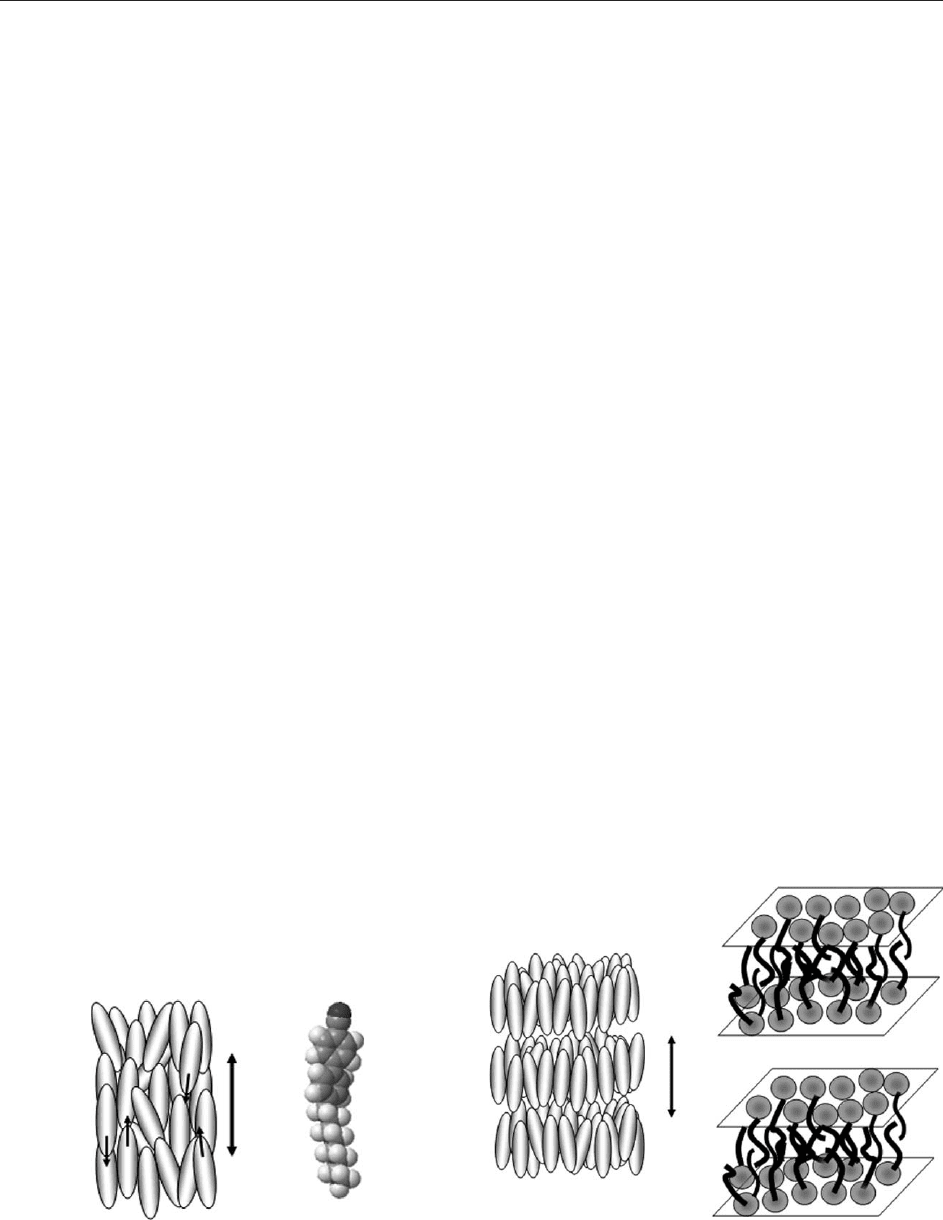
(a)
n
(b)
Figure 1 (a) Nematic (uniaxial) type of ordering in thermotropic
liquid crystals; the molecular long axes are on average aligned
along the director n; (b) a molecule of octylcyanobiphenyl, a
typical thermotropic liquid crystalline material capable of both
nematic and SmA types of ordering.
Water
Water
Water
Thermotropic SmA Lyotropic
L
α
phase
n
Figure 2 SmA type of ordering in the thermotropic SmA liquid
crystal (left) and the lyotropic analog, L
phase (right) formed by
equidistant arrangement of amphiphilic bilayers in water.
Liquid Crystals 321

hidden in the middle of the bilayer (note that
membranes of many biological cells are organized
in the similar way). The periodic structure of
alternating surfactant and water layers gives rise to
the L
phase (see Figure 2). Interestingly, the
structure might retain its smectic ordering even
when strongly diluted, being stabilized by thermal
fluctuations of bilayers.
Other types of smectics show in-plane order,
caused, for example, by a collective tilt of the rod-
like molecules with respect to the normals to the
layers (the so-called SmC). In chiral materials, the
tilt of the molecules might lead to the helicoidal
structure; we do not consider them here, although
the chiral SmC phase is of considerable interest for
applications in fast-switching optical devices.
‘‘Columnar phases’’ are most frequently formed
by hexagonal packing of cylindrical aggregates, as in
the case of thermotropic materials formed by disc-
like molecules. The positional order is 2D only, as
the intermolecular distances along the axes of the
aggregates are not regular.
‘‘3D-correlated structures’’ demonstrate a periodic
structure along all three coordinates, but they are
still different from the 3D crystals, as the periodicity
is caused by the repetition of molecular orientations
rather than by regular repetition of the molecular
centers of mass. For example, in cubic lyotropic
phases, the 3D network is formed by periodically
curved layers of amphiphilic molecules; the mol-
ecules are free to move within the layers.
Order Parameter
The concept of an order parameter (OP) has
emerged in its modern form in the Landau model
of phase transitions and has been later expanded to
describe other features such as topologically stable
defects in the ordered media. The OP of the liquid
crystal can be related to the anisotropy of macro-
scopic properties such as diamagnetic or dielectric
susceptibility. Measuring these anisotropies allows
one to determine the degree of orientational order.
The magnetic measurements are especially conveni-
ent compared with their electric counterparts, as in
this case the local field acting on the molecules
differs very little from the external field. In UN, the
components of the (symmetric) magnetic suscepti-
bility tensor
=
read in the frame in which the z-axis
is parallel to the director n,as
¼
¼
?
00
0
?
0
00
k
0
@
1
A
½1
The quantity
a
=
k
?
is called the anisotropy
of the magnetic susceptibility. In most thermotropic
UNs,
k
< 0and
?
< 0 (diamagnetism), and
a
> 0,
so that n orients along the applied magnetic field. In
the isotropic phase,
a
= 0; in UN,
a
is determined by
(1) molecular susceptibilities of individual molecules
and (2) degree of molecular order. For the latter, one
can chose the temperature-dependent quantity
s(T) = (1=2) 3 cos
2
1
,where is the angle
between the axis of an individual molecule and the
director n and ...himeans an average over molecular
orientations. The OP is thus the traceless symmetric
tensor Q
=
with the components that vanish in the
isotropic phase, and are proportional to
a
in the UN
phase:
Q
¼
¼Q
a
=30 0
0
a
=30
002
a
=3
0
@
1
A
½2
One can choose the constant Q in such a way
that in an arbitrary coordinate syste m, where
ij
=
?
ij
þ
a
n
i
n
j
,
Q
ij
¼sðTÞ n
i
n
j
1
3
ij
½3
The tensor OP allows one to describe the biaxial
nematic phase as well:
Q
ij
¼sTðÞn
i
n
j
1
3
ij
þ bTðÞl
i
l
j
m
i
m
j
½4
where n, l, and m are three orthogonal directors and
b is the ‘‘biaxiality parameter’’; b = 0 in UN.
Elasticity of the Nematic Phase
In real samples of liquid crystals, the average
molecular orientation changes from point to point
because of the external fields, boundary conditions,
presence of foreign particles, etc. The OP becomes
spatially nonuniform, Q
ij
(r). In most problems of
practical interest, the typical scale of distortions is
much larger than the molecular scale; the deforma-
tions are weak in the sense that the scalar part of the
OP, s(T), remains constant despite the spatial
gradients of the director field n(r).
The free-energy density associated with the (small)
deformations of the UN, classified as splay, twist,
and bend of the director (see Figure 3) writes in
terms of the director gradients n
i; j
= (@n
i
=@x
j
)as
f
FO
¼
1
2
K
1
ðdiv nÞ
2
þ
1
2
K
2
ðn curl nÞ
2
þ
1
2
K
3
ðn curl nÞ
2
½5
and is known as the Frank–Oseen energy density with
Frank elastic constants of splay (K
1
), twist (K
2
), and
bend (K
3
); all three are necessarily positive definite; the
322 Liquid Crystals
dimensionality is that of a force. The elastic constants
can be estimated as the typical energy of molecular
interactions responsible for the orientational order
divided by the characteristic length (a molecular size):
K U=l k
B
T=l 4 10
21
J=10
9
4 pN, which
yields a good estimate for many thermotropic UNs,
as the experimental values are between 1 and 10 pN.
The energy density [5] is often supplemented with the
so-called divergence terms:
f
13
þ f
24
¼ K
13
divðn div nÞ
K
24
divðn div n þ n curl nÞ½6
The K
24
term can be re-expressed as a quadratic
form of the first derivatives whereas the K
13
term is
proportional to the second derivatives n
i, jk
and thus
might in principle be comparable to f
FO
n
i, j
n
k, l
.
The volume integrals of these terms can be
re-expressed as the surface integrals by virtue of
the Gauss theorem (but only when the elastic moduli
K
13
and K
24
are constant which might not be the
case at certain interfaces and at the core of defects).
Therefore, when one seeks for equilibrium director
configurations by minimizing the total free-energy
functional
R
(f
FO
þ f
13
þ f
24
)dV, the K
13
and K
24
terms do not enter the Euler–Lagrange variational
derivative for the bulk. However, they can
contribute t o the energy and influence the equili-
brium director through boundary conditions at the
surface. Usually, K
24
term is retained when the
system experiences a topological change of the
director field. The K
13
term is often neglected;
very little is known about K
13
value.
In the presence of external field, the free-energy
density acquires additional terms. For example, for
the magnetic field B, the energy density [5], [6] should
be supple mented by the term (1=2)
1
0
a
(B n)
2
,
where
0
= 4 10
7
Hm
1
is the magnetic perme-
ability of free space (magnetic constant).
The possibility to orient the director by an ap plied
electric or magnetic field leads to numerous practical
applications. Any actual liquid crystal cell is
confined; say, by a pair of parallel glass plates. The
molecular interact ions between the liquid crystal
and the bounda ry substrates are anisotropic. This
anisotropy establishes one (sometimes more) pre-
ferred orientation of n at the boundary, the so-called
‘‘easy axis.’’ The phenomenon is called the ‘‘surface
anchoring.’’ Orienting action of the substrates
usually keeps the director uniform if the external
field is absent. However, the external field can
overcome both the ‘‘anchoring’’ at the surfaces and
the elasticity of the nematic bulk and reorient the
director. This is the ‘‘Frederiks effect,’’ first dis-
covered for the magnetic case. When the field is
removed, the surface anchoring restores the original
director structure. Thus, one can use the external
field and surface anchoring to switch the liquid
crystal orientation back and forth. The dielectric
version of the effect is used in electrooptic devices,
including displays. The liquid crystal is usually
sandwiched between two transparent electroconduc-
tive plates (e.g., glass covered with indium tin oxide)
coated with a suitable alignment layer. The voltage
across the cell controls the director configuration
and thus the optical properties of the cell.
Elasticity of the Smectic A Phase
For the SmA phase, the elastic free-energy density
should be modified to take into account (1)
restrictions that the layered structure imposes onto
the director twist and bend, and (2) elastic cost of
changes in the thickness of the layers:
f ¼
1
2
K
1
ðdiv n Þ
2
þ
1
2
B
2
½7
where B is the Young modulus (layers compressi-
bility modulus) and = (d d
0
)=d
0
, the relative
difference between the equilibrium period d
0
and
the actual layer thickness measured along the
director n. The ratio of K
1
to B defines an important
length scale
¼
ffiffiffiffiffiffiffiffiffiffiffiffi
K
1
=B
p
½8
called ‘‘the penetration length’’; is of the order
of the layer separation but diverges when the
system approaches the SmA–nematic transition.
The splay constant K
1
in the SmA phase is o f the
same order as in a nematic phase stable at higher
temperatures. With d
0
(1 3) nm, one finds
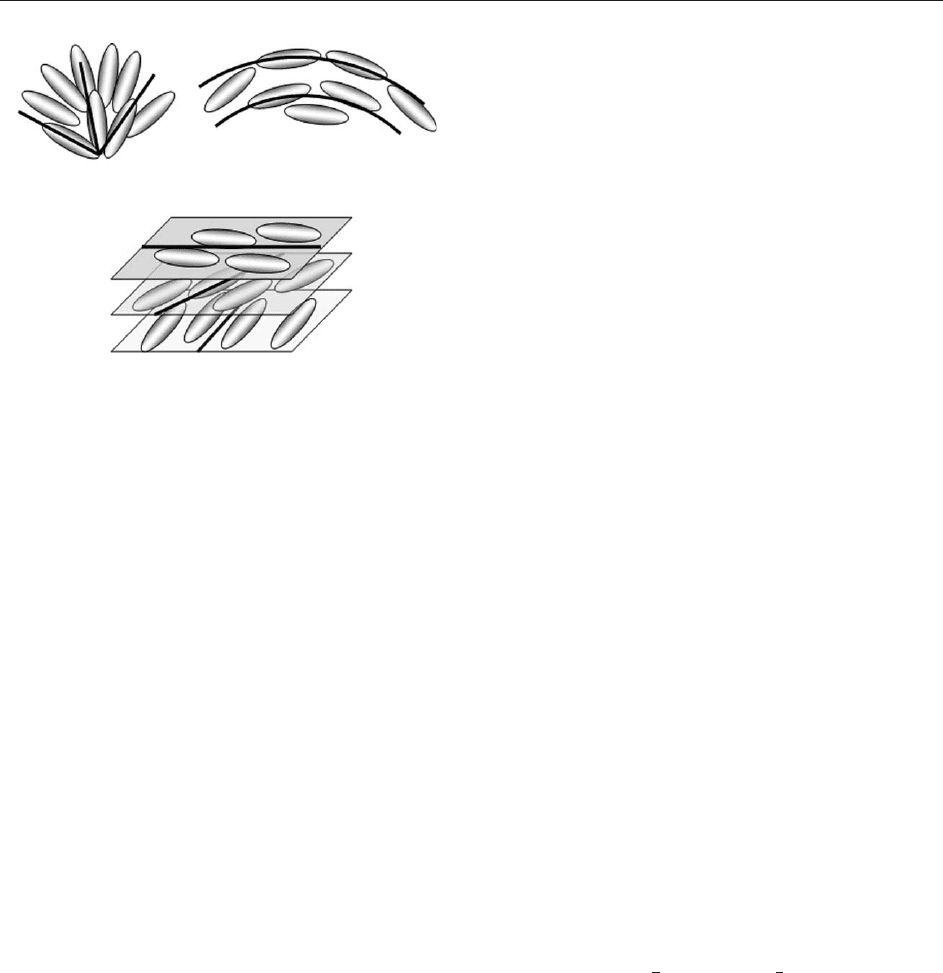
Splay
Twist
Bend
n
n
n
Figure 3 Basic types of director distortions in the bulk of the
uniaxial nematic.
Liquid Crystals 323
B 10
6
10
7
N=m
2
, a value that is 10
3
to 10
4
times
smaller than the compressibility modulus in a solid.
The SmA elastic free-energy density is often
written in terms of the mean curvature
H = (1=2)(
1
þ
2
) and the Gaussian curvature
G =
1
2
of the layers:
f ¼
1
2
K
1
1
þ
2
ðÞ
2
þK
1
2
þ
1
2
B
2
½9
As compared with eqn [7], it is supplemented by the
divergence saddle-splay term
K; 2K
1
< K 0 (for
the system of flat layers to be energetically stable);
1
= 1=R
1
and
2
= 1=R
2
are the local values of the
principal curvatures of the sme ctic layers.
Dynamics
Liquid crystals are fluids; they can flow preserving
the orientational order. Flow imposes an orienta-
tional torque on the liquid crystals. Most often, the
director tends to realign along the direction of flow.
There is also an inverse effect: dire ctor distortions
can cause the flow. This ‘‘backflow’’ effect is of
importance in liquid crystal displays. In the approxi-
mation of a constant scalar OP, the hydrodynamics
of liquid crystals is described in terms of seven
unknown variables: (1) mass density (r, t), (2) three
components of the velocity field v(r, t), (3) energy
density, and (4) two components of the director field
n(r, t). These variables are found from seven
equations
1. conservation of mass,
2. three equations for the conserved components of
the linear momentum,
3. entropy balance equation, and
4. two director dynamics equations.
In contrast to an isotropic fluid, the stress tensor
depends not only on the gradients of the velocity,
but also on the director components. UN phase
should be characterized by five different viscosity
constants. The number of viscosities reduces to
three, when the director distortions are small.
These three can be chosen as the effective viscosities
for three idealized geometries of flow, also known as
Miezowicz geometries, in which one assumes that
the director is fixed (e.g., by a strong magnetic field)
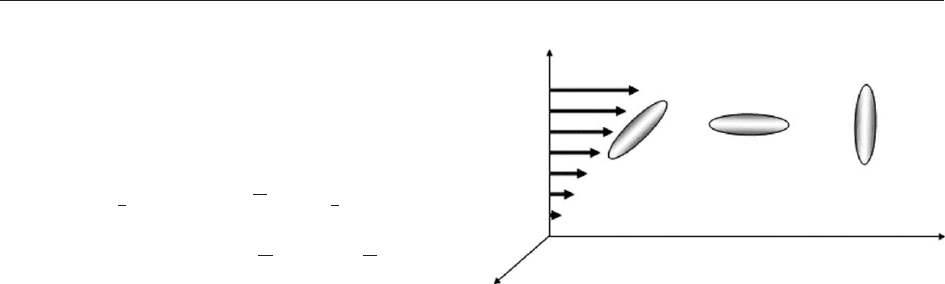
(see Figure 4):
When n = (1, 0, 0) is perpendicular to both the
flow direction and the velocity gradient, the UN
behaves as an isotropic fluid with a viscosity
a
;
however, director fluctuations coupled with the
certain values of the viscosity coefficients might
destabilize the ini tial director orientation (see
Figure 4a). When n is parallel to the flow
(Figure 4b) or parallel to the velocity gradient
(Figure 4c), the corresponding viscosities
b
and
c
are generally differe nt from
a
and from each other;
b
<
a
<
c
for a typical thermotropic UN material
composed of the rod-like elongated molecules. The
result
b
<
c
can be explained by assuming that
the friction correlates with the cross section of the
molecules seen by the flow.
Topological Defects
Experimental Observations
When a thick UN sample (say, 100 mm thick) with
no special aligning layers is viewed under the
microscope, one usually observes a number of
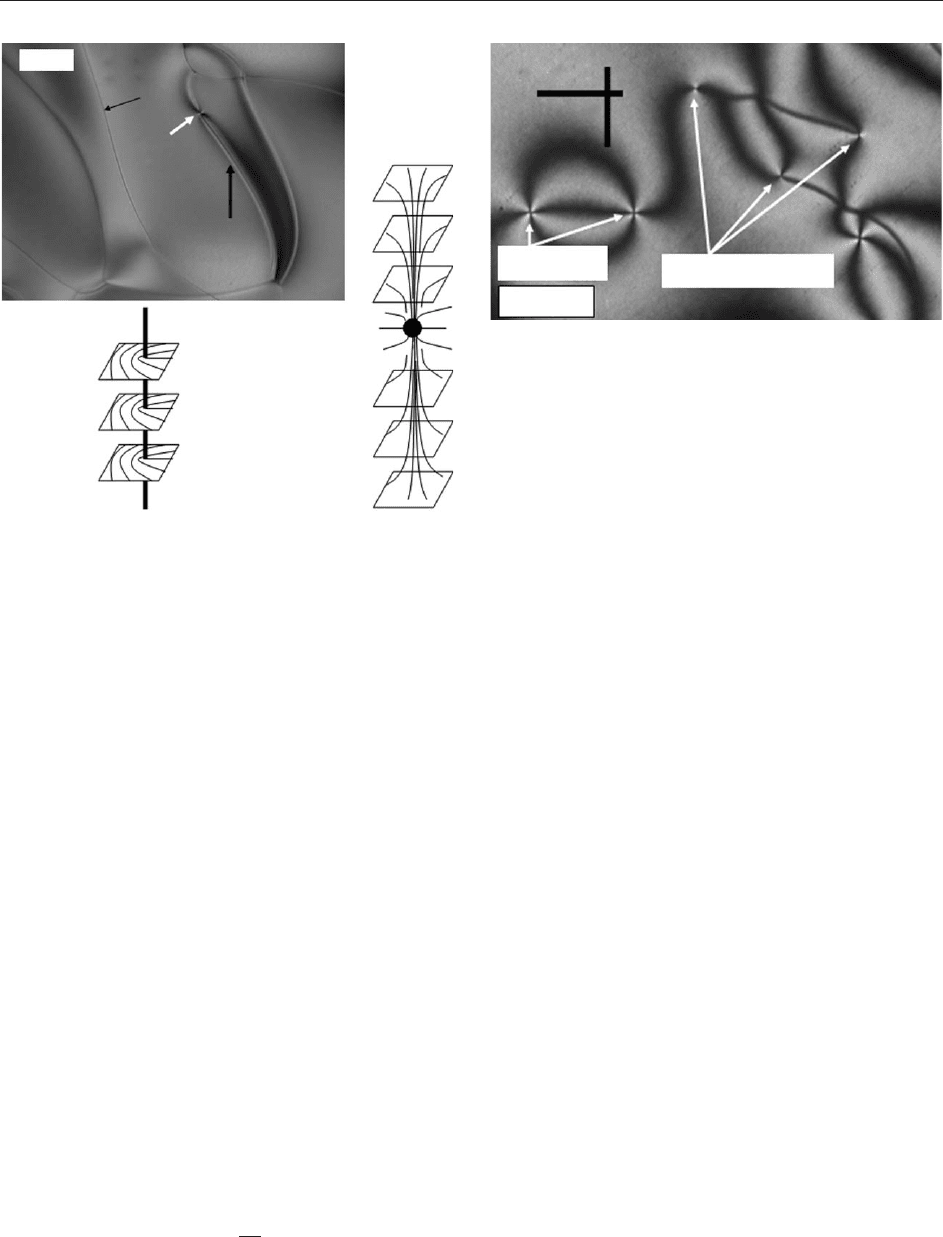
mobile flexible lines, the so-called disclinations.
The disclinations are seen as thin and thick threads
(see Figure 5). Thin threads strongly scatter light and
show up as sharp lines. These are truly topologically
stable defect lines, along which the nematic sym-
metry of rotation is broken. The disclinations are
topologically stable in the sense that no continuous
deformation can transform them into a uniform
state, n(r) = const. Thin disclinations are singular in
the sense that the director is not defined along the
core of the defect line. Thick threads are line
defects only in appearance; they are not singular
disclinations. The director is smoothly curved and
well defined everywhere, except, perhaps, at a
number of point defects, the so-called hedgehogs
(see Figure 5).
In thin UN samples (1–50 mm) with the director
tangential to the bounding plates, the disclinations
are often perpendicular to the plates. Under
a microscope with two crossed polarizers, one
can see the ends of the disclinations as centers
with emanating pairs of dark brushes (see Figure 6)
giving rise to the so-called ‘‘Schlieren texture.’’ The
dark brushes display the areas where n is either in
x
v
= [0, v(z), 0]
n
= (1,0,0)
η
a
n = (0,1,0)
η
b
n = (0,0,1)
η
c
y
(a) (b)
(c)
z
Figure 4 Miezowicz geometries for effective viscosities of the
uniaxial nematic.
324 Liquid Crystals
the plane of polarization of light or in the perpendi-
cular plane. The director rotates by an angle
when one goes around the end of the disclination at
the surface. Centers with four emanating brushes are
also observed; they correspond to point defects
located at the surface, the so-called boojums, (see
Figure 6). The director undergoes a 2 rotation
around these four-brush centers. The principal
difference between the centers with two brushes
(ends of singular lines) and centers with four brushes
(surface point defects) can be seen after a gentle shift
of one of the bounding plates with respect to the
other. Upon shear-induced separation in the plane of
observation, the centers with two brushes are clearly
seen as connected by a singular trace – disclination,
while the centers with four brushes separate without
a visible singularity between them.
The intensity of linearly polarized light coming
through a uniform UN slab depends on the angle
between the polarization direction and the projec-
tion of the director n onto the slab’s plane:
I ¼ I
0
sin
2
2 sin
2
h
n
e;eff
n
o
½10
where I
0
is the intensity of incident light, is the
wavelength of the light, n
e, eff
is the effective
refractive index that depends on the ordinary index
n
o
, extraordinary index n
e
, and the director orien ta-
tion. Equation [10] allows one to relate the number
jkj of director rotations by 2 around the defect
core, to the number B of brushes:
jkj¼B=4 ½11
Taken with a sign that specifies the direction of
rotation, k is called the ‘‘strength of disclination,’’
and is related to a more general concept of a
topological charge (but does not coincide with it).
Note that I = 0 when n is perpendicular to the plates
(so-called homeotropic state), as n
e, eff
= n
o
. The
homeotropic state is used as one of the ground
states in modern fla t-panel TV sets. By applying the
electric field, one tilts the director so that n
e, eff
6¼ n
o
and the cell (or the corresponding pixel in the liquid
crystal panel) becomes transparent.
Nematic Droplets
When left intact, textures with defects in flat samples
relax into a more or less uniform state. Disclinations
with positive and negative k find each other and
annihilate. There are, however, situations when the
equilibrium state requires topological defects.
Nematic droplets suspended in an isotropic matrix
such as glycerin, water, polymer, etc., (see Figure 7)
and inverted systems, such as water droplets in a
nematic matrix are the most evident examples.
Consider a spherical nematic droplet of a
radius R and the balance o f the surface anchoring
energy W
a
R
2
( W
a
is the surface anchoring
coefficient), and the elast ic energy KR; K is
some averaged Frank constant. Small droplets
with R << K=W
a
avoid spatial variations of n at
the expense of violated boundary conditions. In
contrast, large droplets, R >> K =W
a
,satisfy
boundary conditions by aligning n along the
200 µm
Singular
disclination
Singular
disclination
Core
(a)
(b)
(c)
Nonsingular
disclination
Nonsingular
disclination
n
n
Point
defect
hedgehog
Figure 5 (a) Thin singular disclinations and thick nonsingular
threads in the nematic (n-pentylcyanobiphenyle (5CB)) bulk.
Crossed polarizers; (b, c) typical director configurations asso-
ciated with thin and thick lines; thick lines are often associated
with point defects in the nematic bulk – hedgehogs.
100 µm
Boojums
Disclination ends
Analyzer
Polarizer
Figure 6 Schlieren texture of a thin (13 mm) slab of 5CB.
Centers with two and four brushes are the ends of singular
disclinations and point defects – boojums, respectively. Tangen-
tial director orientation. Crossed polarizers.
Liquid Crystals 325
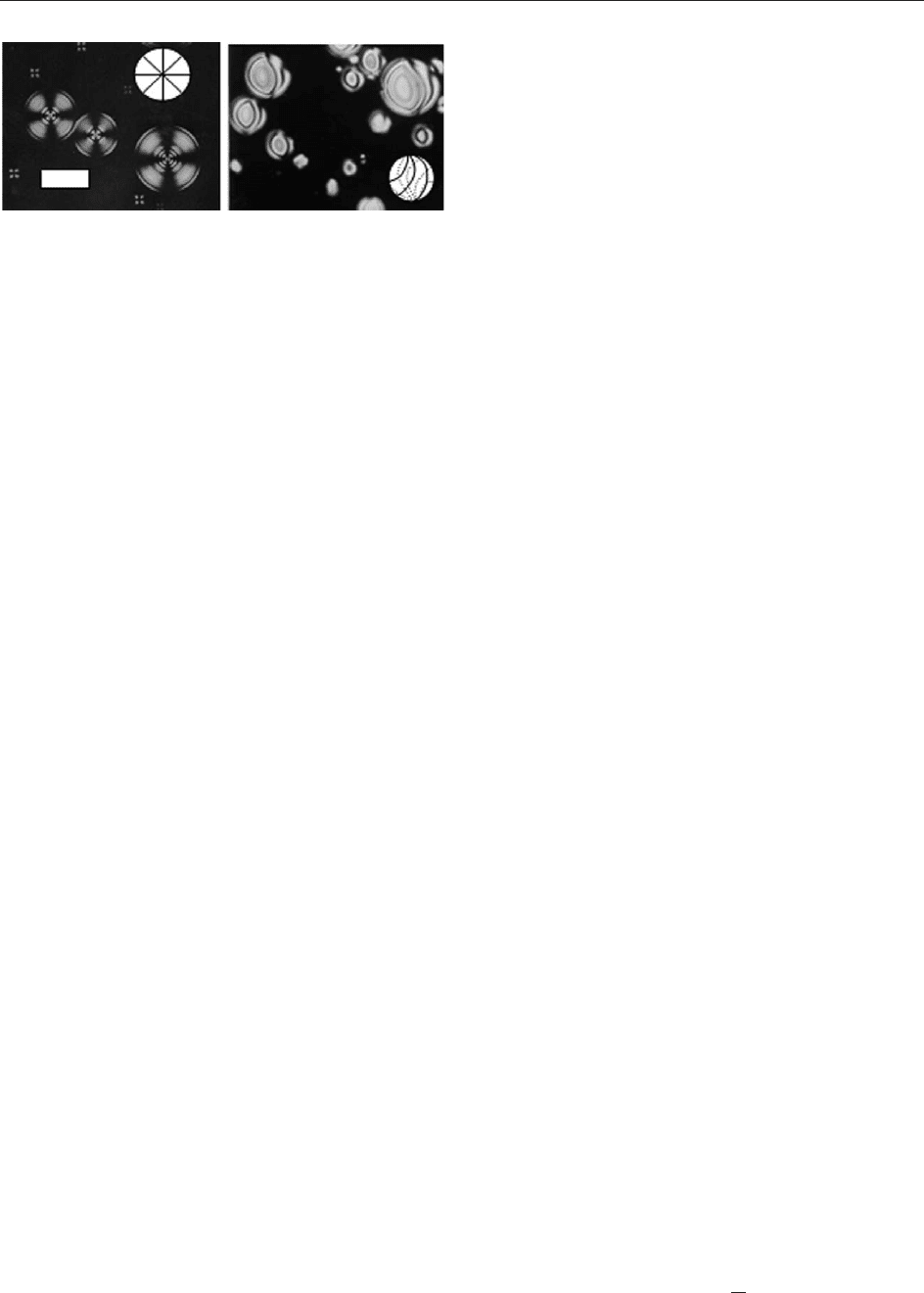
preferred direction(s) at the surface. Since the
surface is a s phere, the result is the distorted
director in the bulk, for example, a radial hedgehog
when the surface orientation is normal (see Figure 7).
The characteristic radius R is macroscopic (microns),
as K 10 pN and W
a
10
5
–10
6
Jm
2
.Point
defects in large nematic droplets must satisfy restric-
tions on their topological characteristics that have
their roots in the Poincare´ and Gauss theorems of
differential geometry.
Topological Classification
of Defects in UN
The language of topology, or, more precisely, of
homotopy theory, allows one to associate the
character of ordering of a medium and the types of
defects arising in it, to find the laws of decay,
merger and crossing of defects, to trace out their
behavior during phase transitions, etc. The key point
is occupied by the concept ‘‘of topological invari-
ant,’’ also called a ‘‘topological charge,’’ which is
inherent in every defect. The stability of the defect is
guaranteed by the conservation of its charge.
Homotopy classification of defects includes three
steps.
First, one defines the OP of the system. In a
nonuniform state, the OP is a function of
coordinates.
Second, one determines the OP (or degeneracy)
space R, that is, the manifold of all possible values
of the OP that do not alter the thermodynamical
potentials of the system. In the UN, R is a unit
sphere denoted S
2
=Z
2
(also called the projective
plane RP
2
) with pairs of diametrically opposite
points being identical. Every point of S
2
=Z
2
represents a particular orientation of n. Since
n n, any two diametrically opposite points at
S
2
=Z
2
describe the same state.
The function n(r) maps the points of the nematic
volume into S
2
=Z
2
. The mappings of interest are
those of i-dimensional ‘‘spheres’’ enclosing defects.
A line defect is enclosed by a linear contour, i = 1; a
point defect is enclosed by a sphere, i = 2, etc.
Third, one defines the hom otopy groups
i
(R).
The elements of these groups are mappings of
i-dimensional spheres enclosing the defect in real
space into the OP space. To classify the defects of
dimensionality t
0
in a t-dimensional medium, one
has to know the homotopy group
i
(R) with
i = t t
0
1.
Each element of
i
(R) corresponds to a class of
topologically stable defects; all these defects are
equivalent to one another under continuous
deformations. The elements of homotopy groups
are topological charges of the defects. For UN,
the homotopy group
1
(S
2
=Z
2
) = Z
2
= {0, 1=2} is
composed of two elements; there is thus only one
class of topologically stable defects (that appear
as thin singular lines under the microscope, see
Figure 5) with the addition rules 1=2 þ 1=2 = 0
and 1=2 þ 0 = 1=2 describing interaction of dis-
clinations. The topological point defects in the
bulk (hedgehogs) are described by the second
homotopy group,
2
(S
2
=Z
2
) = Z = {0, 1, 2, ...}, and
can be labeled by integer topological charges. The
simplest point defe ct is a ‘‘radial’’ hedgehog, seen
in the c enter of the radial droplet (see Figure 7a).
Boojums are special point defects that, in contrast
to hedgehogs, can exist only at the boundary of
the medium (see Fi gure 7b).
The relative stability of stable disclinations
depends on the Frank elastic constants of s play
(K
11
), twist (K
22
), bend (K
33
) and saddle-splay
(K
24
) in the Frank–Oseen elastic free-energy
density functional; the role of the elastic constant
K
13
in the struc ture of defects is not clarified yet.
Consider the simple st case of ‘‘planar’’ disclina-
tions with n perpendi cular to the line. In this case,
the K
24
-term in the line’s energy is zero. Assuming
K
11
= K
22
= K
33
= K, by minimizing the bulk integral
of [5], one finds the equilibrium director configura-
tion around the line of strength k
n ¼ cos k’ þ c½; sin k’ þ c½; 0
fg
½12
where ’ = arctan (y=x), x and y are Cartesian coor-
dinates normal to the line, c is a constant. The energy
per unit length of a straight planar disclination is
F
1l
¼ Kk
2
ln
L
r
c
þ F
c
½13
30 µm
(a) (b)
Figure 7 Polarizing-microscope texture of spherical nematic
droplets suspended in glycerin. (a) The director configuration is
radial and normal to the spherical surface; the inset shows the
point-defect hedgehog in the center of the droplet. (b) Tangential
director orientation at the interface results in the bipolar structure
with two defects-boojums at the poles. The director is twisted
because of the smallness of the twist elastic constant as
compared to the splay and bend constants.
326 Liquid Crystals