
Francoise J.-P., Naber G.L., Tsun T.S. (editors) Encyclopedia of Mathematical Physics
Подождите немного. Документ загружается.


variables t
1
, t
2
, ..., t
n
such that the physical situation
corresponds in this extended time-variable space to
the line
t
0
¼ t; t
1
¼ t; t
2
¼
2
t ; ...
d
dt
¼
@
@t
0
þ
@
@t
1
þ
2
@
@t
2
þ
½2
It thus amounts to a perturbation expansion of the
time-derivative operator. This method can be traced
back to the Lindstedt–Poincare´ technique, where the
time variable t is expanded according to t = s(1 þ
!
1
þ
2
!
2
þ) and the evolution described in
terms of the new variable s and unknown frequencies
(!
i
)
i1
to be determined self-consistently (Nayfeh
1973). By contrast, the multiple-scale approach puts
on a par t
0
= t and the additional variables (t
i
)
i1
.
The perturbation approach is then carried out as
usual, plugging eqn [2] for d/dt and the expansion
z(, t) =
P
n0
n
z
n
(t
0
, t
1
, t
2
, ...) into the evolution
equation and identifying term-wise the coefficients
of the successive powers of . The additional freedom
thus introduced when considering (t
i
)
i0
as indepen-
dent variables will be compensated in the course of
the computation, by imposing ‘‘solubility conditions’’
ensuring the vanishing of secular terms and the
consistency of the perturbation method. In particular,
it is possible to freely choose boundary conditions
outside the physical line t
1
= t
0
, ..., t
n
=
n
t
0
.The
resulting set of equations contains exactly the same
information as the original one, only expressed in a
different way: by construction, terms depending, say,
on t
0
, describe a fast component with no emerging
slow trends that would intermix with the t
1
-
dependence; fast variables contribute only to fast
modes. At the end, one restricts to the physical line,
thus turning back to the single ‘‘real’’ variable t.The
benefit of the method is to provide a joint access to
dependences at different scales, now expressing as
dependences onto the different time variables
t
0
, t
1
, ..., t
n
. One introduces as many new variables
as necessary to circumvent secular divergences. We
have implicitly supposed above that the behavior at
timescale t = O(1) corresponds to the fastest
timescale of the evolution. If it were not the case,
the rescaled time variables would be t
0
=
n
0
t,
t
1
=
n
0
þ1
t, ... if the fastest timescale is t = O (
n
0
).
More general time-derivative expansion, associated
with rescaled variables t
n
=
n
t might be considered
to better account for the hierarchy of characteristic
timescales of the dynamics.
Multiple-Scale Method: Abstract Examples
Let us first consider the simplest possible example
_
x = a(1 þ )x, for which the exact solution is trivially
known, allowing to appreciate the validity of the
multiscale approach compared to the straightforward
perturbation expansion. In the latter case, one looks
for a solution x(t) = x
0
(t) þ x
1
(t) þO(
2
) and identi-
fies term-wise the powers of . At order 0,
_
x
0
= ax
0
yields x
0
(t) = c
0
e
at
. At order 1,
_
x
1
ax
1
= x
0
(t) leads
to a secular divergence: x
1
(t) = c
0
1
e
at
þ c
0
te
at
. Carry-
ing on the perturbation analysis yields the following
expansion:
xðtÞ¼c e
at
ð1 þ t þ
2
t
2
=2 þÞ ½3
which is not uniformly convergent:fort = O(1=), all
terms are of the same magnitude. Using this recursive
method to obtain a finite-order approximate solution
(e.g., stopping, as here, after two steps of the
perturbation method) is only relevant at short times
t 1=. The straightforward perturbation analysis
captures the behavior of the exact solution only if all
terms are computed and taken into account (in less
trivial examples, the straightforward perturbation
series might even be divergent). In the multiple-scale
approach, one introduces two rescaled variables t
0
= t
and t
1
= t and looks for a solution of the form x(t)
x
0
(t
0
, t
1
, ...) þ x
1
(t
0
, t
1
, ...) þO(
2
). At order 0,
@
t
0
x
0
= ax
0
yields x
0
(t
0
, t
1
, ...) = c
0
(t
1
, ...)e
at
0
.At
order 1, we get @
t
0
x
1
þ @
t
1
x
0
= x
0
þ ax
1
. The solubil-
ity condition writes ac
0
@
t
1
c
0
= 0, which allows as
to avoid secular divergence and suppresses the
artificial freedom introduced with the additional
time variable t
1
, yielding c
0
= ce
at
1
. The equation
(@
t
0
a)x
1
= 0 is here superfluous, but in less simple
situations, it remains at this stage a nontrivial
equation for x
1
. One thus directly gets the solution,
uniformly valid at all times:
xðtÞ¼c e
at
1
e
at
0
¼ c e
að1þÞt
½4
As a rule in singular perturbation method, the
difficulty here originates in the noncommuting limits
! 0andt !1; indeed, denoting y
(t) = x
(t)e
at
,
one has lim
t !1
lim
!0
þ
y
(t) = c, whereas lim
!0
þ
lim
t !1
y
(t) = 1.
Other training examples are the weakly damped
linear oscillator
€
x þ x = 2
_
x, solved with multiple
scales t
0
= t, t
1
= t, t
1
=
2
t , or with the more spe-
cific variables =
ffiffiffiffiffiffiffiffiffiffiffiffiffi
1
2
p
t, = t; the Duffing oscil-
lator
€
x þ x = x
3
introduced above, whose
multiple-scale resolution requires three variables
t
0
= t, t
1
= t, t
1
=
2
t; and the Van der Pol oscillator
€
x þ x = (1 x
2
)
_
x.
An Illustration: Classical Lorentz Electron Gas
in a Weak Field
As a less abstract, hence more convincing, illustra-
tion of the strength of multiple-scale method, let us
Multiscale Approaches 467

consider the dynamics of a classical Lorentz electron
gas acted upon an external electric field (associated
acceleration a). This model considers the electrons
as charged hard spheres whose motion results from
the superimposition of a driven classical motion in
the field and elastic collision on immobile scatterers
(the atoms). It is implemented within a kinetic-
theoretic framework, based upon a Boltzmann-like
equation for the electron velocity distribution:
@
@t
þ a:
@
@v
f ðv; tÞ¼
v
Qf ðv; tÞ½5
where v = jvj, and is the mean free path of the
electrons. Qf = f f
sph
is a projector accounting for
the effect of collisions through the deviation of the
distribution f from spherical symmetry, namely
through the discrepancy between f and its isotropic
counterpart f
sph
(v) = (1=4)
R
f (v, t)d
^
v obtained as
an average over the velocity directions
^
v. The
relevant small parameter is = ma=kT, measuring
the ratio of the work ma done by the field over the
mean free path to the thermal energy kT in the
initial state. The condition 1 ensures
the separation of the characteristic timescales of
the two mechanisms experienced by an electron: the
thermal motion and the field-induced deterministic
motion. Denoting by v
th
=
ffiffiffiffiffiffiffiffiffiffiffiffiffi
kT=m
p
the thermal
velocity of the electrons, we have indeed
= (t
th
=t
acc
)
2
, where t
th
= v
th
is the mean time
between two successive collisions with the scatterers
and t
acc
=
ffiffiffiffiffiffiffiffi
=a
p
is the acceleration time required for
the field to move the electron over the mean free
path starting from rest. The result of the plain
weak-field expansion is to evidence its own failure:
it shows that the perturbation is singular insofar as
the asymptotic state will be fully dominated by the
field, with no memory of the initial temperature.
Multiple-scale method is here implemented with
respect to the time variable, introducing new
independent variables (
i
)
i>0
such that the physical
situation corresponds to the line
0
¼ tv
th
=;
1
¼
0
;
2
¼
2
0
; ...;
n
¼
n
0
; ...
ð ¼ ma=kTÞ½6
The time-derivative expansion [2] is supplemented
with an expansion of the velocity distribution:
f ðv; tÞ¼
X
i0
i
F
ðiÞ
ðv;
0
;
1
; ...;
n
; ...Þ½7
The procedure is conducted as exposed in the
general case. Identifying term-wise the coefficients
of the expansion yields a hierarchy of equations for
the (F
(i)
)
i1
, each supplemented with a solubility
condition preventing the appearance of secular
divergences. A detailed presentation can be found
in Piasecki (1993). The benefit of the multiple-scale
method is to yield jointly the different stages of the
gas evolution, starting from thermal equilibrium and
switching on the field at t = 0:
at times = O(1), an initial transient with a drift
velocity hv
z
i(t) = at C
1
at
2
v
th
= þ in the
direction of the applied field (denoting C
1
some
numerical constant);
at times = O(1=), a linear-response regime with
a steady drift velocity hv
z
ia=v
th
;and
at times = O(1=
2
), a long-time field-dominated
heating of the gas, where the velocity distribution
is no longer Maxwellian, and the kinetic energy of
the electrons grows without bounds as t
2=3
,
whereas the drift velocity slowly vanishes asymp-
totically: hv
z
i(
2
a=t)
1=3
.
Domains of Application of the Multiple-Scale
Method
The multiple-scale method was first developed in
nonlinear mechanics. It is fruitful and is even
required in any instance where plain perturbation
expansion is not uniformly convergent, more gen-
erally when it is necessary to account jointly for
variations at different timescales: resonant wave
interactions, for example, in plasmas, or in the case
of oscillations with slowly varying coefficients.
Multiple-timescale method was applied, around
1960, to get kinetic equations (closed equations for
the one-particle distribution) from molecular
dynamics (Liouville equation) for dilute gases,
plasmas, or to establish a microscopic theory of
Brownian motion from molecular dynamics of a
hard-sphere system (see the section ‘‘Microscopic
theory of Brownian motion’’). In the same spirit, it
allows to relate constructively different mesoscopic
descriptions, for example, in the case of Brownian
motion, to relate the Kramers equation for the
distribution P(r, v, t) to the Smoluchowski equation
for P(r, t ) (see the section ‘‘Mesoscopic theory of
Brownian motion’’). Other examples are the deter-
mination of transport coefficients (friction, viscosity)
from kinetic description or, at macroscopic scale,
the determination of eddy viscosity and eddy
diffusivity (see the section ‘‘Effective diffusivity for
a passively advected scalar’’). A last domain of
application concerns systems where relaxation pro-
cesses at different scales superimpose, requiring to
handle jointly different time dependences. Multiple-
scale method then displays the physics of the
relaxation process and its associated hierarchical
structure (e.g., the application to the adiabatic
piston problem discussed in this Encyclopedia by
468 Multiscale Approaches

Gruber and Lesne – see Adiabatic Piston; see also
the section ‘‘Some typical applications’’).
A Brief Overview of Multiscale
Approaches
Different Scales and Regimes
Common to all multiscale approaches is the focus on
the very existence of different scales, exploited
through the use of rescaled variables, which makes
explicit the presence of a small parameter control-
ling the dynamics, responsible for the existence of
different timescales and related to the scale separa-
tion. Technically, the first, very simple but essential,
step is to replace the variables, fields, and param-
eters by their dimensionless counterparts. So doing,
small parameters reflecting scale separation (in time,
space, energies, amplitudes, ...) will naturally
appear. Although it is thus possible to estimate the
order of the different terms, it is to be underlined
that it give s no clue on their actual contribution to
the long-term behavior: in singular situations, pre-
cisely those where multiscale approaches have to be
developed, small terms can have a noticeable
influence at all scales. As illustrated in the following
sections, different rescalings of variables and func-
tions allow us to discriminate features at different
scales and to capture different regimes. More
specifically, the techniques to manage with the
joint contributions of several regimes at different
timescales depend on the way these regimes inter-
mix. They can be:
superimposed regimes, when fast and slow depen-
dences intermingle in the evolution of the same
variable. It is the framework of multiple-scale
analysis. The solution writes typically x(t, t,
2
t , ...); or
coexisting regimes, namely a coexistence of fast
and slow evolutions. One might focus either on
the fast evolution and use a quasistatic approx-
imation (or parametric approximation) for the
slow evolution, either on the slow evolution and
use a quasistationary approximation or an aver-
aging of the fast evolution. The solution writes
typically [x
fast
(t), x
slow
(t )] (or [x
fast
(=), x
slow
()]
if the observation takes place at long timescales,
with a relevant time variable = t); or
successive regimes, when initial conditions, bulk
behavior and asymptotics are not of the same
order with respect to ; this is a boundary-layer-
like issue, and the solution writes typically
x
layer
(t=) for 0 t t
0
, then x
bulk
(t) for t t
0
,
with t
0
= O(1).
Applications are innumerable; the most typical
and investigated ones are the climate (from ‘‘hours’’
for the observed weather to ‘‘thousands of years’’ for
eras), population dynamics, coasts and sand dunes
(from ‘‘grains’’ to ‘‘country’’ scales), protein folding
(the vibration of covalent bonds occurs at scale of
femtoseconds, while the whole folding may require
up to a few seconds), or trading markets (from
seconds to years). Let us finally give two typical
examples for the parameter :
The weak-damping and high-frictio n limits, best
explained on an example. The damped oscillator
m
€
x þ
_
x þ V
0
(x) = 0 appears as an Hamiltonian
dynamics m
€
x þ V
0
(x) = 0 as soon as the damping
can be neglected, when the characteristic time
= [m=V
00
(0)]
1=2
of the undamped oscillator is far
smaller than the damping time = m=. The
weak-damping limit is thus defined as ! 0,
where = = = [
2
=mV
00
(0)]
1=2
. It leads to a
singular behavior when investigating the asymp-
totics, as in the Duffing oscillator and weakly
damped oscillator mentioned in the last section.
On the contrary, the evolution appears as a
dissipative gradient dynamics
_
x = V
0
(x)= = 0
as soon as . This leads to the high-friction
limit: = = [mV
00
(0)=
2
]
1=2
! 0. This example
somehow reconciles conservative and dissipative
dynamics, showing that they might coexist in the
same system.
The hydrodynamic limit involved in the deriva-
tion of hydrodynamics equations (namely incom-
pressible Navier–Stokes equations) from kinetic
Boltzmann equation. It writes = =L ! 0, where
is the so-called Knudsen number, defined as the
ratio of the mean free path (the average distance
traveled by a fluid molecule between two succes-
sive collisions) to a characteristic spatial scale L of
the system (e.g., the size of an obstacle).
Bridging the Scales: Mean-Field, Singular
and Scaling Approaches
The aim of multiscale approaches is to bridge
different scales, through the determination of the
large-scale behavior of the solution, or by establish-
ing a constructive relation between the initial model
and an effective model at higher scale. We have
mentioned in the introduction a first classification of
multiscale systems and associated approaches: they
might exhibit (1) scale decoupling, (2) some singu-
larity in the relation between the different scales, or
(3) scale invariance.
Mean-field approaches In case of scale decoupling,
mean-field approaches apply. Let us briefly recall,
Multiscale Approaches 469

within its usual spatial formulation, that a mean-
field approach amounts to identifying the local
environment, which is a priori fluctuating and
spatially inhomogeneous (e.g., the local magnetic
field generated by neighboring spins in a spin lattice
model) with the average one, expressed as a function
of the average order parameter (spatial average or
equivalently a statistical average in the limit as the
system size tends to infinity). Mean-field approaches
can be implemented either in time (averaging), in
real space (homogenization, coarse-graining), or in
phase space (aggregation and projection techniques).
In the present context, the best example of a mean-
field approach is provided by homogenization proce-
dures. They can be traced back to the method of
Lagrange to solve the three-body problem. The issue is
to describe the motion of a light body B
2
experiencing
the gravitational attraction of the Sun and a heavier
body B
1
. The mass of B
2
is supposed to be small
enough to neglect its influence on the Sun and B
1
(the
so-called restricted three-body problem); B
1
will thus
obey the Keplerian laws of motion. The method of
Lagrange applies when B
2
is far more distant from the
Sun than B
1
(r
2
r
1
), which implies (due to the third
law of Kepler: !
2
r
3
= const.) that the angular velocity
!
1
of B
1
is far larger than !
2
: the large body B
1
moves
faster than B
2
around the Sun. In first approximation,
Lagrange replaced the rapidly oscillating influence of
B
1
on the motion of B
2
by the influence of a constant
distribution of mass, obtained by spreading the mass
m
1
of B
1
all over its orbit. The Gauss theorem thus
states that this influence can be accounted for by
simply adding the total mass of this distribution to the
mass of the Sun. The stability of the system would
follow: B
2
will remain trapped in the neighborhood of
the pair composed with the Sun and B
1
.
Singular perturbations A typical instance of singu-
lar multiscale behavior is associated with asymptotic
expansions
xðtÞ¼
X
n1
r¼0
r
x
r
þ R
n
ð; tÞ½8
which are not convergent: lim
n!1
R
n
(, t) 6¼ 0at
fixed, but lim
!0
n
R
n
(, t) = 0 at fixed n and t.
Asymptotic expansions are ubiquitous in multiscale
approaches: the coexistence of different timescales,
superimposed and nontrivially coupled to get rise to
the observed phenomenon, prevents from obtaining
uniformly convergent perturbative expansions; it
is only in this latter regular case that the above-
mentioned mean-field approaches and homogeniza-
tion techniques apply.
Scale invariance, scaling theories and renormalization
Self-similarity and associated criticality prevent scale
decoupling, but allow us to develop scaling theories
and renormalization methods. In contrast to scale-
separation arguments, the guiding principle is now
to focus on the links relating one scale to the others
(scaling transformations, renormalization transfor-
mations). The problem complexity is thus reduced in
a some ‘‘transverse way,’’ by retaining only scale-
invariant features. We shall expose in the section
‘‘Renormalization: an iterated multiscale approach’’
further links between multiscale approaches and
renormalization methods, beyond the restricted
scope of scale-invariant systems: in many instances,
renormalization can be seen as an iterated multiscale
approach.
Scaling Limits
Let us mention a specific instance of multiscale
approach, which is associated with scaling limits.
Scaling limit refers to a joint limiting procedure, in
which several independent variables jointly converge
towards given limits, with prescribed relative beha-
viors; this latter condition is a key point in the
frequent case when the different limits do not
commute, and we shall see later that it is an
essential ingredient of renormalization methods.
Let us cite two acknowledged examples:
The thermodynamic limit for a system of N particles
in a volume V; it amounts to let N !1, V !1,
while N=V = n = const. (constant average number
density). It is a prerequisite to derive standard
thermodynamic behavior from the statistical–
mechanical description; it supports the use of
asymptotic results given by the law of large numbers
and the central-limit theorem provided the correla-
tions between the particles remain short-range.
The Boltzmann–Grad limit for a system of n hard
spheres of radius per unit volume. In dimension
d, it writes ! 0, n !1(thus differing from the
thermodynamic limit) while n
d1
= z remains
constant. This limit is involved in kinetic theory
as a limiting instance where the Boltzmann ansatz
applies (identifying the two-particle distribution
function with the product of the corresponding
one-particle distributions). Indeed, the occupied
volume fraction n
d
tends to 0 so that recollisions
and ensuing long-term correlations can be
neglected (rarefied gas). On the other hand, the
mean free path of a particle remains finite, so that
numerous collisions and associated molecular
chaos further support the Boltzmann decorrela-
tion ansatz.
470 Multiscale Approaches
Stochastic Multiscale Approaches
Multiscale approaches are far less developed for
stochastic processes. Let us mention the case of a
Markov process. Scale separation reflects in a
spectral gap in the transition matrix generating the
dynamics. Identification of fast and slow modes is
then straightforward: slow modes are associated
with quasidegenerated eigenvalues ( 0 in a time-
continuous setting), whereas fast dynamics is asso-
ciated with damped modes and negative eigenvalues
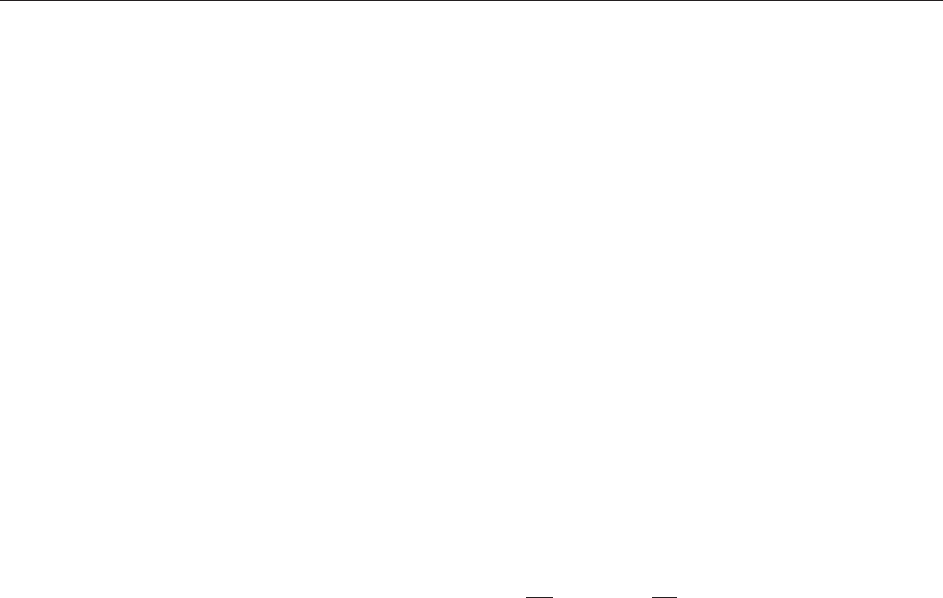
(<0, jj1) (Gaveau et al. 1999). A basic
difficulty in extending methods developed in a
deterministic context is the fact that the reduction
(or projection) of a Markov process is a priori no
longer Markovian. Closure relations and approx-
imations should be introduced to circumvent mem-
ory effects, for example, supported by arguments
of decorrelation and ensuing fast temporal self-
averaging of the fast dynamics.
It is to note that the behavior upon rescaling of a
stochastic process differs from the transformation of
a deterministic evolution. The basic relation is the
scaling upon a time rescaling = t of the white
noise involved in stochastic differential equations
and defined from the Wiener process W(t) through
the relation dW(t) = (t )dt. It follows from the
definition
f
W() = W(t) that d
f
W() =
ffiffi
p
dW(t). At
this point, it is important to notice the difference
with respect to the behavior of a plain deterministic
function
e
f () = f (t) for which d
e
f () = df (t ). Using
the fact that (t)
= () and the definition
d
f
W() =
e
()d, we obtain that
e
() is a white noise
with respect to the rescaled time , that is, a
stationary Gaussian process defined by its first two
moments
h
e
ðÞi ¼ 0; h
e
ð Þ
e
ð
0
Þi ¼ ð
0
Þ½9
Slow/Fast Variables
Slow/Fast Decomposition
Dynamics of systems made of many interacting
elements, for example, chemical reactions, or popu-
lation dynamics, typically involves far too many
degrees of freedom to be handled at the level of
individual units, and requires a drastic reduction to
make sense of it. A natural way of reduction is based
upon the phenomenology, taking as relevant degrees
of freedom those describing the slow evolution
observed at macroscopic scales. Scale separation
between microscopic and macroscopic worlds has to
be turned into a constructive and quantitative
argument to achieve this reduction.
Solving this typical multiscale issue first requires
to identify and construct expli citly the slow vari-
ables, for example, collective variables obtained
through aggregation or coarse-grainings. The second
step is to eliminate or rather integrate the fast
dynamics into a closed system of effective equations
describing the large-scale evolution. The closure
requirement generically involves an approximation,
neglecting the remaining dynamic coupling between
fast and slow variables. It is precisely here that scale-
separation arguments and the very choice of the
slow variables are crucial, ensuring that the influ-
ence of fast dynamics is essentially accounted for in
its effective or average contribution to the slow
dynamics; remaining fluctuating influences can be
either neglected or included in a noise term, required
to be fully determined as a function of the slow
variable only (otherwise the whole procedure would
neither be consistent nor useful). In the following
subsections, we shall briefly present the main
techniques allowing to achieve this program, con-
sidering the simple abstract system:
dX
dt
¼ f ðX; YÞ;
dY
dt
¼ gðX; YÞ; ð 1Þ½10
Although involving only two variables for simpli-
city, it exhibits the typical multiscale structure:
whereas X varies on scales O(1), Y appears as a
slow variable of characteristic timescale O(1=).
Parametric Approximation
The preliminary step of the reduction is to get some
knowledge on the fast dynamics, at least to choose
the proper multiscale technique. A plain but never-
theless fruitful remark is that a parameter p can
always be seen as a variable that does not evolve:
dp=dt = 0 in a deterministic setting, or W
p!q
=
(p q) in a stochastic one (transition probability
W). Conversely, a slow variable can be transiently
treated as a mere parameter in the fast dynamics.
Supported by timescale separation, this parametric
approximation (or quasistatic approximation)
decouples the fast dynamics from the slow variable
evolution, investigating the fast dynamics asympto-
tics (t !1) while considering that the slow variable
remains constant Y(t) y. In the following, we shall
distinguish two cases: (1) the fast dynamics oscillates
with a period T 1=, and (2) the fast dynamics
relaxes to a stable equilibrium point X
(y) slaved to
the slow variable.
Amplitude Equations
A ubiquitous technique to account for slowly
modulated oscillations has been introduced first by
Multiscale Approaches 471
Fresnel for light propagation and optical phenom-
ena. The basic idea is to take benefit from the scale
separation between the fundamental oscillation
(frequency !, wavelength = 2=k) and a super-
imposed slow variation of the wave amplitude
Aðr; tÞ¼Aðr; tÞe
iðk:r !tÞ
K jrA=A jk; j@
t
A=Aj!
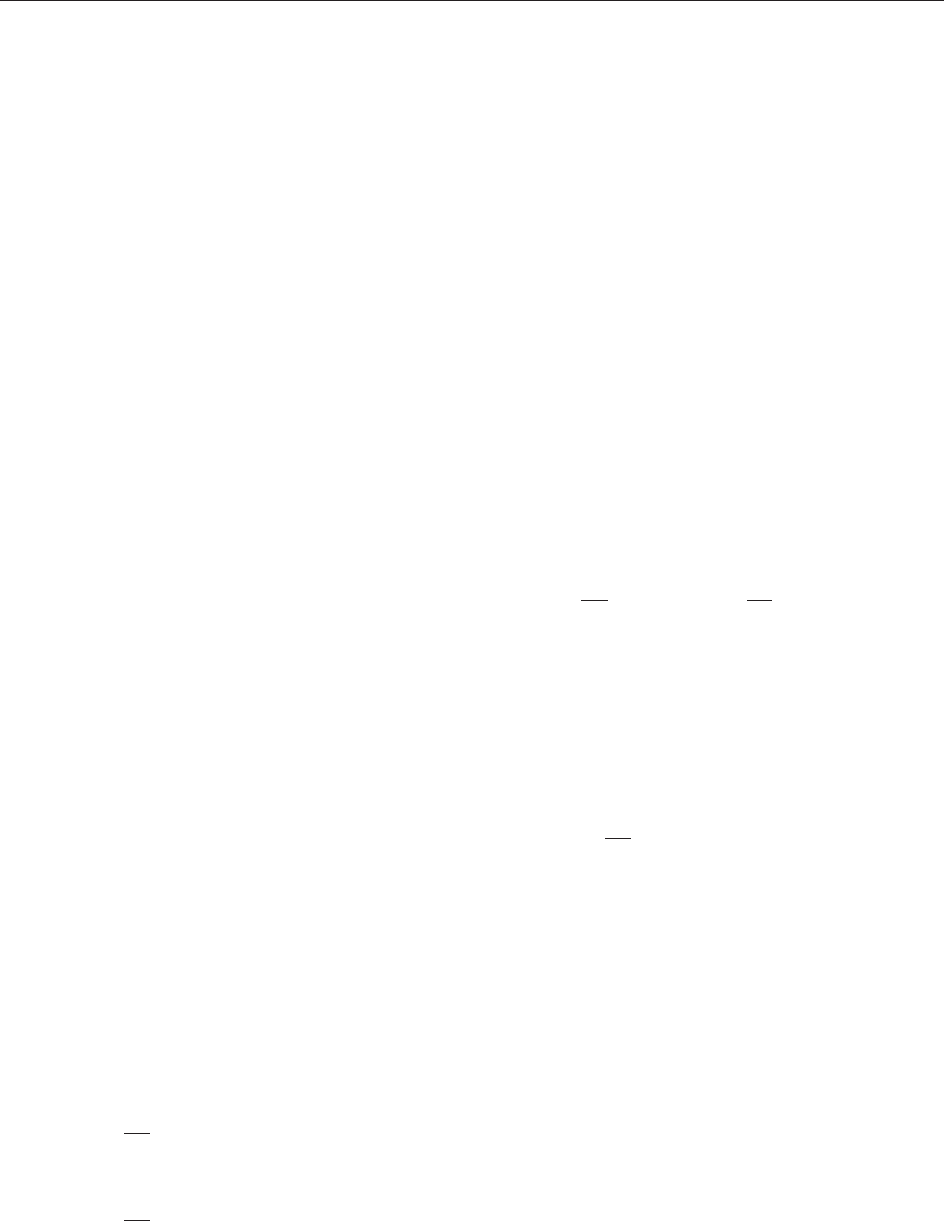
½11
The evolution can be rewritten in terms of the
slowly varying amplitude A; by construction, it is
ruled by terms involving the small parameter
K=k =! 1, but the resulting equation is now
devoid of small or large parameter. Such technique
has been successfully applied and further developed,
for example, in various situations involving electro-
magnetic waves (e.g., diffraction of Hertzian waves),
in plasma physics (resonant interaction between
electromagnetic waves and acoustic modes) and in
quantum mechanics, to investigate the deformation
of a wave packet in a potential.
Averaging
Let us discuss further, in a general setting, the case
when the fast dynamics is an oscillation of period T
(either linear modes as in the last subsection or a
stable limit cycle). It is a context where averaging
techniques apply. We refer to the associated entry in
this Encyclopedia by Neishtatdt (see the article
Averaging Methods) and only mention here the
main principle: to exploit scale separation and self-
averaging property of the fast dynamics to replace
X(t) by an average value
X
av
ðtÞ¼ð1=TÞ
Z
Tþt
t
XðsÞds
The underlying idea is that averaging cancels out
most of the fast variations so that X
av
(t) is now
slowly varying. In case when the fast dynamics is
influenced by the slow variable Y, its value is kept
constant in the averaging (see the section ‘‘Para-
metric approximation’’). The resulting average
behavior X
av
[Y(t), t] is reinjected in the evolution
of the slow component, leading to a closed equation,
dY
dt
¼ gX
av
½YðtÞ; t; YðÞ
or rather
d
e
Y
d
¼ g
e
X
av
½
e
YðÞ;;
e
Y
½12
in terms of the more relevant rescaled time variable
= t and
e
Y() Y(t). Denoting
Y() the solution
of this approximate equation, the validity of the
averaging procedure is assessed by theorems
giving conditions ensuring that lim
!0
e
Y
() =
Y().
Note that such theorems (quite unusually) state
the convergence, for a vanishing value of the
perturbation parameter , of the exact solutions
towards the approximate one (solution of the
average equations).
To conclude, let us notice that one speaks of
averaging in temporal context and homogenization
in spatial or spatio-temporal contexts, when aver-
aging is performed over space; as discussed in the
section ‘‘Bridging the scales: mean-field, scalar, and
scaling approaches,’’ averaging and homogenization
belongs to the general class of mean-field
approximations.
Quasistationary Approximation
Let us now consider the case when the fast dynamics
converges at fixed Y towards a stable fixed point
X
(Y). Focusing on the slow dynamics, the relevant
time variable is = t, which turns the evolution
[10] into
dX
dt
¼ f ðX; YÞ;
dY
dt
¼ gðX; YÞ½13
(for the sake of simplicity, we use the same notation
X for both X(t)and
e
X()). It is solved in two steps, by
noticing that at lowest order in , the fast dynamics
reduces to the asymptotic regime f (X, Y) = 0, slaved to
the slow variable Y. The corresponding stable state
X
(Y) is then plugged into the slow dynamics to get a
closed equation for Y():
dY
d
¼ g½X
ðYÞ; YGðYÞ½14
This achieves the desired dimensional reduction. It
works equally well when X is a string of variables
X = (x
1
, ..., x
N
).
There is seemingly a paradox here, ubiquitous in
many multiscale approaches: in order to determine
the evolution of the slow variable Y, it is considered
a constant! The solution lies in scale separation: the
trick is to consider the ensuing approximate decou-
pling as an exact one (what it would be in the limit
! 0). In other words, the constancy of Y is
considered over a time length which is long at the
level of fast dynamics (t 1), long enough for X
to reach its equilibrium state X
(Y), but short at
the macroscopic level (t = 1). As in the
so-called ‘‘quasistatic evolutions’’ encountered in
thermodynamics, the large-scale evolution will be
composed of a continued succession of local
equilibrium states: at each time , X takes its
instantaneous equilibrium value, slaved to Y().
Here one speaks equivalently of quasistationary
472 Multiscale Approaches

approximation, quasisteady-state approximation,or
adiabatic elimination of fast variables.
Slow Invariant Manifolds
In the previous subsections, the decomposition
between fast variables X and slow variables Y was
given. But in practice, only the whole dynamics of
the system is known and a main part of the issue is
to find and construct explicitly the slow variables.
A geometrical viewpoint on the dynamics
appears to be fruitful: if the system evolution is
to be reducible to the evolution of a few degrees
of freedom, it means that the flow essentially lives
in a low-dimensional region of the phase space,
which can be parametrized by these degrees of
freedom up to some fuzziness of order O().
Mathematical investigations have been conducted
to assess this point, leading to the concept of
invariant slow manifold: a manifold M of the
phase space, invariant upon the dynamics and
describing the slow dynamics once the system has
reached it (Gorban et al. 2004). Starting from an
arbitrary point z
0
, the trajectory first exhibits a
fast transient bringing the system state close to M,
up to some tolerance of order O(), then sticks to
M. Its evolution on M isruledbyareduced
dynamics, far slower than the fast relaxation to
M as soon as the system actually exhibits a
timescale separation. This latter self-consistent
assertion should be considered as a working
hypothesis, to be validated by the explicit deter-
mination of M and associated reduced dynamics.
This can be done numerically, by exploiting the
presumed convergence property of any trajectory
reaching M after some intrinsic transients. In
other words, if the dynamics possesses a slow
invariant manifold, an operational way to find M
is to let the system evolve, starting from a sample
of initial conditions, and to observe its stabiliza-
tion on M.
This framework obviously embeds the quasista-
tionary approximation presented in the last subsec-
tion: in this case, the slow invariant manifold is
M={z=(x,y), f (z)=0}={(x
(y),y)} and the dynamics
restricted to M is the slow dynamics dy=d =
G[y()], x() = x
[y()]. Here the manifold is invar-
iant upon the approximate dynamics (for all
t, f [z(t)] = 0, hence z(t) 2M) but not upon the
original one: some rigorous mathematical work has
to be done to show that the actual dynamics keeps
the trajectory in a proper neighborhood of M of
width O(). In other words, one has to control the
discrepancy between the exact trajectory and the
trajectory slaved on M.
Central Manifold
The notion of slow invariant manifold generalizes
older results about central manifolds, exploited to
reduce the dynamics near a bifurcation point.Letus
consider a dynamical system
_
x = f (x, ) near a
bifurcation point: in =
c
, the fixed point x
0
,
stable for <
c
, loses its stability. This reflects on
the largest eigenvalue(s) of the stability matrix
Df (x
0
, ), namely
1
() < 0 for <
c
,
1
() > 0
for >
c
, and
1
(
c
) = 0. The small parameter is
then =
1
. A main result was to show that, near the
bifurcation point, slow modes coincide with
unstable directions and fast modes with stable
directions (Haken 1996). The decomposition into
slow and fast variables is ruled by the central
manifold theorem: the solutions can be expressed
in terms of the amplitudes along the eigenvectors of
the null space of the dynamics at = 0; these
amplitudes appear as the relevant order parameters
near the bifurcation. This is referred to as the slaving
principle. Compared to the setting presented in the
subsection ‘‘Slow invariant manifolds,’’ the slow
invariant manifold M is given here by the central
manifold.
Projection Techniques
The methods presented in the previous subsections
to eliminate fast variables and construct a reduced
slow dynamics can be unified into a common
framework: Mori–Zwanzig projection techniques.
The full state (x, y) of the system is projected onto
the slow variable y and the functions w(x, y) are
projected onto their conditional expectation
PwðyÞ
Z
wðx; yÞð xjyÞdx ½15
The core of the method lies in the choice of
conditional distribution (x jy), for instance,
(x jy) = (x x
(y)) in case when there is an
invariant manifold x = x
(y), or (x jy) = 1=2 in
case of averaging over a rapidly varying phase x.We
refer to Givon et al. (2004) for a review.
Aggregation Techniques and Coarse-Grainings
An intuitive guideline in the analysis of a multiscale
dynamics is that collective variables or coherent
states coinc ide with slow modes. The rationale is
that numerous fast fluctuations at the level of agent
dynamics self-average, so that only a slow trend is
perceptible at large scale. Aggregation methods have
been developed in this spirit to build reduced models
governing the slow dynamics. Nevertheless, in
generic situations, aggregation does not lead to
Multiscale Approaches 473
closed equations for the collective variables and
some level of approximation has to be introduced.
Let us now consider a system of N coupled
degrees of freedom, [x
i
(t)]
I = 1...N
(e.g., a system of N
interacting agents) evolving deterministically accord-
ing to a two-scale dynamics (Auger and Bravo de la
Parra 2000):
dx
i
dt
¼ f
i
ðx
1
; ...; x
n
Þþg
i
ðx
1
; ...; x
n
Þ½16
where f describes a fast evolution due to the
coupling between species and g
i
a slow evolution
due to internal mechanisms. A natural choice for the
slow variable is Y(x
1
, ..., x
n
) =
P
i
x
i
, but we shall
write below the general case. The self-consistent
requirement of the method is that this variable Y
reflect a global and slow behavior. Considering t as
a fast time variable, this condition amounts to
require a quasistatic behavior for Y at this timescale.
In other words, the consistency condition requires
that there exists a manifold F
y
such that
X
N
i¼1
@Y
@x
i
ðx
1
; ...; x
N
Þf
i
ðx
1
; ...; x
N
Þ¼0
on F
y
¼fYðx
1
; ...; x
N
Þ¼yg½17
We, moreover, assume that the fast dynamics on this
manifold F
y
leads to a stable equilibrium
(x
1
(y), ..., x
N
(y)). We are then in a position to
describe the slow evolution of the manifold itself,
that is, the slow dynamics ruling the evolution of the
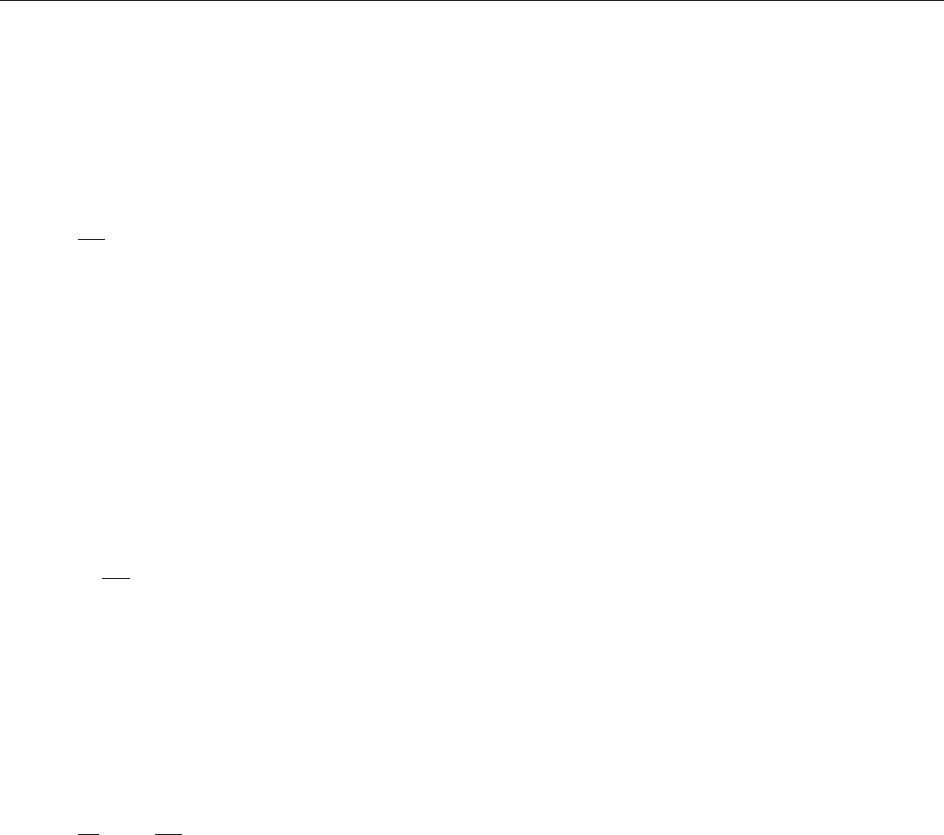
aggregated variable y for small enough:
dy
dt
¼
X
i
@Y
@x
i
x
1
ðyÞ; ...; x
N
ðyÞ
g
i
x
1
ðyÞ; ...; x
N
ðyÞ
þOðÞ½18
Internal support of the procedure is to check the
structural stability of this resulting aggregated
dynamics. Compared to the quasistationary approx-
imation and slaving principle presented earlier, here
the slow variable is not given independently but
constructed as a function of the fast variables
(aggregated variable). The same principles can also
be implemented for discrete-time models.
Coarse-graining can be seen as the spatial analog
of aggregation techniques developed in the phase
space: the real space is split into cells considered as
elementary units at macroscopic scale, and all the
small-scale physics is averaged over each cell,
yielding the apparent state of each unit (described
by a few ‘‘coarse-grained’’ variables) and the
effective interactions between them.
Let us cite two hydrodynamic examples. Eddy
viscosity refers to an effective viscosity involved in
coarse-grained hydrodynamics equations; the con-
tribution of small-scale turbulent structures is
accounted for in an integrated way in this para-
meter, hence its name. It is typically lower than bare
viscosity, even possibly reaching negative values at
large enough Reynolds number, that is, at low
enough bare viscosities. Cellular flows are space-
periodic flows, thus exhibiting a natural spatial
scale: the coarse-graining amounts to an intrinsic
homogenization over each cell of the flow.
Let us finally mention that coarse-grainings are
involved in renormalization-group transformations
once supplemented with the adequate rescalings (see
the section ‘‘Renormalization: an iterated multiscale
approach’’).
In conclusion, it is to note that all these various
multiscale approaches are closely related and can all
be expressed as a specific projection technique in the
extended phase space containing both fast and slow
variables. For instance, aggregation techniques
replacing the fast variables (x
1
, ..., x
n
) by the slow
collective variable y = Y(x
1
, ..., x
n
) amount to the
projection technique involving the slow invariant
manifold M= {(x
1
, ..., x
n
, y) jy = Y(x
1
, ..., x
n
)}.
Numerical Aspects
In the community of applied mathematics, multi-
scale methods refer specifically to numerical homo-
genization, involving multigrid algorithms as, for
instance, multiscale finite-element method, multigrid
Monte Carlo, multigrid optimization, or annealing.
Basically, the idea of numerical homogenization is
to avoid the numerical cost of using a mesh of size
h <, where is the scale of the smallest-scale
features of the dynamics, and to use jointly:
a fine mesh, to compute local quantities indepen-
dently (hence with a parallelized program); and
a coarse mesh, to compute global behavior using
effective parameters and homogenized quantities
determined in the prior fine-mesh computation.
We refer to Gorban et al. (2004) for a review.
Boundary Layers and Matched
Expansions
Purposes and Principles
Multiscale approach to handle boundary layers was
introduced in 1905 by Prandtl in fluid mechanics for
situations where the solution of hydrodynamics
equations far from the boundaries (‘‘bulk’’ solution)
does not match the conditions at the surface of the
walls or obstacles. This typically originates in the
presence of a multiplicative small factor in front of
474 Multiscale Approaches
the highest-order derivative; accordingly, the flow
exhibits two different scales in space: a thin
boundary layer of width controlled by and the
bulk domain. The idea is to perform two different
perturbation methods in the layer and in the bulk,
involving a different rescaling in order to focus on
and give the ruling place to either the boundary
conditions or the bulk dynamics (one also speaks of
inner and outer expansions). Then these parallel
perturbation expansions have to be bridged into a
single global continuous solution. The matching
principle is to identify the asymptotic behavior on
the boundary side with the boundary condition of
the bulk behavior (Nayfeh 1973):
lim
r!0
X
bulk
ðrÞ¼lim
!1
X
layer
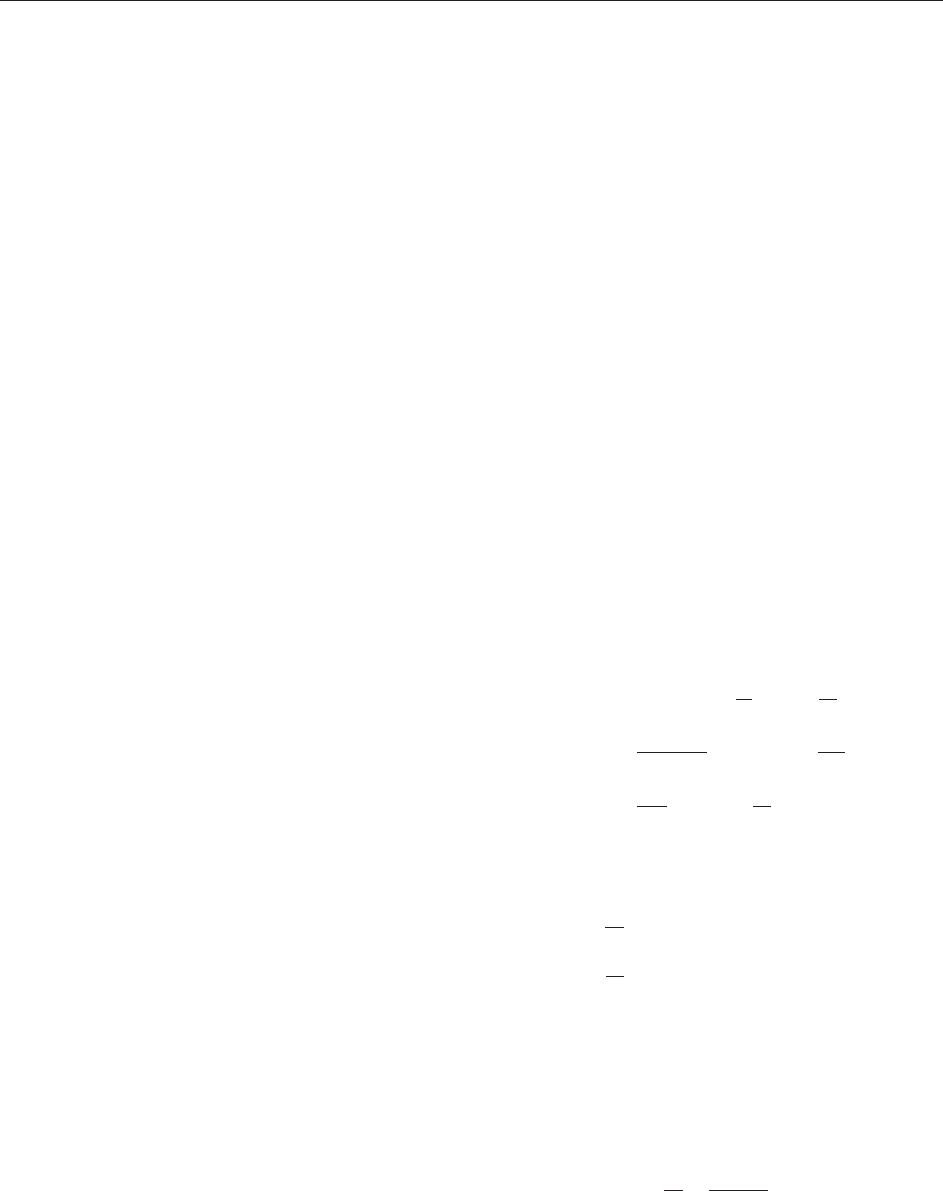
ðÞ with ¼ r= ½19
Boundary layers of hydrodynamics have numer-
ous analogs: initial layers in chemical kinetics, skin
layers in electrodynamics and edge layers in solid-
state physics (Nayfeh 1973). Adaptation of this
technique is to be developed to determine the
complete dynamics in the slow-invariant-manifold
approach, matching the fast relaxation towards the
manifold with the slow motion onto the manifold.
Let us finally note that the matched-expansion
approach can benefit in each region of all the
above-mentioned multiscale techniques.
Time Analog: Implementation for Initial Layers
We shall now work out the time analog of a
boundary-layer problem on the abstract example
encountered in [10], in the case when X rapidly
evolves to a slaved equilibrium state X
(Y) but with
initial conditions Y(0) = y
0
and X(0) = x
0
6¼ X
(y
0
).
Obviously, the quasistationary approximation fails
to describe the initial regime and its applicability
has to be reconsidered. The general principle of
boundary-layer analysis, namely the recourse to two
different perturbation approaches, is implemented as
follows:
For the initial regime, one solves the fast
dynamics with initial conditions X(0) = x
0
while
keeping Y(t) y
0
; this yields an approximate
solution [X
layer
(t), Y
layer
(t)], satisfying the initial
conditions and valid at short times, as long as Y
has not evolved.
At longer times, the relevant variable is the
rescaled time = t and the quasistationary
approximation described in the last section
applies.
The consistency of the two perturbative
approaches is ensured by the matching conditions
lim
!0
X
bulk
ðÞ¼lim
t!1
X
layer
ðtÞ
lim
!0
Y
bulk
ðÞ¼lim
t!1
Y
layer
ðtÞy
0
½20
These conditions are actually satisfied since X
bulk
()
X
[Y
bulk
()], hence lim
!0
X
bulk
() = X
(y
0
)and,by
definition of X
(at fixed Y(t) y
0
), lim
t !1
X
layer
(t) = X
(y
0
).
Some Typical Applications
Enzymatic catalysis A matched singular perturba-
tion approach is currently encountered in chemical
systems, for instance, in the derivation of the
Michaelis–Menten kinetics for a single enzyme and
the Hille cooperative kinetics for an allosteric
enzyme (Murray 2002). Denoting by E the enzyme,
by S the substrate, by ES the active complex, and by
P the product, the single-enzyme catalytic transfor-
mation of S into P is described by the following
scheme:
S þ E Ð
k
k
0
ES !
k
cal
P þ E
½Ss; ½Ee; ½ESc
½21
where, as is well known, the enzyme is released at
the end. Introducing dimensionless quantities
~
t ke
0
t;
~
s
s
s
0
;
~
c
c
e
0
K
m
k
0
þ k
cat
k
;
e
K
m
¼
K
m
s
0
k
cat
ks
0
;¼
e
0
s
0
½22
the corresponding chemical kinetic equations can be
written as
d
~
s
d
~
t
¼
~
s þ
~
cð
~
s þ
e
K
m
Þ
~
c
d
~
t
¼gð
~
s;
~
cÞ
~
s
~
cð
~
s þ
e
K
m
Þ
½23
Noticing that 1 (the enzyme is present in
infinitesimal quantities compared to the substrate),
a quasistationary approximation applies for the
variable
~
c: it means that the intermediary species
ES rapidly reaches a local equilibrium state
~
c =
~
c
(
~
s).
This yields the substrate evolution
d
~
s
d
~
t
¼
~
s
~
s þ
e
K
m
½24
The initial condition is set only on the substrate:
s(0) = s
0
, that is,
~
s(0) = 1. It yields the well-known
expression of the velocity V (ds=dt)
jt = 0
as a
function of the initial substrate concentration:
V(s
0
) = e
0
k
cat
s
0
=(s
0
þ K
m
) (with a maximal value
Multiscale Approaches 475

V
max
= e
0
k
cat
). The quasistationary value for the
complex (dimensionless) concentration
~
c
(
~
s = 1) =
1=(1 þ
e
K
m
)att = 0 obviously differs from the actual
initial condition
~
c(0) = 0: besides, it is quite foresee-
able that the transients leading the complex ES to its
stationary value cannot be described using a
quasistationary approximation. At short times, the
relevant time variable is the fast rescaled time
=
~
t=, leading to the equation describing the initial
regime when supplemented with the actual initial
condition
~
c(0) = 0,
~
s(0) = 1. The analysis is straight-
forwardly carried over, exactly as in the general
abstract case, with a matching condition lim
!1
~
c() =
~
c(t = 0) = 1=(1 þ
e
K
m
).
Kinetic theory Time-matched expansions have
been developed in kinetic theory, for instance, to
describe the fate of a tagged particle within a gas. In
a first, short stage (kinetic stage) following the
injection of the particle in the thermally equilibrated
gas, the velocity distribution of the particle rapidly
evolves due to collisions with gas molecules and
associated momentum transfer. This stage lasts a
few mean-free-times and it ends when the tagged-
particle distribution is almost Maxwellian. Then, in
a second stage (hydrodynamic stage), the distribu-
tion slowly relaxes towards a spatially uniform
distribution, ultimately equal to the equilibrium
Maxwell–Boltzmann distribution; at each time, the
velocity distribution is almost Maxwellian. The
particle dynamics is described at the level of its
distribution function by the Boltzmann equation,
and the resolution (the so-called Chapman–Enskog
method) is based on the above general principles.
The adiabatic-piston problem A matched two-
timescale perturbation approach has been developed
for the adiabatic piston problem: an isolated cylinder
filled with an ideal gas (noninteracting light particles
of mass m)isseparatedintwocompartmentsbya
moving piston, of mass M, adiabatic in the sense that
it has no internal degrees of freedom and does not
conduct heat when fixed. The small parameter is the
mass ratio = 2m=(M þ m). It quantifies the effi-
ciency of energy transfer between the gas particles
and the piston upon elastic collisions, and the
strength of the indirect coupling of the two gas
compartments through the collisions of their particles
with one and the same piston. The matched
perturbation approach gives access both to a fast
deterministic relaxation towards mechanical equili-
brium, at timescales O(1), with no heat transfer
between the compartments, and a slow fluctuation-
driven evolution towards thermal equilibrium, where
the heat transfer is achieved by the collision-induced
coupling between the gas and the piston fluctuating
motion, thus occurring at timescales O(M= m)(see
Adiabatic Piston).
Renormalization: An Iterated
Multiscale Approach
It is not the place to expose or even summarize the
implementation of renormalization techniques, for
which we refer to the associated entries in this
Encyclopedia. Here we will only stress the natural
relations between renormalization group (RG) and
multiscale approaches. The RG approach indeed
shares many steps and guiding principles: joint
rescalings, coarse-grainings and local averaging,
effective parameters and effective terms, relevant
and irrelevant contributions, with a focus on large-
scale behavior. Moreover, far beyond the scope of
the study of critical phenomena, RG has been
extended into an iterated multiscale approach
allowing to determine in a systematic and construc-
tive way the effective equation describing the
universal large-scale features and asymptotics of a
multiscale system (see, e.g., Chen et al. (1996) and
Mazzino et al. (2004).
It is first to be underlined that different meanings
are associated with the term ‘‘renormalization,’’
corresponding to very different statuses for the
associated renormalization procedures.
A renormalized quantity can be plainly a rescaled
quantity (normalized, dimensionless or put to the
scale of the considered sample): here arises a first
connection with multiscale approaches, both involv-
ing rescalings as an essential preliminary step.
A renormalized quantity can be an effective
quantity accounting in an integrated way of com-
plicated underlying mechanisms (e.g., the renorma-
lized mass of a body moving in a fluid, accounting
for hydrodynamic effects); here arises another
central notion of multiscale approaches: effective
parameters or effective equations (following, e.g.,
from averaging or homogenization).
Renormalization is also a mathematical technique
developed first in celestial mechanics, and then
mainly in quantum electrodynamics to regularize
divergent expansions and perturbation series. It
might proceed by means of resummation; the idea,
implemented by Rayleigh in 1917, is to sum up
correlations and interactions into a redefinition of
the parameters. It might either rely on the introduc-
tion of a cutoff in the space, time, and energy scales,
then accounting in an effective way of the host
of contributions at smaller space and time scales
x , t (or, equivalently, larger momentum
476 Multiscale Approaches