
Francoise J.-P., Naber G.L., Tsun T.S. (editors) Encyclopedia of Mathematical Physics
Подождите немного. Документ загружается.


obtained from the ones given above for U
h
(
^
g)by
setting
q
H
i
=2
i
¼ K
i
; i ¼ 0; ...; r ½11
One can go further to an algebraic formulation over
C in which q is a complex number (with some points
including q = 0 not allowed). This has the advantage
that it becomes possible to specialize, for example, to
q a root of unity, where special phenomena occur.
Representations
For applications in physics, the finite-dimensional
representations of U
h
(
^
g
0
) are the most interesting. As
will be explained in later sections, these occur, for
example, as particle multiplets in 2D quantum field
theory or as spin Hilbert spaces in quantum spin
chains. In the next subsection, we will use them to
derive matrix solutions to the Yang–Baxter equation.
While for a nonaffine quantum algebra U
h
(g)
the ring of representations is isomorphic to that of
the classical enveloping algebra U(g)(becauseinfact
the algebras are isomorphic, as Drinfeld has pointed
out), the corresponding fact is no longer true for affine
quantum groups, except in the case
^
g = a
(1)
n
=
d
sl
nþ1
.
For the classical enveloping algebras U(
^
g
0
), any
finite-dimensional representation of U(g) also carries
a finite-dimensional representation of U(
^
g
0
). In the
quantum case, however, in general, an irreducible
representation of U
h
(
^
g
0
) reduces to a sum of
representations of U
h
(g).
To classify the finite-dimensional representations
of U
h
(
^
g
0
), it is necessary to use a different realization
of U
h
(
^
g
0
) that looks more like a quantization of the
loop algebra realization [3] than the realizati on in
terms of Chevalley generators. In terms of the
generators in this alternative realization, which we
do not give here because of its complexity, the
finite-dimensional representations can be viewed as
pseudo-highest-weight representations. There is a set
of r ‘‘fundamental’’ representations V
a
, a = 1, ...r,
each containing the corresponding U
h
(g) fundamen-
tal representation as a component, from the tensor
products of which all the other finite-dimensional
representations may be constr ucted. The details can
be found in Chari and Pressley (1994).
Given some representation : U
h
(
^
g
0
) !End(V),
we can introd uce a parameter with the help of
the automorphism
of U
h
(
^
g
0
) generated by D and
given by
E
i
¼
s
i
E
i
ðH
i
Þ¼H
i
i ¼ 0; ...; r ½12
Different choices for the s
i
correspond to different
gradations. Commonly used are the ‘‘homogeneous
gradation,’’ s
0
= 1, s
1
= = s
r
= 0, and the ‘‘prin-
cipal gradation,’’ s
0
= s
1
= = s
r
= 1. We shall
also need the ‘‘spin gradation’’ s
i
= d
1
i
. The
representations
¼
play an important role in applications to integrable
models where is referred to as the (multiplicative)
spectral parameter. In applications to particle scatter-
ing introduced in a later section, it is related to the
rapidity of the particle. The generator D can be
realized as an infinitesimal scaling operator on and
thus plays the role of the Lorentz boost generator.
The tensor product representations
a
b
are
irreducible generically but become reducible for
certain values of =, a fact which again is important
in applications (fusion procedure, particle-bound
states).
R-Matrices
AHopfalgebraA is said to be ‘‘almost cocommu-
tative’’ if there exists an invertible element R2A A
such that
RðxÞ¼ð ðxÞÞR; for all x 2 A ½13
where : x y 7!y x exchanges the two factors in
the coproduct. In a quasitriangular Hopf algebra,
this element R satisfies
ð idÞðRÞ ¼ R
13
R
23
ðid ÞðRÞ ¼ R
13
R
12
½14
and is known as the ‘‘universal R-matrix’’ (see Hopf
Algebras and q-Deformation Quantum Groups). As
a consequence of [13] and [14], it automatically
satisfies the Yang–Baxter equation
R
12
R
13
R
23
¼R
23
R
13
R
12
½15
For technical reasons, to do with the infinite number
of root vectors of
^
g, the quantum affine algebra U
h
(
^
g)
does not possess a universal R-matrix that is an
element of U
h
(
^
g) U
h
(
^
g). However, as pointed out
by Drinfeld (1985), it possesses a pseudouniversal
R-matrix R() 2 (U
h
(
^
g
0
) U
h
(
^
g
0
))(()). The is
related to the automorphism
defined in [12].
When using the homogeneous gradation, R()isa
formal power series in .
When the pseudouniversal R-matrix is evaluated
in the tensor product of any two indecomposable
finite-dimensional representations
1
and
2
, one
obtains a numerical R-matrix
R
12
ðÞ¼ð
1
2
ÞRðÞ½16
Affine Quantum Groups 185
The entries of these numerical R-matrices are
rational functions of the multiplicative spectral
parameter but when written in terms of the
additive spectral parameter u = log () they are
trigonometric functions of u and satisfy the Yang–
Baxter equation in the form given in [1]. The matrix
R
12
ðÞ¼ R
12
ðÞ
satisfies the intertwining relation
R
12
ð=Þ
1
2
ðxÞðÞ
¼
2
1
ðxÞðÞ
R
12
ð=Þ½17
for any x 2 U
h
(
^
g
0
). It follow s from the irreducibility
of the tensor product representations that these
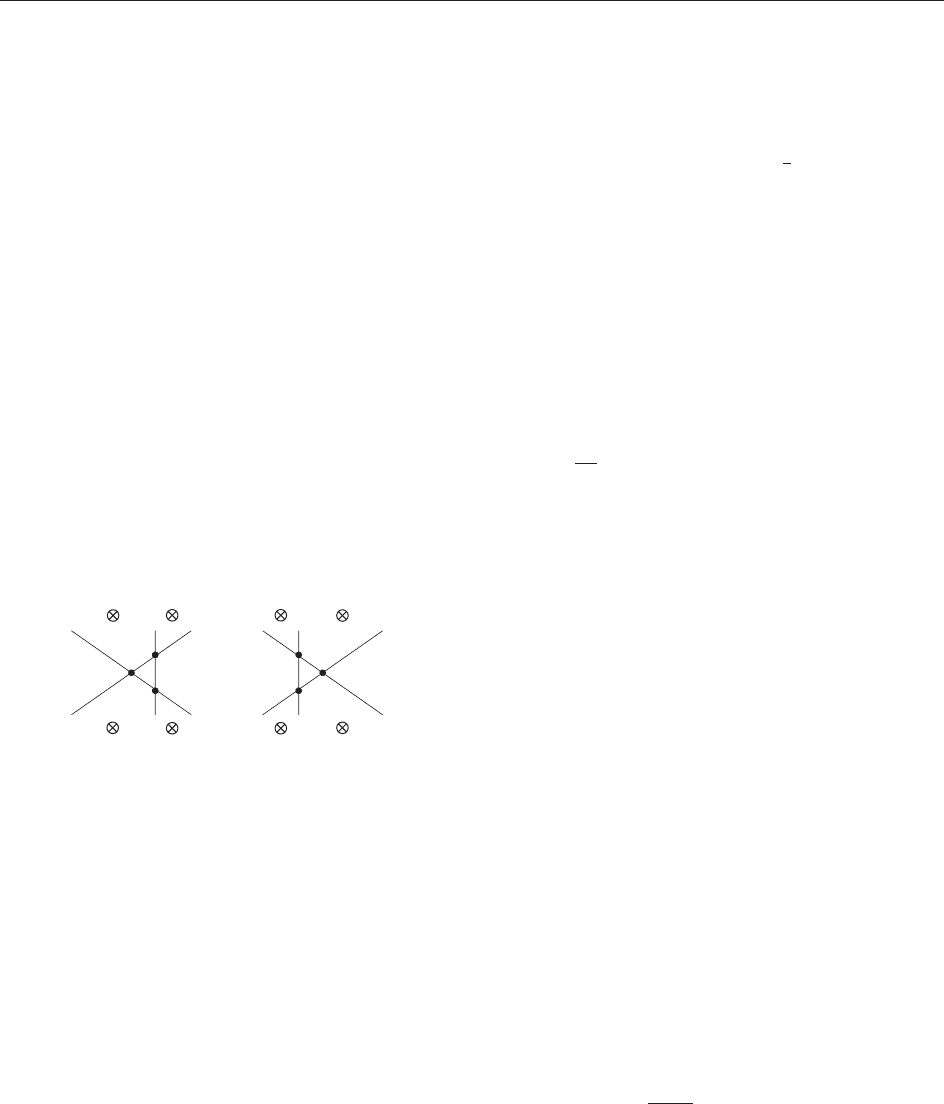
R-matrices satisfy the Yang–Baxter equations
ðid
R
23
ð=ÞÞð
R
13
ð=ÞidÞðid
R
12
ð=ÞÞ
¼ð
R
12
ð=ÞidÞðid
R
13
ð=ÞÞ
ð
R
23
ð=ÞidÞ½18
or, graphically,
=
V
ν
3
V
λ
1
V
μ
2
V
λ
1
V
λ
1
V
ν
3
V
μ
2
V
ν
3
V
λ
1
V
μ
2
V
μ
2
V
ν
3
Explicit formulas for the pseudouniversal
R-matrices were found by Khoroshkin and Tolstoy.
However, these are difficult to evaluate explicitly in
specific representations so that in practice it is easiest
to find the numerical R-matrices
R
ab
() by solving the
intertwining relation [17].Itshouldbestressedthat
solving the intertwining relation, which is a linear
equation for the R-matrix, is much easier than directly
solving the Yang–Baxter equation, a cubic equation.
Yangians
As remarked by Drinfeld (1986), for untwisted
^
g the
quantum affine algebra U
h
(
^
g
0
) degenerates as h !0
into another quasipseudotriangular Hopf algebra,
the ‘‘Yangian’’ Y(g )(Drinfeld 1985). It is associated
with R-matrices which are rational functions of the
additive spectral parameter u. Its representation ring
coincides with that of U
h
(
^
g
0
).
Consider a general presentation of a Lie algebra g ,
with generators I
a
and structure constants f
abc
,
so that
½I
a
; I
b
¼f
abc
I
c
; ðI
a
Þ¼I
a
1 þ 1 I
a
(with summation over repeated indices). The Yan-
gian Y(g ) is the algebra generated by these and a
second set of generators J
a
satisfying
I
a
; J
b
½¼f
abc
J
c
ðJ
a
Þ¼J
a
1 þ 1 J
a
þ
1
2
f
abc
I
c
I
b
The requirement that be a homomorphism
imposes further relations:
½J
a
; ½J
b
; I
c
½I
a
; ½J
b
; J
c
¼
abcdeg
fI
d
; I
e
; I
g
g
and
½½J
a
; J
b
; ½I
l
; J
m
þ ½½J
l
; J
m
; ½I
a
; J
b
¼
abcdeg
f
lmc
þ
lmcdeg
f
abc
I
d
; I
e
; J
g
where
abcdeg
¼
1
24
f
adi
f
bej
f
cgk
f
ijk
; fx
1
; x
2
; x
3
g¼
X
i6¼j6¼k
x
i
x
j
x
k
When g = sl
2
the first of these is trivial, while for
g 6¼ sl
2
the first implies the second. The co-unit is
(I
a
) = (J
a
) = 0; the anti pode is s(I
a
) = I
a
, s(J
a
) =
J
a
þ (1=2)f
abc
I
c
I
b
. The Yangian may be obtained
from U
h
(
^
g
0
) by expanding in powers of h. For
the precise relationship, see Drinfeld (1985) and
MacKay (2005). In the spin gradation, the auto-
morphism [12] generated by D descends to Y( g)as
I
a
7!I
a
, J
a
7!J
a
þ uI
a
.
There are two other realizations of Y(g). The first
(see, for example, Molev 2003) defines Y(gl
n
)
directly from
Rðu vÞT
1
ðuÞT
2
ðvÞ¼T
2
ðvÞT
1
ðuÞRðu vÞ
where T
1
(u) = T(u) id, T
2
(v) = id T(v), and
TðuÞ¼
X
n
i;j¼1
t
ij
ðuÞe
ij
t
ij
ðuÞ¼
ij
þ I
ij
u
1
þ J
ij
u
2
þ
where e
ij
are the standard matrix units for gl
n
. The
rational R-matrix for the n-dimensional representa-
tion of gl
n
is
Rðu vÞ¼1
P
u v
; where P ¼
X
n
i;j¼1
e
ij
e
ji
is the transposition operator. Y(gl
n
) is then defined
to be the algebra generated by I
ij
, J
ij
, and must be
quotiented by the ‘‘quantum determinant’’ at its
center to define Y(sl
n
). The coproduct takes a
particularly simple form,
ðt
ij
ðuÞÞ ¼
X
n
k¼1
t
ik
ðuÞt
kj
ðuÞ
186 Affine Quantum Groups

Here we do not give explicitly the third realization,
namely Drinfeld’s ‘ ‘new’’ realization of Y(g)(Drinfeld
1988), but we remark that it was in this presentation
that Drinfeld found a correspondence between certain
sets of polynomials and finite-dimensional irreducible
representations of Y(g ), thus classifying these (although
not thereby deducing their dimension or constructing
the action of Y(g)). As remarked earlier, the structure is
as in the earlier section: Y(g ) representations are in
general g-reducible, and there is a set of r fundamental
Y(g)-representations, containing the fundamental
g-representations as components, from which all
other representations can be constructed.
Origins in the Quantum
Inverse-Scattering Method
Quantum affine algebras for general
^
g first appear in
Drinfeld (1985, 1986) and Jimbo (1985, 1986), but
they have their origin in the ‘‘quantum inverse-
scattering method’’ (QISM) of the St. Petersburg
school, and the essential features of U
h
(
c
sl
2
) first
appear in Kulish and Reshetikhin (1983) . In this
section, we explain how the quantization of the Lax-
pair description of affine Toda theory led to the
discovery of the U
h
(
^
g) coproduct, commutation
relations, and R-matrix. We use the normalizations
of Jimbo (1986), in which the H
i
are rescaled so that
the Cartan matrix a
ij
=
i
.
j
is symmetric.
We begin with the affine Toda field equations
@
@
i
¼
m
2
X
r
j¼1
e
a
ij
j
n
i
e
0
:
j
j
an integrable model in R
1þ1
of r real scalar fields
i
(x, t) with a mass parameter m and coupling
constant . Equivalently, we may write
[@
x
þ L
x
, @
t
þ L
t
] = 0 for the Lax pair
L
x
ðx; tÞ¼
2
X
r
i¼1
H
i
@
t
i
þ
m
2
X
r
i;j¼1
e
ð=2Þa
ij
j
E
þ
i
þ E
i
þ
m
2
X
r
j¼1
e
ð=2Þa
0j
j
E
þ
0
þ
1
E
0
L
t
ðx; tÞ¼
2
X
r
i¼1
H
i
@
x
i
þ
m
2
X
r
i;j¼1
e
ð=2Þa
ij
j
E
þ
i
E
i
þ
m
2
X
r
j¼1
e
ð=2Þa
0j
j
E
þ
0
1
E
0
with arbitrary 2 C. The classical integrability of the
system is seen in the existence of r(,
0
)suchthat
TðÞTð
0
Þ
fg
¼ rð;
0
Þ; TðÞTð
0
Þ½
where T() = T(1, 1; ) and T(x, y; ) =
P exp(
R
y
x
L(; )d). Taking the trace of this relati on
gives an infinity of charges in involution.
Quantization is problematic, owing to divergences
in T. The QISM regularizes these by putting the
model on a lattice of spacing , defining the lattice
Lax operator to be
L
n
ðÞ¼Tðð n 1=2Þ; ð n þ 1=2Þ; Þ
¼P exp
Z
ðnþð1=2ÞÞ
ðnð1=2ÞÞ
Lð; Þd
!
The lattice monodromy matrix is then T() =
lim
l !1, m !1
T
m
l
where T
m
l
= L
m
L
m1
...L
lþ1
,
and its trace again yields an infinity of commu ting
charges, provided that there exists a quantum
R-matrix R(
1
,
2
) such that
Rð
1
;
2
ÞL
1
n
ð
1
ÞL
2
n
ð
2
Þ
¼ L
2
n
ð
2
ÞL
1
n
ð
1
ÞRð
1
;
2
Þ½19
where L
1
n
(
1
) = L
n
(
1
) id, L
2
n
(
2
) = id L
n
(
2
).
That R solves the Yang–Baxter equation follows
from the equivalence of the two ways of intertwining
L
n
(
1
) L
n
(
2
) L
n
(
3
) with L
n
(
3
) L
n
(
2
)
L
n
(
1
).
To compute L
n
(), one uses the canonical, equal-
time commutation relations for the
i
and
_
i
.In
terms of the lattice fields
p
i;n
¼
Z
ðnþð1=2ÞÞ
ðnð1=2ÞÞ
_
i
ðxÞdx
q
i;n
¼
Z
ðnþð1=2ÞÞ
ðnð1=2ÞÞ
X
j
e
ð=2Þa
ij
j
ðxÞ
dx
the only nontrivial relation is [p
i, n
, q
j, n
] =
(ih=2)
ij
q
j, n
, and one finds
L
n
ðÞ¼exp
2
X
i
H
i
p
i;n
!
þ exp
4
X
j
H
j
p
j;n
!
m
2
X
i
q
i;n
E
þ
i
þ E
i
"
þ
Y
i
q
n
i
i;n
E
þ
0
þ
1
E
0
#
exp
4
X
j
H
j
p
j;n
!
þ Oð
2
Þ
the expression used by the St Petersburg school and
by Jimbo. We now make the replacement
E
i
7!q
H
i
=4
E
i
q
H
i
=4
, where q = exp(ih
2
=2), and
compute the O() terms in [19], which reduce to
Affine Quantum Groups 187
RðzÞðH
i
1 þ 1 H
i
Þ
¼ðH
i
1 þ 1 H
i
ÞRðzÞ
RðzÞ E
i
q
H
i
=2
þ q
H
i
=2
E
i
¼ q
H
i
=2
E
i
þ E
i
q
H
i
=2
RðzÞ
RðzÞ z
1
E
0
q
H
0
=2
þ q
H
0
=2
E
0
¼ q
H
0
=2
E
0
þ z
1
E
0
q
H
0
=2
RðzÞ
where z =
1
=
2
. We recognize in these the U
h
(
^
g)
coproduct and thus the intertwining relations, in the
homogeneous gradation. These equations were
solved for R in defining representations of
nonexceptional g by Jimbo (1986).
For
^
g =
c
sl
2
, it was Kulish and Reshetikhin (1983)
who first discovered that the requirement that the
coproduct must be an algebra homomorphism forces
the replacement of the commutation relations of
U(
b
sl
2
) by those of U
h
(
b
sl
2
); more generally it requires
the replacement of U(
^
g)byU
h
(
^
g).
Affine Quantum Group Symmetry
and the Exact S-Matrix
In the last section, we saw the origins of U
h
(
^
g) in the
‘‘auxiliary’’ algebra introduced in the Lax pair.
However, the quantum affine algebras also play a
second role, as a symmetry algebra. An imaginary-
coupled affine Toda field theory based on the affine
algebra
^
g
_
possesses the quantum affine algebra
U
h
(
^
g) as a symmetry algebra, where
^
g
_
is the
Langland dual to
^
g (the algebra obtained by
replacing roots by coroots).
The solitonic particle states in affine Toda theories
form multiplets which transform in the fundamental
representations of the quantum affine algebra. Multi-
particle states transform in tensor product representa-
tions V
a
V
b
. The scattering of two solitons of type
a and b with relative rapidity is described by the
S-matrix S
ab
():V
a
V
b
!V
b
V
a
, graphically
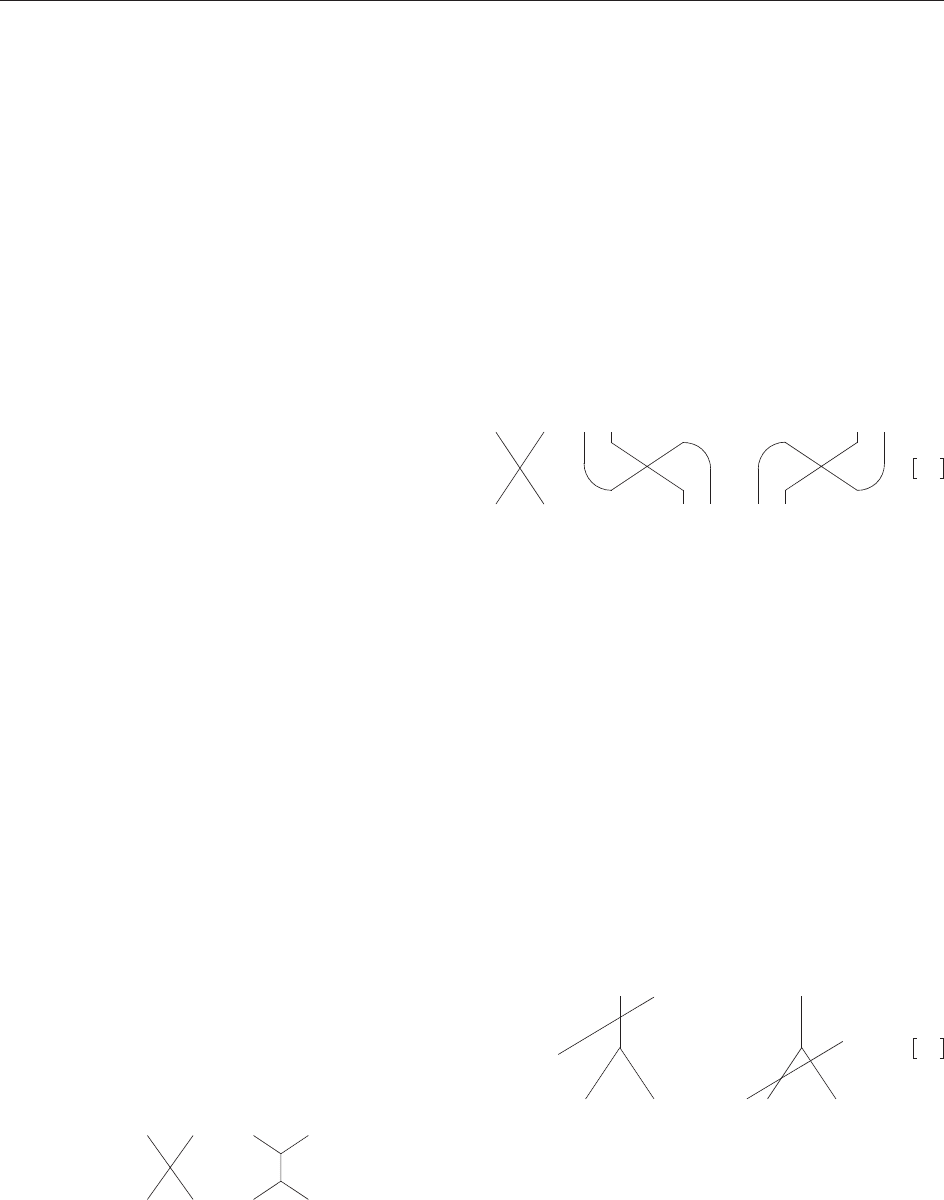
represented in Figure 1a. It then follows from the
symmetry that the two-particle scattering matrix
(S-matrix) for solitons must be proportional to the
intertwiner for these tensor product representa-
tions, the R matrix:
S
ab
ðÞ¼f
ab
ðÞ
R
ab
ðÞ
with proportional to u, the additive spectral
parameter. The scalar prefactor f
ab
() is not deter-
mined by the symmetry but is fixed by other
requirements like unitarity, crossing symmetry, and
the bootstrap principle.
It turns out that the axiomatic properties of the
R-matrices are in perfect agreement with the
axiomatic properties of the analytic S-matrix. For
example, crossing symmetry of the S-matrix, gra-
phically represented by
iπ – θ
==
ab
θ
ab
ba
iπ – θ
ab
ba ba
20
is a consequence of the property of the universal
R-matrix with respect to the action of the antipode S,
ðS 1ÞR ¼ R
1
An S-matrix will have poles at certain imaginary
rapidities
ab
c
corresponding to the formation of
virtual bound states. This is graphically represented
in Figure 1b. The location of the pole is determined
by the masses of the three particles involved,
m
2
c
¼ m
2
a
þ m
2
b
þ 2m
a
m
b
cosði
ab
c
Þ
At the bound state pole, the S-matrix will project
onto the multiplet V
c
. Thus, the
R matrix has to have
this projection property as well and indeed, this turns
out to be the case. The bootstrap principle, whereby
the S-matrix for a bound state is obtained from the
S-matrices of the constituent particles,
ab
cd
d
da b
c
d
=
21
is a consequence of the property [14] of the universal
R-matrix with respect to the coproduct.
There is a famous no-go theorem due to Coleman
and Mandula which states the ‘‘impossibility of
combining space-time and internal symmetries in
any but a trivial way.’’ Affine quantum group
symmetry circumvents this no-go theorem. In fact,
the derivation D is the infini tesimal two-dimens ional
Lorentz boost generator and the other symmetry
ab
c
a
a
ba
b
b
θ
c
ab
θ
(a) (b)
Figure 1 (a) Graphical representation of a two-particle
scattering process described by the S-matrix S
ab
(). (b) At
special values
c
ab
of the relative spectral parameter, the two
particles of types a and b form a bound state of type c.
188 Affine Quantum Groups

charges trans form nontrivially under these Lorentz
transformations, see [2].
The noncocommutative coproduct [8] means
that a U
h
(
^
g) symmetry generator, when acting on a
2-soliton state, acts differently on the left soliton
than on the right soliton. This is only possible
because the generator is a nonlocal symmetry charge
– that is, a charge which is obtained as the space
integral of the time compone nt of a current which
itself is a nonlocal expression in terms of the fields
of the theory.
Similarly, many nonlinear sigma models possess
nonlocal charges which form Y(g), and the con-
struction proceeds similarly, now utilizing rational
R-matrices, and with particle multiplets forming
fundamental representations of Y(g ). In each case,
the three-point couplings corresponding to the
formation of bound states, and thus the analogs for
U
h
(
^
g) and Y(g ) of the Clebsch–Gordan couplings,
obey a rather beautiful geometric rule originally
deduced in simpler, purely elastic scattering models
(Chari and Pressley 1996).
More details about this topic can be found in
Delius (1995) and MacKay (2005).
Integrable Quantum Spin Chains
Affine quantum groups provide an unlimited supply
of integrable quantum spin chains. From any
R-matrix R() for any tensor product of finite-
dimensional representations W V, one can pro-
duce an integrable quantum system on the Hilbert
space V
n
. This Hilber t space can then be inter-
preted as the space of n interacting spins. The space
W is an auxiliary space required in the construction
but not playing a role in the physics.
Given an arbitrar y R-matrix R(), one defines the
monodromy matrix T() 2 End(W V
n
)by
TðÞ¼R
01
ð
1
ÞR
02
ð
2
ÞR
0n
ð
n
Þ
where, as usual, R
ij
is the R-matrix acting on the
ith and jth component of the tensor product space.
The
i
can be chosen arbitrarily for convenience.
Graphically the monodromy matrix can be repre-
sented as
V
1
V
2
V
3
V
n – 1
V
n
W
. . .
As a consequence of the Yang–Baxter equation
satisfied by the R-matrices the monodromy matrix
satisfies
RTT ¼ TTR ½22
or, graphically,
W
W
′
V
1
V
2
V
n
V
1
V
2
V
n
=
. . .. . .
One defines the transfer matrix
ð Þ¼tr
W
TðÞ
which is now an operator on V
n
, the Hilbert space
of the quantum spin chain. Due to [22], two transfer
matrices commute,
½ðÞ;ð
0
Þ ¼ 0
and thus the () can be seen as a generating
function of an infinite number of commuting
charges, one of which will be chosen as the
Hamiltonian. This Hamiltonian can then be diag-
onalized using the algebraic Bethe ansatz.
One is usually interested in the thermodynamic
limit where the number of spins goes to infinity. In
this limit, it has been conjectured, the Hilbert space
of the spin chain carries a certain infinite-dimensional
representation of the quantum affine algebra and this
has been used to solve the model algebraically, using
vertex operators (Jimbo and Miwa 1995).
Boundary Quantum Groups
In applications to physical systems that have a
boundary, the Yang–Baxter equation [1] appears in
conjunction with the boundary Yang–Baxter equa-
tion, also known as the reflection equation,
R
12
ðu vÞK
1
ðuÞR
21
ðu þ vÞK
2
ðvÞ
¼ K
2
ðvÞR
12
ðu þ vÞK
1
ðuÞR
21
ðu vÞ½23
The matrices K are known as reflection matrices. This
equation was originally introduced by Cherednik to
describe the reflection of particles from a boundary in
an integrable scattering theory and was used by
Sklyanin to construct integrable spin chains and
quantum field theories with boundaries.
Boundary quantum groups are certain co-ideal
subalgebras of affine quantum groups. They provide
the algebraic structures underlying the solutions of the
boundary Yang–Baxter equation in the same way in
which affine quantum groups underlie the solutions of
the ordinary Yang–Baxter equation. Both allow one
to find solutions of the respective Yang–Baxter
equation by solving a linear intertwining relation. In
the case without spectral parameters these algebras
appear in the theory of braided groups (see Hopf
Algebras and q-Deformation Quantum Groups and
Braided and Modular Tensor Categories).
Affine Quantum Groups 189

For example, the subalgebra B
(
^
g)ofU
h
(
^
g
0
)
generated by
Q
i
¼ q
H
i
=2
i
ðE
þ
i
þ E
i
Þþ
i
ðq
H
i
i
1Þ;
i ¼ 0; ...; r ½24
is a boundary quantum group for certain choices of
the parameters
i
2 C[[h]]. It is a left co-ideal
subalgebra of U
h
(
^
g
0
) because
ðQ
i
Þ¼Q
i
1 þ q
H
i
i
Q
i
2 U
h
ð
^
g
0
ÞB
ð
^
gÞ½25
Intertwiners K():V
!V
=
for some constant
satisfying
KðÞ
ðQÞ¼
=
ðQÞKðÞ; for all Q 2 B
ð
^
gÞ½26
provide solutions of the reflection equation in the
form
ðid K
2
ðÞÞ
R
12
ðÞðid K
1
ðÞÞ
R
21
ð=Þ
¼
R
12
ð=Þðid K
1
ðÞÞ
R
21
ðÞðid K
2
ðÞÞ ½27
This can be extended to the case where the
boundary itself carries a representati on W of B
(
^
g).
The boundary Yang–Baxter equation can be repre-
sented graphically as
=
V
2
1/μ
V
1
1/λ
V
1
λ
V
2
μ
W
V
2
1/μ
V
1
1/λ
V
1
λ
V
2
μ
W
Another example is provided by twisted Yangians
where, when the I
a
and J
a
are constructed as
nonlocal charges in sigma models, it is found that
a boundary condition which preserves integrability
leaves only the subset
I
i
and
~
J
p
¼ J
p
þ
1
4
f
piq
ðI
i
I
q
þ I
q
I
i
Þ
conserved, where i labels the h-indices and p, q the
k-indices of a symmetric splitting g = h þk. The
algebra Y(g , h) generated by the I
i
,
~
J
p
is, like B
(
^
g),
a co-ideal subalgebra, (Y(g , h)) Y(g ) Y(g, h),
and again yields an intertwining relation for
K-matrices. For g = sl
n
and h = so
n
or sp
2n
, Y(g , h)
is the ‘‘twisted Yangian’’ described in Molev (2003).
All the constructions in earlier sections of this
review have analogs in the boundary setting. For
more details see Delius and MacKay (2003) and
MacKay (2005).
See also: Bethe Ansatz; Boundary Conformal Field
Theory; Classical r-Matrices, Lie Bialgebras, and Poisson
Lie Groups; Hopf Algebras and q-Deformation Quantum
Groups; Riemann–Hilbert Problem; Solitons and
Kac–Moody Lie Algebras; Yang–Baxter Equations.
Further Reading
Chari V and Pressley AN (1994) Quantum Groups. Cambridge:
Cambridge University Press.
Chari V and Pressley AN (1996) Yangians, integrable quantum
systems and Dorey’s rule. Communications in Mathematical
Physics 181: 265–302.
Delius GW (1995) Exact S-matrices with affine quantum group
symmetry. Nuclear Physics B 451: 445–465.
Delius GW and MacKay NJ (2003) Quantum group symmetry in
sine-Gordon and affine Toda field Theories on the Half-Line,
Communications in Mathematical Physics 233: 173–190.
Drinfeld V (1985) Hopf algebras and the quantum Yang–Baxter
equation. Soviet Mathematics Doklady 32: 254–258.
Drinfeld V (1986) Quantum Groups, Proc. Int. Cong. Math.
(Berkeley), pp. 798–820.
Drinfeld V (1988) A new realization of Yangians and quantized
affine algebras. Soviet Mathematics Doklady 36: 212–216.
Jimbo M (1985) A q-difference analogue of UðgÞ and the Yang–
Baxter equation. Letters in Mathematical Physics 10: 63–69.
Jimbo M (1986) Quantum R-matrix for the generalized Toda
system. Communications in Mathematical Physics 102:
537–547.
Jimbo M and Miwa T (1995) Algebraic Analysis of Solvable
Lattice Models. Providence, RI: American Mathematical
Society.
Kulish PP and Reshetikhin NY (1983) Quantum linear problem
for the sine-Gordon equation and higher representations.
Journal of Soviet Mathematics 23: 2435.
MacKay NJ (2005) Introduction to Yangian symmetry in
integrable field theory. International Journal of Modern
Physics (to appear).
Molev A (2003) Yangians and their applications. In: Hazewinkel
M (ed.) Handbook of Algebra, vol. 3, pp. 907–959. Elsevier.
190 Affine Quantum Groups

Aharonov–Bohm Effect
M Socolovsky, Universidad Nacional Auto
´
noma de
Me
´
xico, Me
´
xico DF, Me
´
xico
ª 2006 Elsevier Ltd. All rights reserved.
Introduction
In classical electrodynamics, the interaction of charged
particles with the electromagnetic field is local,
through the pointlike coupling of the electric charge
of the particles with the electric and magnetic fields, E
and B, respectively. This is mathematically expressed
by the Lorentz-force law. The scalar and vector
potentials, ’ and A, which are the time and space
components of the relativistic 4-potential A
,are
considered auxiliary quantities in terms of which
the field strengths E and B, the observables, are
expressed in a gauge-invariant manner. The homo-
geneous or first pair of Maxwell equations are a direct
consequence of the definition of the field strengths in
terms of A
_ The inhomogeneous or second pair of
Maxwell equations, which involve the charges and
currents present in the problem, are also usually
written in terms of E and B; however when writing
them in terms of A
, the number of degrees of freedom
of the electromagnetic field is explicitly reduced from
six to four; and finally, with two additional gauge
transformations, one ends with the two physical
degrees of freedom of the electromagnetic field.
In quantum mechanics, however, both the
Schro¨ dinger equation and the path-integral approaches
for scalar and unpolarized charged particles in the
presence of electromagnetic fields, are written in
terms of the potential and not of the field strengths.
Even in the case of the Schro¨ dinger–Pauli equation
for spin 1=2 electrons with magnetic moment m
interacting with a magnetic field B, one knows that
the coupling m × B is the nonrelativistic limit of the
Dirac equation, which depends on A
but not on E and
B_ Since gauge invariance also holds in the quantum
domain, it was thought that A and ’ were mere
auxiliary quantities, like in the classical case.
Aharonov and Bohm, in 1959,predictedaquan-
tum interference effect due to the motion of charged
particles in regions where B(E) vanishes, but not
A(’), leading to a nonlocal gauge-invariant effect
depending on the flux of the magnetic field in the
inaccessible region, in the magnetic case, and on the
difference of the integrals over time of time-varying
potentials, in the electric case. (The magnetic effect
was already noticed 10 years before by Ehrenberg
and Siday in a paper on the refractive index of
electrons.)
In the context of the Schro¨ dinger equation, one
can show that due to gauge invariance, if
0
is a
solution to the equation in the absence of an
electromagnetic potential, then the product of
0
(x) times the integral of A
over a path joining
an arbitrary reference point x
0
to x is also a
solution, if the integral is path independent. How-
ever, it is the path integral of Feynman which in the
formulas for propagators of charged particles in the
presence of electromagnetic fields clearly shows that
the action of these fields on charged particles is
nonlocal, and it is given by the celebrated non-
integrable (path-dependent) phase factor of Wu and
Yang (1975). Moreover, this fact provides an
additional proof of the nonlocal character of
quantum mechanics: to surround fluxes, or to
develop a potent ial difference, the particle has to
travel simultaneously at least through two paths.
Thus, the fact that the Aharonov–Bohm (A–B)
effect was verified experimentally, by Chambers and
others, demonstrates the necessity of introducing the
(gauge-dependent) potential A
in descr ibing the
electromagnetic interactions of the quantum parti-
cle. This is widely regarded as the single most
important piece of evidence for electromagnetism
being a gauge theory. Moreover, it shows, to
paraphrase Yang, that the field underdescribes the
physical theory, while the potential overdescribes it,
and it is the phase factor which describes it exactly.
The content of this article is essentially twofold.
The first four sections are mainly physical, where we
describe the magnetic A–B effect using the
Schro¨ dinger equation and the Feynman path inte-
gral. The fifth section is geometrical and is the long-
est of the article. We describe the effect in the
context of fiber bundles and connections, namely
as a result of the coupling of the wave function
(section of an associated bundle) to a nontrivial
flat connection (non-pure gauge vector potential
with zero magnetic field) in a trivial bundle (the
A–B bundle) with topologically nontrivial (non-
simply-connected) base space. We discuss the mod-
uli space of flat connections and the holonomy
groups giving the phase shifts of the interference
patterns. Finally, in the last section, we briefly
comment on the nonabelian A–B effect.
Electromagnetic Fields in Classical Physics
In classical physics, the motion of charged particles
in the presence of electromagnetic fields is governed
by the equation
Aharonov–Bohm Effect 191

d
dt
p = q
E þ
v
c
B
½1
where
p =
mv
ffiffiffiffiffiffiffiffiffiffiffiffiffiffiffiffiffiffiffiffiffiffiffiffi
1 ðv
2
=c
2
Þ
p
is the mechanical momentum of the particle with
electric charge q, mass m, and velocity v =
˙
x (c is
the velocity of light in vacuum, and for jvjc the
left-hand side (LHS) of [1] is approximately mv); the
right-hand side (RHS) is the Lorentz force, where E
and B are, respe ctively, the electric and magnetic
fields at the spacetime point (t, x) where the particle
is located. Equation [1] is easily deri ved from the
Euler–Lagrange equation
d
dt
@L
@v
@L
@x
= 0 ½2
with the Lagrangian L given by the sum of the free
Lagrangian for the particle,
L
0
= mc
2
ffiffiffiffiffiffiffiffiffiffiffiffiffi
1
v
2
c
2
r
½3
and the Lagrangian describing the particle–field
interaction,
L
int
=
q
c
A v q’ ½4
In [4], A and ’ are, respectivel y, the vector potent ial
and the scalar potential, which together form the
4-potential A
= (A
0
, A) = (’, A
i
), i = 1, 2, 3,
in terms of which the electric and magnetic field
strengths are given by
E =
1
c
@
@t
A r’ ½5a
B = rA ½5b
The classical action correspo nding to a given path of
the particle is
S ¼
Z
t
2
t
1
dtL¼
Z
t
2
t
1
dtðL
0
þ L
int
Þ
¼
Z
t
2
t
1
dtL
0
þ
Z
t
2
t
1
dtL
int
S
0
þ S
int
½6
E, B, and S are invariant under the gauge
transformation
A ! A
0
= A r ½7a
’ ! ’
0
= ’ þ
1
c
@
@t
½7b
where is a real-valued differentiable scalar
function (at least of class C
2
) on spacetime. That
is, if E
0
, B
0
,andS
0
int
are defined in te rms of A
0
and
’
0
as E, B,andS
int
are defined in terms of A and
’,thenE
0
= E, B
0
= B,andS
0
int
= S
int
.Thisfact
leads to the concept that, cla ssi call y, the observa-
bles E and B are the physical quantities, while A
is only a n auxiliary quantity. Also, and most
important in the present context, eqn [ 1] states
that the motion of the particles is determined by
the values or state of the f ield strengths in an
infinitesimal neighborhood of the particles, that is,
classically, E and B act locally. If one defines the
differential 1-form A A
dx
(with dx
0
= c dt),
then the components of the differential 2-form
F = dA = (1=2)(@
A
@
A
)dx
^ dx
(1=2)F
dx
^ dx
are precisely the electric and magnetic
fields:
F
=
0 E
1
E
2
E
3
E
1
0 B
3
B
2
E
2
B
3
0 B
1
E
3
B
2
B
1
0
0
B
B
B
B
B
@
1
C
C
C
C
C
A
½8
At the level of A,
dF = d
2
A = 0 ½9
is an identity, but at the level of E and B, [9]
amounts to the homogeneous (or first pair of)
Maxwell equations obeyed by the field strengths:
rB = 0 ½10a
rE þ
1
c
@
@t
B = 0 ½10b
Therefore, these equations have a geometrical
origin. The second pair of Maxwell equations is
dynamical, and is obtained from the field action (in
the Heaviside system of units)
S
field
=
1
4c
Z
d
4
xF
F
½11
which leads to
rE = 4 ½12a
rB
1
c
@
@t
E =
4j
c
½12b
where (, j) = ( j
0
, j) is the 4-current satisfying, as a
consequence of [12a] and [12b], the conservation law
@
j
= 0 ½ 13
For a pointlike particle, (t, x) = q
3
(x x(t)) and
j = v.
192 Aharonov–Bohm Effect

Electromagnetic Fields in Quantum
Physics
In quantum physics, the motion of charged particles in
external electromagnetic fields is governed by the
Schro¨ dinger equation or, equivalently, by the Feynman
path integral. In both cases, however, it is the
4-potential A
which appears in the equations, and
not the field strengths. For simplicity, we consider here
scalar (spinless) charged particles or unpolarized
electrons (spin-(1=2)particles), both of which, in the
nonrelativistic approximation, can be described quan-
tum mechanically by a complex wave function (t, x).
To derive the Schro¨ dinger equation, one starts
from the classical Hamiltonian
H = P v L mc
2
=
1
2
P
q
c
A
2
þ q’ ½14
where
P =
@
@v
L = p þ
q
c
A
is the canonical momentum of the particle, and we
have subtracted its rest energy. The replacements
P !ihr and H ! ih@=@t lead to
ih
@
@t
¼
1
2m
ihrþ
q
c
A
2
þ q’
¼
h
2
2m
r
2
þ
q
2
2mc
2
A
2
þ
ihq
2mc
rA þ
ihq
mc
A rþq’
½15
The gau ge transformation [7a] and [7b] is a
symmetry of this equation, if simultaneously to the
change of the 4-potential, the wave function trans-
forms as follows:
ðt ; xÞ!
0
ðt; xÞ = e
ðiq=hcÞ
ðt ; xÞ½7c
So, A
0
and
0
obey [15]. At each (t, x), e
(iq=hc)
belongs to U(1), the unit circle in the complex plane.
In the path-integral approach, the kernel
K(t
0
, x
0
;t, x), which gives the probability amplitude
for the propagation of the particle from the spacetime
point (t, x) to the spacetime point (t
0
, x
0
)(t < t
0
), is
given by
Kðt
0
; x
0
; t; xÞ
¼
Z
xðt
0
Þ¼x
0
xðtÞ¼x
DxðÞexp
i
h
ðS
0
þ S
int
Þ
¼
Z
xðt
0
Þ¼x
0
xðtÞ¼x
DxðÞexp
i
h
Z
t
0
t
d
1
2
m
˙
x
2
þ
q
c
A v q’
¼
Z
xðt
0
Þ¼x
0
xðtÞ¼x
DxðÞexp
i
h
Z
t
0
t
d
1
2
m
˙
x
2
exp
iq
hc
Z
t
0
t
A dx ’ dx
0
¼
Z
xðt
0
Þ¼x
0
xðtÞ¼x
DxðÞexp
i
h
Z
t
0
t
d
1
2
m
˙
x
2
exp
iq
hc
Z
t
0
t
dx
A
½16
where the integral
R
Dx() ... is over all continuous
spacetime paths (, x()) which join (t, x)with(t
0
, x
0
).
If one knows the wave function at (t, x), then the
wave function at (t
0
, x
0
) is given by
ðt
0
; x
0
Þ =
Z
d
3
x Kðt
0
; x
0
; t; xÞ ðt; xÞ½17
An important point is the natural appearance in the
integrand of the functional integral of the factor
e
ðiq=hcÞ
R
A
for each path joining (t, x) with (t
0
, x
0
).
A Solution to the Schro¨ dinger Equation
In what follows, we shall restrict ourselves to static
magnetic fields; then in the previous formulas, we
set ’ = 0 and A(t, x) = A(x). It is then easy to
show that if x
0
is an arbitrar y reference point and
the integral
R
x
x
0
A(x
0
) dx
0
is independent of the
integration path from x
0
to x, that is, it is a well-
defined function f of x, and if
0
is a solution of
the free Schro¨ dinger equation, that is,
ih
@
@t
0
=
h
2
2m
r
2
0
½18
then
ðt; xÞ = exp
iq
hc
Z
x
x
0
Aðx
0
Þdx
0
0
ðt; xÞ½19
is a solution of [15]. In fact, replacing [19] in [15],
the LHS gives
exp
iq
hc
f ðxÞ
ih
@
@t
0
while for the RHS one has
exp
iq
hc
f ðxÞ
h
2
2m
r
2
0
Aharonov–Bohm Effect 193
The cancelation of the exponential factors shows
that, unde r the condition of path independence,
there is no effect of the potential on the charged
particles. Another way to see this is by making a
gauge transformation [7a]–[7c] with (x) = f (x),
which changes !
0
and A ! A
0
= A r
R
x
x
0
A(x
0
) dx
0
= A A = 0.
The condition of path independence amounts,
however, to the condition that no magnetic field is
present since, if
R
A depends on , then for some
pair of paths and
0
from (t, x)to(t
0
, x
0
), 0 6¼
R
A
R
0
A =
R
A þ
R
0
A =
H
[(
0
)
A =
R
ds (rA),
where in the last equality we applied Stokes theorem
( is any surface with boundary [(
0
)), which
shows that B = rA must not vanish everywhere
and has a nonzero flux through given by
=
Z
ds B ½20
The conclusion of this section is that the ansatz [19] for
solving [15] can only be applied in simply connected
regions with no magnetic field strength present.
Aharonov–Bohm Proposal
In 1959, Aharonov and Bohm proposed an experi-
ment to test, in qua ntum mechanics, the coupling of
electric charges to electromagnetic field strengths
through a local interaction with the electromagnetic
potential A
, but not with the field strengths
themselves. However, as we saw before, no physical
effect exists, that is, A
can be gauged away, unless
magnetic and/or electric fields exist somewhere,
although not necessarily overlapping the wave func-
tion of the particles.
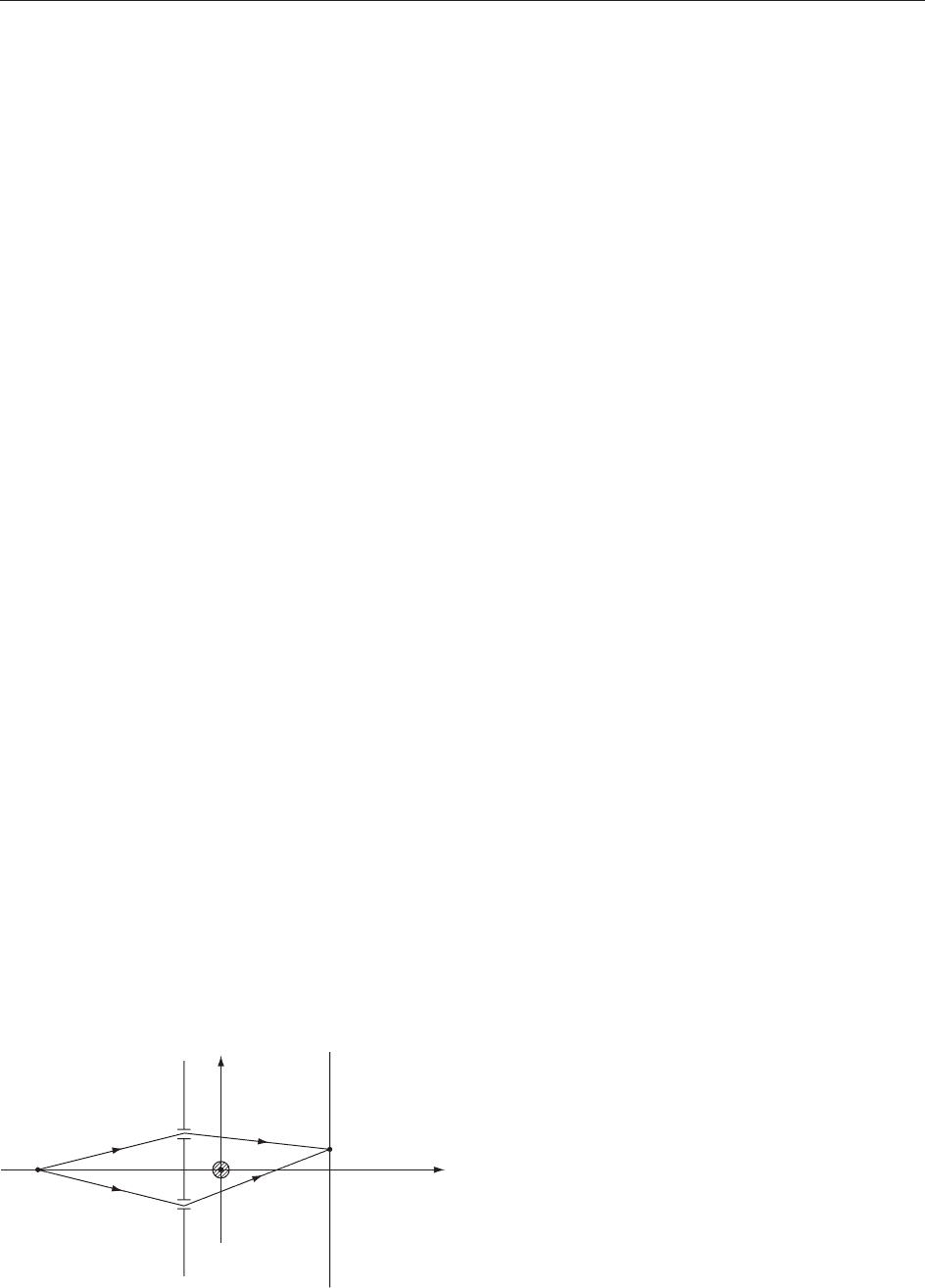
Consider the usual two-slit experiment as depicted
in Figure 1, with the additional presence, behind the
slits, of a long and narrow solenoid enclosing a
nonvanishing magnetic flux due to a constant and
homogeneous magnetic field B normal to the plane
of the figure (in direction z); outside of the solenoid,
the magnetic field is zero. If the radius of the
solenoid is R, a vector potent ial A that produces
such field strength is given by
AðxÞ¼
(jBjr/2)
^
’; r R
(/2r)
^
’; r > R
½21
where =R
2
jBj and
ˆ
’ is a unit vector in the
azimuthal direction. In fact,
B = rAðxÞ =
jBj
^
z; r R
0; r > R
½22
Notice that at r = R, A is continuous but not
continuously differentiable. Also, the ideal limit of
an infinitely long solenoid makes the problem two-
dimensional, that is, in the x–y plane.
The probability amplitude for an electron emitted
at the source S to arrive at the point P on the screen
, is given by the sum of two probability ampli-
tudes, namely those corresponding to passing
through the slits 1 and 2. The solenoid is assumed
to be impenetrable to the electrons; math ematically,
this corresponds to a motion in a non-simply-
connected region. In the approximation for the
path integral [16], in which one considers the
contribution of only two classes of paths, that is,
the class fg represented by path I, and the class
f
0
g represented by path II, if the wave function at
the source is
S
, then the wave function at P is
given by
P
¼
Z
fg
e
i=hðÞS
0
ðÞ
e
ijej=hcðÞ
R
A
þ
Z
f
0
g
e
i=hðÞS
0
ð
0
Þ
e
ðijej=hcÞ
R
0
A
!
S
¼ e
ðijej=hcÞ
R
I
A
Z
fg
e
ði=hÞS
0
ðÞ
S
þ e
ðijej=hcÞ
R
II
A
Z
f
0
g
e
ði=hÞS
0
ð
0
Þ
S
¼ e
ðijej=hcÞ
R
I
A
0
P
ðIÞ
þ e
ðijej=hcÞ
R
II[ðIÞ
A
0
P
ðIIÞ
¼ e
ðijej=hcÞ
R
I
A
0
P
ðIÞþe
2ið=
0
Þ
0
P
ðIIÞ
½23
where, in the second line, we used the path
independence of the integral of A within each class
of paths;
0
P
ðIÞ =
Z
fg
e
ði=hÞ
R
fg
S
0
ðÞ
S
S
I
II
1
2
z
y
x
R
P
∏
Figure 1 Magnetic Aharonov–Bohm effect.
194 Aharonov–Bohm Effect