
Francoise J.-P., Naber G.L., Tsun T.S. (editors) Encyclopedia of Mathematical Physics
Подождите немного. Документ загружается.


projection of the wave functions onto a certain state
in Hilbert space. If the latter are represented by a
fixed matrix A or a fixed vector a, respectively, one
can calculate the RMT prediction for the probability
densities of the matrix elements u
y
n
Au
m
or the
widths a
y
u
n
from the probability density of the
eigenvectors.
Scattering Systems
It is important that RMT can be used as a powerful
tool in scattering theory, because the major part of
the experimental information about quantum sys-
tems comes from scattering experiments. Consider
an example from compound nucleus scattering. In
an accelerator, a proton is shot on a nucleus, with
which it forms a compou nd nucleus. This then
decays by emitting a neutron. More generally, the
ingoing channel (the proton in our example)
connects to the interaction region (the nucleus),
which also connects to an outgoing channel (the
neutron). There are channels with channel wave
functions which are labeled = 1, ..., . The
interaction region is described by an N N
Hamiltonian matrix H whose eigenvalues x
n
are
bound-state energies labeled n = 1, ..., N. The
dimension N is a cutoff which has to be taken to
infinity at the end of a calculation. The
scattering matrix S contains the information about
how the ingoing channels are transformed into the
outgoing channels. The scattering matrix S is
unitary. Under certain and often justified assump-
tions, a scattering matrix element can be cast into
the form
S
¼
i2W
y
G
1
W
½16
The couplings W
n
between the bound states n and
the channels are collected in the N matrix W,
W
is its th column. The propagator G
1
is the
inverse of
G ¼z1
N
H þ i
X
open
W
W
y
½17
Here, z is the scattering energy and the summati on
is only ov er chan nels which are open, that is,
accessible. Formula [16] has a clear intuitive inter-
pretation. The scattering region is entered through
channel , the bound states of H become resonances
in the scattering process according to eqn [17], the
interaction region is left through channel . This
formulation applies in many areas of physics. All
observables such as transmission coefficients, cross
sections, and others can be calculated from the
scattering matrix S.
We have not made any statistical assumptions yet.
Often, one can understand generic features of a
scattering system by assum ing that the Hamiltonian
H is a random matrix, taken from one of the three
classical ensembles. This is one RMT approach used
in scattering theory.
Another RMT approach is based on the scattering
matrix itself, S is modeled by a unitary
random matrix. Taking into account additional
symmetries, one arrives at the three circular ensem-
bles, circular orthogonal (COE) , unitary (CUE) and
symplectic (CSE ). They correspon d to the three
classical Gaussian ensembles and are also labeled
with the Dyson index = 1, 2, 4. The eigenphases of
the random scat tering matrix correspond to the
eigenvalues of the random Hamiltonian matrix. The
unfolded correlation funct ions of the circular
ensembles are identical to those of the Gaussian
ensembles.
Supersymmetry
Apart from the symmetries, random matrices con-
tain nothing but random numbers. Thus, a certain
type of redundancy is present in RMT. Remarkably,
this redundancy can be removed, without losing any
piece of information by using supersymmetry, that
is, by a reformulation of the random matrix model
involving commuting an d anticommuting variables.
For the sake of simplicity, we sketch the main ideas
for the GUE, but they apply to the GOE and the
GSE accordingly.
One defines the k-level correlat ion functions by
using the resolvent of the Schro¨ dinger equation,
b
R
ð2Þ
k
ðx
1
; ...; x
k
Þ
¼
1
k
Z
P
ð2Þ
N
ðHÞ
Y
k
p¼1
tr
1
x
p
H
d½H½18
The energies carry an imaginary increment x
p
= x
p
i" and the limit " ! 0 has to be taken at the end of
the calculation. The k-level correlation functions
R
(2)
k
(x
1
, ..., x
k
) as defined in eqn [8] can always be
obtained from the functions [18] by constructing a
linear combination of the
b
R
(2)
k
(x
1
, ..., x
k
)inwhich
the signs of the imaginary increments are chosen
such that only the imaginary parts of the traces
contribute. Some trivial -distributions have to be
removed. The k-level correlation functions [18]
can be written as the k-fold derivative
b
R
ð2Þ
k
ðx
1
; ...; x
k
Þ
¼
1
ð2Þ
k
@
k
Q
k
p¼1
@J
p
Z
ð2Þ
k
ðx þ JÞ
J¼0
½19
342 Random Matrix Theory in Physics

of the generating function
Z
ð2Þ
k
ðx þ J Þ
¼
Z
P
ð2Þ
N
ðHÞ
Y
k
p¼1
det x
p
þ J
p
H
det x
p
J
p
H
d½H½20
which depends on the energies and k new source
variables J
p
, p = 1, ..., k, ordered in 2k 2k diag-
onal matrices
x ¼ diagðx
1
; x
1
; ...; x
k
; x
k
Þ
J ¼ diagðþJ
1
; J
1
; ...; þJ
k
; J
k
Þ
½21
We notice the normalization Z
(2)
k
(x) = 1atJ = 0. The
generating function [20] is an integral over an
ordinary N N matrix H. It can be exactly rewritten
as an integral over a 2k 2k supermatrix contain-
ing commuting and anticommuting variable s,
Z
ð2Þ
k
ðx þ JÞ
¼
Z
Q
ð2Þ
k
ðÞsdet
N
ðx
þ J Þd½½22
The integrals over the commuting variable s are of
the ordinary Riemann–Stiltjes type, while those over
the anticommuting variables are Berezin integrals.
The Gaussian probability density [5] is mapped onto
its counterpart in superspace
Q
ð2Þ
k
ðÞ¼c
ð2Þ
k
exp
1
2v
2
str
2
½23
where c
(2)
k
is a normalization constant. The supertrace
str and the superdeterminant sdet generalize the
corresponding invariants for ordinary matrices. The
total number of integrations in eqn [22] is drastically
reduced as compared to eqn [20]. Importantly, it is
independent of the level number N which now only
appears as the negative power of the superdeterminant
in eqn [22], that is, as an explicit parameter. This most
convenient feature makes it possible to take the limit of
infinitely many levels by means of a saddle point
approximation to the generating function.
Loosely speaking, the supersymmetric formulation
can be viewed as an irreducible representation of RMT
which yields a clearer insight into the mathematical
structures. The same is true for applications in
scattering theory and in models for crossover transi-
tions to be discussed below. This explains why super-
symmetry is so often used in RMT calculations.
It should be emphasized that the roˆ le of super-
symmetry in RMT is quite different from the one in
high-energy physics, where the commuting and
anticommuting variables represent physical parti-
cles, bosons and fermions, respectively. This is not
so in the RMT context. The commuting and
anticommuting variables have no direct phy sics
interpretation; they appear simply as helpful math-
ematical devices to cast the RMT model into an
often much more convenient form.
Crossover Transitions
TheRMTmodelsdiscusseduptonowdescribe
four extreme situations, the absence of correla-
tions in the Poisson case and the presence of
correlations as in the three fully rotational
invariant models GOE, GUE, and GSE. A real
physics system , however, is often between t hese
extreme situations. The corresponding RMT mod-
els can vary considerably, depending on the
specific situation. Nevertheless, those models in
which the random matrices for two extreme
situations are simply added with some weight are
useful in so many applications that they acquired a
rather generic standing. One writes
HðÞ¼H
ð0Þ
þ H
ð Þ
½24
where H
(0)
is a random matrix drawn from an
ensemble with a completely arbitrary probability
density P
(0)
N
(H
(0)
). The case of a fixed matrix is
included, because one may choose a product of
-distributions for the probability density. The
matrix H
()
is random and drawn from the classical
Gaussian ensembles with probability density
P
()
N
(H
()
) for = 1, 2, 4. One requires that the
group diagonalizing H
(0)
is a subgroup of the one
diagonalizing H
()
. The model [24] describes a
crossover transition. The weight is referred to as
transition parameter. It is useful to choo se the
spectral support of H
(0)
and H
()
equal. One can
then view as the root-mean-square matrix element
of H
()
.At = 0, one has the arbitrary ensemble.
The Gaussian ensembles are formally recovered in
the limi t !1, to be taken in a proper way such
that the energies remain finite.
We are always interested in the unfolded correla-
tion functions. T hus, hastobemeasuredinunits
of the mean level spacing D such that = =D is
the physically relevant transition parameter. It
means that, depending on the numerical value of
D,evenasmalleffectontheoriginalenergyscale
can have sizeable i mpact on the spectral statistics.
This is referred to as statistical enhancement.The
nearest-neighbor spacing distribution is already
very close to p
()
(s) f or the Gaussian ensembles if
is larger than 0.5 or so. In the l ong-range
observables such as the level number variance
2
(L), the deviation from the Gaussian ensemble
statistics becomes visible at interval lengths L
comparable to .
Random Matrix Theory in Physics 343

Crossover transitions can be interpreted as diffu-
sion processes. With the fictitious time t =
2
=2, the
probability density P
N
(x, t) of the eigenvalues x of
the total Hamilton matrix H = H(t) = H() satisfies
the diffusion equation
x
P
N
ðx; tÞ¼
4
@
@t
P
N
ðx; tÞ½25
where the probability density for the arbitrary
ensemble is the initial condition P
N
(x,0)= P
(0)
N
(x).
The Laplacian
x
¼
X
N
n¼1
@
2
@x
2
n
þ
X
n<m
x
n
x
m
@
@x
n
@
@x
m
½26
lives in the curved space of the eigenvalues x.This
diffusion process is Dyson’s Brownian motion in
slightly simplified form. It has a rather general meaning
for harmonic analysis on symmetric spaces, connecting
to the spherical functions of Gelfand and Harish-
Chandra, Itzykson–Zuber integrals, and to Calogero–
Sutherland models of interacting particles. All this
generalizes to superspace. In the supersymmetric
version of Dyson’s Brownian motion the generating
function of the correlation functions is propagated,
s
Z
k
ðs; tÞ¼
4
@
@t
Z
k
ðs; tÞ½27
where the initial condition Z
k
(s,0)= Z
(0)
k
(s) is the
generating function of the correlation functions for
the arbitrary ensemble. Here, s denotes the eigenva-
lues of some supermatrices, not to be confused with
the spacing between adjacent levels. Since the
Laplacian
s
lives in this curved eigenvalue space,
this diffusion process establishes an intimate con-
nection to harmonic analysis on superspaces. Advan-
tageously, the diffusion [27] is the same on the
original and on the unfolded energy scales.
Fields of Application
Many-Body Systems
Numerous studies apply RMT to nuclear physics
which is also the field of its origin. If the total
number of nucleons, that is, protons and neutrons, is
not too small, nuclei show single-particle and
collective motion. Roughly speaking, the former is
decoherent out-of-phase motion of the nucleons
confined in the nucleus, while the latter is coherent
in-phase motion of all nucleons or of large groups of
them such that any additional individual motion of
the nucleons becomes largely irrelevant. It has been
shown empirically that the single-particle excitations
lead to GOE statistics, while collective excitations
produce different statistics, often of the Poisson type.
Mixed statistics as described by crossover transitions
are then of particular interest to investigate the
character of excitations. For example, one applies
the model [24] with H
(0)
drawn from a Poisson
ensemble and H
()
from a GOE. Another application
of crossover transitions is breaking of time-reversal
invariance in nuclei. Here, H
(0)
is from a GOE and
H
()
from a GUE. Indeed, a fit of spectral data to this
model yields an upper bound for the time-reversal
invariance violating root-mean-square matrix element
in nuclei. Yet another application is breaking of
symmetries such as parity or isospin. In the case of
two quantum numbers, positive and negative parity,
say, one chooses H
(0)
= diag(H
(þ)
, H
()
) block-
diagonal with H
(þ)
and H
()
drawn from two
uncorrelated GOE and H
()
from a third uncorre-
lated GOE which breaks the block structure. Again,
root-mean-square matrix elements for symmetry
breaking have been derived from the data.
Nuclear excitation spectra are extracted from
scattering experiments. An analysis as described
above is only possible if the resonances are isolated.
Often, this is not the case and the resonance widths
are comparable to or even much larger than the mean
level spacing, making it impossible to obtain the
excitation energies directly from the cross sections.
One then analyzes the latter and their fluctuations as
measured and applies the concepts sketched above
for scattering systems. This approach has also been
successful for crossover transitions.
Due to the complexity of the nuclear many-body
problem, one has to use effective or phenomenological
interactions when calculating spectra. Hence, one often
studies whether the statistical features found in the
experimental data are also present in the calculated
spectra which result from the various models for nuclei.
Other many-body systems, such as complex atoms
and molecules, have also been studied with RMT
concepts, but the main focus has always been on nuclei.
Quantum Chaos
Originally, RMT was intended for modeling systems
with many degrees of freedom such as nuclei. Surpris-
ingly, RMT proved useful for systems with few degrees
of freedom as well. Most of these studies aim at
establishing a link between RMT and classical chaos.
Consider as an example the classical motion of a point-
like particle in a rectangle billiard. Ideal reflection at the
boundaries and absence of friction are assumed,
implying that the particle is reflected infinitely many
times. A second billiard is built by taking a rectangle
and replacing one corner with a quarter circle as shown
in Figure 5. The motion of the particle in this Sinai
344 Random Matrix Theory in Physics

billiard is very different from the one in the rectangle.
The quarter circle acts like a convex mirror which
spreads out the rays of light upon reflection. This effect
accumulates, because the vast majority of the possible
trajectories hit the quarter circle infinitely many times
under different angles. This makes the motion in the
Sinai billiard classically chaotic, while the one in the
rectangle is classically regular. The rectangle is separ-
able and integrable, while this feature is destroyed in the
Sinai billiard. One now quantizes these billiard systems,
calculates the spectra, and analyzes their statistics. Up
to certain scales, the rectangle (for irrational squared
ratio of the side lengths) shows Poisson behavior, the
Sinai billiard yields GOE statistics.
A wealth of such empirical studies led to the Bohigas–
Giannoni–Schmit conjecture. We state it here not in its
original, but in a frequently used form: spectra of
systems whose classical analogues are fully chaotic
show correlation properties as modeled by the Gaussian
ensembles. The Berry–Tabor conjecture is complemen-
tary: spectra of systems whose classical analogs are fully
regular show correlation properties which are often
those of the Poisson type. As far as concrete physics
applications are concerned, these conjectures are well-
posed. From a strict mathematical viewpoint, they have
to be supplemented with certain conditions to exclude
exceptions such as Artin’s billiard. Due to the defnition
of this system on the hyperbolic plane, its quantum
version shows Poisson-like statistics, although the
classical dynamics is chaotic. Up to now, no general
and mathematically rigorous proofs could be given.
However, semiclassical reasoning involving periodic
orbit theory and, in particular, the Gutzwiller trace
formula, yields at least a heuristic understanding.
Quantum chaos has been studied in numerous
systems. An especially prominent example is the
Hydrogen atom put in a strong magnetic field,
which breaks the integrability and drives the
correlations towards the GOE limit.
Disordered and Mesoscopic Systems
An electron moving in a probe, a piece of wire, say, is
scattered many times at impurities in the material.
This renders the motion diffusive. In a statistical
model, one writes the Hamilton operator as a sum of
the kinetic part, that is, the Laplacian, and a white-
noise disorder potential V(r)withsecondmoment
hVðrÞVðr
0
Þi¼c
V
ðdÞ
ðr r
0
Þ½28
Here, r is the position vector in d dimensions. The
constant c
V
determines the mean free time between
two scattering processes in relation to the density of
states. It is assumed that phase coherence is present
such that quantum effects are still significant. This
defines the mesoscopic regime. The average over the
disorder potential can be done with supersymmetry.
In fact, this is the context in which supersymmetric
techniques in statistical physics were developed,
before they were applied to RMT models. In the
case of weak disorder, the resulting field theory in
superspace for two-level correlations acquires the
form
Z
dðQÞf ðQÞexp SðQÞðÞ ½29
where f (Q) projects out the observable under
consideration and where S(Q) is the effective
Lagrangian
SðQÞ¼
Z
str DðrQðrÞÞ
2
þ i2rMQðrÞ
d
d
r ½30
This is the supersymmetric nonlinear model.Itis
used to study level correlations, but also to obtain
information about the conductance and conduc-
tance fluctuations when the probe is coupled to
external leads. The supermatrix field Q(r) is the
remainder of the disorder average, its matrix
dimension is four or eight, depending on the
symmetry class. This field is a Goldstone mode. It
does not directly represent a particle as often the
case in high-energy physics. The matrix Q(r) lives
in a coset space of certain supergroups. A tensor M
appears in the calculation, and r is the energy
difference on the unfolded scale, not to be confused
with the position vector r.
The first term in the effective Lagrangian invol-
ving a gradient squared is the kinetic term, it stems
from the Laplacian in the Hamiltonian. The con-
stant D is the classical diffusion constant for the
motion of the electron through the probe. The
second term is the ergodic term. In the limit of
zero dimensions, d !0, the kinetic term vanishes
and the remaining ergodic term yields precisely the
unfolded two-level correlations of the Gaussian
ensembles. Thus, RMT can be viewed as the zero-
dimensional limit of field theory for disordered
systems. For d > 0, there is a competition between
the two terms. The diffusion constant D and the
system size determine an energy scale, the Thouless
Figure 5 The Sinai billiard.
Random Matrix Theory in Physics 345
energy E
c
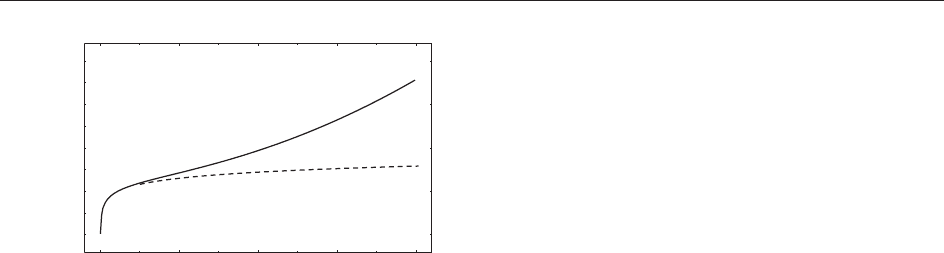
, within which the spectral statistics is of
the Gaussian ensemble type and beyond which it
approaches the Poisson limit. In Figure 6, this is
schematically shown for the level number variance
2
(L), which bends from Gaussian ensemble to
Poisson behavior when L > E
c
. This relates to the
crossover transitions in RMT. Gaussian ensemble
statistics means that the electron states extend over
the probe, while Poisson statistics implies their
spatial localization. Hence, the Thouless energy is
directly the dimensionless conductance.
A large number of issues in disordered and
mesoscopic systems have been studied with the
supersymmetric nonlinear model. Most results
have been derived for quasi-one-dimensional sys-
tems. Through a proper discretization, a link is
established to models involving chains of random
matrices. As the conductance can be formulated in
terms of the scattering matrix, the experience with
RMT for scat tering systems can be applied and
indeed leads to numerous new results.
Quantum Chromodynamics
Quarks interact by exchanging gluons. In quantum
chromodynamics, the gluons are described by gauge
fields. Relativistic quantum mechanics has to be
used. Analytical calculations are only possible after
some drastic assumptions and one must resort to
lattice gauge theory, that is, to demandi ng numerics,
to study the full problem.
The massless Dirac operator has chiral symmetry,
implying that all nonzero eigenvalues come in pairs
(
n
, þ
n
) symmetrically around zero. In chiral
RMT, the Dirac operator is replaced with block
off-diagonal matrices
W ¼
0 W
b
W
y
b
0
½31
where W
b
is a random matrix without further
symmetries. By construction, W has chiral symmetry.
The assumption underlying chiral RMT is that the
gauge fields effectively randomize the motion of the
quark. Indeed, this simple schematic model correctly
reproduces low-energy sum rules and spectral statis-
tics of lattice gauge calculations. Near the center of
the spectrum, there is a direct connection to the
partition function of quantum chromodynamics.
Furthermore, a similarity to disordered systems exists
and an analog of the Thouless energy could be found.
Other Fields
Of the wealth of further investigations, we can
mention but a few. RMT is in general useful for
wave phenomena of all kinds, including classical
ones. This has been shown for elastomechanical and
electromagnetic resonances.
An important field of application is quantum
gravity and matrix model aspects of string theory.
We decided not to go into this, because the reason
for the emergence of RMT concepts there is very
different from everything else discussed above.
RMT is also succe ssful beyond physics. Not
surprisingly, it always received interest in mathema-
tical statistics, but, as already said, it also relates to
harmonic analysis. A connection to number theory
exists as well. The high-lying zeros of the Riemann
function follow the GUE predictions over certain
interval lengths. Unfortunately, a deeper under-
standing is still lacking.
As the interest in statistical concepts grow s, RMT
keeps finding new applications. Recently, one even
started using RMT for risk management in finance.
See also: Arithmetic Quantum Chaos; Chaos and
Attractors; Determinantal Random Fields; Free Probability
Theory; Growth Processes in Random Matrix Theory;
Hyperbolic Billiards; Integrable Systems in Random
Matrix Theory; Integrable Systems: Overview; Number
Theory in Physics; Ordinary Special Functions; Quantum
Chromodynamics; Quantum Mechanical Scattering
Theory; Random Partitions; Random Walks in Random
Environments; Semi-Classical Spectra and Closed
Orbits; Supermanifolds; Supersymmetry Methods in
Random Matrix Theory; Symmetry Classes in Random
Matrix Theory.
Further Reading
Beenakker CWJ (1997) Random-matrix theory of quantum
Transport. Reviews of Modern Physics 69: 731–808.
Bohigas O (1984) Chaotic motion and random matrix theory. In:
Dehesa JS, Gomez JMG, and Polls A (eds.) Mathematical and
Computational Methods in Physics, Lecture Notes in Physics,
vol. 209. Berlin: Springer.
L
0.0
0.5
1.0
1.5
2.0
Σ
2
(L)
0 20406080
Figure 6 Level number variance
2
(L). In this example, the
Thouless energy is E
c
10 on the unfolded scale. The
Gaussian ensemble behavior is dashed.
346 Random Matrix Theory in Physics
Brody TA, Flores J, French JB, Mello PA, Pandey A, and Wong
SSM (1981) Random-matrix physics: spectrum and strength
fluctuations. Reviews of Modern Physics 53: 385–479.
Efetov K (1997) Supersymmetry in Disorder and Chaos. Cambridge:
Cambridge University Press.
Forrester PJ, Snaith NC, and Verbaarschot JJM (eds.) (2003)
Special issue: random matrix theory. Journal of Physics A 36.
Guhr T, Mu¨ ller-Groeling A, and Weidenmu¨ ller HA (1998)
Random-matrix theories in quantum physics: common con-
cepts. Physics Reports 299: 189–428.
Haake F (2001) Quantum Signatures of Chaos, 2nd edn. Berlin:
Springer.
Mehta ML (2004) Random Matrices, 3rd edn. New York:
Academic Press.
Sto¨ ckmann HJ (1999) Quantum Chaos: An Introduction. Cambridge:
Cambridge University Press.
Verbaarschot JJM and Wettig T (2000) Random matrix theory
and chiral symmetry in QCD. Annual Review of Nuclear and
Particle Science 50: 343–410.
Random Partitions
A Okounkov, Princeton University, Princeton, NJ,
USA
ª 2006 A Okounkov. Published by Elsevier Ltd.
All rights reserved.
Partitions
A partition of n is a monotone sequence of non-
negative integers,
¼ð
1
2
3
0Þ
with sum n. The number n is also denoted by jj and
is called the size of n. The number of nonzero terms
in is called the length of and often denoted by
‘(). It is convenient to make the sequence infinite
by adding a string of zeros at the end.
A geometric object associated to partition is its
diagram. The diagram of = (4, 2, 2, 1) is shown in
Figure 1. A larger diagram, flipped and rotated by 135
,
can be seen in Figure 2. Flipping the diagram introduces
an involution on the set of partitions of n known as
transposition. The transposed partition is denoted by
0
.
Partitions serve as natural combinatorial labels for
many basic objects in mathematics and physics. For
example, partitions of n index both conjugacy classes
and irreducible representations of the symmetric
group S(n). Partitions with ‘() n index irredu-
cible polynomial representations of the general linear
group GL(n). More generally, the highest weight of a
rational representation of GL(n) can be naturally
viewed as two partitions of total length n.
For an even more basic example, partitions with
1
m and ‘() n are the same as upright lattice
paths making n steps up and m steps to the right
(just follow the boundary of ). In particular, there
are
nþm
n
of such. By a variation on this theme,
partitions label the standard basis of fermionic Fock
space (Miwa et al. 2000). They also label a standard
basis of the bosonic Fock space.
In most instances, partitions naturally occur
together with some weight function. For example,
the dimension, dim , of an irreducible representation
of S(n), or some power of it, is what always appears in
harmonic analysis on S(n). By a theorem of Burnside,
M
Planch
ðÞ¼
ðdim Þ
2
n!
½1
is a probability measure on the set of partitions of n;it
is known as the Plancherel measure. Besides harmonic
analysis, there are many other contexts in which
it appears, for example, by a theorem of
Schensted (see Sagan (2001) and Stanley (1999)), the
distribution of the first part
1
of a Plancherel random
partition is the same as the distribution of the longest
increasing subsequence in a uniformly random permu-
tation of {1, 2, ..., n}.
Figure 1 Diagram of a partition.
2
1.5
1
0.5
–2 –1 21
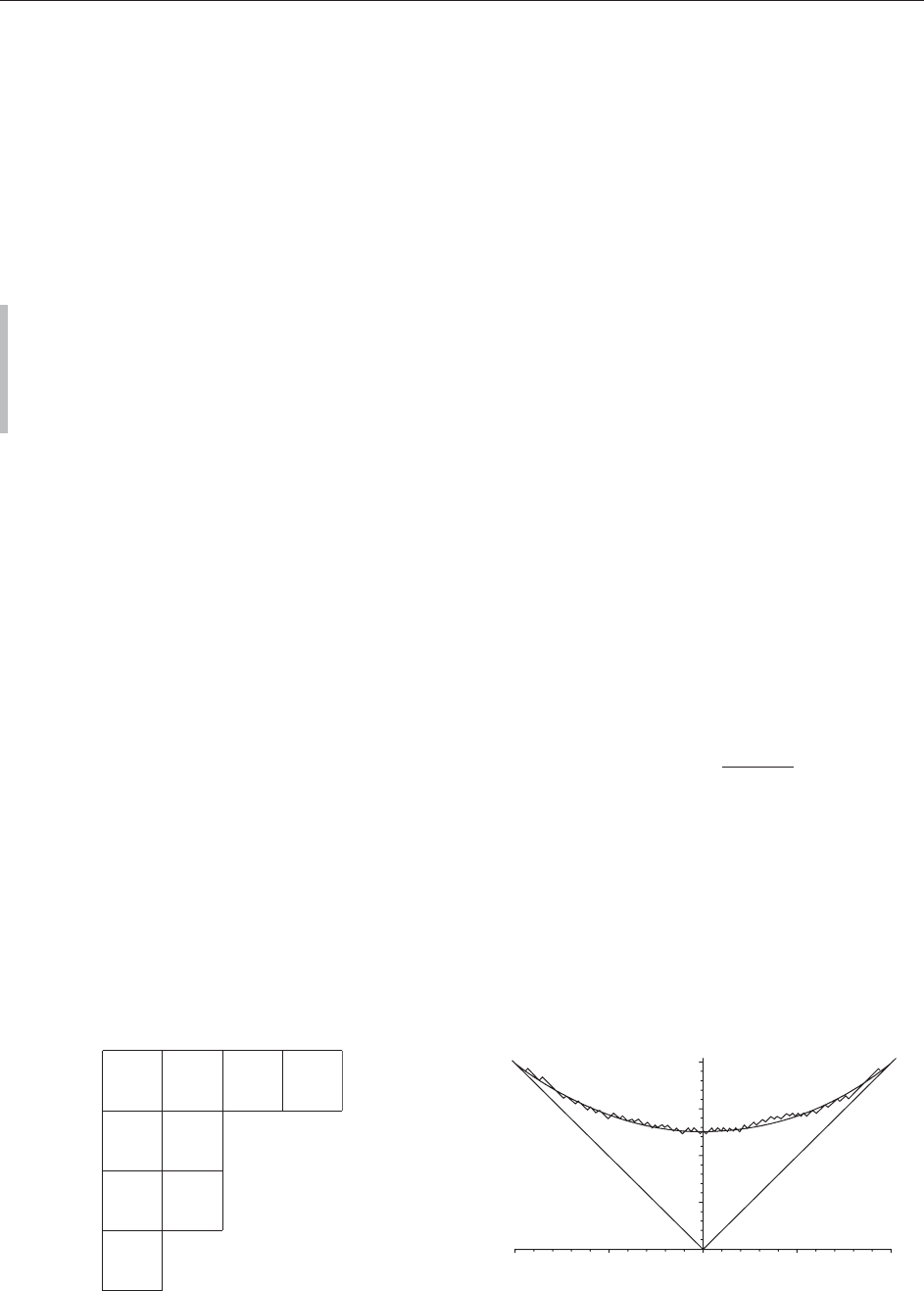
Figure 2 A Plancherel-random partition of 1000 and the limit
shape.
Random Partitions 347

Partitions of n being just a finite set, one is often
interested in letting n !1. Even if the original
problem was not of a probabilistic origin, one can
still often benefit from adopting a probabilistic
viewpoint because of the intuition and techniques
that it brings. This is best illustrated by concrete
examples, which is what we now turn to. These
examples are not meant to be a panorama of
random partitions. This is an old and still rapidly
growing field and a simple list of all major
contributions will take more space than is allowed.
The books Kerov (2003), Pitman (n.d.) Sagan
(2001),andStanley (1999) offer much more
information on the topics discussed below.
Plancherel Measure
Dimension of a Diagram
There are sever al formulas and interpretations
for the number dim in [1];seeSagan (2001) and
Stanley (1999). The one that often appears in the
context of growth processes is the following:
dim is the n umber of ways to grow the diagram
from the empty diagram ; by adding a square
at a time. That is, dim is number of chains of
the form
;¼
ð0Þ
ð1Þ
ðn1Þ
ðnÞ
¼
where j
(k)
j= k and means inclusion of
diagrams.
From the classical formula
dim ¼
jj!
Q
ð
i
þ k iÞ!
Y
ijk
ð
i
j
þ j iÞ½2
where k is any number such that
kþ1
= 0, one sees
that the Planche rel measure is a discrete analog of
the eigenvalue density
e
ð1/2Þ
P
x
2
i
Y
i<j
ðx
i
x
j
Þ
2
of a GUE random matrix (Mehta 1991). Indeed,
the first f actor in [2], which looks like a multi-
nomial coefficient, is the analog of the Gaussian
weight. Kerov (2003) and Johansson were a mong
the first to recognize the analogy between Plan-
cherel measure and GUE. One comes across many
partition sums that are discrete analogs o f r andom
matrix integrals.
The most compact formula for dim is the hook
formula
dim
jj!
¼
Y
&2
hð&Þ
1
½3
Here the product is over all squares & in the
diagram of and
hð&Þ¼1 þ að&Þþlð&Þ
where a(&) and l( & ) is the number of squares to the
right of the square & and below it, respe ctively.
(These are known as arm-length and leg-length.)
Limit Shape and Edge Scaling
When the diagram of is very large, the logarithm
of the hook product approximates a double
integral. The analysis of the corresponding integral
plays the central role, (see Kerov (2003), chapter 3)
in the proof of the following law of large numbers
for the Plancherel measure.
Take the diagram of , flip and rotate it as in Figure 1
and rescale by a factor of
ffiffiffi
n
p
so that it has unit area. In
this way one obtains a measure on continuous and, in
fact, Lipschitz functions. By a result of Logan and Shepp
and, independently, Vershik and Kerov these measures
converge as n !1 to the -measure on a single
function (x). This limit shape for the Plancherel
measure, is also plotted in Figure 2. Explicitly,
ðxÞ¼
2
x arcsinðx=2Þþ
ffiffiffiffiffiffiffiffiffiffiffiffiffiffi
4 x
2
p
; jxj2
jxj; jxj > 2
8
<
:
This is an analog of Wigne r’s semicircle law (Mehta
1991) for spectra of random matrices. The Gaussian
correction to the limit shape was also found by
Kerov (2003).
The limit shape result can be refined to show
that
1
=
ffiffiffi
n
p
! 2 in probability. Together with
Schensted’s theorem, this answers the question
posed by Ulam about the l ongest increasing
subsequence in a random permutation. Further
progress came in the work of Baik, Deift, and
Johansson (see Deift (2000)), who conjectured
(and proved for i = 1 and 2) that as n !1 the
joint distribution
i
2
ffiffiffi
n
p
n
1=6
; i ¼ 1; 2; ...
becomes exactly the same as the distribution of
largest eigenvalues of a GUE random matrix. In
particular, the longest increasing subsequence,
suitably scaled, i s distributed exactly like the
largest eigenvalue. The distribution of the l atter is
known as the Tracy–Widom distribution; it is
given in terms of a particular solution of the
Painleve´ II equation. For more information about
the proof of the full conjecture, see Aldous and
Diaconis (1999), Deift (2000),andOkounkov
(2002).
348 Random Partitions

Correlation Functions
One way to prove the full BDJ conjecture is to use the
following exact formula first obtained in a more general
setting by Borodin and Olshanski (see Olshanski (2003),
and Okounkov (2002) for further generalizations).
Look at the downsteps of the zig-zag curve in Figure 2.
The x-coordinates of their midpoints are the numbers
SðÞ¼
i
i þ
1
2
Z þ
1
2
½4
The map 7!S() makes a random partition a random
subset of Z þ
1
2
, that is, a random point field on a lattice.
These random points should be treated like eigenvalues
of a random matrix. In particular, it is natural to consider
their correlations, that is, the probability that X S()
for some fixed X Z þ
1
2
.
Many formulas work better if we replace the
Plancherel measures M
Planch, n
on partitions of a
fixed number n by their Poisson average,
M
¼ e
X
n0
n
n!
M
Planch;n
Here >0 is a parameter. It equals the expected
size of . For any finite set X, we have
Prob
X SðÞðÞ¼det K
Bessel
ðx
i
; x
j
; Þ
x
i
;x
j
2X
½5
where K
Bessel
is the discrete Bessel kernel given by
K
Bessel
ðx;y;Þ
¼
ffiffiffi
p
J
x1=2
ð2
ffiffiffi
p
ÞJ
yþ1=2
ð2
ffiffiffi
p
ÞJ
xþ1=2
ð2
ffiffiffi
p
ÞJ
y1=2
ð2
ffiffiffi
p
Þ
x y
Note that only Bessel function of integral order
enter this formula.
For large argument , J
n
(2
ffiffiffi
p
) has sine asymptotics
if n 2
ffiffiffi
p
and Airy function asymptotics if n
2
ffiffiffi
p
. Consequently, one gets the random matrix
behavior near the edge of the limit shape and
discrete sine kernel asymptotics of correlations in
the bulk of the limit shape.
Permutation Enumeration
A basic combinatorial problem is to count per-
mutations
1
, ...,
p
2 S(n) of given cycle types
(1)
, ...,
(p)
such that
1
p
¼ 1 ½6
A geometric interpretation of this problem is to count
covers of the sphere S
2
= CP
1
branched over p given
points with monodromy
(1)
, ...,
(p)
. Elementary
character theory of S(n)gives(Jones 1998)
#f
i
2 C
ðiÞ
;
Y
i
¼ 1g¼
D
Y
f
ðiÞ
E
Planch
½7
where C
is the conjugacy class with cycle type
and
f
ðÞ¼jC
j
dim
is the central charac ter of the irreducible representa-
tion . Here
is the character of any 2 C
in the
representation .
Let be of the form (
,1,1,...) with
fixed.
By a result of Kerov and Olshanski,
n
j
j
1
f
(), is a
polynomial in of degree j
j. See [11] for the
simplest example
= (2), that is, for the central
character of a transposition. We thus recognize in
[7] a discrete analog of the GUE expectation of a
polynomial in traces of a random matrix. This
analogy becomes even clearer in the Gromov–Witten
theory of CP
1
, which can be viewed as taking into
account contributions of certain degenerate covers,
see Okounkov (2002).
There is a generalization, due to Burnside, of [7]
to counting branched covers of surfaces of any
genus g; see Jones (1998). The only modification
required is that a representation is now counted
with the weight ( dim )
22g
. For example, covers of
the torus correspond to a uniform measure on
partitions. In particular, the probability that two
random perm utation from S( n) commute is p(n)/n!,
where p(n) is the number of partitions of n.
Generalizations of Plancherel Measure
Schur Functions and Cauchy Identity
Schur functions s
(x
1
, ..., x
n
), where is a parti-
tion with at most n parts, form a distinguished
linear basis of the algebra of symmetric polyno-
mials in x
1
, ..., x
n
. Various definitio ns and many
remarkable properties of these function are dis-
cussed in, for example, Sagan (2001) and Sta nley
(1999). One of them is that s
(x)isthetraceofa
matrix with eigenvalues {x
i
}inanirreducible
GL(n) module with highest weight . The follow-
ing stability of s
,
s
ðx
1
; ...; x
n
; 0Þ¼s
ðx
1
; ...; x
n
Þ;‘ðÞn
allows one to define Schur functions in infinitely
many variables. The formulas
p
¼
X
s
; s
¼
X
zðÞ
p
where
zðÞ¼
jj!
jC
j
¼jAutðÞj
Y
i
Random Partitions 349

establish the transition between the basis of Schur
function and the basis of power sum functions
p
¼
Y
p
i
; p
k
¼
X
i
x
k
i
In particular, the dimension function dim is the
following specialization of the Schur function:
dim
jj!
¼ s
p
1
¼1; p
2
¼p
3
¼¼0
We will discuss other important specializations of
Schur functions later.
A typical situation in which a random matrix
integral can be reduced to a sum over partition is
when one uses the Cauchy identity
1
Q
ð1 x
i
y
i
Þ
¼ exp
X
p
k
ðxÞp
k
ðyÞ
k
¼
X
s
ðxÞs
ðyÞ½8
to expand the integrand in Schur function and
integrate term by term using, for example, the
orthogonality of characters or the identity
Z
UðnÞ
s
ðAgBg
1
Þdg ¼
1
dim
n
s
ðAÞs
ðBÞ½9
Here s
(A) denotes the Schur function in eigenvalues
of a matrix A,dg is the normalized Haar measure on
the unitary group U(n), and
dim
n
¼ s
ð1; ...; 1
|fflfflfflffl{zfflfflfflffl}
n times
Þ
is the dimension of irredu cible GL(n) module V
with highest weight . The meaning of [9] is that
normalized characters are algebra homomorphisms
from the cente r of the group algebra of U(n)to
numbers. This method of converting a random
matrix problem to a random partition problem is
known as character expansion (see, e.g., Kazakov
(2001)).
Inspired by the Cauchy identity, one can general-
ize Plancherel measure to
M
Schur
¼
Y
ð1 x
i
y
i
Þs
ðxÞs
ðyÞ
where x and y, or, equivalently, p
k
(x) and p
k
(y), are
viewed as parameters. This is known as the Schur
measure. If p
1
(x) = p
2
(y) =
ffiffiffi
p
and all other p
k
’s
vanish, we get M
Schur
= M
. Many properties of the
Plancherel measure can be generalized to Schur
measure, in particular, exact formulas for correla-
tion functions, description of the limit shape, etc.
(Okounkov 2002).
Dimension Functions
We already met the function dim
n
. There is a
useful formula
dim
n
¼
Y
&2
n þ cð&Þ
hð&Þ
½10
where c((i, j)) = j i is the content of the square
&
in
ith row and jth column. From [10] it is clear that dim
n
makes sense for arbitrary complex values of n. The
corresponding specializations of the Schur measure
x ¼
ffiffiffi
p
; ...;
ffiffiffi
p
|fflfflfflfflfflfflfflffl{zfflfflfflfflfflfflfflffl}
z times
; y ¼
ffiffiffi
p
; ...;
ffiffiffi
p
|fflfflfflfflfflfflfflffl{zfflfflfflfflfflfflfflffl}
z
0
times
where , z, z
0
are parameters, are related to
the so-called Z-measures and their theory is much-
developed ( Olshanski 2003). As z, z
0
,
1
!1 in
such a way that zz
0
!
0
, we get M
0
in the limit.
The enumerative problems discussed in the section
‘‘Permutation enumeration’’ have analogs for the
unitary groups U(n) and, suitably interpreted, the
answers are the same with the dimension dim
n
replacing dim . For example, instead of counting the
solutions to [6], one may be interested in the volume
of the set of p-tuples of unitary matrices with given
eigenvalues that multiply to 1. Geometrically, such
data arise as the monodromy of a flat unitary
connection over S
2
n{p points}, which is a U(n)analog
of a branched cover. The analog of Burnside’s
formula is Witten’s formula for the volumes of
moduli spaces of flat connections on a genus g
surface with given holonomy around p punctures,
(see, e.g., Witten (1991) and Woodward (2004)). It
involves summing normalized characters over all
representations V
, not necessarily polynomial, with
the weight (dim V
)
22g
. If additionally weighted by
a Gaussian of the form exp(A(f
2
() þ (n=2)jj)),
where
f
2
ðÞ¼
1
2
X
i
i
i þ
1
2
2
i þ
1
2
2
hi
¼
X
&2
cð&Þ½11
this becomes Migdal’s formula for the partition
function of the 2D Yang–Mills theory , the positive
constant A being the area of the surfa ce (see, e.g.,
Witten (1991) and Woodward (2004 )).
A further generalization naturally arising in the
theory of quantum groups is the quantum dimension
dim
n;q
¼ s
ðq
1n
; q
3n
; ...; q
n3
; q
n1
Þ
¼
Y
&2
q
nþcð&Þ
q
ncð&Þ
q
hð&Þ
q
hð&Þ
350 Random Partitions

where q is a parameter (it is more common to use
dim
n, q
1=2
instead). Obviously, dim
n, q
! dim
n
as q ! 1.
The function dim
n, q
is an important building block of,
for example, quantum invariants of knots and 3-folds,
and various related objects (see, e.g., Bakalov and
Kirillov (2001)). The Verlinde formula (Bakalov and
Kirillov 2001) can be viewed as an analog of Burnside’s
formula with weight dim
n, q
.Whenq is a root of unity
the summation over is naturally truncated to a
finite sum.
The next level of generalization is obtained by
deforming Schur function to Jack and, more generally,
Macdonald symmetric functions (Macdonald 1995).
In particular, the Jack polynomial analog of the
Plancherel measure is
M
Jack
ðÞ
¼
Y
&2
n!ðt
1
t
2
Þ
n
ððað&Þþ1Þt
1
þ lð&Þt
2
Þðað&Þt
1
þðlð&Þþ1Þt
2
Þ
where t
1
, t
2
are parameters, and a(
&
)andl(
&
)
denote, as above, the arm- and leg-length of a
square
&
. This measure depends only on the ratio
t
2
=t
1
which is the usual parameter of Jack poly-
nomials. To continue the analogy with random
matrices, this should be viewed as a general
analog of the Plancherel measure.
The measure M
Jack
naturally arises in Atiyah–
Bott localization computations on the Hilbert
scheme of n points in C
2
. By definition, this
Hilbert scheme parametrizes ideals I C[x, y]of
codimension n as linear spaces. The torus (C
)
2
acts on it by rescaling x and y and the fixed points
of this action are
I
¼ Span of x
j1
y
i1
ði;jÞ=2
where is a partition of n. The weight of this fixed
point in the Atiyah–Bott formula is proportional to
M
Jack
(), the parameters t
1
and t
2
being the
standard torus weights. Corresponding formulas in
K-theory involve a Macdonald polynomial analog of
dim .
Nekrasov defines the partition functions of N = 2
supersymmetric gauge theories by formally applying
the Atiyah–Bott localization formula to (noncom-
pact) instanton moduli spaces. The resulting ex pres-
sion is a sum over partitions with a weight which is
a generalization of M
Jack
. In this way, random
partitions enter gauge theory. What is more,
statistical properties of these random partitions are
reflected in the dynamics of gauge theories. For
example, the limit shape turns out to be precisely the
Seiberg–Witten curve (see Nekrasov and Okounkov
(2003), Okounkov (2002), and also Nakajima and
Yoshioka (2003)).
Harmonic Functions on Young Graph
Definitions
Partitions form a natural directed graph Y, known
as Young graph , in which there is an edge from to
if is obtained from by ad ding a square. We
will denote this by % . Let be a non-negative
function (called multiplicity) on edges of Y.A
function on the vertices of Y is harmonic if it
satisfies
ðÞ¼
X
-
ð; ÞðÞ½12
for any . For given edge multiplicities , non-
negative harmonic functions normalized by (;) = 1
form a convex compact (with respect to pointwise
convergence) set, which we will denote by H(). The
extreme points of H() are the indecomposable or
ergodic harmoni c functions. They are the most
important ones. One defines
dim
= ¼
X
¼
0
%
1
%%
jjjj
¼
Y
ð
i
;
iþ1
Þ
and dim
= dim
=;. For example, if 1 then
dim
= dim . Any function 2 H() defines a
probability measure on partitions of fixed size
n, n = 0, 1, 2, ...,by
M
;n
ðÞ¼ðÞdim
; jj¼n ½13
The mean value property [12] implies a certain
coherence of these measures for different values of
n, which, in general, does not hold for measures like
M
Schur
. Two multiplicity functions and
0
are
gauge equivalent if
0
ð; Þ¼f ðÞð; Þf ðÞ
1
for some function f.Inthiscase,H()andH(
0
)are
naturally isomorphic and the measures M
are the same.
First Example: Thoma Theorem
Let F be a central function on the infinite symmetric
group S(1) =
S
n
S(n), normalized by F(1) = 1.
Restricted to S(n), F is a linear combination of
irreducible characters
Fj
SðnÞ
¼
X
jj¼n
ðÞ
The branching rule
j
S(n1)
=
P
%
implies that
the Fourier coefficients are harmonic with respect
to 1. They are non-negative if and only if F is a
positive-definite function on S(1), which means that
the matrix (F(g
i
g
1
j
)) is non-negative definite for any
{g
i
} S(1). The description of all indecomposable
positive-definite central functions on S(1) was first
Random Partitions 351